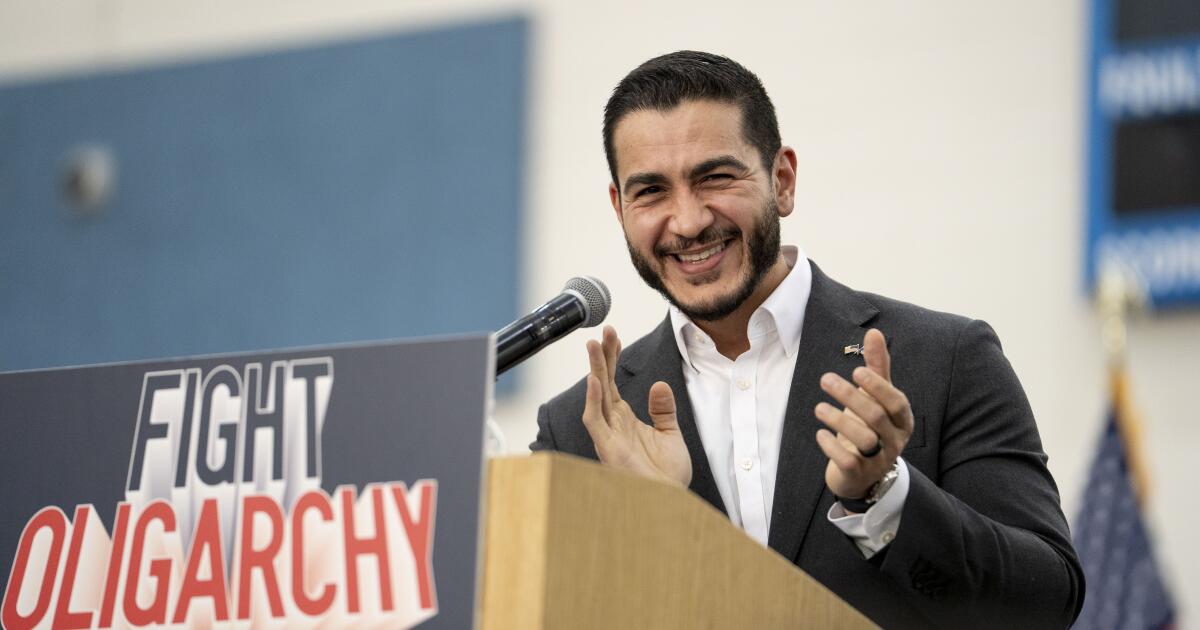
Abdul El-Sayed is the latest Muslim candidate to labeled an anti-American extremist.
Muslims are embroiled in yet another war, but this one isn’t in the Middle East, Southeast Asia or another predominantly Islamic region.
The battleground is Michigan. New York. Minnesota. Or anywhere else in the U.S. where a politician with a name like Abdul El-Sayed, Zohran Mamdani or Ilhan Omar have run for office — and won.
Today’s primary target is Michigan Democratic U.S. Senate candidate El-Sayed. Since his victory in August, the right’s main strategy to beat him this fall is a familiar one: paint El-Sayed, the Muslim son of Egyptian immigrants, as an anti-American extremist.
Vice President JD Vance recently told a crowd that “there’s something about Abdul El-Sayed that is very, very evil,” suggesting that Democratic nominee represents a divisive ideology. Representative Nancy Mace warned of a larger problem when she said that “every single Muslim holding public office in America” is “a threat to both national security and our republic.” Senator Tommy Tuberville flat-out called El-Sayed a “terrorist.”
“The message is that these candidates are a civilizational threat that is going to destroy American society and Western civilization from within,” says Salam Al-Marayati, president and co-founder of the non-profit Muslim Public Affairs Council. “You saw that a lot when Mamdani was elected.”
And given that he was elected, the Islamophobia playbook may need an overhaul.
New York City Mayor Mamdani and El-Sayed are among the more than 255 Muslim elected officials serving across 26 states and at nearly every level of government, according to the Council on American-Islamic Relations. That number includes a historical high of four Muslim Americans in Congress.
But as their political power has grown, so too has the bigoted rhetoric about the dangers of electing a Muslim to office. But now, there’s pushback.
CBS News, now under the leadership of conservative editor-in-Chief Bari Weiss, caught flack this week for publishing a story with the headline: “Michigan Democrat Abdul El-Sayed’s deleted tweets on Sept. 11 attacks invite scrutiny of past remarks.”
Criticisms of the piece were immediate, including commentary in The Atlantic that called the story a political dog whistle for using a tenuous connection to align El-Sayed’s name with the phrase “9/11 attacks.”
The pandemic-era posts from El-Sayed did not celebrate the tragedy or the terrorists who perpetrated the attacks. He instead compared the nearly 3,000 people killed in the September 11 attacks to the growing COVID-19 death toll in the U.S., and called for a strong response against the virus as there was to the 9/11 attacks. In the second tweet, El-Sayed wrote that more Americans had died from COVID than in the 9/11 attacks, so he hoped “that means we’ll spend the next ten years fighting a war for public health & against poverty … like we launched a global #WaronTerror after 9/11. We could save lives rather than take them.”
Hardly the smoking gun that puts him in an Afghan cave, scheming with bin Laden.
The tweets were deleted along with all of Al-Sayed’s other posts dated before July 2023. His campaign said he did so to prevent “old posts from being taken out of context.” Oh the irony.
Similar tactics were used against Mamdani in his run for mayor. After a particularly rousing speech leading up to his 2025 win, the New York Times noted that “…Republican elected officials and right-wing media figures [are] accusing him of promoting Islamic law, supporting terrorism and posing a threat to the safety of New Yorkers, especially Jews.”
Before Mamdani, Somali-American Rep. Ilhan Omar (D-MN) was the subject of “Send her back” chants at Trump rallies. Rep. Lauren Boebert (R-CO) publicly referred to Omar as a member of the “Jihad Squad.”
Nevertheless, Omar became the first African refugee to become a Member of Congress when she assumed office in January of 2019.
“What we have found out from previous elections is that candidates like Abdul Sayed are speaking to the masses,” says Al-Marayati. “They’re not speaking to the Democratic and Republican establishment who believe in this hierarchical structure where you only have a few in control, whether it’s corporate influence or lobbies or a certain race and religion that that are on top and the rest of us are merely visitors who should just be thankful for getting the crumbs from the economy. [El-Sayed and Mamdani] are returning to the vision of a pluralistic democracy.”
The latest efforts to derail El-Sayed’s campaign include weaponizing his association with leftist Twitch streamer Hasan Piker. Piker, who earlier this year appeared on the campaign trail with El-Sayed, is a major influence among progressives and a bogeyman to establishment Republicans and Democrats alike. The right can’t stop talking about his sharp criticisms of MAGA leadership, disdain for US foreign policy, and his pro-Palestinian stance. The left is terrified of being associated with Piker.
Now the candidate is pressed daily to answer for things said by Piker’ stretching as far back as 2019, when the influencer commented that “America deserved 9/11” (a quote that was incorrectly attributed to El-Sayed). El-Sayed has denounced the statement as “stupid,” and Piker has walked back his words.
But the unyielding scrutiny over dubious associations doesn’t cut both ways. Relative to El-Sayed, there’s been little inquiry of Michigan’s Republican U.S. Senate candidate, Mike Rogers, and his close ties with Pastor Lorenzo Sewell. A member of Roger’s faith advisory team, Sewell in August co-organized and led a “Christian Crusader March” and anti-Islam protest in Dearborn, MI alongside far-right activist and January 6 pardoned defendant Jake Lang.
Campaigns that leverage hate and fear against Muslim candidates and elected officials are nothing new, but they appear to be less effective with each passing election season. It’s possible more and more voters see through the prejudiced subterfuge, but it’s more likely that folks simply need a change.
“The real threat that Abdul Sayed represents is that he is knocking down that hierarchical structure, and that’s why you have the attacks on him of being a radical, being a terror sympathizer, being a threat to civilization,” says Al-Marayati. “When Thomas Jefferson was drafting the Charter on Religious Freedom, he included Muslims, and even he was accused of being a Muslim. So you’ve had this problem for a long time. Abdul Sayed’s affiliation with Thomas Jefferson is a badge of honor.”