abandoned

Abandoned UK village that was ‘lost underwater’ still reappears once in a while

Derwent was once a small village in the heart of the Peak District in Derbyshire, but between 1935 and 1943 it was flooded to create a reservoir

An abandoned village, purposefully submerged over 80 years ago and now ‘lost underwater’, mysteriously resurfaces from time to time, revealing its captivating past.

Derwent was once a bustling village located in the heart of Derbyshire’s Peak District. It boasted quaint limestone cottages lining scenic streets, offering breathtaking views across the undulating countryside that its inhabitants called home.

Despite its modest size, the village had all the necessary amenities, meaning its residents rarely needed to venture far. With its school, church, post office and grand manor house, complete with immaculately kept gardens and a substantial fishpond, the village was well-provisioned.

Sheep grazed on nearby hills and a small bridge spanned a river. Home to around 50 residents, this tranquil village took an unexpected turn between 1935 and 1943 when plans were approved to flood both Derwent and the neighbouring settlement of Ashopton.

READ MORE: Wizz Air just made a big change to its seats and it’ll change how passengers book

Predictably, these plans were met with resistance from locals who faced the daunting prospect of being uprooted from their homes. Despite the objections, residents relocated to the nearby Yorkshire Bridge estate, and by 1943, just two years before World War II ended, Derwent was transformed into a vast dam, reports Yorkshire Live.

This was done to supply water to the growing cities in the English Midlands.

This tragically meant that, as time passed, the village gradually vanished beneath the water as the valley filled with rainfall, mountain runoff, and rivers. Derwent ceased to exist, and became known as Ladybower Reservoir, with blue waters engulfing what was once a thriving community.

READ MORE: ‘World’s smallest town’ was once a bustling hub but now has just one resident

Fortunately, the reservoir serves an important purpose, with the capacity to hold an impressive 27,869 mega litres of water, providing supply to the neighbouring cities of Derby, Sheffield, and Nottingham. It has emerged as a beloved destination for ramblers and wildlife lovers who admire the vast lake, nestled within the undulating hills of the Peak District.

Yet in 2018, following an ‘exceptionally dry and hot summer’, which dramatically lowered the reservoir’s water levels, the former Derwent resurfaced. As the reservoir dried up, the remnants of the Derwent church emerged, alongside doorways of cottages and walls.

Those who have wandered amongst the ruins have discovered a stone fireplace, paths near the church that once guided children to school, cottage walls, and debris from a small bridge. Former Derwent residents are believed to have visited the reservoir and reported hearing the church bell ringing, despite the bell being removed before the village was flooded.

READ MORE: Eurocamp is opening 13 new parks in 2026 – see the full list of locations

In 2019, the BBC interviewed Mabel Bamford, a 92 year old former Derwent resident, who revealed: “I may be the last person who remembers Ashopton and Derwent.”

Recounting her memories of the village to the BBC, she said: “I was going to school there, even as the construction of Ladybower was underway. We had to walk one and a half miles to Derwent. Sometimes the shooters and beaters in grouse season gave us a lift. But the rides we liked best were offered by the pipeline workers. They’d lift us inside the big black pipes they were constructing at the site of the reservoir.”

In 2022, the village made another appearance due to similar weather conditions that led to a drop in the reservoir’s water levels. The sight attracted hordes of visitors keen to see the remnants of a railway line and a church that briefly resurfaced.

The village made yet another comeback in 2025, thanks to low water levels revealing the ruins of the village church. It was reported that in September of the previous year, visitors could glimpse parts of the remains from Derwent Hall, before they were subsequently submerged following heavy rainfall in the area. However, it is believed that the village may continue to re-emerge in the future, offering glimpses into its past.

Source link

Abandoned medieval village lay forgotten for centuries now loved by walkers

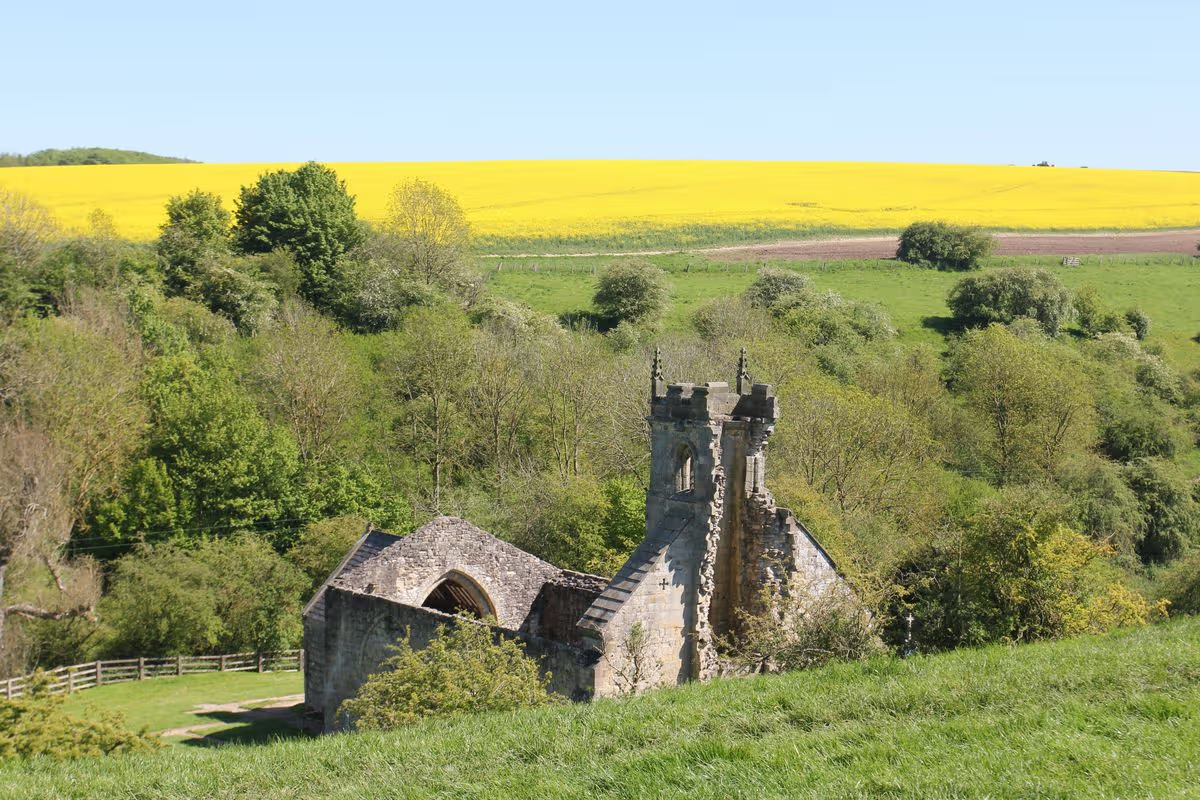
One of Britain’s biggest and most famous deserted medieval villages, Wharram Percy in North Yorkshire has remnants of century-old houses, a church and ancient ruins for visitors to explore

Travellers journey from all corners to glimpse the UK’s ‘best preserved’ medieval village, Wharram Percy in North Yorkshire, which lay deserted for centuries and now serves as a fascinating site for walkers and history enthusiasts.

Nestled in North Yorkshire, Wharram Percy is one of the largest abandoned medieval villages in Britain and undoubtedly the most renowned. Visitors are invited to stroll through the historic grounds, taking in the remnants of age-old houses, a church, and manorial ruins.

Ideally located halfway between popular attractions Scarborough Castle and Clifford’s Tower in York, it makes for an excellent stopover on your trip between these two sites. While entry to the village is free, there is a nominal £2 charge for parking.

Over an impressive 60-year period, archaeologists have gradually unearthed more details about Wharram Percy’s history. Their findings have shed light on why the area was initially abandoned and what life was like here in bygone times.

Perched on the edge of a Yorkshire valley, this unique village once housed inhabitants for up to six centuries but was deserted after the 1500s. It’s believed that even today, outlines of old houses can be discerned in the ground, alongside the more substantial remains that attract curious visitors.

The history takes some understanding, but experts believe the earliest settlement dates back to approximately 50 BC. This land was subsequently transformed into farmland but lay deserted during the 5th century, before eventually becoming a Middle Saxon settlement.

It’s important to note that reaching the village requires roughly a 3/4 mile walk from the car park to the main site, which is frequently both steep and muddy. The site features rough terrain throughout, which can be challenging for some visitors and is generally unsuitable for wheelchairs or buggies.

A TripAdvisor reviewer highlighted this, writing: “Parking on the Heritage car park off the B1248 prepare for a trek to the village.” They went on to describe it as a “sharp gravelled decline” and a “daunting” journey unsuitable for those with limited mobility, as the route passes through fields.

Following their visit, one enthusiast praised their experience, saying: “Lovely walk from the car park to the site, but people with mobility issues may struggle. It’s a fascinating historical site that has been really well managed. Only a few visitors when we visited, which added to the peace and tranquillity of the place. Loved it!”.

Another guest added: “This lovely deserted mediaeval village is truly fascinating! The history is incredible, and it was wonderful to wander around and explore. We really lucked out and had beautiful weather, so we got to sit on the grass by the pond and soak it all in.”
Source link

Abandoned UK ghost village that’s cut off for 310 days a year finally opens to public

A TOWN frozen in time since World War II will open to the public for a limited time.

The abandoned ghost village stays cut off from the world for most of the year, with visits only permitted this week.

The abandoned village of Imber in Wiltshire is open to the public for a limited time this weekCredit: Alamy
The Ministry of Defence took over the town during World War II, converting it to a military training areaCredit: Alamy

History buffs and nature lovers alike swarm to the area, where 150 people once lived until 1943.

Since then, the abandoned village of Imber in Wiltshire, only sees visitors for 12 days out of the year.

During the second World War, residents of the area were given 47 days to evacuate their homes so the village could be turned into a military training area for troops.

While they were promised they would be able to return after the war, the village is still occupied by the Ministry of Defence (MoD) to this day.

Read More On Abandoned Towns

LEFT TO ROT

Inside abandoned town ‘haunted by ghosts’ where parents were made to leave kids


ICY ISOLATION

The eerie ghost town on world’s largest island, abandoned for 20 years

And now it has invited the public to visit, with roads opening through Imber this week, until 8am on Friday, January 2.

Public access has been granted to the village as well as the Grade I-listed St Giles Church, which will be open from 11am to 4pm daily.

The original surviving building is free to visit during open days with any donations going towards the Churches Conservation Trust (CCT) for maintenance and restoration.

Along with an old pub, the church is one of the few remaining original structures in the village.

Most of the larger stone buildings were damaged during military training, and were subsequently demolished.

Meanwhile, other houses in the village are either hollowed-out shells or have been converted into modern windowless buildings createdto simulate urban environments for military training.

While those who once lived in the village have the right to be buried on the church grounds, the only living residents now are an abundance of undisturbed wildlife, including owls, badgers, birds, and foxes.

Imber also holds open days during Easter weekend and a single day in summer, with all visitors required to adhere to the public rights of way and designated areas, and comply with signposting.

The public are permitted access to the town for 12 days out of the year, including this weekCredit: Alamy
Residents of the village were given 47 days to evacuate and never returnedCredit: Alamy

Source link

The five abandoned UK railway stations set to reopen with new train routes

FIVE train stations in the UK left deserted for decades have undergone major renovation projects and will soon have new routes to a major city.

The five stations include three on the Camp Hill Line and two between Wolverhampton and Walsall.

Illustration of a train map of South Birmingham, showing the Camp Hill line and existing railway lines with station names.
Five stations are reopening with routes to Birmingham and WolverhamptonCredit: West Midlands Combined Authority

All five of the stations will welcome new West Midlands Railway services in early 2026.

On the Camp Hill Line, £120million has been spent on three stations at Moseley Village, Kings Heath and Pineapple Road to reopen them.

Moseley Village, Kings Heath and Pineapple Road train stations all closed in 1941 during the Second World War and never reopened.

Ahead of services starting early next year, construction work at each of the stations has been completed.

Read more on travel inspo

LUCKY DIP

I tried Wowcher’s £99 Mystery Christmas Market – everything you need to know


TRIP TIPS

I’ve visited Disney 55 times… mistakes parents make that ruin trips & waste money

Each station will have two platforms for six-carriage trains, bike parking, ticket machines, information screens and lifts.

There will also be pick up and drop off zones at Moseley Village and Pineapple Road stations.

This also means that the stations will gain services for the first time since World War II.

The services will call at each of the stations every 30 minutes, with destinations including Birmingham New Street and Kings Norton.

It is estimated that the reopened stations will cut journey times to Birmingham New Street by between nine and 31 minutes.

As for the two stations between Wolverhampton and Walsall – Darlaston and Willenhall – there will be train services for the first time since 1965 when the stations were both closed.

To begin with, there will be two services an hour between Wolverhampton and Birmingham.

A direct service to Walsall town centre, known as the ‘leather capital of the world’ due to its leatherworking history, is also being discussed with the Department for Transport and Walsall Council.

In total, the two stations have cost £85million to reopen.

Walsall Council hopes that the stations will better connect local residents to the wider region, as well as create more opportunities for people to travel, whether that be for holidays or for work.

Richard Parker, Mayor of the West Midlands, said: “For some communities, this is the first time in more than 80 years they’ve had their own train service.

“That changes everyday life. Getting to work, college or seeing family becomes simpler and quicker.

“It also means more people coming into town centres. More footfall for shops and cafés. More confidence for local businesses to invest and grow.

“This is what delivery looks like – backing places that have waited far too long for decent connections.”

In other train news, here’s the first look at the new Virgin Trains that will take Brits from UK to France, Belgium and Netherlands.

Plus, the low-cost train launching more routes between two popular UK cities – and tickets are £33.

Train arriving at Willenhall Station.
The stations will launch services in early 2026Credit: West Midlands Combined Authority

Source link