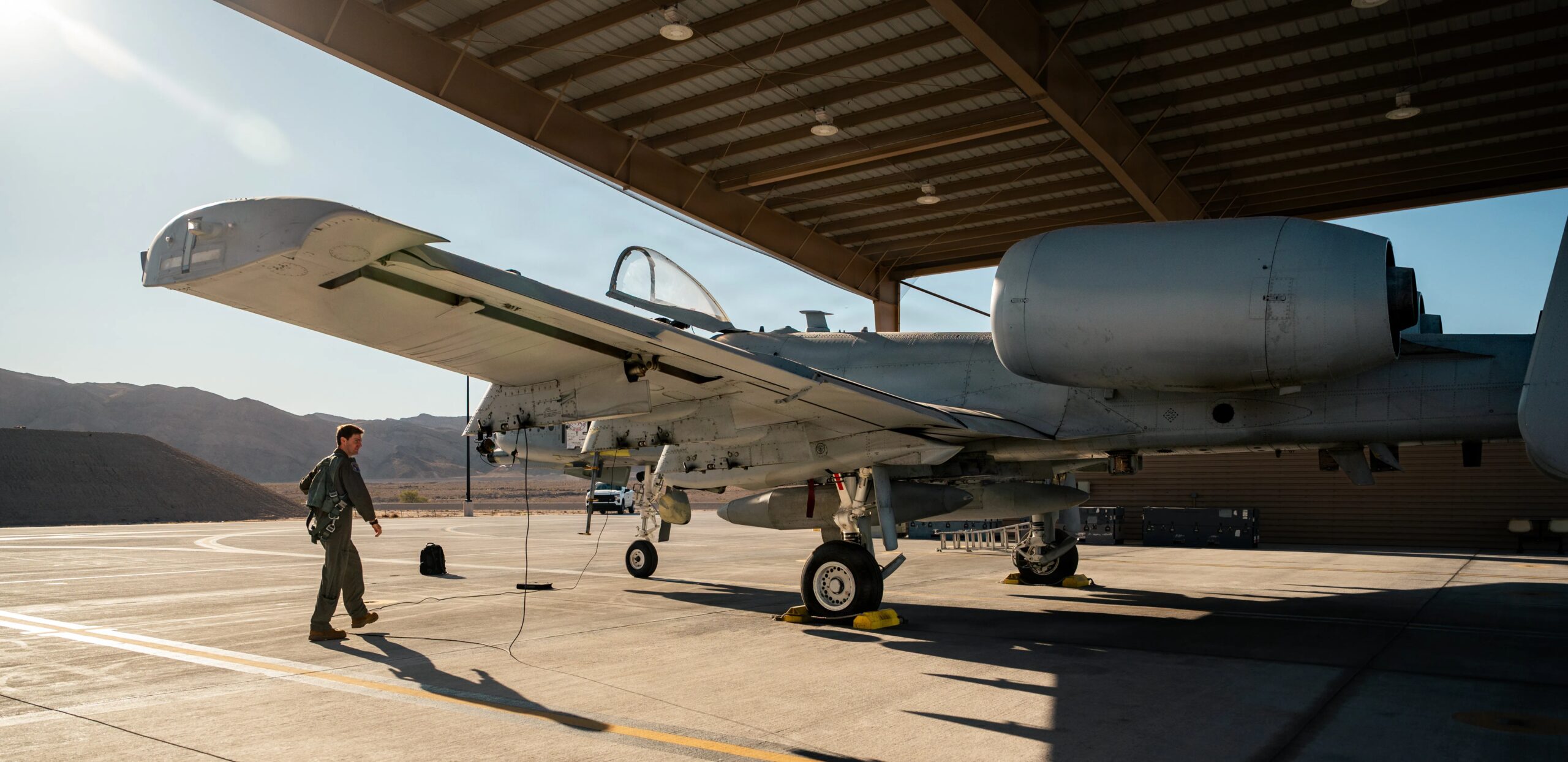
The A-10 Era Is Over At Nellis AFB
The last A-10 Thunderbolt II assigned to Nellis Air Force Base, Nevada, left the installation on September 22. The departure marks the end of nearly five decades of Warthog operations, including tactics development and testing, at the Air Force’s most high-profile fighter base. It also reflects a broader shift in which close air support expertise and some associated missions are supposedly being distributed among the F-15, F-16, and F-35 communities, although the move is controversial, to say the least.
Nearly 70 airmen assigned to Nellis gathered along the flight line to salute the aircraft as it departed. The final takeoff closes a chapter that began in 1977, when the first A-10 arrived at the base, which subsequently became a major center for developing and refining the aircraft’s operational employment.

Over the decades, Nellis-based units worked on the A-10’s software, avionics, and precision weapons capabilities, while the U.S. Air Force Weapons School’s 66th Weapons Squadron trained more than 300 A-10 weapons officers through approximately 100 classes. Many of the tactics in the A-10’s playbook emanated from the base.
The A-10’s departure consequently represents more than the retirement of another aircraft from a Nellis ramp. It also marks the end of a dedicated training and institutional ecosystem that developed around an aircraft specifically designed for close air support.
Earlier this year, Jamie Hunter of TWZ visited the U.S. Air Force A-10 Weapons Instructor Course as it was in the process of closing down, as documented in these exclusive videos:

A-10 Cockpit And Walk-Around Tour With A Warthog Weapons Instructor

The Last Days Of The A-10 Warthog Weapons School
The Air Force is now attempting to carry at least some of that expertise into a force built around multirole fourth- and fifth-generation fighters.
“We are maintaining the culture of the A-10 by involving as many other fighter communities involved in the close air support mission,” Lt. Col. Ridge Flick, commander of the 66th Weapons Squadron, said. “We are also training F-15 Eagle, F-35 Lightning II and F-16 Fighting Falcon pilots to take on some roles we have had in combat search and rescue.”

The A-10 was developed specifically for close air support, with its design emphasizing survivability at relatively low altitude, weapons employment against ground targets, and the ability to persist in the vicinity of friendly forces. In contrast, the F-16C/D and F-15E/EX were developed primarily as multirole fighters, while the F-35 combines strike, air-to-air, intelligence, surveillance and reconnaissance, and networking capabilities with a low-observable design.
Rather than replacing the A-10 with a single successor, the Air Force is therefore distributing elements of its former mission set across several aircraft and communities. The service insists its close air-support capability is not being reduced as the Warthog fleet retires, but at the very least the transition does represent a significant change in how that capability is generated and employed.

Regardless, the USAF’s claim that the impact of losing the heart of the A-10’s braintrust will not dramatically impact key mission sets in a negative manner has been viewed with extreme skepticism by some. It’s not uncommon for subject matter experts to believe the close air support and ‘Sandy’ aircrew recovery mission braintrust that the Warthog community represents is a far bigger loss than the aircraft itself, and that the USAF is not prepared to preserve this critical expertise, regardless of the service’s stated intentions.
The end of A-10 operations at Nellis also put what may be the final nail in the A-10’s coffin, as reconstituting these operations would be very challenging and costly. All this points to the Warthog being on its final glide path to retirement, once and for all.
You can read all about this controversy in our past special feature linked here.

Beyond the redistribution of Nellis’s A-10 pilots, the transition is also affecting the maintainers who supported the base’s A-10 fleet. Airmen assigned to the 757th Aircraft Maintenance Squadron’s Thunder Aircraft Maintenance Unit are being reassigned to other squadrons and airframes, including the F-35 and F-16. The Air Force is consequently moving not only personnel, but also decades of experience maintaining an aging and structurally demanding aircraft into programs supporting newer fighters.
For Staff Sgt. Eva Kehn, a weapons load crew chief with the 757th AMXS, the end of the A-10 era has an especially personal dimension because of her family’s connection to the aircraft and to aviation.

“Working on the A-10 is meaningful to me because that is something that I share with my grandfather,” Kehn said. “I’m very excited to have that new chapter and bond over that again with my grandfather.”
Kehn is transferring to an F-35 unit at Nellis, where that connection will continue in a different form. Her grandfather is now a civilian F-35 instructor, giving the two an opportunity to remain professionally connected even as the A-10 disappears from the installation.

Master Sgt. Aaron Edmonds, an aircraft section chief with the 757th AMXS, is also moving on from the Warthog after spending the past five years maintaining the aircraft. Edmonds previously worked on the F-16 earlier in his career and will now return to the Viper community.
“It’s a bittersweet moment,” Edmonds said. “I enjoyed my time with the A-10, but I’m excited because this departure marks the closing of one chapter and the start of another.”
Edmonds said the experience gained on the A-10 should be carried into the next aircraft rather than left behind with the airframe. “The advice I would give airmen who are transitioning from one airframe to another is to be open-minded, willing to learn and carry on the great work ethic from your previous aircraft over to your new one,” he said.

With the A-10 no longer present at Nellis, at least some of the expertise attached to it is being incorporated into a fighter force in which other aircraft types can contribute to the close air support mission in very different ways. An F-35, for example, can use its sensors and networking capabilities to identify and share information about targets and the battlespace, and it can go where other fighters can’t. An F-15 can contribute heavier weapons and longer endurance, among other capabilities, depending on the mission. This is not exactly new, either, as all types of aircraft provided CAS during the Global War on Terror-era, although the masters of exactly how to do it and how to execute the critical airborne forward air control (FAC-A) mission existed in the A-10 community. Still, the resulting force will be considerably different from the one centered on the Warthog, even where the underlying requirement to support troops on the ground remains.

As noted, the A-10’s retirement now looks to be gathering pace, despite repeated efforts to keep the A-10 in service and recent employment in combat operations in the Middle East. The Pentagon has granted three Warthog squadrons a reprieve to continue operating through 2030. In July, a bipartisan group of Congressmen introduced a bill that, if passed and signed into law, would require the Air Force to keep flying the jets through Fiscal Year 2033. Still, the aircraft’s eventual fate appears increasingly clear, with growing numbers heading to the 309th Aerospace Maintenance and Regeneration Group (AMARG) boneyard in Arizona for storage, including the last one from Nellis.
The ongoing retirement of the A-10 is bringing a fundamental change in how the Air Force organizes and executes the missions for which the Warthog became synonymous. Nellis will remain an important center for developing those capabilities, even though the aircraft around which that expertise was built is no longer part of the equation.
Contact the author: thomas@thewarzone.com