MQ-58 Valkyrie Drones Now Cost $6M-$8M Each
Kratos has provided an interesting update on the price of its Valkyrie drones. The uncrewed aircraft currently cost roughly $6 to $8 million, depending on their configuration and without certain mission systems installed. Though this is a more expensive price point than Kratos has said it has been aiming for in the past, it still puts Valkyrie firmly at the lower end of the cost spectrum for Collaborative Combat Aircraft (CCA) type drones based on available information, while still providing relatively high-end capabilities.
Kratos’ President and CEO Eric DeMarco shared the new cost figures, as well as other new details about the Valkyrie program, during a recent quarterly earnings call. He also spent considerable time talking about his view that affordability will be a central key factor for prospective customers for CCA-type drones going forward.

“I would not want to be anyone else than Kratos with the Valkyrie, that’s in production, that comes off the line, ‘white tail,’ six million dollars or something like that, maybe eight [million dollars], depending on configuration,” DeMarco said at one point during the call. “Missionized is more.”
Some more context is necessary before any more discussion of these cost figures. DeMarco’s remarks here were part of a lengthy response to a question about Kratos’ view of potential U.S. opportunities for sales of CCA-type drones in the next year.
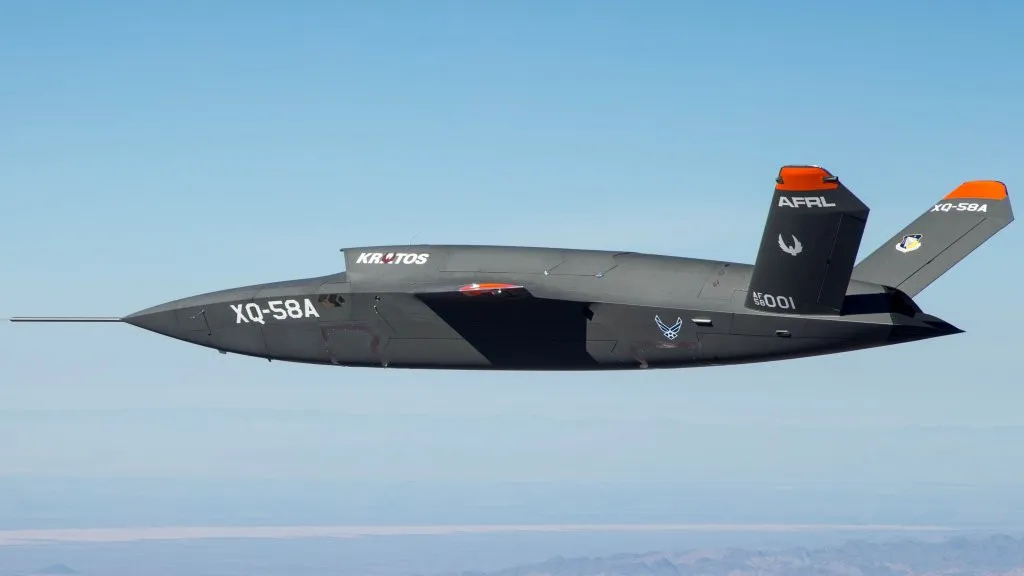
The U.S. Air Force has been operating a small number of XQ-58As since the type first flew in 2019, in support of research and development and test and evaluation activities. The Marine Corps also experimented with the XQ-58A and is now in the process of acquiring a fully missionized version of the Valkyrie for operational use through that service’s CCA program. Those drones are sometimes referred to as the MQ-58Bs. Northrop Grumman is technically the prime contractor for the Marine effort, which falls under the umbrella of the larger Marine Air-Ground Task Force Uncrewed Expeditionary Tactical Aircraft (MUX TACAIR) program.

XQ-58 Valkyrie first flight with the USMC
Kratos has also secured at least two other contracts for Valkyries from other still-unidentified customers. At least one of them is outside of the United States and took delivery of drones back in the third quarter of 2025. The company is known to be pursuing a bid to supply a version of the Valkyrie called the U740 to the German Air Force, or Luftwaffe, through a partnership with Airbus. The U740 made its first flight at an unnamed test facility in northern Europe last month.
At the time of writing, Valkyrie drones fall into two main categories, at least that we know of. These are rocket-assisted takeoff (RATO) versions, which lack landing gear, and landing gear-equipped conventional takeoff and landing (CTOL) types that operate from traditional runways. The U.S. Air Force’s XQ-58As, as well as the European U740, are RATO types. The MQ-58Bs the Marines are acquiring are CTOL versions.

Kratos has also developed a special launch trolley so RATO drones can take off from a runway. No matter how they get into the air, drones in the RATO configuration land via parachute at the end of a sortie. CTOL drones can also be launched via the RATO method, but then land on a traditional runway.

Kratos Valkyrie Trolley Launch System

In March 2024, before the CTOL version was officially disclosed, Kratos told TWZ that there were at least five distinct subvariants of the Valkyrie. The company has been steadily working to expand the performance envelope of the core design since its first flight in 2019, too.
Going back to the matter of the Valkyrie’s unit price, DeMarco had put the figure at around $6.5 million back in 2023. The following year, he told TWZ directly that the price range for RATO versions, specifically, was between $4 and $6 million. At that time, he said the $4 million figure reflected economies of scale benefits from a production run of 100 drones. Kratos had said years ago now that it was hoping to eventually be able to drive down the price point to $2 million apiece as production ramped up. As of August, the company’s stated goal was to get to an annual production rate of 40 airframes by 2028.

As noted earlier, even at $8 million, Valkyrie’s unit cost is deeply at the lower end of the known spectrum for CCA-type designs.
General Atomics and Anduril are both on contract now to build batches of their respective FQ-42A Vengeance and FQ-44A Fury drone designs under the first phase of the U.S. Air Force’s CCA program, or Increment 1. The service has said that it is aiming to have at least 500 of those uncrewed aircraft in inventory by 2032. The Air Force also expects to acquire additional CCAs, which could be of entirely different designs, through a follow-on Increment 2. Kratos could potentially submit a bid for that competition.
The Air Force has said that it is targeting a $20 million average unit cost for Increment 1 CCAs once full-scale production is achieved, but what the actual price point will be remains to be seen. There has been talk previously of the price range of the designs we are seeing now being between $20 and $30 million. Anduril has said that each Fury will be cheaper than that, but has yet to provide a hard figure. At the time of writing, it is unclear whether General Atomics has yet shared any hard cost data of its own.

Boeing’s MQ-28 Ghost Bat, another CCA-type design originally developed for the Royal Australian Air Force and in limited production now, offers another point of comparison. In 2024, authorities in Australia said Boeing was aiming for the Ghost Bat’s unit cost to be “10 per cent of the cost of a crewed aircraft such as a[n F-35] Joint Strike Fighter.” At that time, this would have translated to between $8 and $10 million based on publicly available F-35 cost data. How that cost projection has evolved since then, and how it applies to the larger Block 3 version Boeing now has in development, is unknown.

“Affordability is gonna win,” Kratos CEO DeMarco said on the recent earnings call. “We build 150 to 200 jet drones every year. I think more than anyone else in the world, Kratos does [sic], target and tactical. And our bill of materials across the target drones and the tactical drones is substantially the same, which gives us leverage on the supply chain. No one can hit our price points, cost points. Can’t do it.”
“I believe we’re going to win ultimately globally, including in the U.S. because of capability and affordability,” he added.
DeMarco also highlighted last month’s first flight of the U740 variant as another reflection of potential foreign sales opportunities for the Valkyrie.
“We’re flying internationally. What does that mean? We had to get State Department approval,” he explained. “You don’t see anyone else flying internationally, do you? They talk about it. We’re going to fly here. We’re going to fly there. We’re going to build it here. We’re going to build it there. No one’s done it but us. That is a huge, ginormous competitive advantage for us with international customers because we can bring them airplanes and fly them for them on their ranges, and, heretofore, no one else can.”

All this being said, it is important to remember that, despite Kratos’ significant success with Valkyrie in recent years, the drone’s continued development has not been without hurdles. TWZ was the first to report on the crash of one of these drones in a still-unknown “test configuration” on August 4. That mishap occurred at the U.S. Army’s Dugway Proving Ground in Utah, a known hub for uncrewed aircraft testing.
“No one was injured in the incident. As safety is our top priority, flight test operations for this system have been paused temporarily in an abundance of caution while we investigate the cause of the incident,” Kratos told TWZ in a statement at the time. “Kratos has additional test systems ready once the investigation is complete.”
“We push the envelope across all of our system types,” Steve Fendley, President of Kratos’ Unmanned Systems Division, also subsequently told TWZ. “The other thing I can say is we are constantly increasing the capability of the system, both for what we think it needs to be, and in other cases to satisfy what a particular customer may want to do to satisfy a certain mission.”
The crash at Dugway did not come up at all during the recent earnings call, despite it having occurred during the quarter under discussion.
Furthermore, DeMarco’s comments underscore just how much the CCA market is heating up, and not just in the United States. There has been an explosion in the development of relevant designs in recent years globally. This extends to potential adversaries, too, especially China.
Kratos is clearly hoping that Valkyrie’s price point, together with other attributes of the still-evolving design, will help it continue to stand out in this still-growing field of major competitors.
Contact the author: joe@twz.com