Russian oil tanker skips Cuba, docks in Venezuela; 2nd tanker in limbo

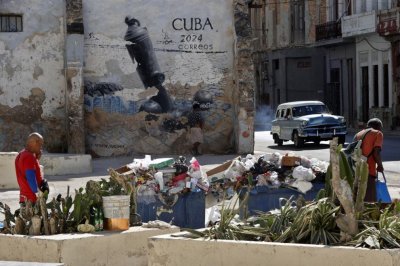
People walk past rubbish accumulating in the streets of Havana on Wednesday. The Caribbean nation has been experiencing a severe energy crisis with the island nation virtually out of fuel. Photo by Ernesto Mastrascusa/EPA
March 27 (UPI) — A tanker carrying Russian fuel initially headed to Cuba ended up docking in Venezuela after weeks of deviations, while a second oil-carrying vessel remains without a clear destination in the Caribbean amid the island nation’s energy crisis.
The vessel Sea Horse, sailing under the Hong Kong flag, had been closely tracked by maritime analysts since it departed from the eastern Mediterranean carrying between 190,000 and 200,000 barrels of Russian diesel initially destined for Cuba.
During its voyage, the tanker repeatedly changed its declared destination. It went from being listed as en route to Havana to indicating “Caribbean Sea” and later Trinidad and Tobago in a pattern that reflected growing uncertainty about its final destination.
Ultimately, the Sea Horse arrived at Puerto Cabello, in Venezuela, on Wednesday morning after nearly 50 days in transit.
The diversion occurred in a context of increasing pressure from the United States to restrict fuel supplies to Cuba, which is facing a severe energy crisis with recurring blackouts and oil shortages.
The case of the Sea Horse is not isolated. Maritime tracking data show that other vessels have altered their routes or avoided declaring final destinations in recent weeks, amid sanctions that explicitly exclude Cuba from relaxed sanctions for Russian oil trade.
The second vessel, the Russian tanker Anatoly Kolodkin, maintains its uncertainty.
The ship, which is carrying roughly 730,000 barrels of crude, continues in the Caribbean Atlantic without a publicly confirmed final destination.
The maritime tracking website VesselFinder shows the destination of the Anatoly Kolodkin as “Atlantic for order,” a designation used in the industry to indicate that the vessel is sailing without a publicly confirmed final destination.
On Tuesday, maritime intelligence analyst Michelle Wiese Bockmann told Politico that the vessel could arrive in Cuba in “two or three days,” although its trajectory remains without clear confirmation.
The most recent AIS tracking data indicate that the vessel is about 487 miles from Turks and Caicos, with an estimated arrival Monday. However, its current vectors do not point directly toward Cuba, reinforcing uncertainty about true destination.
The behavior of the Kolodkin raises questions in a highly monitored environment.
“There are details that just don’t add up,” said Evan Ellis, a professor at the U.S. Army War College Strategic Studies Institute.
“Given the U.S. naval and air assets in the area, the Russian tanker has to know it won’t get in undetected. The question is whether this is some kind of cat-and-mouse game, or if shifting expectations, possibly tied to developments in Cuba, have changed whether it believes it can enter unopposed,” he said.
“Maybe the deliberate attempt was meant to apply pressure, and then once it got a reaction, it was backing off,” he added.
For Ellis, the key point remains outside the public radar.
“The biggest story is what’s going on behind the scenes that we don’t know about,” he said.
The eventual arrival of the Kolodkin also could force a decision from Washington. Analysts cited by the Miami Herald say the options range from diplomatic pressure to a possible interception by the U.S. Navy or U.S. Coast Guard.
“At the end of the day, what we really have to watch for is what actually happens,” said Jorge Piñón, a senior research collaborator at the University of Texas Energy Institute.
Cuba imports about 60% of its energy and depends on external supplies to sustain its electrical system, making each shipment a critical factor within a scenario of growing geopolitical tension.