Adam Miller’s $2-million question: How much will he spend on his mayoral campaign?
Good morning, and welcome to L.A. on the Record — our City Hall newsletter. It’s Noah Goldberg, with an assist from David Zahniser and Rebecca Ellis, giving you the latest on city and county government.
Adam Miller is running for mayor.
You might not know that, and you might not even know who he is — and his campaign team wouldn’t blame you.
In fact, the Miller team’s own internal poll of 800 likely voters shows the tech entrepreneur with just 6% support, behind incumbent Mayor Karen Bass, City Councilmember Nithya Raman, conservative reality TV star Spencer Pratt and leftist Rae Huang. Only 13% of Angelenos even have an opinion of Miller, with 7% coming down on the positive side and 6% negative.
Miller’s pollster, Jefrey Pollock, admits it’s not often that a campaign brags about a humble 6% backing their candidate.
But during a video conference with reporters, Pollock argued that Miller’s support rises along with his name recognition. When likely voters were given more information about the candidates, he shot up to 20%, according to the poll. When provided with additional positive information about the candidates, Miller finished first, with 27%.
“Adam is the one who jumps up,” said Pollock, who runs Global Strategy Group.
After voters got the first dose of information, 22% supported Bass, down from 26%; 21% went with Pratt, up from 14%; 14% backed Raman, up from 12%; and 8% chose Huang, down from 9%.
In a poll earlier this month by the UC Berkeley Institute of Governmental Studies, co-sponsored by The Times, Miller also came out with 6% support. Bass was supported by 25% of voters, while Raman drew 17% and conservative reality TV star Spencer Pratt came in third at 14%. About a quarter of voters were undecided.
Paul Mitchell, vice president of the bipartisan voter data firm Political Data Inc., said the Miller campaign poll was compelling.
“What I see is a good argument that he can make the runoff,” Mitchell said. “This is a real deal.”
The question for Miller and his team then becomes, how can he introduce himself to more voters before the June 2 primary?
Miller is the former CEO of Cornerstone OnDemand, a global training and development company he built over the course of more than 20 years. The publicly traded company was eventually sold to a private equity firm for $5.2 billion. He is also a co-founder of Better Angels, a nonprofit focused on preventing homelessness and building affordable housing.
Among everyday Angelenos, he’s a no-name.
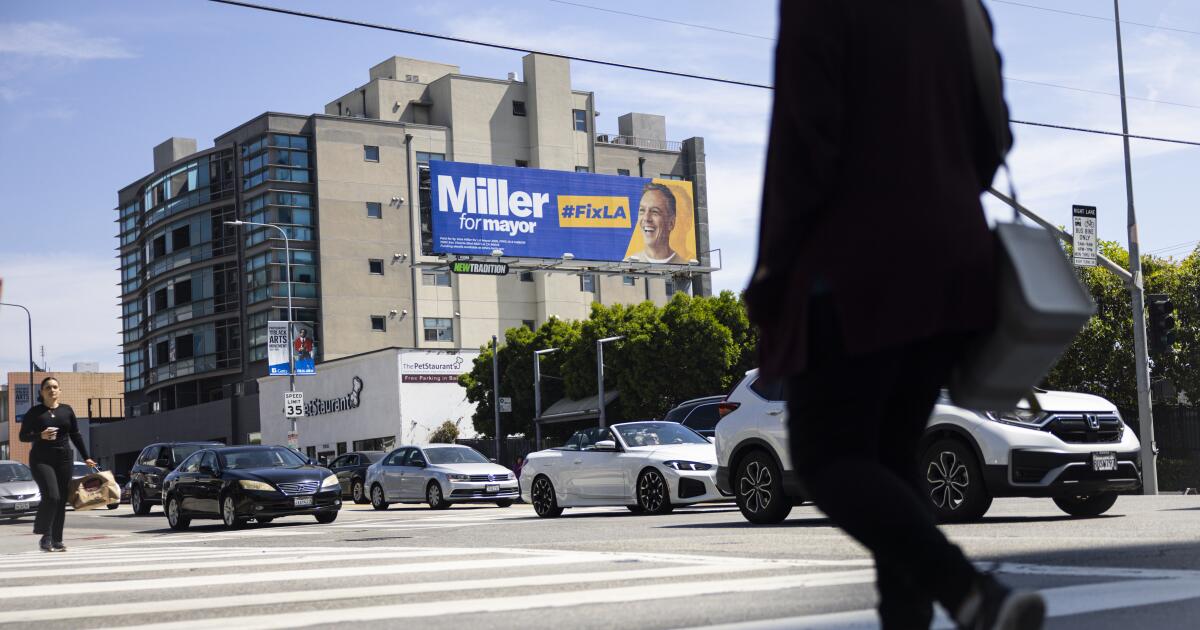
A television, social media and outdoor billboard advertising campaign launched this week should help change that, Miller’s team said. They said the “omnichannel” blitz cost seven figures but did not provide an exact amount.
The first billboard went up this week at Bundy Drive and Wilshire Boulevard, not far from Miller’s Brentwood home. More are expected next week in the San Fernando Valley.
Miller said he personally loaned his campaign a “majority” of the money for the ad blitz.
How much Miller is willing to spend on his mayoral ambitions?
In 2022, billionaire developer Rick Caruso threw more than $100 million of his own money into his campaign against Bass during the primary and runoff elections. He still lost by more than 10 percentage points.
“Obviously, we have the benefit of hindsight that that strategy did not work,” Miller said of the Caruso campaign. “There’s reasons my candidacy is different.”
For one thing, as opposed to Caruso, who was a Republican before registering as a Democrat to run for mayor, Miller is a lifelong Democrat. (That said, Miller voted for Caruso in 2022, said his spokesperson, Jaime Sarachit).
Miller is a moderate who sees himself as leader who gets things done. He believes the LAPD needs a minimum of 10,000 officers, up from about 8,700. He thinks the city should use anti-encampment laws to move homeless people away from sensitive areas like schools and day cares.
Miller would not directly answer a question about how much of his own money he will spend on his campaign. He has so far loaned it $2 million, “to get it up and running,” Sarachit said.
“That’s a significant sum, obviously,” said longtime L.A. political consultant Bill Carrick. “It’s a lot more efficient to write a check from your personal account than it is to go raise $2 million.”
But Miller said his campaign will largely be “traditionally financed,” meaning he plans to fundraise.
State of play
— AO-K’ed: Metro’s board on Thursday unanimously approved a new route for a rail line that would extend from South L.A. into West Hollywood — a milestone deal struck after last-minute negotiations between Bass and local leaders. The K Line northern extension would link with four major rail lines and increase the number of riders to 100,000 a day.
— SOCIALIST SNUB: The Los Angeles chapter of the Democratic Socialists of America will not endorse a candidate for mayor. Last weekend, the group voted on whether to reopen its endorsement process and consider backing Huang or Raman but ultimately decided to stay out of the fray for the June primary.
— GUNNING FOR COUNCIL: Leftist City Council candidate Estuardo Mazariegos was convicted of misdemeanor gun possession in 2009. He thinks the conviction is a strength, not a weakness.
— SMALLER BIGGER: On Tuesday, the City Council adopted a strategy that would delay the effects of SB 79 citywide by upzoning 55 single-family and low-density areas, allowing for buildings of four to 16 units that are up to four stories tall. Under SB 79, buildings adjacent to certain transit stops can be up to nine stories.
— NOT UP FOR DEBATE: USC canceled its Tuesday gubernatorial debate, a stunning about-face after days of fiery criticism that every prominent candidate of color was excluded. Although the university defended the methodology used to determine who was invited, it ended up calling off the event with less than 24 hours’ notice.
— PHANTOM SUIT: A man said he has no idea how he became a plaintiff in the county’s $4-billion payout for sex abuse in juvenile halls and foster homes. His lawsuit, which he says was filed without his consent by Downtown LA Law Group, deepens questions around possible fraud in the nation’s largest sex abuse settlement.
— TAX TAKEAWAY: The proposal from a group of business leaders to repeal the city’s business tax has qualified for the November ballot. Organizers said their success — gathering twice as many signatures as needed — shows that voters “want affordability and fairness to be addressed immediately.” Labor unions have vowed to fight the proposal, which would rip an $800-million hole in the city budget.
— HOUSING HUDDLE: Three of the mayoral candidates — Miller, Huang and Raman — took the stage Monday for a downtown forum. The trio went back and forth on housing, transportation and other issues, particularly the future of Measure ULA, the so-called mansion tax. Bass did not attend, citing a previous engagement in New Orleans, where she held a campaign fundraiser with U.S. Rep. Troy Carter (D-La.) and the city’s mayor, Helena Moreno. Pratt also did not show.
QUICK HITS
- Where is Inside Safe? The mayor’s signature program visited Skid Row in Councilmember Ysabel Jurado‘s district, moving 25 people indoors.
- On the docket next week: The City Council is on recess next week.
Stay in touch
That’s it for this week! Send your questions, comments and gossip to LAontheRecord@latimes.com. Did a friend forward you this email? Sign up here to get it in your inbox every Saturday morning.