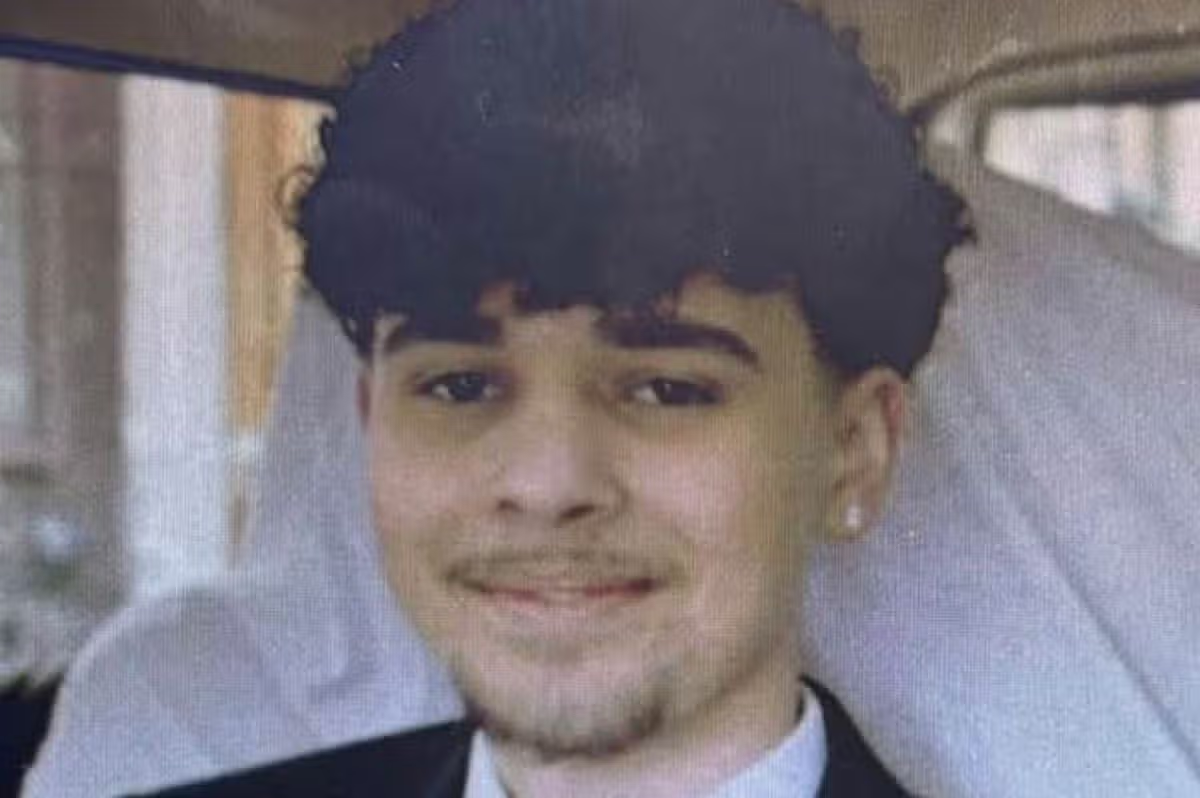
20yearold

Ben Gannon-Doak: The 20-year-old who stole the show on Scotland’s World Cup return

Though he’s “not praying for hat-tricks”, many would have been asking the man above for a favour or two as Scotland eyed up their first World Cup win in 36 years.

It was evident early doors against Haiti that if anything was going to happen, Gannon-Doak would be at the heart of it.

Keeping it simple, when he received the ball down the right, he looked to attack. A sight that makes Scotland supporters rejoice, such has been its rarity in recent times.

When McTominay skelped a post, it was on the end of another dazzling Gannon-Doak burst. He set up Che Adams shortly after for a shot that would be parried right in the path of McGinn, who was wheeling away in ecstasy seconds later as Scotland scored their first World Cup goal since 1998.

For 83 minutes, Gannon-Doak was the youngest man to appear at a World Cup for Scotland. That’s until his 19-year-old pal Findlay Curtis came on.

The pair play in a care-free manner. They don’t carry the years of missed qualifications or even the recent disappointments at the Euros. And it shows.

Gannon-Doak departed with 15 minutes to go against the Haitians. A collective gulp was inhaled.

“He had a cracker tonight,” former Scotland winger Pat Nevin said on BBC Sportsound.

“He’s what you want a Scotland player to be,” added ex-captain Scott Brown on BBC One.

Like few others, Gannon-Doak gets the faithful going. Believing. Hoping.

Like the rest of his generation, we’ve grown up believing ‘it’s the hope that kills you’, but with this 20-year-old driving the team, it’s difficult not to.

Source link

‘Backrooms’ review: Get lost in a 20-year-old director’s vision

Hollywood has been waiting for Kane Parsons since the year he was born. The 20-year-old director is the same age as YouTube’s first videos and grew up with no barriers between his creativity and an audience. “Backrooms,” his debut feature, marks the start of a new new wave of filmmakers raised by internet feedback who are ready to reinvigorate the industry.

Young Steven Spielberg screened his 8mm reels for his neighborhood. Parsons uploaded his early shorts online where he could analyze the mass response. When one, an unsettling nine-minute experiment about a warren of dingy carpets, taffy-yellow walls and gridded drop ceilings clicked with 78 million viewers, he made sequels. A24 offered Parsons a deal before he finished high school. He’s graduating into multiplexes having spent his adolescence writing, directing, editing, composing and market-testing what people want to watch. I’d toast to that, but Parsons isn’t old enough for Champagne.

Given that backdrop, “Backrooms” would be one of the year’s most significant releases even if the movie itself was merely fine. But it’s better than fine — it’s a work of honest-to-goodness art. Working with screenwriter Will Soodik, Parsons has gone back into that banal maze to find an uncannily mature story about loss and stagnation, about how our self-serving narratives barricade us from emotional growth.

Set in 1990, “Backrooms” has the fritz of an old VHS tape. (Like so many other Gen Z kids, Parsons is nostalgic for a pre-smartphone era he never knew.) A failed architect-turned-furniture salesman named Clark (Chiwetel Ejiofor, superbly expressive) tumbles through a portal in his store’s basement to the backrooms of the title — less Alice in Wonderland, more Alice in Wonderbland.

“It’s like it was made by a bunch of construction workers on acid,” he muses. The hallways lead to more hallways, the overhead fluorescents whine like hornets. Someone — or something — has piled lamps and stools into the center of one room, scattered chairs in another and embedded shoes into the floor as though the ground were made of sand. The disorder looks like the wreckage of an unknown chaos. Aboveground, Clark is trapped in his own resentments, throwing temper tantrums like a toddler. Down here, frustration feels natural.

Should he be afraid? And if so, then what of?

Distant thuds warn that Clark isn’t alone. Soon after, three other characters follow Clark into this liminal space: his loud employees Bobby and Kat (Finn Bennett and Lukita Maxwell) and his exasperated therapist, Dr. Mary Kline (Renate Reinsve), who is haunted by flashbacks of her agoraphobic mother. There’s also a mysterious man in a lab coat (Mark Duplass) who works for a company that factors into the backrooms’ preexisting internet lore, but doesn’t have much purpose in this script. It’s fine just to see Duplass as a gesture toward corporate apathy. More beings will appear too and cinematographer Jeremy Cox’s deliberately low-fi look forces you to do triple and quadruple takes to comprehend what you’re even seeing.

How does a 20-year-old fathom adult-sized discontent? Lord knows, but Parsons does. One theory is that today’s 20-year-olds were just launching into teenhood when the pandemic teleported them from their classrooms to isolated computer screens. Meanwhile, they overheard their parents fret that society might be forever hollowed out. When a young person looks toward the future, what do they see? Probably not an office building bustling with entry-level jobs.

Think about how the act of buying a couch no longer involves interacting with a salesman like Clark, but peering at a pixelated living room that doesn’t actually exist with a couch that changes colors at a tap. Think about how lately the internet at large feels human-less. Then layer that emptiness over the images here.

Sparse yet gripping, “Backrooms” and its minimalist story accommodate the audience’s own free-ranging imagination. The infinite size of these drab catacombs triggers sense-memories of feeling small and confused in an ordinary place that feels all wrong. It’s a time travel trip back to childhood — mass entertainment made intimate — with Parsons tossing us scraps of Clark and Mary’s personal histories like a breadcrumb trail. I remembered what it felt like to get lost in a motel on a road trip with my grandparents. More recently, I tidied the home of a friend who was in the hospital, the pill bottles and crumpled blankets left in situ as evidence of someone else’s pain. “Backrooms” felt like that, too.

There’s an incredible special effects shot where the camera sinks through the floor of Mary’s living room to find a mutation of the same room — and then another and another — each replica deteriorating further from reality until it becomes a new room altogether that would fit right into the backrooms. This, we wordlessly understand, represents how memories of the past can be at once factually inaccurate and emotionally true. We’ve all been bewildered kids, Parsons more recently than most. Some of the most powerful people on Earth still behave like they’re stuck in that headspace.

Describing “Backrooms” as a horror film doesn’t feel exactly right. It’s a surrealist painting in motion, the equivalent of staring at Salvador Dali’s wasteland of melting clocks until it makes gut-sense. Dali made that famous masterpiece, “The Persistence of Memory,” in 1931, a breath-holding moment between wars when daily life looked normal enough but vibrated with the dread that no, things were definitely not OK. Kids don’t know that, but they vibe with Dali anyway because he keys into their suspicion that the world doesn’t really obey the rules.

That anxiety hums through “Backrooms.” It’s why millions of people watched and shared the original short. Yet as fraught as it sounds — and as abruptly as it ends — I left elated. A major new moviemaking talent has arrived and he’s the beginning of a movement. Other internet-honed young filmmakers will follow with their own fresh insights into genres like action, comedy and romance. Kane Parsons is just the first one through Hollywood’s labyrinth.

‘Backrooms’

Rated: R, for language and some violent content/bloody images

Running time: 1 hour, 45 minutes

Playing: Opening Friday, May 29 in wide release

Source link