2026 Amnesty Law

Venezuelan Parliament Approves Amnesty Law, Rodríguez Calls for ‘Peace and Tolerance’

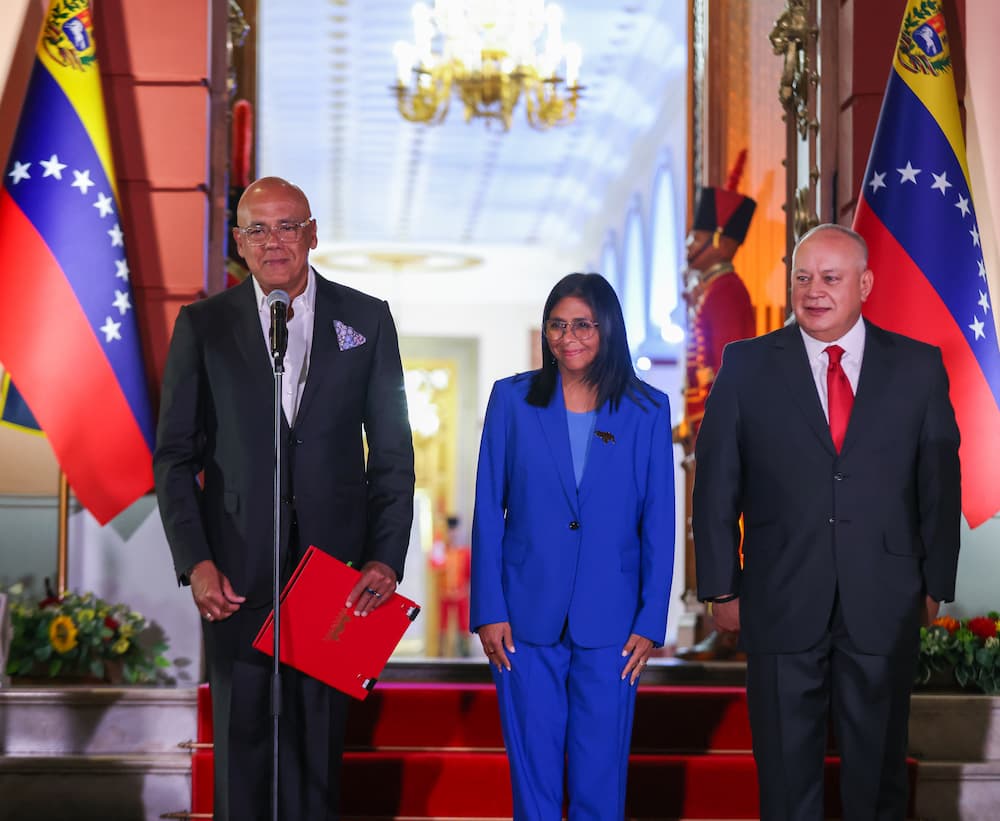
A special ceremony in Miraflores to deliver the amnesty law to Acting President Delcy Rodríguez. (Presidential Press)

Mérida, February 23, 2026 (venezuelanalysis.com) – The Venezuelan National Assembly passed the Amnesty Law for Democratic Coexistence on Thursday, January 19. 

The government, led by Acting President Delcy Rodríguez, immediately enacted the legislation and presented it as a step toward “peace and tolerance.”

The law establishes mechanisms that aim to promote political reconciliation through a blanket amnesty for crimes or offenses committed in the context of political violence between 1999 and 2026. The final document explicitly lists high-profile contexts, including the 2002 coup against then-President Hugo Chávez, the 2014 and 2017 opposition-led violent “guarimba” street protests, and the unrest following the July 2024 presidential elections.

“This law is guided by principles of freedom, justice, equality, […] the primacy of human rights, and political diversity,” article 3 reads.

Article 7 of the amnesty bill defines the ethical and constitutional scope of the pardon, expressly excluding those who have participated in serious human rights violations, crimes against humanity, or war crimes, in accordance with Article 29 of the Venezuelan Constitution.

The legislation also excludes those prosecuted for or convicted of homicide, corruption offenses while in public office, and drug trafficking with sentences exceeding nine years.

During a press conference at the National Assembly, the head of parliament Jorge Rodríguez stated that the new law represents “a step forward to avoid the mistakes of the past.” 

“I believe that this law recognizes the victims in its articles and represents a step toward avoiding the mistakes of the past,” he told reporters. “This sends a powerful message that we can live, work, and grow politically within the framework established by the Constitution of the Bolivarian Republic of Venezuela.”

During the Thursday session, opposition Deputy Henry Falcón from the Democratic Alliance affirmed that “amnesty is an opportunity that the state offers to forget. We cannot cling to past differences in the face of a higher interest: the country itself.”

After twenty days of consultations and debates and three two legislative debates, Jorge Rodríguez presented the final text that was unanimously endorsed by all 277 deputies. He also announced the creation of a Special Monitoring Commission, chaired by Jorge Arreaza (United Socialist Party of Venezuela, PSUV) and Nora Bracho (A New Era, UNT). This commission is responsible for ensuring the law’s implementation and addressing requests for release.

At a special ceremony held at Miraflores Palace on Thursday evening, Acting President Delcy Rodríguez formally received the Amnesty Law for Democratic Coexistence following approval by the legislature and called for national reconciliation.

“This amnesty law opens an extraordinary door for Venezuela to come together again, to learn to live together democratically and peacefully, and to rid itself of hatred and intolerance,” she expressed. “ 

Regarding the exclusions contemplated, Rodríguez asked the Commission for the Judicial Revolution, chaired by Interior Minister Diosdado Cabello, to review cases not covered by the amnesty and formulate recommendations to “heal wounds.”

The president of the legislature’s special commission, Jorge Arreaza, stated on a televised interview that the first 379 amnesty applications had been processed, primarily in Caracas.

“Both the Supreme Court and the Attorney General’s Office have received 379 requests for amnesty,” he explained. “These individuals should be released in the coming hours. This process will continue in the coming days.”

Parliamentary leader Jorge Rodríguez said on Saturday that there are a further 1,500 cases being revised.

Meanwhile, Ernesto Villegas, minister of culture and coordinator of the Program for Peace and Democratic Coexistence, reported on his Telegram channel a meeting with campesino, tenant, and labor organizations to discuss cases of activists facing legal proceedings due to social struggles over land, housing, and employment. These groups were not explicitly contemplated among the direct beneficiaries of the law.

The grassroots collectives denounced the criminalization of their social demands and provided concrete information that will be forwarded to the relevant authorities in coordination with the National Assembly’s special commission.

The meeting hosted by Villegas also saw relatives of individuals imprisoned for alleged corruption in the public sector criticize the penal system and advocate for their loved ones’ rights.

The Program for Peace and Democratic Coexistence promised to promptly send the complaints to the relevant bodies and encourage corrective actions.

Edited by Ricardo Vaz in Caracas.

Source link

Venezuelan Authorities Begin Consultations on Amnesty Law

Jorge Arreaza (center) will head a parliamentary commission tasked with conducting consultations on the amnesty bill. (Asamblea Nacional)

Mérida, February 9, 2026 (venezuelanalysis.com) – The Venezuelan National Assembly has launched discussions on a preliminarily-approved “Amnesty Bill for Democratic Coexistence,” including public consultations with community peace judges, NGOs and academics. 

Deputy Jorge Arreaza, who heads the parliament’s special commission for the amnesty bill, said that the legislature’s intention was to shape the law as a mechanism to ensure political stability in Venezuela but without impunity.

“The goal of this law is to contribute to peace, democratic coexistence and national reconciliation,” he explained during a meeting with community peace judges on Sunday. “It is a necessity of the new political moment we are going through.” Arreaza had previously served as Foreign Minister and Communes Minister.

The National Assembly commission’s consultations included a meeting with NGOs such as Provea, Foro Penal, and Acceso a la Justicia on Saturday. One they earlier, the legislators hosted deans from sixteen public and private university law schools to receive their input on the project. 

During these meetings, Arreaza stressed the importance of community justice participation, civil society organisations and academia. 

“We went to the law, reviewed each of the contributions, and will conduct an evaluation. We must contribute to the dialogue; we must listen to each other with patience and empathy,” he emphasized.

The Amnesty Bill for Democratic Coexistence, first announced by Acting President Delcy Rodríguez on January 30, was approved in its first reading on Thursday. A revised text is expected to be submitted to a final vote in the coming weeks.

The central stated objective of the initiative is national reconciliation and social peace through the pardon of political and related crimes committed between January 1, 1999, and January 30, 2026. 

According to Venezuelan authorities, the project aims to address the political conflict that occurred between 1999 and 2026 by channelling differences through constitutional means, as well as modernise the legal system to help secure social peace.

The bill’s Article 6 explains that the selected period covers significant conflicts such as the 2002 coup d’État, the 2002-03 oil lockout and opposition-led violent street protests in 2013, 2014 and 2017.

However, the bill sets strict limits, excluding those responsible for serious human rights violations, crimes against humanity, homicide, drug trafficking, and corruption from any benefits. In addition to the release of those who have been prosecuted or convicted, the law establishes the termination of legal proceedings and the removal of criminal records from police and military files for those who benefit from it.

The Venezuelan government’s consultations likewise included a meeting between Acting President Delcy Rodríguez and former Spanish President José Luis Rodríguez Zapatero in Caracas on Friday. Zapatero, who has mediated past dialogue initiatives with the Venezuelan opposition, expressed his support for the Amnesty Bill, considering that it will mark “a turning point” for the country’s future and reconciliation.

He emphasized that the amnesty should be as extensive as possible and implemented swiftly to meet the expectations of families affected by arrests. Zapatero pledged to assist in any requested way, arguing that forgiveness and dialogue are essential elements in what he described as an “extraordinary moment” for the Caribbean nation.

Amid amnesty debates, the Committee of Family and Friends for the Freedom of Imprisoned Workers demanded that the legislation extend to imprisoned workers who have been criminalized on charges of ‘terrorism’ and ‘treason’ for defending labor rights or speaking out against corruption.

In a statement, the committee argued that the amnesty should not be limited to high-profile political figures, but rather apply to working-class and grassroots activists as well. 

Investigative blog La Tabla also put forward a proposal to expand the removal of charges and convictions to campesino leaders who have been targeted amid ongoing land struggles. In recent years, rural organizations have denounced a growing criminalization of local activists, accusing judicial authorities of favoring landowning interests.

Releases of high-profile opposition figures continue

In recent days, Venezuelan judicial authorities have continued a process of prisoner releases which, according to the President of the National Assembly, Jorge Rodríguez, are intended to promote national reconciliation. The Venezuelan government has reported around 900 releases since December.

Rodríguez recently announced that further detainees would be released this week, describing the process as an “act of justice and forgiveness.” The people released are still facing trial, with charges against high-profile anti-government figures including “terrorism” and “treason.”

NGO Foro Penal reported the release of dozens of opposition politicians on Sunday, including several associates of far-right leader María Corina Machado. However, hours after exiting prison, former Deputy Juan Pablo Guanipa was arrested again in Caracas.

The Venezuelan Attorney General’s Office published a statement arguing that Guanipa had violated the conditions of his release, though it did not offer specifics, and requesting a court order to move him to house arrest.

Edited by Ricardo Vaz in Caracas.

Source link

Venezuela: Rodríguez Hosts US Chargé d’Affaires Dogu in Presidential Palace

Rodríguez received Dogu in the presidential palace in Caracas. (Presidential Press)

Mérida, February 2, 2026 (venezuelanalysis.com) – Venezuelan Acting President Delcy Rodríguez met with US Chargé d’Affaires Laura Dogu in Miraflores Presidential Palace on Monday afternoon.

According to Communications Minister Miguel Pérez Pirela, the meeting took place “in the context of the working agenda” between Caracas and Washington. National Assembly President Jorge Rodríguez was likewise present.

Dogu confirmed the high-level audience with Venezuelan leaders via social media, saying that she reiterated Washington’s intended “three-phase plan” for the Caribbean nation.

“Today I met with Delcy Rodríguez and Jorge Rodríguez to reiterate the three phases that Secretary of State Marco Rubio has proposed for Venezuela: stabilization, economic recovery and reconciliation, and transition,” she said.

The US diplomat arrived in Caracas on Saturday, vowing that her team is “ready to work.” US State Department officials had visited the Venezuelan capital previously to assess conditions for the reopening of the US embassy.

Venezuelan Foreign Minister Yván Gil was the first high-ranking official to meet with Dogu, writing that the country’s authorities are looking to work on “issues of bilateral interest” with US counterparts. On Monday, Gil announced that Félix Plasencia will be Venezuela’s diplomatic representative in the US and will travel to Washington in the coming days.

This diplomatic rapprochement follows the January 3 US military strikes that killed dozens, while special operations teams kidnapped President Nicolás Maduro and First Lady and Deputy Cilia Flores.

In the weeks since, the Venezuelan government has emphasized its commitment to reestablish ties with the Trump administration, with Rodríguez pledging that she is not afraid to address “differences” with Washington through diplomatic channels.

For his part, US President Donald Trump told reporters aboard Air Force One that he maintains positive relationships with Venezuelan leaders, including the acting president.

Since the January 3 strikes, the White House has claimed control over Venezuelan crude sales, with proceeds reportedly deposited in US-administered accounts in Qatar before a portion is returned to the South American nation. Last week, the Venezuelan National Assembly approved an oil reform granting expanded benefits for private corporations that drew praise from US officials.

Caracas severed diplomatic ties with Washington in 2019 after the Trump administration recognized the self-proclaimed “interim government” headed by Juan Guaidó as the country’s legitimate authority.

A formal reestablishment of diplomatic relations hinges on the White House formally recognizing the Venezuelan acting government, a move that is also a necessary step before any process of debt renegotiation.

Rodríguez announces Amnesty Law, Helicoide closure

Venezuelan acting authorities have combined the restoration of ties with Washington with a fast-moving domestic legislative agenda.

On Friday, during the Supreme Court’s 2026 opening ceremony, Acting President Rodríguez announced a new “General Amnesty Law,” intended to cover acts of political violence that have occurred in Venezuela from 1999 to the present.

In her speech, Rodríguez explained that the law aims to “heal the wounds” resulting from political confrontation.

“I request the full cooperation of the Venezuelan parliament so that this law may contribute to healing the wounds left by confrontation, violence, and extremism,” she told attendees. “May it serve to redirect justice in our country and restore coexistence among Venezuelans.”

The legislative proposal will reportedly exclude those who have been convicted or are facing charges of homicide, drug trafficking, corruption, and serious human rights violations.

Alongside the new law proposal, Rodríguez announced the closure of the Helicoide detention center in Caracas, with plans to turn it into a recreational center. The facility, run by the SEBIN intelligence agency, has held multiple high-profile opposition figures accused of crimes including treason and terrorism.

Human rights organizations over the years have denounced grave human rights violations against Helicoide prisoners. Dozens of prisoners have been gradually released in recent days. 

Javier Tarazona, director of the NGO Fundaredes, was among those released during the weekend. He had been detained since 2021 on terrorism and treason charges. Luis Istúriz, a leader from the far-right Vente Venezuela party, also exited the Helicoide on Sunday following 18 months behind bars. He had begun a 30-year sentence on charges of terrorism and conspiracy.

Venezuelan Interior Minister Diosdado Cabello affirmed in a Monday press conference that the amnesty law is about promoting “coexistence and peace” and will see authorities review the cases of people who have “undoubtedly committed crimes.”

“Those who benefit from the amnesty will be given an opportunity to return to politics,” he said, adding that the amnesty project was a government initiative that had no influence from “NGOs and foreign governments.”

Edited and with additional reporting by Ricardo Vaz in Caracas.

Source link