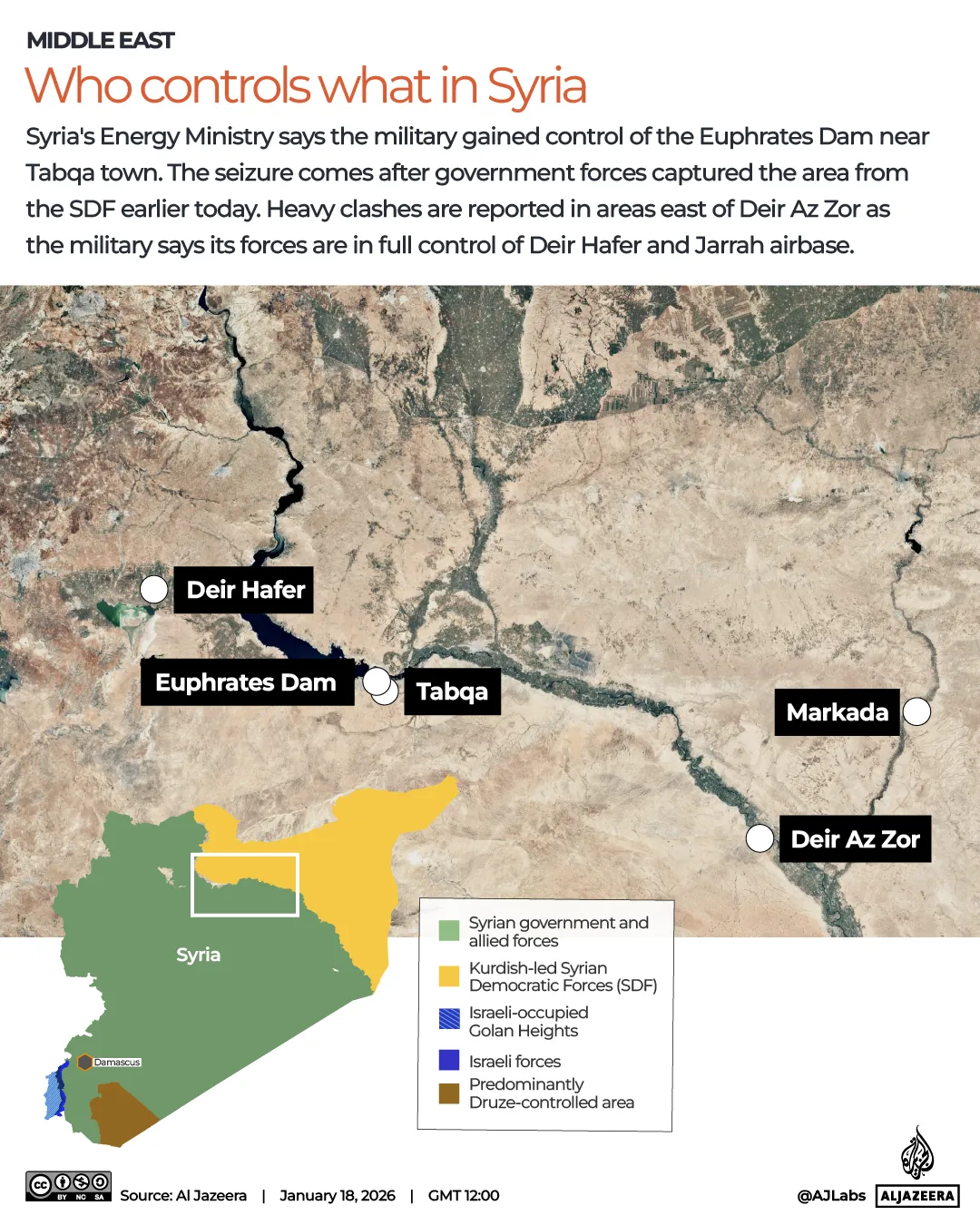
The Syrian army is advancing towards Raqqa, the stronghold of the United States-trained, Kurdish-led Syrian Democratic Forces (SDF), after capturing the northern strategic city of Tabqa and its military airport on the Euphrates River in a lightning offensive.
Government forces captured the Euphrates Dam, also known as the Tabqa Dam, about 50km (31 miles) west of Raqqa city, after heavy fighting with SDF forces. Government forces are amassing heavy military equipment in Raqqa governorate, which has been under SDF control since 2015.
Recommended Stories
list of 4 itemsend of list
Fighting erupted between the army and SDF forces in Aleppo on January 6 after talks aimed at integrating the Kurdish fighters into Syria’s national army stalled. The two sides also clashed last month before a deadline for the SDF to lay down its heavy weapons and hand over control of areas in Aleppo to the national army.
So what’s the latest situation on the ground? Will the offensive by the Syrian army heighten the conflict in northern Syria?

What is the latest from Syria’s northeast?
On Sunday, the Syrian army took control of Tabqa, about 40km (24 miles) west of Raqqa. It also captured the Euphrates Dam, the largest in the country and adjacent to the strategic city, as well as the Freedom Dam, formerly known as the Baath Dam.
Government-allied groups said they have taken control of the Asayish headquarters, the security and police force in the Autonomous Administration of North and East Syria, in the town of Markada while tribal fighters allied with the government have taken control of several major oil- and gasfields in the northeast, including Jafra and Conoco located in Deir Az Zor province bordering Iraq.
The Syrian Petroleum Company said Syrian forces seized the Rasafa and Sufyan oilfields in Raqqa, which could now be returned to production, according to the Reuters news agency.
Syrian state media on Sunday accused the SDF of using drones in areas east of Deir Az Zor, another SDF stronghold in the northeast.
Video clips and live footage published on social media and verified by Al Jazeera show celebrations in the cities of Hajin and al-Shuhayl in the eastern countryside of Deir Az Zor after news of the withdrawal of the SDF from the area. The Deir Az Zor governorate has announced the closure of all public institutions for the safety of residents as fighting continues to rage.
Syrian Ministry of Interior spokesman Noureddine al-Baba told Al Jazeera that police have secured all areas captured by Syrian soldiers after the rapid territorial gains over the past few days.
On Saturday, the SDF withdrew from Deir Hafer and some surrounding villages in Aleppo governorate that are home to predominantly Arab populations, after which Syrian forces moved in, triggering celebrations. Deir Hafer is about 50km (30 miles) east of Aleppo city.
“It happened with the least amount of losses,” Hussein al-Khalaf, a resident of Deir Hafer, told Reuters. “There’s been enough blood in this country, Syria. We have sacrificed and lost enough. People are tired of it.”
The Autonomous Administration of North and East Syria, affiliated with the SDF, on Saturday accused the Syrian government of violating a withdrawal agreement, saying it “attacked our forces on multiple fronts since yesterday morning”. The SDF also warned that the attacks on Raqqa might threaten security as the city hosts thousands of ISIL (ISIS) detainees.
The US-backed SDF, an alliance of Kurdish and Arab militias, was formed in 2015, nearly four years after the armed uprising against President Bashar al-Assad began. Al-Assad remained in power until he was ousted in December 2024 by Syrian opposition fighters led by Ahmed al-Sharaa, who is now interim president.
The US envoy for Syria, Tom Barrack, will meet SDF leader Mazloum Abdi (also known as Mazloum Kobani) and al-Sharaa on Sunday in Damascus, according to the Syrian Ministry of Information.
The renewed fighting has widened the rift between al-Sharaa’s government, which has pledged to reunify Syria after 14 years of war, and wary Kurdish authorities who distrust the new administration. On Friday al-Sharaa issued a decree declaring Kurdish a “national language” and granting the minority group official recognition.

How significant is the control of Raqqa?
Raqqa is an Arab-majority governorate in northern Syria and has some of the country’s largest oil- and gasfields.
Kurdish anxieties have been sharpened by sectarian bloodshed last year when almost 1,500 Alawites were killed by pro-government forces in western Syria and hundreds of Druze were killed in clashes in the south.
When the Syrian army seized these regions, Arab civilians took to the streets to celebrate.
“This indicated the social and demographic fragility of the SDF. Now the question is, will the SDF see this reality and agree to demands by Damascus to integrate into the Syrian state,” Omer Ozkizilcik from the Atlantic Council’s Middle East Programs said.
Omar Abu Layla, a Syrian affairs analyst, told Al Jazeera Barrack tried on several occasions to bring the SDF to the negotiating table with the authorities in Damascus but “they didn’t listen to him.”
Abu Layla said the central government made many overtures to the group but the SDF “wasted time”, assuming the authorities in Damascus were weak and allowing nearly a year to pass since an agreement in March that would have seen the SDF’s forces integrated into the regular army.
“What [we] are witnessing now in the region is the end of the SDF,” he argued.
What was the March agreement between the Syrian army and SDF?
On March 10, al-Sharaa reached an agreement with Abdi.
The agreement emphasised the unity of Syria and stipulated that “all civil and military institutions in northeastern Syria” be merged “into the administration of the Syrian state, including border crossings, the airport and oil and gas fields”.
The agreement also included affirmation that the Kurdish people are integral to Syria and have a right to citizenship and guaranteed constitutional rights.
After a breakdown of this deal, heavy fighting between the SDF and Syrian army resumed in the Sheikh Maqsoud and Ashrafieh neighbourhoods of Aleppo city last month. A US-brokered ceasefire took effect on January 10.
The SDF’s secular Kurdish leadership is linked to the Kurdish nationalist Kurdistan Workers’ Party (PKK), which fought a decades-old rebellion against the Turkish state until last year. Although the PKK announced in May that it would lay down its arms and disband, it is still listed as a “terrorist” group by Turkiye, the European Union and the US.
Despite this, the US backed the SDF because it was an effective partner against ISIL, which the SDF and a US-led coalition defeated in northeastern Syria by 2019.
How has the US reacted?
Washington has urged the Syrian army to stop advancing into Kurdish-held territory.
Admiral Brad Cooper, who is in charge of US Central Command, which oversees the US military’s Middle East operations, wrote in a statement published on X that the Syrian army should “cease any offensive actions in areas” between Aleppo city and Tabqa.
Aleppo is roughly 160km (100 miles) west of Tabqa.
“Aggressively pursuing ISIS and relentlessly applying military pressure requires teamwork among Syrian partners in coordination with US and coalition forces,” Cooper said. “A Syria at peace with itself and its neighbors is essential to peace and stability across the region.”
William Laurence, a professor at American University in Washington, DC, and a former US diplomat, said “it’s going to be very difficult” for the US to resolve the political impasse between Syria’s government and the SDF.
“[US President Donald] Trump wants the quick fix, and he wants Tom Barrack to sort of wave a magic wand and get what he wants. But that’s not really how things work,” Laurence told Al Jazeera.
“Sustainable solutions rely on trust-building, and we’ve had very little of that.”
What has al-Sharaa said?
After fierce clashes earlier this month, al-Sharaa issued a decree on Friday formally recognising Kurdish as a “national language” and restoring citizenship to all Kurdish Syrians.
At least 22 people were killed and 173 wounded in Aleppo after fighting broke out there on January 6.
The decree for the first time grants Kurdish Syrians rights, including recognition of their Kurdish identity as part of Syria’s national fabric. It designates Kurdish as a national language alongside Arabic and allows schools to teach it.
It also abolishes measures dating to a 1962 census in Hasakah province that stripped many Kurds of Syrian nationality and grants citizenship to all affected residents, including those previously registered as stateless.
The decree declares Newroz, the Kurdish New Year festival, a paid national holiday. It bans ethnic or linguistic discrimination, requires state institutions to adopt inclusive national messaging and sets penalties for incitement to ethnic strife.
Reacting to the decree, the Kurdish administration in Syria’s north and northeast said the decree was “a first step, however it does not satisfy the aspirations and hopes of the Syrian people”.
It added that “rights are not protected by temporary decrees, but… through permanent constitutions that express the will of the people and all components” of a society.