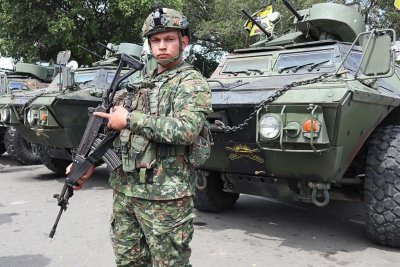

A member of the Colombian Army stands guard at the Simon Bolivar International Bridge in Cucuta, Colombia, on Sunday. The bridge is the main crossing point between Colombia and Venezuela, and it remains open after Venezuelan President Nicolas Maduro and his wife, Cilia Flores, were captured by the United States military action on Saturday and flown to New York to stand trial. Photo by Mario Caicedo/EPA
Jan. 5 (UPI) — Several South American countries announced new migration controls and border security measures in response to Venezuela’s political crisis following a United States operation that detained Venezuelan President Nicolás Maduro and his wife, Cilia Flores, and transferred them to New York to face drug-related charges.
While Colombia said it will keep its border crossings with Venezuela open and ruled out closures, Argentina, Peru, Ecuador and Paraguay announced restrictions on the entry of people linked to the Venezuelan government amid regional uncertainty and diplomatic coordination.
Colombian Vice Foreign Minister Mauricio Jaramillo said keeping the border open is strategic given cross-border migration and commercial flows along some 1,370 miles of shared frontier.
“Colombia has no interest in closing the border. It is essential that it remain open,” Jaramillo said, adding that Migration Colombia activated a permanent monitoring plan to oversee the situation without disrupting the regular movement of people and goods.
At the same time, President Gustavo Petro ordered tighter security along the border through the deployment of more than 30,000 public security personnel, including military and police forces, as a preventive measure against possible disturbances to public order.
Argentina, Peru, Ecuador and Paraguay separately announced new migration controls and entry restrictions targeting government officials, military personnel and others linked to the Venezuelan government.
In Ecuador, the Foreign Ministry said it will apply migration restrictions to public officials, members of the armed forces and security services, business figures, and other people associated with the government of Nicolás Maduro, citing national security concerns.
Authorities said asylum and refugee protections will not be misused and must comply with principles and procedures established under national and international law.
In Argentina, National Security Minister Alejandra Monteoliva said the National Migration Directorate will impose limits on the entry of people connected to the Venezuelan government, including officials, members of the armed forces, business figures and sanctioned individuals, to prevent what she described as regime collaborators from using the country as a refuge or protective platform.
“Argentina will not grant protection to collaborators of the Maduro regime,” the ministry said in a statement. President Javier Milei welcomed the fall of the Venezuelan leader and voiced support for a political transition process in Venezuela.
In Peru, the Interior Ministry announced the immediate implementation of migration controls through the National Superintendency of Migration, in coordination with the National Police.
The measures target Venezuelan citizens linked to the Caribbean nation’s government who appear on international sanctions lists, particularly those issued by the United States, to prevent Peru from being used to evade judicial proceedings.
“Notified. Those who oppressed their country for years are not welcome,” interim President Jose Jeri said in a post on social media platform X.
In Paraguay, the National Migration Directorate said it adopted control and restriction measures, with support from state security agencies, to block the entry of people linked to the Venezuelan government or with alleged ties to drug trafficking, narcoterrorism or pending criminal cases.
Authorities said they will evaluate international cooperation mechanisms and database cross-checks to verify individuals’ links to the Venezuelan government.