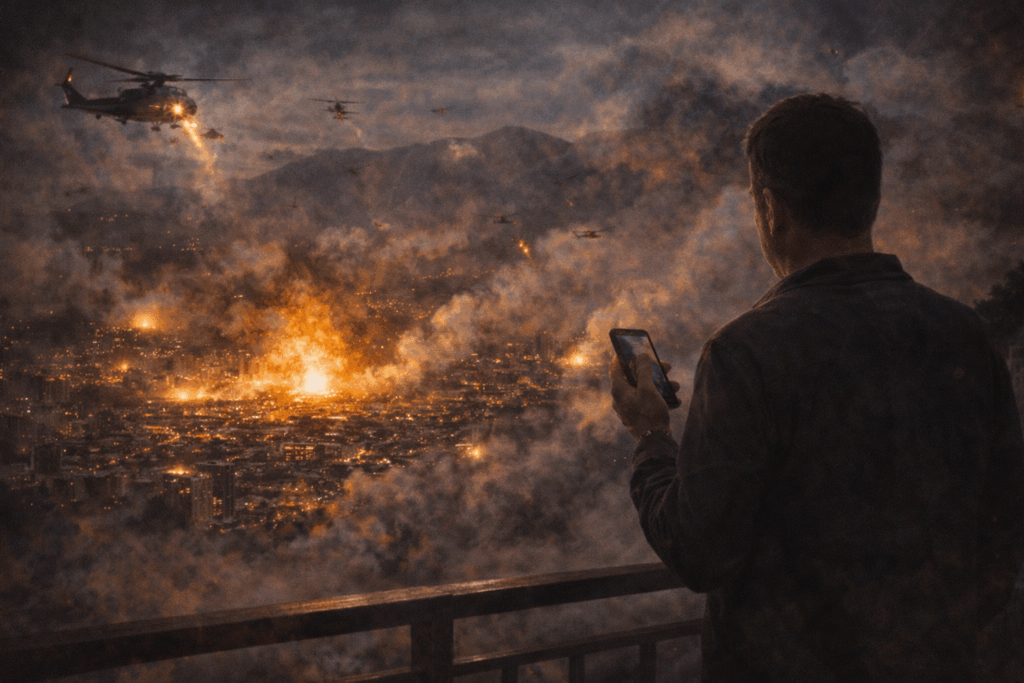
In Caracas, in early January, explosions are a common sound in the morning hours. To be honest, it’s not unusual for some irresponsible person, after a few too many drinks, to decide to disrupt the sleep of the entire neighborhood by launching firecrackers or fireworks. We’re quite used to it. That distinctive whistling sound, a couple of seconds of silence, and an explosion that makes dogs bark and babies cry.
That’s why, perhaps, the explosions that sounded shortly before 2:00 a.m. in the early morning of January 3, 2026, didn’t seem strange, until they were accompanied by the vibration of a cell phone. Since I have most of its contacts on silent mode and I don’t care much about what might be happening in the world outside my four walls when I’m asleep, I was about to turn it off. But when one of those WhatsApp calls came in from a group chat, my wife, who already had her phone in her hand, worriedly asked me not to. Something was happening. She had just heard a loud bang.
“I think something exploded in Caracas.”
As soon as she said that, we started receiving videos that quickly went viral on social media. The first one we saw was a convoy of planes and helicopters heading west of the capital, leaving a trail of explosions across the valley. The only thing missing was the classic “Fortunate Son” by Creedence Clearwater Revival as its soundtrack, typical of any Vietnam War movie.
“They’re bombing the city,” my wife added.
Is it true? That’s the first question in times when artificial intelligence can create any kind of video. So, seeing is believing, as the apostle Thomas said. Like many skeptics, I went outside to look at the sky and listen. The roar of aircraft flying over the city at that hour was enough to confirm that it wasn’t just rumors.
Indeed, they weren’t fireworks, nor was it a false alarm. I had just gotten up, and, amidst the confusion, stunned, I went out onto the terrace to listen to the explosions of the bombs, as well as to see the sky light up in different places on the horizon, despite the dense night fog that usually shrouds the mountains around the antennas of El Volcán in its whitish mantle.
“We’re safe here,” I thought naively, very casually. I went back to the room to tell my wife, exuding all the confidence in the world, that we had nothing to fear, since all the impact reports were in the area of Fuerte Tiuna and the Generalisimo Francisco de Miranda Air Base, far away enough for us to feel safe.
I will never forget the roar, that light, or the panic that I can only describe as when your blood freezes and your heart skips a beat.
But at the same time, out of pure reflex, I was getting out of my pajamas and putting on jeans, a sweater, and sneakers, anticipating that we might suddenly have to leave urgently for some unknown reason, without knowing where to find shelter.
Suspecting the possibility of a power outage, I turned on the phone, and in less than two minutes it rang. I didn’t want to answer, but when I realized it was one of my good friends from school, one of those I’ve seen twice in the 20 years since he left the country, I had to.
José Ricardo, with the classic greeting, “What’s up, Joe?”, immediately asked if we were okay, and I could only tell him the same thing I told my wife.
—Aircraft and explosions can be heard in the distance. We’re far away, everything is calm, but it sounds like things are rough and it’s raining bullets along the Guaire River.
I promised to call him with more details as soon as the sun came up. At that precise moment, I didn’t have much to say, other than confirm that the bombing of Caracas was true.
—Nothing’s happening here in El Hatillo—I said before hanging up, unaware that, in a matter of seconds, I would eat my words. I left the phone plugged in to recharge the battery and went out onto the terrace to continue contemplating the sky and listening to the buzzing and booming sounds. The only thing running through my head was the lyrics and melody of Pink Floyd’s “Goodbye Blue Sky”: Did you see the frightened ones? Did you hear the falling bombs? Did you ever wonder why we had to run for shelter when the promise of a brave new world unfurled beneath the clear blue sky?
It was impossible not to recall what my grandfather once told me about his adolescence during World War II. Of all the grim anecdotes in his repertoire, the one that impressed me most was the terrifying sound of the bombings, when they heard the sound of the planes flying overhead, the whistling and the impact, the shaking of the ground making the walls and ceilings creak, as if death were dancing above their heads, claiming lives without distinguishing between the righteous and the sinners. “The only thing you can do,” my grandfather would say, “is pray that that hell won’t last long.”
That cruel memory haunted me just as I heard the roar of the engines approaching and I looked up. I heard the whistling sound and didn’t even have a chance to move. I was petrified with terror. The explosion illuminated the bleak landscape as if the sun had peeked out for that fleeting moment, adding color to a blast that shook the floor, walls, ceiling, and windows of the house with the force of the most violent earthquake.
I will never forget the roar, that light, or the panic that I can only describe as when your blood freezes and your heart skips a beat. The sound of war and a bombing raid is the most terrifying thing I have ever heard. No one can imagine it until they experience it firsthand, murmuring prayers to God for it all to end quickly, for the bombs to stop falling, and for dawn to break, while the uncertainty of what the end of the storm will bring gnaws at you from within.