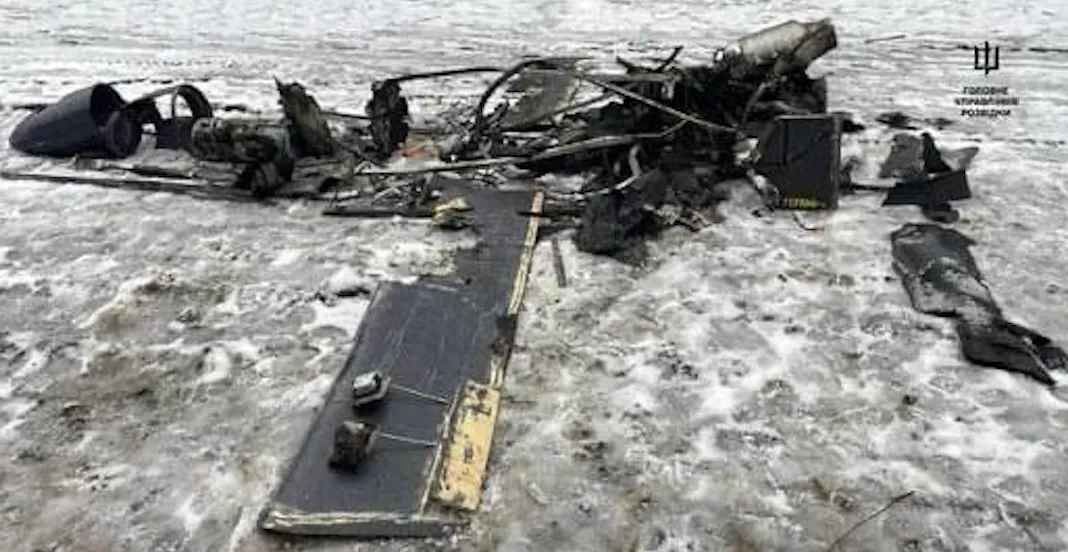
The latest iteration of Russia’s Geran long-range one-way attack drone features a jet engine and is apparently being considered for launch from aircraft to boost its range. The new drone, apparently first used at the beginning of this year, underlines Russia’s continued development of these drones, which bear the brunt of its relentless strikes on Ukraine, which ramp up during the winter months. It further points to Russia seeking to field drones that are better able to evade Ukraine’s air defenses, which are increasingly tailored to these kinds of threats.


In addition to the new powerplant, photos showing the wreckage of the Geran-5 reveal a significant change in the design. The previous Geran versions were based on the propeller-driven Iranian Shahed-136, with its cropped delta planform, blended wing/body configuration, and prominent stabilizing fins at the tips. In contrast, the Geran-5 has a more conventional aerodynamic configuration, with a tube-like fuselage with a centrally mounted straight wing, and a straight horizontal tail with finlets on each end. In this sense, the Geran-5 is actually a closer match to the Iranian Karrar drone, rather than the Shahed series.
A video showing the Iranian Karrar drone:

New Iranian long range combat drone “Karrar” HQ video
As for the engine, Ukrainian accounts state that this is a JT80 turbojet from the Chinese Telefly company. This is said to provide greater thrust than the jet engine used in the Geran-3. This earlier jet-powered drone was essentially a Russian analog of the Shahed-238, which shares its configuration with the prop-driven Shahed-136. Using a jet engine means the Geran-5 will be faster than the propeller-driven versions, making it harder to intercept.
According to the Ukrainian Ministry of Defense’s Main Directorate of Intelligence (GUR), the Geran-5 has a length of around 20 feet and a wingspan of approximately 18 feet. Overall, the drone weighs around 200 pounds, and it is thought to have a range of around 620 miles.

Despite its very different appearance, the GUR says that, apart from the engine, most of the components found in the Geran-5 are common to those used in previous Geran-series drones.
Key components include a 12-channel Kometa satellite navigation system, a feature widely used in Russian drones and other guided weapons. It also has a tracker based on a Raspberry Pi microcomputer and 3G/4G modems, according to the GUR.
Based on the mix of Iranian design heritage and Russian-introduced improvements, the GUR says that “it is difficult to consider this UAV an in-house development of the Russian Federation.” However, it’s unclear to what degree, if any, Iran provided direct support for the development of the new drone.
The GUR says that Russia is considering adding the option of one or more air-to-air missiles to the Geran-5 for self-defense. The Soviet-era, infrared-guided R-73 (AA-11 Archer) is mentioned specifically, which would presumably be mounted below the wings, in a similar configuration to what has been seen in the past on the Iranian-operated Karrar drone.

This would continue a line of development that Russia is already working on.
Last week, we reported on how Russia has begun arming its propeller-driven Shahed/Geran with a man-portable air defense system (MANPADS), the Verba. This development followed a previous version of the drone carrying a single R-60 air-to-air missile, which you can read more about here.
Perhaps most intriguing is the claim from the GUR that Russia is also looking at the possibility of adapting the Geran-5 for launch from crewed aircraft. Ukraine has published diagrams, the source of which is unknown, showing the Su-25 Frogfoot ground-attack aircraft carrying one of the drones under each wing.


At the very least, having an air-launched Geran-5 would provide an immediate boost in range for the one-way attack drone.
With internal fuel only, the Su-25 has a range, at low altitude, of around 320 miles. This increases when flying at higher altitudes for at least a part of the mission. The ferry range of the Frogfoot, with external drop tanks, is around 1,450 miles.
As well as increased range, launching the Geran-5 from Su-25s would allow the drones to approach their targets from less-predictable vectors, putting a greater burden on Ukrainian air defenses. This would be especially effective when the drones were launched as part of larger barrages containing conventionally (ground) launched Gerans, cruise missiles, ballistic missiles, and decoys.
Potentially, the air-launched Geran-5 could be used to attack targets of opportunity, although it’s unclear if the drone would be interfaced with the Su-25 in such a way that the pilot would be able to input target coordinates into it while the plane is in flight. However, Russia is certainly working to expand the ability to use the Geran with direct line-of-sight control, at least close to the front lines.
Recently, Shahed/Geran drones have been noted flying with direct line-of-sight antennas, which allow them to hit targets dynamically, much like a first-person-view (FPV) drone, but with a much greater destructive effect and with the ability to loiter for long periods of time. You can read all about this development here. Furthermore, the datalink range for the drone is being extended using airborne signal relays, possibly creating a mesh network with multiple line-of-sight links. Russian drones are also starting to feature Starlink terminals, which could provide a vastly superior beyond-line-of-sight capability.
These developments are increasingly blurring the classification of the Shahed/Geran from its original long-range one-way attack drone to a loitering munition, with an onboard imaging capability.
Taken together, there exists the potential at least to have the Geran-5 launched from a Su-25 relatively close to the front lines, then loiter over the battlefield for significant lengths of time, with at least some degree of control maintained over the drone either by ground troops on or near the battlefield, or even from the Su-25 itself, although this is more questionable.

Shahed/Geran one-way attack drones have been at the forefront of Russia’s ongoing campaign against Ukrainian cities and infrastructure, with a particular focus on the country’s energy supply as the winter continues to bite hard.
In an illustration of the scale of the current Russian campaign, in the past week, its forces launched almost 1,100 strike drones against Ukraine, as well as 890 guided aerial bombs and 50 missiles, Ukrainian President Volodymyr Zelensky said yesterday.
In the wake of extensive attacks on the Ukrainian energy grid last week, Ukraine’s largest private energy company, DTEK, said it was “the most difficult situation with electricity this winter.”
On the other hand, the fact that Russia continues to adapt and enhance its long-range one-way attack drone fleet points to the success of new Ukrainian weapons and tactics introduced to counter these threats.

While relatively small in number, Ukraine has been successful in using Western-supplied air defense systems, including specific counter-drone equipment, to tackle the Shahed/Geran menace. At the same time, Ukraine has ramped up the production of locally developed interceptor drones, some of which are specifically designed to counter the Shahed/Geran series.
Whether or not the Geran-5 is introduced in an air-launched capacity, the emergence of a new type of long-range one-way attack drone is another problem for Ukraine, provided that Russia can produce it in large volumes.
Contact the author: thomas@thewarzone.com