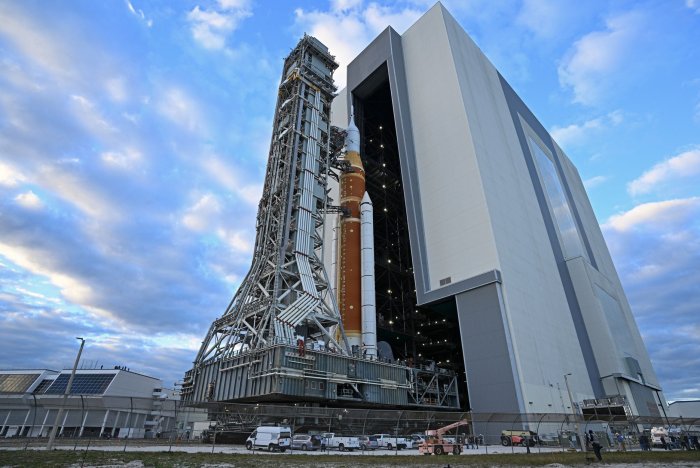
Jan. 17 (UPI) — NASA early Saturday morning started the slow roll of the 322-foot-tall Artemis II rocket from Kennedy Space Center’s Vehicle Assembly Building to Launch Pad 39B for final preparations before its launch to the moon.
The rocket — now fully assembled with the Orion spacecraft atop the Space Launch System rocket — started it’s 1-mile-per-hour journey from the VAB to the launch pad on the crawler-transporter 2 around 7:00 a.m.
The 11-million-pound stack’s four-mile trip could take up to 12 hours to complete, NASA said earlier this week.
Once on the pad, NASA and the four-astronaut crew will run tests on SLS, most significantly a wet dress rehearsal that includes fully fueling and unfueling the rocket, in the run up its launch window opening on Feb. 6.
“Artemis II will be a momentous step forward for human spaceflight,” NASA Administrator Jared Isaacman said in a statement. “This historic mission will send humans farther from Earth than ever before and deliver the insights needed for us to return to the moon.”
Artemis II is the second of three missions building to the first human return to the surface of the moon in more than 50 years.
NASA said it designed the Artemis missions for scientific discovery and potential “economic benefits,” as well as to prepare for future crewed missions to Mars.
The crew — Commander Reid Wiseman, Pilot Victor Glover, Mission Specialist Christina Koch and Mission Specialist Jeremy Hansen — has been at Kennedy Space Center since July training and preparing.
The 10-day Artemis II mission will take the four astronauts farther from Earth than any previous human as Orion enters orbit around the moon before heading back home.
During the mission, the astronauts will be tasked with testing Orion’s systems for deep-space travel, to gather data on how humans fare on the journey and to get a first-hand look at parts of the moon.
The most important part of testing the SLS ahead of launch is the wet dress, which allows NASA officials in mission control to make sure the rocket will function properly during launch.
In 2022, the wet dress rehearsal for Artemis 1 revealed a crucial fuel leak that had to be repaired on the launchpad before the first launch of the SLS, which was uncrewed — and successful.
While the first Artemis II launch window opens on Feb. 6, NASA said it will not announce a specific launch date until all testing, including the wet dress and a formal flight readiness review, is complete.
If NASA misses the February launch window, it already has windows identified in March and April that are suitable for launch.
The Artemis II moon mission, as well as 2027’s Artemis III moon mission, will be broadcast on NASA’s free app, its website and through the NASA+ channel it launched last year on Netflix using high-definition cameras to deliver much better views of the moon than the grainy images beamed back during the Apollo missions.
