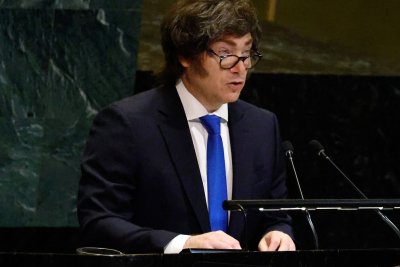

BUENOS AIRES, Dec. 26 (UPI) — Argentine President Javier Milei’s government is promoting a reform that seeks to redefine the role of the state in public education, curb direct government intervention and give families greater control over their children’s schooling.
A proposed law would legalize homeschooling, expand school choice and grant parents a more active role in school governance, including mechanisms to influence the appointment or removal of principals.
The stated goal is to introduce greater competition among educational institutions to attract students. The initiative has been submitted to Congress, and debate could begin in March.
The reform focuses primarily on basic education, which includes preschool, primary and secondary levels, while also introducing changes to the university financing system.
If approved, it would fully replace the current National Education Law in force since 2006.
“Argentina faces a deep educational crisis, as shown by our students’ results in national and international assessments,” a report by the Ministry of Deregulation and the Secretariat of Education said.
Internationally, PISA tests, which measure skills in math, reading and science, show stagnation or a sustained decline in the performance of Argentine students.
“Compared with other countries in the region, Argentina consistently ranks among the worst performers,” the report said.
Domestically, national assessments show that more than 80% of students in their final year of secondary school fail to reach satisfactory levels in math, while more than 40% have difficulties with reading comprehension.
The official diagnosis also describes the system as overly centralized and bureaucratic, with little room for pedagogical innovation and oversight mechanisms considered weak and lacking transparency.
“The family is the natural and primary agent of education; civil society is the space where it develops through various institutions and projects; and the state has the obligation to guarantee access, continuity and completion of studies at all levels,” the draft law says.
At the secondary level, reform would promote agreements between schools, companies and the productive sector to improve general education and vocational guidance.
Basic education also would be declared an essential service, requiring a minimum level of classes.
The bill recognizes multiple teaching modalities, including in-person, hybrid, community-based, home-based and distance learning, all subject to supervision and evaluation under national and local standards.
Julio Alonso, an academic at the University of Buenos Aires, told UPI the education reform is part of a broader package of changes pushed by the government.
“It is not an isolated measure. It is linked to labor and tax reforms,” he said.
According to Alonso, the central change lies in redefining the role of the state relative to that of families.
“The state takes on a subsidiary role. It guarantees access, but the main decisions fall to parents. The family is formally established as the central actor in the education system,” he said.
Another key point, he said, is the abandonment of a unified national curriculum. Provinces and the country’s capital would assume full responsibility for education, while the federal government would be limited to setting common minimum content.
“The idea of a national education project is left behind. In practice, responsibilities are further delegated to provincial governments,” Alonso said.
He added that the initiative also decentralizes education financing by eliminating the legal spending floor equivalent to 6% of gross domestic product.
“Under this reform, provinces would cover costs with their own resources, while the national government would concentrate spending on direct transfers to families,” he said.
A third pillar of the proposal concerns teachers, with greater family participation in evaluation processes, though not in hiring decisions.
Alonso warned, however, that the reform faces political and social obstacles. The ruling coalition lacks a majority in Congress and depends on support from provincial lawmakers — a weakness recently seen during the budget debate.
On the social front, Alonso anticipates strong resistance, particularly over cuts to the university system, with possible strikes and protests.