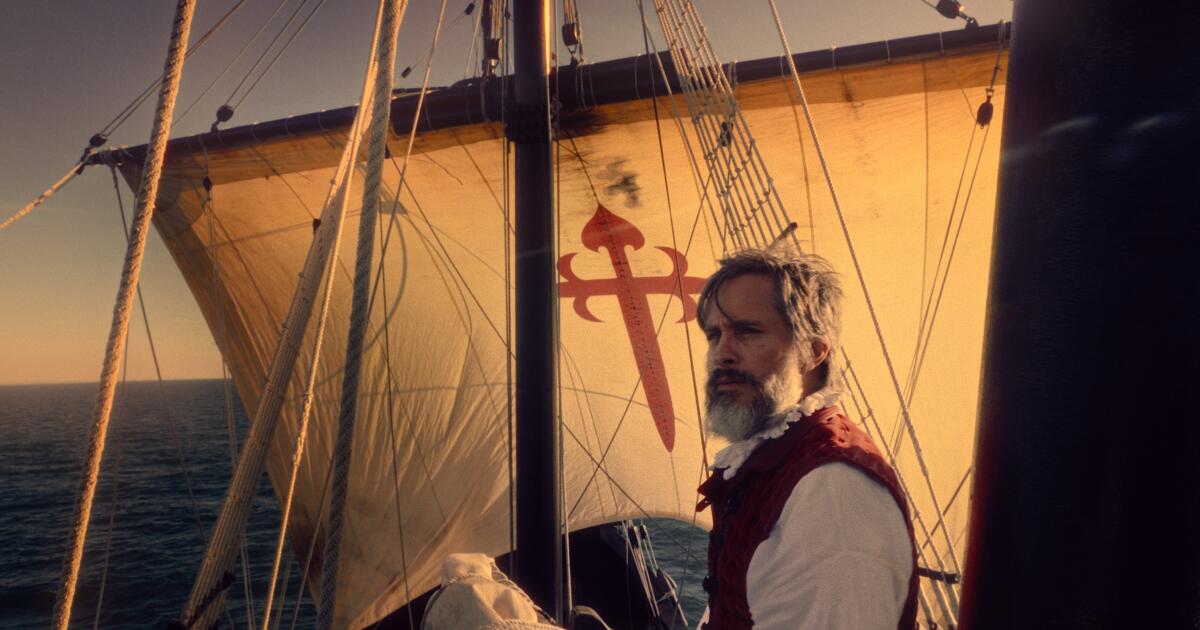
Leave it to slow cinema auteur Lav Diaz (2013’s four-hour “Norte, The End of History”) to serve you colonialism in real time, in all its stark ugliness and mind-curdling greed, but also alongside a sense of wonderment. The Filipino filmmaker’s 163-minute epic “Magellan,” starring Gael García Bernal as the 16th century Portuguese explorer, is a regimen and a cure simultaneously, correcting a conqueror narrative that has too often centered on excitement and unfettered might over the madness of such endeavors.
With a breathtaking eye for one-shot scenes and unwavering confidence in the demands he makes on our monkey-brained attention spans, Diaz has crafted a stunning piece of time travel, its languidness and exquisitely hued imagery working in perfect sync. As arthouse fare goes, “Magellan” counts as accessible if you’re familiar with Diaz’s stately, intimate work, but also serves as an ideal introduction to his uncompromising vision.
A nude Indigenous woman rummages in a picturesque rainforest river, then collapses in shock at something witnessed off camera. “I saw a white man!” she warns her people. Shortly after, we see horrific tableaux of slaughtered bodies on the bloodied, gently lapping shores and verdant inland of the Malaysian peninsula, which was conquered by the Portuguese in 1511.
Ferdinand Magellan (Bernal) was then only a cog in his country’s subjugation machinery, but this crewman has ambitions for future campaigns. They’re not necessarily aligned with his superiors’ venal greed, expressed feverishly in a victory speech by a hammered conquistador: “We will suffocate the entire world! Islam will finally disappear!” (Then he passes out.) But as we’ll eventually see, the need to dominate does things to men’s souls.
A few years later, scorned by the king, Magellan is limping around Lisbon like a scruffy, taskless animal. He eventually finds favor with Spain for his grand journey, mapping an uncharted route to the East’s spice islands, which means leaving behind his pregnant wife, Beatriz (Angela Azevedo). That legendary multiyear circumnavigation, a 45-minute sequence marked by paranoia, hallucinations, death, disease, starvation, groaning silence and crushing despair, makes for one of the most casually brutal depictions of transoceanic voyaging ever committed to film. Mesmerizingly severe yet still streaked with glimpses of natural beauty, the sequence practically trains you to listen for the seabirds that spark the eventual scream of “Land!” Devoid of music or melodrama, this is slow cinema at its most viscerally rigorous and patient.
It also sets up the acute psychology that drives Magellan: obsessive curiosity warping into enforced Christian conversion, a consequential folly to which the filmmaker adds his own historical take. Up till then, Bernal, without the conventional assistance of close-ups, registers this feature-length change with brilliant subtlety across Diaz’s and co-cinematographer Artur Tort’s captivating, distanced long takes, often marked by angled perspectives.
Magellan’s occupier’s mentality is pointedly contrasted with the movie’s other key figure, Enrique (Arjay Babon), whose journey from purchased Malay slave to assimilated translator is a harrowing portrait of unrooted ache. Spiritual wailing is common in “Magellan,” whether from Enrique in his moments alone or from the invaded Indigenous pleading for help, or back in Portugal, from the black-clad wives who line the beach, waiting for word of their husbands’ fate. Time stretches punishingly throughout this masterful “Magellan,” foregrounding the painful legacy of colonialism and prioritizing a raw splendor that can never truly be conquered.
‘Magellan’
In Portuguese, Spanish, Cebuano and French, with subtitles
Not rated
Running time: 2 hours, 43 minutes
Playing: Opens Friday, Jan. 9 at Landmark’s Nuart Theatre