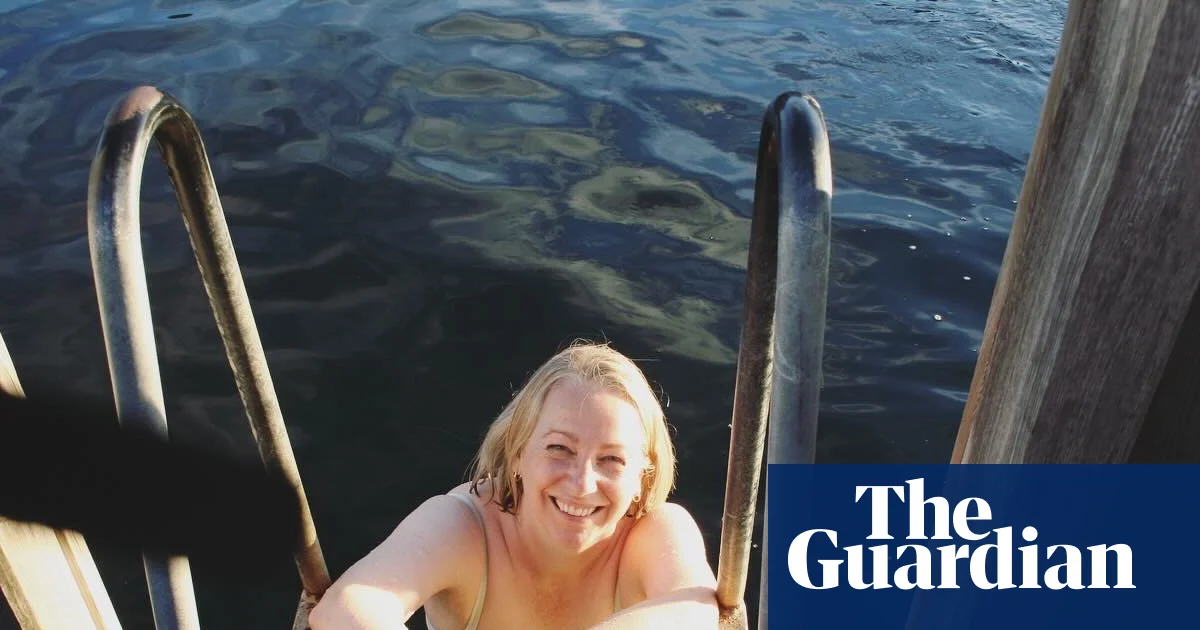
Warm lights shine from the houses that dot the wintry slopes of Mount Fløyen and a cold wind blows as I stand in a swimming costume trying to talk myself into joining my friends in Bergen harbour. Stars are already appearing in the inky mid-afternoon sky.
Life-changing moments are easy to spot in retrospect, but at the time they can feel so ordinary. I didn’t know then that my wintry swim would lead to a year of adventures. I was a hair’s breadth from wimping out, but then I was in. The water was so cold it burned. I gasped for breath. The bones in my feet ached with cold as I trod water, legs frantic under the dark surface. It lasted under a minute and then we were out.
As we warmed up, hands around mugs of hot chocolate, skin zinging from the experience, more and more women arrived at the cafe, hair wet from the sea. As stars spread across the early evening sky, we chatted about swimming and how it made us feel. I’d been looking for something to pick me up ever since I had left my job on the verge of burnout. I said to my friend: “I’m going to spend a year doing this. I’ve finally found what makes me feel alive. I’m going to spend a year swimming in the Nordic countries.”
There are some delightful generalisations to make about Nordic people. Finns, they say, are born in the sauna. Norwegians are said to be born on skis. But if you ask me, all Nordic people are born with saltwater in their veins: that’s how much they love the sea. In Iceland it’s so ingrained that people see water as a cure-all. If you need time to think, if you need perspective, they say you should lay your head in water. It became my mantra for the year.
I decided to swim once a week wherever I was. After my experience in Bergen, I returned to my home in Copenhagen and started to plot a route around the region. Where would I swim if I could swim anywhere? I could take a dip in the harbour outside my flat – that was easy. But what about Sweden, 35 minutes away by train? What about the Arctic – could I do that? Maybe I’d swim in Allas Pool, the heated floating swimming pool in Helsinki harbour I’d seen on Instagram.
As a journalist covering Scandinavia, the travel side was easy; all I had to do was pack my kit wherever I went on assignment. I only needed a swimming costume, two towels, one for my feet and one for my body, and an S hook to hang my bag from. That last tip came from a lady I swam with one pitch-black morning in central Copenhagen: you don’t want to inadvertently leave your bag in a puddle, after all.
I reached out to other Scandinavian swimmers on Instagram to ask if I could join them for a dip if I was in town. I looked up places with saunas, natural spas and simple stretches of beach where other people regularly swam. Serendipitously, things started to happen. I went to write about a tiny hotel on a remote archipelago in Arctic Norway and I found myself packing a swimming costume. I landed in a snowstorm and the next day picked my way down an icy path from the Arctic Hideaway’s sauna to the quay in my flip-flops. Looking down, I could make out the dark purple spiny sea urchins moving on the seafloor. And then I was in, head under the water, in a sea where an orca had been seen just days before.
At the Arctic Hideaway I met Siri, a champion freediver, and a few months later I went to meet her in Oslo. I swam in a harbour pool all by myself, as if I owned it, with views of the Oslofjord’s rocky pine-covered islands stippling the horizon. At lunch, Siri told me how she had dived with orca in northern Norway and seen a huge bull orca spot her, turn and swim towards her. He had appraised her with one of his black eyes before calmly swimming away. I was in awe of what you can find in the sea if you go looking.
As the year went on, my swimming confidence grew. I met dippers dressed as mermaids, whirlpool swimmers, lighthouse swimmers and a lot of naked swimmers. I met people setting themselves big swimming challenges, and those who make a daily practice of submerging themselves in the water for their health and for fun. It has been a life-changing adventure.
I knew I had really changed when I found myself swimming in Greenland. On a tiny island called Uunartoq in the south of the country, I stripped down to my black swimming costume. Just off shore, two icebergs, each the size of a three-bedroom detached house, floated beneath stern black mountains. Up the hill, there was a natural hot pool with gently simmering water. But all I wanted to do was get in the sea.
My feet sank into the feather-soft sand of the beach as I ran and threw my body into the waves. Little pieces of seaweed drifted in the water and I could see all the way to the bottom. I was out quickly, unable to take the cold for long. But I ran up and down the beach to warm up so I could go in again, this time for longer. Then I climbed the hill and sank into the 38C waters of the island’s hot spring, watching tiny bubbles percolate up from the silty floor.
After a year of swimming in some of the world’s coldest seas, I’ve learned a lot about my ability to do hard things. I’ve learned that doing things that make you feel alive, with other people who feel the same, is intoxicating. I’ve found that sinking into nature on a regular basis makes you feel part of it. I’d started the year feeling burnt out and depressed, not sure if I could find a future for myself in this part of the world. But I learned that while I will always be English, it’s still possible to get a little saltwater in your veins.
The Year I Lay My Head in Water: Swimming Scandinavia in Search of a Better Life by Laura Hall is published by Icon at £18.99. To support the Guardian, buy your copy at guardianbookshop.com. Delivery charges may apply