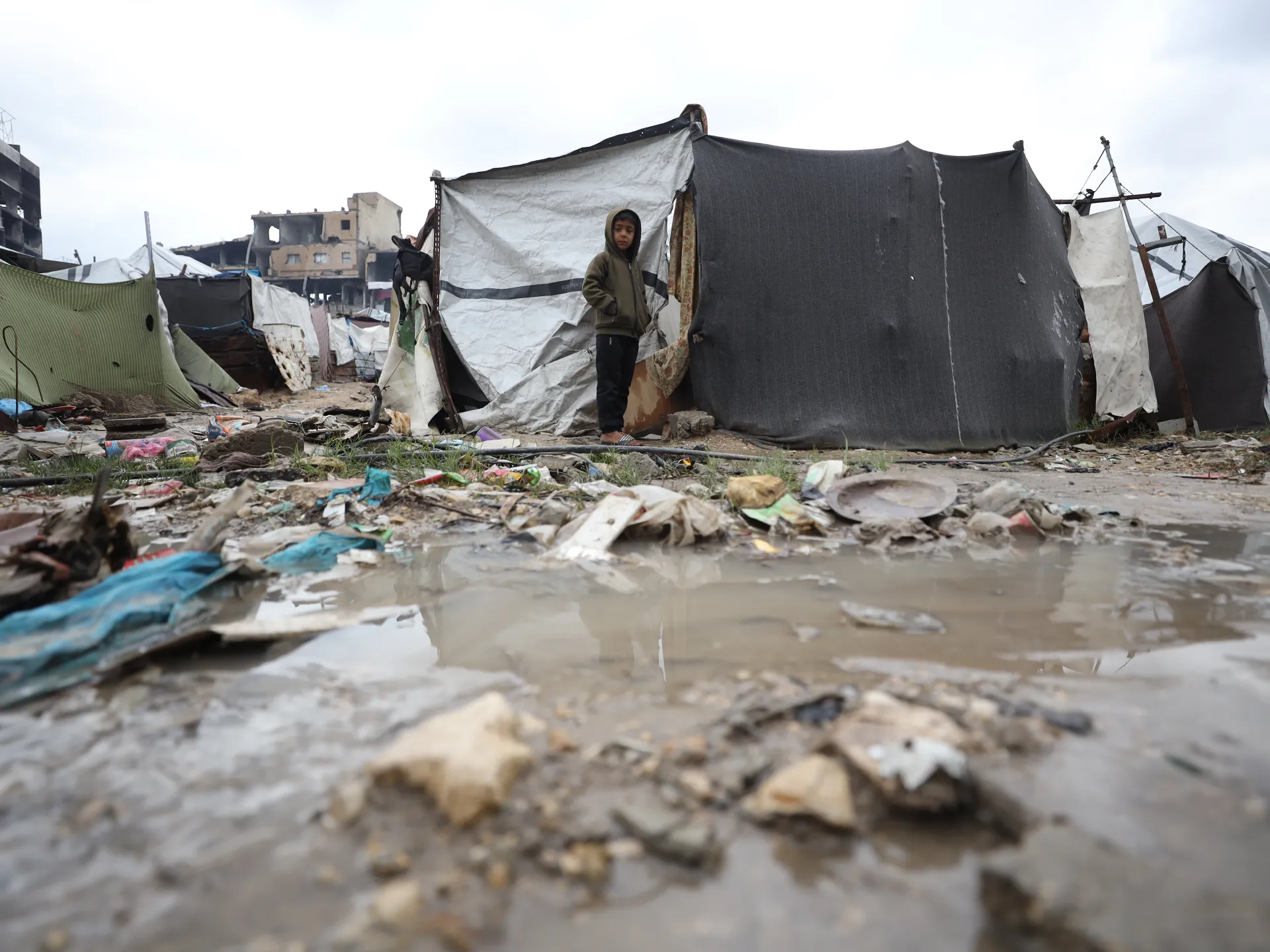
The Israeli military has spent the past 24 hours expanding the so-called “yellow line” in eastern Gaza, particularly in eastern Gaza City’s Tuffah, Shujayea, and Zeitoun neighbourhoods, according to Al Jazeera teams on the ground, squeezing Palestinians into ever smaller clusters of the enclave.
The Israeli army’s actions on Monday are also pushing it closer to the key artery of Salah al-Din Street, forcing displaced families sheltering near the area to flee as more of them come under intensive threat, as Israel’s genocidal war on Gaza shows no signs of abating.
Recommended Stories
list of 3 itemsend of list
Israel now physically occupies more than 50 percent of the Gaza Strip.
Since the ceasefire took effect, Israeli attacks have killed at least 414 Palestinians and injured 1,145 in daily truce violations despite the ceasefire deal mediated by the United States on October 10.
Al Jazeera’s Hani Mahmoud, reporting from Gaza City, said, “The ongoing Israeli attacks on the ground, the expansion of the ‘yellow line’ are meant to eat up more of the territory across the eastern part, really shrinking the total area where people are sheltering.”
“Everyone is cramped here. The population here not just doubled but tripled in many of the neighbourhoods, given the fact that none of these people is able to go back to their neighbourhoods. We’re talking about Zeitoun, Shujayea, as well as Tuffah,” he added.
“It was not until the past few minutes that the sounds of hums, the drones buzzing, faded away, but it had been going on for the past night and all of yesterday. Ongoing explosions that could be heard clearly from here,” Mahmoud said.
Intense artillery bombardment and helicopter fire also resumed on Monday in the areas south of the besieged enclave, north and east of the cities of Rafah and Khan Younis.
On Sunday, Israel launched more attacks into parts of Gaza outside its direct military control. At least three Palestinians were killed in separate Israeli attacks in Khan Younis, medical sources told Al Jazeera.
A five-storey building belonging to the al-Shana family in the Maghazi camp in central Gaza collapsed. It had been subjected to Israeli bombing at the end of 2023.
Civil Defence teams are searching for missing people under the rubble. The Wafa news agency reported that at least five people were injured.
Israeli push to make Rafah crossing ‘one-way exit’
Expectations have heightened around the possible reopening of the Rafah crossing, fuelling both desperate hope and deep fear.
For many in Gaza, there is some hope it could offer a lifeline, allowing the sick and wounded to access medical care, reuniting separated families, and giving some people a rare chance to move in or out of the Strip. Some also see it as a potential sign of easing restrictions.
But fears remain strong. Many worry the opening will be limited and temporary, benefitting only a few. Others fear it could become a one-way exit, raising concerns about permanent expulsion, effectively Israeli ethnic cleansing, and whether those who leave will be allowed to return.
“Until this moment, there’s nothing on the ground other than the headlines we’ve been reading over the past couple of days, the expectation now that within days the Rafah crossing is going to open and allow for movement in and out of Gaza. So far, we know the Israeli military is pushing for Rafah to be just a one-way exit,” Al Jazeera’s Mahmoud reported.
After months of uncertainty, people in Gaza who have suffered unimaginable loss and destruction are cautious. Even the possibility of relief comes with questions and little trust in what will happen next.
At least 71,386 Palestinians have been killed and 171,264 injured since the start of the war in October 2023, according to the latest figures from Gaza’s Ministry of Health. At least 420 people have been killed since the ceasefire was agreed upon three months ago.
The Israeli military continues to block a large amount of international humanitarian aid amassing at the Gaza crossings, while maintaining that there is no shortage of aid despite testimonies by the United Nations and others working on the ground.