There were no stars in the October sky. No moon that 64-year-old Masuma Khan could see from the narrow window of the California City Immigration Processing Center.
“No planes,” she said, recalling her confinement.
Once a prison, the facility in the Mojave Desert, located 67 miles east of Bakersfield, reopened in April to hold people in removal proceedings, including Khan.
It was not the kind of place where she imagined ending up — not after living in the country for 28 years, caring for her daughter and surviving one of California’s deadliest wildfires, the Eaton fire.
Khan was fortunate not to have lost her west Altadena home to the Jan. 7 fire, which destroyed more than 9,000 structures and killed 19 people.
But in the months that followed, Khan faced another threat — deportation.
As fire recovery efforts were underway in Los Angeles, the Trump administration launched immigration raids in the city, hampering recovery efforts and creating more distress for immigrants after the fires.
Although Trump said the mass deportations would target criminals, news reports and court filings show the roundups ensnared immigrants with no criminal history, green card applicants, even American citizens.
Khan worried. She was in the process of adjusting her immigration status and was required to check in every year with U.S. Immigration and Customs Enforcement.
An immigration attorney reassured her that there was no cause for concern: Her husband and daughter were citizens, she had no criminal record, and her case was still under review.
And so, on Oct. 6, Khan drove to downtown Los Angeles for her routine immigration check-in and found herself caught up in Trump’s deportation surge.

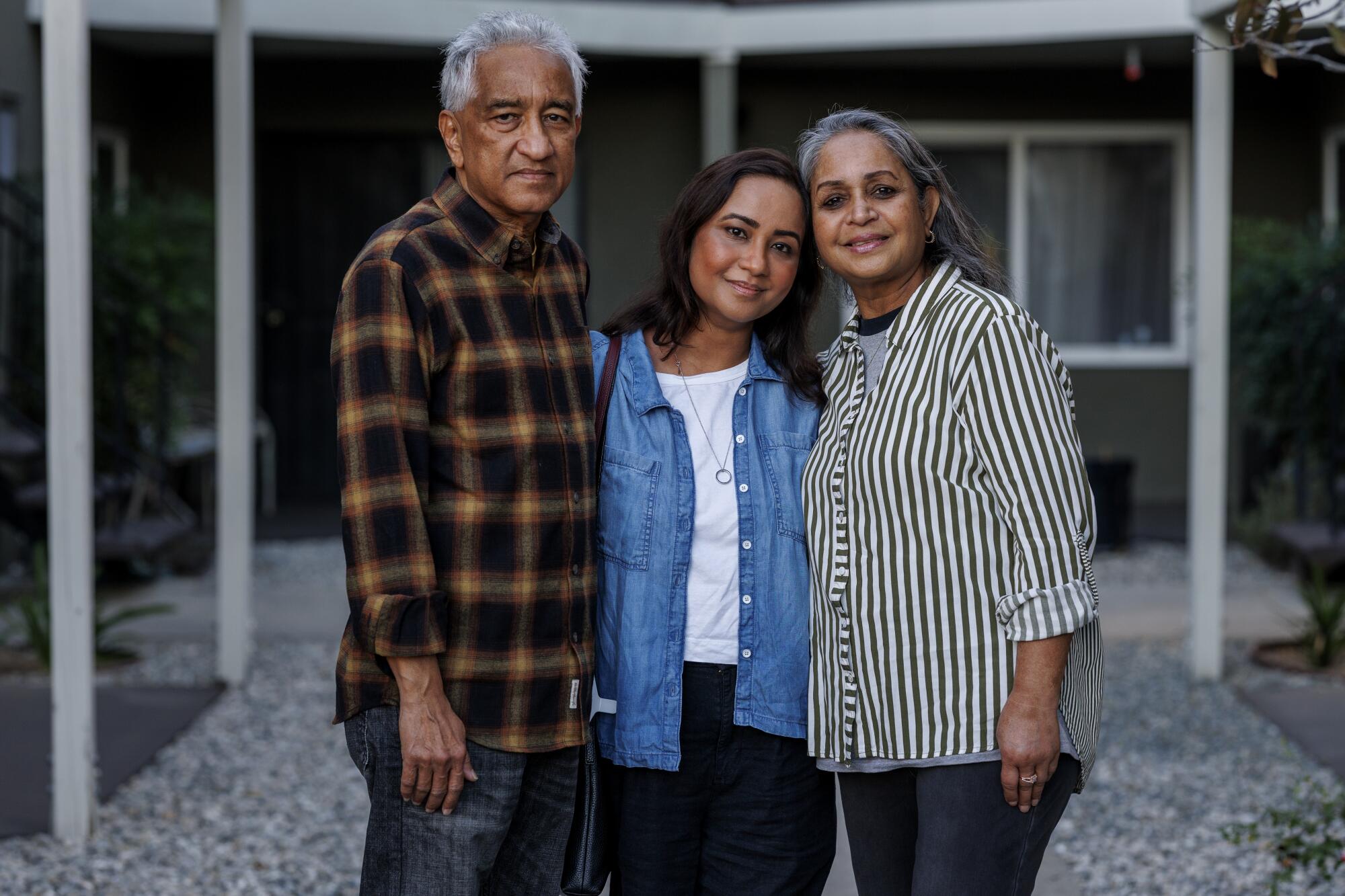
Eaton fire survivor Masuma Khan, 64, right, with her daughter Riya Khan and husband Isteak Khan after bring released in December.
(Gina Ferazzi/Los Angeles Times)
Khan was taken into custody by ICE agents and kept in a cold room for almost an entire day. She said agents denied her access to a lawyer and a phone until she signed deportation papers. Khan resisted but later signed.
She was placed in a van with other detainees and driven three hours north to the detention center in California City. She said there was no air conditioning in the van and she became nauseous and started to experience hypertension symptoms.
At the facility she was denied access to medications for high blood pressure, asthma, peripheral arterial disease, general anxiety and hypothyroidism, she said.
Khan, who is also prediabetic, said she struggled to maintain her health at the facility. Her blood pressure spiked and she began to experience stroke-like symptoms. Her legs swelled up and she became weak.
She said the facility was so cold that people often became ill, including staff. She and other women used socks as scarves, sleeves and mittens but were threatened with fines if they continued to misuse the garments.
She said she became sick and her vision got blurry without her prescribed eye drops. Her Halal meals shifted to a medical diet that included pork, which she cannot eat because she is Muslim.
Khan’s experience at the facility was similar to that of other detainees who filed a federal class-action lawsuit against the Department of Homeland Security and ICE. They alleged inhumane conditions at the facility that included inadequate food, water and medical care, frigid cells and lack of access to medications and lawyers.

The California City Immigration Processing Center in Kern County, where Masuma Khan was held.
(Patrick T. Fallon/AFP/Getty Images)
In an email response, Tricia McLaughlin, a DHS spokesperson, said any claims about “subprime conditions at ICE detention facilities are false.”
“All detainees are provided with proper meals, certified by dietitians, medical treatment and have the opportunities to communicate with lawyers and family members.”
Khan said she spent most days in her cell crying.
“I missed my family, I missed everything,” she said “I was frustrated.”
She often thought of home: her husband and daughter, her small garden and the birds she fed daily with seeds and oranges from her balcony.
It would be weeks before she could see her family again, before she could gaze at the mountains and hear the symphony of wildlife.
‘Like an inferno’
The Eaton fire had been raging for hours in west Altadena when Khan and her husband were awakened by evacuation alerts on their phones at 3:30 a.m.
Khan got out of bed and from her bedroom window could see flames raging in the mountains.
Khan hadn’t seen anything like it. Four years before she arrived, the Kinneloa fire, sparked by a campfire, erupted in the same mountains. It fed on dry and flammable vegetation and was driven by Santa Ana winds. It was a destructive fire.
But the Eaton fire was different. Hurricane-force winds helped spread the embers and flames deep into the town’s heart — destroying homes, schools and countless structures.

A business and vehicle are a total loss as the Eaton fire rages along Lake Avenue in Altadena on January 8, 2025.
(Gina Ferazzi/Los Angeles Times)
Khan and her husband, Isteak, didn’t have time to grab much before fleeing in their car that evening.
“It was like an inferno,” Isteak Khan, 66, recalled. “You could see the embers flying everywhere. It was very chaotic.”
The couple drove about three miles south to a supermarket in Pasadena. For a month they lived at a hotel until they were allowed to return home.
When they got back the surrounding neighborhoods were in ruins: Trees were charred, cars were stripped down to metal frames and homes were gutted or left in ash.
The couple’s apartment still was standing but had suffered smoke damage and there was no electricity, no safe water to use. The couple depended on water bottles and showered at the homes of relatives.
Khan never thought she would experience such a disaster in the U.S. Then again, she didn’t journey here for her own reasons. She came to save her daughter.
‘Incredibly traumatized’
In August 1997, Khan was living in Bangladesh with her husband and their 9-year-old daughter, Riya. That month Riya had traveled with her grandparents to the U.S. to see relatives when she fell seriously ill. Doctors determined she was suffering from kidney failure and needed ongoing treatment including chemotherapy and peritoneal dialysis.
Khan traveled to the U.S. on a visitor’s visa to be with Riya. For more than a decade her daughter received treatment at the Children’s Hospital in Los Angeles.
Khan became her daughter’s primary caretaker and did not return to Bangladesh as her visa was expiring. Her husband joined her in 1999 after obtaining a visa. He and Riya eventually received green cards and became citizens.
The following year, as Khan looked for legal ways to adjust her immigration status, she met a man at a Bangladeshi grocery store who befriended her and offered to help her obtain a green card, according to court records. Little did Khan know that this man — who spoke her language and was well known in the Bangladeshi community — was a scammer, one of many who prey on South Asians migrating to the U.S.
At the time Khan did not speak, read or write English well, and this man told her he could file an asylum application on her behalf, for a fee amounting to several thousand dollars.
But Khan was unaware this man had filed the application for her using a false name and listed his own address for future correspondence from immigration authorities, according to court documents.
All this came to light when she showed up for an asylum hearing in Anaheim in 1999 and responded to the questions of an asylum officer who noticed the information did not match what was in the application.
The officer denied the application, and later she was unaware of a notice to appear before an immigration court, since it had been sent to the scammer’s address.
Her absence at the hearing prompted an immigration judge to order her to be deported. Khan did not find out about the court’s action until 2015, when her husband petitioned to adjust her status so she could obtain a green card.
After the petition was denied and her case was closed because of the deportation order, Khan hired an immigration attorney who sought to reopen the case. But a judge denied it, and her appeal also was rejected by the 9th Circuit Court of Appeals.
In February 2020, Khan was detained by ICE but released and required to check in with immigration officials. That year she hired an immigration attorney who submitted paperwork to let her stay in the U.S. The application was pending when ICE took her into custody on Oct. 6.
McLaughlin, the DHS spokesperson, said there was no reason for the government to reconsider her case, since Khan had a final removal order since 1999 and had exhausted all appeals.
“She has no legal right to be in our country,” McLaughlin said. “DHS law enforcement lawfully arrested her on Oct. 6.”
Yet Khan caught a break in early November when a federal judge ordered her released. The judge ruled the government cannot detain Khan without giving her a hearing and explaining why it needs to detain her.
It was a victory for her legal team, made up of a law firm and two nonprofit groups — the South Asian Network and Public Counsel and Hoq Law APC.
Laboni Hoq, a chief attorney on the case, said the goal is to keep Khan out of detention while the team seeks to adjust her status.
“We’re feeling like she has a shot to pursue that process … given her long history in the country and that she is law-abiding and has met all the requirements to deal with her case through the court system and immigration system,” Hoq said.
Khan’s predicament has drawn the attention of numerous Southern California politicians, including U.S. Rep. Judy Chu and U.S. Sen. Adam Schiff. Much of it had to do with Khan’s 38-year-old daughter, Riya, who reached out to the lawmakers and also took to social media to bring her mother’s case to the public’s attention.
Still, it is unclear what will happen next.
As Khan’s legal fight proceeds, she must check in regularly with immigration authorities, as she did in downtown L.A. on Dec. 19, accompanied by Sen. Sasha Renée Pérez (D-Alhambra), who also became aware of her case from Riya’s efforts.
“She’s incredibly traumatized by what’s happened to her,” Pérez said of Khan. “She’s scared to even participate in the community events that we have during the holidays … it’s painful, it makes me angry, it makes me sad and I just wanted to be here with her.”
At their Altadena home one recent evening, the Khans sat in their living room. Riya said the hope was that the case will be reopened so her mother can obtain a green card.
“We’re going to stay together,” Isteak said.
Not far from Masuma, old “welcome home” balloons hovered. As she sat next to her daughter, she could express only two things: “I cannot leave this country. This is my home.”