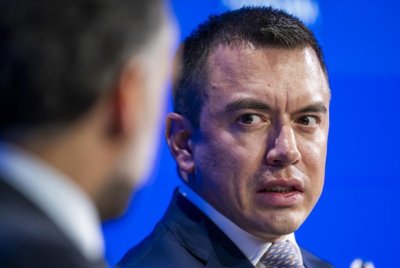

Ecuadorian President Daniel Noboa said a 30% tariff would apply to certain Colombian imports starting Feb. 1. Photo by Gian Ehrenzeller/EPA
Jan. 22 (UPI) — Ecuador and Colombia have initiated a tariff dispute after a decision by Ecuador’s government to impose a 30% duty on imports from Colombia, a move Quito justified on grounds of border security concerns and a persistent trade imbalance.
Colombia responded swiftly, suspending electricity exports to Ecuador and announcing equivalent tariffs on an initial list of 20 Ecuadorian products, escalating tensions between the two Andean neighbors.
Ecuadorian President Daniel Noboa said Wednesday that the 30% tariff would apply to certain Colombian imports starting Feb. 1, citing what he described as a lack of reciprocity and insufficient security cooperation by the government of Colombian President Gustavo Petro.
The measure will remain in force “until there is a real commitment to jointly confront drug trafficking and illegal mining along the border,” Noboa said in a post on X.
Noboa contended that Ecuador has made “real efforts of cooperation” with Colombia, despite running a trade deficit that he said exceeds $1 billion annually. He added that those efforts have not been met with comparable actions by the Colombian side.
The sectors most affected by the 30% tariff are expected to be those with the highest share of bilateral trade, including electricity, pharmaceuticals for human use, certain food products, cane sugars, jet fuel, vehicles and unroasted coffee.
Colombia’s Minister of Trade, Industry and Tourism Diana Marcela Morales Rojas said the 30% tariff Colombia will apply to 20 products imported from Ecuador is a temporary instrument aimed at restoring balance to bilateral trade conditions.
“In the government of President Gustavo Petro, we have strengthened the state’s institutional capacity to act in a technical and proportional manner, in accordance with existing regulations, when the rules governing trade between countries are altered,” Morales said, according to local outlet El Colombiano.
As part of the escalating dispute, Colombia’s Ministry of Mines and Energy announced Thursday the suspension of International Electricity Transactions with Ecuador, arguing the decision was necessary to guarantee domestic energy supply.
The ministry said the move responds to climate variability and projections of reduced firm energy availability in Colombia’s national interconnected system, factors it said increase risks to the country’s energy security.
“The duty of the state is to ensure, above all, that Colombian households, industry and essential services have secure and reliable energy,” said Energy and Mines Minister Edwin Palma Egea, according to Ecuadorian daily El Universo. He described the suspension as “a responsible, preventive and sovereign decision.”
The suspension is indefinite. Palma said Colombia rejects “unilateral measures imposed by the neighboring country,” but expressed confidence that diplomatic channels and open dialogue could quickly resolve the differences.
“When energy security conditions are restored and a framework of trust and good faith between both countries is rebuilt, Colombia will be willing to resume electricity exchanges,” he said. “Integration cannot be built at the expense of sovereignty or the well-being of our people.”
Ecuador relies on Colombian electricity imports to supplement its largely hydroelectric power system, particularly during periods of reduced rainfall that affect river flows and reservoir levels.
In response to the electricity suspension, Ecuador announced it will impose new tariffs on transporting Colombian crude oil through one of its pipelines.
In a post on X, Ecuador’s Minister of Environment and Energy Inés Manzano said that “the transport tariff for Colombian crude through the OCP pipeline will reflect the reciprocity received in the case of electricity.”
She added that Ecuador is prioritizing border security, its trade balance and its energy security.
These measures add to earlier restrictions along the border. Since Dec. 24, Ecuador has limited cross-border transit for security reasons, keeping open only two official crossings with Colombia and Peru.