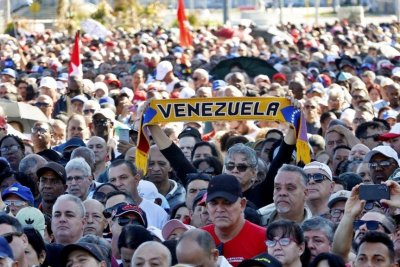

People attend an event held at the Anti-Imperialist Tribune in support of Venezuela in Havana on Saturday. Cuban President Miguel Diaz-Canel condemned the United States’ attack on Venezuela and the capture of President Nicolas Maduro and his wife, Cilia Flores. Photo by Ernesto Mastrascusa/EPA
BUESNOS AIRES, Jan. 6 (UPI) — Cuba is navigating another delicate moment in its recent history after the capture of Venezuelan President Nicolás Maduro by U.S. forces Saturday.
The operation that removed him from Caracas and left him facing a court in New York killed 32 Cuban soldiers, part of Maduro’s praetorian guard, and abruptly dismantled the island’s main economic lifeline.
The blow comes amid an energy and health crisis already considered the worst in decades — and one that could now deepen rapidly.
For more than 20 years, the alliance with Venezuela served as a strategic pillar for the Cuban government. The exchange of subsidized oil for medical and security services allowed Havana to sustain its economy after the Soviet collapse and cushion the impact of the U.S. embargo.
Maduro’s fall and the prospect of a regime change in Caracas directly disrupt that balance and place Cuba in a position of heightened economic and political vulnerability.
In the days after the Venezuelan leader’s arrest, the Cuban government responded with a mix of public gestures of support, internal political mobilization and tighter security.
On Saturday, President Miguel Díaz-Canel led a protest outside the U.S. Embassy in Havana, where he said Cuba was prepared to defend its alliance with Venezuela “even at a very high cost.”
The next day, the government decreed two days of national mourning in response to events in Venezuela. Senior officials dominated state television broadcasts to reinforce the idea of a “shared homeland” and a historic resistance to adversity.
The official narrative sought to counter statements by U.S. President Donald Trump, who publicly warned that allies of chavismo would face direct consequences.
Speaking about the island nation just 90 miles from Key West, Fla., Trump said, “Cuba is ready to fall … going down for the count,” while aboard Air Force One on Sunday.
On Monday, according to diplomatic sources, Cuban authorities stepped up surveillance at strategic facilities and convened emergency meetings. At the same time, reports of prolonged blackouts multiplied across several provinces — a concrete sign of the fragility of the energy system, as Venezuelan assistance could disappear or be sharply reduced within weeks.
Cuba’s energy crisis stems from a combination of obsolete infrastructure, chronic lack of maintenance and fuel shortages.
Most electricity generation depends on decades-old thermoelectric plants that are frequently offline due to breakdowns. Limited alternative capacity forces the state to rely on floating plants and diesel generators, whose operation depends on imports the country cannot secure due to a lack of hard currency or the loss of free supplies from traditional allies such as Venezuela.
Venezuelan lawyer and former prosecutor Zair Mundaray told UPI that for decades, Cuba depended entirely on Venezuelan oil, and that the collapse of Petróleos de Venezuela, S.A., Venezuela’s state‑owned oil and gas company, which started around 2014, broke that anchor. That left the island exposed to more frequent blackouts and a deeper economic downturn.
“In that vacuum, Mexico’s assistance emerged,” Mundaray said.
Press reports indicate that during the peak years of cooperation with Cuba, Caracas sent between 90,000 and 120,000 barrels per day. Since 2023, the Mexican state has shipped hundreds of thousands of barrels of crude and diesel to Cuba in operations valued at more than $300 million.
For economic historian Leandro Morgenfeld at the University of Buenos Aires, one of the objectives of U.S. intervention in Venezuela is to deepen Cuba’s isolation.
“The United States sees the Western Hemisphere as its exclusive domain. It will not accept the presence of extra-hemispheric forces and is willing to remove governments if it believes its interests or national security are at risk,” Morgenfeld said.
From that perspective, he added, the goal goes beyond Venezuela and seeks to dismantle the political and economic ties that sustain adversarial governments in the region, including Cuba.
“That is why they want to cut the political and economic link with Venezuela and further suffocate the island. Despite the blockade, they aim to intensify financial pressure to achieve what they have pursued for decades: the fall of the Cuban revolutionary government,” he said.
Morgenfeld said concern in Havana is real and deep. Cuba has faced a complex economic situation for years, marked by sanctions, lack of hard currency and low productivity.
“It is no longer, as in other times, an economy with easy sources of financing. If chavismo were to fall, the impact on Cuba would be very severe, economically and politically,” he said, while noting that a full regime change in Venezuela has not yet occurred.
From another angle, Colombian political scientist Christian Arias Barona said it is premature to anticipate an immediate collapse of the Cuban model.
He told UPI that as long as Delcy Rodríguez remains in power and U.S. hostility does not intensify, an abrupt shift is unlikely.
“Cuba would not face a drastic alteration in its economy or international relations, especially in its ties with Venezuela, from which it receives significant assistance, particularly in energy,” Arias Barona said. “Nor would its links with Russia and China be immediately affected.”
He recalled that Cuba’s recent history reflects an ability to adapt to adverse scenarios. Since the 1959 revolution, the island has faced what he described as constant “aggressions and hostilities” from the United States, including the ongoing economic embargo.
“That experience has allowed it to develop mechanisms of political and diplomatic survival,” he said.
Arias Barona also noted that the U.N. General Assembly has repeatedly voted against the U.S. embargo on Cuba, calling it a unilateral measure without backing in international law.
However, he said the United States, as a permanent member of the Security Council, has maintained its position and secured occasional support, including from Israel and, in recent votes, Argentina, Ecuador and Paraguay.
“What we are seeing today is a situation that increases Cuba’s vulnerability,” he said.
Sociologist Luis Wainer, also an academic at the University of Buenos Aires, agreed it is too early to project definitive scenarios.
“We do not know whether there will be a change in the political and economic model, how such a transition would look or even whether a transition will exist,” he told UPI.
“We are at a moment of negotiations, where what will be defined is who manages to impose the conditions,” he said.
Wainer said strong interest exists in framing this moment as a return to the Special Period, the severe economic and social crisis that began in 1991 after the collapse of the Soviet Union, Cuba’s main ally and supplier, and resulted in extreme shortages of fuel, food and medicine.
“There is a tendency to think Cuba will return to that scenario, but Cuban experience itself shows the country has developed creative responses to sustain itself without surrendering sovereignty,” he said.
Those responses include selective openings to new trade schemes, agreements with strategic sectors in other countries and the promotion of activities such as international tourism.
In that context, he highlighted the political and economic impact of Latin America’s leftward shift following Hugo Chávez’s electoral victory in 1998.
“That progressive cycle was a key lifeline for Cuba,” Wainer said. “It enabled regional integration, political cooperation and economic agreements that were fundamental for the island, especially with Venezuela.”