After a dawn briefly interrupted by the explosions of missiles fired from MH-60L helicopters, there was a silence greater than the one traditionally accompanied by the crickets in Caracas: uncertainty about what the target had been. Social media users posted different images from their homes in which the fires resulting from the explosions rose in columns of uncertainty.
That uncertainty lasted a few hours, initially with a statement from the Foreign Ministry stating that Nicolás Maduro, in the exercise of his duties, had activated all the necessary defense protocols and plans to protect the nation, while also announcing the state of national emergency. Hours later, through a voice note recorded by Vice President Delcy Rodríguez, it was announced that the whereabouts of Nicolás Maduro and Cilia Flores were unknown. At the same time, Defense Minister Vladimir Padrino López warned of a further escalation of violence, said that the attacks had included civilian sites, and called for the consolidation of a wall of resistance made up of civilians and military forces in the face of the “invasion.”
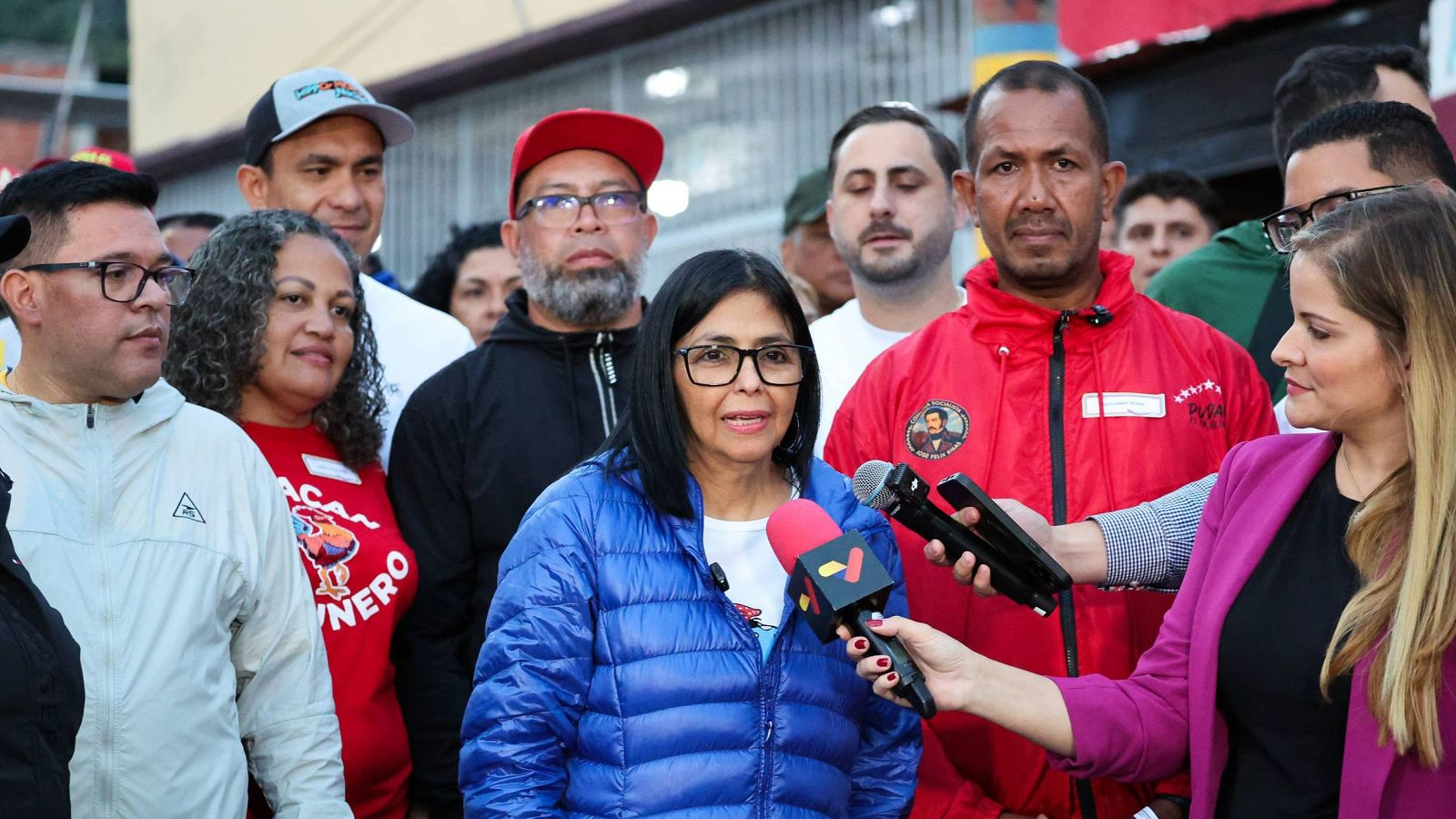
A wall that no one saw erected before, in his statement from his Mar-a-Lago resort, Trump said that cordial talks had been established with Delcy Rodríguez and that she was completely willing to work. A microphone became a dagger for the official narrative in less than 24 hours. Since July 28, 2024, the government’s ability to manage the media agenda had been undermined by a “data-beats-narrative” premise, which was validated by official voting records. Any attempt at explanation was no longer credible. Dissociation became a way of continuing to govern without legitimacy.
Since January 3, the Venezuelan government has had to juggle between showing that there is collaboration with the US and defending two central figures, such as Maduro and Flores. “It’s nothing personal, it’s just business” is one of the lessons that chavismo seems to have learned from Michael Corleone. As of today, even the son of Nicolás Maduro (“Nicolasito” Maduro Guerra) has said that he feels it’s necessary to reopen the US embassy in Caracas and even the Israeli one, which was closed long before.
Jorge Rodríguez: “If we are going to promote peaceful coexistence, we have to rectify, we have to look for mechanisms where there is calm (parsimonia), engagement (encuentro), and where we can tone down the arrogance (soberbia) a bit, but you (the opposition) have to tone down the pettiness (mezquindad).”
While the chavista leadership seeks to please the interests of the Trump administration and position itself as an indispensable ally for foreign investment, the grassroots support of the ruling PSUV party chants and performs choreographies on social media saying that it will rescue Maduro and Flores from an “illegal” imprisonment. In the meantime, it is at least interesting that those regime groups that have the most to lose from this sudden rapprochement with Washington are the most loyal ones, while the leadership in Caracas receives the CIA director.
Watching a spokesman as radical as Diosdado Cabello say that he wants the opening of the Venezuelan embassy in Washington is a sign that something has changed. In his words: “We are not afraid to sit down and talk to whoever we have to talk to. Doubting is betrayal. Unity turns us into a single body, there are no free agents here.”
Cabello has also accepted the (very slow and selective) release of political prisoners in these terms: “It has to do with a process of national reconciliation that the acting president has announced. Those who have cases of drug trafficking, rape, attacks on children, and murder are excluded.” But neither repression nor the verbal attacks on NGOs have ceased. Not even by Jorge Rodríguez, who on January 13 said that Foro Penal were petty and self-interested. Cabello said that “the so-called NGOs are charging families, saying that detainees are released thanks to them. Thanks to them? If NGOs do anything, it’s to slander detainees, because they receive money from abroad.”
Meanwhile, the “workers’ president” now shares prison with the world’s most famous criminals. Chavismo can try to turn the man who ordered mass kidnappings into a poor hostage of the US imperialism, while Delcy says that if she has to go to Washington, she will do so accompanied by the spirit of a brave people. The most reasonable scenario is that the legal battle over Maduro’s release will take years, along with an artificial anti-imperialist narrative.
Cabello tries to compensate for the impact of January 3 by claiming that nothing has really changed.
The Rodríguez siblings have already toned down the level of conflict. Addressing non-chavista lawmakers in the National Assembly, Jorge Rodríguez said: “If we are going to promote peaceful coexistence, we have to rectify, we have to look for mechanisms where there is calm (parsimonia), engagement (encuentro), and where we can tone down the arrogance (soberbia) a bit, but you (the opposition) have to tone down the pettiness (mezquindad).”
It is necessary to highlight that historically, in the official narrative, the opposition is an extension of Washington’s interests. That rectification has also become evident in the claims of international sectors of the left that have shifted from the term “invasion” to “intervention” to sum it up as an “illegal” detention. Nicolasito has framed it that way on a podcast tour, where he downplays the importance of the new Miraflores–White House relationship and instead focuses on the conditions under which his father and stepmother are being held..
The removal of Alex Saab and Freddy Ñáñez from the cabinet can also be considered a gesture to the Trump administration—the former for being Maduro’s financial operator (imprisoned by the US and later released by the Biden administration), and the latter for being in charge of the Venezuelan government’s “communications guerrilla” during moments of greatest tension between Miraflores and the White House.
Between biting their tongues and appealing to selective memory, the regime now seems focused on appropriating the narrative and confronting disputes over the truth. Cabello tries to compensate for the impact of January 3 by claiming that nothing has really changed: “the only thing that didn’t work out for them is that the Bolivarian Revolution is still governing and the country is at peace.”
But still, “data beats narrative.” Starting with Delcy Rodríguez, in this provisional government that Trump says is obeying him, there are actors indicted and under investigation for crimes related to money laundering and drug trafficking. Not to mention the cases of human rights violations, which do not expire.