Explore new cultures, find the best travel deals, and make informed decisions with our trusted travel news. Let your wanderlust thrive as you stay connected with the ever-changing world of travel.
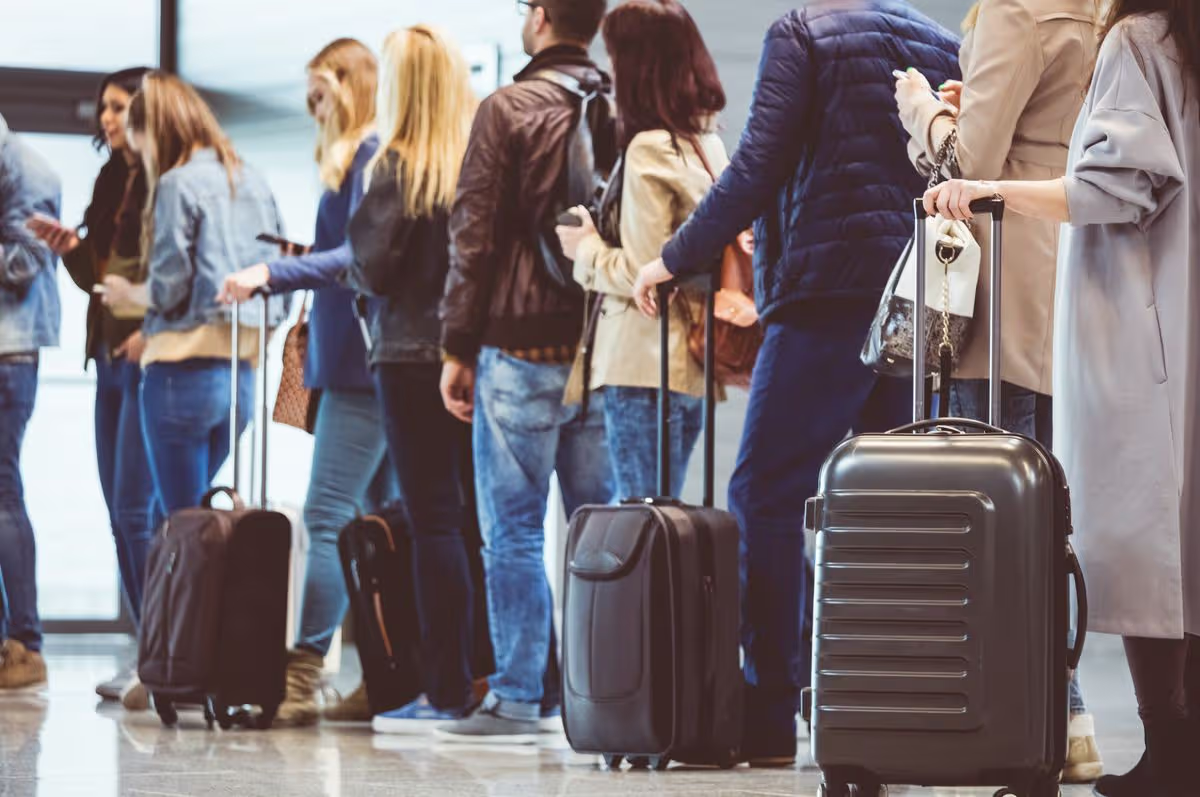
Thousands of Brits are thought to be stranded in the Middle East after US and Israeli airstrikes on Iran
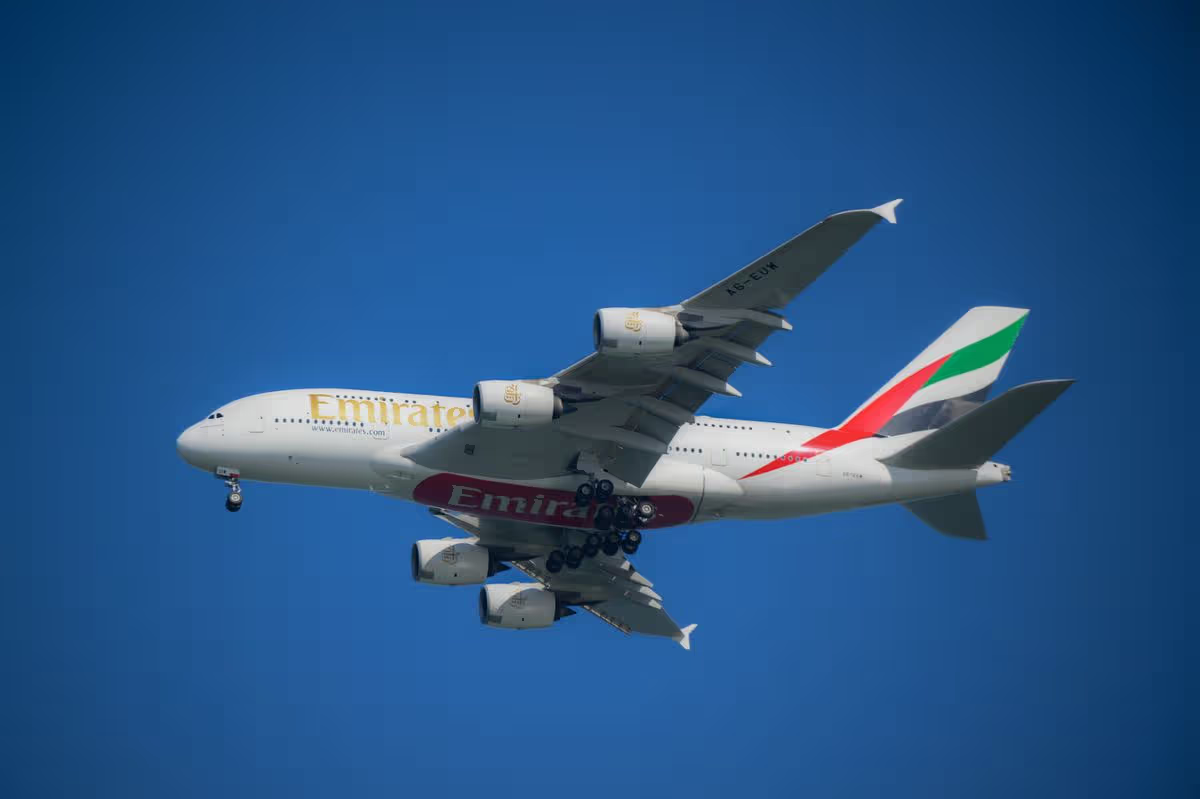
Thousands remain stranded after military strikes rocked the Middle East(Image: AP)
A travel expert has issued three words of crucial advice for people stranded in the Middle East following US and Israeli air strikes on Iran. Simon Calder made the remarks after hundreds of thousands of travellers found themselves stuck in destinations such as Qatar and Abu Dhabi in the wake of the attacks.
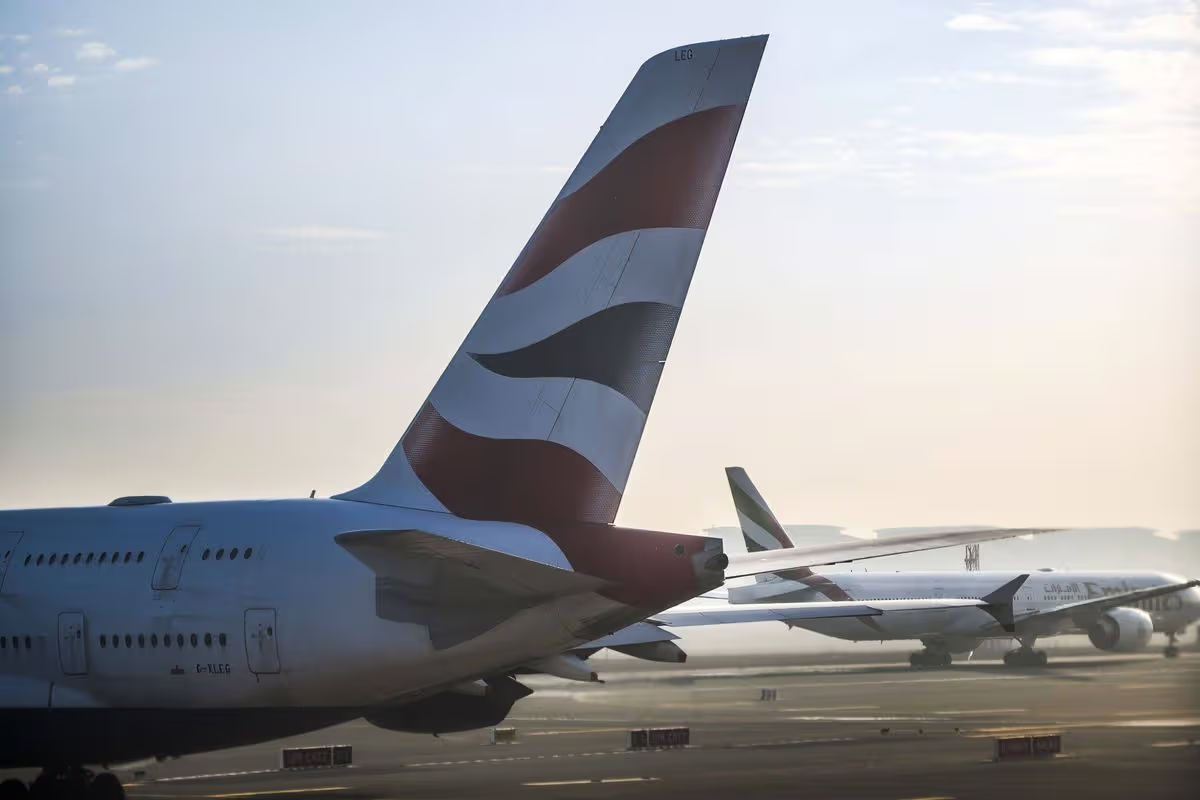
Numerous airlines, including British Airways, Emirates, and Qatar Airways, grounded flights following Iranian retaliatory strikes throughout the region. When flights will resume normal service remains unclear, with thousands of Britons believed to be stranded.
Speaking on Radio 5 Live, Mr Calder had three key words he urged travellers to follow: “At the moment, the best advice I have for anyone who is stuck in various parts of the world is: just be patient.”
The situation will be resolved – I hope, very much sooner rather than later,” he added. “What we have seen is the extraordinary sight of the big three of Middle Eastern hubs – Dubai International, Doha, and Abu Dhabi – all closing because of the retaliatory strikes from Iran. We have never seen that. The last thing of this scale we saw in this area like that here was the Covid pandemic.
“Consider this. More than a quarter of a million passengers were due (on Saturday) to fly to and through Dubai International Airport alone. It is bigger than Heathrow Airport, handles more passengers, and everyone is desperate to get where they need to be.
“I have been speaking to people who were about to take off, they had the ‘boarding complete’ announcement, and suddenly the captain said, ‘Sorry, airspace closed, we are staying here’. It took them three hours to get off the aircraft because they all had to be processed through immigration, leaving them in a place where they really didn’t want to be. Many of them were just off a previous flight a few hours before and were waiting to travel on to their final destination of London Heathrow.”
It was subsequently confirmed that Iranian Supreme Leader Ayatollah Ali Khamenei was killed in the strikes, casting serious doubt over the future of the Islamic Republic. The death of Mr Khamenei, following decades in power, has triggered furious scenes across other parts of the Middle East and beyond, heightening the threat of potential regional instability.
Dubai International ranks as the world’s busiest airport, processing roughly 250,000 passengers daily. Doha Airport in Qatar handles approximately 150,000 travellers each day, meaning enormous travel chaos as both airports continue to be affected.
Doha holds particular significance for British passengers flying to and from the Middle East, Asia and the UK. Mr Calder went on to say: “Some people are in the difficult position of being stranded on the wrong side, and they are trying to get back to the UK but finding that air passenger rights rules – which are great when you are flying from Europe – don’t work the same way when you are flying to Europe on a non-UK or non-EU airline.
“They can basically just say, ‘well, good luck, we’ll try and get you there in a week or you can take a refund’. It’s really, really difficult Airlines like Emirates, Etihad, Qatar Airways, they are not legally obliged to find hotel accommodation for all these stranded passengers and get them back as soon as possible but hopefully they will do so.
“The other problem for people whose flights have been cancelled, when flights resume, they go to the back of the queue. If flights resume on Monday, anybody who has a flight booked on Monday will fly on Monday, and people whose flights were cancelled over the weekend – and we are talking hundreds of thousands now – they are going to be finding that they are at the back of the queue, scrabbling for whatever available seats there are.”
And there I was too, like a budget Cathy, if she wore Gore-Tex and hiking boots rather than a generous bustle.
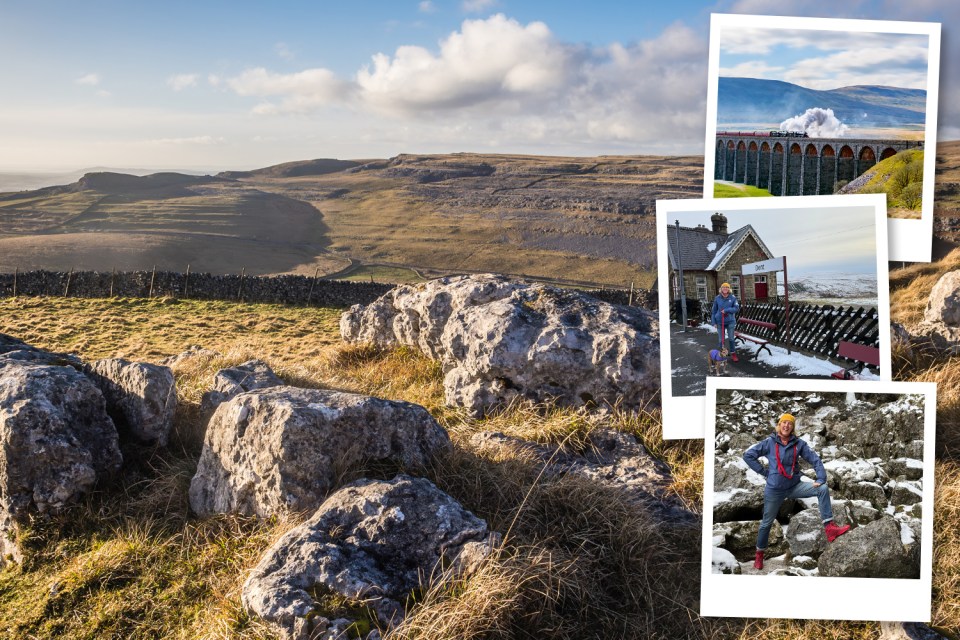
Largely shot on location in the Yorkshire Dales National Park — amid the landcapes of Swaledale and Arkengarthdale valleys and the peaceful village of Low Row — the movie shines a well-deserved spotlight on this glorious corner of England.
With its scarred limestone hills, scattered with rocks, and rolling green pastures, criss-crossed with drystone walls and peppered with honeyed-stone villages, this region is the picture of a period drama.
While the rain barely lets up in the movie, Yorkshire welcomes me with beautiful blue skies, sunshine and even a light dusting of snow on the hills.
I’m almost disappointed.
I’ve brought along my own Heathcliff, my partner Toby, and my dog, Miss Babs, who loves a good romp across the moors.
We’re staying in Settle, a cute little market town in the heart of Bronte Country near the southern entrance of the National Park.
After the long journey, we hunker down with the first of many pints of local Thwaites ale in The Golden Lion – a coaching inn in the centre of town and our base for the weekend.
Rooms are cosy and comfy with a modern country feel.
Tracey at Dent, the highest railway station in EnglandCredit: Tracey Davies
Settle is a popular base for walkers.
Nearby is Ribblesdale, probably the best known walking area in the Yorkshire Dales National Park, not least for those conquering the Yorkshire Three Peaks — Whernside, Ingleborough and Pen-y-ghent.
As keen but fair-weather walkers, we opt for an easy route along the River Ribble, which still offers some spectacular views across the Dales.
Unlike in the 18th century, there’s no need to ride a bumpy old stagecoach around these parts.
Settle is the starting point of England’s most scenic railway journey.
Celebrating its 150th anniversary this year, the Settle–Carlisle Railway soars over viaducts and through heather-filled moorlands.
The magnificent Ribblehead Viaduct, which has 24 archesCredit: Getty
There are numerous stops on the 72-mile route, including the magnificent Ribblehead Viaduct, which has 24 arches.
It’s a bargain at £4.60 for a single journey.
We stayed on until Dent, the highest railway station in England, and walked part of the Dales Way, which runs from Ilkley to Lake Windermere, stopping for a pint (OK, three) at the Sportsman Inn before wobbling back for the train.
Back at the The Golden Lion, it’s time for dinner.
Choices include fat steaks (from £18.50), beer-battered fish and chips (£18.50) and Settle pudding, a traditional suet pudding oozing with steak and ale, which Toby gazes at with the lustful look of Heathcliff.
On Sunday morning, the weather turns moody.
Margot Robbie and Jacob Elordi in Wuthering HeightsCredit: Alamy
After a hearty Yorkshire breakfast, we drive five miles to Malham, a fine village with several easy-to-access walks.
We take a muddy trudge up to Malham Cove – a natural limestone amphitheatre – and then to Gordale Scar, a towering limestone gorge with a gushing waterfall, which featured in Netflix drama, The Witcher.
Dark, damp and deliciously Gothic, it’s a fitting end to our Wuthering Heights weekend.
Cliff is sitting in his farm truck scanning the hillsides with powerful binoculars. “It’s the rams,” he says. “They can stray at this time of year.” I follow his direction of gaze, down a golden hillside covered in bracken and boulders to a dark patch in the valley bottom. “Hopefully not down there,” he adds. “That’s the quaking bog.”
Sometimes a chance encounter can transform your appreciation of an area, and that is about to happen for me. I’m heading up Craig y Garn mountain to catch the sunrise over the Llŷn peninsula and the first rays are already stealing over the tops of distant Cadair Idris, rousing giant shadows from under the trees. Cliff, who also happens to be my landlord for the week, points to the house on a hill above the bog: “Where you’re staying was my great-grandmother’s house – or at least what is now the living room. She kept one pig, one sheep and one cow, and made buttermilk where the conservatory is.”
Below the house, mostly out of sight, is the local village. “There used to be a pub and a shop. The school had 150 in it when I was there 70 years ago.” He grins. “I didn’t speak a word of English till I was seven.”
The tale of decline in rural amenities is a common one, but I am here to investigate an area that is pushing back hard. The Llŷn is leading the way in opening community pubs, restaurants, cafes and shops, facilities that, combined with the Wales Coast Path, make it a great area to explore.
For Cliff, the rural decline was a family lived experience. “Great uncle Bob left on a ship from Caernarfon in 1900 and joined the Klondike goldrush. Lots of people here were slate miners so could get jobs in North America.”
In fact, throughout the late 19th century, parts of Wales were gripped by emigration fever. Posters went up advertising passage on “fine fast-sailing barques”, usually with a “ballast of slates”. After many adventures, great uncle Bob settled in Whitehorse, in Canada’s Yukon, and is buried in its Pioneer Cemetery.
Kevin Rushby on Craig y Garn. Photograph: Kevin Rushby
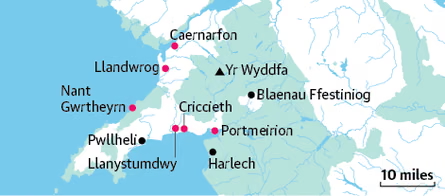
I leave Cliff and run up to the summit. The shadow giants have all disappeared, but the view is still dazzling, a reminder that the Llŷn is an extraordinary place. To the east, Yr Wyddfa (Snowdon) is white with ice. Looking west, I can see the Irish Sea on both sides and on the north coast a trio of conical mountains, like volcanic plugs. The tallest, Garn Ganol (561m), is an extraordinary granite intrusion that was once a busy mining area, one of only two sources in the world for curling stones. Nearby is one of the first-ever community pubs in Britain, the Tafarn y Fic, established in 1988, where I aim to finish my first walk.
I start right under Garn Ganol peak, heading down a steep and spectacular valley towards a shingle beach and the village of Nant Gwrtheyrn. The settlement was abandoned when the mines closed, but local doctor Carl Clowes set about reviving it as a cultural centre in 1978, with courses in the Welsh language. (The doctor’s cultural impact didn’t stop there: two of his sons played in the rock band Super Furry Animals, a big part of the Welsh musical renaissance of the 1990s.)
From the beach, the path winds up over a headland to St Beuno’s chapel near the hamlet of Pistyll. This simple church is more like an ancient sacred cave with its bare stone walls and straw-covered floor. From here, I loop back over the hill to Tafarn y Fic in Llithfaen.
Tafarn y Fic in Llithfaen was bought by locals in the 1980s to prevent it closing down
Back in the 1980s, this village was in decline, but its relative isolation proved a vital factor in triggering community action. With alternative pubs and shops a long drive away, the defunct Victoria Hotel (the “Vic”, which transliterates as Fic in Welsh) was bought out by locals and reopened. When I drop in for a pint, there are teenagers playing pool and darts while a couple of locals are working on their laptops by the fire. Across the road is a community shop.
The pioneering Tafarn y Fic proved an inspiration to other villages in the area. My next walk is along the south coast from the village of Llanystumdwy, where Tafarn y Plu (The Feathers) stands. Here, they have a fun little honesty shop outside and a stage for concerts. “It got so busy last summer that we ran out of beer,” the barmaid tells me. “Luckily, all the other community pubs sent barrels over.”
Llanystumdwy is famous for its most successful son: David Lloyd George. The great political orator grew up here, deeply immersed in Welsh nonconformist liberalism, factors that are arguably still at play in the strong tradition of collective action. Not that community spirit is necessarily benevolent: when Lloyd George came back to speak here in 1912 as chancellor of the exchequer, suffragette hecklers were beaten unconscious by locals.
Dylan’s in Criccieth makes for a stylish lunch stop on the coast path. Photograph: John Davidson Photos/Alamy
I walk through the village, past the lovely stone bridge and the great man’s grave in the woods. There is a museum, too, closed for winter at the time of my visit. Back on the coastal path, I reach Criccieth, a lovely town with an impressive castle, still much as it was when sketched by JMW Turner back in 1798, having been left in ruins by Owain Glyndwr’s forces in 1404.
Just beyond, on the town beach, is a lovely art deco building, now Dylan’s restaurant. Designed by Clough Williams Ellis, known for nearby Portmeirion, it was not actually built until the 1950s and now makes a rather stylish lunch stop on the walk.
The coastal path here follows the long, broad beaches with stunning views of Harlech Castle, the Rhinogs and Cadair Idris mountains across the bay. No wonder Turner loved the area: there is always something going on with the light. The sea is suddenly snarling with whitecaps or else washed with an orange blush. As the bay narrows into the estuary, a steam train puffs out across the causeway and a squadron of curlews lands on one of many sandbanks.
I was hoping to catch the northern branch of the Ffestiniog and Welsh Highland Line to Caernarfon and pick up the coastal path again, but that plan is foiled by a landslip. In summer, however, this would be a great option. The two heritage lines, one up to Caernarfon and one to Blaenau Ffestiniog, are fine examples of community effort too, having been rescued from oblivion by volunteers and enthusiasts who even built four new kilometres of track after the Electricity Board unhelpfully flooded part of the line in 1954. Together with the mainline to Pwllheli, they are a convenient means to starting or finishing non-circular walks.
Ty’n Llan community pub and hotel in Llandwrog, where Welsh is the main language.
Once I reach Caernarfon, I find a lovely ancient town with a newly redeveloped old slate-loading quay, Cei Llechi, right under the famous castle walls. The coastal path here follows the Menai Strait, circling around Foryd Bay bird reserve, then the long beach at Dinas Dinlle. Just back from the beach in the village of Llandwrog is the latest addition to the roster of community ventures: the Ty’n Llan community pub, restaurant and hotel. This vibrant and extensive project is testament to the growing confidence and capability of the community-ownership movement. It’s also a great spot to start learning Welsh, as it’s the main language of the public bar. So, iechyd da – cheers!
The trip was provided by the Wales Coast Path which follows the Llŷn peninsula for 96 miles. Pen y Braich Uchaf cottage sleeps six and is bookable through Sykes Cottages from £714 a week. Tafarn y Plu will reopen in autumn 2026 after a £2m upgrade
British Airways has cancelled flights to Tel Aviv, Bahrain and Amman with passengers offered free changes or refunds – as travellers are warned they may need to ‘get creative’ amid mass disruption
Flights to and from Dubai International Airport have been cancelled (Image: Getty)
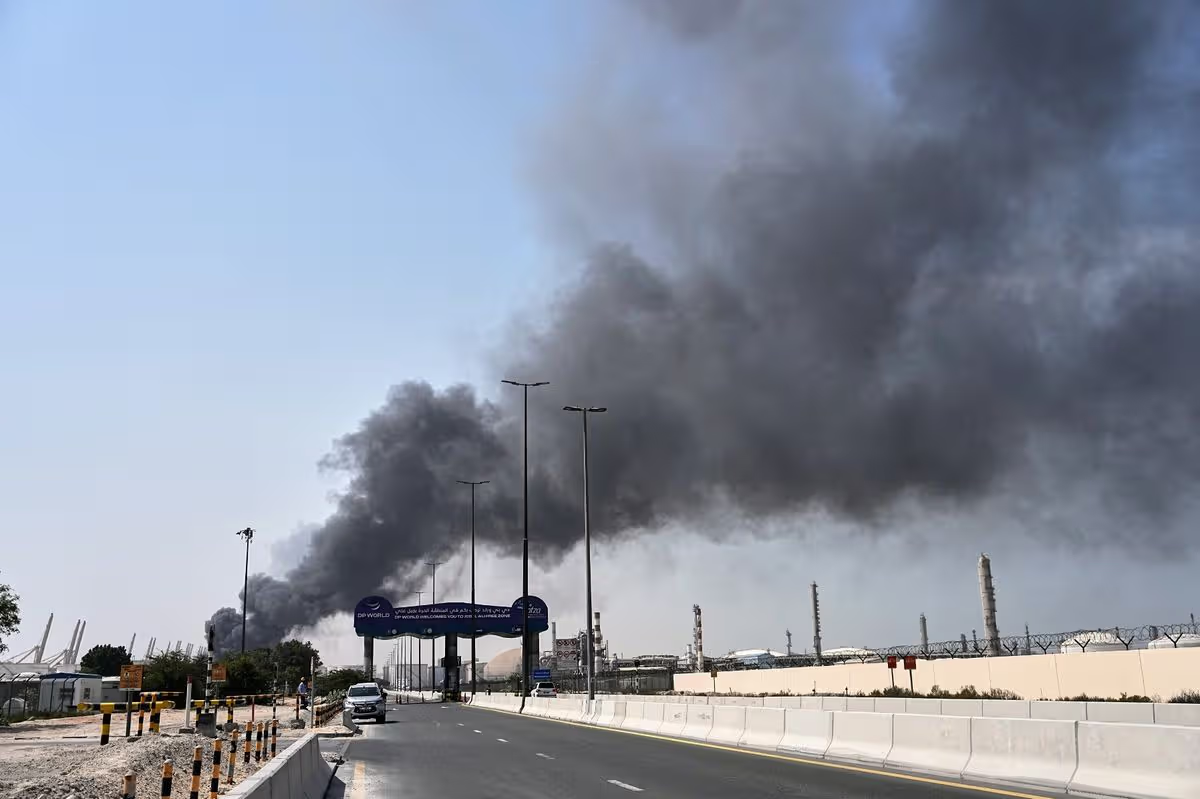
Travellers will need to “get creative” if they want to fly in the coming days, an expert has cautioned, with hundreds of thousands of people stranded or rerouted to alternative airports following widespread airspace closures throughout the Middle East.
Israel, Qatar, Syria, Iran, Iraq, Kuwait and Bahrain have all closed their airspaces. Flight tracking website FlightRadar24 recorded no flight activity over the United Arab Emirates, with the UAE government announcing a “temporary and partial closure” of its airspace.
British Airways has confirmed flights to Tel Aviv and Bahrain will remain suspended until next week, whilst flights to Amman, Jordan, were scrapped on Saturday.
Ensure our latest headlines always appear at the top of your Google Search by making us a Preferred Source. Click here to activate or add us as your Preferred Source in your Google search settings.
This resulted in the shutdown of crucial hub airports in Dubai, Abu Dhabi and Doha, and the scrapping of over 1,000 flights by leading Middle Eastern carriers, reports the Express.
The three principal airlines operating from those airports – Emirates, Qatar Airways and Etihad – typically handle approximately 90,000 passengers daily through those hubs, with even greater numbers of travellers bound for Middle Eastern destinations, according to aviation analytics firm Cirium. Dubai international airport ranks as the world’s busiest airport for international flights.
Aviation industry analyst and president of Atmosphere Research Group Henry Harteveldt said, via AP: “For travellers, there’s no way to sugarcoat this… you should prepare for delays or cancellations for the next few days as these attacks evolve and hopefully end.
“Travellers should anticipate that there will be a lot of disruptions,” he said, before adding: “To be honest, if you haven’t left home, chances are you won’t be leaving home if you’re supposed to travel to or through these destinations for at least several days, if not longer. And if you are returning home, you will have to be very creative about how you get home.”
BRITISH AIRWAYS: FULL STATEMENT ON FLIGHTS TO AND FROM THE MIDDLE EAST.
BA released an official statement on its website late on Saturday (February 28) for passengers who may be affected by the rapidly developing situation in the Middle East.
Here is the statement in full:. “We are closely monitoring the situation and have cancelled a number of our flights to the Middle East. Safety is always our top priority and we would never operate a flight unless it was safe to do so.
“If you are due to fly between London Heathrow and Abu Dhabi, Amman, Bahrain, Doha, Dubai or Tel Aviv you can change your flight free of charge up to and including 6 March. Customers travelling up to and including 4 March may also request a full refund.
“Should you wish to do so, please ring our contact centres on 0800 727 800 within the UK or 020 3250 0145 where a member of our team will be happy to assist. You can also find useful information, including details of your consumer rights, at ba.com/helpme..
“Thank you for your understanding and we look forward to welcoming you on board soon.”
BA’s statement comes as airlines serving the Middle East cancelled or diverted flights en masse on Saturday in the wake of US and Israeli airstrikes against on Iran.
Iran hit back by launching a wave of attacks, targeting Israel and four Gulf Arab nations hosting US military bases – Bahrain, Kuwait, Qatar and the UAE.
British Airways, Virgin Atlantic and Wizz Air were amongst the carriers to reduce their schedules to Middle Eastern destinations, citing safety concerns. The UK Foreign Office urged British nationals in Bahrain, Qatar, Kuwait and the United Arab Emirates (UAE) to immediately shelter in place following explosions.
UK Foreign Office issues advice for Britons trapped in Dubai.
For any Britons currently in the UAE, the Foreign Office released new guidance overnight.
All citizens already present in the UAE are strongly encouraged to notify the UK government by registering their presence to receive further updates as the situation continues to develop across the Middle East. “Due to reported missile attacks, British nationals in the UAE should immediately shelter in place. Remain indoors in a secure location, avoid all travel and follow instructions from the local authorities.”
The FDCO also advised British nationals in the UAE to take sensible precautions, taking into account their own personal circumstances.
– Read the UK Government’s fact sheet If you’re affected by a crisis abroad. This includes guidance on how to prepare for a crisis with suggestions on what you might include in your emergency supplies and what to do in a crisis.
– Follow advice from the local authorities and sign up to receive information and alerts. Read the FDCO fact sheet: National Emergency Crisis and Disaster Management Authority’s guidance across numerous emergencies.
– Sign up to FCDO Travel Advice to get email notifications on updates as they happen.
Follow our live blog for the latest travel updates by clicking here.
The idyllic Welsh seaside town of Rhos-on-Sea is home to a remarkable landmark – a tiny chapel that holds the title for being the smallest in the British Isles
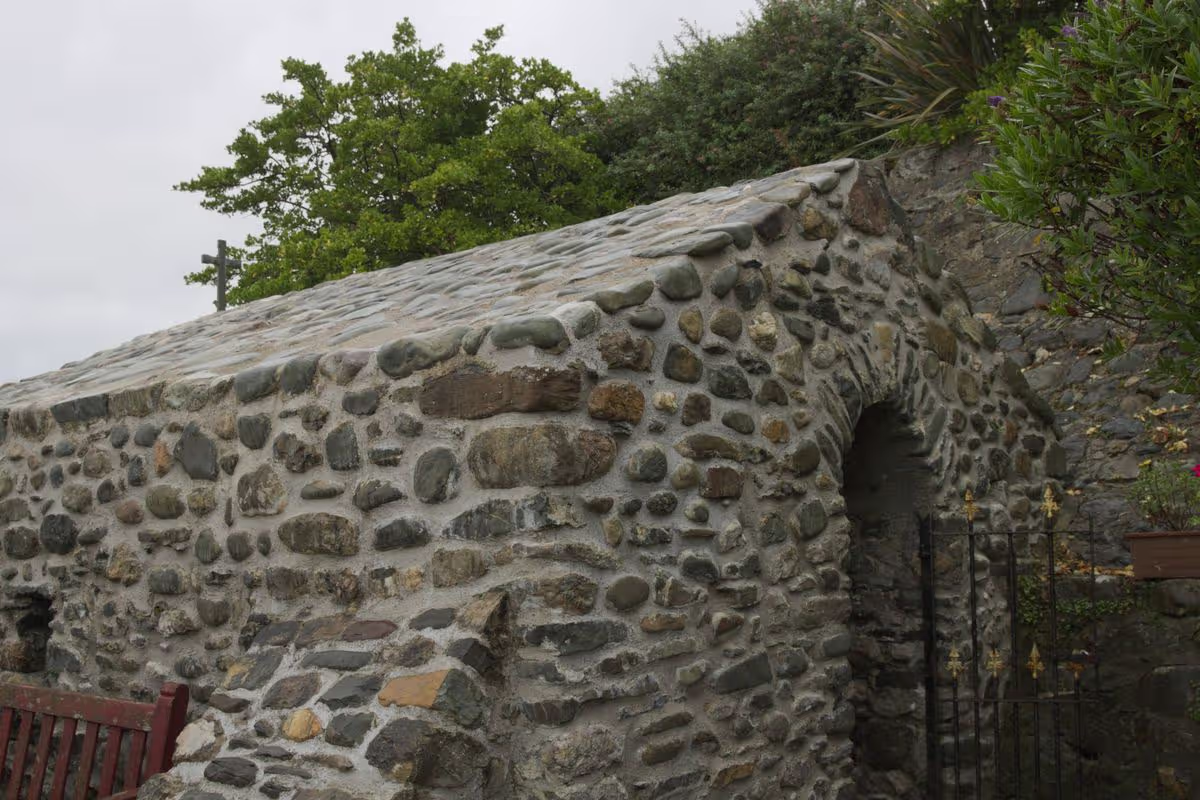
It can only seat six people inside(Image: mpphotos via Getty Images)
This picturesque seaside town in Conwy, Wales provides a far more tranquil coastal retreat for those seeking respite by the shore – whilst also being home to a remarkable UK landmark.
Nestled discreetly along a coastal path boasting breathtaking vistas of the Welsh coastline, sits a diminutive chapel in Rhos-on-Sea, so minute that it claims the distinction of being the smallest throughout the entire British Isles.
St Trillo’s Chapel is so compact that it can accommodate merely six worshippers at once, and astonishingly, communion services continue to be held there.
The chapel takes its name from St Trillo, a 6th-century saint who is believed to have constructed his cell on this very site.
Best holiday cottage deals in Wales
This article contains affiliate links, we will receive a commission on any sales we generate from it. Learn more
Wales is renowned for its stunning mountains, picturesque coastline and rich Celtic history. Sykes has a wide and varied collection of holiday cottages, houses and apartments across the country. Prices start from £35 per night with current deals.
History
When St Trillo established his cell, research indicates it was probably fashioned from timber and wattle, with the possibility that the saint collected and erected a stone barrier to shield it from harsh winds.
However, it was the natural spring within the chapel, furnishing the saint with fresh water, which rendered this location ideal for his dwelling. The well persists to this day, positioned before the altar, and is believed to possess considerable historical significance.
This very spring subsequently provided water for countless baptisms throughout the mediaeval parish of Llandrillo and is regarded as possessing curative properties.
The water is thought to flow westward underneath the floor straight from the well, which ‘carries the blessed soul’ from the altar towards the congregation.
While we have a good understanding of its structure today, there’s no specific date attributed to the chapel due to numerous repairs carried out over the centuries. Despite its diminutive size and stone roof, it retains the essence of the saint’s original space.
Present day
St Trillo’s Chapel is nestled next to Marine Drive, a scenic route that stretches from Colwyn Bay along the tranquil seafront. From the road, the chapel is almost hidden from view, but a small signpost will guide you to its location.
The most convenient place to park would be Trillo Avenue, located on the inland side of Marine Drive. From here, you can stroll back to Marine Drive and make your way towards the chapel. It’s just a few metres north of the junction and is accompanied by a small garden, overlooking the sea.
One visitor shared their experience on TripAdvisor, writing: “Stumbled across this as I was walking along the promenade. It was so cute, and I was surprised to see it was open.
“It was quite cold outside, so it was a relief to get out of the wind. Very peaceful inside with two candles burning, and it was well kept. Useful sign nearby detailing its history.”
Another visitor added: “I have been fascinated with this tiny little chapel ever since I read about it on TripAdvisor. Took ages to find but so worth it.
“I could of sat there for ages as it had a comforting and peaceful atmosphere. It is wonderful that it’s kept open for visitors and so well looked after. The little garden is beautifully kept. A magical place on the beach.”
The beach
Beyond the iconic chapel, visitors find themselves surrounded by the stunning scenery of Rhos-on-Sea Beach. A well-loved promenade for walkers and cyclists curves along the golden sands, dotted with numerous cafes, pubs and other establishments perfect for enjoying refreshments whilst overlooking the ocean.
The beach sits within easy reach of the town centre and forms part of the considerably longer three-mile Colwyn Bay coastline. Boasting sweeping sea vistas, it proves particularly popular with families during the summer months who flock here to sunbathe, paddle in the waves or enjoy various water sports.
One recent visitor described it as a “traditional seaside town”. They wrote: “Lovely traditional seaside resort. Clean beach, plenty of car parking, plenty of little cafes and little ice cream and gift shops, like seaside resorts used to be.”
Bear in mind that whilst parking spaces line the promenade, charges do apply. Additionally, dog walking restrictions are enforced on specific sections of the beach during the period between May and September.
Ensure our latest headlines always appear at the top of your Google Search by making us a Preferred Source.Click here to activate or add us as your Preferred Source in your Google search settings.
Nationwide members issued good news by BBC expert – what you should know – The Mirror
Need to know
Nationwide customers have been given some good news ahead of summer
06:00, 01 Mar 2026Updated 08:44, 01 Mar 2026
Nationwide is the world’s largest building society and has over 16 million members(Image: Peter Dazeley/Getty Images)
Need to know: Nationwide customers could save on travel insurance
Nationwide customers could save money on travel insurance by checking if they already have cover through their bank account.
Travel expert Rebecca Wilcox appeared on BBC Morning Live to highlight that many people overlook existing travel insurance benefits. She described not having travel insurance as “astonishing” but revealed some may already be covered.
Wilcox asked: “Are you already covered? You could have it with your bank account.”
Nationwide’s FlexPlus current account costs £18 per month and includes Worldwide Family Travel Insurance from Aviva. The account provides comprehensive coverage including emergency medical expenses up to £10 million and missed departure cover up to £1,000.
The FlexPlus account also covers trip cancellation up to £5,000 and alternative travel arrangements for disruptions.
Other banks including Monzo, Virgin Money and Halifax also offer travel insurance with their packaged accounts.
Customers are advised to check their existing bank account benefits before purchasing separate travel insurance to avoid paying twice.
The cheapest European city breaks have been revealed for a serene and sun-soaked escape over the Easter holidays, and many have pristine beaches to lap up the balmy rays
There are plenty of European destinations that offer an affordable escape during the Easter holidays(Image: Getty Images)
Heading on holiday during the peak travel season can be notoriously expensive, but some beautiful European destinations offer an affordable escape over Easter.
As we inch closer to Spring, thoughts turn to the Easter holidays and how we intend to spend the welcoming long weekend, or weeks, while the kids are off school. With the British weather somewhat unpredictable, a trip to a sun-soaked city destination might be top of the list, or a city packed with charm for a day of exploring.
In a bid to help travellers book their Easter escape, Which? compared more than 3,000 package holidays across Europe during the busy travel period, to reveal where you can get the best bang for your buck. The travel experts outlined the price, per person, for a seven-night stay, with flights and accommodation included, and some beautiful cities came out on top.
Ranked as the cheapest for an escape was the resort town of Marmaris, situated along the Turkish Riviera, often known as the ‘Turquoise Coast’ or the ‘King of the coast’. It’s a haven for those looking to soak up the balmy rays, with highs of 25C in April and stretches of golden-sand beaches. Which? found that a trip to the sun-soaked city would cost an average of £594 per person for a seven-night package – half the cost of a trip to Paris!
2. Krakow, Poland
Following close behind is the city of Krakow, Poland, with its fascinating medieval architecture, market square, and iconic landmarks, including Wawel Castle and the Cathedral. Its scenic backdrop will feel as though you’ve stepped into a fairy tale, and while the weather offers a cooler 14C in April, you’ll barely notice as you lose yourself among the enchanting streets. A seven-night package getaway to Krawkow will cost around £628 per person, as outlined by the experts at Which?
3. Albufeira, Portugal
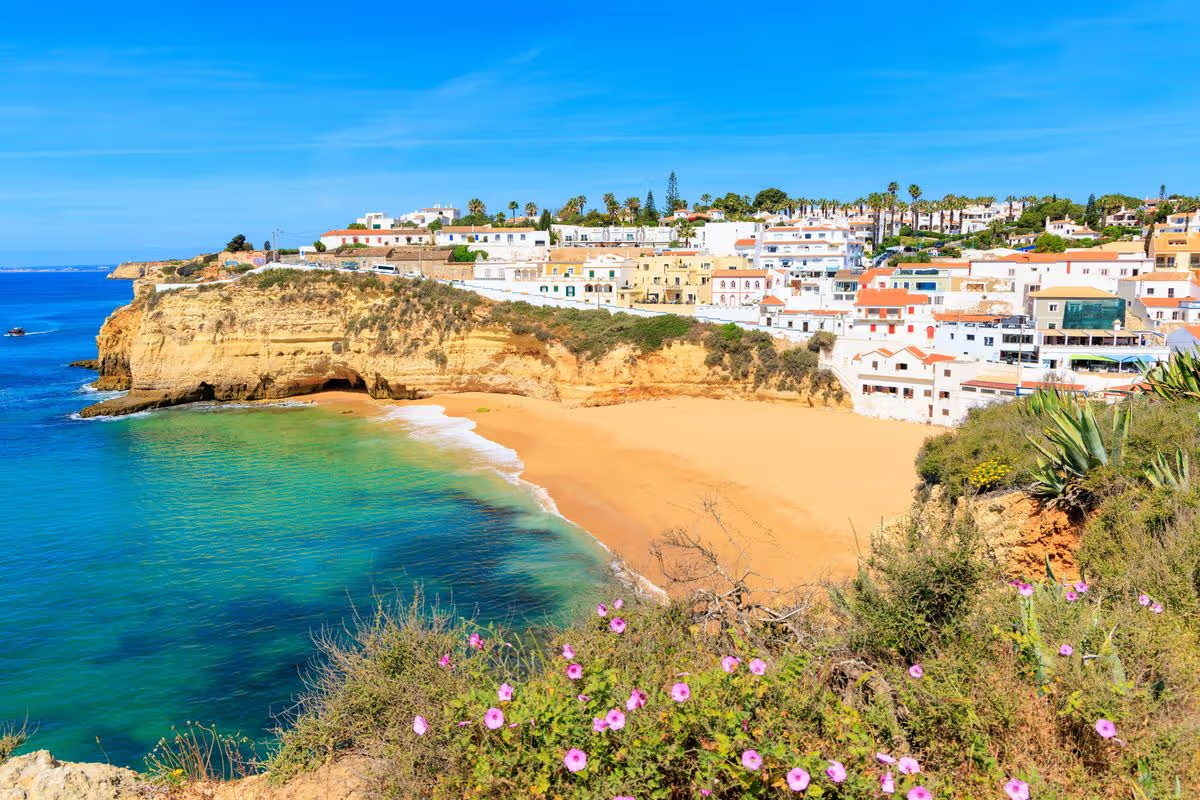
Offering a blend of city and beach escapes is the Albufeira, nestled along the picturesque coast of the southern Algarve of Portugal. Along with its sprawling beaches and turquoise waters, there’s the Old Town with cobbled streets lined with shops and restaurants, and its museums to explore. With highs of around 19C predicted over the Easter period, it might just be the best time to visit, that alongside its reasonable cost of around £638 per person.
4. Las Palmas de Gran Canaria, Spain
The Canary Islands are a popular hotspot among Brits seeking some sunny rays, and the city of Las Palmas de Gran Canaria, also known as Las Palmas, is a great, affordable option. As the largest city of the Canary Islands, Las Palmas has a historic charm, with its Vegueta district brimming with landmarks, and its golden sands at the lengthy Playa de Las Canteras, which also boasts a vibrant promenade. A trip to the city will bring a warming 21C, and cost around £671 per person for that escape this April.
5. Benidorm, Spain
It’s no surprise that Benidorm on Spain’s Costa Blanca in Alicante secured a spot on the Which? list, with its promise of cheap drinks, affordable hotels, bustling nightlife and balmy rays along its stretching beaches. It’s famed for boasting more than 320 days of sunshine a year, and in April is expected to welcome temperatures of around 19C – ideal for a cocktail in one of the bars that line the beachfront. According to Which?, a seven-night stay will set you back on average, £682 per person – that’s a reasonable £97 a day with flights and accommodation included.
6. Prague, Czech Republic
It’s long been hailed as a stag-do destination or beer capital, but Prague has much more to offer away from its cheap pints, although that is a bonus. The city is surrounded by Gothic, Baroque, and Renaissance-style architecture, alongside its stunning Prague Castle and striking Charles Bridge. Making it even more appealing is the prospect of paying £753 per person for a seven-night package stay, as well as its warming rays of 14C to wander around the city in.
7. Budapest, Hungary
Securing a place on the list is the capital of Hungary, characterised by its Danube River, majestic Hungarian Parliament Building, ruin bars and thermal baths. Its most famous is the Széchenyi Thermal Bath, the largest medicinal bath in Europe, along with the Art Nouveau Gellért. A trip to the vibrant city with sunny scenes of 17C in April will cost around £770 per person on a package holiday.
8. Porto, Portugal
While it’s a little further down on the list, the coastal city of Porto deserves its time in the spotlight. Located on the Douro River, the walkable city is brimming with character, with its steep, colourful streets, restaurants, shops, landmarks, and plenty of bars and cellars to taste its famous port wine. A seven-night package holiday is around £780 per person, and during that time you can expect to bask in a warming 18C in April.
9. Milan, Italy
Renowned as one of Europe’s biggest fashion capitals, Milan is an elegant city with its Gothic cathedral, Duomo di Milano, taking centre stage and its historic shopping centre, Galleria Vittorio Emanuele II, a standout spot, whether you’re a fashionista or not. There are meandering streets to explore, you’ll never be short of things to do, and with a package holiday setting you back around £795 per person, and rays of 17C, perhaps Easter is the best time to explore the Italian city.
10. Dubrovnik, Croatia
Known as the ‘Pearl of the Adriatic’, Dubrovnik is characterised by its 16th-century city walls, its main street, Stradun, lined with boutiques and cafés, and its Old Town with Baroque churches and the Rector’s Palace. There are some breathtaking coastal views to marvel at, and Game of Thrones locations to explore. A cooler temperature of 14C is expected during Easter, making it a prime time to wander around the charming city, and a package holiday could cost around £796 per person.
Do you have a travel story to share? Email webtravel@reachplc.com
Ensure our latest lifestyle and travel stories always appear at the top of your Google Search by making us a Preferred Source. Click here to activate or add us as your Preferred Source in your Google search settings.
This resort has a taste-tempting trick up its sleeve that Jeff never imagined seeing during a recent trip up the mountains – a McDonald’s with the world’s first and only ski-thru window
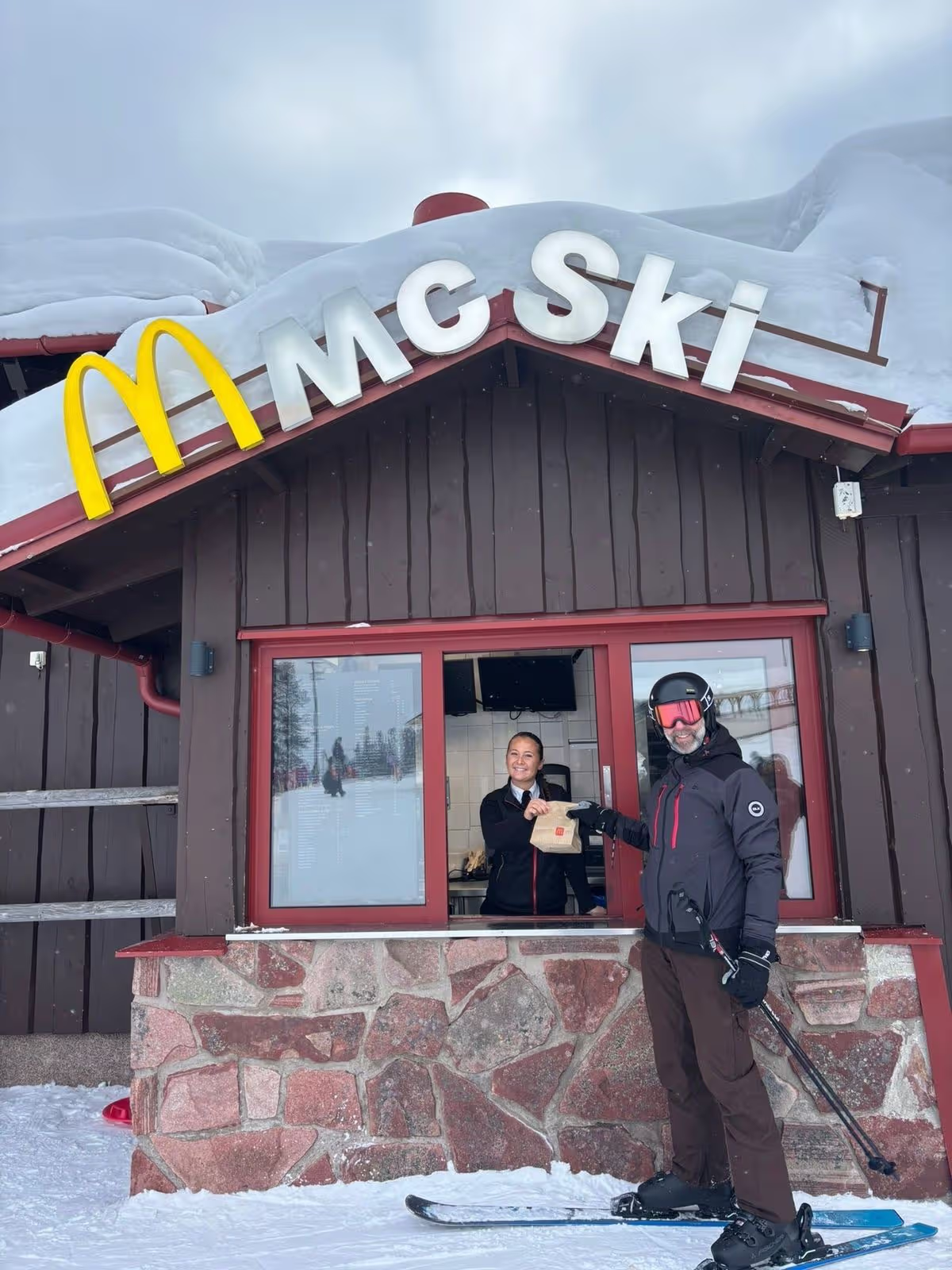
Visit to the world’s only ski-thru McDonald’s (McSki)
A Swedish ski resort has come up with an unexpectedly unique way to top up your tummy while sliding down the slopes – with the unlikely help of a fast food giant.
Everyone who has been lucky enough to give it a go knows skiing is hungry work. And in minus double-digit Scandinavian temperatures, just the shivering burns enough calories to have you scouring the wintry landscape for lunch, a warm snack or hot drink.
Of course, there are all manner of options and temptations in the cosy or cavernous cafeterias and restaurants up and down the mountain. As I found out during a recent Crystal Ski trip, Lindvallen in western Sweden has another taste-tempting trick up its sleeve that I never imagined seeing during a recent trip up the mountains – a McDonald’s with the world’s first and only ski-thru window. Yes, really.
It might not seem a natural combination, and certainly looks odd. If you didn’t know it was there, you could well do a double-take as you ski down Valletorget’s central slope, look past the Experium Express chair lift, to the right of the vast Experiumtorget base building, and spot that unmistakably familiar structure.
It’s curious enough to see the famous Golden Arches rising incongruously out of the snow, a dark wood-clad, multi-branded, single-story outlet of the worldwide chain, with full wraparound windows and the unusual addition of foot-deep snow covering the whole roof and rows of ski racks out front.
But the real surprise comes when you clock the outside service window. They’ve even given it a special, slightly tongue-in-cheek name – McSki. Opened in the resort in Sälen in western Sweden 30 years ago, even if you’re not a Maccies fan, it’s surely impossible to resist having a go.
The vast area linking several resorts has just got a lot closer after TUI launched flights direct to Scandinavian Mountains Airport, just a 20-minute transfer away. You don’t get the full drive-thru sister experience – no menu board with speaker station to place your order. But the full menu is available, seen through the glass on the left, when you ski or snowboard up to the sliding window, greeted by the familiarly uniformed McD’s employee smile from their significantly warmer surroundings.
Within minutes, you’re away with anything from just a McCafé coffee and pastry to a full Big Mac meal deal. There are outside tables, or if you don’t want to miss any more time on the piste than necessary, you can jump right back onto the heated seated lift a few yards away and enjoy your snack or lunch on your way back to the top for more.
To be honest, it’s not ideal or as attractive an option in February. When it’s minus 12 to minus 15, little is more welcome than a break indoors with your hands around a steaming coffee, tea or mug of hot chocolate.
But I’d wager a stack of McDonald’s Monopoly pieces that it comes into its own in March and April, when the weather is more suited to dining on the go.
As well as hungry work, skiing is also a pricey pastime (which reminds me, the outlet’s prices roughly match the hike at motorway services in the UK).
So when you want to squeeze every run out of your time on the slopes and not spend ages stripping off multiple layers of garb – or in fact even stepping out of your skis – to satiate your thirst and replenish those calories, a quick stop at McSki might be just the order.
Offered alongside the full normal eat-in experience, McSki certainly brings a whole new meaning to the term fast food – and the Swedes and skiers are clearly lovin’ it.
If a snow-style McDonald’s is not your thing then there are other unique chains around the world. Customers can sit at sophisticated tables by a stunning fireplace while enjoy lobster rolls and McNuggets at this McDonald’s McMansion, in the Maine.
And there is another posh McDonald’s in New York. Fans have been wowed by this old mansion that has been restored and turned into a fancy fast-food eatery with a grand staircase, a glass conservatory, and posh booths to eat in. The historic property was previously home to other restaurants and was also used as a funeral home.
Book it
Crystal Ski Holidays (020 8610 3123) offers a bed and breakfast holiday in Högfjället, Sälen in Sweden, staying at the Sälens Högfjällshotell from £818 per person when booked online. Based on two adults sharing a Superior Twin Room, including flights from London Gatwick to Scandinavian Mountains Airport, transfers and 20kg hold luggage per person.
Airlines serving the Middle East cancelled or diverted a large number of flights on Saturday in the wake of US and Israeli airstrikes against on Iran – Emirates have issued an update
Many passengers are facing delays or cancelled flights to UAE(Image: Anadolu via Getty Images)
Thousands of holidaymakers have been left stranded after aviation giant Emirates axed all flights in and out of Dubai on Saturday.
The ongoing situation in Iran and the Middle East has lead to multiple regional airspace closures over Dubai.
Emirates issued a “red alert” suspension lasting until at least 3pm local time Sunday. The carrier is “actively monitoring” the high-stakes situation as authorities scramble to manage the unfolding crisis. While safety remains the “highest priority,” the move has sparked travel mayhem for those caught in the crossfire.
Airlines serving the Middle East cancelled or diverted a large number of flights on Saturday in the wake of US and Israeli airstrikes against on Iran. British Airways, Virgin Atlantic and Wizz Air were among carriers to scale back their schedules to destinations in the Middle East, citing safety concerns.
Ensure our latest headlines always appear at the top of your Google Search by making us a Preferred Source. Click here to activate or add us as your Preferred Source in your Google search settings.
Taking to X an Emirates spokesperson said: “Due to multiple regional airspace closures, Emirates has temporarily suspended all operations to and from Dubai, up until 1500hrs UAE time on Sunday, 1 March. If you are booked to travel in the next 72 hours, your options are:
“Rebook on an alternate flight. You can rebook on another flight to your intended destination up to 10 days from your original date of travel. If you booked your flight with a travel agent, please contact them. If you booked with us directly, contact us.
“Request for refund. You can request for a refund of your ticket by completing the refund form if you booked with us directly. If you booked your flights with a travel agent, please contact them. We urge all customers to check flight status before proceeding to the airport. Customers impacted by flight cancellations must contact their travel agency for rebooking.
“If booked directly with Emirates, please contact us. Customers are requested to ensure their contact details are correct by visiting http://emirat.es/managebooking to receive updates We are actively monitoring the situation and engaging with relevant authorities. We apologise to customers affected by disruptions for any inconvenience caused. The safety and security of our passengers and crew remain our highest priority.”
The update comes in the wake of confirmation from Iran’s state broadcaster that Supreme Leader Ali Khamenei was killed in the early hours Sunday local time in US and Israeli aristrikes.
Follow our live blog for the latest travel updates by clicking here.
The historic city has been named a better place to live than the likes of Leeds, Cardiff, York and Bath.
Katie Oborn GAU Writer, Sophie Law Deputy Editor Spare Time and Oli Smith
01:12, 01 Mar 2026
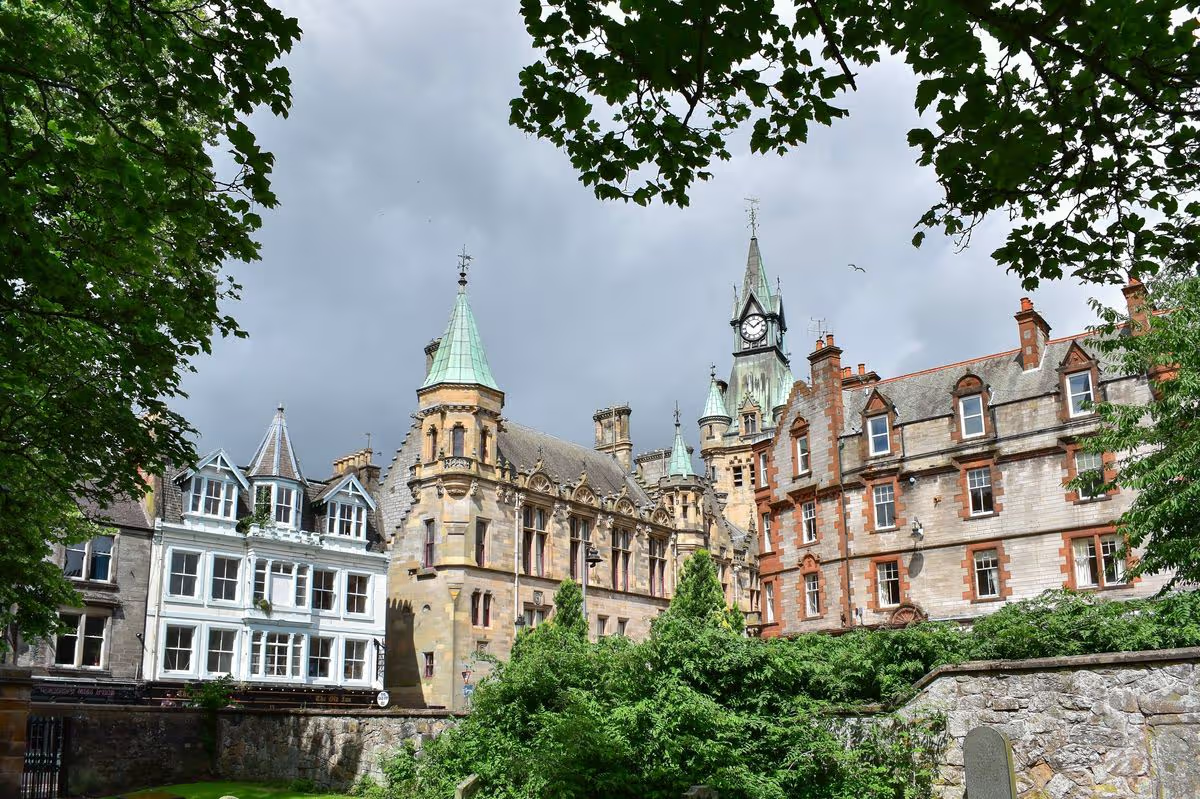
Dunfermline, Scotland’s historic former capital, has claimed the top spot in a new league table as Britain’s best value city(Image: The World Traveller via Getty Images)
Dunfermline, Scotland’s historic former capital, has claimed the top spot in a new league table as Britain’s best value city. Despite only gaining official city status in 2022 ahead of the late Queen’s Platinum Jubilee celebrations, the ancient Scottish settlement has beaten major competitors including Leeds and Cardiff to secure first place in The Telegraph’s value-for-money rankings.
Analysis by property specialists Savills shows Dunfermline emerges as the most attractive and affordable option for young graduates grappling with today’s cost of living crisis. The league table saw Newcastle, Salford, Leeds and Cardiff round out the top five most economical cities across the country.
Dunfermline’s success lies in its combination of “well-paid jobs, comparatively low house prices, a favourable ratio of property costs to household income and somewhere which is teeming with culture and amenities”.
Whilst Aberdeen boasts marginally lower property prices and a slightly superior house price-to-income ratio, Dunfermline secured the title due to its robust employment market and vibrant cultural offerings.
The research highlights Dunfermline’s advantageous proximity to Edinburgh, with rail connections transporting commuters to Scotland’s capital in just 32 minutes.
Despite sitting merely 30 minutes apart, homes in Dunfermline cost more than £133,000 less than comparable Edinburgh properties on average. Savills’ research reveals that typical properties in the Fife city command £206,900, with average household earnings sitting at £56,225.
By comparison, the average London home cost £723,132 last year, against a Great Britain average of £346,683.
Those making the move to Dunfermline can enjoy the breathtaking woodland surroundings of Pittencrieff Park, whilst a mere five minutes from the city centre lies the exciting Townhill Country Park and Town Loch – the national training centre for waterskiing and wakeboarding.
The area also boasts a wealth of wild swimming spots, including Aberdour Silver Sands Beach, as well as a flourishing community of independent craft artisans.
The former Art Deco fire station has been reinvented as Fire Station Creative, a buzzing arts hub home to artists, printmakers and jewellers. Newcomers can also discover up-and-coming bands through the city’s lively open mic scene.
Steeped in history, this ancient Scottish capital serves as the burial ground for some of Scotland’s most celebrated monarchs – among them Robert the Bruce.
Local campaigner Michelle McWilliams, who took part in the city status bid, said at the time: “We were Europe’s fastest-growing town. Now we’re one of its most creative and historic small cities.”
London failed to make the top ten, with Lucian Cook, head of residential research for Savills, observing: “House prices are as high as eight times household incomes across 75 percent of the capital.”
Separately, jobs platform Adzuna has found that Leeds offers the most lucrative employment prospects of any city outside London.
STARGAZE for days at this island gem, says Associate Editor Sarah Barns.
Tent-atively escape with the fam to Glamping The Wight WayCredit: Supplied by Glamping – The Wight Way
The Pad
With a slipper bath, outdoor shower and a cloud-like king-size bed, Glamping The Wight Way’s four plush safari tents are ideal for giving off-grid life a go.
Sign up for the Travel newsletter
Thank you!
Set in lush meadows between Yarmouth and Freshwater, expect solar-panel lighting and USB charging points, plus three spacious bedrooms, a sofa bed, a well-equipped kitchen and a wood burner.
Glamping The Wight Way’s four plush safari tents are ideal for giving off-grid life a goCredit: Supplied by Glamping – The Wight Way
We loved toasting marshmallows on the fire bowl overlooking the River Yar – one of the best paddleboarding spots in the UK – and gazing at the starry night skies.
There are also countryside walks, cycling trails and horse-riding opportunities, as well as binoculars in the dresser for spotting red squirrels and an Isle of Wight edition of Monopoly.
Nab the swing chair and watch the kids run around with the rounders set as the fairy lights twinkle.
The golden beaches at Freshwater Bay, Compton Bay and Colwell Bay are nearby, and you’re only five minutes’ drive from Tapnell Farm Park with its go-karts, jumping pillows, sledge slides, soft play and an array of animals.
The Wallaby Walkabout, where you get to feed the marsupials, is a particular hit.
Feed the wallabies at Tapnell FarmCredit: Supplied by Tapnell Farm
Entry costs from £8 per adult, £10 per child (Tapnellfarm.com).
Robin Hill is a 30-minute drive away, offering 88 acres of adventure, with 35 rides, treetop walks, climbing walls, mini diggers and electric boats.
The exhilarating quarter-mile downhill toboggan ride will have even the big kids screaming.
Entry costs from £16.49 per person over 1m (Robin-hill.com).
No trip to the island is complete without a visit to The Needles, just 10 minutes’ drive from your tent.
Take a breathtaking chairlift down to Alum Bay beach to see the famous cliffs up close, from £6 one way, then putt your way around the 11-hole Jurassic Adventure Golf course or hop on the traditional horse carousel (Theneedles.co.uk).
Refuel
Follow in Kate Winslet and Benedict Cumberbatch’s footsteps and dine at The Hut in Colwell Bay, a beachfront restaurant dubbed the Chiltern Firehouse of the Solent.
The restaurant’s branded Jeep will pick you up in Yarmouth harbour, so you can enjoy a glass (or three) of Mirabello rosé, £37 a bottle.
Flying high over Alum BayCredit: Supplied Isle of Wight Tourist Board
The seafood is all sourced from the south coast – we devoured lemon sole, £36, with fries and tomato salad, £6 each, followed by banoffee pie, £10 (Thehutcolwell.co.uk).
Harbourside restaurant The Terrace in Yarmouth is another popular spot.
Order the divine Cornish cod with pea fritter and potato rosti, £27, and the rich dark chocolate mousse with salted chocolate crumble, £11 (Theterraceiow.co.uk).
For quick bites, Off The Rails, set on the old railway line in Yarmouth, does a cracking bacon sandwich, £8 (Offtherailsyarmouth.co.uk).
And PO41 Coffee House serves up island-brewed teas, home-made cake and delicious picnic essentials – we loved the orange and almond loaf, £8.75 (Po41coffeehouse.com).
Book It
Two-night stays for up to eight people at Glamping The Wight Way cost from £650 (Glampingthewightway.co.uk).
Two-night stays for up to eight people at Glamping The Wight Way cost from £650Credit: Supplied by Glamping – The Wight Way
HAVEN is adding four brand-new Wetherspoons pubs to some of its parks across the country – and has revealed their names.
The holiday park has invested £9million into its venues that will open later this year.
Sign up for the Travel newsletter
Thank you!
Haven revealed a first look at the Wetherspoons opening in LakelandCredit: HavenThe The Alfred Wainwright is set to get skylights and the classic colourful carpetCredit: Haven
Haven revealed last year that even more of the popular British boozers would be coming to its holiday parks, taking its total up to nine.
The pub is named after Springfield House which stood on what is now the main entrance to the park in the 1960s.
The Cornwall-based holiday park called Riviere Sands will open up The Bluff.
Its name refers to the steep bank or cliff edge where the pub is located.
However the pub site isn’t actually new as it will takeover the existing pub site – also called The Bluff.
The last of the new Wetherspoons pubs will be at Haven’s Hopton in Great Yarmouth.
It’s name is The White Clover – named after the flower grown across the county representing good luck.
Simon Palethorpe, Haven’s CEO, said: “Our partnership with J D Wetherspoon continues to grow. With a record 4 million holidaymakers and owners due to take a Haven holiday in 2026, the UK coastal holiday shows no signs of slowing down.
“The naming of the J D Wetherspoon pubs is highly anticipated and always reveals an interesting historical, geographical or cultural reference to the area.
“We look forward to more guests enjoying a pint whilst taking in some of the most beautiful views of our UK coastline.”
The very first Wetherspoons opened in 2024Credit: Wetherspoons/Simon Kench
The four new Wetherspoons brings the total at Haven up to nine.
The very first of the pubs to open at the holiday park was the Five Stones at Primrose Valley in Yorkshire.
This was followed by The Red Rocks at Devon Cliffs, The Humber Stone at Cleethorpes Beach, The London Stone at Kent Coast and The Sir Thomas Haggerston at Haggerston Castle in Northumberland.
Since 2021, Haven has invested £660 million upgrading the guest experience and facilities.
The holiday park is also set to renovate the Show Bar at Marton Mere in Blackpool and build a new supermarket at Kent Coast.
One writer went for a drink at the UK’s first on-site Wetherspoons at Haven…
Writer Christine Challand visited Haven’s very first Wetherspoons called The Five Stones – and chatted to visitors who love it…
“It’s a grey and blustery morning on the North Yorkshire coast but guests at Haven’s Primrose Valley holiday park in Filey are still in high spirits
“It might have something to do with the company’s first and only Wetherspoons pub, The Five Stones, which is set to make the resort even more popular with holidaymakers.
“Hilary, 65, has visited 829 Wetherspoons pubs and says the couple are always happy to travel to compare menus and bar lay-out.
“She said: ‘People might think it’s a bit strange that we go all over the UK to do this, but it’s a lot of fun,’ she added. ‘There’s a nice inclusive atmosphere here in Filey.’
“For Andy and Gill Bishop, a £2.80 pint of Ruddles and a cheeky £5.26 glass of Sauvignon Blanc make a perfect mid-morning start to the day at The Five Stones.
“The couple, who live in Harrogate and run their own holiday apartments in Filey, have been caravan owners at Haven’s Primrose Valley site for 14 years and think the Wetherspoons opening will be a major draw for holidaymakers.
” Gill said: ‘This is just a warm-up for celebrating my 61st birthday tomorrow. It doesn’t matter what the weather’s like, Filey was recently voted one of the ten best beaches in the world so we’d never go anywhere else.’”
HIKING down the mountain, butterflies fluttering past, the sound of moo-sic fills the air. It seems the native black Hérens cows, adorned with huge bells, are on the move, too…
My daughter Ava, 12, and I are on an idyllic, hour-long trail in the Swiss Alps that starts at Cabanes-des-Violettes cable car and has us venturing across a spring, wildflower meadows and alpine forest.
Sign up for the Travel newsletter
Thank you!
Take in the wildflower meadows and alpine forest while hiking in ValaisCredit: OLIVIER MAIREHotel Valaisia features roomy balconies leading off its comfy doublesCredit: RICARD ROMAINThere are indoor and outdoor pools, as well as a saunaCredit: Supplied by PR
And just when I think Ava is on her last legs, we round a bend to discover the Relais de Colombire restaurant, perched as high as the paragliders.
It’s the perfect spot to refuel on fondue, £27, and local Marmotte Hippie IPA, £6, while Ava makes light work of the giant cookie and ice cream, £11.20 (Colombire.ch/en/restaurant).
Fun-icular times
We’re kipping in the pretty town of Crans-Montana, with its elaborate flower displays, boutiques and eight lakes, in the French-speaking region of Valais.
It’s a scenic two-hour train around Lake Geneva then a thrilling funicular ride to get here from Geneva airport, and Hotel Valaisia makes the most of the scenery, with roomy balconies leading off its comfy doubles.
There are indoor and outdoor pools, a sauna, cosy snug and games room, and at Eteila Brasserie, we feast on tasty dishes such as salmon with baked potato and mango salsa, £42 for three courses. You can also bike and hike from the doorstep.
Hopping on two wheels is a great way to get your bearings – more so if you’re over 16 and can e-bike!
We do our best to keep up with guide John, and even test our skills on a forest obstacle course.
Afterwards, we treat our wobbly legs to pulled veal burgers, £33, on La Plage’s terrace at Lake Moubra, where I try (unsuccessfully) to tempt Ava to sample my bourguignon-style escargots, £11 (Restaurant laplage.ch).
Even in August, you can still find snow up high. We catch a gondola to 3,000m above sea level, spying cute mountain goats and Roger Moore’s Bond pad on the way.
At the top, Plaine Morte Glacier – an 8km expanse of glistening ice – is breathtaking, as are views of the snowy peaks of Mont Blanc and the Matterhorn – the mountain Toblerone was modelled on.
It’s that same chocolate I find myself scraping out of my bowl that evening at Le Mayen, a short stroll from our beds, where the Toblerone mousse, £12, is a must.
Surrounded by check tablecloths, dirndl-wearing waitresses and a waft of cheese, we soak up the full Swiss experience, carb-loading on rosti – a heavenly mix of raclette, fondue and local dried meat, £31 (Mayen.ch).
Wakeboard me up, before you go, go!
On our last morning, we swap snow for the palm-tree-lined beach of Étang Long lake and watch a 140m wakeboarding cable give people the ride of their life, from £23 (Cransmontana.ch).
It looks easy, until I nose-dive into the water.
Swap snow for the palm-tree-lined beach of Étang Long lakeCredit: PATRICK GUELLERFab Mag’s Kirsty with daughter AvaCredit: Supplied by Kirsty Spence
The lake inflatables – free with the MyExplorer Card hotel guests receive – are more our bag, then as we await our Beach Club crêpes with goat’s cheese, walnuts and honey, £17, Ava challenges me to a volleyball match. . .
I’ve done more exercise in just a few days here than I have in weeks back home.
There’s clearly something in the air – and it’s not just cheese.
BTW
Double rooms at Hotel Valaisia start from £235 B&B (Faernresorts.com).
Flights from the UK to Geneva cost from £42 return.
Major airlines including British Airways, Emirates and Qatar Airways have cancelled flights following joint US-Israeli strikes on Iran
23:55, 28 Feb 2026Updated 00:00, 01 Mar 2026
Numerous airlines have cancelled routes or altered flights in the wake of the US-Israeli attack on Iran (stock image)
Travel expert Simon Calder has forecasted when flights between the UK and the Middle East might recommence. Several leading airlines, including British Airways, Emirates, and Qatar Airways, have suspended flights in the wake of joint US-Israeli attacks on Iran.
It is estimated that hundreds of thousands of travellers are stuck in the region, with no immediate hope of return flights due to the unstable situation. Airports in Dubai and Doha have halted all operations after US bases in Bahrain, Qatar, the UAE and Kuwait were hit by Iranian retaliatory strikes.
British Airways has called off all flights to Tel Aviv and Bahrain until 3 March. Speaking on Radio 5 Live, Mr Calder admitted it was difficult to predict when flights would start again.
He stated: “It’s possible that flights will resume tomorrow (Sunday). Looking at what Emirates are saying in Dubai, it is possible there will not be any more flights until 3pm on Sunday afternoon – that is 11am GMT – with the implication that flights may well resume again then.
“Etihad, just down the road in Abu Dhabi, are saying that flights will be resuming at 2pm local time, so 10am tomorrow morning GMT. We will see if that happens. Quite a lot would need to be said and done to make the airlines confident that the airspace was safe.
“At the moment though, if I had a flight booked back from Doha then, my goodness me, my absolute sympathy with anybody who is stuck in a war zone with missiles coming in, it is unbelievable and I am so, so sorry it is happening, but I would think March 5 is not a bad day to have planned your escape.”
Airports across London and Manchester have reported disruptions, with one British Airways flight from London to Doha forced to turn back to Heathrow after three hours in the air.
Leading global carriers including Delta, Lufthansa, Cathay Pacific and Turkish Airlines have suspended services to the Middle East, alongside certain routes traversing the region.
The UK Foreign Office (FCDO) urged British nationals in affected nations to “immediately shelter in place” and steer clear of travel to Israel and Palestine. “Remain indoors in a secure location, avoid all travel and follow instructions from the local authorities,” the FCDO stated.
The department confirmed it was working tirelessly to bring home thousands of stranded Britons following the attacks. UK citizens are being encouraged to register via Register Your Presence and sign up for travel advisory emails to receive the most current updates from the Foreign Office.
Health officials in Spain have reported 82 cases of mpox clade Ib
Travellers have been urged to “take extra precautions” due to cases of mpox(Image: Getty)
British holidaymakers travelling to a popular destination have been advised to take “extra precautions” following a surge in cases of an infectious disease. Spanish health authorities have confirmed 82 cases of a particular strain of mpox.
Travel Health Pro stated: “As of 17 February 2026, a total of 82 cases of mpox clade Ib have been reported in Spain. 62 of these cases have been reported in men who have sex with men (MSM).” The organisation added: “Take extra precautions.”
After contracting mpox, symptoms typically emerge between five and 21 days following infection. Initial signs may include a high temperature, intense headaches, muscle pains and backache, along with swollen glands, chills, extreme fatigue and joint discomfort.
A rash may appear anywhere on the body between one and five days after symptom onset. The World Health Organisation (WHO) warns that very young children, pregnant women, and individuals with weakened immune systems, particularly those with uncontrolled HIV, are at heightened risk of severe complications from mpox, which can be life-threatening.
Throughout 2024, several African nations have been grappling with an outbreak of clade Ib mpox cases. Concurrently, imported instances have surfaced in a range of countries, including Belgium, Canada, France, Germany, Sweden, and the United States.
The NHS recommends contacting 111 if you exhibit any symptoms of mpox and have travelled to central or eastern Africa within the past three weeks, especially if you’ve had close contact with an individual showing signs of mpox.
The health organisation emphasised that whilst the condition is “rare”, there are measures you can take to minimise your risk of contracting it and transmitting it to others. These include:
Get vaccinated if you’re offered the mpox vaccine
Wash your hands with soap and water regularly or use an alcohol-based hand sanitiser
Look out for any possible symptoms of mpox for three weeks after returning from central or east Africa
Talk to sexual partners about their sexual health and any symptoms they may have
Be aware of the symptoms of mpox if you’re sexually active, especially if you have new sexual partners
Take a break from sex and intimate contact if you have symptoms of mpox until you’re seen by a doctor and are told you cannot pass it on
Do not share bedding or towels with people who may have mpox
Do not have close contact (within one metre) with people who may have mpox
Do not go near wild or stray animals, including animals that appear unwell or are dead, while travelling in central or east Africa
Do not eat or touch meat from wild animals while travelling in central or east Africa
According to the UK Health Security Agency (UKHSA), the first case of mpox clade Ib infection was confirmed in the UK on 30 October 2024. Up to 31 January 2026, 25 cases of were reported.
It said: “To 31 January 2026, most of these cases have reported direct or indirect links to travel to countries where mpox clade Ib is circulating.”
Ensure our latest headlines always appear at the top of your Google Search by making us a Preferred Source. Click here to activate or add us as your Preferred Source in your Google search settings.
IT is ten past midnight as I watch a rocket blasting off and lighting up the sky for miles as it begins its mind-boggling journey to space.
For residents in Florida it is just another day, and many only find the rumble of the sonic boom a minor inconvenience.
Sign up for the Travel newsletter
Thank you!
Artemis II is poised to make historyCredit: UnknownThere’s a display covering moon landingsThe Sun’s Howell Davies takes control of the space shuttleCredit: Supplied
But for Brits like me, even watching it from afar is a once-in-a-lifetime experience.
Florida is the centre of the world when it comes to space travel. In April, the Artemis II Space Launch System rocket will aim to send astronauts to the moon for the first time since 1972. Right now, it is sat at the famous Launch Complex 39B.
And nowhere can you delve deeper into the history of space travel than at the neighbouring Kennedy Space Center Visitor Complex.
A 45-minute drive from Orlando, the centre opened in 1967 and has expanded so much that I couldn’t fit everything into my two-day visit.
But top of my list was the Spaceport KSC attraction, where you head to a futuristic boarding gate and go on one of four motion theatre rides, taking you on a virtual journey to Mars, Saturn and Jupiter.
It’s a perfect example of what the Kennedy Space Center does well — combining a thirst for knowledge with the demand from thrillseekers.
There’s a virtual reality game called Hyperdeck and the Atlantis Shuttle Launch Experience, where you feel what a space launch is like.
The complex is a visual spectacle from the beginning, with the Rocket Garden, featuring towering spacecraft of the past, a must-do.
I joined one of the regular 15-minute tours, and my guide Richard gave an overview of the space race with the Soviet Union and the significance of each of the rockets.
From there, there are exhibits on everything you could want to know about Nasa, SpaceX, Blue Origin and what’s next.
The Heroes & Legends building tells the story of Nasa’s early programmes and the astronauts who paved the way, while Race To The Moon explores everything that led to the 1969 Apollo 11 space landing — and features one of the 111-metre Saturn V rockets, which was used for missions to the lunar surface.
That building is accessed via the bus tour of the area, included in the ticket price, where you can pass the monumental VAB building, where rockets are still built to this day.
It was where the Apollo 11 rocket was built and features the largest doors in the world. It is so vast, you could fit the Empire State Building in it three and a half times.
Back on the main lot, one of the most interesting exhibits is Nasa Now + Next.
It’s one of the newest attractions and gives information about what is next in our exploration of the solar system — and the very real likelihood of mainstream space tourism.
You’ll also have the chance to hear directly from those who have made it into space. Bill McArthur, an astronaut who went on three space shuttle missions, did a live Q&A during my visit.
For me, it was well worth the additional $50 price tag, which came with refreshments and a signed photo.
We talked to him about everything from how you go to the toilet in zero gravity — the logistics are fairly complex — to how he thinks we will be sending people up in rockets for years to come.
There’s so much to see and do, with live science shows, two different IMAX shows and an Astronaut Training Experience.
And for the youngsters, there is Planet Play — a three-storey interactive soft play centre, where parents can relax at the bar while the kids let off some steam.
The space centre has an app to plan your day, with an event calendar and show notifications as well as alerts about forthcoming launches, so it’s well worth downloading.
It is located on Merritt Island, a wildlife refuge area of 140,000 acres, which is popular with raccoons, bobcats, tortoises and yes, alligators, which I saw plenty of on the short drive from my hotel.
Howell exploring the shuttle on displayCredit: SuppliedNasa astonaut suitCredit: Supplied
The Courtyard by Marriott Titusville has spacious rooms and views over the Indian River, as well as a pool, gym and plenty of space goodies to keep the theme going.
You can rent telescopes and binoculars and each room features solar system projectors to bring the night’s sky inside.
But the real star is the Space Bar, complete with space-themed cocktails. It is the perfect location to watch launches from.
As well as being about as close as you can get to the action, the hotel live-streams the launches so you can hear exactly what is going on at the launch pad in the lead-up.
That’s an out-of-this-world experience I won’t forget.
GO: KENNEDY SPACE CENTER
GETTING THERE: Aer Lingus has fares from Heathrow to Orlando via Dublin from £289 each way. See aerlingus.com.
STAYING THERE: Rooms at Courtyard by Marriott Titusville Kennedy Space Center from £122 per night, room-only. See marriott.co.uk.
OUT & ABOUT: Kennedy Space Center single-day tickets from £77 for adults and £50 for children. Two-day tickets from £68 and £60. See kennedyspacecenter.com.
FLYING in economy usually makes you think of leg pain thanks to limited space.
But one airline’s economy seats are known for having the opposite.
Sign up for the Travel newsletter
Thank you!
Japan Airlines has won the Skytrax award for ‘Best Economy Class Airline Seat’ for six consecutive yearsCredit: Japan Airlines
Japan Airlines is often considered as having one of the best and most spacious economy seats in the world, having won the Skytrax award for ‘Best Economy Class Airline Seat’ for six consecutive years.
For example, Japan Airlines has a seat pitch – that’s the distance between seats – of up to 86cm.
Other airlines usually have up to a maximum of 81cm.
The seats are also wider on a Japan Airlines flight, with the Boeing 787 Dreamliners using a 2-4-2 configuration, rather than 3-3-3.
This allows each seat to have an extra 5cm of room, reaching up to 48cm in total width.
There’s more room between armrests as well, ranging from 45cm to 48cm.
Seats also have 13-inch 4K entertainment screens, adjustable headrests, power outlets and built-in cup holders.
The food on board is next level too, as Japan Airlines collaborates with leading Japanese restaurants to create their in-flight meals.
And Brits can experience this as well…
Japan Airlines runs long-haul flights from London Heathrow to a number of destinations including Tokyo, Osaka, Hiroshima, Fukuoka, Nagoya and Okinawa.
Japan Airlines flights from the UK usually start from around £700 return.
Last year, travel writer Jacob Lewis tried out the first cabin seats with built-in speakers, which were on Japan Airlines aircraft.
He said: “Settling into my private business class suite, I felt nervous as I queued up The Super Mario Bros Movie on my massive 24-inch 4K monitor.
“But it turns out my fears of disturbing my neighbours‘ peace were unfounded.
For example, Japan Airlines has a seat pitch – that’s the distance between seats – of up to 86cmCredit: Getty – Contributor
“Even with explosions raging at full volume through the headrest speakers, you couldn’t hear a peep from the aisle.
“I thoroughly tested this theory by enthusiastically blasting some aggressively peppy J-pop, but again, the audio seemed to be tuned perfectly to keep it confined to my seat.
“The speakers will truly come into their own if you’re the kind who likes to fall asleep to music or a movie.”
He also added that the rest of the cabin felt futuristic.
He said: “Each seat now comes with fully closing doors featuring translucent panels that feel private without being claustrophobic.
“There’s wireless charging built right into the console (no more wrestling with cables mid-flight) and a handy wardrobe space to store your shoes before you step inside, Japanese style, along with your jacket.
“The seat itself features pressure-dispersing cushions that make you forget you’re in an airplane seat at all, and the cabin crew will fetch a nice squishy memory foam-style mattress when it’s time to sleep.”
Japan Airlines runs long-haul flights from London Heathrow to a number of destinations including Tokyo, Osaka, Hiroshima, Fukuoka, Nagoya and OkinawaCredit: Japan Airlines
WE were all set for a summer beach holiday until a massive passport mishap saw my poor son turned away at the airport check-in desk.
So to make it up to him, I took him to Disneyland Paris — but in the depths of winter, would it be a hit?
Sign up for the Travel newsletter
Thank you!
January, February and March are certainly the best time to go for valueCredit: SuppliedRachel Shields and son Rufus took advantage of the small winter queues to enjoy Disneyland ParisCredit: Rachel Shields
As the mercury plunged across Europe, Rufus and I set out to enjoy a “tropical” break at Europe’s most famous theme park.
Tropical? Well, Disneyland Paris has 300,000 plants which create microclimates and as we wander in, the Arctic chill noticeably lessens. It is actually HOTTER in Disney than outside.
But how do the prices compare to sand, sea and sunshine?
January, February and March are certainly the best time to go for value.
In March this year, stays in a Disney hotel cost from £132pp per night including park tickets, which is a darn sight cheaper than the Christmas and summer peak times.
And the post-Christmas drop in park attendance also means shorter queues — great when you’re with youngsters.
The tropical holiday style of much of Adventureland extends beyond the themed music and decor.
Home to the Indiana Jones And The Temple Of Peril roller coaster, it is a medley of the Africa of The Lion King, the Caribbean of Pirates Of The Caribbean and the Agrabah of Aladdin. All are brought to life with tropical bamboo, ferns and palm trees.
Not that I’ve got much time to appreciate the foliage, as Rufus drags me from one big ticket roller coaster to the next.
After tackling the multiple loop-the-loops of Star Wars Hyperspace Mountain and Avengers-themed Flight Force plus the pitch-black twists and turns of Crush’s Coaster, I decide we need a break. Despite Rufus’s insistence that the Mickey the Magician show is going to “babyish”, he loves it.
The 20-minute song medley is like a mini West End show, bringing the classic film hits to life, with can-can girls in gold frilly knickers playing the tableware in Beauty And The Beast and dancers weaving through the crowds operating giant puppets of giraffes, zebras and tropical birds to the Lion King soundtrack.
Winter at Disney is the hottest ticket in town, even with snow visible around the parkCredit: SuppliedRufus’ magical holiday to Disneyland Paris was a hit – and he wants to back next yearCredit: Rachel Shields
Thoroughly thawed out, we tackle the Tower Of Terror — even scarier in the fading light.
As we rattle around on my favourite ride, Thunder Mountain’s runaway mine train, we soak up great views of faux-gothic Phantom Manor and the beautifully lit steamer which pootles up and down the lake.
We scoff chocolate churros while watching the early evening Disney parade.
By the time it hits 6pm it’s time for a stiff drink — not to mention a sit down which doesn’t involve over-the-shoulder straps.
So we head to the Pirates Of The Caribbean restaurant, whose pina colada cocktails, humid air and splashes of the river ride moving past us add to the holiday vibes.
After this brief pit stop, we then make the most of the shorter evening queues, racing around everything from Spider-Man Web Adventure to the gentle joys of Peter Pan’s Flight over a minature London.
By 8pm we’ve done 22,000 steps and it starts to rain, but we dodge it by navigating the Victorian-style gas-lit arcades which connect different areas on Main Street USA.
Mercifully when it gets to 10pm, the rides shut. Sixteen roller coasters down, and I’m barely standing.
I’m not a big fireworks fan — too many years of my dad coming close to danger in the back garden — but the Disney display is incredible.
The clever drones and laser projections diminishing the firework fear factor.
When the show comes to a close, I’m glad we only have to stagger ten minutes back to our hotel in the park, the superhero-themed Hotel New York, The Art Of Marvel.
Not that Rufus’ energy or enthusiasm are at all dampened by either the weather or the marathon we’ve walked. As we fall into our beds, he’s already begging me to bring him back next year.
The summer’s passport disaster is a distant memory. Turns out we didn’t need a beach for a fab holiday.
Winter at Disney is the hottest ticket in town.
GO: Disneyland
GETTING THERE: easyJet flies from Manchester, London, Newcastle and other UK airports to Paris from £25.99 each way. See easyjet.com.
STAYING/PLAYING THERE: A two-night/three-day stay at Disney’s Hotel Cheyenne is from £262.92pp based on two adults and two kids sharing, for arrival between March 22 and 26 this year.
The price includes a ticket package for unlimited access to Disneyland Park & Walt Disney Studios Parks.
Thousands of vehicles make the crossing every day.
Nicola Roy Spare Time writer
13:24, 28 Feb 2026
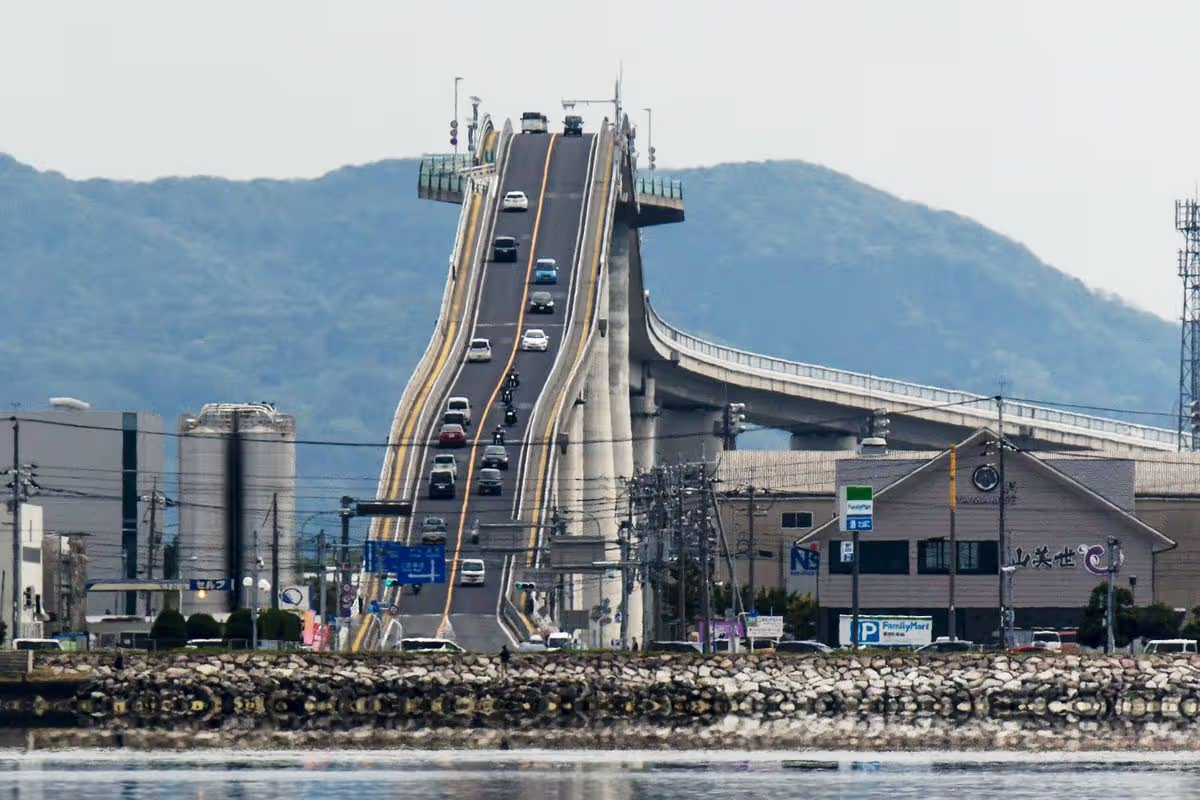
The bridge looks extremely steep from afar(Image: Getty)
A bridge so steep it’s been dubbed the ‘rollercoaster bridge’ is located in Japan and sees thousands of vehicles cross it daily. Often regarded as one of the steepest in the world, the Eshima Ohashi bridge links Matsue, in the Shimane Prefecture, with Sakaiminato in the Tottori Prefecture.
People say they have ‘nightmares’ after seeing photographs and footage of this bridge, which cost an eye-watering £119m to construct. In some images, it looks as though vehicles must climb at an extremely sharp angle.
It’s approximately 1.1 miles long, rising to 147 feet as it spans the Nakaumi Lake.
The bridge was constructed between 1997 and 2004, replacing a drawbridge that previously existed there. That structure, however, had some significant design flaws.
For instance, it could only handle 4,000 vehicles daily. Today, roughly 14,900 vehicles make the journey across in a 24-hour period, reports the Express.
It was also blocked by ships for approximately eight minutes at a time, and only vehicles weighing under 14 tons were permitted to use it.
In terms of its gradient, it measures approximately 6.1% on the Shimane side, which is where it’s often photographed from. On the opposite side, it’s marginally lower at 5.1%.
Ensure our latest lifestyle and travel headlines always appear at the top of your Google Search by making us a Preferred Source. Click here to activate or add us as Preferred Source in your Google search settings.
Images and clips of the bridge frequently cause a stir on social media, sparking discussion about its ‘terrifying’ appearance. One individual shared their thoughts on Reddit, saying: “One of my lifelong reoccurring nightmares involves bridges that look like this.”
Another wrote: “Oh. My. God. I get terrified shivers just looking at these pictures. Massive phobia of heights, I don’t think I’d do well on that bad boy.”
However, it’s important to bear in mind that photos of this bridge are often captured using a telephoto lens, which tends to make it appear far more dramatic than it truly is. It’s still quite steep, and extra caution is needed during the winter months to prevent it from becoming blanketed in ice and snow.
According to the Japan National Tourist Organisation, it’s frequently named one of the ‘craziest’ or ‘scariest’ bridges. Even if you’re without a car, you can walk or cycle across it, and it offers an excellent backdrop for photographs.
Additionally, telescopes and binoculars are available for tourists to gaze out across the lake when the weather permits.
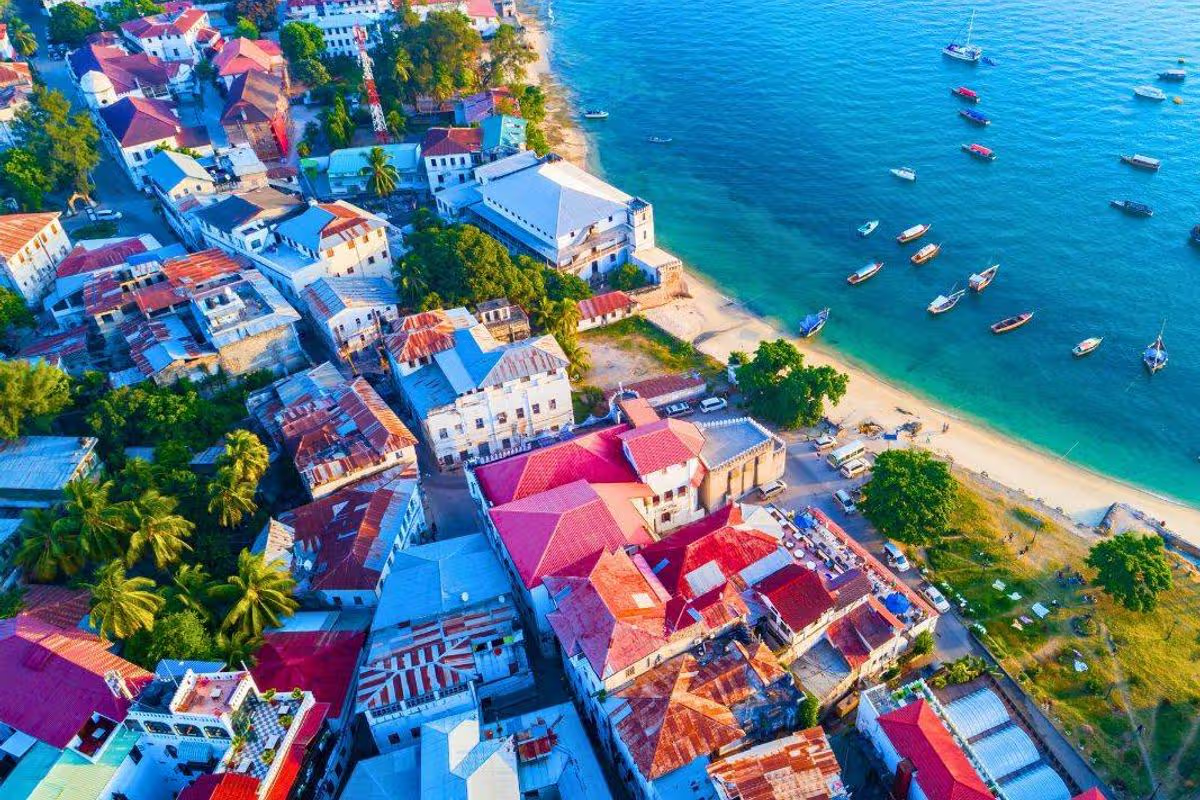
This stunning island off the east coast of Africais known for its budget-friendly prices and being the birthplace of Freddie Mercury.
(Image: Getty)
Temperatures are beginning to rise across the UK, prompting many Brits to start planning their summer getaway, and jetting off to somewhere tropical doesn’t have to break the bank. One destination worth considering is Zanzibar Island, also called Unguja, a beautiful island situated off Africa’s eastern coast, just above Tanzania.
Zanzibar Island is renowned for its coastline, where the sand is remarkably fine, making it ideal for anyone simply seeking a sunny spot to unwind. Paje beach has earned recognition as one of the world’s finest beaches, thanks to its landscape featuring swaying palm trees, shimmering azure waters and a spectacular sunset vista across the Indian Ocean.
Yet Zanzibar offers far more than just beaches, particularly for wildlife enthusiasts, as it’s home to Jozani Forest, a national park sheltering creatures found nowhere else on Earth.
The red colobus monkey exists exclusively on Zanzibar and is recognised by its distinctive red-striped coat and vocal nature; you’ll frequently hear it communicating with fellow group members.
Visitors can encounter numerous wild species, including blue monkeys, bush babies, elephant shrews, and an array of exotic birdlife, reports the Express.
Zanzibar’s eastern shoreline is also famous for hosting a substantial population of vibrant starfish, and boat excursions are available for snorkelling alongside these remarkable marine animals. It’s an outstanding destination for snorkelling and scuba diving enthusiasts, as coral reefs line much of the island’s shores, teeming with parrotfish, clownfish, angel fish and occasionally even reef sharks.
Plenty of travellers also relish hiring transparent kayaks, allowing you to glide around the island whilst capturing photographs of the stunning azure waters.
Zanzibar has earned the moniker Spice Island, being amongst the world’s leading clove producers, whilst also cultivating cinnamon, nutmeg, vanilla, mace and black pepper.
Visitors can explore spice plantations to witness the island’s verdant crop gardens and join guided tours where you’ll sample fresh spices straight from the plants.
It’s equally worthwhile simply strolling through Stone Town, the capital, which holds UNESCO World Heritage status thanks to its distinctive Swahili architecture, shaped by Indian, Arab and European influences.
Stone Town is renowned for its bustling markets, narrow alleyways and exquisitely carved wooden doors adorning the structures. It’s also Freddie Mercury’s birthplace, and you can tour his childhood residence and discover a museum celebrating the legendary performer.
Countless visitors adore Zanzibar for its sweltering climate, and during this period temperatures typically hover around 30C, dropping to 25C after dark.
Nevertheless, many holidaymakers favour Zanzibar because it’s considered remarkably affordable, with TripAdvisor users reporting it’s perfectly feasible to dine out for just a few quid. One holidaymaker reported: “A local beer is about £2.50 in a nice bar. A glass of wine (always South African) is a bit more. Soft drinks are fairly cheap. The local ginger beer (Tangawizi) is worth experiencing.”
Another traveller commented: “My experience is that for dinner and drinks (a two course meal, a glass of wine and lots of bottled water) one would expect to pay around £10 per head in Zanzibar, including Stone Town.”
A third visitor noted: “In the very local style places we are eating: large bottles of water for $1.50, Sprite/Coke $2, juice $3, beer and Savannah cider $3 and a glass of wine $3-$4.”
BOOKING a holiday can feel overwhelming at the best of times, but when you’re travelling alone with children, it becomes something else entirely.
You are the organiser, the navigator, the passport holder and the snack distributor. And if anything goes wrong, there is no one else to tag in. I work in travel and look at holiday pricing data every day. One trend that stands out consistently is that single-parent bookings often cost more than people expect.
Holiday expert Rob Brooks has scoured the internet for single-parent-friendly bargain hotelsCredit: Rob Brooks
With only one adult in the room and fewer family-room configurations available, the price per person can climb quickly.
So I wanted to approach this properly. I analysed booking data to identify the hotels that come out cheapest for single parents, ranking them by how far below the average single-parent booking they sit.
Then I sense-checked them: reading reviews, looking at layouts, and considering whether they genuinely work when you are the only adult in charge.
So here are the ten cheapest hotels for single-parent family holidays, and why they’re actually smart choices for a trip with the kids.
BLUESEA Montevista Hawai, Costa Brava
Costa Brava remains one of the most reliable regions for affordable family breaks, and BLUESEA Montevista Hawai delivers on practicality.
It is an all-inclusive property with two pools and regular kids’ entertainment, which immediately removes the daily stress of budgeting for meals.
Buffet dining means flexibility, and the hotel sits within easy walking distance of both the beach and the town.
When I compared it to the average single-parent booking, it came out around 52 per cent cheaper, which is a big gap.
Reviews describe it as lively and full of families, which helps if you’re worried about your kids being the only ones making noise.
I found a deal for 7 nights in June 2026, direct from Bournemouth, bed & breakfast from £250pp for one adult and one child.
For Spain in June, that’s really good value, and upgrading to all-inclusive doesn’t send the price sky high.
BLUESEA Montevista Hawai has a lively, family-friendly atmosphere perfect for kidsCredit: On The BeachRooms at the Pierre & Vacances Benidorm Horizon are simple and spaciousCredit: On The Beach
Pierre & Vacances Benidorm Horizon
If space is high on your list, this Benidorm apartment complex makes sense.
You get a separate bedroom, living area and kitchen, which means once the kids are asleep, you’re not stuck sitting in the dark.
Benidorm itself is flat and easy to walk around, with supermarkets and restaurants close by.
In the data, it worked out just over 53 per cent cheaper than the average single-parent holiday.
That level of saving, combined with proper apartment space, makes it a very strong option.
I found a deal for 7 nights in June 2026 from Leeds Bradford, self-catering, from £400pp for one adult and two children.
Location is doing most of the work here. Sol Puerto Marina sits right on Torremolinos Marina, with the beach, promenade and restaurants just minutes away.
When you’re managing children alone, being able to walk everywhere makes a real difference.
Rooms include kitchenettes for flexibility, and compared to the wider single-parent market, it is priced at roughly 55% below average.
I found a deal for 8 nights in early June 2026 from London Luton, room only, from £620pp.
Beachfront Costa del Sol in June at that price is impressive.
You’re just a short walk away from the bustling promenade and beaches at Sol Puerto MarinaCredit: on the beachThe Dalaman region of Turkey is often described as the Turquoise CoastCredit: Getty
London Blue Hotel, Dalaman
Not every family wants a huge resort in Turkey. London Blue Hotel in Dalaman is smaller and calmer, with reviews praising friendly staff and a relaxed pool area.
When you’re the only adult supervising, that quieter feel can make things much easier.
It also came in at around 55 per cent cheaper than the average single-parent booking, according to the data.
I found a deal for 8 nights in June 2026 from London Gatwick, bed & breakfast, from £240pp.
Turkey in June at that level feels almost too good to be true.
Campanile Val de France, Disneyland Paris
Theme park holidays can get expensive quickly, which is why this hotel stands out.
Campanile Val de France offers family rooms, breakfast included and a free shuttle to Disneyland Paris.
You get the location and convenience without paying Disney hotel prices.
Compared to the average single-parent booking, it came out around 56 per cent cheaper.
I found a deal for 7 nights in late June 2026 from Birmingham, bed & breakfast, from £357pp – around £1,070 total for one adult and two children.
FuerteSol, Fuerteventura
The Canary Islands are a safe bet for sunshine, and FuerteSol gives you flexibility.
It’s made up of bungalow-style apartments with terraces and kitchenettes.
The beach is five minutes away, there’s a supermarket nearby and the promenade is flat and easy for evening walks.
In the data, it worked out just over 56 per cent cheaper than the average single-parent holiday, which is a big saving for June.
I found a deal for 7 nights in June 2026 from Bournemouth, self-catering, from £210pp.
The Canaries in early summer for that kind of money is excellent value.
FuerteSol in Fuerteventura worked out at 56% cheaper than the average single-parent holidayCredit: On The BeachThe Els Llorers Apartments have an on-site shuttle bus to transport you into townCredit: On The Beach
Els Llorers Apartments, Costa Brava
Els Llorers is another apartment-style option that focuses on practicality.
Full kitchens, separate bedrooms and a kids’ pool with slides make it very family-friendly.
There’s even a shuttle into town, so you’re not dragging tired children up hills.
Price-wise, it came in around 57 per cent below the average single-parent booking, which explains why it performs so well.
I found a deal for 7 nights in June 2026 from Birmingham, self-catering, from £187pp – roughly £560 total for one adult and two children.
Spain, early peak season, under £600 is hard to beat.
Modern apartments, a heated pool and a free shuttle mean you can prepare breakfast, head to the parks and come back to your own living space rather than squeezing into one hotel room.
It is also priced around 58 per cent cheaper than the average single-parent holiday.
I found a deal for 7 nights mid-June 2026 from Belfast, room only, from £364pp.
For a well-rated aparthotel near Disney in summer, that’s solid value.
Pebbles Resort, Malta
Malta is straightforward, and that counts for a lot. English is widely spoken, it’s easy to get around, and even the plugs are the same as the UK, which saves hunting for adaptors.
Pebbles Resort gets strong reviews for friendly staff and spacious rooms, and there are several restaurants on site.
In cost terms, it came in nearly 60 per cent cheaper than the average single-parent booking.
I found a deal for 7 nights in late June 2026 from Norwich, room only, from £460pp.
Malta in June for under a grand is very good value.
You could stay at Pebbles Resort in Malta from just £460pp in JuneCredit: On The BeachThere’s thousands of hotels out there – but which ones are actually single-parent-friendly?Credit: Getty
BLUESEA Puerto Caleta, Fuerteventura
At the top of the list is BLUESEA Puerto Caleta in Fuerteventura.
It’s simple and self-catering, but brilliantly located. The beach is two minutes away, and the supermarket is even closer.
When you can walk everywhere, you remove half the hassle.
It is priced around 67 per cent below the average single-parent booking, making it the biggest saving in the data.
Summer 2026 is already sold out, which says a lot.
The deal I found was for January 2027: 7 nights from London Luton, self-catering, from £310pp.
How to pick a hotel for a single-parent holiday:
When you step back and look at the data – pricing, bookings, reviews – the pattern is clear.
Apartments tend to be cheaper than big-name resorts.
Central, walkable locations make life easier than remote luxury.
Flexibility usually matters more than flashy extras.
Single-parent holidays might feel stressful, but with the right hotel choice, the price doesn’t have to add to it.
IF you love a day out in a place that looks like a fairytale – put this spot on your list.
Called Chocolate Ville, the man-made village has become a popular tourist attraction with some even dubbing it the ‘Disneyland of Thailand.’
Sign up for the Travel newsletter
Thank you!
Chocolate Ville is a dining outlet in Thailand that has been compared to DisneyCredit: instagram/@chocolatevilleIt has al fresco dining as well as mascot parades, puppet shows and firework displaysCredit: Facebook/Chocolate Ville
The popular attraction that’s a European-style village is just 30-minutes from the centre of Bangkok.
Although, unlike Disneyland, Chocolate Ville has no rides.
Instead, it’s an outdoor dining attraction built to resemble it’s own little village with cobbed streets and fronts designed to look like toy shops and florists.
But it is filled with restaurants with al fresco seats where diners can dig into pizza, pasta, salads, steak, and of course, Thai dishes.
Through Chocolate Ville runs a river with waterfalls, riverboat and dotted about are ponds with capybaras.
One visitors wrote about the destination: “Chocolate Ville is a picture-perfect dining village straight out of a fairy tale! Set around a charming European-style park with cobblestone paths, pastel buildings, and a scenic lake, it offers a magical escape from Bangkok’s hustle.
“Whether you’re snapping Instagram-worthy photos by the lighthouse, strolling through flower-lined streets, or enjoying a cozy dinner under twinkling lights, every corner is full of charm.”
The makeshift village is also dressed up during certain times of the year like Halloween and Christmas.
At 5pm, costumed mascots roam the streets and perform for visitors.
In some places there are puppet shows or even parades – just like they have at Disneyland.
The biggest event in Chocolate Ville happens in the evening when there’s a huge fireworks display.
It’s not clear how much entrance to Chocolate Ville is online, but one visitor reported paying 100 thb (£2.36) for a ticket.
But this can be used in exchange for a drink, snack, souvenir, or as used as a voucher at one of the restaurants.
During the evening the whole place lights upCredit: Facebook/Chocolate Ville
If you actually want thrilling rides then Thailand has some incredible parks like Siam Amazing Park.
It’s filled with rollercoasters, drop towers, log flumes and carousels.
The theme park is split into sections from Xtreme World with the tallest and fastest rides, to Adventure World, Family World, Small World and Water World – the water park.
Here’s where visitors will find the record-breaking wave pool along with signature water rides like Speed Slide and Super Spiral.
It’s a seven-storey-rainbow slide, which is the highest in Southeast Asia and was once recorded as the highest in the world.
Another popular theme park in Bangkok is Dream World which has 32 attractions.
There’s go-karting, a swinging Viking ship, bumper cars, a haunted castle, pedalos on the lake, an animal farm – and classic rollercoasters.