TOP NEWS

From breaking news to significant developments in politics, business, technology, entertainment, and more, we deliver the stories that shape our global landscape.

Lawmakers want to know about Tulsi Gabbard’s role in Georgia FBI raid

Jan. 30 (UPI) — Two Democratic lawmakers are demanding answers about why National Intelligence Director Tulsi Gabbard was at an FBI raid at a Georgia election facility.

Gabbard was photographed outside the Fulton County Election Hub and Operations Center, just outside of Atlanta, when the FBI executed a “a court authorized law enforcement action” on Wednesday. FBI spokesperson Jenna Sellitto told The Hill that boxes loaded on trucks contained ballots.

Agents sought 2020 election records, Fulton County spokesperson Jessica Corbitt-Dominguez said.

“We don’t know why they took them, and we don’t know where they’re taking them to,” county board of commissioners Chair Robb Pitts told The Hill.

“Director Gabbard has a pivotal role in election security and protecting the integrity of our elections against interference, including operations targeting voting systems, databases, and election infrastructure,” a senior administration official told NBC News.

Sen. Mark Warner, D-Va., released a statement about Gabbard’s presence at the raid.

“There are only two explanations for why the Director of National Intelligence would show up at a federal raid tied to Donald Trump‘s obsession with losing the 2020 election,” he said. “Either Director Gabbard believes there was a legitimate foreign intelligence nexus — in which case she is in clear violation of her obligation under the law to keep the intelligence committees ‘fully and currently informed’ of relevant national security concerns — or she is once again demonstrating her utter lack of fitness for the office that she holds by injecting the nonpartisan intelligence community she is supposed to be leading into a domestic political stunt designed to legitimize conspiracy theories that undermine our democracy.”

He said it shows she is unfit for the job.

“Either is a serious breach of trust that further underscores why she is totally unqualified to hold a position that demands sound judgment, apolitical independence, and a singular focus on keeping Americans safe,” he said.

Warner and Rep. Jim Himes, D-Conn., who both serve on their chambers’ intelligence committees, penned a letter to Gabbard expressing concern about her appearance in Georgia and demanding that she “appear before the House Permanent Select Committee on Intelligence and the Senate Select Committee on Intelligence immediately.”

The letter said it is “deeply concerning that you participated in this domestic law enforcement action. The Intelligence Community should be focused on foreign threats and, as you yourself have testified, when those intelligence authorities are turned inwards the results can be devastating for Americans’ privacy and civil liberties.”

They said they want her to address her reasoning and role in attending the FBI operation in Fulton County, under what legal authority she or any other IC employee were involved, and an update on any intelligence she has concerning foreign interference in U.S. elections, including the 2020 election.

“Given the politically fraught nature of elections for federal office, any federal efforts associated with combatting foreign election threats necessitate public transparency, prompt updating of Congressional intelligence committees, and clear commitment to non-partisan conduct,” the letter said.

“Your recent actions raise foundational questions about the current mission of your office, and it is critical that you brief the Committees immediately as part of your obligation to keep Congress fully and currently informed.”

Two unnamed senior officials with knowledge of the matter told NBC that Gabbard’s presence in Fulton County was not requested by the Justice Department. They said Gabbard was only observing, and her presence wasn’t illegal.

“It seems to be an attempt to make herself relevant,” one official told NBC. “It’s so strange.”

On Thursday, Trump responded to a reporter’s question about her presence in Georgia.

“She’s working very hard on trying to keep the elections safe, and she’s done a very good job,” Trump said at the Kennedy Center. “You got a signed judge’s order in Georgia, and you’re going to see some interesting things happening. They’ve been trying to get there for a long time.”

If she took part in the search, her involvement would be “wrong and potentially even illegal,” said Kevin Carrol, a former CIA officer and national security lawyer, to NBC.

“It is also inappropriate for a Cabinet-level official to take part in a law enforcement operation. Among other things, the director is now potentially a fact witness in any suppression hearing or trial related to the evidence seized by the bureau,” Carroll said.

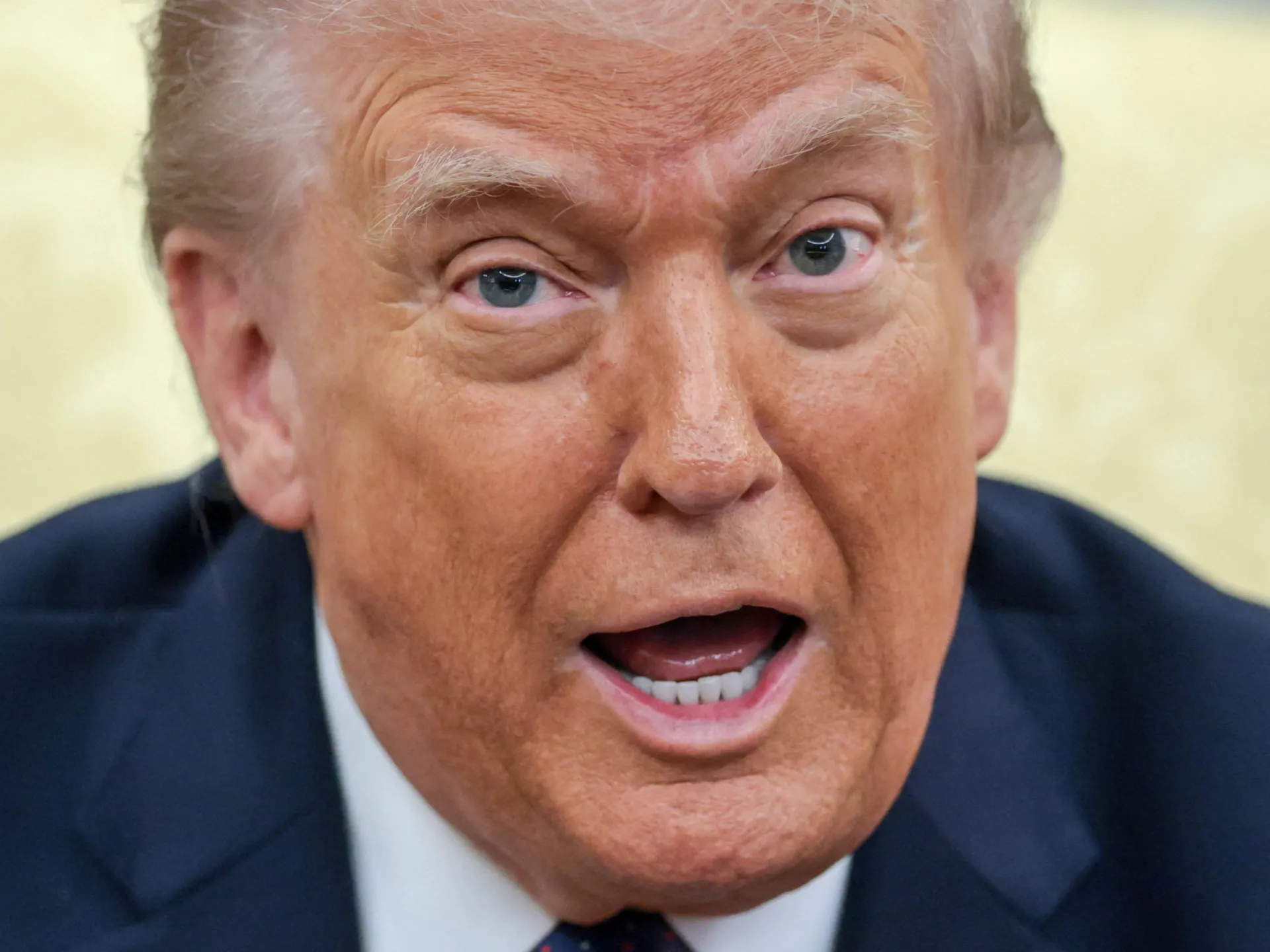
President Donald Trump poses with an executive order he signed during a ceremony inside the Oval Office of the White House on Thursday. Trump signed an executive order to create the “Great American Recovery Initiative” to tackle drug addiction. Photo by Aaron Schwartz/UPI | License Photo

Source link

US Department of Justice releases three million new Epstein documents | Donald Trump News

The United States Justice Department has released a massive new tranche of investigative files related to the late financier and convicted sex offender Jeffrey Epstein.

At a news conference on Friday, Deputy Attorney General Todd Blanche said the department was releasing more than 3 million pages of documents, as well as more than 2,000 videos and 180,000 images.

Recommended Stories

list of 3 itemsend of list

He said the release means the department has met a legal requirement passed by Congress last year.

“Today’s release marks the end of a very comprehensive document identification and review process to ensure transparency to the American people and compliance with the act,” Blanche said.

But the administration of President Donald Trump has faced scrutiny over the pacing of the files’ release and redactions within the published documents.

Trump himself has been confronted with questions about his past relationship with Epstein, who cultivated a roster of influential contacts.

On Friday, Blanche dismissed rumours that the Justice Department had sought to protect powerful individuals, including Trump.

While Trump has acknowledged a years-long friendship with with the financier, he has denied any knowledge of the underage sex-trafficking ring that prosecutors say Epstein led.

“There’s this built-in assumption that somehow there’s this hidden tranche of information ‌of men that we know about, that we’re covering up, or that we’re not we’re choosing not to prosecute,” Blanche said. “That is not the case.”

The Justice Department had initially missed a December 19 deadline set by Congress to release all the files.

The publication is the result of the Epstein Files Transparency Act, which was published in November with bipartisan support to force the release of all federal documents pertaining to Epstein.

In response to the law, the Justice Department said it had tasked hundreds of lawyers with reviewing the records to determine what needs to be blacked out to protect the identities of sexual abuse victims.

Blanche said the department withheld any materials that could jeopardise ongoing investigations or expose potential victims.

All women in the Epstein files other than Ghislaine Maxwell — an ex-girlfriend who was also convicted of child sex trafficking — have been obscured from the videos and images being released on Friday, according to Blanche.

In the past, some of Epstein’s victims have slammed the department’s redactions and withholdings as excessive, with critics pointing out that previously published documents were among the files blacked out.

In December, the Justice Department released an initial batch of Epstein-related documents, though it fell short of the full publication mandated by November’s law.

That release, however, included previously unreleased flight logs showing that Trump flew on Epstein’s private jet in the 1990s. Those trips appeared to happen before Trump has said the pair had a falling out.

The recent releases also contain images showing prominent individuals like tech billionaire Bill Gates, former Trump adviser Steve Bannon, director Woody Allen and former US President Bill Clinton socialising with Epstein, sometimes on his private island.

To date, none of the individuals depicted in the releases have been charged with any crimes, outside of Maxwell.

Following her conviction in 2021, she is serving a 20-year prison sentence, though she has continued to deny any wrongdoing.

Epstein died from of apparent suicide in a New York jail cell in August 2019, a month after he was indicted on federal sex trafficking charges.

He had previously been convicted of state sex-offender charges in Florida in 2008 as part of a plea deal that was widely slammed for its leniency. He spent a total of 13 months in custody.

One of Epstein’s victims, Virginia Roberts Giuffre, also filed lawsuits against him, accusing him of arranging sexual encounters with politicians, business titans, academics and other influential figures while she was underage.

All of the men identified by Giuffre, who died in April 2025 in Australia, have denied the allegations.

Among the people she accused was Andrew Mountbatten-Windsor, formerly known as Prince Andrew, who denied the clams but settled a lawsuit filed by Giuffre for an undisclosed sum.

In October, his brother, King Charles III of the United Kingdom, stripped Mountbatten-Windsor of his royal titles as a result of the controversy.

Source link

Panama Supreme Court axes port contract with Hong Kong

A cargo ship leaves a lock on the Panama Canal in Panama City, Panama, on Jan. 19. The Supreme Court of Panama invalidated the contract of a Hong Kong subsidiary to operate ports on the Panama Canal, ruling it is unconstitutional. Photo by Carlos Lemos/EPA

Jan. 30 (UPI) — The Supreme Court of Panama invalidated the contract of a Hong Kong subsidiary to operate ports on the Panama Canal, ruling it is unconstitutional.

In a Thursday ruling the high court said the terms of Panama Ports Company’s contract that allowed it to operate the ports of Balboa and Cristobal violated the country’s constitution. Panama Ports Company is a subsidiary of CK Hutchinson Holding, a company based in Hong Kong.

The court said the ruling was made after “extensive deliberation.”

Panama Ports Company has been operating two of Panama’s five ports since 1997. It was founded in Hong Kong and is not owned by the Chinese government.

The company argues that the court’s ruling lacks a legal basis and “jeopardises not only PPC and its contract but also the well-being and stability of thousands of Panamanian families who depend directly and indirectly on port activity.” It said that it has invested more than $1.8 billion in the ports’ infrastructure in the nearly 30 years it has operated there.

Panama’s President Jose Raul Mulino said ports will continue to operate without interruption following Thursday’s ruling. APM Terminals Panama will operate the Balboa and Cristobal ports in the interim.

President Donald Trump has long sought control over the Panama Canal and voiced his desire to block China from operating there. Last year he threatened to seize control of the canal.

After the ruling, shares in CK Hutchinson fell by 4.6%.

China’s Ministry of Foreign Affairs said Chinese companies will pursue legal action to maintain their rights to operate on the Panama Canal, calling the decision “contrary to the laws governing Panama’s approval of the relevant franchises.”

CK Hutchinson has pursued a sale of its interest in the Balboa and Cristobal ports to a group of U.S. investment firms, including BlackRock. The proposed deal is estimated to be worth more than $22 billion.

Thursday’s decision may impact those plans.

Picketers hold signs outside at the entrance to Mount Sinai Hospital on Monday in New York City. Nearly 15,000 nurses across New York City are now on strike after no agreement was reached ahead of the deadline for contract negotiations. It is the largest nurses’ strike in NYC’s history. The hospital locations impacted by the strike include Mount Sinai Hospital, Mount Sinai Morningside, Mount Sinai West, Montefiore Hospital and New York Presbyterian Hospital. Photo by John Angelillo/UPI | License Photo

Source link

Djokovic beats Sinner as history and Alcaraz await in Australian Open final | Tennis News

Novak Djokovic stuns reigning two-time champion Jannik Sinner to set up Australian Open final against Carlos Alcaraz.

Novak ‍Djokovic ‍channelled his halcyon days in a five-set classic to dethrone Jannik Sinner and become ⁠the oldest man to reach ​the Australian Open final ‍in the professional era at a rocking Rod Laver Arena.

Four months before his ‍39th ⁠birthday, Djokovic showed he remains unbeatable on his day as he sent the double defending champion packing with a 3-6 6-3 4-6 6-4 ​6-4 win in a 1:32am finish early on Saturday in Melbourne (14:32 GMT on Friday).

Recommended Stories

list of 4 itemsend of list

“It feels surreal to be honest, playing over four hours,” Djokovic said on ​court.

“I was reminiscing in 2012 when I played Rafa [Nadal] in the final, that was six ‍hours almost.

“The level of intensity and quality was high [against Sinner], and that was the only way to have a chance to win.

“He won the last five matches against me, he had my mobile number, so I had to change my ‍number tonight.

“Jokes aside I ⁠said at the net: ‘Thanks for allowing me at least one’. Tremendous respect, an incredible player. He pushed me to the limit, so he deserves applause for his performance.”

Novak Djokovic of Serbia in the Men's Singles Semifinal against Jannik Sinner of Italy
Novak Djokovic of Serbia plays a forehand against Jannik Sinner of Italy [Quinn Rooney/Getty Images]

Djokovic will meet world number one Carlos Alcaraz in Sunday’s decider, the Spaniard having fought off Alexander Zverev in the longest Australian Open semifinal.

Eighteen years after his first Melbourne crown, Djokovic will strive for a record-extending 11th against Alcaraz and the unprecedented 25th Grand Slam title that has eluded him.

Djokovic needed incredible ​fortune to reach the semifinals, with his quarterfinal opponent, Lorenzo Musetti, retiring injured ‌after taking the first two sets.

The Serb enjoyed a walkover in the fourth round as well, when Jakub Mensik pulled out.

But it was hard work and mental toughness that got Djokovic over the line against Sinner, a player who had beaten him in ‌their previous five matches.

Jannik Sinner in defeat to Novak Djokovic at the Australian Open tennis
Jannik Sinner of Italy plays a forehand in the Men’s Singles semifinal at Melbourne Park[Phil Walter/Getty Images]

Victory came grudgingly.

He had to save a slew of break points in the decisive set before finally getting a look at Sinner’s ‌serve at 3-3.

Flooring the Italian in three punishing rallies, the Serb ⁠broke him to lead 4-3, raised one fist and threw an icy stare at his player’s box.

Djokovic had to save another three break points in the next service game, but sent Serbian fans into delirium when he survived them all and held with an ‌ace.

Serving for the match at 5-4, Djokovic summoned the grit and champion spirit of 20 years at the top, setting up two match points with a forehand winner down the line.

Sinner saved both, but finally fired ‍a backhand wide to concede, leaving Djokovic to throw away his racket, get down on his knees and cross his chest.

Source link

Trump nominates Kevin Warsh to replace Powell as fed chair | Donald Trump News

United States President Donald Trump has nominated former Federal Reserve Governor Kevin Warsh to head the US central bank when current Federal Reserve Chair Jerome Powell’s term ends in May.

The announcement on Friday caps a months-long, highly publicised search for a new chair of the Federal Reserve, widely regarded as one of the most influential economic officials in the world.

Recommended Stories

list of 3 itemsend of list

It comes amid Trump’s public pressure campaign on Powell, whom he appointed during his first term but has repeatedly condemned for not cutting interest rates at the pace the president would like.

“I have known Kevin for a long period of time, and have no doubt that he will go down as one of the GREAT Fed Chairmen, maybe the best,” Trump posted on his Truth Social site. “On top of everything else, he is ‘central casting,’ and he will never let you down.”

The statement referenced the apparent compromise Warsh represents. The 55-year-old is known to be in Trump’s orbit and has recently called for lower interest rates, although he is expected to stop short of the more aggressive easing associated with some other potential candidates for the job.

Still, he is expected to face a punishing Senate confirmation hearing, with US lawmakers likely to be particularly critical given Trump’s public comments and the Department of Justice’s decision earlier this month to open a criminal probe into Powell.

Critics, including Powell, have said Trump’s actions seek to undermine the Federal Reserve’s independence and pressure the agency to set monetary policy aligned with the president’s wishes.

What does the Federal Reserve do?

The Federal Reserve has long been seen as a stabilising force in global financial markets, due in part to its perceived independence from politics.

The Federal Reserve is tasked with combating inflation in the United States while also supporting maximum employment. It is also the nation’s top banking regulator.

The agency’s rate decisions over time influence borrowing costs throughout the economy, including for mortgages, car loans and credit cards.

In a statement, Senator Elizabeth Warren, the top Democrat on the US Senate Banking Committee, said, “This nomination is the latest step in Trump’s attempt to seize control of the Fed.”

She pointed to the investigation into Powell, as well as Trump’s effort to push out Fed Governor Lisa Cook, which is currently being challenged before the US Supreme Court.

“No Republican purporting to care about Fed independence should agree to move forward with this nomination until Trump drops his witch-hunt,” Warren said.

Republican Senator Thom Tillis, meanwhile, said he would not vote to confirm any nominee until the Department of Justice probe into Powell is ended.

“Protecting the independence of the Federal Reserve from political interference or legal intimidation is non-negotiable,” he said in a statement.

Still, some Republicans welcomed the nomination.

“No one is better suited to steer the Fed and refocus our central bank on its core statutory mandate,” Republican Senator Bill Hagerty said in a statement.

If Warsh is confirmed, it remains unclear if Powell would immediately step down or finish out his term. Traditionally, Federal Reserve Chairs step aside as soon as their replacement is appointed, but the political situation has led to speculation Powell could stay on as long as possible.

Who is Warsh?

Warsh is currently a fellow at the right-leaning Hoover Institution and a lecturer at the Stanford Graduate School of Business.

He was a member of the Federal Reserve’s board from 2006 to 2011 and became the youngest Federal Reserve Governor in history when he was appointed at age 35.

He was an economic aide in George W Bush’s Republican administration and was an investment banker at Morgan Stanley. His father-in-law is Ronald Lauder, heir to the Estee Lauder cosmetics fortune and a longtime donor and confidant of Trump’s.

Warsh has historically supported higher interest rates to control inflation, but has more recently argued for lower rates.

He has been a vocal critic of current Federal Reserve leadership, calling for “regime change” and criticising Powell for engaging on issues like climate change, which Warsh has said are outside the role’s mandate.

Reporting from Washington, DC, Al Jazeera’s Kimberly Halkett said Warsh’s experience means his appointment will likely be well received by the markets.

“The consensus is that in the short term, yes, this is a nominee who will do what the president has asked,” she said.

“But what he could do long term as chair of the board is very similar, ironically, to what Jerome Powell, the current board chair, is doing right now,” she said.

“That is having independence – making decisions based on economic data and not necessarily on political whims of a president.”

Source link

Seoul stocks renew record high on AI confidence amid U.S. tariff woes

South Korea’s KOSPI index closed at a record high on Friday, as seen on a board at the dealing room of Woori Bank in Seoul. Photo by Yonhap

South Korean stocks closed a tad higher Friday to extend their winning streak to a fourth session to a new record high as investors scooped of artificial intelligence (AI) shares despite concerns over a bubble. The local currency fell against the greenback.

The benchmark Korea Composite Stock Price Index (KOSPI) inched up 3.11 points, or 0.06 percent, to close at 5,224.3, after rising as high as to 5,321.68.

Trade volume was heavy at 852 million shares worth 34.7 trillion won (US$24.1 billion). Losers outnumbered winners 602 to 278.

Individuals bought a net 2.2 trillion won, while foreigners sold a net 1.9 trillion won. Institutions sold a net 425 billion won.

Investors continued to purchase tech shares despite concerns over a bubble, as their performance has already been proven for robust earnings amid the AI cycle.

“For the time being, AI hardware and software companies need to overcome concerns over their profitability,” Han Ji-young, a researcher at Kiwoom Securities, said.

“During the period, the market’s preference for chipmakers that sell memory products to such companies will remain strong,” Han added.

The market advance was limited after U.S. President Donald Trump vowed to raise “reciprocal” tariffs and auto duties on South Korea back to 25 percent this week.

Top-cap Samsung Electronics edged down 0.12 percent to 160,500 won, while SK hynix set a fresh high at 909,000 won, up 5.57 percent.

Brokerage houses closed bullish amid the market rally, with Mirae Asset Securities rising 4.65 percent to 42,750 won and Kiwoom Securities increasing 4.11 percent to 443,500 won.

Top mobile carrier SK Telecom rose 4.32 percent to 72,500 won on the back of improved business outlook, and its rival KT added 1.43 percent to 56,900 won.

Samsung SDI rose 0.52 percent as the company said it has won a battery supply contract without disclosing details, with the deal widely believed to be related to Tesla Inc.’s energy storage system business.

The Korean won was quoted at 1,439.5 won against the U.S. dollar at 3:30 p.m., down 13.2 won from the previous session’s close.

Bond prices, which move inversely to yields, closed lower. The yield on three-year Treasurys rose 3.2 basis points to 3.138 percent, and the return on the benchmark five-year government bonds added 4.1 basis points to 3.436 percent.

Copyright (c) Yonhap News Agency prohibits its content from being redistributed or reprinted without consent, and forbids the content from being learned and used by artificial intelligence systems.

Source link

Massive project to analyze space signals to end; hunt for ‘ET’ goes on

1 of 4 | Scientists from the University of California at Berkeley are using the 500-meter Aperture Spherical Telescope in China to check out a final batch of 100 candidate “ET” radio signals detected through the “SETI@home” program. File Photo by STR/EPA

ST. PAUL, Minn., Jan. 30 (UPI) — One of the longest-running searches for extraterrestrial life is coming to end this year as U.S. scientists wrap up a popular program that enlisted millions of home computer users to analyze radio signals received from space.

After years poring through immense amounts of generated data, the program’s co-founders at the University of California at Berkeley told UPI this week they are probing 100 detected signals deemed to be the best candidates for messages from “ET” before the effort is wrapped up for good, 27 years after it was launched.

But even though the “SETI@home” project has so far failed to record a “first contact” from an alien civilization, its leaders say valuable lessons have been learned that can be applied to the continuing hunt for beyond Earth.

SETI@home, short for Search for Extraterrestrial Intelligence, was launched in 1999 by scientists at UC Berkeley who over the course of two-plus decades enlisted more than 5 million “crowdsourced” volunteers willing to donate their home computers’ processing capacity to analyze data generated by momentary energy blips picked up by the Arecibo Observatory in Puerto Rico.

It was one of the pioneering efforts at distributed computing in an era before supercomputers and high-speed Internet connections. Under the project, home users downloaded and installed free software that could pick out signals deemed to be “ET” candidates from raw data supplied by the 1,000-foot radio telescope at Arecibo, which collapsed in 2020

The observatory was damaged by Hurricane Maria in 2017 and rebuilt, but it met its end a little more than three years later because filled spelter sockets that anchored the massive support cables had been undergoing long-term chemical and mechanical degradation.

The data was collected over a period of 14 years and covered almost the entire sky visible to the telescope as its operators performed other tasks, such as mapping solar system bodies and discovering pulsars.

From its data, the home computer users ultimately produced 12 billion detections. The vast majority turned out to be radio frequency interference from man-made sources, such as satellites and earthbound radio and television broadcasts, but researchers for years continued to doggedly plow through the possibilities.

Billions of “candidate” radio signals narrowed to final 100

Project co-founder David Anderson of UC Berkeley’s Space Sciences Laboratory said he and his team spent a decade narrowing down that massive list to 1 million candidates and then to a final 100, which are now being investigated using China’s 500-meter Aperture Spherical Telescope, also known as FAST, in hopes of finding them again.

And after that’s completed, the long-running program will officially be a wrap, in part because it has now reached point of diminishing scientific returns.

“The output of the first two phases of SETI@home were millions of what we call signal candidates, which are basically collections of momentary bursts of energy from the same place in the sky at about the same frequency, but possibly spread over many years,” Anderson told UPI.

“And of course, there was a lot of work involved in removing the man-made interference from from these things and ranking them, because at some point we had to go through them and manually inspect the signal candidates to get rid of the ones that are obviously interference.

“A lot of that we could do by using computer algorithms we developed, but in the end, we had to look at these signals ourselves.”

To guide the development of those algorithms, Anderson and his team used artificial candidates, or “birdies,” that modeled persistent ET signals within a range of power and bandwidth parameters. The birdies were introduced blindly, allowing the team to gauge how sensitive their detection system was.

The only reason they were able to generate the initial billions of candidate signals was due to the small processors provided the home-based volunteers, whose response at the start of effort in the late ’90s was overwhelming, Anderson said.

“Whether there is extraterrestrial life is kind of the most important unanswered scientific question at this point, and so I think we knew that we’d get some users,” he said. “We banked on, I think, 50,000 people initially, which we thought we’d need to keep up with the stream of data from Arecibo.

“We got a lot of national media coverage at right at the beginning, and within the first year we had close to 1 million participants. We actually had to scramble to figure out ways to use that surplus of computing power effectively.”

UC Berkeley research astronomer Eric Korpela, another co-founder of the program, said he felt a keen “sense of accomplishment” with SETI@home, both in the sense of technical achievements — such as in vastly increasing the sensitivity of signal detection over existing spectroscopic methods — and in how it demonstrated the intensity of worldwide public interest in the search for ET.

“We encountered a lot of resistance from the SETI community when we first started started this,” he told UPI. “Whenever you start a project with a large public-facing component, there’s always the fear in a lot of peoples’ minds that you are going to do something wrong and you’re going to turn people off the entire field.

“But, of course, I think that wasn’t the case. Instead, this really engaged the public imagination, and I don’t think that we’re necessarily done with that. Someone could again tap into that sense of fascination that people have about the search for extraterrestrial life.”

Many people still want to have a connection to this sort of science, Korpela said, adding, “I think that is really a large part of our legacy.”

Others praise, assess impact of SETI@home

Other researchers and organizations deeply involved in the search for extraterrestrial life also praised the accomplishments and legacy of SETI@home as it wraps up its mission.

One of them is the National Science Foundation National Radio Astronomy Observatory and Green Bank Observatory in West Virginia, trailblazers in radio astronomy and operators of Breakthrough Listen, described as the largest ever scientific research program aimed at finding evidence of civilizations beyond Earth.

Observatory public information officer Jill Malusky noted that her organization and UC Berkeley’s SETI Research Center worked together on SETI@home, and that its winding down won’t sever that relationship.

“The NSF NRAO/GBO are big supporters of citizen science projects, and we’re excited about the impact of SETI@home’s legacy through the tireless work of its volunteers, and for the public recognition SETI can bring to efforts like these,” she told UPI.

“The search for techno-signatures and extraterrestrial life is a very exciting part of the scientific research that the NSF NRAO’s telescopes can do — and it’s one of the accessible areas for the public to understand.”

Most staffers who work at the West Virginia observatories were drawn there “by the same curiosity we all have when we look up at the universe — are we the only ones here? Is anyone else out there?” she said.

“While what we find with our telescopes may not be as dramatic as we hope, like a sci-fi movie, it’s still exciting to have our work overlap with the search.”

Similarly, prominent astrobiologist and SETI researcher Douglas Vakoch said SETI@home revolutionized the search for life in the universe by solving one of the greatest challenges of looking for intelligence in space, and that by doing so “directly inspired a new generation of researchers who are attempting first contact by sending powerful radio messages to the stars.”

Vakoch is president of METI International, a nonprofit research and educational organization dedicated to messaging extraterrestrial intelligence, and editor of many academic works in several fields.

He told UPI that SETI@home was a breakthrough in that it was able to combine “mainstream astronomy” with the search for extraterrestrials, which researchers must “constantly struggle to justify” as they seek precious telescope time.

“With SETI@home, scientists did both,” Vakoch said. “As astronomers pointed the Arecibo radio telescope at targets of their choice, SETI@home also analyzed the incoming data, but this time for signals that can’t be created by nature. SETI@home was designed so scientists could conduct mainstream astronomy and simultaneously determine whether we’re alone in the universe.”

in that way, instead of becoming an obstacle to astronomers seeking time on the world’s largest radio telescope, SETI@home “helped foster public support and recognition for space science.”

Its greatest legacy, he said, is that it is now “guiding the next generation of interstellar communication,” including Vakoch’s own METI project, which rather than listening for radio signals from space as SETI does, reverses the process by sending powerful radio signals to nearby stars in the hope of eliciting a response from an advanced civilization.

Despite thus far coming away empty-handed in the search for ET, the SETI@home project nonetheless provided many valuable insights, Anderson said.

“It was a ‘whole sky’ project that covered the everything visible from Arecibo, and there’s there’s a lot of technical things that we did, some of which were right and others we would do differently if we had to go back,” he said.

“So we learned a lot of lessons about how to do radio astronomy, and we published two papers last year describing them.”

He added that the powerful distributed computing system established for SETI@home can be used in the future for research in related areas such as cosmology and pulsars, or even for medical research.

Source link

Alcaraz beats Zverev to break slam record in reaching Australian Open final | Tennis News

Carlos Alcaraz becomes the youngest man to reach all four slam finals and can now become youngest to win all four.

Carlos Alcaraz overcame cramps and injury to fend off Alexander Zverev in an epic, momentum-swinging five-setter to become the youngest man in the Open era to reach the finals of all four Grand Slam events.

At 22, he’s aiming to be the youngest man to complete a career Grand Slam.

Recommended Stories

list of 4 itemsend of list

He reached his first Australian Open final the hard way, winning 6-4, 7-6 (5), 6-7 (3), 6-7 (4), 7-5 in 5 hours, 27 minutes on Friday.

That’s despite being two points away in the third set from a semifinal victory in a tournament where he hadn’t dropped a set through five rounds.

He was behind in the fifth set after dropping the first game and didn’t break back until Zverev was serving for the match in the 10th.

Alcaraz will next face either two-time defending champion Jannik Sinner or 10-time Australian Open titlist Novak Djokovic, who is bidding for an unprecedented 25th Grand Slam singles title. The long afternoon match delayed the start of the night’s semifinal.

The top-ranked Alcaraz was leading by two sets and appeared to be in the kind of form that won him the US Open last year and has helped him evenly split the last eight majors with Sinner.

But in the ninth game of the third, he started limping and appeared to be struggling with an upper right leg problem. After holding for 5-4, he took a medical timeout in the changeover. It may have been cramp, but he rubbed the inside of his right thigh and called for the trainer, who also massaged the same area.

Zverev was demonstrably upset, talking with a tournament official, when his rival was given the three-minute break for treatment.

Spain's Carlos Alcaraz receives medical attention during his semi final match against Germany's Alexander Zverev
Spain’s Carlos Alcaraz receives medical attention during his semifinal match against Germany’s Alexander Zverev [Jaimi Joy/Reuters]

Even with his limited footwork, Alcaraz was able to hit winners and get to 6-5 before the trainer returned in the changeover to massage the area again.

When he went back out, the crowd gave him rousing support. Zverev served a double-fault to open the next game, and Alcaraz lobbed and then slapped a forehand winner down the line to get to 0-30. But Zverev won four straight points to force the tiebreaker and then win it.

No 3 Zverev, the 2025 runner-up, retained his composure despite Alcaraz’s obvious discomfort on the other side of the net, and the crowd on Rod Laver Arena firmly behind the Spaniard.

He was in front for the entire fourth set, but Alcaraz stayed with him, until Zverev again took charge in the tiebreaker. More than four hours had elapsed when the match went to a fifth set, the first five-setter on the centre court in the 2026 tournament.

Alcaraz dropped serve in the opening game of the fifth set but hung with Zverev, getting five breakpoint chances without being able to convert.

The drama lifted in the sixth game, when Alcaraz sprinted across court to track down a drop shot and slid at full pace for an angled forehand winner. The crowd went crazy.

Alcaraz finally converted the break when Zverev was serving for the match at 5-4 in the fifth set.

He held for 6-5 and converted his first match point when Zverev was serving to stay in the match.

Source link

Are Trump officials driving Alberta’s separatist movement in Canada? | Donald Trump News

Canada’s Prime Minister Mark Carney has said that he expects the United States to respect the country’s sovereignty after reports that Alberta separatists have met several times with officials of the Donald Trump administration.

The Financial Times reported that US State Department officials held meetings with the Alberta Prosperity Project (APP), a group calling for a referendum on whether the energy-rich western province should leave Canada.

Recommended Stories

list of 1 itemend of list

Speaking in Ottawa on Thursday, Carney said he has been clear with US President Donald Trump on the issue.

“I expect the US administration to respect Canadian sovereignty,” he said, adding that after raising the issue, he wanted the two sides to focus on areas where they can work together.

Carney is himself an Albertan, raised in Edmonton, the provincial capital. The province has had an independence movement for decades.

Trump has repeatedly threatened to make Canada the “51st state” of the American Union.

Here is what we know:

Leaders of the APP have reportedly met with US State Department officials in Washington at least three times since last April. Trump entered office for a second time in January.

These meetings have prompted concern in Ottawa regarding potential US interference in Canadian domestic politics.

This follows comments by US Treasury Secretary Scott Bessent last week, who described Alberta as “a natural partner for the US” and praised the province’s resource wealth and “independent” character during an interview with the right-wing broadcaster Real America’s Voice.

“Alberta has a wealth of natural resources, but they [the Canadian government] won’t let them build a pipeline to the Pacific,” he said. “I think we should let them come down into the US,” Bessent said during an interview with the right-wing broadcaster.

“There’s a rumour they may have a referendum on whether they want to stay in Canada or not.”

Asked if he knew something about the separation effort, Bessent said, “People are talking. People want sovereignty. They want what the US has got.”

After Bessent’s comments, Jeffrey Rath, a leader of the APP, said that the group was seeking another meeting with US officials next month, where they are expected to ask about a possible $500bn credit line to support Alberta if a future independence referendum – which has not yet been called – were to be held.


The developments come at a sensitive moment in US-Canada relations, with trade tensions still simmering and after a recent speech at the World Economic Forum in Davos where Carney warned that Washington was contributing to a “rupture” in the global order.

Trump has repeatedly threatened to make Canada part of the American Union. His expansionist ambitions have been further underscored by his recent push to acquire Greenland from Denmark, which, like Canada, is a NATO ally. At the start of the year, the US military also abducted Venezuelan President Nicolas Maduro, and has since attempted to take control of the South American nation’s massive oil industry.

How have Canadian leaders reacted to the reports?

Speaking on Thursday, British Columbia Premier David Eby described the reported behind-the-scenes meetings as “treason”.

“To go to a foreign country and to ask for assistance in breaking up Canada, there’s an old-fashioned word for that – and that word is treason,” Eby told reporters.

“It is completely inappropriate to seek to weaken Canada, to go and ask for assistance, to break up this country from a foreign power and – with respect – a president who has not been particularly respectful of Canada’s sovereignty.”

Ontario Premier Doug Ford appealed for Canadian unity on Thursday morning.

“You know, we have a referendum going on out in Alberta. The separatists in Quebec say they’re gonna call a referendum if they get elected. Like, folks, we need to stick together. It’s Team Canada. It’s nothing else,” he said.

Alberta Premier Danielle Smith, however, said she won’t demonise the Albertans who are open to separation because of “legitimate grievances” with Ottawa and said she did not want to “demonise or marginalise a million of my fellow citizens”.

Smith has long been pro-Trump and visited the US president’s Mar-a-Lago estate in January 2025, at a time when most other Canadian leaders were joining hands to criticise his demand that the country become a part of the United States.

Alberta Premier Danielle Smith speaks at the Calgary Chamber
Alberta Premier Danielle Smith [FILE: Todd Korol/Reuters]

What do we know about a potential referendum in Alberta?

Anger towards Ottawa has been building in Alberta for decades, rooted largely in disputes over how the federal government manages the province’s vast oil and gas resources.

Many Albertans feel federal policies – particularly environmental regulations, carbon pricing and pipeline approvals – limit Alberta’s ability to develop and export its energy.

As a landlocked province, Alberta depends on pipelines and cooperation with other provinces to access global markets, making those federal decisions especially contentious.

Many Albertans believe the province generates significant wealth while having limited influence over national decision-making. In 2024-25, for instance, it contributed 15 percent of Canada’s gross domestic product (GDP), despite being home to only 12 percent of the population.

Alberta consistently produces more than 80 percent of Canada’s oil and 60 percent of the country’s natural gas.

Yet, many Albertans say that the federal government does not give the province its fair share from taxes collected. Canada has a system of equalisation payments, under which the federal government pays poorer provinces extra funds to ensure that they can maintain social services. While Quebec and Manitoba receive the highest payments, Alberta – as well as British Columbia and Saskatchewan – at the moment receive no equalisation payments.

A woman crosses an empty downtown street in Calgary, Alberta
A woman crosses an empty downtown street in Calgary, Alberta [FILE: Andy Clark/Reuters]

Carney recently signed an agreement with Alberta, opening the door for an oil pipeline to the Pacific, though it is opposed by Eby and faces significant hurdles.

Recent Ipsos polling suggests that about three in 10 Albertans would support starting the process of leaving Canada.

But the survey also found that roughly one in five of those supporters viewed a vote to leave as largely symbolic – a way to signal political dissatisfaction rather than a firm desire for independence.

A referendum on Alberta independence could happen later this year if a group of residents can collect the nearly 178,000 signatures required to force a vote on the issue. But even if the referendum passes, Alberta would not be immediately independent.

Under the Clarity Act, the federal government would first have to determine whether the referendum question was clear and whether the result represented a clear majority. Only then would negotiations begin, covering issues such as the division of assets and debt, borders and Indigenous rights.

What is the Alberta Prosperity Project and what does it want?

The APP is a pro-independence group that is campaigning for a referendum on Alberta leaving Canada.

It argues that the province would be better off controlling its own resources, taxes and policies, and has been working to gather signatures under Alberta’s citizen-initiative rules to trigger a vote.

While it describes itself as an educational, non-partisan project, the group has drawn controversy over its claims about the economic viability of an independent Alberta.

On its website, the APP says, “Alberta sovereignty, in the context of its relationship with Canada, refers to the aspiration for Alberta to gain greater autonomy and control over provincial areas of responsibility.”

“However, a combination of economic, political, cultural and human rights factors … has resulted in many Albertans defining ‘Alberta sovereignty’ to mean Alberta becoming an independent country and taking control of all matters that fall within the jurisdiction of an independent nation,” it adds.

What else has Washington said?

White House and State Department officials told the FT that administration officials regularly meet with civil society groups and that no support or commitments were conveyed.

A  report published by Canada’s public broadcaster CBC earlier this year quoted US national security analyst Brandon Weichert as saying that Trump’s talk of Canada becoming the “51st state” was, in reality, aimed at Alberta.

Appearing on a show hosted by former Trump chief strategist Steve Bannon, Weichert suggested that a vote for independence in Alberta would prompt the US to recognise the province and guide it towards becoming a US state.

Has the Trump administration tried this elsewhere?

Yes, in Greenland.

As with Canada, Trump has repeatedly called for Greenland to be incorporated into the US. His threats to annex Greenland have prompted strong opposition from the government of the Arctic island, Denmark — which governs Greenland — and Europe.

But as with Alberta, Trump’s administration has also attempted to test separatist sentiment. In August 2025, the Danish government summoned the top US diplomat in Copenhagen after Denmark’s national broadcaster reported that three Trump allies had begun pulling together a list of Greenlanders supportive of the US president’s efforts to get it to join the United States.

Source link

Zelenskyy seeks 50,000 Russian ‘losses’ a month to win the Ukraine war | Russia-Ukraine war News

Ukrainian President Volodymyr Zelenskyy says he plans to increase his armed forces’ lethality as part of a strategy to disarm Moscow and turn a deadlocked negotiating table.

“The task of Ukrainian units is to ensure a level of destruction of the occupier at which Russian losses exceed the number of reinforcements they can send to their forces each month,” he told military personnel on Monday.

Recommended Stories

list of 4 itemsend of list

“We are talking about 50,000 Russian losses per month, this is the optimal level,” he said.

Video analysis, Zelenskyy recently said, showed 35,000 confirmed kills in December 2025, up from 30,000 in November and 26,000 in October. But on Monday, he clarified that the 35,000 were “killed and badly wounded occupiers”, who would not be returning to the battlefield.

His commander in chief, Oleksandr Syrskii, conservatively estimated “more than 33,000” confirmed kills in December.

Ukraine believes it has killed or maimed 1.2 million Russians since Russia’s full-scale invasion in 2022.

The Center for Strategic and International Studies recently estimated that Russia had suffered 1.2mn casualties, including at least 325,000 deaths, and Ukraine up to 600,000 casualties, with as many as 140,000 deaths.

Al Jazeera cannot confirm casualty estimates from either side.

INTERACTIVE-WHO CONTROLS WHAT IN UKRAINE-1769615866

The war is currently stalemated, with Russia struggling to make meaningful territorial gains.

Russia held just more than a quarter of Ukraine a month into its full-scale war, in March 2022, according to geolocated footage.

The following month, Ukraine pushed Russian forces back from a string of northern cities – Kyiv, Kharkiv, Sumy and Chernihiv – leaving Russia in possession of one-fifth of the country.

In August and September 2022, then-ground forces commander Syrskii masterminded a campaign to push Russian forces east of the Oskil River in the northern Kharkiv region, and Russia itself withdrew east of the Dnipro River in the southern region of Kherson, leaving it with 17.8 percent of the country.

In the last three years, Russia increased that number to 19.3 percent.

For almost six months, Russia has struggled to seize two towns it has almost surrounded with 150,000 troops in Ukraine’s eastern Donetsk region.

“In Pokrovsk and Myrnohrad, the Ukrainian Defence Forces continue to contain the enemy, which is trying to infiltrate the northern districts of both cities in small groups,” Syrskii said last week.

Russia claimed it had captured the northern city of Kupiansk last month, but Russian military reporters say Ukrainian forces have retaken control of the town and surrounded the Russian assault force within it.

The engine of war

Zelenskyy’s strategy involves increasing domestic drone production and honing the skills of drone operators, because drones now hit 80 percent of targets on the battlefield.

“In just the past year alone, 819,737 targets were hit – hit by drones. And we clearly record every single hit,” he said on Monday.

The military has instituted a point system, rewarding drone operators for the number and precision of their hits.

That reflects a system put in place in April 2024, offering financial rewards to ground troops for destroying Russian battlefield equipment, culminating in $23,000 for capturing a battle tank.

Zelenskyy appointed Mykhailo Fedorov as defence minister this month, who previously served as digital transformation minister and deputy prime minister for innovation, education, science and technology.

INTERACTIVE-WHO CONTROLS WHAT IN EASTERN UKRAINE copy-1769615858

Last week, Fedorov began to appoint his advisers. They include Serhiy Sternenko, who last year created Ukraine’s largest non-state supplier of military drones, to step up drone production. Fedorov’s former deputy at the digital transformation ministry, Valeriya Ionan, was put in charge of international collaborations, thanks to her experience with Silicon Valley giants like Google and Cisco. Fedorov also appointed Serhiy Beskrestnov as technological adviser. Beskrestnov is an expert on Russian drone and electronic warfare innovation.

Russian assaults pound Ukraine

Zelenskyy’s war aims stem in part from the fact that Russia refuses to give up its campaign to seize more of Ukraine.

Despite US President Donald Trump’s efforts to bring about a ceasefire, talks remain deadlocked over the future of Donetsk.

Russia’s worst attack against Ukrainian cities and energy facilities last week came on Saturday, involving 375 drones and 21 missiles, as Russian, US and Ukrainian delegations were negotiating a ceasefire in Abu Dhabi.

The strike left 1.2 million homes without power nationwide, including 6,000 in Kyiv.

Energy Minister Denys Shmyhal said 800,000 homes in Kyiv were still without power following three previous strikes this month. “Constant enemy attacks unfortunately keep the situation from being stabilised,” he wrote on social media.

INTERACTIVE-WHO CONTROLS WHAT IN SOUTHERN UKRAINE-1769615861

Zelenskyy told Ukrainians in an evening video address that electricity supply problems were still widespread in Kyiv, Kryvyi Rih, Dnipro and in the Chernihiv and Sumy regions.

“We are scaling up assistance points and warming centers,” he said, adding that 174 [crews] were working to fix the damage in Kyiv alone. Shmyal said 710,000 people were still without power in Kyiv.

A Czech grassroots initiative fundraised $6m to buy hundreds of electric generators for Ukrainian households. On Friday, the European Commission said it was sending 447 generators to Ukraine.

On Wednesday, Russian drones killed three people. Two of them were a young couple in Kyiv killed when a drone struck their apartment building. Rescuers found only their four-year-old daughter alive.

“When I carried her out, the girl started crying very hard, and then she began to shake violently,” said Marian Kushnir, a journalist who was a neighbour of the couple.

At least five more people died when a drone struck a passenger train in the northern Kharkiv region, and two children and a pregnant woman were wounded when 50 drones rained down on the southern port of Odesa.

Talks in Abu Dhabi ended without a ceasefire. Kremlin spokesman Dmitry Peskov had said before they began that Russia was not willing to compromise on any of its territorial demands.

US Secretary of State Marco Rubio said talks were focusing on the nub of disagreement between the two sides, which is Ukraine’s refusal to hand over the remaining one-fifth of Donetsk that Moscow does not control.

Talks are scheduled to continue in Abu Dhabi on Sunday, officials said.

Unvarnished truth from Zelenskyy

In a scathing speech to the World Economic Forum in Davos, Zelenskyy accused his European allies of “wait-hoping” the Russian threat would disappear after almost four years of war in Ukraine.

“Europe relies only on the belief that if danger comes, NATO will act. But no one has really seen the Alliance in action. If Putin decides to take Lithuania or strike Poland, who will respond?” Zelenskyy asked.

US President Donald Trump’s threat to take Greenland by force on January 17, he said, revealed Europe’s lack of readiness when seven Nordic countries sent 40 soldiers to the island.

“If you send 30 or 40 soldiers to Greenland – what is that for? What message does it send? What’s the message to [Russian President Vladimir] Putin? To China? And even more importantly, what message does it send to Denmark – the most important – your close ally?”

INTERACTIVE Ukraine Refugees-1769615853

In contrast, said Zelenskyy, Trump was willing to seize Russian tankers selling sanctioned oil, and put Venezuelan President Nicolas Maduro on drug charges, while Putin, an indicted war criminal, remained free. “No security guarantees work without the US,” he said.

NATO Secretary-General Mark Rutte echoed those sentiments in a speech to the European Parliament on Monday [January 26].

“If anyone thinks here . . . that the European Union or Europe as a whole can defend itself without the US, keep on dreaming,” he said. “You can’t.”

Source link

Trump targets Canadian aircraft; reports surface of U.S. talks with Alberta separatists

Jan. 30 (UPI) — President Donald Trump on Thursday night said he was decertifying all Canada-made aircraft and threatened a 50% tariff on all planes sold to the United States, further deepening the fissure in U.S.-Canada relations created under Trump’s second term in office.

Trump made the threat in a post on his Truth Social platform, stating the threat was in response to Canada’s alleged refusal to certify several Gulfstream jet series.

“We are hereby decertifying their Bombardier Global Expresses and all Aircraft made in Canada, until such time as Gulfstream, a Great American Company, is fully certified, as it should have been many years ago,” Trump said.

“Further, Canada is effectively prohibiting the sale of Gulfstream products in Canada through this very same certification process. If, for any reason, this situation is not immediately corrected, I am going to charge Canada a 50% Tariff on any and all Aircraft sold in the United States of America.”

By law, aircraft certification, which includes safety and airworthiness determinations, is governed by the Federal Aviation Administration, and it was not clear if the president has the power to decertify already approved aircraft by presidential action.

UPI contacted the FAA for clarification and was directed to speak with the White House, which has yet to respond to questions about decertification and its process.

Bombardier, the Montreal-based aerospace company, said it has “taken note” of Trump’s social media post and is in contact with the Canadian government.

“Our aircraft, facilities and technicians are fully certified to FAA standards and renowned around the world,” Bombardier said in a statement.

Bombardier said it employs more than 3,000 people across nine facilities in the United States and creates “thousands of jobs” there through its 2,800 suppliers. It said it is also “actively investing” in expanding its U.S. operations.

Relations between the United States and Canada have precipitously dropped since Trump returned to the White House in January 2025.

Trump’s threats to annex Canada, impose unilateral tariffs and take Greenland — territory of a NATO ally — by force if needed has prompted Ottawa to pivot toward Europe and Asia.

The announcement comes on the heels of reports stating that the Trump administration has been in talks with the Alberta Prosperity Project separatist organization.

According to The Financial Times, the first to report on the development Thursday, separatist leaders in the western Canadian province met with U.S. officials in Washington three times since spring.

The APP has said that its leadership has taken “several strategic trips” to Washington, D.C., to foster discussions on Alberta’s potential as an independent nation.

Jeffry Rath, a separatist supporter who participated in the talks, said U.S. officials are “very enthusiastic about Alberta becoming an independent country,” according to the APP.

The meetings were swiftly and widely condemned in Canada.

“I expect the U.S. administration to respect Canadian sovereignty,” Prime Minister Mark Carney of Canada told reporters on Thursday.

“I’m always clear in my conversations with President Trump to that effect, and then move on to what we can do together.”

Premier David Eby of British Columbia called the meetings “treasonous activity.”

“I’m not talking about debates that we have inside the country among Canadians, about how we order ourselves, our relationships between the federal government, the provinces, referenda that might be held. I’m talking about crossing the border, soliciting the assistance of a foreign government to break up this country,” Eby said during the same press conference.

“And I don’t think we should stand for it.”

Source link

South Korea adds 11 public institutions, delays watchdog designation

Koo Yun-cheol, South Korean finance minister and deputy prime minister for economic affairs, speaks during a meeting of economic ministers at the government complex in Seoul, South Korea, 28 January 2026. Photo by YONHAP / EPA

Jan. 29 (Asia Today) — South Korea’s Ministry of Economy and Finance on Wednesday designated 11 new public institutions, bringing the total to 342, while postponing a decision on whether to classify the Financial Supervisory Service as a public institution until next year.

The decision was made at a meeting of the Public Institution Management Committee chaired by Deputy Prime Minister and Finance Minister Koo Yoon-cheol at the Government Complex Seoul.

The newly designated institutions met statutory criteria, including receiving government support exceeding 50% of total revenue, the ministry said.

They include the Korea Customs Information Service, Gadeokdo New Airport Construction Corporation, Child Support Enforcement Agency, National Incheon Maritime Museum, Korea Sports & Leisure, Korea Statistics Promotion Agency, Spatial Information Industry Promotion Agency, Korea Water Technology Certification Agency, National Agricultural Museum, Central Social Service Agency and the National Disaster Relief Association.

The ministry said designation of the Financial Supervisory Service was deferred to prioritize substantive operational reforms over formal classification. Officials cited concerns that adding public institution oversight could overlap with existing supervisory structures and undermine the watchdog’s autonomy and expertise.

As conditions for reconsideration, the government ordered the Financial Supervisory Service to strengthen democratic oversight by its supervising ministry, including mandatory consultation on personnel and organizational changes, expanded management disclosure through ALIO, and full implementation of the Financial Consumer Protection Improvement Roadmap announced last year.

The Public Institution Management Committee plans to review progress on those measures and reassess the watchdog’s designation status in 2027.

Koo said that while public institution designation could enhance transparency and public accountability, it could also create inefficiencies if layered on top of the existing supervision system.

“There is concern that overlapping management structures could weaken autonomy and professional expertise,” Koo said.

Separately, the ministry said it will disclose, for the first time since enactment of the Public Institutions Act in 2007, a list of entities that met designation criteria but were not classified as public institutions, along with the reasons.

The committee also approved changes to designation categories for the Korea Broadcasting Advertising Corporation and the Korea Legal Protection and Welfare Foundation.

Koo said the expanded disclosures are intended to make public institution management more transparent and easier for citizens to understand, while strengthening trust in the public sector.

— Reported by Asia Today; translated by UPI

© Asia Today. Unauthorized reproduction or redistribution prohibited.

Original Korean report: https://www.asiatoday.co.kr/kn/view.php?key=20260129010013790

Source link

U.S. Treasury No trade deal with South Korea without ratification

United States Secretary of the Treasury Scott Bessent speaks as US President Donald J Trump participates in a Cabinet meeting in the Cabinet Room of the White House in Washington, DC on Thursday, January 29, 2026. Photo by Aaron Schwartz/UPI | License Photo

Jan. 29 (Asia Today) — U.S. Treasury Secretary Scott Bessent said Tuesday that Washington does not recognize any trade agreement with South Korea unless it is ratified by the South Korean National Assembly, reaffirming that higher tariffs would remain in place until legislative approval is secured.

In an interview with CNBC, Bessent said the absence of parliamentary ratification meant no valid agreement existed between the two countries.

“Because the South Korean National Assembly has not passed the trade agreement, there is no trade agreement with South Korea until they approve it,” Bessent said, repeatedly emphasizing the need for lawmakers to ratify the deal.

Asked whether South Korea would face 25% tariffs until ratification, Bessent replied, “I think that helps move the situation forward,” a comment widely interpreted as signaling tariff pressure aimed at accelerating legislative action.

His remarks clarified the backdrop to Donald Trump’s announcement Sunday that the United States planned to raise reciprocal tariffs on South Korean exports, including automobiles, timber and pharmaceuticals, from 15% to 25%.

In a post on Truth Social, Trump said the South Korean legislature had failed to enact what he described as a “historic trade agreement.” No executive order or formal notice has yet been issued to implement the tariff increase.

Trump later suggested negotiations could still resolve the issue, saying Monday that Washington would “work with South Korea to find a solution.”

Pressure from the Trump administration has extended beyond tariffs. The Wall Street Journal reported that Washington has raised concerns over South Korea’s regulatory treatment of U.S. technology companies. According to the report, J.D. Vance told South Korean Prime Minister Kim Min-seok during a White House meeting last week that the administration wanted meaningful de-escalation in how U.S. tech firms are regulated.

South Korea has fully mobilized its trade channels to assess Washington’s intentions. Trade Minister Kim Jeong-kwan is scheduled to travel to Washington later Tuesday after completing meetings in Canada, where he is expected to meet U.S. Commerce Secretary Howard Lutnick. Trade Negotiations Commissioner Yeo Han-koo also plans consultations with the U.S. trade representative.

— Reported by Asia Today; translated by UPI

© Asia Today. Unauthorized reproduction or redistribution prohibited.

Original Korean report: https://www.asiatoday.co.kr/kn/view.php?key=20260129010013312

Source link

Niger military gov’t says France, Benin, Ivory Coast behind airport attack | Military News

‘They should be ready to hear us roar,’ says military ruler Tiani, who thanked Russian troops for defending airbase.

Niger’s military government has accused France, Benin and Ivory Coast of sponsoring an assault on a military base at Niamey’s international airport, while thanking “Russian partners” for repelling the attack.

General Abdourahamane Tiani, who seized power in a 2023 coup, made his claims on state television on Thursday, blaming France’s President Emmanuel Macron, Benin’s Patrice Talon and Ivory Coast President Alassane Ouattara. He did not offer any evidence to back up those claims.

Recommended Stories

list of 3 itemsend of list

France, Benin and Ivory Coast have not commented on the claims yet.

The military leader made those claims after visiting the airbase at Diori Hamani International Airport, located some 10km (six miles) from the presidential palace, where explosions and shootings were reported on Wednesday night into Thursday.

Defence Minister Salifou Modi said the attack lasted “about 30 minutes”, before an “air and ground response”. The defence ministry said four military personnel were injured and 20 attackers were killed, with state television saying that a French national was among them.

Eleven people were arrested, it added.

“We have heard them bark, they should be ready to hear us roar,” said Tiani in comments that reflected the recent deterioration of Niger’s relations with France and neighbouring nations that he views as French proxies in the region.

Tiani also thanked Russian troops stationed at the base for “defending their sector”, confirming his nation’s growing ties with Moscow, which has provided military support to tackle a rebellion linked to al-Qaeda and ISIL.

Neither of the armed groups has so far claimed responsibility.

Niger has been led by General Tiani since a coup that overthrew the elected civilian president, Mohamed Bazoum, in July 2023.

The country, which is allied with Sahel neighbours Mali and Burkina Faso in the Alliance of Sahel States (AES), has struggled to contain the rebellion, which has killed thousands and displaced millions in the three nations.

Source link

Appeals court rules DHS Secretary Kristi Noem unlawfully ended TPS for Venezuela, Haiti

Jan. 29 (UPI) — An appeals court ruled that Homeland Security Secretary Kristi Noem unlawfully ended immigration protections for Haiti and Venezuela.

The three judges of the 9th U.S. Circuit Court of Appeals ruled against Noem, who ended the Temporary Protected Status for Venezuelans on Jan. 29, 2025. She ended TPS protection for Haitians on June 28.

The opinion, written late Wednesday by Judge Kim McLane Wardlaw, said Noem’s “unlawful actions have had real and significant consequences for the hundreds of thousands of Venezuelans and Haitians in the United States who rely on TPS.”

She said the move has hurt immigrants who came here to work.

“The record is replete with examples of hard-working, contributing members of society — who are mothers, fathers, wives, husbands, and partners of U.S. citizens, pay taxes, and have no criminal records — who have been deported or detained after losing their TPS,” Wardlaw wrote.

“The Secretary’s actions have left hundreds of thousands of people in a constant state of fear that they will be deported, detained, separated from their families, and returned to a country in which they were subjected to violence or any other number of harms,” she said.

The concurring opinion by Judge Salvador Mendoza Jr. noted that Noem and President Donald Trump had made racist remarks about the people of Venezuela and Haiti, meaning that the decision to end TPS was “preordained” and not based on need.

“The record is replete with public statements by Secretary Noem and President Donald Trump that evince a hostility toward, and desire to rid the country of, TPS holders who are Venezuelan and Haitian,” Mendoza wrote. “And these were not generalized statements about immigration policy toward Venezuela and Haiti or national security concerns to which the Executive is owed deference. Instead, these statements were overtly founded on racist stereotyping based on country of origin.”

The concurring opinion cites Noem calling Venezuelans “dirtbags” and “criminals,” and Trump saying that immigrants are “poisoning the blood” of Americans.

The ruling, though, won’t change the TPS removal for Venezuelans. The Supreme Court ruled in another case in October to allow Noem to end the TPS while the court battles continue.

TPS began as part of the Immigration Act of 1990. It allows the Department of Homeland Security secretary to grant legal status to those fleeing fighting, environmental disaster or “extraordinary and temporary conditions” that prevent a safe return. TPS can last six, 12 or 18 months, and if conditions stay dangerous, they can be extended. It allows TPS holders to work, but there is no path to citizenship.

Haiti was given TPS in 2010 after a magnitude 7 earthquake that killed about 160,000 people. It left more than 1 million without homes.

President Donald Trump walks on the South Lawn of the White House after arriving on Marine One on Tuesday. Trump threw his support behind a legislative proposal that would expand sales of higher-ethanol E15 gasoline as he looked to build support for his economic record with a rally in Iowa. Photo by Kent Nishimura/UPI | License Photo

Source link

NHTSA probes California Waymo taxi incident that injured a child

Jan. 29 (UPI) — The National Highway Transportation and Safety Administration is investigating an incident in which an autonomous Waymo taxi struck and injured a child last week in Santa Monica, Calif.

The child was injured Friday after they ran into the street and was struck by an autonomous Waymo taxi about two blocks from an elementary school during its morning drop-off hours, the NHTSA’s Office of Defects said.

“The child ran across the street from behind a double-parked SUV towards the school and was struck by the Waymo AV,” NHTSA officials said in a document on the matter.

The child stood up after being struck and walked to the sidewalk as Waymo officials contacted local authorities to report the incident. The extent of the child’s injuries was not reported.

The autonomous vehicle remained in the spot where the incident occurred and stayed there until police cleared it to leave.

The agency said its Defects Investigation unit will determine if the driverless Waymo taxi “exercised appropriate caution given, among other things, its proximity to the elementary school during drop-off hours and the presence of young pedestrians and other potential vulnerable road users.”

Waymo officials said Wednesday they were committed to improving road safety for passengers and everyone who shares the road. Transparency regarding crashes and other incidents is a component of that commitment to safety, they said.

“Following the event, we voluntarily contacted the National Highway Traffic Safety Administration (NHTSA) that same day. NHTSA has indicated to us that they intend to open an investigation into this incident, and we will cooperate fully with them throughout the process.”

Waymo officials said the unidentified child “suddenly entered the roadway from behind a tall SUV, moving directly into our vehicle’s path.”.

“Our technology immediately detected the individual as soon as they began to emerge from behind the stopped vehicle,” Waymo officials said.

“The Waymo driver braked hard, reducing speed from approximately 17 mph to under 6 mph before contact was made.”

While the autonomous taxi struck the child, Waymo officials said a similar vehicle driven by a human likely would have struck the child at about 14 mph instead of less than 6 mph.

“This event demonstrates the critical value of our safety systems,” Waymo said. “We remain committed to improving road safety where we operate as we continue on our mission to be the world’s most trusted driver.”

Friday’s incident was the second for Waymo during the past week in California.

Another of its vehicles on Sunday struck several parked vehicles while traveling on a one-way street near Dodger Stadium in Los Angeles.

That vehicle was being operated in manual mode by a driver when the crash occurred, and no injuries were reported.

Tech firm Alphabet owns Waymo, as well as Google and other subsidiary companies.

Source link

Anthony Kazmierczak faces charges in attack on Rep. Ilhan Omar

Jan. 29 (UPI) — The Justice Department on Thursday filed charges against Anthony Kazmierczak, 55, for spraying a substance on Rep. Ilhan Omar as she conducted a town hall hearing in Minneapolis.

FBI special agent Derek Fossi, in a criminal complaint, said Kazmierczak “forcibly assaulted, opposed, impeded, intimidated and interfered with” Omar while she was conducting a town hall with her constituents Tuesday, The New York Times reported.

Omar told the audience that Homeland Security Secretary Kristi Noem should resign when Kazmierczak approached her.

“She’s not resigning. You’re splitting Minnesotans apart,” Kazmierczak said after squirting her with the unknown liquid, as reported by NBC News.

Omar’s security staff detained Kazmierczak, who was arrested after briefly disrupting the congresswoman’s event.

A hazardous materials specialist with the Minneapolis Police Department’s North Metro Chemical Assessment Team tested the substance and identified it as a mix of water and apple cider vinegar, Fossi said.

Kazmierczak was carrying a plastic syringe when he approached Omar while she was speaking and sprayed her with an unidentified liquid that stained her clothes and might have contacted her face and right eye, Fossi wrote.

“As he sprayed her, Kazmierczak gestured at Rep. Omar and shouted at her before turning away and being brought to the floor by two security officers,” he said in the affidavit.

Minneapolis Police Department officers responded to the scene and arrested Kazmierczak and jailed him on third-degree assault charges.

While being arrested, Kazmierczak told officers that he sprayed Omar with vinegar.

Fossi said he interviewed a “close associate” of Kazmierczak on Wednesday, and that person recalled a time “several years ago” when the suspect, during a phone conversation, allegedly said, “somebody should kill that [expletive].”

U.S. District Court of Minnesota Magistrate Judge Dulce Foster confirmed receipt of the criminal complaint and supporting affidavit on Wednesday but did not say when an arraignment hearing will be held to formally charge Kazmierczak.

President Donald Trump walks on the South Lawn of the White House after arriving on Marine One on Tuesday. Trump threw his support behind a legislative proposal that would expand sales of higher-ethanol E15 gasoline as he looked to build support for his economic record with a rally in Iowa. Photo by Kent Nishimura/UPI | License Photo

Source link

Tom Homan: ICE ‘not surrendering president’s’ immigration mission in Minnesota

Jan. 29 (UPI) — White House border czar Tom Homan says federal agents will continue so-called targeted operations in Minneapolis during a news conference on Thursday.

Homan added that the focus of these targeted operations will be “criminal aliens” and threats to public and national safety. He has also directed federal agents to prepare a drawdown plan for Minneapolis but clarified that the administration will not stop with detainments and deportations.

Homan added that decreasing the number of federal agents on Minneapolis’ streets will require the local government and law enforcement entities to cooperate with the federal government to identify and detain immigrants.

“We will conduct targeted enforcement operations. What we’ve done for decades,” Homan said. “With a prioritization on public safety threats. We are not surrendering the president’s mission on immigration enforcement. Prioritization of criminal aliens does not mean we forget about everybody else. That’s just ridiculous.”

Homan took the reins of President Donald Trump‘s Immigration and Customs Enforcement operation in Minneapolis earlier this week. Before his arrival, federal agents had detained several children from an area school district.

Minnesota Gov. Tim Walz, Minneapolis Mayor Jacob Frey and Minnesota Attorney General Keith Ellison have met with Homan this week.

Homan said he “did not agree with everything” the local officials have said, but they did acknowledge ICE is a congressionally approved agency.

“What we did agree on is the community’s safety is paramount,” Homan said. “What we did agree upon is not to release public safety risks back into the community when they could be lawfully transferred to ICE.”

The Minnesota Department of Corrections has been working with ICE to identify and remove immigrants with criminal records, Homan added. He went on to clarify that he was referring to people who were already detained in the Minnesota prison system.

In regards to the fatal shootings of two Minneapolis-area residents Renee Good and Alex Pretti, both 37 years old, Homan said he will not comment or share his personal opinion. He only acknowledged that the federal operation in the city has not been “perfect” and he and Trump “have recognized that certain improvements could and should be made.”

Homan referred to anti-ICE protesters as “agitators,” and asked local officials to “tone down the dangerous rhetoric” and work with federal agents who are “performing their duties in a challenging environment.”

“They’re trying to do it with professionalism,” Homan said. “If they don’t, they’ll be dealt with. Like any other federal agency, we have standards of conduct.”

Homan later blamed the increase of federal agents in Minneapolis on “rhetoric” directed towards agents and the immigration operation.

“I said in March if the rhetoric didn’t stop there was going to be bloodshed,” Homan said. “And there has been. I wish I wasn’t right.”

Frey on Thursday acknowledged participating in “good and productive meetings” with President Donald Trump and Homan, but cautioned that “I will believe it when I see it” regarding improvements in immigration enforcement tactics in Minneapolis.

“They have talked about drawing down the numbers in terms of federal agents — ICE and Border Patrol — in Minneapolis, and that is essential,” Frey told media.

“The reality is we need Operation Metro Surge to end,” he said, adding that the operation did not make the city safer or reduce chaos.

He called the federal law enforcement effort an “invasion” of the city and said that he expects the “conduct to immediately change,” but did not address the conduct of protesters.

President Donald Trump walks on the South Lawn of the White House after arriving on Marine One on Tuesday. Trump threw his support behind a legislative proposal that would expand sales of higher-ethanol E15 gasoline as he looked to build support for his economic record with a rally in Iowa. Photo by Kent Nishimura/UPI | License Photo

Source link

Palestinian journalist Bisan Owda regains TikTok account after outcry | Social Media

NewsFeed

Palestinian journalist Bisan Owda, who’s known for sharing the realities of life in Gaza, says she’s regained access to her TikTok. On Wednesday, she shared a video explaining that her account had been deleted, days after the platform was acquired by new investors in the US.

Source link