From breaking news to significant developments in politics, business, technology, entertainment, and more, we deliver the stories that shape our global landscape.
The company’s stock plunged about 8 percent on the news of Hastings’s departure.
Published On 16 Apr 202616 Apr 2026
Netflix Chairman Reed Hastings is leaving the streaming service he cofounded 29 years ago as the company regains its footing after it lost its $72bn deal for Warner Bros Discovery to Paramount Skydance.
In a letter to investors released on Thursday, Netflix said Hastings will not stand for re-election at its annual meeting in June and plans to focus on philanthropy and other pursuits.
Recommended Stories
list of 4 itemsend of list
The company’s stock plunged about 8 percent on the news of Hastings’s departure. The cofounder is credited with helping to revolutionise how movies and television shows are delivered in homes, upending Hollywood’s business model.
“Netflix is growing revenues double-digits, expanding margins in 2026 and gushing free cash flow,” said LightShed Partners media analyst Richard Greenfield. “While the Q1 was uneventful financially, the departure of Reed Hastings has spooked investors.”
Netflix reaffirmed in a 14-page shareholder letter that its mission remains “ambitious and unchanged” – to entertain the world, providing movies and series for many tastes, cultures and languages. The company’s full-year outlook remained unchanged.
The company did not say how it plans to spend the $2.8bn termination fee it received after losing the Warner Bros movie studio and HBO, and lifted its earnings per share to $1.23 in the first quarter compared with 66 cents per share in the same quarter last year.
Revenue rose to $12.25bn, an increase of 16 percent from the year-ago period, modestly exceeding analyst forecasts of $12.18bn.
Netflix, which long told investors that a Warner Bros acquisition was a “nice to have, not need to have” proposition, highlighted areas of future growth.
The company said its investment in expanding its entertainment offerings, with video podcasts and live entertainment – such as the World Baseball Classic in Japan – is driving engagement.
It plans to use technology to improve the user experience and improve monetisation, as advertising revenue remains on track to reach $3bn in 2026 – a twofold increase from a year ago.
April 16 (UPI) — President Donald Trump announced that Israel and Lebanon agreed to a 10-day cease-fire starting at 5:00 p.m., pausing Israel’s six-week war on Hezbollah in that country.
Trump spoke with Lebanese President Joseph Aoun and Israeli Prime Minister Benjamin Netanyahu on Thursday, both leaders confirmed, and agreed to the cease-fire and to work toward a more permanent peace between their countries.
Aoun and Netanyahu spoke to each other separately because Aoun declined to participate in a call with the Israeli leader because Israel was still bombing Lebanon, CNN reported.
“These two Leaders have agreed that in order to achieve PEACE between their Countries, they will formally begin a 10 Day CEASEFIRE,” he said in a post on Truth Social.
Vice President J.D. Vance, Secretary of State Marco Rubio and Joint Chiefs of Staff Chairman Dan Caine have been directed to work with officials of both countries to achieve a more lasting peace.
Lebanese Prime Minister Nawaf Salam in a statement thanked the United States, France, the European Union, Saudi Arabia, Egypt, Qatar and Jordan for helping to accomplish the cease-fire he had pursued “since the first day of the way,” NBC News reported.
After the United States and Israel launched the Iran war, Israel also launched offensives against the Iran-backed militia Hezbollah in Lebanon, from which it often launches attacks at Israel.
This week, delegates from the neighboring countries conducted diplomatic talks for the first time since 1993, meeting in Washington, D.C., to discuss a cease-fire and the larger issue of Hezbollah’s hijacking of Lebanese lands in order to target Israel.
Netanayhu said Thursday in a video statement that Israeli forces would “remain in a 10-kilometer security zone, which will allow us to prevent infiltration into communities and anti-tank missile fire.”
Calling the negotiations potentially historic, Netanyahu said that Israel’s chief goal is to disarm Hezbollah and its ability to invade or launch weapons across the Lebanese border into Israel.
“That is where we will remain,” he said. “We are not leaving.”
After the diplomatic talks on Wednesday, Rubio reinforced that a key part of the meeting and now peace talks between the two nations is to end Hezbollah’s destabilizing influence in Lebanon and the wider Middle East.
“We have to remember the Lebanese people are victims of Hezbollah,” Rubio said, also noting that accomplishing a lasting peace “will take time.”
First lady Melania Trump speaks during a House Ways and Means Committee roundtable discussion on protecting children in America’s foster care system in the Longworth House Office Building near the U.S. Capitol on Wednesday. The bipartisan group of lawmakers are looking to address challenges children in foster care face, including barriers to education and educational advocacy, housing, employment opportunities, financial independence, and technology. Photo by Bonnie Cash/UPI | License Photo
Penetrium Bioscience CEO Cho Won-dong speaks during a press conference in Seoul on Thursday. Photo by Penetrium Bioscience
SEOUL, April 16 (UPI) — South Korea’s Penetrium Bioscience unveiled a novel approach to cancer treatment that targets the environments surrounding tumors. That announcement came during a press conference in Seoul on Thursday.
The company said that its drug candidate, Penetrium, developed by its major shareholder CNPharm, is designed to overcome a key problem of traditional cancer treatments — drug resistance caused by “sublethal” dosing.
Thus far, such resistance has been attributed to genetic mutations within cancer cells. However, Penetrium Bioscience shifted its focus to the tumor microenvironment, which it identified as a critical factor behind inadequate dosing.
Its rationale is that cancer cells can undergo adaptive changes, which reinforce the physical and metabolic barriers of the tumor microenvironment, enabling them to withstand further treatment.
Based on this concept, the company said that it has targeted the “soil,” which means the environment surrounding cancerous cells, rather than the “seed,” or the tumors themselves.
Penetrium aims to disrupt this process, and the company noted that its mechanism has been checked by three independent institutes, including Seoul National University Hospital and KAIST, one of Korea’s leading science and engineering universities.
“Penetrium is the ideal strategic partner capable of restoring drug efficacy by overcoming the sub-lethal dose limitations faced by targeted anticancer therapies from global big pharmaceutical firms,” Penetrium Bioscience CEO Cho Won-dong told the press meeting.
“This research will usher in a new era for targeted cancer treatments,” he added.
Penetrium Bioscience plans to present its research findings at the upcoming AACR Annual Meeting 2026, one of the world’s most prominent scientific conferences on cancer research.
Hosted by the American Association for Cancer Research, the yearly event is scheduled to begin Friday and run through Wednesday in San Diego.
The share price of Penetrium Bioscience dipped 9.55% on the Seoul bourse on Thursday.
European football’s governing body has already rejected one appeal by Barca about their quarterfinals against Atletico.
Published On 16 Apr 202616 Apr 2026
Barcelona have lodged another complaint with UEFA, after their protest about a handball incident in the first leg of their Champions League quarterfinal defeat to Atletico Madrid was rejected this week.
The Spanish club said in a statement on Thursday that several refereeing decisions across both legs of the tie, which Atletico won 3-2 on aggregate, “did not comply with the Laws of the Game, resulting from an incorrect application of the regulations and a lack of appropriate intervention by the VAR system in incidents of clear significance”.
Recommended Stories
list of 4 itemsend of list
The Catalan club, which finished both matches with 10 men after the dismissals of Pau Cubarsi and then Eric Garcia, believe they were on the wrong end of several contentious decisions, including two potential penalty situations that did not trigger VAR intervention.
“The accumulation of these errors had a direct impact on the course of the matches and on the final outcome of the tie, causing significant sporting and financial harm to the club,” the reigning Spanish champions added.
Barcelona said the club “reiterates the requests previously made to UEFA” and offer to “collaborate with the organisation with the aim of improving the refereeing system to ensure a more rigorous, fair and transparent application” of the regulations.
On Tuesday, UEFA had rejected as “inadmissible” the five-time Champions League winners’ initial complaint regarding a handball on a goal kick by Atletico defender Marc Pubill in the first leg, which his side won 2-0.
The acting president of Venezuela, Delcy Rodriguez, speaks at a pro-government event in Caracas on Monday to commemorate National Dignity Day, which marks the return of the late former president Hugo Chavez to the presidency after being ousted in a coup. Photo by Miguel Gutierrez/EPA
April 16 (UPI) — Venezuelan interim President Delcy Rodríguez has hired U.S. attorney and lobbyist Jihad M. Smaili to represent her interests in Washington and support groundwork for a possible presidential campaign, according to filings with the U.S. Department of Justice.
Records filed under the Foreign Agents Registration Act show Smaili will act as a foreign agent for Rodríguez, including assisting with her “future political campaign” ahead of Venezuela’s next presidential election, though no date has been set for the vote.
According to the filing, Smaili will represent Rodríguez in pending and future litigation involving Petróleos de Venezuela, S.A., Citgo and creditor claims. He will also provide daily advice on matters involving the U.S. State Department and the White House, independent news organization Efecto Cocuyo reported.
The contract said Smaili will “provide daily advice and counsel to the foreign principal on matters involving the Department of State and the president of the United States, including advice on how to strengthen and advance the current relationship for the benefit of the Venezuelan people.”
The agreement also describes Rodríguez as a candidate in Venezuela’s upcoming presidential elections and includes support for her “future political campaign.”
The move comes shortly after the United States lifted personal sanctions on Rodríguez and recognized her as a legitimate authority in Venezuela’s political transition.
According to Infobae, Smaili also will advise on retaining law firms involved in litigation tied to oil companies, as well as creditor claims related to cases involving the Revolutionary Armed Forces of Colombia, or FARC.
Citgo, PDVSA’s U.S.-based refining and marketing subsidiary, is at the center of multiple creditor disputes as international claimants seek to seize the asset to satisfy unpaid Venezuelan debts. A federal court in Delaware has authorized the sale of shares in the company to help cover claims totaling about $20 billion.
U.S. victims of FARC-related violence are also seeking to participate in the auction and recover about $318 million in damages.
Florida Gov. Ron DeSantis makes remarks at the Kennedy Space Center in Florida on January 8, 2025. On Wednesday, he delayed plans for the state legislature to hold a special session to redraw the state’s congressional districts. File Photo by Joe Marino/UPI | License Photo
April 16 (UPI) — Florida Gov. Ron DeSantis has delayed a special session he called for the state legislature to work on redrawing the state’s U.S. congressional districts.
The session was scheduled to take place next week, but DeSantis said Wednesday it would now happen on April 28 to give the governor’s office more time to work on its proposal, The New York Times reported.
He also called legislators back to work to vote on a bill to give parents more freedom to opt out of giving their children school-mandated vaccines and one to protect minors from artificial intelligence, Politico reported. DeSantis called on lawmakers to return to Tallahassee from April 28 to May 1.
DeSantis issued a proclamation in January calling for the special session to reconsider the state’s congressional map.
“Every Florida resident deserves to be represented fairly and constitutionally,” he said at the time.
DeSantis said the redistricting would better ensure that race was not a predominant factor in determining congressional districts. He referenced a Supreme Court case in which Louisiana lawmakers were accused of creating a congressional district comprising mostly racial minorities.
Florida has 28 seats in the U.S. House, gaining one in 2022 after the 2020 census. Republicans hold 20 seats and Democrats have 8.
First lady Melania Trump speaks during a House Ways and Means Committee roundtable discussion on protecting children in America’s foster care system in the Longworth House Office Building near the U.S. Capitol on Wednesday. The bipartisan group of lawmakers are looking to address challenges children in foster care face, including barriers to education and educational advocacy, housing, employment opportunities, financial independence, and technology. Photo by Bonnie Cash/UPI | License Photo
1 of 3 | Virginia Lieutenant Gov.-elect Justin Fairfax arrives to speak at the official Democratic watch party at George Mason University in Fairfax, Va., in 2017. Fairfax and his wife, Cerina, died by murder-suicide Thursday. File Photo by Pete Marovich/UPI | License Photo
April 16 (UPI) — Former Virginia Lt. Gov. Justin Fairfax and his wife, Cerina, are dead from an apparent murder suicide in their home in Annandale, Va.
Justin Fairfax, 47, shot and killed Cerina in the home and then shot himself, police said. The couple’s two teenage children were home, and their son called 911 shortly after midnight Thursday.
Fairfax County Police Chief Kevin Davis said the same gun appears to have been used in both shootings.
The couple had been in an ongoing domestic dispute from “what seems to be a complicated or messy divorce,” Davis said. Fairfax had recently been served paperwork that said when he was next scheduled for court in the divorce, Davis said.
Detectives have reviewed footage from inside the home that came from “a lot of cameras” that were set up as part of the divorce, Davis said. He added that a January call to police alleging his wife assaulted him were not corroborated.
“So tragic for the children to lose both parents, extra tragic for them to actually be in the home when it occurred,” Davis said. “Certainly a fall from grace for a relatively high-profile family that seemingly had a lot of things going in their favor.”
Family members are caring for the children with help from the Fairfax County Police Department’s victim services division, Davis said.
“Half of America probably goes through divorce proceedings at some point in time and very, very rarely, thankfully, does it ever end up like this,” Davis said. “So, very sad for this community … a lot of people who know the Fairfax family — everybody’s shocked. We’re shocked.”
Fairfax, a Democrat, was lieutenant governor under Gov. Ralph Northam from 2018 to 2022. He ran for governor in 2021. He faced sexual assault allegations in 2019.
After his time in office, he returned to practicing law. Cerina Fairfax was a dentist.
First lady Melania Trump speaks during a House Ways and Means Committee roundtable discussion on protecting children in America’s foster care system in the Longworth House Office Building near the U.S. Capitol on Wednesday. The bipartisan group of lawmakers are looking to address challenges children in foster care face, including barriers to education and educational advocacy, housing, employment opportunities, financial independence, and technology. Photo by Bonnie Cash/UPI | License Photo
Modern warfare has dramatically changed as we have seen from the Russia-Ukraine war, conflicts involving Gaza, India and Pakistan, and the recent US-Israeli strikes on Iran. At the centre of this shift is a surging global reliance on drone and missile technology as well as advanced air defence systems.
Turkiye, one of the largest military powers in the Middle East, is increasingly positioning itself as a major supplier in the global defence sector. Central to this effort is Roketsan, a company founded in 1988 to supply the Turkish Armed Forces, which has since evolved into the country’s primary manufacturer of missile and rocket systems.
Recommended Stories
list of 3 itemsend of list
Currently exporting to approximately 50 countries, the firm is one of the fastest-growing defence companies globally.
So how did Roketsan secure a large share of the global arms trade?
Bypassing Western embargoes
Turkiye’s defence expansion was largely accelerated by restrictions placed upon it. Western embargoes aimed at halting its military advancement meant Ankara could not acquire the necessary technical systems or components.
In 2020, the United States imposed Countering America’s Adversaries Through Sanctions Act (CAATSA) restrictions on Turkiye – a key member of the transatlantic military alliance NATO. These sanctions targeted Turkiye’s military procurement agency, its chief Ismail Demir, and three other senior officials. Washington also ejected Ankara from the F-35 stealth jet programme in July 2019.
The measures came after Ankara purchased Russia’s S-400 missile defence system, which was seen as a potential threat to NATO security. The European Union also prepared limited sanctions and discussed restricting arms exports following energy exploration disputes in the Eastern Mediterranean.
To circumvent this, the country built an integrated, domestic defence ecosystem. Today, Turkiye relies on a vast supply chain of nearly 4,000 small and medium-sized enterprises (SMEs) scattered across the country. As a result, the Turkish defence industry now operates with a local production rate exceeding 90 percent.
Türkiye’s defence industry now operates with a local production rate exceeding 90 percent, bypassing long-standing Western embargoes [Al Jazeera]
This shift has yielded significant financial returns for Ankara. In 2025, Turkiye’s defence industry reported $10bn in exports. Roketsan’s General Manager Murat Ikinci told Al Jazeera that the company currently ranks 71st among global defence firms, with ambitions to break into the top 50, then the top 20, and ultimately the top 10.
To support this expansion, Turkish President Recep Tayyip Erdogan inaugurated several large-scale facilities last week, including:
Europe’s largest warhead facility.
new research and development (R&D) centre housing 1,000 engineers.
the “Kirikkale” facility dedicated to rocket fuel technology.
new infrastructure for the mass production of ballistic and cruise missiles.
These projects represent a $1bn investment, with the company planning to inject an additional $2bn to expand mass production capabilities.
The ‘Tayfun’ and modern warfare
Roketsan’s R&D strategy – which employs 3,200 engineers and makes the company the third-largest R&D institution in Turkiye – is heavily influenced by data gathered from ongoing global conflicts.
According to Ikinci, the war in Ukraine highlighted the impact of cheap, first-person view (FPV) and kamikaze drones supported by artificial intelligence. In response, Roketsan developed air defence systems like “ALKA” and “BURC,” alongside the “CIRIT” laser-guided missile.
The regional landscape was further complicated during the US-Israel war on Iran, as cheap Iranian-designed Shahed drones – recently upgraded by Russia with “Kometa-B” anti-jamming modules – overwhelmed defences and even struck a British base in Cyprus in March 2026. During the same month, NATO air defences were forced to intercept three Iranian ballistic missiles that entered Turkish airspace.
Meanwhile, the recent conflict between Israel and Iran showcased the use of complex attacks combining ballistic missiles with “swarms” of kamikaze drones designed to overwhelm air defences. This environment makes hypersonic technology a critical asset.
This brings the Tayfun (Typhoon) project into focus. Tayfun is a developing family of long-range ballistic missiles. Its most advanced iteration, the Tayfun Block 4, is a hypersonic missile engineered to penetrate advanced air defence systems by travelling at extreme speeds.
When Al Jazeera asked for specific details regarding the Tayfun’s exact operational range, Ikinci was elusive. “We avoid mentioning its range; we just say its range is sufficient,” he noted.
Similarly, historical Western sanctions have pushed Turkiye to form new cooperation initiatives, effectively accelerating an “Eastern shift” away from Western defence dependence. Turkish drones are now being used by a growing number of countries, including by Pakistan during its war against India last May.
Based on these threat assessments, Roketsan has prioritised five key areas of production:
long-range ballistic and cruise missiles.
air defence systems, including the “Steel Dome”, Hisar-A, Hisar-O, and Siper.
submarine-launched cruise missiles, utilising the AKYA system to leverage Turkiye’s large submarine fleet.
smart micro-munitions designed specifically for armed drones.
long-range air-to-air missiles, a need highlighted by the brief India-Pakistan skirmish.
A strategic export model
Unlike traditional arms procurement, Turkiye is marketing its defence industry to international buyers as a strategic partnership.
“Our offer to our partners… is as follows: Let’s produce together, let’s develop technology together,” Ikinci stated.
Rokestan’s General Manager Murat İkinci, right, emphasises that Roketsan’s international strategy is based on ‘partnership models’ rather than simple sales [Al Jazeera]
By establishing joint facilities and R&D centres in allied nations across the Middle East, the Far East, and Europe, Turkiye is attempting to secure long-term geopolitical alliances rather than purely transactional sales. Ikinci highlighted Qatar as a prime example of this model, describing it as a benchmark for technological, military, and security cooperation in the region.
Filling the global stockpile gap
This rapid expansion comes at a critical time for the global arms trade. Ongoing wars have severely depleted the stockpiles of advanced weapon systems worldwide.
During the recent US-Israel war on Iran, Washington relied heavily on multimillion-dollar Patriot and Terminal High Altitude Area Defense (THAAD) systems to intercept cheap Iranian drones targeting US assets across Qatar, Kuwait, Bahrain, Saudi Arabia, and the United Arab Emirates. With growing concerns that US interceptor supplies could run low, Gulf states – which have collectively detected over 1,000 drones in their airspace – are actively seeking alternative defence technologies, creating a highly lucrative opening for Turkiye’s missile industry.
Defence analyses indicate that even military superpowers like the US will require significant time to replenish their current air defence inventories due to the complexity and massive infrastructure required to build them.
Turkish defence officials view this shortage as a strategic opening. Having localised its supply chain, Turkiye claims it can manufacture and export these highly sought-after complex systems independently.
As global demand for air defence and ballistic technologies rises, Roketsan is aggressively reinvesting its revenues into production infrastructure to expand its footprint in the international arms market.
Europe, Middle East and Africa President of Snap, Ronan Harris (L), and Wifredo Fernandez, director of global government affairs at X, leave No. 10 Downing Street in London on Thursday morning after meeting Prime Minister Keir Starmer to discuss ways to protect children safe when they are on social media . Photo by Neil Hall/EPA
April 16 (UPI) — British Prime Minister Keir Starmer put the big five social media firms on notice Thursday that he was considering state intervention, including the nuclear option of a ban, if they did not do more to protect children from being harmed by their products.
Starmer warned executives from Meta, Snap, Google, TikTok and X at a meeting in Downing Street that something had to give, saying a ban on children accessing their platforms would be “preferable to a world where harm is the price” for social media use.
“Things can’t go on like this, they must change because right now social media is putting our children at risk. In a world in which children are protected, even if that means access is restricted, that is preferable to a world where harm is the price of participation,” said Starmer.
“I am determined we will build a better future for our children, and look forward to working with you on this. I do think this can be done. I think the question is not whether it is done, the question is how it is done,” he added.
Executives attending the meeting included Google U.K. managing director Kate Alessi, Markus Reinisch, a public policy principal at Meta, and X’s global government affairs director Wifredo Fernandez.
TikTok was represented by Alistair Law, director of public policy for northern Europe, while Snap was represented by Europe president Ronan Harris.
Starmer put to the firms the negative impacts of social media use on children’s ability to concentrate, their sleep, relationships and the way they view the world that have been flagged by parents and child experts.
“It’s clear to me that parents aren’t asking us for tweaks at the edges, they’re asking us whether a system that clearly isn’t working for children should be allowed to continue at all. Companies have to grip this and work with us to do better by British children,” he said.
No. 10 had earlier acknowledged that some of the tech firms had “stepped up” by disabling autoplay of videos for children by default and providing better tools to parents to limit the amount of time their children spend looking at screens, but took a much tougher line at Thursday’s meeting.
Starmer’s Labour administration has previously pushed back on pressure from parents, educators and child safety advocates for an Australia-style ban for children younger than 16 on fears it could drive them onto the dark web and make them more vulnerable when they eventually begin using the apps by hindering development of their digital skills.
Most social media sites operating in Britain do not permit children younger than 13 to use their products.
However, in the past three months, Starmer’s administration has twice been forced to use its House of Commons majority to override two efforts by the House of Lords, the upper chamber of Parliament, to amend a government bill to include a ban for children younger than 16.
The most recent of these was on Wednesday in which the government defeated the Lords’ latest attempt to force through a ban, but with a reduced majority from the previous vote on March 10. More than 240 of 650 MPs either failed to show or abstained.
In January, 60 Labour Party backbenchers signed a letter urging Starmer to bring forward a ban.
The government managed to fend off the first challenge in March by launching a three-month public consultation on how to proceed with anticipation inside his administration growing that Starmer will yield to pressure for a ban when the findings are published in the summer.
Children race to push colored eggs across the grass during the annual Easter Egg Roll event on the South Lawn of the White House in Washington on April 21, 2025. Easter this year takes place on April 5. Photo by Samuel Corum/UPI | License Photo
The developments following the 12-day war between Iran and Israel did not lead to de-escalation, but rather to a redefinition of the conflict on a much broader scale. While volatile negotiations between Tehran and Washington continued, the gap between the two sides’ expectations deepened. Ultimately, this gap led to a decision at the White House based on an optimistic assessment: To enter a limited conflict and force Iran into a rapid retreat.
But the battlefield quickly shattered that assumption. The war that was meant to be short, controlled, and manageable turned into a 40-day war of attrition, one that not only failed to achieve the initial objectives of the United States but imposed heavy military, economic, and political costs.
The key question is: What caused this deep disconnect between initial assessments and reality? To answer that question, this article focuses on pre-war miscalculations and decisive variables during the conflict.
1- Incorrect generalisation of the 12-day war experience
Washington assumed Iran’s behavioural pattern from the short war with Israel would repeat, but this time the level of direct US involvement was far higher. Iran adjusted its response accordingly, most notably by playing the Strait of Hormuz card. According to published reports from a US situation room meeting on February 12, General Keane, chairman of the Joint Chiefs of Staff, warned of the risks of closing the strait, but Trump rejected the general’s assessment and assumed Iran would surrender before reaching that point. On the ground, however, the Strait of Hormuz became a decisive factor in disrupting both economic and military calculations.
2- Neglecting Iran’s strategic shift
The US still assumed Iran’s main target would be Israel, but this time Tehran focused on US bases across the region. The UAE, Bahrain, Kuwait, Qatar, Saudi Arabia and Jordan were placed directly on Iran’s target list.
3- Miscalculating Iran’s military and defensive capabilities
Iran’s gradual advances in missile technology, operational precision and air defence systems were not sufficiently accounted for in Washington’s calculations. The US did not believe Iran’s air defences could down its fighter jets or that Iranian missiles could disable the advanced radars at Gulf Arab states’ bases. Battlefield developments revealed a real leap in Iran’s offensive and defensive capabilities, imposing high costs on the US Air Force and seriously challenging its air superiority.
4- Wrong predictions about Iran’s domestic situation
One of Washington’s key assumptions was the outbreak of instability or internal collapse. Intelligence reports from December led them astray, convincing Trump that with widespread assassinations and the activation of public protests, Iran lacked the necessary resilience. In practice, however, a state of war led to social cohesion and strengthened the spirit of resistance. The reason lies in the “civilisational variable”, the role of historical identity and behavioural patterns within Iranian society, which, in times of crisis, through modern activism and mass street presence, shape national resistance. Washington mistook a “battle for national survival” for “political protests”.
5- Underestimating the cohesion of the “axis of resistance”
The US expected Iran-aligned groups to play a marginal role, but their operational coordination drastically increased battlefield complexity. The “axis of resistance” lined up in a unified front against the US, while NATO failed to provide effective support for Washington, revealing fractures in Washington’s traditional alliances when faced with costly crises.
6- Growing domestic and international pressure
The continuation of the war was met with opposition inside the US – from media criticism by former Trump supporters and figures like Tucker Carlson to human rights protests over attacks on civilians, particularly the Minab school tragedy, which quickly eroded the moral legitimacy of the operation in global public opinion, including within the US.
Meanwhile, the expansion of the war into the region caused oil prices to surge past $120, raising serious concerns and analyses about $200 oil, placing heavy economic pressure on US households.
On the international stage, the veto of Bahrain’s proposed resolution by Russia and China, along with the independent stances of some Western allies, dramatically increased the political cost of the war for Washington.
7 – Signs of fractures within US military decision-making structures
Command disagreements grew increasingly severe. The widespread dismissal of senior generals – including the army chief of staff and several other commanders – in the middle of the war was like a major earthquake at the Pentagon. This was no simple administrative reshuffle; it reflected a deadlock in modern military doctrine, which negatively impacted operational continuity.
Taken together, these errors – from misreading Iran’s behaviour and strategic evolution to ignoring simultaneous domestic and international pressures – placed the US in a position where accepting Iran’s terms after 40 days to begin negotiations became the only realistic option.
In the end, this war stands as a clear example of strategic deadlock: Where the gap between optimistic initial estimates and battlefield realities fundamentally alters the course of events.
It is an experience that will likely be discussed and revisited for years to come in Washington’s strategic circles.
The views expressed in this article are the author’s own and do not necessarily reflect Al Jazeera’s editorial stance.
Kharkiv, Ukraine – Hushruzjon Salohidinov, 26, was working as a courier in Saint Petersburg, Russia’s second-largest city and President Vladimir Putin’s hometown.
But last year, the Tajik man and practising Muslim says he was arrested while picking up a parcel which police claimed contained money stolen from elderly women.
Salohidinov says he never interacted with the alleged criminals, but nevertheless spent nine months in the Kresty-2 pre-trial detention centre about 32km (20 miles) from the city, while a judge refused to start his trial because of the “weak evidence” against him.
But instead of releasing him after that, prison wardens threatened to place him in a cell with HIV-infected inmates who, they said, would gang-rape him – unless he “volunteered” to fight in Ukraine.
“They said, ‘Oh, you’ll put on a skirt now, you’ll be raped,’” Salohidinov, who has raven black hair and a messy full beard, told Al Jazeera at a centre for war prisoners in northeastern Ukraine, where he is now being held, having been captured in January this year by Ukrainian forces.
Using a carrot-and-stick tactic, the wardens also promised him a sign-up bonus of 2 million rubles ($26,200), a monthly salary of 200,000 rubles ($2,620) and an amnesty from all convictions.
So, in the autumn of 2025, Salohidinov signed up as he “saw no other way out”.
Officials in Kresty-2, St Petersburg’s prosecutors’ office and Russia’s Ministry of Defence did not respond to any of Al Jazeera’s requests for comment.
Hushruzjon Salohidinov, 26, a Tajik man forced to fight for Russia, at a prisoner of war facility [Mansur Mirovalev/ Al Jazeera]
‘Catching migrants’
Salohidinov is just one of tens of thousands of labour migrants from Central Asia coerced by Russia to become soldiers as part of the Kremlin’s nationwide campaign, according to human rights groups, media reports and Russian officials.
Hochu Jit, a Ukrainian group that helps Russian soldiers surrender, has published verified lists of thousands of Central Asian soldiers like Salohidinov.
“They are literally sent to be killed, no one considers them soldiers that need to be saved,” the group wrote in a 2025 post on Telegram. These soldiers’ life expectancy on the front line is about four months. “Losses among them are catastrophic,” the group reported.
With its low birthrate and large oil wealth, Russia has for years been a magnet for millions of labour migrants from ex-Soviet Central Asia, especially Tajikistan, Uzbekistan and Kyrgyzstan.
The campaign by the Kremlin to force Central Asians to fight in Ukraine dates back to 2023 – the year after Russia’s invasion of Ukraine – when police began rounding up anyone who didn’t look Slavic and charging them with real or imagined transgressions such as a lack of registration, expired or “fake” permits or blurred stamps on their documents. Sometimes, migrants are simply bused straight to conscription offices.
In 2025, Al Jazeera interviewed another Tajik man who said he had been detained with an expired work permit and was then tortured into “volunteering” while being subjected to countless xenophobic and Islamophobic slurs from his officers.
Migrants say they are abused, tortured and threatened with jail or having their entire families deported.
“The main way of recruiting as many migrants as possible is pressure on them with threats of deportation,” Alisher Ilkhamov, the Uzbekistan-born head of the London-based Central Asia Due Diligence think tank, told Al Jazeera.
Sometimes, migrants are simply duped.
Salohidinov said one serviceman in his squad was an Uzbek who “didn’t speak a word of Russian” and was fooled into “volunteering” while signing papers at a migration centre.
In their reports about “catching” migrants, officials frequently use derogatory terms about them, and also when they describe men who have obtained Russian passports but skipped registration at conscription offices. Since the Soviet era, such registration has been obligatory for all men and, since 2024, a newly naturalised Russian national can lose his citizenship if he fails to do it.
“We’ve caught 80,000 such Russian citizens, who don’t just want to go to the front line, they don’t even want to go to a conscription office,” chief prosecutor Alexander Bastrykin said in May 2025, referring to the migrants’ alleged patriotic sentiments.
He boasted that 20,000 Central Asians with Russian passports were herded to the front line in 2025.
The year before, he said 10,000 Central Asians had been sent to Ukraine.
Such remarks resonate with the Russian public that lives with “a high level of xenophobia in the stage of fear and helplessness,” Sergey Biziyukin, an exiled opposition activist from the western city of Ryazan, told Al Jazeera.
“For them, such phrases from Bastrykin are a form of sedative.”
What makes Central Asians easy targets is that they hail from police states, which depend on Moscow politically and economically, observers say.
“While the migrants are frightened into signing contracts, their motherland doesn’t really pay any attention,” Galiya Ibragimova, an Uzbekistan-born, Moldova-based regional expert, told Al Jazeera.
Despite hefty signup bonuses and relentless propaganda, the number of Russians who want to fight in Ukraine fell by at least one-fifth this year, and Moscow will strive to recruit more Central Asians, she said.
Russian conscripts called up for military service attend a ceremony marking their departure for garrisons from a recruitment centre in Saint Petersburg, Russia, on October 15, 2025 [Anton Vaganov/Reuters]
‘We’ll have our fingers broken’
After signing the contract and leaving his debit card with his sign-up bonus with his parents, Salohidinov was sent to the western city of Voronezh for three weeks of training that did little to prepare him for the war.
“We just kept running back and forth with guns,” he said.

Their drill sergeants, he says, told the conscripts that the standard-issue flak jackets, helmets, boots and flashlights were of subpar quality and urged them to pitch in a million rubles ($13,100) each for “better” gear.
The incident corroborates reports on dozens of similar cases in Russian military units.
Salohidinov was ordered to work in a kitchen – and was verbally abused and beaten for the slightest transgression.
Of 28 men in his unit, 21 were Muslims – but their ethnic Russian officers ignored their pleas not to have pork in meals, repeating a decades-old practice of ignoring religion-related dietary restrictions dating back to the Soviet army.
The commanders demonised Ukrainians, telling them “that if we surrender, we’d be tortured, have our fingers broken, maimed, get [construction] foam up our a**, have our teeth yanked out one by one, have our arms broken”, Salohidinov says.
In early January this year, the conscripts were bused to the Russia-occupied Ukrainian region of Luhansk.
Salohidinov says he was tired, frightened and disoriented – Ukrainian drones were “always” above them and a grenade explosion nearby damaged his left eardrum.
A woman waits for news about a missing loved one as some Ukrainian soldiers return during a prisoner of war (POW) swap, amid Russia’s attacks on Ukraine, in an undisclosed location in Ukraine, on April 11, 2026 [Thomas Peter/Reuters]
‘Glad I got captured’
On the fourth day of his service, Salohidinov was ordered to run beyond Ukrainian positions as part of Russia’s new tactic to send two or three servicemen to infiltrate the porous front line.
The mission was suicidal because the terrain was open, dotted with landmines and the bodies of dead Russian soldiers, while Ukrainians were firing machineguns and flew drones above them.
“I ran and ran and saw we were being shot at,” he said. “Me and my commander decided to surrender voluntarily instead of dying for nothing.”
They detached their assault rifles’ magazines, raised their hands and yelled they were surrendering.
What followed was “a calm feeling, beautiful”, he said. “They fed us, let us have a smoke, gave us food and water and even cake.”
Now, Salohidinov hopes to return to Tajikistan and panics at the thought of being made part of a prisoner swap – these have taken place several times each year – and returning to Russia because he would be sent back to the front line.
Tajikistan and other Central Asian nations have never endorsed Russia’s war in Ukraine, but nor have they openly criticised it.
In August 2025, Tajikistan’s Prosecutor General Habibullo Vohidzoda declared that no Tajik national would be charged for fighting in Ukraine.
So, what Salohidinov needs right now is an extradition request.
“I’m even glad that I got captured, because I’m not fighting anyone now, not risking anything,” he said. “I’ll even say thanks to Ukraine for taking me prisoner.”
The Tajik embassy in Kyiv did not respond to Al Jazeera’s request for comment.
The Iran war has deepened the damage to its sanctions-hit economy, but oil revenues have provided a crucial cushion.
The US has spent decades trying to squeeze Iran economically. Six weeks into the Middle East conflict, Tehran is still standing. US and Israeli attacks on infrastructure, industry and trade have damaged Iran’s sanctioned economy even further.
But oil revenues have kept flowing, giving the regime a financial cushion.
The Strait of Hormuz is now at the centre of this economic battle; whoever controls it controls the pressure.
At the negotiating table, sanctions relief, billions in frozen assets and war reparations are all at stake.
Meanwhile, millions of Iranians are bearing the brunt of inflation, shortages and a collapsing currency.
Magistrate hands the opposition figure five-year term, that his lawyers say will be appealed.
Published On 16 Apr 202616 Apr 2026
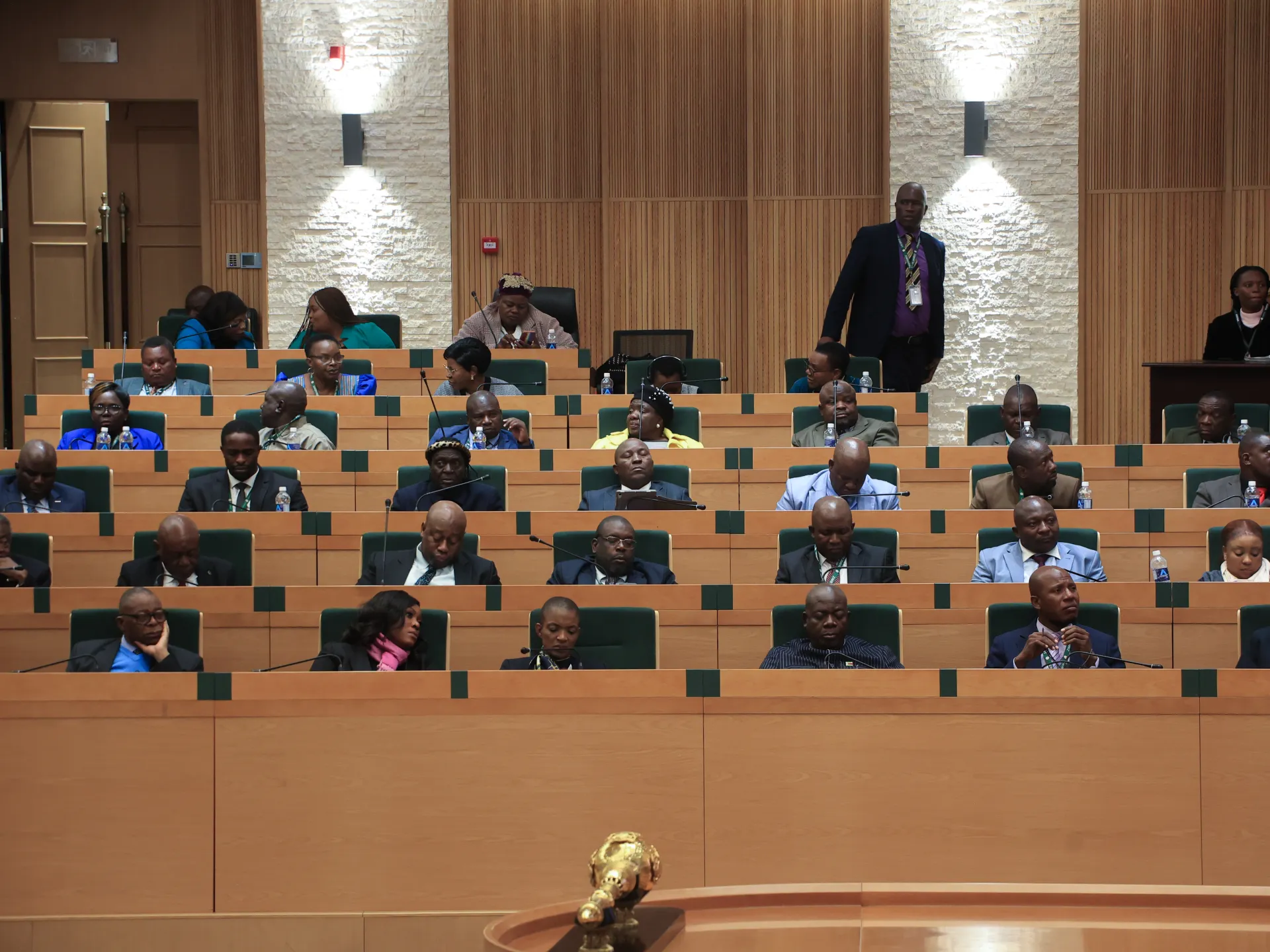
South African opposition politician Julius Malema has been sentenced to prison time for firing a rifle in the air at a party rally.
Malema, the leader of the far-left opposition Economic Freedom Fighters (EFF), was handed a five-year sentence on Thursday by Magistrate Twanet Olivier.
Recommended Stories
list of 3 itemsend of list
Malema, who is one of South Africa’s most prominent politicians, was convicted last year of charges, including unlawful possession of a firearm and discharging a weapon in a public place over the 2018 incident at a stadium in the Eastern Cape province.
The 45-year-old leader of the fourth-biggest party in parliament had pleaded not guilty, arguing the gun was a toy.
“It wasn’t … an impulsive act,” the magistrate said. “It was the event of the evening.”
Malema’s defence said the shots were only intended to be celebratory.
His lawyers applied for leave to appeal the magistrate’s decision within minutes of it being read out in a court in KuGompo City, formerly East London, on Thursday.
Outside the court, hundreds of Malema’s red-clad EFF supporters gathered for the sentencing in the politically charged case.
The EFF – a small but vocal party – says the case is an attempt to silence its outspoken leader, who is known for fiery speeches.
Party supporters have threatened protests should their leader be jailed.
The magistrate stressed it “is not a political party who has been convicted here … it is a person, an individual.”
The maximum time was a 15-year prison sentence. If confirmed after all appeals, the five-year sentence would bar Malema from serving as a lawmaker.
That would be a major setback to the EFF, which has strong support among young South Africans frustrated by the racial inequality that has persisted since the end of white minority rule in 1994.
An Economic Freedom Fighters (EFF) supporter holds up a placard as supporters gather outside court ahead of South African opposition politician Julius Malema’s appearance for sentencing after being convicted of charges including unlawful possession of a firearm and discharging a weapon in public, in KuGompo City, South Africa, April 16, 2026. [Esa Alexander/Reuters]
SEOUL, April 16 (UPI) — Two U.S. nationals were sentenced to federal prison for helping North Korean operatives obtain remote IT jobs with American companies in a scheme that generated millions of dollars for Pyongyang’s weapons programs, the Justice Department said Wednesday.
New Jersey residents Kejia “Tony” Wang, 42, and Zhenxing “Danny” Wang, 39, operated so-called “laptop farms” that made it appear as though overseas workers were based in the United States, allowing North Korean IT personnel to secure jobs using stolen American identities.
The scheme used identities from at least 80 individuals and generated more than $5 million in revenue for the North Korean government, the department said in a press release.
Kejia Wang was sentenced to nine years in prison by U.S. Senior District Judge Nathaniel M. Gorton in federal court in Boston, followed by three years of supervised release, after pleading guilty to conspiracy charges including wire fraud, money laundering and identity theft.
Zhenxing Wang was sentenced to seven years and eight months in prison by the same court, followed by three years of supervised release, after pleading guilty to conspiracy to commit fraud and money laundering. He was also ordered to pay $200,000 in restitution.
The two were additionally ordered to forfeit $600,000 in proceeds tied to the operation.
“This case exposes a sophisticated scheme that exploited stolen American identities and U.S. companies to generate millions of dollars for a hostile foreign regime,” U.S. Attorney for Massachusetts Leah B. Foley said. “By operating so-called ‘laptop farms,’ these defendants enabled overseas actors to infiltrate U.S. businesses, access sensitive data and undermine our economic and national security.”

Prosecutors said the scheme ran from about 2021 through October 2024, with the defendants and their co-conspirators using stolen identities to obtain remote jobs at more than 100 U.S. companies, including several Fortune 500 firms and a defense contractor.
Companies incurred at least $3 million in losses from legal fees, network remediation and other damages, the Justice Department said.
The operation also exposed sensitive data, including export-controlled information governed by International Traffic in Arms Regulations, after an overseas co-conspirator accessed systems belonging to a California-based defense contractor, according to court documents.
Kejia Wang acted as the U.S.-based manager for the operation, overseeing multiple facilitators who hosted hundreds of company-issued laptops at their residences. He also traveled to China in 2023 to meet overseas co-conspirators, including a North Korean national, according to court filings.
Zhenxing Wang was among the facilitators who hosted company laptops and enabled remote access by connecting them to specialized hardware devices.
The two were charged in June 2025 alongside eight foreign nationals who remain at large and are wanted by the FBI.
In a related move, the U.S. State Department on Wednesday offered a reward of up to $5 million for information on the eight co-conspirators, as well as one suspected North Korean IT worker, leading to the disruption of the scheme’s financial networks.
The case comes as North Korea, under heavy international sanctions, has increasingly turned to cybercrime and illicit IT work to generate revenue for its nuclear and ballistic missile programs.
An October report by the 11-country Multilateral Sanctions Monitoring Team described North Korea’s cyber operations as “a full-spectrum national program operating at a sophistication approaching the cyber programs of China and Russia.”
The report said nearly all of the country’s cyber activity, illicit IT work and financial operations are carried out under the direction of entities sanctioned by the United Nations over Pyongyang’s weapons programs.
The U.S. Treasury Department said in November that North Korea had stolen more than $3 billion over the previous three years through cyberattacks on financial institutions and cryptocurrency platforms.
A 2022 Treasury advisory estimated that North Korean IT workers generate hundreds of millions of dollars annually, with some individuals earning more than $300,000 a year.
The Justice Department has stepped up enforcement as part of an inter-agency effort in recent years, announcing multiple related prosecutions, including the sentencing of three Americans in March and a Ukrainian national in February.
US–Iran talks gain pace as Pakistan mediates, with fresh optimism for a new round of talks in Islamabad.

Published On 16 Apr 202616 Apr 2026
Efforts to revive US-Iran negotiations are gathering pace, with Pakistan again having an important mediating role as its leaders hold high-level talks in Tehran and the Gulf.
Amid a renewed push to end the war, a Pakistani delegation, led by army chief Field Marshal Asim Munir is in Tehran. He is expected to relay messages from the United States, while Pakistan’s Prime Minister, Shehbaz Sharif, arrived in Saudi Arabia as part of a regional tour that includes Qatar and Turkiye.
Recommended Stories
list of 4 itemsend of list
Iran’s Foreign Ministry spokesman, Esmael Baghaei, said Tehran and Washington have remained in contact since talks in Islamabad ended on Sunday. On Wednesday, Washington signalled optimism about a new round of talks in the Pakistani capital.
But the diplomatic push comes amid increasing tension, as Iran warns it could expand its response to the US naval blockade beyond its own waters.
Divisions in Washington persist, with the US Senate rejecting a measure to limit the war without congressional approval.
Here is what we know:
In Iran
Hormuz tensions remain high: Adviser Mohsen Rezaei warned that Iran could target US ships, if Washington continues to enforce its naval blockade in the Strait of Hormuz. The warning comes as the US tightens restrictions on vessels linked to Iranian ports, with ships already being turned back amid the standoff.
Nuclear issue shows potential breakthrough: Analyst Abas Aslani says Tehran is open to nuclear transparency if Washington is serious about a deal, but new US sanctions and the blockade of Iranian ports are fuelling distrust.
“There is a sense of distrust, and at the moment, Iran is ready for every possible scenario, either progress in the negotiations or returning to the military conflict,” he told Al Jazeera.
Iran’s Foreign Minister Abbas Araghchi warned of consequences over US “provocative actions” in the Gulf and the Strait of Hormuz during a call with his Chinese counterpart Wang Yi.
War diplomacy
Round two of talks: The US is discussing holding a second round of peace talks with Iran and is optimistic about reaching a deal, the White House said.
China supports ‘momentum’ of peace talks: China’s Foreign Minister, Wang Yi, told his Iranian counterpart that Beijing “supports maintaining the momentum of the ceasefire and peace talks”.
Saudi crown prince, Pakistan PM meet: Crown Prince Mohammed bin Salman and Shehbaz Sharif met in Jeddah to discuss regional issues, including US-Iran negotiations. Talks hosted by Pakistan were a key focus, said the Saudi Press Agency.
US and Qatar: US President Trump discussed regional developments and energy concerns, specifically regarding the oil market and gas prices, with Qatari Emir Sheikh Tamim bin Hamad Al Thani.
Saudi Crown Prince Mohammed bin Salman and Pakistan’s Prime Minister Shehbaz Sharif in Jeddah, Saudi Arabia [Saudi Press Agency/Reuters]
In the US
US President Donald Trump has announced that Israeli and Lebanese leaders will hold direct talks later today – their first such contact in 34 years.
New oil sanctions: US officials targeted more than two dozen individuals, along with companies and vessels linked to the oil transport network of Iranian shipping magnate Mohammad Hossein Shamkhani.
US says 10 vessels blocked from Iranian ports: The US military’s Middle East command (CENTCOM) said 10 ships were stopped or redirected within the first 48 hours of a naval blockade, with none leaving Iranian ports.
US Congress divisions: The Senate rejected efforts to limit US involvement in the war and blocked measures targeting arms sales to Israel, though growing opposition signals shifting political pressure.
In Israel
‘Identical’ goals: Israeli Prime Minister Benjamin Netanyahu said that Israel and the US are fully aligned in their objectives to contain Iran.
Ceasefire pressure, no halt in fighting: Despite pressure, Netanyahu said Israel would continue military operations.
End of Hezbollah: The Israeli prime minister said the country’s top priority in Lebanon was to secure the “dismantling” of Hezbollah, in its first direct talks with the country in decades.
“There are two central objectives: first, the dismantling of Hezbollah; second, a sustainable peace… achieved through strength,” he said.
In Lebanon
Relentless strikes continue: Air raids and shelling hit southern and eastern Lebanon, including Kafr Sir and Nabatieh, while a “triple-tap” strike in Mayfadoun killed four paramedics. Israeli vehicles and bulldozers remain active.
Lebanon’s Minister for Administrative Reform Fadi Makki said an Israeli attack that killed four paramedics in southern Lebanon was “a new war crime”.
Rising toll: Israeli strikes have killed at least 2,167 and injured more than 7,000 people, according to the Lebanese Health Ministry. About 1.2 million people have been displaced since March 2. Israel has been accused of destroying homes in southern Lebanon, as happened in Gaza.
‘Homes that no longer exist’: “Even if a ceasefire is reached, the reality on the ground is devastating.. entire communities along the border have been destroyed,” Al Jazeera’s Malcolm Webb reported from Beirut. He added that Israel has yet to secure its objective of controlling territory up to the Litani River.
Balakrishnan Rajagopal, the UN special rapporteur on the right to housing, has joined other UN human rights experts, calling for Israel to immediately stop its bombing of Lebanon. Rajagopal wrote on social media that the Israeli military is using the “same strategy” in southern Lebanon as in Gaza or the occupied West Bank.
Diplomatic tensions grow: Hezbollah has condemned US-hosted Israel-Lebanon talks as “shameful,” while a failed Senate vote to block bulldozer sales to Israel highlights increasing concern over civilian harm.
An armoured Israeli military vehicle near the Lebanon border [Florion Goga/Reuters]
Global economy
Growing hunger fears: The war could push millions more towards hunger as its economic fallout reverberates around the globe, the World Bank’s chief economist told AFP.
“You have about 300 million people who suffer from acute food insecurity already,” Indermit Gill said. “That’ll go up by about 20 percent very, very quickly,” as knock-on effects grow.
Wall Street records: Major Wall Street stock indices finished at record highs on Wednesday following optimism about an accord in the US-Iran conflict.
Rafael Grossi, director general of the International Atomic Energy Agency, speaks at a press briefing at the Four Seasons Hotel in Seoul on April 15. Photo by Asia Today
April 15 (Asia Today) — Rafael Grossi said Tuesday that North Korea has built a new uranium enrichment facility in the Yongbyon area, signaling a significant expansion of its nuclear capabilities.
Speaking at a press briefing in Seoul, Grossi said assessments by the International Atomic Energy Agency show North Korea’s nuclear activities have expanded across multiple facilities, including a 5-megawatt reactor, reprocessing plants and a light-water reactor.
He said the newly identified building appears similar in scale and infrastructure to the Kangson enrichment facility, indicating a substantial increase in uranium enrichment capacity.
“While it is difficult to calculate exact production levels without on-site access, the external features suggest a significant expansion,” Grossi said. “This points to a serious increase in the ability to produce dozens of nuclear warheads.”
The agency had previously monitored the construction of the facility, noting similarities in cooling and supply systems to existing enrichment sites.
Grossi also warned that nuclear weapons development fuels proliferation and accelerates arms competition, adding that such capabilities do not necessarily improve national security.
On South Korea’s potential pursuit of nuclear-powered submarines, Grossi stressed the need for strict safeguards under the Nuclear Non-Proliferation Treaty.
He raised concerns that nuclear material used in submarines could fall outside routine inspection regimes due to extended underwater operations, particularly if highly enriched uranium is used.
Grossi said South Korea would need to establish special procedures and coordination mechanisms with the agency to ensure transparency and prevent diversion of nuclear material.
He added that discussions with the government, navy and industry would follow if the project proceeds, noting that the development process would take years and involve multiple stages.
A chart shows the number of pet insurance policies in South Korea rising sharply from 51,727 in 2021 to 251,961 in 2025. Graphic by Asia Today and translated by UPI
April 15 (Asia Today) — South Korea’s pet insurance market has expanded more than threefold in the past three years, but low enrollment rates continue to limit its growth, prompting insurers to step up marketing efforts.
According to industry data, the number of pet insurance policies in force reached 251,961 last year, up 55.4% from a year earlier. The figure has increased about 3.5 times from 71,896 in 2022.
New policy subscriptions have also risen steadily, while total premiums surpassed 100 billion won (about $75 million) for the first time, jumping from 28.8 billion won (about $21 million) in 2022 to 129.1 billion won (about $97 million) last year.
Despite the rapid growth, the market penetration rate remains low. Data from the KB Financial Research Institute show that only about 2-3% of pets are insured.
As of late 2024, about 15.46 million people in South Korea owned pets, with an estimated 7.63 million dogs and cats nationwide.
The low adoption rate contrasts with more mature markets such as Japan, where the pet insurance sector is valued at around 1 trillion won (about $750 million).
Industry officials say the market still has strong growth potential, driven by rising pet ownership and increasing veterinary costs. Government data show the average monthly veterinary expense per pet is about 37,000 won (about $28), though costs vary widely by clinic.
To raise awareness, insurers are expanding promotional efforts. Companies are launching supporter programs, hosting offline events and collaborating with influencers and pet trainers to reach potential customers.
For example, a pet-focused insurer recently launched a supporter program in which participants share their experiences using insurance products. Other companies have held in-person promotional events and partnered with well-known dog trainers to produce online content.
Analysts say high premiums and limited coverage remain key barriers. Calls are also growing for standardized veterinary pricing to reduce uncertainty in medical costs.
“As pets are increasingly seen as family members, interest in their health care is rising,” an industry official said. “Insurers are working to tap into latent demand by expanding coverage and improving price competitiveness.”
Pakistani officials are expecting a “major breakthrough” in talks between Iran and the United States on Tehran’s nuclear programme, sources have told Al Jazeera, as Islamabad steps up diplomatic efforts to end a war that has killed thousands of people.
The optimism on Wednesday came as a high-level Pakistani delegation, headed by Army Chief Asim Munir, arrived in Tehran to deliver a message from the US to the Iranian leadership, according to Iran’s Press TV broadcaster.
Recommended Stories
list of 4 itemsend of list
He was received by Iran’s Foreign Minister Abbas Araghchi, who expressed gratitude for Pakistan’s “gracious hosting of dialogue”. According to Press TV, Munir is also seeking to lay the groundwork for a second round of talks between the US and Iran.
Al Jazeera’s Osama Bin Javaid, who has been covering the US-Iran talks, said Pakistani officials were expecting “a major breakthrough on the nuclear front” and that the delegates were continuing to relay messages back and forth between Washington and Tehran.
The central sticking point remains the duration of any enrichment freeze by Iran and the country’s stockpile of 440 kilogrammes of highly enriched uranium.
“We know that both sides are essentially stuck on between five years of no enrichment to 20 years of no enrichment. And there is a solution in the middle,” Bin Javaid said.
“There’s also talk about what Iran will do with the 440kg of nuclear-enriched material that it has in the country. There are multiple options – whether sending it abroad to a third party or bringing it down to either uranium in its natural form or up to 3 percent,” he said.
“According to these sources, there’s major headway that has been made, and they’re expecting that the Pakistanis are going to be able to convince Tehran,” he added.
Shuttle diplomacy
The shuttle diplomacy by Pakistan came after talks between the US and Iran in Islamabad ended over the weekend without an agreement to end the war. Mediators are pressing for a compromise on three main issues: Iran’s nuclear programme, control of the Strait of Hormuz – which Tehran has effectively closed, causing a surge in global oil prices – and compensation for wartime damages.
The conflict, launched by the US and Israel on February 28, has killed more than 3,000 people in Iran and triggered retaliatory attacks by Tehran on Gulf countries. It has also reignited a conflict between Israel and Hezbollah in Lebanon, where Israeli forces have killed more than 2,000 people since March 2.
A ceasefire between Tehran and Washington on April 8 has halted attacks in Iran and the Gulf, but strikes by Israeli forces on Lebanon have continued.
Separately on Wednesday, Pakistan’s Prime Minister Shehbaz Sharif also travelled to Saudi Arabia as part of a regional tour that also includes stops in Qatar and Turkiye. Al Jazeera’s Bin Javaid said Sharif’s tour was part of a “double-pronged strategy”.
“While the Iranians are speaking to the Pakistani military chief, the Pakistani prime minister and foreign minister are talking to the Saudis and the Qataris. The day after, they go to Turkiye,” he said, with the aim of neutralising any detractors to a deal
Bin Javaid said the detractors include elements in Tehran, in Washington, DC, and most of all, Israel, “which does not want a peace deal and wants a perpetual war in the region”.
‘Very close to over’
The diplomatic push appears bolstered by optimistic comments from US President Donald Trump, who said late on Tuesday that the world should brace for an “amazing two days” and the war on Iran is “very close to over”.
White House Press Secretary Karoline Leavitt later said that further negotiations would likely be held in Islamabad, calling Pakistan-mediated discussions “productive and ongoing”.
“We feel good about the prospects of a deal,” she said on Wednesday.
In Tehran, Iran’s Ministry of Foreign Affairs confirmed that exchanges with the US have continued since the end of the talks in Islamabad. Spokesman Esmaeil Baghaei said “several messages have been exchanged through Pakistan” and that Iranian “positions have been expressed in those exchanges”.
Tensions remain, however.
A US Navy blockade on Iranian ports – which began following the end of the talks – remains in effect in the Strait of Hormuz. The US Central Command claimed it has turned back nine vessels as of Wednesday.
Iran’s military has denounced the blockade as a violation of the April 8 ceasefire. Iran’s Fars News Agency separately reported that a sanctioned Iranian supertanker had crossed the Strait of Hormuz despite the blockade, though it gave no further details.
Ali Abdollahi, the commander of Iran’s joint military command, has also threatened to halt trade in the region if the US does not lift its blockade. He warned that Iran would retaliate by blocking trade through the Red Sea, along with the Gulf and the Sea of Oman.
A source has told Al Jazeera that Pakistan is expecting a breakthrough tied to Iran’s nuclear programme as Islamabad helps negotiate an end the US-Israeli war on Iran. Pakistani military and government officials met with Iranian and Saudi leaders on Wednesday.
Sophia D’Eramo plays on the online game platform Roblox in 2020 in Franklin, Mass. The state of Nevada and Roblox reached a settlement to better protect young gamers, the Nevada attorney general said Wednesday. File Photo by Emily Flynn/EPA
April 15 (UPI) — Nevada and the online gaming platform Roblox have reached a unique settlement that will help protect young online gamers and pour money into the state’s youth programs, the state’s attorney general said Wednesday.
“This settlement will create a safer environment for our children online,” Attorney General Aaron Ford told reporters during a press conference. “I hope that it will serve as a bellwether for how online interactive platforms allow our state’s youth to use the products.”
Nevada opened an investigation into children’s safety on the popular online game creation platform in 2024. There have been lawsuits in that state and others alleging that Roblox has failed to protect young gamers from online predators and other issues.
As part of the settlement, Roblox will spend about $10 million on non-digital youth programs in the state, plus contribute toward an online safety awareness program.
In addition, the company will start using stricter age-verification measures, which will restrict what children under certain ages can see and with whom they can communicate. These measures will include facial age-estimation technology, robust parental controls, expanded parental oversight and dedicated law enforcement support.
Roblox has also committed to using government-issued ID for age assurance as well as behavioral monitoring to identify users who may have been assigned the wrong age, Ford said during the press conference.
Roblox will also include tighter controls for parents and a ban on encrypted messaging involving minors. If a parent account isn’t linked to a child account, the latter will be limited to a restricted child mode. Adults must have a “trusted friend” label, which requires parental consent, before they can chat with those under the age of 13. The changes will also include limits on notifications during nighttime hours.
Roblox told UPI in a statement that while it disputes the claims in the complaint it is “pleased” to have reached a settlement with Ford, stating it reflects the company’s “continued commitment to fostering online health and safety for kids.”
“Roblox is proud to have worked alongside Attorney General Ford to reach this landmark agreement, which builds on our work to establish a new standard for digital safety,” Roblox Chief Safety Officer Matt Kaufman said.
“This resolution creates a blueprint for how industry and regulators can work together to protect the next generation of digital citizens.”
Roblox told UPI that the agreement helped shape several safety measures, including two new age-based accounts announced Monday: Roblox Kids for users between the ages of 5 and 8 and Roblox Select for users ages 9 to 15.
Beginning in June, the accounts will “more closely align content access, communication settings and parental controls with a user’s age,” Roblox said Monday in a statement.
Huge crowds have greeted Pope Leo in Cameroon, returning to a country he visited 20 years ago as ‘Father Bob’. Al Jazeera’s Nicolas Haque was there, and explains how the Roman Catholic leader is transforming the church as congregations shrink in Europe but expand in Africa.
1 of 3 | Andrew Ferguson, chairman of the Federal Trade Commission, delivers remarks during a White House fraud task force meeting March 27 in the Eisenhower Executive Office Building next to the White House in Washington, D.C. Three U.S. ad companies settled with the FTC on Wednesday over alleged collusion. File Photo by Shawn Thew/UPI | License Photo
April 15 (UPI) — U.S. advertising companies Dentsu, Publicis and WPP settled Wednesday with the Federal Trade Commission, which claimed they colluded over anti-misinformation policies that affected ad money for conservative publishers. The companies did not admit wrongdoing as part of the settlement.
In a press release, the FTC said the agencies “distorted America’s modern public square” and worked together to establish “brand safety” policies that limited the ads that could run on sites with content designated as misinformation. This affected ad revenues for conservative political websites and made it more difficult for them to make money from “disfavored political viewpoints,” the FTC release said. The commission filed a complaint Wednesday in the U.S.District Court for the Northern District of Texas.
A court must approve the settlement. The companies agreed not to collude to restrict ad-buying services over “news and political and social commentary content,” the FTC said.
The New York Times reported that a representative for Dentsu said the company was “fully committed to operating transparently, with integrity and in strict compliance with all applicable laws.” A representative for WPP told that Times the agreement “reflects our existing and ongoing commitment to provide our clients with unbiased advice as they decide where to place their media.” The companies own multiple ad agencies and buy digital ads on behalf of advertisers.
FTC Chairman Andrew N. Ferguson said in the release that the agencies’ brand safety policies “turned competition in the market for ad-buying services on its head.” The collusion, he said, “distorted the marketplace of ideas by discriminating against speech and ideas that fell below the unlawfully agreed-on floor.”
This follows a longstanding claim by the Trump administration that the media and websites treat conservatives unfairly. Ferguson and the FTC in 2025 also opened other inquiries into alleged anti-conservative censorship through online content moderation.
Speaker of the House Mike Johnson, R-La., speaks during a press conference on Tax Day and the Working Families Tax Cut outside the U.S. Capitol on Wednesday. Photo by Bonnie Cash/UPI | License Photo