Stay up-to-date with the latest entertainment news from around the world. Get exclusive insights into celebrity gossip, red carpet events, movie premieres, music releases, and more.Stream TV Online Read more at: https://hotdog.com/tv/stream/
A classic period drama, one that popularised the genre globally, is still regarded as one of the finest to ever grace our screens. Period drama enthusiasts will be familiar with the show in question — Upstairs, Downstairs.
Upstairs, Downstairs laid the groundwork for Downton Abbey with a story that will be familiar with fans who have only seen the modern sensation. As the definitive period dramas of their era, the parallels between Upstairs, Downstairs and Downton Abbey are self-evident.
Both shows portray the personal struggles of an aristocratic family and their servants against a backdrop of social and political upheaval on an overlapping timeline.
Like Downton Abbey, it spans three decades, covering both World Wars and the roaring 20s through to the Great Depression. The classic show chronicled the turbulent lives of the aristocratic Bellamy family and their servants in the early 1900s.
They diverge in numerous ways, however, and one is immediately apparent.
The seventies programme is less high-end, a quality that can taken as nostalgic or a dealbreaker. Upstairs, Downstairs premiered in 1971 and ran for five years, predating Downton Abbey by a good 50 years.
In fairness, Downton’s setting is inherently more luxurious. The Bellamy family inhabit a London townhouse, a far cry from the Crawley family’s lavish country estate that was a character in its own right.
And while Downton’s visuals proved a triumph, a frequent criticism from audiences is that the programme descended into melodrama. In contrast, Upstairs, Downstairs has been likened to a stage play for its more understated visuals and plotlines.
Fans of both period dramas shared their preferences. One viewer sparked a debate on Reddit, asking: “If you have seen both shows, which show do you think is better?”
“Upstairs Downstairs without question,” replied one viewer decisively. Another agreed: “I like Downton Abbey better, but Upstairs, Downstairs is the better show.
“I have tried watching the Upstairs/Downstairs remake multiple times and I always end stopping after about two episodes,” commented a third. “It just doesn’t grab me like Downton.”
Upstairs, Downstairs is available to watch on ITVX.
Last May, a strange thing happened on the U.S. album charts. Two metal bands (or at least metal-adjacent hard rock acts) scored No. 1 albums in the same month. The genre hadn’t seen multiple bestsellers in the same year since 2019 — and those were from veteran acts. So it was notable when the young U.K. group Sleep Token crushed on streaming and Ghost topped charts with a Taylor Swift-sized vinyl rollout. Meanwhile, avant-garde heavy rockers Deftones became unexpected TikTok darlings and arena stars.
Metal had not-so-quietly reemerged as a commercial force, and not just in the live sphere, where it’s always thrived and continues to grow. Pop culture seemed ready to welcome back a breed of hitmaker thought lost to time — the sleeve-tatted, throat-shredding hard rock star.
So the wider pop world should acquaint itself with the Virginia-born group Bad Omens, whose slam-packed Thursday night show at the Forum in Inglewood reaffirmed that they’re one of the most ambitious and skilled young bands in heavy rock, and have the star wattage and ravenous fan culture to get even bigger.
Bad Omens — with singer Noah Sebastian, bassist Nicholas Ruffilo, guitarist Joakim Karlsson and drummer Nick Folio — are not brand new. They’ve slugged it out on the metalcore and heavy rock circuit for a decade, signed to the small-ish but influential imprint Sumerian Records. But they hit their stride with 2022’s “The Death of Peace of Mind,” which melded a Weeknd-worthy R&B falsetto with rotted, churning guitars and tasteful electronics.
The band became festival headliners and racked up billions of streams, surely aided by Sebastian’s dreamboat-goth-BF good looks and striking range as a vocalist, where he veers from an ear-tickling whisper to an operatic howl and a shriek worthy of Norway in the ‘90s (sometimes on the same song, as he did on “Like a Villain”).
The band has tipped a new album for some time, though for this career-peak arena tour, it had only a handful of new singles in tow. No matter. At the Forum, the band cohered its catalog with an eye-popping stage production, one that made its case as an ultra-modern heavy rock act with the reach to be huge stars, even if they take genuine fame with some ambivalence.
That force-of-gravity was evident in the days leading up to the Forum show, where fans debated how many hours early they needed to be at the Forum to be on the barricades (the consensus — get there by breakfast). Mid-set, Sebastian pointed out one fan whom he recognized from years on the road. “You’ve been coming to see us since we sucked,” he said, laughing.
That commitment wouldn’t be possible if the music didn’t have a preternatural force to speak to current anxieties. From the first notes of its new single “Specter” — a brooding vocal workout for Sebastian that ended on pulverizing riffs — Bad Omens used cutting-edge tools and underground influence to elicit arena-rock catharsis.
One early peak of the set came when Jake Duzsik of the L.A. industrial-rock trio Health came out to duet on “The Drain,” a lurching, menacing collaborative single and a standout for both bands. Heavy-rock veterans see something compelling in Bad Omens, which helps situate the band’s pop-savvy tracks like “Left for Good” and “Just Pretend” (a platinum-selling single that wrapped up the main set) with earned feeling rather than calculation.
After the Forum show, I understood why it’s taking them so long to finish a new LP. Sebastian has been open about his mental health struggles. The band is pitched right at a difficult juncture at which their artistic ambitions abut real, life-altering attention.
They can make songs like “What It Cost” (a hooky, lecherous electro track that I’d totally believe was co-written with Max Martin if you told me) and the serrated metal that them earned them their fanbase and would cause a revolt without. It’s not easy to pair the two in a natural way. (Just ask Code Orange, once pitched as metal’s breakout stars who got bogged down in electronic experiments.) Having a K-pop-caliber devoted fanbase is great on the way up, but it’s a tense relationship.
But first and foremost, Bad Omens are gifted musicians, and whatever eldritch magic Sebastian wields onstage will always be bolstered by a serious band contorting metal, dark pop and electronic music. I saw nothing that would stop that one fan from coming back for 10 more years of Bad Omens shows, and plenty to suggest others are going to follow him.
The Grammy-winning composer behind the signature opening chant in the song “Circle of Life” for “The Lion King” movies is taking a comedian to court for allegedly damaging his reputation by misrepresenting the song’s meaning on a viral podcast episode.
In a federal lawsuit filed this month seeking millions in damages, Lebohang Morake, known as Lebo M, accused Zimbabwean comedian Learnmore Jonasi of intentionally botching the translation of the lyrics, central to both the Disney films and the musical theater adaptations.
“I’m getting sued for $27 million and to make matters worse, I got served the lawsuit while I was performing,” Jonasi said in a post on social media Tuesday. The post included a clip of the comedian performing at the Laugh Factory when a manila envelope is tossed onstage.
“Right now, I’m looking for a lawyer. … I can’t believe I’m getting sued for telling a joke. What kind of stupid world do we live in?” he added.
It all started when Jonasi’s appearance on the “One54” podcast went viral late last month. In the episode of “One54” cited in the lawsuit, one of the podcast’s Nigerian hosts, Akbar Gbajabiamila, prompts the comedian with “I heard you had a problem with the ‘Lion King,’ why?” He then breaks into song, trying his hand at the chant and butchering the delivery.
“That’s not how you sing it, don’t mess up our language like that,” Jonasi says, before singing the correct lyrics in Zulu. When the hosts ask what it means, he says it translates to: “Look, there’s a lion. Oh, my God.”
The hosts erupt with laughter, saying that they’d always thought the chant was something more “beautiful and majestic.”
Jonasi often uses the same “Lion King” bit in his stand-up routines. He translates the song’s lyrics from Zulu and Xhosa, two of South Africa’s 12 national languages, and offers a broader critique on the film.
In Season 19 of “America’s Got Talent,” the comedian won over audiences by joking about how American movies about Africa often confuse Africans, asking, “Why do the lions have American accents?”
The civil lawsuit accuses Jonasi of intentionally mocking “the chant’s cultural significance with exaggerated imitations,” according to the complaint.
Disney’s official translation of the opening phrase “Nants’ingonyama bagithi Baba” is “All hail the king, we all bow in the presence of the king.”
“Hay! baba, sizongqoba,” the chant continues. It translates to “Through you we will emerge victoriously,” according to Lebo M.
Lebo M’s lawyers acknowledged in the complaint that “ingonyama” can literally translate to “lion,” but said it’s used in the song as a “royal metaphor” that invokes kingship, and that Jonasi intentionally misrepresented “an African vocal proclamation grounded in South African tradition.”
Jonasi “received a standing ovation” for a similar joke he made about the song during a March 12 stand-up performance in Los Angeles, according to the lawsuit. Such viral statements, it says, are interfering with Lebo M’s business relationships with Disney and his income from royalties, causing more than $20 million in actual damages. The lawsuit also seeks $7 million in punitive damages.
The complaint also argues that Jonasi presented his translation “as authoritative fact, not comedy,” so it shouldn’t get the 1st Amendment protections afforded to parody and satire.
Jonasi and reps for Lebo M didn’t respond to emails seeking comment, but the two have been busy on social media, making alternating statements and sub-posting each other for weeks.
Earlier this month, Jonasi revealed that he’d been receiving threats on social media for offending his fellow Africans. “It was never my intention to disrespect anybody,” he said in the video posted to Instagram. “When I went on that podcast, my intention was actually to talk about African identity. … I’d like to apologize to anybody that I hurt. But my comedy was a way to crack open a window for a conversation.”
“I had no idea the chant from ‘The Lion King’ was a royal welcoming song … I speak a little bit of Zulu, so I directly translated the words, and I even spoke to some of my South African friends, and most of them don’t even know what it means. And the rest of the world thought it was actually gibberish.”
A few days later, Lebo M posted his own Instagram video, saying he had attempted to speak with Jonasi privately, but claimed the comedian had disrespected him. “You are riding a huge wave of going viral on negativity,” he said in the video.
“I would like to encourage you to please slow down. You have a long way to go. I wish you success, but you cannot disrespect other people’s cultures that gave you the first opportunity to start with and claim it’s comedy. … You continue making a mockery of my work … the likes and the viral things won’t be there when it’s just you.”
After exchanging a few more public statements via Instagram, Jonasi was served with court papers.
He shared the news online and announced he’s selling merchandise and launching a GoFundMe to raise money for his defense. The shirts and hoodies for sale feature two different designs — one reads “Look it’s a lion,” and the other “Look it’s a lawsuit, Oh, my God.” As of Friday afternoon, Jonasi’s GoFundMe raised more than $17,000.
The tense situation seemed to be cooling on Friday morning, when Lebo M posted a lengthy statement to Instagram signaling a shift from an impending courtroom showdown to what his team is calling a “white flag moment.”
According to the post, Lebo M’s team has contacted Jonasi to “explore the possibility of a structured settlement.”
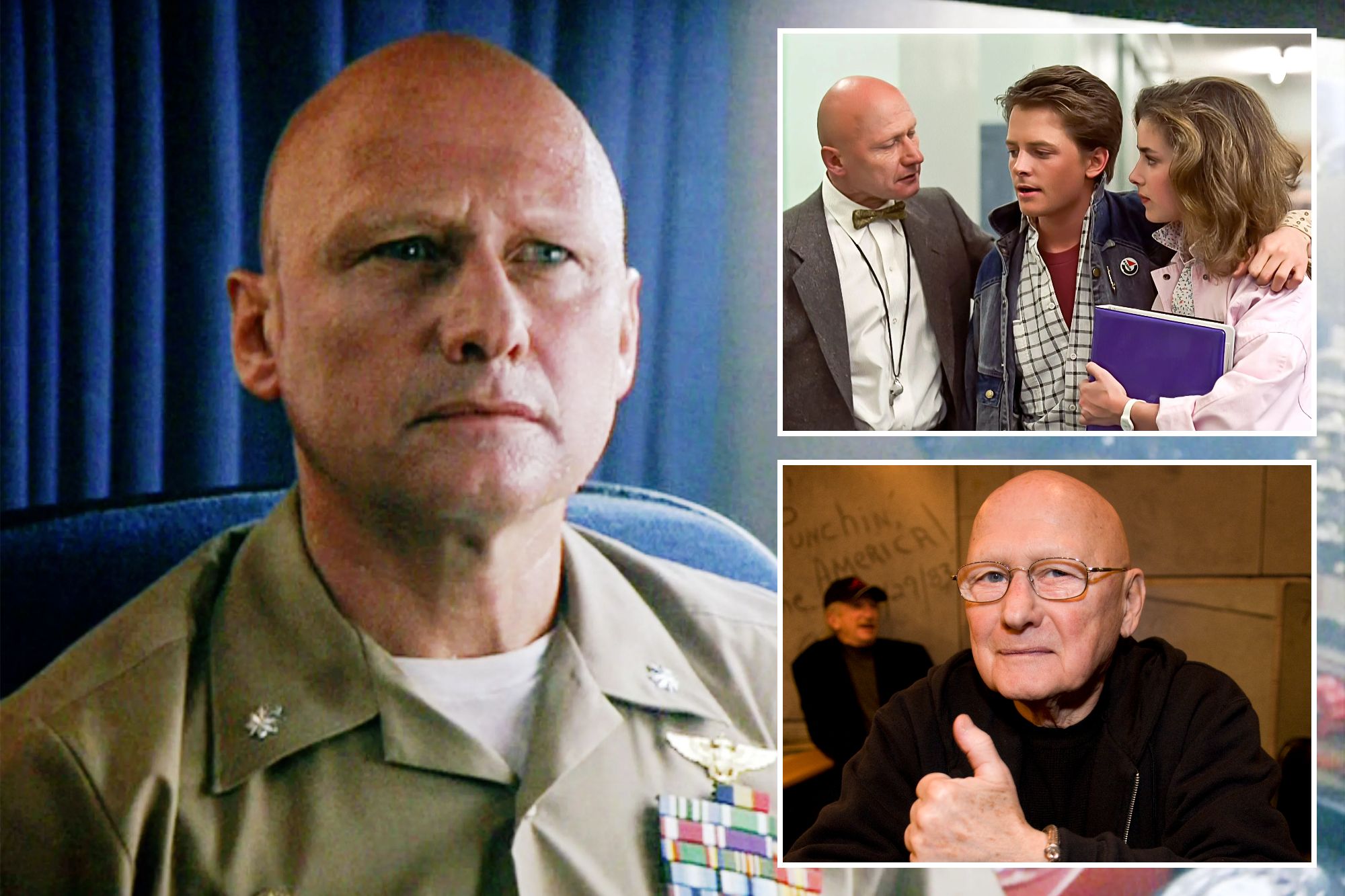
BACK to the Future and Top Gun actor James Tolkan has sadly died aged 94.
The Hollywood star passed away peacefully at his New York state home on Thursday after a celebrated TV and stage career spanning 55 years.
Sign up for the Showbiz newsletter
Thank you!
Hollywood actor James Tolkan has passed away aged 94Credit: GettyTolkan as tough teacher Mr. Strickland in Back to the FutureCredit: AlamyThe actor was also known for his role as Commander “Stinger” Jardian in Top GunCredit: Getty
His death was announced on the Back to the Future website as well as by writer-producer Bob Gale, but a cause was not provided.
Tolkan played the slacker-hating teacher Mr. Strickland in the first two films of the iconic 80s franchise, returning as the grandfather of his character in the third.
He was also known for his performance as air group commanding officer “Stinger” Jardian in the 1986 blockbuster Top Gun, alongside stars Tom Cruise, Val Kilmer and Meg Ryan.
Tolkan’s five-decade-long career started in the 1960s series Naked City and called it a day after the 2015 film Bone Tomahawk.
He was born on June 20, 1931 in Calumet, Michigan and served in the brutal Korean War as part of the United States Navy.
The young sailor was discharged due to a heart condition and set his sights on becoming an actor, earning a BA in drama from the University of Iowa.
An obituary on the Back to the Future website says that he then “got on a bus for New York City with $75 in his pocket, went to work on the docks and enrolled with both Stella Adler and Lee Strasburg to learn the art of acting.
“He spent 25 years in New York theater, from off off Broadway to the great White Way.
Most read in Entertainment
“Notably, he was a member of the original ensemble cast of the ‘Glengarry Glen Ross’.”
Tolkan moved his career from New York to California and Canada in 1983 when he was cast in War Games.
After his roles in Back to the Future and Top Gun, Tolkan had a dual role in Woody Allen’s Love and Death.
Tolkan is survived by his wife of 54 years, Parmelee – whom he met in the off-Broadway play Pinkville in 1971 – and his three nieces in Des Moines, Iowa.
The late actor adored animals and the obituary asked for donations in his memory to your local animal shelter, animal rescue organisation or Humane Society chapter.
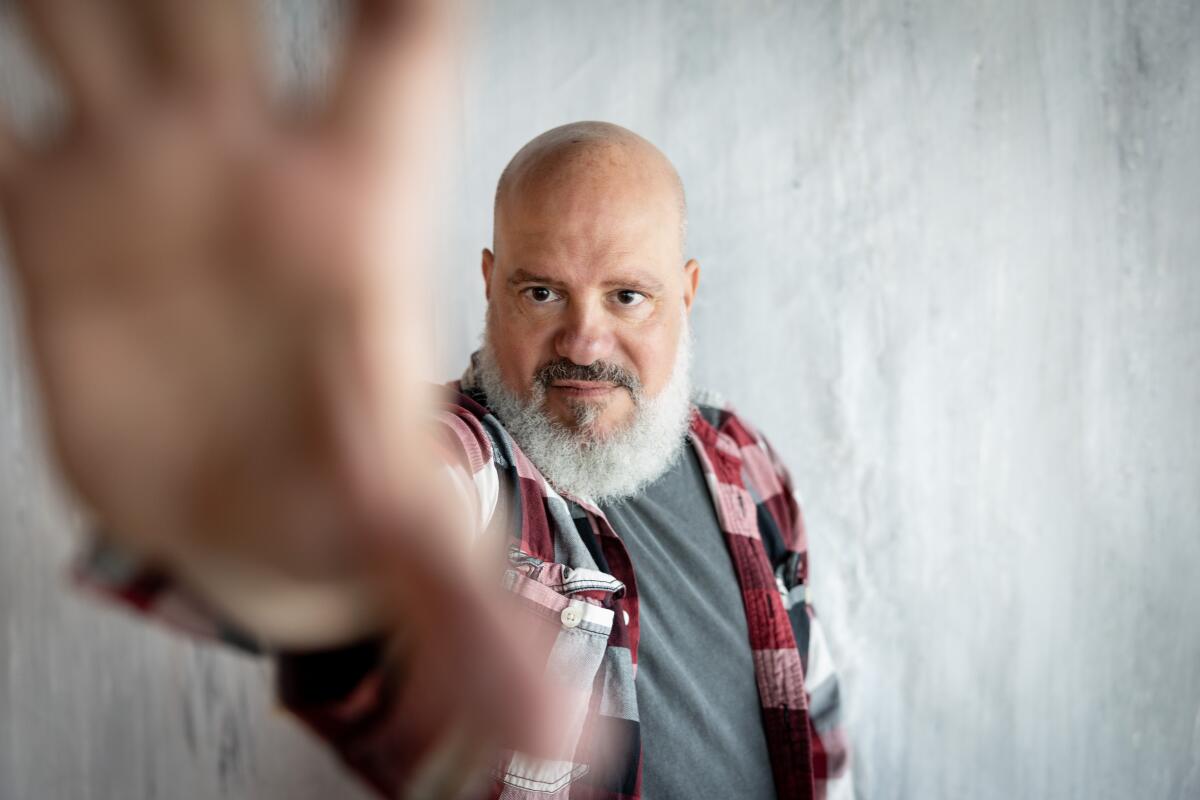
Ranting about the decline of comedy specials while releasing a new one at the same time feels a bit like an oxymoron. But somehow it still makes sense coming from alt-comedy pioneer David Cross, who isn’t just complaining; he’s finding his own route to making specials feel special again. The only way to do that is by putting one out in the manner he’d like to see more often — starting by making the whole crowd stand up too.
Capturing the energy of a concert at the famous 40 Watt Club in Athens, Ga., was the first step in differentiating “The End of the Beginning of the End” from the typical hour you watch on a big streamer. And, with this new special, Cross is able to get back to his own beginnings of touring across the country with love bands as his openers, performing for crowds for as long as he could until he had to run offstage to pee.
Premiering the special earlier this month on his website (and on April 7, it will be available on YouTube via production company 800 Pound Gorilla), Cross is hoping the special connects with comedy fans in a way that we’ve forgotten specials could.
This interview has been edited for length and clarity
Your new special is called “The End of the Beginning of the End.” What does that title mean to you as it relates to the impending doom of what we’re all living right now.
David Cross: Well, you can look at it in a couple different ways. To me, it signifies that the beginning of the end has occurred. And we are now at the end of the beginning of the end. And from where you go with that, that’s for you to decide.
One of the things I love about the special is the fact that you shoot it at a club in the style of a live–music concert.
I’ve shot specials in theaters and it’s just different, not that one is better than the other, but they’re just different. You have a different relationship with the audience. When I first started touring, I would go to music venues and I’d have a band open for me and then I would just go up and pretty much [perform] as long as I could until I had to pee. Sometimes I’d have a band playing, sometimes two bands, then I’d go out. And I did that a couple of times, and then stopped doing that and did theaters, and I decided for the last two specials I’m going to go to, when I shoot it, I’ll go to a music venue, and I was at the 40 Watt Club in Athens this last time, I was at the Metro in Chicago before that, both places I played on earlier tours, and, you know, it’s not seated. People are standing there at the stage, and I prefer it. It’s more fun. It’s not as lucrative but, to me, a more fun show to do.
Comedian David Cross
(Jason Armond / Los Angeles Times)
The ambience of it was great.You can hear people shouting and drinking and having a good time, and the crowd work is also a little more spontaneous and fun than it would be in a regular venue.
Yeah, well, there’s more opportunity for that. But my thing has never been about crowd work. I like engaging with it, it’s kind of a nice distraction from the set that you’ve been doing 100 times, 150 times at that point. So it’s always fun to have that thing happen and that feeling of spontaneity. And like the guy [who I talk to in the crowd during the special], I could not have asked for [someone better]. I mean, even if it was scripted, it wouldn’t have been as good. The guy who [I talk to] during the stuff about hiking Machu Picchu [with Bob Odenkirk], that’s just… [chef’s kiss].
Speaking of Bob Odenkirk, you guys have this long relationship. How would you describe the dynamic of working with Bob and just how you guys bounce ideas off each other?
I mean, it’s great. We have an inordinate amount of respect for each other, both as people and as creative partners. And so there’s never any real issues. There’s things we will definitely disagree with, but we’re both decent people. So you know somebody backs off and says, “OK, let’s do it that way.” But even then, there aren’t that many of those [issues]. We just have really worked well at building something or molding it, creating it and shaping it. And our aforementioned hike to Machu Picchu, we have a documentary about that, that will be premiering at a fancy festival at some point in the near-future. And so we got that doc and we’ve been working on that. And for the way we work now, because he lives in L.A. and I live in New York, and it’s been like that for a while, he’ll write a bunch of stuff, I’ll make notes, I’ll write my things, send it back. And so we’re able to do that and not necessarily have to be in the same room because we’ve had 30-plus years of working with each other.
It’s a kind of like an unspoken language you guys probably have in terms of comedy, which is super important, I imagine, just for collaborating.
Yeah, and it’s something we discovered very early on … before there was even “Mr. Show,” what would ultimately become “Mr. Show,” when we got together to write sketches for this bigger kind of comedy collective thing, and these shows that we would all do with each other, for each other, and the stuff that we would write together was just, like, really good, easy writing — again, one person adding this thing and one person saying here’s a switch yeah and another person adding this thing in. It was fun, it’s cool, still is. One thing he doesn’t get credit for is he’s a really decent human being. And with all the awfulness in the world that’s magnified, every sense is bombarded with it — it’s just good to be hanging with somebody whose energy is a good person, a decent person and an equitable, nice guy, so that’s good as well.
Comedian David Cross poses for a portrait ahead of his comedy special “The End of the Beginning of the End.”
(Jason Armond / Los Angeles Times)
One thing you guys also have in common is you both have kids, and he has a comedy show for kids called “The Appropriate Show.” Have you taken your daughter to see it?
It’s a sketch show [in which] all the sketches are appropriate for kids to watch. And the sketches have been done in other sketch shows onstage, live. And he puts together this thing once, twice a year here in L.A. And I took my daughter to it last year. It’s just sketches that kids can [understand]. At least if they don’t understand the actual references they get the archetype. “Oh, that’s the boss, that’s that uh… And it’s great, it’s a really cool idea uh… “ And would an ass— think of [a show like] that? No, one good decent person; a good man. But listen, this interview isn’t about me, it’s about Bob Odenkirk, so let’s get back to that.
Well, speaking of having comedy geared toward kids, your daughter’s at an age where she’s probably consumed or seen some of your comedy at this point.
Not, not really. No, no.
Do you shield her from your stuff, or are you not so concerned about it?
I don’t actively shield her, but I don’t introduce her to anything. So I was a little bummed out, and I got over it pretty quickly, but when I found out that she had seen a little bit of “Alvin and the Chipmunks,” and only because I don’t want to spoil the enjoyment of what movies are and what kids’ movies are and how things work. And I feel like that would introduce an element of reality that I want her to be able to just enjoy these things without — she’s seen “Kung Fu Panda”when she was younger, like, I don’t know, three, four, five times, has no idea that I’m in that, that my voice is in there. She knows I do stand-up, she gets that now. And when she was younger, she’d say, “Daddy’s silly for a living.” … I’m just trying to ride the balance of letting her have those childhood joys and experiences.
Comedian David Cross.
(Jason Armond / Los Angeles Times)
Does having a kid make you think about what’s coming up in the future of comedy, or what kids are gonna maybe find funny, or what they find funny now? Do you have any thoughts on kid comedy in general?
Not really. I mean, I can see that she and her friends, who are kind of like-minded, are naturally funny, and then that’s kind of encouraging and heartwarming and they’re silly, but I’ll be long gone when that generation is is providing comedy. And I’m still, although I’ve kind of given up, I’m still trying to grasp what works now. I mean, it’s short-term TikTok, Instagram stuff. There are some amazing, like really, really great things being done as far as film sketches for YouTube channels. “Almost Friday,” they’ve got genius-level stuff. I mean, really good. And where the sketch goes in a place, you’re never ahead of it, goes in a place where you’re not expecting. It’s really well written and well performed.
What are your thoughts on what a comedy special is nowadays or what it should be?
I mean, that’s a great question. I think anybody who plays with the form, whether I think it’s that funny or not, is different. But I’m happy when anybody kind of tries at least to play with a form. I just went to Rory Scovel‘s taping last week of his latest special. I don’t know when that’ll air, but if you’ve seen the beginning to his first special, stuff like that where you’re like, “Wait, what’s happening? What’s going on?” I love stuff like that.
I still get excited to watch specials by some of my favorite comics, but there’s a quality that’s missing. And these are stand-ups I love, and they’re not that great. They’re not bad but they’re not special, you know? And all those guys I mentioned, and more, have great specials. Like, you can go back and they’re great. And I don’t know why that is. I mean, there’s still funny stuff, but I don’t ever want to get to that place where its just feels a little phoned-in a little bit… that is, in part, why the last two specials were shot in this more intimate setting that feels special. And … as I said, the energy’s different, it’s a little bit different, and it’s less slick. It feels like you’re in the moment. You don’t need a million dollars to shoot a special. You don’t 28 camera angles, it‘s just bull—. And it takes something away.
Comedian David Cross
(Jason Armond / Los Angeles Times)
It all should feel the right amount of unsafe as well, I think.
That’s never gonna happen at a theater show. You’re never gonna feel that. And I don’t know, it really does feel almost like maybe we peaked in a sense, like there’s too much, and because of that, these things aren’t special. They’re not revelatory, they’re not unique. I dunno, can 18,000 people in an arena really relate to a … billionaire talking about how they’re gonna get canceled. I mean, is that a thing I guess? Those other big, slick specials that are shot in, like, a 3,200-seat, 3,500-seat theater, it just feels like, “Oh this person is up there and I’m listening to their jokes.” There’s nothing wrong with that. They’re often very funny jokes, but it doesn’t go beyond that. It’s just like, “All right, tell me your joke.” It might as well be an audio thing, you know?
Well, hopefully the robots aren’t coming for your job anytime soon.
Absolutely not. I mean, this could be naive, but I feel 100% safe that you are never going to replicate an evening of stand-up at a nigtclub like that. And not sitting down at tables while you’re having drinks and waitresses are coming by. I’m talking about everybody’s up on the stage, sold-out, maximum capacity; everybody’s there, focused, we’re all sharing that thing. You can’t. AI’s not going to be able to do that.
Yeah, the robots can’t do that, Terminator can’t do that..
Oh, I forgot about Terminator. He could do that. G— it.
EAMONN Holmes and ex-wife Ruth Langsford’s joint business has racked up six-figure debts, new accounts reveal.
Figures filed at Companies House today reveal Holmes & Away has to fork out £251,029 on bills.
Sign up for the Showbiz newsletter
Thank you!
Eamonn Holmes’ business with ex Ruth Langsford owes over £250k in billsCredit: GettyHolmes & Away was set up by Eamonn and Ruth back in 2009Credit: Alamy
It owes a six-figure sum to creditors, according to the figures dated 31 March 2025, and signed off by Eamonn in January.
All are due to be ‘repaid within a year,’ and will leave the firm, which currently holds £203,055 in assets, £47,974 in the red.
The Sun has contacted representatives for Eamonn and Ruth for comment.
It’s another blow for Eamonn, who has been grappling with ongoing health issues as well as a tax dispute with HMRC which he says has cost him £1 million.
Holmes & Away was set up by Eamonn and Ruth back in 2009.
The former couple still co-own and co-run the firm despite splitting in 2024.
It’s the second year in a row that the business has fallen into the red.
In 2024 it was £22,850 in the red and owed £149,115 in bills.
It’s a long way from the firm’s heyday.
At its peak, in 2018, it held assets of £658,680 as well as £337,477 in ongoing profits.
Efforts to end the business relationship seem to have failed, at least as at the date of the new accounts.
For two years running accounts have stated: “These accounts are prepared on a basis other than going concern as the company has ceased trading and plans to dissolve in the next twelve months.”
Despite its intention to close, the firm still has two employees.
In addition to his troubles at Holmes & Away, Eamonn has been outperformed by Ruth in their solo business ventures.
Figures filed last month reveal Ruth paid herself £585,000 and held £776,889 at her solo firm, Hey Ho.
Meanwhile, Eamonn’s solo business, Red White & Green, returned a £29,093 profit in the year to 31 March 2025.
Its accounts, also filed at Companies House today, report £264,778 in funds.
Set up in 2001, it was at the centre of his £1 million tax case that saw HMRC argue he had avoided tax through the firm.
Eamonn with girlfriend Katie AlexanderCredit: GettyEamonn and Ruth split in 2024Credit: PA
Gerald Barry is today’s rare opera composer with a draught-dry wit. Is there such a thing as a soaking wet wit, the opposite of the parched variety, because he has that, too. He is Irish. He has some Beckett in him. And a helping of Oscar Wilde.
At the behest of British composer Thomas Adès, the Los Angeles Philharmonic has given, over the past 20 years, the U.S. or world premieres of four Barry operas in its Green Umbrella new music series, all conducted by Adès. The first, “The Triumph of Beauty and Deceit,” seemed to take zaniness to outlandish operatic extremes, which led to the orchestra commissioning the next three. “The Importance of Being Ernest” and “Alice’s Adventures Underground,” in 2011 and 2016 respectively, proved each funnier and more outrageous musical spectacle than the last.
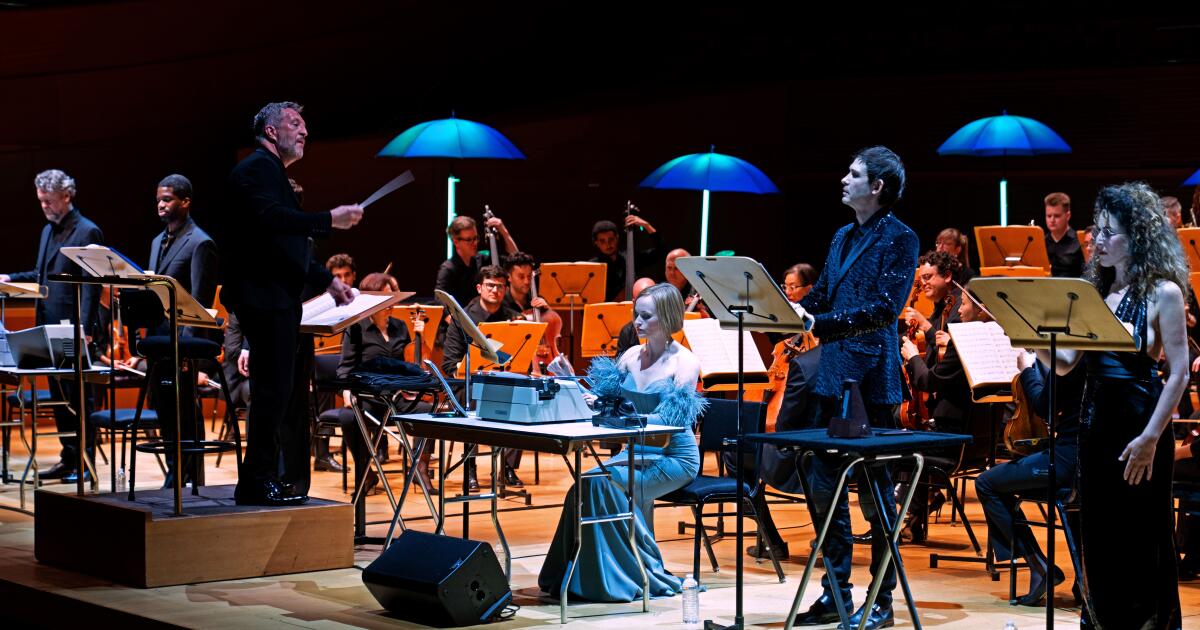
On Tuesday night, the L.A. Phil New Music Group and a cast of extraordinary singers gave the U.S. premiere of “Salome” at Walt Disney Concert Hall. Here we go again.
The description by the composer (who is also his librettist) can hardly be bettered. He has cut Wilde’s play by about half. And, in that half, explored another less knowable side of the moon represented by Richard Strauss’ well-known “Salome,” which helped usher in 20th-century operatic modernism. Barry says his “Salome” is “an opera of voyeurism, the moon, French, God, punishment of sin, misunderstanding, sex, the metronome, suicide, hysteria, hunger, blood, typing, speaking correctly, sterility, ‘The Blue Danube,’ fever, art, Wilde, dreaming, beheading, Frankenstein, kissing.”
No nudity, though, and no dance. Salome is a typist. Her dance of the seven veils is sexy typing.
Barry begins where Wilde begins and Strauss (who follows the original play closely) with a pair of soldiers in Herod’s court peering at the moon, one moonstruck by the beauty of Herod’s daughter Salome. Salome has other ideas. She’s taken, perversely, with John the Baptist, imprisoned in a cistern and prophesying doom for the decadent, Godless heathens, Salome in particular. All of this readily registers on Barry’s Dada-absurdity meter.
Even so, Barry has an oracular outlook. He goes in for proclamatory melody, each note an event, when punched out by brass and lower string like hammering spikes in the ground. Harmonies can be raw. There is a Stravinskyan quality, but nothing is ever predictable.
The orchestral introduction to “Salome” is like that. But it gets screwy fast. Other than Salome, the characters are not named, rather treated as types. John the Baptist is The Prisoner. Herod and Herodias are The King and The Queen. All have some Alice in a different wonderland about them.
The Prisoner could be straight out of a Godard film. He speaks only French (Wilde’s play was first published in French in 1893). He speaks more than he sings and finds outrage everywhere he looks. The surtitles intentionally refrain from translating much of what he says, leaving the audience to rely on his loony spoken tone and loony tunes to carry meaning. His way of impatiently rebuffing Salome’s inappropriate advances is to give her singing lessons.
That’s the last thing she needs. Her part, like that of Alice in Barry’s previous opera, is enlivened by delightfully squeaky high notes in unexpected places. She’s Barbie with exceptional smarts and grotesque sexual fantasies. Soprano Alison Scherzer, who has starred in Barry’s other operas and in Adès’ “Powder Her Face,” is spectacular.
Everyone is odd. The half-crazed King, magnificently sung by the ever-disruptive Timur, lusts after Salome by speaking and singing at different speeds he selects on a metronome, as he entices her to type for him. When she first refuses, the King has everyone sing “The Blue Danube,” because that’s what you do when Salome won’t sexy type for you.
Sara Hershkowitz’s wildly contemptuous Queen adds further soprano glory. The baritone, Vincent Casagrande, a marvelously cantankerous Prisoner, tells us only sick people dream, and of course everyone on stage automatically enters a dream state.
The shock of Wilde’s play, amplified in Strauss’ opera, is the sheer horror of Salome demanding as a reward for her striptease the decapitated head of the prophet, whose bloody lips she desires to kiss. In this case, her typing, which is accompanied by the two soldiers (Justin Hopkins and Karl Huml) on their own typewriters, leads to a dismemberment Frankenstein-style. The ghoulish ending is not unhappy.
Barry’s score remains as uncanny as his sense of drama. He plays with our senses of normality. He frequently uses the instrumentalists in the chamber orchestra like theatrical characters. The ensemble contradicts the singers but also eggs them on. Adès, who has his own unpredictably whimsical side, conducts as though he had written the score himself and shares his pleasure with every delightful effect.
The premiere of “Salome,” intended for 2021 in Disney, was disrupted by the pandemic. The first performance, then, became a staging in Magdeburg, Germany, last year. Barry said Tuesday in the pre-concert Upbeat Live that he is often happier with concert performances, like at this Green Umbrella. He has good reason.
The magic of this “Salome” is its transcendence of silliness into acceptance. When presented without theatrical aspect but as a private process of the imagination, it becomes a lavishly lovable antidote to our too often accepting the world’s absurdity only as dooms-scrollable tragedy.
“I want to lick your stink … I want to taste your foulness … I want to shower in your rot … I want to feast in your fetid funk.”
Have more romantic sweet nothings ever graced the screen? Scripted by Grace Glowicki and Ben Petrie (partners in life and in filmmaking), these words of seduction are music to the ears of a lonely Gravedigger (Glowicki), who has been formulating a perfume to cover up her corpse-like stench. What she discovers is that the right one will love her exactly the way she smells, learning that she’s not so pheromonally challenged after all.
Glowicki’s sophomore feature “Dead Lover,” sometimes presented in “Stink-O-Vision,” is one of those entirely singular freakouts that we can thank Telefilm Canada for subsidizing (see also: the Cronenberg family oeuvre, Matt Johnson’s current “Nirvanna the Band the Show the Movie” and many more).
She co-writes, directs and stars in this highly stylized, wonderfully DIY handmade project, beautifully designed with gruesomely gothic sets by production designer Becca Morrin and art director Ashley Devereux. The blend of intentional artifice paired with deep emotion calls to mind other Canadian auteurs like Guy Maddin and Matthew Rankin (“The Twentieth Century”), but Glowicki’s film also exists within another lineage: the feminist Frankenstein film.
The film opens with a quote from Mary Shelley: “There is something at work in my soul which I do not understand.” Her 1818 novel “Frankenstein: or, the Modern Prometheus” has always been a feminist text (despite Guillermo del Toro’s more bro-ey adaptation), grappling with the terrifying power of creating life — and how close that is to death. Feminist filmmakers have drawn out these inherent themes from the book, the most recent and loudest example being Maggie Gyllenhaal’s “The Bride!” But “Dead Lover” hews closer to Laura Moss’ modern medical take, “birth/rebirth,” and even more closely to Zelda Williams’ cute, poppy “Lisa Frankenstein,” in which a young seamstress stitches up a reanimated boyfriend.
Our Gravedigger speaks to us, and to the moon, about her heart’s desire in charming cockney rhyming slang. Her hopes are rather simple and conventional: one true lifelong love and a family. After much rejection, she finally finds her Lover (Petrie) in the cemetery, saving him from a ferocious beast while he mourns his late opera-singer sister (Leah Doz). After the pair consummate their fragrant lust, the Gravedigger is ready to settle down right away.
In order to make her dreams come true, Lover travels to Europe for fertility treatments, where he drowns on a ship, the only thing left of him a finger, delivered to her by fishermen. Our enterprising Gravedigger, a true woman of science, engineers a lizard elixir and regenerates the finger into a long tentacle that eventually demands a body. What better choice than his own sister? But when her wild new Creature (Doz) comes to life, all hell breaks loose, summoning the sister’s jealous, grief-stricken Widower (Lowen Morrow) into an unfortunate love triangle (or square?).
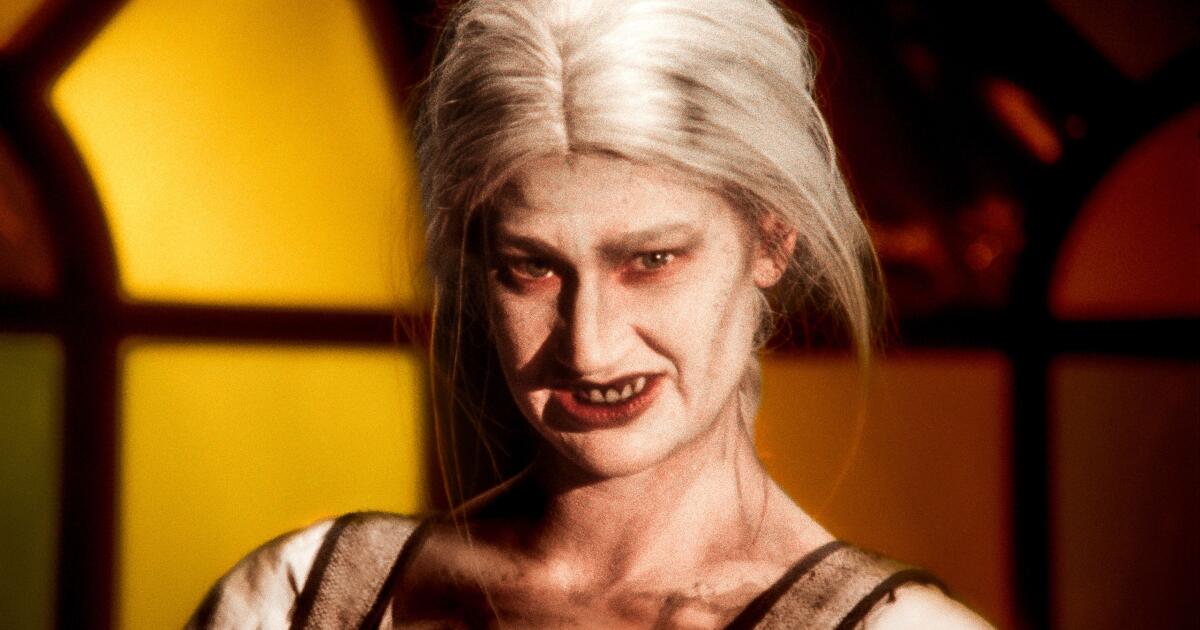
Glowicki is a terrific filmmaker, marshaling her tiny troupe to execute this unique project. Petrie, Doz and Morrow play multiple roles, including a gossipy Greek chorus and the band of merry fisherman (truly an astonishing array of Canadian accent work on display). Her commitment to her singular vision never wavers, but as an actor, Glowicki is truly astonishing. Caked in Halloween makeup and lit with an array of colored gels, Glowicki summons something primal, pure and deeply moving about the lengths one will go to for love, a screech from the depths of her gut.
With a dream-pop soundtrack by U.S. Girls that would be at home in an episode of “Twin Peaks,” “Dead Lover,” in all its stinky, sexy, queer and grotesque glory, is one of the grossest and loveliest films about love I’ve ever seen. This one’s for the horny, hopeless goth inside all of us.
‘Dead Lover’
Not rated
Running time: 1 hour, 25 minutes
Playing: Opens Friday, March 27 at Laemmle Glendale
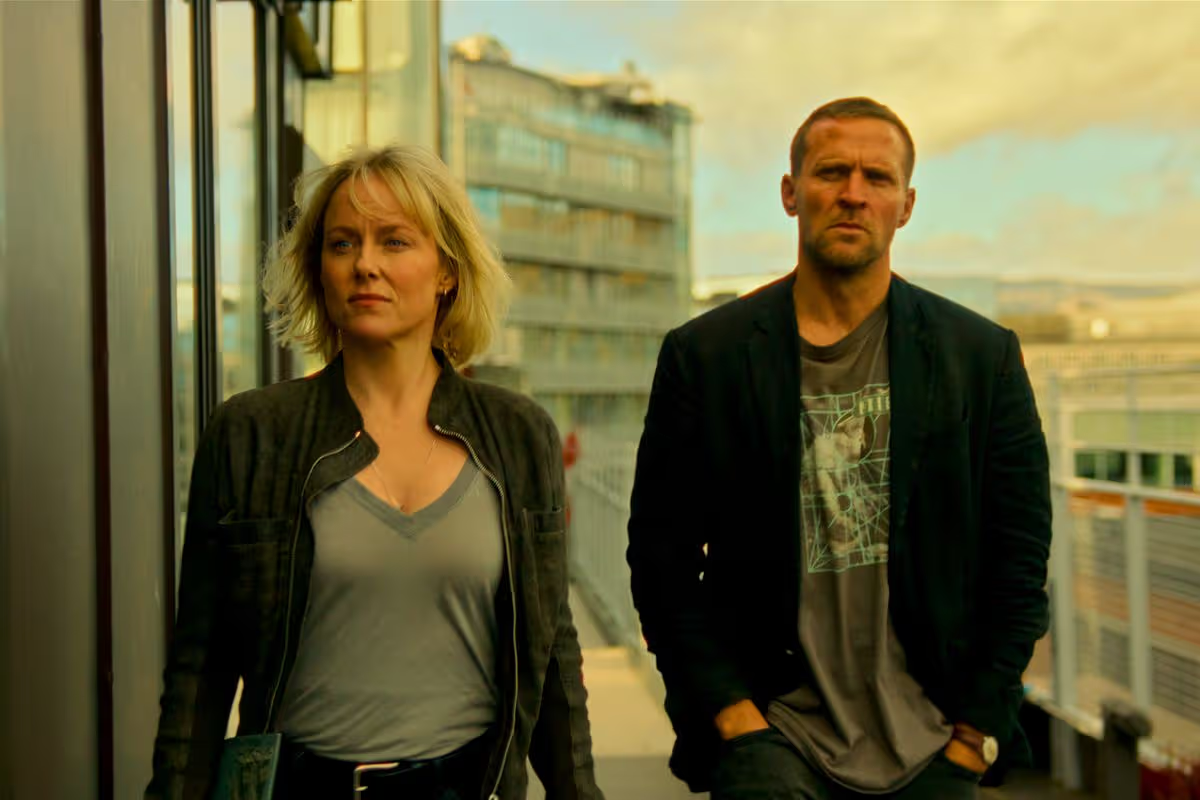
The Netflix cast is led by Norwegian star Tobias Santelmann, who portrays protagonist Harry Hole. The actor is best known for his roles in The Last Kingdom, Kon-Tiki, and Exit. Meanwhile, Swedish-American actor Joel Kinnaman stars as detective Tom Waaler after appearing in Apple TV+’s For All Mankind, Hanna, Altered Carbon The Killing and Suicide Squad.
Norwegian star Pia Tjelta portrays Harry’s girlfriend Rakel Fauke and counts credits in State of Happiness, Cold Lunch, Blindsone, Cold Lunch, Next Summer and Norsemen. Swedish actress Ellen Helinder also stars as officer Beate Lønn and has appeared in Exit alongside her co-star Santelmann, as well as Beck, Studenternas undergång and Veronika.
Other cast members include Anders Baasmo, Maxime Baune Bochud, Kåre Conradi, Simon J. Berger, Prison Break’s Peter Stormare, Fridtjov Såheim, Eili Harboe, Atle Antonsen, Manish Sharma, Jesper Christensen, Kristoffer Joner, Ingrid Bolsø Berdal, Linn Skåber, Jonas Strand Gravli, Sonny Lindberg, Agnes Kittelsen, Nader Khademi, Agot Sendstad, Maja Christiansen, Frank Kjosås, Kelly Gale, Oddgeir Thune, Ravdeep Singh Bajwa, Henrik Mestad, Ingar Helge Gimle, Henriette Steenstrup, Helge Jordal, Eirik Hallert, Anders Danielsen Lie, Ane Dahl Torp and Dagny.
Netflix describes Jo Nesbo’s Detective Hole as “a whodunnit serial killer mystery led by famed anti-hero Harry Hole” that operates as “a nuanced character drama about two police officers operating on opposite sides of the law.” The drama sees Harry clash with corrupt colleague Tom Waaler (Joel Kinnaman) whilst trying to solve murders. The streaming giant promises viewers will see how “Harry must do all he can to catch a serial killer and bring Waaler to justice before it is too late.”
Hello! I’m Mark Olsen. Welcome to another edition of your regular field guide to a world of Only Good Movies.
In another busy week for new releases, the horror-comedy “Forbidden Fruits” is among the standouts. Having just premiered at SXSW, it is the feature debut for director Meredith Alloway, who co-wrote the screenplay with Lily Houghton, adapting Houghton’s play. Diablo Cody is a producer on the film, and the movie shares a sensibility with her beloved “Jennifer’s Body.”
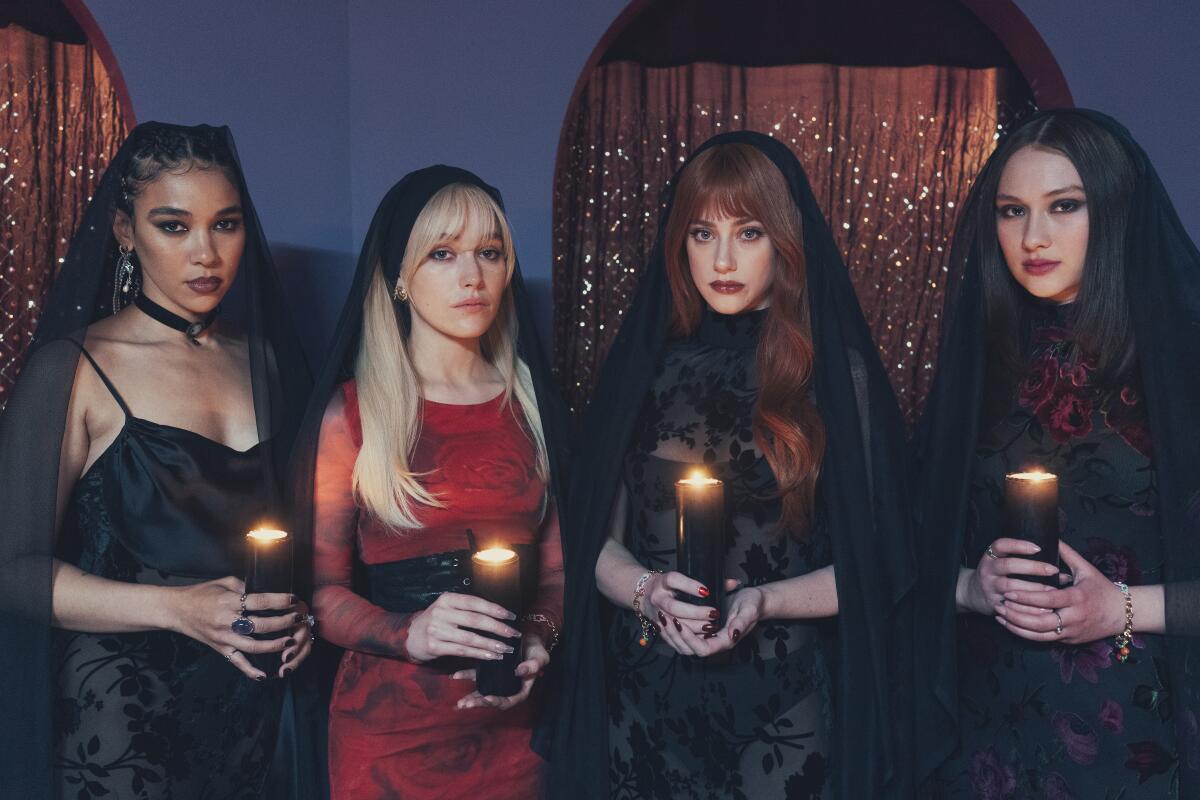
Set at a Texas shopping mall, the plot follows a group of female employees at a boutique who are secretly a coven of witches after hours. They bring a new employee into their fold. Lili Reinhart, Lola Tung, Victoria Pedretti and Alexandra Shipp star.
Alexandra Shipp, from left, Victoria Pedretti, Lili Reinhart and Lola Tung in the movie “Forbidden Fruits.”
(Sabrina Lantos / Independent Film Co. / Shudder)
Though Katie Walsh gave the film a mixed review, declaring it “essentially the fast fashion of girly pop horror,” the film casts a spell when it is working.
Pedretti in particular is a standout, and Malia Mendez spoke to her about the role. “It asks a lot of people to try to step into a world like this one,” Pedretti said of the film’s knowing, campy style. “And as nerve-racking as it may be to take that big swing, you gotta take the big swing.”
Also opening in L.A. this week is Sofia Coppola’s “Marc by Sofia.” The director’s first documentary, it’s more a snapshot than a definitive portrait of the life and career of her longtime friend, fashion designer Marc Jacobs, as he prepares for his spring 2024 collection. While not as in-depth or revealing as one would hope, the film has a warmth and charm all its own. And anyone feeling nostalgic for ’90s New York after watching the recent TV series “Love Story” will get a buzz from this too.
Larry Karaszewski on ‘Last Summer’
Richard Thomas, left, Barbara Hershey and Bruce Davison in the movie “Last Summer.”
(Warner Archive)
The American Cinematheque at the Aero Theatre on Sunday will host the world premiere of a new restoration of the theatrical version of 1969’s “Last Summer,” directed by Frank Perry from a screenplay by Eleanor Perry. Actors Barbara Hershey and Bruce Davison will be there for a Q&A moderated by screenwriter Larry Karaszewski.
“This is one of the holy grails for movie nerds,” says Karaszewski in a recent phone interview. The restoration happened in no small part thanks to his persistent and vocal fandom of the film. Best known for his work with writing partner Scott Alexander (including “Dolemite Is My Name” and “Ed Wood”) and currently a governor in the academy’s writer’s branch, Karaszewski is also a pillar of the repertory scene around Los Angeles, frequently moderating Q&As and an avid moviegoer.
Richard Thomas, left, Barbara Hershey and Bruce Davison in the movie “Last Summer.”
(Warner Archive)
“Last Summer” follows three teenagers (Hershey, Davison and Richard Thomas) whiling away the summer at the beach on New York’s Fire Island. As a certain psychosexual energy escalates among them, winding each other up, they turn their attention to a younger girl (Catherine Burns) and torment her in increasingly sadistic ways.
For her performance, Burns was nominated for an Oscar for supporting actress, while Hershey briefly changed her last name to Seagull after a bird was accidentally injured on set.
In his original July 1969 review, The Times’ Charles Champlin called “Last Summer” “a compelling and disturbing movie, with moments of quite extraordinary power and poignance.”
“This was a movie that people who saw it were just fascinated by,” says Karaszewski. “Even though it came out in ’69, it feels like an important ’70s-style movie, a really rough youth film that used the new freedom that cinema had at that time. But you couldn’t see it.”
Director Frank Perry and screenwriter Eleanor Perry during production of “Last Summer.”
(Warner Archive)
Over time, the rights to the movie changed hands, elements went missing and it became a rarity. Due to an intense rape scene, the movie was also briefly released to some theaters with an X-rating, though Karaszewski says the differences to the R-rated version are minimal — a matter of a few frames and a single word. Released on VHS, “Last Summer” has never been on DVD or Blu-ray. (The Warner Archive label will release a disc of the new restoration later this year.) An edited TV version of the film has circulated, and the last few times “Last Summer” has shown in Los Angeles, it has been from a print discovered at an archive in Australia.
Karaszewski has long had a fascination with the film, one that was only fueled by its inaccessibility.
“It became famous as just, ‘Oh, that’s the movie Larry champions, that’s the movie that Larry won’t stop talking about,’ ” he says. Karaszewski jokes that he won’t know what to do with himself now that his longtime obsession with seeing the film revived has been fulfilled.
“I’ve been championing it so long,” he says. “It could have been just like, ‘Oh, Larry’s a little crazy. He loves this movie.’ And that would’ve been fine too. I’m a person that feels like every movie should have its day in the spotlight.”
The complete Akira Kurosawa in 35mm
An image from Akira Kurosawa’s “Ran.”
(Rialto Pictures)
On Saturday, the Academy Museum launches “Darkness and Humanity: The Complete Akira Kurosawa,” a comprehensive retrospective of the Japanese filmmaker’s 30 existing features, all of which will screen in 35mm. The series opens with two of Kurosawa’s best-known films, “Seven Samurai” and “Rashomon.” Other highlights include “Throne of Blood,” “Ikiru,” “Hidden Fortress,” “Stray Dog,” “High and Low,” “Dreams” and “Ran.” This is a rare opportunity to take in the true breadth of Kurosawa’s work.
Writing about the filmmaker in 2009 to commemorate the centennial of his birth, Dennis Lim said, “The wonder of Akira Kurosawa’s 50-year career is that it was at once remarkably varied and satisfyingly coherent …. But the constant in his films was the principle of heroism, not as a vaporous ideal but a way of life, an awareness of individual agency and personal responsibility in a world that does not always reward or even allow heroic behavior.”
Toshiro Mifune in Akira Kurosawa’s “Yojimbo.”
(Janus Films)
Kurosawa’s influence on other filmmakers around the world has been widely acknowledged. Upon the news of Kurosawa’s death, Steven Spielberg proclaimed him “the visual Shakespeare of our time” and added, “I am deeply saddened by Kurosawa’s death. But what encourages me is that he … is the only director who right until the end of his life continued to make films that were recognized as, or will be recognized as, classics.”
In 1985, while in Los Angeles for a screening of his film “Ran,” Kurosawa described his own work by saying, “I just make up stories and film them. When I am lucky, the stories have a lifelike quality that makes them appealing to people and the film is successful.”
Points of interest
‘To Sleep With Anger’ in 35mm
Actor Danny Glover and director Charles Burnett during production of “To Sleep With Anger.”
(Samuel Goldwyn Company / Photofest)
To celebrate the release of Ashley Clark’s new book “The World of Black Film: A Journey Through Cinematic Blackness in 100 Films,” the UCLA Film and Television Archive will screen Charles Burnett’s 1990 drama “To Sleep With Anger” in 35mm at the Billy Wilder Theater on Sunday. Clark will be there for a book signing, and Burnett will join him for a Q&A.
Recently included as part of The Times’ ranked list of the 101 best Los Angeles movies, “Anger” stars Danny Glover in a galvanizing performance as Harry, an old friend from the South who arrives for an unexpected visit to a family in South Central L.A., upending their lives.
In his book, Clark describes the film as “a singular work with a distinct yet tantalizingly hard-to-pin-down performance from Danny Glover, who, as the inscrutable Harry, flickers between menace and charm, using all of his six-foot-four-inch stature to dominate the frame.”
In a 1990 Times story by David Wallace, Burnett spoke about how the film was meant to evoke a sense of Black cultural history, saying, “I didn’t appreciate the [storytelling] tradition until it disappeared. I had a sense of who I was because of that experience. … This film was an attempt to go back and deal with the past. To tell a story about a story.”
Added Glover: “I think there is a little of Harry in all of us. We’re constantly in conflict between the good side and the other. Harry’s involvement with the dark side is not that uncommon.”
Clark will also appear at the Academy Museum on Monday for the world premiere of Ngozi Onwurah’s restored 1995 film “Welcome II the Terrordome.”
‘Thank You for Smoking’
Aaron Eckhart in the movie “Thank You for Smoking.”
(Dale Robinette / Fox Searchlight Pictures)
On Saturday, Vidiots will host a 20th anniversary screening of Jason Reitman’s debut feature “Thank You for Smoking” in 35mm, with the filmmaker in attendance for a Q&A. Adapted by Reitman from a novel by Christopher Buckley, the film is media satire that follows the misadventures of a lobbyist (Aaron Eckhart) for Big Tobacco. The cast also includes Katie Holmes, Robert Duvall, William H. Macy and Sam Elliott.
In his original review, Kenneth Turan called the movie “that rare film that actually has a sense of humor,” before adding, “Reitman’s script and direction retain the novel’s rhythms and black comic sensibility while at the same time eliminating and/or rearranging large chunks of its plot. He’s also figured out a way to make the story more conventionally audience-friendly without losing the extraordinary bite that made the book so successful.”
I recall an afternoon spent on the Fox lot talking to Reitman and Buckley together for a piece I wrote in 2006. The political climate that the film examines, one of extreme partisanship, has only heightened in the years since.
“The compliment the book always got,” said Reitman at the time, “which I thought was wonderful, was Democrats always thought it was theirs and Republicans always thought it was theirs. Like all good satire, the book was a mirror. … It doesn’t feel like it’s coming from one way or the other. It’s ridiculing both, and hopefully the film does the same thing.”
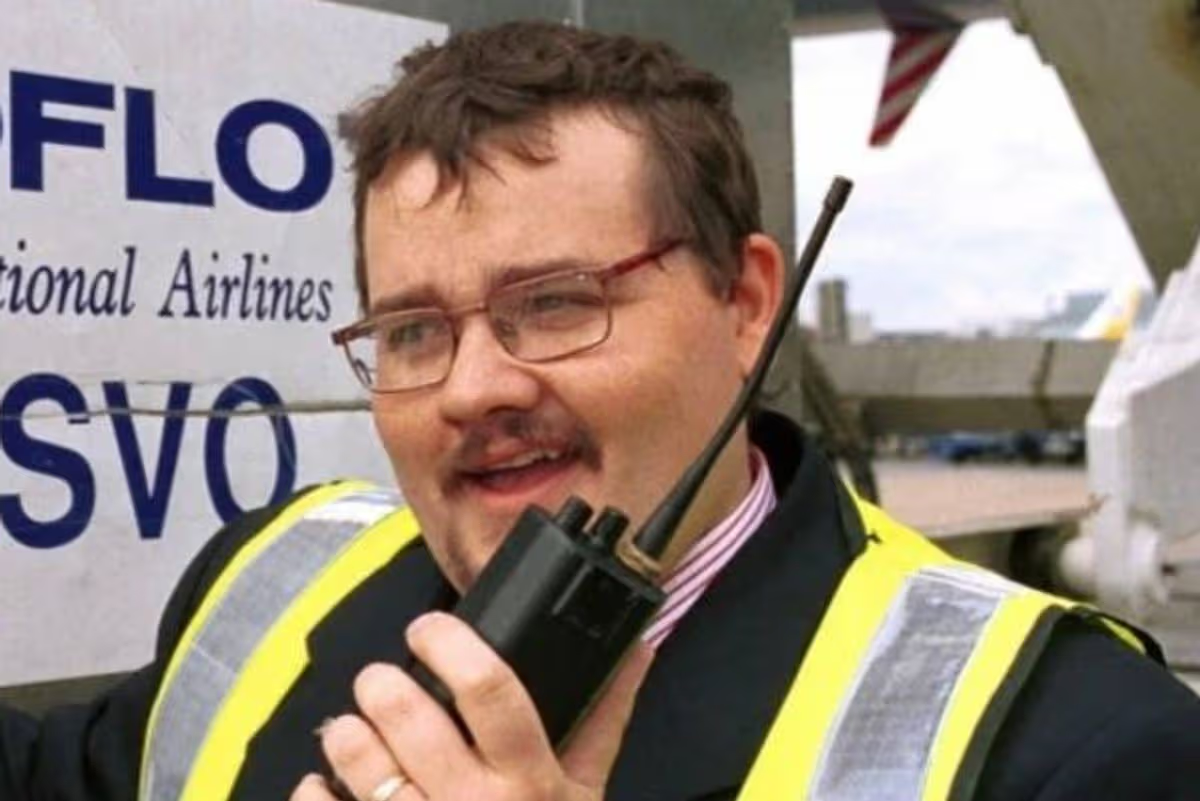
Jeremy Spake became a firm favourite on the BBC series Airport, which first aired in 1996, and has since gone on to enjoy a successful media and aviation career before alleging workplace issues
Jeremy Spake first catapulted to fame an astonishing 30 years ago on the BBC series Airport(Image: BBC)
Jeremy Spake, who was first catapulted into the limelight an astonishing 30 years ago on the BBC series Airport, is now almost unrecognisable. The programme, similar to ITV’s own successful Airline, gave viewers a behind-the-scenes look at the daily workings of Heathrow Airport and the aircraft departing from there. Now 56, Jeremy was featured on the show in 1996 during his stint as a ground services manager for Russian airline Aeroflot.
He swiftly became a viewer favourite during his time on the show, which subsequently paved the way for additional television opportunities. He went on to host Toughest Jobs in Britain, a documentary series that followed workers in some of the UK’s most challenging and physically demanding roles, as well as the medical programme City Hospital.
He also authored two books, titled Jeremy’s Airport and The Toughest Job in Britain. Jeremy’s Airport drew from his experiences working at Heathrow, guiding readers through a typical week on the job, while The Toughest Job in Britain saw him reflect on some of the incredibly tough jobs he tackled while presenting the show.
While pursuing his media career, Jeremy was also steadily ascending the corporate ranks in his day job. Proficient in Russian, Jeremy eventually climbed to the position of services manager for Aeroflot before being promoted to Deputy Director of Isle of Man Airport.
Nevertheless, Jeremy chose to resign from his position at the Isle of Man airport, describing ‘bullying, harassment and mobbing on an almost industrial scale’ via his LinkedIn profile. Reports emerged in 2023 that he was pursuing legal action against the Isle of Man government for personal injuries, alleging damage to his mental wellbeing.
He subsequently fronted a six-episode documentary series aired on the BBC, The Airport: Back In The Skies. The fresh series witnessed Jeremy returning to his roots, reuniting with former colleagues, and examining closely how the sector was recovering following the coronavirus crisis.
Production for The Airport: Back In The Skies kicked off in October 2021, after approximately eighteen months of lockdown measures, travel restrictions, and vaccine passport requirements, while the airport was working to rebuild operations and restore full capacity.
Thankfully, Jeremy has never been one to stand on the sidelines and pitched in by helping to prepare a Boeing 737 for departure and lending a hand to holidaymakers stranded during the turmoil.
The television personality has also released his own audio book, Jeremy’s Airport Audio Book, which recounts the Airport narrative with extra commentary and fresh anecdotes that didn’t feature in the original BBC television programme. Adding another dimension to Jeremy’s repertoire, he now presents daily aviation updates on Instagram, for Air News Daily.
However, Jeremy now has a dramatically different look. His brown hair has disappeared as the star is now completely bald and he has swapped his smart goatee for a clean-shaven look. The website for the channel says: “Jeremy is a seasoned broadcaster and aviation professional with 40 years experience of working with some of the largest airlines and airports around the world and brings his unique insight to every show.”
DRAGONS Den star Steven Bartlett has banked a massive £10million from the sale of Huel.
Steven, 33, was one of the first investors in the meal replacement brand and first took a stake in 2017.
Sign up for the Showbiz newsletter
Thank you!
Steven Bartlett is in for a hefty payday for the sale of Huel, the meal replacement drink brand he invested in almost a decade agoCredit: YouTubeThe businessman is known for his keen investing eye, and has stakes in several top businessesCredit: BBC
Now food giant Danone – which owns Activia and Actimel – has agreed to purchase Huel for £860m.
Since then, Huel expanded its range to nutrition bars, health drinks and ready meals.
Huel is just the latest investment of Steven’s to deliver.
Perfect Ted – the matcha company he invested in – has become the most successful Dragons Den pitch ever; after it was valued at more than £140 million late last year.
Today, matcha has taken over an entire floor of his London office building.
Bartlett is also the host of Diary Of A CEO, one of the biggest Podcasts in the world – and the UK and Europe’s No1.
Earlier this year, Steven announced he was engaged to long-term partner Melanie Lopes, a French-Portuguese wellness influencer.
Steven isn’t the only one doing well off the sale, with stars such as Jonathan Ross also boasting a stake in the companyCredit: GettySteven, who joined Dragon’s Den in 2021, became a millionaire at the age of 23 by co-founding the social media marketing agency Social ChainCredit: BBC
More than a century after the Gilded Age, we have entered another: The gilded age of Trump.
A little over a year after President Trump was sworn into office for the second time, the country has borne witness to a striking aesthetic makeover of the White House and Washington, D.C. A week ago, when the Trump-packed Commission of Fine Arts approved a 24-karat commemorative coin stamped with Trump’s image, that makeover ascended to staggering new heights.
The coin, which breaks with the country’s longstanding tradition of not featuring a living person on its currency, joins a swiftly growing list of other Trumpian imprints on arts and culture, including architectural choices deemed gaudy and garish by experts and laypeople alike.
Plenty of people are on guard against these changes. This week a coalition of eight cultural heritage and architectural organizations, including the National Trust for Historic Preservation and the American Institute of Architects, filed a lawsuit to require the Trump administration to comply with historic preservation laws and get congressional authorization before making any changes to the Kennedy Center.
“The Kennedy Center is not a personal project of any president. It is a national cultural monument built to honor John F. Kennedy and to serve the American people. Federal law requires transparency, expert review, and public participation before it can be fundamentally altered,” Rebecca Miller, executive director of the DC Preservation League, said in a statement.
The same could be said of the White House, the Smithsonian, the NPS and the United States Mint. But Trump doesn’t care about due process, congressional approval or the courts. Time and again he has shown his willingness to go it alone when making big decisions that affect not only America but the world. This includes his actions in Venezuela and Iran. But if he decides he wants to take the Kennedy Center “down to the steel,” as he once threatened, there isn’t really anything that can stop him.
The gilded age of Trump proves that the look of things really does affect how the country sees itself — and how it acts as a result of its new self-image. Golden gaudiness conjures thoughts of empire and imperial rule, but it is also unserious and incidental, bombastic and self-centered. The Trump aesthetic screams, “Me, me, mine!” A willingness to tear down historic structures without care for their symbolic meaning reveals an inability to learn from the past, a tendency that has proved frighteningly perilous.
Will the leader who rises after Trump tear down all that Trump has built? And even if they do, can the damage really be undone?
I’m Arts editor Jessica Gelt, keeping it small and simple for posterity. Here’s your arts and culture news for the week.
You’re reading Essential Arts
Our critics and reporters guide you through events and happenings of L.A.
By continuing, you agree to our Terms of Service, which include arbitration and a class action waiver. You agree that we and our third-party vendors may collect and use your information, including through cookies, pixels and similar technologies, for the purposes set forth in our Privacy Policy such as personalizing your experience and ads.
FRIDAY
Laura Aguilar The late trailblazing photographer’s exploration of her queer Chicana identity against the natural backdrops of Southern California and the Southwest is on display in the exhibition “Body and Landscape.” More of the artist’s work will be on display starting Sept. 20 in “Laura Aguilar: Day of the Dead.” Through Sept. 7. The Huntington, 1151 Oxford Road, San Marino. huntington.org
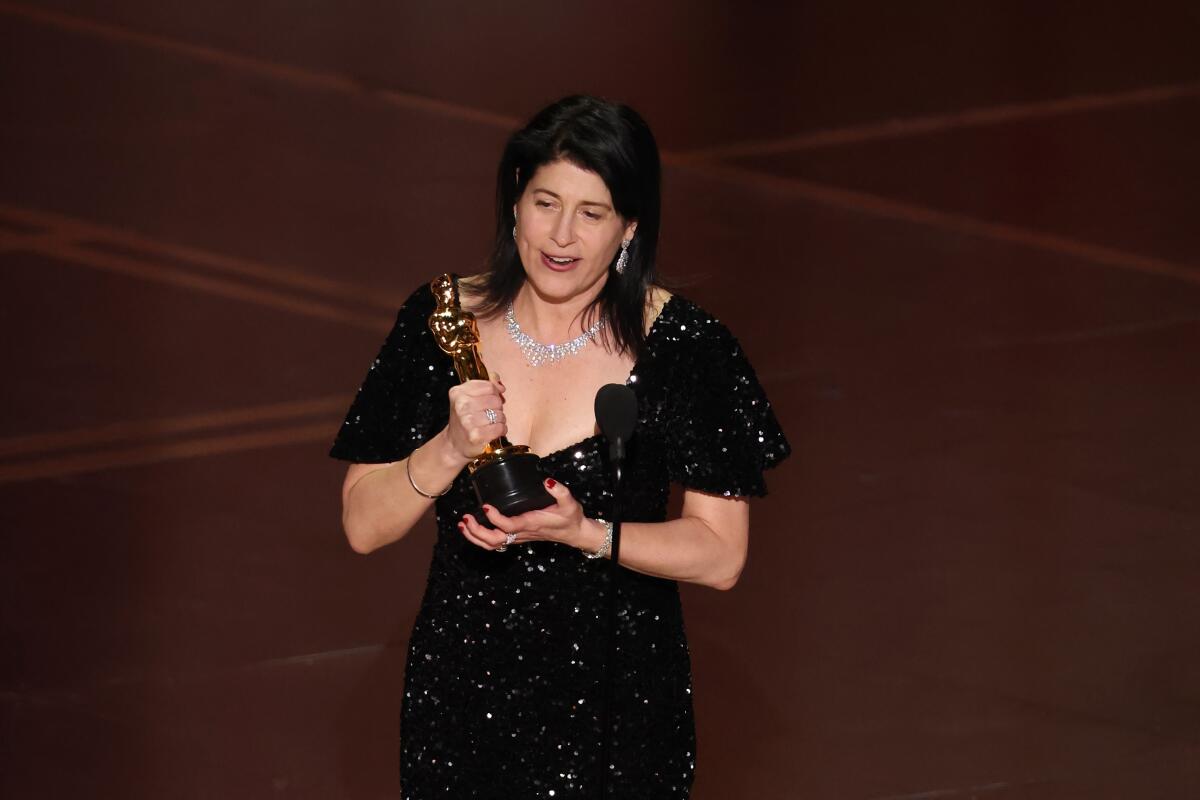
Cassandra Kulukundis holds the first-ever Oscar for casting for her work on “One Battle After Another” during the Academy Awards, March 15, 2026.
(Robert Gauthier/Los Angeles Times)
The Art of Casting With Cassandra Kulukundis recently winning the first Oscar in the category for her work on Paul Thomas Anderson’s “One Battle After Another,” what better time to learn more about the subject? The academy’s video presentation goes inside the casting process with casting directors discussing their craft and includes previously unseen auditions and screen tests. Through July 6. Academy Museum, 6067 Wilshire Blvd. academymuseum.org
Brahms & Beethoven Uzbek pianist Behzod Abduraimov performs Beethoven’s “Piano Concerto No. 3” as Paavo Järvi conducts the L.A. Phil in Brahms’ “Second Symphony” and Schumann’s “Overture, Scherzo and Finale.” 8 p.m. Friday and Saturday; 2 p.m. Sunday. Walt Disney Concert Hall, 111 S. Grand Ave., downtown L.A. laphil.com
A performance of “Escape.”
(Traj George Simian)
Escape Diavolo reprises this production featuring its trademark blend of dance, movement and storytelling as 22 artists challenge their abilities against a variety of architectural structures. 8 p.m. Fridays and Saturdays; 6 p.m. Sundays, through June 14. L’Espace Diavolo, 616 Moulton Ave. diavolo.org
Arshile Gorky: Horizon West In the summer of 1941, the Armenian immigrant artist, his soon-to-be wife Agnes “Mougouch” Magruder and the artist and furniture designer Isamu Noguchi drove from New York City to L.A. Gorky was emerging as one of the most important figures in the nascent Abstract Expressionism movement, and his cross-country adventures had an enormous impact on his art, which is explored in depth in this exhibit. A selection of landscapes include Gorky’s rich, surrealistic paintings and drawings from before, during and after the life-changing trip. (Jessica Gelt) Through April 25. Hauser & Wirth West Hollywood, 8980 Santa Monica Blvd. hauserwirth.com
A New Song: Langston Hughes in the West The exhibition reveals Hughes’ time spent in California, Nevada and Mexico during the Great Depression, World War II and into the 1950s, when he produced significant work, including lectures, film scripts, plays and his first book of short stories. Through Sept. 13. California African American Museum, 600 State Drive, Exposition Park. caamuseum.org
The White Album Arthur Jafa’s 2018 30-minute experimental film, a social critique of whiteness, uses found and produced footage to demonstrate how the creative work of Black Americans has been co-opted by white culture throughout history. Through Aug 30. UCLA Hammer Museum, 10899 Wilshire Blvd., Westwood. hammer.ucla.edu
SATURDAY
Akira Kurosawa’s “Seven Samurai,”starring Takashi Shimura, from left, Toshiro Mifune and Yoshio Inaba.
(Janus Films)
Darkness and Humanity: The Complete Akira Kurosawa The 1954 classic “Seven Samurai,” starring Toshiro Mifune, kicks off this comprehensive retrospective of the great Japanese filmmaker’s work. 6 p.m. Saturday; series continues through May 30. Academy Museum, 6067 Wilshire Blvd. academymuseum.org
from rock to rock… aka how magnolia was taken for granite Choreographer Jeremy Nedd’s exploration of the hidden poetry, virtuosic freedom and ownership features five performers examining “the Milly Rock,” a viral dance move. 8 p.m. UCLA Macgowan Hall, Freud Playhouse, 245 Charles E. Young Drive East. cap.ucla.edu
A Queer Arcana: Art, Magic, and Spirit On The exhibition collects an intergenerational group of Queer artists whose work examines hidden and mystical knowledge to find sources of connection and transformation. Through Oct. 18. Palm Springs Art Museum, 101 Museum Drivepsmuseum.org
Ralph Steadman More than 140 original artworks and ephemera, including sketchbooks, handwritten notes and personal photographs are included in “And Another Thing,” a traveling exhibition tracing six decades of the artist and illustrator’s career. Through May 9 Torrance Art Museum, 3320 Civic Center Drivetorranceartmuseum.com
Tonality The vocal ensemble performs “Refuge/Requiem,” a program that includes Caroline Shaw’s 17th-century-influenced contemporary work “To the Hands,” and “1605 Requiem,” composed for the funeral rites of Empress María by Tomás Luis de Victoria. Presented with the Wallis. 7:30 p.m. All Saints’ Beverly Hills, 504 N. Camden Drivethewallis.org
SUNDAY To Sleep With Anger Written and directed by the protean Charles Burnett, this film does more than vividly illuminate South-Central’s rarely portrayed Black middle class. A deft domestic horror story, it’s a contemporary tale with a folkloric twist that has old friend Harry (Danny Glover) visiting a married couple and gradually revealing himself to be a trickster with trouble on his mind. With a terrific ensemble headed by Mary Alice and Paul Butler as the couple in question. (Kenneth Turan) 7 p.m. The 35mm screening includes a Q&A with the filmmaker and Ashley Clark, author of “The World of Black Film: A Journey Through Cinematic Blackness in 100 Films.” Beginning at 6 p.m. Clark will sign copies of the book. Billy Wilder Theater, UCLA Hammer Museum, 10899 Wilshire Blvd., Westwood. cinema.ucla.edu
TUESDAY Philip Glass’ Cocteau Trilogy Pianists and siblings Katia and Marielle Labèque perform the composer’s triptych inspired by the films of Jean Cocteau. Part of the LA Phil’s “Body and Sound” festival. 8 p.m. Walt Disney Concert Hall, 111 S. Grand Ave., downtown L.A. laphil.com
Mary Halvorson The contemporary jazz musician, guitarist and composer and new quartet project Canis Major — featuring Dave Adewumi on trumpet, Henry Fraser on bass and Tomas Fujiwara on drums — perform an evening of music designed for deep listening and total immersion. 7 p.m. Getty Center, Harold M. Williams Auditorium, 1200 Getty Center Drive, L.A. getty.edu
Arts anywhere
New releases of arts-related media.
Album cover for “Evening Light: Raga Cycle I.”
(Cantaloupe Music)
Evening Light: Raga Cycle I The first release of an eight-album series in which American composer and pianist Michael Harrison collaborates with a global assortment of artists combining Eastern and Western musical traditions. Each chapter represents three hours of day or night following the Indian raga time cycle. For “Evening Light,” Quebec-based Brazilian vocalist Ina Filip co-composed the music with Harrison. Also appearing on the album are American composer Elliot Cole on synthesizer, French composer Benoit Rolland on electro-acoustics and Bangladeshi tabla virtuoso Mir Naqibul Islam. Cantaloupe Music: download ($10).
Book jacket for “Stephen Sondheim: Art Isn’t Easy” by Daniel Okrent.
(Yale University Press)
Stephen Sondheim: Art Isn’t Easy Part of Yale University Press’ Jewish Lives series, Daniel Okrent’s new biography of the award-winning composer-lyricist who took Broadway musicals to new heights “is a brisk, engaging read that avoids hagiography,” writes Julia M. Klein in a review for The Times. “Okrent highlights the emotional frailties that coexisted with the brilliance and generosity. He seeks to liberate Sondheim’s reputation from the encrustation of myth and to demystify his relationships, while offering a succinct analysis of his achievements. That’s a tall order for a compact book, especially given its subject’s long, complicated life. Okrent’s failings are, unsurprisingly, primarily those of omission.” Yale University Press: 320 pages, $35
Martha Graham Dance Company: We Are Our Times A two-part documentary goes behind the scenes with the troupe as it prepares for its 100th anniversary celebration. Producer-directors Peter Schnall and Cyndee Readdean followed the dancers from rehearsal to premiere on a global tour, capturing their artistic routines and everyday lives. Episode 1, “American Spirit,” 9 p.m. Friday; Episode 2, ““Athletes of God,” 9 p.m. April 3 on PBS. Streaming at pbs.org and on the PBS app.
Culture news and the SoCal scene
Pritzker Prize-winning architect Frank Gehry is photographed in May 2019 with a model of the Grand Avenue Project at his L.A. offices.
(Jay L. Clendenin / Los Angeles Times)
Can downtown L.A. still benefit from the vision of late-great architect Frank Gehry, who put so much time and energy into lifting the area up? Times classical music critic Mark Swed says yes in an optimistic column noting that, “So many plans Frank Gehry imagined for L.A. still remain. Gehry bequeathed blueprints and models, sketches and concepts, for his large and devoted team of younger architects and next-generation visionaries equipped to fabricate our way out of angst.” The time to build, Swed writes, is now.
Freelance writer Jane Horowitz got the skinny on the fifth edition of High Desert Art Fair, which arrives in Pioneertown this weekend, transforming “the rooms of the historic Pioneertown Motel into exhibition spaces for 20 galleries and publishers, while expanding into a broader mix of programming — something akin to a mini Coachella Valley Music & Arts Festival. This year’s edition includes an opening night party with a DJ set by street artist Shepard Fairey, panel discussions, guided meditation and even a sound bath.”
Monty Python” alum Eric Idle poses for a portrait at the Hollywood Pantages.
(Jason Armond / Los Angeles Times)
Malia Mendez sat down with British comedy legend Eric Idle to talk about his spoof musical “Spamalot,” which arrives at the Pantages more than a decade after its last stop at the stage. Over a margarita with a side of chef olives, Idle opened up to Mendez about “his earliest forays into comedy, his legendary run and subsequent break with his former ‘Monty Python’ castmates, and why ‘Spamalot’ arrives in L.A. at the perfect time.”
Times theater critic Charles McNulty headed to the Matrix Theatre to watch Rogue Machine’s production of Jackie Sibblies Drury’s Pulitzer Prize-winning 2018 drama “Fairview.” He writes that the play is “a shape-shifting work that eludes an audience’s assumptions at every turn,” and concludes that the new production “may struggle with the slipperiness of Drury’s writing.” The dramatic construction, however, is solid enough to withstand some of the overly broad strokes of the staging.”
Richard Neutra imagined his first Los Angeles project, the Jardinette Apartments, as a prototype for future garden apartment buildings.
(Myung J. Chun / Los Angeles Times)
Sam Lubell wrote a fascinating story about the painstaking rehabilitation of Modernist architect Richard Neutra’s first L.A. commission: the Jardinette Apartments in Hollywood. The building was hailed a structural and technical breakthrough when it opened in 1928, but it soon dropped from public view and sank into disrepair. The new owner spent more than $5 million on the historic preservation project and the complex may soon go on the market.
Enjoying this newsletter? Consider subscribing to the Los Angeles Times
The Hammer Museum Gala on Oct. 8, 2022, in Los Angeles.
(Michelle Groskopf / For The Times)
The Hammer Museum has announced the honorees for its annual gala. They are artist Betye Saar and television creator Darren Star. The highly anticipated event, set to take place in the Hammer’s garden courtyard on May 2, aims to honor impactful artists while raising funds to support the museum’s exhibitions and public programs.
The 80th Ojai Music Festival, set to take place June 11-14, recently announced this season’s programming and artistic collaborators. Much of this year’s event will be devoted to unpacking and performing works that have been central to the 2026 festival’s music director‘s artistic life. “Esa-Pekka Salonen is one of the most vibrant and adventurous creative forces in our musical world,” said Executive Director Ara Guzelimian in a statement. “It has been an absolute joy to dream up programs together that focus on numerous personal dimensions — his work as composer and conductor, his rich associations with and remarkable history in Los Angeles, the formative influence of his teachers and the giant musical figures of 20th century music, his deep friendships with many peer composers, and his championing of a new generation of composers.”
Washington National Opera Artistic Director Francesca Zambello, who was instrumental in the company’s decision to leave the Kennedy Center after Trump’s takeover, was inducted into the Opera Hall of Fame at the OPERA America Salutes Awards Dinner on March 20, at the Plaza Hotel in New York City.
An uprising typically has a long parentage and, if effective enough, can leave behind many like-minded descendants. Such is the bracing air that Palestinian filmmaker Annemarie Jacir breathes into her historical drama “Palestine ’36” as she dramatizes the 1936-1939 Arab Revolt against occupying Britain’s increasingly punitive, underhanded rule, offering up a multifaceted rebellion tale with plenty of contemporary resonance.
That being said, Jacir’s fourth feature — packed as it is with storylines — could stand a bit more context and fewer of the expositional traps that big-cast sagas easily fall into. But the key element that grounds Jacir’s version of an old-fashioned epic (and helps it withstand its faults) is that we’re seeing a place rarely depicted with such sweep, detail and scope outside of biblical epics. It’s as if a long-disused history book’s pages have finally been opened, dust giving way to color and purpose.
Some of that breadth is seen at the beginning in some astonishing newsreel footage from the era, which segues into Jacir’s establishing story threads. We meet village-born Yusuf (newcomer Karim Daoud Anaya), an ambitious young man who moves restlessly between bustling Jerusalem, where he works for a wealthy, British-friendly Palestinian businessman (Dhafer L’Abidine) and his journalist wife (Yasmine Al Massri), and his rural home where villagers are routinely targeted by British authorities. If it isn’t vicious Capt. Wingate (Robert Aramayo) violently rooting out rebels and putting locals in pens, it’s outwardly friendly officials like the secretary who oversees new policies kinder to the increasing numbers of Jewish settlers than to those who have been farming the hills for ages.
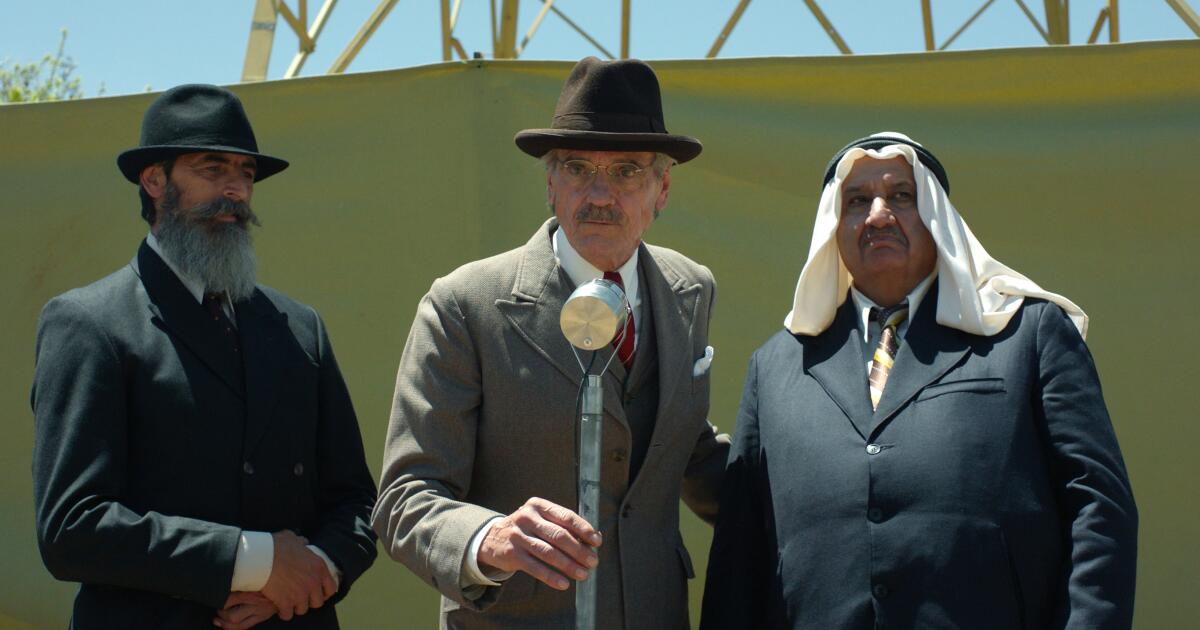
The split widens when a labor strike becomes an armed revolt, with Jacir gamely tracking the hardening or shifting loyalties of both her peasant and well-to-do characters. The British, represented at the top by the casually imperious High Commissioner Wauchope (a perfectly cast Jeremy Irons), are decidedly the villains here as a colonial force quick to brutalize Palestinians for speaking up for themselves. Still, by forgoing any Jewish characters when there was already a burgeoning transplanted minority — all we see is a kibbutz being erected in the far distance — seems like too careful an avoidance of contextual reality.
As “Palestine ’36” eventually sacrifices focus on the many characters it has, one wishes Jacir had had the luxury of a classic epic’s standard third hour to build that complexity into a vivid resistance narrative. Wanting more from this material, though, feels better than not getting the opportunity to see it at all. As overdue tales of history go, “Palestine ‘36” (currently one of the last films with access to its real-world locations) is certainly more of a blunt instrument than a novelistic endeavor. But its broad strokes and rooted passions easily earn their place, and deserve to inspire more such stories.
‘Palestine ’36’
In Arabic and English, with subtitles
Not rated
Running time: 1 hour, 59 minutes
Playing: Opens Friday, March 27 at Laemmle Royal and Laemmle NoHo 7
During the opening episode of the BBC series, Humphrey and his new wife, Martha (Sally Bretton), encounter a challenging predicament when they’re stranded at sea after the Lily Bond is caught adrift.
Nevertheless, this is merely the beginning of their troubles as the newlyweds find themselves residing with Martha’s mum, Anne (Barbara Flynn), as their houseboat is out of commission.
Despite the couple encountering less than perfect conditions, one thing is certain, they’ll be working through their difficulties against the stunning backdrop of Cornwall, reports Plymouth Live.
Throughout this series, Devon locals may spot a recognisable location featured on the programme as the crew has filmed at Mothecombe Beach in Plymouth.
When questioned if there were any locations in this series that stood out to the BBC star, Sally hinted at one racy scene audiences can look forward to.
She revealed: “There’s a rather scandalous scene where Martha and Humphrey go for a swim at Mothecombe Beach. We filmed this at sunrise at the most beautiful beach, but oh my goodness, it was freezing!”
This won’t be the first occasion the stunning private beach has appeared in the cherished programme, as the beach was previously closed during filming of Dawn French’s The Trouble With Maggie Cole.
Sally wasn’t the only star from Beyond Paradise to laud the Devon location, as Kris Marshall highlighted Mothecombe beach as a standout spot for him this series.
He shared: “As always, we got to film in some stunning locations, especially Mothecombe Beach. You can only get down there by foot or in a 4×4, and when the sun is out, it feels like you’re in the Caribbean.
“Sally and I had a brilliant scene there – it was at sunrise, and it was freezing, but so beautiful. I even got to have a dip in the sea!”
A synopsis for this series teases more ‘mind-boggling’ cases for the team to unravel, ranging from the death of a crime novelist to an intruder returning to rectify a crime they instigated.
It states: “Set against the breathtaking landscapes of Devon and Cornwall, fact and folklore blur when a witness claims a mermaid wrecked a local seaweed farm, an off-grid community fight developers with the image of the Green Man, a Morris dancer is targeted in plain sight, and a stolen pirate map reappears under mysterious circumstances.
“Beyond the station, Humphrey and Martha launch into married life as they search for a new place to call home, all whilst Humphrey faces mounting pressure when tasked with an impossible decision that will change his team forever.
“Meanwhile, Anne rises to new heights as a local councillor, Esther is forced to grapple with the consequences of her past choices, and Zoe starts planning her next steps. Elsewhere, Kelby’s dating life takes an unexpected turn when he meets someone online, but Margo spots warning signs that all may not be as it seems.”
The fourth series of Beyond Paradise airs Friday 27 March on BBC One from 8pm
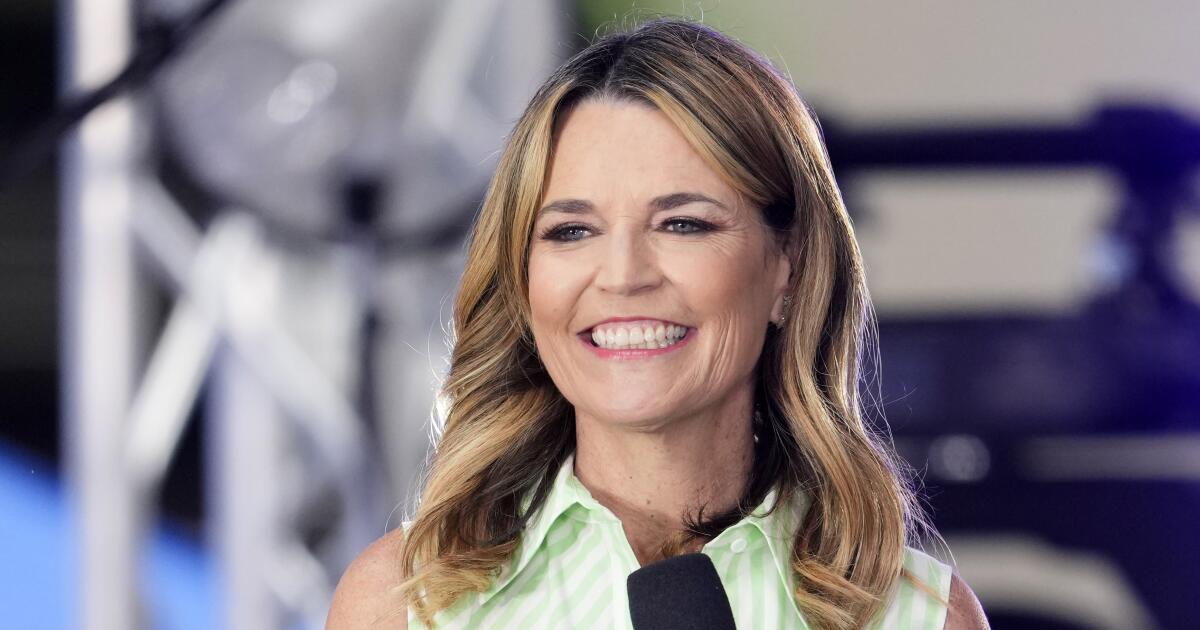
Viewers of NBC’s morning program learned Friday that Guthrie will be back to her hosting duties at the network’s Rockefeller Plaza studio in New York on April 6.
Guthrie has been absent from “Today” since Feb. 2, the day after learning her mother Nancy was abducted from her Tucson home. She appeared on the program this week in a taped interview with Hoda Kotb, her first since her mother went missing..
Guthrie’s re-entry on “Today” is certain to generate significant viewer interest. Her 84-year-old mother’s case, still being investigated by law enforcement, generated an outpouring of public affection for the co-host.
Many media industry insiders expressed serious doubts over whether Guthrie would return to television before law enforcement determined what happened to Nancy Guthrie. But people close to Guthrie believe her grit and deep religious faith will provide her with the strength to move forward.
Guthrie’s daily presence on “Today” will also help keep her mother’s case in the public eye. NBC is also airing a special “Dateline” episode on the abduction on Friday.
Guthrie has spent most of the last seven weeks in Tucson with her family. She canceled plans to be a part of NBC’s coverage of the Winter Olympics in Milan and before this week only appeared on TV and social media in taped messages asking for the help in finding her mother.
Nancy Guthrie was last seen Jan. 31, when she spent the evening with family members. Law enforcement officials believe she was removed from her Catalina Foothills home later that night against her will as her phone, wallet, car and medication were left behind.
Surveillance videos of a masked man who was outside Guthrie’s front door on the night she disappeared were released by the FBI.
Some people prefer a laid back comedy, while others look for a psychological thriller that keeps them on the edge of their seats – but these 10 shows are tried and tested
Abigail Nicholson Content Editor
10:59, 27 Mar 2026
The Good Place(Image: Daily Mirror)
When it comes to watching TV, everyone has different opinions on what they like to watch. Some people prefer a laid back comedy, while others look for a psychological thriller that keeps them on the edge of their seats.
But there are some cult classics that hundreds of thousands of people watch, and rewatch, that bring joy, excitement and nostalgia. One Reddit user posed in the R/AskReddit community to ask members what their favourite TV show of all time was.
The post said: “What’s a TV series you’ll never get tired of recommending to someone?” Hundereds of people were quick to hail their 10 favourite TV shows, with some being aired for the first time in 2002.
1. The Wire, 2002
The Wire was aired on HBO between 2002 and 2008 and looks at the narcotics scene in Baltimore through the eyes of police, as well as the drug dealers and users.
The show was created by former police reporter David Simon, who also wrote many of the episodes, and has a huge 94% rating on Rotten Tomatoes.
One person commented: “I was advocating for someone I know to watch it about four hours ago. I had to share, to someone who works in a bureaucracy, the line ‘There you go Jimmy…Givin’ a f***, when it ain’t your turn to give a f***’. Masterpiece of a show.”
A second said: “So I just watched this cause everyone raves about it. And I liked it, but it felt really forced in season 5.”
The Wire can be watched on HBO Max.
2. The Good Place, 2016
The Good Place was first aired on NBC in 2016 and follows four people who enter the afterlife after dying on earth. Eleanor Shellstrop [Kristen Bell] is both relieved and surprised that she’s made it into the Good Place.
But it doesn’t take long for her to realize she’s there by mistake, and is forced to hide in plain sight. The show has a huge 97% rating on Rotten Tomatoes and is a firm favourite by TV fans.
One person said: “One of the most perfect shows ever made, imo. From start to finish.”
A second said: “I recommend this show to my mom and I regret it LOL. she watches it everyday. AND I mean everyday. She will just keep watching it and not get tired of it.”
Dark was first aired on Netflix in 2017 and follows two families searching for answers when their children go missing in a small German town. A sinful past is exposed along with the double lives and fractured relationships that exist among four families as they search for the kids.
The mystery-drama series introduces an intricate puzzle filled with twists that includes a web of curious characters, all of whom have a connection to the town’s troubled history.
The series has a 95% rating on Rotten Tomatoes and can be watched in Netflix.
One person said: “Dark was incredibly fine-tuned. I had found a chart online to help with family connections and time jumps.”
A second said: “Truly a 10/10 show. Still sad 1899 didn’t get the full run it deserved.”
4. Arrested Development, 2003
Arrested Development was first aired on Fox in 2003, and follows the Bluth family. Michael Bluth finds himself forced to stay in Orange County and run the family real estate business after his father, George Bluth Sr, is sent to prison for committing white-collar crime.
He tries to juggle the wants and needs of his spoiled and eccentric family while being a good role model for his teenage son, George Michael.
The series, which has a Rotten Tomatoes score of 75%, is known for having a reboot after season three, which did not go down as well as the first three seasons of the programme.
One person said: “Arrested Development (Seasons 1-3 too afraid to watch reboot so never did).”
A second person said: “Arrested Development is mine for sure. I don’t think there has ever been a funnier show on television.”
You can watch Arrested Development on Netflix and Disney+.
5. The Expanse, 2015
The Expanse was first aired on Syfy channel in 2015, and takes viewers hundreds of years into the future. Things are much different than what humanity is used to after humans have colonized the solar system and Mars has become an independent military power.
She show follows rising tensions between Earth and Mars that have put them on the brink of war. The show has a massive 95% rating on Rotten Tomatoes, with many people singing its praises.
One person said: “Such a great show. One of the only good things Bezos has done in his life is paying to finish that show.”
A second said: “Excellent show! You gotta check out.”
The Expanse can be watched on Prime Video.
6. Parks and Recreation, 2009
The comedy was first aired on NBC in 2009 and follows the Indiana Parks and Recreation Department as they deal with oafish bureaucrats, selfish neighbours, governmental red tape and a myriad of other challenges.
The show is known as an easy to watch cult classic, and has a massive 93% rating on Rotten Tomatoes.
One person said: “The first show my wife and I binged when we first started dating. We ended up finishing our wedding vowels with “I love you and I like you” and engraving it on our wedding rings.”
A second said: “Way better than the office in my opinion.”
Parks and Recreation on Sky.
7. Psych, 2006
The Comedy, Crime and Mystery & Thriller was first aired on USA network in 2006, and follows Shawn Spencer as he happens to possess some uncanny powers of observation thanks to his father, Henry, a former police officer who taught his son to remember even the smallest details of his surroundings.
When Shawn is accused of committing a crime that he actually solved, he convinces the cops that he’s a psychic. The show has an 89% rating on Rotten Tomatoes and ran for 8 seasons.
One person said: “Psych was an incredible mix of humor, intrigue, creative writing and stupidity. I loved every second of it.”
A second said: “Episodic shows have so much rewatchability. Need to sit for 40 minutes? Watch an episode. Doesn’t matter which, they’re all self contained. Serial shows you can’t watch a random episode because you may not remember what’s going on.”
Psych can be bought on Prime and Apple TV.
8. Ted Lasso, 2020
Ted Lasso was first released on Apple TV in 2020 and follows an American football coach who is hired to manage a British soccer team.
What he lacks in knowledge, he makes up for in optimism, determination and biscuits. This comedy/drama is an easy watch, and features some big stars such as Hannah Waddingham, Jason Sudeikis and Nick Mohammed.
The show has a 90% rating on Rotton Tomatoes, and you don’t need to enjoy football to watch the show.
One person said: “I’m not even a fan of Soccer or most sports, but this show may be the most Wholesome, Down to Earth show I’ve ever seen. For anyone who hasn’t seen it, Soccer & sports is only about 5% of the show. The other 95% is behind the scenes, character development, comedy, and straight up genuine wholesomeness.”
A second said: “Idk if I’d even say it’s 5%, the soccer thing is all just backdrop really for some incredible character development.”
Ted Lasso can be watched on Apple TV.
9. Fleabag, 2016
Fleabag was first aired on BBC Tree in 2016 and follows a dry-witted woman, known only as Fleabag, as she navigates life and love in London while trying to cope with tragedy. The angry, grief-riddled woman tries to heal while rejecting anyone who tries to help her.
The show has a 100% rating on Rotten Tomatoes and is known for its depth and dark comedy.
One person said: “Kind of dark to be fair. More raunchy than dark to me really. But it’s amazing, so I agree on the brilliance. Olivia Coleman may be my favourite British actresses of all time, even if she has been around the station a few times.”
A second said: “Season 2 is as close to perfection as any show will ever get.”
Fleabag can be watched on Prime Video, Sky and BBC iPlayer.
10. Brooklyn Nine-Nine, 2013
Brooklyn Nine-Nine was first aired on Fox in 2013 before moving to NBC for the final three seasons. The show follows the team of detectives at Brooklyn’s 99th Precinct – made up a loveable and offbeat squad that must get its act together when the office gets a new captain.
The show has a 95% approval rating on Rotten Tomatoes, with many describing the show as “hilarious”.
One person said: “My wife made me watch it and I was hooked from the first episode.”
A second said: “I have to admit, this was recommended many times and when I saw bits and pieces I really hated it. Then I gave it a chance, now I’m at season 5, so many hilarious bits.”
Former Made in Chelsea stars Jamie Laing and Sophie Habboo are starring in their own three-part series, which focuses on their romance and journey to becoming parents
10:27, 27 Mar 2026Updated 10:27, 27 Mar 2026
Jamie Laing and Sophie Habboo seen in emotional clash in Raising Chelsea trailer(Image: Youtube/Disney Plus)
Jamie Laing and wife Sophie Habboo are seen in a tense, emotional clash in a new trailer for their upcoming series Raising Chelsea.
The Made in Chelsea couple, who wed in April 2023, are the stars of a brand new series with Disney+ which is due to premiere next week. Ahead of the three-part series’ release, Disney+ has released a teaser trailer to give a glimpse of what fans can expect from the show.
The candid trailer traces their journey to parenthood – and opens with a clip of Jamie, 37, and Sophie, 31, in the back of a car as Jamie explains: “We’re currently heading to the Lindo Wing,” before Sophie adds: “We think it’s happening,” in reference to the birth of their first child.
**Ensure our latest headlines always appear at the top of your Google Search by making us a Preferred Source. **Click here to activate** or add us as your Preferred Source in your Google search settings.**
The teaser then turns back time as a montage looks at the couple meeting, tying the knot and their career highlights – including Jamie’s Strictly stint and Sophie recording their podcast. Before the pair announce: “And we’re having a baby!”
“I’ve always wanted to be a mum,” Sophie confesses as the montage moves on to focus on the couple’s journey to parenthood – from planning to conceive to midwife appointments. “Pregnancy is a rollercoaster,” Sophie confesses as she is seen having an ultrasound scan. Another clip shows Sophie in tears as Jamie tells her: “Nothing’s the matter, I promise you.”
Meanwhile, Jamie is seen in a confessional telling the camera: “The dynamic between Sophie and I; she’s the boss and I’m the intern.” Before it cuts to more clips and Jamie is heard telling the camera: “We’re bringing you on our journey. There’s c-sections, vaginal birth, births out your butthole…”
As the montage continues it cuts to a particularly tense clash between the couple as a wide-eyed Jamie is seen sharply saying: “I’m stressed, I’m tired.” The camera then cuts to an emotional Sophie, who is seen tearing up as she says: “But you just go behind my back. That’s so unacceptable.”
The camera then cuts to a confessional of Jamie’s mum Penny Baines who says: “This pregnancy, you’d think the Messiah was coming.” The clips then cut to show images of Sophie in hospital as she’s under observation as she smiles. Before Jamie gives an update on the birth, telling the camera: “Bad news is that the baby, his arm is through the cervix, she needs to have an emergency C-section.”
Emotional scenes follow as Jamie is seen reassuring Sophie while she undergoes the C-section before a newborn cry is heard and a doctor says: “Hear that sound?” As the elated couple are overwhelmed with emotion. The scenes then cut to a quiet moment of Sophie at home, feeding her baby son Ziggy, who was born in December.
The trailer ends with the date the series will be available to stream, which is April 2.
The new Harry Potter series is winging its way to HBO, but the show, based on the smash-hit books by author, JK Rowling, has divided die-hard fans of the boy wizard
09:10, 27 Mar 2026Updated 09:11, 27 Mar 2026
First look at HBO Harry Potter cast including Snape and Dumbledore
JK Rowling has given her take on the new Harry Potter trailer – which has seriously divided fans. The new series on HBO, titled Harry Potter and the Philosopher’s Stone, is set to debut on Christmas Day this this year.
Featuring a new cast, including Dominic McLaughlin as Harry, each series will adapt each of Rowling’s seven books across seven seasons over the course of a decade. The teaser opens exactly where fans would expect—at the Dursleys’ house. We see Harry hidden in the now-iconic cupboard, with Petunia Dursley dismissing him as “nothing special”. But almost immediately, the tone shifts. A letter arrives. A door opens. And just like that, the magic starts to happen.
Responding to the trailer, many fans were excited, as one took to X, exclaiming: “The trailer for the new Harry Potter looks b****y marvellous. I cannot wait, and as it seems to me, neither can the rest of the world.” However, others were not convinced, with one claiming the new offering was little more than “millennial slop”.
On Thursday, Rowling threw her support behind the project, insisting she’s “so happy” with the teaser trailer for the series adaptation of her novels, sharing her reaction to the first look with fans on social media. “It’s going to be incredible,” she exclaimed on X, adding: “I’m so happy with it.”
However, at least some of the book’s fans would disagree, with several slamming the new series in comparison to the Harry Potter films, which were released from 2001 to 2011.
Ensure our latest headlines always appear at the top of your Google Search by making us a Preferred Source. Click here to activate or add us as your Preferred Source in your Google search settings.
Several have also complained about the race-swapping of Severus Snape with actor Paapa Essiedu, who recently revealed he’s received racially-motivated death threats over his casting.
Giving their take on the trailer, one fan quipped: “The new Harry Potter show is truly amazing to me. Leftists won’t like because of JKR, right wingers won’t like it because JKR retconned a bunch of characters to try and be woke, and the kids of today won’t like it because it’s literally f******g millennial slop.”
Meanwhile, Rowling’s controversial views on the trans community have also called the series into question, with one fan tweeting: “You cannot ‘separate the art from the artist’ with Harry Potter.”
Scheduled to premiere on Christmas Day, Harry Potter began filming in the UK last summer.
Its cast includes McLaughlin as the titular boy wizard, Alastair Stout as Ron Weasley, Arabella Stanton as Hermione Granger, John Lithgow as Albus Dumbledore, Janet McTeer as Minerva McGonagall and Nick Frost as Rubeus Hagrid.
Venezuela Fury looked incredible as she arrived at her hen doCredit: SplashThe teenager was joined by her glam mum ParisCredit: SplashVenezuela pulled out all the stops for her hen do at Morecambe Football ClubCredit: Splash
The young couple have not yet announced a date for their wedding, but as the hen do was last night, this could be a big hint their big day is getting closer.
Venezuela, who appears in the Fury family’s hit Netflix reality series At Home With The Furys, pulled out all the stops as she stepped out for her bachelorette party.
The teen was dressed in a stunning metallic dress, and matching strappy heels.
Venezuela wore her hair up on top of her head with a tiara and bridal veil.
She also made sure to flash her huge engagement ring as she made her way into her hen do, which was held at Morecambe Football Club
As Venezuela walked into her party, she told The Daily Mail: “I can’t wait. I’m really looking forward to married life. I’m very happy and excited.”
The youngster was joined by her glam mum Paris, 36, who looked incredible in her white bodycon dress.
The mother-of-eight showed off her stunning figure in the skintight dress.
It has been reported that Venezuela had an estimated 300 guests at the hen party.
According to the Mail, party goers were treated to a huge buffet, Karaoke and a DJ.
Venezuela added extra glam to her outfit with a tiara which had a bridal veil attachedCredit: SplashThe youngster needed some help with her dress as she got out of the carCredit: Splash
When it was announced last September that the teenager had got engaged, there was some backlash from fans, due to her age.
Venezuela has since been forced to hit back at trolls who have said that she is too young to marry.
“I didn’t feel old enough for this, but Venezuela is over-the-moon happy,” she told The Mirror.
Venezuela is seen here with her famous dad Tyson and mum Paris along with her husband-to-be, Noah PriceCredit: TikTok/@parisvenezuela
“The two of them are in their own little bubble. And, look, I got married myself at 18.”
Although Paris is delighted for Venezuela and Noah, she insisted it is “too soon” for the pair to start having children – saying they want to travel first.
The mother-of-eight also admitted that she’s worried about herself when her eldest child eventually moves out.
She said: “I’ll feel like I’ve lost my arm. It’s going to hit me hard.
Paris recently opened up about her daughter Venezuela getting married at 16Credit: Instagram
“Right now, Tyson’s in training camp in Thailand, the kids are in school, and Venezuela and I… basically co‐parent!
“But I do let her have her space. The weekends are her time. I know she’ll be fine, getting on with an exciting new life. It’s me I’m worried about.”
In a Q&A with fans on Instagram, the teenager confirmed she would be staying with her parents until she is married.
Paris said she doesn’t feel ‘old enough’ for her daughter. 16, to be getting marriedCredit: Instagram
Venezuela told followers: “I’m trying to get everything booked for May/June time, but I’m not sure when it will be.
“I will be in my mam and dad’s home til I’m married.”
In order to get ready to set up her marital home, Venezuela has been buying home items ready and showed off the results from a haul.
Paris also recently opened up about her feelings surrounding Venezuela’s engagement, which has sparked controversy among fans regarding her age.
But speaking to The Sun, the matriarch insisted she’s “really pleased” for her daughter, adding: “I got engaged at 17, so even though I feel she’s young, I did it.
“I wouldn’t change a thing.
“So if that’s what she wants to do, then 100 per cent, me and her dad support her.”
Paris also dropped some hints about Venezuela’s upcoming wedding as she says the teen isn’t “rushing to plan weddings” – in sharp contrast to her daughter’s Instagram remarks.
“She’s not rushing to plan weddings or get married,” she said.
“We have very different tastes.
“She has said she wants a smaller wedding, so if that’s what she wants, I’ll go along with it.”
Paris and Tyson Fury share eight childrenCredit: Instagram/ parisfury1,
FOR Dermot Kennedy’s third album, he wanted to explore both the beauty and burden of a successful music career.
The award-winning Irish singer might headline huge arenas but he has always had his feet firmly on the ground, valuing a normal life, privacy and simple things such as walking in his local woods — the theme of his new record.
Sign up for the Showbiz newsletter
Thank you!
Dermot Kennedy says a lot of songs from his new album, The Weight of the Woods, carry a ‘vulnerability’ he has not previously shownCredit: SuppliedKennedy says it’s better for him to ‘sit back and let the music do the work’Credit: Supplied
He says: “I feel I’m at a sweet spot, because I can play The O2 in London but I can walk around all day and no one really knows who I am.
“Having a career in music is a blessing. It’s the most amazing thing, but at the same time, there are certain challenges that come with it. It tests relationships and tests your own resolve, it’s a pressure. And I wanted to write about that.”
The pull of nature as a place to reset became more powerful to the singer as he found success — both his previous collections, Without Fear (2019) and Sonder (2022), topped the album chart.
“With a career in music, you’re not anonymous, you’re constantly moving from city to city,” he explains.
“Being somewhere where you can only see trees in every direction has become more and more important to me, and more powerful. Where I live is quite remote, and that’s the way I want to be.”
This recurring woodland imagery reflects a sense of calm and nostalgia to Kennedy, and the cover of his new album, The Weight Of The Woods, features the singer in a woodland setting.
As we chat in his central London record label offices, he’s signing a huge pile of his new CDs.
“It’s a great album cover,” he says smiling. “Even signing these all morning, I’m not sick of looking at it yet.”
A standout on Kennedy’s new record is the track Sycamore, a gorgeous introspective ode to home and identity.
“The Irish landscape has always been important to me,” he says. “Where we took the picture for the album still resonates. It’s a big part of how I’m inspired.”
Working with producer Gabe Simon — who produced Noah Kahan’s 2022 breakthrough album, Stick Season — Kennedy made The Weight Of The Woods in Ireland, Nashville and Norway.
He says: “Sycamore is lush and smooth, which felt different for me. It was the first song we made when Gabe came over — there’s a sycamore tree right in front of my house that’s become a kind of talisman in my life. It felt like a lovely way to start.
“A lot of these songs carry a vulnerability I haven’t shown before, and that felt important, because you can’t pretend you’re 100 per cent all the time. It’s just not true.”
This shift shows a new confidence, one that allows him to do things his own way.
“Generally, I’m a quiet person, so on previous albums I wasn’t the loudest in the room whereas with this one, I have the confidence to shout for it and take my time.
“It’s taken this long to get to a point where I know what I want — what I need and what’s authentic.”
The Weight Of The Woods reflects a stage in his life where Kennedy feels more secure, more at home and more fully himself. Now married with a baby daughter, his perspective has shifted in ways he struggles to fully articulate.
“How has fatherhood changed me?” he ponders. “It’s hard to sum up, I can’t explain it in a couple of minutes.
“It just means the world to me and gives you a completely new perspective on life.
“It makes you realise there are more important things than chasing goals in music.
“The best thing I can do now is make music that moves me and try to live in a way that feels like the purest version of who I am. It becomes the centre of everything.
“Fatherhood has given me more confidence, but also a different kind of fragility, making me more emotionally open.
“A lot of these songs carry a vulnerability that I haven’t shown in my music before, and that’s important.”
Musically, Kennedy feels the album has a strong Irishness, though it was not a deliberate concept.
Honest is a track that feels especially personal, as it directly references where he is from in Ireland.
He says: The first lyric is about Kilteel [near Rathcoole, Co Dublin] which is an important part of where I’m from. It’s a more personal record so I needed to tell the story of where I’m from.”
He reflects on the pull of home: “Sometimes when you’re trying to have a career in music, people assume they need to move away and live somewhere else.
“But in Ireland we have one of the richest musical landscapes in the world, you know? So, it’s nice to be a part of that.
“And it’s the most Irish-sounding track. I played the bodhran [a traditional Irish frame drum] on it, the drum you hear at the beginning, and there’s also a tin whistle. It all came together very naturally so these songs feel dynamic to me and they’re really going to work live.”
Wasted is a favourite of Kennedy’s on the record. Inspired by US singer and producer Dijon, he says: “It felt like it had that excited, upbeat energy without being pop. It felt real in the room and exciting.”
Then there’s The Only Time I Prayed, which explores the singer’s relationship with faith.
“I’ve got songs like Glory, and lyrics about the devil, but I’d consider myself definitely agnostic. I believe in otherworldly things but I’m not a practising Catholic.
“Still, when things get difficult, people pray — regardless of faith. It comes from desperation, and I find that fascinating. Sometimes I even feel envious of people with a strong faith.”
The singer says it has taken time for him to discover what he truly wants, needs, and feels is authenticCredit: Supplied
Another highlight on the record is Funeral, a stunning track about letting go of the past to move forward.
“I just wanted that song to be about ditching any difficult stuff I’ve been through,” he says.
“Songwriters spend an awful lot of time wallowing in the past and I wanted it to feel triumphant — moving forward into something more positive.
“It felt good and the vocal carries an energy which is always a fun thing on a song.”
On this third album, Kennedy feels more confident, self-assured and clearer about what is authentic to him.
He says: “It’s less inhibition and less stress — not poring over every decision. So confidence showed up in quite a carefree, exciting way.”
It was important to Kennedy that the album was stripped back and imperfect to add to the studio atmosphere.
“Musically, if you listen closely, there are lots of imperfections, little noises other artists or producers might take out,” he says.
“You can hear someone talking, a chair creaking. It puts me back in that room, and I don’t want to lose that.”
That same approach mirrors a wider creative release: “I feel like I’ve let go massively, which is a good thing.”
That sense of letting go has also reshaped how he defines success.
“Any pressure that came with the second album was internal, applied by myself,” he says. “I don’t think being competitive puts me in the best place to be the best artist I can be. I’m pretty sure it doesn’t.
“Tracking streams or records isn’t success to me. With this record, it was just lovely to get back to a place where I really enjoyed making the music, the visual world around it, and playing the songs.
“Don’t get me wrong, I still want lots of people to hear it, but I feel like I’ve already succeeded with this project.
“If it reaches a ton of people, that’s fantastic, but I had a beautiful time making it, and that’s everything.
“When you chase numbers and all that stuff, it’s all quite surface level and not very fulfilling in the end.
“I don’t think trying too hard is the move. It’s important to work hard and promote things, but being overly try-hard isn’t appealing.
“It’s better to sit back and let the music do the work. By letting go — stepping back from social media and putting the music first — it feels more likely to set my career up the way I want it.”
Live performance remains central to Kennedy’s identity. He feels he has built his career the “old-fashioned way” by playing rooms and winning audiences over.
He says: “Nowadays, there’s so many ways that someone can forge a career. You can blow up on the internet or go viral. For me, it’s never really been like that.
“It’s been more about getting people into a room. I think I can play in such a way that they might want to come back and see it again next time.”
“For me, when I dreamed about having a career in music, all I thought about was playing in big, beautiful theatres. So playing live is an important part of what I do.”
Even as he now fills large venues, Kennedy is keen to preserve a sense of intimacy within those spaces.
He explains: “We’re going to do it differently. There are lots of ways you can use tech in a live show. You can run tracks for things like horns and production, but then the whole show ends up on track and can feel like elevated karaoke.
“You can come off stage feeling like you haven’t really achieved much. So, with this tour, we’ve got rid of the click track and any backing tracks. It’s about keeping it real and letting the performance have more freedom.
“We’re getting rid of any kind of bells and whistles, and it’s just fun. I could start a song at any tempo, I could be feeling a certain way that ends up being a faster version with more energy, or we could pull it right back.
“You go to a live show for the energy, and I think it’s far easier to tap into that special place if you don’t have that stuff.”
Kennedy is also more careful about looking after his voice when he tours
“I try not to do more than two nights in a row, because it compromises the rest of the tour. It means I can walk on stage excited, instead of just hoping I get through it.”
It’s part of a wider shift in how he approaches performance. “It’s a process as well, working with vocal coaches and stuff. I run a lot more now, because you need that lung capacity. I’m not sure about other people’s experience touring, but it feels like a sport sometimes.”
That mindset has also made him more aware of the level required to sustain a major live career — something he saw first-hand watching Taylor Swift live.
Kennedy on stage in the US earlier this monthCredit: Getty
“Well, I saw her at the venue I’m playing this summer, and it was inspiring.” he says. “I saw Travis, her fiancé, talking about her fitness regime and just how she’s operating at a kind of scary level.
“I find that really inspiring, because it makes you realise this is a very high level of what we do — you have to take it seriously. When someone is that on top of their game, it’s just incredibly motivating.”
“The show is, what, three hours long? It was wild to see. And honestly, it was just cool to be in Dublin and see people so excited by those songs.
“What really struck me was that it was just her songs. You realise this is someone who started out just writing songs, and now it’s millions of people all over the world.
“But it doesn’t feel like some manufactured pop machine. It just feels like someone who writes songs, and that’s what makes it so powerful.”
The album The Weight Of The Woods is out on April 3.
Dermot Kennedy’s The Weight Of The Woods is out on April 3Credit: supplied
You thought the Oscars brought awards season to an end? Think again. The iHeartRadio Music Awards took place Thursday night with performances and appearances by Taylor Swift, Miley Cyrus, Sombr, Weezer, Alex Warren, Shaboozey and John Mellencamp, among other stars. Here’s a glimpse at the best looks from the red carpet and the best moments of the show itself, which took place at the Dolby Theatre in Los Angeles.
The Show
Lainey Wilson performs onstage at the 2026 iHeartRadio Music Awards at Dolby Theatre in Hollywood.
Taylor Swift accepts the pop album of the year award onstage at the 2026 iHeartRadio Music Awards at Dolby Theatre in Hollywood.
Miley Cyrus accepts the Innovator Award onstage at the 2026 iHeartRadio Music Awards at Dolby Theatre in Hollywood.
John Mellencamp, right, performs onstage at the 2026 iHeartRadio Music Awards at Dolby Theatre in Hollywood.
Terry Ellis, from left, Cindy Herron and Maxine Jones of En Vogue perform at the 2026 iHeartRadio Music Awards.
Red Carpet
Miley Cyrus on the red carpet for the iHeartRadio Music Awards at the Dolby Theatre in Hollywood.
Ella Langley on the red carpet for the iHeartRadio Music Awards at the Dolby Theatre in Hollywood.
Shaboozey and Kehlani on the red carpet for the iHeartRadio Music Awards at the Dolby Theatre in Hollywood.
Cheryl Porter on the red carpet for the iHeartRadio Music Awards at the Dolby Theatre in Hollywood.
Cindy Herron, Maxine Jones and Terry Ellis of En Vogue on the red carpet for the iHeartRadio Music Awards at the Dolby Theatre in Hollywood.
Teddi Mellencamp on the red carpet for the iHeartRadio Music Awards at the Dolby Theatre in Hollywood.
Brianna Mazzola and Wennely Quezada of ‘3QUENCY’ on the red carpet for the iHeartRadio Music Awards at the Dolby Theatre in Hollywood.
Sublime on the red carpet for the iHeartRadio Music Awards at the Dolby Theatre in Hollywood.
Brent Smith and Zach Myers of Shinedown on the red carpet for the 2026 iHeartRadio Music Awards at the Dolby Theatre in Hollywood.
Graham Stanush, Sebastian Gonzalez, Matty Bielawski and London Hudson of Return to Dust on the red carpet for the iHeartRadio Music Awards at the Dolby Theatre in Hollywood.