Stay informed about the latest developments in politics with our comprehensive political news coverage. Get updates on elections, government policies, international relations, and the voices shaping the political landscape.
A federal judge in San Francisco on Wednesday barred Immigration and Customs Enforcement and its Justice Department counterpart from “sweeping” civil arrests at immigration courthouses across Northern California, teeing up an appellate challenge to one of the Trump administration’s most controversial deportation tactics.
“This circumstance presents noncitizens in removal proceedings with a Hobson’s choice between two irreparable harms,” Judge P. Casey Pitts wrote in his Christmas Eve decision.
“First, they may appear in immigration court and face likely arrest and detention,” the judge wrote. “Alternatively, noncitizens may choose not to appear and instead to forego their opportunity to pursue their claims for asylum or other relief from removal.”
Wednesday’s decision blocks ICE and the Department of Justice’s Executive Office for Immigration Review from lying in wait for asylum seekers and other noncitizens at routine hearings throughout the region — a move that would effectively restore pre-Trump prohibition on such arrests.
“Here, ICE and EOIR’s prior policies governing courthouse arrests and detention in holding facilities provide a standard,” the judge said.
Authorities have long curbed arrests at “sensitive locations”— such as hospitals, houses of worship and schools — putting them out of reach of most civil immigration enforcement.
The designation was first established decades ago under ICE’s predecessor agency, Immigration and Naturalization Services. ICE absorbed the prohibitions when the agency was formed in the wake of the Sept. 11 attacks.
Courts were added to the list under President Obama. The policy prohibiting most courthouse arrests was suspended during the first Trump administration and reinstated by President Biden.
Internal ICE guidance from the Biden era found “[e]xecuting civil immigration enforcement actions in or near a courthouse may chill individuals’ access to courthouses and, as a result, impair the fair administration of justice.”
Nevertheless, the agency’s courthouse policy was reversed again earlier this year, leading to a surge in arrests, and a staggering drop in court appearances, court records show.
Most who do not show up are ordered removed in absentia.
Monthly removal in absentia orders more than doubled this year, to 4,177 from fewer than 1,600 in 2024, justice department data show.
More than 50,000 asylum seekers have been ordered removed after failing to appear in court hearings since January — more than were ordered removed in absentia in the previous five years combined.
“ICE cannot choose to ignore the ‘costs’ of its new policies—chilling the participation of noncitizens in their removal proceedings —and consider only the policies’ purported ‘benefits’ for immigration enforcement,” Pitts wrote in his stay order.
That ruling likely sets the San Francisco case on a collision course with other lawsuits seeking to curb ICE’s incursions into spaces previously considered off-limits. This suit was brought by a group of asylum seekers who braved the risk and were detained when they showed up to court.
One, a 24-year-old Guatemalan asylum seeker named Yulisa Alvarado Ambrocio, was spared detention only because her breastfeeding 11-month-old was with her in court, records show. Administration lawyers told the court ICE would almost certainly pick her up at her next hearing.
Such arrests appear arbitrary and capricious, and are unlikely to survive scrutiny by the courts, Judge Pitts ruled Wednesday.
“That widespread civil arrests at immigration courts could have a chilling effect on noncitizens’ attendance at removal proceedings (as common sense, the prior guidance, and the actual experience in immigration court since May 2025 make clear) and thereby undermine this central purpose is thus ‘an important aspect of the problem’ that ICE was required, but failed, to consider,” Pitts wrote.
A district judge in Manhattan ruled the opposite way on a similar case this fall, setting up a possible circuit split and even a Supreme Court challenge to courthouse arrests in 2026.
For now, the Christmas Eve decision only applies to ICE’s San Francisco Area of Responsibility, a region encompassing all of Northern and Central California, as far south as Bakersfield.
The geographic limit comes in response to the Supreme Court’s emergency decision earlier this year stripping district judges of the power to block federal policies outside narrowly-tailored circumstances.
The administration told the court it intends to appeal to the 9th Circuit, where Trump-appointed judges have swung the bench far to the right of its longtime liberal reputation.
WASHINGTON — The national Republican Party leadership, spurred by chairman Lee Atwater, today cut all ties to former Ku Klux Klan leader David Duke, the newly elected Louisiana Republican state lawmaker.
Party spokeswoman Leslie Goodman said 28 voting members of the party’s executive committee unanimously repudiated during a telephone vote Duke’s racist and anti-Semitic views and barred financial or other assistance for him.
Duke, 38, a former klan grand wizard, was elected to the Legislature Saturday from a suburban New Orleans district in a narrow victory over builder John Treen, 63, who was backed by President Bush and former President Ronald Reagan.
The resolution adopted by the national Republicans in effect “excommunicates” Duke, according to Atwater, who said Duke is neither a Republican nor a Democrat but “a charlatan and a faker” using Republicans to promote his racist agenda.
WASHINGTON — Congressional investigators on Friday interviewed Edwin P. Wilson, the convicted former CIA official, at a maximum-security prison as part of their investigation into the Iran- contra affair, officials said.
Bob Havel, a spokesman for the House Iran-contra committee, said congressional staffers flew to Marion, Ill., to talk to Wilson, who knew some of the figures in the affair.
“I understand he wanted to talk with them,” Havel said.
Paul Blumenthal, an attorney for Wilson, identified the three as Cameron Holmes and David Faulkner of the Senate committee and Allan Hobron of the House committee.
Wilson, who is serving a 52-year sentence for illegally selling explosives to Libya and plotting to kill federal prosecutors and witnesses, has claimed in television and newspaper interviews that he was a one-time business partner of retired Maj. Gen. Richard V. Secord.
Denies Business Ties
Secord said he knew Wilson but has denied that he had any business association with the former CIA official.
Secord is under investigation by independent counsel Lawrence E. Walsh for his role in helping former National Security Council aide Lt. Col. Oliver L. North sell weapons to Iran and divert the profits to the Nicaraguan contras.
Havel said one of the issues investigators wanted to question Wilson about was a Feb. 16, 1984, cashier’s check for $33,000 that Secord made out to Thomas Clines, another former CIA official who was once associated with Wilson. A copy of the check was introduced at the hearings.
Testimony in the public Iran-contra hearings, which ended Aug. 3, showed that Clines worked with Secord in supplying weapons to the contras.
Purpose of Check
Secord has said the check represented a loan to Clines and had nothing to do with a fine that Clines’ company had to pay in 1984 for overbilling the U.S. government on shipping costs.
Clines was involved in the Egyptian-American Transport & Service Co., a now-defunct firm that pleaded guilty to filing false statements with the U.S. government. Eatsco was created to ship U.S. military equipment to Egypt.
Wilson, whose estate is tied up in U.S. Bankruptcy Court, has filed papers seeking to pursue financial claims against Clines, Secord and several Egyptians who he says were involved in Eatsco.
Wilson contends that he provided start-up money for Eatsco, but never received a promised return on his investment.
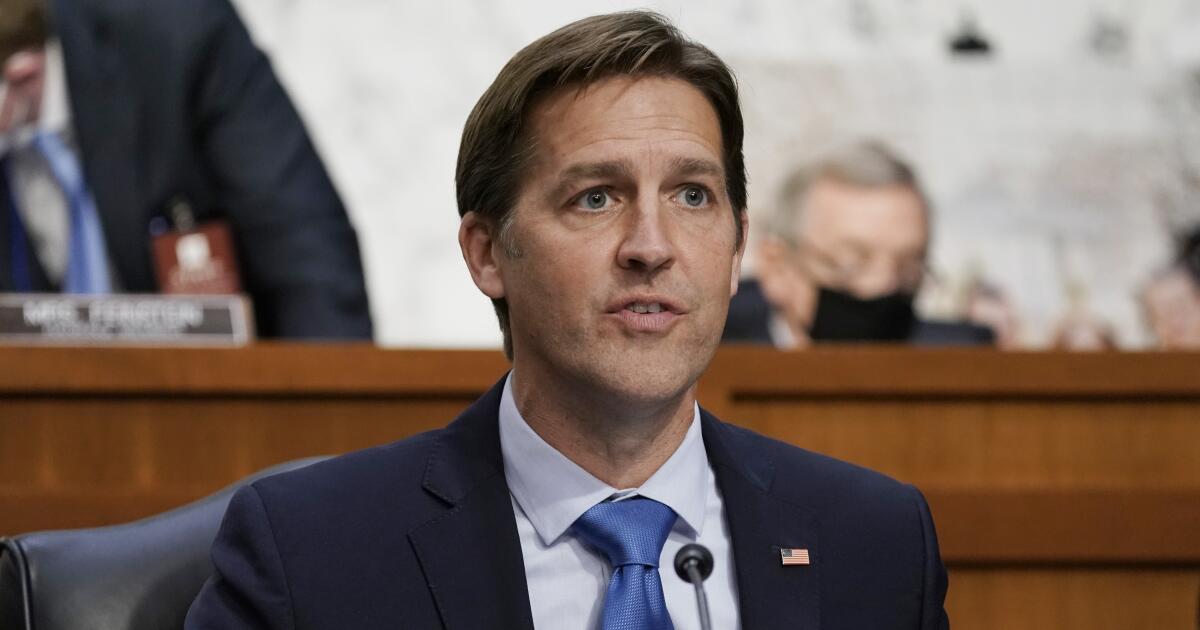
WASHINGTON — Republican Sen. Ben Sasse told Nebraska constituents in a telephone town hall meeting that President Trump has “flirted with white supremacists,” mocks Christian evangelicals in private and “kisses dictators’ butts.”
Sasse, who is running for a second term representing the reliably red state, made the comments in response to a question about why he has been willing to publicly criticize a president of his own party. He also criticized Trump’s handling of the coronavirus crisis and said Trump’s family has treated the presidency “like a business opportunity.”
The comments were first reported by the Washington Examiner after it obtained an audio recording of the senator’s comments, which has been posted on YouTube. Sasse spokesman James Wegmann said the call occurred Wednesday.
Other Nebraska Republicans, including U.S. Rep. Dan Bacon and state GOP executive director Ryan Hamilton, told the Omaha World-Herald that they disagree with Sasse’s characterizations of the president.
“Sen. Sasse is entitled to his own opinion,” U.S. Rep. Adrian Smith, another Nebraska Republican, said in a statement. “I appreciate what President Trump has accomplished for our country and will continue to work with him on efforts which help Nebraska.”
Trump campaign spokesman Tim Murtaugh declined to comment on Sasse’s remarks, the World-Herald said.
Sasse has positioned himself as a conservative willing to criticize Trump at times, and he is seen as a potential presidential candidate for 2024. His comments Wednesday were in response to a caller who asked about his relationship with the president, adding, “Why do you have to criticize him so much?” Trump carried Nebraska by 25 percentage points in 2016.
The senator said he has worked hard to have a good relationship with Trump and prays for the president regularly “at the breakfast table in our house.” He praised Trump’s judicial appointments.
But he said he’s had disagreements with Trump that do not involve “mere policy issues,” adding, “I’m not at all apologetic for having fought for my values against his in places where I think his are deficient, not just for a Republican, but for an American.”
Sasse began his list with, “The way he kisses dictators’ butts,” and said Trump “hasn’t lifted a finger” on behalf of pro-democracy protesters in Hong Kong.
“I mean, he and I have a very different foreign policy,” Sasse said. “It isn’t just that he fails to lead our allies. It’s that we, the United States, regularly sells out our allies under his leadership.”
Sasse said he criticizes Trump for how he treats women and because Trump “spends like a drunken sailor,” saying he criticized Democratic President Obama over spending.
“He mocks evangelicals behind closed doors,” Sasse said. “At the beginning of the COVID crisis, he refused to treat it seriously. For months, he treated it like a news-cycle-by-news-cycle PR crisis rather than a multiyear public health challenge, which is what it is.”
James P. Pinkerton, former deputy assistant to President Bush,
is the senior fellow at the John Locke Foundation in Raleigh, N.C.
A year ago, Ross Perot began his campaign with his if-the-volunteers-want-me appearance on “Larry King Live.” This evening, he tops off a round of rallies and a medley of talk shows as Jay Leno’s guest on “The Tonight Show.” Beyond the obvious question–when will he do Letterman?–lies an even bigger one: What does Perot want?
He’s already fulfilled one wish, destroying George Bush. Candidate Clinton must have enjoyed watching Perot torpedo Bush last year. After all, the nonpartisan Perot was much more credible attacking Bush for the deficit or Iraq-gate than any Democrat could have been. Now, it’s President Clinton’s turn. Perot’s Will Rogers-style gibes at Clinton’s attorneys-general follies are drawing blood. More ominously, Perot’s support for a balanced-budget amendment threatens to undercut, if not actually nullify, Clinton’s “investment” agenda.
Specific issues aside, Perot has a broad and true message: Washington is out of sync with the country. Does anyone think that the middle class wanted their new President to fill up his Cabinet with yuppies who have more experience dealing with domestics and chauffeurs than they do with nurses and auto workers? Does anyone think that this Congress will pass meaningful ethics or campaign-finance-reform legislation?
Perot’s sweeping critique of Washington’s “arrogance” poses tough questions to the Beltway culture. One such question comes from business guru Peter Drucker: “If we weren’t doing it now, would we start?” In other words, are the structures of the government, from the schools to welfare to the military, the best we can possibly do? If we can do better, what are the obstacles to real reform? Official Washington could find the answer in a mirror, which is exactly Perot’s point. Perot may seem simplistic, but he plays well in Peoria; especially as Clinton seems to have lost his “reinventing government” zest about the time he went to Pamela Harriman’s Georgetown mansion for cocktails.
Sen. Bob Krueger (D-Tex.) expressed the fundamental problem–that government is incompetent–in crisp Perotian terms: “If the government were a store, nobody would buy here. If it were an airline, nobody would fly it.”
A recent Business Week article described “The Virtual Corporation,” the new phenomenon of “temporary networks of companies that come together quickly to exploit fast-changing opportunities.” Global competition forces change. Virtual corporations “could well be the model for the American business organization in the years ahead.” What about government organization? With the current crew, the prospects of applying these profound lessons to Washington are nil. Perot, with his business background and his blunt desire to “get under the hood” and fix things, has reformist credibility no politician can dream of.
So what does Perot want? The average billionaire lives a life of quiet desperation. With every material need satisfied, he has to find something to do. Some buy tabloid newspapers; others, baseball teams. Perot clearly relishes his “Mr. Smith goes to Washington” role. And what if lightning were to strike? Perot must be haunted by an exit poll from last November which showed that a stunning 36% of the voters would have voted for him if they had thought he could have won. With that share of the vote in a three-way race in 1996, Perot could indeed win.
But Doug Bailey, a veteran Republican who foresaw Perot’s rise last year, isn’t sure that Perot actually wants to be President. “I think he really wants to be the First Kibitzer,” Bailey said in an interview. Perot is likely to keep his presidential options open till the last minute. That means 3 1/2 years of “will he or won’t he?” stories, with accompanying heartburn for both parties. The Republicans would love to march in Perot’s populist parade, but Perot understands that his aura would be smudged if he consorted with either party. Clinton can try to co-opt some of Perot’s juice with White House perk purges and call-in shows, but he lacks Perot’s earthy urgency.
Clinton used the wrong system of quotas when he staffed his Administration without a single one of the 19 million Perot voters. Now, he would be wise to call Perot in to the Oval Office for a humble-pie session. And if Clinton’s troubles continue, don’t be surprised if he reaches under the hood of his own Administration and offers Perot a “policy czar” appointment well before the next election.
U.S. Immigration and Customs Enforcement summoned Afghans residing in the U.S. to present their documents during the holiday season, marking the latest effort by the Trump administration to crack down on migrants from the Asian nation.
ICE is seeking appointments for a “scheduled report check-in,” with one requesting such a meeting on Christmas Day and another asking for one on New Year’s Day, according to copies of letters sent to different people seen by Bloomberg News. Other notices were for check-ins around the holidays on Dec. 27 and Dec. 30.
The immigration agency has arrested migrants who appear at its offices in response to such formal requests, including those attending interviews for their green cards. Recipients of the letters had previously gained legal protection and were deemed “Afghan allies” as part of a program started by former President Joe Biden in August 2021 to protect those who fled to the U.S. after the American military’s withdrawal from Afghanistan and the Taliban’s subsequent takeover of the war-torn country.
“ICE is using federal and religious holidays to detain Afghans when access to legal counsel, courts, and advocates is at its lowest,” Shawn VanDiver, founder of the nonprofit group AfghanEvac that supports Afghans who assisted the U.S. war effort, said in a statement criticizing the call-ins and their timing. “This is not routine administrative scheduling.”
A Department of Homeland Security spokesperson, however, called the check-ins “routine” and “long-standing” without elaborating on how many letters were sent out. The spokesperson added that ICE continues its standard operations during the holidays.
Christmas and New Year’s Day are federal holidays when most government offices are closed.
The call-ins follow substantial changes to the U.S. immigration policy under President Donald Trump targeting Afghans in the wake of the November shooting of two National Guard troops by Rahmanullah Lakanwal, an Afghan national who worked with U.S. forces and the CIA in Afghanistan before arriving in the US in 2021. Homeland Security Secretary Kristi Noem said that Lakanwal, who has been charged with murder, came to the U.S. through the Biden program known as Operation Allies Welcome.
Since the November shooting, the Trump administration has announced it will re-review the cases of all refugees resettled under the Biden administration and freeze their green card applications, and will consider among “significant negative factors” a country’s inclusion on the president’s vast travel ban.
In another blow to Afghans, the administration’s refugee cap for fiscal year 2026 was vastly lowered to 7,500 from 125,000. The presidential determination indicated it will favor White South Afrikaners and did not mention Afghans.
The administration also removed an exemption for Afghan nationals with Special Immigration Visas — which offers those who provided services to the US government or military in Afghanistan — when it expanded its entry ban list to nationals of more than 30 countries from 19 previously. Afghan nationals were already on the entry ban list prior to the expansion.
The State Department earlier this year shuttered the office that helped resettle Afghan refugees who assisted the American war effort. An effort on Capitol Hill to compel the administration to restart the operations failed to make it into the defense policy bill that Trump signed this month.
With assistance from Alicia A. Caldwell. Lowenkron writes for Bloomberg.
The Bush Administration’s long-heralded gag order–a regulation that prevents federally funded family planning centers from providing abortion counseling–went into effect Thursday, leaving a bureaucratic ball of confusion for California clinics leading a nationwide fight to thwart the rule.
The state’s 220 clinics, which receive $12 million a year in federal family planning funds, have implemented an elaborate bookkeeping plan that takes advantage of state law, which contradicts the federal regulation by mandating that clinics suggest abortion as an option for pregnant women.
Under the plan, staff members whose salaries are paid with state or private money will continue to offer the counseling while those who are paid by the federal government will not.
Barbara Jackson, director of public affairs for Planned Parenthood of Orange and San Bernardino counties, said her organization simply made adjustments to use state money for pregnancy testing and options counseling and to redirect federal money for approved services. “We’re not changing our service one iota,” Jackson said Thursday. “We’re providing the same level of care for our patients that we always have and always will.
“We had made the decision that we could not deny our patients information, and we’ve not renegged on that commitment to our patients. We’ve simply been practical and decided that if we can’t use federal money for that service, we’ll use other money for that service.”
At Planned Parenthood’s five Orange County clinics Thursday, patients found signs explaining that federal money was not sudisidizing pregnancy counseling or testing. Those patients who received those services signed release forms stating that they understood that their care was funded by the state, not the federal government.
“The only thing different is simply making it clear to our patients, to anyone that is concerned about this issue, that these particular services are not funded by federal dollars,” Jackson said.
Last year, Planned Parenthood of Orange and San Bernardino counties received $122,000 in Title 10 federal funds–those that cannot now be used for pregnancy testing and counseling. That is only about 3.7% of the program’s $3.3-million budget, which made it somewhat simple to divert the funds from the prohibited activities, Jackson said. Because California has a state family planning office that funds clinics, the ruling “has a much greater impact in other parts of the country.”
But even in Southern California, some clinic’s found Thursday that while the fund-diversion plan sounded good in theory, it was not easy in practice–and could put the clinics on shaky legal ground.
At the T.H.E. Clinic for Women in Los Angeles’ Crenshaw district–where 2,500 largely poor, mostly minority women come each year for family planning services–nurse practitioners must account for every hour of their time and who is paying for it.
If a woman tests positive for pregnancy in the morning, when the nurses are being paid with state funds, she will receive counseling and pamphlets outlining her options–carrying the baby to term and raising it, placing the child up for adoption or in a foster home, or terminating the pregnancy.
But if a patient visits in the afternoon, when the nurses’ salaries are drawn from federal money, any discussion of abortion will be taboo and the woman will be told euphemistically to come back another time if she wants to talk about further options.
Across the nation, many family planning centers are following California’s lead, said Judith DeSarno, executive director of the National Family Planning and Reproductive Health Assn., which represents 90% of the nation’s 4,000 federally funded family planning clinics. “Everyone is trying a variation of the California theme,” she said.
The new system was put to the test Thursday morning at T.H.E. Clinic for Women, when nursing director Marilyn Norwood received a visit from a 21-year-old college student who is 10 weeks pregnant and wanted information about abortion. During the session, Norwood told the young woman–who had not heard of the gag order–that she would have been out of luck if she had arrived an hour later. Norwood found the encounter frustrating–and infuriating.
“I am angry,” said the bespectacled, 61-year-old nurse practitioner who has worked at the clinic for 18 years. “Now, (in the afternoons) all of a sudden I have to sit there like I have tape across my mouth?”
To Sylvia Drew Ivie, the clinic’s executive director, the plan is “a real bureaucratic nightmare. . . . We have never before had to account for time spent on what you are permitted to say and what you are not permitted to say.”
But the real hardship, Ivie said, will be on patients, many of whom have to take public transportation to the clinic and have difficulty coming for visits–let alone coming back a second time at a precise hour for counseling that was once available any time.
In rural Tulare County, Family Planning Program Inc. serves 7,000 patients each year in its three clinics. Executive Director Kay Truesdale said the program’s one full-time bookkeeper must design a system for keeping track of which money is spent on what. Truesdale is worried that the clinics will be forced to spend more on administration, which could mean a cutback in other services.
“It’s going to be difficult. We are a very small agency and it’s going to add a burden to our clinic. . . . Each layer of (bureaucracy) adds to the cost of doing business and that takes away from the money that we can use to see patients, no matter how you slice it.”
The gag order, initiated by President Ronald Reagan in 1988, goes into effect amid a flurry of activity in Washington that has opponents hoping the regulation will not remain in effect for long. The Senate on Thursday overrode President Bush’s veto of a bill that would have nullified the regulation, although the House is expected to sustain the veto.
Meanwhile, two legal challenges are pending. A federal judge in Washington may rule today on a request brought by the National Family Planning and Reproductive Health Assn. for an injunction to delay implementation of the rule. And an appeals court hearing is scheduled Oct. 14 in another lawsuit, also brought by that group.
In the interim, DeSarno said, her organization is concerned that the government could crack down on California and other states that are using creative maneuvers to get around the rule, particularly because the U.S. Department of Health and Human Services has not given explicit approval to their methods. Health and Human Services officials have only said that the California plan is under review.
“There are severe federal penalties if you say you are going to comply with regulations and then you don’t,” DeSarno said. “It’s considered fraud. We now don’t know–are we complying or are we not complying? People are being put at great risk. The California clinics may be put at great risk.”
California clinic administrators have been outspoken opponents of the abortion gag rules. Officials of the California Family Planning Council said more than a year ago that the clinics would forfeit federal assistance rather than deny women full discussion of their options. Instead, the clinics decided to try the new plan–a decision that was encouraged by a favorable court ruling in one of the lawsuits and wavering by the federal government on the precise scope of the regulations.
Sima Michaels, associate director of the council, said the organization has instructed its member clinics to post signs informing clients that federal funds are not being used for pregnancy counseling. In addition, she said, patients are being asked to sign consent forms stating that they understand that federal money is not being used for the services.
“So far,” she said, “we have not heard that our plan is not acceptable. We are complying with the gag rule. We’re just being creative about it.”
Times staff writer Jodi Wilgoren contributed to this story.
DIVISIVE ISSUE: Senate votes to override Bush abortion counseling veto. A27
SACRAMENTO — Assembly Speaker Karen Bass, widely known as a nice person, flexed some muscle Monday: She punished the sole Assembly Democrat who refused to vote Sunday evening for a state spending plan drafted by fellow Democrats.
Bass (D-Los Angeles) ordered Assemblywoman Nicole Parra of Hanford out of her fifth-floor Capitol office and into an office building across the street where legislative staffers work.
“They wanted us to have everything packed up by 4 p.m.,” said Parra’s chief of staff, Derek Chernow, as he ripped packing tape to seal a box of office supplies.
Parra, who is in her last few months in the Assembly, said she didn’t vote for the budget because it was not paired with a water bond to pay for dams to ease water supply troubles in her agricultural district. She said she warned Assembly leaders weeks ago that she wouldn’t vote for a budget unless it also improved water delivery.
“I knew I would be punished,” she said in the hallway outside the Assembly chamber. “I don’t regret it. I would do it again. I’m still hopeful that we can get a vote on a water bond and therefore we can get a budget resolved. But it was a drill yesterday. We didn’t even have the votes.”
The vote on the Democratic spending plan was 45 to 30, but 54 votes — a two-thirds majority — were needed to advance it to the Senate. Budget talks continue today among legislative leaders and Gov. Arnold Schwarzenegger.
Bass referred reporters to a couple of Parra’s colleagues, who expressed outrage at her refusal to vote.
“Every Democrat in our caucus is expected to put a vote up on the budget, and to hold the budget hostage . . . to me is intolerable,” said Assemblywoman Patty Berg (D-Eureka). She added that fellow Democrats have spent millions of dollars helping Parra win election in her conservative district.
It probably didn’t help that Parra has offered more enthusiastic support of the Republican running to replace her now that she’s termed out — Danny Gilmore — than the Democrat, Fran Florez, the mother of state Sen. Dean Florez (D-Shafter), with whom Parra has openly feuded for years.
“I’m probably not a favorite of the speaker,” Parra said.
In other Assembly business Monday, two measures to restrict the use of chemicals in food containers and wrapping, among the most heavily lobbied of the year and previously passed by the Senate, were defeated.
The first, SB 1713 by Sen. Carole Migden (D-San Francisco), would ban a chemical called bisphenol A from use in bottles or cups designed for children 3 and younger. Starting in 2012, the measure would also ban bisphenol A from use in cans or jars that hold food for babies and toddlers.
The chemical is used mostly in the production of hard plastics and the epoxy resins that coat metal cans and bottle tops, and it can migrate into food, scientists have found.
Several Democratic legislators criticized as disingenuous the chemical-industry campaign against the bill, which included full-page newspaper ads showing an empty shopping cart on a parched lake bed.
“They don’t have empty grocery carts in Japan, where they have banned bisphenol A in a manner even more broad than what this bill proposes,” said Assemblyman Jared Huffman (D-San Rafael).
Republicans opposed the bill and many Democrats abstained. It was defeated 27 to 31. Migden could bring it up for another vote before the Legislature adjourns later this month.
Tim Shestek, director of state affairs for the American Chemistry Council, a trade group for chemical manufacturers, said the federal Food and Drug Administration recently concluded that the public’s current contact with bisphenol A is safe.
“When the Legislature finally took a look at it,” Shestek said, “they came down in agreement.”
The second chemical measure, SB 1313 by Sen. Ellen Corbett (D-San Leandro), would restrict perfluorinated compounds from use in food packaging starting in 2010. The chemicals help keep water, oil and grease from leaking.
Perfluorinated compounds have been linked to a wide range of maladies including prostate cancer. The chemical industry argues that the science is not conclusive.
Corbett’s bill was defeated 36 to 33 but may also be subject to another vote.
Also on Monday, the Senate passed measures that would:
* Allow Riverside County to build and operate four carpool lanes as toll lanes on Interstate 15. The measure, AB 1954 by Assemblyman Kevin Jeffries (R-Lake Elsinore), goes back to the Assembly for final approval.
* Make it easier for farm workers to unionize with a two-part ballot they can fill out privately. AB 2386 by Assembly Speaker Emeritus Fabian Nunez (D-Los Angeles) passed on a 23-15 vote and goes back to the Assembly for final action.
Karl Rove, the canny and controversial presidential advisor who will be leaving the White House at the end of the week, may have more enemies than anybody in Washington. He also may have more nicknames. George Bush calls him “boy genius.” Critics of the administration have often described him as “Bush’s brain.”
But the name that has really stuck with Rove over the years is “the architect.” In January 2000, before Bush had competed in a presidential primary, he was asked about Rove’s role in shaping his campaign strategy.
“Karl gets credit for being the architect of it,” he said, “and he should.” He famously repeated the term at a news conference after his 2004 victory over John Kerry. Wayne Slater and James Moore titled their second book on Rove, published last year, “The Architect: Karl Rove and the Master Plan for Absolute Power.”
What is it about architecture that makes it so attractive as a metaphorical job description? There’s Bill Walsh, the NFL coach who after he died last month was widely remembered as “the architect of the West Coast offense.” And Khalid Shaikh Mohammed, Osama bin Laden’s Rove, often is called the architect of 9/11. Don’t forget James Madison, architect of the Constitution, or Alfred Hitchcock, labeled by one of his biographers “the architect of anxiety.” The computer industry is full of information and software “architects” who do their building with zeros and ones.
And, of course, there’s God: architect of the universe.
The architect label suggests precision, strategic savvy and the ability to consider a project from a certain analytical remove — to see the whole chessboard at a glance. It describes the person who sketches out a complex plan but never the one who executes it.
As a metaphor, it’s a step up from “engineer,” which used to be as common a rhetorical title as architect is now. Somebody in Rove’s position a few decades ago would have been said to have “engineered” an electoral victory; those architects at Intel and Microsoft were once called software engineers.
But engineering, a profession that tends to be more esteemed in quickly growing industrial societies than in postindustrial ones like ours, has none of the Machiavellian undertones required to capture the scope of Rove’s role. It implies pure expertise — all science and no art.
In his canonical “Ten Books on Architecture,” written in the 1st century BC, Roman architect Vitruvius argued that successful buildings had three qualities in common: firmness, commodity and delight. In other words, to qualify as a piece of architecture, a structure had to be not only stable and useful but beautiful.
That distinction helps explain why certain public figures become candidates for architect status. There usually has to be a sense, even among rivals, that what you are producing is the result of creativity along with hard work or brute force. It has to be impressive in form as well as function, in operation as well as plan. Like architecture, it has to have one foot in the practical world and one foot in the aesthetic.
And it helps if there is a noticeable gap between a typical approach to your job and the way you perform it. Walsh’s reserved, professorial style on the sidelines and the quick grace of his best San Francisco 49ers offered a sharp contrast to football’s inherent violence and plodding, three-yards-and-a-cloud-of-dust conservatism. Hitchcock too seemed all the more urbane because he was creating artworks for a mass audience, cinematic choreography to be enjoyed with popcorn.
A similar dynamic was at work from the start between Bush and Rove. As a presidential candidate, Bush had the popcorn part down from the beginning: Despite his gilded political pedigree as the son of a president and the grandson of a senator, and his years at Andover, Yale and Harvard, he has always been comfortable cloaking himself in down-home rhetoric. He needed a way to turn that raw material — of connections and a certain kind of charm — into votes on a national level.
And we, the public, needed a way to reconcile the seeming contradiction between the aw-shucks, tongue-tied Bush persona and the nimble strategic thinking that got him elected president — twice — by outfoxing the Democrats in nearly every battleground state. (Bush might have won Georgia or Texas by himself, but it took an architect to win Ohio.) Self-taught and widely curious, Rove is a true mirror image of Bush — and the perfect vehicle for that reconciliation. If he hadn’t existed, the pundits would have had to invent him.
The odd twist to this story is that architects are increasingly chafing at what they see as the political limitations of their profession. At ground zero in New York, in post-Katrina New Orleans and in traffic-choked Los Angeles, they are realizing that however much celebrity they may enjoy, it hasn’t helped them become real players in shaping the future of cities.
Leading architects, including Thom Mayne and Rem Koolhaas, have been outspoken in recent months about trying to change that. They want to leverage their fame into clout and, by operating more strategically, move closer to the centers of power. They want to be metaphorical architects — of disaster recovery, of urban rebirth — and not just the real thing.
Reporting from Cleveland — A top police union official asked Ohio’s governor to temporarily ban guns outside the Republican National Convention in downtown Cleveland after the shooting of several police officers in Louisiana renewed fears about the safety of this week’s political gathering.
But a spokeswoman for Gov. John Kasich, a Republican, said Sunday that he did not have the power to suspend the state’s open-carry laws.
The city has banned a wide variety of potential weapons from the protest zone near the convention — including tennis balls, water pistols and bicycle locks — but cannot limit firearms.
The dispute over the open-carry law, which is similar to statutes in most other states, came as protesters from a long list of organizations began to gather here for demonstrations that are expected to last at least until Donald Trump accepts the Republican presidential nomination on Thursday.
Sunday afternoon, a man with an AR-15 semiautomatic rifle, a handgun and ammunition stood in downtown’s Public Square saying he was there to exercise his rights and make a point.
“What are you going to do, ban everything that kills people?” Steve Thacker, a 57-year-old information technology engineer from Westlake, Ohio, asked when someone criticized his decision to walk through Cleveland with the rifle. “The point is to protect yourself. This world is not the world I grew up in.”
A local resident, Steve Roberts, 61, who was riding his bike through the square, stopped to acknowledge that Thacker was within his rights, but asked him to leave.
“You’ve shown it. Why don’t you take it back?” Roberts, who was wearing a “Stand for Love” T-shirt, told Thacker. “I find it offensive.”
The miniature drama between the men could be one of many that will play out as viewpoints collide in Cleveland this week — not just left versus right, but sometimes far left versus far right.
In preparation, metal security fencing stands around the convention site, which is protected by the U.S. Secret Service. The rest is the responsibility of a police force including thousands of officers from agencies from California to Florida who have been sworn in with arrest powers in the city. Police officers with dogs have begun patrolling the streets.
“It’s game time,” Cleveland Police Chief Calvin Williams said Sunday morning, “and we’re ready for it.”
Black nationalists drew an escort of bicycle officers in helmets and shorts as they marched through the city Saturday. Planes towing banners opposing abortion and supporting the imprisonment of Hillary Clinton circled the city Sunday while hundreds of activists marched through the streets to protest Trump and killings by police.
The names of Tamir Rice and Eric Garner, who were killed by police, were invoked as a small but raucous crowd began to chant outside the Cleveland Masonic and Performance Arts Center.
“No Trump. No KKK. No fascist USA,” the crowd chanted, with many holding signs that read “Stop Trump” or “Black Lives Matter.”
On Monday, one group of anti-Trump activists plan to hold an illegal march to the Quicken Loans Arena, the site of the convention, to have a “clash of ideas” with Trump supporters.
The city granted the activists use of a public park but denied them a permit for the route they desired, said organizer Tom Burke, who said they wanted to get “as close as they possibly can” to the Republican delegates shielded behind the metal fencing.
“We hope that they’ll hear us inside the convention,” Burke said. “We don’t expect any trouble.”
Chelsea Byers, 26, of Los Angeles was dressed in a pink Statue of Liberty costume and said she traveled to Cleveland to protest the Trump and Clinton candidacies. A member of the antiwar group Code Pink, she thought it was important to rail against “war hawks.”
“We felt like it was important to stand in solidarity to stop the hate,” she said.
Cleveland natives said they were more worried about how out-of-town demonstrators might act as the week goes on.
“It’s always a concern because it’s not their city. Whatever they do, they don’t care,” said David Allen, a biker and longtime city resident. “I’m just gonna try and stay away from downtown.”
Mike Deighan, a 28-year-old restaurant employee in the downtown area, seemed to be enjoying the fanfare near the Quicken Loans Arena as he purchased a hat from one of several pop-up stands that were selling shirts disparaging Trump and Clinton.
But his mood soured when the topic turned to the likely demonstrations later in the week.
“I’m not really excited about it at all,” he said. The only people who are going to destroy this city are the people who aren’t from here.”
Along East 55th Street, Brian Lange waved a 2nd Amendment flag proudly as he stood near a vendor hawking pro-Trump paraphernalia. Lange, who is affiliated with the right-wing Oath Keepers group, said he had traveled from Lima, Ohio, to report for his radio show.
Although he’d been in Cleveland for less than an hour, he said, someone had already driven by and hurled profanities at him for supporting Trump. Lange, an Air Force veteran, said he just smiled back.
“They got the freedom to say whatever they want, as long as they don’t trample on my rights,” Lange said. “I just consider them ill-informed.”
Steve Loomis, president of the Cleveland Police Patrolmen’s Assn., who called for the ban on guns outside the convention, said he was not “against the 2nd Amendment.”
But recent killings of police in Texas and Louisiana, combined with volatile confrontations that could occur outside the convention, will create situations that are too risky for city police, he said.
City officials canceled a security briefing for reporters Sunday night and issued a statement that extended condolences for the deaths of the three officers killed in Baton Rouge, La., but said nothing about whether the shooting would change the security plan.
Jeff Larson, chief executive of the Republican National Convention, told reporters in a briefing that “I feel good about the security plan.”
Cleveland police have had “a number of big events that have taken place with open carry without any issues,” Larson said.
He added: “It is the constitution in Ohio. The governor can’t simply say, I’m going to relax it for a day or tighten it up for a five-day period of time.”
Times staff writer Michael Finnegan contributed to this report.
Last February, I climbed into a Jeep and rumbled up a rocky shelf road that took me high above a breathtaking corner of the Mojave National Preserve. At the top was an old gold mine where an Australian company had recently restarted activities, looking for rare earth minerals.
The National Park Service had been embroiled in a years-long dispute with the company, Dateline Resources Ltd., alleging that it was operating the Colosseum Mine without authorization and had damaged the surrounding landscape with heavy equipment. Dateline said it had the right to work the mine under a plan its prior operators had submitted to the Bureau of Land Management decades before.
President Trump had taken office just weeks before my visit. Environmentalists told me the conflict posed an early test of how his administration would handle the corporate exploitation of public lands.
You’re reading Boiling Point
The L.A. Times climate team gets you up to speed on climate change, energy and the environment. Sign up to get it in your inbox every week.
At the time, observers weren’t sure how things would shake out. Conserving public lands is one of the rare issues that’s popular on both sides of the political aisle, they pointed out.
Almost a year later, it’s clear that the Trump administration has sided with the corporations.
Trump directed the Department of Interior to inventory mineral deposits on federal lands and prioritize mining as the primary use of those lands. He instructed officials to dramatically fast-track permitting and environmental reviews for certain types of energy and critical minerals projects — and designated metallurgical coal a critical mineral, enabling companies that mine it to qualify for a lucrative tax credit.
His budget bill lowered the royalty rates companies must pay the government to extract coal, oil or gas from public lands and provided other financial incentives for such projects while reducing the authority of federal land managers to deny them.
Under the president’s direction, the DOI has opened up millions of acres of federal land to new coal leasing and moved to rescind both the 2021 Roadless Rule, which protects swaths of national forest lands from extractive activities by barring most new road construction, and the 2024 Public Lands Rule, which puts conservation and restoration on par with other uses of BLM land like mining, drilling and grazing.
Altogether, the Trump administration and its legislative allies have taken steps to reduce or eliminate protections for nearly 90 million acres of public land, according to the Center for American Progress, a progressive think tank. That figure rises to more than 175 million acres if you include the habitat protections diminished by the administration’s moves to weaken the Endangered Species Act, the organization notes.
“All of these things represent in some ways the largest attack on our public lands and giveaway to large multinational mining corporations that we’ve seen probably since the 19th century,” said U.S. Rep. Melanie Stansbury of New Mexico, who likened the level of resource exploitation to “something like what happened during the robber baron era when there was no regulation or protection for our communities or the environment.”
Stansbury has introduced legislation that would increase the fees mining companies must pay to sit on speculative claims on federal lands and require those funds be used for conservation. She told me it’s just a tiny contribution to a larger effort to push back against the administration’s approach to initiate extraction on public lands, which she described as so frequent and pervasive that “it’s a bit like whack-a-mole.”
“So much damage has been done, both administratively and legislatively, over the last 11 months since Trump took office,” she said.
As for the Colosseum Mine, the DOI sided with its operators back in the spring, saying Dateline Resources did not have to seek authorization from the Park Service to keep mining. The announcement was followed by public endorsements from Trump and Interior Secretary Doug Burgum. The company’s stock value soared, and by September, it had kicked off a major drilling blitz.
The company has already uncovered high-grade gold deposits. It’s taking a break for Christmas, but is expected to resume drilling in the new year.
More recent land news
The Pacific Forest Trust returned nearly 900 acres of land near Yosemite National Park to the Southern Sierra Miwuk Nation in a transfer partially financed by the state,reports Kurtis Alexander of the San Francisco Chronicle. Members of the Indigenous group were forced off their ancestral lands during the California Gold Rush, when state-sponsored militias undertook efforts to exterminate them. Some now hope the new property will bolster their decades-long push for federal recognition.
California State Parks is violating the Endangered Species Act by allowing offroaders to drive over dunes that are home to western snowy plovers, a judge recently ruled in a long-running legal case over the use of Oceano Dunes State Recreation Area along the Central Coast. Edvard Pettersson of the Courthouse News Service reports that State Parks will need a federal “take” permit to continue to allow offroading at the popular beachside spot.
California lawmakers introduced legislation to conserve more than 1.7 million acres of public lands across the state, in part by expanding the Los Padres National Forest and the Carrizo Plain National Monument, according to Stephanie Zappelli of the San Luis Obispo Tribune.
President Trump’s media company is merging with a nuclear fusion energy firm in a $6-billion deal that some analysts have described as a major conflict of interest, my colleague Caroline Petrow-Cohen reports.
House Republicans pushed through a bill that would overhaul the federal environmental review process in a way that critics say could speed up the approval process for oil and gas projects while stymieing clean energy, report Aidan Hughes and Carl David Goette-Luciak of Inside Climate News.
The iconic chasing-arrows recycling symbol is likely to be removed from California milk cartons, my colleague Susanne Rust reports. The decision exposes how used beverage packaging has been illegally exported to East Asia as “recycled” mixed paper, violating international environmental law.
Wind energy is again under attack from the Trump administration, which this week ordered all major wind construction projects to halt. As The Times’ Hayley Smith notes, the White House has been consistent in slowing down clean energy development in 2025, but offshore wind has been a particular bête noire for the President.
We’ve published a comprehensive collection of stories looking back on thewildfires that burned though Altadena and Pacific Palisades last January and all that’s happened since, which columnist Steve Lopez calls “one of the most apocalyptic years in Southern California history.” Check out After the Fires here.
This is the latest edition of Boiling Point, a newsletter about climate change and the environment in the American West. Sign up here to get it in your inbox. And listen to our Boiling Point podcast here.
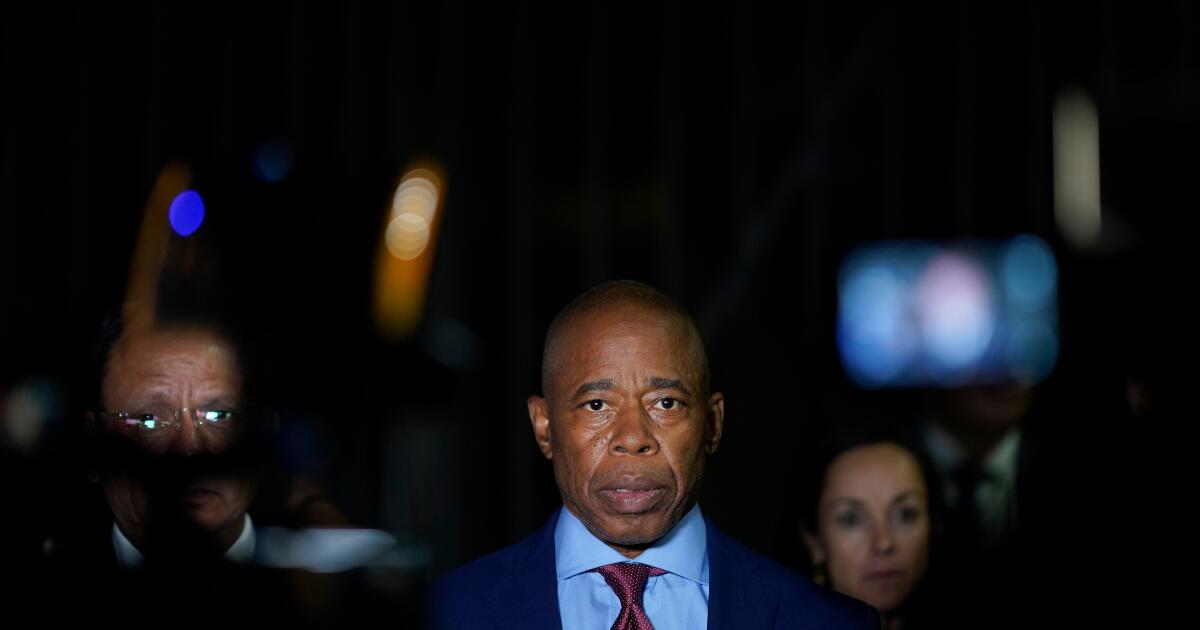
NEW YORK — Four years ago, New York City Mayor Eric Adams swept into office with swaggering confidence, pledging to lead a government unlike any other in history and declaring himself the “future of the Democratic Party.”
On the first promise, the mayor more than delivered. But as his tumultuous term comes to an end, Adams, 65, finds himself in the political wilderness, his onetime aspirations as a party leader now a distant memory.
Instead, he has spent his final weeks in power wandering the globe, publicly mulling his next private sector job and lashing out at the “haters” and “naysayers” whom he accuses of overlooking his accomplishments.
For many of his supporters, the Adams era will be looked back on as a missed opportunity. Only the second Black mayor in city history, he helped steer New York out of the throes of the COVID-19 pandemic, often linking the city’s comeback to his own rise from humble roots in working-class Queens.
At a moment when many Democrats were struggling to address voter concerns about public safety, he drew national attention for a “radically practical” agenda focused on slashing crime and reactivating the economy.
But while most categories of crime returned to pre-pandemic levels, Adams will probably be remembered for another superlative: He is the only New York City mayor of the modern era to be indicted while in office.
“That’s a disappointment for voters, especially for Black voters, who had high expectations and aspirations,” said Basil Smikle, a political strategist who served as executive director of the state’s Democratic Party. “He entered with a lot of political capital, and that was squandered, in part because of his own hubris.”
Equally memorable, perhaps, were the strange subplots along the way: his hatred of rats and fear of ghosts; the mysteries about his home, his diet, his childhood; and his endless supply of catchphrases, gestures and head-scratching stories that could instantly transform a mundane bureaucratic event into a widely shared meme.
“So many mayors want to be filtered, they want to pretend who they are and act like they are perfect,” Adams said during a recent speech at City Hall, a freewheeling affair that ended with the mayor burying a time capsule of his achievements beneath a Manhattan sidewalk. “I am not.”
Swagger versus seriousness
Adams took over from Mayor Bill de Blasio in January 2022, amid a COVID-19 spike that was killing hundreds of New Yorkers every day, along with a worrisome uptick in both violent crime and unemployment.
Adams, a former police captain, Brooklyn borough president and state senator, increased patrols on streets and subways, brought back a controversial anti-crime unit and appointed the department’s first female police commissioner. He also raised eyebrows for installing many of his former Police Department allies, including some ex-officials with histories of alleged misconduct.
As he encouraged New Yorkers to return to their pre-pandemic lives, Adams made an effort to lead by example, frequenting private clubs and upscale restaurants in order to “test the product” and “bring swagger back” to the city, he said.
But if New Yorkers initially tolerated Adams’ passion for late-night partying, there seemed to be a growing sense that the mayor was distracted, or even slacking off, according to Hank Sheinkopf, a longtime Democratic consultant and supporter of Adams.
“There was a tension between swagger and seriousness,” Sheinkopf said. “New Yorkers wanted to see more seriousness. They didn’t want to see him out partying at some club they couldn’t afford to go into.”
It didn’t help that Adams often declined to say who was footing the bills for his meals, his entry into private clubs or his flights out of the city. When reporters staked out his nighttime activities, they found that Adams, who long professed to be a vegan, regularly ordered the branzino.
Asked about his diet, the mayor acknowledged that he ate fish and occasionally “nibbled” on chicken, describing himself, as he often would in the coming years, as “perfectly imperfect.”
City Hall in crisis
The corruption investigation into Adams’ campaign, launched quietly in the early stages of his mayoralty, first spilled into public view in the fall of 2023, as federal agents seized the mayor’s phones as he was leaving an event. It loomed for nearly a year, as Adams faced new struggles, including a surge of migrants arriving in the city by bus.
Then, on Sept. 26, 2024, federal prosecutors brought fraud and bribery charges against Adams, accusing him of allowing Turkish officials and other businesspeople to buy his influence with illegal campaign contributions and steep discounts on overseas trips.
Investigators also seized phones from the mayor’s police commissioner, schools chancellor and multiple deputy mayors. Each denied wrongdoing, but a mass exodus of leadership followed, along with questions about the mayor’s ability to govern.
Adams insisted, without evidence, that he had been politically targeted by the Biden administration for his criticism of its immigration policy. But his frequently invoked mantra — “stay focused, no distractions, and grind” — seemed to lose potency with each new scandal.
Among them: a chief adviser indicted by state prosecutors in a separate alleged bribery scheme involving a bike lane and minor TV role; another longtime adviser forced to resign after handing a chip bag filled with cash to a reporter; and a string of abuse and corruption allegations within the Police Department, many of them linked to longtime friends Adams had installed in high-ranking positions.
Looking back at what went wrong, both supporters and critics of the mayor tend to agree on at least one point: Adams could be loyal to a fault, refusing to distance himself from long-serving allies even after they appeared to cross ethical lines.
“There was one City Hall made up of dedicated and competent leaders focused on executing his priorities,” said Sheena Wright, Adams’ former first deputy mayor. “There was another City Hall made up of people who knew the mayor for a long time, and who were allowed to operate outside the norms of government.”
‘A nuclear bomb’
Facing a plummeting approval rating and the prospect of years in prison, Adams began aligning himself with President Trump, going to great lengths to avoid criticizing the Republican and even leaving open the possibility of switching parties.
That seemed to work: Weeks after Trump took office, the Justice Department dismissed the corruption case, writing in a two-page memo that it had interfered with Adams’ ability to help with the president’s immigration agenda.
But in the view of Evan Thies, one of Adams’ closest advisers at the time, that was the moment that sealed Adams’ fate as a one-term mayor.
“The memo hit like a nuclear bomb,” Thies said.
The damage worsened a few days later, when Adams appeared on “Fox & Friends” alongside Trump’s border director Tom Homan, who threatened to “be up his butt” if the mayor didn’t comply with Trump’s agenda.
“It seemed to confirm the belief that he had traded his duty to New Yorkers for his personal freedom,” Thies recalled. “It wasn’t true, but that was perception.”
Adams adamantly denied striking a deal with the Trump administration. He has continued to suggest a broad conspiracy against him, at times blaming bureaucrats in the “deep state.”
Even with his case behind him, Adams struggled to build a reelection campaign. Earlier this year, his approval rating sank to a record low. In September, he abandoned his efforts, throwing his support behind former Gov. Andrew Cuomo, a onetime rival he’d recently referred to as a “snake and a liar.”
As of late December, Adams’ plans for life after he leaves office remain uncertain.
“I did what I had to do, I left everything I had on the ice, and I’m looking forward to the next step of my journey,” he said during a farewell speech at City Hall.
Then, for the third time in as many months, Adams took off on an international trip. This time, the destination was Mexico.
NEW YORK — A planned Christmas Eve jazz concert at the Kennedy Center, a holiday tradition dating back more than 20 years, has been canceled. The show’s host, musician Chuck Redd, says that he called off the performance in the wake of the White House announcing last week that President Trump’s name would be added to the facility.
As of Friday, the building’s facade reads The Donald J. Trump and The John F. Kennedy Memorial Center for the Performing Arts. According to the White House, the president’s handpicked board approved the decision, which scholars have said violates the law. Trump had been suggesting for months he was open to changing the center’s name.
“When I saw the name change on the Kennedy Center website and then hours later on the building, I chose to cancel our concert,” Redd told the Associated Press in an email Wednesday. Redd, a drummer and vibraphone player who has toured with everyone from Dizzy Gillespie to Ray Brown, has been presiding over holiday “Jazz Jams” at the Kennedy Center since 2006, succeeding bassist William “Keter” Betts.
The Kennedy Center did not immediately respond to email seeking comment. The center’s website lists the show as canceled.
President Kennedy was assassinated in 1963, and Congress passed a law the following year naming the center as a living memorial to him. Kennedy niece Kerry Kennedy has vowed to remove Trump’s name from the building once he leaves office and former House historian Ray Smock is among those who say any changes would have to be approved by Congress.
The law explicitly prohibits the board of trustees from making the center into a memorial to anyone else, and from putting another person’s name on the building’s exterior.
Trump, a Republican, has been deeply involved with the center named for an iconic Democrat after mostly ignoring it during his first term. He has forced out its leadership, overhauled the board while arranging for himself to head it and hosted this year’s Kennedy Center honors, breaking a long tradition of presidents mostly serving as spectators. The changes at the Kennedy Center are part of the president’s larger mission to fight “woke” culture at federal cultural institutions.
Numerous artists have called off Kennedy Center performances since Trump returned to office, including Issa Rae and Peter Wolf. Lin-Manuel Miranda canceled a planned production of “Hamilton.”
The American Academy of Pediatrics sued the U.S. Department of Health and Human Services on Wednesday, seeking to block nearly $12 million in cuts to the group.
Earlier this month, the federal government “abruptly terminated” grants to the group, the lawsuit says.
The funding supported numerous public health programs, including efforts to prevent sudden unexpected infant death, strengthen pediatric care in rural communities and support teens facing substance use and mental health challenges.
“AAP does not have other sources of grant funding to replace the federal awards, and without the necessary funds it must immediately terminate its work on its dozens of programs that save children’s lives every day,” says the lawsuit, filed in the U.S. District Court for the District of Columbia. “Within a few weeks, AAP will have to begin laying off employees dedicated to this critically important work.”
The suit alleges Health and Human Services made the cuts in retaliation for the doctors’ group speaking out against the Trump administration’s positions and actions.
The doctors’ group has been vocal about its support for pediatric vaccines and has publicly opposed the agency’s positions. Health Secretary Robert F. Kennedy Jr. — who helped lead the anti-vaccine movement for years — is seeking to broadly remake federal policies on vaccines. Earlier this year, the pediatrics group released its own recommendations on COVID-19 vaccines, which substantially diverged from the government’s recommendations.
The group also supports access to gender-affirming care and has publicly criticized Health and Human Services positions on the topic, saying it opposes what it calls the government’s infringements on the doctor-patient relationship.
“The Department of Health and Human Services is using federal funding as a political weapon to punish protected speech, trying to silence one of the nation’s most trusted voices for children’s well-being by cutting off critical public health funding in retaliation for speaking the truth,” Skye Perryman, president and chief executive officer of Democracy Forward, said in a statement. Perryman’s organization is representing the doctors’ group in the case.
A spokesman for Health and Human Services could not immediately be reached for comment.
Mark Del Monte, CEO and executive vice president of the 67,000-member doctors’ group, said the organization depends on its relationship with the federal government.
“We need this partnership to advance policies that prioritize children’s health. These vital child health programs fund services like hearing screenings for newborns and safe sleep campaigns to prevent sudden unexpected infant death,” he said in a statement. “We are forced to take legal action today so that these programs can continue to make communities safer and healthier.”
WASHINGTON — As the increasingly troubled economy emerges as the trump issue of the 2008 political season, senior congressional Republicans said Wednesday they would put aside demands to make President Bush’s tax cuts permanent if that was what it took to get quick action on a stimulus package.
Democrats, meantime, signaled they too would consider compromises in the interest of fast action, such as reining in some social spending they might otherwise push for and accepting inclusion of business tax incentives in the bill.
“I think there is a way to come to an agreement,” House Minority Leader John A. Boehner (R-Ohio) said in an interview. “Not having an agreement is a lose-lose.”
The White House has not addressed the issue in detail, but Bush, who has been traveling in the Middle East, is scheduled to hold a conference call today with congressional leaders. To avoid a veto, they hope to get his nod in advance on the outlines of a plan that would probably include a $500 rebate check for taxpayers, extended unemployment benefits for the jobless, and incentives for businesses to expand and create jobs.
The president also has invited congressional leaders to the White House for a meeting Tuesday. And Federal Reserve Chairman Ben S. Bernanke is expected to add his voice to the support for stimulus when he testifies on the Hill today.
The sudden unanimity on the need for action, standing in sharp contrast with the ideological deadlock and partisan jockeying that have characterized Washington for more than a year, reflects a confluence of developments that threaten trouble for both parties.
On the political front, exit polls in Michigan’s GOP presidential primary Tuesday showed that economic anxiety outstripped all other issues on voters’ minds. Former Massachusetts Gov. Mitt Romney won in Michigan after setting aside conservative orthodoxy and vowing to play a highly active role as president to set the nation on the road to prosperity.
With presidential tests looming in Nevada, South Carolina, Florida and other states where economic distress is evident, candidates in both parties have ratcheted up their expressions of concern and rushed out their own stimulus proposals.
A stream of unwelcome economic data has added to politicians’ sense of urgency. The Labor Department announced Wednesday that consumer prices rose 4.1% last year — the fastest in 17 years — led by soaring gasoline costs and higher prices at the supermarket. Average wages, meantime, recorded a slight drop when adjusted for inflation. Earlier this month, the department reported unemployment had hit 5%, the highest rate in two years.
Economists consider the dual ills of rising inflation and rising unemployment to be the worst situation policymakers can face, because the cure for one — increasing fiscal spending or the money supply to spur job growth — can stimulate further price increases.
A member of the GOP rank-and-file, Rep. Lee Terry of Nebraska, expressed the feelings of both parties when he said: “People expect us to act.” If Democrats and Republicans can get together, he said, it will “let people know we can do something here.”
Perhaps the most striking illustration of how much these developments were changing the atmosphere on Capitol Hill was the readiness of Republicans to step back from their long insistence that Congress make the Bush tax cuts permanent. Such tax cuts have been central to GOP economic policy for more than two decades.
Now Republican leaders say they are ready to put off action.
“It’s impossible for me to believe that [permanent tax cuts] would be part of the agreement, as much as I would like to see that happen,” Boehner said.
Republican leaders met privately with House Speaker Nancy Pelosi (D-San Francisco) on Wednesday to discuss stimulus ideas — a meeting Boehner described as his first policy get-together with her since Democrats won control of Congress in November 2006.
While yielding on the Bush cuts, Republicans said they would insist that Democrats not include new taxes as part of the package and that they try to hold the reins on some social welfare spending.
House Minority Whip Roy Blunt (R-Mo.), who attended the meeting with Pelosi, revealed no details of the talks but said he and Boehner had “made clear that Republicans are interested in working toward an agreement on a short-term stimulus package.”
“But we were equally clear that hard-working middle-class families must not be burdened with new taxes or wasteful spending if any such plan has a chance of becoming law,” he said.
Democrats say they are mindful that the president wields a veto pen and that their Senate majority is thin. If they want to avoid the kind of extended tug-of-war they had with Bush over Iraq war funding last year, Democrats will have to get him and his Republican allies on board in advance.
“This will need an unusual level of bipartisanism,” said Jim Manley, staff director for Senate Majority Leader Harry Reid (D-Nev.).
Some Republicans acknowledged that the emerging shape of the stimulus legislation made it more likely that the president — who mentions the issue at every opportunity — would not get his tax cuts extended before he left office.
“If they don’t get it in the stimulus package, they are not likely to get the Bush tax extension this year,” said Bill Frenzel, a former Republican congressman from Minnesota and longtime member of the House Budget Committee who is now a guest scholar at the centrist Brookings Institution.
For their part, Democrats indicated that they were likely to set aside “pay-go” standards under which they have pledged to offset any new spending with revenue increases or cuts elsewhere. Keeping the economy growing and stemming job losses are higher priorities in the short term than worsening the federal budget deficit, they indicated.
There is “a growing consensus that this is not the time for pay-go, because you want to inject money into the economy,” said Sen. Charles E. Schumer (D-N.Y.), chairman of Congress’ joint economic committee.
Despite the new urgency, both parties see opportunities to score partisan points on the economy.
Democrats, including Schumer, say that to stimulate the economy, it makes the most sense to give money to people who need it the most and will spend it right away. For example, they favor extending unemployment benefits in hard-hit areas.
But Republicans, wary of expanding government entitlements even temporarily, favor tax incentives to businesses to help them create more jobs.
Conservatives angered over Democrats’ opposition to previous tax-cut proposals noted that new spending enlarges the federal deficit just the same as new tax cuts, which Democrats long have opposed.
“The Democrats have been preaching, ‘We can’t do anything to increase the deficit.’ Now it appears they’ve kind of thrown that by the wayside,” said Rep. Jeb Hensarling (R-Texas), leader of a group of House conservatives.
To get the Republican support they need to pass a bill, Democrats may need to give greater weight to tax incentives and less weight to social welfare spending than they might otherwise want.
Schumer said such compromises would be better than delay, in large part because economists say a stimulus package has to be enacted fast or it will have little effect.
“If this isn’t done in the first quarter — finished, signed, sealed and delivered and already going into effect — it may be too late,” he said.
Neither party looks forward to running for election in the fall with the economy in the dumps, but the prospect may be especially unwelcome for congressional Republicans.
“Bad economic times almost certainly work against the party of the president,” said Thomas Mann of the Brookings Institution, who studies the relationship between Congress and the White House. “For Bush to block it would make a drubbing only more likely for the Republican candidate for president.”
Fed Chairman Bernanke visited Pelosi in her office Monday to discuss a need for economic stimulus; he signaled last week that the central bank was increasingly worried about an economic downturn. Some analysts said his remarks suggest the Fed is going to make a bold, three-quarters-of-a-point interest rate cut at its next meeting on Jan. 30.
WASHINGTON — In a dramatic development that threatens William Lucas’ nomination as the government’s chief civil rights enforcer, Rep. John Conyers Jr. (D-Mich.) Thursday withdrew his endorsement a day after introducing Lucas to the Senate Judiciary Committee with warm praise.
Conyers told a hushed session of the panel that he was taking the unusual action with “a slightly heavy heart” because of Lucas’ hands-off position on recent Supreme Court rulings that civil rights leaders regard as disastrous setbacks.
“I want someone who is deeply disturbed” by the decisions, Conyers said, contending that they had plunged the civil rights movement into a crisis.
Conyers’ reversal could provide Lucas’ foes with crucial momentum in their struggle against his nomination as assistant attorney general for civil rights. Conyers is an influential black leader in Congress and the Administration had turned to him to introduce Lucas, who also is black, after the nominee’s two home state Michigan senators broke with tradition and declined to do so.
In another blow to Lucas’ prospects, Senate Judiciary Committee Chairman Joseph R. Biden Jr.(D-Del.), who advised civil rights leaders last week that he was inclined to vote for Lucas, told the same officials Thursday at the panel hearing that he is now leaning against confirmation.
Biden cited Lucas’ lack of an opinion when he asked him about the Supreme Court rulings, whether the country was moving in the right direction on civil rights and whether the Ronald Reagan Administration had been for or against civil rights.
Despite the setbacks, David Runkel, spokesman for Atty. Gen. Dick Thornburgh, said: “I still expect Bill Lucas to be confirmed.”
Conyers’ withdrawal of support–he said he was not asking the committee to vote against recommending Lucas’ confirmation–came after he met Thursday morning with Lucas and John Mackey of the Justice Department’s office of congressional affairs.
Justice Department officials then discussed with Conyers’ staff issuing a joint statement that “they share a commitment to civil rights,” but Conyers, after reviewing Lucas’ testimony, decided that did not go far enough, sources familiar with the meeting said.
In introducing his longtime friend Wednesday to the Senate committee, Conyers had said he was “convinced Bill Lucas will go to greatness” in the high-level Justice Department post. “If he doesn’t, I will be the first one calling for his head on a pike.”
But after reviewing a transcript of Lucas’ testimony on “the most enormous question facing the civil rights community,” which he did not remain in Wednesday’s session to hear, Conyers said he “was frankly astounded.”
Lucas, echoing comments by Thornburgh, President Bush and Vice President Dan Quayle, said he did not view the high court rulings as having substantial impact on civil rights law and promised to monitor them aggressively instead of proposing legislation to counteract the rulings. The rulings narrowed the use of affirmative action and plaintiffs’ options in job discrimination complaints.
He contended that the Justice Department’s civil rights division believes that the rulings have “a sound basis in law” and that they have not undermined civil rights, an assessment that Sen. Paul Simon (D-Ill.) said he found hard to believe.
“He said he could live with these cases,” Conyers told the hearing. “I can’t live with these cases.”
In predicting that Lucas would win Senate confirmation, Runkel said: “This guy went up there and voiced the views of the Administration. It’s unrealistic to think that he would do other than that. If the expectation of some people is that a liberal Democrat is going to be nominated” to the civil rights post, “they’re wrong. It ain’t going to happen.”
Lucas, a former Wayne County, Mich., sheriff and county executive, has also drawn criticism from the NAACP.
In other testimony Thursday, Henry Sanders, president of the Alabama New South Coalition, one of that state’s major civil rights groups, said: “I submit to you that if Mr. Lucas was white that there would be no problem in rejecting him. But he’s black, and it’s civil rights and both of those have a different standard.
“I think it’s terrible when you have to deal with a different standard.”
Although Conyers’ reversal and Biden’s comment mark significant setbacks for Lucas, his opponents were cautious in assessing the impact.
“I think it’s very close,” said Ralph G. Neas, executive director of the Leadership Conference on Civil Rights. “He came out of the hearings in much worse shape than he went into them.”
In addition to Biden, Sens. Howard M. Metzenbaum (D-Ohio), Edward M. Kennedy (D-Mass.), Howell Heflin (D-Ala.), Arlen Specter (R-Pa.) and Simon have all seemed concerned by Lucas’ testimony. The committee has 14 members, and Lucas went into the hearing backed by five Republicans and one of the panel’s eight Democrats, Sen. Dennis DeConcini of Arizona.
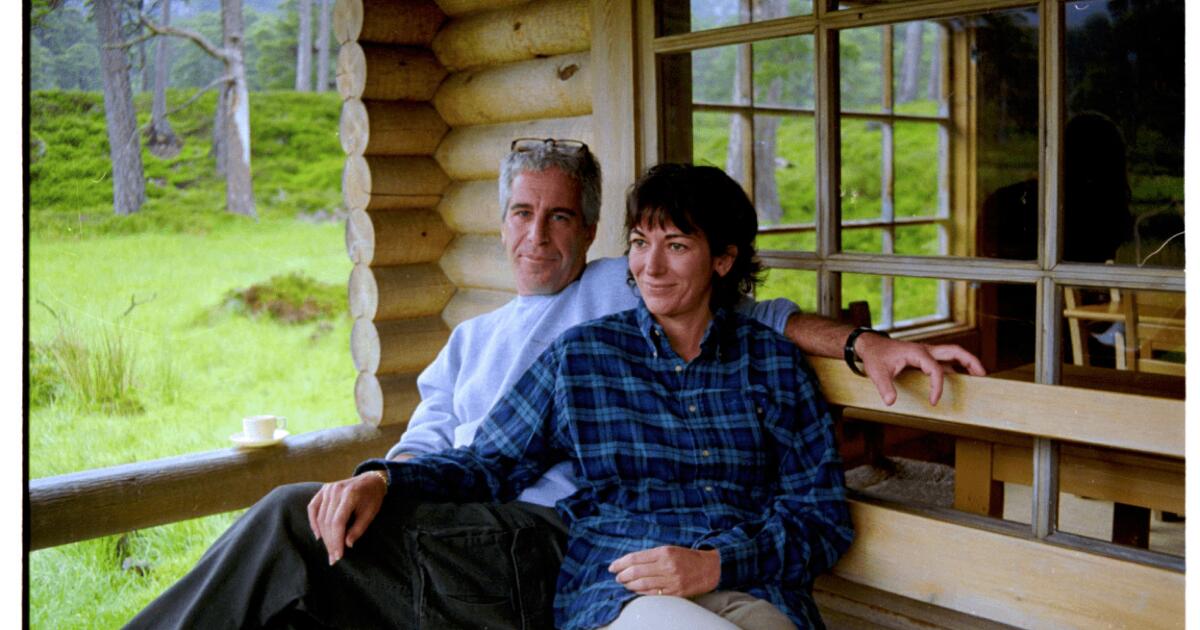
WASHINGTON — A dozen U.S. senators are calling on the Justice Department’s watchdog to examine the department’s failure to release all records pertaining to the late sex offender Jeffrey Epstein by last Friday’s congressionally mandated deadline, saying victims “deserve full disclosure” and the “peace of mind” of an independent audit.
Republican Sen. Lisa Murkowski of Alaska joined 11 Democrats in signing a letter Wednesday urging Acting Inspector General Don Berthiaume to audit the Justice Department’s compliance with the Epstein Files Transparency Act, the law enacted last month that requires the government to open its files on Epstein and his longtime confidant Ghislaine Maxwell.
“Given the [Trump] Administration’s historic hostility to releasing the files, politicization of the Epstein case more broadly, and failure to comply with the Epstein Files Transparency Act, a neutral assessment of its compliance with the statutory disclosure requirements is essential,” the senators wrote. Full transparency, they said, “is essential in identifying members of our society who enabled and participated in Epstein’s crimes.”
Murkowski and Sens. Richard Blumenthal (D-Conn.) and Jeff Merkley (D-Ore.) led the letter-writing group. Others included Democratic Sens. Amy Klobuchar of Minnesota, Adam Schiff of California, Dick Durbin of Illinois, both Cory Booker and Andy Kim of New Jersey, Gary Peters of Michigan, Chris Van Hollen of Maryland, Mazie Hirono of Hawaii, and Sheldon Whitehouse of Rhode Island.
Meanwhile, Republican Rep. Thomas Massie of Kentucky, a co-sponsor of the transparency act, posted Wednesday on X: “DOJ did break the law by making illegal redactions and by missing the deadline.”
Despite the deadline, the Justice Department has said it plans to release records on a rolling basis. It blamed the delay on the time-consuming process of obscuring survivors’ names and other identifying information. More batches of records were posted over the weekend and on Tuesday. The department has not given any notice when more records might arrive.
“The reason why we are still reviewing documents and still continuing our process is simply that to protect victims,” Deputy Atty. Gen. Todd Blanche told NBC’s “Meet the Press” on Sunday. “So the same individuals that are out there complaining about the lack of documents that were produced on Friday are the same individuals who apparently don’t want us to protect victims.”
Records that have been released, including photographs, interview transcripts, call logs, court records and other documents, were either already public or heavily blacked out, and many lacked necessary context. Records that hadn’t been seen before include transcripts of grand jury testimony from FBI agents who described interviews they had with several girls and young women who described being paid to perform sex acts for Epstein.
Other records made public in recent days include a note from a federal prosecutor from January 2020 that said Trump had flown on the financier’s private plane more often than had been previously known and emails between Maxwell and someone who signs off with the initial “A.” They contain other references that suggest the writer was Britain’s former Prince Andrew. In one, “A” writes: “How’s LA? Have you found me some new inappropriate friends?”
The senators’ call Wednesday for an inspector general audit comes days after Minority Leader Chuck Schumer (D-N.Y.) introduced a resolution that, if passed, would direct the Senate to file or join lawsuits aimed at forcing the Justice Department to comply with the disclosure and deadline requirements. In a statement, he called the staggered, heavily redacted release “a blatant cover-up.”
WASHINGTON — A federal judge has blocked the Trump administration from enforcing a March presidential memorandum to revoke the security clearance of prominent Washington attorney Mark Zaid, ruling that the order — which also targeted 14 other individuals — could not be applied to him.
The decision marked the administration’s second legal setback on Tuesday, after the Supreme Court declined to allow Trump to deploy National Guard troops in the Chicago area, capping a first year in office in which President Trump’s efforts to impose a sweeping agenda and pursue retribution against political adversaries have been repeatedly slowed by the courts.
U.S. District Judge Amir Ali in Washington granted Zaid’s request for a preliminary injunction, after he sued the Trump administration in May over the revocation of his security clearance. Zaid’s request called it an act of “improper political retribution” that jeopardized his ability to continue representing clients in sensitive national security cases.
The March presidential memorandum singled out Zaid and 14 other individuals who the White House asserted were unsuitable to retain their clearances because it was “no longer in the national interest.” The list included targets of Trump’s fury from both the political and legal spheres, including former Deputy Attorney General Lisa Monaco, New York Attorney General Letitia James, former President Joe Biden and members of his family.
The action was part of a much broader retribution campaign that Trump has waged since returning to the White House, including directing specific Justice Department investigations against perceived adversaries and issuing sweeping executive orders targeting law firms over legal work he does not like.
In August, the Trump administration said it was revoking the security clearances of 37 current and former national security officials. Ordering the revocation of clearances has been a favored retributive tactic that Trump has wielded — or at least tried to — against high-profile political figures, lawyers and intelligence officials in his second term.
Zaid said in his lawsuit that he has represented clients across the political spectrum over nearly 35 years, including government officials, law enforcement and military officials and whistleblowers. In 2019, he represented an intelligence community whistleblower whose account of a conversation between Trump and Ukrainian President Volodymyr Zelenskyy helped set the stage for the first of two impeachment cases against Trump in his first term.
“This court joins the several others in this district that have enjoined the government from using the summary revocation of security clearances to penalize lawyers for representing people adverse to it,” Ali wrote in his order.
Ali emphasized that his order does not prevent the government from revoking or suspending Zaid’s clearance for reasons independent of the presidential memorandum and through normal agency processes. The preliminary injunction does not go into effect until January 13.
Zaid said in a statement, “This is not just a victory for me, it’s an indictment of the Trump administration’s attempts to intimidate and silence the legal community, especially lawyers who represent people who dare to question or hold this government accountable.”
Cappelletti writes for the Associated Press. AP reporter Eric Tucker contributed to this report.
C. Montgomery Johnson, 81, a veteran political strategist and former Washington state Republican Party chairman, died of complications from a stroke and diabetes May 21 in Olympia, Wash.
Widely known as “Gummie,” Johnson directed Daniel J. Evans’ successful 1964 gubernatorial campaign.
He was the first full-time chairman of the state Republican Central Committee from 1964 to 1971, during which he helped purge members of the John Birch Society from the state party.
During that time, Johnson also served as an executive member of the Republican National Committee.
In partnership with his third wife, Democratic lobbyist Ann Quantock, he founded the political consulting firm C. Montgomery Johnson Associates.
The cigar-smoking Johnson, who was known for being opinionated, profane and progressive, campaigned for public education, the environment, Native Americans, libraries and hospitals. As a champion of equal rights for women, Johnson advised the campaign that elected the state’s first female governor, conservative Democrat Dixy Lee Ray, in 1976.
The Seattle native received a master’s degree in forestry from the University of Washington in 1950, and later worked as a forest ranger before becoming public relations director for Weyerhaeuser, a forest products company.
BRUSSELS — The European Union’s executive arm on Wednesday warned that it would take action against any “unjustified measures” after the U.S. State Department barred five Europeans it accuses of pressuring U.S. technology firms to censor or suppress American viewpoints.
The Europeans were characterized by U.S. Secretary of State Marco Rubio as “radical” activists and “weaponized” nongovernmental organizations. They include the former EU commissioner responsible for supervising social media rules, Thierry Breton.
Breton, a businessman and former French finance minister, clashed last year on social media with tech billionaire Elon Musk over broadcasting an online interview with Donald Trump in the months leading up to the U.S. election.
The European Commission, the EU’s powerful executive branch and which supervises tech regulation in Europe, said that it “strongly condemns the U.S. decision to impose travel restrictions” and that it has requested clarification about the move. French President Emmanuel Macron also condemned it.
“If needed, we will respond swiftly and decisively to defend our regulatory autonomy against unjustified measures,” the commission said in a statement, without elaborating.
Rubio wrote in an X post on Tuesday that “for far too long, ideologues in Europe have led organized efforts to coerce American platforms to punish American viewpoints they oppose.”
“The Trump Administration will no longer tolerate these egregious acts of extraterritorial censorship,” he posted.
The European Commission countered that “the EU is an open, rules-based single market, with the sovereign right to regulate economic activity in line with our democratic values and international commitments.”
“Our digital rules ensure a safe, fair, and level playing field for all companies, applied fairly and without discrimination,” it said.
Macron said that the visa restrictions “amount to intimidation and coercion aimed at undermining European digital sovereignty,” he posted on X.
Macron said that the EU’s digital rules were adopted by “a democratic and sovereign process” involving all member countries and the European Parliament. He said that the rules “ensure fair competition among platforms, without targeting any third country.”
He underlined that “the rules governing the European Union’s digital space are not meant to be determined outside Europe.”
Breton and the group of Europeans fell afoul of a new visa policy announced in May to restrict the entry of foreigners deemed responsible for censorship of protected speech in the United States.
The four others are: Imran Ahmed, chief executive of the Centre for Countering Digital Hate; Josephine Ballon and Anna-Lena von Hodenberg, leaders of HateAid, a German organization; and Clare Melford, who runs the Global Disinformation Index.
Rubio said the five had advanced foreign government censorship campaigns against Americans and U.S. companies, which he said created “potentially serious adverse foreign policy consequences” for the United States.
The action to bar them from the U.S. is part of a Trump administration campaign against foreign influence over online speech, using immigration law rather than platform regulations or penalties.
In a post on X on Tuesday, Sarah Rogers, the U.S. under secretary of state for public diplomacy, called Breton the “mastermind” behind the EU’s Digital Services Act, which imposes a set of strict requirements designed to keep internet users safe online. This includes flagging harmful or illegal content like hate speech.
Breton responded on X by noting that all 27 EU member countries voted for the Digital Services Act in 2022. “To our American friends: ‘Censorship isn’t where you think it is,’” he wrote.
Cook writes for the Associated Press. AP journalist Angela Charlton contributed to this report from Paris.
Christmas is a Christian holiday that observes the birth of Jesus. But did you know that the earliest followers of Jesus did not annually commemorate his birth? Or that Santa Claus is inspired by the acts of kindness of a fourth-century Christian saint? And have you heard about the modern-day Japanese tradition of eating Kentucky Fried Chicken on Christmas?
Since the early 20th century, Christmas has evolved from a religious holiday to a hugely popular cultural holiday observed by Christian and secular people across the globe who gather with families, exchange gifts and cards and decorate Christmas trees.
Here’s a look at the history, beliefs and the evolution of Christmas:
Origins and early history of Christmas
Early followers of Jesus did not annually commemorate his birth but instead focused on commemorating their belief in his resurrection at Easter.
The story of the birth of Jesus appears only in two of the four Gospels of the New Testament: Matthew and Luke. They provide different details, though both say Jesus was born in Bethlehem.
The exact day, month and even year of Jesus’s birth are unknown, said Christine Shepardson, a professor at the University of Tennessee who studies early Christianity.
The tradition of celebrating Jesus’ birth on Dec. 25, she said, only emerged in the fourth century.
“It’s hard to overemphasize how important the fourth century is for constructing Christianity as we experience it in our world today,” Shepardson said. It was then, under Emperor Constantine, that Christians began the practice of gathering at churches instead of meeting at homes.
Some theories say the date coincides with existing pagan winter solstice festivals, including the Roman celebration of Sol Invictus, or the “Unconquered Sun,” on Dec 25.
While most Christians celebrate Christmas on Dec. 25, some Eastern Orthodox traditions celebrate the holy day on Jan. 7. That’s because they follow the ancient Julian calendar, which runs 13 days behind the Gregorian calendar, used by Catholic and Protestant churches as well as by much of the secular world.
Rowdy medieval celebrations
For centuries, especially during the Middle Ages, Christmas was associated with rowdy street celebrations of feasting and drinking, and for many Christians, it “was not in good standing as a holiday,” said Thomas Ruys Smith, a professor of American literature and culture at the University of East Anglia in England.
“Puritans,” he said, “were not fond of Christmas.”
But in the 19th century, he said, Christmas became “respectable” with “the domestic celebration that we understand today — one centered around the home, the family, children, gift-giving.”
The roots of modern-day Christmas can be traced back to Germany. In the late 19th century, there are accounts of Christmas trees and gift-giving that, according to Smith, later spread to Britain and America, helping to revitalize Christmas on both sides of the Atlantic.
Christmas became further popularized with the publication of “A Christmas Carol” by Charles Dickens in 1843, and the writings of Washington Irving, who was a fan of St. Nicholas and helped popularize the celebration of Christmas in America.
The first Rockefeller Center Christmas tree was put up by workers in 1931 to raise spirits during the Great Depression. The tradition stuck as the first tree-lighting ceremony was held in 1933 and remains one of New York City’s most popular holiday attractions.
America’s secular Santa is inspired by a Christian saint
St. Nicholas was a fourth-century Christian bishop from the Mediterranean port city of Myra (in modern-day Turkey). His acts of generosity inspired the secular Santa Claus legend.
The legends surrounding jolly old St. Nicholas — celebrated annually on Dec. 6 — go way beyond delivering candy and toys to children. He is believed to have interceded on behalf of wrongly condemned prisoners and miraculously saved sailors from storms.
Devotion to St. Nicholas spread during the Middle Ages across Europe and he became a favorite subject for medieval artists and liturgical plays. He is the patron saint of sailors and children, as well as of Greece, Russia and New York.
Devotion to St. Nicholas seems to have faded after the 16th century Protestant Reformation, except in the Netherlands, where his legend remained as Sinterklaas. In the 17th century, Dutch Protestants who settled in New York brought the Sinterklaas tradition with them.
Eventually, St. Nicholas morphed into the secular Santa Claus.
It’s not just Santa who delivers the gifts
In the U.K., it’s Father Christmas; in Greece and Cyprus, St. Basil (who arrives on New Year’s Eve). In some parts of Italy, it’s St. Lucy (earlier in December) and in other Italian regions, Befana, a witch-like figure, who brings presents on the Epiphany on Jan. 6.
Instead of a friendly Santa Claus, children in Iceland enjoy favors from 13 mischievous troll brothers, called the Yule Lads. They come down from their mountain cave 13 days before Christmas, according to folklore.
Christian traditions of Christmas
One of the oldest traditions around Christmas is bringing greenery — holly, ivy or evergreen trees — into homes. But determining whether it’s a Christian tradition is harder. “For many people, the evergreen can symbolize Christ’s promise of eternal life and his return from death,” Smith said. “So, you can interpret that evergreen tradition within the Christian concept.”
The decorating of evergreen trees is a German custom that began in the 16th century, said Maria Kennedy, a professor at Rutgers University—New Brunswick’s Department of American Studies. It was later popularized in England and America.
“Mistletoe, an evergreen shrub, was used in celebrations dating back to the ancient Druids — Celtic religious leaders — some 2,000 years ago,” Kennedy writes in The Surprising History of Christmas Traditions.
“Mistletoe represented immortality because it continued to grow in the darkest time of the year and bore white berries when everything else had died.”
Other traditions include Christmas services and Nativity scenes at homes and churches. More recently, Nativity scenes — when erected on public property in the U.S. — have triggered legal battles over the question of the separation of church and state.
Christmas caroling, Kennedy writes, can also be traced back to European traditions, where people would go from home to home during the darkest time of the year to renew relationships within their communities and give wishes for good luck, health and wealth for the forthcoming year.
“They would recite poetry, sing and sometimes perform a skit. The idea was that these acts would bring about good fortune to influence a future harvest,” Kennedy writes.
Kentucky Fried Chicken for Christmas in Japan
Among the many Christmas traditions that have been adopted and localized globally, there’s one that involves KFC.
In 1974, KFC launched a Christmas campaign where they began to sell fried chicken with a bottle of wine so it could be used for a Christmas party.
KFC says the idea for the campaign came from an employee who overheard a foreign customer at one of its Tokyo restaurants saying that since he couldn’t get turkey in Japan, he’d have to celebrate Christmas with Kentucky Fried Chicken.
“That really stuck,” Smith said. “And still today, you have to order your KFC months in advance to make sure that you’re going to get it at Christmas Day.”
OXNARD — A father who has become the sole caretaker for his two young children after his wife was deported. A school district seeing absenteeism similar to what it experienced during the pandemic. Businesses struggling because customers are scared to go outside.
These are just a sampling of how this part of Ventura County is reckoning with the aftermath of federal immigration raids on Glass House cannabis farms six months ago, when hundreds of workers were detained and families split apart. In some instances, there is still uncertainty about what happened to minors left behind after one or both parents were deported. Now, while Latino households gather for the holidays, businesses and restaurants are largely quiet as anxiety about more Immigration and Customs Enforcement raids lingers.
“There’s a lot of fear that the community is living,” said Alicia Flores, executive director of La Hermandad Hank Lacayo Youth and Family Center. This time of year, clients usually ask her about her holiday plans, but now no one asks. Families are divided by the U.S. border or have loved ones in immigration detainment. “They were ready for Christmas, to make tamales, to make pozole, to make something and celebrate with the family. And now, nothing.”
At the time, the immigration raids on Glass House Farms in Camarillo and Carpinteria were some of the largest of their kind nationwide, resulting in chaotic scenes, confusion and violence. At least 361 undocumented immigrants were detained, many of them third-party contractors for Glass House. One of those contractors, Jaime Alanis Garcia, died after he fell from a greenhouse rooftop in the July 10 raid.
Jacqueline Rodriguez, in mirror, works on a customer’s hair as Silvia Lopez, left, owner of Divine Hair Design, waits for customers in downtown Oxnard on Dec. 19, 2025.
(Genaro Molina/Los Angeles Times)
The raids catalyzed mass protests along the Central Coast and sent a chill through Oxnard, a tight-knit community where many families work in the surrounding fields and live in multigenerational homes far more modest than many on the Ventura coast. It also reignited fears about how farmworker communities — often among the most low-paid and vulnerable parts of the labor pool — would be targeted during the Trump administration’s intense deportation campaign.
In California, undocumented workers represent nearly 60% of the agricultural workforce, and many of them live in mixed-immigration-status households or households where none are citizens, said Ana Padilla, executive director of the UC Merced Community and Labor Center. After the Glass House raid, Padilla and UC Merced associate professor Edward Flores identified economic trends similar to the Great Recession, when private-sector jobs fell. Although undocumented workers contribute to state and federal taxes, they don’t qualify for unemployment benefits that could lessen the blow of job loss after a family member gets detained.
“These are households that have been more affected by the economic consequences than any other group,” Padilla said. She added that California should consider distributing “replacement funds” for workers and families that have lost income because of immigration enforcement activity.
An Oxnard store owner who sells quinceañera and baptism dresses — and who asked that her name not be used — says she has lost 60% of her business since the immigrant raids this year at Glass House farms.
(Genaro Molina/Los Angeles Times)
Local businesses are feeling the effects as well. Silvia Lopez, who has run Divine Hair Design in downtown Oxnard for 16 years, said she’s lost as much as 75% of business after the July raid. The salon usually saw 40 clients a day, she said, but on the day after the raid, it had only two clients — and four stylists who were stunned. Already, she said, other salon owners have had to close, and she cut back her own hours to help her remaining stylists make enough each month.
“Everything changed for everyone,” she said.
In another part of town, a store owner who sells quinceañera and baptism dresses said her sales have dropped by 60% every month since August, and clients have postponed shopping. A car shop owner, who declined to be identified because he fears government retribution, said he supported President Trump because of his campaign pledge to help small-business owners like himself. But federal loans have been difficult to access, he said, and he feels betrayed by the president’s deportation campaign that has targeted communities such as Oxnard.
“There’s a lot of fear that the community is living,” said Alicia Flores, executive director of La Hermandad Hank Lacayo Youth and Family Center in downtown Oxnard, on Dec. 19, 2025.
(Genaro Molina/Los Angeles Times)
“Glass House had a big impact,” he said. “It made people realize, ‘Oh s—, they’re hitting us hard.’ ”
The raid’s domino effect has raised concerns about the welfare of children in affected households. Immigration enforcement actions can have detrimental effects on young children, according to the American Immigration Council, and they can be at risk of experiencing severe psychological distress.
Olivia Lopez, a community organizer at Central Coast Alliance United for a Sustainable Economy, highlighted the predicament of one father. He became the sole caretaker of his infant and 4-year-old son after his wife was deported, and can’t afford child care. He is considering sending the children across the border to his wife in Mexico, who misses her kids.
In a separate situation, Lopez said, an 18-year-old has been suddenly thrust into caring for two siblings after her mother, a single parent, was deported.
Additionally, she said she has heard stories of children left behind, including a 16-year-old who does not want to leave the U.S. and reunite with her mother who was deported after the Glass House raid. She said she suspects that at least 50 families — and as many as 100 children — lost both or their only parent in the raid.
“I have questions after hearing all the stories: Where are the children, in cases where two parents, those responsible for the children, were deported? Where are those children?” she said. “How did we get to this point?”
Robin Godfrey, public information officer for the Ventura County Human Services Agency, which is responsible for overseeing child welfare in the county, said she could not answer specific questions about whether the agency has become aware of minors left behind after parents were detained.
“Federal and state laws prevent us from confirming or denying if children from Glass House Farms families came into the child welfare system,” she said in a statement.
The raid has been jarring in the Oxnard School District, which was closed for summer vacation but reopened on July 10 to contact families and ensure their well-being, Supt. Ana DeGenna said. Her staff called all 13,000 families in the district to ask whether they needed resources and whether they wanted access to virtual classes for the upcoming school year.
Even before the July 10 raid, DeGenna and her staff were preparing. In January, after Trump was inaugurated, the district sped up installing doorbells at every school site in case immigration agents attempted to enter. They referred families to organizations that would help them draft affidavits so their U.S.-born children could have legal guardians, in case the parents were deported. They asked parents to submit not just one or two, but as many as 10 emergency contacts in case they don’t show up to pick up their children.
Rodrigo is considering moving back to Mexico after living in the U.S. for 42 years.
(Genaro Molina/Los Angeles Times)
With a district that is 92% Latino, she said, nearly everyone is fearful, whether they are directly or indirectly affected, regardless if they have citizenship. Some families have self-deported, leaving the country, while children have changed households to continue their schooling. Nearly every morning, as raids continue in the region, she fields calls about sightings of ICE vehicles near schools. When that happens, she said, she knows attendance will be depressed to near COVID-19 levels for those surrounding schools, with parents afraid to send their children back to the classroom.
But unlike the pandemic, there is no relief in knowing they’ve experienced the worst, such as the Glass House raid, which saw hundreds of families affected in just a day, she said. The need for mental health counselors and support has only grown.
“We have to be there to protect them and take care of them, but we have to acknowledge it’s a reality they’re living through,” she said. “We can’t stop the learning, we can’t stop the education, because we also know that is the most important thing that’s going to help them in the future to potentially avoid being victimized in any way.”
Jasmine Cruz, 21, launched a GoFundMe page after her father was taken during the Glass House raid. He remains in detention in Arizona, and the family hired an immigration attorney in hopes of getting him released.
Each month, she said, it gets harder to pay off their rent and utility bills. She managed to raise about $2,700 through GoFundMe, which didn’t fully cover a month of rent. Her mother is considering moving the family back to Mexico if her father is deported, Cruz said.
“I tried telling my mom we should stay here,” she said. “But she said it’s too much for us without our dad.”
Many of the families torn apart by the Glass House raid did not have plans in place, said Lopez, the community organizer, and some families were resistant because they believed they wouldn’t be affected. But after the raid, she received calls from several families who wanted to know whether they could get family affidavit forms notarized. One notary, she said, spent 10 hours working with families for free, including some former Glass House workers who evaded the raid.
“The way I always explain it is, look, everything that is being done by this government agency, you can’t control,” she said. “But what you can control is having peace of mind knowing you did something to protect your children and you didn’t leave them unprotected.”
For many undocumented immigrants, the choices are few.
Rodrigo, who is undocumented and worries about ICE reprisals, has made his living with his guitar, which he has been playing since he was 17.
While taking a break outside a downtown Oxnard restaurant, he looked tired, wiping his forehead after serenading a pair, a couple and a group at a Mexican restaurant. He has been in the U.S. for 42 years, but since the summer raid, business has been slow. Now, people no longer want to hire for house parties.
The 77-year-old said he wants to retire but has to continue working. But he fears getting picked up at random, based on how abusive agents have been. He’s thinking about the new year, and returning to Mexico on his own accord.
“Before they take away my guitar,” he said, “I better go.”