POLITICS

Stay informed about the latest developments in politics with our comprehensive political news coverage. Get updates on elections, government policies, international relations, and the voices shaping the political landscape.

Hard-right former lawmaker José Antonio Kast leads in Chile’s polarizing presidential runoff

A hard-right former lawmaker and admirer of President Trump held the upper hand as Chile headed to a polarizing presidential runoff against a member of Chile’s Communist Party representing the incumbent government.

José Antonio Kast, an ultraconservative lawyer opposed to abortion and same-sex marriage, appears to be in pole position after nearly 70% of votes went to right-wing candidates in Sunday’s first round. Many Chileans worry about organized crime, illegal immigration and unemployment in one of Latin America’s safest and most prosperous nations.

The father of nine, who pushed his traditional Catholic beliefs and nostalgia for aspects of Chile’s brutal dictatorship into the political mainstream after founding his own Republican Party in 2019, came in second with nearly 24% of the vote. He campaigned on plans to crack down on gang violence, build a giant border wall and deport tens of thousands of immigrants.

Jeannette Jara, a former labor minister in President Gabriel Boric’s left-wing government, eked out a narrower-than-expected lead with 27% of the vote. She wants to expand Chile’s social safety net and tackle money laundering and drug trafficking to stem organized crime.

Neither contender received more than 50% of the overall vote count, sending the poll to a second round of voting on Dec. 14.

‘Voters are upset’

The mood was ebullient at Kast’s campaign headquarters early Monday, where young Chileans wrapped in national flags drank beer and rolled cigarettes as workers took down the stage where Kast had pledged a radical transformation in the country’s security.

“We needed a safe candidate, someone with a firm hand to bring economic growth, attract investment, create jobs, strengthen the police and give them support,” said Ignacio Rojas, 20. “Chile isn’t safe anymore, and he’ll change that.”

The results seemed set to extend a growing regional shift across Latin America, as popular discontent with the economy simmers and right-wing challengers take over from leftist politicians who shot to power in the wake of the pandemic but largely failed to deliver on their lofty promises of social change and more equitable distribution of wealth.

“Economies are not growing, there are no new jobs, and people remember that 10 years ago they used to pay lower prices for almost everything,” said Patricio Navia, a Chilean analyst and professor at New York University.

“Voters are upset with governments all over the region,” he added.

Conservatives led the pack in Chile’s eight-candidate field, with populist businessman and celebrity economist Franco Parisi surprising pundits by securing 20% of the votes and third place, reflecting the power of his anti-establishment message.

He also ran a tough law and order campaign, vowing to plant land mines along Chile’s porous northern border to prevent people from crossing.

Another 14% of the votes went to Johannes Kaiser, a libertarian congressman and a former YouTube provocateur who campaigned as an even more radical alternative to Kast.

Chile’s traditional center-right coalition landed in fifth place, with establishment candidate Evelyn Matthei winning 12.5% of the vote.

Conservative runners-up endorse Kast

Not all of the divided right is guaranteed to go to Kast, whose conservative moral values have previously alienated voters concerned about the rollback of hard-won rights for women and LGBTQ+ community. His promise to cut up to $6 billion in public spending within his first 18 months has also been criticized by traditional conservative politicians as unrealistic. He has lost two presidential races before.

But it’s also unlikely that many voters who supported Kaiser’s plans to deport migrants who entered the country illegally to prison in El Salvador, or Matthei’s plans to consider bringing back the death penalty, would vote for a lifelong member of Chile’s hard-line Communist Party, which supports autocratic governments in Venezuela and Cuba.

There were no other left-wing front-runners, as all six parties in Chile’s governing coalition threw their weight behind Jara.

After learning of the election results late Sunday, Matthei rushed to Kast’s party headquarters to profess her support for her right-wing rival. “Chile needs a sharp change of direction,” she said.

Kaiser also promised to back Kast, saying his libertarian party would “ensure that a sound doctrine and defense of freedom are not abandoned.”

Parisi was coy after the results came out, saying, “We don’t give anyone a blank check.”

“The burden of proof lies with both candidates,” said the political outsider, whose voters eschew elites on the left and right. “They have to win people over.”

Economic travails and fervent anti-incumbent sentiment appear to have fueled a gradual pendulum swing away from the left-wing leaders who were ascendant across the region just a few years ago.

In Argentina, radical libertarian President Javier Milei, elected in late 2023 on a vow to break with years of left-leaning populism, has doubled down on his close bond with Trump and reshaped Argentina’s foreign policy in line with the U.S.

Elections during the last year in Ecuador, El Salvador and Panama have kept right-wing leaders in office, while in Bolivia, restive voters outraged over a currency crisis punished the Movement Toward Socialism party and elected a conservative opposition candidate for the first time in nearly 20 years last month.

Gains for the right could buoy the U.S. as it competes for regional influence with China, some analysts say, with a new crop of leaders keen for American investment. Chile is the world’s largest copper producer and home to vast reserves of other minerals key to the global energy transition.

Like many hopeful leftists four years ago, Boric, a young former student activist elected on the heels of Chile’s 2019 mass protests over widening inequality, saw his ambitions to raise taxes on the rich and adopt one of the world’s most progressive constitutions run into major legislative opposition.

Analysts warned that Kast could face the same fate if he caved to his most radical allies or pushed morally conservative measures. Although early legislative election results indicated that right-wing parties would hold a majority in the 155-member lower house of Congress, left-wing parties appeared to hold a slight edge in the Senate on Monday.

“There is a path forward for Kast,” Navia said. But “if he tries to govern as a radical right-winger, he will hit a wall, just like outgoing President Gabriel Boric did.”

Debre writes for the Associated Press.

Source link

Hundreds of National Guard troops deployed to Portland and Chicago are being sent home

Hundreds of National Guard troops deployed to Chicago and Portland, Ore., are being sent home, and those who will remain will continue to stay off the streets amid court battles over their deployment by the Trump administration, a defense official said Monday.

The withdrawal of soldiers — sent from California and Texas — is part of a larger change to troop deployments after President Trump began his immigration crackdown in various cities with Democratic leadership. The official requested anonymity because they were not authorized to publicly discuss the issue.

U.S. Northern Command said in a statement Sunday it was “shifting and/or rightsizing” units in Portland, Los Angeles and Chicago. Although it said there would be a “constant, enduring, and long-term presence in each city.”

In the coming days, 200 California National Guard troops currently deployed to Oregon will be sent home, and about 100 will remain in the Portland area doing training, the official said. The military also plans to cut in half the number of Oregon National Guard troops on deployment there from 200 soldiers to 100, the official said.

About 200 Texas National Guard troops in Chicago also are being sent home and about 200 soldiers will be on standby at Fort Bliss, an Army base that stretches across parts of Texas and New Mexico, the official said.

About 300 Illinois National Guard troops will remain in the Chicago area, also doing training, but they currently are not legally allowed to conduct operations with the Department of Homeland Security, the official said.

The official said the upcoming holiday season may have played a role in the change in deployments.

Diana Crofts-Pelayo, a spokesperson for California Gov. Gavin Newsom, said Trump “never should have illegally deployed our troops in the first place.”

“We’re glad they’re finally coming home,” she wrote in an email. “It’s long overdue!”

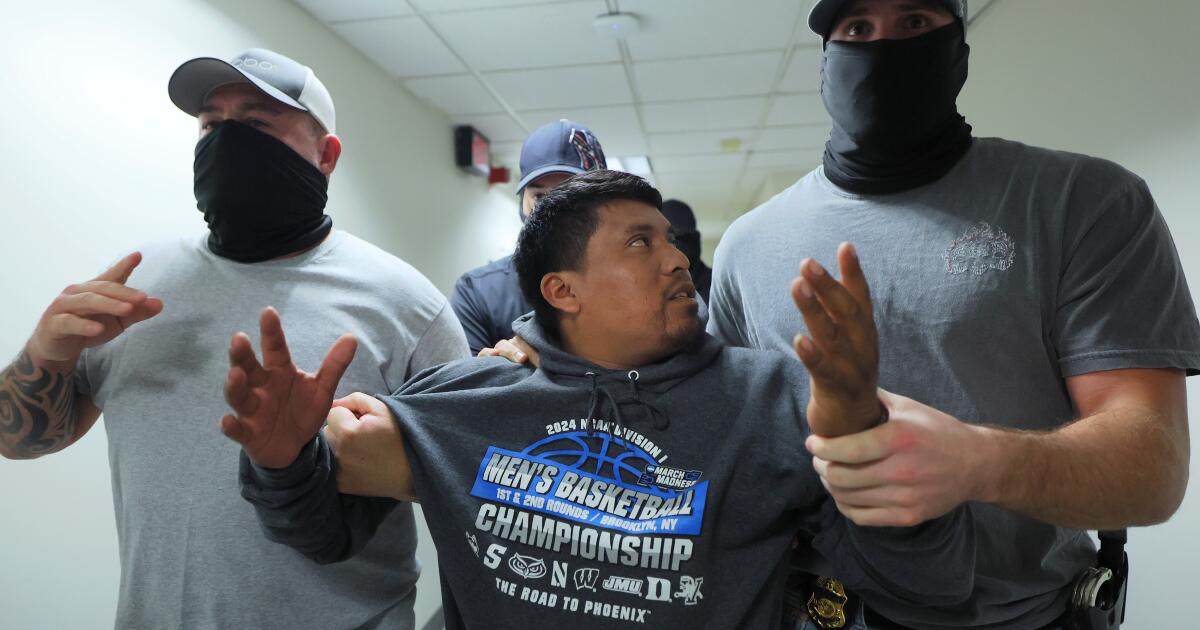
Separately, the Trump administration has stepped up immigration enforcement in Charlotte, North Carolina, expanding an aggressive campaign that’s been spearheaded by U.S. Customs and Border Protection.

National Guard deployments have been one of the most controversial initiatives of Trump’s second term, demonstrating an expanded willingness to use the military to accomplish domestic goals.

Troops, including active-duty Marines, were deployed to Los Angeles during immigration protests earlier this year.

The National Guard was also sent to Washington, D.C., where they were part of a broader federal intervention that Trump claimed was necessary because of crime problems.

The deployments later expanded to Portland and Chicago.

Although they don’t play a law enforcement role, members of the National Guard have been tasked with protecting federal facilities, particularly those run by U.S. Immigration and Customs Enforcement.

About 100 troops who have been in Los Angeles will remain on deployment, the defense official said.

Watson writes for the Associated Press. AP writer Chris Megerian in Washington contributed to this report.

Source link

Column: Sacramento scandal a wild card for Xavier Becerra and the governor’s race

So far, gubernatorial candidate Xavier Becerra has escaped the bright spotlight focused on Gov. Gavin Newsom in the money pilfering scandal involving their former top aides. But that could change.

It seems only a matter of time before one of Becerra’s campaign rivals seizes the federal fraud case for attack fodder. I can hear it already: “If the man who wants to be governor can’t protect his own political funds, he shouldn’t be trusted to safeguard your tax money.”

That might not be fair, but this is big-time politics. And the word “fair” isn’t in the political dictionary.

Neither Becerra nor Newsom is implicated in any wrongdoing.

Newsom has drawn heavy media attention because his former chief of staff, Dana Williamson, is the central figure in the criminal case. Newsom also has made himself into a national political celebrity and the leader in early polling for the 2028 Democratic presidential nomination. That makes him prime news copy.

Becerra is low-profile by comparison, although he has achieved a very successful and respectable career: U.S. Health and Human Services secretary under President Biden, California attorney general and 12-term congressman.

It was Becerra’s dormant state political account that allegedly got pilfered of $225,000 while he was health secretary.

Federal prosecutors allege that Williamson, former Becerra chief of staff Sean McCluskie and Sacramento lobbyist Greg Campbell illegally diverted money to McCluskie’s wife, funneling the loot through shell companies for bogus consulting services.

McCluskie and Campbell both pleaded guilty to conspiracy to commit fraud and have been cooperating with the federal government.

Williamson, who allegedly fleeced Becerra’s political kitty when she owned a government relations firm before joining Newsom’s staff, pleaded not guilty to bank and tax fraud charges. Besides raiding Becerra’s account, she’s accused of falsifying documents involving a COVID small-business loan and claiming $1 million in personal luxuries as business expenses on her income taxes.

After news of the case broke last week with Williamson’s arrest, Newsom’s office said the governor suspended her last November after she informed him of the federal investigation.

There also was a sophomoric attempt by a Newsom spokesperson to link the federal case to the combative relationship between President Trump and the California governor. It’s true Trump has been targeting his “enemies.” But this three-year FBI probe began under the Biden administration.

Becerra issued a statement saying that the “formal accusations of impropriety by a long-serving trusted advisor are a gut punch.” He also said he had been cooperating with the U.S. Justice Department‘s investigation.

The federal indictment alleges that McCluskie and Williamson misled Becerra about how monthly withdrawals from his political account were to be used.

The account stash of nearly $2 million was raised for a 2022 attorney general reelection campaign that never occurred because by then Becerra was health secretary. But the money could be used in some future state race, such as for governor.

Political operatives I talked with were stunned that $225,000 could be siphoned out of a politician’s campaign account without him noticing.

“Did the account have no one watching it except the consultants who were pilfering from it?” asked veteran Democratic consultant Garry South. “Those of us who have run campaigns are scratching our heads. I can’t imagine how this would happen.”

I asked the Becerra campaign.

A spokesperson replied that the health secretary had authorized payments for “campaign management” after being misled by trusted advisors.

Also, the spokesperson added, Becerra was counseled by a Health and Human Services attorney to distance himself from any “campaign or political activity” prohibited by the federal Hatch Act and ethics rules. So he delegated responsibility for managing the account to advisors.

And he got snookered and ripped off.

Will it tarnish Becerra’s image and hurt his campaign for governor? We don’t know yet. But probably not that much, if any. His only sin, after all, was trusting the wrong people and following an attorney’s advice.

Even big scandals don’t seem to damage politicians in this era — Trump being the unfathomable best example.

It could crimp Becerra’s fundraising if potential donors wonder where their money is actually going and whether anyone credible will be watching it.

The gubernatorial race is still wide open without a real front-runner. No candidate is captivating the voters.

A late October poll by the UC Berkeley Institute of Governmental Studies showed paltry numbers for all candidates. Former Orange County Rep. Katie Porter led Democrats with 11% support among registered voters. Becerra was second with 8%. A whopping 44% of those surveyed were undecided.

Riverside County Sheriff Chad Blanco, a Republican, was first overall with 13%. But no Republican need apply for this job. California hasn’t elected a GOP candidate to a statewide office since 2006.

Becerra has as good a shot at winning as any current candidate. He was the leading Democrat among Latinos at 12%.

But he’ll need a better answer for why he may have allowed $225,000 in donated political contributions to be grabbed and illegally spent by people he trusted.

Source link

One issue is uniting Americans in a time of polarization, according to a new poll

Pessimism about the country’s future has risen in cities since last year, but rural America is more optimistic about what’s ahead for the U.S., according to a new survey from the American Communities Project.

And despite President Trump’s insistence that crime is out of control in big cities, residents of the nation’s largest metropolitan centers are less likely to list crime and gun violence among the chief concerns facing their communities than they were a couple years ago.

Optimism about the future is also down from last year in areas with large Hispanic communities.

These are some of the snapshots from the new ACP/Ipsos survey, which offers a nuanced look at local concerns by breaking the nation’s counties into community types, using data points like race, income, age and religious affiliation. The survey evaluated moods and priorities across the 15 different community types, such as heavily Hispanic areas, big cities and different kinds of rural communities.

The common denominator across the communities? A gnawing worry about daily household costs.

“Concerns about inflation are across the board,” said Dante Chinni, founder and director of ACP. “One thing that truly unites the country is economic angst.”

Rising optimism in rural areas, despite economic anxiety

Rural residents are feeling more upbeat about the country’s trajectory — even though most aren’t seeing Trump’s promised economic revival.

The $15 price tag on a variety pack of Halloween candy at the Kroger supermarket last month struck Carl Gruber. Disabled and receiving federal food aid, the 42-year-old from Newark, Ohio, had hardly been oblivious to lingering, high supermarket prices.

But Gruber, whose wife also is unable to work, is hopeful about the nation’s future, primarily in the belief that prices will moderate as Trump suggests.

“Right now, the president is trying to get companies who moved their businesses out of the country to move them back,” said Gruber, a Trump voter whose support has wavered over the federal shutdown that delayed his monthly food benefit. “So, maybe we’ll start to see prices come down.”

About 6 in 10 residents of Rural Middle America — Newark’s classification in the survey — say they are hopeful about the country’s future over the next few years, up from 43% in the 2024 ACP survey. Other communities, like heavily evangelical areas or working-class rural regions, have also seen an uptick in optimism.

Kimmie Pace, a 33-year-old unemployed mother of four from a small town in northwest Georgia, said, “I have anxiety every time I go to the grocery store.”

But she, too, is hopeful in Trump. “Trump’s in charge, and I trust him, even if we’re not seeing the benefits yet,” she said.

Big-city residents are worried about the future

By contrast, the share of big-city residents who say they are hopeful about the nation’s future has shrunk, from 55% last year to 45% in the new survey.

Robert Engel of San Antonio — Texas’ booming, second most-populous city — is worried about what’s next for the U.S., though less for his generation than the next. The 61-year-old federal worker, whose employment was not interrupted by the government shutdown nor Trump’s effort to reduce the federal workforce, is near retirement and feels financially stable.

A stable job market, health care availability and a fair economic environment for his adult children are his main priorities.

Recently, the inflation outlook has worsened under Trump. Consumer prices in September increased at an annual rate of 3%, up from 2.3% in April, when the president first began to roll out substantial tariff increases that burdened the economy with uncertainty.

Engel’s less-hopeful outlook for the country is broader. “It’s not just the economy, but the state of democracy and polarization,” Engel said. “It’s a real worry. I try to be cautiously optimistic, but it’s very, very hard.”

Crime, gun violence are less a concern in urban America

Trump had threatened to deploy the National Guard to Chicago, New York, Seattle, Baltimore, San Francisco and Portland, Ore., to fight what he said was runaway, urban crime.

Yet data shows most violent crime in those places, and around the country, has declined in recent years. That tracks with the poll, which found that residents of America’s Big Cities and Middle Suburbs are less likely to list crime or gun violence among the top issues facing their communities than they were in 2023.

For Angel Gamboa, a retired municipal worker in Austin, Tex., Trump’s claims don’t ring true in the city of roughly 1 million people.

“I don’t want to say it’s overblown, because crime is a serious subject,” Gamboa said. “But I feel like there’s an agenda to scare Americans, and it’s so unnecessary.”

Instead, residents of Big Cities are more likely to say immigration and health care are important issues for their communities.

Big Cities are one of the community types where residents are most likely to say they’ve seen changes in immigration recently, with 65% saying they’ve seen a change in their community related to immigration over the past 12 months, compared with only about 4 in 10 residents of communities labeled in the survey as Evangelical Hubs or Rural Middle America.

Gamboa says he has witnessed changes, notably outside an Austin Home Depot, where day laborers regularly would gather in the mornings to find work.

Not anymore, he said.

“Immigrants were not showing up there to commit crimes,” Gamboa said. “They were showing up to help their families. But when ICE was in the parking lot, that’s all it took to scatter people who were just trying to find a job.”

Hispanic communities are less hopeful about the future

After Hispanic voters moved sharply toward Trump in the 2024 election, the poll shows that residents of heavily Hispanic areas are feeling worse about the future of their communities than they were before Trump was elected.

Carmen Maldonado describes her community of Kissimmee, Fla., a fast-growing, majority-Hispanic city of about 80,000 residents about 22 miles south of Orlando, as “seriously troubled.”

The 61-year-old retired, active-duty National Guard member isn’t alone. The survey found that 58% of residents of such communities are hopeful about the future of their community, down from 78% last year.

“It’s not just hopelessness, but fear,” said Maldonado, who says people in her community — even her fellow native Puerto Ricans, who are American citizens — are anxious about the Trump administration’s aggressive pursuit of Latino immigrants.

Just over a year ago, Trump made substantial inroads with Hispanic voters in the 2024 presidential election.

Beyond just the future of their communities, Hispanic respondents are also substantially less likely to say they’re hopeful about the future of their children or the next generation: 55% this year, down from 69% in July 2024.

Maldonado worries that the Trump administration’s policies have stoked anti-Hispanic attitudes and that they will last for her adult child’s lifetime and beyond.

“My hopelessness comes from the fact that we are a large part of what makes up the United States,” she said, “and sometimes I cry thinking about these families.”

Beaumont, Parwani and Thomson-Deveaux write for the Associated Press. Parwani and Thomson-DeVeaux reported from Washington. The American Communities Project/Ipsos Fragmentation Study of 5,489 American adults aged 18 or older was conducted from Aug. 18 – Sept. 4, 2025, using the Ipsos probability-based online panel and RDD telephone interviews. The margin of sampling error for adults overall is plus or minus 1.8 percentage points.

Source link

After weekend’s Border Patrol surge in North Carolina, governor says effort is ‘stoking fear’

After a surge in Border Patrol activity in North Carolina’s largest city over the weekend, including dozens of arrests, Gov. Josh Stein said the effort is “stoking fear,” not making Charlotte safer.

The Trump administration has made the Democratic city of about 950,000 people its latest target for an immigration enforcement surge it says will combat crime, despite fierce objections from local leaders and downtrending crime rates. Charlotte residents reported encounters with federal immigration agents near churches, apartment complexes and stores.

“We’ve seen masked, heavily armed agents in paramilitary garb driving unmarked cars, targeting American citizens based on their skin color, racially profiling, and picking up random people in parking lots and off of our sidewalks,” Stein said in a video statement late Sunday. “This is not making us safer. It’s stoking fear and dividing our community.”

Stein acknowledged that it was a stressful time, but he called on residents to stay peaceful. If people see something wrong, he said they should record it and report it to local law enforcement.

The Department of Homeland Security, which oversees CBP, has said it was focusing on North Carolina because of so-called sanctuary policies, which limit cooperation between local authorities and immigration agents.

Several county jails house immigrant arrestees and honor detainers, which allow jails to hold detainees for immigration officers to pick them up. But Mecklenburg County, where Charlotte is located, does not. Also, the city’s police department does not help with immigration enforcement. DHS alleged that about 1,400 detainers across North Carolina had not been honored, putting the public at risk.

Gregory Bovino, who led hundreds of U.S. Customs and Border Protection agents in a similar effort in Chicago, documented some of the more than 80 arrests he said agents had made in social media posts on Sunday. He posted pictures of people the Trump administration commonly dubs “criminal illegal aliens,” meaning people living in the U.S. without legal permission who allegedly have criminal records. That included one of a man with an alleged history of drunk driving convictions.

The activity has prompted fear and questions, including where detainees would be held, how long the operation would last and what agents’ tactics — criticized elsewhere as aggressive and racist — would look like in North Carolina.

However, some welcomed the effort, including Mecklenburg County Republican Party Chairman Kyle Kirby, who said in a post Saturday that the county GOP “stands with the rule of law — and with every Charlottean’s safety first.”

Bovino’s operations in Chicago and Los Angeles triggered lawsuits over the use of force, including widespread deployment of chemical agents. Democratic leaders in both cities accused agents of inflaming community tensions. Federal agents fatally shot one suburban Chicago man during a traffic stop.

Bovino, head of a Border Patrol sector in El Centro, California, and other Trump administration officials have called their tactics appropriate for growing threats on agents.

Tareen, Witte and Dale write for the Associated Press. Tareen and Dale reported from Chicago. Witte reported from Annapolis, Md.

Source link

Supreme Court may restrict asylum claims from those arriving at the southern border

The Supreme Court agreed Monday to hear a Trump administration appeal that argues migrants have no right to seek asylum at the southern border.

Rather, the government says border agents may block asylum seekers from stepping on to U.S. soil and turn away their claims without a hearing.

The new case seeks to clarify the immigration laws and resolve an issue that has divided past administrations and the 9th Circuit Court of Appeals.

Under federal law, migrants who faces persecution in their home countries may apply for asylum and receive a screening hearing if they are “physically present in the United States” or if such a person “arrives in the United States.”

Since 2016, however, the Obama, Biden and Trump administrations responded to surges at the border by adopting temporary rules which required migrants to wait on the Mexican side before they could apply for asylum.

But in May, a divided 9th Circuit Court ruled those restrictions were illegal if they prevented migrants from applying for asylum.

“To ‘arrive’ means ‘to reach a destination,’” wrote Judge Michelle Friedland, citing a dictionary definition. “A person who presents herself to an official at the border has ‘arrived.’”

She said this interpretation “does not radically expand the right to asylum.” By contrast, the “government’s reading would reflect a radical reconstruction of the right to apply for asylum because it would give the executive branch vast discretion to prevent people from applying by blocking them at the border.”

“We therefore conclude that a non-citizen stopped by U.S. officials at the border is eligible to apply for asylum,” she wrote.

The 2-1 decision upheld a federal judge in San Diego who ruled for migrants who had filed a class-action suit and said they were wrongly denied an asylum hearing.

But Solicitor Gen. D. John Sauer urged the Supreme Court to review and reverse the appellate ruling, noting 15 judges of the 9th Circuit joined dissents that called the decision “radical” and “clearly wrong.”

In football, a “running back does not ‘arrive in’ the end zone when he is stopped at the one-yard line,” Sauer wrote.

He said federal immigration law “does not grant aliens throughout the world a right to enter the United States so that they can seek asylum.” From abroad, they may “seek admission as refugees,” he said, but the government may enforce its laws by “blocking illegal immigrants from stepping on U.S. soil.”

Immigrants rights lawyers advised the court to turn away the appeal because the government is no longer using the “metering” system that required migrants to wait for a hearing.

Since June 2024, they said the government has restricted inspections and processing of these non-citizens under a different provision of law that authorizes the president to “suspend the entry of all aliens or any class of alien” if he believes they would be “detrimental to the interests of the United States.”

The government also routinely sends back migrants who illegally cross the border.

But the solicitor general said the asylum provision should be clarified.

The justices voted to hear the case of Noem vs. Al Otro Lado early next year and decide “whether an alien who is stopped on the Mexican side of the U.S.-Mexico border ‘arrives in the United States’ within the meaning” of federal immigration law.

Source link

Column: Sacramento scandal a wild card for Xavier Becerra and the governor’s race

You’re reading the L.A. Times Politics newsletter

Anita Chabria and David Lauter bring insights into legislation, politics and policy from California and beyond. In your inbox three times per week.

By continuing, you agree to our Terms of Service and our Privacy Policy.

So far, gubernatorial candidate Xavier Becerra has escaped the bright spotlight focused on Gov. Gavin Newsom in the money pilfering scandal involving their former top aides. But that could change.

It seems only a matter of time before one of Becerra’s campaign rivals seizes the federal fraud case for attack fodder. I can hear it already: “If the man who wants to be governor can’t protect his own political funds, he shouldn’t be trusted to safeguard your tax money.”

That might not be fair, but this is big-time politics. And the word “fair” isn’t in the political dictionary.

Neither Becerra nor Newsom is implicated in any wrongdoing.

Newsom has drawn heavy media attention because his former chief of staff, Dana Williamson, is the central figure in the criminal case. Newsom also has made himself into a national political celebrity and the leader in early polling for the 2028 Democratic presidential nomination. That makes him prime news copy.

Becerra is low-profile by comparison, although he has achieved a very successful and respectable career: U.S. Health and Human Services secretary under President Biden, California attorney general and 12-term congressman.

It was Becerra’s dormant state political account that allegedly got pilfered of $225,000 while he was health secretary.

Federal prosecutors allege that Williamson, former Becerra chief of staff Sean McCluskie and Sacramento lobbyist Greg Campbell illegally diverted money to McCluskie’s wife, funneling the loot through shell companies for bogus consulting services.

McCluskie and Campbell both pleaded guilty to conspiracy to commit fraud and have been cooperating with the federal government.

Williamson, who allegedly fleeced Becerra’s political kitty when she owned a government relations firm before joining Newsom’s staff, pleaded not guilty to bank and tax fraud charges. Besides raiding Becerra’s account, she’s accused of falsifying documents involving a COVID small-business loan and claiming $1 million in personal luxuries as business expenses on her income taxes.

After news of the case broke last week with Williamson’s arrest, Newsom’s office said the governor suspended her last November after she informed him of the federal investigation.

There also was a sophomoric attempt by a Newsom spokesperson to link the federal case to the combative relationship between President Trump and the California governor. It’s true Trump has been targeting his “enemies.” But this three-year FBI probe began under the Biden administration.

Becerra issued a statement saying that the “formal accusations of impropriety by a long-serving trusted advisor are a gut punch.” He also said he had been cooperating with the U.S. Justice Department‘s investigation.

The federal indictment alleges that McCluskie and Williamson misled Becerra about how monthly withdrawals from his political account were to be used.

The account stash of nearly $2 million was raised for a 2022 attorney general reelection campaign that never occurred because by then Becerra was health secretary. But the money could be used in some future state race, such as for governor.

Political operatives I talked with were stunned that $225,000 could be siphoned out of a politician’s campaign account without him noticing.

“Did the account have no one watching it except the consultants who were pilfering from it?” asked veteran Democratic consultant Garry South. “Those of us who have run campaigns are scratching our heads. I can’t imagine how this would happen.”

I asked the Becerra campaign.

A spokesperson replied that the health secretary had authorized payments for “campaign management” after being misled by trusted advisors.

Also, the spokesperson added, Becerra was counseled by a Health and Human Services attorney to distance himself from any “campaign or political activity” prohibited by the federal Hatch Act and ethics rules. So he delegated responsibility for managing the account to advisors.

And he got snookered and ripped off.

Will it tarnish Becerra’s image and hurt his campaign for governor? We don’t know yet. But probably not that much, if any. His only sin, after all, was trusting the wrong people and following an attorney’s advice.

Even big scandals don’t seem to damage politicians in this era — Trump being the unfathomable best example.

It could crimp Becerra’s fundraising if potential donors wonder where their money is actually going and whether anyone credible will be watching it.

The gubernatorial race is still wide open without a real front-runner. No candidate is captivating the voters.

A late October poll by the UC Berkeley Institute of Governmental Studies showed paltry numbers for all candidates. Former Orange County Rep. Katie Porter led Democrats with 11% support among registered voters. Becerra was second with 8%. A whopping 44% of those surveyed were undecided.

Riverside County Sheriff Chad Blanco, a Republican, was first overall with 13%. But no Republican need apply for this job. California hasn’t elected a GOP candidate to a statewide office since 2006.

Becerra has as good a shot at winning as any current candidate. He was the leading Democrat among Latinos at 12%.

What else you should be reading

The must-read: Front-runner or flash in the pan? Sizing up Newsom, 2028
CA vs. Trump: At Brazilian climate summit, Newsom positions California as a stand-in for the U.S.
The L.A. Times Special: Indictment of ex-Newsom aide hints at feds’ probe into state’s earlier investigation of video game giant

Until next week,
George Skelton


Was this newsletter forwarded to you? Sign up here to get it in your inbox.

Source link

An Amazon climate summit built on contradiction, creating unease for California delegates

Two stark-white cruise ships loomed over a muddy Amazonian estuary, an odd sight from a beach where two children waded in the water.

The diesel-powered vessels towered over the impoverished riverfront neighborhood where trash littered the ground and a rainbow sheen from household and street runoff glistened on top of rain puddles.

The cruise liners — with their advertised swimming pools, seafront promenades and an array of restaurants and bars — were brought in to house thousands of delegates attending the 12-day United Nations COP30 climate summit in Belém, which ends Friday. The ships helped address a housing crunch created by an influx of roughly 50,000 people into the capital of Pará in northern Brazil.

Along with being a global economic powerhouse, Brazil is also one of the planet’s most important climate actors. The South American nation is home to tropical rainforests that absorb vast amounts of carbon dioxide but are increasingly threatened by deforestation and a drying Amazon.

A navy soldier patrols the Port of Outeiro, where a giant cruise ship is docked in the background.

A navy soldier patrols the Port of Outeiro, where cruise ships are docked to host delegations attending the COP30 U.N. Climate Change Conference in Belem, Brazil, on Nov. 8. Two cruise ships tower imposingly over a sleepy port in the Brazilian Amazon where some 50,000 people are gathering for a U.N. climate conference. With capacity for 6,000 people, the behemoths came from Europe to the riverine city of Belem on Brazil’s north coast to serve as floating hotels.

(Pablo Porciuncula / AFP via Getty Images)

The contrast — a climate conference relying on emissions-heavy cruise ships — has become the defining image of this year’s COP30, where wealth and scarcity sit side by side.

Belém residents said they felt a mix of curiosity and excitement watching the influx of foreigners, eager to show a culture that is often overshadowed by the country’s larger southern cities.

Many described COP30 as the first time the world had paused long enough to take notice of the people living at the mouth of the Amazon River, where locally grown açaí is sold on nearly every block. The region supplies the vast majority of Brazil’s açaí crop and much of what’s exported worldwide.

As humidity hung thick in the hot air, locals across the city of 1.3 million people pointed to expanded docks meant to attract future tourism, freshly painted walkways, restored colonial buildings with late-19th-century European touches and new cultural centers rushed to completion. But the sudden infusion of money layered atop long-standing inequality sharpened questions from residents about what will remain after the summit’s global spotlight fades.

Much of the summit footprint, they said, sits in areas where new structures were built fast, unevenly or only partly completed. Brazil’s government highlighted upgrades to Belém’s airports, ports, drainage systems, sanitation networks, parks and tourist areas, saying the work would leave a lasting legacy beyond COP30.

The BBC reported that a new four-lane highway built for COP30 resulted in tens of thousands of acres of protected Amazon rainforest being leveled, including trees locals relied on to harvest açaí berries to sell. One roadway to ease traffic to the climate summit remains unfinished and blocked by plastic orange netting.

“They cut all this forest to make that road and didn’t even finish it,” said Lucas Lina, 19, who works as an administrator at a Belém fire station, as he pointed to the unfinished road. “I don’t think they ever will. They will delay and delay.”

Lina said climate change is something locals feel acutely. The region has seen unpredictable rainfall, and in some years, receives little at all in an area used to its showers.

“The climate is going crazy,” Ana Paula, a government food safety inspector, said in Portuguese as Lina translated. “We can’t predict anything anymore.”

Even environmentalists acknowledge the optics are fraught, particularly as attendees flew more than 1,800 miles from events in Rio de Janeiro and São Paulo for satellite gatherings. That included members of California’s delegation and Gov. Gavin Newsom.

“It’s not well conceived because there’s not enough housing,” said Terry Tamminen, former California environmental secretary. “If we really cared about the climate, we’d have these events every year and they’d be 100% virtual.”

Such contradictions have often fueled demonstrations at climate summits, including on Friday when roughly 100 Indigenous protesters blocked the conference’s main entrance for more than 90 minutes. They formed a human chain as they denounced development plans they say would accelerate deforestation.

Indigenous activists participate in a climate protest during the COP30 U.N. Climate Summit.

Indigenous activists participate in a climate protest during the COP30 U.N. Climate Summit on Saturday in Belém, Brazil.

(Andre Penner / Associated Press)

“Our forest is not for sale,” they wrote in a statement.

It was the second protest during the first week of COP30 after a brief clash inside the massive newly constructed facility resulted in two security guards suffering minor injuries.

“There are a lot of promises that the government made that are yet to be delivered,” said Lina, who taught himself English by watching YouTube and through online gaming. “We don’t know if these promises will actually be kept up after COP30.”

That tension — between symbolism and the city’s strained reality — defines this climate conference in a way that delegates say feels impossible to ignore.

Brazil remains one of the world’s top oil producers and recently approved new drilling near the rainforest. Many delegates argued that no setting better captures the stakes of the climate crisis than the Amazon, where Indigenous stewardship, extraordinary biodiversity and the consequences of deforestation are felt globally.

“I don’t know there’s a more important location than the rainforest,” Newsom told The Times. “The one area that consistently gets overlooked in the climate discussion is biodiversity.”

This aerial view shows a deforested area of the Amazon rainforest.

This aerial view shows a deforested area of the Amazon rainforest in the municipality of Moju, Brazil, on Wednesday during the COP30 U.N. Climate Change Conference.

(Mauro Pimentel / AFP via Getty Images)

With the summit came new investments that residents say they welcomed, including new bus routes, expansions at ports meant to increase future tourism and increased police presence to make streets safer.

“It’s very good for us,” said Maria Fátima in Portuguese while standing under an awning of a shuttered bar overlooking the cruise ships. She smiled and gave a thumbs up after saying she had never seen an American in Belém before.

“Everyone is very happy,” she said of the possibility that the newly expanded port will bring future tourism.

That port, which experienced an oil spill in April, is now being marketed as the Amazon’s next cruise-tourism hub. Its expansion cost $44 million and relied on nonstop work from construction crews in rotating shifts. The rush project doubled the pier’s capacity.

Room prices aboard the cruise ships soared to more than $1,400 a night for a balcony cabin, according to Times inquiries. On land, Belém’s modest supply of hotels and even seedy love motels that typically rent by the hour surged in price, pushing residents to rent their apartments and homes at rates many said they had never imagined.

People on a beach watch cruise ships docked at the Port of Outeiro, which will host delegations attending the COP30.

People on a beach along the Guama River watch cruise ships docked at the Port of Outeiro, which will host delegations attending the COP30 U.N. Climate Change Conference in Belém, Brazil, on Nov. 6.

(Carlos Fabal/AFP via Getty Images)

One attendee said her hotel room typically goes for $85 a night. Her room cost $1,000 instead.

Newsom even joked about the costs. When a Brazilian journalist asked whether California would make climate investments in the country, Newsom said the price of his room at the Holiday Inn in Belém already felt like an “economic contribution.”

But those prices didn’t benefit everyone. Local media reported that some renters were evicted ahead of the conference in order to open up rooms to foreigners.

Inside the summit, Newsom operated as a proxy for the United States while attending COP30 for two days after President Trump, an outspoken climate skeptic, declined to send any high-level federal officials.

Long Beach resident Dominic Bednar, attending his fifth climate summit, said the contradictions of this year’s summit don’t diminish the importance of being there.

“It’s a double-edged sword,” said Bednar, an assistant professor in the Department of Urban Planning and Public Policy at UC Irvine. “On one hand, it brings understanding to the city and is driving a lot of economic investment. But I’m also curious: What is the carbon footprint of everybody coming into COP and the construction of this place? We are using energy, and we’re contributing to climate pollution.”

People riding in small boats in Guajara Bay with high rises on land in the background.

People riding in boats participate in a People’s Summit event on Guajara Bay during the COP30 U.N. Climate Summit on Wednesday in Belém, Brazil.

(Andre Penner / Associated Press)

Graduate students from UC San Diego’s Scripps Institution of Oceanography echoed that discomfort, but said not attending would only cede more ground to powerful energy interests that already dominate climate talks.

“We can empathize with not having our voices heard,” said graduate student Danielle McHaskell as she waited to take a photo with Newsom. “And that’s an important part of the climate movement — empathy for other people.”

Newsom, too, said he was aware of the contradiction of using fossil fuels to reach a climate summit.

Still, he defended the decision to hold COP30 in the Amazon. He said it offered a chance to “see what I’ve only seen on TV or could see disappear in my lifetime.” He added that he was particularly excited about venturing into the Amazon rainforest with a small delegation to learn in person about conservation efforts and connect with something beyond policy and negotiations.

“I think that spiritual element really matters in a world that can use a little bit more of that,” he said before returning to California on Sunday. “That’s one of the reasons I’m looking forward to getting deeper into the Amazon.”

Source link

California Republicans split on Trump’s immigration strategy, poll finds

Republicans in California have diverging opinions on President Trump’s immigration enforcement policies, according to a study published by the UCLA Latino Policy and Politics Institute on Monday.

The Trump administration has deployed a sweeping crackdown on immigration, launching ICE raids across the country and removing legal barriers in order to make deportations faster. The study found that while Democrats were largely consistent in their opposition to these immigration policies, Republican sentiment varied more, especially by age, gender and ethnicity.

“At least some subset of Republicans are seeing that these immigration strategies are a step too far,” said G. Cristina Mora, a sociology professor and co-director of the UC Berkeley Institute of Governmental Studies, which administered the poll. The polling data were collected from nearly 5,000 registered voters in mid-August. Just over 1,000 of those surveyed were registered Republicans.

Latino Republicans, with whom Trump made historic gains during the 2024 elections, showed the highest levels of disagreement with the party’s aggressive stance on immigration. Young people from 18 to 29 and moderate women in the Republican Party also more significantly diverged from Trump’s policies.

The majority of Republican respondents expressed approval of Trump’s immigration strategy overall. However, the study found respondents diverged more from Trump’s policies that ignore established legal processes, including due process, birthright citizenship and identification of federal agents.

“On these legalistic issues, this is where you see some of the bigger breaks,” Mora said.

Of those surveyed, 28% disapproved of the end of birthright citizenship, which Trump is pushing for, and 45% agreed that ICE agents should show clear identification. Four in 10 Republican respondents also support due process for detained immigrants.

Young people, who make up about 15% of the party in California, were on average also more likely to break from Trump’s policies than older Republicans.

The analysis also found that education level and region had almost no impact on respondents’ beliefs on immigration.

Latinos and women were more likely to disagree with Trump on humanitarian issues than their demographic counterparts.

Nearly 60% of moderate Republican women disagree with deporting longtime undocumented immigrants, compared with 47% of moderate men. 45% of women believe ICE raids unfairly target Latino communities.

The political party was most split across racial lines when it came to immigration enforcement being expanded into hospitals and schools. Forty-four percent of Latinos disagreed with the practice, compared with 26% of white respondents, while 46% of Latino respondents disagreed with deporting immigrants who have resided in the country for a long time, compared with just 30% of their white counterparts.

Trump had gained a significant Latino vote that helped him win reelection last year. Democratic candidates, however, made gains with Latino voters in elections earlier this month, indicating a possible shift away from the GOP.

The data could indicate Latino Republicans “are somewhat disillusioned” by the Trump administration’s handling of immigration, Mora said. “Latinos aren’t just disagreeing on the issues that we think are about process and American legal fairness. They’re also disagreeing on just the idea that this is cruel.”

Mora said the deluge of tense and sometimes violent encounters posted online could have an impact on Republican opinion surrounding immigration. A plainclothes agent pointed his gun at a female driver in Santa Ana last week, and two shootings involving ICE agents took place in Southern California late last month.

“You now have several months of Latinos being able to log on to their social media and see every kind of video of Latinos being targeted with or without papers,” Mora said. “I have to believe that that is doing something to everybody, not just Latino Republicans or Latino Democrats.”

Source link

California Democrats will be urged to ‘persist’ at their convention this weekend. Here’s the story behind it

Stenciled on sidewalks, projected on buildings and tweeted in hashtags, a one-word message will greet California Democrats as they arrive in Sacramento for their party convention this weekend: Persist.

It’s not a guerrilla marketing campaign for a politician or a product. It’s the brainchild of a crew of top Democratic strategists — all women — who were seeking a cathartic way to channel their grief over the outcome of the 2016 presidential election.

What started as an internal support group has become a multi-pronged effort to promote female empowerment, capped off by a 5-foot-8, 400-pound bronze figure of a defiant young girl perched on the roof of the Democratic Party headquarters in downtown Sacramento — the West Coast’s own version of the Wall Street “Fearless” statue.

Here’s how the effort evolved:

Democratic strategists commissioned their own version of the Wall Street “Fearless” statue. (Melanie Mason / Los Angeles Times)

(Melanie Mason / Los Angeles Times)


The inspiration

The word “persist” took on new political meaning in February, when GOP Senate Majority Leader Mitch McConnell cut Massachusetts Sen. Elizabeth Warren off from speaking, offering as an explanation, “She was warned. She was given an explanation. Nevertheless she persisted.”

But it was a month later, when a statue of an assured girl facing down the iconic Charging Bull statue appeared on Wall Street, when Angie Tate decided to act.

The "Fearless Girl" statue stands facing the Charging Bull statue as tourists take pictures in New York on April 12. (Jewel Samad / AFP/Getty Images)

The “Fearless Girl” statue stands facing the Charging Bull statue as tourists take pictures in New York on April 12. (Jewel Samad / AFP/Getty Images)

(JEWEL SAMAD / AFP/Getty Images)

Tate, chief fundraiser for the California Democratic party, saw a picture of the “Fearless” statue before her morning walk to the office. By the time she arrived, she had the makings of a plan — and was quickly drafting friends to join.

“There was a morning when there were a lot of texts from Angie,” recalled Robin Swanson, a veteran Democratic communications consultant.

Tate’s idea was to make their own version of “Fearless” for the West Coast. Within weeks, they had found a model for the statue — the 5-year-old daughter of Democratic strategist Dana Williamson — and two anonymous donors to cover the $16,000 tab.

The message

The organizers of the campaign have their own definitions of what it means to persist.

“It’s a symbol that we can all choose our own path if we continue to stand, even when it’s really hard,” Tate said.

For Swanson, the word carries a political connotation after last year’s presidential election.

“For me, I am inspired by Hillary Clinton — inspired that every day she gets out bed and has something to say,” Swanson said.

Children of the “Persist” campaigners pose at the California Democratic Party headquarters. (Jeff Walters)

But she and her colleagues hastened to make clear that their message was not limited to partisan politics.

“I was picturing a little girl in a classroom afraid to raise her hand,” said Williamson, who is an advisor to Gov. Jerry Brown. “We want this next generation to see powerful images of strong women and girls so that they believe very early on that [they] not only can they speak up, but that they should.”


The clues

A completed stencil in Sacramento. (Melanie Mason / Los Angeles Times)

Robin Swanson stencils “persist.” (Melanie Mason / Los Angeles Times)

In the run-up to this weekend’s party convention, the Persist campaign planners steadily dropped hints about their effort. They launched a website and encouraged women to share their own stories about persistence on social media. They recruited heavy-hitter friends in California politics — including former First Lady Maria Shriver, Brown’s top aide Nancy McFadden, influential labor and Democratic Party figures, even Colusa, the governor’s dog — to reference the campaign on their Twitter feeds.


The big reveal

Finally, on Friday morning, the “persist” statue was installed on top of the Democratic Party headquarters in Sacramento — which had its roof reinforced to accommodate the new addition.

The references to the campaign will crop up throughout the convention, including on fliers slipped in delegate goody bags and in planned mentions in speeches by Lt. Gov. Gavin Newsom and Sen. Kamala Harris.. But organizers are hoping the campaign endures beyond the weekend; they’ll continue to collect stories on their website and have discussed potential for other art installations across the state.

For now, their statue now peers out from the corner of the building to passersby.

“Little girls need something to look up to,” Swanson said. “They can literally look up at the statue of ‘persist’ and say ‘I can persist.’ Frankly, we all need a little reassurance ourselves.”


UPDATES:

1:30 p.m. This article was updated to include planned references to “persist” in convention speeches by Lt. Gov. Gavin Newsom and Sen. Kamala Harris.

This article was originally published at 1:20 p.m.


Source link

Trump defends Tucker Carlson over interview with Nick Fuentes, known for antisemitic views

President Trump on Sunday brushed aside concerns about conservative commentator Tucker Carlson’s recent interview with a far-right activist known for his antisemitic views, which has caused a schism within the GOP.

Trump defended Carlson, citing “good interviews” he’d had over the years with the former Fox News host. He said if Carlson wants to interview Nick Fuentes, whose followers see themselves as working to preserve a white, Christian American identity, then “people have to decide.” Trump did not criticize Carlson or Fuentes.

Fuentes appeared to appreciate Trump’s sentiment, posting Sunday, “Thank you Mr. President!” along with video of his interaction with reporters.

Carlson had an amiable sit-down on his podcast last month with Fuentes that touched off a controversy among some conservatives. It roiled the Heritage Foundation, where the president of the right-wing think tank defended Carlson for his interview, drawing outrage from staffers. Heritage President Kevin Roberts later denounced Fuentes’ views.

Trump told reporters as he prepared to fly back to Washington from a weekend at his Florida estate that when it comes to Carlson, “you can’t tell him who to interview.”

“If he wants to interview Nick Fuentes, I don’t know much about him, but if he wants to do it, get the word out,” Trump said. “People have to decide.”

A few minutes later, Trump added, “Meeting people, talking to people for somebody like Tucker — that’s what they do. You know, people are controversial.”

The president then said: “I’m not controversial, so I like it that way.”

It’s not the first time Trump has been asked about Fuentes. Three years ago, he hosted Fuentes at a dinner at his Mar-a-Lago resort, along with the rapper Ye, formerly known as Kanye West. Ye, like Fuentes, has repeatedly made antisemitic remarks in recent years.

Trump at the time said he had not previously met Fuentes and “knew nothing about” him.

Fuentes’ visit to Trump’s estate was condemned by numerous Republicans at the time, including former Vice President Mike Pence, who said it was wrong for Trump “to give a white nationalist, an antisemite and Holocaust denier, a seat at the table.”

Trump said Sunday that he didn’t know Fuentes at the time and that he didn’t know he was coming with Ye.

Trump’s defense of Carlson’s interview comes as he has used his second term to crack down on colleges and universities over what his administration claims is a tolerance of antisemitic views during protests over the Israel-Hamas war.

Carlson has been critical of U.S. support for Israel in the war in Gaza and has come under fire for his own far-right views, including the white supremacist theory that says white Americans are being “replaced” by people of color.

Price and Megerian write for the Associated Press and reported from Washington and West Palm Beach, respectively.

Source link

Trump plans to meet with Mamdani, says he’ll ‘work something out’ with New York City’s mayor-elect

President Trump indicated Sunday that he plans to meet with New York Mayor-elect Zohran Mamdani and said they’ll “work something out,” in what could be a detente for the Republican president and Democratic political star who have cast each other as political foils.

Trump has for months slammed Mamdani, falsely labeling him as a “communist” and predicting the ruin of his hometown, New York, if the democratic socialist were elected. He also threatened to deport Mamdani, who was born in Uganda and became a naturalized American citizen, and to pull federal money from the city.

Mamdani rose from an obscure state lawmaker to become a social media star and symbol of the resistance against Trump during his mayoral campaign. He ran on an array of progressive policies and a message that was stark in its opposition to the aggressive anti-immigrant agenda Trump has pursued in his second White House term.

The 34-year-old appealed to a broad cross-section of New Yorkers and defeated one of its political heavyweights, former Gov. Andrew Cuomo, by nearly 9 percentage points.

In his election night victory speech, Mamdani said he wanted New York to show the country how to defeat Trump. But the day after, while speaking about his plans for “Trump-proofing” New York once he takes office in January, the incoming mayor also said he was willing to work with anyone, including the president, if it can help New Yorkers.

Representatives for Mamdani did not have an immediate comment Sunday night on the president’s remarks, but a spokesperson pointed to the mayor-elect’s remarks last week when he said he planned to reach out to the White House “because this is a relationship that will be critical to the success of the city.”

Trump expressed a similar sentiment Sunday.

“The mayor of New York, I will say, would like to meet with us. We’ll work something out,” Trump told reporters as he prepared to fly back to Washington after spending the weekend at his Florida estate.

White House Press Secretary Karoline Leavitt clarified shortly afterward that Trump was referring to Mamdani, who assumes office in January, and said no date had been set for such a meeting.

“We want to see everything work out well for New York,” Trump said.

Trump’s comments came as he also said the U.S. may hold discussions soon with Venezuelan President Nicolás Maduro, after a military buildup near the South American country: “I’ll talk to anybody,” Trump said.

Price and Megerian write for the Associated Press and reported from Washington and West Palm Beach, respectively. AP writer Jake Offenhartz in New York contributed to this report.

Source link

‘Deluge’ of House Republicans expected to back a bill to release Epstein files

Lawmakers seeking to force the release of files related to the sex trafficking investigation into Jeffrey Epstein are predicting a big win in the House this week with a “deluge of Republicans” voting for their bill and bucking the GOP leadership and President Trump, who for months have disparaged their effort.

The bill would force the Justice Department to release all files and communications related to Epstein, as well as any information about the investigation into his death in federal prison. Information about Epstein’s victims or ongoing federal investigations would be allowed to be redacted.

“There could be 100 or more” votes from Republicans, said Rep. Thomas Massie (R-Ky.), among the lawmakers discussing the legislation on Sunday news show appearances. “I’m hoping to get a veto-proof majority on this legislation when it comes up for a vote.”

Massie and Rep. Ro Khanna (D-Fremont) introduced a discharge petition in July to force a vote on their bill. That is a rarely successful tool that allows a majority of members to bypass House leadership and force a floor vote.

Speaker Mike Johnson (R-La.) had panned the discharge petition effort and sent members home early for their August recess when the GOP’s legislative agenda was upended by the clamoring for an Epstein vote.

Democrats also contend that the seating of Rep. Adelita Grijalva (D-Ariz.) was stalled to delay her becoming the 218th member to sign the petition and gain the threshold needed to force a vote. She became the 218th signature moments after taking the oath of office last week.

Massie said Johnson, Trump and others who have been critical of his efforts would be “taking a big loss this week.”

“I’m not tired of winning yet, but we are winning,” Massie said.

The view from GOP leadership

Johnson seems to expect the House will decisively back the Epstein bill.

“We’ll just get this done and move it on. There’s nothing to hide,” the speaker said. He continued to deride the Massie-Khanna effort, however, asserting that the House Oversight and Government Reform Committee has been releasing “far more information than the discharge petition, their little gambit.”

The vote comes at a time when new documents are raising fresh questions about Epstein and his associates, including a 2019 email that Epstein wrote to a journalist that said Trump “knew about the girls.” The White House has accused Democrats of selectively leaking the emails to smear the Republican president, though lawmakers from both parties released emails last week.

Johnson said Trump “has nothing to hide from this.”

“They’re doing this to go after President Trump on this theory that he has something to do with it. He does not,” Johnson said.

Trump’s former friendship and association with Epstein is well-established, and the president’s name was included in records that his Justice Department released in February as part of an effort to satisfy public interest in information from the sex-trafficking investigation.

Trump has never been accused of wrongdoing in connection with Epstein and the mere inclusion of someone’s name in files from the investigation does not imply otherwise. Epstein, who killed himself in jail in 2019 while awaiting trial, also had many prominent acquaintances in political and celebrity circles besides Trump.

Khanna voiced more modest expectations on the vote count than Massie. Still, Khanna said he was hoping for 40 or more Republicans to join the effort.

“I don’t even know how involved Trump was,” Khanna said. “There are a lot of other people involved who have to be held accountable.”

Khanna also asked Trump to meet with some of Epstein’s victims. Some will be at the Capitol on Tuesday for a news conference, he said.

Massie said Republican lawmakers who fear losing Trump’s endorsement because of how they vote will have a mark on their record if they vote “no,” which could hurt their political prospects in the long term.

“The record of this vote will last longer than Donald Trump’s presidency,” Massie said.

A MAGA split

On the Republican side, three Republicans joined with Massie in signing the discharge petition: Reps. Marjorie Taylor Greene of Georgia, Nancy Mace of South Carolina and Lauren Boebert of Colorado.

Trump publicly broke with Greene last week and said he would endorse a challenger against her in 2026 “if the right person runs.”

Greene, a MAGA stalwart throughout her time in Congress, attributed her fallout with Trump to the Epstein debate. “Unfortunately, it has all come down to the Epstein files,” she said, adding that the country deserves transparency on the issue and that Trump’s criticism of her is confusing because the women she has talked to say he did nothing wrong.

“I have no idea what’s in the files. I can’t even guess. But that is the question everyone is asking: … ‘Why fight this so hard?’” Greene said.

Even if the bill passes the House, there is no guarantee that Senate Republicans will go along. Massie said he just hopes Senate Majority Leader John Thune (R-S.D.) “will do the right thing.”

“The pressure is going to be there if we get a big vote in the House,” said Massie, who thinks “we could have a deluge of Republicans.”

Massie appeared on ABC’s “This Week,” Johnson was on “Fox News Sunday,” Khanna spoke on NBC’s “Meet the Press,” and Greene was interviewed on CNN’s “State of the Union.”

Freking writes for the Associated Press.

Source link

Imprisoning women? Banning IUDs? South Carolina considers abortion bill that would be nation’s strictest

Sending women who get abortions to prison for decades. Outlawing IUDs. Sharply restricting in vitro fertilization.

These are the strictest abortion prohibitions and punishments in the nation being considered by South Carolina lawmakers, as opponents of the procedure are divided over how far to go.

The bill faces a long legislative path and uncertain prospects, even if it clears the state Senate subcommittee that’s reviewing it.

But the measure up for a second hearing Tuesday would go further than any considered since the Supreme Court overturned Roe vs. Wade in 2022, as abortion remains an unsettled issue in conservative states.

What’s in the bill

The proposal would ban all abortions unless the woman’s life is at risk and eliminates exceptions for rape and incest victims for pregnancies up to 12 weeks. Current law blocks abortions after cardiac activity is detected, which is typically six weeks into a pregnancy, before many women know they are pregnant.

The proposal would also go further than any other U.S. state. Women who get an abortion and anyone who helps them could face up to 30 years in prison. It appears to ban any contraception that prevents a fertilized egg from implanting. That would ban IUDs and could strictly limit in vitro fertilization.

Providing information about abortions would be illegal, leaving doctors worried they couldn’t suggest legal abortion elsewhere.

OB-GYN Natalie Gregory said passing a bill like this would make so many discussions in her practice — about contraceptives, losing a pregnancy, in vitro fertilization options — a “legal minefield” that could have her risking decades in prison.

“It constitutes a unconstitutional reach that threatens the very fabric of healthcare in our state,” she said during an eight-hour public hearing on the bill last month, adding that the proposal is a waste of time and public money.

The proposal has even split groups that oppose abortion and once celebrated together when South Carolina passed the six-week ban in 2021, a trigger law that took effect after Roe vs. Wade was overturned the next year.

South Carolina Citizens for Life, one of the state’s largest and oldest opponents of abortion, issued a statement the day of last month’s hearing saying it can’t support the bill because women who get abortions are victims too and shouldn’t be punished.

On the other side, at least for this bill, are groups including Equal Protection South Carolina. “Abortion is murder and should be treated as such,” the group’s founder, Mark Corral, said.

Past messaging fuels divide

Mary Ziegler, a law professor at UC Davis who has written extensively about abortion, said the divide stems from long-standing messaging that labeled abortion murder while avoiding punishment of women.

Ziegler refers to groups pushing for more penalties and restrictions as “abolitionists” and said their success in reshaping laws in conservative states, as well as shifting the broader political climate, has emboldened them to push ideas that don’t appear to have broad public support. They also have enough influence to get lawmakers to listen.

“It’s not going to go away. The trajectory keeps shifting and the abolitionists have more influence,” Ziegler said.

As the nation’s social and political discussions lurch to the right, with debates over whether same-sex marriage should be made illegal again or whether women should work outside the home, Ziegler said it has become easier to push for restrictions that might have never been brought before legislatures before.

“There is more breathing room for abolitionists now,” she said.

The bill’s prospects

A similar House bill last year got a public hearing but went no further. As the subcommittee met, Republican House leaders issued a statement that they were happy with the current state law, and that bill went nowhere.

But things are less certain in the Senate, where nine of the 34 Republicans in the 46-member chamber were elected after the current law was passed. Three of them unseated the Senate’s only Republican women, a trio who called themselves the “Sister Senators” after helping block a stricter abortion ban after Roe was overturned.

Republican Sen. Richard Cash, who sponsors the bill and is one of the Senate’s most resolute voices against abortion, will run Tuesday’s subcommittee. He acknowledged problems last month with potentially banning contraception and restricting the advice doctors can give to patients. But he has not indicated what changes he or the rest of the subcommittee might support. Six of the nine members are Republicans.

GOP Senate leaders said there is no guarantee if the bill passes out of the subcommittee that it goes any further.

“I can say this definitively — there has been not only no decision made to bring up that bill, there’s been no discussion about bringing up that bill,” Senate Majority Leader Shane Massey said.

Collins writes for the Associated Press.

Source link

Border Patrol commander touts dozens of North Carolina arrests

A top Border Patrol commander touted dozens of arrests in North Carolina’s largest city Sunday as Charlotte residents reported encounters with federal immigration agents near churches and apartment complexes.

The Trump administration has made the Democratic city of about 950,000 people its latest target for an immigration enforcement surge it says will combat crime, despite fierce objections from local leaders and data showing declining crime rates.

Gregory Bovino, who led hundreds of U.S. Customs and Border Protection agents on a similar operation in Chicago, went on social media to document some of the arrests he said numbered more than 80 in Charlotte. He posted pictures of people the administration commonly dubs “criminal illegal aliens,” in reference to people living in the U.S. without legal permission who are alleged to have criminal records. That included one of a man with an alleged history of drunk driving convictions.

“We arrested him, taking him off the streets of Charlotte so he can’t continue to ignore our laws and drive intoxicated on the same roads you and your loved ones are on,” Bovino wrote on X.

The effort was dubbed “Operation Charlotte’s Web,” a play on the title of the beloved E.B. White children’s book, which isn’t about North Carolina — and whose story of friendship and solidarity with a seemingly doomed farm animal would appear antithetical to the federal crackdown.

The flurry of activity immediately raised questions, including where detainees would be held, how long the operation would run and what agents’ tactics that have been heavily criticized elsewhere would look like in North Carolina.

Bovino’s operations in Chicago and Los Angeles triggered a series of lawsuits and investigations over questions about use of force, including wide deployment of chemical agents. Democratic leaders in both cities said that agents’ presence inflamed community tensions and led to violence. During the Chicago area operation, federal agents fatally shot one suburban man during an attempted traffic stop.

Bovino and other Trump administration officials have called the use of force an appropriate response to growing threats on agents’ lives.

The Department of Homeland Security, which oversees Customs and Border Patrol, did not respond to inquiries about the Charlotte arrests. Bovino’s spokesman did not return a request for comment Sunday.

Elsewhere, Homeland Security has not offered many details about who it is arresting. For instance, in Chicago, the agency provided names and details on only a handful of its more than 3,000 arrests in the metro region from September to last week. In several instances U.S. citizens were handcuffed and detained during operations, and dozens of demonstrators were also charged, often in community clashes over arrests or protests.

By Sunday, reports of CBP activity were “overwhelming” and difficult to quantify, Greg Asciutto, executive director of the community development group CharlotteEast, said in an email.

“The past two hours we’ve received countless reports of CBP activity at churches, apartment complexes and a hardware store,” he said.

City Councilmember-elect JD Mazuera Arias said federal agents appeared to be focused on churches and apartment complexes.

“Houses of worship. I mean, that’s just awful,” he said. “These are sanctuaries for people who are looking for hope and faith in dark times like these and who no longer can feel safe because of the gross violation of people’s right to worship.”

Tareen, Witte and Dale write for the Associated Press. Tareen and Dale reported from Chicago, Witte from Annapolis, Md.

Source link

Why Gov. Jerry Brown endorsed Hillary, despite a bitter history with the Clintons

After carefully avoiding any involvement in the Democratic presidential primary, Gov. Jerry Brown dropped his neutrality – and looked past his bitter history with the Clintons – to endorse Hillary Clinton on Tuesday.

In an open letter to Democrats and independents, Brown urged voters who do not want to see a Donald Trump presidency to stop the infighting and rally behind Clinton, the Democratic front-runner.

“This is no time for Democrats to keep fighting each other,” he wrote. “The general election has already begun.”

Brown said Clinton has made a persuasive case that she is capable of pushing forward a progressive agenda, and her lead over rival Bernie Sanders is so large at this point that the insurgent Vermonter no longer stands any realistic chance of winning the party’s nomination. Clinton is poised to wrap up the nomination on June 7, when California and five other states will be voting.

Election 2016 | Live coverage on Trail Guide | Track the delegate race | Sign up for the newsletter

Still, Brown’s endorsement at this stage is yet more evidence of the closely fought primary ahead in California. A recent poll showed Sanders and Clinton in a dead heat in the state, and Clinton cut short a planned campaign swing through New Jersey so she could get back to California by Thursday and hit the stump for several days.

Brown’s backing is also an indication of Democratic Party leaders’ eagerness to coalesce around their front-runner and kick their general-election campaign into full gear. He wrote that he will be voting for Clinton because “this is the only path forward to win the presidency and stop the candidacy of Donald Trump.”

A loss for Clinton in the most populous state in the nation and the last major primary going into the Democratic National Convention in July in Philadelphia would deeply bruise her campaign.

Those close to the governor believe Brown simply thought it was the right time, given his own sense of the campaign’s rhythm.

For weeks, Brown had been conspicuously coy about his presidential leanings. In mid-April, the governor said he was “not in any hurry” but reminded reporters that he will serve as a superdelegate to the party’s convention.

Even so, it may have been Bill Clinton who helped seal the deal. The former president spent an hour and a half with the governor in Sacramento last week, delaying an evening speech on the campus of Cal State Sacramento.

Helping win an endorsement for his wife from Brown would mark yet another intriguing chapter in one of politics’ most tempestuous relationships.

It was Brown, after all, who refused to close ranks after losing to Bill Clinton in the 1992 presidential primary, famously referring to his rival as “the prince of sleaze.”

Brown played a role that year not unlike the one Sanders is playing now, running as the outsider against the establishment, demanding the Democratic Party move in a more leftward direction and refusing to yield to the front-runner at a time party leaders were eager for unity.

At the party’s 1992 national convention in New York, Brown supporters roamed Madison Square Garden with tape over their mouths, protesting what they said was the muzzling of their candidate by party leaders. They interrupted a speech by Hillary Clinton with shouts of “Let Jerry speak!”

“I’ve never known Jerry not to speak when he wants to speak,” Clinton said at the time. “He’s always speaking, near as I can tell.”

The uneasiness still had not subsided by the time Brown had launched his campaign for governor, in 2010. His GOP rival at the time, Meg Whitman, quoted Bill Clinton to make her case that Brown had raised taxes during his first stint as governor.

Brown responded by pointing out that Bill Clinton lied about his philandering in the White House, mocking Clinton’s notorious line, “I did not have sexual relations with that woman.”

“Clinton’s a nice guy, but who ever said he always told the truth?” Brown told a crowd at the opening of a Democratic Party office in East Los Angeles in 2010. “You remember, right? There’s that whole story there about did he or didn’t he. OK, I did — I did not have taxes with this state.”

Brown later apologized. And Bill Clinton ultimately endorsed his gubernatorial bid that year.

The governor worked hard to stay on the sidelines after Hillary Clinton launched her White House bid last year.

But his endorsement, one week before election day, may not have the impact that it could have a few weeks earlier. More than 1.5 million ballots have already been cast through the mail in California, according to an analysis by Political Data Inc., a well-known campaign data firm. A number of other prominent Democrats, from statewide elected officials to most every state legislator, have already spoken up in favor of Clinton.

Sanders’ team argued that the endorsement was akin to party leadership panic.

“That may be why he’s weighing in now on behalf of the Democratic establishment,” said Jane Sanders, the candidate’s wife, in a CNN interview on Tuesday.

Veteran campaign watchers in California all but declared that the endorsement would signal the beginning of the end of a raucous race.

”He’s really become an elder statesman in the Democratic Party,” David Townsend, a longtime party strategist, said of Brown. “I think he realizes that it’s his state and that we need to pull together.”

Regardless of whether animosity between the two big personalities remains, Trump’s agenda could be more disruptive to California than any other state, as Brown alluded to in his open letter.

The presumptive GOP nominee is looking to roll back many of the California policies that Brown’s legacy has been built on, particularly those involving rights for migrant workers and combating climate change.

Trump “has called climate change a ‘hoax,’” Brown warned in his letter. “He has promised to deport millions of immigrants and ominously suggested that other countries may need the nuclear bomb.

“I want to be sure it is Hillary Clinton who takes the oath of office, not Donald Trump,” Brown wrote.

Halper reported from Washington and Myers from Sacramento.

Twitter: @evanhalper

@johnmyers

ALSO:

Bernie Sanders moves toward a fight over Israel, forcing Hillary Clinton to navigate a splintered party

Libertarians hope voter frustration with Trump and Clinton will create a ‘perfect storm’

Analysis: Bernie Sanders looks for success in an ‘unbelievable’ place: California’s Central Valley


UPDATES:

3:28 p.m.: The story was updated with background on Gov. Jerry Brown.

The story was originally published at 8:41 a.m.


Source link

Most advanced U.S. aircraft carrier arrives in Caribbean in major buildup near Venezuela

The nation’s most advanced aircraft carrier arrived in the Caribbean Sea on Sunday in a display of U.S. military power, raising questions about what the new influx of troops and weaponry could signal for the Trump administration’s drug enforcement campaign in South America.

The arrival of the USS Gerald R. Ford, announced by the U.S. military in a news release, marks a major moment in what the Trump administration says is an antidrug operation but has been seen as an escalating pressure tactic against Venezuelan President Nicolás Maduro. Since early September, U.S. strikes have killed at least 80 people in 20 attacks on small boats accused of transporting drugs in the Caribbean and eastern Pacific Ocean.

The Ford rounds off the largest buildup of U.S. firepower in the region in generations, bringing the total number of troops to around 12,000 on nearly a dozen Navy ships in what Defense Secretary Pete Hegseth has dubbed Operation Southern Spear.

The Ford’s carrier strike group, which includes squadrons of fighter jets and guided-missile destroyers, transited the Anegada Passage near the British Virgin Islands on Sunday morning, the Navy said in a statement.

Rear Adm. Paul Lanzilotta, who commands the Ford’s carrier strike group, said it will bolster an already large force of American warships to “protect our nation’s security and prosperity against narco-terrorism in the Western Hemisphere.”

The administration has maintained that the buildup of warships is focused on stopping the flow of drugs into the U.S., but it has released no evidence to support its assertions that those killed in the boats were “narco-terrorists.” An Associated Press report recently found that those killed included Venezuelan fishermen and other impoverished men earning a few hundred dollars per trip.

President Trump has indicated military action would expand beyond strikes by sea, saying the U.S. would “stop the drugs coming in by land.”

The U.S. has long used aircraft carriers to pressure and deter aggression by other nations because their warplanes can strike targets deep inside another country. Some experts say the Ford is ill-suited to fighting cartels, but it could be an effective instrument of intimidation for Maduro in a push to get him to step down.

Secretary of State Marco Rubio says the United States does not recognize Maduro, who was widely accused of stealing last year’s election, as Venezuela’s legitimate leader. Rubio has called Venezuela’s government a “transshipment organization” that openly cooperates with those trafficking drugs.

Maduro, who faces charges of narco-terrorism in the U.S., has said the government in Washington is “fabricating” a war against him. Venezuela’s government recently touted a “massive” mobilization of troops and civilians to defend against possible U.S. attacks.

Trump has justified the attacks on drug boats by saying the U.S. is in “armed conflict” with drug cartels while claiming the boats are operated by foreign terrorist organizations.

He has faced skepticism and opposition from leaders in the region, the United Nations human rights chief and U.S. lawmakers, including Republicans, who have pressed for more information on who is being targeted and the legal justification for the boat strikes.

Senate Republicans, however, recently voted to reject legislation that would have put a check on Trump’s ability to launch an attack against Venezuela without congressional authorization.

Experts disagree on whether or not American warplanes may be used to strike land targets inside Venezuela. Either way, the 100,000-ton warship is sending a message.

“This is the anchor of what it means to have U.S. military power once again in Latin America,” said Elizabeth Dickinson, the International Crisis Group’s senior analyst for the Andes region. “And it has raised a lot of anxieties in Venezuela but also throughout the region. I think everyone is watching this with sort of bated breath to see just how willing the U.S. is to really use military force.”

Finley writes for the Associated Press.

Source link

Is Newsom Democrats’ 2028 frontrunner or a flash in the pan?

The 2028 presidential election is more than 1,000 days away, but you’d hardly know it from all the speculation and anticipation that’s swirling from Sacramento to the Washington Beltway.

Standing at the center of attention is California Gov. Gavin Newsom, fresh off his big victory on Proposition 50, the backatcha ballot measure that gerrymandered the state’s congressional map to boost Democrats and offset a power grab by Texas Republicans.

Newsom is bidding for the White House, and has been doing so for the better part of a year, though he won’t say so out loud. Is Newsom the Democratic front-runner or a mere flash in the pan?

Times columnists Anita Chabria and Mark Z. Barabak disagree on Newsom’s presidential prospects, and more. Here the two hash out some of their differences.

Barabak: So is the presidential race over, Anita? Should I just spend the next few years backpacking and snowboarding in the Sierra and return in January 2029 to watch Newsom iterate, meet the moment and, with intentionality, be sworn in as our nation’s 48th president?

Chabria: You should definitely spend as much time in the Sierra as possible, but I have no idea if Newsom will be elected president in 2028 or not. That’s about a million light-years away in political terms. But I think he has a shot, and is the front-runner for the nomination right now. He’s set himself up as the quick-to-punch foil to President Trump, and increasingly as the leader of the Democratic Party. Last week, he visited Brazil for a climate summit that Trump ghosted, making Newsom the American presence.

And in a recent (albeit small) poll, in a hypothetical race against JD Vance, the current Republican favorite, Newsom lead by three points. Though, unexpectedly, respondents still picked Kamala Harris as their choice for the nomination.

To me, that shows he’s popular across the country. But you’ve warned that Californians have a tough time pulling voters in other states. Do you think his Golden State roots will kill off his contender status?

Barabak: I make no predictions. I’m smart enough to know that I’m not smart enough to know. And, after 2016 and the election of Trump, the words “can’t,” “not,” “won’t,” “never ever” are permanently stricken from my political vocabulary.

That said, I wouldn’t stake more than a penny — which may eventually be worth something, as they’re phased out of our currency — on Newsom’s chances.

Look, I yield to no one in my love of California. (And I’ve got the Golden State tats to prove it.) But I’m mindful of how the rest of the country views the state and those politicians who bear a California return address. You can be sure whoever runs against Newsom — and I’m talking about his fellow Democrats, not just Republicans — will have a great deal to say about the state’s much-higher-than-elsewhere housing, grocery and gas prices and our shameful rates of poverty and homelessness.

Not a great look for Newsom, especially when affordability is all the political rage these days.

And while I understand the governor’s appeal — Fight! Fight! Fight! — I liken it to the fleeting fancy that, for a time, made attorney, convicted swindler and rhetorical battering ram Michael Avenatti seriously discussed as a Democratic presidential contender. At a certain point — and we’re still years away — people will assess the candidates with their head, not viscera.

As for the polling, ask Edmund Muskie, Gary Hart or Hillary Clinton how much those soundings matter at this exceedingly early stage of a presidential race. Well, you can’t ask Muskie, because the former Maine senator is dead. But all three were early front-runners who failed to win the Democratic nomination.

Chabria: I don’t argue the historical case against the Golden State, but I will argue that these are different days. People don’t vote with their heads. Fight me on that.

They vote on charisma, tribalism, and maybe some hope and fear. They vote on issues as social media explains them. They vote on memes.

There no reality in which our next president is rationally evaluated on their record — our current president has a criminal one and that didn’t make a difference.

But I do think, as we’ve talked about ad nauseam, that democracy is in peril. Trump has threatened to run for a third term and recently lamented that his Cabinet doesn’t show him the same kind of fear that Chinese President Xi Jinping gets from his top advisers. And Vance, should he get the chance to run, has made it clear he’s a Christian nationalist who would like to deport nearly every immigrant he can catch, legal or not.

Being a Californian may not be the drawback it’s historically been, especially if Trump’s authoritarianism continues and this state remains the symbol of resistance.

But our governor does have an immediate scandal to contend with. His former chief of staff, Dana Williamson, was just arrested on federal corruption charges. Do you think that hurts him?

Barabak: It shouldn’t.

There’s no evidence of wrongdoing on Newsom’s part. His opponents will try the guilt-by-association thing. Some already have. But unless something damning surfaces, there’s no reason the governor should be punished for the alleged wrongdoing of Williamson or others charged in the case.

But let’s go back to 2028 and the presidential race. I think one of our fundamental disagreements is that I believe people do very much evaluate a candidate’s ideas and records. Not in granular fashion, or the way some chin-stroking political scientist might. But voters do want to know how and whether a candidate can materially improve their lives.

There are, of course, a great many who’d reflexively support Donald Trump, or Donald Duck for that matter, if he’s the Republican nominee. Same goes for Democrats who’d vote for Gavin Newsom or Gavin Floyd, if either were the party’s nominee. (While Newsom played baseball in college, Floyd pitched 13 seasons in the major leagues, so he’s got that advantage over the governor.)

But I’m talking about those voters who are up for grabs — the ones who decide competitive races — who make a very rational decision based on their lives and livelihoods and which candidate they believe will benefit them most.

Granted, the dynamic is a bit different in a primary contest. But even then, we’ve seen time and again the whole dated/married phenomenon. As in 2004, when a lot of Democrats “dated” Howard Dean early in the primary season but “married” John Kerry. I see electability — as in the perception of which Democrat can win the general election — being right up there alongside affordability when it comes time for primary voters to make their 2028 pick.

Chabria: No doubt affordability will be a huge issue, especially if consumer confidence continues to plummet. And we are sure to hear criticisms of California, many of which are fair, as you point out. Housing costs too much, homelessness remains intractable.

But these are also problems across the United States, and require deeper fixes than even this economically powerful state can handle alone. More than past record, future vision is going to matter. What’s the plan?

It can’t be vague tax credits or even student loan forgiveness. We need a concrete vision for an economy that brings not just more of the basics like homes, but the kind of long-term economic stability — higher wages, good schools, living-wage jobs — that makes the middle class stronger and attainable.

The Democrat who can lay out that vision while simultaneously continuing to battle the authoritarian creep currently eating our democracy will, in my humble opinion, be the one voters choose, regardless of origin story. After all, it was that message of change with hope that gave us President Obama, another candidate many considered a long shot at first.

Mark, are there any 2028 prospects you’re keeping a particularly close eye on?

Barabak: I’m taking things one election at a time, starting with the 2026 midterms, which include an open-seat race for governor here in California. The results in November 2026 will go a long way toward shaping the dynamic in November 2028. That said, there’s no shortage of Democrats eyeing the race — too many to list here. Will the number surpass the 29 major Democrats who ran in 2020? We’ll see.

I do agree with you that, to stand any chance of winning in 2028, whomever Democrats nominate will have to offer some serious and substantive ideas on how to make people’s lives materially better. Imperiled democracy and scary authoritarianism aside, it’s still the economy, stupid.

Which brings us full circle, back to our gallivanting governor. He may be winning fans and building his national fundraising base with his snippy memes and zippy Trump put-downs. But even if he gets past the built-in anti-California bias among so many voters outside our blessed state, he’s not going to snark his way to the White House.

I’d wager more than a penny on that.

Source link

What to know about the Georgia election case against Trump

The fate of the Georgia election interference case against President Trump and others is now in the hands of a new prosecutor who has to decide how he is going to move forward with the sprawling indictment.

After courts removed Fulton County Dist. Atty. Fani Willis over an “appearance of impropriety” created by a romantic relationship with the special prosecutor she had chosen to lead the case, it was up to the Prosecuting Attorneys’ Council of Georgia to name someone to take over. Council Executive Director Pete Skandalakis said Friday that he would handle the case himself after he was unable to find anyone else willing to do it.

The indictment against Trump and 18 others was returned by a grand jury in August 2023 and uses the state’s anti-racketeering law to allege a wide-ranging conspiracy to illegally overturn Trump’s narrow loss to Democrat Joe Biden in Georgia in the 2020 election.

Here are some things to know about Skandalakis and what might come next for this prosecution.

How did Skandalakis end up with this case?

When a prosecutor recuses or is removed from a case in Georgia, the executive director of the nonpartisan Prosecuting Attorneys’ Council steps in to appoint a substitute prosecutor. Skandalakis, who has led the agency since January 2018, said in an emailed statement that he contacted several prosecutors about taking over the election interference case and they all declined.

The judge overseeing the case had said that if a new prosecutor wasn’t appointed by Friday, he would dismiss the case. Skandalakis said that while he could easily have let the judge’s deadline pass without appointing anyone and allowed the case to be dismissed, he “did not believe that to be the right course of action.”

He acknowledged that he had not had a chance to fully review the case, having only recently received from Willis’ office 101 boxes of documents and an eight-terabyte hard drive with the full investigative file. Appointing himself to the case, he said, “will allow me to complete a comprehensive review and make an informed decision regarding how best to proceed.”

Prior to his time at the council, Skandalakis spent about 25 years as the elected Republican district attorney for the Coweta Judicial Circuit, southwest of Atlanta. But former Gwinnett County Dist. Atty. Danny Porter, who has known Skandalakis for more than 40 years, said they shared a philosophy that the district attorney’s office should be nonpartisan.

“I wouldn’t put too much weight on the fact that he ran as a Republican,” Porter said. “I feel certain that he’s going to do what he said he’s going to do and give it a fair and transparent review and come to conclusions based on the law and the facts.”

Skandalakis is no stranger to sensitive high-profile cases. He took on the investigation into the June 2020 shooting death of Rayshard Brooks, a Black man, by a white police officer after Willis recused her office from the case. He ultimately decided that the two officers involved had acted reasonably, and he declined to pursue charges.

What happens next?

Skandalakis will continue to review the case file to decide how he wants to proceed. The judge has set a Dec. 1 status hearing and said the prosecution should be prepared to say at that time whether it intends to seek a new indictment.

Skandalakis has declined to comment beyond the statement he released Friday. But Porter, who has served as a substitute prosecutor, said the first step is generally to get the case filed, which Skandalakis has done. Then, Porter said, it is not improper to have a discussion with the removed prosecutor about their summary of the case, but that should be the last contact between the two prosecution teams about the case.

Then the substitute prosecutor would start from scratch, figuring out how the case is organized, determining the budget and resources needed and figuring out how to handle it.

The size of this case makes all that a “nearly impossible task for one person to do,” Porter said. While Skandalakis has a “great staff” with some really talented prosecutors, they all have other cases on their plates.

The Prosecuting Attorneys’ Council has a tight budget, and the state Legislature is dominated by Republicans, many loyal to Trump, who are unlikely to grant any special appropriations for this prosecution. But Skandalakis could look for money elsewhere to hire contract attorneys and cover other expenses, Porter said.

Then Skandalakis will have to decide whether he wants to continue on the course that Willis had charted, pursue only some of the charges or dismiss the case.

“I think the case as it’s indicted is completely untryable,” Porter said, adding that he would try to slim it down, either by seeking a new indictment or asking the judge to sever some counts to break it down into smaller cases, Porter said.

What is in the indictment?

The indictment includes charges related to a Jan. 2, 2021, phone call between Trump and Georgia Secretary of State Brad Raffensperger during which Trump urged the state’s top elections official to help him “find” the votes he needed to win. Other charges have to do with a getting a slate of Republican electors to falsely declare that Trump won the state, allegations of harassment of a Georgia election worker and a breach of election equipment in a rural south Georgia county.

Four of the 19 people charged pleaded guilty after reaching deals with prosecutors in the months following the indictment. Trump and the other 14 people charged have all pleaded not guilty. It seems unlikely that any action against Trump could proceed while he is in office — given U.S. Justice Department policy and a Supreme Court ruling that shield a president from prosecution — but the others do not have that protection.

Brumback writes for the Associated Press.

Source link

Green bins clog L.A. curbs as city’s organic waste program goes into overdrive

Koreatown resident Scott Lyness was well aware that the city of Los Angeles was looking to tackle its food waste problem.

While bicycling to work, he saw the growing number of green trash bins popping up on curbs. He read the notice sent to his home instructing residents to expect green bins to be delivered at some point.

Still, Lyness was not prepared for what came next: 13 green bins deposited earlier this month outside the apartment building he manages on New Hampshire Avenue.

That’s on top of the three bins that the city delivered the previous week at a smaller building he also manages next door, and the two green bins that those properties were already using.

Lyness, 69, who works as a project manager at USC, said the two buildings don’t have anywhere near the room to store so many full-size cans — and don’t generate enough organic waste to fill them. He’s tried to have his tenants contact city offices to say they don’t need them. He said he’s even thought about throwing them into the street.

“Our neighborhoods are being inundated with green waste bins,” he said.

City officials are working furiously to get Angelenos to separate more of their food waste — eggshells, coffee grounds, meat bones, unfinished vegetables, orange peels, greasy napkins — to comply with SB 1383, a state composting law passed in 2016. They’ve even implemented Professor Green, an online chatbot that can help residents decide what can and can’t go in the green bin.

SB 1383 requires that 75% of organic waste be diverted away from landfills by the end of the year and instead turned into compost. Food and other organic waste sent to landfills is a significant source of methane, a potent greenhouse gas. Methane has a global warming potential about 80 times greater than carbon dioxide over a 20-year period.

To reach that goal, crews from L.A.’s Bureau of Sanitation have deposited huge numbers of 90-gallon green bins in front of some apartment buildings, including duplexes, triplexes, fourplexes and larger buildings that have been grandfathered into the city’s curbside trash collection program.

Scott Lyness, 69, stands besides green bins outside the apartment building he managed in Koreatown.

Scott Lyness, 69, stands near green waste bins outside the apartment building he manages in Koreatown.

(Kayla Bartkowski / Los Angeles Times)

Residents are already familiar with the green bins, which were long reserved for lawn clippings and other yard waste but now are the destination for food scraps as well.

Most large apartment buildings in L.A. have been spared from the recent round of green bin deliveries, since they participate in recycLA, the city trash franchise program that relies on private waste haulers.

Sanitation officials say that Angelenos who prefer smaller, more manageable containers should fill out a form to get a 30- or 60-gallon replacement. They point out that the bins are part of a much larger effort by the city to reach its zero-waste goals and “lead on sustainability.”

Most of the green bins’ contents are taken to a facility in Bakersfield, where the resulting compost can be used by farmers, said Heather Johnson, a sanitation spokesperson.

“While some may find [the bins] inconvenient at the moment, in the short term they will result in more diverted waste and cleaner air,” Johnson said in an email.

Despite those serious intentions, Angelenos have been poking fun at the “Great Green Bin Apocalypse of 2025,” as journalist and podcaster Alissa Walker framed the situation on Bluesky. Walker recently shared a photo showing what appeared to be 20 green bins in front of one property, right next to a discarded sofa.

“This one is probably my favorite,” she wrote. “I like how they lined them all up neatly in a row and then left the couch.”

Green waste bins outside an apartment building in Koreatown.

Green organic waste bins outside an apartment building in Koreatown.

(Kayla Bartkowski/Los Angeles Times)

After Walker urged others to send in pictures, Silver Lake resident Tommy Newman posted a photo on Bluesky showing eight bins outside an eight-unit building, just south of Sunset Boulevard.

“Unless they are running a juice bar in there, how could they possibly create this much organic waste on a weekly basis?” wrote Newman, who works at a county housing agency.

Over on X, another observer summed up the absurdity in a different way. “LA gave every multi family unit a green bin due to a bureaucratic fever dream about composting,” the person wrote. “I have 5 personally.”

In recent months, L.A.’s sanitation agency has sent teams of “ambassadors” into neighborhoods to educate residents about the need to throw food in the green bins.

That means keeping food out of the 60-gallon black bins where residents have been accustomed to dumping most of their garbage, which ultimately winds up in landfills. Recyclable items, including glass and aluminum, will continue to go into blue bins.

The changes were also spelled out on fliers sent out by the city last summer, with a clear warning in all capital letters: “Unless we hear from you immediately, we will deliver a 90-gallon green container to your residence.”

Lyness saw those alerts and knew about the change. But he contends that most people would have missed the news or thrown the fliers away. Depositing an inordinate amount of bins around town is just not the way to encourage people to properly dispose of their organic waste, he said.

The city’s new food-waste program, which is projected to cost $66 million a year, is one reason the City Council approved a huge increase in trash fees earlier this year, in some cases doubling them. Each 90-gallon green bin costs the city $58.61, tax included, though residents are not being directly charged for the recent deliveries.

Sanitation officials say they have delivered more than 65,000 green bins across the city, with 4,000 to go. For residents waiting for them to be removed or replaced with a smaller bin, only 1,000 orders can be carried out in a regular workday, those officials said.

Around the corner on North Berendo Street, Lyness’ neighbor Lucy Alvidrez agreed that the green bins were troublesome while dragging in her black bin Thursday afternoon.

“They sure got carried away with it,” she said, pointing across the street to an apartment building with about two dozen green bins on its front curb.

Alvidrez, 69, who has lived in the neighborhood for two decades, never had an issue with trash collection until the city dropped off four green bins, one for each unit in her building. She was more fortunate than Lyness: sanitation workers took two of the bins back, upon request.

Alvidrez said she would prefer that the city “spend our money feeding the homeless” instead of purchasing bins that no one needs, she said.

A dozen green waste bins occupy a street in Koreatown..

A dozen green organic waste bins occupy a street in Koreatown..

(Kayla Bartkowski/Los Angeles Times)

Nearby, Lyness opened a neighbor’s green bin, which was filled to the brim with trash that wasn’t compostable and should have gone in a black bin. If no one knows what to put in the green bins, nothing is going to improve, he said.

“It’s trash,” he lamented. “It’s all trash.”

Source link