
Prince William visits newly built Cornish suburb
The Prince of Wales visits Nansledan, a “sustainable urban extension” of a Cornwall coastal town.
Source link
Stay informed and up-to-date with the latest news from around the world. Our comprehensive news coverage brings you the most relevant and impactful stories in politics, business, technology, entertainment, and more.
The Prince of Wales visits Nansledan, a “sustainable urban extension” of a Cornwall coastal town.
Source link
The ONS says net migration fell to 171,000 in the 12 months to the end of December from 331,000 a year earlier.

Published On 21 May 202621 May 2026
Long-term net migration to the United Kingdom nearly halved in 2025, falling to levels last seen before the post-Brexit immigration system was introduced, as tougher government measures enacted in recent years restricted arrivals.
The Office for National Statistics (ONS) said on Thursday that net migration fell to 171,000 in the 12 months to the end of December from 331,000 a year earlier, extending a sharp decline from a record peak of 944,000 in 2023.
list of 3 itemsend of list
Immigration – both legal and illegal – has dominated political debate in the for more than a decade, with successive governments imposing stricter visa rules and higher salary thresholds. The current government has pledged to go further.
The British Future think tank said the country was “experiencing one of the sharpest falls in net migration on record”, but that most people believed the opposite, according to its research.
Interior Minister Shabana Mahmood welcomed the progress from tighter policies, but said that there was still work to do.
“We will always welcome those who contribute to this country and wish to build a better life here. But we must restore order and control to our borders,” she said, adding that the government’s new skills-based migration would reward contribution and end reliance on “cheap overseas workers”.
On Saturday, far-right activist Tommy Robinson drew tens of thousands of people in London to attend his “unite the kingdom” march. Islamophobic and ethnonationalist hate flyers were reportedly distributed to the crowds. “In a country saturated with degenerates, grifters and imported political enemies … We are a brotherhood of White Europeans who share the same values,” read one leaflet.
Meanwhile, employers and economists have raised concerns about labour shortages, particularly in sectors such as care and hospitality.
The ONS said long-term net migration was now close to its level before the new immigration system was introduced at the start of 2021, when the UK transitioned out of European Union membership, and when COVID restrictions were still in place.
The drop reflects policy changes implemented from 2024, when the previous Conservative government banned most international students from bringing dependents and raised salary thresholds for skilled worker visas.
The current Labour government has tightened policies further as it seeks to counter Nigel Farage’s populist Reform UK party, which campaigns on an anti-migration platform and holds a double-digit lead in opinion polls.
To that end, the government last year moved to end overseas recruitment of care workers, the single biggest driver of work migration in recent years, and raised the salary threshold for skilled worker visas further. It has since announced more sweeping reforms, including plans to speed up deportations of those arriving illegally and double the qualifying period for some workers to obtain settled status to 10 years, as well as making refugee status temporary.

Chancellor Rachel Reeves made a series of announcements aimed at relieving cost-of-living pressures.
Source link

Manuel Neuer to start for Germany in World Cup upon his return, despite Oliver Baumann long being labelled team’s first choice.
Published On 21 May 202621 May 2026
Bayern Munich’s Manuel Neuer has come out of international retirement to compete in next month’s World Cup after being named on Thursday as the starting goalkeeper in Germany coach Julian Nagelsmann’s squad for the tournament.
Nagelsmann made the decision after having long labelled Hoffenheim’s Oliver Baumann as his first-choice keeper.
list of 4 itemsend of list
“Yes, I plan with that [with Neuer as number one],” Nagelsmann told a press conference. “The main task was to nominate the best three keepers. So we decided that these three are part of that.”
“We contacted Manuel and asked him if he wanted to play for the national team again,” said Nagelsmann.
The 40-year-old Neuer, who last competed for Germany at Euro 2024 before his international retirement, is now set to play in his fifth successive World Cup, joining an elite group of football players with five or more tournaments.
Neuer, a 2014 World Cup winner, enjoyed a solid season with champions Bayern, who could win the domestic double with victory over VfB Stuttgart in the German Cup final on Saturday.
He signed a contract extension with Bayern last week.
There were few other major surprises in Nagelsmann’s 26-man squad for the tournament starting next month. But the coach also called up Bayern’s teenage player Lennart Karl, who enjoyed a meteoric rise this season, as well as Nadiem Amiri and Leroy Sane, who both had outside chances of earning a spot.
“They [players] fit well together. It is a good mix. Many have been playing since their youth together,” Nagelsmann said. “We are happy with our choice, but know others will stay at home who have performed very well.”
Germany, who face Curacao, Ecuador and Ivory Coast in Group E at the World Cup, have set their sights on a fifth title after shock first-round exits in the past two editions in 2018 and 2022.
“The statement stands,” Nagelsmann said. “We want to become world champions. Every player who is nominated needs to show it now every day.”
Goalkeepers: Manuel Neuer, Oliver Baumann, Alexander Nubel
Defenders: Nico Schlotterbeck, David Raum, Nathaniel Brown, Jonathan Tah, Waldemar Anton, Pascal Gross, Joshua Kimmich, Felix Nmecha, Malick Thiaw, Aleksandar Pavlovic, Antonio Rudiger, Angelo Stiller
Midfielders/Forwards: Leon Goretzka, Maximilian Beier, Jamal Musiala, Nadiem Amiri, Jamie Leweling, Kai Havertz, Lennart Karl, Florian Wirtz, Deniz Undav, Nick Woltemade, Leroy Sane

All-time record Brazil scorer Neymar misses Santos draw with San Lorenzo in the Copa Sudamericana due to calf injury.
Published On 21 May 202621 May 2026
Neymar has suffered a minor calf injury but is expected to recover in time to join Brazil’s camp next week, before the World Cup starting on June 11 in the United States, Canada and Mexico.
The 34-year-old, Brazil’s all-time leading scorer, was named in the squad on Monday, marking his return after a prolonged injury layoff that kept him out for much of the qualifying campaign, as Brazil chase a record-extending sixth title.
list of 4 itemsend of list
Much of the build-up to the squad announcement centred on coach Carlo Ancelotti’s decision over whether to include Neymar.
The Italian, who took charge of Brazil last year, had not previously recalled the former Barcelona and Paris St Germain attacker, who now plays for Santos and is set to feature at his fourth World Cup in pursuit of his first world title.
“Neymar has a minor calf injury, an oedema,” Santos’ head of medical services Rodrigo Zogaib told Brazil’s ge.globo on Wednesday. “But, according to our planning, his progress will allow him to be fit next week when he will join up with the national team.”
Neymar, who has 79 goals in 128 internationals and has not featured for Brazil since 2023, continues to face scrutiny over his fitness and form.
His stint at Saudi club Al-Hilal was disrupted by injuries, and he returned to boyhood club Santos last year but has struggled to recapture his form.
Neymar missed Santos’s 2-2 home draw with San Lorenzo in the Copa Sudamericana on Wednesday.
Brazil open their World Cup campaign against Morocco on June 13 in New Jersey, before facing Haiti and Scotland in Group C.
They are scheduled to play warm-up matches against Panama on May 31 and Egypt in the lead-up to the tournament.


At least 17 civilians were killed in an attack by rebels of the Allied Democratic Forces (ADF) in the Ituri province of the Democratic Republic of Congo (DRC). On Tuesday, May 19, the ADF terrorists operated for hours in the Alima locality before moving on to maim locals in the neighbouring villages of Peleki, Manyama and its environs, where houses were set ablaze.
Peresi Mamboro, the coordinator of the Congolese New Civil Society of Babila-Bambomi, commented on the situation, saying, “The casualty figure of the ADF incursion yesterday at 20 hours now stands at 17 dead. The enemy passed in Peleki before burning several houses in Manyama and its environs. This figure is still provisional because the enemy continues to roam as a free electron in the zone.”
Horror is being visited on several areas of Mambasa territory, and, faced with this situation, civil society is calling on the population to reinforce its vigilance. “We call on the population to be vigilant while denouncing all suspicious movement,” Peresi Mamboro said.
The ADF combatants have been intensifying their attacks in the region and have already crossed the national road number 44 on the Biakato-Mambasa highway, near the hills of Alima village, before dispersing in several directions after the attack.
“After the attack, the assailants broke into two groups. One group returned to the east, passing through the office of the Congolese national police in Alima, while one other group took the direction to the west of Babila-Babombi by passing through Alima stadium avenue,” Zephani Kataliko, a human rights defender in the Babila-Babombi chiefdom, noted.
This recent attack has reignited panic and fear in Mambasa territory, which has also faced a resurgence of violence attributed to the ADF over the past weeks. In several villages, families continue to flee to areas deemed safer, while travel is severely disrupted on certain roads due to fears of rebel ambushes.
Local actors fear that, in the absence of sustained military operations and reinforced control over the movements of armed groups, the ADF may consolidate its presence in the forest zones of Babila-Babombi.
Seventeen civilians were killed by the Allied Democratic Forces (ADF) rebels in Ituri province, Democratic Republic of Congo.
The attack occurred on May 19, affecting the Alima locality and nearby villages, with rebels setting houses on fire and continuing unchecked in the area.
Local civil authorities report that the violence has led to increased fear and panic, prompting calls for civilian vigilance and denunciation of suspicious activities. The recent attack is part of a surge in ADF aggression, disrupting travel and prompting mass displacement as families flee to safer zones.
The assailants split into groups after the attack, complicating the security situation. Concerns are rising that without decisive military intervention, the ADF may establish a stronger foothold in the Babila-Babombi forest regions.

Maduro and Saab in a public rally in 2024. (AFP)
Caracas, May 20, 2026 (venezuelanalysis.com) – Former Venezuelan Industry Minister Alex Saab appeared before a federal court in Miami on Monday and was formally charged with money laundering offenses.
The accusations are linked to alleged misappropriation of funds from Venezuelan government contracts, including the CLAP subsidized food program, which was created to support the country’s most vulnerable sectors.
Following his “deportation” from Caracas last Saturday, Saab — who was previously charged in the United States in 2021 but pardoned in 2023 by former President Joe Biden as part of a prisoner swap with Venezuela — was also accused of conspiracy to conduct financial transactions through the US financial system, as well as concealing and disguising the origin of funds.
According to US Deputy Attorney General Andrew Tysen Duva, Saab “allegedly used US banks to launder hundreds of millions of dollars stolen from a Venezuelan food program and from profits generated through the illegal sale of Venezuelan oil.”
The former minister, who also served as a diplomatic envoy for the Nicolás Maduro government, is accused of “secretly using shell companies, fraudulent invoices, falsified shipping records and other fabricated documents.”
The Department of Justice stated that “from 2019 through at least January 2026, the conspiracy expanded as US economic sanctions crippled Venezuelan exports, especially oil.” If convicted, Saab faces a maximum sentence of 20 years in federal prison. He will remain detained without bail, with the next hearing scheduled for June 24.
The Colombian-born businessman was previously arrested in mid-2020 during a refueling stop in Cape Verde at the behest of US authorities. Saab was headed to Iran to negotiate fuel and food imports at a time of acute shortages in Venezuela.
The Venezuelan government launched a massive international PR and solidarity campaign to protest Saab’s arrest and later extradition to the US. Authorities established his release as a foreign policy priority, even temporarily suspending a dialogue process with US-backed opposition factions. Saab’s legal and public defense centered on his diplomatic immunity and his role in securing imports that circumvented US sanctions.
Upon his release, Saab was appointed industry minister in October 2024. He was removed from the post by Acting President Delcy Rodríguez in January, weeks after the US military strikes and kidnapping of Maduro.
Rumors that the former government envoy had been arrested by security forces began to circulate in February, with authorities neither confirming nor denying them. Following his handover to US agencies, Venezuelan high-ranking officials have sought to distance themselves from Saab.
Rodríguez defended Saab’s handover on Monday, arguing that it was an administrative measure justified by national interests.
“Any decision taken by the national government will be made in Venezuela’s interest (…) Alex Saab is a citizen of Colombian origin, he carried out functions in Venezuela, and these are matters between the United States of America and him,” she said in a televised broadcast, adding that the upcoming prosecution is an issue “between the US and Saab.”
For his part, National Assembly President Jorge Rodríguez accused Saab of maintaining “ties” with “US agencies” since 2019. “We are only learning about this now (…) All of you will soon find out what kind of relationship Saab had and still has with those agencies,” he stated during a legislative session on Tuesday.
Rodríguez — who spent three years leading negotiations aimed at securing Saab’s release — insisted that he was following instructions and that it was “not his place” to investigate Saab’s background or whether he had committed any crimes.
At the same time, Venezuelan Interior Minister Diosdado Cabello claimed that Saab had fraudulently obtained Venezuelan nationality back in 2004 and went on to “defraud” the country.
“He is not Venezuelan, he is a citizen of Colombian origin,” Cabello affirmed in a Monday press conference. “He always presented an illegal Venezuelan ID card that has no backing from the immigration services.”
The Venezuelan leaders’ statements sparked doubts and criticism on social media, with users publishing Supreme Court resolutions affirming Saab’s Venezuelan nationality and questioning how Saab’s migratory status was not vetted before his high-level appointments.
Saab’s second arrest and prosecution by the US Justice Department have reportedly coincided with the launch of a new probe against Maduro.
According to CBS News, US authorities worry that the case against the kidnapped president in New York is “weak” and ordered federal prosecutors in Florida to open a second criminal investigation against him. It is not presently known whether the goal is to tie the new probe to Saab, whom Washington has accused of serving as Maduro’s “financial operator.”
The latest investigation was reportedly opened in March and is being led by prosecutor Michael Berger, who specializes in international criminal cases. Several FBI and Homeland Security agents are likewise participating, along with the IRS’ criminal investigation division.
Maduro and First Lady Cilia Flores pleaded not guilty to charges including drug trafficking conspiracy. Their trial is set to resume on June 30.
Edited by Ricardo Vaz in Caracas.

The latest episode of the Venezuelanalysis podcast sees VA editor Ricardo Vaz speak with Austin Cole and Michela Martinazzi about international solidarity with Venezuela and the challenges of organizing against imperialism from inside the United States.
The discussion covers solidarity initiatives, escalating US attacks abroad and repression at home, the need to connect struggles for justice domestically and internationally, and the difficulties social movements face in building meaningful solidarity and broad coalitions.
Powered by RedCircle
Michela Martinazzi: Organizer with Brooklyn Against War and member of the Steering Committee of the International League of Peoples’ Struggle.
Austin Cole: National Co-Coordinator of the Black Alliance for Peace and co-coordinator of BAP’s Haiti/Americas Team.

The TWZ Newsletter
Weekly insights and analysis on the latest developments in military technology, strategy, and foreign policy.
The new Tranche 4 Eurofighter for Germany has been unveiled by Airbus Defense & Space. The appearance of the jet comes at a time when the pan-European multirole fighter is enjoying renewed momentum, bolstered by upgrades that include advanced radars and new weapons. At the same time, the Eurofighter’s importance to Germany, especially, is becoming greater as questions grow about the future of the sixth-generation Future Combat Air System (FCAS) program, at the heart of which is supposed to be the crewed New Generation Fighter (NGF).
The initial German Tranche 4 Eurofighter to be shown in public was presented at Airbus Defense & Space’s Manching site near Munich today, as part of the Airbus Defense Summit. The aircraft, a single-seater, has the production number GS0115 and the service registration 34+03. At this point, no German Tranche 4 has flown, but the company says it has already completed several examples at Manching. Flight testing is scheduled to begin in the coming weeks.

Under Project Quadriga, Germany ordered 38 Tranche 4-standard aircraft in November 2020. Originally planned to be delivered between 2025 and 2030, 31 of the aircraft will be single-seaters, and seven will be two-seaters. The total also includes replacements for two Eurofighters lost in accidents.
This is part of a broader push to enhance the capabilities of the Luftwaffe. While the Tranche 4 jets are slated to replace the Luftwaffe’s early Tranche 1 aircraft, which have far more limited capabilities, Berlin also plans on buying another 55 Eurofighters as a partial replacement for the Tornado swing-wing combat jet. As well as these 93 Tranche 4 Eurofighters, Germany has ordered a batch of 20 Tranche 5 Eurofighters, with a contract for these signed late last year.

The German requirement has been made more complex by the need to replace a portion of the Tornados operating in the nuclear strike role. This has led to a decision to purchase 35 F-35As that will be able to carry B61-12 free-fall nuclear bombs. However, the F-35As will also have an important role within Germany’s expanding conventional long-range strike arsenal, including using the Joint Strike Missile (JSM) cruise missile.
Currently, the Luftwaffe has around 138 Eurofighters in service, which includes a mixture of Tranche 1, 2, and 3 variants.
While the Tranche 4 Eurofighter looks much the same as the earlier (Tranche 1 to 3) jets operated by the Luftwaffe, it is a notably different aircraft underneath the skin.
Significantly, the Tranche 4 Eurofighter is fitted with the ECRS active electronically scanned array (AESA) radar, supplied by Hensoldt. The new radar has already been trialled in a specially configured Eurofighter test aircraft, and using a modified Airbus A320 testbed, the so-called Advanced Technology Research Aircraft.


HENSOLDT Eurofighter Radar Mk1
An AESA radar was long a glaring absence from the Eurofighter and has been in the works for many years.
The European Common Radar System (ECRS) story is a long and complicated one, involving Leonardo in the United Kingdom and Italy, Indra in Spain, and Hensoldt in Germany. Ultimately, it has spawned three discrete AESA radar versions, based on differing requirements and timelines.

As such, the ECRS Mk 0 is fitted in aircraft for Kuwait and Qatar, and initial Tranche 4 deliveries for Germany. The Mk 1 is the definitive standard for Germany and Spain, while the United Kingdom gets the more advanced Mk 2, which you can read about here.
Despite the differences, all these sensors combine traditional radar functions, such as search and targeting, with electronic warfare tasks, a growing area of interest for Typhoon operators, as well as high-speed communications tasks.
Overall, any kind of AESA radar brings some major advantages to modern combat aircraft. In contrast with traditional mechanically scanned array technology, an AESA can find and track a target at a much greater range, more quickly, and with a greater degree of accuracy. This also applies to smaller threats, including those with limited radar signatures or flying at very low levels, which older radars find much harder to detect. This is especially relevant when tackling drones or cruise missiles.
With their increased power output, AESA radars also typically offer a higher standard of target discrimination and multi-target tracking capabilities, and are more resilient to hostile jamming. They are also considered a lot more reliable, primarily due to having far fewer moving parts than mechanically scanned arrays.

EUROFIGHTER TYPHOON TEST PILOT TALKS CAPABILITY
Longer range means that AESA radars are a significant advantage when employing beyond-visual-range air-to-air missiles, like the Meteor that arms the Eurofighter.
More enhancements for the Tranche 4 jets are expected to be incorporated under the Long-Term Evolution (LTE) program, which focuses on the aircraft’s avionics architecture. The work includes developing a new cockpit featuring a large-area display, as well as new flight-control and mission computers, communications equipment, and armament control systems. However, it’s not clear what Germany will pick from this ‘menu’ of improvements. Different Eurofighter customers choose specific configurations; notably, the Tranche 4 aircraft unveiled today still lacks the PIRATE (Passive InfraRed Airborne Track Equipment). The important forward-looking infrared and infrared search and track sensor was omitted by Germany, originally on budget grounds.
Connected with LTE, work has also been underway for some time on a Large Area Display for the Eurofighter. Measuring 12 x 22 inches, the Large Area Display replaces the previous three 6 x 6-inch multifunction head-down displays (MHDDs) and makes it easier for pilots to handle vast quantities of information better. This is especially useful when working with AESA, or during crewed-uncrewed teaming, for example.

Falling outside the scope of Project Quadriga, but just as important for the Luftwaffe, is the plan to transform 15 existing Eurofighters into electronic warfare aircraft. The resulting Typhoon EK jets will feature an Arexis electronic warfare suite from Saab and be able to employ AGM-88E Advanced Anti-radiation Guided Missiles to suppress and destroy enemy air defenses. The EKs will replace Germany’s Tornado ECR jets that have been serving in this role since the 1990s and will give the Luftwaffe an important capability boost.

At one stage, it looked as if the Eurofighter’s central role within the Luftwaffe would start to diminish after around 2040, when the FCAS was expected to come online and replace these combat aircraft with a new ‘system of systems,’ including a crewed fighter, the NGF.
But for a long time now, there have been cracks in the FCAS program, with France and Germany, the two major partners, at loggerheads. German defense officials are apparently unhappy with French demands to have a disproportionate share of the program and are now said to be looking at other options, including how it might separate itself from France in the program.
Whatever happens with FCAS, the chances of a sixth-generation crewed fighter entering service on the given timeline are increasingly unlikely.

As a result, the Eurofighter is set to be an even more important Luftwaffe asset, and for longer. It will almost certainly be operated in the future alongside ‘loyal wingman’-type drones, which now feature prominently in German military ambitions.
Contenders for this requirement, which calls for capabilities to be fielded around 2030, include the stealthy XQ-58A Valkyrie drone, which Airbus and Kratos are pitching to Germany. At the same time, Airbus has also been working on a stealthy CCA-like concept of its own, known as Wingman. Meanwhile, Boeing Australia has teamed up with Rheinmetall, the largest arms manufacturer in Germany, to offer the MQ-28 Ghost Bat drone to the German military.
Last year also saw the emergence of another possible contender for the Luftwaffe CCA, when German defense startup Helsing unveiled its CA-1 Europa.

CA-1 Europa: Autonomous Air Dominance
More extensive investments in the Luftwaffe reflect a significant shift in priorities for the German military, which is now increasingly orienting itself toward a potential future conflict with Russia.
In response to Russia’s 2022 invasion of Ukraine, the German Armed Forces are undergoing their biggest transformation since the Cold War. There is now a broader effort underway to reconfigure the German military from a low-readiness, expeditionary force to a high-readiness, territorial military focused on operations on NATO’s eastern flank. At the same time, long-range strike capabilities, neglected since the Cold War, are suddenly a major area of concern.
Just as important is investing in new equipment, and the unveiling of the Tranche 4 Eurofighter in Bavaria today is a very visible demonstration of this trend.
UPDATE: 5:00 PM EDT –
The original version of this story stated that the German Tranche 4 jets were receiving the ECRS Mk 1 radar. The initial deliveries, at least, are being provided with the previous Mk 0 standard of radar.
Contact the author: thomas@thewarzone.com

While the United States backs away from threats to resume bombing Iran if it does not agree to a peace deal, Israel’s political establishment is reportedly itching for war.
Shimon Riklin, an anchor for the right-wing Israeli Channel 14, blurted out apparently confidential plans about a renewed attack on Tehran, which included the location of what he claimed was a uranium storage facility that could be targeted.
list of 4 itemsend of list
Members of the Israeli parliament roundly criticised Riklin’s supposed revelations, leading the anchor to say his comments were purely hypothetical.
Still, despite broad agreement that Israel is eager to restart hostilities, it is unlikely to be able to do so without US permission. That does not look like it will be quick in coming. Reports of a call overnight between Israeli Prime Minister Benjamin Netanyahu and US President Donald Trump over Washington’s push for a truce irrespective of Israeli concerns left the Israeli leader reportedly with his “hair on fire”.
This week, Israeli media reported that Netanyahu chaired the second meeting of his security cabinet to discuss renewing the conflict with Iran. Despite billions of dollars in Israeli and US ordnance thrown at Iran, the government in Tehran remains in place.
Iran’s deterrence strategy of striking regional states and the subsequent closure of the Strait of Hormuz has dented the US’s appetite for renewing a costly and perhaps unremitting war against Tehran.
For Netanyahu, the April 8 ceasefire – agreed with little Israeli involvement – has proven politically costly and, analysts say, unnerved a public conditioned to view Iran as an existential threat.
Opposition leader Yair Lapid and former Prime Minister Naftali Bennett have used the ceasefire as political currency in their attacks on Netanyahu. Lapid described the truce as one of the greatest “political disasters in all of our history”, a view that appears to be in line with that of the Israeli public.
A poll conducted by the Israel Democracy Institute in early May showed that a majority of Israelis believed a premature end to the war ran counter to their country’s security interests, while a similar percentage thought that a resumption of the conflict is likely.
To a public and political class accustomed to viewing Iran as their number one nemesis, it is unclear what solution they want in dealing with Tehran, Haggai Ram of Ben-Gurion University told Al Jazeera.
“Both politicians and public have been inculcated into seeing Iran as their ultimate foe,” said Ram, whose book Iranophobia chronicles Israel’s longstanding fixation on Iran.
Israeli people have been effectively trained for most of their lives to see war as inevitable, Ram said, a situation evident in their approach to bomb shelters when Iranian missiles fell, with Israelis whom Ram met at the time seemingly unfazed by the experience.
“It was perfectly normal to them that they should effectively stop their lives if it prevented Iran from completing its nuclear programme, or, from their perspective, if it helped ‘free the people’,” he said.
The only question for many Israelis, Ram said, is how Netanyahu – regarded in some quarters as a “magician” – would bring Iran to its knees.

Many in Israel have grown accustomed to seeing Netanyahu defy the laws of political gravity. In 2022, he won an election despite being hounded by multiple corruption charges. He has managed to distance himself from the security failures of the Hamas-led attack on southern Israel on October 7, 2023, and achieved credit – even if he officially denies it – for allegedly manipulating Trump into joining the war on Iran.
The October 2023 attacks and the US-brokered truce with Iran, which Israel had no role in, will be the foremost political concerns on Netanyahu’s mind, Alon Pinkas, a former Israeli ambassador and consul general in New York, told Al Jazeera. He noted that these could serve as an incentive for resuming military operations.
“My guess is there are three interlocking reasons why Netanyahu is looking to restart the war,” Pinkas said. “Firstly, there’s the distance he wants to put between him and October 7 – he needs a big strategic victory and he’s not going to get that in Gaza or Lebanon, so this is it.
“Secondly, the war wasn’t finished. Every taxi driver or second-rate political commentator will tell you: Israel achieved nothing with its war on Iran.
“Thirdly, and you only need to look at the polls to see it, he needs a victory with Iran to take with him into the [election] later this year.”
Iran’s seizure of the Strait of Hormuz, which has thrown global markets into turmoil, as well as Tehran’s strikes on its neighbours, appear to be consequences that Netanyahu never considered when starting the conflict. Israel’s failures in the war on Iran are expected to be key debates in the general election, slated for August.

A few weeks after the April 8 ceasefire, Israeli Defence Minister Israel Katz boasted that once the US gave the green light, Israel was ready to bomb them “back to the Stone Ages”, highlighting the government’s eagerness to restart the conflict.
“There are those in Israel who would like to cut their losses and walk away,” former Israeli government adviser Daniel Levy told Al Jazeera.
“And then there are those, like Netanyahu, and much of the Israeli political mainstream, who want to double down and use all that US hardware [assembled off the coast of Iran] in an attempt to seriously degrade Iran.”
Ultimately, despite the broad political support for a renewed war with Israel, there are still limits to what Netanyahu can do. “This stops when the US says it stops,” Levy said.
Or, as Trump said of Netanyahu after their overnight call on Tuesday, he’ll “do whatever I want him to do”.
The TWZ Newsletter
Weekly insights and analysis on the latest developments in military technology, strategy, and foreign policy.
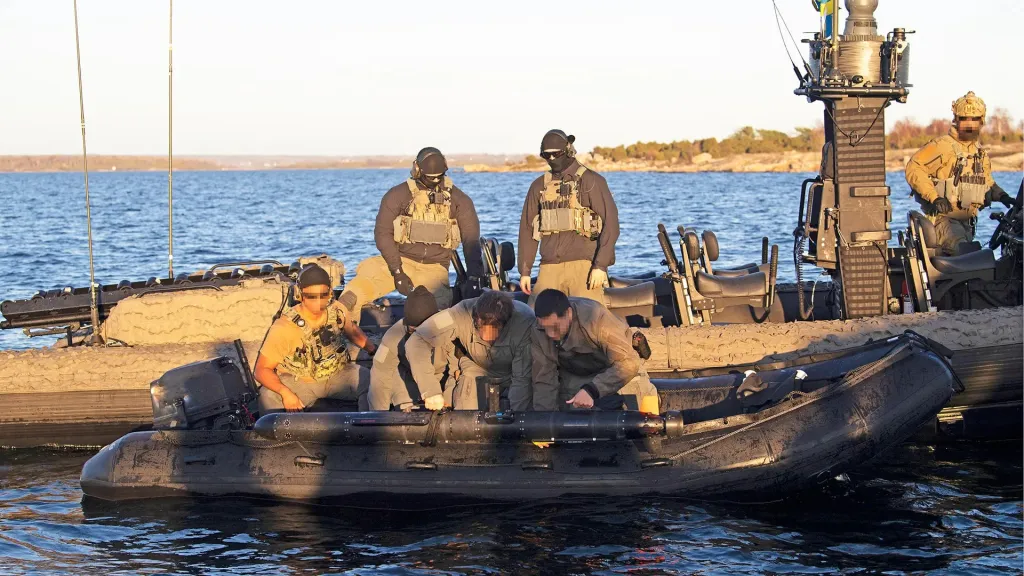
The U.S. Navy sees a future in which uncrewed underwater vehicles (UUV) work together with submersibles loaded with SEALs. The service has already been conducting tests to explore how crewed-uncrewed teaming under the waves might work. UUVs could help extend the operational reach of operators riding in SDVs, as well as help reduce their vulnerability, but there are communications and other challenges still to overcome.
Navy Capt. Mike Linn shared details about the Navy’s plans for teaming UUVs and various types of swimmer delivery vehicles (SDV) with our Howard Altman on the sidelines of the annual SOF Week conference yesterday. Linn currently works within the Naval Special Warfare program office (PMS 340), a division of the Naval Sea Systems Command’s (NAVSEA) Program Executive Office for Unmanned and Small Combatants (PEO USC).

“That is the goal,” Linn said when asked about the Navy’s view of teaming UUVs with SDVs, the latter of which the service also refers to as SEAL Delivery Vehicles.
As it stands now, the main workhorse of the Navy’s SDV force is the Mk 11, which is just under 22 and a half feet long. It is operated by a crew of two and can carry six passengers. Also referred to as the Shallow Water Combat Submersible (SWCS), the Mk 11 is what is known as a “wet” submersible design, where the occupants are exposed to water the entire time during their voyage. The Mk 11, like its predecessors, can be launched and recovered from submerged submarines with specialized Dry Deck Shelters (DDS) attached to their hulls.

The Navy has also acquired several new Dry Combat Submersibles (DCS) in recent years, which feature a pressurized cabin with space for a crew of two and eight passengers. This means the larger DCSs can operate at greater depths than the SWCSs. They also deliver their occupants to the destination dry and relatively warm, helping to reduce operator fatigue and certain potential health risks. The DCS does have the limitation of being too big to fit inside existing DDSs. At least publicly, this is understood to translate to the need for support from a mothership on the surface.

There are multiple UUV designs in the Navy’s inventory today, as well. These are largely torpedo-shaped designs intended to be deployed from and retrieved by vessels riding on the surface or submarines. In recent years, the service has been working to expand its ability to launch and recover UUVs from submerged submarines without the need to send out divers to help. Historically, underwater retrieval of UUVs, in particular, has been a largely manual affair, often conducted via DDS.

In terms of the potential benefits of UUV-SDV teams, “underwater systems like the SDV and UUVs afford reach underwater,” Capt. Linn explained. “So, if you can get somewhere in an SDV and then launch a UUV to go do something, then that would make you more capable.”
“You could extrapolate, just as you would have an unmanned wingman in an aircraft, or a maritime surface co-pilot, the same can be said for underseas,” he continued. “So, if you have an unmanned system with you underwater, then I suppose you can use your imagination.”
“A good example might be a harbor,” he added. “Technology is in a state where passing through the mouth of a harbor, a choke point, is maybe much more well defended. Or it is a choke point, and they don’t want to pass there with a big manned platform. So if you send a smaller unmanned platform through, then that’s pretty logical.”
“It can be an overall risk-reducer,” he further noted. A key mission set for Navy UUVs is scouting ahead for mines and other potential hazards, and otherwise helping commanders establish a better ‘view’ of the battlespace above and below the waves. This could all be especially valuable for SEALs during high-risk missions, including ones being conducted covertly or clandestinely.

Capt. Linn was also candid about the challenges the Navy still has to overcome to make this underwater teaming ability a reality. He described both crewed SDVs and UUVs as being “deaf, dumb, and blind” in terms of their current ability to communicate and coordinate with each other to ensure they are both in the right place at the right time.
“Through-water data transfer is difficult, and so the modality that you choose while remaining survivable is kind of difficult. And, also, in order to do that, you have to have pretty well synchronized systems,” he said. “We’re looking at all ways of transferring data through water. It can be acoustic, [and] there’s light-based transfers.”
There are other questions still be answered around how UUVs teamed with the SDVs would operate, including where the uncrewed companions would be launched from. If the SDVs have to carry them to the launch point themselves, this could present additional challenges.
“You’ve got to consider your volume in the SDV, which is not great,” Capt. Linn noted. “Are you going to strap it to the outside?”
He did confirm that testing is already being conducted to delve deeper into this potential pairing. He said that the Naval Surface Warfare Center Panama City Division (NSWC PCD), headquartered in Panama City, Florida, has been leading the charge.

“I think we’re still years away from having something at the reliability level that they want,” Capt. Linn added. “Again, back to the actual ones and zeros, and the modality of data transmission, [being at the] right time, right place,” and doing all of this “where you have to be survivable, that’s difficult.”
As Capt. Linn has made clear, significant hurdles will need to be cleared before UUV-SDV taming can become a reality. However, there are also real operational benefits that would come from pushing toward this goal.
Contact the author: joe@twz.com

Bolivian President Rodrigo Paz has announced a cabinet reshuffle and other measures as protests demanding his resignation continue. Paz said the government wants to build a collaborative government with broader participation from social and economic groups.
Published On 21 May 202621 May 2026
Share

Hundreds marched in Buenos Aires against President Javier Milei’s austerity policies and cuts to Argentina’s healthcare system. Protesters said funding cuts and rising costs are worsening access to healthcare and medicines and pushing the public health system into crisis.
Published On 21 May 202621 May 2026
Share

The walkout, which was due to start on Thursday, has been suspended while union members vote on a tentative deal.
Source link

Some lawmakers and legal experts say the department has violated federal law with its addendum to the settlement.
Source link

The TWZ Newsletter
Weekly insights and analysis on the latest developments in military technology, strategy, and foreign policy.
Trump’s White House ballroom, the controversy that keeps on giving, will of course be much more than just a ballroom and offices. This was always a given. Taking down an entire wing of the White House would be seen as the biggest opportunity in generations to install modernized hardened infrastructure at the most famous, most threatened, and highest-security house in America. Now, thanks to a remarkably detailed monologue and question-and-answer session from President Trump, we are learning a lot more about exactly what the ballroom’s security and military features will include, and just how deep the facility will go. The big takeaway here is that while it may be branded a ballroom, it’s really a fortress too — one with some very specialized and even somewhat puzzling capabilities.
Was there ever any doubt about this? They would never take this opportunity and not install a more survivable and much larger bunker. Also keep in mind the last major expansion and addition to the bunker facilities under the WH occurred under Obama. https://t.co/48WJKSTeAU https://t.co/MPJhDVT8Rm
— Tyler Rogoway (@Aviation_Intel) March 30, 2026
The fact that the ballroom is as much of a military and security services installation as it is its stated function comes as the administration seeks a billion dollars in new funding from Congress for the U.S. Secret Service. Of that money, $220 million would go toward the facility, while the rest would go to other efforts to enhance security around the complex. The total cost of the ballroom project has previously been estimated to be $400 million. Trump had said in the past that private donors would pay for the construction — another controversial aspect of the project.


The last time a major bunker complex was installed below the White House grounds was roughly a decade and a half ago, under President Barack Obama. During that period, a large but secretive project saw the installation of an expansive underground facility, supposedly five stories deep, beneath the North Lawn. This facility was far larger and more elaborate than the President’s Emergency Operations Center — the PEOC — that was built below the now destroyed East Wing and dates back, at least in part, to around World War II. This facility was made famous by the tragic events of 9/11.

Based on lessons learned from the rickety response to that crisis, the PEOC was also progressively upgraded throughout the Bush Administration and beyond. You can read all about the existing bunker facilities at the White House in our prior report linked here.
Now that the East Wing is gone, the historic PEOC is likely gone as well, and a much grander labyrinth of underground spaces is being installed in its place. It appears that these deep underground areas will take up a substantial part of the entire floor plate of the massive ballroom building, so we are talking about a huge amount of square footage here, not just a new emergency bunker. Think a multi-story underground office building more so than a bomb shelter.

Trump, standing in front of the foundation of the ballroom while the racket of work crews filled the air, went into detail to reporters yesterday as to what is being built beneath the ballroom. Some of the features he mentioned were already known about, but not elaborated on, and some were new. They included:
Trump goes on to proclaim the ballroom is actually a “shield” to protect all these sensitive areas. Overall, Trump says the facility is “already down about six stories deep.” He later restated that the complex does indeed go six stories down. Trump also said during his presser, “the underneath is far more complex than the upper” when discussing the overall structure.


Trump continued to detail some of the defensive features of the ballroom facility:

Trump calls construction of new White House ballroom ‘a gift’
NOW – Trump says a hospital, research facilities and meeting rooms, for the military, are being built below the White House ballroom. pic.twitter.com/JhcWBZScv4
— Disclose.tv (@disclosetv) May 19, 2026
Now we get into the really interesting and a bit peculiar part. Trump went on to say that the roof will have a “massive drone capacity.” He later adds that “it’s also meant as a drone port, so it protects all of Washington.” The president also stated that “we use it as a drone port. We can have unlimited drones up there, and drones are what’s happening right now.”
In another quote, Trump, talking about the roof again, said “on top of the roof, we’re going to have the greatest drone empire you’ve ever seen that’s going to protect Washington.” He also said systems from below the new ballroom facility will be put on the roof “for drone and missile capacity.”
So what is he actually talking about here?
First off, it is abundantly clear that this will be the most hardened overall structure on the White House grounds by a huge margin. It will feature passive defenses against many forms of attack. From the windows to the walls, the facility will be hardened to a level not seen on legacy structures on the property.
It will also have active defenses. Clearly, the drone issue is a massive one and has been for many years. This structure will serve as a secure place to do daily business if needed. Based on Trump’s comments, it will also act as a critical active defense node with its roof hosting air defenses, and apparently ones that are capable of at least a limited degree of area defense, not just highly-localized point defense. This is where drones could come into play. Drone interceptors (drones that intercept other drones) are well suited for the unique challenges of defending the White House and the Mall area as a whole, where collateral damage is a huge concern. Some of these systems use warheads, while others do not, physically smashing into their targets or blasting them with electrical pulses and other non-traditional effects instead. Drone interceptor capabilities are expanding rapidly now, equipping forward bases and warships. They proved critical in defending U.S. interests against Iranian attacks during the recent war. In Ukraine, they have proven indispensable in countering waves of Russian Shaheds.

Ukraine’s drone defense tech reshapes combat as warfare evolves

Raytheon Missiles & Defense proves counter-UAS effectiveness against enemy drones
So, it sounds like the roof of the ballroom is going to be a major air defense installation, at least for counter-drone applications, for the area, and interceptor drones will likely provide at least part of this capability, along with electronic warfare and possibly directed energy weapons. Surface-to-air missiles could find a home there, as well. There is a known rooftop FIM-92 Stinger-firing Avenger missile turret near the White House for this purpose today, which was installed not long after 9/11, but this capability could be expanded, at least in a crisis or during special occasions, to the rooftop of the new structure. It could even host longer-range systems. Currently, the capital area features the only permanent surface-to-air missile network in the United States, featuring the NASAMS system for medium-range defense, with launchers arrayed around the region.
Still, firing off a rocket packed with a high-explosive blast-fragmentation warhead low over the capital is a far more dangerous action than emerging alternatives, as mentioned above, at least for countering drones. Regardless, Trump alluded to systems being able to be stored in the bottom of the ballroom facility that can be moved up to the roof for protection. It’s unclear if some sort of lift system would allow this to occur more seamlessly on demand, if indeed his description was accurate, but being able to configure air defenses on the rooftop based on the threat at any given time would be highly advantageous.

Whether the president thinks drones will be used in the future to transport cargo and individuals to and from the White House grounds, using the roof of the new facility, isn’t clear, but it sounds like that’s at least part of the vision. Not long after the East Wing was torn down, we inquired with the White House if the ballroom’s roof would work as a helipad for Marine One. This inquiry was spurred by the chronic landing area issues with the new VH-92A Marine One helicopters. We never got a response, but the news hit this week that the White House is now looking to build a helicopter landing pad due to this issue. It isn’t perfectly clear if the ballroom could serve in this role or at least be used as an alternative landing site.

Finally, it’s clear that the underground portion of the ballroom will include a multitude of command and control, training, computers, and communications support areas, and much more for military operations and defense of the White House itself. Much of this also fits into the continuity of government realm, a key mission for the USSS and the White House Military Office. Considering the size of the new facility, it will likely also have a lot of room for future expansion.
That being said, it is worth noting that while a modern underground facility like this may be more secure, it cannot even come close to protecting against a direct nuclear attack. The requirements for such an installation far exceed anything we are seeing with the ballroom (or anywhere else really).
Trump added in his presser yesterday that with the ballroom will come “great military capacity, we are building it in conjunction with the United States military.” Exactly how the marriage of the military’s and the Secret Service’s wants and building a huge building for galas came together is unclear. The timeline of events that gave birth to the ballroom-fortress concept seems fascinating in its own right.
With that in mind, and considering this was all in the blueprints for the highly complex structure being built now, the military and the USSS were clearly deeply involved in its design from early on, which makes it puzzling as to why the White House is just asking for funding for those security features now.
Regardless, while this new addition to the White House grounds may be referred to as a ballroom, it is one built atop a sprawling military installation and cocooned within a hardened armor shell that has many other roles than its stated purpose.
Contact the author: Tyler@twz.com

The childhood best friends from Liverpool are the youngest duo in this series of the BBC show.
Source link

Washington, DC – US Ambassador to Israel Mike Huckabee has become the first official from the administration of President Donald Trump to join global criticism of Israel’s far-right national security minister, Itamar Ben-Gvir.
But as several countries summoned Israel’s ambassadors after Ben-Gvir posted a video of himself taunting abducted foreign activists from a Gaza-bound aid flotilla, Huckabee’s response rang largely hollow, coming a day after the US Department of the Treasury had sanctioned the flotilla organisers.
list of 3 itemsend of list
It was the latest incident underscoring a US double standard towards Israel, Palestinians and their supporters, analysts said, and one that showed the US and Israel increasingly out of step with the international community.
“We see a big difference between the US and other Western countries… who see things like freedom of navigation in international waters as a fundamental concept of international law that should be respected, not to mention the mistreatment of civilians,” said Michael Omer-Man, the Israel-Palestine director at the DAWN advocacy group.
Huckabee made his comments on Wednesday, shortly after Italy, France, the Netherlands and Canada summoned Israeli ambassadors over Ben-Gvir’s video, which showed detained activists kneeling on the floor with their hands bound, and at times being shoved to the ground.
Ben-Gvir is seen waving an Israeli flag, shouting and pointing over the detainees.
In a post on X, Huckabee referenced a slew of Israeli officials who have criticised Ben-Gvir for the video, including Prime Minister Benjamin Netanyahu and Minister of Foreign Affairs Gideon Saar.
Huckabee pointed to “universal outrage from every high-ranking Israeli official”, tagging Netanyahu, Saar, the office of Israeli President Isaac Herzog, and Israel’s ambassador to the US, Yechiel Leiter.
“Flotilla was stupid stunt, but Ben Gvir betrayed dignity of his nation,” Huckabee wrote.
Rights observers have long documented Israeli abuses against Palestinian detainees and their supporters from abroad, including detained activists flotilla activists. Israeli authorities have largely dismissed such accounts.
Critics questioned whether the groundswell of condemnation from officials in Netanyahu’s government, which has emboldened far-right figures like Ben-Gvir, was motivated by the abuses committed or by Ben-Gvir’s decision to post it online.
“I do believe that they’re more focused on the public relations side of it,” Omer-Man told Al Jazeera, “both with regards to the international community… and because it’s election season [in Israel] and they’re trying to distinguish themselves as the more stately, less radical actors”.
Annelle Sheline, a research fellow at the Quincy Institute for Responsible Statecraft, said Ben-Gvir’s actions should be seen not as an aberration, but also as part of a manifestation of a US policy that has long fostered impunity and emboldened Israel’s far right.
“Israel knows that as long as it has the unconditional support of the US, it will face no real consequences,” Sheline told Al Jazeera.
The former administration of US President Joe Biden had ruled out sanctioning Ben-Gvir and Finance Minister Bezalel Smotrich as its term ended in 2024, despite mounting calls from US lawmakers to do so.
In a letter that year, nearly 80 members of Congress charged that Ben-Gvir had played a role in “inciting violence against Palestinian civilians, encouraging the construction of illegal outposts, and preventing enforcement against violent settlers” in the occupied Palestinian territory.
That included using his position to “prevent police from protecting humanitarian convoys bound for Gaza, allowing settlers to attack and halt aid”.
Upon taking office, the Trump administration lifted a set of US sanctions imposed on violent Israeli settlers. Shortly after, the administration imposed sanctions on several Palestinian civil society organisations and rights groups for supporting an International Criminal Court (ICC) investigation into Israeli officials.
The administration has also imposed sanctions and travel restrictions on ICC prosecutors and Palestinian Authority officials.
The latest round of US sanctions targeted four organisers of the Global Sumud Flotilla, seeking to break the siege of Gaza, deliver aid and show solidarity with Palestinians. Two of the organisers were from the Popular Conference for Palestinians Abroad (PCPA), and two others were from the Palestinian prisoners’ solidarity network Samidoun.
US Treasury Secretary Scott Bessent said the activists were part of a “pro-terror flotilla”, claiming the humanitarian effort was “in support of Hamas”.
Organisers have roundly rejected the statement, with Samidoun decrying the sanctions against flotilla activists and Palestinian organisations as “aiding and abetting genocide”.
DAWN’s Omer-Man said the latest sanctions further underscore that the Trump administration is “accepting [Israel’s] arguments – that trying to break the blockade is illegal in some way – at face value”.
“I think we can say that the United States, officially, is just never going to criticise Israel under the Trump administration,” he said.
The Quincy Institute’s Sheline said the rare instances of public rebuke from the Trump administration, including Huckabee in November last year, labelling settler violence as “terrorism”, mean little against the billions of dollars in military aid Washington continues to provide to Israel.
“Weak gestures… are insignificant in the face of billions of dollars a year,” she said.

Rodrigo Paz is under pressure from weeks of demonstrations and poor economic conditions.
Published On 20 May 202620 May 2026
Bolivia’s right-wing President Rodrigo Paz has said he will reorganise his cabinet as he faces calls to resign amid weeks of widespread protests.
During a news conference on Wednesday, Paz said he would reshuffle his ministers in a bid to ease tensions with antigovernment protesters.
list of 3 itemsend of list
“We need to reorganise a cabinet that must be able to listen,” Paz told reporters.
Since taking office in November, Paz and his government have faced backlash to economic restructuring measures, including controversial cuts to fuel subsidies. The country is in one of its worst economic crises in decades.
Protesters have taken to the streets to express frustration with Paz’s free-market reforms. His inauguration ushered in a period of right-wing leadership after nearly two decades of governance by the Movement for Socialism (MAS).
Thousands of farmers, labourers, miners and teachers have denounced Paz’s reforms. Riot police clashed with protesters again in the capital, La Paz, earlier this week.
While Paz acknowledged frustrations in his remarks on Wednesday, his government has depicted the protests as dangerous and anti-democratic.
Minister of Foreign Affairs Fernando Aramayo said earlier in the day that the mass protests and roadblocks were aimed at destabilising the country and “disrupting the democratic order”.
Former leftist President Evo Morales, who continues to exert influence over the country’s politics, has expressed support for the demonstrations.
The Paz government, meanwhile, has accused Morales of fomenting unrest. The former socialist president faces charges of statutory rape and has an arrest warrant out against him. His allies, however, say the charges are part of an effort to remove him from political life.
The administration of US President Donald Trump has expressed support for Paz, whose election is seen as part of a regional shift to the right.
“Let there be no mistake: the United States stands squarely in support of Bolivia’s legitimate constitutional government,” Secretary of State Marco Rubio said in a social media post on Wednesday. “We will not allow criminals and drug traffickers to overthrow democratically elected leaders in our hemisphere.”
Paz also slammed Colombian President Gustavo Petro, who has frequently feuded with right-wing governments in the region, for recent comments describing the protests as a “popular insurrection”.
The Bolivian Ministry of Foreign Affairs announced on Wednesday that it would ask the Colombian ambassador to leave the country, citing interference in domestic political affairs.
“If they expel the ambassador simply for proposing dialogue and mediation, it means we’re sliding towards extremism that could lead to a very difficult situation for the Bolivian people,” Petro said in an interview with the local radio station Caracol.

The deal, valued at more than $300m, gives Murdoch control of a storied magazine and a podcast division with a reach valued by advertisers.
Published On 20 May 202620 May 2026
Media scion James Murdoch has agreed to acquire New York Magazine and the Vox Media Podcast Network in a deal that will significantly expand his portfolio and stands to boost his influence over news and entertainment.
“This acquisition reflects both our interest in the forward edge of culture and our deep commitment to ambitious journalism,” Murdoch, the younger son of media mogul Rupert Murdoch, said in a statement on Wednesday announcing the transaction. His company Lupa Systems will buy both properties from Vox Media.
list of 4 itemsend of list
The deal, valued at more than $300m, gives Murdoch control of a storied magazine known for its coverage of culture, politics and fashion, and a podcast division whose reach, among a demographic coveted by advertisers, rivals that of cable television news networks, according to several people with direct knowledge of the acquisition. The politics news site Vox.com is also included.
Murdoch and his wife Kathryn Murdoch were intimately involved in courting key talent from Vox, specifically Kara Swisher and Scott Galloway, stars of the popular Pivot podcast, as well as several other programmes on the company’s podcast network.
“I like James and Kathryn,” Swisher said in a phone interview. “Unlike many other media owners these days, they’re savvy about the business and willing to take smart risks.”
Vox’s podcast division was valued much higher than New York Magazine in the transaction, two of the people said, spotlighting the importance of making sure top programmes were locked in. Pivot, for example, has three years remaining on its contract, which will continue under Murdoch. Swisher met with the investor and his wife Kathryn several times before the deal came together.
“In a company like Vox, if its talent doesn’t like something, it’s not gonna happen,” Galloway said in an interview. He added, “James is the only Murdoch that this deal could have happened with.”
Several years ago, James was locked in a fierce dispute with his father over the editorial direction and future control of the family’s media empire. In 2019, he founded Lupa after stepping down as chief executive of 21st Century Fox. In 2020, he resigned from the board of News Corp, the publishing arm of the family’s media empire, citing “disagreements over certain editorial content”.
Vox’s podcast and publishing assets will operate as a subsidiary of Lupa Systems, which also owns Art Basel, which hosts annual events in Paris, Miami, Hong Kong, and Doha, and Tribeca Enterprises, the media and entertainment company cofounded by Robert De Niro and Jane Rosenthal.
Vox Media CEO Jim Bankoff will join Lupa Systems and will continue to lead the brands under the Vox Media label, he said in a note to the company’s staff, adding the deal is expected to close in four to six weeks.
New York Magazine’s publications include The Cut, Vulture and Intelligencer, with a digital audience of tens of millions and more than 400,000 paying subscribers currently.
The acquisition does not include other Vox Media brands such as Eater, Popsugar and The Verge. These brands, along with SB Nation and The Dodo, will become an independent company under a new corporate name.
James’s father, Rupert Murdoch, once owned New York Magazine from the late 1970s till he sold it in 1991.

The victory of Chris Rabb in a US House of Representatives primary in Pennsylvania represents a boost to Democrats’ progressive flank, a movement that has come under heavy pressure in recent years.
Running to represent a district stretching across Philadelphia, widely considered the “bluest” in the country, Rabb handily defeated his top competitors. The state lawmaker carried about 44 percent of the vote, compared with about 30 percent for State Senator Sharif Street and 24 percent for paediatric surgeon Ala Stanford.
list of 3 itemsend of list
With no Republicans on the ballot in the primary, Rabb is expected to skate to victory in the midterm.
While all candidates sought to highlight progressives’ bona fides in the race, Rabb skewed farthest left, railing against the political machinery that has long played kingmaker in local politics.
He also broke from his opponents on US policy towards Israel. He has pledged to join 12 current members of Congress in signing a resolution recognising the Nakba and has urged his competitors to describe Israel’s actions in Gaza as a “genocide” on the campaign trail.
In one exchange with voters, Stanford appeared to say that using the term “genocide” was “harmful”. Street, whose victory would have made him Philadelphia’s first Muslim member of Congress, has also been criticised for a lack of clarity on the issue.
In a statement, Kendra Brooks and Nicolas O’Rourke, cochairs of the Pennsylvania Working Families Party, said the race was a weathervane for Democrats.
“The question in this race was not whether we would elect a Democrat, but what kind of Democrat we would choose,” they said.
“The people of Philadelphia made their choice clear: bold, working-class leadership, and an end to the broken status quo.”
Indeed, the race in many ways mirrored internal strife for Democrats, kicked into overdrive following the party’s routing in the 2024 election.
Street, the former chair of the Pennsylvania Democratic Party, and Stanford, who was endorsed by outgoing Representative Dwight Evans, have largely been viewed as representing the party’s longstanding establishment.
Underscoring that perception, earlier this Month, Axios reported that Pennsylvania Governor Josh Shapiro had urged building unions supporting Street not to run attack advertisements against Stanford, over concerns it would boost Rabb’s chances.
Rabb, meanwhile, had been endorsed by a series of progressive stalwarts, including Representatives Ocasio-Cortez, Representative Ilhan Omar and Senator Chris Van Hollen and progressive groups, including Justice Democrats and the Sunrise Movement.
The Socialist Democrats of America, who endorsed Rabb early on in the race, have been largely credited with leveraging their ground operation before the primary win.
“We will be with Congressman Rabb every step of the way in the fight to abolish ICE (Immigration and Customs Enforcement), free Palestine and win Medicare for All,” the group said on Wednesday.
Rabb’s win represents a sign of hope for progressives, who have been heavily targeted in primary races, particularly for their criticism of Washington’s longstanding support for Israel.
In 2024, both Cori Bush of Missouri and Jamaal Bowman of New York, members of the so-called Progressive “squad” in Congress, lost their primary races amid a massive influx of spending by AIPAC and pro-Israel lobby groups. All told, AIPAC and affiliated groups spent about $25m to unseat the pair.
Progressives have so far seen a mixed bag this primary season. Analilia Mejia saw an early surprise victory when she defeated former Representative Tom Malinowski in February.
Malinowski, who has long portrayed himself as a centrist, was targeted by AIPAC in the 11-way race, in a strategy that has been viewed as a major backfire for the pro-Israel lobby. Instead of boosting a pro-Israel candidate, AIPAC’s targeting indirectly buoyed Mejia, a staunch critic.
In Texas, pro-Palestine pastor and civil rights leader Frederick Haynes III also won his primary race. Haynes was also endorsed by the Justice Democrats, an organisation launched in 2017 to support progressive candidates. The group has endorsed 15 candidates so far this year.
Three other progressive candidates, Junaid Ahmed and Kat Abughazaleh in Illinois, and Nida Allam in North Carolina, lost their primaries amid a massive onslaught of opposition spending from pro-Israel and artificial intelligence-aligned groups.
Still, Justice Democrats spokesperson Usamah Andrabi said Rabb’s victory was an energising sign before a slate of competitive races in June.
Also in Pennsylvania, incumbent Representative Summer Lee easily sailed to victory in her Democratic primary race in Pittsburgh.
“The sky is the limit,” Andrabi told Al Jazeera, “and it is clear that the Democratic base is desperate for a new generation of leadership that not only takes on Republican extremism but takes on the Democratic establishment and their corporate backers all at once.”
Tuesday’s primaries across six states saw the battle lines for the midterm election in November further drawn.
The vote will determine which party controls the US Senate and the US House of Representatives, which will set the pace for US President Donald Trump’s second term in office.
Most notably on the Republican side, US Representative Thomas Massie lost his primary race to Trump-backed challenger Ed Gallrein, in what was the most expensive House primary race in history.
Massie had broken with Trump on the investigation into billionaire financier Jeffrey Epstein, the war in Iran, and US support for Israel. His loss indicated Trump’s enduring hold over the party.
But it remained to be seen if that influence would extend to the general election, with Trump’s approval ranking tanking in recent months amid the war with Iran and its knock-on economic fallout. Polls have shown the president’s support has been particularly hard hit among independents, who typically do not vote in primaries.
In Georgia, two Republicans, Congressman Mike Collins and former football coach Derek Dooley, will advance to a run-off election on June 16 in the US Senate race. The winner will take on Democrat Jon Ossoff in one of the closest-watched races of the season.
Meanwhile, Democrat Keisha Lance Bottoms, the former mayor of Atlanta, won the party’s primary in the gubernatorial race. Two Republicans, Rich Jackson and Burt Jones, meanwhile, will head to a run-off.
The race is set to be consequential, with election administration – and the redrawing of congressional maps – in the state looming large in 2024 and potentially set to play a key role in the 2028 race.

The TWZ Newsletter
Weekly insights and analysis on the latest developments in military technology, strategy, and foreign policy.
Nine American destroyers stand at the vanguard of the U.S. Navy’s efforts to integrate laser weapons into the battlefield of the future. Lasers and other directed energy (DE) weapon systems went from an elusive dream to reality over the past decade, which TWZ has covered extensively. We’ve now compiled the most complete public accounting of the warships equipped with operational systems today, where they’re deployed, and what they can do.

The U.S. military is moving aggressively to reduce reliance on expensive single-use munitions, and laser weapons are oft-touted as part of a long-term solution. The recently released FY2027 budget reflects the urgency, with billions appropriated for scaled directed energy research and development (R&D) programs. “DE capabilities offer an inexpensive cost-per-shot alternative to conventional systems, increased magazine depth, and enhanced defense-in-depth,” budget documents state. The volume of high-end munitions expended during Operation Epic Fury, previous engagements with Iran, and the fight in and around the Red Sea against the Houthis, not to mention the near half-decade-long war in Ukraine, has sparked debate around the status and depth of U.S. stockpiles, driving renewed interest and investment in low-cost, reusable alternatives.
Countering swarms of cheap Iranian drones and missiles during extended combat operations presents a new challenge for America’s Arleigh Burke class destroyers, which are limited by how many missiles can be packed into 90 or 96 vertical launch system (VLS) cells and can only be reloaded at friendly ports with proper gear. Lasers, in contrast, do not face the same constraints, although the services have faced significant hurdles in fielding operational systems in the past.
The Navy has armed nine guided-missile destroyers with shipboard solid state lasers (SSLs) for self-defense since we reported on the first in November 2019. “The Navy has placed directed energy systems on nine ships and is working to expand testing and employment in the fleet,” a U.S. Navy official confirmed to TWZ. However, the official declined to discuss current operations when asked if the systems were employed against Iranian forces in the Middle East.


While the U.S. has several SSL programs in various stages of testing and development, two primary systems are operational on warships today: the Optical Dazzling Interdictor, Navy (ODIN), and the High Energy Laser with Integrated Optical-dazzler and Surveillance (HELIOS). TWZ has covered both systems in detail before, which you can read about here and here.
ODIN, the first SSL scaled across multiple destroyers, features a low-powered laser designed to work as a “dazzler” to blind or confuse the electro-optical and/or imaging infrared seekers on incoming weapons, such as one-way attack drones, throwing them off course. The system can also neutralize cameras and sensors used for intelligence, surveillance, and reconnaissance (ISR) deployed aboard enemy ships, submarine masts, crewed aircraft, and drones. Initially, ODIN was installed on eight ships, but one unit was transferred for training to Naval Surface Warfare Center Port Hueneme from USS Kidd (DDG-100), which is completing a two-year maintenance availability in Everett, WA.

Two ODIN-enabled destroyers are on combat deployments in the U.S. Central Command (CENTCOM) area of responsibility (AOR). USS Spruance (DDG-111), part of the five-ship Abraham Lincoln Carrier Strike Group and the independently deployed USS John Finn (DDG-113) are operating in the Indian Ocean supporting ongoing operations against Iran. USS Gridley (DDG-101), the only other ODIN-equipped DDG underway, is in the South Atlantic Ocean escorting aircraft carrier USS Nimitz (CVN-68) to her new homeport at Norfolk. The four other destroyers are at their respective homeports in San Diego and Yokosuka, as depicted in the graphic at the top of this post.

The far more powerful but less numerous HELIOS system, integrated solely on USS Preble (DDG-88), is a 60-kilowatt (kW) class laser weapon capable of knocking down smaller unmanned aerial systems (UAS) and burning holes in fast inshore attack craft (FIAC), as well as functioning as a dazzler like ODIN. The system, which also carries the designation Mk 5 Mod 0, provides a low cost-per-shot capability to address anti-surface warfare and counter-ISR threats, while fully integrating with the Aegis Combat System. Lockheed Martin has previously discussed scaling the power rating up to 150kW.


Preble, the only destroyer currently equipped with HELIOS, is forward-deployed and at homeport in Yokosuka, Japan. During a demonstration last year, Preble successfully disabled four incoming drones. Funding for additional tests and maintenance was included in the FY2027 budget.

The Navy has also installed other experimental high-energy laser directed energy weapons on ships in the past, such as the Laser Weapon System Demonstrator tested aboard USS Portland, and test-fired a LOCUST laser from an aircraft carrier for the first time last year. The latest budget request supports R&D for several programs, including a containerized 150kW Joint Laser Weapon System (JLWS) for cruise missile defense, the Joint Beam Control System (JBCS) technology to develop a 300-500kW laser, and upgrades for the High Energy Laser Counter Anti-Ship Cruise Missile Project (HELCAP).
Regardless, while laser weapons are very attractive for all the reasons listed earlier in this article, their application remains limited by various factors. Laser weapons capable of downing drones and disabling small boats have a range measured in single miles, at best, so they are only capable of providing close-in defense. This is further impacted, and heavily so, by atmospheric conditions. They also need to have their beam dwell on the target for extended periods of time in order to burn a hole in it. As a result, their ability to rapidly engage targets, and especially at range in all weather conditions, is very limited. Thermal and power supply restrictions also impact their ability to make rapid follow-up shots. Finally, lasers remain finicky pieces of technology and are full of delicate components, which has impacted reliability in the field.
Still, even with all these limitations, these systems are improving and their range, reliability, and power will increase over time. As a result, they will only become a more important part of naval warfare in the coming years, with hopes that their ability to rapidly down faster-flying missiles isn’t too far over the horizon.
Contact the author: ian.ellis-jones@teamrecurrent.io