Politics Desk

Republicans launch a voting bill debate that could last days or even weeks

Republicans launched an unprecedented effort on Tuesday to hold the Senate floor and talk for days about a bill that they know won’t pass — an attempt to capture public attention on legislation requiring stricter voter registration rules as President Trump pressures Congress to act before November’s midterm elections.

The talkathon could last a week or longer, potentially through the weekend, as Senate Majority Leader John Thune (R-S.D.) tries to navigate Trump’s insistence on the issue and Democrats’ united opposition. Trump has urged Thune to scrap the legislative filibuster, which triggers a 60-vote threshold in the 100-member Senate, or find another workaround to pass the bill, but Thune has repeatedly said he doesn’t have the votes to do that.

Instead, Republicans intend to make a long, noisy show of support for the legislation, which would require Americans to prove they are U.S. citizens before they register to vote and to show identification at the polls, among other things. It’s a risky strategy, with no guarantee it will be enough for Trump, who has said he won’t sign other bills until the Safeguard American Voter Eligibility Act — also known as the SAVE America Act or the SAVE Act — is passed.

The floor debate is expected to eventually end with a failed vote. Republicans need 60 votes to advance the bill to a final vote, but they hold 53 seats, and all 45 Democrats and both independents, who caucus with the Democrats, oppose it.

The debate will “put Democrats on the record,” Thune said. He added that “how it ends remains to be seen.”

The Senate voted 51 to 48 Tuesday to begin the debate, with Alaska Sen. Lisa Murkowski the only Republican voting against moving forward on the bill.

In a social media post on Tuesday morning, Trump issued a warning to any Republican who doesn’t support the bill: “I WILL NEVER (EVER!) ENDORSE ANYONE WHO VOTES AGAINST ‘SAVE AMERICA!!!’”

Creating strict voter registration rules

Trump says, without evidence, that Democrats can only win in the midterms if they cheat and explicitly said Republicans need the SAVE America Act to win in November. The House passed the legislation earlier this year, but the Senate turned to other issues as it became evident that Republicans didn’t have the votes to pass it.

But Trump made clear he wasn’t satisfied and pushed the Senate to act. The Republican president has said he won’t sign other legislation, including a bipartisan housing bill backed by the White House, until the voting bill passes.

The bill contains a slew of provisions that Trump and his most loyal supporters have pushed as part of a broad effort to assert federal control over elections. It would require voters nationwide to provide proof of citizenship when they register and to show accepted voter identification when casting a ballot.

It would also create new penalties for election workers who register voters without proof of citizenship and require states to hand voter data over to the Department of Homeland Security so federal officials could screen for voters who are in the country illegally.

Trump also wants new provisions added to the bill, including a ban on most mail-in ballots.

“It’ll guarantee the midterms,” Trump said of the bill last week. “If you don’t get it, big trouble.”

Democratic opposition to the bill is firm

Democrats and many groups that champion voter access say there is little evidence of noncitizens voting and say the bill would disenfranchise millions of voters — including Republicans — by creating new burdens to prove citizenship.

It is already illegal to vote if you are not a U.S. citizen, but the bill would lay out strict new rules for paperwork that most people would have to present in person to register to vote. Opponents of the measure say those documents are not always readily available for many people and argue that it would kill voter registration efforts and unfairly penalize young people who are registering to vote for the first time, married women who change their last name and people who cannot travel to present their documents, among other groups.

While Republicans have focused on the bill’s new requirements to show identification when they show up to vote, Democrats say they are most concerned that the legislation would allow the federal government to take voters off the rolls.

Senate Minority Leader Chuck Schumer (D-N.Y.) said that Democrats are not opposed to voter identification but “this is about purging the voter rolls in a massive way, so you never even get the chance to show a voter ID when you showed up to vote.”

Expect a show on the Senate floor

Trump, backed by Republican Sen. Mike Lee of Utah, has pushed for a talking filibuster, which would force Democrats to talk for days or weeks to delay passage of the bill. But Thune and the larger GOP conference rejected that idea, arguing that it would end in failure after giving Democrats a stage and the opportunity to offer endless amendments, potentially adding their priorities to the bill.

Republicans are instead taking over the floor with their own speeches, proceeding under regular order but operating outside the normal time limits that are customary when debating legislation. Democrats are expected to answer with their own procedural hijinks, potentially forcing Republicans to come to the floor at all hours for votes, meaning they will need to stay close to the Senate for the duration.

Lee said last week that it’s unclear how it will all play out. He said he thinks Trump “understands that we need to put in an aggressive effort here.”

“And a lot of that,” he said, “is going to have to be determined in real time as we go about it.”

The extent of Trump’s satisfaction with the process, Lee said, “will depend on whether, in his view, we gave it everything we have.”

On Monday night, Lee was rallying voters in Trump’s base on X.

“Once we’re on this bill,” he wrote, “we must stay on it until it’s passed into law.”

Jalonick writes for the Associated Press. AP writer Lisa Mascaro contributed to this report.

Source link

Cesar Chavez celebrations canceled over ‘profoundly shocking’ allegations

The United Farm Workers said it would not participate in celebrations of its founder Cesar Chavez amid what the labor union described as “troubling allegations” against the iconic Chicano figure.

The union, in a statement released Tuesday, did not detail the accusations against Chavez but said they were concerning enough for the organization to take action. But several events around the country honoring Chavez including events in Tucson, Houston, Corpus Christi, San Antonio and San Bernardino have been canceled in recent weeks, with little explanation given by organizers.

The claims against Chavez “are incompatible with our organization’s values. Some of the reports are family issues, and not our story to tell or our place to comment on. Far more troubling are allegations involving abuse of young women or minors. Allegations that very young women or girls may have been victimized are crushing. We have not received any direct reports, and we do not have any firsthand knowledge of these allegations,” the union said.

Canceling events, the union said, would “provide space for people who may have been victimized to find support and to share their stories if that is what they choose.”

Chavez is a towering national figure credited with organizing and raising the lives of migrant farmworkers in California and beyond and giving voice to the struggles of Mexican Americans.

Bursting into national prominence in the mid-1960s in the San Joaquin Valley, Chavez galvanized public support on behalf of them after organizing community groups across Central and Southern California. For decades, agricultural laborers had lived in substandard housing and were paid terrible wages. Efforts to organize migrant laborers were usually crushed violently by farmers and local law enforcement.

Chavez and his associates joined a grape pickers’ strike in 1965 launched by Filipino organizers centered around Delano, the heart of California’s table grape crop. Those early years were marked by bitter and sometimes brutal incidents involving picketing farmworkers who screamed “Huelga!” — “Strike!”—and growers who vowed never to give in to Chavez and his movement.

Sen. Robert Kennedy and Cesar Chavez as Chavez ended a 25-day fast.

Sen. Robert Kennedy and Cesar Chavez as Chavez ended a 25-day fast.

(Bettmann Archive)

That eventually transformed into a boycott that earned international attention. Chavez, drawing on his Catholic faith, fasted for 25 days in 1968 to draw attention to the violence swirling around the effort, ending it by sharing bread with then-presidential candidate Robert F. Kennedy. Two years later, the UFW was able to secure contracts for more than 10,000 grape pickers.

Those successes made Chavez an almost mythic figure. The UFW flag — a stylized black Aztec eagle against a red background — became synonymous with the Chicano movement that was emerging at the same time. Posters and murals featuring Chavez’s beatific face sprouted in the Southwest and beyond. He traveled across the United States espousing his philosophy of nonviolence, union and dignity for farmworkers.

A 1983 poll of Latinos by The Times found Chavez to be the most admired leader.

But Chavez’s legacy became increasingly tarnished as the years went on. Labor victories became fewer and fewer. His fierce criticism of illegal immigration — Chavez argued that they undercut his unionization efforts — put him at odds with immigration activists. A 2006 Times investigation detailed how dozens of former associates and workers left the UFW because of what they described as Chavez’s increasingly autocratic ways.

Cesar Chavez talks to striking Salinas Valley farmworkers

Cesar Chavez talks to striking Salinas Valley farmworkers.

(Sakuma / Associated Press )

When the Los Angeles County Board of Supervisors decided to change the name of Brooklyn Avenue in East Los Angeles and Boyle Heights to Cesar Chavez Avenue after the labor leader’s death in 1993, many in the community opposed it, citing the economic burden businesses would undergo to update their addresses and the erasure of the community’s history on the street.

Yet his standing among Latinos nationwide was such that schools, streets and parks were renamed in his honor in the years after his death. In 2012, President Obama went to tiny Keene, Calif. — where Chavez had set up both his home and the operational headquarters of the United Farm Workers — to dedicate the César E. Chávez National Monument.

It’s unclear the source of the new allegations or when they might become public. But there has been rumbling for weeks among activists that something about Chavez was coming.

A Corpus Christi march was called off last week after labor leader Dolores Huerta withdrew, the San Antonio Express-News reported.

Huerta is not commenting on the issue at this time, said Eric Olvera, spokesperson for Huerta.

The news comes two weeks before Cesar Chavez Day, observed March 31.

Local organizers in Los Angeles haven’t announced whether they will cancel their events.

The UFW was vague about the claims but suggested they were serious enough for extreme action.

“These allegations have been profoundly shocking. We need some time to get this right, including to ensure robust, trauma-informed services are available to those who may need it.

“We understand this will be tremendously painful for many and we encourage our community to seek mental health support if they experience distress.”

Tuesday morning, the Cesar Chavez Foundation said in a statement that it had “become aware of disturbing allegations that Cesar Chavez engaged in inappropriate sexual behavior with women and minors during his time as President of the United Farm Workers of America.”

The foundation said it was working with leaders in the farmworker movement to be responsive to these allegations and support the people who might have been harmed.

“In partnership with the UFW, we are establishing a safe and confidential process for those who wish to share their experiences of historic harm, and, if they choose to, participate in efforts toward repair and reconciliation,” the statement said. “In addition, we are investing time and resources to ensure the Foundation promotes and strengthens a workplace culture that is safe and welcoming for all.”

In the 48 hours before the UFW and Cesar Chavez Foundation made their statements, La Unión del Pueblo Entero, a community-based union and nonprofit in the Rio Grande Valley of Texas, which was founded by Huerta and Chavez, erased the names and affiliation with the leaders from its website.

The new allegations could have implications beyond Chavez’s place in history. If he has been accused of sexual abuse, a legal expert said it could spark legal claims against the union he ran for so long.

In California, Assembly Bill 250 opened a two-year window to file sex assault claims beyond a previous statute of limitations. The Catholic Church, Scouting and public school districts, as a result, have been hit hard with lawsuits.

“It is [a] matter [of] who knew what and when,” said John Manly, a sexual abuse attorney, adding that Chavez’s leadership role could create liability for the UFW.

Source link

Trump attacks Newsom again for having dyslexia, says it disqualifies him from being president

President Trump has once again mocked Gov. Gavin Newsom’s dyslexia as “disqualifying” for leadership, marking at least the fourth time in a week that the president has targeted the California Democrat for being open about his diagnosis.

In remarks Monday in the Oval Office, Trump said Newsom was “dumb” and should never be allowed to be president because he has “admitted that he has learning disabilities, dyslexia.”

“That’s how crazy it’s gotten with a low-IQ person,” Trump said. “Honestly, I’m all for people with learning disabilities but not for my president. … And I know it’s highly controversial to say such a horrible thing.”

But in the course of his needling, Trump mistakenly elevated his political rival to the rank of commander in chief — repeatedly referring to Newsom as “the president of the United States.” Newsom took the opportunity to turn the tables on the president.

“I, GAVIN C. NEWSOM, AM OFFICIALLY PRESIDENT OF THE UNITED STATES (THANK YOU DONALD!)” he wrote on X Monday.

The clash is the latest in a storied contest of chest-beating between Trump and Newsom, who have made sport of bad-mouthing one another across campaign rallies, interviews and social media.

A model stealth bomber in front of US President Donald Trump during an executive order signing

A model stealth bomber sits in front of President Trump during an executive order signing in the Oval Office Monday.

(Aaron Schwartz / Bloomberg via Getty Images)

The president has frequently cast Newsom as a symbol of the liberal governance he opposes, while the governor has leaned into the confrontations, often using them to elevate his national profile and position himself as a leading Democratic counterweight. His sparring with the president appears to be part of an aggressive strategy to amplify his own messaging as he weighs a potential run for president in 2028. This time, Newsom used the spotlight to support young people with dyslexia.

“To every kid with a learning disability: don’t let anyone — not even the President of the United States — bully you,” Newsom wrote on X. “Dyslexia isn’t a weakness. It’s your strength.”

The insults first materialized when a video went viral of Newsom speaking at a book tour appearance with Atlanta Mayor Andre Dickens during which he discussed his lifelong struggle with the learning disability. Since then, the president has repeatedly poked at the vulnerability.

Trump has brought up the governor’s dyslexia at least four times in the last week. He mentioned it at a political rally in Kentucky last week, where he equated dyslexia with a “mental lack of ability,” and again during a Fox News Radio interview on Friday, in which he reiterated that “presidents can’t have a learning disability.” In a post on Truth Social, Trump labeled Newsom’s admission a “politically suicidal act,” calling him “dumb” and “A Cognitive Mess!”

After the Kentucky rally, Newsom responded to Trump.

“I spoke about my dyslexia, I know that’s hard for a brain-dead moron who bombs children and protects pedophiles to understand,” he said.

Dyslexia affects as much as 20% of the population, according to the Yale Center for Dyslexia and Creativity. Despite affecting a such a wide portion of the population, the condition is widely misunderstood, according to dyslexia researcher Dr. Helen Taylor of the University of Cambridge.

“In some ways, Trump’s awful comments are just a cruder version of assumptions that already run through our culture,” she said. “If anything, [it’s] the opposite. There is evidence of an overrepresentation of people with dyslexia in business leadership roles.”

According to Taylor, there is a link between dyslexia and “enhanced abilities” in areas such as discovery, invention and creativity.

“The same cognitive trade-offs that can make routine tasks like reading more difficult support strengths in navigating complexity and guiding groups toward better future outcomes,” she said.

Newsom often describes his early experiences with dyslexia as a source of insecurity when he was growing up. In his memoir, the governor writes about his mother, Tessa Newsom, attempting to help him with homework. The lessons ended with him “running out of the room screaming that I didn’t know what was wrong with my brain.”

Back when Newsom was a boy in the 1970s, dyslexia was recognized but still not fully understood. He recalls a day when his mother grew so concerned that she took a deep breath and told him, “It’s OK to be average, Gavin.”

“I understood even back then that this, too, came from her deep reservoir of love for me,” Newsom writes in his book “Young Man in a Hurry.” “But I don’t recall crueler words ever said about me.”

The challenges from his learning disorder persist in his work at the state Capitol. Newsom finds reading off a teleprompter challenging. His aides describe days of painstaking preparation before major addresses to live audiences. Late edits to a speech, and the resulting changes to the words on the screen, threaten to throw off his delivery.

All memos in the governor’s office are written in 12 point Century Gothic font with specific spacing between lines, formatting that his aides say helps him with his disability.

The governor reads his daily briefings a few times in the morning, underlines sentences and writes down notes to retain the information on yellow cards he keeps in his suit pockets.

The ritual, he has said, helps him compensate for his dyslexia and feel confident communicating. But it also adds to the public perception of Newsom as a smooth-talking, and at times rehearsed, politician. His excessive preparation has become a trait he considers a “super power.”

His effort to thoroughly absorb reading material and desire to understand issues before he speaks about them means he’s often well-prepared. In his perception, the learning disorder has brought out his grit and resilience, and helped him hone other skills, such as quickly reading a crowd.

It has also sharpened his memory.

At a news conference revealing his budget proposal in 2020, a reporter asked the governor what he would do to address 500,000 housing units that had been approved by developers in California, but hadn’t been constructed.

Without missing a beat, Newsom directed the journalist to the exact page in his 246-page budget that touched on the issue.

“While people with dyslexia are slow readers, they often, paradoxically, are very fast and creative thinkers with strong reasoning abilities,” according to the Yale Center for Dyslexia and Creativity.

The governor’s wife, Jennifer Siebel Newsom, discussed the president’s attacks Tuesday in a video on X in which she emphasized that “learning differences do not determine someone’s potential.” She listed a number of qualities she considered disqualifying for the presidency, including being a convicted felon, bankrupting businesses, having numerous associations with convicted sex offender Jeffrey Epstein, and sending “masked extremists to terrorize Black and brown communities and rip kids away from their families.”

“Everything that Donald Trump represents is frankly beyond disqualifying,” she said. “Day in and day out, Trump says things that make him unfit for office. He degrades our vulnerable communities, our institutions, even the Constitution itself.”

Two of the Newsoms’ four children have also been diagnosed with dyslexia.

Quinton reported from Washington, D.C., and Luna from Sacramento.

Source link

Live Nation trial resumes, as 32 states proceed with trial

Live Nation, the ticketing giant that reached a tentative settlement with the Department of Justice last week, remains under fire.

A coalition of more than 30 states that had joined the original lawsuit filed in 2024 is refusing to accept the $200-million settlement, causing the trial to resume this week in Manhattan’s Federal Court.

The settlement with the Justice Department requires Beverly Hills-based Live Nation to open Ticketmaster to rival ticket sellers, force the company to open select venues to competing promoters and cap service fees at 15%. California is one of the key states still involved in the trial.

But those steps fall short, critics say.

“It’s clear that Live Nation has manipulated the market and made itself untouchable by competitors, hurting artists, hurting fans, hurting venues, all the while, raking in the cash,” said California Atty. Gen. Rob Bonta at the Capitol Forum conference last week. “Not because it’s a better service or product, because it acted illegally and created a monopoly.”

U.S. senators have also chimed in. Minnesota’s Amy Klobuchar recently introduced the Antitrust Accountability and Transparency Act to strengthen the review of antitrust settlements. Klobuchar said in a release that it’s “clear the American people got the raw end of the deal.”

And Connecticut’s Richard Blumenthal released a report that provides new details into the inner workings of Ticketmaster and urges attorneys general across the nation to reject the settlement.

Blumenthal said that the Trump administration’s settlement with Live Nation will keep consumers vulnerable to Ticketmaster’s “anticompetitive practices” and ultimately push “concert tickets farther out of reach for fans.”

The senator’s report, entitled “So Casually Cruel: How Ticketmaster’s Monopoly Supercharges Prices and Fees,” examined over 100,000 documents and Ticketmaster’s revenue data. The report argues that the company leveraged its market control to make tickets available on the resale market before they were available to the general public in an effort to hike prices and boost profits.

“The ticketing market is broken,” Blumenthal said in a statement.

In its own statement, Ticketmaster said Blumenthal’s report “misrepresents how the live events industry works” and that the problem lies in the secondary ticketing industry.

“This is why we’ve long called for industry resale reform, including price caps, while also developing tools to empower artists and protect fans,” Ticketmaster said in a statement.

Recently, Ticketmaster has backed ticketing bills like AB-1349 and advocated to Congress for an industry-wide resale cap.

Sens. Blumenthal and Klobuchar are among many industry experts who say the settlement doesn’t adequately address anticompetitive practices and falls short of protecting consumers from high ticket prices.

Under Klobuchar’s new bill, courts could have 90 days to review public comments and government responses.

“When the government prosecutes antitrust violations, the goal should be to uphold the law, lower prices, and protect consumers and small businesses,” Klobuchar said in the statement.

Lindsay Owens, the executive director of the economic policy nonprofit Groundwork Collaborative, said the settlement will end up being “incredibly costly for concertgoers, performers, and independent venues.”

“California and 35 other states are standing up for Americans who are sick and tired of being ripped off and having to scrimp and save to enjoy a night out,” Owens said in a statement.

This ongoing trial is one of several major legal battles the ticketing giant is facing. The company is also being sued by the Federal Trade Commission and is dealing with a handful of class-action lawsuits from groups of concertgoers.

Times staff writer Meg James contributed to this report.

Source link

Atty. Gen. Pam Bondi subpoenaed to answer questions from Congress about the Epstein files

Atty. Gen. Pam Bondi was subpoenaed Tuesday to answer questions from Congress about the Justice Department’s sex trafficking investigation of Jeffrey Epstein and the agency’s handling of millions of files related to the disgraced financier.

Bondi was ordered to appear for a deposition on April 14 by the Committee on Oversight and Government Reform after a vote earlier this month that five Republicans supported.

The Justice Department’s failure to fend off the subpoena from the Republican-led committee underscores widespread discontent among President Trump’s own base over Bondi’s management of the review and release of a trove of documents from the criminal investigation into Epstein.

“The Committee has questions regarding the Department of Justice’s handling of the investigation into Jeffrey Epstein and his associates and its compliance with the Epstein Files Transparency Act,” Rep. James Comer, the Republican chairman, said in a letter to Bondi.

“As Attorney General, you are directly responsible for overseeing the Department’s collection, review, and determinations regarding the release of files pursuant to the Epstein Files Transparency Act, and the Committee therefore believes that you possess valuable insight into these efforts,” he wrote.

The department on Tuesday called the subpoena “completely unnecessary.” Bondi and Deputy Atty. Gen. Todd Blanche were expected to provide a private briefing Wednesday to members of the committee.

“Lawmakers have been invited to view the unredacted files for themselves at the Department of Justice, and the Attorney General has always made herself available to speak directly with members of Congress,” the department said in a statement. The agency said it looks forward to “continuing to provide policymakers with the facts.”

The Trump administration has faced constant political headaches since the rollout of the files began in December, with critics accusing the department of hiding certain documents and over-redacting files. In other cases, victims have slammed the department for sloppy redactions that revealed their sensitive information.

The Justice Department has fiercely defended its handling of the Epstein files, saying it worked as quickly and diligently as possible to review and release millions of documents required under the law. The department has denied any accusations that it used redactions to protect certain people or improperly withheld certain materials. And it has said it immediately worked to fix any redaction errors raised by victims.

Richer writes for the Associated Press.

Source link

Man in pipe bomb case argues Trump’s Jan. 6 riot pardons apply to him

President Trump’s sweeping act of clemency for rioters who stormed the U.S. Capitol also should apply to a man charged with planting pipe bombs near the national headquarters of the Democratic and Republican parties on the eve of the Jan. 6, 2021, riot, the suspect’s attorneys argue in a bid to get his case dismissed.

In a court filing Monday, defense attorneys assert that Trump’s blanket pardons extend to the charges against Brian J. Cole Jr. because his alleged conduct on Jan. 5, 2021, is “inextricably tethered” to what happened at the Capitol the next day. They’re asking U.S. District Judge Amir Ali to throw out the case before trial.

Justice Department prosecutors didn’t immediately respond in writing to the defense’s request. In a previous court filing, prosecutors said Cole, under questioning by FBI agents, denied that his actions were related to the Jan. 6 proceedings at the Capitol.

On his first day back in the White House last year, Trump pardoned, commuted prison sentences and ordered the dismissal of all 1,500-plus people charged in the attack by a mob of his supporters.

Nearly a year later, Cole was arrested on charges that he placed two pipe bombs outside both the Republican and the Democratic national committees’ headquarters in Washington the night before the riot. The devices didn’t detonate before law enforcement officers discovered them Jan. 6.

Cole’s attorneys said the Justice Department’s framing of the case has explicitly linked Cole’s alleged conduct on Jan. 5 to the events of Jan. 6, when rioters disrupted the joint session of Congress for certifying Joe Biden’s electoral victory over Trump.

“That is not happenstance sequencing in time. It is the government’s theory of Mr. Cole’s alleged motive and context,” defense lawyers wrote. “According to the government, the timing was chosen because of what was scheduled to occur at the Capitol on January 6.”

They also argued that prosecutors’ theory of a possible motive places Cole’s alleged conduct “in the same political controversy that animated the January 6 crowd.”

In court filings, prosecutors have said that Cole confessed to investigators after his Dec. 4 arrest. He told FBI agents that he felt “bewildered” by conspiracy theories related to the 2020 presidential election and “something just snapped” after “watching everything, just everything getting worse,” prosecutors said.

Cole has remained jailed since his arrest. His attorneys have appealed Ali’s refusal to order Cole’s pretrial release from custody. The judge hasn’t set a trial date yet.

Cole, 30, of Woodbridge, Virginia, has been diagnosed with autism and obsessive-compulsive disorder. His attorneys say he has no criminal record.

Authorities said they used phone records and other evidence to identify him as a suspect in a crime that confounded the FBI for more than four years.

Kunzelman writes for the Associated Press.

Source link

A $50-million push hopes to make child care a top issue in the midterm elections

An advocacy group hoping to expand support for child and elder care is planning to spend $50 million to back Democrats in congressional races, tying the costs of caregiving to the nation’s affordability debate.

The Campaign for a Family Friendly Economy, created a decade ago, aims to make caregiver issues more salient in elections. The announcement comes as the cost of child care continues to rise and as waiting lists for federal child-care subsidies, which support working families in poverty, continue to grow.

Sondra Goldschein, executive director of the campaign and its political action committee, said child care and elder care are important to the affordability conversation, especially as child-care costs exceed what families pay for housing. Then there is the pressure on the “sandwich generation,” composed of middle-aged people who are caring simultaneously for their own children and parents.

“When child care can cost more than your rent or a mortgage, or you have to sacrifice a paycheck in order to be able to take care of a loved one,” that can motivate how people vote, said Goldschein. “Each election cycle, we see candidates recognizing that more and more.”

She hopes the message will resonate as families face a slew of rising costs, including climbing gas prices driven by a war in Iran that is unpopular with many voters.

The campaign plans to pour support for Democrats into Senate races in North Carolina, Georgia, Michigan, Maine and Ohio and into House races in Iowa and Pennsylvania. It is also slated to dispatch volunteers to talk with voters about caregiving.

The National Republican Congressional Committee did not immediately respond to a request for comment.

Republicans have begun to back child care as an issue crucial to growing the workforce, but their proposals tend to be less dramatic than those offered by Democrats. Last year, through President Trump’s One Big Beautiful Bill, Republicans made an estimated 4 million more families eligible for a child-care tax credit. The law also increased child-care aid for military families and tax credits for employers who provide child care to their workers.

Before 2020, many candidates rarely spoke about child care. But the COVID-19 pandemic laid bare the child-care industry’s precarity and necessity. Preschools and child-care centers were pressed to stay open so parents in front-line jobs — such as those in healthcare — could return to work.

Then-President Biden successfully persuaded Congress in 2021 to pass $39 billion in aid for child care, allowing states to offer support to more families and subsidizing wages for child-care workers. Later that year, Biden sought to create nationwide universal pre-kindergarten and to vastly expand child-care subsidies for families so that none would pay more than 7% of their household income for care. But the proposal narrowly failed in Congress. Since then, the pandemic aid has dried up and families are feeling the pinch of rising costs.

Now, several candidates have centered their campaigns around child-care affordability. New York Mayor Zohran Mamdani, a democratic socialist who won election after pledging to make the city more affordable for middle-class residents, ran on universal child care. Democratic Gov. Mikie Sherrill of New Jersey and Gov. Abigail Spanberger of Virginia won elections after pledging to expand child-care subsidies.

Candidates this election cycle are running on universal child-care pledges. They include Democrats Janeese Lewis George, who is running for mayor in Washington, D.C., and Francesca Hong, a gubernatorial candidate in Wisconsin. New York Gov. Kathy Hochul, who is up for reelection this year, has pledged to support Mamdani’s ambitions and eventually to expand universal child care statewide.

Neither the White House nor the Department of Health and Human Services, which oversees federal child-care programs, responded to requests for comment. In his 2024 campaign, during an address to the Economic Club of New York, Trump said increasing foreign tariffs would “take care” of the expense of child care. That plan, thus far, has not materialized.

In Trump’s current term, the administration has largely focused on cracking down on fraud, after a viral video alleged Somali-run child-care centers in Minneapolis were billing the government for children they weren’t caring for.

While there have been prosecutions stemming from child-care subsidy fraud, the Minneapolis video’s central claims were disproven by state inspectors. Nonetheless, the Trump administration attempted to freeze child-care funding for Minnesota and five other Democratic-led states until a court ordered the funding to be released.

Balingit writes for the Associated Press.

Source link

College Republicans sue University of Florida’s president over deactivation of its chapter

College Republicans have sued the University of Florida’s president on free speech grounds over the school’s decision to deactivate its chapter after being notified that at least one member engaged in an antisemitic act.

The University of Florida College Republicans filed the lawsuit Monday in federal court against interim president Donald Landry, asking a judge to stop the enforcement of the school’s decision and to restore access to facilities on the Gainesville campus.

“The University of Florida punitively deactivated and shut down the UFCR, in response to alleged viewpoints expressed by a member of UFCR, and in an effort to silence the club and chill its future speech,” the group said in its lawsuit.

UF spokeswoman Cynthia Roldan Hernandez said in an email that the university doesn’t comment on pending litigation.

Officials at the University of Florida said over the weekend that they had been informed by the Florida Federation of College Republicans that the federation had disbanded the Gainesville campus’ chapter after determining that some members had “engaged in a pattern of conduct that violated its rules and values, including a recent antisemitic gesture.”

When the Florida Federation of College Republicans is ready, the university will assist with reactivating the campus chapter under new student leadership, UF officials said in a statement.

The deactivation wasn’t based on any university policy or rule, and it was only based on a member’s expression of a viewpoint “which was alleged to be antisemitic,” the lawsuit said.

The university also didn’t provide the College Republicans with adequate notice and didn’t give the chapter an opportunity to explain its side of the story, according to the lawsuit.

The deactivation effort at the University of Florida campus marks the second time this month that a public university in Florida has taken action against a Republican group accused of being involved in racist or antisemitic behavior.

Earlier this month, Florida International University in Miami launched an investigation into a group chat started by an official with the Miami-Dade chapter of the Republican Party that included violently racist slurs, antisemitic comments and misogynistic language. The chat involved students and several top conservative leaders at Florida International University.

Last fall, New York’s Republican State Committee suspended a Young Republican organization following the release of a group chat that included jokes about rape and flippant commentary on gas chambers.

Schneider writes for the Associated Press.

Source link

Suspending gas tax, reducing refinery regulations pushed by two Democrats running for governor

As gas prices surge in California and nationally due to the war in Iran, two Democrats running for California governor are calling for the state to temporarily suspend its fuel tax or ease refinery regulations in an effort to lower costs.

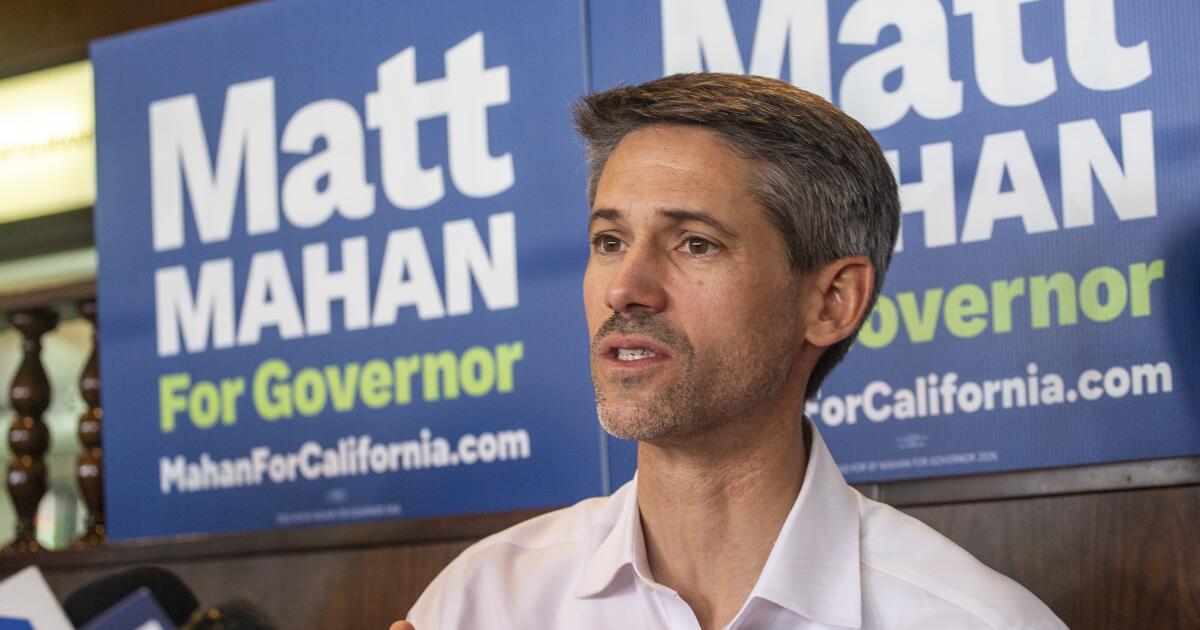
Standing in front of a gas pump in a video posted to social media, San Jose Mayor Matt Mahan said the costs are “becoming an emergency for working families, and I think we ought to act like it.”

The moderate Democrat called on state lawmakers to suspend California’s gas tax, which at 61 cents per gallon is the highest in the nation.

Former Los Angeles Mayor Antonio Villaraigosa also called for an “immediate moratorium” on regulations that he blamed for “overburdening” California refineries and working families.

“These failed policies are not only hurting tens of millions of Californians, they are terrible for the environment because they have forced California to depend on imported foreign oil from the Middle East,” Villaraigosa said in a statement.

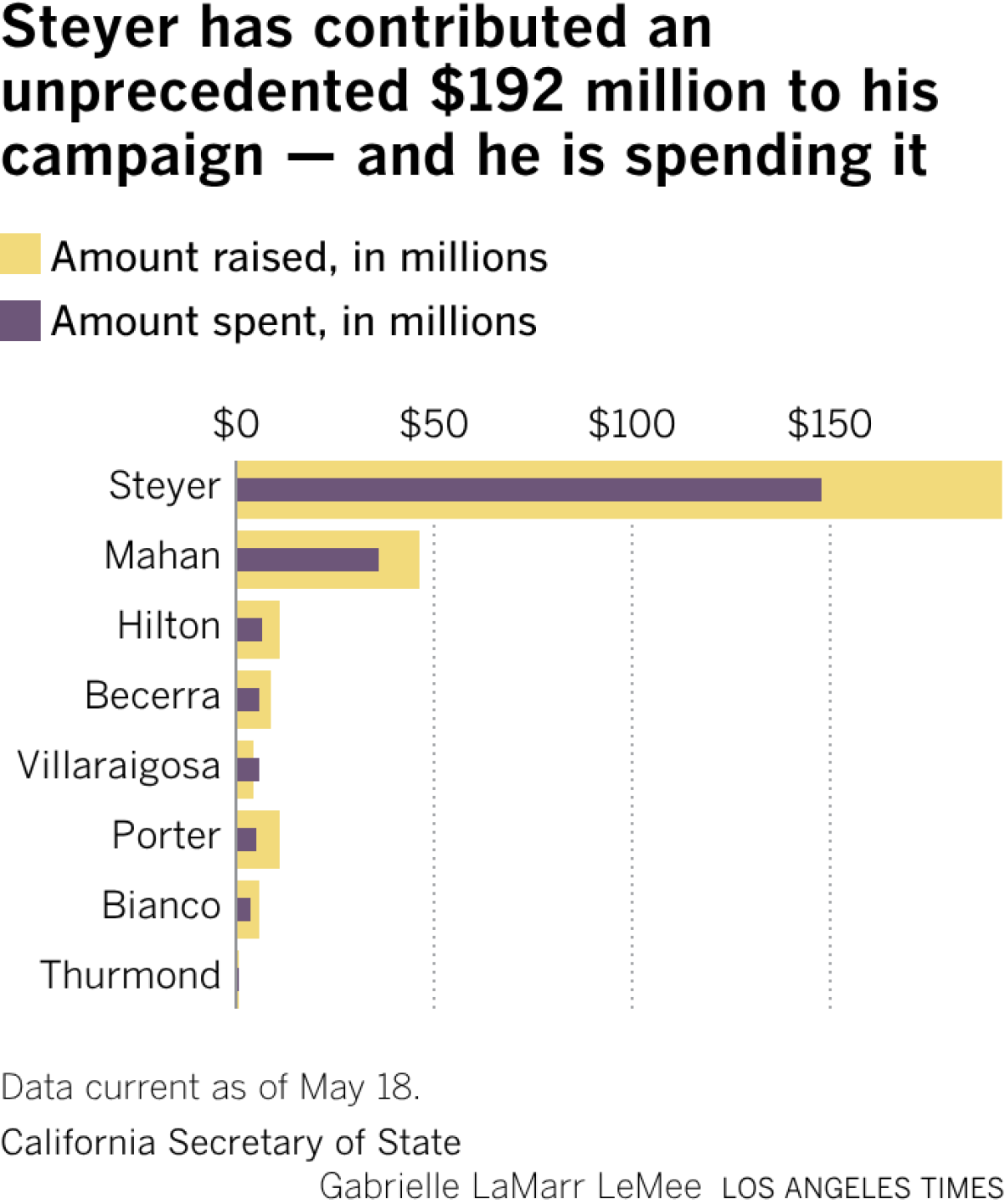
The cost of living in California, including the price at the pump, remains a pivotal issue for voters in the state, and has become central to the moderate-leaning campaigns of Mahan and Villaraigosa as they attempt to distinguish themselves in the tightly contested race for governor.

According to AAA, the average price for a gallon of regular gasoline in California on Monday was $5.52, the highest in the nation and more than 50 cents higher than any other state. The national average was $3.71, up from the previous month’s average of $2.92.

Gasoline prices in California are often among the highest in the country for a number of reasons, including environmental rules that require a unique blend of cleaner-burning fuel.

The state also relies mostly on crude oil imported from other countries including Brazil, Iraq and Guyana and processed at in-state refineries. In 2025, 61% of oil processed at California refineries was imported, compared with 23% that was produced in the state, according to data from the California Energy Commission.

A greater reliance on foreign oil has made California more susceptible to price spikes during global conflicts and other disruptions.

Republicans have long supported suspending the gas tax and cutting regulations in order to lower prices at the pump.

Steve Hilton, a GOP candidate for governor and former Fox News host, outlined a plan to lower California gas prices to $3 per gallon by slashing regulations including the low-carbon fuel standard, the rule that requires cleaner-burning gas in order to reduce tailpipe emissions.

The other major Republican in the race, Riverside Sheriff Chad Bianco, supports suspending the gas tax, according to his website.

The current price spike echoes 2022, when Russia invaded Ukraine and disrupted global oil markets.

As prices eventually fell around the rest of the country that year, they remained high for months in California, leading Gov. Gavin Newsom to wage war against oil and gas companies. He accused them of price-gouging drivers and backed laws requiring companies to report their profit margins and keep a supply of fuel on hand to prevent shortages and price spikes.

The governor backed off his battle with the oil companies last year after two refineries announced plans to close. In September, he signed legislation to permit 2,000 new oil wells in Kern County, reflecting an acknowledgement that his war on oil companies threatened to send California’s gas market spiraling.

Republican state lawmakers in 2022 pushed for a temporary suspension of California’s excise tax on gasoline, arguing that it would provide immediate relief to California drivers. That effort was rebuffed by Newsom and Democratic lawmakers, but they later approved $9.5 billion in tax refunds to Californians, providing as much as $1,050 to families as financial relief from record-high gasoline prices and other rising costs.

In 2017, the Democratic-controlled Legislature passed Senate Bill 1, which then-Gov. Jerry Brown signed into law, levying the state’s first gas tax increase in 23 years to fix California’s roads and bridges in disrepair. Under the law, the tax increases each year on July 1 based on the growth in the California Consumer Price Index.

California voters remain conflicted on the state’s regulation of the oil industry, according to an August survey by the Public Policy Institute of California. It found that more than 60% of adults support goals to reduce greenhouse gas emissions and generate electricity from renewable energy sources.

But majorities also said the costs of gasoline and utility bills is a major problem for them personally, according to the poll.

Mahan and Villaraigosa are the only two Democrats who have publicly called to roll back regulations on the state’s oil and gas market, illustrating the political murkiness at the nexus of California’s climate and affordability challenges.

Still, Democratic lawmakers – who hold supermajorities in the state Senate and Assembly – continue to shut down proposals to pause the gas tax, arguing that the state would lose out on much-needed money for roads.

“If anyone has a proposal about how to backfill (transportation) revenues, I’m up for that conversation, but so far, it’s just a bulls— political talking point,” said Assemblymember Cottie Petrie-Norris (D-Irvine).

Petrie-Norris chairs the Assembly Utilities and Energy Committee and has helped lead legislative efforts to stabilize California’s fuels market without retreating from goals to achieve carbon neutrality.

”When I ask people, ‘Do you want affordable gas, clean air or safe roads?’ they say yes. So they want us to do all three of these things,” she said. “We’ve got to be honest with Californians about trade-offs so that we can have real conversations.”

Mahan pushed back on the importance of collecting gas tax revenue.

“The truth is we have the highest taxes in the country and a $350-billion budget, and we ought to be able to pave our roads and enable working families to put food on the table,” he said in an interview. “I just reject the notion that the sky is going to fall if we provide temporary relief to working families who are being pushed to the brink by a war that they didn’t ask for.”

The San José mayor said the state should suspend the fuel tax “for the duration of the war” in Iran “or as long as gas prices are over $5 a gallon” in the state. He also called for “massive regulatory overhaul that brings down costs across the board,” including rules on refineries.

If elected governor, Villaraigosa said he would “reform and overhaul” the California Air Resources Board, which enacts many of the state’s environmental laws — including the low carbon fuel standard and cap-and-invest program.

“We can no longer allow bureaucrats who live in a bubble — with no accountability for the harm they are causing our economy and our people — to have so much power over the lives of every Californian,” Villaraigosa said in a statement.

Source link

Contributor: War abroad, injustices at home and a theme running through it all

As the U.S. wades even deeper into the conflict with Iran, some Democratic and progressive political figures are trying to figure out how to connect the public’s wariness about war with concerns about affordability and the widespread reaction against President Trump’s xenophobic immigration policies.

If you’re looking for a template to do it well, one can be found in the words and actions of a political figure who recently passed away: the Rev. Jesse Jackson.

For while attention after his death has rightfully focused on Jackson’s long involvement with the civil rights movement, the more telling lesson for this moment is how his presidential campaigns connected a concern for addressing domestic disenfranchisement with a resolute stance against U.S. military adventures — a message that built on and echoed the Rev. Martin Luther King Jr.’s landmark 1967 speech against the Vietnam War, economic exploitation and racial injustice.

Jackson’s candidacies in 1984 and 1988 emerged at a moment when the social compacts forged by the labor, civil rights and women’s movements of the 20th century were being systematically undone. Deindustrialization was hollowing out working-class communities. Reaganism was consolidating power around tax cuts for the wealthy, deregulation and attacks on unions. A new corporate consensus was hardening — one that increasingly shaped both major parties — prioritizing financial elites while disciplining labor and shrinking the public sphere.

Sound familiar?

Jackson refused to accept that such a right-wing and corporate realignment was inevitable. His Rainbow Coalition was far more ambitious than a candidate-centered campaign. It was an attempt to build an organized, multiracial, cross-class political front capable of contesting the direction of the country itself.

The Rainbow brought together constituencies that conventional political wisdom said could not unite — Black voters in the South, industrial workers in the Midwest, family farmers in crisis, Latino and Native organizers, Arab American activists, peace advocates, labor insurgents and progressive whites.

Jackson’s platform did not treat these groups as symbolic additions to a coalition; it linked their material interests. Farmers facing foreclosure were not an afterthought — the farm crisis was up front. Deindustrialized workers were not rhetorical props — trade, jobs and industrial policy were central. Civil rights were braided together with economic justice.

And crucially, Jackson insisted, as King had, that economic populism could not be separated from anti-militarism.

At the height of the Cold War, amid Reagan’s military buildup and interventionist doctrine, Jackson argued that bloated Pentagon budgets were not abstract line items. They were resources diverted from schools, healthcare, housing and jobs. He connected the violence of abandonment at home to the violence of intervention abroad — and his campaign called for redirecting military spending toward human needs and for diplomacy over escalation.

When Jackson thundered that we should “choose the human race over the nuclear race,” this was not a simple turn of phrase. It was integral to the Rainbow’s moral and economic logic. A government that prioritizes war over welfare, weapons over workers, cannot sustain democratic life.

That clarity feels especially salient today, as the United States continues to pursue military interventions and proxy conflicts whose legality and human cost are deeply contested. Once again, defense budgets swell while public goods strain. Once again, dissent against war is treated as disloyalty. Jackson rejected that false choice decades ago. He understood that militarism abroad reinforces inequality and immorality at home.

Jackson’s 1988 campaign captured millions of votes, won primaries and caucuses across the country and forced issues into the Democratic Party that party elites preferred to sideline. He demonstrated that a progressive program grounded in the lived experiences of ordinary people — rural collapse, urban disinvestment, plant closures, racial injustice and war — could assemble a national constituency.

Unfortunately, after Jackson’s last campaign, the Rainbow’s experiment in independent organizational life was folded too tightly into the mainstream Democratic Party. While that seemed a strategy to achieve a broader front, it meant that the progressive anchor was unmoored — and the effort dissolved before it could truly mature.

But the lessons of that era may be more relevant than ever.

Today, we again confront an ever-ascendant rightward turn buttressed by concentrated corporate power and normalized militarism. As in Jackson’s day, some leaders seek to deflect our attention, blaming economic challenges on the proximate “other” — in his era, Black women taking welfare, in our era, immigrants taking jobs — rather than those with power.

Jackson understood that defeating reactionary politics required isolating it — not only morally, but structurally — by assembling a coalition larger than the right’s base and rooted in shared material demands. He understood that hope had to be organized and that peace had to be part of prosperity. His campaigns showed that racial justice, labor rights, rural survival, gender equality and anti-war politics were not competing claims but interlocking ones.

Protest has surged in the United States, particularly after the excesses in Minnesota. But protest alone does not prevent consolidation. Nor do narrow electoral bargains that leave the underlying corporate and military consensus intact.

At a time when both parties remain deeply entangled with corporate and defense interests, remembering the promise of the Rainbow is not nostalgia. It is instruction.

Rishi Awatramani is a postdoctoral scholar in sociology at USC, where Manuel Pastor is a professor of sociology and the director of the Equity Research Institute.

Source link

California trial attorneys push bills to rein in ‘bad actors’

A group of California trial lawyers is backing a package of bills aimed at policing their industry by ramping up the penalties for attorneys who recruit clients illegally or prioritize the desires of hedge fund investors.

The Consumer Attorneys of California, a prominent trade group, said it is supporting two bills this session meant to crack down on the “small number of bad actors engaged in illegal conduct that threatens to undermine public trust” in the state’s legal bar.

The group said the bills, introduced Monday by Assemblymembers Ash Kalra (D-San José) and Rick Chavez Zbur (D-Los Angeles), were a response to recent Times investigations involving California lawyers. The Times found nine clients within L.A. County’s $4-billion sex-abuse settlement who said they were paid to sue and, in some cases, fabricate claims that became part of the historic payout. Another story examined opaque investor financing arrangements used by some firms.

“We’re not trying to insulate ourselves from accountability,” said Douglas Saeltzer, president of the attorney group, in an interview. “There needs to be consequences.”

The bill introduced by Zbur would disbar any attorney who is convicted of illegally soliciting clients. Kalra’s bill would ban private equity firms and hedge funds from dictating case strategy after giving money to a law firm.

Plaintiff’s attorneys say the legislative push is an attempt to clean up their profession’s image. It comes amid efforts by companies and governments frequently targeted by lawsuits to rein in a barrage of litigation.

Uber is pushing a measure for the November ballot that would limit how much lawyers can collect in fees for car crash cases, encouraging Californians to “stop the billboard lawyer scam.” A coalition of California counties has simultaneously begun circulating language to lawmakers that would limit attorneys’ ability to sue over older sex-abuse cases, pointing to recent allegations of fraud.

Zbur’s legislation, Assembly Bill 2039, would require the State Bar strip the license of any attorney with a felony conviction for a practice known as capping, in which law firms directly solicit or procure clients to sign up for lawsuits. Currently, attorneys convicted of capping can face suspension or probation, but are eligible to keep their license.

Under the bill, the attorney also would be disbarred for a misdemeanor capping conviction if the lawyer “acted knowingly and for financial gain.”

“It really is making very clear that if you’re engaging in this kind of capping, then there’s going to be a consequence,” Zbur said.

All clients who said they were paid to sue L.A. County over sex abuse were represented by Downtown LA Law Group, one of Southern California’s largest personal injury firms. The firm, also known as DTLA, is under investigation by the district attorney, the State Bar and L.A. County.

DTLA has denied any wrongdoing and said its lawyers “operate with unwavering integrity, prioritizing client welfare.”

Zbur’s bill also would provide whistleblower protections to people who report on attorney misconduct and tighten the rules around client loans. California is one of the few states where lawyers can lend money directly to clients.

Other states have barred the practice, concerned that direct loans give an attorney too much leverage over their clients.

The second bill introduced Monday, AB 2305, is aimed at the rising trend of private equity firms and hedge funds lending money to law firms and profiting from the payouts. The Times reported in December that investors were financing some of the flood of sex-abuse litigation against L.A. County.

Supporters of litigation finance say it gives attorneys the funding they need to take on deep-pocketed corporations and represent victims who can’t afford to sue on their own. Critics say investors can secretly sway case strategy, putting their profit before the best interests of a client.

“These Wall Street investors are salivating,” Kalra said. “This is just gonna clearly say, ‘No, no more. We’re not gonna allow these types of investments to influence the practice of law.’”

Kalra’s bill would bar investors from weighing in on litigation, such as who the firm should take on as a client and when they should settle a case. Any contracts that allow investor influence would be void under the law.

It’s unclear how the restrictions would be enforced. It’s often difficult to tell when an investor is financing a firm’s caseload, much less whether they’re exerting influence on a case.

Lawyers already are barred under the State Bar’s rules from allowing a third party to dictate case strategy and are barred in many cases from sharing legal fees with a nonlawyer.

“We’re finding that’s not enough,” Kalra said. “We actually need clear statutory safeguards.”

Source link

Ending a corporate tax break pitched to offset federal healthcare cuts

A corporate tax policy that costs California billions in lost tax revenue each year could be coming to an end as the state struggles to backfill federal cuts and resolve a looming budget deficit.

The proposed legislation, Assembly Bill 1790, would repeal the so-called “water’s edge” tax break, a filing option that allows multinational corporations to exclude the income of their foreign subsidiaries from state taxation.

“The tax bills of the wealthiest, most powerful corporations in the world are at all-time lows,” Assemblymember Damon Connolly (D-San Rafael), one of the primary sponsors of the bill, told The Times. “Meanwhile, we’re struggling to fund programs that feed children — I think everyone understands that now is the time for long-term budget solutions.”

Republican Sen. Roger Niello, vice chair of the Senate Budget and Fiscal Review Committee, said the bill to repeal water’s edge won’t receive support from GOP lawmakers. He said the legislation would lead to double taxation, meaning the same income would be taxed twice by different countries, and compared taxing corporations’ foreign profits to enacting tariffs.

“California already has the reputation of being not particularly business friendly,” said Niello (R-Fair Oaks). “This would really just compound that.”

A spokesperson for Gov. Gavin Newsom did not respond to a request for comment about the governor’s views on the proposal. Newsom, however, has largely shunned new tax increase proposals.

Legislation to increase taxes requires a two-thirds approval vote instead of a simple majority. Democrats in California hold a supermajority in both the Assembly and Senate, meaning the bill could still pass without Republican support, but it would require backing from the progressive and moderate wings of the party.

Kayla Kitson, a senior analyst at the California Budget and Policy Center, said the measure has a decent chance of winning support among moderate Democrats due to the state’s budgetary woes.

“The stakes are really high this year,” she said. “With any tax policy, it’s certainly hard to get folks beyond the progressive community on board, but there are a lot of discussions happening behind closed doors given the challenges that the state knows it’s going to have to deal with in the next few years.”

When filing taxes, a multinational corporation in the United States can currently choose between two methods. Worldwide reporting takes into account all of the corporation’s global profits or losses, while the water’s edge option allows the U.S.-based parent company to exclude the income of foreign subsidiaries. This can help corporations that own profitable foreign companies pay less taxes in the United States.

California is scrambling for solutions as the state is facing an estimated $18-billion budget deficit and fallout from federal cuts that slashed healthcare. A Republican-backed tax and spending bill signed last year by President Trump shifted federal funding away from safety net programs and toward tax cuts and immigration enforcement.

Carl Davis, a research director for the Institute on Taxation and Economic Policy, said the idea is picking up momentum nationwide, with states like Maryland, Minnesota and New Hampshire also considering a repeal in recent years, due to a growing awareness about profit shifting — a loophole in the water’s edge tax break that some corporations use to reduce their tax burdens by shifting profits made in a high-tax country into tax havens.

“Folks are outraged when they hear that these companies are pretending that they are earning their profits in the Caymans or in Switzerland and are skipping out on paying U.S. taxes as a result,” he said. “That feels insulting to a lot of people who are paying the taxes they owe every day.”

During an informational hearing at the Legislature last month, Rowan Isaaks, an economist with the nonpartisan Legislative Analyst’s Office, said the state does not know the extent to which corporations use profit shifting, which makes it impossible to determine exactly how much revenue California would gain by eliminating the water’s edge tax exemption. But he estimated it would bring in “single digit billions” for the state each year.

“While there would be revenue gains, the Legislature also faces a trade-off between broadening the tax base but also managing additional uncertainty,” said Isaaks, explaining it could increase budget volatility because foreign income is more sensitive to global economic conditions.

Issaks added that the Legislative Analyst’s Office has found no strong evidence that companies would flee California if the water’s edge tax break was repealed.

Jennifer Barton, director of the legislative services bureau for the California Franchise Tax Board, told legislators that mandating worldwide reporting wouldn’t be difficult for the state from an administrative standpoint, only requiring some additional outreach or educational efforts.

California Tax Foundation visiting fellow Jared Walczak said that the water’s edge option exists for a reason and that it would be unfair to mandate worldwide reporting. “The vast majority of the activity abroad is true economic activity abroad,” he told lawmakers. “Companies don’t just exist in the United States; they have sales, they have manufacturing, they do things abroad.”

A survey last year from the nonpartisan Pew Research Center found 63% of adult Americans believe large corporations or businesses should pay more in taxes, while 19% want corporate taxes to be lower and 17% believe corporate tax policy should remain the same.

Tech companies appear to be particularly aggressive with profit shifting. Six U.S. multinational corporations — Apple, Cisco, EBay, Facebook, Google and Microsoft — may have underpaid their U.S. corporate income taxes by $277 billion over varying periods from 2009 through 2022, according to a report from the Center on Budget and Policy Priorities.

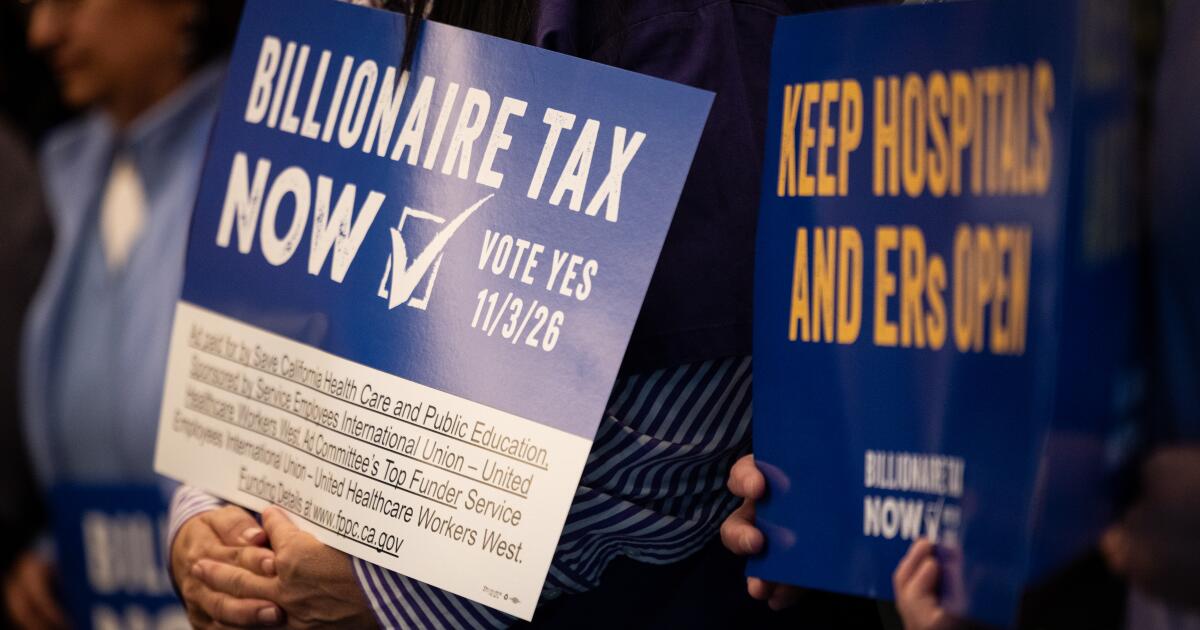
Repealing the water’s edge tax break isn’t the only tax-related proposal being considered as the state seeks to increase revenue. The Billionaire Tax Act is a controversial proposed state ballot initiative that would levy a one-time, 5% tax on the state’s billionaires to help offset federal cuts. Newsom is among its critics.

Davis believes it will continue to be a hot topic regardless of the bill’s outcome this year.

“There is very good reason to think this [repeal] is going to happen at some point,” he said. “This is a debate that is certainly not going away.”

Source link

Trump calls on allies to help guard the Strait of Hormuz. Most have refused

President Trump expressed frustration Monday that U.S. allies were not enthusiastic about sending warships to protect merchant vessels passing through the Strait of Hormuz, a sign of Washington’s growing isolation as it tries to stabilize one of the world’s most critical shipping lanes amid its war against Iran.

Trump declined to name the “numerous countries” he said had agreed to help reopen the oil route, which has come under the threat of retaliation from Iran, but was annoyed that most longtime allies were hesitant about joining his international police force. He said they should be “jumping to help us.”

“Some countries that we have helped for many, many years, we’ve protected them from horrible outside sources and they weren’t that enthusiastic — and the level of enthusiasm, it matters to me,” Trump said at the White House.

For Trump, securing allies’ help is as much a domestic economic need as it is international diplomacy. Since the hostilities against Iran began on Feb. 28, Tehran has retaliated by targeting regional oil facilities and at least 20 vessels operating in and around the Persian Gulf, the Strait of Hormuz and the Gulf of Oman.

The result has been “the largest supply disruption in the history of the global oil market,” according to the International Energy Agency, and it has led to international oil prices surging more than 30% to over $100 a barrel as the war entered its third week with no clear end in sight.

The diplomatic friction, meanwhile, reflects the limits of Trump’s influence at a moment when the global economy is absorbing one of the worst oil supply shocks in modern history, a dynamic that has prompted Trump to warn that countries refusing to help may find Washington a far less generous partner in turn.

Despite Trump‘s demands, several key allies have publicly rebuffed his calls for support.

French President Emmanuel Macron formally rejected the request, saying that France would maintain a “defensive and protective” posture focused on stability rather than escalation.

German Foreign Minister Boris Pistorius was blunter, saying, “This is not our war; we didn’t start it.”

British Prime Minister Keir Starmer also declined to commit, saying the U.K. “will not be drawn into the wider war.” Italy, Spain, Australia and Japan similarly declined, while South Korea and China have not publicly stated their intentions.

The rejections seems to have only sharpened Trump’s demands. At one point during an event Monday, the president turned to House Speaker Mike Johnson (R-La.) and said he would share a list of nations that declined to help, suggesting Congress could have a role in any retaliatory measures against reluctant allies.

“Why are we protecting countries that don’t protect us?” Trump said.

Yet Trump also sent conflicting signals about how much allied help he actually needs. At one point he claimed the United States did not require assistance from other countries.

“We don’t need them, but it’s interesting — I am doing it, in some cases, not because we need them, but because I want to see how they react,” Trump said.

On the threat to merchant ships, Trump projected uncertainty. He said the possibility of mines was “enough to keep people” from transiting the waterway, but said that “we don’t even know” if Iran has placed any mines in the strait.

“They may have no mines,” he said. “We hit every one of their mine ships. Every one of them is gone — but it only takes one.”

Speaking aboard Air Force One on Sunday, Trump also sent mixed messages about the threats and the need for help. He said the United States was coordinating with roughly seven countries to deploy naval forces to “police the straits — before adding, in the same remarks, that “maybe we shouldn’t even be there at all.”

He suggested American forces should not be there because other nations depend more heavily on oil shipments through the oil route, an about-face that drew criticism from allies, who said it created confusion about Washington’s strategy in a conflict the United States had itself started.

“To keep the strait open, I have a very hard time believing that China and the other countries the president enlisted are really going to be escorting ships through the strait. That just really doesn’t add up to me,” Sen. Adam Schiff (D-Calif.) said in an NBC “Meet the Press” interview Sunday.

“The bottom line is, we really don’t know how long this war is going to be,” he added.

Trump, however, is keeping the pressure on allied countries, making the future of the conflict more open-ended depending on their response.

Trump insisted Monday that “numerous countries have told me they are on their way,” but said he would “rather not say” who they are.

He then said the tepid responses from some U.S. allies had reinforced his skepticism about the value of the NATO alliance, echoing comments he made over the weekend when he warned that a failure to assist would be “very bad for the future of NATO” and that the U.S. would “remember” those who did not step up.

When asked if he was confident Macron will help with the reopening of the strait, Trump told reporters: “Yeah, I mean sure. … I think he’s gonna help. I mean I’ll let you know.”

Europe has nonetheless been drawn deeper into the conflict.

The U.K. initially refused to support U.S. military operations, but softened its position after Trump mocked Starmer as “no Winston Churchill” and called Britain a “once great ally.” France also said last week that it was preparing a separate “purely defensive” naval mission to escort commercial vessels through the strait once it was safe to do so.

Moving forward, it is unclear how the European Union and other nations around the world will respond to Trump’s pressure.

“Nobody wants to go actively in this war. And of course, everybody is concerned what will be the outcome,” Kaja Kallas, the European Union’s top diplomat, said Monday after a meeting of foreign ministers in Brussels. “This is not Europe’s war, but Europe’s interests are directly at stake.”

Source link

Trump’s mass deportation agenda is at a crossroads with the Homeland Security shake-up

The Department of Homeland Security will soon be under new management, an opportunity to reset President Trump’s immigration agenda or to double down on his signature campaign promise to conduct the largest deportation operation in American history.

The White House’s political director recently encouraged party lawmakers during a retreat at the Republican president’s golf club in Florida to focus on immigration enforcement against criminals, a pivot from the mass deportation agenda he ran on. House Speaker Mike Johnson said the aggressive operations have created a “hiccup” for the party, which is now embarking on a “course correction.”

Yet all indications are that Trump’s mass deportation operation is not stalling but intensifying, with billions of dollars being spent to hire Immigration and Customs Enforcement officers, build warehouse detention sites and meet the administration’s goal of rounding up and removing some 1 million immigrants from the U.S. this year.

“We are at an interesting moment where it has been an inflection point — the public has finally seen what mass detention and mass deportation mean,” said Sarah Mehta, who tracks the issue at the American Civil Liberties Union.

“This is not an agency that’s slowing down,” she said. “They’re really going forward with some of the cruelest policies.”

White House spokeswoman Abigail Jackson said the president’s policies have sent immigrants out of the U.S., either through forced deportations or on their own, and sealed up the U.S.-Mexico border.

“Nobody is changing the administration’s immigration enforcement agenda,” she said.

Senators ready to grill Trump’s DHS nominee over deportations

The questions put Homeland Security at a crossroads. Secretary Kristi Noem is on her way out, and Trump’s nominee to replace her, Sen. Markwayne Mullin of Oklahoma, appears this week for Senate confirmation hearings.

After the intense deportation sweeps in Minneapolis and other cities — and the deaths of at least three U.S. citizens at the hands of officers — Democratic lawmakers are refusing to provide routine funding unless the department changes its policies.

At the same time, those who believe Trump won the White House with his mass deportation agenda are disappointed the administration did not achieve its goals last year and insist he must do better.

“There has been a lot of talk in Congress and now in the White House about kind of backing away from President Trump’s, candidate Trump’s, mass deportation promise,” said Rosemary Jenks, co-founder of the Immigration Accountability Project, which argues for deportations.

“We believe that now is an opportunity,” she said. “We’ve got to get the deportation numbers up.”

A nation of immigrants no longer?

The debate is playing out as the United States, celebrating its 250th year, squares its founding as a nation of immigrants with images of masked federal agents breaking car windows and detaining people suspected of being in the U.S. without proper legal standing.

The Congress, controlled by Republicans, provided some $170 billion in last year’s tax cuts bill to fuel the effort, more than tripling the budget of ICE.

GOP Sen. Eric Schmitt of Missouri, in a fiery speech, fought back against the Democrats’ proposed restraints. “This question about deporting illegal immigrants was on the ballot. President Trump was not bashful,” he said. “And the American people supported the idea that we are going to deport people.”

Yet there are signs of cracks in the Trump coalition. Some Republicans prefer what one called a more humane approach and are sharing their views with Mullin.

Sen. Ron Johnson (R-Wis.), considered a stalwart against illegal immigration, said in his state it’s immigrants who milk most of the dairy cows, and he’s heard from restaurant groups that rely on immigrants to fill jobs.

“Can we just turn back the clock and have … all these people who came in here illegally, just be back home?” he asked.

“In terms of actually implementing that, it’s a lot tougher — particularly, in fact, when you realize a lot of these people, most of them, came here to seek opportunity, wanting freedom,” he said. “They’re working, supporting their family, contributing to organizations and community.”

Mass deportation group wants more

The Mass Deportation Coalition, a group of conservative organizations including the Heritage Foundation and Erik Prince, founder of the security firm Blackwater, was formed recently to keep the administration on track.

It calls last year’s focus on removing violent criminal immigrants “phase one” and says “phase two” should focus this year on deporting immigrants beyond those with violent criminal histories.

Mark Morgan, who served as acting head of ICE and Customs and Border Protection during Trump’s first term and is part of the coalition, said that doesn’t mean roving patrols through Home Depot parking lots. It’s about strategic enforcement focused on immigrants at worksites and those who have overstayed visas and whom a judge has already ordered removed, he said.

But they’re facing opposition from within the Republican Party, Morgan said, particularly from those who want to narrow deportation to mainly criminals and from business groups that want to ease up on worksite enforcement.

“The Republicans that are saying that their definition of targeted enforcement is only criminal, they’re wrong. They’re on the wrong side of this,” he said.

“That’s why you see some of the base that’s really becoming apoplectic because they’re like, ‘Wait a minute. You’re talking about only removing criminals now? That’s not what you promised,’” Morgan said.

What’s coming next

The deportation advocates as well as those working to protect the rights of immigrants see that the Trump administration’s best chance at reaching its goals is creating an environment so unwelcoming for immigrants that they just leave — what’s often called self-deportation.

Mehta, at the ACLU, expects the administration will step up efforts to end temporary permissions that allow immigrants to remain in the U.S. — particularly refugees and asylum seekers — while their cases are making their way through the system. She called it a “deliberate attempt to make people undocumented — to take away lawful status — and then to be able to enforce against them.”

Sen. Alex Padilla (D-Calif.) said he fears that more nonviolent immigrants will be rounded up to fill the new warehouses being equipped as the Trump administration tries to reach its deportation goals.

That’s unacceptable, he said, and among “the key questions that Senator Mullin will have to answer at his confirmation hearing.”

Mascaro, Santana and Cappelletti write for the Associated Press.

Source link

Supreme Court will rule on Trump’s plan to end temporary protection for Haitians, Syrians

The Supreme Court agreed Monday to rule on whether the Trump administration may end the temporary protection that had been extended in the past to migrants who live and work in the United States.

At issue are legal protections for about 6,000 Syrians and up to 350,000 Haitians.

The court’s announcement signals the justices want to resolve this issue in a written opinion rather through emergency appeals.

Twice last year, the court’s conservatives set aside decisions from judges in San Francisco who said President Trump’s Homeland Security secretary had overstepped her authority.

Those cases involved the temporary protection status extended to about 600,000 Venezuelans.

But those decisions did not set clear precedents, and in recent weeks, judges in New York and Washington, D.C., blocked the administration’s plan to end the special protections for Haitians and Syrians.

Frustrated by what he labeled “indefensible” decisions, Trump’s Solicitor Gen. D. John Sauer advised the court to hear arguments and issue a written ruling on the issue.

The justices on Monday agreed to just that. Arguments will be heard in April, and a decision will be handed down by July.

Immigrant-rights advocates argued the repeal of the special protection would be cruel and unjust to migrants who have established lives and careers in this country.

In 1990, Congress authorized giving temporary shelter to non-citizens from countries experiencing armed conflict, natural disaster or “extraordinary and temporary conditions” that prevent them from returning there.

In 2012, the Homeland Security secretary extended this protection to Syrians in response to a “brutal crackdown” engineered by its then-President Bashar al-Assad.

Last year, citing Assad’s fall from power, Trump’s Secretary Kristi Noem proposed to cancel the temporary protection for Syrians. Lawyers for the Syrians questioned how this could be seen as an emergency requiring an immediate ruling.

They said about 6,100 Syrians who have lived here lawfully for years.

They are “highly sought-after doctors and medical professionals, reporters, students, teachers, business owners, caretakers, and others who have been repeatedly vetted and by definition have virtually no criminal history. The government apparently needs urgent authority to send them to a country in the middle of an active war,” the lawyers said.

In 2010, the Obama administration extended the protection to Haiti after an earthquake caused death and damage in Port-au-Prince, the capital.

Judges in New York and Washington blocked those repeals and said the high court had given “no explanation” for its decision upholding the repeal for Venezuelans.

Those judges said the Supreme Court’s earlier orders orders “involved a TPS designation of a different country, with different factual circumstances, and different grounds for resolution by the district court.”

Sauer pointed to a provision in the 1990 law that says judges have no authority to second-guess the government’s decision to end it.

“There is no judicial review of any determination of the [Secretary] with respect to the designation, or termination or extension of a designation, of a foreign state under this subsection,” the law says.

In the three weeks since Trump’s attorney filed his emergency appeal, there have been two significant changes since then.

Trump fired Homeland Security Secretary Kristi Noem. And his war launched against Iran threatens countries throughout the Mideast, including Syria.

In agreeing to hear the pair of cases, the justices did not disturb the lower court rulings that blocked the repeals for now.

Source link

Judge blocks U.S. government from slimming down vaccine recommendations

A federal judge on Monday temporarily blocked federal health officials from cutting the number of vaccines recommended for every child, and said U.S. Health Secretary Robert F. Kennedy Jr. likely violated federal procedures in revamping a key vaccine advisory committee.

The decision halts an order by Kennedy — announced in January — to end broad recommendations for all children to be vaccinated against flu, rotavirus, hepatitis A, hepatitis B, some forms of meningitis and RSV.

A number of leading medical groups raised alarms that the vaccine recommendation changes made under Kennedy would undermine protections against a half-dozen diseases. And the American Academy of Pediatrics and some other groups amended a lawsuit they had filed in July, asking the judge to stop the scaling back of the nation’s childhood vaccination schedule.

The original lawsuit, in federal court in Boston, focused on Kennedy’s decision to stop recommending COVID-19 vaccinations for most children and pregnant women.

The suit was updated as Kennedy took more steps that alarmed medical societies, causing the plaintiffs to ask Judge Brian E. Murphy to take steps to address those policy changes too. For example, the amended complaint asked the court to look at Kennedy’s actions concerning the Advisory Committee on Immunization Practices, which advises public health officials on what vaccines to recommend to doctors and patients.

Kennedy, a leading anti-vaccine activist before becoming the nation’s top health official, fired the entire 17-member panel last year and replaced it with a group that includes several anti-vaccine voices.

Murphy, who was nominated to the bench by President Biden, said Kennedy’s reconstitution of ACIP likely violated federal law. He ordered the appointments — and all decisions made by the reformed committee — put on hold.

Department of Health and Human Services spokesman Andrew Nixon said: “HHS looks forward to this judge’s decision being overturned just like his other attempts to keep the Trump administration from governing.”

ACIP was scheduled to meet this week to discuss COVID-19 vaccines, among other issues, but that gathering was being postponed.

“ACIP as currently constituted cannot meet,” said Richard Hughes IV, an attorney representing the AAP. “How can a committee meet without nearly the entirety of its membership?”

Stobbe writes for the Associated Press.

Source link

California, other states sue to block Trump effort to roll back fair housing protections

California and a coalition of other states sued the Trump administration Monday over its efforts to roll back fair housing rules that bar certain types of discrimination by landlords, including against LGBTQ+ people.

California Atty. Gen. Rob Bonta said a U.S. Department of Housing and Urban Development rule change threatening funding for states that offer housing protections for LGBTQ+ and other marginalized individuals who are not explicitly covered by federal law is illegal, undermines state efforts to combat discrimination and would push vulnerable people onto the streets.

“In effect, the Trump administration is attempting to roll back civil rights enforcement in housing at the federal level, and pressure states to weaken their own protections as well,” Bonta said during a news conference Monday. “That’s not just bad policy, it’s unlawful.”

Representatives from HUD and the White House did not immediately respond to a request for comment.

The federal Fair Housing Act explicitly bans discrimination based on seven traits: race, color, national origin, religion, sex, familial status and disability. Under rules set forth during the Obama administration, the U.S. Department of Housing and Urban Development has for years interpreted the law as banning discrimination based on sexual orientation and gender identity.

Many states, including California, also have adopted laws explicitly banning discrimination against LGBTQ+ people and other marginalized groups not mentioned in the federal law, with California also banning discrimination based on marital status, ancestry, source of income and veteran or military status.

In September, HUD issued new guidance threatening to decertify state housing agencies — stripping their federal funding and ability to investigate discrimination claims — if they provide anti-discrimination protections other than those spelled out in the Fair Housing Act. The guidance also barred state agencies from using federal funds to “promote gender ideology,” “fund or promote elective abortions” or promote illegal immigration, according to the lawsuit.

The guidance followed that of HUD Secretary Scott Turner, a former NFL player and Trump loyalist, who announced last year that HUD would no longer adhere to a 2016 Obama-era rule protecting transgender people from housing discrimination, which Turner said “tied housing programs, shelters and other facilities funded by HUD to far-left gender ideology.”

“We, at this agency, are carrying out the mission laid out by President Trump on January 20th [2025] when he signed an executive order to restore biological truth to the federal government,” Turner said in a statement, referring to Trump’s order calling on federal agencies across the government to rescind protections for transgender Americans.

“This means recognizing there are only two sexes: male and female,” Turner said. “It means getting government out of the way of what the Lord established from the beginning when he created man in His own image.”

Among other things, the administration said rules barring discrimination against transgender people allowed “biological men to enter shelters intended for women impacted by trauma, domestic abuse and violence.”

LGBTQ+ advocacy groups condemned the move, noting that transgender Americans face heightened discrimination in a slate of areas — including housing — and need protections. They also contended that HUD’s new policies violate a 2020 U.S. Supreme Court decision barring employment discrimination based on gender or gender identity.

Bonta said the Fair Housing Act “set a floor, not a ceiling, for protections against discrimination,” which means that states “have the authority to go further and protect more people,” as California has endeavored to do.

He said HUD has supported the state’s anti-discrimination work for decades through the Fair Housing Assistance Program, which provides funding to state and local agencies to investigate and enforce laws against housing discrimination. HUD’s new guidance “threatens to undermine that system” by demanding an end to state protections not just for LGBTQ+ people, but for military veterans, immigrants as well as women receiving abortions and other reproductive healthcare, he said.

“Families across California are already struggling to find homes they can afford, and the last thing they need is for the federal government to make it harder,” Bonta said. “At its core, this lawsuit is about protecting a fundamental civil right: the right to rent, buy, or live in housing without discrimination.”

Bonta said California interprets the Fair Housing Act’s ban on sex discrimination as protecting LGBTQ+ people, but the Trump administration doesn’t agree — making the state’s more explicit protections important.

He said about $3 million in federal funding is currently at stake for California, with millions more at stake in other states.

Illinois Atty. Gen. Kwame Raoul, who is helping lead the lawsuit and spoke alongside Bonta Monday, said states with robust antidiscrimination laws “will not go backwards and we will not give in to threats” from the Trump administration.

“These actions are part of a broader, ongoing pattern by this administration to subvert the legal protections our country has put in place to combat discrimination, and to tear down the hard fought progress we have made for civil rights,” Raoul said. “It is also just the latest page in the president’s illegal playbook to use funding and programs created by Congress to try to strong arm states into adopting Trump’s preferred policies.”

The states allege that HUD’s targeting of state antidiscrimination policies comes after it downsized its own workforce and significantly reduced its ability to investigate housing discrimination complaints and enforce fair housing laws. They say the new guidance violates multiple federal laws, including laws that govern federal spending and rule changes, and are asking the federal court to immediately invalidate the guidance as unlawful.

Bonta and Raoul are joined in the lawsuit by the attorneys general of Arizona, Colorado, Connecticut, Delaware, the District of Columbia, Hawaii, Maine, Maryland, Massachusetts, Michigan, New Jersey, Rhode Island, Vermont and Washington.

Source link

As Trump pushes deportations, immigration data becomes harder to find

The Trump administration likes to promote its immigration enforcement agenda through numbers, with ambitious goals to deport 1 million people, report zero releases at the U.S.-Mexico border and arrest thousands of alleged gang members.

For all the boasting, the administration has been releasing less reliable, carefully vetted data than its predecessors on a signature policy that has become one of the most contentious of Trump’s second term.

The gap in information and a loss of figures from an office that has tracked immigration data back to the 1800s have left researchers, advocates, lawyers and journalists without important statistics to hold the Republican administration to account.

“They aren’t publishing the data,” said Mike Howell, who heads the conservative Oversight Project, an advocacy group pushing for more deportations. Instead, Howell said, the Department of Homeland Security has put out numbers in news releases “that purport to be statistics with no statistical backup and the numbers have jumped all over the place.”

With mass deportations a priority, new restrictions and increased enforcement have led to a surge in immigration arrests, detentions and deportations.

But finding the metrics that once measured those changes can be hard. It is an extension of earlier administration moves to limit the flow of government information by scrubbing or removing federal datasets or by the firing last year of the top official overseeing jobs data.

Important data is no longer publicly available

The Office of Homeland Security Statistics is responsible for publishing figures from Homeland Security agencies, including removals and the nationalities of those deported, to provide a comprehensive picture of immigration trends at the border and inside the United States.

Originally known as the Office of Immigration Statistics, it tracked such data since 1872. In its current form, created under the Biden administration, it also started publishing monthly reports that allowed researchers to track developments almost in real time.

But key enforcement metrics on its website have not been updated since early last year. A note on the page where the monthly reports were says it “is delayed while it is under review.”

“It’s the most timely data. It’s the most reliable data,” Austin Kocher, research professor at Syracuse University who closely follows immigration data trends, said about the monthly reports. “It has the most omniscient view of immigration enforcement across the entire agency.”

An interactive dashboard launched by U.S. Immigration and Customs Enforcement in December 2023 once let users examine whom the agency was arresting, their nationalities, criminal histories and removal numbers. ICE called it a “new era in transparency.”

Though intended for quarterly updates, the latest data is from January 2025. The agency’s annual report, typically released in December, had not been published as of mid-March.

Other agencies also publish data that touches on immigration, and parts of it do continue to roll out, such as U.S. Customs and Border Protection statistics detailing border encounters or data from the Department of Justice’s immigration courts.

But experts say other data has slowed.

The State Department’s most recent visa issuance data is from August. Key statistics from U.S. Citizenship and Immigration Services have not been updated since October.

The now-missing data had helped researchers study the effects of different policies. Lawyers could cite the figures to support their litigation. Journalists saw in them a powerful tool to hold the government to account on public claims or to report on important trends.

“We’re all a little bit in the dark about exactly how immigration enforcement is operating at a time when it’s taking new and unprecedented forms,” said Julia Gelatt, associate director of the U.S. Immigration Policy Program at the Migration Policy Institute.

DHS did not respond to detailed questions about why it was no longer releasing specific data.

“This is the most transparent Administration in history, we release new data multiple times a week and upon reporter request,” the department said in a statement.

Researchers contend with a patchwork of numbers

Figures the administration has released are inconsistent and unverifiable.

In a Jan. 20 news release, DHS said it had deported more than 675,000 people since Trump returned to the White House. A day later, in a second release, the department put the figure at 622,000. In congressional testimony March 4, Homeland Security Secretary Kristi Noem said the figure was 700,000.

But ICE, an agency within DHS, also releases figures on how many people it has removed from the country, part of a large data release mandated by Congress. An Associated Press analysis of the figures put that number at roughly 400,000 over Trump’s first year.

DHS has said 2.2 million people who were in the U.S. illegally have gone home on their own, but the department has given no explanation for the count. Experts have questioned the source of that figure, saying this was not something that DHS historically has tracked.

The department did not respond to questions about where that data came from.

With key sources of data halted, researchers, advocates and others have had to rely on information the administration is obliged to report or that has come to light through legal action.

The publication of ICE detention figures — how many people are detained, for how long and whether they have committed a crime — is required by Congress and is generally released every two weeks. But the figures’ release has faced some delays and its data gets overwritten with every new publication, complicating the work of people who need access to it.

The University of California, Berkeley’s Deportation Data Project, a research initiative, successfully sued through the Freedom of Information Act to access data about ICE arrests including nationalities, conviction status and whether arrests occurred at jails or in the community.

Graeme Blair, co-director of the project, said every administration has struggled with transparency in immigration enforcement, and given the Trump administration’s ambitious enforcement goals, the team wanted to secure and verify information that the government might not publicly release.

“Given the scale of what they were talking about doing, it seemed really important to be able to understand, to be able to double check those numbers,” he said.

But there are limitations, he said. The data obtained through the lawsuit only runs through Oct. 15. It does not cover recent operations such as the Minneapolis enforcement surge, when federal immigration officers fatally shot two protesters, leading to widespread demonstrations and scrutiny of enforcement tactics.

The absence of data is one of the few issues that has drawn bipartisan criticism.

“We deserve to know the numbers, just like we deserve to know who’s in our country and who needs to leave,” Howell said.

Santana writes for the Associated Press.

Source link

BBC asks U.S. court to dismiss Trump’s $10 billion defamation lawsuit

The BBC filed a motion Monday asking a U.S. court to dismiss President Trump’s $10 billion lawsuit against it.

The British national broadcaster said that the Florida court where the case is expected to be heard does not have jurisdiction over it. It also argued that Trump could not show that it intended to misrepresent him.

Trump filed a lawsuit in December over the way a BBC documentary edited a speech he gave on Jan. 6, 2021. The claim seeks $5 billion in damages for defamation and a further $5 billion for unfair trade practices.

Last month a judge at the federal court for the Southern District of Florida provisionally set a trial date for February 2027.

The BBC argued that the case should be thrown out because the documentary was never aired in Florida or the U.S.

“We have therefore challenged jurisdiction of the Florida court and filed a motion to dismiss the president’s claim,” the corporation said in a statement.

In a 34-page document, the BBC also argued that Trump failed to “plausibly allege facts showing that defendants knowingly intended to create a false impression.”

Trump’s case “falls well short of the high bar of actual malice,” it added.

The documentary — titled “Trump: A Second Chance?” — was aired days before the 2024 U.S. presidential election.

The program spliced together three quotes from two sections of a speech Trump made on Jan. 6, 2021, into what appeared to be one quote, in which Trump appeared to explicitly encourage his supporters to storm the Capitol building.

Among the parts cut out was a section where Trump said he wanted supporters to demonstrate peacefully.

The broadcaster’s chairman has apologized to Trump over the edit of the speech, admitting that it gave “the impression of a direct call for violent action.” But the BBC rejects claims it defamed him. The furor triggered the resignations of the BBC’s top executive and its head of news last year.

Source link

Trump says chief of staff Susie Wiles has breast cancer but will keep working through treatment

White House chief of staff Susie Wiles has been diagnosed with early stage breast cancer but will continue working during her treatment, President Donald Trump said in a social media post on Monday.

Trump said Wiles’ prognosis is “excellent” and described her as “one of the strongest people I know.” He said Wiles plans to begin treatment immediately but made no suggestion she was pulling back on her work as one of his closest advisers.

“During the treatment period, she will be spending virtually full time at the White House, which makes me, as President, very happy!” Trump said on his Truth Social platform. “She will soon be better than ever!”

It comes as the Republican president confronts mounting challenges on global and national fronts, from the war in Iran and soaring oil prices to this fall’s midterm elections and American’s concerns over affordability.

Wiles, 68, is a longtime Trump ally who rose from his campaign co-chair to his closest adviser and counsel. The first woman to become White House chief of staff, Wiles spent decades as a lobbyist and political operative in Florida and led Trump’s 2016 effort in the state.

Binkley writes for the Associated Press.

Source link

Should child rapists be released just because they’re old? Maybe

Murder is considered the worst crime out there, but for my money, it’s child rapists who are the worst of the worst — especially the serial ones who destroy one life after another.

That’s wholly subjective on my part, but I doubt I’m alone. Which is why I was far from surprised at the outrage that accompanied two recent, successful parole hearings for convicted serial child predators in Sacramento.

Gregory Lee Vogelsang, 57, and David Funston, 64, both attacked children and were granted parole through California’s elderly parole program — though both remain behind bars for now.

But the fury over the possibility of their freedom has put the state’s controversial elderly parole program under scrutiny — again — and led to a flurry of legislation to add new restrictions. Should sex offenders be excluded? Especially heinous murderers? Everyone under the age of 75?

It’s easy to answer “yes” to all of the above.

“Part of the problem we have is we shouldn’t be making policy decisions based on speculation and on scary rhetoric that’s disconnected from the facts,” Keith Wattley told me. He’s the founder and director of UnCommon Law, a nonprofit that provides legal services and parole advocacy.

“That’s how politicians make people afraid, but it shouldn’t be how we make law,” he said.

And he’s right, as grotesque as these headline-grabbing cases are. In 2024, there were 3,580 elderly parole hearings and 606 people were granted that relief. Most have remained law-abiding. In the 2019-20 year, the most recent recidivism statistics available from CDCR, 221 people were granted elderly parole. Within three years, only four had been convicted of new crimes, and only one of those was a felony for a crime against a person. That tracks with lots of data that shows men generally age out of violent crimes.

But Funston and Vogelsang are the worst of what we fear when we talk about parole, and their cases rightfully make us wonder what the heck the parole board is doing. Though Gov. Gavin Newsom sent both of these decisions back for review, it’s easy to imagine the attack ads should he run for president: Under Newsom’s watch, child rapists walked free.

“Elder parole has gone too far,” Thien Ho, the Sacramento district attorney whose office prosecuted both men, told me. “I support the opportunity of people to be rehabilitated. But I think that certain individuals, in my opinion, and in my experience, cannot be rehabilitated.”

Here’s where I’m going to make a lot of folks mad on both sides of this issue. I agree with Ho, but also, I agree with Wattley. I don’t think we can pass laws based on our grimmest view of humanity. Removing hope from the system turns our prisons into dungeons and does not ultimately serve public safety.

But then, neither does releasing child molesters into our communities.

Lost in all the wrath about these two cases is the difficult business of justice that led to the early release law in 2014, and any interest in the hard and nuanced conversation that we need to have around terrible crimes. It’s easy and popular to say no violent criminal should ever be released, but we can’t just lock up everyone with no possibility of ever getting out because the “R” in CDCR stands for “rehabilitation,” and also — we just can’t afford the forever scenario, morally or fiscally.

California tried the throw-away-the-key model in the 1980s and ‘90s and ended up with prisons so overcrowded that the federal courts stepped in. The original elderly parole effort came through a 2014 court decision on overcrowding that gave inmates 60 or older who had served at least 25 years a chance to go before the parole board. A chance — no guaranteed freedom, and usually it takes multiple hearings years apart before the board approves it.

Later, the Legislature expanded elderly parole to inmates 50 or older who had served 20 years, but excluded those sentenced under the “three strikes” law or those who had murdered peace officers.

The reality is California has a lot of old, aging and sick people behind bars — at great expense. As we grapple with the idea of universal healthcare, there’s one place in California where it already exists — our prisons and jails. We currently pay more than $41,000 in healthcare costs per inmate per year, according to the Legislative Analyst’s Office.

I’m not going to tell you it’s the best healthcare, but it’s taxpayer-funded, and includes even long-term dementia care. And yes, we do have incarcerated dementia patients.

“This is about reducing our prison population and our liability to cover housing and healthcare for an aging prison population, and we have to balance that with the safety of the community and the rights of victims,” state Assemblymember Maggy Krell (D-Sacramento) told me. She’s sponsoring a bill that would create an additional layer of safety around sex crimes by referring these possible parolees to the civil system that evaluates sexually violent predators for confinement in mental facilities after their prison terms.

“Under some circumstances, it is worth considering paroling some of these defendants,” she said, with the kind of thoughtful rationality sure to offend many. “But the cases that you’re seeing right now are completely egregious, and those defendants should not be released.”

Vogelsang was convicted of almost 30 counts of kidnapping and sex crimes, against kids as young as 5. He’s served 27 years of a 355-year sentence.

David Allen Funston, a child predator convicted in 1999 of multiple counts of kidnapping and child molestation.

David Allen Funston, a Sacramento County child predator convicted in 1999 of multiple counts of kidnapping and child molestation. Funston was granted parole suitability under California’s Elderly Parole Program after serving more than two decades in prison.

(Sacramento County Sheriff’s Office)

David Allen Funston was convicted in 1999 of 16 counts of kidnapping and child molestation for kids as young as toddlers. He was sentenced to three consecutive 25-to-life prison sentences. Newsom bounced his first successful parole bid back to the parole board for a review, and on Feb. 18, it affirmed its decision.

But Placer County prosecutors quickly charged him with an old crime that had never been filed due to the Sacramento case, and he remains incarcerated awaiting trial on those charges.

Vogelsang’s case particularly raised a red flag for me. He told the parole board he’s been working successfully for about five years to control his thoughts about children.

“I don’t want to become aroused, but I know it’s always going to be there,” he said during the hearing.

Newsom also sent Vogelsang’s case back for review, and he will go before the board again on March 18. Vogelsang’s testimony was concerning enough that if I had a vote in this, I’d probably ask him to come back again in a few years, but we’ll see what the board does.

I’ll admit my decision would be emotional, and these cases do make me wonder. But Wattley is right that condemning elderly parole based on the monstrous deeds of these child predators is shortsighted. There is likely little to no public safety benefit in raising the overall age for elderly parole, and certainly no fiscal benefit.

“When you’re paying for older, sicker people to be incarcerated, and they don’t pose a risk to public safety, what are we actually getting for that? We’re not getting anything that supports survivors. We’re not getting anything that prevents crime. We’re just spending taxpayer dollars on something that doesn’t correlate with the public safety risk,” Wattley pointed out.

As hard as it is to wrap our minds around, it’s best for public safety to allow even the worst of the worst their chance in front of the parole board. It may even make sense for some who have committed truly terrible crimes decades ago to be released, if there is strong evidence of change and a low risk to public safety. That’s the kind of fair and realistic justice that no one on either side of the issue wants to talk about.

I’m not convinced Vogelsang and Funston have met those bars. But that doesn’t mean we should throw out the bars.

You’re reading the L.A. Times Politics newsletter

George Skelton and Michael Wilner cover the insights, legislation, players and politics you need to know. In your inbox Monday and Thursday mornings.

By continuing, you agree to our Terms of Service and our Privacy Policy.

What else you should be reading

The must-read: USC and ABC7 criticized for exclusion of all candidates of color in upcoming gubernatorial debate
Money, it’s a gas: Poison-pill effort to cancel proposed billionaire tax hits voters’ mailboxes
The L.A. Times Special: China-backed Big Pork wants to override 63% of California voters. Even conservatives are mad

Stay Golden,
Anita Chabria


Was this newsletter forwarded to you? Sign up here to get it in your inbox.

Source link

Pledge to Root Out Terrorists Haunts Bush

Pity the person with a hard act to follow, particularly if it’s his own. George W. Bush is such a person. For three months, he has shone as the take-charge leader of a powerful nation reeling from an unexpected blow. A quiet sense of triumph now pervades Washington’s inner circles.

But here’s the hard-act-to-follow part, and the irony of President Bush’s situation: In declaring a war on terrorism and the states that harbor terrorists, Bush’s policy of rooting out terrorism wherever it thrives plunks his administration smack into the middle of the world’s trouble spots.

Merely to list the breeding grounds for terrorism is to suggest the scope of the challenge: Sudan, Somalia, Colombia, Iraq, Indonesia, the Philippines, Iran, Pakistan, Chechnya and, yes, Saudi Arabia. Here is the underbelly of globalization: countries rendered unstable by the absence of power or its autocratic concentration

The speed with which success has come to the American campaign in Afghanistan exacerbates the problem. Had the conflict there dragged on, people might have forgotten Bush’s pledge to root out terrorism. Today, still fresh in mind, it attracts world attention.

The havens of terrorists are either dysfunctional countries in need of nation-building or autocratic regimes sowing the seeds of despair that sprout fanatics.

Turning these retrograde states into open, self-sustaining communities will require a generosity of spirit and patience for study that Bush’s go-go team has yet to demonstrate.

Worse, the expense of promoting economic growth, public schooling and human rights in failing states will run athwart the Bush administration’s priority to cut taxes. Bringing poor countries into the global economy will require opening our doors to their goods. Yet low-wage commodity exporters seeking American buyers are sure to mobilize calls from Congress for protection against unfair competition.

Complicating these demands is the arena of power from which Bush will have to lead. While fighting the war in Afghanistan, he makes decisions as commander in chief. The George Bush who must fashion a successful foreign policy to eradicate terrorism acts as head of the executive branch of a three-part government designed by the U.S. Constitution to operate through checks and balances.

The Bush people have emphasized that we are in this fight for the long haul. The “long haul” they have in mind may be strictly military, but their words have nurtured hopes of a sustained effort to get at the stubborn causes of poverty and fanaticism.

Nation-building, as candidate Bush well knew, is a messy business where trial and error–the only possible approach–consumes endless months and billions of dollars.

The bright side of the picture is that many of America’s allies have also been singed by terrorism, either from dissidents inside their country or on their borders. Spain has problems with its Basque separatists, Turkey with the Kurds, Russia with Chechnya and China with its Muslim Uighurs calling for an “Eastern Turkey.” Their national self-interest inclines them to cooperate with the United States.

At the end of the Gulf War, the elder George Bush, enjoying similarly high approval ratings, declared victory after routing Saddam Hussein’s army. He then precipitately announced the arrival of a new world order.

Within months, that phrase had become a term of derision and his ratings plummeted.

But if George W. Bush stays the course and builds from the ground up, he could usher in a new world order and secure for himself the greatness that eluded his father.

*

Joyce Appleby is a professor emeritus from UCLA and past president of the American Historical Assn.

Source link