Norway is preparing to lift restrictions preventing its $2.2 trillion sovereign wealth fund from investing in government bonds issued by Syria.
The move follows the political transition after the ousting of Bashar al-Assad and the rise of Ahmed al-Sharaa, whose government has been seeking economic recovery and international reintegration after more than a decade of war and sanctions.
At the same time, Norway plans to newly restrict investments in bonds issued by Iran, aligning with ongoing international sanctions.
Policy Shift and Financial Context
The Norwegian sovereign wealth fund, the largest in the world, plays a major role in global financial markets. Its investment decisions often influence broader investor behaviour.
The updated policy removes Syria from the exclusion list for government bonds while adding Iran, reflecting changing geopolitical and sanctions dynamics.
Although the fund does not currently hold investments in Middle Eastern government bonds, the policy shift opens the door for future allocations and signals a reassessment of risk and legitimacy.
Geopolitical Significance
Norway’s decision represents a notable step toward Syria’s re-entry into the global financial system. It comes alongside other developments, including the restoration of Syria’s financial links with international institutions after years of isolation.
The move also highlights a divergence in how states are being treated: while Syria is gradually being reintegrated, Iran remains economically isolated due to continued tensions and sanctions.
As one of the world’s most influential sovereign investors, Norway’s stance could encourage other countries and institutions to reconsider their own restrictions on Syria.
Analysis
The decision reflects a broader recalibration of international economic engagement based on political change and shifting strategic priorities. By opening the possibility of investment in Syrian bonds, Norway is signalling cautious confidence in the new government’s direction and stability.
At the same time, the move remains largely symbolic in the short term. The wealth fund has no immediate exposure to Syrian debt, and actual investment will depend on risk assessments, market conditions, and institutional safeguards.
More importantly, the policy underscores how financial tools are increasingly used as instruments of foreign policy. Inclusion or exclusion from global capital markets can legitimise governments, incentivise reforms, or reinforce isolation.
In Syria’s case, gradual financial reintegration could support reconstruction and economic recovery, but it also raises questions about governance, transparency, and long-term stability after years of conflict.
JASON Statham has shared some very rare family snaps from his holiday to Turkey with fiancee Rosie Huntington-Whiteley and their two young children.
The actor, 58, took to social media to post photos from their time at five star hotel Regnum at The Crown in Antalya, where rooms cost up to £3,000-a-night.
Sign up for the Showbiz newsletter
Thank you!
Jason shared a rare family update from their holiday to Antalya in TurkeyCredit: InstagramHe and son Jack, eight, were seen taking in the viewCredit: InstagramProud dad Jason messed around in the pool with four-year-old daughter IsabellaCredit: Instagram
Jason and model Rosie, 38, are parents to Jack, eight, and four-year-old Isabella.
Fast & Furious star Jason showed off his close bond with the kids while they relaxed at the hotel’s stunning crystal cove pool.
He and Jack were seen taking in the view with their arms around each other, while another snap showed the young lad standing on his dad’s shoulders in the pool.
Meanwhile Isabella was seen taking a dip in the water and one photo showed proud dad Jason lifting her into the air.
Jason didn’t include any photos of Rosie in his upload, which he captioned: “The cave.”
The couple have been together since 2010 and got engaged in 2016.
But Rosie previously confessed they’re in no rush to walk down the aisle.
She told Entertainment Tonight: “We’re looking forward to that time. It’s also not a huge priority for us, we’re so happy.
“I think it will be fun to do it when the baby’s [Jack] grown up a bit and he can be involved in the wedding.”
Rosie and Jack live in a Georgian townhouse in London and have spent two years renovating it together.
Revealing how the process has been, she told Vogue Australia: “Jason has the most impeccable taste.
“He taught me so much about architecture and furniture.”
Rosie added that being in a relationship with Jason for 16 years has been “very grounding”.
The father and son duo showed off their acrobatic skillsCredit: UnknownJason and Rosie have been together for 16 years – but are in no rush to tie the knotCredit: Rosie Huntingdon-Whitely and dau
England captain Ben Stokes was struck on the face by a cricket ball, which required surgery for a broken cheekbone.
Published On 15 Apr 202615 Apr 2026
England Test captain Ben Stokes has said he feels “quite lucky” to be alive as he recovers from surgery after being hit in the face by a cricket ball.
All-rounder Stokes required the procedure after suffering a broken cheekbone sustained by being hit by the ball during a net session while he was coaching academy players at his domestic county side Durham in February.
Recommended Stories
list of 4 itemsend of list
Stokes is set to play in two first-class County Championship games next month, but he revealed the incident could have been so much worse.
“I copped one straight in the face,” the 34-year-old told the England and Wales Cricket Board.
“Pretty nasty but, funnily, probably the best result of a bad situation, to be honest. Just a couple of inches one way or the other, I might not be here doing this interview, if I didn’t turn my head round.
“All things considered, although I had pretty major facial surgery to sort it out – it was a bit of a mess under here (cheekbone), I’ve got out quite lucky. So pretty thankful for that.”
He added: “Obviously it set everything back about a month, five weeks, with getting back to where I wanted to be to play at the start of the season for Durham, but just had to sort of quickly go back to the drawing board and put a plan together to get me ready to play a couple of games for Durham before the Test summer starts.
“At the back end of all that now, but it was a pretty scary situation. Thankfully still here and everything’s all right.”
Stokes is expected to be fit to lead England in the first Test of their home season against New Zealand at Lord’s starting on June 4, as they look to recover from their woeful 4-1 Ashes humiliation in Australia.
Stokes downplays rift with England coach McCullum
Stokes, meanwhile, has played down reports of disagreements with head coach Brendon McCullum but added that they do have different viewpoints at times.
British media reported that former New Zealand captain McCullum’s relationship with Test captain Stokes frayed during the Ashes series defeat in Australia, though the duo have publicly backed each other.
“I am very confident in mine and Brendon’s ability to be able to work together, because we’ve done it for such a long period of time now,” Stokes said in an interview with the England and Wales Cricket Board (ECB).
“But we work together in a slightly different way. The main point of me and Brendon is our alignment towards winning things and making this team as good as they can be.”
Since taking charge in 2022, McCullum and Stokes implemented an ultra-aggressive style of play known as “Bazball”, which has come under much scrutiny since England’s Ashes defeat, prompting the ECB to launch a thorough review into the team’s preparations.
“Agreeing on every single thing, that’s just impossible,” Stokes said.
“We agree 95% of the time on things, but those 5% things that we might have different views on, we talk about it between each other and then we end up getting to the place where we want to get to.
“We put a lot of our heart and soul into this job. Brendon certainly has for the four years he’s done it so far, and hopefully we’ll still be together at the end of 2027, winning what we want to win.”
England host New Zealand for a three-Test series in June before eight limited-overs matches at home to India.
With the global attention fixated on the diplomatic efforts to end the war on Iran, Israel has systematically escalated its attacks on Gaza and choked off vital aid, plunging the besieged enclave into what economic experts are now calling an “engineered, compounded famine”.
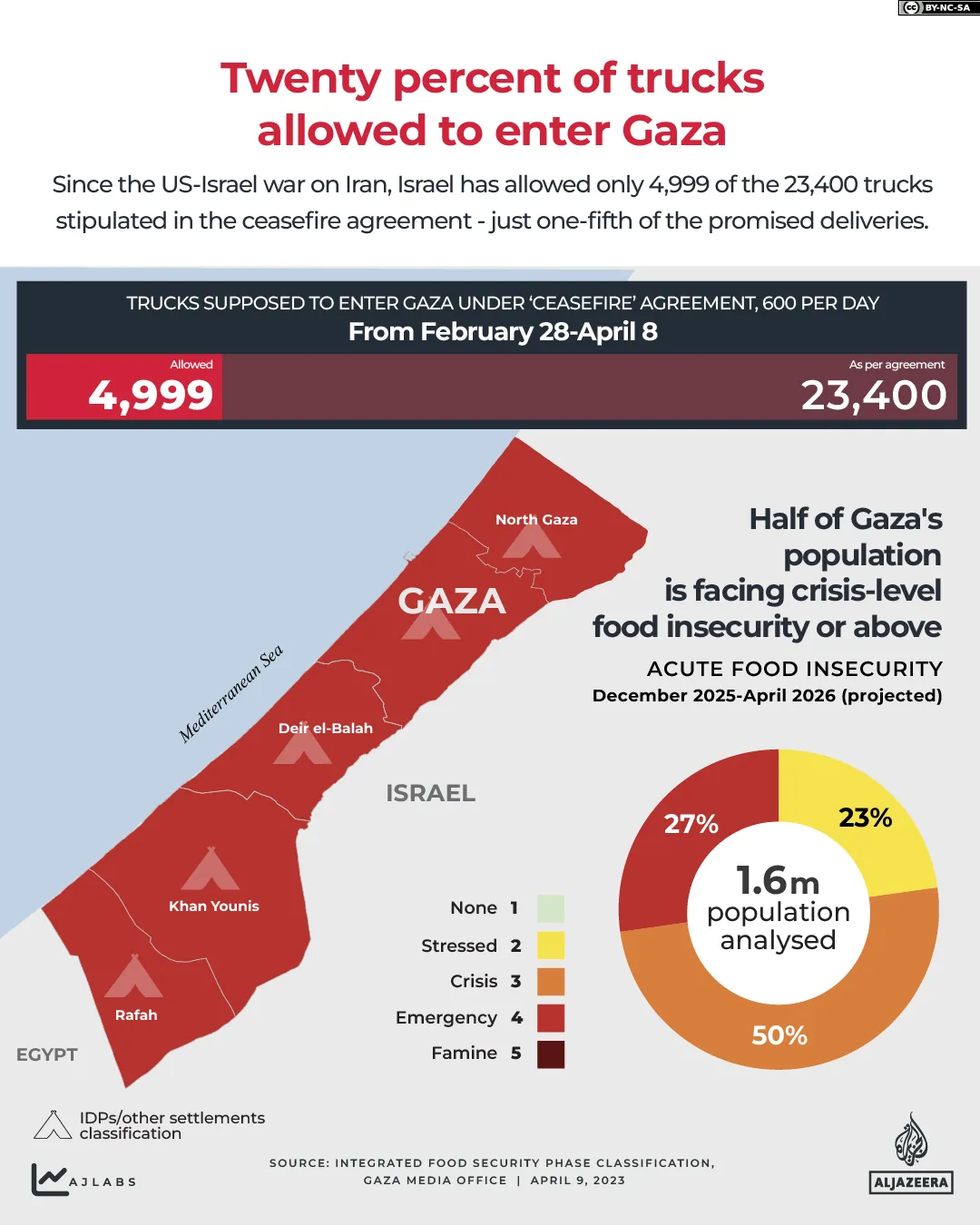
The number of aid trucks entering Gaza has dropped drastically in violation of the October 2025 ceasefire with Hamas. Since then, the Government Media Office in Gaza has recorded 2,400 military violations by Israeli forces, resulting in the killing of more than 700 Palestinians.
Recommended Stories
list of 4 itemsend of list
On Tuesday, Israel’s military killed at least 11 Palestinians, including two children, in separate attacks across the war-torn Strip.
The intensity of these attacks spiked during peak regional tensions. Between February 28 and April 8, while Israel and the US were engaged in a bombing campaign against Iran, Israeli forces bombed Gaza on 36 out of those 40 days.
In the last five weeks alone, more than 100 people have been killed, including Al Jazeera journalist Mohammed Wishah. Israel has killed more than 72,336 people since launching the brutal military offensive on October 7, 2023.
The ‘truck deception’
While Israel frequently claims it is allowing hundreds of aid trucks into Gaza, Palestinian officials and economic experts argue these figures are a deliberate mathematical deception.
According to the Government Media Office, only 41,714 aid and commercial trucks have entered Gaza over the past six months. This represents a mere 37 percent of the 110,400 trucks stipulated under the ceasefire agreement. The fuel situation is even more critical, with only 1,366 fuel trucks entering out of a promised 9,200 – an abysmal 14 percent compliance rate.
Recent daily logs highlight the severity of the bottleneck. On April 13, a total of only 102 aid trucks and 7 fuel trucks were allowed into the entire Strip, alongside 216 commercial trucks – a fraction of the more than 600 total trucks required daily under the “ceasefire” deal. By April 14, the numbers remained critically low with 122 aid trucks and 12 fuel trucks entering.
Crucially, Israeli authorities entirely shut down additional entry points like the Zikim and Kissufim crossings, which had processed dozens of commercial and aid trucks just a day prior, bottlenecking all limited traffic exclusively through Karem Abu Salem.
Mohammed Abu Jayyab, a Palestinian economic expert based in Gaza, told Al Jazeera that Israel utilises a “technical and commercial deception” to inflate these numbers.
“An Israeli truck carries up to 32 or 34 pallets… which are then unloaded into two or three smaller, dilapidated Palestinian trucks on the Gaza side,” Abu Jayyab explained. “Consequently, the UN and Israel count double or triple the actual number of Israeli trucks entering.” One pallet holds roughly 1 tonne of goods or food items.
Furthermore, Israel recently banned mixed-load shipments. If a merchant brings in 20 pallets of sugar, the remaining 12 pallet spaces on the truck must remain empty, yet it is still registered as a full commercial truck.
“The political agreement stipulated a ‘truck’ but did not specify quantities, weights, or the number of pallets,” Abu Jayyab noted, allowing Israel to weaponise logistics to restrict aid while appearing compliant.
Engineering starvation
This logistical strangulation is part of a broader strategy. Hassan Abu Riyala, undersecretary of the Ministry of National Economy in Gaza, stated in a meeting published on the ministry’s official Telegram channel that Israel is “engineering a policy of starvation”.
To ensure chaos in the local markets and sky-high prices, Israel has deliberately dismantled civil regulatory bodies. “The occupation targeted the majority of the crews that monitored prices, and assassinated the [former] undersecretary of the Ministry of Economy and five directors general during the war,” Abu Riyala said.
The results have been devastating, basic commodities have become scarce, and bread production has plummeted to 200 tonnes daily, far below the 450 tonnes required to feed the population.
“We manage this structural deficit under exceptional and coercive conditions,” Ismail Al-Thawabteh, director general of the Government Media Office, told Al Jazeera.
He described the ongoing reduction of supplies despite the truce as a “systematic restriction of basic supplies” that pushes the population towards dangerous levels of food insecurity. Fresh produce has skyrocketed, with 1kg (2.2lb) of tomatoes jumping from $1.50 to nearly $4 in a matter of weeks.
Moreover, the humanitarian catastrophe is being accelerated by the withdrawal of major aid groups. Al-Thawabteh noted that the scaling back or suspension of operations by key international institutions, most notably the World Food Programme (WFP), due to Israeli restrictions, represents a “highly dangerous development” that threatens the complete collapse of Gaza’s relief system.
“We issue an urgent appeal to the international community and the guarantors of the agreement to immediately pressure Israel to open the crossings… before reaching a point of no return and an imminent human explosion,” he said.
A ‘compounded famine’
The crisis has evolved beyond a simple lack of food; it is now a complete collapse of the Palestinian economy.
Abu Jayyab described the current situation as a “compounded famine”. With unemployment soaring to 80 percent and the destruction of more than 160,000 jobs across industrial, agricultural, and commercial sectors, the population has entirely lost its purchasing power.
“It has become illogical to link the entry of food supplies from the crossings to their availability to Palestinian citizens,” Abu Jayyab told Al Jazeera. Even when goods reach the market, between 70 to 80 percent of families simply cannot afford to buy them due to the total absence of income.
This extreme deprivation is forcing civilians into life-threatening alternatives. “The return of long queues for bakeries, and citizens resorting to burning plastic and waste in the absence of cooking gas, are dangerous field indicators of an unprecedented deterioration,” Al-Thawabteh warned, noting that government health facilities are currently struggling to treat respiratory and skin diseases resulting from this toxic pollution.
The medical blockade
Meanwhile, the stranglehold extends to Gaza’s most vulnerable patients. While the ceasefire agreement mandated the opening of the Rafah crossing for medical evacuations, Israel has kept the borders tightly restricted.
Over the past six months, only 2,703 people have been allowed to cross through Rafah out of an expected 36,800 – a compliance rate of just 7 percent. Consequently, only 8 percent of the severely wounded and chronically ill patients slated for urgent medical evacuation have been permitted to leave. According to the World Health Organization, roughly 18,000 people are still trapped in Gaza waiting for life-saving treatment abroad.
Families, in their various flavors, have been essential to television since that light first flickered on. They may be ideal or nightmarish, or both, or in between, and we take to them — be they Waltons or Addamses or Simpsons — according to our own experience or desires, having known families of our own or wanted something other than what we had.
In “Schitt’s Creek,” Dan Levy co-created — with his father, Eugene, yet — one of the medium’s greatest family comedies. It was a show that grew over time from a basic premise about rich people who lose their money and are forced to live at close quarters in adjoining motel rooms to a paean to love, understanding and acceptance. It swept the comedy categories at the 2020 Emmys, including acting awards for both Levys, Catherine O’Hara and Annie Murphy and writing and directing trophies for Dan.
“To family” are in fact the last words spoken in the first season of “Bad Mistakes,” Levy’s noisy, funny new show, co-created with Rachel Sennott and now streaming on Netflix — though given what precedes it, it’s less a blessing than a curse. Levy plays Nicky, a pastor at a sparsely attended suburban New Jersey church of no evident denomination. He’s out as gay, but supposedly celibate; that he has a boyfriend, Tareq (Jacob Gutierrez), is known only to Tareq; this, of course, creates a secret, which will create pressure, which will create comedy.
Sister Morgan (Taylor Ortega) is an elementary school teacher, a job that doesn’t quite jibe with everything else we see about her — it’s barely represented, anyway, summer having come — and a very longtime boyfriend, Max (Jack Innanen), who has decided that now is the moment to propose. She had once tried acting in New York, which means that she lived a wilder life once and is something of an improviser. Their mother, Linda (Laurie Metcalf), who owns a hardware store, is running for mayor and the campaign is being managed by extra daughter Natalie (Abby Quinn).
The series begins as their grandmother is dying, and at Linda’s command, they rush out to buy her a present — Linda is trying to squeeze in an “early birthday” before her mother passes. And because she is that sort of person, Morgan shoplifts what she imagines is a cheap necklace from a convenience store. (Attendant Yusuf, played by Boran Kuzum, will have much to do.) The necklace isn’t cheap, it turns out, for no particularly good reason, and the convenience store isn’t just a convenience store, but a kind of waystation for stolen goods run by local Russian mobsters. As a result, Morgan and Nicky find themselves forced to run errands for them, under threat of death, or worse.
The show gets very complicated on its way to a circular semi-conclusion; there is a lot going on, with Linda’s mayoral ambitions and various relationship issues. (Elizabeth Perkins plays Max’s mother, bridging storylines.) But it’s a good ride, and classic in its way; searching the phrase “get mixed up with gangsters” brings forth a host of old comedies. Through the dodgiest situations, brother and sister do not hesitate to argue. Nicky would love to be anywhere else, while Morgan finds it invigorating. Though it is all improbable, the parts do mesh neatly; they make television sense.
Finally, the series rests on the shoulders of the three principal players, who are just a pleasure to watch; the camera obliges by moving in close. Levy brings a soft-spoken breathlessness you may recognize from his David Rose on “Schitt’s”; his softly muttered “OK,” which might just mean “stop talking,” is almost a trademark. Ortega brings a kind of poignance to her reborn wild child, while Metcalf plays Linda with a kind of small-town operatic intensity, eyes popped and pronunciation precise — she’s like a country cousin to O’Hara’s Moira Rose — as if she were onstage pitching to the back row of the theater.
Michelle Pfeiffer and Elle Fanning in “Margo’s Got Money Troubles,” premiering April 15, 2026 on Apple TV.
(Allyson Riggs/Courtesy of Apple)
In “Margo’s Got Money Problems, premiering Wednesday on Apple TV, Elle Fanning plays the title character, a college student flattered into bed by her married-with-children writing professor, Mark (Michael Angarano), despite my shouting at the screen for her not to do it. Soon she is pregnant, and soon after that the essentially single mother of baby Bodhi, unable to find work or the time to write. (As the heroine, we assume her talent.)
Presumably in search of some normalcy, Margo’s mother, Shyanne (Michelle Pfeiffer), a former good time girl — but still sparkly — has become engaged to Kenny (Greg Kinnear), Christian, square and sincere; the Ralph Bellamy of the piece, you are not asked to take him quite seriously (though Kinnear plays him straight). Shyanne’s ex-husband is Jinx, a former professional wrestler, played by Nick Offerman with the low-key affect of Ron Swanson, dialed down even further; depression and drug addiction will do that to you. Fresh out of rehab, he trades a championship belt for a motorcycle and joins the household; though he left Margo early, and unlike Shyanne, he proves to have a marvelous, easy way with Bodhi. (The baby himself, or babies — they use twins for this job — are themselves marvelous.)
Also in residence is roommate Susie (Thaddea Graham), a chirpy cosplayer — and coincidentally Jinx’s biggest fan — whose skills will become valuable as Margo, needing cash, sets off into the world of OnlyFans. First picking up tips describing followers’ penises in terms of Pokémon (no explanation has been thought necessary), she pivots to video, mounting increasingly elaborate sexy sci-fi productions alongside Susie (sets and costumes), Jinx (narrative advice, stunt coordinator) and OnlyFans veterans KC (Rico Nasty) and Rose (Lindsey Normington), a fabulous tag team to whom Margo turns for advice. (Margo does seem to take things over, but it’s her name in the title, so there you go.) This introduces an element of Mickey and Judy, my uncle’s got a barn, let’s put on a show comedy. More important, it creates a team, melding the family you make with the family you have.
It’s as sweet as can be. Apart from sleeping with one’s professor — students, do not do this! — the show is positive about just about everything: motherhood, daughterhood, professional wrestling, second chances, sex work, cosplaying and the way art shows up in strange places. Only Marcia Gay Harden, as Mark’s mother, Elizabeth, is an outright villain, and you will hate her.
The series was created by David E. Kelley (Mr. Michelle Pfeiffer), from Rufi Thorpe’s 2024 novel, once again under the umbrella of Nicole Kidman’s Blossom Films (following their collaborations on “Big Little Lies,” “Nine Perfect Strangers” and “Love & Death”), with its house style of well-upholstered capital-Q Quality (as distinct, in its pop-cult, way, from prestige). (Kidman has a small role as a wrestler-turned-lawyer and it’s been a while since I’ve seen her this well used.) “Margo’s Got Money Problems” can be terribly sentimental, almost corny — the climax is pure Hollywood — but undeniably effective. And if its mix of comedy and drama can be a little destabilizing, you won’t need to worry about where it ends up.
Draw for the 24-team 2027 AFC Asian Cup, originally set for Saturday, moved to May 9.
Published On 15 Apr 202615 Apr 2026
The draw for the 2027 Asian Cup in Saudi Arabia has been rescheduled for May 9 in Riyadh as the United States-Israel war on Iran disrupts regional sporting events.
The draw, originally scheduled for last Saturday, will be held at the historic At-Turaif District in Diriyah. The Asian Football Confederation (AFC) said on Wednesday that the postponement was made to ensure the full participation of all key stakeholders and member associations.
Recommended Stories
list of 4 itemsend of list
A number of sporting events across the region have been postponed or cancelled due to the war, which began on February 28.
Saudi Arabia is set to host the 24-team, quadrennial continental championship for the first time from January 7 to February 5. With 23 of the 24 teams already confirmed, the draw will divide the qualified nations into six groups of four.
The final qualification place will be decided on June 4 when Lebanon face Yemen in a playoff.
Defending champions Qatar have already secured their place at the finals along with four-time winners Japan and fellow World Cup qualifiers South Korea, Iran, Jordan, Australia and Uzbekistan.
Three students and a teacher have been killed in the province of Kahramanmaras, according to the local governor.
Published On 15 Apr 202615 Apr 2026
A student has shot at least four people dead, including fellow pupils and wounded at least 20 others at a middle school in southeastern Turkiye, according to the local governor.
Wednesday’s deadly incident marks the country’s second school attack in two days.
Three students and one teacher were killed in the incident in the province of Kahramanmaras, Governor Mukerrem Unluer told reporters.
The shooter died in the attack.
The student was in the eighth-grade at the school and concealed their father’s guns in a backpack to carry out the attack, the governor added.
David Haye is set to target the Rhino’s dinner in tonight’s edition of I’m A Celebrity…South Africa amid what is already a controversial time in the jungle for the boxer
13:31, 15 Apr 2026Updated 13:31, 15 Apr 2026
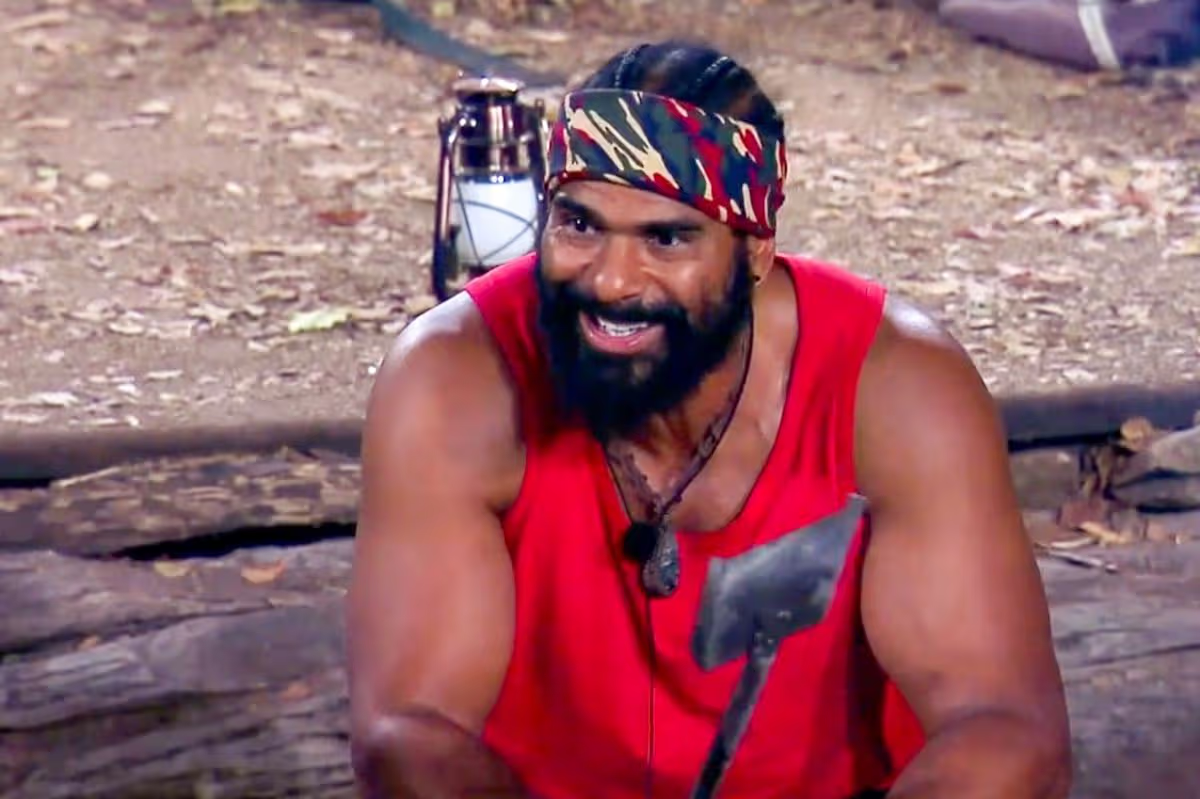
David Haye is set to target the Rhino’s dinner in tonight’s edition of I’m A Celebrity…South Africa(Image: ITV/Shutterstock)
David Haye is set to target the Rhino’s dinner in tonight’s edition of I’m A Celebrity…South Africa. The boxer, 45, is currently taking part in the all-stars edition of Ant and Dec’s ITV reality survival show and is a member of the Lion’s team alongside Harry Redknapp and Ashley Roberts.
As the food is lowered into camp, David says confidently : “I can’t wait for the food to get here. It’s not going to be easy getting up there but where there’s a will, there’s a way.”
Immediately taken aback by his plan, Olympian Sir Mo Farah tells his teammate: “Damn, brother. No, I think we should just let them have it… technically they did win it.”
But David remains undeterred as he says: “This is the Lions’ lair, anything coming in here is getting eaten,” However, their conversation is overhear by Coronation Street star Craig Charles from the other side of the fence.
He says: “You’re not really going to steal the bag, are you? You can’t steal the bag off our girls who just won the challenge!” Whether he is successful in his ploy remains to be seen, but David wastes no time as he sets about King Harry’s throne to propel himself nearer to the food bag.
The boxing star has had quite the controversial time in camp already – having already made offensive comments about women and seemingly directed a joke about weight at Gemma Collins. After suffering a defeat in a trial, David admitted that he did not like losing and it would “eat him up for a while,” and it was then that Gemma went to comfort him over the loss, which left fans confused, especially after he made insulting comments to her earlier in the week.
He said: “It’s gonna eat me up for a while. They tried to get under my skin, and they have; that’s what they should do, and I expect nothing less. I don’t like losing any rounds.” It was at that point that Gemma, who, as a member of the team on the other side of the fence, made the forbidden move to speak to him, and he began by saying: “Hello sweetheart” when he saw her.
She said: “You’re not a loser, David. Don’t be hard on yourself, tomorrow is another day, dust it off, you’re always a champ, you know that. Love ya. Come on, it’s not the end of the world.” Gemma then hugged her co-star before heading off.
Then, in the Bush Telegraph, Gemma said: “Obviously, there’s been a bit of banter between us. I’ve seen a different side to David.” But fans were left taken aback as to why the TOWIE legend had been so kind and understanding towards him, especially as he made comments last night which seemingly referred to her weight.
David’s controversy all started innocently enough when it was suggested the group of celebs should meet up for a party when they left the show, and David said his girlfriend Sian was a great cook and could possibly provide food for the event.
He then added: “She’s like tall, blue eyes. She’s lovely. She’s got the personality of a proper ugly bird.” Scarlett Moffatt replied: “You can’t say that.”
But David brushed off the response and added: “She has. Most ugly girls realise they don’t they’re not pretty enough to….they gotta have a personality to banter and to tell jokes and s**t, so people overlook the fact that they’re not aesthetically amazing, straight away.
“Which is what’s called Ugly Duckling syndrome, where girls are ugly, when they start off, and then they and then they kind of they, they get pretty as they get older. But they still got the personality of when they’re ugly. Does that make sense?”
As Scarlett and others made shocked noises, David continued to express his opinions. Haye added: “You get a girl who’s pretty from day one, you get a girl who’s different day one. Everyone goes ‘You’re so beautiful. You’re amazing’. She grows up thinking, I’m amazing. Everyone loves me. I can open any door. I can go anywhere I want.” Later on, Gemma was talking about how “thick” her hair is, and David quipped: “It certainly ain’t thin.”
I’m A Celebrity…South Africa airs weeknights 9PM on ITV1, ITVX, STV AND STV PLAYER
April 15 (UPI) — U.S. President Donald Trump said peace talks with Iran “could be happening in the next two days,” with American negotiators most likely to return to Islamabad where the first round of talks at the weekend ended without a breakthrough.
In an interview with the New York Post on Tuesday, Trump said talks between the sides were “happening, but, you know, a little bit slow,” saying a new round of direct negotiations would probably be hosted by a country in Europe.
However, around 30 minutes after the interview had concluded, Trump called back to tell the Post that it should keep its reporter covering the talks in Islamabad in place and not bring them home.
“You should stay there, really, because something could be happening over the next two days, and we’re more inclined to go there [Islamabad]. It’s more likely, you know why? Because the field marshal is doing a great job,” Trump said, referencing Pakistan’s Field Marshal Gen. Asim Munir who has a direct line of communication with the regime in Tehran and a strong relationship with Trump.
“He’s fantastic, and therefore it’s more likely that we go back there. Why should we go to some country that has nothing to do with it?” added Trump.
The Washington D.C.,-headquartered Institute for the Study of War also said a fresh round of negotiations was likely this week but said it believed Iran’s approach would be to try to buy time by spinning out the talks
“Iran likely aims to protract negotiations as long as possible in order to prepare for a potential resumption of conflict,” ISW said in a post on X.
The developments, which came as a fragile cease-fire that took effect April 7 entered its second week, followed earlier reports in which unnamed White House officials told CNBC, CNN and NBC News that in-person negotiations could restart before the truce expires on Tuesday.
Vice President JD Vance said round one of the talks in Islamabad, which ran for more than 20 hours, foundered on differences over Iran’s nuclear program — which the United States wants it to give up completely to ensure it can never develop a nuclear weapon — and control of the Strait of Hormuz.
Reports later emerged that more progress had been made than initially suggested, with the sides getting close to agreement on nuclear enrichment after Iran countered U.S. demands for a 20-year suspension with an offer to halt all enrichment for 5 years.
Trump told the Post he was unhappy with the thinking that a moratorium on enrichment, instead of terminating the program, would make the regime in Tehran more amenable to a lasting peace agreement by providing them a face-saving “success” to sell to the Iranian people.
“I’ve been saying they can’t have nuclear weapons. So I don’t like the 20 years. I don’t want them [Iran] to feel like they have a win.”
Experts concurred with Trump’s analysis, saying the only way to guarantee Iran would not be able to pursue a nuclear weapon in the future was to make sure the entire program was put beyond use, in a verifiable way, and that it needed to happen while Trump was still in office.
Under the Joint Comprehensive Plan of Action, a 2025 deal between Iran and the United States, Britain, France, Germany, Russia and China, enrichment by Tehran of its 300 Kg stockpile of uranium was capped at 3.67%, in exchange for sanctions relief.
However, that deal lapsed in October, although in practice it was long dead after Trump pulled the United States out of the agreement in May 2018, during his first term, with Iran subsequently proceeding to enrich an expanded 441 kg uranium stockpile to around 60%, not far short of weapons grade.
Speaker of the House Mike Johnson, R-La., presents the family of Benjamin Ferencz with his Congressional Gold Medal during the Holocaust Memorial Museum’s Days of Remembrance ceremony at the U.S. Capitol on Tuesday. The gold medal was presented posthumously to Ferencz, who served in the Army during World War II and prosecuted Nazi war criminals during the Nuremberg Trials. Photo by Bonnie Cash/UPI | License Photo
ASML occupies a critical position in the global semiconductor supply chain as the sole producer of extreme ultraviolet lithography systems. These machines are essential for manufacturing the most advanced chips used in artificial intelligence applications. As demand for AI computing has surged, driven by data centre expansion and high performance processing needs, the semiconductor industry has entered a new investment cycle focused on capacity growth.
Strong earnings and upgraded forecast
ASML reported first quarter earnings that exceeded expectations and raised its 2026 revenue outlook to between 36 billion and 40 billion euros. This revision signals stronger than anticipated order inflows and reinforces the scale of demand emerging from the AI sector.
The company’s performance reflects a broader trend in which chip demand is outpacing supply. According to CEO Christophe Fouquet, customers are accelerating expansion plans well beyond the near term, indicating confidence in sustained AI driven growth.
ASML as a strategic enabler of AI growth
Investors increasingly view ASML as a foundational player in the AI ecosystem rather than a conventional manufacturer. Its tools are used by leading chipmakers such as TSMC, which produces advanced processors for firms like Nvidia and Apple.
This positioning places ASML at the upstream end of the value chain. Instead of competing in chip design or production, it supplies the essential infrastructure that enables both. As a result, its growth is tied to the entire semiconductor sector rather than any single company.
Supply constraints and industrial limits
Despite strong demand, structural constraints remain significant. Semiconductor fabrication plants require years to build and involve complex global supply chains. ASML itself faces production bottlenecks due to the precision and cost of its machines, which can reach hundreds of millions of dollars per unit.
Even with plans to increase shipments of its leading systems in 2026 and 2027, capacity expansion is gradual. This creates a persistent imbalance where demand continues to exceed supply, reinforcing pricing power across the industry.
Geopolitical and regulatory risks
A key uncertainty for ASML lies in export controls, particularly regarding sales to China. Proposed restrictions in the United States, including the MATCH Act, could limit the company’s ability to supply Chinese customers. Currently, China represents a significant portion of ASML’s revenue.
However, the global shortage of advanced chips may mitigate this risk. Reduced access to one market could be offset by demand from others, especially as countries and companies compete to secure semiconductor supply chains.
Market response and valuation concerns
ASML’s share price has risen sharply, reflecting investor optimism around AI driven growth. The company is often described as a “picks and shovels” investment, benefiting from the broader expansion of the industry regardless of which firms dominate end products.
At the same time, analysts caution that valuations are elevated. The current pricing assumes sustained high growth, leaving limited room for setbacks related to supply constraints or regulatory changes.
Analysis
The upgrade in ASML’s forecast highlights a structural shift rather than a temporary cycle. AI is not only increasing demand for chips but also reshaping the entire semiconductor value chain. ASML’s monopoly in EUV technology gives it a unique strategic advantage, effectively making it a gatekeeper for next generation chip production.
However, this dominance also exposes the company to geopolitical pressures and operational challenges. The interplay between technological leadership, supply limitations, and regulatory dynamics will determine whether current growth trajectories can be maintained.
ASML’s stronger outlook underscores the depth of the AI driven semiconductor boom. While demand momentum remains robust, the company operates within a constrained and politically sensitive environment. Its future performance will depend on balancing rapid industry expansion with the physical and geopolitical limits shaping the global chip ecosystem.
GLADIATORS star Jodie Ounsley has shared rare loved-up snaps with her rugby player girlfriend Ellen Ramsbottom.
The pair went public with their romance in July last year and now Jodie has called her other half “my calm in all the chaos” in a gushing birthday tribute.
Sign up for the Showbiz newsletter
Thank you!
Gladiators star Jodie Ounsley has shared loved-up snaps with her girlfriend Ellen RamsbottomCredit: InstagramShe shared a gushing tribute for Ellen on her birthdayCredit: Instagram
The BBC One star, known as Fury on the show, took to her Instagram feed to share a series of snaps of the two of them together as well as solo pictures of Ellen.
In one photo, the ladies are glammed up in stunning dresses as they hold hands while walking down a hotel hallway.
In another picture, the two are seen enjoying a beach day as Ellen plants a kiss on Jodie’s face.
She captioned the post: “The person who holds everything together behind the scenes, my calm in all the chaos and the one who makes me cackle like no one else.
“Happy Birthday, ya special human,” Jodie concluded.
Their fans flocked to the comments section to send the couple some love as one said: “Eugh the beautiful eyes in this relationship is unreal!”
Another person gushed: “You two seem like a ‘forever’ kinda couple. I love it xxxx.”
While a third added: “Happy birthday to your special person.”
Jodie and Ellen first met when they were 16, playing together at Loughborough Rugby.
They went public with their romance last Summer in a YouTube vlog and their relationship appears to be going from strength to strength.
The post comes after Jodie’s dad Phil Ounsley, 56, tragically died after collapsing on one of Yorkshire’s three peaks in December.
She shared the heartbreaking news on Instagram as she penned: “Heartbroken. Yesterday, my dad suddenly passed away while doing one of his favourite things—walking Pen-y-Ghent.
“He had hiked that peak countless times throughout his life, but none of us knew he wouldn’t walk back down that day.
“I don’t have the words. All I can say is that he was, and always will be, my absolute hero.
“He encouraged me to dream big and loved me wholeheartedly, and for that I will be forever grateful. Until we meet again, Dad.”
Jodie is known as Fury on GladiatorsCredit: InstagramShe tragically lost her dad in DecemberCredit: Instagram
Israel’s ambassador to the US has held talks with his Lebanese counterpart. But as a pro-settler ‘activist’ and former soldier who took part in invading Lebanon, critics say Yechiel Leiter is a problematic negotiator.
Italy has suspended the renewal of a 20-year-long defence agreement with Israel, following recent tensions between the two countries after the Italian government accused Israeli forces of firing warning shots at a convoy of Italian peacekeepers in Lebanon.
HELEN Flanagan has admitted she “constantly suffers” with mum guilt – even when her three kids are spending time with their father.
The former Coronation Street star spoke candidly in an exclusive interview with The Sun, and told us she has to force herself to “look at the bigger picture”.
Sign up for the Showbiz newsletter
Thank you!
Helen Flanagan has candidly revealed her feelings of mum guilt in an exclusive chat with The SunCredit: makeupbyashleyuk/InstagramThe actress told how she ‘constantly suffers’ when she is away from her broodCredit: Helen Flanagan InstagramHelen shares three kids with ex fiance Scott SinclairCredit: InstagramShe has repeatedly locked horns with the footballer over their co-parentingCredit: Instagram/Scotty_sinclair
Dressed up in character this month, the panto star shared: “I am princess Jill today. I’m really, really loving this theatre tour so much.
“I miss my kids today. I’ve been away from them now for about a week as they are at their daddy’s for Easter.
“I definitely don’t think it gets easier sharing your children, it really doesn’t, but there’s so many of us that are in these situations and it can be really tricky.”
Helen’s comments about her former partner — and the positive nature of him spending time with their kids — seem to hint the pair have built bridges.
Their most recent explosive spat saw her clash with Scott after he missed their son Charlie’s nativity play because he was in Abu Dhabi for theF1.
She branded him a “piece of s**t” as he lived it up in the UAE instead.
On the prospect of her signing up for more dating shows, she told us: “My children just find it funny.
“My daughter and I are very close. She just sees it as me working and doing different things – we have such a close bond, so it’s all very normal to her.
“I’m very open-minded about it.
“I don’t think there’s an age where you suddenly have to stop doing things like modelling or dating shows.
“You can still feel beautiful and confident at any age, so I don’t think you can put a limit on it.”
Helen told how she has to look at the ‘bigger picture’ when it comes to managing her mum guiltCredit: InstagramShe told how she takes different acting jobs now to ensure she provides with her kidsCredit: Getty
South Korean Chief of Naval Operations Adm. Kim Kyung-ryul (L) and U.S. Pacific Fleet Commander Adm. Stephen Koehler (R) hold talks in Seoul on Wednesday. The two were also set to meet with Japan’s top naval commander for trilateral talks on strengthening maritime cooperation. Photo courtesy of South Korea Navy
Top naval commanders of South Korea, the United States and Japan gathered in Seoul on Wednesday to hold a series of talks aimed at strengthening their trilateral maritime security cooperation, the South’s Navy said.
The gathering brought together Chief of Naval Operations Adm. Kim Kyung-ryul, U.S. Pacific Fleet Commander Adm. Stephen Koehler and Adm. Akira Saito, chief of staff of the Japan Maritime Self-Defense Force, for bilateral talks and a trilateral dinner meeting, according to the armed service.
The meetings came amid heightened tensions in the Middle East, raising speculation over whether their talks would address the ongoing U.S. blockade of Iranian ports.
U.S. President Donald Trump earlier called on South Korea, Japan and others to send warships to the Strait of Hormuz to help secure shipping lanes.
In the bilateral talks between Kim and Koehler held earlier in the day, both sides exchanged opinions on the robust South Korea-U.S. combined defense posture as well as cooperation in the area of naval maintenance, repair and operations, the Navy said.
Kim and Saito, meanwhile, held in-depth discussions on expanding personnel exchange and resuming joint maritime search and rescue exercises (SAREX) as discussed in a ministerial meeting between their defense chiefs earlier this year, it added.
In January, Defense Minister Ahn Gyu-back and his Japanese counterpart, Shinjiro Koizumi, met in Japan and agreed to resume joint SAREX drills for the first time in nine years as part of efforts to strengthen bilateral defense cooperation.
The top admirals of the three countries were set to attend a dinner meeting later Wednesday to likely discuss trilateral coordination measures to respond to and deter North Korea‘s advancing nuclear and missile threats.
Copyright (c) Yonhap News Agency prohibits its content from being redistributed or reprinted without consent, and forbids the content from being learned and used by artificial intelligence systems.
Release of Mahdieh Esfandiari comes a week after Iran released two French citizens held on espionage charges.
Published On 15 Apr 202615 Apr 2026
Iranian national Mahdieh Esfandiari has returned home after being held in France for more than a year as part of what appears to be an exchange of detainees between the countries.
Iran’s state television reported on Wednesday that the “rights activist”, sentenced to one year in prison after making online comments supportive of Palestine and the 2023 Hamas attack on Israel that prompted the genocidal war on Gaza, had returned to Iran.
Recommended Stories
list of 2 itemsend of list
The University of Lyon graduate, who had been living in France since 2018, where she worked as a translator, was arrested in February last year on charges of promoting “terrorism”, and released on bail in October.
“I think it’s clear for everyone that there is no freedom of speech, at least not in France where I was. The court’s ruling was very unjust,” Esfandiari told state television in a Wednesday broadcast.
Esfandiari’s release comes a week after French citizens Cecile Kohler, 41, and Jacques Paris, 72, arrived in France after being held for more than three years in Iran.
Kohler and Paris were arrested by Iranian authorities in May 2022 but were freed in November last year, after more than three years in prison on espionage charges that their families vehemently deny.
They were taken by French diplomats to France’s mission in Tehran, where they lived under house arrest until their full release on April 7. Upon their release, they were driven from Iran to neighbouring Azerbaijan before taking a flight to Paris.
President Emmanuel Macron’s office said their release was the outcome of a “long-term effort”, but talks accelerated in recent weeks due to pressure from the US-Israel war on Iran, giving a sense of urgency to the situation.
While an exchange was not explicitly acknowledged by France, Iran’s state-run agency IRNA had previously said Tehran reached an agreement with Paris for the release of the French citizens in exchange for Esfandiari.
The U.S Central Command said late Tuesday that its forces have halted all maritime traffic to and from Iran. File Photo by Ali Haider/EPA-EFE
April 15 (UPI) — The U.S. military’s maritime blockade of Iran has “completely halted” sea-based trade with the Middle Eastern country, U.S. Central Command said late Tuesday.
President Donald Trump announced the blockade on Sunday after negotiations to end the U.S.-Israeli war with Iran collapsed.
The blockade of 12 U.S. warships, more than 100 fighter and surveillance aircraft and more than 10,000 soldiers began at 10 a.m. EDT Monday, an effort to prohibit maritime traffic to and from all Iranian ports.
According to U.S. military officials, it covers the entire southern coastline of Iran, including ports on the Arabian Gulf and Gulf of Oman, between which lies the Strait of Hormuz.
“A blockade of Iranian ports has been fully implemented as U.S. forces maintain maritime superiority in the Middle East,” Adm. Brad Cooper, Central Command commander, said in a statement.
“In less than 36 hours since the blockade was implemented, U.S. forces have completely halted economic trade going into and out of Iran by sea.”
Central Command said earlier Tuesday that no ships had made it through during the blockade’s first 24 hours and that six vessels had complied with U.S. forces’ direction to return to an Iranian port on the Gulf of Oman.
“The blockade is being enforced impartially against vessels of all nations entering or departing Iranian ports and coastal areas,” Central Command said.
The blockade comes amid a two-week cease-fire between the United States and Iran that Trump announced on April 8. During the fragile truce negotiations on a permanent end to the war were to be conducted.
However, negotiations with Iran collapsed in Pakistan on Sunday, seemingly over disagreements on Iran’s nuclear program and control of the Strait of Hormuz.
Not long after the war began with the United States and Israel attacking Iran on Feb. 28, Iran sharply restricted vessel traffic to the Strait of Hormuz, an important trade route through which flows roughly 27% of the world’s maritime trade in crude oil and petroleum products as well as 20% of global liquefied natural gas trade, according to the U.S. Congressional Research Service.
Iran’s control of trade through the strait has caused gas prices to spike, threatening countries with energy crises.
The U.S. blockade appears aimed at financially squeezing Iran by cutting it off from maritime trade revenue.
According to Maid Maleki, senior fellow of the Foundation for Defense of Democracies, a nonpartisan Washington, D.C., research institute, the blockade could cost Iran about $435 million a day.
“The blockade makes continued resistance economically impossible,” he said in a statement.
At the end of every farming season, farmers across Kwapre, an agrarian community in Hong Local Government Area (LGA) of Adamawa State in northeastern Nigeria, come together to mark an annual event. Known for their guinea corn farming, the men in Kwapre take turns harvesting each other’s farms. A date is fixed for each farmer, and the rest join him on the farm. While the men work, a set of drummers line up behind them, and the women scatter across the field, singing and dancing to the melody of the talking drum.
Harvest season here was always a farming festival that held the community together for generations. It was the celebration of a bountiful harvest, and after every farmer’s crop had been harvested, the whole community came together to drink and make merry. The festival, however, would later stop as insurgency and violence steadily eroded the safety and cohesion of the community.
Buba Baba, a farmer who used to live in Kwapre, remembers the festival with nostalgia.
“We were living well. We had an abundant food supply, and our families were well taken care of,” he recounted.
Everything changed in 2014. The insurgency in the region intensified. The Boko Haram terror group peaked and began spreading its influence across Borno State through sustained attacks and by asserting control over captured communities. From Bama in Borno to Sambisa Forest, the group pushed into hinterland settlements, imposing its rule in areas under its control while terrorising those beyond it.
This influence extended across border communities, cutting through the edges of Borno and spilling into northern Adamawa. Violence moved easily through these indistinguishable boundaries, reaching rural communities in Adamawa. Places like Kwapre, Shuwari, Kaya, and several localities across Madagali, Hong, and Michika LGAs fell within the terror group’s reach. Across these local governments, communities faced the threat of displacement from their land and the loss of their ancestral culture, a fate that soon reached Kwapre.
That same year, terrorists invaded the community. The annual farming festival became inconsistent over the years and eventually stopped when the once-vibrant area was finally completely abandoned in 2025.
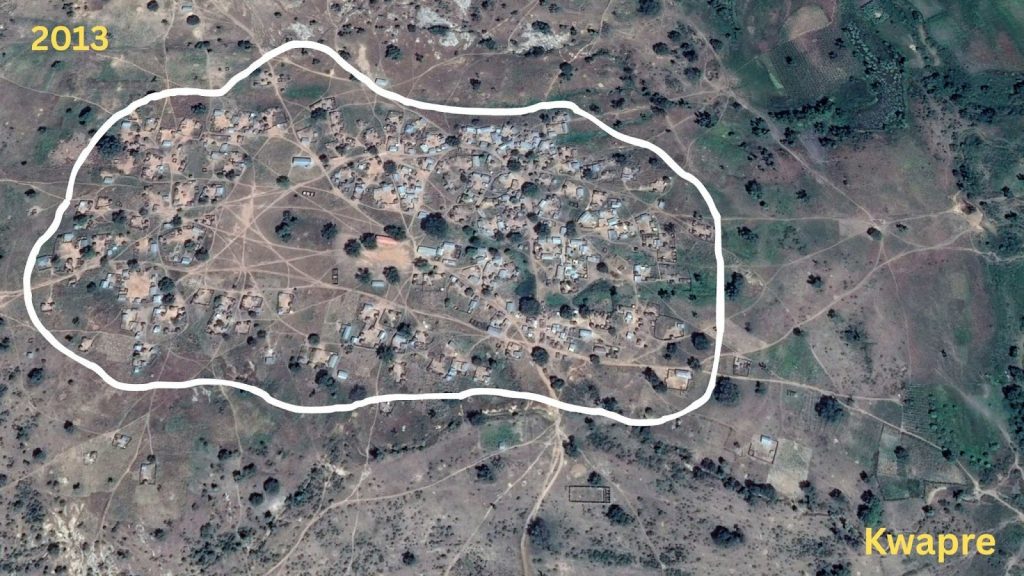
Despite repeatedly fleeing, residents kept returning to Kwapre. Google satellite imagery shows a strong tie to their homeland that keeps them returning and growing the communities despite periods of partial exodus. The latest attack led to a full abandonment in 2025. Map illustration: Mansir Muhammed/HumAngle.
The violence that broke ties
Buba is among the over 200,000 persons who have been displaced by Boko Haram in Adamawa State, with most of them from Michika and Madagali local government areas.
He told HumAngle that Boko Haram first attacked his community in 2014, and residents fled the area. After a year, the locals returned, but the terrorists kept storming the area at intervals. Some left for good, while others, like Buba, stayed behind, clinging to their ancestral inheritance and hoping that the violence would end.
“We go back when everything is calm and flee when the conflict starts again, but by 2025, we have all left, and there is currently no one in Kwapre,” Buba said.
Boko Haram has been displacing residents in Adamawa since 2014. About 40 people were killed after the terrorists attacked seven villages in Michika and its environs in 2014. In 2016, the group invaded the Kuda Kaya village of Madagali LGA and killed 24 people during indiscriminate shooting.
In 2019, Boko Haram struck again, but some of them were killed in Madagali after they tried to infiltrate a military camp. However, one soldier and a civilian were killed. In 2020, Kirchinga village in Madagali was attacked after the insurgents stormed the area. Houses were razed and shops looted, causing residents to flee.
Other attacks were unreported. Data from the International Organisation for Migration (IOM) shows that a total of 665 individuals from 133 households were displaced from their communities in Madagali by a non-state armed group in June 2022.
Chinapi Agara, a resident of Garaha, another community in Hong, told HumAngle that when the Islamic State West Africa Province (ISWAP), a Boko Haram breakaway group, attacked a military base in the area in February, communities within Garaha had experienced a surge in kidnappings in the last few years, which had forced many to flee.
“Lots of communities like Kwapre, Gabba, and Lar have been completely displaced,” he said. Chinapi’s relative died from a stray bullet during the attack.
Shuwari in Kirchinga, under the Madagali LGA of Adamawa State, is one community that has been deserted following insurgents’ attacks in the area. Despite the recurring attacks in the last decade, locals stayed back, but in February, the entire village was deserted after Boko Haram stormed the area and opened fire on locals. HumAngle learned that 21 people were killed, including the Shuwari community leader.
Bitrus Peter, a resident of Kirchinga, told HumAngle that this was not the first Boko Haram attack in the area. “Since we came back from displacement in 2015, we have been facing this challenge. Sometimes, they give a break of a year or two and then return,” he said.
Gambo Stephen, a survivor of the February attack in Shuwari who has since fled the area, told HumAngle that residents have now been scattered across various places.
Back in Shuwari, Gambo owned a barbing salon that brought in a modest income to support his wife and four children. “I opened the shop immediately after I was done with my tertiary education, and for years, it helped me to provide for my family,” he noted.
On February 24, when Boko Haram raided Shuwari, Gambo’s salon was burnt to the ground alongside other houses and properties in the area. “I narrowly escaped because five people who were running with me were all shot dead,” Gambo said.
Get our in-depth, creative coverage of conflict and development delivered to you every weekend.
Subscribe now to our newsletter!
These localities around Kirchinga are geographically at risk of cultural loss.
Kirchinga town itself is a border settlement between Adamawa and Borno states. It lies along the banks of a large river that sustains a livelihood built around fishing. Even with seasonal drying of the water, satellite imagery shows stretches of low-lying land between the levelled terrain, supporting farming during the dry season.
Beyond this, the area serves as a pathway between Borno and Adamawa, with a road tracing the river’s path and linking a chain of localities. Agricultural fields, water sources, and this road network connect these settlements across the local government area through markets and other primary commercial activities.
The land around the settlement dwarfs it. The road sustains movement and exchange, but along that same path is the spread of insurgent influence.
Illustration: Akila Jibrin/HumAngle
Zooming out from Kirchinga through satellite imagery reveals the other settlements facing similar patterns of displacement and abandonment. To the north lies Bikiti. While its layout differs from Kirchinga, the parallels are clear in the vast cultivation fields surrounding the settlement. Alongside these are a mix of swampy wetlands and local streams, supporting a range of ecosystem services, from farming to aquatic life and small game.
Beyond this lies a large stretch of uninhabited land, many times larger than the settlement itself, composed almost entirely of cultivated fields. Further out, this landscape opens into forested areas that connect toward Sambisa Forest, long associated with insurgent strongholds.
Though these places differ in their satellite layouts, their cultural identities are evident from above. Whether through farming, fishing, hunting or trade, the patterns on the land reflect the life of the people who lived there. These are the same patterns that begin to disappear as displacement takes hold.
Kuda Kaya, another such settlement, offers another case in point. Located northeast of Kirchinga, it has become known for both attacks and displacement.
It is a small settlement, easy to miss at a wider satellite scale. Within its tight layout are key structures: a primary school, a health post, and an administrative building, surrounded by clusters of homes. The settlement itself is heavily vegetated, with tree cover rising to roof level. Beyond this, shorter grasslands spread into cultivated fields, intersected by small streams. While hunting may not be the dominant activity, the landscape supports tree crops and grain farming.
Kuda Kaya is known for both attacks and displacement. Satellite illustration: Mansir Muhammed/HumAngle
The intent behind settlement patterns becomes clear when looking at historical imagery, even as far back as 2004, available on Google Earth. The ancestral communities chose flat terrain near rivers or streams, or large forest areas, settling in compact clusters while using the surrounding land for food production.
At present, signs of abandonment are not always as obvious as in parts of Borno or Benue in the country’s North Central. Some of these communities endured repeated attacks, with residents returning each time. But over time, the strain of persistent insecurity led to wider displacement and, in most recent cases, total abandonment.
In a few years, many of these buildings will begin to collapse. Roofs will give way, and some structures will be burned, patterns already observed across abandoned communities affected by insurgency in Nigeria. What will also become visible is the absence of farming. Recent imagery already shows early signs of neglect across what were once actively cultivated lands.
The same likely extends to the rivers. While satellite imagery cannot fully capture changes in aquatic life, the absence of regular human activity around these waters will affect both the ecosystem and the human systems tied to it, similar to what has been observed in parts of the Lake Chad region.
Zooming further out shows northern Adamawa marked by these border communities, many of which are now within displacement hotspots.
Some abandoned communities in northern Adamawa state. Map illustration: Mansir Muhammed/HumAngle
Today, many of their residents live in resettled communities and displacement camps still active across the region, some farther away, removed from the cultural heritage their ancestral lands once provided. They adapt to the host communities, the only available way for them. They can no longer point to land and trace ownership or inheritance. Even when they take up familiar activities like farming, fishing, or hunting, they remain outsiders for a time.
The geographic shift may not always be extreme, but the separation from their roots is. The connection is severed, even when practices are carried into new environments. For those displaced, especially across generations or into prolonged uncertainty, that break becomes harder to repair. It is reinforced by the trauma of the violence that forced them out.
Some still hold on to the hope of return. Others are already preparing to move on, regardless of what becomes of home.
Resettlement
When the terrorists returned to Kwapre in 2025, Buba faced a near-death experience, and that was the last straw. He fled with his wife and five children alongside other community members when the village was being set ablaze.
“I left home empty,” he stated, adding that his family didn’t flee with any belongings.
Buba moved into Hong town, where he settled with his family. With each passing day, he remembered home, but he knew it would be unwise to return. It’s been about a year since Buba resettled in Hong town. He describes the last couple of months as hell.
“We are suffering, and since I was born, I have never suffered like this,” he said. Buba is unsure of his exact age, but is estimated to be in his 50s. “We have to pay for house rent, and there is no money to do so. We are always pleading with the landlord. We are also managing food supply,” he lamented.
Back at Kwapre, Buba had his own house. As a full-time farmer, he said his harvest was always bountiful, and his family was always cared for, but now, they even struggle to feed themselves. He currently works as a labourer on a construction site. His task is to fill up trucks with sand and transport them, but the wage barely covers his family’s needs. Since he has been a farmer all his life, Buba acquired a plot of land in his new area so he could cultivate crops, keep some, and sell the rest to augment his income from his labouring job.
“I cultivated last year, but it was destroyed by cattle, and I couldn’t get even a bag of maize during the harvest,” he said.
While he considers himself lucky to be alive, Buba says life has taken a difficult turn. “I can’t even pay my children’s school fees. I registered them in a school here in Hong town but they have just been sent back home,” he said.
After making it out of Shuwari, Gambo travelled to Yola, the capital of Adamawa State, and settled in an old secondary school in Saminaka, a neighbourhood in the city.
“I didn’t leave with anything because they burnt everything, so someone gave me a student mattress to lie on,” he said.
After taking shelter at the school, he was able to phone his wife, who had made it out safely with his four children.
“They are currently staying with her relatives in Madagali town,” he said.
Gambo feels his family is better off without him because he has nothing to offer them.
“Thank God for relatives because they do buy things and give them, and also some friends. If I had left home with some of my valuables, I would have started a business, but I don’t have anything on me. They (Boko Haram) also burnt my farm produce, slaughtered all my cattle alongside others in the village,” he said.
If the violence ever ceases and peace is permanently restored, Gambo said he would never return to Shuwari, for he had seen enough.
“My friends died there, and it’s only God that protected me, especially my wife and children,” he said.
Gambo told HumAngle that the community is completely deserted and that his main concern right now is raising capital to start a business at his new location in Saminaka. If things somehow get better, he would send for his family to join him.
In 2025, HumAngle reported how many displaced persons from Adamawa are stuck in displacement camps for about a decade because their hometowns remain unsafe.
Ghost towns
While he has not kept in touch with anyone from his community since he fled, Buba fears that the name ‘Kwapre’ will be erased from history, as the once-lively village now lies empty and silent. He wished things were different. He dreams of a time when the terrorists will stop invading the area, and his people will return and carry on with their regular lives. He looks forward to the annual harvest festival, but he believes his aspirations are not enough to hold water.
“People from Kwapre have been scattered across different regions. It’s even difficult to keep in touch with close relatives,” Buba said.
But if the violence ceases and peace is permanently restored, Buba said he will return home even if it means he will be the only one living there. At least, he’ll have his house, his large farmlands and grains filled in his store. His children won’t go hungry, and he won’t have to labour day and night.
However, some questions linger in his mind: When will the violence end, and even if it does, will Kwapre be the same again?
According to Gambo, the fact that he misses Shuwari can’t be denied. It was the only home he had known all his life. “We used to celebrate together when we were in the village. We lived peacefully, but when the insurgency started, everything crumbled,” he said.
While he misses the community that has stood by him his whole life, Gambo has made up his mind: he is done with Shuwari.
“I won’t go back because the village is on the border of Sambisa Forest,” he said.
Studies have shown that the Boko Haram insurgency in Adamawa, which targets communities near the Sambisa Forest, has caused several communities within the Northern Senatorial District of the state to vanish. Madagali, Michika and Hong local governments specifically have the highest number of abandoned communities as attacks continue to intensify. From 2023 to 2025, villages in Kwapre, Zah, Kinging, Mubang, and Dabna in the Hong local government, with a combined population of over 10,000, were said to have been massively displaced, with many residents fleeing to safer towns.
Boko Haram insurgency in Adamawa targets communities at the Borno border, especially near the Sambisa Forest, causing several communities within the state’s northern region to vanish. Photo: Cyrus Ezra
Sini Peter, the youth leader of Kirchinga community in Madagali, told HumAngle that a lot of cultural festivals have stopped due to Boko Haram’s consistent attacks in the area.
The Yawal festival, the most popular cultural event in the area, was held annually in the middle of the year and is no longer held.
“A grass would be tied to a guinea corn stem, which is a year old, and we would go out early in the morning, around 3 a.m., to chant,” Sini recalls how the festival used to be held.
The Yawal festival was so significant to the Kirchinga people that the ritual had to be completed before locals could carry out their daily activities. The chants were traditional songs believed to ward off death from the community and were sung every morning on the day of the festival. Locals were always eager to participate in the ritual and sing the song until terrorists started invading the area.
However, they no longer believe in the ritual’s efficacy or mark the festival, according to Sini. “Boko Haram attacks made death a normal thing to us today,” he said.
According to the youth leader, the February attack on Shuwari, which had caused residents to flee the area completely, shows a broader displacement pattern across Madagali communities that have been affected in the area.
“Villages like Imirsa, Madukufam, Balgi and Yafa, which are bordering Kirchinga, are empty due to the Boko Haram issues,” he said, adding that the terrorists have been looting properties like roofing sheets in some of these communities from time to time.
While many have deserted these areas for good, including Kirchinga town, Sini is among those who stayed behind. “I know that wherever a Marghi man goes, he will remember home because he will not enjoy anywhere like home. Even with the killings, we don’t have anywhere like Kirchinga,” he stated.
One of the Motorcycles burnt in the Wagga-Mongoro community of Madagali after terrorists invaded the area in 2025 and killed civilians. Photo: Cyrus Ezra
Speaking on the security situation in the area, he noted that the security architecture in Kirchinga is very poor. “What should be done is not done because fear is all over us, including the security personnel,” he said.
When Ahmadu Fintiri, the governor of Adamawa State, visited the area following the attack in Shuwari, he vowed to secure the area, but Sini fears the promise will not translate into action.
“There are people trained now; they are called Forest Guards, and when the attacks happen, they do not have arms, but after the governor left, they were given AK-47s, but when they want to go for duty, they have to go to Shuwa to get the arms and return them after duty,” Sini said.
He explained that this strategy might not work, as the forest guards spend over ₦1,000 daily to obtain and return arms in Shuwa, as protocol demands.
It’s been a month since people treaded the Shuwari path, and with the community now completely deserted, Gambo fears that his children might never know their ancestral homes or experience the cultural heritage that once united their people.
What’s left of the ghost towns?
The analysis of satellite imagery from 2013 to 2025 across 14 communities in Adamawa State, using specialised satellite sensors (Landsat/Sentinel), shows environmental change linked to abandonment and displacement. When fields are left uncultivated, the land does not simply freeze in time. In some areas, weeds overtake cultivation, while in others, the soil and greenery collapse, leaving the land barren.
The vicinity of the abandoned communities. Green shows shrub reclamation. Red shows the growing barrenness of abandoned lands. Data source: Landsat & Sentinel/ illustration: Mansir Muhammed/HumAngle.
In communities like Larh and Dabna, the data shows a steady increase in shrubs and bushes. In recent times, peak vegetation values in Larh have risen by nearly 12 per cent, as weeds are left unattended in places where farmlands used to be.
The seasonal variation has also increased, indicating that the lands now support vegetation growth in response to rainfall rather than following a stable, cultivated rhythm. Mubang and Banga show similar trends, with significant growth in peak farmland weed growth over the same period. The land is reclaiming itself in a chaotic, unregulated way, with invasive, fast-growing plants dominating.
On the other hand, several communities tell a different story. Kirchinga and Kopa have experienced dramatic declines in greenness, with vegetation dropping by 27 per cent and 23 per cent, respectively. These are areas where abandonment appears to have compounded other pressures, such as erosion, burning, or neglect, leaving the soil exposed and vulnerable.
Shuwari and Yaza have also lost nearly one-fifth of their peak greenness over the same period. Unlike Larh or Dabna, these communities are not witnessing vigorous shrub growth. Instead, the land shows signs of degradation, with both peak greenness and seasonal variability shrinking, suggesting that vegetation’s capacity to recover is weakening.
This has long-term implications for returnees. The data highlights a dual response to abandonment. In some areas, the absence of farming has allowed nature to fill the gaps, though not always in ways that benefit local livelihoods. In others, the land deteriorates quickly once cultivation stops, leaving behind increasingly unproductive expanses.
These two observed outcomes will shape the future of the homes should locals return.
GEMMA Arterton has revealed she secretly welcomed a second child.
The actress – who is set to headline the new big budget ITV drama Secret Service later this month – has revealed she kept her entire pregnancy a secret last year.
Sign up for the Showbiz newsletter
Thank you!
Gemma Arterton has revealed she secretly welcomed her second child last yearCredit: GettyThe new mum looked incredible as she sported some bright red trousers earlier this week in the London sunshineCredit: BackGridGemma stepped out with her co-star Rafe Spall while promoting their new thriller Secret ServiceCredit: BackGrid
As reported by the Mirror, speaking on the Dish podcast with hosts Nick Grimshaw and Angela Hartnett, Gemma casually revealed she is now a mother of two.
Asked how she is on the latest podcast, she told the hosts: “I’m happy to be let out for the day.
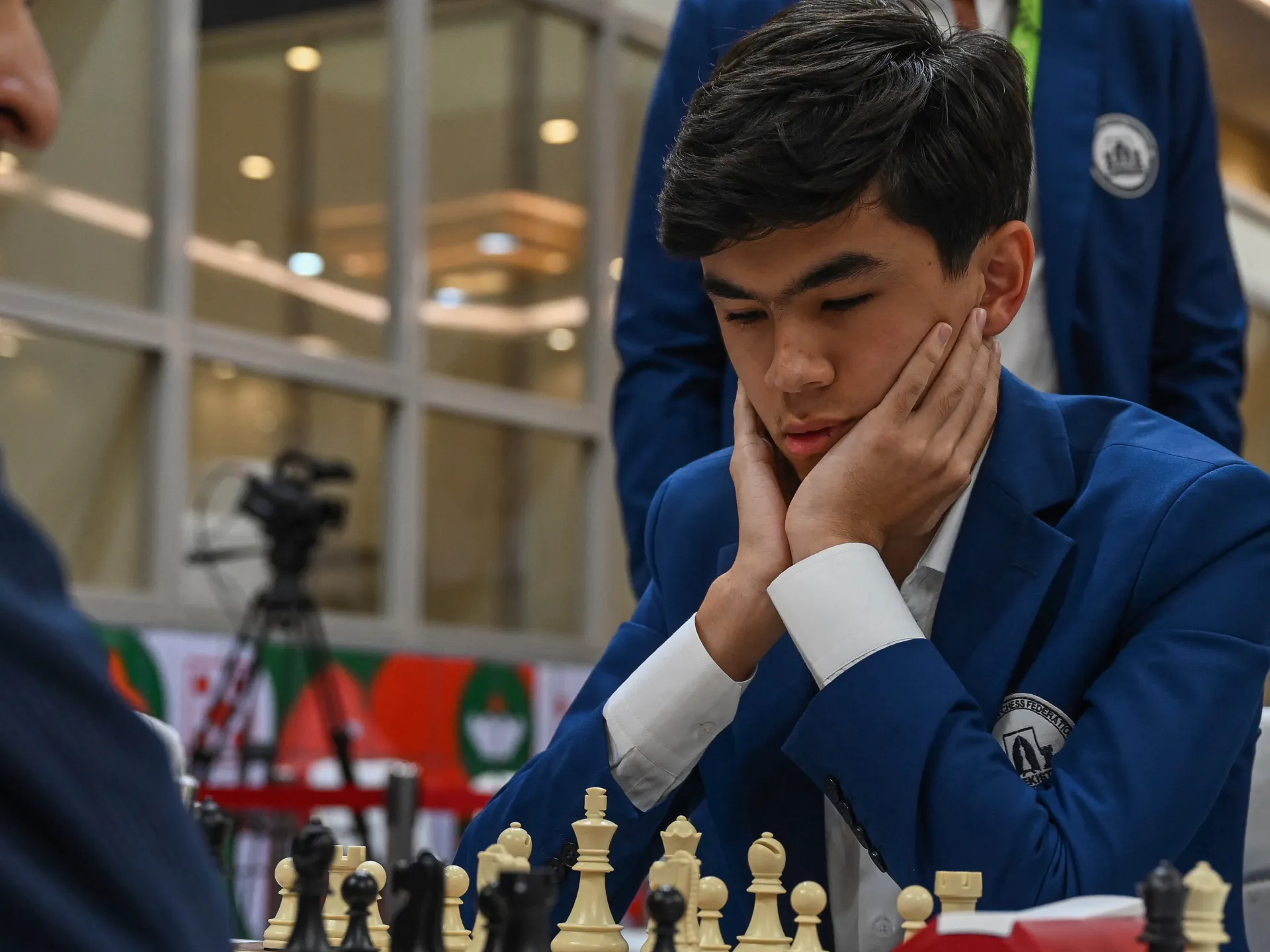
Javokhir Sindarov wins the Candidates Tournament with a round to spare and will face India’s Gukesh next.
Published On 15 Apr 202615 Apr 2026
Uzbek grandmaster Javokhir Sindarov has clinched victory in the chess Candidates Tournament with a round to spare, drawing with Dutchman Anish Giri to set up a World Championship match against India’s Gukesh Dommaraju.
The 20-year-old stormed through the event in Cyprus on Tuesday, winning six of his 13 games and losing none in a dominant performance never seen at the Candidates.
Recommended Stories
list of 3 itemsend of list
Sindarov moved to 9.5 points, two clear of second-placed Giri on 7.5, after the Dutchman failed to convert a winning position against China’s Wei Yi in the previous round.
“It was the hardest week in my life. I even slept really bad the last few days. I am very happy to finish this tournament with a win,” Sindarov said after his win.
The tournament had been seen as a possible last opportunity for the old guard to mount another challenge for the world title, but Americans Fabiano Caruana and Hikaru Nakamura never seriously threatened.
Gukesh won the title in 2024, defeating China’s Ding Liren in the 14th and final game of their match. Ding had himself become champion by beating Ian Nepomniachtchi after Magnus Carlsen, the five-times champion who remains world number one, relinquished the crown, citing a lack of motivation.
“I do not want to think a lot about the upcoming World Championship match right now. I know it will be a very hard match,” Sindarov said.
“Gukesh has an experience of playing at this level. But I have a very good team. I have a lot to work on, and I will work a lot for this and take my chances.”
While Sindarov’s breakthrough and the broader rise of a younger generation are likely to prompt new speculation about a Carlsen comeback, the Norwegian has said he has no intention of returning to the classical World Championship cycle.
A precise date and a venue for the World Championship match have yet to be announced.