The territorial dispute flared up over the discovery of massive offshore oil deposits. (Archive)
Mérida, February 18, 2026 (venezuelanalysis.com) – The Venezuelan government commemorated the 60th anniversary of the Geneva Agreement and urged Guyana to engage in “good faith negotiations” to settle the longstanding dispute over the Essequibo Strip.
In a statement published on Tuesday, Caracas celebrated six decades of the agreement and reiterated that the treaty is “the only valid legal instrument for reaching a mutually acceptable solution to the dispute” over the 160,000 square-kilometer territory.
The 1966 accord, signed by Venezuela, the United Kingdom, and British Guiana, a British colony at the time, saw the different parties pledge to find an agreeable solution to the border issue.
The Venezuelan government’s communique noted that the treaty was submitted to the United Nations, arguing that it overruled the controversial 1899 arbitration ruling which awarded the territory to the United Kingdom.
The text also reaffirmed Venezuela’s sovereignty claim over the resource-rich territory and referenced the popular mandate from the December 3, 2023, referendum that saw over 90 percent of respondents back the country’s rights over the Essequibo Strip.
“The only possible solution to the territorial controversy is to engage in good faith negotiations, to achieve a satisfactory arrangement for the two parties that signed the Geneva Agreement,” the declaration concluded.
The Guyanese government responded on Wednesday with its own statement, arguing that the Geneva Agreement did not annul the 1899 Arbitral Award but rather established a framework for resolving the dispute that arose when Venezuela questioned the border’s validity in 1962.
Georgetown likewise noted that, in January 2018, the Secretary-General of the United Nations determined that the “good offices” mechanism had been unsuccessful in resolving the dispute.
“In accordance with Article IV (2) of the Geneva Agreement, the Secretary-General decided to submit the case to the International Court of Justice (ICJ) as the final means of resolution. Both Guyana and Venezuela were bound by that decision.”
Hours later, the Venezuelan government issued a second statement accusing Guyana of attempting to distort the spirit of the Geneva Agreement and reiterating Caracas’ position rejecting the ICJ’s jurisdiction over the border controversy.
“Venezuela will not recognize any decision emanating from the International Court of Justice on the territorial dispute surrounding Guayana Esequiba,” the document read.
Despite rejecting the Hague-based court’s authority on the matter, the Venezuelan government participated in a documentation-gathering process before the ICJ during 2023 and 2024. Acting President Delcy Rodríguez, then vice president, led the country’s legal efforts.
In August 2025, Caracas submitted further evidence backing its Essequibo sovereignty claim and challenging Georgetown’s historical and legal arguments. The case will advance to the oral hearings phase in May 2026.
In January, the Guyanese Minister of Foreign Affairs and International Cooperation, Hugh Todd, claimed that the ICJ’s ruling would be binding for both nations and that the case was now in the hands of “the highest and most respected judicial authority in the world.”
The longstanding territorial controversy flared up in 2015 after ExxonMobil discovered and began exploiting massive offshore oil reserves. Venezuelan authorities have raised their sovereignty claims and criticized Guyanese counterparts for giving drilling permits to multinational corporations in undelimited waters.
Caracas has also criticized the US’ interference in the issue, with successive administrations offering their full backing to Georgetown. Venezuelan authorities have accused Washington of stoking regional tensions amid plans to establish military bases in Guyana.
UCLA has canceled an upcoming lecture featuring CBS News editor-in-chief Bari Weiss.
Weiss was scheduled to give the annual Daniel Pearl Memorial lecture on Feb. 27, about “The Future of Journalism.” But according to the university, the program will not move forward as scheduled, after Weiss’ team withdrew from the event.
A source familiar with the UCLA program said the lecture was canceled due to security concerns from Weiss, despite the public university offering to obtain additional security for the event, the source said. The Daniel Pearl Memorial lecture series honors the late journalist and is considered the capstone of the university’s Burkle Center for International Relations. Previous speakers include journalists Jake Tapper, Anderson Cooper and Bob Woodward.
According to the source, several employees at both the Burkle Center and the International Institute expressed opposition to Weiss speaking on campus. The university was also expecting a large number of students to protest the event.
Neither Weiss nor CBS immediately responded to a request for comment.
Weiss founded the media company, The Free Press, which was purchased in October by Paramount, CBS’ parent company. Following the $150 million purchase, Weiss was installed as editor-in-chief of CBS News.
Two months after taking on the new role, Weiss made the widely panned decision to pull a “60 Minutes” episode that examined the alleged abuse of deportees sent from the U.S. to an El Salvador prison. The decision earned Weiss heavy criticism and accusations that the move was politically motivated.
The canceled UCLA lecture comes at a time of ongoing organizational upheaval at CBS, which this week made headlines amid an escalating battle with its own late-night talk host, Stephen Colbert, over the FCC’s effort to enact stricter enforcement of the equal-time rule.
A Russian drone strike on a five-story residential building in Kyiv, Ukraine, shows why a third of Ukrainian children are displaced, as reported by UNICEF on Tuesday. Photo by EPA/Stringer
Feb. 18 (UPI) — As the Ukraine war nears its fifth year, more than a third of Ukrainian children remain displaced following Russia’s invasion of its neighboring nation.
Russian forces invaded Ukraine on Feb. 24, 2022, which has led to the displacement of 2.59 million Ukrainian children, UNICEF reported on Tuesday.
The number of displaced children includes 791,000 who are still inside Ukraine and nearly 1.8 million who are refugees living outside of the country’s borders. Russian forces also have taken many Ukrainian children and relocated them to Russia.
“Millions of children and families have fled their homes in search of safety, with one in three children remaining displaced four years into this relentless war,” said UNICEF Regional Director for Europe and Central Asia Regina De Dominicis.
“For children in Ukraine, safety is increasingly hard to come by as attacks on civilian areas continue across the country,” De Dominicis said. “In many ways, the war is following these children.”
Many children and their families have been forced to flee their homes several times during the war as Russian forces targeted civilian areas.
A recently published UNICEF survey showed that a third of teen respondents between age 15 and 19 said they moved at least two times due to safety reasons so far during the war.
Bombardments by Russian artillery, attack drones and ballistic missiles have killed or injured more than 3,200 children since the war started.
Each year, the number of dead and injured has increased among Ukraine’s children, according to UNICEF.
“Obligations under international humanitarian law must be upheld, and every possible measure to protect children and the civilian infrastructure they rely on must be taken,” De Dominicis said.
“Every child has the right to grow up in safety, and without exception that right must be respected.”
Many of the support services for the country’s children also have been damaged or destroyed, including more than 1,700 schools and other education facilities, which deprives a third of Ukrainian children from attending school on a full-time basis.
Russian strikes on Ukraine’s energy infrastructure have deprived millions of Ukrainian children and their families of the power needed to heat their homes and water during the country’s extremely cold winters.
Babies and young children are especially vulnerable to harm due to a lack of electrical power, which could lead to hypothermia and respiratory illnesses.
More than 200 medical facilities also have been damaged or destroyed in Ukraine over the past year and many more before then.
The stress of the ongoing war is putting a severe mental strain on Ukraine’s children, who often experience a constant fear of attacks that force them to seek shelter in basements and remain isolated while at home.
About a fourth of Ukrainian youth between age 15 and 19 say they are losing hope for the country’s future.
UNICEF officials said they are working with local and national authorities to support Ukrainian children and provide them and their families with safe water, healthcare, food, educational support, mental health services and similar needs.
These are the key developments from day 1,456 of Russia’s war on Ukraine.
Published On 19 Feb 202619 Feb 2026
Share
Here is where things stand on Thursday, February 19:
Fighting
Russian forces launched multiple attacks on Ukraine’s Zaporizhia region, killing one person and injuring seven others over the past day, the region’s military administration said on the Telegram messaging platform.
The attacks involved 448 drones as well as 163 artillery strikes, causing damage to 136 homes, cars and other structures, the military administration said.
Russian forces also continued shelling Ukraine’s Donetsk region, forcing 173 people, including 135 children, to evacuate front-line areas over the past day, regional governor Vadym Filashkin said on Telegram.
A 54-year-old man was killed in a Russian attack in the Nikopol district of Ukraine’s Dnipropetrovsk region, Governor Oleksandr Hanzha said on Telegram.
Russian attacks also left many people without electricity across Ukraine, according to the Ministry of Energy, including more than 99,000 households in the Odesa region.
In Russia, one person was killed in a Ukrainian drone attack on the village of Aleynikovo in the country’s Bryansk region, Governor Alexander Bogomaz said.
Russia’s Ministry of Defence said that Russian forces seized the village of Kharkivka in Ukraine’s Sumy region and Krynychne in the Zaporizhia region, according to Russia’s state news agency TASS.
Ukrainian battlefield monitoring site DeepState said that Russian forces advanced in Nykyforivka in Ukraine’s Donetsk region.
Russian forces shot down 155 Ukrainian drones, 11 rocket launchers, and two guided aerial bombs in a 24-hour period, Russia’s Defence Ministry said, according to TASS.
Peace talks
Negotiators from Russia and Ukraine concluded the second of two days of US-mediated talks in Geneva, with both sides describing the negotiations as “difficult”.
Ukrainian President Volodymyr Zelenskyy said that although “progress has been made … for now, positions differ because the negotiations were difficult”.
President Zelenskyy later told the Piers Morgan Uncensored current affairs show that Russia and Ukraine were close to defining terms for how a potential ceasefire would be monitored, but progress on “political” issues had been slower, including on the most divisive issue of control of territory.
In Washington, White House spokeswoman Karoline Leavitt said there was “meaningful progress made” with pledges “to continue to work towards a peace deal together”, and more talks are expected in the near future.
Vladimir Medinsky, Russia’s top negotiator, said the two days of talks in Geneva were “difficult but businesslike,” telling reporters that further negotiations would be held soon, without specifying when.
Rustem Umerov, the head of Kyiv’s negotiating team, said that the second day had been “intensive and substantive” and that both sides were working towards decisions that can be sent to their presidents, he said.
Politics and diplomacy
Ukraine imposed sanctions against Belarusian President Alexander Lukashenko, promising to “increase countermeasures” against Minsk for supporting Russia’s war against Ukraine, including through providing relay stations for Russian drone attacks on Ukraine, Zelenskyy said on social media.
United States Senator Jeanne Shaheen of New Hampshire along with three other US senators from the Democratic Party visited Kyiv.
Shaheen told reporters that she “would hope that we would see a stronger effort and some real work when we get back to put pressure on Putin”.
Sport
Estonian Foreign Minister Margus Tsahkna said in a post on Telegram that “allowing Russian and Belarusian athletes to participate in the Milano-Cortina Paralympics while Russia continues its full-scale war against Ukraine is a disgrace”.
Estonian Public Broadcasting company Eesti Rahvusringhaaling announced it would not broadcast the games in protest at the decision to allow the Russian and Belarusian athletes to compete under their own flags.
The new Channel 5 programme follows the lives of working surgeons and left viewers moved
Viewers were impressed by new Channel 5 show The Surgeon(Image: Channel 5 screengrab)
Channel 5 viewers were emotional as a doctor battled to save an elderly lady in new series The Surgeon.
The TV series, which started on Channel 5 on Wednesday (February 18), shines a spotlight on doctors, with episode one focusing on bowel cancer surgeon Daren Francis. His first patient was a retired nurse named Doris, who worked for the NHS for over 50 years, with the narrator explaining that it was a “life-threatening emergency” after a blockage was discovered in her bowel.
The doctor had to operate before the bowel ruptured, admitting it was “a major operation” with increased risks given that Doris was 88.
Doris had said that she was in “excruciating” pain, with her daughter explaining further: “Mum was very sick and we weren’t sure whether to come or not because mum doesn’t like to be a nuisance. She doesn’t like, you know, I think being a retired nurse, I think she just doesn’t want to be a bother.”
Dr Francis told her: “It looks like the bowel’s blocked with a growth or a little lump. And that, we’ve got to consider is potentially a malignant or a cancerous growth.
“The plan is to take you to the operating theatre, general anaesthetic, you’ll be asleep, and make a cut in your tummy up and down. And then remove that piece of bowel, which is blocking the rest of the bowel.”
He continued: “So if we leave it there, the bowel can get stretched and stretched, and then eventually it could pop. Time is of essence. So we need to get on and do this. Otherwise, we’ll be in trouble.”
The programme then documented the successful operation, with viewers impressed by the surgeon’s skill. At the end of the episode, it was announced that Doris was recovering at home.
One viewer posted on X, which was formerly Twitter: “3 mins in and I am crying already! surgeons are so compassionate, skilled and amazing!”
Another shared a crying emoji as they posted “What a bloke. Skill and perfect bedside manner with patients.”
Someone else remarked: “”The Surgeon on 5 is phenomenal TV. Daren is an incredible human being. Amazing.”
Another impressed viewer said the surgeon was “fantastic”, as somebody else commented: “People talk about miracles but people like Daren create them here and now for people using his phenomenal surgery skills. Awe inspiring.”
“Never get tired of watching programmes like The Surgeon,” posted another viewer. “Skills beyond belief.”
For the latest showbiz, TV, movie and streaming news, go to the new **Everything Gossip** website.
Ensure our latest headlines always appear at the top of your Google Search by making us a Preferred Source.** Click here to activate**** or add us as your Preferred Source in your Google search settings.**
Fireworks erupt during the launch ceremony of the new 8,200-ton Aegis destroyer Dasan Jeong Yak-yong at the HD Hyundai Heavy Industries shipyard in the southeastern city of Ulsan, South Korea, 17 September 2025. The 170-meter-long, 21-meter-wide destroyer is equipped with advanced stealth features and enhanced detection and interception capabilities against ballistic missiles. File. Photo by YONHAP / EPA
Feb. 18 (Asia Today) — South Korea faces mounting strategic pressure as rivalry between the United States and China intensifies across the Indo-Pacific, raising questions about how Seoul should balance its security alliance with Washington and its economic ties with Beijing.
Analysts say the regional balance of power is entering a new phase. U.S. carrier strike groups continue to patrol the Western Pacific and longstanding alliances remain intact. Yet some experts argue Washington’s long-term strategy integrating economic, diplomatic and industrial policy lacks consistency.
In the March-April issue of Foreign Affairs, U.S. Indo-Pacific strategist Jack Cooper wrote that while American military power remains strong, its broader strategic integration has weakened. In an article titled “Asia After America,” he argued that policy shifts between administrations and the U.S. withdrawal from the Trans-Pacific Partnership have left gaps in regional economic leadership.
Cooper said the issue is not U.S. withdrawal but uncertainty over long-term strategic continuity. For allies, he wrote, the question is who shapes the regional order beyond crisis intervention.
Meanwhile, China has continued expanding its footprint through militarization of artificial islands in the South China Sea and sustained military activity near Taiwan. Beijing is also deepening regional economic integration through the Regional Comprehensive Economic Partnership and the Belt and Road Initiative, often referred to as the New Silk Road.
South Korea sits at the center of these tensions. Its security rests on its alliance with the United States, while China remains its largest trading partner. Key sectors such as semiconductors, batteries and artificial intelligence are directly exposed to U.S.-China competition.
Jung Seong-jang, vice president of the Sejong Institute, said in an interview that a Taiwan contingency could directly affect South Korea by disrupting critical sea lanes of communication.
A 2023 report by the Korea Institute for International Economic Policy found that 33.27% of South Korea’s maritime trade passes through or near the Taiwan Strait. The institute estimated that disruption of major shipping routes in the area could cause economic losses of about 445.2 billion won ($334 million) per day, based on current exchange rates.
Jung cautioned that direct South Korean military involvement in protecting sea lanes could heighten tensions with China, while North Korea might exploit regional instability to escalate provocations.
Joo Eun-sik, head of the Korea Institute for Strategic Studies, outlined several policy recommendations.
First, he called for deeper integration of the U.S.-South Korea alliance, including coordinated planning in maritime security, missile defense, space and cyber domains to strengthen deterrence against so-called gray-zone threats.
Second, he urged a combined economic and security strategy, strengthening supply chain cooperation and expanding investment in strategic technologies. He said South Korea’s defense industry should function not only as an export sector but as part of a broader strategic network.
Third, he emphasized maritime capabilities, describing sea routes from the Strait of Malacca through the South China Sea and Taiwan Strait as vital to South Korea’s economy. Expanding blue-water naval operations, submarine forces, maritime patrol and unmanned systems, he said, is essential.
Finally, he highlighted the need to build strategic autonomy within the alliance framework by investing in independent intelligence, surveillance and reconnaissance capabilities, space monitoring systems and layered missile defense.
Analysts say the Indo-Pacific order remains unsettled. Whether South Korea becomes a passive bystander or an active architect of its own strategy may depend on how effectively it integrates security, industry and technology into a coherent national plan.
The Government Accountability Office (GAO), a congressional watchdog, highlighted how Sentinel will impact Air Force Security Forces units in a brief report released earlier today. This comes a day after the Air Force put out its own update on the new ICBM program, stating that the current goal is for the restructuring effort to wrap up before the end of the year and for the first launch of a prototype LGM-35A to occur in 2027. The hope now is that Sentinel will begin entering operational service sometime in the early 2030s. The original schedule had called for the missiles to reach initial operational capability in 2029.
A three-stage test booster used in the ongoing development of the LGM-35A Sentinel intercontinental ballistic missile. USAF
“DOD will need to complete Sentinel launch facility test and evaluation activities early in the transition to inform DOD and Air Force security policy updates,” the GAO report says. “Because security forces incorporate these updates into unit-level operating instructions, these policy updates will be needed to train Air Force security forces for the transition.”
A rendering of a complete LGM-35A Sentinel missile. Northrop Grumman
The report does not elaborate on the changes that will be required. As noted, Security Forces personnel currently assigned to Air Force Missile wings train to protect the Minuteman III force above and below ground. There are currently 400 LGM-30Gs loaded into silos spread across five states. Sentinel is said to offer greater range and improved accuracy, as well as reliability and sustainability benefits, over the aging Minuteman IIIs, which first entered service in 1970. The development of a new ICBM also offers the opportunity for the inclusion of survivability improvements and other additional capabilities.
An infrared picture of a Minuteman III during a test launch. USAF An infrared image of an LGM-30G Minuteman III ICBM taken during a routine test launch. USAF
“The training simulated a hostile’s attempt to capture a nuclear asset. Security forces Airmen, who arrived by both Humvee and helicopter, began to combat the threat and worked their way toward retaking control of the launch facility. After neutralizing the threat, recapturing and securing the launch facility, the Airmen performed self-aid buddy care and tactical combat casualty care.”
The video below shows scenes from a recapture and recovery exercise conducted as part of the larger Global Thunder 23 exercise.
91st Missile Wing participates in Global Thunder 23
Terrorists or other hostile actors could also seek to break into silos or launch facilities just to damage or destroy them. Even if they could not trigger a nuclear detonation, blowing up an ICBM inside its silo would have significant operational, environmental, and other ramifications.
The Air Force had originally said it would reuse Minuteman III silos and other existing infrastructure for Sentinel, but subsequently determined that was no longer a viable course of action. As such, new silos and launch control facilities could easily come with substantially different physical layouts that would affect the tactics, techniques, and procedures for securing them. The LGM-35A missiles will also be completely different from the existing LGM-30Gs, and there could be additional notable differences in how the Sentinels are married together with their new ground-based infrastructure. All of this could further impact how Security Forces personnel prepare themselves for a variety of contingencies, including any potential for accidental detonations or launches.
Graphics depicting existing Minuteman III silos and launch facilities from the report that GAO released today. GAOA rendering of a future Sentinel launch facility, including the silo, which dates back at least to 2023. Northrop Grumman
In its update about Sentinel yesterday, the Air Force shared that prime contractor Northrop Grumman is set to start building a prototype launch silo at the company’s facility in Promontory, Utah, this month. “This crucial effort will allow engineers to test and refine modern construction techniques, validating the new silo design before work begins in the missile fields,” according to the release.
There’s a strong possibility that a prototype silo could also be used to help develop and refine new Security Forces TTPs in future, as well.
Site defense is also just one aspect of the elaborate and costly security ecosystem in place now for the Minuteman III force. This includes protection for ICBMs while they are being transported via transporter-erector trucks, as well as loaded or unloaded into silos. All of this will also have to adapt to the future Sentinel missiles and their new facilities. The Air Force has already been modernizing certain aspects of nuclear force protection capabilities, including the acquisition of new MH-139A Grey Wolf helicopters to replace aging UH-1Ns used to provide air support over the silo fields and for convoys on the move. An MH-139A was used to escort a Minuteman III convoy for the first time in January.
An MH-139A helicopter seen helping escort a Minuteman III convoy for the first time on January 8, 2026. USAF
In terms of other Sentinel-related infrastructure work, “this summer, prototyping activities at F.E. Warren AFB [Air Force Base, in Wyoming] will validate innovative utility corridor construction methods, which are key to streamlining the installation of thousands of miles of secure infrastructure and fielding the system faster,” the Air Force’s release added. “Meanwhile, foundational construction on permanent facilities is already well underway. The first of three new Wing Command Centers is taking shape at F.E. Warren AFB, and critical test facilities are being erected at Vandenberg SFB [Space Force Base, in California] to support the future flight test campaign.”
So-called Site Activation Task Force (SATAF) detachments are also helping lay the groundwork for the transition from Minuteman III to Sentinel at F.E. Warren and Vandenberg, as well as Malmstrom Air Force Base in Montana and Minot Air Force Base in North Dakota. It should be noted that Vandenberg does not currently host operational ICBMs, and is not set to do so in the future, but is used for routine test launches. The Air Force also says that the planned first launch of a Sentinel in 2027 will be from a pad rather than a silo.
US Air Force launches Minuteman III ICBM from Vandenberg in unarmed test
The Air Force is otherwise hopeful that the ongoing restructuring effort will reduce the chance for further schedule risks to the Sentinel program and, by extension, cost growth.
“We certainly have not lowered the bar, and we certainly have not taken on any risk by doing this,” Air Force Gen. Dale White, the new Direct Reporting Portfolio Manager (DRPM) for Critical Major Weapon Systems (CMWS), told Breaking Defense in an interview published yesterday. The DRPM CMWS role was established last August to create a “single empowered leader” to manage Sentinel and other top-priority Air Force weapon systems programs, including the F-47 sixth-generation fighter and B-21 Raider stealth bomber.
“The restructured program incorporates key lessons learned to ensure maximum efficiency,” the Air Force’s release explained. “The decision to build new silos, for example, avoids the unpredictable costs and safety hazards of excavating and retrofitting 450 unique structures built over 50 years ago, and is a prime example of choosing a path that delivers capability with greater speed and less risk.”
“Sentinel program officials continue to evaluate options to potentially redesign portions of the weapon system for cost reductions and are looking at avenues to minimize further schedule delays,” GAO’s report today also noted. “For example, the Air Force is reevaluating system requirements and evaluating changes to the acquisition strategy – both of which could limit further cost and schedule growth.”
GAO’s report did still highlight continued concerns about potential challenges for Sentinel, including in relation to software development for the missiles and work on the extensive new ground infrastructure. As noted, the need for all-new silos has already been a central factor in delays and cost overruns, despite the hope that this will prove less risky in the long run. There are also concerns about sustaining the Minuteman III force beyond 2036, when the transition to Sentinel was originally supposed to be complete. A seamless replacement process is critical to ensuring that the land-based leg of America’s nuclear triad remains a credible deterrent capability throughout.
A transporter-erector seen loading a Minuteman III into a silo at Malmstrom Air Force Base. USAF
“I think Sentinel is going to be a bit easier with some of the things we’re designing into the program, the digital infrastructure, the open architecture,” Air Force Gen. Stephen Davis, head of Air Force Global Strike Command (AFGSC), told TWZ in an interview last month. “I think it will make it easier to upgrade and keep that missile relevant. I don’t have any worries about being able to do that in the future.”
Overall, the Sentinel is categorized as “megaproject” by GAO, defined as something that “costs $1 billion or more, affects 1 million or more people, and runs for years.” Such efforts “are extremely risky ventures, notoriously difficult to manage, and often fail to achieve their original objectives,” according to the Congressional watchdog.
A revised cost for Sentinel has yet to be released. However, when the Air Force announced the restructuring effort back in 2024, the total acquisition costs were projected to rise to approximately $140.9 billion, an 81 percent increase over the original estimates.
Even if the restructured Sentinel plan holds going forward, the program will still be immensely complex and resource-intensive, and have many different facets, including changes to how Security Forces units operate going forward.
Stephen Libby – who won The Traitors alongside Rachel Duffy – has confessed he has gone “full survival” with his winnings after quitting his job
22:44, 18 Feb 2026Updated 22:53, 18 Feb 2026
Stephen and Rachel won The Traitors(Image: CREDIT LINE:BBC/Studio Lambert/Paul Chappells)
Just last month Stephen Libby, was crowned the winner of The Traitors in a dramatic and nail-biting final watched by a staggering 9.6million viewers. Despite the hit BBC series, being filmed last year, the Scotsman, has only just received his £47,875 prize money.
The share of the total £95,750 was spilt between Stephen, 32, and his fellow co-Traitor Rachel Duffy, 42, who also made the final.
“I have the money, but I’ve not spent it,” says the former cyber security consultant. “I’ve left my job, so right now it’s going on full survival. It’s going to my London rent and things like that, so I’ve not made any plans for it just yet.”
The London-based star – who is originally from the Isle of Lewis in Scotland – confesses he is not tempted to jump onto the property ladder with his winnings.
“I don’t know what properties could be bought in London with the money that I just received. Maybe 40 years ago I might have been able to, but not anymore,” he tells The Mirror at the C abaret press night in the Kit Kat Club.
Ensure our latest headlines always appear at the top of your Google Search by making us a Preferred Source.Click here to activateor add us as your Preferred Source in your Google search settings.
Stephen and Rachel may have been Traitors on the gripping gameshow fronted by Claudia Winkleman, but they remained loyal to each other until the very end.
Tragically, Rachel’s mother, Anne – who suffered from Parkinson’s disease and dementia, passed away just days after the final, meaning she couldn’t create new memories with her mum, like she had planned to with the winnings.
“I speak with Rachel all the time. We are on the phone every day almost. We are really close, and I love her family,” he shares. “She’s had nothing but all the support of myself and all the cast as well.
“I’ve met her children and husband, Sean – they’re lovely. I went over to [her home city] Newry in Northern Ireland last year, and she took me for a lovely meal to Friar Tucks,” he adds.
Earlier this month, Stephen, made his This Morning debut, where he presented the fashion segment of the programme, alongside his style icon, Anneka Rice.
“It was so much fun. I was very nervous because it’s very different doing interviews and being asked questions, to then having to present something and leading it. That happened so quickly after being on The Traitors that I just didn’t know if I was ready for it, but I had so much fun,” he says.
Incredibly, TV star, Anneka, 67, is rumoured to take part in the celebrity version of The Traitors later this year, alongside actors, Danny Dyer and Richard E. Grant.
Luckily, Stephen has no regrets about his spell on the show, and is already settling into his new showbiz life.
“I’ve been to a couple of awards ceremonies, and I guess it’s just been so nice to see that everyone watches The Traitors,” he admits, “Everyone who I bump into says, ‘I loved you on the show,’ so it’s lovely. I feel very overwhelmed.”
Stephen spoke to the Mirror at the Cabaret press night in the Kit Kat Club.
White House spokesperson Karoline Leavitt has said Iran would be “wise” to make a deal, as the United States surges further military assets to the Middle East.
Her statement came as part of a series of veiled threats from officials under US President Donald Trump, a day after US and Iranian representatives held a second round of indirect talks this month.
Recommended Stories
list of 3 itemsend of list
The two sides appeared to offer differing accounts of the talks. Iranian officials said both parties had agreed on “guiding principles”, but US Vice President JD Vance said Iran had yet to respond to all of Washington’s “red lines”.
During a news conference on Wednesday, Leavitt articulated the Trump administration’s position that Iran needs to accede to US demands.
“Iran would be very wise to make a deal with President Trump and with his administration,” she told reporters.
Trump, who has repeatedly threatened Iran with military action in response to its crackdown on protests last month, also referenced a possible escalation in a post on Truth Social on Wednesday.
The post warned Prime Minister Keir Starmer of the United Kingdom against a deal agreed to last year that would see London cede control of the Chagos Islands, strategically located in the centre of the Indian Ocean.
The deal nevertheless allows the UK and US to continue to lease and operate a joint airbase on the largest island, Diego Garcia.
“Should Iran decide not to make a Deal, it may be necessary for the United States to use Diego Garcia, and the Airfield located in Fairford, in order to eradicate a potential attack by a highly unstable and dangerous Regime,” Trump wrote.
“An attack that would potentially be made on the United Kingdom, as well as other friendly Countries.”
Meanwhile, speaking from the sidelines of an International Energy Agency (IAE) meeting in Paris, France, US Energy Secretary Chris Wright warned that Washington would deter Tehran from acquiring nuclear weapons “one way or the other”.
“They’ve been very clear about what they would do with nuclear weapons. It’s entirely unacceptable,” Wright said.
Military buildup
The threats come as the US appears to be surging more military assets to the Middle East, raising the spectre of escalation.
As of Wednesday, the Pentagon had one aircraft carrier, the USS Abraham Lincoln, nine destroyers and three littoral combat ships in the region, with an anonymous US official telling the AFP news agency more were on the way.
That includes the world’s largest aircraft carrier, the USS Gerald R Ford, which is en route from the Atlantic Ocean.
The US has also sent a large fleet of aircraft to the Middle East, according to open-source intelligence accounts on X and flight-tracking website Flightradar24.
That deployment appears to include F-22 Raptor stealth fighter jets, F-15 and F-16 warplanes, and the KC-135 aerial refuelling aircraft that are needed to sustain their operations, according to the trackers.
The US had previously surged aircraft and naval vessels to the region ahead of strikes on three Iranian nuclear sites in June of last year, which came at the end of a 12-day war between Israel and Iran.
Iran does ‘not want war’
For his part, Iranian President Masoud Pezeshkian said on Wednesday that the country did “not want war” but would not give in to US demands.
“From the day I took office, I have believed that war must be set aside. But if they are going to try to impose their will on us, humiliate us and demand that we bow our heads at any cost, should we accept that?” he asked.
Pezeshkian spoke shortly after Iran’s Islamic Revolutionary Guard Corps launched exercises on Monday in the Strait of Hormuz, in a show of military might.
Iran’s Supreme Leader Ayatollah Ali Khamenei has previously warned that any new US strikes would lead to wider regional escalation.
Iran’s Ministry of Foreign Affairs said in a statement on Wednesday that its top diplomat Abbas Araghchi had spoken by phone with the head of the United Nations nuclear watchdog, Rafael Grossi.
Grossi “stressed the Islamic Republic of Iran’s focus on drafting an initial and coherent framework to advance future talks” on its nuclear programme, according to the statement.
Trump withdrew from the Joint Comprehensive Plan of Action (JCPOA), which saw Iran curtail its nuclear programme in exchange for sanctions relief, during his first term in 2018. In the years since, he has imposed a “maximum pressure” campaign that includes new sanctions.
Efforts to strike a new nuclear deal have repeatedly stalled since Trump’s first term.
Tehran has called for the latest round of talks to focus solely on its nuclear programme, which it maintains is used only for civilian purposes. It has also indicated it is willing to make concessions in exchange for the lifting of sanctions.
Washington has pushed for wider demands that are considered non-starters for Iran, including limits on its ballistic missile programme, although its demands during the latest round of talks were not immediately clear.
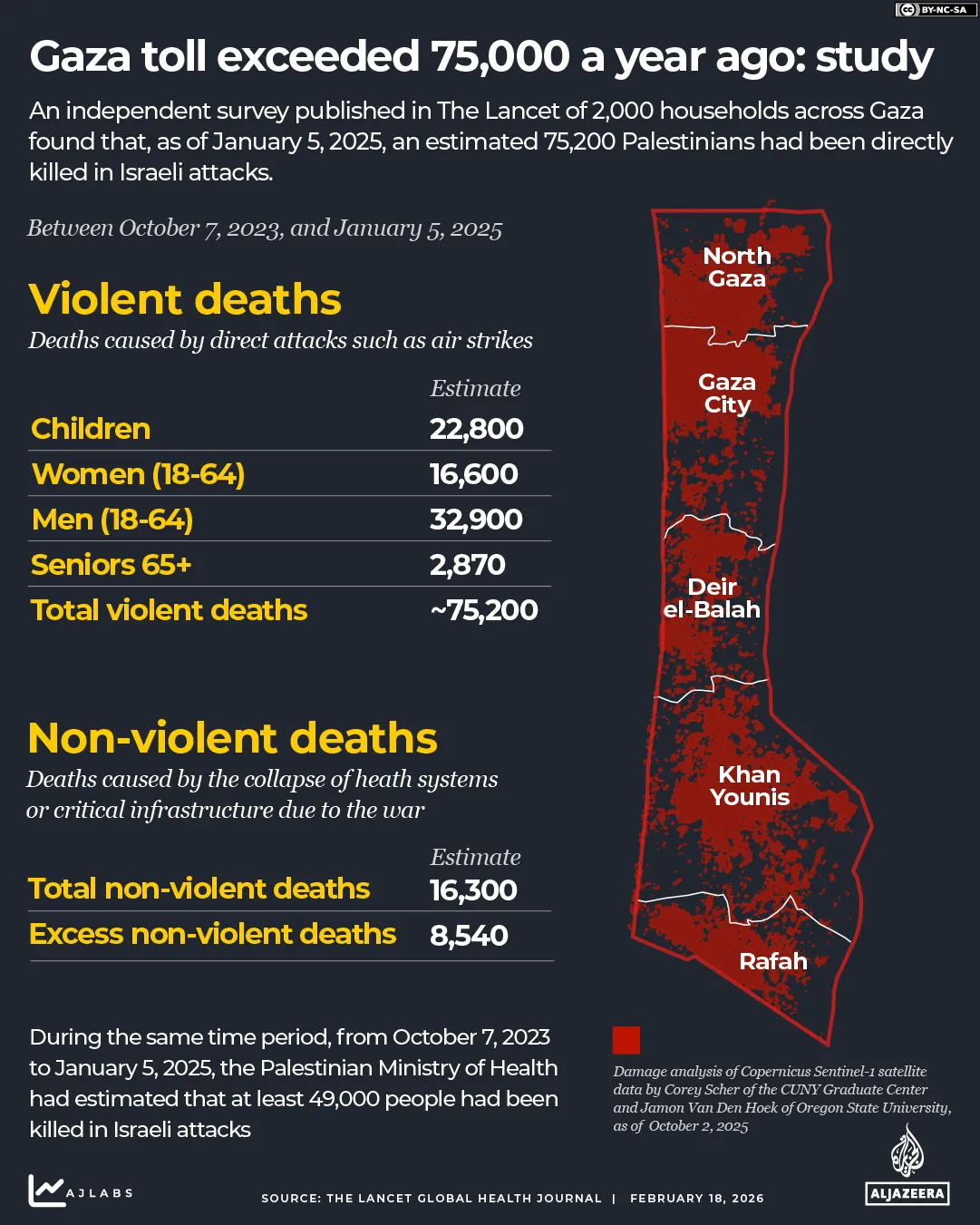
The true human cost of Israel’s genocidal war on the Gaza Strip has far exceeded previous official estimates, with independent research published in the world’s leading medical journals verifying more than 75,000 “violent deaths” by early 2025.
The findings, emerging from a landmark series of scientific papers, suggest that administrative records from the Gaza Ministry of Health (MoH) represent a conservative “floor” rather than an overcount, and provide a rigorous bedrock to the scale of Palestinian loss.
The Gaza Mortality Survey (GMS), a population-representative household study published in The Lancet Global Health, estimated 75,200 “violent deaths” between October 7, 2023 and January 5, 2025. This figure represents approximately 3.4 percent of Gaza’s pre-conflict 2.2 million population and sits 34.7 percent higher than the 49,090 “violent deaths” reported by the MoH for the same period.
The Gaza Health Ministry estimates that as of January 27 this year, at least 71,662 people have been killed since the start of the war. Of those, 488 people have been killed since the declaration of a ceasefire in the Gaza Strip on October 10, 2025.
Israel has consistently questioned the ministry’s figures, but an Israeli army official told journalists in the country in January that the army accepted that about 70,000 people had been killed in Gaza during the war.
Despite the higher figure, researchers noted that the demographic composition of casualties – where women, children, and the elderly comprise 56.2 percent of those killed – remains remarkably consistent with official Palestinian reporting.
(Al Jazeera)
Scientific validation of the toll
The GMS, which interviewed 2,000 households representing 9,729 individuals, provides a rigorous empirical foundation for a death toll.
Michael Spagat, a professor of economics at Royal Holloway University of London and the study’s lead author, found that while MoH reporting remains reliable, it is inherently conservative due to the collapse of the very infrastructure required to document death.
Notably, this research advances upon findings published in The Lancet in January 2025, which used statistical “capture-recapture” modelling to estimate 64,260 deaths during the war’s first nine months.
While that earlier study relied on probability to flag undercounts, this report shifts from mathematical estimation to empirical verification through direct household interviews. It extends the timeline through January 2025, confirming a violent toll exceeding 75,000 and quantifying, for the first time, the burden of “non-violent excess mortality”.
According to a separate commentary in the same publication, the systematic destruction of hospitals and administrative centres has created a “central paradox” where the more devastating the harm to the health system, the more difficult it becomes to analyse the total death toll.
Verification is further hindered by thousands of bodies still buried under rubble or mutilated beyond recognition. Beyond direct violence, the survey estimated 16,300 “non-violent deaths”, including 8,540 “excess” deaths caused directly by the deterioration of living conditions and the blockade-induced collapse of the medical sector.
Researchers highlighted that the MoH figures appear to be conservative and reliable, dispelling misinformation campaigns aimed at discrediting Palestinian casualty data. “The validation of MoH reporting through multiple independent methodologies supports the reliability of its administrative casualty recording systems even under extreme conditions,” the study concluded.
A decade of reconstructive backlogs
While the death toll continues to mount, survivors face an unprecedented burden of complex injury that Gaza’s decimated healthcare system is no longer equipped to manage. A predictive, multi-source model published in eClinicalMedicine quantified 116,020 cumulative injuries as of April 30, 2025.
The study, led by researchers from Duke University and Gaza’s al-Shifa Hospital, estimated that between 29,000 and 46,000 of these injuries require complex reconstructive surgery. More than 80 percent of these injuries resulted from explosions, primarily air attacks and shelling in densely populated urban zones.
The scale of the backlog is staggering. Ash Patel, a surgeon and co-author of the study, noted that even if surgical capacity were miraculously restored to pre-war levels, it would take approximately another decade to work through the estimated backlog of predicted reconstructive cases. Before the escalation, Gaza had only eight board-certified plastic and reconstructive surgeons for a population exceeding 2.2 million people.
The collapse of the health system
The disparity between reconstructive need and capacity is exacerbated by what researchers describe as the “systematic destruction” of medical infrastructure. By May 2025, only 12 of Gaza’s 36 hospitals remained capable of providing care beyond basic emergency triage, with approximately 2,000 hospital beds available for the entire population, down from more than 3,000 beds before the war.
“There is little to no reconstructive surgery capacity left within Gaza,” the research concluded, warning that specialised expertise like microsurgery is almost absent. The clinical challenge is further compounded by Israel’s use of incendiary weapons, which produce severe burns alongside blast-related fractures.
The long-term effect of these injuries is often irreversible. Without prompt medical treatment, patients face high risks of wound infection, sepsis, and permanent disability. The data indicate that tens of thousands of Palestinians will remain with surgically addressable disabilities for life unless there is a huge international increase in reconstructive capacity and aid.
The ‘grey zone’ of mortality
Writing in The Lancet Global Health, authors Belal Aldabbour and Bilal Irfan observed a growing “grey zone” in mortality where the distinction between direct and indirect death becomes blurred. Patients who die of sepsis months after a blast, or from renal failure after a crushing injury because they cannot access clean water or surgery, occupy a space that risks understating the true lethality of military attacks.
Conditions have only deteriorated since the data collection periods. By late 2025, forced evacuations covered more than 80 percent of Gaza’s area, with northern Gaza and Rafah governorates facing full razing by Israeli forces. Famine was declared in northern Gaza in August 2025, further reducing the physiological reserve of injured survivors and complicating any surgical recovery.
This series of independent studies serves as an urgent call for accountability and an immediate cessation of hostilities. “The healthcare infrastructure in Gaza is being repeatedly decimated by attacks despite protection by international humanitarian law,” researchers stated. They underscored that the only way to prevent the reconstructive burden from growing further is an immediate end to attacks against civilians and vital infrastructure.
SAM Thompson has shared a health update after undergoing surgery to remove a cyst on his vocal cords.
The TV favourite, 33, revealed in January that he would be having the surgery, and underwent the procedure on Tuesday.
Sign up for the Showbiz newsletter
Thank you!
Sam Thompson has shared a health update after undergoing surgery to remove cyst on his vocal cordsCredit: InstagramSam had the surgery on TuesdayCredit: InstagramSam revealed he was bored on the first day of vocal restCredit: Instagram
A day later, Sam shared a snap of him back home as he updated fans on his recovery.
Wearing a T-shirt underneath a zip up hoodie, Sam smiled for the selfie and wrote: “Day 1 of no speaking… I am so bored.
“Although I am LOVING seeing all the cat memes you’re sending!!”
In a video shared from hospital on Tuesday, Sam was seen in his medical gown as he said: “I’m having vocal cord surgery – this has been in the diary for a while, I had a cyst on my vocal cords.
“It’s because I talk to much and shout too loudly and I keep losing my voice really easily.
“So yeah they are cutting it out, they are putting me to sleep, I’ve never been put to sleep before.
“I’m a bit nervous, I don’t like not being in control.”
Sam first revealed the surgery on his podcast with BFF Pete Wicks.
A vocal cord cyst is a benign lesion which may cause a hoarse voice.
They often occur in those who over-use their voice, such as singers, professional speakers and broadcasters and the cysts happen when glands that produce mucus in the throat get blocked up.
According to NHS after-care advice from London-based Guys and St Thomas’, they state: “For the first three days after the operation, we recommend that you do not speak or use your voice at all.
“This is to allow healing time for the surface of your vocal cord or cords around the site of the surgery.”
They state whispering, laughing or humming should also be avoided.
Feb. 18 (UPI) — A federal court gave a final ruling Wednesday negating the Department of Education’s 2025 directive that sought to prevent federally funded schools and universities from practicing diversity, equity and inclusion.
The U.S. District Court in New Hampshire issued the ruling that permanently invalidated the “Dear Colleague” letter of Feb. 14, 2025, after the Department of Education backed down from the lawsuit. The letter, signed by Craig Trainor, who was then the acting assistant secretary for Civil Rights at the Department of Education, told schools they had 14 days to comply with the directive or face consequences, including loss of funding. Trainor cited the Supreme Court‘s 2023 ruling on Students for Fair Admissions vs. Harvard, which effectively ended affirmative action.
Soon after, the American Civil Liberties Union, the ACLU of New Hampshire, the ACLU of Massachusetts and lawyers for the National Education Association, filed suit to block enforcement of the letter. The Center for Black Educator Development and several New Hampshire School Districts later joined the case as plaintiffs.
In April, the court issued a preliminary injunction stopping the Department of Education from enforcing the new ruling.
District Court Judge Landya McCafferty ruled earlier in the case that the letter’s “isolated characterizations of unlawful DEI” conflicted with the term’s meaning, saying that DEI is fostering “a group culture of equitable and inclusive treatment.”
McCafferty said the plaintiffs were likely to succeed in proving that the letter was vague, viewpoint discriminatory and unlawfully imposed new legal obligations.
Plaintiffs said they were pleased with the decision.
“This ruling affirms what educators and communities have long known: celebrating the full existence of every person and sharing the truth about our history is essential,” Sharif El-Mekki, CEO at The Center for Black Educator Development, said in a statement. “Today’s decision protects educators’ livelihoods and their responsibility to teach honestly.”
“While [President Donald] Trump and [Secretary of Education Linda] McMahon want to ban diversity, equity, and inclusion, educators know these values are at the core of our nation,” Becky Pringle, president of the National Education Association, said in a statement. “The Trump administration’s unlawful Dear Colleague letter and certification requirement have now been vacated and abandoned, underscoring how badly Trump and McMahon overreached in their attempt to interfere with curriculum and instruction.”
Brendan Carr, the chair of the Federal Communications Commission (FCC) in the United States, has confirmed that the agency launched an investigation against ABC’s daytime talk show The View over a recent appearance by a politician.
In comments to reporters on Wednesday, Carr indicated the probe would examine whether The View violated a new interpretation of an “equal time” rule implemented under President Donald Trump.
Recommended Stories
list of 3 itemsend of list
Fox News had been the first to report on the investigation in early February. The segment in question involves an appearance from Texas state Representative James Talarico, a Democrat who is vying for the US Senate.
The confirmation comes as Carr attempted to shut down claims that the government censored an interview between Talarico and late-night talk show host Stephen Colbert.
“There was no censorship here at all,” Carr said.
“Every single broadcaster in this country has an obligation to be responsible for the programming that they choose to air, and they’re responsible whether it complies with FCC rules or not, and it doesn’t, and those individual broadcasters are also going to have a potential liability.”
The controversy with Colbert likewise stems from the Trump administration’s decision to shift definitions under the “equal time” rule.
What is the ‘equal time’ rule?
The rule is part of section 315 of the 1934 Communications Act. Under that law, if a broadcaster allows one candidate for public office to use its facilities, it is required to “afford equal opportunities” to all other candidates in the same race.
But the law includes exceptions for “bona fide newscasts” and “bona fide news interviews”.
For nearly 20 years, talk shows and late-night comedy programmes were included in those categories.
In January, however, the FCC issued new guidance (PDF) that significantly narrows how it interprets the “bona fide news” exemption. In a memo, it described daytime talk shows and late-night comedy as “entertainment programs” that fall outside the exception.
“The FCC has not been presented with any evidence that the interview portion of any late night or daytime television talk show program on air presently would qualify for the bona fide news exemption,” the memo reads.
The commission also suggested that many such programmes are “motivated by partisan purposes” and are therefore not “bona fide” news.
The new interpretation of the “equal time” rule, the FCC argued, is designed to “ensure that no legally qualified candidate for office is unfairly given less access to the public airwaves than their opponent.”
Controversy with Colbert
That new interpretation came roaring into the spotlight on Monday, after a broadcast of the CBS comedy programme The Late Show with Stephen Colbert.
In one of his opening segments, Colbert alleged that the network lawyers barred him from airing a planned interview that night with Talarico.
“Let’s just call it what it is,” Colbert told his audience. “Donald Trump’s administration wants to silence anyone who says anything bad about Trump on TV, because all Trump does is watch TV. OK? He’s like a toddler with too much screen time.”
Trump has previously criticised both Colbert’s show and The View for what he considers a left-wing slant.
Instead of broadcasting his interview with Talarico on network television, Colbert instead posted the segment on the programme’s YouTube page, where it has gained more than 6 million views as of 3:30pm Eastern Time (20:30 GMT) on Wednesday.
According to Carr, Colbert’s show could have aired the Talarico interview if it had complied with the equal time rule.
That would have involved allowing other candidates in Texas vying for the Senate seat to come on the show. Carr also suggested that another solution could have been to restrict the broadcast in Texas.
But the FCC has continued to face criticisms for its actions. In Tuesday’s broadcast, Colbert addressed the issue a second time.
He read aloud a statement from his broadcast channel that read, in part, that The Late Show “was not prohibited by CBS from broadcasting the interview” and that it was instead “provided legal guidance that the broadcast could trigger the FCC equal-time rule”.
CBS added, in the statement, that Colbert could have invited onto the show Talarico’s rivals, including fellow Democrat Jasmine Crockett.
“I am well aware that we can book other guests,” Colbert responded. “I didn’t need to be presented with that option. I’ve had Jasmine Crockett on my show twice. I could prove that to you, but the network won’t let me show you her picture without including her opponents.”
Colbert has been a vocal critic of CBS’s parent company, Paramount Global, particularly after it settled a lawsuit last year with the Trump administration for $16m in the run-up to a critical merger for which it needed government approval.
Talarico, meanwhile, accused the FCC of censoring his interviews. Nevertheless, on Wednesday, he noted that the uptick in media attention from the scandal has helped him gather donations.
“Our campaign raised $2.5 million in 24 hours after the FCC banned our Colbert interview,” he wrote on social media.
Gordon Ramsay is seen holding back tears during his daughter’s engagement party in scenes that have now aired on his Netflix documentaryCredit: Not known, clear with picture deskThe TV chef got emotional while his daughter made a speech at the bashCredit: Not known, clear with picture deskHolly and swimmer Adam have since gotten married in a stunning Bath ceremonyCredit: Instagram/@hollyramsayy
In the six-part series, Being Gordon Ramsay, swimming champ Adam and his fiancée Holly are seen throwing a lavish bash with Adam’s mum Caroline in attendance.
Holly and Adam’s engagement party is caught on film – with both the Ramsay and Peaty families in attendance.
During the evening, Holly thanks her fiancé Adam for his constant love and support.
And while she gives the speech, Gordon is seen holding back tears while watching on with his wife Tana.
Elsewhere during the evening, Gordon was filmed saying: “The most important family is the one you create and she [Holly] comes from an incredible family so its now her time to create her own family. It is quite a moment.”
The party marked one of the last times that the Ramsay family were with the Peaty clan before their public feud imploded.
Despite Gordon having a close relationship with his son-in-law, Adam’s parents have publicly blasted the family after they weren’t invited to Holly’s hen do and were later uninvited to the wedding.
Holly’s mum Tana and close family friend Victoria Beckham were invited on the hen do, but Caroline was left off the guest list.
The family have since been in a war of words during their very bitter feud.
Feb. 18 (UPI) — White House economic adviser Kevin Hassett on Wednesday said that employees at the New York Federal Reserve should face punishment for publishing “the worst paper I’ve ever seen in the history of the Federal Reserve System.
The research published Feb. 12 concluded that most of President Donald Trump‘s tariffs are being paid by U.S. businesses and consumers. The authors said 90% of the costs are being passed on, though it acknowledged that the effect had dropped slightly as the year went on.
In an appearance on CNBC’s Squawk Box, Hassett, the director of the National Economic Council, called it an “embarrassment” and said of the four authors, “the people associated with this paper should presumably be disciplined.”
He argued that tariffs are responsible for a higher standard of living.
“Prices have gone down. Inflation is down over time,” Hassett said. “Import prices dropped a lot in the first half of the year and then leveled off, and [inflation-adjusted] wages were up $1,400 on average last year, which means that consumers were made better off by the tariffs. And consumers couldn’t have been made better off by the tariffs if this New York Fed analysis was correct.”
Harvard Business School, Yale’s Budget Lab, the Kiel Institute for the World Economy and the Congressional Budget Office have published similar findings, Politico reported.
“Our results imply that U.S. import prices for goods subject to the average tariff increased by 11% … more than those for goods not subject to tariffs,” the paper, written by Mary Amiti, Chris Flanagan, Sebastian Heise and David E. Weinstein, said. “U.S. firms and consumers continue to bear the bulk of the economic burden of the high tariffs imposed in 2025.”
Hassett was on Trump’s short list for Fed chair, but Kevin Warsh was chosen.
Weekly insights and analysis on the latest developments in military technology, strategy, and foreign policy.
In the past two days, the U.S. Air Force has sent six of its 16 E-3 Sentry Airborne Warning and Control System (AWACS) radar planes to bases in Europe. Two of those jets are now headed to the Middle East, and the others will likely follow, as a massive buildup of U.S. airpower continues ahead of potential strikes on Iran. The deployment of nearly 40 percent of all Air Force E-3s underscores how critical the aircraft remain, but also the challenges of meeting intense operational demands with a rapidly aging and shrunken-down fleet. It also further calls into question a puzzling Pentagon move to axe the purchase of replacement E-7 Wedgetail jets, which Congress has now reversed.
Readers can first get caught up on the full scope of the U.S. buildup around the Middle East in our recent reporting here.
As of yesterday, a pair of E-3s had arrived at RAF Mildenhall in the United Kingdom after traveling from their home station at Elmendorf Air Force Base in Alaska. Four more AWACS jets from Tinker Air Force Base in Oklahoma had also touched down at Ramstein Air Base in Germany. Online flight tracking data shows that the E-3s at Mildenhall have now departed and are headed toward the Middle East. There is widespread expectation that those aircraft, as well as the ones at Ramstein, will eventually make their way to Prince Sultan Air Base in Saudi Arabia.
Update: At least 4 #USAF E-3G Sentry AWACS at Ramstein AB 🇩🇪 are currently relocating to Prince Sultan AB 🇸🇦 before the strikes on Iran 🇮🇷. I’m unclear if the 2 @ RAF Mildenhall 🇬🇧 are also in transit to 🇸🇦.
As noted, the U.S. Air Force currently has just 16 E-3s remaining in its inventory, roughly half the size of what it was just a few years ago. Six aircraft represent 37.5 percent of the total fleet. However, not all Sentry radar planes are available for operational tasking at any one time. For example, the average mission-capable rate for the E-3 fleet during the 2024 Fiscal Year was 55.68 percent, according to a story last year from Air & Space Forces Magazine. At the time of writing, this appears to be the most recent readiness data the Air Force has released for the E-3s. As such, the six forward-deployed AWACS jets represent an even larger percentage of the aircraft that can actually be sent out on real-world missions. This includes providing radar coverage for alert scrambles of fighter jets defending the homeland. This happens in some circumstances in the lower 48 states, but it is standard practice in Alaska, where there are usually a couple of E-3s typically stationed, with one on alert to launch in support of the fighters, which happens regularly. This is something we will come back to later on.
One of the E-3 AWACS aircraft that recently passed through RAF Mildenhall in the United Kingdom. Harry Moulton / @havoc_aviation on X
The E-3 is best known as a flying radar station, with its array contained inside a spinning dome mounted on top of the rear of the fuselage. From its perch, the Sentry can track hostile and friendly air and naval movements across a broad area of the battlespace. Its look-down radar capability offers particular advantages for spotting and tracking lower flying threats, including drones and cruise missiles. Kamikaze drones, as well as cruise and ballistic missiles, would be a central feature in any Iranian retaliatory attacks on American assets on land and at sea in the Middle East.
However, each Sentry, which typically flies with 13 to 19 mission specialists onboard in addition to a four-person flight crew, is much more than just its radar. It has other passive sensors and an advanced communications suite. Its combined capabilities make it a key battle management node during operations, and not just in the aerial domain.
“The radar and computer subsystems on the E-3 Sentry can gather and present broad and detailed battlefield information. This includes position and tracking information on enemy aircraft and ships, and location and status of friendly aircraft and naval vessels. The information can be sent to major command and control centers in rear areas or aboard ships,” according to the Air Force. “In support of air-to-ground operations, the Sentry can provide direct information needed for interdiction, reconnaissance, airlift and close-air support for friendly ground forces. It can also provide information for commanders of air operations to gain and maintain control of the air battle.”
Altgoether, E-3 crews run the air battle, and also serve as a key battle management node during operations outside of the aerial domain. These command and control functions would be key in any future offensive operations against Iran, as well as for defending against any retaliation.
At the same time, the Air Force has been open for years now about the increasing challenges involved in operating and sustaining the E-3 fleet. The last new production Sentry aircraft were delivered in 1992, and were also some of the last derivatives of the Boeing 707 airliner to ever be produced. Air Force E-3s have received substantial upgrades since then, but the underlying aircraft are still aging and are increasingly difficult to support. Between 2023 and 2024, the Sentry fleet notably shrank from 31 aircraft down to its present size, in part to try to help improve overall readiness. The fact that U.S. E-3s are powered by long-out-of-production low-bypass Pratt & Whitney TF33 turbofans has been cited as a particular issue.
US Air Force E-3 Sentry aircraft undergoing maintenance. USAF
“The first thing I would offer is there’s already – whether there’s 31 airplanes or 16 airplanes – there’s a gap today,” now-retired Gen. Mark Kelly, then head of Air Combat Command, told TWZ and other outlets at the Air & Space Forces Association’s main annual conference in 2022. “There’s a reason why there’s exactly zero airlines on planet earth that fly the 707 with TF-33 engines.”
“The last airline was Saha Airlines in Iran,” Kelly added at that time. “We basically have 31 airplanes in hospice care, the most expensive care there is. And we need to get into the maternity business and out of hospices.”
As already noted, the remaining E-3 fleet has continued to struggle with readiness issues amid consistently high demand. These issues have been compounded by resistance over the years to acquiring a direct replacement. When the Air Force finally did decide to supplant at least a portion of the Sentry fleet with newer and more capable E-7 Wedgetail airborne early warning and control aircraft, that effort turned into a protracted saga.
The Air Force officially started down the road of acquiring E-7s in 2022, but the program became mired in delays and cost overruns. Last year, the Pentagon revealed its intention to axe the Wedgetail purchases in favor of an interim solution involving buying more of the U.S. Navy’s E-2 Hawkeye airborne early warning and control planes. That, in turn, would serve as a bridge to a longer-term Air Force goal of pushing most, if not all, airborne target tracking sensor layer tasks into space. Questions about the survivability of the E-7 were also cited as having contributed to the decision.
A rendering of an E-7 Wedgetail in US Air Force service. Boeing
Questions were immediately raised about the new plan, especially about the viability of the E-2, a lower and slower flying aircraft designed around carrier-based operations, to meet Air Force needs, as TWZ has explored in the past. The service has also said that it does not expect new space-based capabilities to be operational before, at best, the early 2030s. Traditional airborne early warning and control aircraft are expected to continue playing important roles even after that milestone is reached.
“I have been concerned. We have E-3 capability up north, of course, but we were all counting on the E-7 Wedgetail coming our way. We’re kind of limping along up north right now, which is unfortunate. And the budget proposes terminating the program,” Sen. Lisa Murkowski, a Republican from Alaska, had said during a June 2025 Senate Appropriations Committee hearing, where the E-7 cancellation plans first emerged publicly. “Again, the E-3 fleet [is] barely operational now, and I understand the intent to shift towards the space-based – you call it the ‘air moving target indicators’ – but my concern is that you’ve got a situation where you’re not going to be able to use more duct tape to hold things together until you put this system in place. And, so, how we maintain that level of operational readiness and coverage, I’m not sure how you make it.”
Congress has since taken action to save the E-7, but the program may now be even more delayed as a result of the impasse over the past year. Legislators have also taken steps to block any further E-3 retirements, at least through the end of Fiscal Year 2026.
Still, the truncated E-3 fleet clearly remains under immense strain. Sen. Murkowski’s comments last Summer also remain particularly relevant in light of the fact that two of the six E-3s recently sent across the Atlantic came from Elmendorf in Alaska. Recent tracking data suggests that there may only be one Sentry at Elmendorf now to meet operational needs in and around the High North, a part of the world that has only grown in strategic significance in recent years.
There is also a question now about the availability of E-3 coverage should a crisis break out somewhere in the Indo-Pacific. If a major contingency were to emerge in the region tomorrow, the Air Force would be faced with a situation compounded not just by low availability rates and high demand elsewhere globally, but also the so-called ‘tyranny of distance.’ The sheer expanse of the Pacific, much of which is water, presents additional requirements when it comes to total coverage area and sortie generation rates to maintain a steady flow of aircraft on station around designated operating areas. Just getting to those areas and back could take many hours. Any future conflict in the region could occur over a massive total area, as well, which would be problematic for such a tiny fleet. All this is exacerbated by the age of the airframes and copious amount of maintenance to keep them flying in the best of conditions, let alone when deployed to the Pacific.
As a point of comparison, China’s People’s Liberation Army (PLA), which would be fighting from its home turf during a major conflict in the Pacific, has made significant investments in a diverse and still growing array of airborne early warning and control aircraft. The Chinese see a force-multiplying need for these aircraft, and for large numbers of them to be able to cover a lot of territory at once, as you can read more about in this past TWZ feature.
Moving capabilities into space is an admirable goal, and has many advantages in theory, but the capabilities are not available now. Further, while some of the sensing can be distributed to other platforms and leveraged via advanced networking, there still is a place for an integrated and powerful airborne early warning and control solution, at least till the ‘all-seeing’ space layer is actually in place. Saving money now by leaving such a glaring gap, especially in the current security environment globally, appears bizarrely short-sighted.
A US Air Force E-3 Sentry seen departing Al Dhafra Air Base in the United Arab Emirates in 2022. USAF
It does remain to be seen whether or not the United States ultimately launches a new major air campaign against Iran. U.S. and Iranian officials have now met twice to try to reach some type of diplomatic agreement, with the focus largely on the latter country’s nuclear ambitions. At the same time, the ongoing build-up in U.S. airpower around the Middle East, and not just limited to the E-3s, aligns with recent reports that assets are being positioned at least for possiblity of a sustained, weeks-long operation.
“The boss [President Trump] is getting fed up,” an unnamed Trump adviser said, according to a report today from Axios. “Some people around him warn him against going to war with Iran, but I think there is 90% chance we see kinetic action in the next few weeks.”
“One thing about the negotiation I will say this morning is, in some ways it went well. They agreed to meet afterwards,” Vice President J.D. Vance said during an interview on Fox News yesterday following the second round of negotiations. “But in other ways it was very clear that the President has set some red lines that the Iranians are not yet willing to actually acknowledge and work through.”
VP VANCE on negotiations with Iran: “One thing about the negotiation I will say this morning is, in some ways it went well. They agreed to meet afterwards, but in other ways it was very clear that the president has set some red lines that the Iranians are not yet willing to… pic.twitter.com/AbgH9t3lY0
Regardless, as mentioned, the deployment of the six E-3s is one of the strongest signs that the last pieces needed for a new major operation against Iran are increasingly in position. All of this puts a particular spotlight on the critical capabilities that the AWACS aircraft provide, but also the new strain that has been put on such a highly in-demand, but shrinking fleet, as well as the puzzling decision to slow-roll or entirely eliminate their replacement.
“How to Make a Killing” boasts an opening so strong that it buys enough audience goodwill to coast through nearly its entire running time. That’s priceless in a screwball murder movie in which everyone’s soul is for sale.
Death row inmate Becket Redfellow (Glen Powell) is four hours away from execution. A priest (Sean C. Michael) solemnly arrives to take his final confession and finds the condemned man lounging in a sleeping eye mask, griping that his last meal served him the wrong flavor of cheesecake. “Kill me now,” Becket quips.
This will be a tale of crime and punishment told in flashback, rewinding to Becket’s mother, an heiress excised from an eleven-figure fortune for giving birth as an unwed teenager. And it will be, as Becket insists, “a tragedy.”
But while the story’s framework is familiar, what gives this intro sequence zip is Powell’s sly nonchalance, the little bounce he makes on his cot when Becket pivots to give the flabbergasted priest his full attention. He has ours, too. Powell has yet to find his perfect role (this one’s close) but his confidence is why the industry is convinced that he’s the reincarnation of a classic leading man: Tom Cruise or Cary Grant if we’re lucky, or at least Bugs Bunny.
Writer-director John Patton Ford’s morally bleak comedy is itself a reincarnation of the 1949 British caper “Kind Hearts and Coronets,” which egged on an exiled sire as he avenges himself upon his royal family by murdering everyone between himself and dukedom. The 21st century American privilege that Becket is chasing in the remake doesn’t rely on formal titles. He wants cold hard cash, plus a couple of private islands, planes and ultra-luxury yachts. Besides, he’s already got a first name that sounds like a last name, signifying the American upper crust.
This Dickensian vengeance setup gives us an awful lot of people to murder, all caricatures of the elite. The original “Coronets” offed a posh feminist who scattered political leaflets across London from a hot air balloon, Ford spins that passé joke into a gag where Becket’s spoiled cousin (Raff Law) hovers in a helicopter sprinkling money over a pool party and then for good measure, cannonballs into the water to stuff bills in the crowd’s open and appreciative mouths. (For his next trick, perhaps Ford will remake Terry Southern’s outlandish satire “The Magic Christian,” which has a scene like that but five times filthier.)
Lore goes that when Alec Guinness received the “Coronets” script with an offer to play four of the ill-fated tycoons, he wrote back greedily and said, “Why not eight?” To our good fortune, Guinness did play all eight, even the suffragette. “How to Make a Killing” shares the wealth, giving cameos to a very funny Zach Woods as the scion who fancies himself a hipster artist (he takes photos of the unhoused) and Topher Grace as the Redfellow who found faith or, rather, a more sanctimonious spin on grift as a megachurch pastor. Likening himself to Jesus, Grace’s bleached blond huffs, “Don’t hate on me just because my dad’s a big deal.”
There’s a tease of real-world critique in how the preacher has decorated his office with framed photos of himself with various presidents and drug-runners, alluding to the inescapable suspicion that the world is run by a powerful club whose only admissions requirement is a bank balance with plenty of zeros. The jabs stop at allusions — they’re entertaining but as thin as a communion wafer. Still, I guffawed when Becket popped back into his present-day cell to poke fun at his audience, the Catholic priest: “The last thing the Church wanted was an investigation,” he says with a smirk. “I’m sure you know all about that.”
Like his lead character, Ford himself had to ascend in clout to direct this script, which he launched on the Black List in 2014. He instead made his debut with the much-smaller 2022 indie “Emily the Criminal,” which starred Aubrey Plaza as an art student desperate to pay off her student loans. His heart is with the strivers who find that our K-shaped economy makes it impossible to go straight.
Yet he hasn’t cracked whether the corpses in “How to Make a Killing” are victims themselves. The rich Redfellows get dispatched one by one in scenes that are fun but empty — neither cathartic nor comic, simply boxes to be checked off to great big poundings of thunder and harpsichords.
Surely, I thought, the film will figure out how it feels by the time it offs a Redfellow who’s merely ordinary-terrible: Bill Camp’s drunken, cowardly banker. But it doesn’t and the real victim of the indecision is Powell, who is rarely given a reaction to play. (Guilt? Rage? Glee?) He needs to give us an extra hint how he’s feeling — as an actor, Powell is so slick that even his regular smile comes across phony. I’d say he couldn’t be sincere if he tried, except Powell actually does try for one scene and the bleary, terrified look in his eyes is devastating.
While the promise of that gangbusters opening sequence goes a tad unfulfilled, “Killing” has two strong twists and plenty of reasons to enjoy the romp. I suspect that the movie might be too smart for its own good, or perhaps hemmed in by a cynicism that, everywhere we look lately, it appears that crime does pay. As Becket says early on, “We’re all adults here.” Ford sees all the wrong moves and isn’t sure-footed in choosing the right one, even though I think he has. Today’s crowd wants to smash Marie Antoinette’s cake and eat it, too.
At least along the way, there’s a playful love triangle between Julia (Margaret Qualley), the privileged nightmare who’s had Becket wrapped around her pinky finger since grade school, and Ruth (Jessica Henwick), a humble school teacher. Both characters stake out their polarized corners — the rich bitch versus the sweetheart — with Qualley somehow always arranging her legs to be seductively horizontal in her too-few scenes. Henwick is saddled with the more prosaic role and dialogue (“It’s scary to dream small,” she says). Nevertheless, her presence is so compelling that we root for Ruth every time she’s onscreen.
I’m glad that Ford is part of today’s guillotine crew making capers about economic inequality. But the best shot in the movie shows his promise as a romantic comedian: Becket and Ruth bump into each other in the rain and just as they make eye contact, the sun comes out and they share a smile. It’s a tiny moment of magic that gives you hope that these young lovers can work it out. Better still, it even gives you hope for humanity, even if the movie’s overall forecast for society is stormy.
‘How to Make a Killing’
Rated: Rated R, for language and some violence/bloody images
US Senator Graham claims the UAE royal is ‘as sharp as I’ve ever seen him’ in Abu Dhabi encounter.
Published On 18 Feb 202618 Feb 2026
Share
Emirati President Mohamed bin Zayed Al Nahyan has made his first appearance since rumours about his health spread online.
The Presidential Court on Wednesday shared video footage of the Emirati president, also known as MBZ, smiling alongside Republican US Senator Lindsey Graham during a meeting in Abu Dhabi.
Recommended Stories
list of 3 itemsend of list
WAM, the UAE’s official news agency, also shared photographs of the encounter at Qasr Al Shati, in which MBZ appeared alongside Graham.
In a social media post, the US senator rebuffed in no uncertain terms any claims that the UAE president may be unwell.
“To those who are perpetuating false narratives against the United Arab Emirates and President Sheikh [Mohamed bin Zayed] personally, you are full of it,” Graham said on X.
“Not only is he alive, but he is also well and as sharp as I’ve ever seen him.”
Graham, a top Republican in Congress, hailed MBZ for embracing the so-called Abraham Accords, a series of US-brokered deals to normalise relations between Israel and Arab states.
The UAE was among the countries to sign on to the initiative, which was unveiled in 2020 during US President Donald Trump’s first term in office.
Palestinian leaders condemned the Abraham Accords as a betrayal of their cause and the Palestinian push for self-determination.
One person remains missing after a heavy avalanche engulfed a group of skiers in the Sierra Nevada mountains of the US.
Published On 18 Feb 202618 Feb 2026
Share
Local authorities say that at least eight people have been found dead following an avalanche in the Sierra Nevada mountains of California, the deadliest incident of its kind in more than 40 years.
Nevada County Sheriff Shannon Moon said on Wednesday that rescue crews have been hindered by difficult conditions during a powerful winter storm.
Recommended Stories
list of 3 itemsend of list
One person remains missing. Six of the 15 skiers buried by the avalanche were found alive.
“We are still looking for one of the members at this time,” Moon confirmed to reporters, adding that family members have been informed that the search has moved from rescue to recovery.
The deadly incident comes as California experiences a winter storm that has deluged the mountains near the popular winter destination of Lake Tahoe with heavy snow.
The Sierra Avalanche Center warned on Wednesday that the risk of further avalanches remains high in the area as several feet of additional snow contribute to unstable conditions.
Snow covers street signs on February 18 in Truckee, California, located in the US’s Sierra Nevada mountain range [Brooke Hess-Homeier/AP Photo]
The California Governor’s Office of Emergency Services announced in a statement that it was “leading whole of government efforts to aid Nevada County”, which is located in eastern California, on the border with the neighbouring US state of Nevada.
“We are actively coordinating additional resources statewide to support avalanche search and rescue efforts to locate missing skiers near Castle Peak,” the office added.
Search-and-rescue teams were dispatched to the Castle Peak area after a call to emergency services reported that 15 people on a three-day trek had been buried by an avalanche on Tuesday morning.
“Our thoughts are with the missing individuals, their families, and first responders in the field,” the company Blackbird Mountain Guides said in a statement, noting that four guides were among those struck by the avalanche as they were returning to a trailhead.
An exit is seemingly on the cards for Jack Hodgson in Silent Witness but how will this affect the show for good? Super fan Jasmine Allday gives her verdict
20:30, 18 Feb 2026Updated 20:40, 18 Feb 2026
Jack and Nikki are finally married and living happily ever after… for now(Image: BBC)
Call it a TV journalist’s intuition – but I can feel it coming. An exit is seemingly on the cards for Jack Hodgson – played by David Caves – on Silent Witness and every moment he’s on screen recently has drawn the same conclusion for me.
I’ve been watching Silent Witness for half of my life, when Dr Nikki Alexander (Emilia Fox) and Harry Cunningham (Tom Ward) were leading the charge at the Lyell Centre. It was always a ‘will they won’t they’ storyline with Nikki and Harry to the point that I’d be screaming at my TV and praying they finally realised.
So when Jack stepped foot in the Lyell Centre, FINALLY I was getting my wish. It was clear both Jack and Nikki matched each other in every way and it was a long road of flirty glances and close calls until they finally got together.
What makes this show so lovely – and different from similar ones – is the dynamic between the characters. Nikki and Harry initially, and the late Leo Dalton, and now between Nikki and Jack.
Ensure our latest headlines always appear at the top of your Google Search by making us a Preferred Source. Click here to activate or add us as your Preferred Source in your Google search settings.
Jack joined in series 15 and was a great addition to the cast, with everyone unsure how Harry could be replaced. Finally – in the 24th series – Jack and Nikki confessed their feelings for each other with a kiss. Not that we had to wait until the next series to find out what happened to them and if they were going to succumb to the relationship they both clearly wanted.
In series 27, we got a proposal between the pair – something fans from the start of the show will have wanted. Nikki finally happy and with someone who loved her, the world could rest.
However, a move to Birmingham following their wedding at the end of series 28 has seemingly caused quite a stir for the pair. It’s clear there’s trouble ahead as Jack finds himself preyed on by the people pulling the strings with AI deep fakes claiming he is racist.
With his job potentially in trouble – and spoilers revealing he faces a very uncertain fate – it looks like we could be seeing the end to the character of Jack Hodgson for good.
We’ve waited years for Nikki to find her happy ever after, let’s not kill him off and ruin their chance so soon after they got together. There’s a happiness and lightness in Nikki we haven’t seen in years and whilst the programme is very much about the job they do, it’s also about the people behind the job and their lives.
If Jack goes, don’t let Nikki’s sparkle go with it.
Climate Central’s researchers found in a new analysis that heat threatens coffee harvests and coincides with recent record highs in prices. File Photo by Fully Handoko/EPA
Feb. 18 (UPI) — An analysis by Climate Central found that the world’s five largest coffee-producing countries, which account for 75% of global supply, are experiencing an average of 57 additional days of extreme heat per year due to climate change.
Its researchers found that heat threatens coffee harvests and coincides with recent record highs in prices.
Climate Central, based in Princeton, N.J., is an independent group of scientists and communicators who research and report the facts about climate change and how it affects people’s lives.
The analysis, released Wednesday, examined daily temperatures between 2021 and 2025 in 25 countries that represent 97% of global production. The report concluded that all of them recorded more days of harmful heat as a result of environmental warming attributed to greenhouse gas emissions.
The two main varieties that supply the global market are arabica and robusta.
Arabica accounts for between 60% and 70% of global supply and is grown mainly in mountainous regions of Latin America and Africa, where moderate temperatures have historically prevailed.
Robusta, which is more heat-tolerant but has a stronger flavor, is produced largely in Southeast Asian countriesm such as Vietnam and Indonesia.
Coffee is cultivated in a tropical belt stretching across Latin America, Africa and Southeast Asia, where it requires specific temperature ranges and consistent rainfall.
Temperatures above 86 degrees F are considered extremely harmful for arabica and suboptimal for robusta, as they reduce yields and can affect bean quality.
The analysis was published after a period in which the planet recorded the warmest years since modern measurements began, with episodes of extreme heat in Latin America.
According to Climate Central, this warming increased the frequency of days exceeding the critical 86-degree threshold in coffee-growing regions.
Brazil, the world’s largest producer and responsible for nearly 37% of global supply, experienced an average of 70 additional days per year with temperatures above 86 degrees. In Minas Gerais, its main coffee-producing state, 67 of these extra days were recorded.
Colombia, the world’s third-largest producer and one of the leading exporters of arabica coffee, recorded 48 additional days per year above the critical threshold. The increase threatens productivity and bean quality, the foundation of its international competitiveness.
Some of the sharpest increases were observed in Central America. El Salvador recorded 99 additional days of extreme heat per year and Nicaragua 77, according to the report.
“Nearly all major producing countries are now experiencing more days of extreme heat that can damage plants, reduce yields and affect quality,” said Kristina Dahl, vice president for science at Climate Central.
“Over time, these impacts can extend from farms to consumers, directly affecting the quality and cost of their daily coffee.”
According to the World Bank, its beverage price index rose 58% in 2024 and in December remained approximately 91% higher than a year earlier, driven by increases in coffee and cocoa amid supply concerns.
In December, the price of arabica coffee rose 13% compared with the previous month and more than 60% year over year, while robusta more than doubled compared with the same period the previous year.