News Desk

El Mencho’s killing won’t solve Mexico’s cartel problem – or anything else | Drugs

On Sunday, Mexican security forces killed 59-year-old Nemesio Ruben Oseguera Cervantes, alias “El Mencho”, the leader of the notorious Jalisco New Generation Cartel (CJNG), based in western Mexico’s Jalisco state.

The Mexican defence ministry acknowledged that the lethal operation had been conducted with “complementary information” from the United States, whose “peacemaker” president, Donald Trump, has repeatedly threatened to attack Mexico to combat the drug cartels.

Mind you, these are organisations that owe their very existence to US policy and drug consumption in the first place.

US Deputy Secretary of State Christopher Landau greeted the news of El Mencho’s death with glee, taking to X to proclaim: “This is a great development for Mexico, the US, Latin America, and the world.”

And yet things aren’t looking quite so “great” thus far.

As anyone who has ever paid remote attention to global affairs might have predicted, violence has broken out across several Mexican states in the aftermath of the killing – which is generally what happens when you take out a cartel kingpin.

Gunmen have torched vehicles and blocked highways in various locales while various US media have reported sensationally on the plight of American tourists “stranded” in Mexican resort cities on account of the upheaval.

Shortly after his initial enthusiastic post, Landau returned to X with a “PS, I’m watching the scenes of violence from Mexico with great sadness and concern.” But no matter: “We must never lose our nerve.”

The deputy secretary of state ended his “PS” with some words of encouragement in Spanish for the Mexican nation: “¡Animo Mexico!” (Cheer up, Mexico!)

But again, there is hardly room for cheer given that there is not a single example in pretty much the entire history of the world in which the killing of one cartel boss has resolved the narcotrafficking problem – or anything else, for that matter.

Recall the case of Pablo Escobar of the Medellin Cartel, killed in 1993 by Colombian police with a whole lot of help from the US Drug Enforcement Agency (DEA).

Despite Escobar’s absence, the international drug trade proceeded apace, and ensuing decades played host to spectacular levels of violence in Colombia – much of it coincidentally perpetrated by heavily US-backed state security forces.

In one particularly memorable episode, members of the Colombian army slaughtered an estimated 10,000 civilians and passed the cadavers off as left-wing “terrorists”.

To this day, Colombia remains the world’s top producer of cocaine.

In other words, to hail El Mencho’s demise as a “great development” for Mexico or anyone else is at best preposterously delusional.

On Sunday I phoned a Mexican friend in the southern state of Oaxaca, a supporter of Mexican President Claudia Sheinbaum, for our requisite argument over the day’s events. In his view, Mexico’s government had simply been “doing its job” in the “war on drugs” by eliminating El Mencho, and the US had nothing substantial to do with it.

Indeed, much like her predecessor and mentor Andres Manuel Lopez Obrador, Sheinbaum has perfected the art of doing the gringos’ dirty work while purporting to act in a “sovereign” fashion – and even to defy the imperial overlords to the north.

Granted, she does not have a whole lot of room to manoeuvre given the recent kidnapping by the US of Venezuelan head of state Nicolas Maduro – and the fact that Trump has made it known that he is beholden to no law, whether domestic or international.

But while Sheinbaum may have seen no choice but to temporarily placate the Americans and satisfy Trump’s need for blood, Mexicans will pay a heavy price.

A brief review of contemporary Mexican history confirms as much. No sooner did then-Mexican President Felipe Calderon launch his “drug war” under US guidance in 2006 than homicides and enforced disappearances skyrocketed in the country.

Well over half a million people have since been killed and disappeared, many of them victims of militarised agents of the state who often operate in cahoots with organised crime.

Nary a dent has been put in the northward flow of drugs while the southward flow of US-manufactured weapons continues unabated.

The state of Jalisco itself happens to have the highest number of enforced disappearances in all of Mexico and made headlines last year with the discovery of a clandestine crematorium on a ranch outside Guadalajara, one of the host cities of the upcoming World Cup.

The ranch was reportedly used by the CJNG as a recruitment and training centre as well as an extermination site.

And the removal of El Mencho from the equation will do precisely nothing in terms of pacifying the landscape – just as the respective extraditions to the US of Sinaloa cartel leaders Joaquin “El Chapo” Guzman and Ismael “El Mayo” Zambada merely set off an ongoing violent battle for power.

Contrary to lofty soundbites from US officials, the empire is not at all interested in getting rid of either drug trafficking or violence south of the border as both phenomena provide a perennial excuse for US interference in Mexico and beyond.

Were the gringos actually serious about ridding “Mexico, the US, Latin America, and the world” of the whole cartel problem, a decriminalisation of drugs would do much to nip the business in the bud by rendering the movement of drugs far less fantastically lucrative.

A moratorium on the US’s obsessive manufacture of weapons would also help.

Obviously, nothing so much as resembling those potential solutions is even on the horizon. If it were, that would be one hell of a “great development” indeed.

The views expressed in this article are the author’s own and do not necessarily reflect Al Jazeera’s editorial stance.

Source link

Coronation Street’s Andy McDonald actor now including very different job

Nicholas Cochrane played Andy McDonald in Coronation Street from 1989, but where is the actor now as the ITV soap kills off his on-screen dad Jim McDonald?

Coronation Street is poised to kill off Jim McDonald this week – but what became of the actor who portrayed his son Andy?

Andy (Nicholas Cochrane) first appeared on the ITV soap back in 1989, arriving in Weatherfield alongside mum Liz (Beverley Callard), dad Jim (Charlie Lawson) and brother Steve (Simon Gregson).

The McDonald family wasted little time in stirring up trouble on the cobbles. Andy himself became embroiled in numerous major storylines throughout his tenure.

His romantic endeavours proved catastrophic, with failed relationships involving several Coronation Street characters including Amy Nelson (Louise Duprey) and Paula Maxwell (Judy Brook). He also held a position at the Rovers and found himself caught up in Gerry Turner’s (Keith Woodason) armed siege.

Nevertheless, actor Nicholas was compelled to depart the soap alongside other prominent characters when a new producer took the helm in 1997. Andy’s exit storyline saw him relocating to Spain to take up a teaching position, reports the Daily Star.

The performer has made several return visits over the years, with guest appearances as Andy in 2000 and 2004. His most recent appearance came in 2009, when Andy came back for Steve’s wedding to Becky Granger (Katherine Kelly).

Regarding Andy’s father Jim, his last appearance was in 2018. In Monday’s episode (February 23), however, Steve learns his estranged father has been hospitalised.

Later in the week, he receives the devastating news that Jim has passed away. Following his departure from Coronation Street, Nicholas maintained a presence on television.

He featured in the ITV police drama Heartbeat, portraying golfer Barry Scripps, and in 2019 appeared in Doctors as Dean Telford, a father indebted to a local businessman.

Nicholas also ventured into theatre, joining the nationwide tour of Spring and Port Wine with The Middle Ground Theatre Company. He subsequently moved into TV presenting, appearing on Granada TV and MUTV, where he interviewed A-list footballers including Roy Keane and David Beckham.

**For the latest showbiz, TV, movie and streaming news, go to the new **Everything Gossip** website**

Beyond television, Nicholas has presented radio programmes for Talksport and BBC5 Live. Outside of his professional life, Nicholas resides in Manchester with his wife Denise and their two children. In his leisure time, he now enjoys watching and participating in various sports.

Meanwhile, in 2020, Nicholas discussed the possibility of returning to Coronation Street. He told the Distinct Nostalgia podcast: “It would be good if the boys got back in touch and Andy ends up back in Weatherfield.

“It would be good if Steve needed an organ [transplant] or there were some reason why one of us stays and one goes. That would be best for me … it would be a good storyline.”

Ensure our latest headlines always appear at the top of your Google Search by making us a Preferred Source.** Click here to activate**** or add us as your Preferred Source in your Google search settings.**

Coronation Street airs Monday to Friday at 8:30pm on ITV1 and ITVX

Source link

India, U.S. pause trade talks following Supreme Court tariff ruling

Feb. 23 (UPI) — A meeting on trade negotiations between the United States and India this week has been postponed in light of Friday’s Supreme Court ruling on President Donald Trump‘s tariffs.

Officials representing the United States and India were scheduled to meet for three days in Washington, D.C., to discuss their interim trade deal but the meeting has been delayed, CNBC, the BBC and Hindustan Times reported.

India’s top trade negotiator, Darpan Jain, was slated to travel to the United States for the meeting.

India is under a 25% reciprocal tariff imposed by the United States. It was expected to be reduced to 18% as part of an interim agreement between the countries earlier this month. The sides have continued to discuss future trade plans virtually since reaching the interim deal.

The United States and India were slated to finalize the interim agreement in March with it likely to go into effect in April. The framework for the agreement noted that any changes to the deal would allow the other country to “modify its commitments.”

On Friday, the U.S. Supreme Court ruled that Trump improperly applied the Emergency Economic Powers Act to impose a swath of tariffs. With those tariffs ruled unlawful, Trump announced a 15% global tariff, citing Section 122 of the Trade Act of 1974, which allows a president to impose temporary tariffs.

The act allows for the president to impose tariffs of up to 15% for 150 days.

The Trump administration continues to consider new plans to continue with its tariff policy, exploring other legal routes, U.S. Treasury Secretary Scott Bessent said in a social media post.

“We will immediately shift to other proven authorities — Actions 232, 301, and 122 — to keep our tariff strategy strong,” Bessent wrote.

President Donald Trump speaks alongside Administrator of the Environmental Protection Agency Lee Zeldin in the Roosevelt Room of the White House on Thursday. The Trump administration has announced the finalization of rules that revoke the EPA’s ability to regulate climate pollution by ending the endangerment finding that determined six greenhouse gases could be categorized as dangerous to human health. Photo by Will Oliver/UPI | License Photo

Source link

Pakistan vs England: Super Eight T20 World Cup – team news, start time, XI | ICC Men’s T20 World Cup News

Who: Pakistan vs England
What: 2026 ICC Men’s T20 World Cup Super Eight
When: Tuesday, February 24, at 7pm (13:30 GMT)
Where: Pallekele International Cricket Stadium, Kandy, Sri Lanka
How to follow: We’ll have all the build-up on Al Jazeera Sport from 10:30 GMT in advance of our text commentary stream.

Click here to follow our live coverage.

Recommended Stories

list of 4 itemsend of list

The second Super Eight ties of the 2026 ICC Men’s T20 World Cup starts on Tuesday with an intriguing contest between former champions who both consider themselves legit title contenders: Pakistan and England.

Pakistan, despite being humiliated by India in the group phase, possess a stacked roster who, on their day, can compete with any cricket team in the world.

England, listed as the pre-tournament joint-second favorite to raise the T20 world crown, are slowly building momentum in the competition, as exhibited by their dismantling of host nation Sri Lanka in their Super Eight opener on Sunday.

Al Jazeera Sport takes a look at the matchup, which may turn out to be a pivotal outcome affecting both nations’ semifinal qualification hopes.

What’s at stake in the Pakistan-England Super Eight tie?

Pakistan desperately need a win after their first match against New Zealand was washed out on Saturday.

A defeat would put England, who skittled Sri Lanka out for just 95 runs, through to the semifinals with a game to spare.

Pakistan would then need to beat Sri Lanka in their final Super Eight match and hope other results go their way to reach the last four.

History will be against Pakistan as they have never beaten England in three previous Twenty20 (T20) World Cup clashes.

“We are confident and our morale is high,” said Pakistan batsman Sahibzada Farhan, who scored an unbeaten 100 against Namibia in Pakistan’s final group match.

“We are focused on this match to win and progress.”

Weather watch for Pakistan in Pallekele

Persistent rain in the Sri Lankan capital Colombo forced the abandonment of Pakistan’s opening Super Eight game with New Zealand without a single ball being bowled, forcing the sides to split the points at R Premadasa Stadium.

Pakistan will be hoping that the weather does not play a factor in their crucial second tie as another split result would all but end their semifinal aspirations.

Thankfully, the forecast looks good for Tuesday’s match against England at the Pallekele International Stadium in Kandy, with 33 degrees Celsius (91F) predicted with only a 25 percent possibility of rain. In short, there should be a result and a full match is a strong possibility.

England rounding into form

England kicked off their Super Eight campaign with a 51-run victory over Sri Lanka, a statistically dominant result that vaulted them to the top of the Group 2 standings on net run rate.

The two-time champions have now won their last three matches at the tournament.

Will Jacks has been the breakout star with the bat at the tournament, averaging 65 on a scintillating 195 strike rate.

Harry Brook in action.
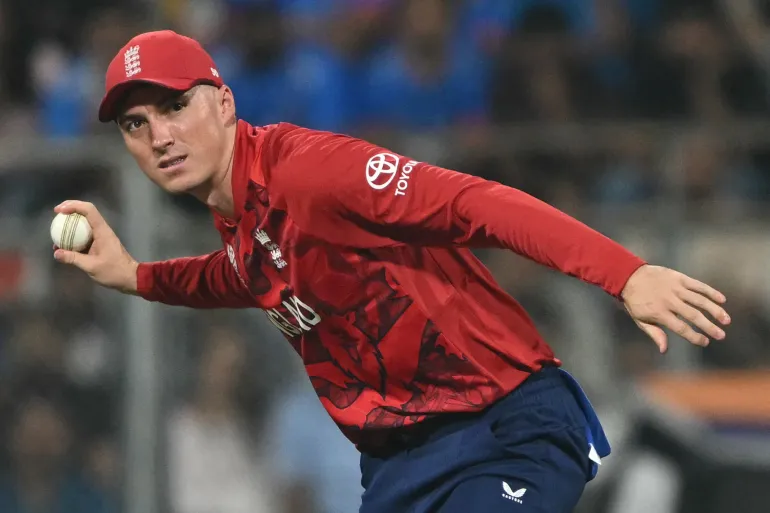
England captain Harry Brook has his side at the top of the Super Eight Group 2 standings ahead of the all-important Pakistan tie on Tuesday [Indranil Mukherjee/AFP]

Pakistan to put England in a spin

Pakistan on Monday warned England’s inconsistent batting lineup to expect a trial by spin when the teams clash.

Farhan told reporters that England struggled to 146-9 against Sri Lanka’s spinners on Sunday.

The in-form opener said that England can expect more of the same from Pakistan’s spinners when they meet on the same Pallekele ground on Tuesday night.

“What we saw in the Sri Lanka-England game was that the ball was gripping and England struggled against spin,” said Farhan on Monday.

“Sri Lanka have one or two spinners, but we have five in all, so we will give England a tough time on a pitch that looks good and will grip,” he added.

Pakistan’s spinners have taken 26 wickets in the four matches so far. Their seamers have dismissed only seven batsmen.

‘Will not be difficult’: Farhan on Archer express

Farhan, who tops the T20 World Cup run-scoring chart with 220, said he was ready for the threat of England’s express pace bowler Jofra Archer.

“Facing Archer will not be difficult because I have faced similar bowlers in Pakistan,” said Farhan.

“So if he has plans against me, I also have plans against him.”

Pakistan team news

Pakistan are likely to bring in spinner Abrar Ahmed in place of seaming all-rounder Faheem Ashraf.

Shaheen Shah Afridi’s omission from the final group stage match against Namibia and the Super Eight opener against New Zealand was a huge shock.

The bowling superstar was expensive in the group phase, with his side pivoting to a spin-dominant strategy.

With Pakistan desperately needing a win against England, the left-arm quick is expected to return to the starting XI.

England team news

England may name an unchanged side for the fifth match in succession with Liam Dawson, Will Jacks, Adil Rashid and Jacob Bethell providing their spin options.

Form Guide:

Pakistan

W-W-L-W-NR (most recent result last)

England

W-L-W-W-W (most recent result last)

Interactive_T20_Cricket_Super8_Feb18_2026-1771484826

What is England’s T20 World Cup record?

England has won the T20 World Cup title twice, in 2010 (defeated Australia) and in 2022 (defeated Pakistan).

They jointly hold the record for the most T20 World Cup titles alongside India (2007, 2024) and the West Indies (2012, 2016).

What is Pakistan’s T20 World Cup record?

Pakistan are three-time finalists, but have only lifted the trophy once.

The first appearance in the final came in the inaugural competition in 2007, when India claimed a five-run win.

The second edition, in 2009, saw Pakistan beat Sri Lanka in the final, but a 13-year wait ensued for the next appearance in the showpiece finale – only for England to sweep to a five-wicket victory.

What happened the last time England played Pakistan in a T20 match?

England and Pakistan have not played each other in a Twenty20 fixture since before the last T20 World Cup in 2024.

The sides competed in a four-game series in England with the home side winning 2-0, capping off their triumph in the last fixture with a seven-wicket victory at The Oval on May 30, 2024.

Head-to-head

This will be the 32nd meeting between the countries in cricket’s shortest format.

England has won more than two-thirds of matches with 21 victories, while Pakistan has nine wins. There has been one “no result”.

Possible Pakistan playing XI

Sahibzada Farhan, Saim Ayub, Salman Ali Agha (c), Babar Azam, Usman Khan (wk), Khawaja Nafay, Shadab Khan, Mohammad Nawaz, Shaheen Shah Afridi, Abrar Ahmed, Usman Tariq

Possible England playing XI

Jos Buttler (wk), Phil Salt, Jacob Bethell, Harry Brook (c), Tom Banton, Sam Curran, Will Jacks, Jamie Overton, Liam Dawson, Jofra Archer, Adil Rashid

INTERACTIVE -WINNERS- T20 MEN'S CRICKET WORLD CUP - 2026 - FEB3, 2026-1770220856

Source link

Furious row over Tourettes Baftas slur as Jamie Foxx says ‘he meant it’ but charity says it’s ‘NOT intentional!’

JAMIE Foxx has claimed an audience member with Tourettes who shouted a slur at the Baftas “meant it” despite a charity saying it was “not intentional”.

John Davidson, who suffers from Tourette syndrome, let out involuntary shouts including a racial slur due to his condition during the ceremony.

Jamie Foxx blasted John Davidson for the outburst despite his Tourettes diagnosisCredit: Getty
Michael B. Jordan and Delroy Lindo present the Special Visual Effects Award on stageCredit: Getty

The incident happened at the 79th annual British Academy Film Awards, which took place at the Royal Festival Hall last night.

The slur was shouted as actors Delroy Lindo and Michael B Jordan presented the award for special visual effects.

The actors, both stars of vampire horror Sinners, appeared to pause momentarily after the insult was heard but then continued presenting.

But Oscar-winning actor Jamie Foxx has now blasted John Davidson for his “unacceptable” outburst at the BAFTAs.

on gard

David Beckham’s best friend Dave Gardner takes swipe at Brooklyn


SLUR SAGA

BBC PULLS Baftas from iPlayer after audience member with Tourettes shouted slur

A fuming Foxx said on social media: “Out of all the words you could’ve said Tourette’s makes you say that. Nah he meant that s**t. Unacceptable.” 

The outburst, which was one of many unintentional interruptions, was explained as coming from John, who has Tourette syndrome.

John’s life story inspired the film I Swear which shares John’s journey from his diagnosis before much was known about the condition.

However, campaigners staunchly defended John after his outburst after criticism from Foxx.

Tourettes Action charity said: “We also want to address the negative comments that have surfaced following John’s involuntary vocal tics during the ceremony.

“We deeply understand that these words can cause hurt but, at the same time, it is vital that the public understands a fundamental truth about Tourette syndrome, tics are involuntary.

“They are not a reflection of a person’s beliefs, intentions or character.

“People with Tourettes can say words or phrases they do not mean, do not endorse and feel great distress about afterwards.

“These symptoms are neurological, not intentional, and they are something John – like many others with Tourettes – lives with every single day.”

The title is a nod to his uncontrollable swearing associated with the syndrome.

Earlier, the BBC apologised for the slur after some viewers were left shocked.

And the episode has now been pulled off BBC iPlayer after initial outrage.

The Beeb has confirmed the slur will be edited out of the version uploaded.

A BBC spokesperson said: “Some viewers may have heard strong and offensive language during the BAFTA Film Awards.

“This arose from involuntary verbal tics associated with Tourette syndrome, and as explained during the ceremony it was not intentional.

“We apologise that this was not edited out prior to broadcast and it will now be removed from the version on BBC iPlayer.”

The reality of living with Tourette syndrome

TOURETTE syndrome is a condition that causes a person to make involuntary sounds and movements called tics.

It usually starts during childhood, but the tics and other symptoms often improve after several years, and sometimes go away completely.

There’s no cure for Tourettes, but treatment can help manage symptoms.

The most common physical tics include:

  • Blinking
  • Eye rolling
  • Grimacing
  • Shoulder shrugging
  • Jerking of the head or limbs
  • Jumping
  • Twirling
  • Touching objects and other people

Examples of vocal tics include:

  • Grunting
  • Throat clearing
  • Whistling
  • Coughing
  • Tongue clicking
  • Animal sounds
  • Saying random words and phrases
  • Repeating a sound, word or phrase
  • Swearing

Swearing is rare and only affects about 1 in 10 people with Tourettes.

Some people can control their tics for a short time in certain social situations, like in a classroom.

But this can be tiring, and someone may have a sudden release of tics when they return home.

Aidy Smith, who was diagnosed with Tourettes aged nine, said these are the most common misconceptions about the condition:

  1. It is a ‘swearing disease’ characterised by repeated bad language
  2. People with Tourette’s can’t succeed in the workplace
  3. It’s impossible to control your tics
  4. ‘Tourettes’ is a ‘dirty’ word
  5. It’s OK to make jokes about the condition because it isn’t serious

Source: NHS and Aidy Smith

During the broadcast, the awards ceremony’s presenter Alan Cumming also issued an apology for the language viewers may hear.

He said: “You may have heard some strong and offensive language tonight. If you have seen the film I Swear, you will know that film is about the experience of a person with Tourette syndrome.

“Tourettes is a disability and the tics you have heard tonight are involuntary, which means the person who has Tourette syndrome has no control over their language.

“We apologise if you were offended.”

But the BBC sparked major backlash after the broadcaster edited out “Free Palestine” during one speech but declined to remove the racial slur at first.

The broadcaster removed the Palestine reference after an acceptance speech made by filmmaker Akinola Davies Jr paid tribute to those who are trying to “obtain a better life for their children”.

Davies Jr. closed his speech by saying: “To the economic migrant. The conflict migrant. Those under occupation, dictatorship, persecution, and those experiencing genocide. You matter.

“Your stories matter more than ever. Your dreams are an act of resistance to those watching at home.  

“Archive your loved ones. Archive your stories yesterday, today, and forever. For Nigeria, for London, the Congo, Sudan, free Palestine.”

Tourettes campaigner John Davidson at the 79th BAFTAsCredit: Shutterstock Editorial

Source link

Benfica’s Prestianni gets provisional one-match ban for Vinicius incident | Football News

UEFA announces suspension of Gianluca Prestianni after accusations he racially abused Real Madrid’s Vinicius Junior.

The Union of European Football Associations (UEFA) said on Monday it has provisionally suspended Benfica player Gianluca Prestianni for one match following accusations he racially abused Real Madrid star Vinicius Junior.

The decision means that Prestianni will miss Wednesday’s second leg of the Champions League playoff between Real and Benfica at the Bernabeu. Madrid won the first match in Lisbon last Tuesday with Vinicius scoring a second-half winner for a 1-0 victory.

Recommended Stories

list of 3 itemsend of list

The game was halted for nearly 10 minutes after the Brazil forward scored and celebrated by the Benfica corner flag, upsetting local fans and players. After being confronted by Prestianni, Vinicius accused the Argentine player of calling him “monkey.”

Prestianni has denied racially insulting Vinicius.

The anti-racism protocol was activated but no further action was taken during the match as there was no evidence against Prestianni, who covered his mouth with his shirt while talking to Vinicius. The Madrid forward was shown a yellow card after his celebration.

UEFA said the decision from its control, ethics and disciplinary Body (CEDB) is related to a discriminatory behavior.

“This is without prejudice to any ruling that the UEFA disciplinary bodies may subsequently make following the conclusion of the ongoing investigation and its respective submission to the UEFA disciplinary bodies,” it said in a statement.

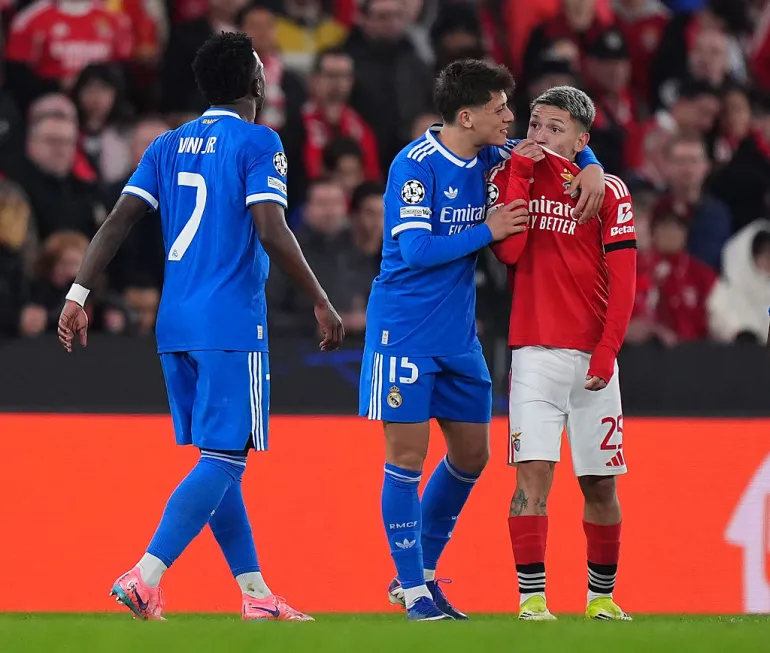
Gianluca Prestianni of Benfica speaks towards Vinicius Junior of Real Madrid during the UEFA Champions League 2025/26 League Knockout Play-off First Leg match
Prestianni, right, speaks towards Vinicius Junior at the time the Real Madrid player was allegedly racially abused [Angel Martinez/Getty Images]

FIFA President Gianni Infantino said after the match he was “shocked and saddened to see the incident of alleged racism” and praised the referee for activating the anti-racism protocol.

Benfica showed support for Prestianni, with the Portuguese club claiming that Madrid players who said they heard the insult were too far away. Benfica later released a statement saying it welcomed UEFA’s investigation and that it “fully supports and believes the version presented” by Prestianni, “whose conduct while with the club has always been guided by respect” toward everyone.

Benfica fans had reacted angrily to Vinicius celebrating his 50th-minute goal by dancing at the corner flag, throwing bottles and other objects toward the Madrid players. Prestianni then confronted Vinicius and said something while covering his mouth with his jersey.

Prestianni insisted that Vinicius misunderstood what was said, while Benfica players after the match reportedly said the Argentine provoked the Brazil forward but never racially insulted him.

Kylian Mbappe was among the Madrid players who strongly defended Vinicius and posted on X: “Dance, Vini, and please never stop. They will never tell us what we have to do or not.”

The France star also said Prestianni should never play in the Champions League again.

Source link

What is Christian Zionism, the pro-Israel ideology invoked by US ambassador | Israel-Palestine conflict News

United States Ambassador to Israel Mike Huckabee has faced condemnation from Arab and Muslim countries after suggesting Israel has a biblical right to much of the Middle East.

In an interview with prominent right-wing American commentator Tucker Carlson, Huckabee suggested that Israel has a God-given right to land stretching from the Euphrates River to the Nile, which would encompass Lebanon, Syria, Jordan and parts of Saudi Arabia.

Recommended Stories

list of 3 itemsend of list

It would be fine if they took it all,” he said, arguing that the geographical borders of Israel are rooted in the Bible, a belief shared by Christian Zionists.

The US diplomat, a self-professed Christian Zionist and staunch supporter of Israel, later walked back his comments, calling them “somewhat hyperbolic” and adding that Israel is not seeking expansion but has a right to security within its current borders.

But were his comments indeed hyperbolic in the Christian Zionist worldview? Or is that precisely what he and his fellow proponents of the ideology believe?

How did Christian Zionism begin, and what are its tenets?

In 1878, William Blackstone, a student of the prominent American evangelist Dwight Moody and a believer in the biblical restoration of Israel, published a book titled Jesus Is Coming. The best-selling work popularised among Americans a belief held by some Christian leaders: that God had given the land of Israel to the Jewish people.

This conviction, often taken from a Protestant evangelical perspective, draws on the ancient biblical idea that, nearly four millennia ago, God promised the land to the Jews, who would rule it until the return of Jesus to Jerusalem for the rapture. According to this theology, Christians will be saved upon Christ’s return while non-Christians who do not convert will face damnation.

The most commonly quoted Bible verse relating to this covenant is Genesis 12:3, in which God tells Abraham: “I will bless those who bless you and I will curse those who curse you and in you all the families of the earth will be blessed,” according to the Religion Media Centre.

According to ChristianZionism.org, a website run by professors, pastors and leaders of church-related organisations, four themes can be found in Christian Zionist thought: One, the founding of today’s nation-state of Israel in 1948 marked the final human era and signals an end of times. Two, the ongoing conflict in the Middle East is a part of God’s plan with a great and final war preceding the second coming of Christ. Three, God’s covenant with Israel is eternal and unconditional. And four, failing to support Israel’s political dominance today will incur divine judgement.

Writer and historian David Swift said that although many Christians – evangelical or otherwise – supported the creation of Israel before 1948, they cannot be called Christian Zionists in the modern parlance.

“This is because Christian Zionism essentially fuses religious belief with a military, strategic and even economic programme,” Swift told Al Jazeera.

“Specifically, Christian Zionism is not just the belief that the biblical land of Israel is the ordained country of the Jewish people but that it is in America’s strategic, military and economic interest to support the expansion of Israel.”

Fathi Nimer, a policy fellow at Al-Shabaka: The Palestinian Policy Network, described the movement as one that “translates into absolute unquestioning support for the Israeli regime”.

He described hearing a podcast about a Christian Zionist woman visiting Bethlehem who, after seeing the separation wall, Israeli soldiers and the harsh conditions in Palestinian refugee camps, remarked: “I feel bad for them, but scripture is scripture.”

“‘Scripture is scripture’ – that overrides everything,” Nimer told Al Jazeera.

“That’s why it’s such a powerful tool for brainwashing.”

How many American Christian Zionists are there?

According to author and academic Tristan Sturm, the largest population of Christian Zionists is in the US, and it numbers more than 30 million. Most are affiliated with evangelical churches in the southeast and south-central regions, often referred to as the “Bible Belt”.

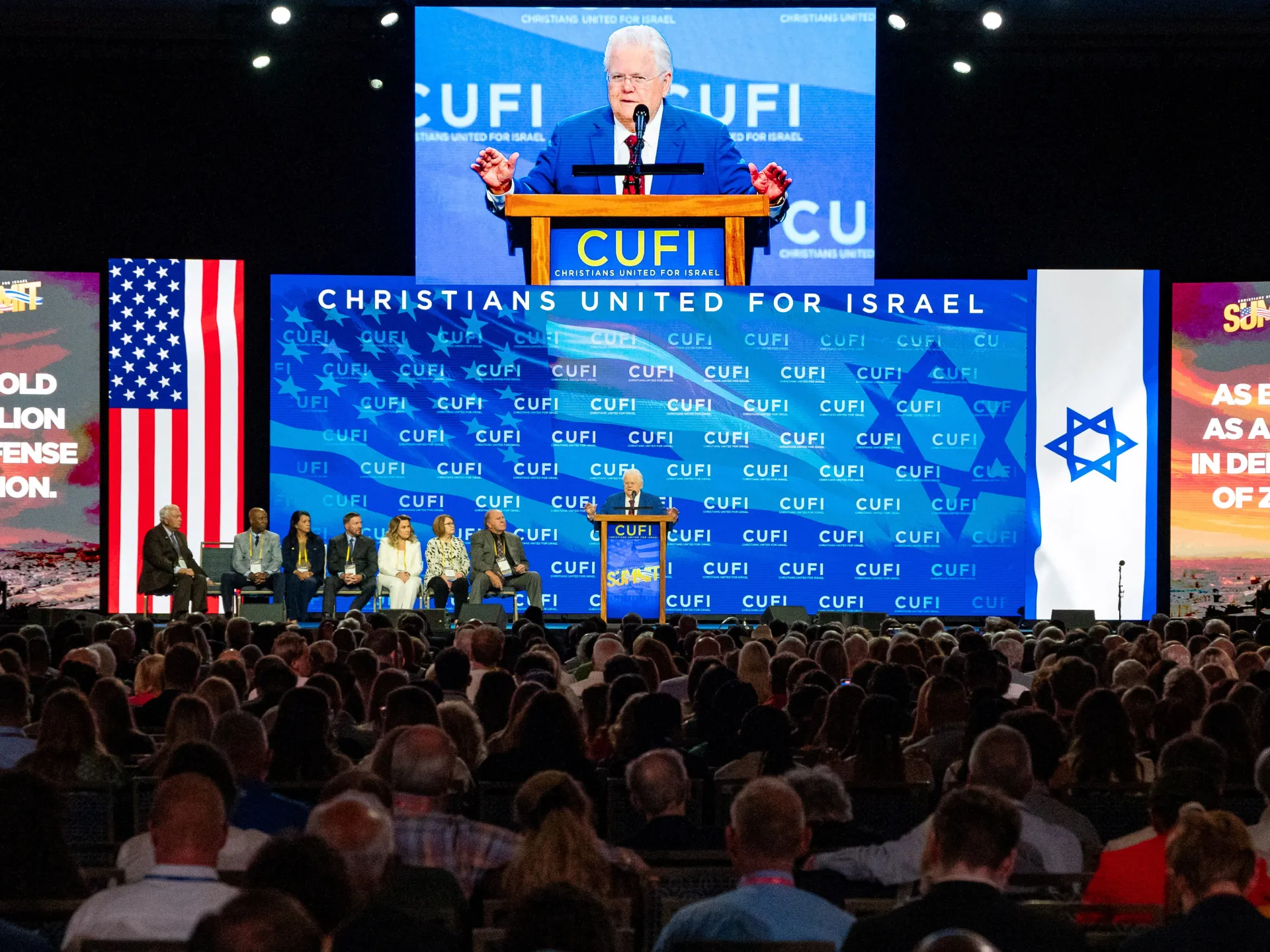
The biggest organisation is Christians United for Israel, which itself boasts 10 million members, Nimer said.

“They are overwhelmingly conservative Republicans, found mostly in the Bible Belt, but also other places in the United States, and they form one of the most formidable voting blocs in the Republican Party,” he said.

Swift stated that only a few million from this group, however, are “fully signed up to the political, military and religious aspects of Christian Zionism”.

What impact do Christian Zionists have on US policy?

Nimer argued that Christian Zionists are “deeply intertwined” with American politics. “A lot of the major donors to the Republican Party and also the Democratic Party are Christian Zionists,” Nimer said.

According to the analyst, Christian Zionists are a cornerstone of Israeli lobbying groups, ranging from the American Israel Public Affairs Committee (AIPAC) to the Anti-Defamation League, “that work to spread the Israeli narrative” in American society.

Meanwhile, a lot of members of the US Congress are “openly” Christian Zionist, Nimer said.

“[Politicians like] Mike Huckabee, … they reached the highest echelons of the state. And they bring these beliefs into their politics, into their policies,” the analyst said.

US foreign policy on Israel is, therefore, heavily influenced and shaped around the underlying biblical premise that the Jewish people are divinely destined to be restored to Palestine, he argued.

“When it comes to Palestine and the region in general, as you see right now with the [potential] war in Iran, they’re saying that the ballistic missile programme is now on the table,” Nimer said.

“It has nothing to do with the nuclear deal, … but the idea is that Israel must be able to maintain its superiority over every country in the region, and that’s a decree by God because if Israel prospers, then that’s another step towards the end of the world.”

Christian Zionist groups have also backed Israel’s illegal settlement project in the occupied West Bank and other measures that they see as reinforcing Israeli Jewish sovereignty.

Furthermore, for two decades, organisations such as HaYovel have been bringing in hundreds of American Christian volunteers to work in Israeli settlement agricultural projects, especially during the genocidal war on Gaza, when Jewish Israelis were called for military duty. Many also strongly endorsed US President Donald Trump’s moving of the US embassy from Tel Aviv to Jerusalem in 2017.

Swift, however, said Christian Zionists have played only a minor role in shaping US support for Israel and their influence is waning.

He argued that while Christian Zionism is integrated with a “broader neoconservative foreign policy agenda” also tied to the “US defence industry and broader military-industrial complex”, the group does not have much influence in American politics, and, in fact, it is declining.

Traditionally, US government support for Israel was driven by Cold War considerations and by pressure from the Jewish community within the US and lobbying groups like AIPAC. What played less of a role was support for Israel from evangelical Christians and the smaller community of Christian Zionists, Swift said.

“The US president is finally de facto abandoning the previous theoretical support for a two-state solution – although not for Christian Zionist reasons. When Trump talks of ethnically cleansing Gaza and turning it into a beach resort, he uses the language of real estate, not the Old Testament,” the historian said.

According to the analysts, very representative.

“It is pretty representative: Christian Zionists derive their understanding of the proper borders of Israel from the same place as people like [Israeli National Security Minister] Itamar Ben-Gvir and [Israeli Finance Minister] Bezalel Smotrich: the Old Testament. Therefore, they think Israel should expand to include all of the territory of ‘biblical Israel’,” Swift said, referring to the far-right Israeli cabinet members who have worked to expand and protect Israeli settlements and outposts in the occupied West Bank, which are illegal under international law.

Nimer said Huckabee’s statement is also not something that can be criticised within the Christian Zionist community.

“You’re not allowed to criticise that because it’s like you’re criticising prophecy and you’re criticising God and the return of Jesus,” he said.

Huckabee’s comments, therefore, come as no surprise despite infringing upon the sovereignty of US allies in the Middle East, Nimer said.

On Monday, Smotrich said Israel would eventually occupy the Gaza Strip and establish a Jewish settlement there despite a “ceasefire” that went into effect in October.

“We are giving US President Donald Trump the opportunity to do it in his own way. If he does not succeed in eliminating Hamas, the Israeli army will get international legitimacy and American support to do it,” he said in statements to Israeli radio.

How do Jewish Israelis view Christian Zionists?

Mimi Kirk, the director of the Institute for the Study of Christian Zionism and the associate director of Georgetown University’s Center for Contemporary Arab Studies, writes that “despite the matter of their supposed end-of-times demise according to this view, Jewish Israeli leaders have embraced the money and influence on US foreign policy that Christian Zionists offer,” especially as its adherents include top officials from the first Trump administration, including former Vice President Mike Pence and Secretary of State Mike Pompeo.

Nimer said it’s a rather “cynical relationship”, given that the Christian Zionist worldview, which sees all non-Christians going to hell, is “anti-Semitic to the bone”.

“But they support Israel, so it’s fine,” the policy analyst said.

“They care about what they can get out of them right now as the biggest support base in the West currently.”

Israel is further banking on this support because it is quickly losing its “progressive facade” of a “liberal democracy” with “all these progressive rights”, Nimer added.

“This has completely faded over the last few decades, and especially since the genocide in Gaza, this has become completely unacceptable.”

How do Christians in Palestine view Christian Zionists?

Palestinian Christians have long voiced concern that the Christian Zionist position threatens their existence, further entrenching Israel’s occupation while marginalising their community and undermining the historic churches of the Holy Land.

Just last month, the Patriarchs and Heads of the Churches in Jerusalem said activities by local individuals advancing “damaging ideologies, such as Christian Zionism” “mislead the public, sow confusion, and harm the unity of our flock”.

The Christian leaders warned that these efforts could undermine the Christian presence not only in the Holy Land but across the wider Middle East.

The statement came amid growing concern among Palestinian Christians that Israel’s policies – including land confiscation, settlement expansion and pressure on church property – are accelerating the erosion of one of the world’s oldest Christian communities.

Are there critiques of Christian Zionism among other Christians?

Criticism of Christian Zionists from within Christianity is abundant.

In the US, the Institute for the Study of Christian Zionism was created to critique and combat the movement through liberation theology, seeking justice for Palestinians and a resolution to the ongoing conflict.

Swift pointed out that many of the world’s most Catholic countries, from Ireland to those in South America and Southern Europe, “tend to be quite pro-Palestinian”.

Meanwhile, Palestinian Christian scholars “have written very detailed theological critiques of Christian Zionism”, Nimer said, as have pastors from other parts of the Global South.

A prize awarded by the Nelson Mandela Foundation last year was explicitly aimed at initiatives working against Christian Zionism, and a conference next month in Turkiye is being organised to combat the ideology, Nimer said.

“The world is waking up to how insidious this ideology is and how it creeps into societies and makes it impossible to have any kind of solidarity with Palestinians as long as they believe it,” he said.

Source link

Do You Know Your Place host pulled out at last minute ‘I can’t do it’

Vernon Kay is hosting brand new BBC gameshow Do You Know Your Place? teaming up with The Traitors star Paul Gorton

The BBC has introduced a new quiz show Do You Know Your Place?, which launches on Monday 23 February.

However, according to The Traitors star Paul Gorton, who is co-presenting the show with main host Vernon Kay, he was originally down to be a guest until the host they had booked to present his segment had to pull out.

The new series sees Paul lead an ‘unreliable’ UK tour of a different destination each day with three celebrity players battling it out to sort unbelievable facts from fiction.

From locations in Belfast to Wrexham, celebrity guests include EastEnders star Nitin Ganatra, the Reverend Kate Bottley, Gladiator ‘Apollo’ Alex Gray, Anneka Rice, Susan Calman, Owain Wyn Evans and Max Fosh.

Alongside Paul’s tours, Vernon will task the celebrities with a number of in-studio games, each taking inspiration from the day’s destination.

Whoever gets the most points across the show wins the episode and a souvenir that Paul has sent back from his travels with points accrued across five days with the overall winner at the end of the week receiving an ‘I Know My Place’ sweatshirt.

Talking about the new series, The Traitors star Paul said of how he got the role, telling us in an exclusive chat: “I think it was two years ago, there was an idea to do kind of like a travel show with celebs and then have all these kind of games in there and almost pack everything that you’ve watched into kind of like one show in one location, do it all there.

“I was booked to be a guest on one of these early iterations and the host pulled out, because the host was going to be out with the celebs, so Vernon [who has the main hosting gig] would be out with the celebs type of thing, and whoever they booked decided to not show and said, ‘Oh I can’t do it now’, so instead of finding someone, let’s see if Paul wants to have a go.

“We did the pilot which was me and these three celebs and it was just off you go, have fun.

“And I think they quite quickly realised that it would be nice to have this lovely kind of homely studio element to it with an absolute megastar [Vernon] and then we’ll still have Paul running around in a storm, in the rain and in the freezing cold.

“Luckily it all worked, it all clicked together. I did my bit which was all kind of the VTs, then Vernon’s done his bit in kind of like a mock studio and they stitched it together and the BBC just, it feels very weird to me because, and Vernon will know this a lot more than I do, but they were saying pretty much everything never gets commissioned.

“But the BBC guys were just like ‘Yep, we love it, we want it’ and that got us to almost present day where I’ve been running around the country finding all the weird and wonderful and magnificent parts of the UK.”

Do You Know Your Place? airs on BBC Two, weekdays at 6.30PM, starting from Monday 23 February.

**For the latest showbiz, TV, movie and streaming news, go to the new **Everything Gossip** website**

Source link

Samsung SDI discloses major lithium-metal battery advance

Samsung SDI Executive Vice President Joo Yong-lak (L) and Columbia University Professor Yuan Yang. Photo courtesy of Samsung SDI

SEOUL, Feb. 23 (UPI) — South Korea’s Samsung SDI said Monday it collaborated with Columbia University to publish a paper on what it described as a major advance in futuristic lithium-metal batteries.

The study, published in Joule, one of the world’s leading peer-reviewed journals in energy science, discussed the development of a new electrolyte formulation designed to improve the lifespan and safety of lithium-metal batteries, according to Samsung SDI.

Lithium-metal batteries have been regarded as a next-generation technology because they can offer very high energy density, around 1.6 times that of conventional lithium-ion batteries.

However, their commercialization has been constrained by limited charge-discharge lifespans. Samsung SDI expected that the new findings could help address the challenges.

Once commercialized, Samsung SDI projected that lithium-metal batteries could bolster industries that require high energy density, including advanced wearable devices.

“The publication in Joule provides academic validation of our technology that improves the safety of lithium-metal batteries, which had long been considered a key weakness,” Samsung SDI Executive Vice President Joo Yong-lak said in a statement.

“We will continue to accelerate the development of next-generation battery technologies based on our global research network,” he added.

Yuan Yang, an associate professor of materials science and engineering at Columbia University, echoed the sentiment.

“This study represents a major improvement in lithium-metal battery performance through a new electrolyte formulation and brings commercialization of next-generation batteries one step closer,” he said.

The share price of Samsung SDI fell.61% on the Seoul bourse Monday. As a major affiliate of Samsung Group, the company is one of the world’s largest battery manufacturers.

Source link

How the look of ‘Elio’ changed during its journey to the screen

Inside its sci-fi trappings — space travel, crazy technology, oodles of extraterrestrials — Pixar’s “Elio” is the story of an outsider kid who finds a new family. That’s true of the protagonist, a lonely boy who longs to leave Earth, and of the film itself.

“Elio’s” original mission was launched by Adrian Molina, co-writer of “Coco,” who worked on writing and directing the project for a couple of years before departing, officially to devote himself to “Coco 2.” Molina was replaced in “Elio’s” director’s chair(s) by Domee Shi, who helmed “Turning Red” and won an Oscar for her short “Bao,” and Madeline Sharafian, a story artist on “Coco” and story lead on “Turning Red.”

“The basic premise from Adrian’s beginning, five years ago, has stayed the same,” says Sharafian: “A lonely, weird little boy gets abducted by aliens and is mistaken for the leader of Earth. The biggest change we made, and everything rippled from there, was that Elio always wanted to be abducted by aliens, to find a place where he belongs.”

Shi says, “Both of us were weirdo kids in our respective hometowns who dreamed of not being the only one. I was one of the only kids in my school that liked anime. When I finally got into animation school, I was like, ‘I found my people, and I didn’t realize how much I wanted this.’ ”

One tectonic shift under Shi and Sharafian came from screenwriter Julia Cho, who co-wrote “Turning Red” with Shi: Instead of Olga (voiced by Zoe Saldaña) being Elio’s mom, she would be his aunt. Elio (voiced by Yonas Kibreab) would lose both parents before the film. That reconfigured his alienation, so to speak. A harsh confrontation between mother and child usually rests on the foundation that they already know and love each other. For an orphaned boy and his guardian aunt, that closeness must be earned.

“That love isn’t a given,” says Sharafian. “There was no assumption it would be there. So when it is, it’s all the more moving.”

ELIO - Pixar Animation Studios - 05-24-2023

An animated image of a boy looking at computer screens.

“Elio” directors Domee Shi and Madeline Sharafian’s shared “visual language” reshaped the film after they took on the project from its initial director, Adrian Molina.

(Pixar Animation Studios)

Amid the changes, Shi and Sharafian say the working relationship they established on “Turning Red” was invaluable.

Shi says, “Though we have different backgrounds, we grew up watching a lot of the same movies. Both of us love Miyazaki films, we love ‘Sailor Moon,’ we love Disney, Pixar.”

Sharafian adds, “We speak the same visual language. There would be many moments when it was time to come up with a new shot and we both drew the same thing.”

In its 28 previous features, Pixar had dabbled in sci-fi, but “Elio” is immersed in it, with just a soupçon of … horror?

“We’re huge fans of sci-fi horror,” says Shi, “and we wanted to use those moments with Elio’s clone and Olga to have fun, to playfully scare some kids — and some adults too.”

That “clone” is a dead ringer for the protagonist, but it emerged from space goo and formed into an eerily cheerful version of the boy, like something from “Invasion of the Body Snatchers” or “The Stepford Wives,” but nice.

“The movies that impacted me the most as a kid, a lot of them did scare me, but they rewarded me as well,” says Shi. “Our film has this Spielberg-y, comfortable, nostalgic, family sci-fi vibe. So when the audience is at their most comfortable, that’s the perfect opportunity to give ’em a little spook.” Both directors cackle.

Sharafian adds, “ ‘Close Encounters’ is so scary, but in an amazing, tense way, and the musical [phrase] the aliens sent, I was so haunted by that. When we had the universe reach out to Elio, we were like, ‘How do we capture that same feeling — we want to know more, but we’re unsure of their intentions?’ ”

Beyond Steven Spielberg’s “Close Encounters of the Third Kind” and “E.T.,” the shared influences of the sci-fi horror of “The Thing” and “Alien” influenced their choice of a virtual anamorphic lens for their cinematography and aping the visual noise and atmospheric mist in those films.

ELIO - Pixar Animation Studios - 05-24-2023

Among the changes Shi and Sharafian made to "Elio" is its "epic" widescreen aspect ratio.

Among the changes Shi and Sharafian made to “Elio” is its “epic” widescreen aspect ratio.

(Pixar Animation Studios)

Shi adds that they also changed the aspect ratio from 1.85 (standard widescreen) to 2.39:1 (anamorphic widescreen, an ultrawide look): “It helped shots of Elio on Earth feel more lonely, but also made space feel more epic.”

“To lay that on top of” Molina’s existing work, says Sharafian, “completely changed what the movie looked like.”

The directors agree that most of the film seamlessly blends their input, though Shi specialized in the horror and action sequences, while Sharafian leaned into the emotional scenes.

“A lot of Act 1 was you, Maddie,” says Shi, “where he’s feeling soulful and lonely. I love that. Yearning, watching the stars. I feel like that’s probably from your own childhood.”

Sharafian chuckles and says, “Yes, I was very lonely! My sister and I say we had ‘rich inner lives’ because we didn’t have a lot going on outside.”

It’s not “Up”-level gut-wrenching, but the scenes establishing the heartbroken boy’s lingering trauma hit pretty hard.

“I feel like it’s good to be sad,” says Sharafian. “At Pixar, we’re lucky; we get to stay in a childlike headspace for a really long time. I think we forget how deep children’s emotions are and how, when you’re young, you’re already thinking about very sad things and dark things. So I don’t think it’s too much.”

Source link

Hungary blocks latest EU sanctions on Russia, $105B loan to Ukraine

European Union High Representative for Foreign Affairs and Security Policy Kaja Kallas arrives for a Foreign Affairs Council meeting in Brussels on Monday. She vowed to find a solution to a threat by Hungary to veto the bloc’s latest round of sanctions against Russia. Photo by Olivier Matthys/EPA

Feb. 23 (UPI) — A new package of European Union sanctions on Russia over its invasion of Ukraine, the 20th such set of measures, was stalled Monday after being blocked by Hungary, which is demanding Ukraine reopen a pipeline supplying it with Russian oil.

EU foreign policy chief Kaja Kallas said there was “not going to be progress” on the new round of sanctions at Monday’s meeting of EU foreign ministers in Brussels in time for the fourth anniversary of the war, which falls Tuesday.

“We are doing our utmost to have the sanctions package, through, and we are looking for ways how we can do it. But as we have heard some very strong statements from Hungary. I don’t really see they are going to change this unfortunately today,” she said.

“We should not tie together things that are not connected to each other at all. But let us listen to them explaining the reasons why they are blocking, and then see whether there are possibilities to overcome.”

Hungarian Foreign Minister Peter Szijjarto took to social media Sunday to make Hungary’s quid pro quo stance clear.

“The EU aims to adopt the 20th sanctions package at the Foreign Affairs Council. Hungary will block it. Until Ukraine resumes oil transit to Hungary and Slovakia via the Druzhba pipeline, we will not allow decisions important to Kyiv to move forward,” Sijjarto wrote on X.

The pipeline was damaged in a Russian attack, but Hungary insists Ukraine is dragging its feet getting it up and running again.

The financial services, trade and energy sanctions package drawn up by the European Commission would bring in a full maritime services ban for Russian crude oil, reducing its income from energy and making it more difficult to find customers. Access to oil tankers for Russia’s so-called “shadow fleet” will also be tackled, along with measures targeting its gas exports.

Transaction bans will be imposed on 20 more Russian banks as part of an effort to hobble Russian efforts to create its own payment systems to circumvent a ban on using the SWIFT international payments system while tightening restrictions on exports to Russia, including military-use goods and technologies, and import bans on Russian rare earth minerals, metals and chemicals, worth at least $1.1 billion in total.

Hungary’s block drew sharp criticism from Hungary’s EU partners with Swedish Foreign Minister Maria Malmer Stenergard telling Euronews it was a “shame” and a “disgrace.”

“Every delay that we have in the adoption of a sanctions package is a failure for Europe,” she said.

French Foreign Minister Jean-Noel Barrot said he was certain the sanctions package would pass, saying it was a matter of when, not if, while Polish Foreign Minister Radoslaw accused the government of Prime Minister Viktor Orban of leveraging anti-Ukrainian sentiment it had whipped up to boost its fortunes in elections in April.

Hungary announced Friday it would also block a $105 billion EU loan to Ukraine, accusing Ukraine of blackmailing Hungary by shutting off the pipeline and conspiring with Brussels and the Hungarian opposition to “create supply disruptions” in Hungary to push up fuel prices ahead of the election.

Orban previously agreed not to veto the loan, along with Slovakia and the Czech Republic, provided it was exempted from contributing financially.

Populist Orban has been in power since 2010 after a first term between 1998 and 2002 and has been president of his Fidesz, or Hungarian Civic Party, for the past 23 years.

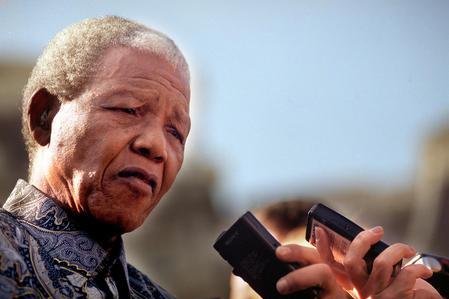
Former South African president Nelson Mandela speaks to reporters outside of the White House in Washington on October 21, 1999. Mandela was famously released from prison in South Africa on February 11, 1990. Photo by Joel Rennich/UPI | License Photo

Source link

Dark Merlin Is The Name Of General Atomics’ YFQ-42A Fighter Drone

We finally have something else to call General Atomics’ Collaborative Combat Aircraft (CCA) by other than its formal YFQ-42A designation: Dark Merlin

Dark Merlin is one of two designs that the USAF has officially chosen for development and flight testing under the first increment of its CCA program, which intends to give fighter aircraft a ‘loyal wingman’ uncrewed companion.

(General Atomics)

General Atomics gives its reasoning for the naming as such:

“Dark merlins, deadly falcons known for their black feathers and devouring of other falcons as prey, often collaborate in groups for maximum effect against their targets. The Cornell Lab of Ornithology describes the merlin as a “small, fierce falcon that uses surprise attacks” to bring down its prey in flight. The dark merlin is native to the Pacific Northwest of the United States, often migrating into southern California, where bird spotters routinely report seeing them near the YFQ-42A’s manufacturing home in San Diego.”

The 1962 book “Profiles of the Future” imagined global technological marvels yet to change the world, offering that “any sufficiently advanced technology is indistinguishable from magic.” It’s no coincidence that the Dark Merlin name also reflects the wizardry of Merlin from
Arthurian legend, paying homage to the somewhat supernatural new era of semi-autonomous
air combat.

“Dark merlins are hunting machines, built for speed and aerodynamics,” said GA-ASI President David R. Alexander. “They harass other falcons for fun, and they eat what they kill. The name sums up our new uncrewed fighter perfectly.”

The name is a very welcome development. We have discussed internally in our newsroom on multiple occasions that the designations for the CCAs, the other being Anduril’s YFQ-44A, which goes by the nickname Fury, carried over from its roots as a ‘red air’ training drone, are a bit hard for the public to follow. Now, with General Atomics giving their ‘fighter drone’ a unique nickname, referring to them as Dark Merlin and Fury will be a bit easier.

YFQ-42A, now known as the Dark Merlin, taking to the skies. (General Atomics)

Both aircraft are currently in flight testing, and General Atomics has already put Dark Merlin, which is based on the firm’s Gambit chassis-centric family of combat drones concept, into production. This is ahead of the USAF making a decision on which Increment 1 CCA, or both, it wants to buy in larger numbers.

The naming also comes after it was announced that the Marines will use Dark Merlin as a testing surrogate for its own CCA program, which could possibly open the door to the Corps purchasing the ‘drone fighters’ for operational use.

Contact the author: Tyler@twz.com

Tyler’s passion is the study of military technology, strategy, and foreign policy and he has fostered a dominant voice on those topics in the defense media space. He was the creator of the hugely popular defense site Foxtrot Alpha before developing The War Zone.


Source link

David Beckham’s best friend Dave Gardner takes swipe at Brooklyn as he poses with Marc Anthony for Cruz birthday tribute

DAVID Beckham’s close pal Dave Gardner appears to have confirmed which team he’s on when it comes to the Brooklyn Beckham family feud.

The football star’s best friend and former agent shared a photo to mark Cruz Beckham‘s 21st birthday – and seems to have taken aim at the other side.

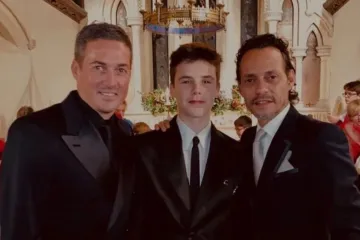
David Gardner appears to have taken a sly swipe at Brooklyn to mark Cruz’s 21stCredit: Instagram
Award-winning Marc Anthony was at the centre of the Beckham wedding feudCredit: Getty

The sports agent, 49, shared the photo on social media standing with a suited-and-booted Cruz and Marc Anthony.

The long-time family friend wrote: “Have a great day mate. Love ya Cruzie.”

Latino star Marc Anthony was at the heart of the Beckham wedding drama where he is said to have called Victoria Beckham, 51, to the dancefloor, rather than Nicola, 31, for the first dance.

He allegedly referred to the mother-of-the-groom as “the most beautiful woman in the room”, which left the bride ‘in tears’.

MOVING ON

Beckhams celebrate Cruz’s 21st birthday as Brooklyn hosts food festival amid feud


GOLDEN CRAWLS

Brooklyn & Nicola ‘plan to adopt child’ in fresh heartache for Beckhams

He recently broke his silence on the allegations which played a part in “ruining” Brooklyn and wife Nicola Peltz’s wedding.

Brooklyn, 26, accused his mum of “hijacking” his and Nicola‘s special moment and claimed she danced “inappropriately” leaving him “embarrassed”.

Marc has been a long-time family friend of the Beckhams, meeting David when he played for Real Madrid around 2005.

Four-time Grammy winner Marc, who is one of Jennifer Lopez’s exes, had offered to perform at the wedding as a gift to the couple.

The family, minus Brooklyn, celebrated Cruz’s birthday last week at The Maine Mayfair in London.

He was joined by his parents as well as siblings Romeo, 23 and Harper, 14, as well as his girlfriend Jackie Apostel, 30 and Romeo’s partner, Kim Turnball, 24.

Meanwhile Brooklyn was busy hosting his very own food festival in Miami, Florida.

Proud dad David appeared to take a swipe at Brooklyn as he praised his youngest son Cruz as “fiercely loyal to family” in a birthday tribute.

The 50-year-old took to Instagram to share an adorable video of some of Cruz’s best moments over the years.

Proud dad David shared a heartfelt caption for his boy as he began: “Happy 21st birthday to my little boy – not so little anymore but the proudest thing that I am of you is the person and the man that you have become.

Seemingly taking a dig at Brooklyn, he continued: “You are kind, considerate and fiercely loyal to your family, friends and everyone around you which makes you a very special person.”

Picture-posting Dave‘s exes include actress Liv Tyler and former Hollyoaks star Davinia Taylorwho he both shares children with.

He recently attended David’s swanky 50th birthday celebrations with his partner, Victoria’s Secret model Jessica Clarke.

Dave met his pal David during his stint at Manchester United Youth Club and the pair have been close from the age of 14.

The footie star was also best man at his wedding in 2003 and made godfather to his son.

Marc previously told The Hollywood Reporter: “They’re a wonderful, wonderful family. I’ve known them since before the kids were born. I’m godfather to Cruz.

“I’m really close to the family. But I have nothing to say about what happened there. It’s extremely unfortunate how it’s playing out — but (how it’s playing out) is hardly the truth.”

Brooklyn appeared on stage in Miami and did not attend Cruz’s birthdayCredit: AP
Brooklyn vowed to ‘forever protect’ his wife Nicola in a Valentine’s Day tributeCredit: Instagram
David wished his son Cruz a happy 21st with family snaps featuring BrooklynCredit: Instagram
The Beckham family were seen at Paris Fashion Week amidst the Brooklyn dramaCredit: Splash
The Beckham clan have appeared strong during the family feudCredit: Instagram

Source link

South Korean farmers sue utility giant KEPCO over climate damage to crops

1 of 6 | Farmer Ma Yong-un, seen here in his apple orchard in November, is one of five plaintiffs in a landmark civil suit against state-owned utility KEPCO for climate-related agricultural damages. Photo by Thomas Maresca/UPI

HAMYANG, South Korea, Feb. 23 (UPI) — As harvest season approached last November, farmer Ma Yong-un walked through his apple orchard in southern South Korea with a growing sense of dread.

The Fuji apples hanging from the trees were pale, lacking the deep red color that signals sweetness and commands a good price. To make matters worse, many were splitting open as they ripened.

An unusually rainy fall had blocked the sunlight needed for proper coloring, following one of the hottest summers on record.

“I had never seen this kind of cracking before,” Ma, 55, told UPI on his farm in Hamyang, a rural county in South Gyeongsang Province. “I was so stressed. I was worried about my family’s survival.”

A late dry spell before the harvest helped salvage some color, but another year of punishing weather had taken its toll. Ma estimated that half his apples were not of good quality.

Across South Korea, similar stories have become increasingly common. Farmers are facing mounting losses from heat waves, heavy rainfall, droughts and shifting growing seasons — impacts scientists widely link to climate change.

Now, their experiences are moving from fields and paddies into a courtroom.

Ma is one of five plaintiffs in a civil lawsuit filed against state-owned utility Korea Electric Power Corporation, or KEPCO, and five of its power-generation subsidiaries. The suit seeks financial compensation for climate-related agricultural damages and asks whether a major corporate emitter can be held legally responsible for the downstream effects of climate change.

The case is the first of its kind in South Korea, according to Yeny Kim, an attorney with the Seoul-based nonprofit Solutions for Our Climate, which is representing the plaintiffs.

“Agriculture is an industry that is absolutely dependent on climate conditions,” Kim told UPI. “As the climate changes, we’re reaching a point where certain crops can no longer be grown. That leads to damages to farmland, reduced yields and increased costs just to grow the same amount of crops.”

Filed in August, the lawsuit argues that KEPCO’s greenhouse gas emissions materially contributed to climate change and, in turn, to the plaintiffs’ economic losses.

Quantifying climate damage

The case is based on an analysis estimating $72.9 billion in climate-related economic damages linked to KEPCO’s emissions between 2011 and 2023. During that period, KEPCO and its subsidiaries accounted for roughly 27% of South Korea’s total greenhouse gas emissions, making the utility the single largest corporate emitter in the country.

Globally, the companies’ emissions represented about 0.39% of cumulative worldwide emissions over the same timeframe — a figure the plaintiffs argue is sufficient to establish measurable responsibility for climate-driven harm.

“In a court of law, quantifiable harm means legal liability,” Kim said.

The lawsuit draws on the “polluter pays” principle, which holds that those responsible for pollution should bear the costs of the damage it causes. While widely used in environmental law, applying it to climate change remains largely untested in Korean courts.

Each plaintiff is seeking an initial 5 million won — about $3,400 — in damages, an amount that could be adjusted as the case proceeds. They are also requesting an additional 2,035 won, roughly $1.40, as symbolic compensation for the emotional and psychological toll they say climate change has imposed on their lives.

Hwang Seong-yeol, a rice farmer and fellow plaintiff, said anxiety and a sense of helplessness now shadow every growing season.

“We just look at the sky and wonder what the weather is going to be like,” Hwang said at a press briefing in Seoul in November. “Being stressed from physical labor is something we can endure. But the stress caused by climate change is completely unbearable.”

The suit’s first hearing took place at Gwangju District Court last month. Court records show the defendants have submitted multiple written responses contesting the claims. The next hearing is scheduled for April 23.

KEPCO did not respond to a request for comment. The company has pledged to achieve carbon neutrality by 2050, in line with South Korean government policy.

An economy at risk

South Korea has lagged other developed countries in transitioning away from fossil fuels. Government data show just 10.7% of the country’s electricity came from renewable sources in 2024, well below the global average of roughly 32%.

The country is also particularly exposed to climate disruptions abroad. South Korea imports the vast majority of its food — its calorie self-sufficiency rate stood at just 32.5% in 2023, roughly half the level recorded in 1990, according to the Korea Rural Economic Institute. The broader grain self-sufficiency rate, including animal feed, has fallen to 22.2%, among the lowest of any OECD country.

Nam Jae-Chol, a professor at Seoul National University and former administrator of the Korea Meteorological Administration, told UPI that dependence leaves the country vulnerable when climate shocks hit major exporters.

“When exporting countries begin to limit shipments because of climate impacts, that’s when the problem becomes visible,” Nam said. “If agricultural imports suddenly decline because of climate change, prices will skyrocket. In extreme cases, exports could even stop.”

“In 10 or 20 years, we’re going to face a serious crisis due to climate change,” Nam added. “It’s inevitable.”

In South Korea, warming temperatures have already pushed traditional crop-growing zones northward, forcing farmers to adapt — changing what they grow, how they manage water and how they run their operations, Nam said.

Ma said he first felt the full weight of climate change in 2018, when severe cold and frost tore through his orchard, a moment that convinced him the changes were accelerating.

Since then, he has cut his use of chemical fertilizers and tried more eco-friendly practices to improve soil health. He has also begun to consider whether he may eventually need to change crops or even move his orchard entirely — decisions that carry steep costs and uncertainty.

“The compensation is 5 million won, but the damages I suffered this fall alone were ten times more than that,” Ma said. “So the amount itself doesn’t really mean much.”

What he hopes, he said, is that the lawsuit makes those struggles harder to ignore.

“Climate change is already having a huge impact on our agriculture, and people need to see that,” Ma said. “KEPCO cannot continue operating this way, and Korea needs to change its energy policy toward something more sustainable.”

Source link

Iran says ready for talks but will defend itself against US aggression | News

Remarks from Ministry of Foreign Affairs come after Trump says he is considering an attack if a nuclear deal is not reached.

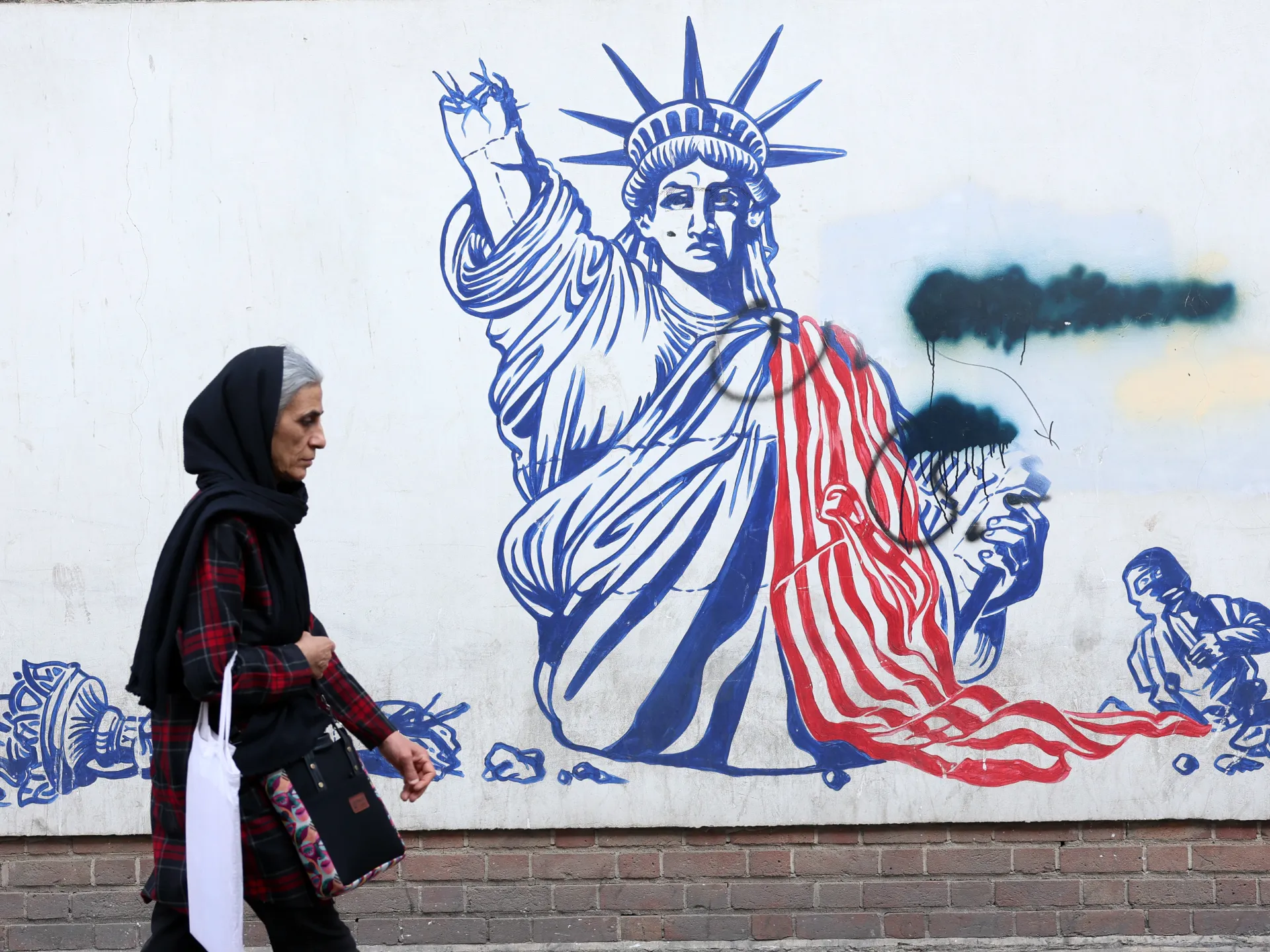
As a new round of talks between the United States and Iran is scheduled to take place in Geneva, Tehran has reiterated that it wants to find a diplomatic solution with the US on its nuclear programme but will defend itself if Washington resorts to military action.

Iran’s Ministry of Foreign Affairs spokesman Esmaeil Baghaei said on Monday that any US attack, including limited strikes, would be considered an “act of aggression” that would precipitate a response after US President Donald Trump said he was considering a limited strike on Iran.

Recommended Stories

list of 4 itemsend of list

“An act of aggression would be regarded as an act of aggression. Period. And any state would react to an act of aggression as part of its inherent right of self-defence ferociously, so that’s what we would do,” Baghaei said during a media briefing.

Trump said on Friday that he was considering a limited strike if Tehran did not reach a deal with the US. “I guess I can say I am considering that,” he said in reply to a question from a reporter.

On Sunday, ⁠Iranian President Masoud Pezeshkian said nuclear talks with the US have produced “encouraging signals” but warned that Tehran is prepared for any scenario in advance of another round of negotiations set for Thursday.

“Iran is committed to peace and stability in the region,” Pezeshkian wrote on X.

The two countries concluded a second round of indirect talks in Switzerland on Tuesday under Omani mediation against the backdrop of the largest US military build-up in the region since the 2003 Iraq war. They resumed talks in Oman this month.

A third round of indirect talks is scheduled for Thursday in Geneva, but the US has yet to confirm. Oman said on Sunday that the talks are set “with a positive push to go the extra mile towards finalising the deal”.

Iranian Foreign Minister Abbas Araghchi has been leading the negotiations for Iran while the US is represented by envoy Steve Witkoff and Trump’s son-in-law Jared Kushner.

‘Iranians had never capitulated’

Baghaei dismissed any claim that a temporary agreement had been reached with Washington, adding that speculation on the nuclear talks is not uncommon.

“We do not confirm any of the speculation. The details of any negotiation process are discussed in the negotiating room. The speculation raised about an interim agreement has no basis.”

Al Jazeera’s Tohid Asadi, reporting from Tehran, said there was a “mixture of optimism and pessimism” in Iran’s capital.

“Let’s call it a pragmatically calibrated cautiousness that we see when it comes to Iran’s statements over the past few weeks, specifically following the major military build-up by the Americans in the region,” he said.

He said Iran is considering both scenarios “on the basis of readiness for diplomatic engagement on the one hand and regional confrontation on the other hand”.

The Trump administration said it has been intensifying its build-up of an array of military assets in the Middle East during the talks with Iran. In an interview with the Fox News TV channel on Sunday, Witkoff said Trump was wondering why Iran has not “capitulated” in the face of the military deployment.

Baghaei on Monday stressed that Iranians had never capitulated at any point in their history.

“This is not the first time we have encountered contradictory claims,” the Foreign Ministry spokesman said.
“We leave the judgement to the discerning people of Iran and the country’s political elites to decide about Iran’s negotiating approach and, in turn, the negotiating approach of the United States,” he added.

“No negotiation that begins with an imposed burden and prejudgement will naturally reach a result,” the official said.

He also stressed that Iran’s positions on its nuclear programme and sanctions relief are clear-cut.

“Any negotiation process requires joint action, and there is hope for results if there is goodwill and seriousness on both sides,” Baghaei said.
Source link

Through ‘K-Pops!,’ Anderson .Paak sought deeper familial connection

When the pandemic hit, and reality settled in that life would be isolated and mostly inside, Grammy winner Anderson .Paak found himself on the outside looking in, in a way he didn’t anticipate. “I was the odd man out. My son was 8, and BTS took over the whole house,” .Paak explained in an interview with The Times at his WeHo lounge, Andy’s. “It was a K-pop storm. Before that, me and my son were bonding off of my music.”

.Paak’s son, Soul Rasheed, and his now ex-wife originally from Korea, Jaylyn Chang, had become obsessed with K-pop alongside much of America, which reminded .Paak of the intensity of Beatlemania. Black American music influenced the birth of a new style, which formed and expanded across oceans, then returned to the U.S. and exploded. This effect in the .Paak household was palpable, causing Soul and Chang to deeply bond in a new way. .Paak himself, as a soul, R&B and hip-hop aficionado, was tapped into the source, but not the reinterpreted subject. So he had to find a way in.

Soul, at the time, like many 8-year-olds, had also become obsessed with becoming a YouTuber. Besides .Paak’s music, the father-and-son duo had also previously connected over humor, so .Paak started there. They began with funny skits and eventually fused them with BTS dances. Soon, there were even videos featuring them comedically educating each other about their individual music tastes. “I loved it,” .Paak recalled, getting lost in the memory. “I was getting to know him more, and he was getting to know me. My mom would always say, ‘It’s one thing for your kids to love you, but it’s another to share things you’re interested in.’ It wasn’t like I was being Anderson .Paak, I was just Dad.”

Anderson .Paak stands in his restaurant lounge

“I was getting to know him more, and he was getting to know me,” .Paak said of bonding with his son, Soul.

(Carlin Stiehl / For The Times)

Through this exploration and the realization of a potential continued familial bond, a story idea emerged, then a treatment for a K-pop-centered film that .Paak would direct and he and Soul would both star in. .Paak then began directing a slew of music videos as the pandemic began to fade, building a portfolio and gaining experience in the medium. But he could start to sense Soul’s interest fading as time passed. After a few failed pitch attempts, .Paak urgently enlisted the help of one of his oldest friends and fellow entertainer, Jonnie “Dumbfoundead” Park, who brought .Paak and the idea to Stampede Ventures.

“The pitch was from an idea that Anderson had, and [to introduce it], we showed them this TikTok that he had with his son,” Park recalled over Zoom. “Anderson was like, ‘Do you know anything about BET, son?’ And [Soul] was like, ‘No, but I know BTS.’ Then they were just going back and forth, arguing about BET and BTS. That was literally the deck, [us saying] we would take that energy and put it into a two-hour film. They loved it. As soon as we walked out of the office, Anderson looked over like, ‘Are we greenlit?!’ They just understood it, the whole intergenerational, intercultural element of Black and Korean.” Stampede combined forces on the project with Live Nation Studios and .Paak’s debut feature “K-Pops!” was off to the races.

It’s important to note that .Paak is himself Black and Korean. His mother was adopted from Korea by a SoCal Black American military family and .Paak’s father was also a Black military officer. Thus, while his mother was born in Korea, he was raised almost entirely within a Black cultural space. .Paak didn’t experience much direct exposure to Korean culture until his 20s, when he met Chang at the Musicians Institute in Hollywood. As an immigrant directly from Korea, Chang showed him the fortitude of structure amid her community. He was also taken by their inherent family value system. “In Korean households, you stay in the house until you get older so you can take care of your parents, and your parents can help take care of the kids,” .Paak explained. “There’s an infrastructure that’s worked out. Also, Korean food is important, as is learning the language. I was drawn to that. My son didn’t eat anything outside of Korean food for so long, and he’s just now getting into tacos.”

.Paak then further explored his Korean side through a burgeoning friendship with Park, which happened a bit later, after Chang had already given birth to Soul. Park introduced .Paak to K-town-based Korean culture through their shared music scene. “The people that came from K-town had a lot of Latino and Black influences as well,” .Paak remembered. “There was a little more of a melting pot, and it was more urban. But in a similarly communal way [to Koreans from Korea], they were all hanging out in K-town with other Korean friends. They’d drink soju, and go to after-hours where you had to have somebody Korean with you.”

While .Paak had some opportunities in adulthood to grasp a bit of his Korean heritage, in “K-Pops!,” through his main character BJ, he also got to actualize what his mother may have missed. In the film, BJ, a failed karaoke bar R&B musician, gets a lucky chance to go to Korea and be the drummer for a popular K-pop competition series. There, he bumps into his estranged ex-girlfriend’s son, Tae Young (played by Soul), who is competing on the show. He then finds out that the kid is his. While a messy transition ensues, BJ and Tae Young eventually get to galavant around Korea and work together to try to win the competition. Through this exploration, BJ finds out he can thrive in Korea while still holding onto his Blackness. .Paak’s mother’s dive back into her roots had a different result. “My mom went abroad and spent a year in Korea, but when she went there, she just didn’t like it,” .Paak explained. “In the movie, initially, BJ doesn’t really have any connection to his Korean side and doesn’t really care to know, but then he finds a bridge.” That bridge is music.

Actor Yvette Nicole Brown, who in “K-Pops!” plays BJ’s mother, proclaimed over Zoom that, “Everything about the film and the music in it is Blasian, every culture is celebrated and massaged and made into something beautiful.” .Paak made a concerted, intentional effort to explore both the Black and Korean sides of K-pop in two scenes.

The first is an early breakdown initiated by Soul’s character, Tae Young, who explains the structured roles of a K-pop group, which may be fun for superfans and educational for laypeople to the genre. The next is a winding presentation by BJ to Tae Young about the influence of Motown groups like the Jackson 5 and boy bands like New Edition on the momentum of K-pop’s rise. It’s particularly poignant because it is all shot at a record store on the streets of Korea, where .Paak explained he actually found the records he was referencing. “There’s nothing wrong with people doing their interpretation of Black music, as long as you pay homage and as long as you respect it and take care of it,” .Paak declared. “Because [if you do], then they’ll take care of you, but the moment you don’t, you’ll see what happens … I wanted to explain that history because that’s how I saw it.”

Real-life father and son, Anderson .Paak, left, and Soul Rasheed, co-star in "K-Pops!"

Real-life father and son, Anderson .Paak, left, and Soul Rasheed, co-star in “K-Pops!”

(Jake Giles Netter)

”K-Pops!” has as much of who .Paak and Soul are as father and son as he could fit in. There are appearances by legacy Black artists like Earth, Wind & Fire, as well as K-pop stars like Vernon from Seventeen. There are original songs co-written and co-produced by .Paak and musician Dem Jointz, that feature K-pop fused with soul and funk, one of which Tae Young performs as his finale competition number (soundtrack arriving soon). The film was shot in both L.A. and Korea and provided ample time for bonding (especially during scenes filled with off-the-cuff humor) that .Paak envisioned from the beginning. Yet still, at the time they were about to shoot, .Paak almost couldn’t get Soul on board because he had turned 11 and wasn’t as into K-pop or acting comedically anymore; he insisted he was instead “into Slipknot.”

The duo did find their footing, though, and executed a winding story that centers on their connection. As a burgeoning teenager in 2024, Soul went with his father to the world premiere at the Toronto International Film Festival, along with a plethora of Korean relatives from his mom’s side. .Paak anxiously awaited their full reaction to the culmination of his quest for a deeper bond.

“Everybody really enjoyed it,” .Paak remembered, relieved. “[Soul] was like, ‘I’m proud of you, Dad.’ I asked him, ‘You think you would ever do part two?’ He was like, ‘Nah, I don’t think acting is my passion, but I’ll never forget those moments … You know what? On second thought, it depends on the script.’ But I think he’s really proud of it. I think it’s something like, when he gets older, he’ll see how special it is as well. But yeah, he didn’t say it’s cringe.”

“K-Pops!” has its L.A. premiere on Tuesday and debuts in select theaters Friday.

Source link

Ramadan in Gaza: Cost of iftar doubles as genocidal war devastates economy | Israel-Palestine conflict

After two years of a grinding war, Palestinians in the Gaza Strip are observing the holy month of Ramadan during an unabating economic catastrophe as Israel continues to impose restrictions on the entry of food and other supplies despite a “ceasefire” reached in October.

For most families, the daily struggle to secure a mere loaf of bread has replaced the traditional festive atmosphere before the war. An analysis by Al Jazeera, based on official data, reveals that skyrocketing prices for basic commodities have made a complete iftar meal to break the daily fast a distant dream for the vast majority of the population.

Skyrocketing costs

During periods when Israel tightened its siege or completely closed the crossings into Gaza, food prices spiked by more than 700 percent. While prices have retreated slightly since the “ceasefire” began in October, they remain significantly higher than pre-war levels.

According to Mohammed Barbakh, director general of policy and planning at the Ministry of Economy in Gaza, official data tracking prices from before the war began on October 7, 2023, to the first days of this Ramadan show staggering increases.

Al Jazeera’s analysis of the ministry’s price data reveals the following hikes:

  • Chicken: Prices rose from 14 shekels ($4.49) to 25 shekels ($8.01) per kilogramme (2.2lb), an 80 percent increase.
  • Frozen fish: Prices jumped from 8 shekels ($2.56) to 23 shekels ($7.37) per kilo, a 190 percent increase.
  • Frozen red meat: Prices rose from 23 shekels ($7.37) to 40 shekels ($12.82) per kilo, a 75 percent difference.
  • Eggs: A tray of 30 eggs now costs 35 shekels ($11.22) compared with 13 shekels ($4.17), a 170 percent increase.

Vegetables, a staple of the Palestinian diet, have also seen dramatic surges. Tomatoes have doubled in price while cucumbers have jumped by 300 percent, rising from 3 shekels ($0.96) per kilo to 12 shekels ($3.85). Cheese prices have increased by up to 110 percent, directly impacting the cost of suhoor, the predawn meal before the daily fasting during Ramadan begins.

INTERACTIVE - How much does food cost in Gaza 2026 Ramadan Israel war-1771823932
(Al Jazeera)

The cost of a meal

Based on data from the Palestinian Central Bureau of Statistics, Al Jazeera estimated the cost of a basic iftar for a family of six. The meal includes two chickens, rice, salad, appetisers, a soft drink, cooking gas and oil.

The price of the meal has risen to about 150 shekels ($48), up from 79 shekels ($25.32) before the war, an increase of 90 percent.

For suhoor, a simple meal of cheese, hummus, falafel and bread now costs 31.5 shekels ($10.10), compared with 18.6 shekels ($5.96) previously.

The combined daily cost to feed a medium-sized family now stands at 181.5 shekels ($58.17), an 88 percent jump from pre-war figures.

Economic obliteration

These price hikes coincide with a collapse in purchasing power. A United Nations report released in late 2025 indicated that the annual per capita income in Gaza plummeted to $161 (503 shekels) in 2024, down from $1,250 (3,900 shekels) in 2022.

The labour market has essentially vanished. In a statement issued in October, Sami al-Amsi, head of the General Federation of Palestinian Trade Unions, said unemployment stood then at more than 95 percent as workshops, farmland and fishing fleets were destroyed.

“The worker is no longer looking for a job because there is no work at all,” al-Amsi said. “Today, the Palestinian worker is looking for a food parcel to survive.”
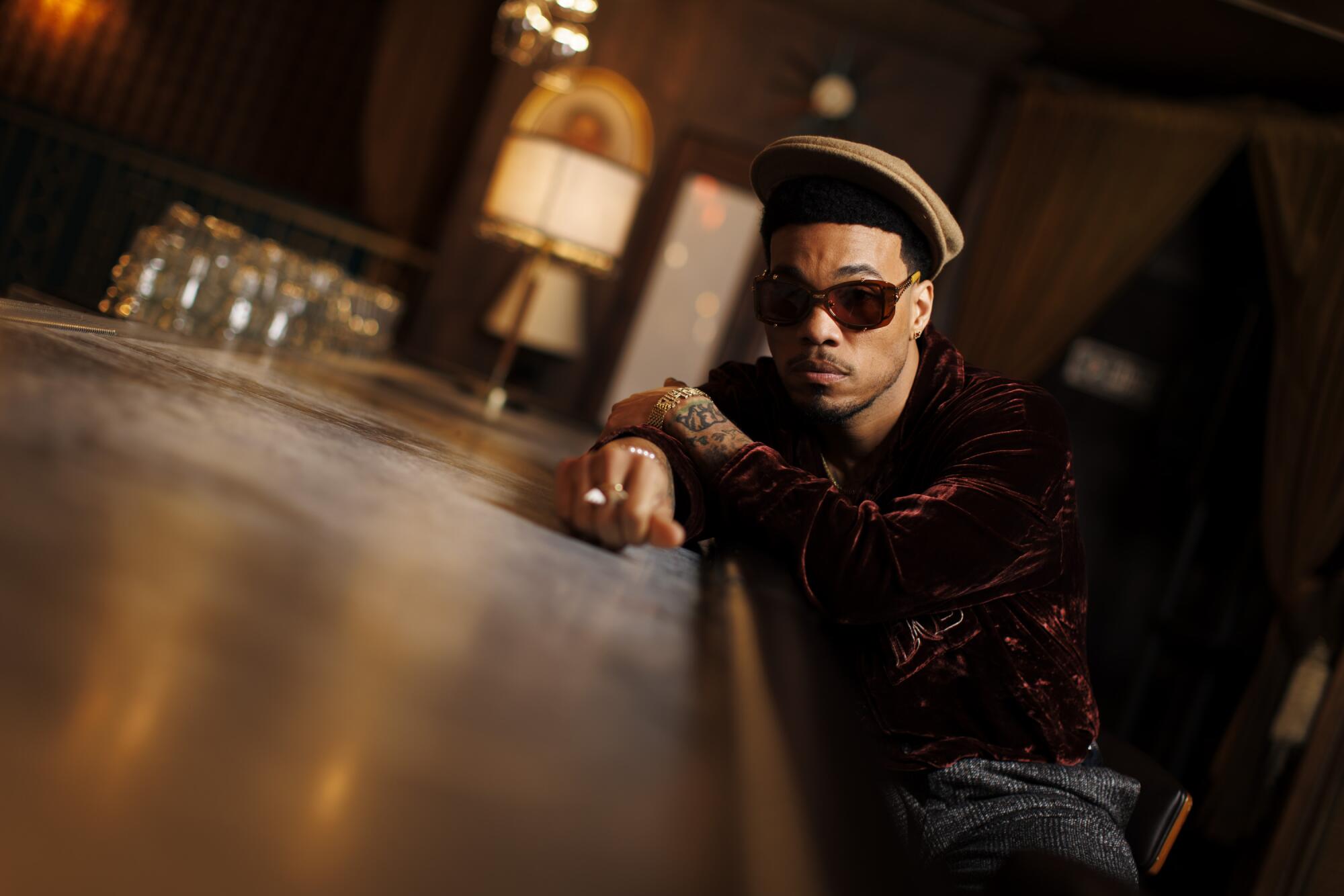
Blockade and monopoly

Economic researcher Ahmed Abu Qamar attributed the inflation to Israel’s restrictive entry policies and “coordination fees” imposed on trucks.

“The humanitarian protocol stipulates the entry of 600 trucks daily, yet the Israeli occupation effectively allows only between 200 and 250 trucks,” Abu Qamar told Al Jazeera, noting that the Strip actually requires 1,000 trucks daily to meet minimum demand.

He also highlighted a monopoly system under which only about 10 merchants are authorised to import goods through four Israeli companies, restricting competition and keeping prices artificially high. He called for a return to a free market system and the full opening of crossings to alleviate the burden on a population already crushed by conflict.

Source link

Susanna Reid sparks backlash with ‘stupid and dismissive’ Tourette’s comment after BAFTAs

Good Morning Britain star Susanna Reid has been criticised for the comments she made about Tourettes syndrome, with some branding it a ‘totally uncaring, stupid and dismissive’ remark

Susanna Reid has been slammed by ITV viewers for a “totally uncaring, stupid and dismissive” remark about Tourette syndrome during a discussion on Good Morning Britain.

The presenter has come under fire for comments she made whilst discussing John Davidson, a Tourette’s campaigner who had his life serialised in new movie I Swear. Actor Robert Aramayo played the role of John in the movie, which he won Best Actor for last night.

During the BAFTAs last night, as Sinners stars Michael B Jordan and Delroy Lindo presented an award, John was heard shouting “shut the f**k up” and “boring” at the actors before using the N-word.

Now, Susanna Reid has been criticised for her comments about Tourettes whilst discussing the news. She said that she was still “thinking about the language'” and branded it “completely unacceptable”.

She referenced that people with Tourettes couldn’t control their ticks, but added: “There’s plenty of people watching who say, ‘Why should a racial slur ever be accepted or simply brushed away?'”

Ed then said: ‘There’s two different issues. If this racial slur was said at the awards ceremony, it shouldn’t have been broadcast. The guy who has Tourette’s – apologising for his disability is not fair or right. It’s not in his control. If it was me, I would have bleeped out the racial slur and not had the apology.”

Ensure our latest headlines always appear at the top of your Google Search by making us a Preferred Source. Click here to activate or add us as your Preferred Source in your Google search settings.

Susanna added: “But it’s absolutely vital that you apologise for it. A racial slur is always something, presumably, that needs to be apologised for.” Ed then replied: “They ought to have apologised for having it on the programme, but apologising for the gentleman with Tourette’s, you can’t apologise for his disability.”

Fans of the ITV show fumed over Susanna’s comment, with one writing: “The actor in the film regarding Tourette’s wins an award but Susanna states that we need to apologise for the consequence of that disability in real life.” Another added: “You shouldn’t apologise for #TouretteSyndrome, it can’t be helped. You should never apologise for an illness…no one asked to have the illness.”

Yesterday, at the awards, host Alan Cumming addressed the comments. He told the audience: “You may have heard some strong offensive language tonight, but if you’ve seen the film I Swear, it’s about the experience of a person with Tourette syndrome.

“It is a disability and the ticks you have heard tonight are involuntary that means the person who has Tourette syndrome has no control over their language and we apologise if it has caused offence.”

A BBC spokesperson added: “Some viewers may have heard strong and offensive language during the Bafta Film Awards 2026. This arose from involuntary verbal tics associated with Tourette syndrome, and was not intentional. We apologise for any offence caused by the language heard.”

Like this story? For more of the latest showbiz news and gossip, follow Mirror Celebs on TikTok, Snapchat, Instagram, Twitter, Facebook, YouTube and Threads.


Source link

Winter Olympics 2026 closes after setting ‘a new standard for future’ | Winter Olympics News

The Winter Olympics ended as the twin flames in host cities Milan and Cortina d’Ampezzo were extinguished during a closing ceremony at the ancient Verona Arena, roughly mid-distance between the far-flung mountain, valley and city venues that made these the most spread-out Winter Games ever.

In declaring the 2026 Games over on Sunday, International Olympic Committee President Kirsty Coventry told local organisers that they “delivered a new kind of Winter Games and you set a new, very high standard for the future”.

The next Winter Games will be held in neighbouring France, which received the Olympic flag in the official handover earlier in the ceremony. Following the same spread-out model, the 2030 Winter Games will stage events in the Alps and Nice, on the Mediterranean Sea, while speed skating will be held either in Italy or the Netherlands.

A total of 116 medal events were held in eight Olympic sports across 16 disciplines, including the debut of ski mountaineering this year, over the course of 17 days of competition. With the final events wrapping up just hours before the ceremony, the 50km mass start men’s and women’s cross-country medals were awarded by Coventry inside the arena.

Hosts Italy won their highest Winter Olympic tally of 30 medals, including 10 gold and six silver, surpassing the previous record of 20 medals, set at the Lillehammer Olympics in 1994.

The closing ceremony paid tribute to Italian dance and music, from lyric opera to Italian pop of the 20th century to the DJ beat of Gabry Ponte, who got the 1,500 athletes on their feet and dancing while colourful confetti exploded on stage. Italian artist Achille Lauro delivered the last word with the song “Incoscienti Giovani”, or “reckless young people”, just before athletes who had so aptly harnessed their youthful energy for these games filed out.

The Milano Cortina Winter Olympics spanned an area of 22,000sq km (8,500sq miles), from ice sports in Milan to biathlon in Anterselva on the Austrian border, snowboarding and men’s downhill in Valtellina on the Swiss border, cross-country skiing in the Val di Fiemme north of Verona, and women’s downhill, curling and sliding sports in Cortina d’Ampezzo.

The closing ceremony concluded with the Olympic flames extinguished at the unprecedented two cauldrons in Milan and Cortina, viewed in Verona via videolink. A light show substituted for fireworks, which are not allowed in Verona to protect animals from being disturbed.

The Milan Cortina Paralympics’ opening ceremony will also take place in the Verona Arena, on March 6, and the games will run until March 15.

Source link

“Sell America” Panic: Markets Plunge Amid Trump’s Tariff Chaos

U.S. trade policy uncertainty has sent shockwaves through global markets, as President Donald Trump moved to impose a 15% tariff following the Supreme Court of the United States ruling invalidating his emergency trade levies. Investors reacted quickly, rotating out of risk assets and the dollar, while seeking shelter in gold, silver, and safe-haven currencies. The turbulence highlights the fragility of global investor confidence when policy reversals collide with high-stakes geopolitical and economic risks.

Wall Street and Currency Volatility

U.S. stock futures fell sharply, with S&P 500 futures down 0.5% and Nasdaq futures slipping 0.6%. The dollar weakened across major pairs, losing 0.21% versus the yen and 0.34% against the Swiss franc, while the euro gained 0.23%. European equities also reflected caution: the STOXX 600 fell 0.19%, Germany’s DAX slid 0.36%, and Britain’s FTSE 100 edged down 0.1%.

Asian markets, however, were mixed. The MSCI Asia index excluding Japan rose 0.83%, while Hong Kong’s Hang Seng surged 2.53% on expectations of lower tariffs for China. Japan’s Nikkei futures fell 0.4% ahead of a holiday, highlighting regional divergence driven by perceived winners and losers in U.S. tariff policy.

Safe-Haven Assets Rally

Amid the uncertainty, investors sought protection in gold and silver, which climbed 0.6% and 2% respectively. Safe-haven currencies, including the Japanese yen and Swiss franc, appreciated as risk-off sentiment grew. Government bonds saw slight gains, with the U.S. 10-year Treasury yield dipping to 4.077%, reflecting flight-to-quality buying. Brent crude prices fell 1.1% to $70.97 a barrel, reversing gains from earlier geopolitical risk sentiment linked to U.S.-Iran tensions.

Tariff Confusion and Its Economic Implications

Trump’s latest tariffs add layers of ambiguity. While the Supreme Court struck down his emergency powers, the new 15% levy relies on Section 122 of the 1974 Trade Act, an untested statute. Questions remain over timing, exclusions, and applicability by country. Some nations, including the UK and Australia, had lower tariffs under prior rules, while many Asian exporters faced higher duties. The Yale Budget Lab estimates the average effective tariff rate at 13.7% following the announcement, down from 16% pre-ruling, with the 15% rate potentially dropping to 9.1% after 150 days.

“This circular process of tariff announcements, legal challenges, and revisions is creating profound uncertainty for markets,” said Rodrigo Catril, senior FX strategist at NAB.

Market Sentiment and Investor Behavior

The episode reflects broader structural concerns about U.S. trade policy’s unpredictability. Investors are no longer just reacting to tariffs themselves, but to the instability and volatility of policy enforcement. The uncertainty affects supply chains, corporate earnings forecasts, and capital allocation decisions. Nvidia’s upcoming earnings, for example, are being closely watched, given the company’s 8% weighting in the S&P 500, demonstrating how trade policy shocks can amplify market sensitivity to specific corporate results.

Analytical Outlook

Trump’s oscillating trade policy highlights a critical tension between political objectives and market stability. While tariffs are framed as instruments to advance domestic economic priorities, the resulting unpredictability imposes systemic costs: currency swings, equity market volatility, and flight to safe assets. The mixed regional responses Asian equities partially rallying, European markets cautious underscore how interconnected global trade and finance are, and how unevenly shocks are absorbed.

In essence, this episode illustrates a modern economic paradox: protective trade measures intended to strengthen domestic interests can, in practice, destabilize markets worldwide. Investors now must hedge not only against tariffs themselves but also against the policy volatility that accompanies them a scenario likely to persist as long as U.S. trade decisions are made unilaterally and unpredictably.

Trump’s approach has transformed trade from a predictable framework into a high-stakes, reactive arena, forcing global markets to continuously recalibrate. The lesson is clear: in today’s interconnected financial system, the cost of policy uncertainty often outweighs the intended protectionist benefit.

With information from Reuters.

Source link