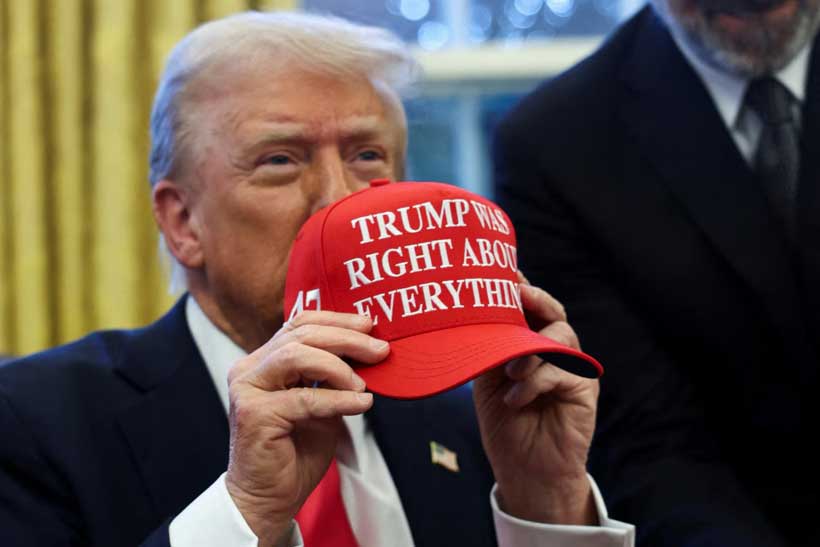
U.S. President Donald Trump on Monday warned countries against backing away from recently negotiated trade deals with the U.S. after the Supreme Court struck down his emergency tariffs, saying that if they did, he would hit them with much higher duties under different trade laws.
Trump, in a series of social media posts, said he also may impose license fees on trading partners as uncertainty over his next tariff moves gripped the global economy and sent stocks lower.
“Any Country that wants to ‘play games’ with the ridiculous supreme court decision, especially those that have ‘Ripped Off’ the U.S.A. for years, and even decades, will be met with a much higher Tariff, and worse, than that which they just recently agreed to. BUYER BEWARE!!!” Trump wrote on Truth Social.
Trump said that despite the court’s decision to invalidate his tariffs under the International Emergency Economic Powers Act (IEEPA), its decision affirmed his ability to use tariffs under other legal authorities “in a much more powerful and obnoxious way, with legal certainty, than the Tariffs as initially used.”
He suggested that the U.S. could impose new license fees on trading partners but did not provide further details. A spokesperson for the U.S. Trade Representative’s office did not immediately respond to requests for comment on Trump’s plans.
EU Trade Deal on Hold
In Brussels, the European Parliament decided on Monday to postpone a vote on the European Union’s trade deal with the U.S. after Trump said he would impose a new temporary import duty of 15% on imports from all countries.
EU goods under the deal would face a 15% U.S. tariff, with exemptions for hundreds of food items, aircraft parts, critical minerals, pharmaceutical ingredients, and other goods, while the EU would remove duties on many imports from the U.S., including industrial goods.
Trump initially announced the temporary duty under Section 122 of the Trade Act of 1974 at 10% but promised on Saturday to raise it to 15%, the maximum allowed under the statute. An initial 10% tariff came into effect at a minute past midnight on Tuesday, though it is unclear when the 15% rate would take effect, as Trump has only signed an executive order for the 10% tariff so far.
Markets React
Wall Street stocks ended lower on Monday as renewed tariff uncertainty following the Supreme Court decision, coupled with concerns about AI-fueled disruption, unnerved investors.
The Dow Jones Industrial Average fell 1.65%
The S&P 500 fell 1.02%
The Nasdaq Composite fell 1.01%
The dollar weakened against the euro and the yen, reflecting market anxiety over potential trade escalation and economic uncertainty.
Global Trade Uncertainty
The path forward for Trump’s foreign trade deals remains unclear:
China has urged Washington to scrap tariff measures.
The EU has frozen its approval process.
India delayed planned talks.
The U.S. Trade Representative, Jamieson Greer, said the administration expects to open new Section 301 unfair trade practices investigations on several countries, potentially paving the way for new tariffs.
Meanwhile, a group of 22 Democratic U.S. senators introduced legislation to force the Trump administration to issue refunds for all now-illegal IEEPA-based tariffs within 180 days, although the bill faces an uncertain path to a vote.
Trump also criticized the Supreme Court justices who ruled against him, including two he appointed, and expressed concern that the Court could rule against his administration in a forthcoming birthright citizenship case.
Analysis
Trump’s latest moves reflect his ongoing use of tariffs as a negotiating tool and political messaging device, rather than a targeted economic strategy. By threatening higher tariffs and potential license fees, he is signaling to trading partners that backing away from deals could carry immediate financial consequences.
However, the approach carries multiple risks:
Market Volatility: Investors are already responding with caution, as uncertainty over tariffs can disrupt supply chains, raise costs for U.S. companies, and weigh on stock prices.
Diplomatic Strain: Allies such as the EU, as well as emerging partners like India, may view the moves as destabilizing, complicating future trade negotiations.
Legal Vulnerabilities: Section 122 of the Trade Act has rarely been invoked, and using it in place of IEEPA may invite further litigation, leaving Trump’s administration open to judicial challenges.
Global Trade Ripple Effects: A 15% tariff on broad imports could increase prices for U.S. consumers, provoke retaliatory tariffs, and shift global supply chains, particularly in sectors like tech, automotive, and pharmaceuticals.
Economists suggest that while Trump’s threats may pressure trading partners, the overall economic rationale is weak, since the U.S. is not in a balance-of-payments crisis, and broad-based tariffs risk collateral damage to U.S. businesses and consumers.
In sum, Trump’s tariff strategy highlights a blend of economic pressure and political signaling, but it comes with high uncertainty and potential unintended consequences for both the U.S. and global markets.
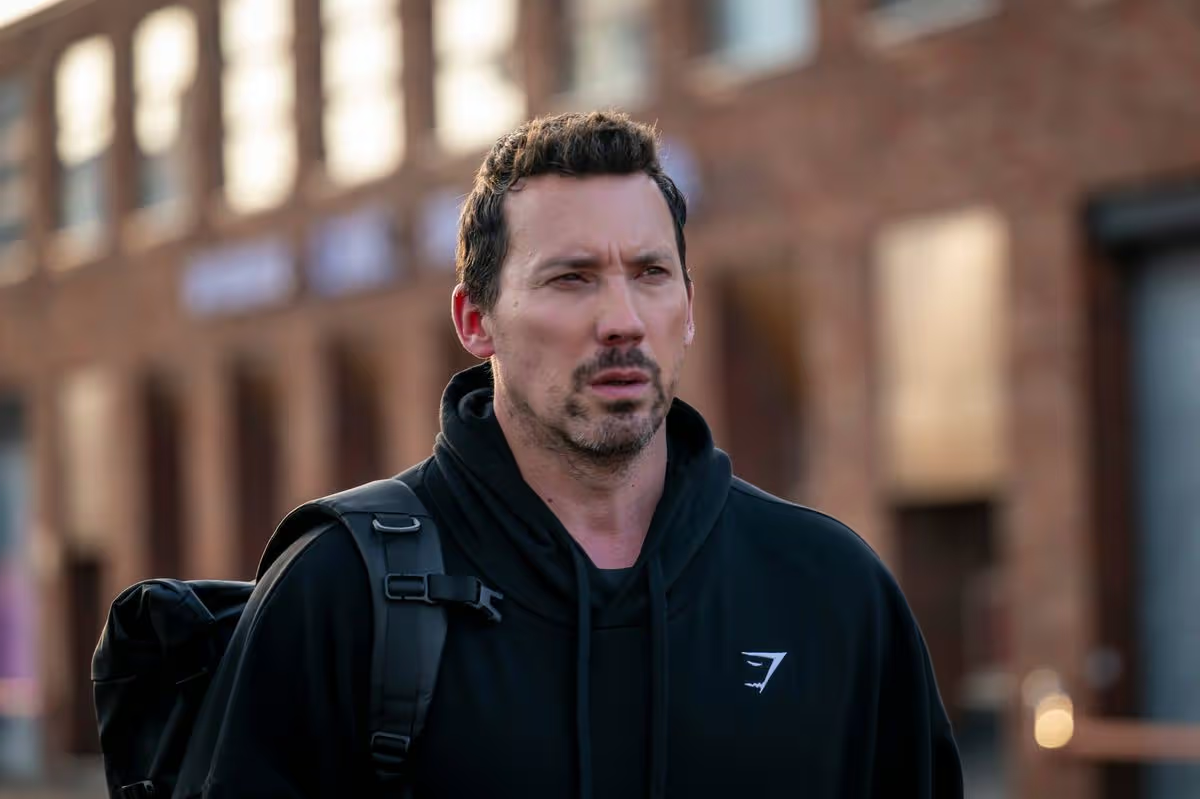
The much-loved forensic scientist, who joined the BBC drama back in the sixteenth series when he replaced Harry Cunningham, has struggled throughout season 29.
The new series has seens Jack, Emila Fox’s Dr. Nikki Alexander and the team relocate to Birmingham from London, where a new enviroment and fresh set of cases has seen Jack “more affected by the trials and tribulations of his work,” as he struggles to find balance.
In the latest episode, called Grace of God, Jack gets himself into a drunken bar brawl as pressure mounts, but things turn from bad to worse when the man he was fighting, Scott Ashton played by Chris Coghill, later winds up dead on Nikki’s examination table.
Consumed with guilt, Jack turns himself in and ends up in prison, with Nikki on the outside trying to keep her husband safe. With his career as a forensic scientist hanging in the balance, many have wondered whether the latest instalment is setting David Caves up for a Silent Witness exit. Warning: The below contains spoilers for Grace of God Part Two.
However, viewers will be pleased to know it looks like Jack is remaining where he is for now, after the second part of Grace of God clears him of the Scott’s murder.
The episode, which is already available on BBC iPlayer, reveals that Jack’s brawl was part of a wider investigation and he was simply a pawn, with Nikki confirming Scott died of injuries sustained after his fight with Jack.
In the instalment, which will air on BBC One on Tuesday, February 23, Jack and Nikki have a teary heart to heart as Jack tells his wife: “The reason I didn’t tell you about the fight is because you trust me and I let you down.”
Responding, Nikki tells him: “And you might do it again. And I might do it to you,” pointing to her wedding band she adds: “That’s what this is. We make mistakes but we come back to each other. We always come back.”
“I’m sorry,” he tells her before they share an emotional embrace and head back home. The episode ends with Jack opposite his therapist as he explains: “We deal with violence almost every day. I experienced the results of violent acts first-hand. And I fool myself that I can separate them from my own life. I grew up being told that strong was the thing. Strength would get you through, no matter how bad.”
“And now?” the therapist asks. “It’s okay to ask for help from time to time, right?” Jack says smiling.
His final reflection seems like a good omen that Jack is returning to work and remaining on the show, as he shares: “Someone once said life is understood backwards but lived forwards. I want to be there… for all of it. I’m ready.”
It’s also worth noting that Jack is scheduled to appear in the final two episodes of Silent Witness season 29 which aire next week on BBC One and BBC iPlayer.
Silent Witness is available to stream on BBC iPlayer now.
For the latest showbiz, TV, movie and streaming news, go to the new Everything Gossip website.
Ensure our latest headlines always appear at the top of your Google Search by making us a Preferred Source. Click here to activateor add us as your Preferred Source in your Google search settings.
ST. PAUL, Minn., Feb. 24 (UPI) — The high-profile abduction of Nancy Guthrie is focusing new attention on a little-known, but quickly growing, segment of the insurance industry known as “kidnap and ransom” in which underwriters cover clients at risk from criminals at home and abroad.
While “K&R” insurance has traditionally been seen the domain of business executives whose travels take them to hot spots across the globe where abduction risk is high, the Guthrie case shows that even within the relatively safe United States, anyone can be subjected to kidnapping or extortion, industry leaders told UPI.
As of Monday, the fate of Nancy Guthrie remained unknown. The 84-year-old mother of Today show host Savannah Guthrie has been missing from her home in Tucson since Jan. 31. Police were notified after she failed to show up to watch a live stream of a church service at a friend’s house.
Her family has been cleared in her disappearance and the case is still being treated as a kidnapping. The FBI describes the prime suspect as a male between 5 feet, 9 inches and 5 feet, 10 inches in height with a medium build and carrying a 24-liter black Ozark Trail Hiker Pack.
An unknown person’s DNA was recovered at the crime scene, authorities said.
Meanwhile, reports have indicated the Guthrie family received a ransom demand of millions of dollars to be paid in cryptocurrency.
As the search has dragged on for weeks without any substantial breaks in the case, the costs to the Guthrie family are likely mounting quickly, even excluding the potential payout of a multimillion-dollar ransom.
This has led to speculation over whether Savannah Guthrie — who has a reported net worth of $50 million — owns a kidnap and ransom insurance policy covering herself and family members.
But, if she is like the vast majority of high-net worth Americans such as top business executives, media figures, politicians, athletes and celebrities, it’s probable she does not have a K&R policy.
This is because kidnappings-for-ransom have always been rare in the United States and, as a result, the worldwide market for such policies has remained relatively small at anestimated at $2 billion in 2025.
But that figure is expected to nearly double by 2033 as buyers’ perceptions of the threat levels evolve.
“Glaring gap”
The Nancy Guthrie case, as well as a recent rash of kidnappings targeting holders of large amounts of cryptocurrency, is shining a light on what some have described as a “glaring gap” in the security measures typically taken by wealthy families, media personalities and others.
Insurers don’t want to talk about the cost of K&R policy premiums. However, according to independent estimates, basic policies can cost as little as $500 per year, but quickly rise in price as coverage expands and risks increase.
If, for instance, the policyholder is planning to travel to kidnapping “hotspots” such as Mexico, the cost will increase. Insurance for high-profile CEOs, regardless of where they travel, can ruin $10,000 or more per year, industry estimates indicate.
One of the world’s largest providers of K&R insurance is the French company AXA and its specialized division for complex risks, AXA XL. Denise Balan, the firm’s senior vice president and head of U.S. security risks, told UPI the need for these policies is evolving beyond business people traveling into risky global hotspots, although that remains a core customer base.
“You’d be surprised how many entities and individuals actually do carry this insurance, because it is a ‘duty of care’ product,” she said, meaning it is provided by businesses as part of their legal duty to protect their employees.
“So, most companies that have a significant number of employees who either travel internationally or have CEOs or board members who have concerns about threats to their physical safety or extortion, they do tend to carry this insurance.”
There are basically two elements to a typical K&R policy, Balan explained, including the obvious benefit: reimbursement of expenses and costs up to and including the ransom payment.
“But the more important aspect of the policy that you get is the service,” she said. “And that’s in the form of a security consultant. I’m sure you’ve heard a number of different security consultants who have been interviewed recently about the Savannah Guthrie case. Each insurance company that offers kidnap-for-ransom policies also offers a security service.”
The cost of the consultants, usually drawn from a small pool of well-known providers such as London-based S-RM Intelligence and Control Risks Group, is entirely absorbed by the insurer and doesn’t erode the policy limit — rather, it is in addition to the limit.
“It is a wonderful service that will give you not only response in a crisis, but will also give you preventative assistance,” Balan said. “It’s useful if a company wants to set up a crisis management plan or to do an exercise so they’d know how to react if, for instance, they get a call on a Sunday night from someone who says one of their products is going to be tampered with unless they get a million dollars.”
The provided security consultant can offer expert advice on “everything from how to speak to a kidnapper to how much ransom might be an appropriate amount to pay. They might know, for instance, that the going rate for kidnapping in Mexico is $2,500, and they can help with the negotiation, although they never speak directly to the kidnapper.”
One reason that K&R policies are generally little-known is that they’re highly confidential in nature and the potential for their abuse is high.
“You can’t be out there talking about how you have an insurance policy that pays in the event of a kidnap because there’s just so much potential for fraud,” Balan said. “So, it’s a very under-the-radar product that’s been around since probably the early 1920s.”
Another indication that threats are expanding beyond the traditional business travel sector is evident with a new phenomenon dubbed “crypto-kidnapping,” in which organized gangs utilize leaked data to locate and target high-net-worth cryptocurrency holders.
The latest such incident came Feb. 12 outside of Paris when masked assailants targeted Binance France CEO David Prinçay in a failed home invasion and kidnapping attempt — an attack that has put the entire cryptocurrency industry on high alert.
Matthew Humphries, head of crisis management at Lockton Cos., the world’s largest privately held independent insurance broker, said such incidents show the universe of who should have K&R policies is expanding.
“Kidnap and ransom insurance is available for people and organizations whose profile or operations are exposed to heightened security risks, whether abroad or closer to home,” he told UPI.
“There’s a perception that kidnapping only happens in places with obvious political or security tensions, but the risk is far broader. We’ve seen kidnapping cases emerge in places few would expect, including some high‑profile incidents targeting people in the crypto sector in the U.S., France and Canada.”
Payment for expert security teams covered
Estimates indicate as many as 25,000 kidnappings occur each year worldwide, according to another leader in the industry, the U.S.-based Travelers Cos., which warns in its literature, “If you still think it could never happen, consider this: Coercive threats to you and your business can take many forms.”
The company cites two real-life examples.
In one, the president of a company was kidnapped in his parking lot and held for five days until a ransom was paid. Costs incurred included $650,000 for the ransom, $2,000 per day for an independent negotiator, $500 per day for recording equipment used to obtain the man’s release, and $200 per day for extra security guards hired to protect his family.
In the other case, a physician’s wife was attending a conference. The physician received a call that his wife had been kidnapped and that he had two hours to wire a ransom payment. He wired the funds, but realized later that his wife was never kidnapped or in any danger — and all the while the expenses, such as the ransom payment and costs for a security team, quickly added up.
What’s essential in any kidnapping scenario is the presence of experts to advise those close to the victims, which is perhaps the most important benefit of a K&R policy, said Tracey Santor, assistant vice president for financial institutions at Travelers.
Much like AXA AL’s Balan, she emphasized the policies usually come with a crisis management team to be made available to victims’ families and paid for by the carrier.
“The firm usually consists of former law enforcement officers from a number of agencies, such as the FBI, DEA and CIA, who can often determine if a kidnapping is from a specific group and what past behavior and demands have been,” she told UPI. “The crisis team may also work with local authorities on the safety and return of the kidnap victim.”
Travelers only issues commercial K&R policies for businesses rather than personal policies for individuals, for whom they recommend another U.S. provider working with the Travelers Syndicate 5000 in London.
Asked whether heavily publicized cases such as the abduction of Nancy Guthrie can drive up demand for K&R insurance, Santor responded, “Any high-profile story in the news has the ability to influence new buyers to look to purchase coverage related to the incident.”
The incident in Isfahan province follows crash of fighter jet in Hamadan province less than a week ago.
Published On 24 Feb 202624 Feb 2026
Share
Tehran, Iran – Two military pilots and two merchants have been killed after an army helicopter crashed into a fruit market in central Iran.
The crash on Tuesday morning occurred in Dorcheh, a town in Isfahan province, where the army has a major airbase, according to state media, which said the cause was likely a technical fault in the aircraft.
Recommended Stories
list of 3 itemsend of list
Footage broadcast by state media from the scene of the crash showed the wreckage and emergency responders putting out the fire.
The Army Aviation Training Centre, in a statement, identified the killed soldiers as Colonel Hamed Sarvazad, the pilot; and his co-pilot, Major Mojtaba Kiani.
Two people working at their booths in the market were also reportedly killed on the scene after the helicopter crashed and caught fire.
The army centre said the cause of the crash is under investigation. The local judiciary chief, Asadollah Jafari, said he had also opened a case and dispatched investigators.
The crash comes less than a week after an Iranian Air Force fighter jet, reportedly an old United States-built F-4 model, crashed during a late-night training mission in the western province of Hamadan.
State media reported that one of the pilots was killed, but the other survived after successfully ejecting. The cause of that crash is under investigation, but state media said it was likely caused by a technical fault, as well.
Iran has been largely unable to upgrade its ageing fleet of aircraft, both military and civilian, as a result of decades-long sanctions imposed by the US and its allies.
Iran has purchased a number of fighter and training aircraft from Russia, and has been seeking to buy advanced Su-35 jets, but they have yet to be delivered by Moscow.
The crash of the helicopter took place amid rising tensions between the US and Iran before a new round of nuclear talks, which are set to take place in Geneva, Switzerland, on Thursday.
Iranian officials have warned that the country will not “bow down” to US pressure as Washington bolsters its military presence in the region.
In recent weeks, the US military has amassed hundreds of advanced fighter aircraft, both in military bases and on two aircraft carrier strike groups, as it threatens to strike Iran if it fails to reach a deal on its nuclear and missile programmes.
Tehran has rejected negotiations about its missiles, but has said an agreement may be possible to ensure it will never possess a nuclear weapon.
The 2026 original song contenders come from deep inside the characters singing them: a simple man wistfully looking back on his ordinary life; a budding bluesman with talent to burn down the house; a 17-time Oscar nominee; a demon-hunting K-pop star channeling the real-life singer-songwriter behind her; and a joyous expression of life from inside a documentary’s main “character,” a retirement home for musicians.
‘Dear Me’ from ‘Diane Warren: Relentless’
Music and lyrics by Diane Warren
Diane Warren in “Diane Warren: Relentless.”
(Don Holtz)
When 17-time Oscar nominee Diane Warren agreed to be in a documentary about her life, she found herself back in her childhood home in Van Nuys — specifically the bathroom where she wrote songs as an angsty teen.
“The acoustics in that bathroom were always great,” she says. “It was cool to go back and look at the bedroom window I used to sneak out of. I’m always connected to that 14-year-old me, with a guitar my dad bought me.”
Inspired by the documentary’s examination of her troubled youth, Warren wrote an “It gets better” ballad sung by Kesha: “Dear me, it’s gonna be all right, all right / Trust me, all of the pain is gonna fade.”
“I get notes from all ages; the song makes them feel like they could hug the little kid inside them,” says Warren. “It’s a love song to your younger self.”
‘Golden’ from ‘KPop Demon Hunters’
Music and lyrics by Ejae, Mark Sonnenblick, Joong Gyu Kwak, Yu Han Lee, Hee Dong Nam, Jeong Hoon Seon and Teddy Park
She related to the film’s protagonist, Rumi, a monster-fighting singer who is secretly part monster herself. “She has this side that she’s so ashamed of, that she was born with. I struggled with my own demons that I was ashamed of, growing up in the K-pop industry, [harshly critiqued for] my physical appearance, my voice, my personality.
“Even when writing ‘Golden,’ things were just not happening. It was a really bad time.”
Yet the hit is a catchy K-pop banger.
“It was very cathartic,” she says. “I remember crying while recording the demo. I was desperate.
“Now when I sing it, it’s a different feeling. I was able to reach a dream, and it makes me feel like this is who I was meant to be.”
‘I Lied to You’ from ‘Sinners’
Music and lyrics by Raphael Saadiq and Ludwig Göransson
Miles Caton, center, in “Sinners.”
(Warner Bros. Pictures)
Ryan Coogler’s “Sinners” features a central moment of musical ecstasy. Emerging bluesman Sammie plays a song he wrote as a confession to his pastor father, a paean to the music he loves. As the juke joint crowd responds, he loses himself in the timeless transcendence artists hope for.
Co-writer Ludwig Göransson says, “It doesn’t happen very often, but you have those experiences when you really are getting into the music and time and space disappears. Ryan’s not a musician, but it was written like he’s been in that position.”
In cosmic communion, practitioners of Black music from many eras appear to Sammie, the joint’s roof combusting in his mind. Göransson assisted in the Dolby Atmos mix, moving the music and sound around spatially as the camera travels.
Co-writer Raphael Saadiq says, “Sammie’s father felt secular music was devil music. Even today, you have people who go to church who don’t listen to the blues [for that reason], but deep down inside, they love it because it’s something we inherited from our ancestors.”
‘Sweet Dreams of Joy’ from ‘Viva Verdi!’
Music and lyrics by Nicholas Pike
Milan’s Casa Verdi, a retirement home for musicians depicted in “Viva Verdi!”
(Viva Verdi! LLC)
Even those who know little about opera have heard of Giuseppe Verdi. What many don’t know is one of his most enduring accomplishments is Casa Verdi — a retirement home for musicians. Yvonne Russo’s documentary “Viva Verdi!” captures the vibrant life inside its walls, expressed in the aria “Sweet Dreams of Joy,” sung by soprano Ana María Martínez and composed by Nicholas Pike.
The filmmakers “sent me this 12-minute assembly, kind of like a teaser, and that’s all I saw,” says Pike. “The passion, the vitality of these residents, the mentoring of young, up-and-coming artists … I went over to the piano and wrote the song.”
He says the whole thing took about a day to craft, with its contemporary piano figures and classical vocals, imbued with the vivaciousness of Casa Verdi’s residents.
He wanted to capture the footage’s “energy and life and hope. We’ve all been to retirement homes; they can be pretty down places. This is 180 degrees from that.”
‘Train Dreams’ from ‘Train Dreams’
Music by Nick Cave and Bryce Dessner; lyrics by Nick Cave
Joel Edgerton in “Train Dreams.”
(Netflix)
When “Train Dreams” star Joel Edgerton called Nick Cave to work with composer Bryce Dessner on a song for the film, the postpunk poet and art rocker was on holiday, avoiding the “attendant agony” of songwriting. But Denis Johnson’s book happened to be a favorite of Cave’s.
Edgerton sent him the film. Cave says, “I sat up in bed and watched it with Bryce’s gorgeous score and fell asleep and had a kind of fever dream with all the images of this extraordinary film, and woke up with the lyrics fully formed, which is extremely unusual for me.”
He went to the hotel’s breakfast room, where there was a piano. “It all just sort of poured out of me. The melody and the lyrics fit perfectly to Bryce’s score.”
The song expresses “the inarticulate wonder at the world that the lead character has. There’s this chordal thing after the refrain, that rises up — an expression of that wonder, rising out of the grief.
“‘This has been going on for years … I can’t begin to tell you how that feels.’”
The Korea Composite Stock Price Index (KOSPI), shown on a screen in the trading room at Hana Bank in Seoul, topped a record-high 5,000 on Tuesday. Photo by Yonhap
Seoul shares surged more than 2 percent Tuesday to close at a fresh record high above the 5,900-point mark, driven by strong gains in technology shares. The Korean won fell against the U.S. dollar.
The benchmark Korea Composite Stock Price Index (KOSPI) advanced 123.55 points, or 2.11 percent, to finish at an all-time high of 5,969.64.
The index has extended its upward momentum in recent weeks, surpassing the 5,000-point mark for the first time on Jan. 27 and crossing 5,500 on Feb. 12. It moved above 5,800 on Friday.
Trading volume was heavy at 1.58 billion shares worth 30.73 trillion won (US$21.3 billion), with decliners outnumbering gainers 465 to 407.
Institutions bought a net 2.37 trillion won worth of stocks, offsetting net sales of 199.16 billion won by foreign investors and 2.28 trillion won by retail investors.
The rally came despite overnight losses on Wall Street.
The Dow Jones Industrial Average fell 1.66 percent, and the tech-heavy Nasdaq Composite declined 1.13 percent.
In Seoul, investors scooped up major chip stocks ahead of an earnings report from U.S. chipmaker Nvidia later this week, while remaining cautious over U.S. President Donald Trump‘s push to impose new tariffs after the Supreme Court struck down his original sweeping duties, analysts said.
Trump signed an executive order Friday (U.S. time) authorizing new 10 percent global tariffs that took effect Tuesday. He has also threatened to raise the rate to 15 percent, though no formal order has been issued.
“Even if the global tariffs are raised to 15 percent, there will be no major impact on the local stock market because current U.S. tariffs on Korean imports already stand at 15 percent,” an analyst at IBK Securities Co. said.
Technology and automobile stocks led the gains.
Market bellwether Samsung Electronics jumped 3.63 percent to 200,000 won, while chip giant SK hynix surged 5.68 percent to a record high of 1,005,000 won.
Top automaker Hyundai Motor rose 0.19 percent to 524,000 won, and leading battery maker LG Energy Solution gained 4.17 percent to 412,500 won.
Among decliners, shipbuilder Hanwha Ocean fell 2.79 percent to 143,100 won, and Lotte Shopping declined 1.67 percent to 111,700 won.
The Korean won was quoted at 1,442.50 won against the U.S. dollar at 3:30 p.m., down 2.5 won from the previous session.
Bond prices, which move inversely to yields, closed lower. The yield on three-year Treasurys rose 0.4 basis point to 3.158 percent, and the return on the benchmark five-year government bonds also climbed 0.5 basis point to 3.410 percent.
Copyright (c) Yonhap News Agency prohibits its content from being redistributed or reprinted without consent, and forbids the content from being learned and used by artificial intelligence systems.
Joint statement says Israeli land grab is ‘deliberate and direct attack’ on the viability of a Palestinian state.
Published On 24 Feb 202624 Feb 2026
Share
Foreign ministers of 19 countries, including Turkiye, Qatar, France and Brazil, have signed a joint statement condemning Israel’s moves to unlawfully extend and consolidate its control over Palestinian land.
The statement issued late Monday by the Turkish Ministry of Foreign Affairs described Israel’s plans to begin land registration in the occupied West Bank, which will sanction the seizure of land from Palestinians who cannot prove ownership, as “de facto annexation”.
Recommended Stories
list of 4 itemsend of list
“Changes are wide-ranging, reclassifying Palestinian land as so-called Israeli ‘state land’, accelerating illegal settlement activity, and further entrenching Israeli administration,” said the joint statement, also signed by Saudi Arabia and Egypt, as well as the heads of the Arab League and Organisation of Islamic Cooperation.
Israel’s plans, signed on February 15, will see registration introduced across Area C, which makes up about 60 percent of the West Bank’s territory, according to the illegal settlement monitoring organisation, Peace Now.
The joint statement warned Israel’s moves could permanently alter the “legal and administrative status” of territory that is largely under Israeli military control, with limited Palestinian self-rule, but which would constitute part of a future Palestinian state.
“Such actions are a deliberate and direct attack on the viability of the Palestinian State and the implementation of the two-State Solution,” the statement said, rejecting measures altering “the demographic composition, character and status of the Palestinian Territory occupied since 1967, including East Jerusalem”.
Signatories also called on Israel to end settler violence against Palestinians, pledging to take “concrete steps, in accordance with international law, to counter the expansion of illegal settlements in Palestinian territory and policies and threats of forcible displacement and annexation”.
The foreign ministers stressed that Israeli settlements constitute “a flagrant violation of international law”, including previous United Nations Security Council resolutions and the 2024 Advisory Opinion of the International Court of Justice (ICJ).
The landmark ICJ ruling stated that Israel’s “abuse of its status as the occupying power” rendered its “presence in the occupied Palestinian territory unlawful”.
According to the ICJ, approximately 465,000 Israeli settlers live in the occupied West Bank, spread across some 300 settlements and outposts, which are illegal under international law.
Earlier this month, UN Secretary-General Antonio Guterres warned that Israel’s land registration plan could lead to the “dispossession of Palestinians of their property and risks expanding Israeli control over land in the area”.
Signatories of the statement urged Israel to immediately release withheld tax revenues owed to the Palestinian Authority in accordance with the 1994 Paris Protocol.
They also stressed the importance of preserving the historic and legal status quo in Jerusalem and its holy sites, particularly during the holy month of Ramadan.
When Jared Snow goes to the hospital, he’s usually in serious pain, which he hopes will be assuaged soon. But living with sickle cell disease as a Black man in America often tests this hope.
The Compton born stand-up comedian and actor has been living with sickle cell disease since he was a child. Hospital visits and pain have always been part of his life. But now he’s using his latest project, a documentary film called “You Look Fine,” to show the world how he copes as an entertainer with living with sickle cell disease in an industry steeped in image and perception.
Alongside actor-comedian Marlon Wayans, Snow wanted to make the film to raise awareness about the realities of sickle cell disease and how it impacts Black communities.
In the United States, sickle cell disease affects about 100,000 people, with more than 90% of cases being among Black people, according to the U.S. Centers for Disease Control and Prevention. Sickle cell disease occurs in about one out of every 365 Black or African American births. People living with sickle cell disease have red blood cells that are crescent shaped due to a gene mutation. Because of this, the red blood cells can block blood flow to the rest of the body and can cause chronic pain, strokes, lung problems, infections and kidney disease.
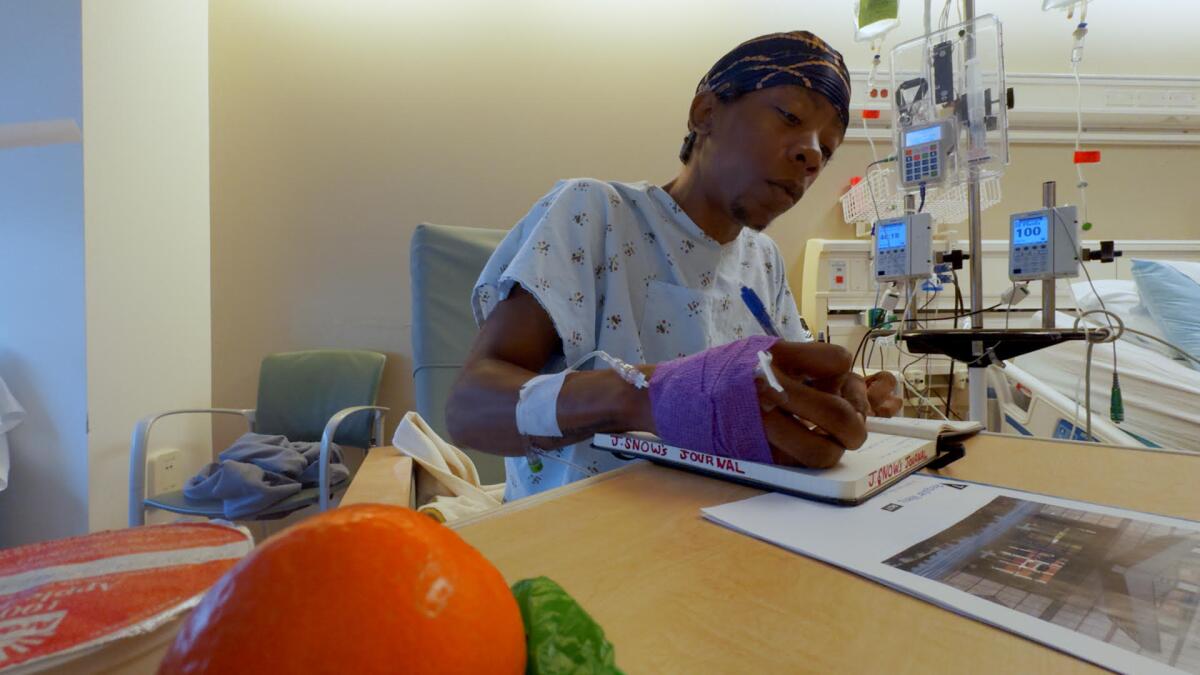
The nearly 90-minute documentary has Snow filming himself inside small hospital rooms, nurses trying to find a vein in which to stick needles, and even him trying to work on material as he lies in hospital beds. The film also includes interviews with his friends.
Snow was adamant about showing the blood and needles in the film as well as footage of himself writhing in pain on hospital beds and the frustration of waiting hours for doctors to provide adequate dosages of pain medication that can help him. He cracks jokes during his hospital stays, but in between you get a front-row look at how tiring, tearful and emotionally devastating his illness can be. Interspersed within such footage are clips from his stand-up shows and him trying to live his best life by traveling, skydiving and even experiencing New York City snowfall.
The Times caught up with Snow and Wayans to talk about the film, vulnerability, Black men’s health, and finding levity through the pain.
J. Snow in the hospital in “You Look Fine”
(J. SnowPro)
I was struck by the handwritten notes with title ideas. Tell me where “You Look Fine” comes from?
J. Snow: It’s just something I hear a lot. It’s something I’ve heard a lot during my life. It’s cultural Black gaslighting is what it is. When you’re in pain, sometimes you look fine. When you are telling people, “I’m not fine,” they’re like, “Your hair is nice.” I can’t go to the hospital with gold. I had gold beads. Sometimes you go there looking too nice. Sometimes I got to dress down just to try to get the help. But if I dress too far down, I look homeless, and they really won’t be open to helping me. So you got to find the balance. But that’s kind of where it comes from. … I wanted to throw it back into people’s face. This is something that a lot of sickle cell warriors, and people with chronic illnesses in general hear, people with mental illness hear, and so I think it’s important to highlight how that literally is gaslighting.
What was your motivation to do this documentary now?
J.S.: I wanted to show that humor lives within this and that a lot of resilience and strength are also within this, and that was really the motivator. Also, just growing up with it, not having a lot of information, not seeing a lot of men talk about it. I wanted to be different, you know.
Marlon Wayans: For me it fits on brand for several reasons. One is because I love taking the dark things in life and finding some humor in it. And I think I try to do that with my comedy. I try to do it with my specials. I try to do it because I think we need to all find smiles no matter what your situation is; laughter is always healing and always necessary. Being African American, I grew up when sickle cell was like a prominent disease, and in our culture I know even when it came to dating, my mother would ask “Who you dating? You know, because if she got the trait, and you got the trait, you know, what could happen.” So I’ve always been aware of it, and I’ve lost now four friends to sickle cell. I just lost two in the last year. It’s a long fight, and so I’m here to support them and our culture and the awareness. And you know, Jay is a friend, and you know, I want him to see fame.
For Jared, in the film, you say, “I just want to see what my body can do.” I thought that was just so deeply profound. What is your relationship like with your body now, compared with the moment you were filming that?
J.S.: When somebody sees me eating a salad, and they’re like, “Oh, you eating salad?” I’m like, “This could save my life.” When I’m stretching and doing yoga, it’s not because I want to be a yogi. It’s because it literally gets oxygen into the joints that are suffering without oxygen. It stretches my hips and I want the longevity. I see what happens in sickle cell warriors and people without sickle cell who just age without moving frequently.
J. Snow walks through the halls of a hospital while dealing with issues from sickle cell.
(Courtesy of J. SnowPro)
Black people, especially for Black men, don’t have their pain taken seriously — be it their physical pain or their emotional pain. What has it been like for you to publicly show that pain?
J.S.: It’s been challenging. It took awhile for me to get to the point where I could even talk about this publicly, especially being in entertainment and trying to maintain a certain persona and image in entertainment where like your ego clashes against your vulnerability and you feeling like you’re weak. That’s the stigma that comes with people who admit that they have illnesses and stuff like that, especially in entertainment. It makes people not want to work with you. I’ve suffered through that. I’ve lost jobs while in the hospital because of this. And so it got to a place where it just was unavoidable. The pressure built so much and the frequency of the hospital visits became so crazy that it was like, you’re either going to be viewed as this very lazy, sometime-y person, or you’re going to come clean about what you’re actually dealing with and just face it.
M.W.: I live in the pain. I live in the vulnerability. I think that’s why I create my best work. You know, my parents died. I thought it was only appropriate to talk about that thing that hurts me so much. I think part of it takes courage, but at the same time, I know it’s necessary.
What was going through your mind when you first saw that footage of [Snow] in the hospital?
M.W.: “This [man] is crazy. Why you filming?” He made sure he had a GoPro on his foot and set cameras up — dude really wants to make it. Forget this disease. He may be faking it just to make it bigger. I was proud, right? That’s because I love the resilience, I love that you still have a passion, that you still have a thing that you want to do, and you have this art and this vessel and this expression, and I know that even though he’s hurting, that he’s healing at the same time, at least, you know, emotionally and spiritually. Because to put art out there at the time that it’s happening, that you’re in pain, that takes a lot of courage from the artist, and so I was proud. That’s why I stand behind it, because I think it’s something I’ve never seen, and I think it’s something that’s necessary for the culture.
How has this film changed your relationship to your understanding of masculinity and strength?
M.W.: For me, it’s just on theme. It hasn’t changed, it just enforced how I feel. You know, I’ve never been one to hide my feelings. I go to therapy. I have two therapists, I go on my walks. I talk to God. I’m reading my Bible. I understand that life is a long journey of suffering, and you need these outlets, and this movie and art are part of that. I have the stage. I always have this thing that I’m expressing because it helps me reconcile all that’s going on with me, especially when I take this pain and make other people laugh or are entertained by it, then I go, all right, I did something good with that thing that was bad. And so this enforces what I want people to feel. I want people to watch this. That’s why I stand behind this, because it’s on theme spiritually for me.
J.S.: I think when you stand outside of that vulnerability and you’re afraid to really go into it, I don’t know, I feel like that’s orbiting your true power. The most masculine thing you can do is face your highs and lows head on and own them. And that’s where you find out who you really are. This is where you find out what you can really bring to the table for yourself, for others, and where you become fearless. And that’s exactly what this showed me, was that I can do anything, I can conquer a lot of things. I walk around with a new energy because I’ve done this. I literally had a film on hard drives, and I sat for 11 months and edited it relentlessly, and now I have my first feature film because I was fearless enough to at least try to do it and not feel, what are people going to think, or what are people going to say? That didn’t matter to me. Also with this clock over my head, you don’t got time to think about stuff like that. It’s like, what do you want to do while you’re here? And what I wanted to do was make movies, make people laugh and inspire others to do things that they want to do too. And that took letting go of whatever this masculine image was that was blocking me.
J. Snow on stage at the Hollywood Laugh Factory
(Brianna Joseph)
The whole film is endearing, but I found those moments of levity so well- timed and so thoughtful and funny. How do Black people find those moments of levity, oftentimes, during these moments of pain?
M.W.: Because Black people have been through so much trauma before we get into family trauma, just as a people. We have suffered the most trauma from being separated from our family, slavery — we’ve been through it — and yet, and still, we find that funny. And that has been, I think, our saving grace is our sense of humor. It’s been a lifesaver. It’s been a raft in a really rough ocean for us. And I think it’s beautiful that we can. I will always promote laughing when you’re in your most pain to find the funny, because that takes a little pressure off. You’re laughing and crying at the same time. It’s like the best feeling.
J.S.: It’s like oxygen, like when the air is being sucked out of the room by your circumstances, your trauma, your pain or whatever. That little laugh is like a little breath of oxygen. It gives you something to keep going forward, to continue to think, “OK, like, where’s another solution from here? What else can I do here?” It gives you that breath that you need.
CK Hutchison says the Panamanian government has taken ‘administrative and operational control’ of its two ports on the canal.
Published On 24 Feb 202624 Feb 2026
Share
The government of Panama has seized control of two ports on either end of the Panama Canal from a Hong Kong conglomerate following a recent ruling by the country’s Supreme Court.
Hong Kong’s CK Hutchison said on Tuesday that Panama’s government had “made direct physical entry into the terminals at Balboa and Cristobal” and assumed “administrative and operational control” over the two ports on the Panama Canal.
Recommended Stories
list of 4 itemsend of list
The company said the “unlawful” takeover reflects the culmination of a campaign by the Panamanian state against its subsidiary, Panama Ports, following the Supreme Court ruling last month.
According to a government decree, the Panama Maritime Authority has been authorised to occupy the ports for “reasons of urgent social interest”, according to The Associated Press (AP) news agency.
The maritime authority also has the right to take over port property, including computer systems and cranes, according to the decree.
The state takeover marks the latest twist in a yearlong saga for CK Hutchison, which has been caught in a three-way fight between China, the United States, and Panama following US President Donald Trump’s return to the White House last year.
Starting in December 2024, Trump began to allege that the Panama Canal was being operated by China and promised to “take it back” – using military force if necessary – as part of a greater effort to reassert US dominance over the Western Hemisphere.
Last month, Panama’s Supreme Court ruled that CK Hutchison’s concession to operate the two ports was “unconstitutional” despite the company renewing its concession in 2021 for another 25 years.
The Chinese government’s Hong Kong and Macao Affairs Office (HKMAO) weighed in on the controversy, describing the ruling as “absurd” and “shameful”, while warning that the Latin American country would pay “heavy prices both politically and economically”.
Panama’s President Jose Raul Mulino responded, saying he “strongly” rejected China’s threat against his country and that Panama was a country that upholds the rule of law “and respects the decisions of the judiciary, which is independent of the central government”.
Weekly insights and analysis on the latest developments in military technology, strategy, and foreign policy.
The U.S. buildup of forces in the Middle East ahead of a possible attack on Iran relies very heavily on the performance of the U.S. Air Force Air Mobility Command (AMC). Hundreds of its cargo jets and aerial refueling tankers have moved materiel into theater and helped tactical jets, radar planes and other aircraft deploy across oceans to places like Muwaffaq Salti Air Base in Jordan, among many other locations. At the same time, the current crisis in the Middle East pales in comparison to the massive spike in demand for airborne logistics that would occur during a Pacific fight against China. Regardless, ever greater demand is being placed on an increasingly aging AMC fleet.
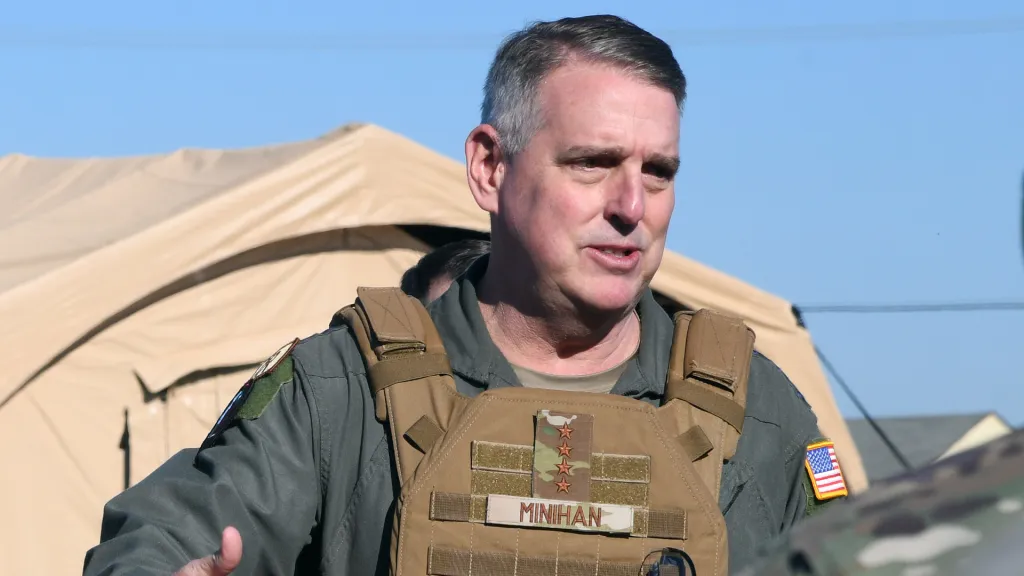
Few people know the nuts and bolts of AMC and its mission better than Michael “Mini” Minihan, a retired Air Force general who led the command from October 2021 to November 2024. In a 45-minute interview, Minihan offered his insights on that and a whole host of other topics. They include the current crisis and its airlift demands, challenges from China, future airframes, arming airlifters and refuelers, the connectivity issues he championed, AI and the leaked memo that put a cap on his career.
Michael Minihan led U.S. Air Force Air Mobility Command (AMC) from October 2021 until his retirement in November 2024. (USAF) AMC commander Gen. Mike Minihan. USAF
Since retiring, Minihan serves as a strategic advisor and board member to defense and technology companies, non-profits, and think tanks while continuing to write and speak on leadership, national security, and the future of air mobility and global power projection.
Some of the questions and answers have been edited for clarity.
Q: The C-17 Globemaster III heavy lifters have been supporting one crisis after another it seems. Have the hours accumulated faster on those airframes? What do you think should replace them and when?
A: All the things I was concerned about while I was in uniform, I remain concerned about right now. The options on the table are service life extension programs [SLEP] that the C-17 is already a candidate for. There was talk late last year about the KC-135 Stratotanker receiving another [SLEP]. You know, those types of things are concerning to me. At the end of the day, I think this nation needs to pay for the Air Force it needs, and the Air Force that it needs has a modern, capable mobility fleet. It’s not just old stuff that keeps getting patched up to get older. That’s the reality. So I’m concerned.
C-17 Globemaster. (USAF)
Q: Right now, a massive buildup is underway in the Middle East. AMC is doing the heavy lifting there as always. But in a crisis in the Pacific, would we have enough airlift aircraft to support moving quick enough across that vast theater, especially to respond to an invasion of Taiwan?
A: What you’re talking about is always a concern, regardless of the scenario. The reality is that America relies on the mobility fleet to project its power… So there’s not any scenario, even in the day-to-day competition, where you’re happy with the supply-demand intersection. So I think that we’ve got to work on capacity, certainly out of the entire mobility fleet, when it comes to the airlift and the air refueling. And then if you overlay that in contested environments, the concern gets bigger.
This KC-46 Pegasus aerial refueling tanker remains at Moron Air Base in Spain after suffering a mishap earlier this momth. (Pepe Jimenez)
Q: Considering how long it has taken to build up forces in the Middle East, where tankers and cargo jets are flying over uncontested airspace, how concerned are you about being able to project enough power over long distances to protect Taiwan from an attack by China?
A: The alarm that I had when I was active duty exists today… So the reason I’m a civilian right now is because I was ringing the bell on the exact questions that you’re asking right now and that concern still remains. The reality is against a China or against a Russia, they’re going to challenge you in all domains, from great distances. They absolutely understand that the mobility fleet is America’s capability to project power quickly. So there’s going to be a focus on it. But once again, you’re describing concerns that I had and expressed when I was active duty, and I still have those same concerns.
Inside Taiwan’s Strategy to Counter a Chinese Invasion | WSJ
A: The leak created antibodies that would want me in another job. That memo was getting after all the things that you’re asking about right now. It was getting after capability and capacity. It was getting after readiness. It was getting after explode into theater. It was getting after the mobility fleet being able to do what it’s asked to do, despite being extremely vulnerable, despite it being extremely antiquated – all those things.
A portion of the memo AMC Commander Gen. Michael Minihan wrote that was leaked to the public. (USAF via X) USAF via Twitter
I believe that the Chief of Staff of the Air Force [Gen. Kenneth S. Wilsbach] now is focused on modernization and readiness. Those were 100% things that I was championing very early. And I think those things exist now, and I think we need to continue to put pressure on [those things] to get the resourcing, to get not just the Air Force, but America’s mobility fleet, to the capability and capacity that it needs to be at, so that we can not have concerns about China and not have concern about [deploying] to Europe when needed.
Q: Were you fired over the memo?
A: I was not fired. I thought for two weeks that I was going to be fired, but I was thankfully allowed to serve out the rest of my command tour. But I was asked to retire.
Gen. Mike Minihan, U.S. Air Force retired, delivers a speech at the Herk Nation Legacy Monument Award at Little Rock Air Force Base, Arkansas, May 5, 2025. The event honored Minihan as the second recipient of the Herk Nation Legacy Award, recognizing his outstanding contributions to Herk Nation and the Air Force. (U.S. Air Force photo by Airman Rachel Bates-Jones)
Q: What were the biggest lessons learned by Mobility Guardian and our readiness to meet the challenge China poses in the Pacific?
A: We’ve got to explode into theater very quickly. We’ve got to be able to explode into theater in numbers and volumes and challenges that we’ve not experienced in any of the modern…operations. We’ve got to put the entire joint force in place. We’ve got to do it quick enough that it gives an enormous deterrent value and also be able to provide that decisive victory, should it get to that.
We’ve got to transition from a deploy to an employ phase very quickly. So that’s establishing hubs and spokes. And then the last thing I’ll say – this is about maneuver. We have got to maneuver at a tempo required to win. So we got to put America’s unique and amazing capabilities in a position of advantage, and then once they’re in that position of advantage, we’ve got to be lethal, and that requires logistics, sustainment, supply maneuver, all the things that have to come together in the joint force to be lethal have to be there, and we need to work extremely hard to do that.
So Mobility Guardian was really a rehearsal, and we demonstrated that we couldn’t explode into theater. We demonstrated that we could go from deploy to employ. But we also learned some hard lessons, and to get it to the scale and the volume of the tempo that we needed to be, we’ve got work to do.
Mobility Guardian 2023
Q: What were some of these lessons?
A: The lessons are connectivity. You probably heard me say that a bunch both in uniform and out of uniform, but connectivity became my number one thing. I testified before the House Readiness Committee on that. I came up with a concept called 25% of the fleet by 2025, but the reality is that the car I rented right now driving from the airport to my hotel room has more connectivity in it than the overwhelming majority of the mobility fleet. So connectivity matters.
We’ve got to operate at a tempo required to win, which means we need to do extremely long missions. We need to have exquisite situational awareness. We need to understand the changing dynamic of the operational environment. When it comes to red forces, blue forces, threats, priority receivers, priority users. We’ve got diffuse information and logistic priorities across services, so there’s almost an unlimited amount of lessons learned. And then command relationships matter as well as command and control. All those things matter too. So plenty of lessons learned. I don’t think any of those are surprising. I think they’re accounted for in the Air Force’s readiness and modernization. But we also need to get resources so that we can be the Air Force this country needs.
An F-15 Eagle from the 159th Fighter Wing receives mid-flight refueling from a KC-135 Stratotanker assigned to the 128th Air Refueling Wing of Milwaukee during Sentry Aloha off the coast of Honolulu, Hawaii on January 15, 2026. (Master Sgt. Lauren Kmiec photo) Master Sgt. Lauren Kmiec
Q: How would you peg our overall readiness, realistically, to confront China in the Pacific militarily?
A: We’re ready. I like the way that [IndoPacific Command leader] Adm. [Sam] Paparo uses it. He says we’re ready, but he’ll never admit to being ready enough. This is kind of like the coaches that you love to play for – they are never satisfied. I would broaden it beyond readiness. I would say readiness, integration and agility of the joint force is what matters. And as ready, integrated and agile as we are, we need to be more. And those things have a deterrent value in themselves, and they’re also the essentials to decisive victory. So China enjoys positional advantage, but America enjoys extreme warfighting capabilities that can always get better, and it starts with readiness, integration and agility. We want to get to the point where we’re so ready that they don’t want to take us on.
Q; What were the three biggest problems you faced in your job and how did you go about solving them? Were you successful?
A: The three biggest problems I faced during my command tour at Air Mobility Command was resourcing, resourcing and resourcing – articulating the state of the mobility platforms and securing the resources necessary to get them on step to where they need to be. And so I said resourcing three times, and I mean it.
The Pentagon. (Department of War) (Photo By Bill Clark/CQ-Roll Call, Inc via Getty Images)
This is all about money. You can say everything you want. You can say all the things are important. You can say ‘you’re right, General Minihan, we agree with you,’ but if it’s not followed up with resourcing, then it’s meaningless, you know? So at the end of the day, this is all about resourcing. Can we decide to be the Air Force, the joint military that puts the resourcing behind what it means to decisively defeat a near peer adversary? Or do we wait until another December 7, or another September 11 event to finally get all the things pulled together that we need to pull together. So I get it. This is expensive.
We’ve got a chance of a century right now, I believe, with this administration. When you line up the executive orders, when you line up the acquisition reform, when you look up the possibility of a $1.5 trillion defense budget, you know those things come together means that we can move faster and move differently than we’ve ever done but we’ve got to be ready to do it.
We can’t apply all the opportunities over the same template of how we acquire, how we take risk, how we get our warfighters the things that they need and expect a different outcome at the end of the day. The overall statement for this, and this is big into problem statements. If I were to describe the problem statement we’re trying to solve is, can we get critical war-winning capabilities to our warfighters faster than China? At the end of the day, if we can answer yes to that question, then we’re going to be okay. If it’s a maybe or a no, then we’re going to have some significant concerns moving forward.
Trump Calls For Massive Increase To Defense Spending: $1.5 Trillion For 2027
Q: Were you successful in your efforts to solve those problems?
A: Was I successful? I would say I was successful at ringing the bell. I needed three more years to get it across the line. And I’m not comparing myself to a Gen. [Curtis E.] LeMay or a Gen. [Wilbur L.] Creech, but those two [Major Command] MAJCOM commanders – who are the fathers of the modern strategic bomber force and the father of the modern fighter force – were both MAJCOM commanders for over six years. So if I had to give myself a grade, I would say me and my teams were A-plus for effort and articulation and at the end of the day, getting the system to react quickly within three years proved extremely challenging.
Q: What was your grade for that?
A: It’s to be determined. You know, the money process takes a little time. I think there’s money for connectivity coming up in the current and the next few years, which is a great sign and a big change. If I were to grade it for what I wanted, I would have given myself a C, but I think it’s a higher grade than that, due to the circumstances, due to the realities of the budgeting and the resourcing process.
A: The problems are getting resourcing across the line. Can you deliver them? Money. You know, at the end of the day, MAJCOMs don’t have the money to get the things that they need and under the current process. So how do you affect the organizations and entities above you, so that you can align the resourcing to do the things that it needs to do, and the timelines that you need to do it when that’s always a challenge for everybody.
Air Mobility Command (AMC) Change of Command Ceremony – Scott AFB
But if you’re asking what [Lamontagne] needs to worry about…if you look at the first Iran operation, if you look at the Venezuela operation, whatever is going to happen over the next short-term future for the Middle East, you can walk away saying, ‘we’re just fine.’ You can walk away saying, ‘Hey, we can project power over long distances. We can impose America’s will. We can do the things that our president and our nation asked us to do.’ And that’s right, you can do it under those circumstances.
The courage of the joint team is phenomenal. The capability of the joint team is phenomenal, but it does not compare to what will happen in a near-peer fight in the Pacific or in Europe. We are going to be contested from long distances in all domains, and the fleet that we have now is not going to be successful in that environment unless we take quick action and fix things.
A B-2 bomber drops a GBU-57/B Massive Ordnance Penetrator (MOP) bunker buster bomb during a test. (USAF) USAF
Q: There is a lot of hype around Rapid Dragon and giving the airlift community a ‘shooter’ role. But in a major conflict, won’t the fleet be tasked to the max just with its core logistics mission? Do we need more airframes to really do the Rapid Dragon concept justice?
A: I hear this one a lot. So here’s the reality. I’ve got to carry the missile, the bomb anyway. Okay, I’m not trying to be Global Strike. I’m not trying to be a fighter. I’m not trying to compete with capabilities that are legit and high-end when it comes to delivering kinetic effects. But if I have to carry it anyway, and there’s an ability for C-130s, C-17s and other airlift platforms, why would you not want that capability?
So I’m not saying it can go into the high-threat areas or the medium-threat areas. I’m not saying that it needs to be a primary mission. But let’s really look at the thing – at the entire process here. I’ve got to carry that stuff anyways, so I am either gonna stop and drop it off for someone else to shoot, or I could have the ability to do it. If a combatant commander needs a demand signal, there’s a ton of C-130s. Our foreign partners and allies operate them. These aren’t complex systems. The munitions already exist. It’s essentially air-dropping it out of the airplane. And I think it has enormous viability in the Pacific. It can service medium- to low-[threat] targets all day long that need servicing and free up the other sets to get after the high-end threat environments where they need to be focused. So I think it’s something we need to consider.
Rapid Dragon
Q: That segues nicely to my next question. What are the biggest threats China poses to our tankers and airlifters during a time of war?
A: The ability to get out of town by dropping electrical grids and navigation signals. This is true for all the platforms. This is why I say we’ll be contested at great distances in all domains. Critical infrastructure matters and getting out of town – we already talked about what it means to explode into theater. So it’d be silly to think that they’re going to not take a very inexpensive way to disrupt our ability to do that. And then, the farther you get to the threat, regardless of which way you’re heading around the ocean, you know is going to increase their ability to reach out with long-range effects and stop mobility.
If you stop one tanker, you stop six fighters. That sounds like a good return on investment if you’re an adversary trying to prevent us from projecting power. I don’t think I’m saying anything I haven’t said before, and I don’t think I’m saying anything that’s inconsistent with others [are saying] about what the real environment is going to look like.
They’re students of us. They have unimpeded access to our critical infrastructure for a decade or more, and we’re going to expect them to call in on their investment and impose a cost on us a great distance.
Q: Is there any particular Chinese system or munition that worries you the most?
A: What worries me the most? I’m worried, just like I was in uniform, about the multi-domain aspect for which they’re going to go after us. I’m worrying about how those all come together. Certainly, without connectivity in the mobility fleet, it’s hard for mobility aircraft to understand where the threats are, especially the kinetic threats. So our ability to understand if you’re in a threat ring or a dynamic threat environment is extremely handicapped. And certainly the kinetic ones are of the biggest concern. Like they are in any war.
1/2 During the 3rd Sept 🇨🇳CCP Military parade in Beijing, some Air Defense Missile systems were shown in CCTV 4K: HQ-9C, HQ-11, HQ-19, HQ-22A & HQ-29… pic.twitter.com/cIxoX5Tc7Z
A: The single biggest contributor to survivability in a big airplane is connectivity. The biggest contributor is not having a 12-hour-old Intel brief that you’re relying on to get you through the mission. So real-world updates, real-time updates, just like our fighters and our bombers enjoy. Battle management that gets after maneuver and not just kill chain. Those things matter.
If you were to ask me what I would want most when it comes to survivability, it would be connectivity that gives me the situational awareness to let our young crews – our captains, our lieutenants, our NCO – go out there and make great decisions as they’re operating under delegated authorities. Connectivity matters most. No doubt. Connectivity is why I put the priority on it when I was in uniform, because it’s the single biggest contributor to survivability. I just don’t think because of the size of these airplanes, in the maturity of the threat, that we’re going to be able to rely on traditional means of survivability.
U.S. Air Force Capt. Jarod Suhr, left, 100th Operations Support Squadron pilot and wing tactics officer, clarifies points of the Real-time Information in the Cockpit system to Capt. Anthony Vecchio, 100th OSS pilot and wing tactics officer, on a KC-135 Stratotanker at Royal Air Force Mildenhall, England, Oct. 18, 2023. The newly installed communications system gives aircrew the ability to access vital information including threats, target data and locations of friendly forces, providing much more accurate and instant information. (U.S. Air Force photo by Karen Abeyasekere) Karen Abeyasekere
Q: What about mini interceptors, or pairing these aircraft with CCA-like companions? Would that work?
A: I mean, I love it. The whole concept we came up with, the next-generation air lift [NGAL] and next-generation air refueling systems [NGAS]. I definitely see a role for CCA beyond just loyal wingman to fighter. So we can do this with everything from a CCA version of a tanker. We can do it with a stealth version of a tanker. I don’t think we need huge numbers of those. We can do stealth-like characteristics, like blended wing.
We can certainly have aircraft that are multirole, both cargo and air refueling. And so then you can have a lot of tankers that look like the tankers that we have now, the ability for small CCA and drones and other things to do electronic warfare and spoof and jam and other things like that are all on the table in my book and things that we should be exploring.
A rendering of the blended wing body demonstrator aircraft now in development for the Air Force. (USAF) A rendering of the blended wing body demonstrator aircraft now in development for the Air Force. USAF
A: I think that we’ve got to have a family approach to air refueling, and that’s where the NGAS concept came up. It’s hard for me to believe, to think that you’re going to be able, in a highly contested environment, to get our highest capabilities into the high-threat environments without having some sort of stealth-like CCA air refueling capability. I don’t think we need big numbers of them. I understand completely that they’re expensive, but we’ve got to work through that process, and we’re doing it with NGAS. So everything I’m telling you, I’ve said for years, and I’ve got a lot on the record out there that’s getting after the questions you’re asking, and I’ve not changed since I got out of uniform.
A rendering of a notional stealth tanker refueling an F-35 Joint Strike Fighter. (Lockheed Martin Skunk Works) Lockheed Martin Skunk Works
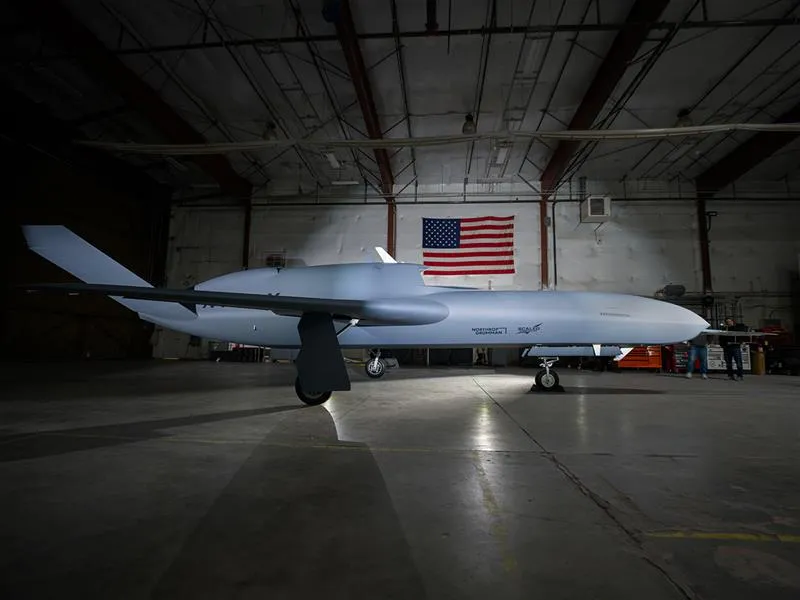
The announcement by Northrop Grumman, the partnership with Embraer gets after this. If you go tackle that announcement, it gets after creating a family-of-systems approach to the problem, as opposed to we’re just going to field one piece of the problem at a time. We’re not going to work the integration in advance. We’re not going to work the readiness in advance. We’re not going to work the agility in advance, and I was happy to see in that announcement that they’re approaching the problem differently, because that’s the kind of approach I think we need to be successful.
Q: Have you looked at adapting the B-21 for this kind of stealth tanker role?
A: I don’t know what they’re looking at adapting, but I think there’s eloquence in the solutions that exist and that they’re working on, and then broadening their missions to beyond just the original intent for which they were designed. So I think that there’s great value in looking at those opportunities.
A B-21 Raider conducts flight testing, which includes ground testing, taxiing, and flying operations, at Edwards Air Force Base, California. (Courtesy photo) 412th Test Wing
Q: What about an Agile Combat Employment (ACE) tanker capable of supporting small numbers of fighters from forward airfields? The KC-390 is being pitched for such a role. Do we need smaller tankers capable of operating from shorter fields?
A: We need a family of tankers that can address all the warfighter needs in all the warfighter environments. So we need tankers that look a lot like the ones we have now, that can handle the low-threat environments. We need tankers that can push into the medium-threat environments and service the big volume offloads in the abundant amount of receivers that will be out there. We need tankers that can operate in a medium- to high-threat with blended wing and stealth characteristics. And then we need stealth like tankers that can go into a higher-threat environment, as well as unmanned and CCA.
Northrop Grumman and Embraer are working together to evolve the multi-mission KC-390 Millennium aircraft, to provide advanced tanking capabilities for the United States Air Force and allied nations. (Photo Credit: Northrop Grumman)
I believe there’s room in the Air Force for all in that capability. Let’s be clear, it’s what the kinetic force needs, you know. So the strike force and the bomber force are [fifth-generation] fifth-gen and [sixth-generation] sixth-gen, and yet we still operate a mobility force that’s on its best day, 2.5 Gen and in some cases, second generation. So we’ve got to catch up, not because of ego, but because of capability. At the end of the day, this is about equilibrium of the enabling force to actually do what it needs to do, so that the strike force can carry out its missions in all environments. That’s what needs to happen.
Q: Is there money to do that? Is there a will from higher headquarters and then the administration to make that happen?
A: Well, there needs to be. Like I said, I think the opportunity is here with this administration. Its executive orders, its acquisition reform, and the possibility of a significant increase in the budget. But this gets back to, are we going to pay for the Air Force that this country needs? It’s been under-invested in, especially in mobility, and we need to ensure that this president and every future president, when they call on the Air Force to support the joint force, to project America’s power to serve the national interests and impose our will when needed, that we need to develop these kind of things. We have to do this if we want to be the Air Force that this country needs.
The last KC-135 Stratotanker aerial refueling jet was delivered to the Air Force in 1965. (USAF)
Q: Have you talked to anybody in the current administration or the current Department of War about this, and what’s your sense of the interest there?
A: I think the conversation is turning where it needs to go. I have not talked to the current administration about this specifically, but I think there’s an appreciation, when you line up the talking points that align the priorities of where the department is going, I think that there is 100% alignment with what my priorities were when I was in uniform, what my priorities are now that I’m out of uniform, with the priorities of where this administration is going.
I realize it’s still hard. I realize there are still challenges. I realize there are no easy answers to any of this, and I realize that there’s more to modernization and readiness than just the mobility fleet. And I also realize that these are the things that we need to do.
Q: Low-end drones are a big problem, especially for big airplanes sitting idle on the ground. What do you think should be done to defend our airlift assets against lower-end drones?
A: Just like everyone else, I watched the [Operation Spider Web] attack that Ukraine carried out on Russia’s strategic forces. And the only thing that surprised me about that is that people were surprised and that it took so long for them to do it. This is a real threat. It gets down to air base defense. It’s something that we championed in Air Mobility Command during my time there, because of the drone incursions that were happening over multiple Air Mobility Command bases and multiple Air Mobility Command missions. So this isn’t a surprise to me.
Over 4-minutes of drone footage from Operation Spiderweb has just been released by the Security Service of Ukraine (SBU), showing the targeting of roughly two dozen Tu-95MS and Tu-22M3 Long-Range Strategic Bombers as well as two of the Russian Air Force’s extremely limited A-50… pic.twitter.com/ZpW85oPb7M
This is going to have to be a joint solution, and I know the Army is working very hard on this, but there’s also going to have to be a capability of the Air Force and wings that are deploying to be able to do this on their own as well. So no easy answers here.
I feel like we’re behind, but catching up. I think it nests nicely into the Golden Dome opportunity as well. But you know, you gotta be able to handle everything from the low-cost drones all the way up to the highest capability missiles that could attack the homeland. This all fits in a spectrum of threats that we need to be concerned about.
A graphic of how the Golden Dome missile defense system will be designed to work. (DIA)
Q: You brought up drone incursions. When and where did they happen and was the source ever found?
A: The incursions took place in late 2021 and early 2022 for Joint Base Andrews in Maryland and constantly at Joint Base McGuire-Dix-Lakehurst in New Jersey throughout my command. I’m not tracking that the source of those incursions was identified. It doesn’t mean that they weren’t. To my knowledge they weren’t. But, you know, at the end of the day, if you can’t control the airspace, including the airspace that drones are using, that’s a problem. It doesn’t matter if you’re in garrison or deployed. We’ve got to have the ability to defend at a greater capability than we have.
Q: How are the C-5M Galaxy cargo jets doing? Are readiness rates improving? Will we need a direct replacement of something its size when their time finally comes to head to the boneyard? Was the M upgrade program successful?
A: I’m a year and a half out of the conversation. The last data point I got was from U.S. Transportation Command (TRANSCOM) commander Gen. [Randall] Reed‘s congressional testimony, where he said that the mission reliability rate, I believe, had fallen to 46%. So, if that’s true, then it’s still an enormous concern. I don’t know any part of your life where you tolerate a critical capability operating less than half the time when you need it. So C-5s are an enormous concern for me.
I think there are options out there when it comes to large-volume aircraft that exist, that are being worked now, that can help us get capability quickly. And then I think there are concepts out there, like the commercialization of the C-5 fleet, that need to be taken seriously as well and apply commercial standards, commercial supply chain to increase the readiness of it. And between a combination of those two, I think that you can sustain what America needs to project large volume lift, but also get much higher than a 46% mission reliability rate.
A C-5 Galaxy transport jet. (USAF)
Q: Do you see the need for a similar sized cargo aircraft to replace the C-5 when it’s finally time for them to retire?
A: I do. I think building large, colossal aircraft is one of the hardest things to do on the planet, when you think about it. I need someone to help fact check me on this, but I don’t think more than 250 large aircraft have ever been built. You know, when you include the Hughes aircraft, include the C-5, include the Russian Antonovs, the fleet has been small because it’s hard. At the same time, it does things that nothing else can do. You don’t have to condemn your cargo to sea lift only. You can move things very quickly – large volume things, critical capabilities. And so we need to have this capability.
But I don’t see the Air Force buying C-5 replacements. I see them transitioning C-5s to a different model, like commercialization. And I see the manufacturer of a large aircraft that can handle the volume being in the CRAF [Civil Reserve Air Fleet], and being a service concept that can get America the stuff we need when we need it. As opposed to developing another C-5 replacement, in addition to what’s going to have to eventually replace the C-5…
Q: Was the M upgrade on the C-5 successful?
A: I wasn’t there for when it was done, but … I would love to see what the original predictions were. When you spend all that money on that airplane and then still have a 46% mission reliability rate, it sounds like it is still challenged, like it used to be.
Seabees assigned to Naval Mobile Construction Battalion (NMCB) 1, NMCB 11, and Air Force Personnel from the 436th Maintenance Squadron (MXS), install a new tail rudder on a C5 Super Galaxy. (U.S. Navy photo by Mass Communication Specialist 1st Class Sean P. Rinner) Petty Officer 1st Class Sean P Rinner
A: Aviation right now is at a point of affordability and simplicity that we have got to distribute capability down to more tactical levels and have less centralization. Drones, automated aircraft 3,000 pounds or less, need to be a part of that equation. They need to be a part of the equation.
I am a big fan of drones…The problem we’re trying to solve is getting winning capabilities to our warfighters faster than China. That’s what we need to be focused on. We have got to be infatuated with automation and connectivity. We have to be infatuated with drones and automated aircraft from small to medium to large capabilities.
China’s unmanned transport aircraft completes maiden test flight
The biggest question I hear about why people don’t want small- and medium-capability is because they’re concerned about who commands and controls it and in my mind, that’s the point. You don’t have to command and control it. This is like a distributed maneuver pool, like a Jeep used to be in the Army. It’s inexpensive, it’s easy to operate, and we give it to maneuvering commanders in the field. We get TRANSCOM and Air Mobility Command out of the command and control of it. We let commanders determine their own priorities and service them, and then all we have to do is integrate them into the critical capabilities that Air Mobility, Command and TRANSCOM provide. You know those and we actually free up more of their assets to do that strategic and operational lift, as opposed to always having to get down into the capabilities that can be served by something much smaller. Does that make sense?
A: Final thought on that is, we need to do more of it. I’m not saying we need to do more testing, but when it comes to automation, when it comes to concepts, when it comes to the tempo, the things we’re going to be required to do, we have to set ourselves up to be successful in an extremely deadly and demanding operational environment.
And to think that we’re going to apply the old dogma over this new operational environment, it’s just going to put us in a really challenging place to be successful in. So single tanker pilot ops made a comment on autonomy. It made a comment on what we need to do to win in the Pacific. It made a comment on risk taking, and it made a comment on, I think, a command team that understood how to apply real concepts over real problems and come out with an informed way forward. So there was a larger message than just single pilots in tankers.
A picture the Air Force released of the KC-46A that was used for the single-pilot sorties on October 25, 2022. (USAF) A picture the Air Force released of the KC-46A that was used for the single-pilot sorties on October 25, 2022. USAF
Q: Finally, how did you see the rise of AI influencing AMC and how do you see it being used by the command in the future?
A: I’m a big fan of AI as long as commanders maintain the risk and the priority settings. You know I tried hard to get AI incorporated in Air Mobility Command, but the entire ecosystem wasn’t ready to have that conversation yet. I think AI and data are its own domain.
Like other domains we’re going to need supremacy and superiority in it. We’re going to need to fight for it and fight from it. It’s going to benefit from the other domains, but I think disproportionately it’s going to benefit the other domains. More so our ability to sense and seize opportunity, our ability to simplify, our ability to reduce variables, our ability to gain decision advantage, our ability to make better decisions, quicker, at a higher tempo than the adversary. I think all those things are AI- and data-oriented, and I’m still not certain that we see it that way. We have got to get first mover advantage in the AI domain, and that’s going to take some work. I think that we’re starting to get there, but I think we have a long way to go on it.
Boeing KC-46A Tanker Refuels Military Aircraft Using 3D
Q: Why do you think that there’s been such resistance to AI?
A: I’m not certain most people actually use it. It’s new. Certainly there’s a newness to it. But at the end of the day, this is about data. Can you trust the data? It really flips the script, if you think about it as its own domain, because then you understand the magnitude of its importance, and you understand that this is about decision making and trust, and that you’re actually not off-shooting that to the machine to do. That you’re asking the machine and the AI to reduce variables and increase simplicity.
Then you really think about, how does a commander be able to set priorities, set risk tolerances, adjust those as required, and then, at the end of the day, this is about better decision making. I think that there’s a complexity to this that just needs to play out a bit, but I know one thing, I don’t think our adversaries are downplaying AI and data as a domain. I think that they’re 100% embracing it, and I think we need to do the same. And of course, it’s American ingenuity. We’ll get better at it and dominate.
Q: Any final thoughts you want to share? Any questions I didn’t ask?
A: No, I appreciate the opportunity here. I think that the Air Force has it right when it comes to modernization and readiness. I think that the Air Force has it right, and we need to have the resourcing to be their Air Force that this country needs. I think mobility has a longer way to go than most within the Air Force. So I continue to champion that. Those things I cared about in uniform, I care about out of uniform, and I didn’t wait to retire to have an opinion on these things. So I want to be the generation of Americans that gets this straight before we get slapped like we did on December 7th and September 11th. Let’s not wait till we get slapped to get the act together. Let’s go now hard, because our sons and daughters deserve it.
Former President Yoon Suk Yeol on Tuesday appealed his life sentence over his insurrection conviction from his failed bid to impose martial law.
The appeal was filed by his lawyers five days after a court sentenced Yoon to life in prison for leading an insurrection when he briefly imposed martial law on Dec. 3, 2024.
“We think we have a responsibility to clearly point out the problems with this decision for not only court records but for future historical records,” the lawyers said in a notice to the press.
“We will not be silent about the special counsel’s overzealous indictment and the contradictory decision of the court of first instance premised on it, as well as its political background,” they added.
The Seoul Central District Court delivered the ruling last Thursday, saying Yoon aimed to cripple the National Assembly by sending troops to the compound after declaring martial law, meeting the definition of an insurrection as stipulated by the Constitution.
It also said the former president planned the crime personally and in a leading role, incurring an enormous social cost, but hardly expressed an apology.
Seven other defendants received their first verdicts alongside Yoon, including former Defense Minister Kim Yong-hyun, former National Police Agency chief Cho Ji-ho and former Seoul Metropolitan Police Agency chief Kim Bong-sik.
The former defense minister was sentenced to 30 years in prison, while Cho was given 12 years and the former Seoul police chief 10 years for their roles in the martial law bid.
Yoon was earlier sentenced to five years in prison in a separate trial on charges that include his alleged obstruction of investigators’ attempt to detain him last year.
Copyright (c) Yonhap News Agency prohibits its content from being redistributed or reprinted without consent, and forbids the content from being learned and used by artificial intelligence systems.
Kyiv, Ukraine – Hennady Kolesnik never expected the full-scale Russian invasion to last this long.
“These are the worst and longest years of my life,” the 71-year-old retired welder told Al Jazeera four years after the aggression that began on February 24, 2022.
Recommended Stories
list of 4 itemsend of list
In the first days of the war, he and many Ukrainians were afraid Kyiv would be lost, as well as the third of their France-sized nation that lies on the left, eastern bank of the Dnipro River.
Tens of thousands of Russian troops, including elite airborne units and motor rifle brigades, occupied north of the Kyiv region, while the Kremlin’s supporters triumphantly touted that the capital would be seized “within three days”.
Months later, “we were ecstatic about what we’d regained” after Russian forces withdrew from around Kyiv and were ousted from northern Ukraine, said Kolesnik, a grey-haired, pallid-faced and emaciated pensioner, clutching a cane.
He is recovering from a case of pneumonia that he feared he would not survive amid days-long power outages and disruptions of central heating caused by Russian drones and missiles during a cold spell, when temperatures plunged to as low as -23 degrees Celsius (-9.4 degrees Fahrenheit).
“But we’re still standing, and that’s the most important thing in a fight,” Kolesnik, who used to dabble in boxing, said with a smile.
His wife, Marina, 70, agreed: “Nobody expected us to last that long, and we’re still here.”
Iryna, a beauty salon manager, participates in the recording of a video for the salon’s social media, as it continues operating despite frequent power outages after recent Russian attacks damaged critical infrastructure in Irpin, in Ukraine’s Kyiv region, on February 6, 2026 [Alina Smutko/Reuters]
However, Ukraine’s 2023 counteroffensive failed to cut Moscow’s “land bridge” from western Russia to annexed Crimea, and Russian troops keep inching forward.
But their advance is glacial amid staggering losses. Last year, they occupied less than 5,000 square kilometres (1,930 sq miles), or about 0.8 percent of Ukraine’s total area, according to Ukrainian officials and Western analysts.
Overall, Russia controls about 19 percent of Ukraine’s territory.
“The front line froze like during World War I,” Nikolay Mitrokhin of Germany’s Bremen University told Al Jazeera. “So far, Russia doesn’t have enough forces or new technologies for a decisive and successful advance, but it can still squander thousands of [its soldiers’] lives.”
This month, Russian forces encountered a dual communication problem that reversed their progress.
Elon Musk’s SpaceX company shut down smuggled Starlink satellite internet terminals used by Russian soldiers, while Moscow’s efforts to block the Telegram messaging app further disrupted coordination.
Ukrainian forces counterattacked, regaining about 200 sq km (77 sq miles) in the eastern Zaporizhia and Dnipropetrovsk regions.
But in other front-line areas, the pressure is mounting.
Russian drones with attached optic fibre immune to jamming began reaching a heavily-fortified town in the southeastern Donetsk region.
“It has gotten a lot noisier. There are more outages; some locals are panicking,” Sviatoslav, a serviceman stationed in Kramatorsk, told Al Jazeera. He withheld his last name in accordance with wartime protocol.
Moscow insists Kyiv surrender Kramatorsk and the rest of Donetsk – about 1,000 sq km (386 sq miles).
What could affect Ukraine’s stance is further Russian strikes on energy infrastructure.
“Ukraine keeps the front line well, but the functionality of its energy system is hanging by a thread, which may affect a lot,” Mitrokhin said.
Eighty-eight percent of Ukrainians think Russia’s strikes are designed to “force them to capitulate”, according to a survey by the Kyiv International Sociology Institute (KMIS) conducted in late January.
Nevertheless, two-thirds of those polled said Ukraine’s armed forces should fight for “as long as it takes”.
“People en masse are more ready to keep resisting [the invasion] than to capitulate,” Svetlana Chunikhina, vice president of the Association of Political Psychologists, a Kyiv-based group, told Al Jazeera.
And even though there is a spike in depression, anxiety, and chronic stress among Ukrainians, there are no “abrupt jumps” in these conditions, she said.
“People adapt – including through depression – to the war’s horrible circumstances; people keep functioning,” she said.
Ukrainians still hope for a better future, she said.
Only one in five polled Ukrainians hopes the war will end this year, but two in three are sure that in 10 years, Ukraine will be a “thriving” member of the European Union.
“This is the literal realisation of the philosophic principle: ‘get ready for the worst, hope for the best,’” Chunikhina said.
However, brain fog and cynicism are on the rise, she said.
“For the Ukrainian public whose fight against the Russian aggression is largely fuelled by moral virtues – including high ones, such as altruism, patriotism, responsibility to future generations – cynicism could be really destructive,” she said.
News brings little relief.
United States President Donald Trump has so far failed to deliver on his pre-election pledge to end the war “in 24 hours”.
Meanwhile, Russian public figures who support the Kremlin still try to present the invasion as a step to “protect” Russian-speaking Ukrainians.
Moscow-based analyst Sergey Markov claims that the war began on February 23, 2014, when pro-Russian protesters began rallying in Crimea, urging the Kremlin to annex the Ukrainian peninsula.
“It was a peaceful uprising of the Russian people for freedom, peace and true democracy,” he wrote on Telegram on Monday.
POPULAR young rapper Luci4 has died, according to his grandparents.
The young musician – best known for his viral hit “BodyPartz” – was just 23 years old.
Sign up for the Showbiz newsletter
Thank you!
Luci4 has tragically died at 23, according to his grandparentsCredit: SpotifyThe young rapper’s grandparents confirmed his death on MondayCredit: Spotify
His grandparents revealed to TMZ that he had died; however, his cause of death remains unknown.
Police have since launched a probe into his sudden death.
The rising star – whose real name was James Dear – passed away at a friend’s home in Los Angeles on February 22.
The Los Angeles County Medical Examiner has since confirmed his death.
His grandparents told TMZ they felt suspicious about their grandson’s death.
They have alleged his wallet was completely emptied, saying they had recently warned him about the people he was surrounding himself with as his fame grew.
The circumstances around his death remain unclear.
The rapper’s grandparents said they are now waiting for the results of the police investigation.
Most read in Entertainment
In a statement, the Los Angeles fire department said it had responded to a medical call at the house around 11.40am.
Sadly, he was already dead when help arrived, so the police were called.
It remains unclear if investigators suspect foul play.
Previously known by other stage names including Axxturel, 4jay, and Plasdu, Luci4 showed an interest in music and digital production at a young age.
His career began with music production, where he created beats and tracks that became popular online.
More recently, he had achieved viral fame through social media platforms including TikTok.
Pioneering the microgenre known online as sigilkore, he shot to fame with hit song “BodyPartz” in 2021.
The song was later recognised as a Gold hit by the Recording Industry Association of America (RIAA).
He rose to fame through viral success on TikTokCredit: SpotifyHis grandparents suspect foul play, alleging his wallet had been emptied at the time he diedCredit: Spotify
He also penned other popular tracks including All Eyez on Me and Kurxxed Emeraldz.
His success led to him signing with Atlantic Records.
His signing was considered a significant milestone for emerging internet-based artists.
It demonstrated the increasing influence of social media in discovering and promoting new talent.
Luci4 founded the collective Jewelxxet – a primary hub for sigilkore.
The genre is defined by dark, lo-fi atmospheres and bitcrushed vocals coupled with occult imagery.
He was popular largely among the underground music community; however, the new wave of experimental rappers including OsamaSon and Che have credited him as one of their influences.
The young rapper still frequently engaged with his fans and the online music community, staying connected with his roots as an online artist.
His death has sent shock waves through the music community, as fans share their grief online in an outpouring of tributes to social media.
“His 2020/21 run will never b forgotten he changed tiktok,” one person said.
Another posted, “That’s insane wtf.”
“Damn. I’ve been actively listening to him since 2021 casually. Was never a super fan but I have six solid songs that get played weekly. It’s always who u least expect. It makes me so sad listening to songs frm dead artists, never thought I would ever get that sentiment w his,” posted a third.
Another mourner said: “RIP TO A KING.”
“He was definitely one of my favorite artists to listen to during covid era,” said another.
Others have said he “really influenced a whole wave of music”, with some even listening to his songs as early as today.
“I was bumping his music so loud earlier today lil did I know he was gon die the same day,” a fan posted.
Fellow rapper ShowMyFangz posted a tribute to InstagramCredit: Spotify
Weekly insights and analysis on the latest developments in military technology, strategy, and foreign policy.
It’s apparently naming season for autonomous air combat drones. Earlier today, we reported that General Atomics had given the name Dark Merlin to its YFQ-42A Collaborative Combat Aircraft (CCA) design. Now Northrop Grumman has stamped a new name on its YFQ-48A: Talon Blue.
Northrop Grumman first unveiled the drone this past December, at which time it was referred to simply as Project Talon, as you can read more about in our initial report here. Later that month, the U.S. Air Force gave it the formal designation YFQ-48A, and described it as “strong contender” to be part of its future CCA fleets. Currently, General Atomics’ YFQ-42A and Anduril’s YFQ-44A are the designs formally in development as part of the first phase, or Increment 1, of the Air Force’s CCA program. Northrop Grumman may now be under contract for the program’s Increment 2, but this remains unconfirmed.
Northrop Grumman’s Talon Blue. (Northrop Grumman)
The “YFQ-48A Talon Blue’s designation within the Air Force’s Collaborative Combat Aircraft program underscores the strategic alignment between Northrop Grumman’s manufacturing agility and the Air Force’s acquisition goals for low-cost, cutting-edge technology,” according to a press release the company put out today. “The aircraft’s design provides mission versatility through advanced modular manufacturing techniques that reduce part count and overall weight – shortening production timelines without sacrificing capability.”
The release does not offer a clear explanation of the significance of the new Talon Blue name. Northrop Grumman previously told TWZ and other outlets that the Project Talon moniker was a callback to the T-38 Talon jet trainer, as both had been designed with high performance, high maneuverability, and affordability in mind.
“And it’s got a cool sound to it, too,” Tom Jones, President of Northrop Grumman’s Aeronautics Systems sector, at the time of the drone’s official unveiling.
As for the new Blue addition to its name, this could be another callback, this time to Northrop’s hugely successful Tacit Blue demonstrator, aka the ‘Whale,’ which revolutionized America’s understanding of stealth technology at the dawn of the stealth age. Lockheed’s stealth demonstrator that led to the F-117 Nighthawk stealth combat jet was also called Have Blue. As TWZ has noted previously, the YFQ-48A is clearly optimized with low-observable (stealthy) characteristics. It also shares many similar features and a general layout with Tacit Blue. You can read more about what else is known about the Talon Blue design so far here.
The Tacit Blue stealth demonstrator. Northrop GrummanTalon Blue has a similar layout to Tacit Blue, including the shovel-like nose, chine-line, splayed v-tail exhaust, and dorsal inlet. (Northrop Grumman)
Regardless, the Talon Blue name is welcome. As we noted with the announcement of the Dark Merlin name for General Atomics’ YFQ-42A, the nomenclatures and terms associated with the U.S. Air Force’s CCA program can often be obtuse to the general public. Being able to use specific names for the different drones helps. Anduril’s YFQ-44A has carried the nickname Fury from the very start, which traces back to its origins as a ‘red air’ training drone.
Beyond the YFQ-48A, Northrop Grumman is now also describing Project Talon as an entire “portfolio of modular, cost-effective and rapidly deployable aircraft that meet the customers’ autonomy needs.” That portfolio includes Talon IQ, formerly called Beacon, a “next-generation autonomous testbed ecosystem” that has been leveraging the Prism autonomy suite and Scaled Composite’s Model 437 Vanguard jet. Scaled Composites is a wholly-owned subsidiary of Northrop Grumman that was also involved in the development of Talon Blue.
Digital Ecosystem Takes Flight
Northrop Grumman has also now released a picture of the YFQ-48A flanked by the Model 437 and one of Scaled Composites’ earlier Model 401 jets, also known as the ‘Son of Ares,’ but it is not immediately clear if the latter is also part of the Project Talon portfolio. The Model 437 evolved from the Model 401. Concepts for uncrewed versions of the Model 401 and Model 437 have been shown in the past.
From left to right, Scaled Composites’ Model 437, the YFQ-48A, and a Scaled Composites Model 401. Northrop Grumman
In December, Northrop Grumman said it was targeting a first flight for YFQ-48A about nine months down the road, or sometime in August of this year.
In terms of the Air Force’s CCA program, the service still has yet to make a decision about which Increment 1 CCA design, or both, it wants to buy in larger numbers. Nine companies are also now under contract to refine concepts under Increment 2. To date, the Air Force has not disclosed the names of any of the Increment 2 awardees, which, as noted, could include Northrop Grumman.
JOJO Siwa’s bank balance is set for a major boost as she relaunches a business venture that once raked in an estimated £336million.
The CelebrityBig Brother star, 22, struck a licensing deal with JennZ and Thomas Global Media to release more JoJo’s Bows, the popular hair accessory.
Sign up for the Showbiz newsletter
Thank you!
JoJo Siwa is bringing back JoJo’s BowsCredit: monsee wShe previously sold 80million of the popular hair accessoriesCredit: Getty
And there’s a new twist for the latest version of the popular brand; the introduction of Joelle Bows, a host of new shapes and designs named after JoJo’s birth name.
“JoJo’s Bows were never just about what you wore, they were about how you felt,” said JoJo.
“Coming back as creative director means I get to personally shape every detail, making sure the heart, energy, and message behind the bows evolve with me and with the fans. This relaunch is for the fans who grew up with me, and for the next generation discovering their voice and confidence.”
JennZ founder and creative director Jennifer Saad added: “The JoJo Bow isn’t just an accessory it’s a symbol of confidence, creativity, and style.
“Reintroducing it for a new generation is about celebrating the magic that made it iconic and evolving it for who those fans have grown to be.”
Some 80 million JoJo Bows have been sold to date as fans flocked to replicate the dancer star’s iconic look.
The bows previously retailed between $5 to $16.
Since shooting to fame on Dance Moms as a young girl, through to a lucrative partnership with Nickelodeon as a teen, JoJo has released a huge assortment of merch.
Most of which has flown off the shelves from T-shirts and toys to shoes and accessories.
She previously told Forbes: “Early on, Nickelodeon wanted to have a meeting, where they discussed big business, and they wanted to do it without me. My Mom and I said, ‘That’s not how it works. We’ve been in this together since day one.’
“And in that meeting Pam, who is the head of consumer products, said, ‘Just so you know, if this t shirt doesn’t sell then it’s all over. That was why I didn’t want you here.’
“Now, every time I see her I laugh and say, ‘How’d that t-shirt sell?’”
Both JoJo’s business and personal life are thriving.
After meeting Chris Hughes, 33, on CBB last year, she already has one eye on marriage and kids.
But their transatlantic romance isn’t entirely smooth sailing.
She recently told fans online: “The hard part for me is like the hours that we do communicate we’re at very very different phases of our day.
“Just as I’m getting up excited to talk to him you know text him or call him he’s in the middle of his day and he’s working or he’s doing something and he’s occupied. So I find that part difficult.”
She continued: “And then the same thing like when he’s going to bed I’m in the middle of my day now occupied… so it’s a little more difficult.”
However, the pair will soon be back together to celebrate their first anniversary.
JoJo and Chris Hughes will soon celebrate their first anniversaryCredit: Instagram
Torrential downpours cause deadly mudslides in southern Peru, while more than 300 districts across the country declare states of emergency.
Published On 24 Feb 202624 Feb 2026
Share
Peruvian authorities say they have recovered the bodies of a father and son who died in a mudslide triggered by heavy rains, which have battered the country’s southern regions of Ica and Arequipa, affecting an estimated 5,500 homes and forcing many people to evacuate.
Authorities in Arequipa have called on the country’s interim president to declare a state of emergency in the region as the governor announced that multiple shelters were being opened to house those fleeing the floods.
Recommended Stories
list of 4 itemsend of list
Peru’s Council of Ministers said on Monday that more than 700 districts nationwide have been declared in emergency status.
In Cayma, Arequipa, a vehicle was seen semi-buried under mud, and homes teetered on the verge of collapse after flash floods swept away the earth and destroyed roadways, the Reuters news agency reported.
According to the Associated Press news agency, the bodies of a father and son were recovered after being swept away by a landslide.
The recovery came a day after 15 people were killed when a military helicopter crashed while providing rescue services during the flooding.
Rescue teams found the wreckage of the helicopter in the Chala district, officials said. Seven children were among the 11 passengers and four crew members who died, according to the AFP news agency.
Torrential downpours have caused widespread damage across southern Peru, affecting about 5,500 homes and forcing many residents to evacuate.
Images shared by Peruvian media showed streets torn up in the affected areas and vehicles buried deep in the mud slides as rescue workers attempted to clear streets using mechanical earth movers.
The El Niño Costero (coastal) climate phenomenon has been the cause of the recent weeks of heavy rain in Peru, weather forecasters report, and is expected to strengthen slightly next month, threatening more heavy rain.
While El Niño is a natural cycle that has existed for millennia, scientists increasingly link its severity to climate change. Rising global temperatures provide a warmer “baseline” for the ocean, making it easier for these extreme heating events to reach record-breaking thresholds and increasing the atmosphere’s capacity to hold the moisture that fuels torrential rain and catastrophic flooding.
On 18 February 2026, reports emerged that Britain was withholding American permission to use Diego Garcia in any hypothetical strike against Iran. The following day, Trump posted “DO NOT GIVE AWAY DIEGO GARCIA” on Truth Social, linking the base directly to potential operations against Tehran in terms that left no room for diplomatic interpretation. The sequence lasted forty-eight hours and revealed what months of careful legal construction had obscured: that the architecture of conditional access Britain had built around a strategically significant military installation was worth precisely what the decisive power chose to make it worth. Whether the intervention also carried tactical signalling toward Tehran is a legitimate question, and intra-alliance friction of this kind sometimes functions as maximalist positioning before settlement. What matters analytically, however, is not the post itself but what the post revealed when operational pressure arrived. It was also, for anyone who had read Washington’s December 2025 National Security Strategy carefully, entirely predictable.
Power Does Not Ask
There are two ways to understand how military power operates in the international system, and the Chagos episode forces a choice between them. The first holds that great powers are meaningfully constrained by the frameworks they inhabit, alliance structures, legal agreements, and diplomatic settlements, and that these frameworks produce stable, predictable behavior even when the underlying interests they were designed to manage come under pressure. The second holds that frameworks are expressions of power relationships at a given moment rather than independent constraints upon them, so that when power shifts or decides to assert itself, the frameworks adjust to reflect the new reality rather than containing it. The first is the language of liberal internationalism. The second is the language of realism, and what February produced was an unambiguous realist moment.
The December 2025 National Security Strategy had already committed this diagnosis to paper. The document did not describe Europe as weak through circumstance. It described Europe as having chosen weakness, identifying a “loss of national identities and self-confidence” as the continent’s defining condition and stating openly that it is “far from obvious whether certain European countries will have economies and militaries strong enough to remain reliable allies.” The strategy framed European concerns about Russia as evidence of that same condition, noting that this lack of self-confidence was most evident in Europe’s relationship with Russia, despite the fact that European allies enjoy a significant hard power advantage over Russia by almost every measure save nuclear weapons. Washington’s reading of its European partners, formalized two months before the Diego Garcia friction became public, was of states that had systematically preferred institutional solutions over sovereign ones, legal arrangements over unconditional control, and managed conditionality over the exercise of will. Britain’s handling of Chagos was, in that context, not an anomaly. It was a confirmation.
What is analytically significant about Trump’s intervention is not simply that he rejected the deal but that he did not engage it at all, did not address the ICJ ruling that gave it legal foundation, did not contest the lease terms that were its operational expression, and did not enter the diplomatic logic that had produced it over months of negotiation. A decision of this kind does not derive its authority from the framework it overrides, because it precedes that framework, and the framework itself only ever existed on the sufferance of the power now choosing to move against it. When Trump asserted that leases are “no good when it comes to countries,” he was not making a legal argument that could be answered within the same register. He was stating a principle about the nature of sovereign will: that when it moves, it moves prior to and above whatever conditional arrangements were constructed in the period of its dormancy.
This is realism in its purest operational form, in which states pursue interests, great powers pursue interests with the capacity to enforce them, and legal architecture functions as an instrument of power when it serves those interests and an obstacle to be displaced when it does not. The Chagos deal did not alter the underlying power relationship between Washington and London, but it did create a layer of conditionality over an asset Washington considers operationally essential, and when operational pressure arrived, that conditionality became intolerable, not because Mauritius is hostile, not because Britain is an adversary, but because no great power conducting military projection at a global scale can accept that a weak state sits structurally inside the chain of its operational decisions, regardless of how that state arrived there or how benign its intentions are understood to be.
Beneath the realist logic sits a transactional one, and the two reinforce each other in ways that matter for how Britain should read what happened. Trump does not evaluate alliance relationships by their historical depth or their institutional architecture. He evaluates them by what they yield in the current moment, and every asset is a leverage point to be maximized. Diego Garcia represents unconditional American operational value. The Chagos deal reduced that value by inserting a condition. From a transactional perspective, that insertion was not a diplomatic nuance to be managed but a concession to be reversed, because Trump’s governing principle across every alliance relationship is maximum American gain, and conditionality is by definition a reduction of gain. The decisionism explains how he responded. The transactionalism explains why.
The Geography of Decision
Diego Garcia is not incidental to American power projection in the region, though its significance is that of an enabler rather than a prerequisite. The base sits at the center of the Indian Ocean, within operational reach of the Persian Gulf, the Strait of Malacca, and the East African littoral, and it has supported American military operations across that entire arc for half a century through bomber rotations, logistics chains, and a sustained forward presence that no other installation in the basin fully replicates at the same scale and permanence. It does not make American power projection possible in any absolute sense, but it makes it faster, cheaper, and more sustained, which in the context of time-sensitive operational planning against a target like Iran is not a marginal difference but a meaningful one.
The Iran dimension exposes the conditionality problem with particular clarity because the operational context in which Diego Garcia’s value is most acute is precisely the context in which conditional access is most dangerous. American military assets have accumulated across the Middle East, talks are active, and a base capable of projecting strategic airpower directly into the Persian Gulf theater is not a background consideration but a variable whose availability, or unavailability, shapes what options exist and on what timeline. Britain’s reported reluctance to grant operational clearance, under a deal still unratified and still contested in domestic courts, still legally dependent on Mauritius’s continued cooperation, revealed that the conditionality embedded in the arrangement had already entered the operational calculus before any of the stabilizing assumptions behind the deal had time to establish themselves. Strategic friction did not arrive at the end of a long maturation period. It arrived in weeks, because operational pressure does not wait for diplomatic frameworks to consolidate.
That compression of the timeline is itself the most realistic lesson. Power does not defer to the developmental logic of legal arrangements, and when the operational moment arrives, whatever sits between a great power’s will and its objective is reclassified from a framework to be respected into a problem to be solved.
The Structural Position of the Weak
The analytical core of the Chagos case is not about Mauritius’s intentions, which by all available evidence are not hostile, but about the structural position that the deal assigned to it within the architecture of American operational planning, because in the logic of great power competition, it is position rather than intention that determines strategic relevance. By inserting itself, or being inserted, into the chain of conditions governing a great power’s operational freedom, a weak state acquires a form of leverage it could never achieve through military means, and the Chagos deal gave Mauritius exactly that position, not through hostility but through legal standing, not through power but through presence within a conditional architecture that a great power now had reason to find constraining.
For Washington operating within a decisionist strategic logic, that presence is categorically unacceptable regardless of Mauritius’s intentions. The relevant question is not whether Mauritius would obstruct American operations but whether, under the terms of the arrangement, it structurally could, and the answer is yes in a way that no amount of diplomatic goodwill can fully neutralize. Sovereignty transferred to Mauritius is not sovereignty parked with a neutral party but sovereignty that now sits within reach of Chinese economic leverage, meaning the lease does not merely introduce conditionality but introduces conditionality whose future content Washington cannot determine or guarantee. A great power conducting global military projection cannot organize its operational planning around the sustained goodwill of a small state whose strategic orientation it cannot guarantee. That such goodwill is required at all is the problem the deal created.
Weak states do not constrain great powers through legal arrangements in any durable sense, because the constraint only holds when the great power chooses to honor it, and great powers choose to honor constraints only when the cost of non-compliance exceeds the cost of compliance, a calculation that shifts decisively once operational necessity enters the equation and the framework reveals itself to be dependent on tolerance rather than grounded in power.
Conclusion
Britain converted unconditional sovereign control over a strategically significant military installation into a conditional leasehold arrangement whose operationalization depended on a small state’s legal cooperation and presented that conversion as a resolution of vulnerability rather than the creation of a new one. Britain was not being naive. It was an attempt to preserve the base’s long-term legal viability against mounting international pressure, a calculation that the alliance relationship would absorb any friction that followed. What Britain did not account for was that its ally evaluates arrangements not by their legal durability but by whether they constrain American will, and a solution sophisticated enough to satisfy international law was simultaneously insufficiently decisive to satisfy Washington.
From the perspective of the December 2025 National Security Strategy, that conversion was not a surprise. It was the predictable output of a European strategic culture that Washington had already formally diagnosed: one that reaches instinctively for institutional solutions when strong states would resolve through will, that mistakes legal legitimacy for strategic security, and that has internalized the habits of the post-Cold War order to the point where it can no longer easily distinguish between a framework and the power that makes frameworks real.
Trump’s response was the most realistic verdict on that presentation, not an argument against the deal’s legal coherence, which was never in question, but a decision that the framework was insufficient for the operational reality it was meant to serve, delivered in terms that made the underlying logic unmistakable. The framework did not collapse under the pressure. It was revealed, under pressure, to have rested entirely on the assumption that the decisive power would continue to choose not to decide otherwise, an assumption that realism has always identified as the central fragility of arrangements built on consent rather than grounded in power.
The strong do not negotiate with the architecture of constraint, and for Europe, February was less a shock than a reminder that the rules it has built its strategic identity around have always depended on the continued willingness of a decisive power to operate within them.
TOURETTES campaigner John Davidson said he was mortified after sparking a race row by shouting out the N-word at the Baftas.
John later voluntarily left the ceremony amid shock at his swearing as Delroy Lindo and Michael B. Jordan were on stage presenting an award.
Sign up for the Showbiz newsletter
Thank you!
The incident happened at the 79th annual British Academy Film Awards, which took place at the Royal Festival Hall on Sunday nightCredit: BBC/UNPIXSJohn Davidson said he was ‘deeply mortified’Credit: BBC/UNPIXSThe campaigner made the decision to leave the awards half way through after several involuntary ticsCredit: Getty
In statement the organisation said: “Early in the ceremony a loud tic in the form of a profoundly offensive term was heard by many people.
“Michael B. Jordan and Delroy Lindo were on stage at the time, and we apologise unreservedly to them, and to all those impacted.
“We would like to thank Michael and Delroy for their incredible dignity and professionalism.
“John chose to leave the auditorium and watch the rest of the ceremony from a screen and we would like to thank him for his consideration of others on what should have been a night of celebration for him.”
I Swear saw Robert Aramayo, 33, pick up Best Actor. It also won Best Casting.
Scottish-born John, 54, is a campaigner for Tourette sufferers and aged 16 was the subject of a BBC documentary, John’s Not Mad, about living with the condition, which leads some to shout swear words.
The Sun understands that Sunday night’s audience was not told a person with Tourette Syndrome was present.
Previously, at the Bafta TV awards, people have been warned in similar situations.
A source said: “Neither host Alan Cumming nor any of the Bafta team warned people — the apology and comments came after the outbursts.”
Cumming had said: “Tourette Syndrome is a disability. We apologise if you’re offended tonight.”
Hannah Beachler, the production designer on movie Sinners, said: “What made the situation worse was the throwaway apology of, ‘if you were offended’. Of course we were.”
It was reported BBC production staff did not hear the N-word — which meant it was left in the coverage.
However, a source added: “It was as loud and as clear as day.”
The corporation said: “Some may have heard strong and offensive language.
“This arose from involuntary verbal tics associated with Tourette’s and, as explained during the ceremony, it was not intentional.
“We apologise that this was not edited out prior to broadcast.”
Campaigner John is the inspiration behind the movie I SwearCredit: Shutterstock EditorialRobert Aramayo posed up with his two BAFTAs – Best Actor and Rising Star after his performance in I SwearThe pair backstage during the EE BAFTA Film Awards 2026Credit: Getty
The reality of living with Tourette syndrome
TOURETTE syndrome is a condition that causes a person to make involuntary sounds and movements called tics.
It usually starts during childhood, but the tics and other symptoms often improve after several years, and sometimes go away completely.
There’s no cure for Tourettes, but treatment can help manage symptoms.
The most common physical tics include:
Blinking
Eye rolling
Grimacing
Shoulder shrugging
Jerking of the head or limbs
Jumping
Twirling
Touching objects and other people
Examples of vocal tics include:
Grunting
Throat clearing
Whistling
Coughing
Tongue clicking
Animal sounds
Saying random words and phrases
Repeating a sound, word or phrase
Swearing
Swearing is rare and only affects about 1 in 10 people with Tourettes.
Some people can control their tics for a short time in certain social situations, like in a classroom.
But this can be tiring, and someone may have a sudden release of tics when they return home.
Aidy Smith, who was diagnosed with Tourettes aged nine, said these are the most common misconceptions about the condition:
It is a ‘swearing disease’ characterised by repeated bad language
People with Tourette’s can’t succeed in the workplace
It’s impossible to control your tics
‘Tourettes’ is a ‘dirty’ word
It’s OK to make jokes about the condition because it isn’t serious
Finance Minister Koo Yun-cheol, who also serves as deputy prime minister for economic affairs, speaks during a meeting of economy-related ministers on price controls affecting household livelihoods at the government complex in Seoul, South Korea, 11 February 2026. File. Photo by YONHAP / EPA
Feb. 23 (Asia Today) — South Korea’s government said Sunday it would maintain round-the-clock market monitoring after the Supreme Court of the United States ruled reciprocal tariffs invalid, adding that the immediate impact on global markets appeared limited.
U.S. and European equities rose on the day of the ruling, while the dollar index remained stable, officials said. Still, Seoul warned that trade uncertainty persists amid signals from Washington about possible new tariff measures and the continuation of sector-specific duties.
First Vice Minister of Economy and Finance Lee Hyung-il chaired an emergency market review meeting in Seoul attended by officials from the central bank and financial regulators.
Participants said global markets reacted calmly on Thursday, when the U.S. court issued its decision. The S&P 500 rose 0.69%, while the Euro Stoxx 50 gained 1.18%. The dollar index fell 0.2%, and yields on 10-year and two-year U.S. Treasury notes each climbed 2 basis points.
Officials said improved risk appetite contributed to broadly stable trading conditions.
However, they cautioned that policy uncertainty remains after the U.S. government signaled it could impose a 10% tariff on goods from all countries, with a possible increase to 15% the following day. Ongoing geopolitical tensions in the Middle East and Ukraine were also cited as potential risks.
The government said it would continue operating a 24-hour joint monitoring system among relevant agencies and strengthen coordination to respond quickly if volatility increases.
Separately, officials noted that tariffs on automobiles and steel imposed under Section 232 of the Trade Expansion Act remain in place, and that a new investigation under Section 301 of the Trade Act has been launched.
Participants agreed to closely track follow-up measures by Washington and responses from major trading partners, and to work to ensure that South Korea’s export conditions to the United States are not adversely affected.
New Zealand says it, too, will support the UK government if it decides to remove the disgraced prince from succession to the throne.
Australian Prime Minister Anthony Albanese has announced that his government is writing to Commonwealth countries about its support to have the United Kingdom’s former prince, Andrew Mountbatten-Windsor, removed from the line of royal succession over his links to convicted sex offender Jeffrey Epstein.
Albanese’s announcement on Tuesday came as neighbouring Commonwealth member New Zealand declared that it would also support the UK government if it proposes the removal of Mountbatten-Windsor from the line of succession to the throne.
Recommended Stories
list of 3 itemsend of list
“Australia likes being first, and we have made sure that everyone knows what our position is, and we’ll be writing today to the other realm countries as well, informing them of our position,” Prime Minister Albanese told Australia’s ABC public broadcaster.
Australians were “disgusted” by revelations about late US sex offender Epstein’s relations with public figures, and they want the government to be clear about its position, Albanese told the ABC.
“King Charles has said that the law must now take its full course. There must be a full, fair and proper investigation. And that needs to occur,” he added.
The former 66-year-old prince was arrested last week, detained and questioned as part of an investigation into alleged misconduct in public office following revelations about his dealings with Epstein.
Albanese also said the UK would have to initiate any proposed change to the line of royal succession, and it would need the agreement of the 14 other Commonwealth nations that have King Charles III as head of state.
Albanese wrote to UK Prime Minister Keir Starmer and informed him that, “in light of recent events”, the Australian government would “agree to any proposal to remove [Mountbatten-Windsor] from the line of royal succession”, according to Australian media.
“I agree with His Majesty that the law must now take its full course and there must be a full, fair and proper investigation,” Albanese wrote.
“These are grave allegations and Australians take them seriously,” he added.
New Zealand Prime Minister Christopher Luxon said that if the UK government proposes to remove Mountbatten-Windsor from the order of succession, New Zealand would support it, the UK’s Press Association reports.
“The bottom line is, no one is above the law, and once that investigation is closed, should the UK government decide to remove him from the line of succession, that is something we would support,” Luxon told reporters.
Officials in the UK have told media outlets that any moves to change the line of succession would come after the police conclude their investigation into the former prince, who is eighth in line to the throne.
Starmer’s official spokesman said on Monday that the government was not ruling out any steps in relation to the disgraced prince, but it would not be appropriate to comment further during the police probe.
Mountbatten-Windsor, who was stripped of his royal title last year as news of links to Epstein emerged, has denied any wrongdoing over his relationship with Epstein, who was ruled to have taken his own life in prison in 2019. He has not directly responded to the latest allegations regarding misconduct in public office.