London, United Kingdom – Legal experts have documented almost 1,000 incidents in which pro-Palestine voices have been allegedly targeted in the United Kingdom, data that they say represents a “systematic effort” to repress the country’s solidarity movement.
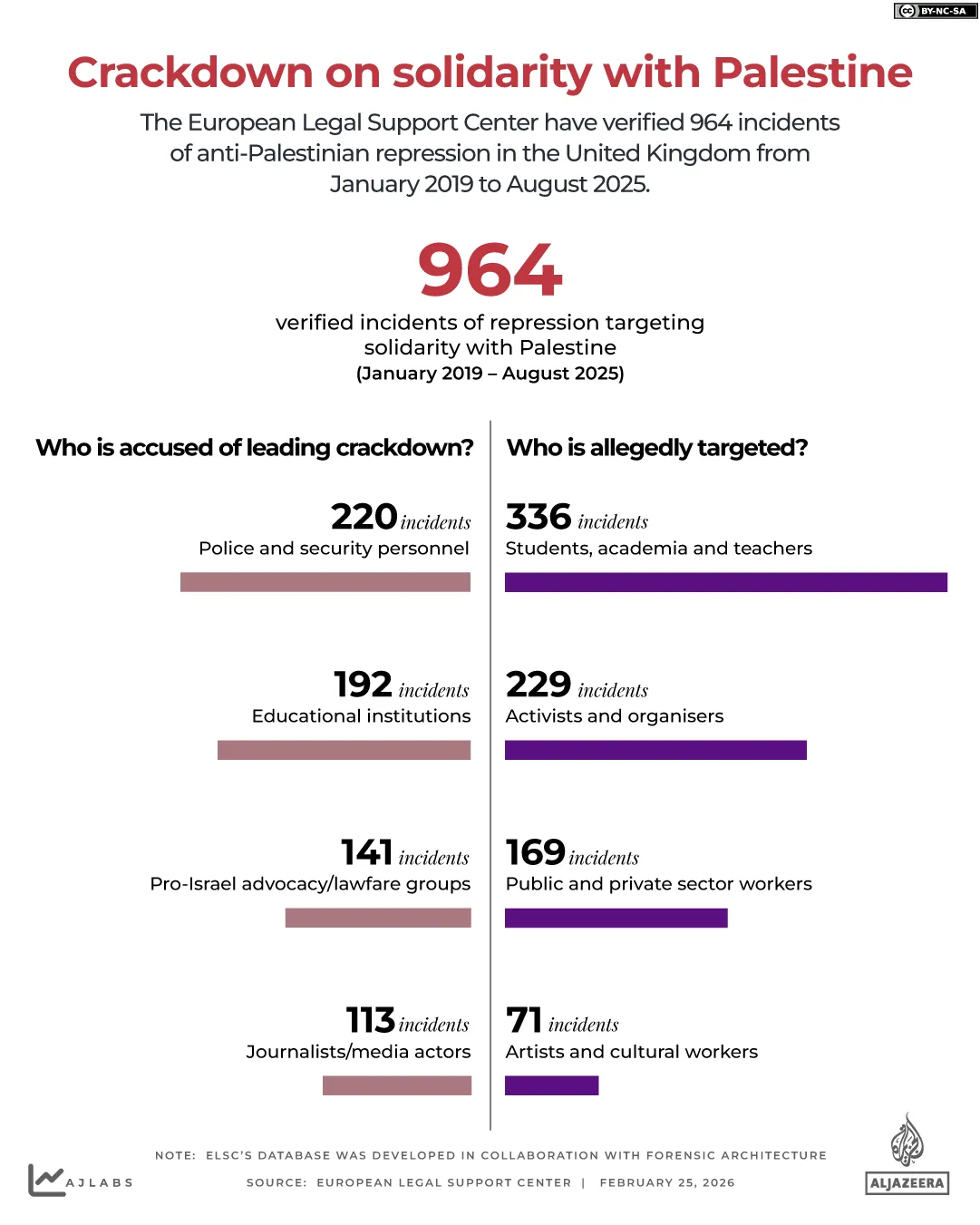
The European Legal Support Center (ELSC) said on Wednesday that it has verified 964 cases of “anti-Palestinian repression” from January 2019 until August 2025, including students being investigated over their solidarity, activists being arrested, employees facing disciplinary procedures and artists having their events cancelled.
Recommended Stories
list of 4 itemsend of list
The findings of the study, carried out in collaboration with researchers at Forensic Architecture, are a “sample indicative of a far wider and deeper pattern”, said the group comprising lawyers and legal officers.
The ELSC pitched the report as an Index of Repression, a database that is open to the public.
“We’re launching this database to show that repression of the Palestine solidarity movement in Britain is pervasive,” Amira Abdelhamid, ELSC’s director of research and monitoring, told Al Jazeera.
One documented case involves a University of Warwick student who was reported to police by their university for carrying a sign that drew parallels between Israel and Nazi Germany during a campus rally in November 2023.
(Al Jazeera)
The student was arrested for “racial aggravation against the Jewish community” and investigated by their university. But in January 2024, after the ELSC stepped in, the police dropped the student’s caution and deleted all associated records. The university confirmed in March that there would be no further disciplinary action.
ELSC said “Zionist advocacy” groups, journalists and media outlets were involved in 138 incidents – including UK Lawyers for Israel (UKLFI), a pro-Israel organisation that it said played a part in 29 of the documented cases.
“The goal of this analysis is to denaturalise this politically produced process,” the group said. “This strategic targeting across sectors represents a kind of division of repressive labour. It aims to dismantle solidarity at every stage, from the formation of political consciousness in universities and schools, to its expression in culture, to its organisation in public spaces.”
Another incident involved a football club’s kit manager who was dismissed after posting his views about Israel’s conduct on social media.
The case of Dana Abuqamar, a University of Manchester student, is also analysed in the database. The Home Office revoked her visa after she told Sky News that, after 16 years of Israel’s blockade of Gaza, “We are both in fear (of) how Israel will retaliate … but also we are full of pride.”
She later clarified that her comments were not in support of the October 7 attacks into southern Israel, during which more than 1,000 people were killed. The UKLFI reported her to the police and her university, but in 2024, she won a human rights appeal.
“The main immediate goal of this anti-Palestinian repression is to depoliticise the movement, to make it seem as though it’s not a legitimate political and ethical struggle, but rather a security problem, a problem of so-called anti-Semitism or a breach of compliance,” ELSC’s Abdelhamid said.“I don’t think that has succeeded … two years on we still see people resisting the repression happening in Britain [and] speaking up and acting for Palestine and against the genocide.”
Since Israel’s onslaught on Gaza began in October 2023, tens of thousands of Britons have rallied in support of Palestine.
According to YouGov, one in three Britons have “no sympathy at all for the Israeli side in the conflict” after Israel killed more than 70,000 people in two years and decimated the Gaza Strip.
The government, led by Labour leader Keir Starmer, has long been accused of cracking down on pro-Palestine solidarity because of a wave of arrests during demonstrations and due to its proscription of Palestine Action as a “terror” organisation – a ruling recently deemed unlawful by the High Court.
In January, Human Rights Watch said that its research found a “disproportionate targeting of certain groups, including climate change activists and Palestine protesters, undermining the right to protest freely and without fear of harassment”.
As court documents tied to the late financier Jeffrey Epstein continue to surface, the scandal has become an international embarrassment, exposing how quickly powerful men can turn into reputational liabilities. That discomfort reached New Delhi, where Microsoft cofounder Bill Gates was expected to deliver the keynote address at the AI Impact Summit but ultimately did not attend amid criticism and apparent unease within the Modi government over his past meetings with Epstein. The spectacle was revealing. Public moral outrage travels swiftly when scandal threatens reputations and diplomatic optics. Yet that sensitivity to association sits uneasily beside a domestic reality in which sexual violence against women unfolds with brutal regularity, drawing neither comparable embarrassment nor consequence. The contrast is grotesque. A political culture capable of signalling discomfort towards a global scandal remains strikingly untroubled by the everyday brutality faced by women at home.
Under the Modi administration, the news cycle churns with reports of gang rapes like factory output — steady, relentless, and numbing in repetition. The rapes have become so common that they are reported like the weather. Heatwave deaths. Flash flood. Five-year-old abducted, raped, murdered. And like the weather, only God is responsible. Not the rapist. Not the court. Not the police. Definitely not the prime minister.
Between the time this piece was commissioned and published, a five-year-old was gang-raped in Meerut, a 26-year-old was gang-raped in Faridabad, and a 17-year-old was gang-raped in Odisha. A 42-year-old was gang-raped in Delhi’s suburbs. A 12-year-old girl was kidnapped and gang-raped in Bikaner. There were more gang rapes in Bihar, Chhattisgarh, Rajasthan, and Kanpur. I could give you statistics, but numbers could never convey the larger, all-encompassing terror of living with predators. The threat of sexual violence is as constant as gravity. The cases are gruesome — intestines pulled out, rods inserted, tongues cut out, acid thrown, decapitation, strangulation, and burning. When I look at government data about rape — an average of 86 women are raped every day — it feels as grisly as stumbling upon a mass grave in Excel sheets.
Prime Minister Narendra Modi and his home minister, Amit Shah, ostensibly obsessed with restoring law and order at any cost, seem entirely unconcerned that India is the gang rape capital of the world on their watch.
The most alarming instance of this was when convicted rapist and Bharatiya Janata Party politician Kuldeep Singh Sengar, found guilty of raping a minor in 2017 and a native of Makhi village in Unnao district of Uttar Pradesh, was granted bail by a high court, raising the possibility of his reintegration into the very social and political landscape that had once enabled his impunity. A high court granted him bail in December. Thankfully, it was stayed by the Supreme Court, but only after infuriated women gathered in Delhi to protest. Sengar had raped a teenager, who was also gang-raped by his associates. Her father was murdered in police custody. A case was registered only after she threatened to burn herself in front of the chief minister’s residence. Her tragic story showcases how Indian men, like the Modi administration, remain remarkably unembarrassed about the state of affairs.
Sadly, this is not an aberration; it is the system speaking in its mother tongue.
Public memory matters because each new case unfolds against the residue of the ones we were told would change everything. In 2012, I read about the “Nirbhaya” gang rape three days after the incident, on my way from the airport. I had been deliberately avoiding the news until she ended up at Safdarjung Hospital, and my editor needed a health update from me. After I learned all the details of what men had done to this young woman, I thought the world would stand still. A threshold had been crossed. Something told me the world would start anew. There were protests, and people everywhere would know her name, and something like this would never happen again.
All of my naivety was drowned in a chorus of “Not All Men”, as the gang rape was turned into something viral to hang a hashtag on. The refrain did not defend innocence so much as redirect attention away from accountability and back towards male comfort.
It is impossible for me to hear of such cases and not think: What if it were me? My body. That rod. Those men. The suffering and mutilation of women’s bodies is so reliable that there is now a market to help ease our fear. Security apps. Pepper sprays and wearable panic alarms. Every time I write about this subject, I sit with the absolute inadequacy of the written word in the face of men who film the rapes, brag about them, and get rehabilitated nevertheless.
It wouldn’t be out of place to call this moment unprecedented, but it is beyond that. It is existential. Whether it is the United States or India, women are watching the same choreography of power protecting itself, as men of consequence close ranks and wait out the storm. The similarity lies not in scale or context, but in the recurring spectacle of institutions cushioning powerful men while survivors fight alone. For a while now, both countries — allegedly the biggest and the oldest democracies — have been on a trajectory of self-destruction, with men leading the way. Under Modi as well as Trump, rape has become an extension of politics. Women are violated no longer by men alone, but by courts, hospitals, and newsrooms, too. It is the age of monsters. It did not begin with Epstein, Gates, or Sengar, of course, but they are the symbols of it.
While the middle class was busy buying into the dream of upward mobility, careerism, and two bedrooms in a gated suburb, we let thugs cultivate a wholesale misogynist empire that runs on hate for women. I do not know what to do with the rage I feel. What do you do when you are constantly told that your body, your people, your gender are disposable? I don’t know.
What I do know is that the teenager who survived Sengar is still fighting for justice. I know that the survivors of Epstein’s sex trafficking network are fighting for justice, too. These women are fighting with heart and soul and sweat and muscle. I know that I have no right to be despondent while they stand tall, looking every inch the hero they are. I also know that nobody puts up a fight like that unless you love your sisters.
At this dark hour, it feels important to place on record that as the Modi administration recoils theatrically from the shadow of the Epstein scandal at the summit stage, the satire writes itself. A government that cannot, or will not, protect its women should be far more ashamed of what is ordinary than of what is scandalous.
The views expressed in this article are the author’s own and do not necessarily reflect Al Jazeera’s editorial stance.
At more than 2,700 feet, “The Great Wall of Los Angeles” is one of the longest murals in the world and among the most important public artworks in the city. Created by artist Judy Baca between 1974 and 1984, the mural is a groundbreaking depiction of Southern California history from the viewpoint of women and minorities and a potent national symbol at the intersection of art and activism.
Baca’s leadership of the collaborative project made her a legend in the art world. She is the co-founder and artistic director of Social and Public Art Resource Center, or SPARC, a community mural nonprofit and has been hailed as one of the most influential figures of L.A.’s Chicano muralism. “The Great Wall” is on the National Register of Historic Places, and Baca is a National Medal of Arts recipient.
But now Baca, 79, has come under criticism from some of those who have worked most closely with her in recent years.
In interviews, 10 former SPARC employees — including two managers — accuse Baca of using her nonprofit to benefit her private, for-profit art practice, Judy Baca Inc. They allege Baca personally benefited from a $5-million Andrew W. Mellon Foundation grant to expand “The Great Wall,” sold the project’s archives to the Lucas Museum of Narrative Art at a large profit to herself, and has blurred the line between her nonprofit and for-profit endeavors.
Baca and SPARC’s board chair, Zojeila Flores, vigorously deny any impropriety or misuse of funds. In an interview, they said grant funds were used appropriately and that Baca maintains a mutually beneficial profit-sharing agreement with SPARC.
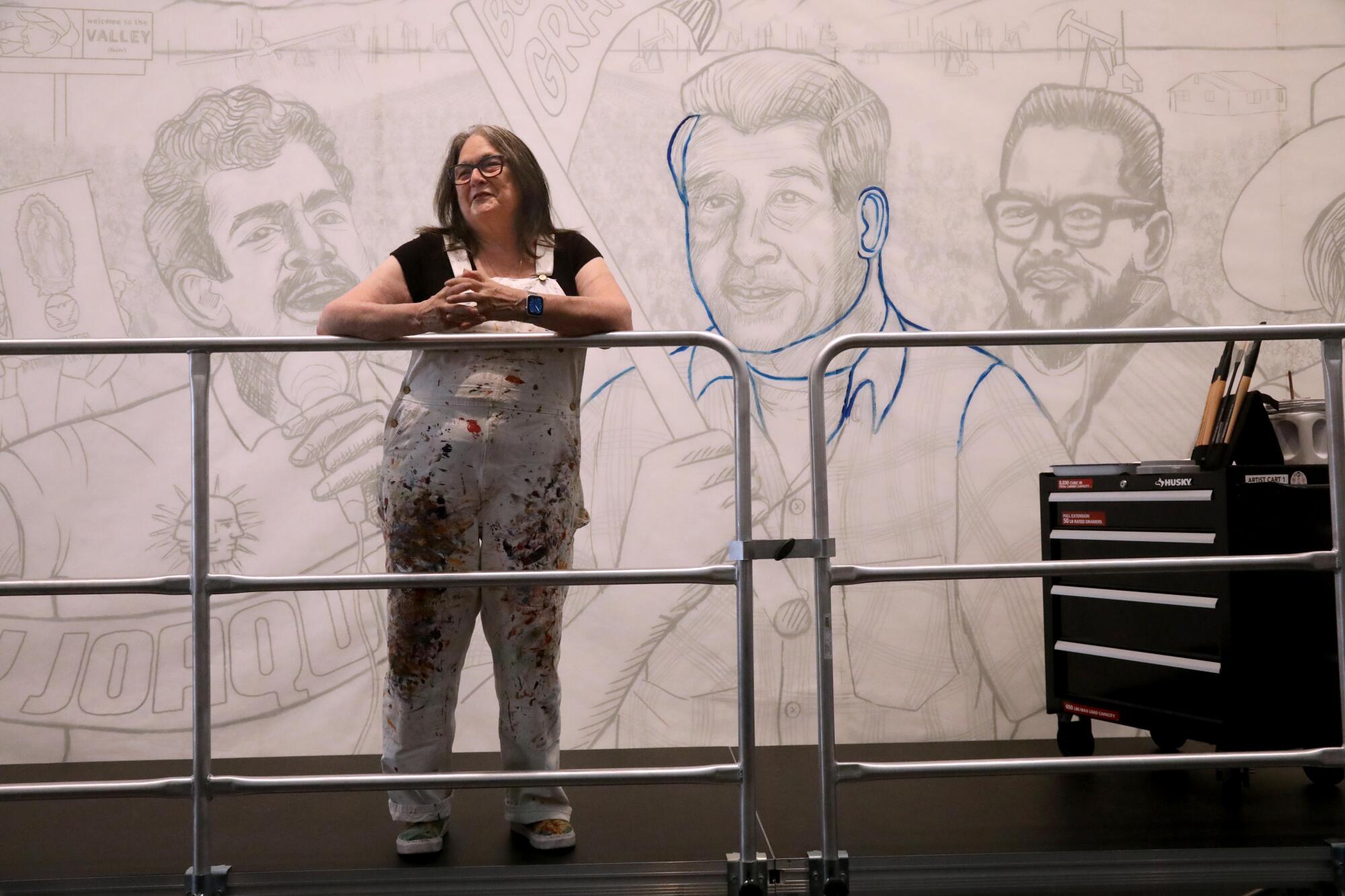
Baca ascribes the criticism to disgruntled former employees and hopes SPARC can finish its work on the mural “without more of this sort of rage and hostility and anger and hate.” It’s on schedule to be completed by 2028, she said, showing The Times sections of the mural in progress at a rented space at Bergamot Station Arts Center, an acclaimed, high-end gallery in Santa Monica.
Artist Judy Baca talks to the media after starting to paint a new section of “The Great Wall of Los Angeles” as part of a LACMA exhibition on Oct. 26, 2023.
(Genaro Molina / Los Angeles Times)
Baca supporters believe she is a visionary who has used the reputation she earned with “The Great Wall” to continue lifting underserved communities.
“I don’t know how to better serve a community than to represent them well,” said Kelly Watts, who, as a teen in the 1980s, participated in painting “The Great Wall” as a student artist. Watts now lives in Tennessee and said she isn’t familiar with the inner workings of SPARC but that what matters to her is Baca’s guidance over the years. “Judy has been a mentor of mine and has always been a really positive influence on me and my growth as an artist.”
The $5-million grant
At the root of the allegations is Baca’s 2017 announcement that she intended to expand “The Great Wall” to include hundreds of feet of new imagery, representing history from the 1960s up to the present day. The mural, which is in a floodwater channel that runs through the leafy Valley Glen neighborhood in the San Fernando Valley, originally concluded with depictions of two Olympic gold medalists, track star Wilma Rudolph and Native American runner Billy Mills. Baca also sought to add interpretive stations, illuminate the mural at night and build a pedestrian bridge over the Tujunga Wash flood control channel to provide a better view of the work.
Judy Baca painting “The Great Wall of Los Angeles” in 1983.
(SPARC Archives / SPARCinLA.org)
Baca’s goals were boosted in 2021 when the Mellon Foundation — one of the largest and most important nonprofit funders of art projects in the nation — supported “The Great Wall” plans with a $5-million grant to be paid over three years, ending in 2024. The grant was distributed through Mellon’s newly formed $250-million Monuments Project “to express, elevate, and preserve the stories of those who have often been denied historical recognition.” (Los Angeles County Museum of Art, the Emmett Till Interpretive Center in Mississippi and other noted institutions also received separate grants.)
Among those who question Baca’s stewardship of the grant are Pete Galindo, a former director of the Great Wall of Los Angeles Institute, which SPARC formed to oversee the mural expansion, and Carmen Garcia, who served as director of SPARC for six months ending in early 2023. Both alleged Baca required SPARC employees to also do work for Judy Baca Inc., Baca’s private business for her art.
Garcia resigned after repeatedly raising concerns about alleged misappropriation of Mellon grant funds, which Baca denied, and calling for the board to investigate Baca. She said she was “forcefully” led out of the building.
Galindo was fired in February 2022 after less than a year in his role. He alleges Baca terminated him in retaliation for questions he raised about how she was using the grant and objecting to her work assignments. Before his Great Wall Institute role, Galindo said he had known Baca for nearly 30 years, beginning as a UCLA student in 1996 and later working in various roles on a variety of SPARC initiatives, including as a community public art director.
According to documents reviewed by The Times, including Galindo’s offer letter and a spreadsheet with Mellon grant line items, Galindo’s $75,000 salary was paid through SPARC and the grant, which stipulates the money be used “to support the preservation, activation, and expansion of one of the country’s largest monuments to interracial harmony through civic engagement and muralist training.” But Galindo alleged Baca assigned him work outside SPARC and the Great Wall: to help sell her personal artwork, aid in fixing a termite infestation in her archives and help to manage the production of a mural titled “La Memoria de la Tierra: UCLA,” which was not related to “The Great Wall.”
The Times reviewed a series of text messages between Galindo and Baca in which Baca asked Galindo to help with jobs outside his Great Wall duties, including dealing with termites. The messages included a question to Baca from Galindo confirming she’d like the team to “print the UCLA mural at scale for review.” Baca replies that she will call momentarily. Another group chat between Galindo and two other SPARC employees is about meeting to move Baca’s belongings out of her office at UCLA in 2021.
Baca denied Galindo’s allegations, including that she asked Galindo to help manage the UCLA mural — a task outside of the Mellon grant’s purview. She said the project was brought to her personally and she referred the work to SPARC. The mural was completed on-site through a research and teaching facility known as the Digital/Mural Lab, she said. SPARC received money for the project, Baca wrote in a statement, although Baca got paid a commission — an “established practice” at SPARC for paying artists for their work.
In an interview, SPARC board chair Flores declined to say how much Baca earned from that project or Baca’s specific commission rate. However, on a hypothetical $200,000 project she said about $58,000 could go to SPARC for costs and fees. The remaining $142,000 could go to other vendors and Baca.
For decades, Baca brought in dozens of commissions to SPARC without being paid, SPARC said in a statement. The board voted to change that in recent years with a so-called “fiscal sponsorship arrangement,” which allows paid projects to piggyback on SPARC’s tax-exempt status. In this case, Baca earns a commission and SPARC receives funds for employee work on projects.
SPARC’S website currently lists nine board members. Baca and Flores are included, as is Mercedes Gertz, who rents an art studio in SPARC’s building. Baca’s cousin, Anthony Salcido, serves as the board’s finance chair. Bookkeeper Gloria Thompson is also Baca’s cousin.
“Mr. Salcido began working with SPARC only after consultation with legal counsel and Board approval, with Judy recused from the vote,” Flores wrote in an email. “Ms. Thompson began with SPARC as a volunteer and later became bookkeeper following formal consultation with legal.”
In 2022, after he was fired from SPARC, Galindo wrote a letter to Emil J. Kang, then the Mellon Foundation’s program director for arts and culture, to allege that Baca had misused the Mellon grant money by asking him to do work for her personal business.
“Throughout my time as the Great Wall of Los Angeles Institute Director, she focused my work on her personal exhibitions, sale of artworks, training her personal assistant, overseeing commissions, press and documentation,” Galindo wrote in the letter, concluding, “While Judy’s contribution to the field over the years cannot be denied, her treatment of employees, unequal pay scales and overall exploitation of staff and artists is anathema to the values and ideals of social justice movements and the monuments they inspire.”
Baca said she could not comment on personnel matters, but in a statement, SPARC said, “We strive to be fair and professional in all our personnel matters.”
Judy Baca poses in front of her artwork “La Salsera” at LA Plaza de Cultura y Artes in downtown Los Angeles in 2024.
(Christina House / Los Angeles Times)
Galindo said he did not receive a reply to his letter from Kang or the Mellon Foundation.
The Mellon Foundation issued a statement to The Times, confirming it had received Galindo’s letter, which “was handled in accordance with Mellon policy on third party complaints about our grantees.” The foundation added that it “does not comment on issues pertaining to internal matters of its grantees.” SPARC’s grant status never changed.
Garcia, who was hired as SPARC’s executive director after Galindo left the organization, remembered dealing with heightened inquiries from Mellon representatives, including culture program director Kang. Once, she said, the foundation asked SPARC for additional information on how grant money was being spent.
SPARC said in its response to The Times that such questions from funders were routine.
“Mellon consistently reviews all of its grantees’ performance, as is standard for nonprofit funders,” SPARC said.
Baca told The Times that she was unaware that Mellon had raised questions about how the grant was being used. However, in a text exchanged with Garcia in 2023 and reviewed by The Times, she indicated she had spoken to Kang at a National Medal of Arts event in Washington, D.C.
“They will ask us to improve some things but generally we had a long discussion and lots of laughs about me ‘hating the interrogation by a bunch of white me[n],’” Baca wrote. “He got a laugh out of it and knew they were a pain in the a—.”
When asked about the text she sent to Garcia, Baca said, “It was an informal conversation at a White House reception. We didn’t talk about the specifics of the grant itself. The conversation really was about the review process.”
Who should profit from ‘The Great Wall’?
Work on “The Great Wall of Los Angeles” began in 1974 and was completed over five summers by Baca with the help of many now well-known artists including Isabel Castro, Ulysses Jenkins, Judithe Hernández, Patssi Valdez, Margaret Garcia, Christina Schlesinger and Judy Chicago. More than 400 young people and their families — many from underserved neighborhoods — also contributed to the project, including 80 youths recruited from the juvenile justice system.
The collective effort made “The Great Wall” a work of social justice, and in 1976 led to the founding of Baca’s nonprofit, SPARC, with its stated mission of producing, preserving and promoting, “activist and socially relevant artwork,” and fostering “artistic collaborations that empower communities who face marginalization or discrimination.”
“The Great Wall of Los Angeles” on April 9, 2025.
(Carlin Stiehl / For The Times)
Some former SPARC employees feel that Baca has failed to honor the community that toiled to create “The Great Wall.” They have expressed concern that Baca has benefited unfairly from the project, and, in particular, the sale of work related to it.
Flores disagrees, writing, “For 50 years, SPARC has used art to empower communities facing marginalization and/or discrimination. This currently includes immigrant populations traumatized by ICE. Further, SPARC ensures that working artists can remain in Venice, a neighborhood with deep artistic and cultural roots.”
When “The Great Wall” was originally copyrighted in 1983, authorship of the work was attributed to both “Judith F. Baca” and the “Social Public Art Resource Center.” In 2011, however, after a restoration effort led by SPARC in which the mural was completely painted over, the project was again copyrighted, this time solely under Baca’s name. Former employees question the ethics of Baca’s profiting off a celebrated community effort, but Flores said Baca has always retained ownership of her work and that, “Owning a copyright is not the same as owning an artwork itself.” Baca, Flores said, evenly splits copyright licensing fees with SPARC.
Baca sold “The Great Wall” archives to the Lucas Museum in 2021. The sale included more than 350 objects and ephemera, including concept drawings, site plans, sketches and correspondence with community leaders, scholars, historians and collaborators.
A Lucas Museum representative declined to comment on how much the museum paid for the archive or whether or not the acquisition was made from Baca or SPARC.
Galindo said he was told by former SPARC executive director Carlos Rogel that it sold for $1.5 million. Rogel declined a request for comment. Another source close to SPARC, who asked to remain anonymous out of fear of retaliation, also said the sale was for $1.5 million.
Baca and Flores declined to say what the archives sold for. In an emailed response, Flores wrote that Baca was the owner of “The Great Wall” archive and was not paid by SPARC to produce that work.
“Nonetheless, following the sale, and although Judy was not required to do so, she generously donated $521,000 to SPARC,” Flores wrote.
Galindo and other former employees also expressed concern about Baca’s rising salary and believe it is out of proportion with SPARC’s mission of uplifting and aiding underserved communities and youth. In the two years prior to receiving the Mellon grant, Baca made $42,916 and $50,000, respectively. The year after SPARC received the grant, Baca’s salary rose to $215,000. In 2023, she made $236,149, and the following year, $211,004. The increase in Baca’s salary is discussed in an internal email and executive board meeting minutes reviewed by The Times, which state that SPARC’s board voted to set Baca’s annual compensation to be commensurate with what Baca was paid before she retired as a UCLA professor and that the additional money should come from the Mellon grant. Records of her 2025 and 2026 salaries were not currently available.
“The Great Wall of Los Angeles” depicts the history of California through the 1950s. An expansion to be completed in 2028 will add scenes from the 1960s to 1990s.
(Carlin Stiehl/For The Times)
SPARC said in a statement that Baca’s salary “is lower than the market rate for similar non-profit CEOs and lower than the market value commissioning rate for artist Judy Baca who is the author of The Great Wall Mural.”
Ongoing work on “The Great Wall” is currently done by a variety of people. For the new panels, which begin with the civil rights era of the 1960s, research is done by Baca and her team from the Great Wall Institute (there is currently no institute director, according to SPARC’s website). From there, Baca creates rough drawings, and drafts are made by artists from SPARC’s Digital/Mural Lab. Baca suggests edits and gives directions, and later she will add her own personal touches.
Eventually, colorations are submitted by various artists, and Baca does one final hand coloration of the entire piece. During The Times’ visit to see the mural expansion in progress, two artists were painting on sketches that had been fine-tuned by Baca and printed onto giant panels. These panels will eventually be attached to the wall of the flood water channel where “The Great Wall” resides, Flores said.
Former SPARC digital mural artist Toria Maldonado alleged it was not always clear if the work they were doing was for SPARC or for Judy Baca Inc. They were asked on occasion to work on assignments that appeared to be for the benefit of the latter, Maldonado said.
Maldonado said they and two other SPARC employees once redrew the 1960s segment of “The Great Wall” for a private collector. Baca, Maldonado said, “was selling a print, and wanted to refine it, and had us do that assignment.” Maldonado shared a checklist with The Times featuring notes about what work needed to be done on the segment, including shading Malcolm X’s hair.
In an email, Flores called Maldonado’s allegations, “factually inaccurate” and “misleading.”
“Judy was the owner of the segment referenced. It was hand-colored by Judy and assistants whom Judy paid personally, and this work was done in her personal studio,” Flores wrote. Baca’s studio is a Frank Gehry-designed space at her Venice home.
Maldonado said that they had never been to Baca’s personal studio and that their salary was always paid through SPARC.
From May through August 2023, segments of “The Great Wall” were exhibited at Jeffrey Deitch Gallery in L.A. Baca didn’t sell any works during that show, Flores wrote in an email, but in 2025, “a coloration by Judy’s hand of a segment presented in that show was sold. This work was created in Judy’s private studio and owned by her.” Baca declined to disclose how much the segment sold for. SPARC began showing more of “The Great Wall” expansion in February at Jeffrey Deitch Gallery. The original panels will not be for sale, but “if a work of Judy’s is sold at the show, she receives the proceeds as the owner of the work,” Flores wrote.
The room where art happens
Galindo and Garcia also alleged that SPARC inappropriately leases its premises to board member Gertz and others.
Since 1977, SPARC has been housed in a former Venice police station and jail, a 1920s Art Deco building owned by the city of Los Angeles. In 2000, the city signed a lease allowing SPARC to use the building for free until 2055. That agreement stipulates the property be used for “production, exhibition, promotion and distribution of and education about public art on a nonprofit basis.” SPARC can sublease portions of its building to those engaged in similar work with a city official’s approval. It must submit annual financial reports to the city with earnings from such deals.
The Times reviewed Instagram posts made by Gertz touting a 2023 exhibition of her personal art at SPARC, another in 2024 advertising a holiday sale, as well as one that shows her working in her studio inside the building. SPARC said Gertz pays market rate for her studio but declined to specify how much that is, only that it is, “equivalent to the rent paid by all the other artists who sublet space in the building.”
Judy Baca outside her Venice nonprofit, the Social and Public Art Resource Center, better known as SPARC, in 2021.
(Gary Coronado / Los Angeles Times)
According to documents obtained through a California Public Records Act request, the city only has one sublease on file for SPARC from 1991. When asked if the city had approved SPARC’s deal with Gertz, Amy Benson, the director of the city’s real estate services division, wrote in an email that she had no further information to provide.
Flores wrote in an email that she was unable to speak to the specifics of a question about whether or not SPARC submits annual financial reports, inclusive of its subleasing income, to the city but noted, “we will follow up to make sure that the City has the documents you mention.” According to the latest available tax filings, SPARC made $64,991 in “rental property income” in 2024 and $57,590 in 2023.
Asked if Gertz’s use of SPARC for her personal, for-profit art practice, violates SPARC’s understanding of the lease, Flores wrote, “Our understanding is that our lease allows any use of the premises that is reasonably consistent with our nonprofit mission… Ms. Gertz uses her studio to weave textiles and also to lead art workshops for immigrants in the community, an activity that we think is entirely in keeping with our mission.”
Baca has also sold her personal art for profit at SPARC. When Baca’s art is for sale she “is treated like all other artists” and receives 60% of profits, the nonprofit said in a statement.
“I’m certain there are hundreds of artists in Los Angeles making socially engaged work who would benefit from a solo exhibition at SPARC,” Galindo wrote in an email.
Feb. 25 (UPI) —Nobel Prize-winner and scientist Richard Axel announced he is resigning as co-director of Columbia University’s premier interdisciplinary brain research center following recent revelations of his relationship with disgraced financier and convicted sex offender Jeffrey Epstein.
Axel announced in a statement that he was stepping down as co-director of the Zuckerman Mind Brain Behavior Institute “to focus on research and teaching in my lab.”
Several high-profile individuals have been fired, resigned and even arrested since late January when the Department of Justice released more than 3 million additional pages of information about its investigation into Epstein, who died by suicide in a Manhattan jail in 2019 while awaiting his sex trafficking trial.
The files — and names they contain — have drawn intense public attention, as demands for accountability grow for wealthy and well-connected associates of Epstein whose ties to him have come under renewed scrutiny.
Axel’s relationship with Epstein was revealed in the recently released documents, showing the two corresponded since at least 2010.
“My past association with Jeffrey Epstein was a serious error in judgment, which I deeply regret,” Axel, 79, said.
“I apologize for compromising the trust of friends, students and colleagues. I recognize the problems that this has caused, and I will work to restore this trust. What has emerged about Epstein’s appalling conduct, the harm that he has caused to so many people, makes my association with him all the more painful and inexcusable.”
Axel told New York Magazine in 2007 that he first met Epstein in the 1980s. The documents recently released showed that the two frequently connected over the years since at least 2010.
Columbia said in a separate statement that it has seen no evidence that Axel violated any university policy or the law.
“However, Dr. Axel made clear that in light of this past association, and the continued fallout from the release of DOJ files, he felt it appropriate to relinquish his position as co-director,” the university said.
“The university agrees with this decision, while at the same time recognizing his extraordinary contributions to the university and his dedication to his colleagues, to his students and to science.”
The school said Axel was also resigning from the Howard Hughes Medical Institute.
Axel won the Nobel Prize in Physiology or Medicine with Linda Buck in 2004 for discoveries related to how the sense of smell works, specifically their identification of odorant receptor genes and how those receptors detect and process smell, according to the Nobel Prize.
Fallout from the Justice Department’s recent release of Epstein files has impacted the lives of several high-profile individuals, including former British Ambassador to the U.S. Peter Mandelson, who was arrested this week on suspicion of misconduct in public office over accusations of leaking government information in emails to Epstein.
Andrew Mountbatten-Windsor, formerly known as Britain’s Prince Andrew, was also recently arrested on similar charges over allegations that he passed confidential information to Epstein.
Morocco sentenced 18 Senegalese football fans last Thursday following disturbances at the Africa Cup of Nations final.
Published On 25 Feb 202625 Feb 2026
Share
Senegal’s Prime Minister Ousmane Sonko has followed his country’s football association in denouncing Morocco’s jailing of 18 Senegalese fans following January’s Africa Cup of Nations (AFCON) final in Rabat.
The Teranga Lions supporters were arrested during the final in the Moroccan capital, which was controversially suspended as the Senegal players left the pitch in protest against the late award of a penalty to the host nation.
Recommended Stories
list of 4 itemsend of list
Fans, in response, attempted to enter the field of play during the match on January 19, leading to the arrest of 18 people who were later charged with hooliganism and violence against security officials.
Prison sentences were handed out last Thursday to them, ranging from three months to one year, along with fines of up to 5,000 dirhams ($545).
“It seems this matter goes beyond the realm of sport and that is regrettable,” Sonko told the Senegalese parliament on Tuesday.
“For two countries that call each other friends, like Morocco and Senegal, things should not have gone this far.”
The 18 fans have denied any wrongdoing but have not appealed the sentence. Senegal, however, will seek a royal pardon from Morocco’s King Mohammed VI.
“If they do not, we have agreements that bind us and allow us to request that the supporters serve their sentences in their own country,” Sonko added.
The Senegal Football Association had immediately spoken out at the time of the sentences, describing them as “incomprehensibly harsh”.
“Clashes occur in numerous stadiums around the world, including every weekend in Morocco, without resulting in such sanctions,” Bacary Cisse, the president of the FSF’s communications committee, said.
“The treatment of these supporters therefore appears disproportionate.”
Defence lawyer for the 18, Patrick Kabou, had said on February 6 that they were still “waiting to learn the charges”.
He added that some had chosen to go on hunger strike against their detention and treatment.
In response to the sentencing, Kabou echoed the “incomprehensible” sentiment, saying his clients were “victims”.
Senegal were the eventual winners of the final after the match resumed following the players’ protest, securing a 1-0 win in extra time.
Tayari Jones was feeling intense pressure to deliver a follow-up to her 2018 bestseller, “An American Marriage.” She was three years past her publisher’s deadline. Worse, she had begun to suffer symptoms of what was ultimately diagnosed as Graves’ disease, a serious autoimmune condition that attacks the thyroid. At the time she didn’t know what was causing pain in her right leg and the intense itching on her arms, legs and torso — or why her handwriting had “gone funky.” Meanwhile, 200 pages in, the novel she owed Knopf Publisher and Editor in Chief Jordan Pavlin wasn’t coming together.
She confided to a close friend, “This book got me feeling like a clown right now.” Jones began to doubt that she was ‘worthy’ of another literary success.
“You know how musicians say ‘that band was swinging’? I wasn’t swinging,” Jones, who lives in Atlanta, tells me during a recent phone call.
She says she turned to an empty notebook, and began word doodling — scrawling random words, going wherever her pen took her. “Kin,” the magnificent novel that emerged, is out now. Oprah recently announced that it’s her latest book club pick (the second time Jones has been honored with the selection).
“Kin: A Novel” by Tayari Jones
(Knopf)
On the Shelf
Kin
By Tayari Jones Knopf: 368 pages, $32
If you buy books linked on our site, The Times may earn a commission from Bookshop.org, whose fees support independent bookstores.
“Kin” was supposed to have been an entirely different book — an of-the-moment novel about gentrification in the New South — but what materialized from Jones’ creative experiment was a tiny Louisiana town called Honeysuckle, amid the 1950s and Jim Crow. Then, as Jones puts it, “Annie and Vernice [her main characters] introduced themselves.” All of Jones’ previous fiction has been contemporary, and at first she didn’t know what to make of the path Annie and Vernice were leading her on. “I don’t write historical,” observes Jones, “I’m a writer of my own era.” Not to mention she’d always been suspicious of writers who claim their characters came to them fully realized.
Even at that point, Jones still believed Vernice and Annie might just be part of a larger backstory, perhaps parents to protagonists she had yet to conjure. “So I stuck with it to find out.” The more she wrote, the more the puzzle pieces began to fit together. Annie’s journey out of Louisiana takes her through a sharecropping brothel in Mississippi, then on to Memphis where she is convinced she will find and reunite with her mother. Meanwhile, Vernice attends Spelman (the HBCU Jones is a ’91 graduate of).
Jones began to suspect that she’d had a previously undetected ulterior motive for moving her book to the past. She wondered if “Kin” was actually an effort to better understand her parents, particularly her mother, a former economist who’d been active in the civil rights movement. “My mother is a very tight-lipped person,” Jones says. “I knew very little about her life, and maybe this was my imagination trying to crack the code.”
Jones’ progress wasn’t without its setbacks. She was deep into the writing of “Kin” when her Graves’ disease flared in earnest. Her blood pressure spiked. She got winded just climbing the stairs to her bedroom. She landed in the emergency room with a life-threatening “thyroid storm,” requiring surgery and daily medication. Then her eyesight deteriorated, which necessitated a month of radiation. But she powered through, and sent off the manuscript.
Jones’ editor, Pavlin, admits the novel she received was a surprise. “But it was as perfect a novel as I’ve ever read,” she says. “No publisher in their right mind would stand on anything as insignificant as a contractual description in the face of such a work.”
“Kin” deftly alternates points of view between Vernice and Annie, narrating events by way of a vernacular that would be at home on a front porch rocking chair. When Annie takes a job at a nightclub in Memphis, she says of its penny-pinching owner: “The man was tight as a skeeter’s teeter.” Jones is equally adept at the delicate prose, as in this description of a well-worn family Bible: “The paper, thin as butterfly wings, was heavy with wisdom.”
While Jones had Toni Morrison’s short story “Recitatif” in mind while writing “Kin,” her take on the subject is singular. “Vernice and Annie remain friends because each of them is the keeper of the other’s true self,” she says. “Friendship is particularly meaningful because it’s a relationship you’re constantly recommitting to — reupping.”
Now that “Kin” is out in the world, and Jones has weathered the bumpy road to publication day, we asked her if she’s nervous about how it will be received eight years after her previous novel was published. “I am not ambitious now in the way I was then,” she says. “I’ve learned what success can and cannot do for a person. You have to learn to be satisfied. People say ‘don’t rest on your laurels,’ but what are laurels for?”
Haber is a writer, editor and publishing strategist, and co-founder of the Ink Book Club on Substack. She was director of Oprah’s Book Club and books editor for O, the Oprah Magazine.
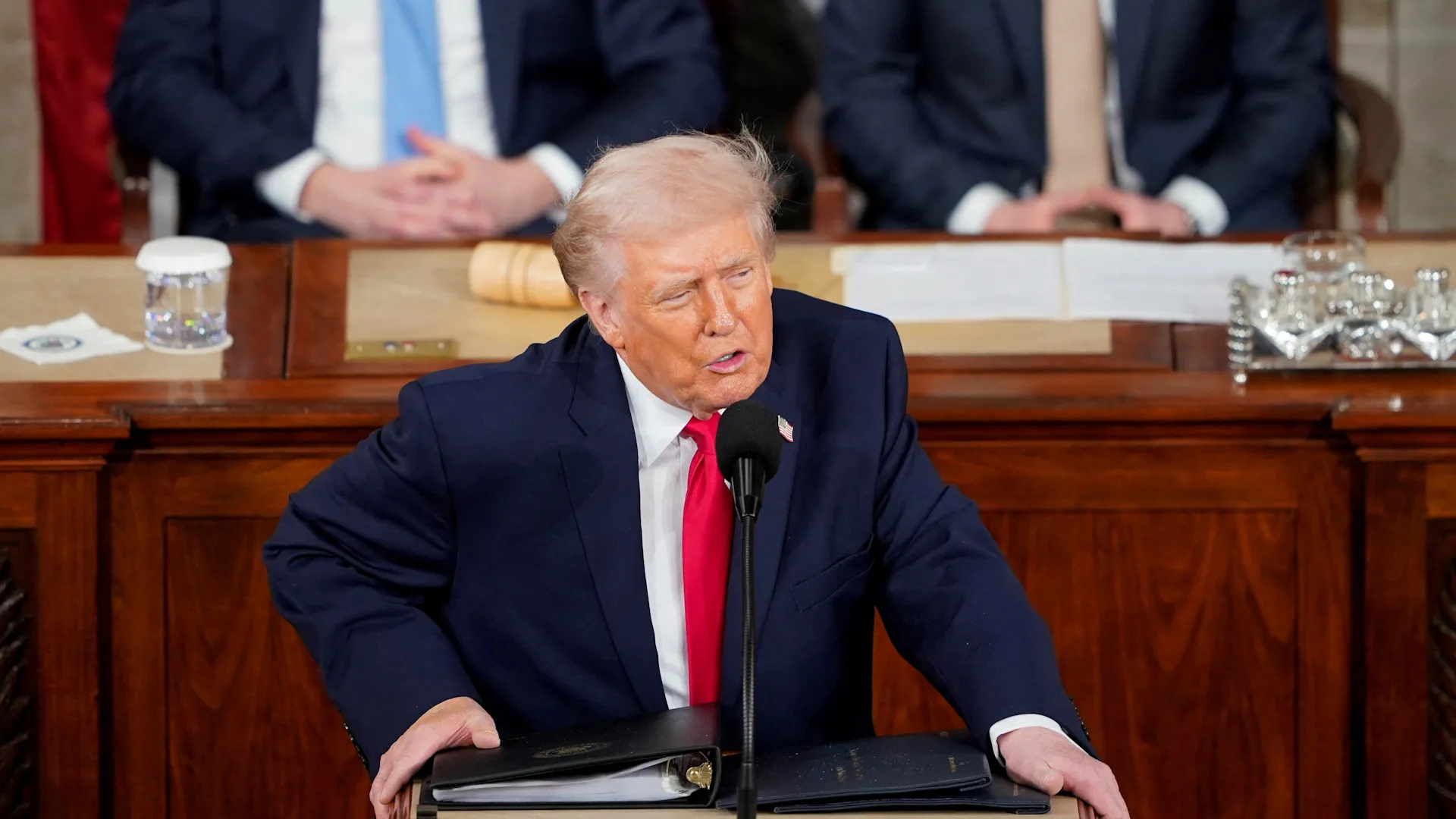
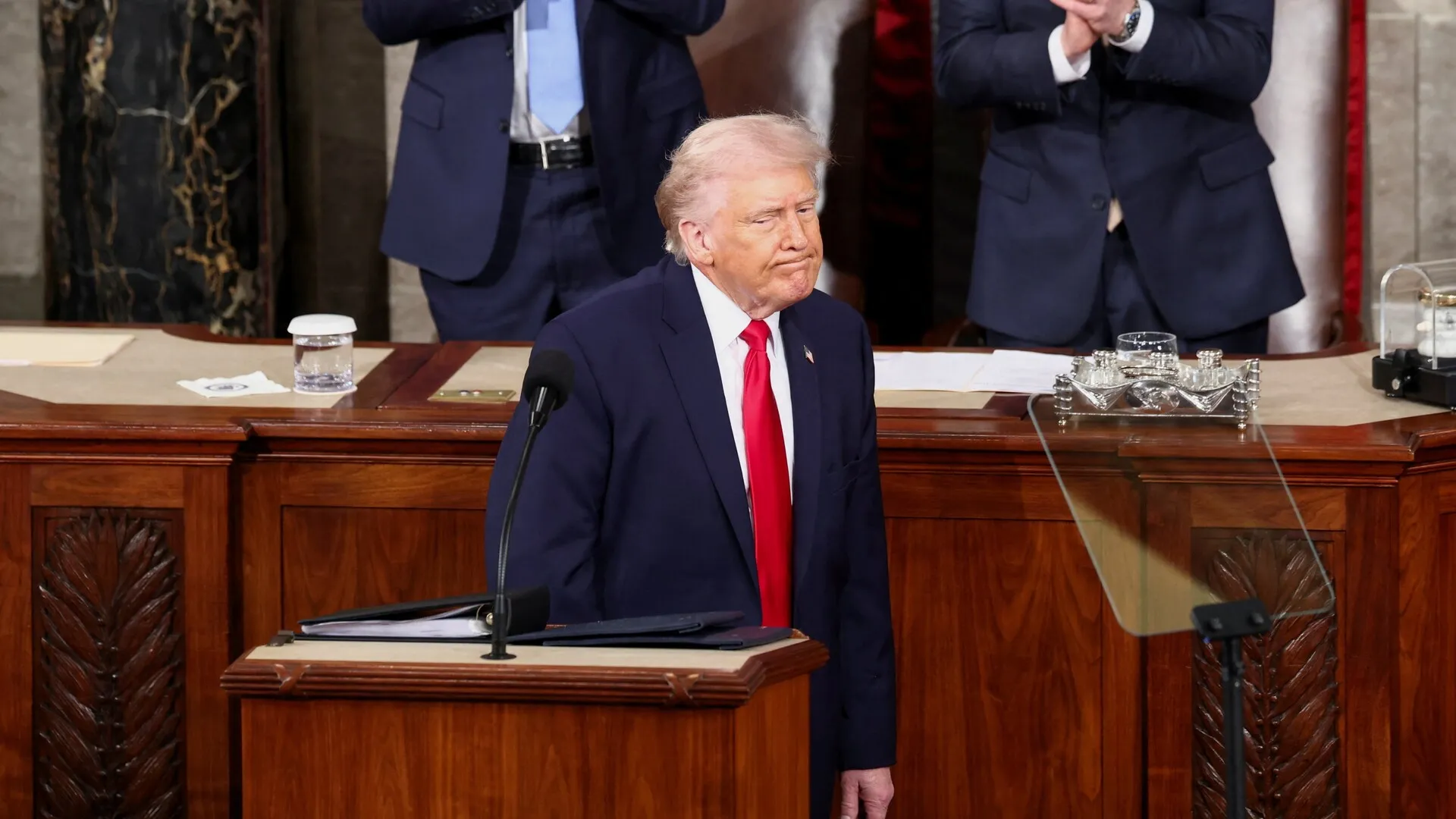
President Donald Trump used his State of Union address to talk up his successes, railed against Democrats over the economy and immigration and warned Iran on nuclear weapons in a speech lasting more than 100 minutes. Al Jazeera’s Kimberly Halkett was watching.
To prepare for his role on the 1984 comedy “Revenge of the Nerds,” Robert Carradine spent two weeks wearing “nerd clothes,” a wig and glasses everywhere he went.
This included heading to fraternity row at the University of Arizona during rush week while in character with a fellow actor. They asked the head of a fraternity if they could join.
“The guy took one look at us and said, ‘No way,’ ” Carradine recalled in 1990. “By the time the first day of shooting rolled around, I was in full flight as a nerd.”
Carradine, who played Lewis Skolnick, the king of the college nerds with a signature laugh, in the “Revenge of the Nerds” movie franchise, has died. He was 71.
In a Monday statement to Deadline, Carradine’s family said he struggled with bipolar disorder and died by suicide.
Suicide prevention and crisis counseling resources
If you or someone you know is struggling with suicidal thoughts, seek help from a professional and call 9-8-8. The United States’ first nationwide three-digit mental health crisis hotline 988 will connect callers with trained mental health counselors. Text “HOME” to 741741 in the U.S. and Canada to reach the Crisis Text Line.
“It is with profound sadness that we must share that our beloved father, grandfather, uncle, and brother Robert Carradine has passed away. In a world that can feel so dark, Bobby was always a beacon [of] light to everyone around him,” the statement said. “We are bereft at the loss of this beautiful soul and want to acknowledge Bobby’s valiant struggle against his nearly two-decade battle with Bipolar Disorder.
“We hope his journey can shine a light and encourage addressing the stigma that attaches to mental illness. At this time we ask for the privacy to grieve this unfathomable loss. With gratitude for your understanding and compassion.”
The youngest of a prolific Hollywood family, Carradine’s siblings include actors David and Keith and architect Christopher, of Walt Disney Imagineering. David Carradine died in 2009 at age 72. Their brother Bruce, who died in 2016, was also an actor.
Keith Carradine told Deadline that his family wanted everyone to know about Robert’s struggle with bipolar disorder.
“We want people to know it, and there is no shame in it,” he told the outlet. “It is an illness that got the best of him, and I want to celebrate him for his struggle with it, and celebrate his beautiful soul. He was profoundly gifted, and we will miss him every day. We will take solace in how funny he could be, how wise and utterly accepting and tolerant he was. That’s who my baby brother was.”
The youngest son of prolific character actor John Carradine, Robert Carradine was born on March 24, 1954, in Los Angeles. Known for both his film and television work, Carradine made his debut in a 1971 episode of the long-running western “Bonanza.” His first film appearance was in the 1972 John Wayne western “The Cowboys.”
During his 50-year Hollywood career, he appeared alongside his brother David in a 1972 episode of “Kung Fu” and the 1973 Martin Scorsese film “Mean Streets.” David, Keith and Robert joined other sets of acting siblings to portray sets of real-life siblings in the 1980 Western “The Long Riders.” Carradine also landed roles in Hal Ashby’s 1978 Vietman War drama “Coming Home” and Samuel Fuller’s 1980 World War II epic “The Big Red One.”
While Carradine found success in the family business, he also had a love for racing.
“There are certain people who are supposed to be race car drivers,” Carradine told The Times in 1991. “And I’ve got that. I’ve got that thing that makes me have to race. I have to do it.”
At the time he was balancing both careers, racing at the Grand Prix level in a Lotus Esprit Turbo SE. But it was clear he would have chosen racing over acting if he could.
“The thing about racing that appeals to me is your destiny is in your own hands at that moment,” Carradine said. “I won a race in the Lotus at Road America, and I won it. And that’s it. You can’t do better.”
In the 2000s, Carradine charmed a new generation of fans as lovable TV dad Sam in “Lizzie McGuire.”
“There was so much warmth in the McGuire family and I always felt so cared for by my on-screen parents,” the show’s star Hilary Duff wrote in her Instagram tribute to her on-screen dad. “I’ll be forever grateful for that. I’m deeply sad to learn Bobby was suffering. My heart aches for him, his family, and everyone who loved him.”
Jake Thomas, who portrayed Lizzie’s brother Matt on the show, said he “looked up” to Carradine, who he’s known for most of his life.
“My heart hurts today,” Thomas wrote in his Instagram tribute. “[H]e was one of the coolest guys you could ever meet. Funny, pragmatic, sometimes cranky, always a little eccentric. He was a talented actor, musician, and director. But more than anything, he was family.”
Carradine is survived by his three children — actor Ever Carradine, Marika Reed Carradine and Ian Alexander Carradine — as well as his brothers, nieces (including actor Martha Plimpton), nephews and grandchildren, according to Deadline.
In her tribute to her father, Ever Carradine described him as a “sweet, funny dad” and “the guy that’s always there.”
“Growing up in the 70s and 80 with a single dad in Laurel Canyon is not exactly the recipe for a grounded childhood, but somehow mine was,” Carradine wrote on Instagram. “Whenever anyone asks me how I turned out so normal, I always tell them it’s because of my dad. I knew my dad loved me, I knew it deep in my bones, and I always knew he had my back.”
“My dad was a lover, not a fighter. He was all heart, and in a world so full of conflict and division, I think we can all take a page out of his book today, open our hearts and feel and share the love,” she added.
Chancellor says he wants to deepen trade relationship while making it fairer during visit that sees signing of several agreements.
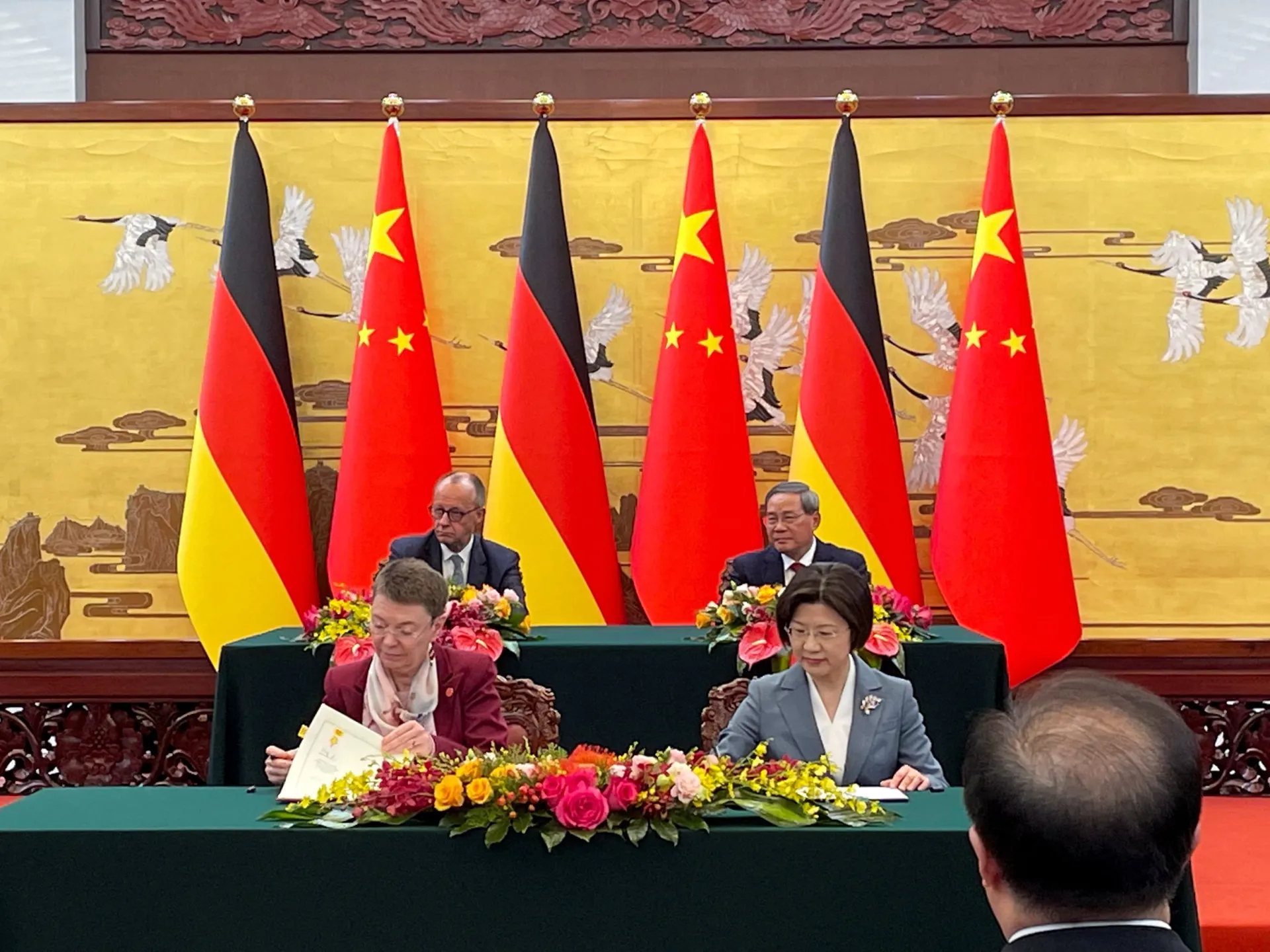
German Chancellor Friedrich Merz has kicked off his inaugural visit to China with a focus on resetting trade relations and deepening cooperation.
Speaking in Beijing on Wednesday, Merz told Chinese Premier Li Qiang that Germany sought to build on the decades-old economic ties with China, while emphasising the need to ensure fair cooperation and open communication.
Recommended Stories
list of 4 itemsend of list
“We have very specific concerns regarding our cooperation, which we want to improve and make fair,” said Merz, in an acknowledgement of the strain faced by Germany’s manufacturing sector from Chinese competition.
Li, who met Merz shortly after his arrival in Beijing’s Great Hall of the People, called on both sides to work together to safeguard multilateralism and free trade, in a reference to US President Donald Trump’s tariff policy that has upended the global trading system.
“China and Germany, as two of the world’s largest economies and major countries with important influence, should strengthen our confidence in cooperation, jointly safeguard multilateralism and free trade, and strive to build a more just and fair global governance system,” Li said.
During the meeting, representatives from both sides signed several agreements and memorandums, including on climate change and food security.
“We share responsibility in the world, and we should live up to that responsibility together,” Merz said, adding there was “great potential for further growth”.
He added that open channels of communication were essential, as he announced visits by several ministers in the months ahead.
‘More equal playing field’ sought
Reporting from Beijing, Al Jazeera’s Rob McBride said the visit, in which Merz was being accompanied by a large delegation of German business executives, was important for both Europe’s economic powerhouse and the world’s second-largest economy.
Alongside the signing of deals with Chinese companies, a key focus of Merz’s visit would be “looking for a more equal playing field when it comes to trade”, he said.
“There is a real concern in markets like the European Union about cheaper, sometimes subsidised Chinese products that are looking for markets other than the US, suddenly flooding other marketplaces such as Germany … undercutting many domestic manufacturers there,” he said.
Germany’s imports from China increased 8.8 percent to 170.6 billion euros ($201bn) last year, while its exports to China dropped 9.7 percent to 81.3 billion euros ($96bn).
McBride noted Beijing was seeking to pitch itself as a “responsible advocate of free trade compared to the sometimes unpredictable and chaotic tariffing policy of the US”.
He said the visit would also see Merz attend a banquet with Chinese President Xi Jinping, and visits to German companies with strongly established presences in China, such as Siemens and Mercedes-Benz.
Geopolitics and human rights would also be on the table, he said, with Germany particularly concerned about Beijing’s support, tacit or otherwise, for Russia amid its war on Ukraine.
Western leaders court Beijing
Merz is the latest in a string of Western leaders to visit Beijing in recent months, including the UK’s Keir Starmer, France’s Emmanuel Macron and Canada’s Mark Carney, amid the fallout from Trump’s tariffs on long-established trade relationships.
The chancellor said on Friday he was going to Beijing in part because export-dependent Germany needs “economic relations all over the world”.
“But we should be under no illusions,” he said, adding that China, as a rival to the United States, now “claims the right to define a new multilateral order according to its own rules.”
Armor Harris, Senior Vice President and General Manager of the company’s growing aircraft division, who is also the ‘father’ of X-BAT, told us on the floor of AFA’s Warfare Symposium in Denver today that the aircraft’s central differentiator, its ability to launch and recover vertically, will be a central focus of early flight testing.
Latest on X-BAT VTOL ‘fighter’ drone from Shield AI’s Armor Harris
The stakes are incredibly high for Shield AI when it comes to X-BAT. They are trying to do something nobody else is offering in the high-performance air combat drone sector. X-BAT could drastically change the flexibility and survivability of advanced uncrewed tactical airpower, but achieving stealth, a large combat radius, a relevant payload, and doing it all at a cost that doesn’t send the DoW running is no easy task, especially for a young airframer like Shield AI. Now doing all that and launching and recovering it vertically from basically anywhere, that’s a whole other level.
X-BAT: Earth Is Our Runway
With such a lofty goal comes doubters who think Shield AI is reaching outside their capabilities with the X-BAT concept. Surely these include competitors who would have a hard time arguing for their air combat solutions if X-BAT were to exist in operational form and capable of the things Shield AI claims.
We will keep you up to date as X-Bat progresses toward flight test.
Suddenly it feels like the 2000s again, with a revived “Scrubs” premiering Wednesday on ABC and Tracy Morgan reincarnating the spirit of “30 Rock” in NBC’s “The Fall and Rise of Reggie Dinkins” — network television shows, too, as in the days when streaming was just something tears and traffic did.
Beginning as a tale of new doctors at work and in love, “Scrubs” may also be seen as a looking-glass “Grey’s Anatomy,” although as “Scrubs” premiered first, it’s fairer to say that “Grey’s” is a straight-faced “Scrubs,” probably not a thought that ever crossed Shonda Rhimes’ mind. The show, then and now, combines a sentimental, satirical, soapy, sometimes surreal comedy with a straightforward medical show. Stars Zach Braff, Donald Faison and Sarah Chalke are back full-time, not quite in their old places, but arranged in close quarters, with Judy Reyes and John C. McGinley listed as recurring and other old faces slated to peek in.
The show left the air in 2010, after its ninth season, a virtual spin-off that has been declared noncanonical. The Season 8 finale saw protagonist, narrator and inveterate daydreamer J.D. (Braff), a person who really needs people — “I can’t do this all on my own” runs the show’s title song — looking into a happy future, married with a child to surgeon Elliot (Chalke). But that was just a dream, just a dream. The new season finds them at odds, and while a child is mentioned, it remains unseen, at least for the four episodes (of nine) out for review.
As we begin again, J.D. is working as a concierge doctor, tending to the minor ailments of the rich — cut toe, long-lasting chemically induced erection — when he’s drawn back to Sacred Heart Hospital to check on a patient. By the end of the first episode, his former mentor, the acerbic yet strangely sympathetic Dr. Cox (McGinley), will give him a job, of which is officially a spoiler to describe — even though it’s the premise of the show — noting his gift for teaching and reuniting J.D. with bromantic best friend Turk (Faison), the chief of surgery. (“Two chiefs!” is their chanted motto, followed by a special handshake. They are men who will be boys.) Turk is still married to head nurse Carla (Judy Reyes); they have four daughters, whom we do see, briefly. (J.D.’s appointment rankles Dr. Park, played by Joel Kim Booster, the series’ designated mean person.)
Moving into the space Turk, J.D. and Elliot occupied 25 years earlier are a new crop of interns, bringing youth appeal and naivete (the better to instruct them). Blake (David Gridley) is a cocky know-it-all, who will become a less cocky know-it-not-all; Asher (Jacob Dudman) is British, insecure and attracted to Amara (Layla Mohammadi), who is homeschooled (“I almost won prom queen twice but my brothers voted for my mom”) and a fan of Sam (Ava Bunn), a social media star who hangs her hands like Alexis Rose. Dashana (Amanda Morrow), the serious one, who sees Turk as an ally: “You’re, like, the only Black surgeon in this place; the rest of them just got, like, Coldplay on loop in the ER and say things like, ‘You’re so articulate.’” (“This brother likes Coldplay, too,” says Turk, pressing play on “Clocks.” Another lesson learned.)
As before, the show is fast-paced, packed with asides and ironic cutaways, with jokes riding on the back of jokes and some unexpected slapstick (the best kind), though it will shift into a lower gear when something capital-I important needs to be said. The world has changed in 16 years (“I am now supposed to watch every word that comes out of my mouth because apparently they are all fragile little Christmas ornaments,” grumbles Dr. Cox) and so the risqué material is left to the older characters, though the sex jokes now mostly amount to lack-of-sex jokes. (“She used to get worked up by ‘Bridgerton,’” Turk says of Carla, “but the new season doesn’t come out for another year.” “Spring 2027,” nods J.D.) Monitoring behavior is Vanessa Bayer as Sibby, a tightly wound administrator with an effortful smile, whom Turk calls “the feelings police.” (A longtime favorite of this department, Bayer is a brilliant addition. Told that Tarzan is a fictional character, Sibby replies, “I wouldn’t be so sure. They did make a movie about his life.”)
They say you can’t go home again, but with a good map and a good crew you can get pretty close. Not every bucket drawn up from the well of old IP will prove potable, but it often has: “Arrested Development,”“Veronica Mars,”“Party Down,”“Roseanne/The Conners,”“Frasier,” even “Dallas.”“Twin Peaks: The Return” is, of course, a work of art. Under the watchful eye of creator Bill Lawrence — later to co-create “Ted Lasso,” which is coming back for a fourth season even though it really ended after the third — with Aseem Batra, who wrote for the original series, as showrunner, it is very much the sitcom of old, older. (But everyone still looks good.)
There will undoubtedly be some who find nits to pick, but it’s hard to imagine any less-than-obsessed fans unhappy with this lagniappe, apart from its comparative brevity. And references to the original run notwithstanding — appletinis, “Star Wars,” a certain closet — it’s intelligible and funny on its own terms , and as full of love as ever. “When this work makes you fall apart,” says J.D., narrating, “someone is there to patch you up.”
A Russian professor specializing in Korean studies and teaching at a South Korean university, Andrey Lankov, was detained by police in Latvia, where he was giving a lecture on North Korea, Russian media reported Wednesday. Lankov is seen here at a 2015 symposium on Korean unification held in Seoul. File photo by Yonhap
A Russian professor specializing in Korean studies and teaching at a South Korean university, Andrey Lankov, has been detained by police in Latvia, where he was giving a lecture on North Korea, Russian media has reported.
Professor Lankov of Kookmin University in Seoul was detained in Latvia and was added to the Latvian authorities’ “blacklist,” Russian news outlet RBC reported Wednesday (Russian time), citing an interview with the professor.
“Andrey Nikolaevich is safe and awaiting the arrival of his lawyer. The Australian consul has been notified of the situation,” RBC quoted the lecture organizers as saying. The professor is reported to hold both Russian and Australian citizenship.
Citing a local Latvian report, the news outlet also said the professor was taken away by Latvian police officers during a lecture in Riga. The lecture, titled “North Korea: What the Leaders Want and Fear”, was supposed to focus on North Korea, it said.
RBC did not provide reasons for Lankov’s detention.
Copyright (c) Yonhap News Agency prohibits its content from being redistributed or reprinted without consent, and forbids the content from being learned and used by artificial intelligence systems.
Venezuela’s National Assembly says thousands of people have regained freedom under a new amnesty law.
Published On 25 Feb 202625 Feb 2026
Share
A special commission of Venezuela’s National Assembly reports that more than 3,200 individuals have been granted full release from prison since the country’s amnesty law took effect last week.
The figures, announced on Tuesday, include former prisoners and individuals who were previously held under house arrest or subject to other restrictive judicial measures.
Recommended Stories
list of 3 itemsend of list
Lawmaker Jorge Arreaza, head of the commission overseeing implementation of the amnesty, said during a news conference that authorities had received a total of 4,203 applications for amnesty since the law was passed on February 20.
Arreaza said after evaluating these requests, 3,052 people previously under house arrest or other restrictive measures were granted full freedom. Additionally, 179 individuals who were in prison have also been released.
Last week, Venezuela’s interim President Delcy Rodriguez signed the amnesty legislation into law after it was unanimously adopted by the National Assembly, which authorities said is intended to ease political tensions, promote reconciliation and accelerate the release of political prisoners.
During its signing, Rodriguez said the law showed that the country’s political leaders were “letting go of a little intolerance and opening new avenues for politics in Venezuela”.
Opposition figures have criticised the amnesty, which appears to include carve-outs for some offences previously used by authorities to target former President Nicolas Maduro’s political opponents.
Critics say the law explicitly does not apply to those prosecuted for “promoting” or “facilitating … armed or forceful actions” by foreign actors against Venezuela’s sovereignty.
The law also excludes amnesty for members of the security forces convicted of terrorism-related charges.
Hundreds of detainees had already been granted conditional release by Rodriguez’s government since the deadly US raid that led to the abduction of Maduro last month.
United Nations human rights experts welcomed the amnesty with “caution”, stressing that it must apply to all victims of unlawful prosecution and be embedded in a comprehensive transitional justice process consistent with international standards.
Hundreds, perhaps thousands, of Venezuelans have been jailed in recent years over plots, real or imagined, to overthrow the government of Maduro, who was flown to New York after his abduction by the US military.
Venezuela-based prisoners’ rights group Foro Penal said on Tuesday that it has verified only 91 “political releases” since the amnesty law took effect on February 20.
The organisation added that it has requested a review of 232 cases currently excluded from the amnesty, and that nearly 600 people remain in detention.
China’s Commerce Ministry says the move against Japanese firms will prevent the remilitarisation of Japan.
Japan has strongly protested China’s move to restrict the export of “dual-use” items to 20 Japanese business entities that Beijing says could be used for military purposes, in the latest twist in a months-long diplomatic row between the two countries.
Japanese Deputy Chief Cabinet Secretary Sato Kei said at a news conference that the move by China’s Ministry of Commerce on Tuesday was “deplorable” and would “not be tolerated” by Tokyo.
Recommended Stories
list of 4 itemsend of list
Companies affected by China’s export ban on dual-use items, or items that can be used for civilian or military purposes, include Mitsubishi Heavy Industries’ shipbuilding group, aerospace and marine machinery subsidiaries, Kawasaki Heavy Industries, Japan’s National Defense Academy, and the Japan Aerospace Exploration Agency.
Beijing said restricting the export of dual-use items to the Japanese firms was necessary to “safeguard national security and interests and fulfil international obligations such as non-proliferation”, adding that the companies were involved in “enhancing Japan’s military strength”.
China’s Commerce Ministry said on Tuesday that it would also add another 20 entities to its export restrictions watchlist, including Japanese automaker Subaru, petroleum company ENEOS Corporation, and Mitsubishi Materials Corporation.
Chinese exporters must submit a risk assessment report for each company to ensure “dual-use items will not be used for any purpose that would enhance Japan’s military strength”, according to a statement on the Commerce Ministry’s website.
China has imposed similar restrictions on the US and Taiwan as a form of political protest, particularly over Washington’s ongoing unofficial support for the self-governed island. Beijing claims democratic Taiwan as its territory and has not ruled out using force for “reunification”.
Tokyo and Beijing have a historically acrimonious relationship, but diplomatic ties took a turn for the worse in November, when Japanese Prime Minister Sanae Takaichi told legislators that a Chinese attack on Taiwan would constitute a “survival-threatening situation” for Japan, which could necessitate military action.
Japan has had a pacifist constitution which restricts its use of force, but an attack on Taiwan could legally allow Tokyo to activate its army, the Self-Defence Forces, Takaichi said.
Takaichi’s remarks were some of the most explicit regarding whether Japan could become involved in a conflict in the Taiwan Strait, and have been accompanied by a push to expand Japan’s military capability.
Beijing reacted with fury to Takaichi’s remarks, discouraging Chinese citizens from visiting Japan, leading to a major drop in tourism revenue from Chinese visitors.
In January, Beijing also imposed Japanese export restrictions on rare earths like gallium, germanium, graphite and rare earth magnets that could be used for defence purposes, according to the US-based Centre for Strategic and International Studies (CSIS) think tank.
The CSIS said at the time that “these retaliatory measures underscore rising tensions between Beijing and Tokyo and serve as a pointed warning from China to countries that take explicit positions on cross-strait relations”.
Tokyo does not have official diplomatic relations with Taiwan, but several of its outlying islands, including Okinawa, are geographically closer to Taiwan than mainland Japan. Taiwan is also enormously popular with the Japanese public.
Indian Prime Minister Narendra Modi will begin a two-day visit to Israel on Wednesday. Modi’s first trip to Israel was in 2017, when he was the first Indian leader to ever visit the country.
India was among the countries that opposed the creation of Israel in 1948, and for decades was one of the most forceful non-Arab critics of Israel’s policies towards Palestinians. It only established diplomatic ties with Israel in 1992, but since 2014, when Modi came to power, relations between the two countries have flourished.
Here is more about what is on the agenda for Modi’s visit, and why it is significant.
Who will Modi meet, and what will they talk about?
Modi is expected to land at the Ben Gurion international airport outside Tel Aviv at 12:45pm local time (10:45 GMT).
Israeli Prime Minister Benjamin Netanyahu is expected to welcome Modi at the airport, as he did during the Indian premier’s 2017 visit. The two leaders are scheduled to hold talks shortly after.
Then, at 4:30pm (14:30 GMT), Modi is scheduled to address the Knesset, the Israeli parliament, in Jerusalem. He then returns to Tel Aviv for the night.
On the morning of February 26, Modi is scheduled to visit the Yad Vashem museum, a memorial to Holocaust victims, before meeting Israeli President Isaac Herzog. Modi and Netanyahu will then meet again and oversee the signing of agreements between the two countries, before Modi departs Israel in the afternoon.
Overall, Modi and Netanyahu aim to use this visit to bolster strategic economic and defence agreements between India and Israel, officials from both sides have said.
“We don’t compete, we rather complement each other,” JP Singh, India’s ambassador to Israel, told state broadcaster All India Radio on Monday, speaking of relations with Israel. “Israel is really good at innovation, science and technology. Therefore, there will be a lot of discussion on AI, cybersecurity and quantum.”
The two countries signed a new Bilateral Investment Treaty in September last year, replacing the 1996 investment treaty, to provide “certainty and protection” to investors from both countries. They are also aiming to upgrade existing bilateral security agreements at this meeting.
In a video posted on the Israeli Embassy’s social media channels on Monday, Israel’s ambassador to India, Reuven Azar, said: “Our economic partnership is gaining real momentum. We signed a bilateral investment treaty, and we are moving forward to sign a free trade agreement, hopefully this year.”
Azar said that Israel wants to encourage Indian infrastructure companies to come to Israel to build and invest in the country.
He added: “We will deepen our defence relationship by updating our security agreements.”
In an X post of his own on Sunday, Netanyahu wrote that he is looking forward to greeting Modi in Jerusalem.
“We are partners in innovation, security, and a shared strategic vision. Together, we are building an axis of nations committed to stability and progress,” he wrote.
“From AI to regional cooperation, our partnership continues to reach new heights,” Netanyahu added.
How are India-Israel relations?
Relations between India and Israel have improved exponentially over the years. While still under British rule in the 1920s and 1930s, India strongly identified with the Palestinian struggle for independence.
In 1917, the United Kingdom signed the Balfour Declaration, promising Jews who had been displaced from Europe due to Adolf Hitler’s oppression a homeland in the British Mandate in Palestine. This was opposed by many nations, including India, which was fighting British colonialism at the time.
“Palestine belongs to the Arabs in the same sense that England belongs to the English, or France to the French,” Mahatma Gandhi, India’s most prominent freedom fighter who is revered as the father of the nation, wrote in an article in his weekly newspaper Harijan on November 26, 1938.
India was among the nations opposed to the creation of Israel in 1948. In 1949, India also voted against Israel’s UN membership. While it recognised Israel as a state in 1950, it was not until 1992 that the two formalised diplomatic relations, and economic relations gradually grew over the following two decades.
Since Modi became India’s leader in 2014, there has been a major shift in the relationship between India and Israel. Nine years ago, Modi was the first Indian prime minister ever to visit Israel.
India is currently Israel’s second-largest trading partner in Asia, after China. According to India’s Ministry of External Affairs, trade jumped from $200m in 1992 to $6.5bn in 2024.
India’s main exports to Israel include pearls, precious stones, automotive diesel, chemicals, machinery, and electrical equipment; imports include petroleum, chemical machinery and transport equipment.
Azad Essa, a senior reporter at Middle East Eye and author of the 2023 book Hostile Homelands: The New Alliance Between India and Israel, told Al Jazeera that Modi’s visit to Israel shows how far India’s relations with Israel have evolved over the past decade.
“Whereas a partnership existed, it was a lot more limited prior to Modi. [New] Delhi has now emerged as Israel’s strongest non-Western ally, so much so that it is now considered a ‘special relationship’, rooted in strategic cooperation and ideological convergence,” Essa said.
“This visit will be Netanyahu’s opportunity to offer appreciation to Modi, and will be used by him to show Israelis that he is a well-respected and popular leader in the Global South.”
Under Modi, India has become Israel’s top arms customer. And in 2024, during Israel’s genocidal war on Gaza, Indian arms firms supplied Israel with rockets and explosives, according to an Al Jazeera investigation.
Modi’s Hindu nationalist Bharatiya Janata Party (BJP) envisions India as a Hindu homeland, echoing Israel’s self-image as a Jewish state. Both India and Israel frame “Islamic terrorism” as a key threat, a label critics say is used to justify wider anti-Muslim policies.
“The alliance between India and Israel is not just about weapon sales or trade. It is about India’s open embrace of authoritarianism and militarism in building a supremacist state in Israel’s image,” Essa said.
“It is also a story about how security, nationalism and democratic language can be used to justify and normalise increasingly illiberal policies, and this has implications for democracies everywhere.”
Why is this visit significant?
Modi’s visit comes at a time of rising and complex geopolitical tensions in and around the Middle East.
Despite the warm relations between the two countries in recent decades, Modi’s trip comes just a week after India joined more than 100 countries in condemning Israel’s de facto expansion in the occupied West Bank. New Delhi signed the statement on February 18 – a day later than most – after initially appearing hesitant.
This week, Netanyahu claimed that he plans to form a new regional bloc of countries, which he termed a “hexagon” alliance, to stand against “radical” Sunni and Shia-majority nations.
On Sunday, Netanyahu said this alliance would include Israel, India, Greece and Cyprus, along with other unnamed Arab, African and Asian states. None of these governments has officially endorsed this plan, including India.
Analysts said Modi’s visit will be viewed by many as an endorsement of Israeli policies, however.
“The timing of the visit is notable because it comes at a time when Netanyahu has lost immense credibility around the world, and to have the leader of the world’s so-called largest democracy visiting Israel and showing affection to Netanyahu, who has a warrant in his name from the International Criminal Court, is a ringing endorsement of him and Israel’s policies,” Essa said.
Modi’s visit also comes at a time of heightened tensions between Iran and the United States.
India and Iran have long had a cooperative relationship. After Modi visited Iran in 2016, the two countries signed a major deal, allowing India to develop the strategically located port of Chabahar on Iran’s southeastern coast. However, after the US imposed additional sanctions on Iran last year and threatened to penalise all countries that do business with Tehran, India has reportedly started moving out of Chabahar.
In June 2025, India did not join the Shanghai Cooperation Organisation’s (SCO’s) condemnation of Israel’s attacks on Iran during the 12-day war between Iran and Israel. However, it did join a later condemnation by the BRICS grouping of major emerging economies of the Israeli and US attacks on Iran.
The US, which has been applying its own pressure on India over the past year in retaliation for its purchase of Russian oil, is building up a vast array of military assets in the Arabian Sea, close to Iran, as President Donald Trump increases pressure on Iran to agree to a deal over its nuclear programme and stock of ballistic missiles.
Trump said last Friday that he was considering a limited strike on Iran if Tehran does not reach a deal with the US. “I guess I can say I am considering that,” he told reporters.
Iran has said it is seeking a diplomatic solution, but will defend itself if Washington resorts to military action.
Israel will likely be a front-line participant in any escalation that might follow from US strikes or Iranian retaliation, analysts say.
Fans of historical dramas are in for a treat as Outlaw King is now available on Netflix UK. The 2018 film stars Chris Pine as Robert the Bruce in a stirring tale of Scotland’s fight for independence.
The film has fans spellbound(Image: Publicity Picture/Netflix)
Fans of historical dramas and period productions are set for a real treat as an outstanding option has landed on the Netflix UK catalogue.
The film, featuring Chris Pine in the leading role alongside Florence Pugh, Aaron Taylor-Johnson, Tony Curran, Callan Mulvey, Billy Howle, Sam Spruell, James Cosmo and Stephen Dillane, portrays pivotal moments from the Scottish Wars of Independence spanning 1304-07.
Outlaw King, a rousing 2018 historical drama, was co-written, produced, and directed by David Mackenzie. The official synopsis reads: “After being crowned King of Scotland, legendary warrior Robert the Bruce is forced into exile by the English and leads a band of outlaws to help him reclaim the throne.”
It’s a classic underdog story of how the 14th century Scottish ‘Outlaw King’ Robert the Bruce employed cunning and courage to vanquish the considerably larger and better equipped occupying English army.
Speaking to Entertainment Weekly, Pine revealed the challenges of perfecting the Scottish accent for the role. The actor admitted: “It was difficult to get an accent to be organic that is so foreign from my own. There were particular sounds that I stumbled on, but also just getting the musicality of the language down.”
“I didn’t want it to be a movie about an accent; I didn’t want people to not believe I was Scottish, but I also couldn’t draw too much attention to it and away from the story.”
Holding a 69 per cent audience approval rating on review aggregator site Rotten Tomatoes, Outlaw King received largely positive notices, with one fan saying: “Great movie all around, deserves way more love than it has received. This one will age well, fantastic period piece with stunning cinematography, solid acting/cast, and realistic fight scenes.”
A further viewer lauded the production, writing: “Noticed that not only were the cast amazing but the extras in the battle scenes were unbelievable, probably the best extras I’ve seen in any movie.”
One noted: “I quite enjoyed this historical tale. It has a quick pace, simple dialogue, brutal violence and charming characters. Quite simply a fun film to watch.”
A professional assessment of the film reads: “The film lifts itself and has great technical and production design, great lead performances, and a story that whilst familiar, is a much better representation of the same story we have gotten before.”
Yet another critic heaped praise upon Chris Pine for his portrayal of the Scottish king: “Chris Pine gives a strong performance in this well-constructed tale of Robert the Bruce’s fight for Scotland’s freedom.”
A third reviewer weighed in on the picture: “Outlaw King is a gripping, moving and grand film full of spellbinding performances. Pine effortlessly embodies Bruce’s conviction, bravery, and compassion.”
Outlaw King is streaming on Netflix now.
Ensure our latest headlines always appear at the top of your Google Search by making us a Preferred Source. Click here to activate or add us as your Preferred Source in your Google search settings.
In his State of the Union address, US President Trump reiterated claims the US “obliterated” Iran’s nuclear programme last year, contradicting his special envoy Steve Witkoff, who said Iran is “one week away” from a nuclear bomb.
THE daughter of a 63-year-old grandmother who was kidnapped from her home and held for ransom three years before Nancy Guthrie was snatched has branded the investigation a “circus.”
Zoe Lopez, whose mother Maria was taken in 2023 and never returned, has also offered advice to heartbroken Today Show host Savannah Guthrie and her family.
Sign up for the Showbiz newsletter
Thank you!
American citizen Maria del Carmen Lopez was 63 when she was taken from her home in MexicoCredit: Facebook / FamilyNancy Guthrie (left) is the 84-year-old mother of US journalist and television host Savannah Guthrie, who went missing from her home in Tucson, Arizona, on February 1, 2026Credit: ReutersA picture of a gun was released by the FBI and is believed to have been used to abduct Maria Lopez. It is unclear when the picture was takenCredit: FBIMaria’s daughter, Zoe Lopez, is still fighting to get answers and have her mom returned home safely after she was kidnappedCredit: Instagram / zoel23
It’s been three weeks since Savannah’s mom was snatched from her home in Arizona, and police are begging the public for help after releasing disturbing doorbell footage of an armed, masked man at the front door minutes before the kidnapping.
The FBI is working with the Pima County Sheriff’s Department, which had been criticized for its handling of the case, and has received more than 21,000 tips.
In an emotional exclusive interview with The U.S. Sun, Zoe said her heart aches for the Guthrie family: “You kind of just go numb. You feel like, ‘This isn’t really happening.’
“My heart sank when … I believe it was her first statement, somebody had sent me.
“I was hesitant to post anything or to comment on it, but unfortunately, I do know her pain.
“I understand the confusion, and I understand the anger, and the sadness, and the heartbreak that she has to deal with every single day, and every single minute. It’s devastating.
“She might feel like, ‘Well, nobody understands.’ I do.
Most read in Entertainment
“It’s been three years, and absolutely nothing is normal about my life. You lose a part of yourself that very day.”
Zoe also slammed the Guthrie investigation and public ransom notes, saying the authorities need to get things under control and “reset” the case.
She said, “This is being handled in a very careless [way]. A circus, a complete circus. And this is something so sensitive.
“I am baffled that so much information is just being brought out in real time.
“It’s been three weeks of chaos. There’s still time for them to get it under control. I think that they should be private about this.
“The loss of control. I can’t imagine how damaging it is to them [the family] emotionally.”
Zoe Lopez [far right] and her family begged former President Joe Biden to help find her mom, Maria, who has now been missing for three yearsCredit: Courtesy of FamilyThe FBI’s Los Angeles Field Office issued an appeal for help in finding Maria, and is still investigating the caseCredit: FBI
Pima County Sheriff Chris Nanos has reportedly “locked down” the case, and there is reported tension between his team and theFBI.
They have faced backlash for many decisions made amid the search for Nancy, including sending DNA samples to be tested at a facility in Florida, instead of letting the FBI use their lab in Quantico, Virginia.
Sheriff Nanos also admitted he likely released the Guthrie home as a crime scene too early.
This allowed reporters to access the property, where they discovered and photographed blood droplets on the front steps that investigators had reportedly not yet addressed publicly.
Zoe said, “They’re missing a lot of steps, and getting to a lot of important stuff days later, [it] is extremely concerning.
“It’s scary, because it makes you think, well, ‘Who are these agents, and how much experience do they have to be handling a case of this magnitude?’ It’s a kidnapping. It’s absurd.”
Similar to her mom’s case, she believes those responsible for taking 83-year-old Nancy were not professionals or cartel-related.
She said, “They saw an opportunity. They’re driven by money.”
Pain & paranoia
Zoe’s mom, Maria, a US citizen, was kidnapped on February 9, 2023, in Pueblo Nuevo, in the Mexican state of Colima, where she had returned to retire with her husband.
She was alone at home watering her garden after shopping when she was approached by “four or five individuals” who bundled her into a white van.
An eyewitness told authorities that at one point she was seen on the ground after either being struck or fainting during a struggle.
But the kidnappers eventually got her into the vehicle and fled the scene.
Zoe and her family received multiple ransom calls demanding large amounts of money, with the first call coming within 24 hours, and setting deadlines they had to meet.
She is unable to reveal whether they paid the kidnappers amid the ongoing investigation.
Zoe, who worked in road management for professional boxers when her mom was taken, believes Savannah has a long road ahead and might end up giving up her role as a host on the Today Show.
She said, “It took me months to go get groceries, to be honest. I was so scared. And although the kidnapping happened in Mexico, I was afraid.
“I was always scared that somebody was following me. People did recognize me once it went public.
“I couldn’t be out because people [would say], ‘Oh, you’re the daughter of the lady that got kidnapped.’ So it’s just safer to be home.
“It took about a year and a half before I decided to take a different role, still in the boxing world, but more on a quieter level, where I’m designing outfits for certain boxers.
“I’m going back into production, working with special teams and stuff, traveling.
“She [Savannah] might not be a reporter after this. She might not want to be in the public eye, or it might give her purpose and make her say, ‘I’m supposed to be here. I have to continue to advocate for my mom.’
‘Survivor’s guilt’
“My heart aches for the family. When we were going through the uncertainty daily, not knowing… and then you come to a point, at least for them, they’re weeks in now, where you just feel alone, like nobody understands how bad this aching pain is. It’s a fear.
“Your body is in shock day in and day out.
“There has to be a way I can say, ‘Hey, make yourself some tea.’ You know? ‘Hug each other. Cry.’
“I think that’s another thing, too: it’s okay to fall apart. It’s okay not to be okay. Forcing yourself to be strong for the public, or forcing yourself to be strong for others, is going to be damaging to you.
“You need to find the energy, find that strength from deep down inside, but you also need to take those small moments, even if it’s 20 or 30 minutes. It’s okay, just hold on to each other.”
Heartbreakingly, Zoe says Savannah may learn that she can’t trust everyone around her, as some people who reach out to see how she is may not have good intentions.
“It’s really hard to even say this, but tune out the noise from the outside because she is a reporter and she is in the public eye,” she advised.
“But try to understand that not everybody is going to reach out to be there for you.
“They will reach out to get information, to see where you’re at, and that could be extremely damaging to you.”
She went on, “Her life is gonna change completely. And it’s probably gonna be the best thing for her to take some time just for her.
“It’s been three years for me, and I’m still learning. I feel like I’m learning how to walk again in the normal world and not feel guilty because I think that we carry that.
“That’s where I guess they call it like survivor’s guilt, you know? Like, why do I get to go to work? Why do I get to go out and have fun? Why do I get to put it aside for a little bit when I don’t know where she is?”
How to help
Tips for the Nancy Guthrie case should go to the Pima County Sheriff’s Department in Tucson, which is coordinating the local investigation.
The department’s non-emergency line is (520) 351-4900, and authorities ask callers to share any relevant sightings, video, or timeline details.
Information can also be reported to the Federal Bureau of Investigation at 1-800-CALL-FBI (1-800-225-5324) or through its official online tip system.
Tips for the Maria Lopez case should contact their local FBI field office or U.S. consulate.
In Los Angeles, the FBI can be reached at (310) 477-6565; information can also be submitted online at tips.fbi.gov.
Mexico rumors
Zoe said she and her family struggled to work with Mexican authorities and the FBI, as both tried to take control, mirroring the situation in Guthrie’s case.
“We reached out to the White House so many times through phone calls. She’s going to have to become relentless in pursuing other government officials as well,” she said.
“She [Nancy] is a U.S. citizen. If they did cross the border, then there should be coordinated searches, with federal agencies in Mexico working together with federal agencies here.
“You don’t know if you can fully trust the authorities there or whether they’re going to work together. Are they going to want to work with the FBI? Unfortunately for us, we learned quickly that they weren’t that open to working with them.
“They feel, ‘Well, it happened in our territory. This is our case. We will handle it.’ It’s kind of like a rivalry.
“At the end of the day, you’re looking for the same victim.
“It doesn’t matter whether it was across the border or here. The fact that you have these kinds of power struggles makes no sense.”
She explained that Mexican authorities are willing to allow families to pay a ransom, whereas the FBI tries to negotiate with kidnappers.
“We were definitely put in the middle because we didn’t know, ‘Do we follow the advice of the FBI and not pay the ransom, or do we pay the ransom and hope for the best? And how do we do that when we’re across borders?’
“It’s just constant torture — one phone call after another with different demands: ‘Do this now,’ or ‘If not…’ They set time frames, and more than anything, you need proof of life.
“You need to know, ‘Okay, you’re telling me you want this amount of money and that you have her. I need to speak to her.’ And that took a long time.”
Zoe and her family received what appeared to be a recording of Maria begging them to meet the kidnappers’ demands.
She said, “You live with the uncertainty of, ‘Where is she? How is she? What have they done to her? Is she alive? Is she dead?’
“As far as my situation, you lose everything, you really do.”
Zoe Lopez on the kidnapping of her beloved mom
“And then you have the speculations of everyone. You have the criticism on top. You have the heartache, the pain, your family, how do you wake up today and just try to be normal? You can’t, there isn’t no normal anymore.
“As far as my situation, you lose everything, you really do.”
Zoe, 42, has been with her husband for 25 years and has two children, much like Savannah, while Maria, a mother of seven, has 21 grandchildren and two great-grandchildren.
Discussing how the kidnapping affected her personal relationships, Zoe admitted, “They are all damaged, at least with my children; they’re dealing with the pain of losing their grandmother.
“So whenever your children hurt, you hurt with them. I feel it’s been trauma over trauma and pain over pain. I’m witnessing my kids are devastated over their grandmother.
“And in return, they’re seeing me falling apart over my mother. And having to find that strength of, ‘What would my mom do? How would my mother handle this situation with me? How do I handle the situation with my children?’
“Although it’s been 3 years, we have not given up. We hold on to hope.
“So for Nancy.. stay strong. Know that you’re loved, and that you’re being looked for, although it seems like a lot is going on, the people who matter, are hanging on to hope as well.
“For the bad guys who do have her, please give her up. She’s an elderly person. She deserves to be home.”
Two men were arrested in connection with another kidnapping in Mexico and have since been linked to Maria’s disappearance through DNA evidence from the crime scene.
However, authorities have not publicly confirmed any direct charge or prosecution in her case.
The FBI and Mexican prosecutors have been working jointly on the investigation, and the FBI’s Los Angeles Field Office has offered a reward of up to $20,000 for information that leads to her physical location.
Pima County Sheriff Chris Nanos has admitted that Savannah and her family could also be waiting “years” for answers about Nancy’s whereabouts.
“It’s exhausting, these ups and downs. But we will keep moving forward,” he told The New York Times.
“Maybe it’s an hour from now. Maybe it’s weeks or months or years from now. But we won’t quit. We’re going to find Nancy. We’re going to find this guy.”
A masked man with a gun and a backpack was seen covering the doorbell camera at Nancy Guthrie’s homeCredit: GettySavannah Guthrie appeared in an emotional video appeal on Tuesday as her family offered a reward of $1million for informationCredit: Shutterstock Editorial
Ukraine’s Deputy Foreign Minister Mariana Betsa attends a United Nations Security Council meeting on peace and security marking the fourth anniversary of Russia’s full-scale invasion in New York, New York, on Tuesday, February 24, 2026. Photo by Olga Fedorova/EPA
Feb. 24 (UPI) — The United Nations General Assembly on Tuesday adopted a resolution calling for an immediate, full and unconditional cease-fire in Russia’s war in Ukraine, despite the United States’ abstention and a failed U.S. bid to strip language identifying the Kremlin’s aggression.
President Volodymyr Zelensky of Ukraine thanked the nations for standing with Ukraine against Russia’s invasion.
“These are the right and necessary steps,” he said on social media. “And we will keep working actively to achieve peace, together with our partners.”
Among nations that abstained in the vote were China and the United States.
Washington had proposed a motion of division to vote separately on two paragraphs in the resolution, but it failed in an 11-69 vote, with 62 abstentions.
Ukraine had staunchly objected to the U.S. motion.
“Weakening or removing this language would send a very dangerous signal that these principles are negotiable,” Deputy Foreign Minister Mariana Betsa of Ukraine said, describing the motion as “deeply concerning and cannot be accepted.”
Tammy Bruce, deputy U.S. representative to the United Nations, said the war must end now, but that it “will require sacrifices and compromises” and called on “everyone to do all in their power to lower the rhetoric and engage in good faith.”
“As we’ve said, this resolution also includes language that is likely to distract from ongoing negotiations, rather than support discussion on the full range of diplomatic avenues that may pave the way to that durable peace,” she said.
“For this reason, the United States called for a vote on the two paragraphs and ultimately chose to abstain on the resolution.”
The move underscores the United States’ drift from Ukraine and its European allies under the Trump administration, which is seeking its own end to the war. It also aligns with Russia, whose deputy permanent representative, Anna Evstigneeva, told the Assembly that diplomacy is what is needed, not declarations, and that the U.N. resolution disregards Trump’s negotiations “to find a compromise.”
“Do not fall for it,” she said. “What you have before you is not an instrument of peace, it is an instrument of politicization.”
Russia began the war on Feb. 24, 2022, when it launched its full-scale invasion of Ukraine under the pretense of a special military operation to denazify its neighbor.
In the four years of war, Russia and its economy have been saddled with thousands of sanctions that have seen it turn to Iran, China and even North Korea for assistance, weapons and even foreign soldiers.
Ukraine has suffered about 55,000 soldiers killed in the war, according to Zelensky. About 20% of its territory has been illegally occupied by Russian forces. Russia has also been accused of unlawful deportation and unlawful transfer of Ukrainian children from occupied areas of Ukraine to Russia.
Russia is also being accused of weaponizing winter in an effort to break Ukraine’s resilience by depriving millions of electricity, heating and water amid freezing temperatures, Betsa told reporters in a press conference at the U.N. General Assembly with allied nations behind her.
“We reaffirm our unwavering commitment to ensure full accountability for crimes committed under international law,” she said. “Justice for victims is not optional.”
General Assembly Vice President Tania Serafim Yvonne Romulado, delivering remarks by the assembly’s president, Annalena Baerbock, emphasized that it was a permanent member of the Security Council who “continues to inflict untold suffering on the Ukrainian people” in violation of the U.N. Charter.
Nearly four million people are internally displaced, 5.7 million live as refugees and nearly one-third of Ukraine’s population, more than half of all children, have been forced to flee.
“We cannot allow the violation of international law to become the norm, and we must safeguard the founding principles of our Charter,” she said.
“And this Assembly can lead the way.”
Ukrainian demonstrators rally in Kyiv on February 12, 2022 to show unity amid U.S. warnings of an imminent Russian invasion. Photo by Oleksandr Khomenko/UPI | License Photo