Reservists participate in simulated firing training during the first reserve forces exercise of the year at the Army’s 51st Infantry Division science-based reservist training center in Pyeongtaek, South Korea, on March 3, 2026. Photo by Yonhap News Agency
March 4 (Asia Today) — South Korea’s Army has begun its 2026 reservist training program using advanced simulation and data systems designed to improve combat realism and tactical efficiency.
At a science-based reservist training center in Seoul’s Seocho district on Wednesday, reservists trained with the Multiple Integrated Laser Engagement System, known as MILES, which uses laser signals and sensors to determine hits during simulated combat.
When a reservist was struck during a mock urban battle exercise, the equipment immediately sounded an alert indicating the participant had been “killed,” demonstrating the system’s ability to provide instant and objective combat assessments.
The Army said the system replaces earlier exercises that relied heavily on instructor judgment. Instead, the equipment records hits and performance data in real time, allowing trainees to review their results and identify areas for improvement.
Officials say the new approach encourages a more participatory training model in which reservists track their own performance and refine their skills based on data.
Indoor firing range reduces noise complaints
The facility also includes an indoor shooting range equipped with advanced soundproofing designed to address long-standing noise complaints from nearby residents.
Army officials said the range is quiet enough that it is difficult to detect gunfire outside the building.
Transparent ballistic acrylic panels at each firing lane and automated fire-control systems were installed to improve safety. Reservists monitor their shooting results in real time on digital displays during training.
The Army said the technology helps transform the facility from a traditional military site into security infrastructure that can coexist more easily with surrounding communities.
VR simulations recreate urban battlefields
Reservists also trained in virtual reality simulations using a three-screen system that recreates realistic urban environments.
The scenarios include detailed digital models of locations such as Seocho Station and the COEX underground shopping mall in Seoul’s Gangnam district.
Participants wearing helmets equipped with spatial-recognition technology practiced navigating the terrain and conducting simulated urban combat operations without the constraints of real-world training space.
Smart systems streamline training process
An information and communications technology management system links multiple stages of the training process.
Reservists register by scanning identification cards when they arrive, after which smartwatches and kiosks connect them to a network that manages equipment distribution, firing exercises, tactical drills, evaluation and discharge.
The Army plans to expand the system to additional training facilities and introduce more simulation-based exercises.
Officials said 29 science-based reservist training centers have been built nationwide so far, including one scheduled for completion in Busan later this month.
New facilities are also planned this year in Mokpo, Daejeon, Chilgok, Yeongcheon and Andong. The Army ultimately plans to operate about 40 such centers nationwide.
Col. Park Hyun-gyu, head of the Army’s reservist training policy division, said the program aims to improve readiness while making training more efficient.
“The science-based system enhances training results while minimizing inconvenience for participants,” Park said. “It will strengthen the combat readiness of our reservists while creating a training environment that can coexist with local communities.”
LIFE Film Festival (Latina Independent Film Extravaganza) returns to Los Angeles this week for its 13th year. Founded by “Real Women Have Curves” playwright Josefina López, the festival will screen over 60 short films and four feature movies at Casa 0101 in Boyle Heights, and for the first time at Cinépolis in Pico Rivera.
From Thursday to Sunday, LIFE Film Festival will offer a series of workshops and networking opportunities where aspiring filmmakers will have a chance to learn from Latinas in Hollywood, like Emmy Award-winning editor Michelle Tesoro, who worked on Netflix’s “The Queen’s Gambit” and the 2023 film “Maestro.”
Since López founded LIFE Film Festival in 2013, her commitment remains the same: to celebrate Latino stories in cinema and empower the next generation of Latina filmmakers.
As a Chicana screenwriter and producer for over 30 years, López knows firsthand the underrepresentation of Latinos in Hollywood films. “Latinos are the majority here in California, and we’re still rendered invisible, even though the industry is right in our backyard,” López said. “They just really don’t want to invest in our stories.”
According to UCLA’s 2025 Hollywood Diversity Report, which looked at the 104 top-performing English-language movies released in 2024, only 1% of leading roles went to Latinos; less than 5% of directors were Latino; and approximately 2% of writers were Latino in last year’s top movies. Latinos make up nearly 20% of the U.S. population.
When it comes to gender, the disparities were even more glaring. There were zero Latina directors and screenwriters in the top theatrical movie releases of 2024. In front of the camera, the numbers weren’t that much better. Less than 1 in 50 movie roles went to Latinas.
“I never knew anybody in my family who was a screenwriter, and now I’m a WGA screenwriter and I’m giving back to my community,” LIFE Film Festival co-director Cristina Nava said. “I could be the tia [to] one of these filmmakers.”
López’s response to underrepresentation extends beyond opening doors. With LIFE, she says she wants to support storytellers who are challenging Latino stereotypes. “There are all sorts of Latinos,” López said. “Yes, we are the immigrants, the servants, but we’re more than that.”
Every year, LIFE recognizes a Latina moviemaker whose work has reshaped representation within the entertainment industry, with the Lupe Ontiveros Award.
Created by López to honor the legendary Mexican American actress, the award is bestowed to a filmmaker whose work amplifies Latino voices. This year’s honoree is “Encanto” Oscar-winning producer Yvett Merino.
In her 35 year-long career, Ontiveros played the role of maids and housekeepers over 150 times. López believed that Hollywood was wasting her friend’s talents and promised to cast her as a more complex and interesting character.
López kept her word, casting Ontiveros as Carmen, the hardworking, hysterical mother in “Real Women Have Curves.” “We have to keep telling stories so that all these talented Latino actors have better opportunities than to play stereotypes,” she said.
A chart outlines key legislative proposals promoted by South Korea’s ruling Democratic Party, including expanding the Supreme Court, abolishing the prosecutor’s office and revising criminal statutes. Graphic by Asia Today and translated by UPI
March 4 (Asia Today) — A series of legislative proposals by South Korea’s ruling Democratic Party has sparked debate over judicial independence, as critics argue the measures could affect ongoing criminal cases involving President Lee Jae-myung.
The legislation includes proposals to expand the Supreme Court, introduce constitutional review of court rulings and abolish the crime of breach of trust. Legal experts say the bills, combined with calls to drop certain prosecutions, raise concerns that lawmakers could influence judicial proceedings.
Five criminal cases involving Lee are currently paused while he serves as president. As the National Assembly moves forward with legal revisions, some members of the legal community warn the changes could intersect with those trials.
National Assembly inquiry targets prosecution investigations
According to political sources, the Democratic Party has launched a parliamentary committee seeking a national investigation into what it calls politically motivated prosecutions under the previous administration.
The committee plans to examine several high-profile cases involving political figures, including the Daejang-dong development case and allegations involving transfers of funds to North Korea.
Party officials have also urged prosecutors to withdraw indictments in cases involving Lee.
The move has prompted criticism from legal observers who say the National Assembly should not interfere in criminal proceedings.
Judicial reform bills move quickly through parliament
The Democratic Party has advanced three major judicial reform bills in recent weeks.
The legislation would expand the number of Supreme Court justices from 14 to 26, allow the Constitutional Court to review final court rulings through a judicial complaint system and introduce a new criminal offense for officials who deliberately misapply the law in judicial decisions or investigations.
Supporters say the reforms are aimed at addressing structural issues within the judiciary.
However, some legal analysts say the proposals could alter the balance of power within the court system and influence the legal environment surrounding ongoing cases.
Breach of trust law could affect corruption cases
Another proposal under discussion involves abolishing the criminal offense of breach of trust, which has been used in several major corruption investigations.
If the law were repealed, legal experts say it could affect cases related to development projects in Daejang-dong and Baekhyeon-dong as well as allegations involving misuse of a provincial government corporate credit card.
Under South Korean law, when a criminal statute is repealed after an alleged offense, courts may dismiss charges related to that statute.
Concerns raised over separation of powers
Some lawyers say the pace and scope of the legislative initiatives raise broader concerns about the balance between the legislative and judicial branches.
“The outcome of trials should be determined in court,” one attorney who previously served as a senior prosecutor said. “If lawmakers change laws in ways that directly affect ongoing cases, it raises questions about the separation of powers.”
Supporters of the legislation argue the reforms are necessary to improve accountability within the justice system.
Debate over the proposals is expected to continue as the National Assembly reviews the measures during the current parliamentary session.
Weekly insights and analysis on the latest developments in military technology, strategy, and foreign policy.
Today’s sinking of an Iranian warship by a U.S. Navy nuclear attack submarine is a hugely significant event in the annals of military history. After all, you have to go back to the final days of World War II to find the last time a U.S. submarine sank an enemy vessel. Since then, however, submarines under the flags of different navies have sunk vessels in combat.
You can catch up with our coverage of the sinking of the Iranian warship here.
In fact, there are some varying accounts as to which U.S. Navy submarine was the last to sink an enemy vessel. The situation at sea as World War II was drawing to a close in the Pacific was a chaotic one, with an increasingly deadly U.S. Navy submarine force tearing through the remnants of Japanese shipping, with subs racking up multiple victories in a short space of time.
A U.S. Navy officer at periscope in the control room of a submarine in the Pacific in 1945. Photo by JAZZ EDITIONS/Gamma-Rapho via Getty Images
With the Imperial Japanese Navy (IJN) in disarray and with Japan still reeling from the two atomic bombs dropped on it, what was left of its seagoing force provided relatively easy pickings for U.S. submarine commanders.
As such, it was on VJ-Day, or Victory over Japan Day, that U.S. subs claimed their last victims before today’s action.
According to available records, on August 14, 1945, the same day that saw President Harry S. Truman announce Japan’s unconditional surrender, two U.S. submarines sank three Japanese warships.
The first victim — a Japanese submarine — appears to have fallen to the USS Spikefish (SS-404).
A bow view of USS Spikefish (SS-404) underway on the surface after World War II. National Archives
Commissioned in June 1944, the Spikefish was a Balao class submarine, the Navy’s largest submarine class, with 120 boats completed. With a surfaced displacement of 1,526 tons, the Balao was around 311 feet long and had a speed of 20 knots surfaced, reduced to 8.75 knots submerged. Moving on the surface at a speed of 10 knots, the boats could cover 11,000 nautical miles.
As of the night of August 13, 1945, the IJN transport submarine I-373 was surfaced in the East China Sea, southeast of Shanghai. Transport submarines of this type were used by the Japanese to transport troops and supplies between mainland Japan and remote islands. Spikefish sighted the Japanese sub on its radar at 8:10 p.m. and also detected emissions from its air-search radar. Spikefish got closer before losing visual contact, after which the I-373 disappeared below the waves. Just after midnight, Spikefish regained radar contact. At 4:24 a.m., Spikefish fired a spread of six Mk 14 torpedoes at a range of 1,300 yards. Two of the torpedoes hit I-373, sinking it. Spikefish surfaced and found five survivors in the water, all of whom refused rescue, a grim reflection of the bitter fighting at this late stage of the Pacific conflict. One IJN crew member was forcibly brought aboard the U.S. sub; his 84 compatriots died.
In previous days, the USS Torsk, a Tench class submarine, commissioned in December 1944, had been marauding in and around the Tsushima Strait, which lies between Korea and Japan. Here, the boat had been picking off Japanese merchant vessels and warships.
USS Torsk (SS-423) underway after the war. National Archives
The Tench class was essentially an improvement of the earlier Balao and Gato classes, moderately bigger but more strongly built and with more fuel. These boats had a surfaced displacement of 1,570 tons, were also around 311 feet long, and had similar surfaced and submerged speeds to the Balao. Thanks to their additional fuel capacity, the Tench boats had a range of around 16,000 nautical miles.
On August 14, Torsk encountered a medium-sized Japanese cargo ship accompanied by the Japanese Type C escort vessel CD-47, off Maizuru in the Sea of Japan. At 10:35 a.m., Torsk launched a Mk 28 torpedo, an experimental type with acoustic homing. The torpedo smashed a hole in the stern of the escort, which quickly went below the waves. An attempt was made to sink the cargo ship, too, as it entered harbor, but the torpedoes missed.
A Japanese Type C escort vessel, of the same kind sunk by USS Torsk. IJN
At around midday, a second Type C escort vessel, CD-13, arrived, apparently in pursuit of Torsk. After firing off a Mk 28 torpedo, Torsk dived for safety. From a depth of 400 feet, Torsk launched a Mk 27 torpedo, a weapon known as “CUTIE,” this time with passive homing. The hydrophone operator on the Torsk then detected a large explosion, indicating the Mk 28 had found its target. The Mk 27 impacted moments later.
A different Japanese transport after having been torpedoed by the American submarine USS Raton (SS-270). National Archives
While the timings are not entirely clear, CD-13 is widely identified as being the last Japanese warship to be sunk in World War II, and therefore the last enemy vessel to have been sunk by a U.S. submarine until today.
The war still wasn’t over for Torsk, however. With more patrol vessels arriving, plus patrol aircraft, the submarine had to remain submerged for more than seven hours after CD-13 went under. After this date, other Japanese vessels would continue to be sunk by mines that had been laid earlier, including by submarines.
Torsk received two battle stars for its World War II service and is today preserved in the Historic Ships collection in Baltimore.
USS Torsk is preserved in the Historic Ships collection in Baltimore, Maryland. Photo by John Greim/LightRocket via Getty Images
At a press conference today, Secretary of War Pete Hegseth said that the sinking of an Iranian warship by an as-yet unidentified U.S. submarine marked the “first sinking of an enemy ship by a torpedo since World War II.”
This is not true.
The Torsk may have been the last U.S. submarine to have sunk an enemy ship prior to today, but other navies have achieved the same feat.
Back in 1971, during the Indo-Pakistan War, the Indian Navy frigate INS Khukri was sunk by the Pakistan Navy submarine PNS Hangor. The Khukri, with a displacement of around 1,200 tons, became the first warship anywhere to fall prey to a submarine since the end of World War II.
A poor-quality but rare view of PNS Hangor in December 1971, while sailing toward its deployment area during the Indo-Pakistan War of 1971. Wikimedia Commons/Public Domain
The Falklands War, fought in the South Atlantic in 1982, between the United Kingdom and Argentina, saw the first instance of a nuclear-powered submarine sinking an enemy vessel.
On May 2, 1982, in a somewhat controversial incident, the Argentine Navy cruiser ARA General Belgranowas sunk by a torpedo launched by the British nuclear-powered attack submarine HMS Conqueror, with the loss of over 300 crew.
The Royal Navy Churchill class nuclear-powered attack submarine HMS Conqueror, underway in the early 1970s. Photo by Royal Navy Official Photographer/Crown Copyright
The controversy around the incident centers upon the fact that General Belgrano was targeted when it was outside a so-called ‘total exclusion zone,’ covering a 200-nautical-mile radius from the Falklands. While there were subsequent protests about the legality of the action, the fact remains that the British had previously warned Argentina that any ships that posed a potential threat to its own task force would be sunk.
The Argentine Navy cruiser ARA General Belgrano lists heavily to port in the Atlantic Ocean, after being attacked by the British Conqueror during the Falklands Conflict. Press Association
Until the sinking of the Russian Navy’s Slava class cruiser Moskva by Ukrainian anti-ship missiles in 2022, the sinking of the General Belgrano was the last time a cruiser was fully destroyed by enemy action.
Another disputed incident occurred in 2010, with the sinking of the South Korean warship ROKS Cheonan.
On March 26, 2010, the Cheonan, a Pohang class corvette, sank in the Yellow Sea, off the country’s west coast, killing 46 of the 104 personnel on board. Exactly why the warship sank remains a matter of conjecture, although a South Korean-led investigation concluded that the vessel was sunk by a North Korean torpedo fired by a midget submarine. The U.S. Navy also stated that the sinking was caused by a non-contact homing torpedo that exploded near the ship. North Korea denied responsibility.
Republic of Korea Navy and U.S. Navy officers inspect the corvette ROKS Cheonan. U.S. Navy photo by LT Jared Apollo Burgamy/Released
The manner of the sinking certainly appears consistent with a torpedo hit, with an explosion reported near the stern of the ship that caused it to break in half soon afterward.
Since then, the closest we have come to seeing submarines destroying other vessels has been sinking exercises (SINKEX) and similar tests. At times, these have also provided a rare glimpse into the effects of potential adversaries’ submarine weapons capabilities. Case in point, the sinking of a decommissioned Chinese amphibious landing ship by a People’s Liberation Army Navy submarine, seen in the video below:
The cloak-and-dagger nature of submarine operations means that many details about their use in combat remain closely guarded secrets. In the case of the Cheonan, we may never exactly know what happened to it. For the time being, we also await more information about today’s sinking of the Iranian frigate. What is certain, however, is that this was an unprecedented event, at least as far as the modern U.S. Navy is concerned, and a truly rare action by any standards.
ANNA and Mandi Vakili admit they’re desperate to reveal their boyfriends’ identities after years of using nicknames to keep them secret.
The Sisters in the City podcast hosts’ other halves have been shielded from the public eye, with Anna referring to her man as ‘Cowslick’ while Mandi’s fella is known as ‘Gingerbeard’.
Sign up for the Showbiz newsletter
Thank you!
Anna and Mandi Vakili might soon reveal their boyfriends’ identitiesCredit: Adored ByAnna has nicknamed her man ‘cowslick’Credit: Instagram
Neither had any say in the moniker they were given, and the girls admit they hate them.
But it might just be a matter of time before the pseudonyms are discarded.
Speaking exclusively to The Sun, Anna, 35, says: “I’m just so ready to put his face out there now.
“I just feel like this whole hiding his face has become such a long and annoying… like my poor editor has to keep blurring his face out in the YouTube vlogs and I want to take cute pictures with him and put it on my Instagram and I can’t do that, so I’m like maybe I’m past the stage of hiding his face.
Mandi, 34, adds: “I feel like the nickname though is kind of a comedic side of it and it’s stuck now. I love my boyfriend having a nickname. It just makes all of the serious stuff a little less serious when I’m calling him Gingerbeard.”
Chiming back in, Anna says: “But the only problem I have is that my boyfriend hates his nickname Cowslick, he’s really like recently he’s trying to like protest against his nickname.”
Her sister playfully jokes: “He has no choice though, he’s got no legal rights.”
It was four years ago that the girls came up with the names as they launched their podcast, which has grown massively and now has 108,000 subscribers on YouTube.
Initially, it was the boyfriends who were desperate to avoid any mention on the pod, and that was before listening figures began to soar.
They settled on the names to highlight parts of their appearance that differed from one another.
There have been ups and downs in Anna’s on/off relationship during that time, which she admits has had “toxic” moments, though things are currently going smoothly.
Last week, she bravely shared her most personal story to date, revealing she suffered a miscarriage just days after discovering she was pregnant. It was met by widespread support and praise from listeners who were moved by the story, as was Mandi beside her sibling in the studio.
Meanwhile, Mandi’s relationship has been stable throughout, with the odd bicker coming on holiday or off the back of pranks and other media appearances.
Reflecting on the early days of the podcast and deciding how much personal information to share, Anna says: “At the beginning there was arguments,” says Anna.
Mandi continues: “When it was like we were becoming really popular and everyone was starting to know that we’re talking, their friends and their community, then they were causing a scene about ‘we don’t want to be talked about’, and now are they have given up. They accept it now.”
Mandi has nicknamed her man ‘Gingerbeard’Credit: InstagramThe sisters have released their own brow and lip edit with Adored ByCredit: InstagramTheir Sisters in the City podcast has 108,000 YouTube subscribers
She continues: “I’ve been thinking about this reveal, but it needs to be major. You know what, I thought about a really good reveal would be like come to our next tour because we’re going to do a Gingerbeard and Cowslick reveal on stage and sell tickets at the same time.”
While their other halves’ faces might be under wraps for now, Mandi and Anna’s certainly aren’t.
The duo have teamed up with Adored.by to create their own brow and lip edit so fans can replicate their flawless aesthetic.
The new range follows a previous release with beauty influencer Lottie Tomlinson, which the girls were a big fan of.
Anna says: “We liked how they tailor the collection to the influencer so it’s not like we just put our name on the product. It’s inspired by us, our podcast, our personality, our makeup looks, so it’s just literally us in a makeup brand.”
Mandi says: “We knew it was going to be like really unique and it wasn’t going to be the same as other ranges they do because they want influencers to create an edit which reflects them and their brand so that’s what Adored by has done with us right now.
“All of the products, the shade, the names, all of them have been chosen and tailored by us, so it’s really exciting.”
She called the importance of good brows and lips “game-changing” an said it could take a 10 out of 10 looker down to a two if not styled correctly, and vice versa.
The girls were committed to putting out products that they personally use and this is reflected in their combo kits.
Mandi says: “We chose shades that we love, you know there are so many shades and everybody likes a different shade but we chose Anna’s lip kit, my lip kit, is our sort of go-to and we always get asked like what’s your lip combo?
She continues: “They say men always notice a woman’s lips so lips are very important.”
But perfection isn’t the goal for the girls, it’s rather about feeling comfortable in your appearance whatever the situation or style.
Anna says: “I feel because of our podcast we’re quite relaxed attitude, because like what’s perfect? I think like that’s so like old news now, people like to relate to people that are real.”
“We love glamming up, we love doing our makeup but we’re in tracksuits on podcast.”
Mandi says: “When you do a podcast you’re just sort of in like an environment, you’re in a kind of dynamic where we’re sitting on a sofa gossiping together, we’re not like catwalk supermodels.
“People want to see the real us, they don’t want to see perfect looking two girls, they just want to see like two real people, but I feel like there’s a balance between being content with how you look but also wanting to glam up and do your makeup, put your heels on and get going.
“At the moment we’re just adorned by Adored By, you know, so we’re really excited about the launch and showing everyone how we do our lips and brows with these products.”
Anna and Mandi have collaborated with Adored.by on the newest makeup edit now available to shop onwww.adoredby.com
The sisters’ edit is inspired by their big personalitiesCredit: Adored By
WASHINGTON, March 4 (UPI) — The Supreme Court on Wednesday considered whether the brokers who connect shippers with trucking companies can be held liable for irresponsible drivers.
The case, Montgomery vs. Caribe Transport II LLC, stems from a 2017 incident in which Shawn Montgomery, the petitioner, suffered significant injuries after a tractor-trailer hit his parked truck on the side of an Illinois highway.
A key part of the case is the interpretation of part of the Federal Aviation Administration Authorization Act of 1994. It prevents state laws “related to a price, route or service” of trucking companies or brokers that connect them to shippers.
However, the statute also provides an exception, stating that it will “not restrict the safety regulatory authority of a state with respect to motor vehicles.”
The outcome could redefine liability standards for freight brokers and impact the broader transportation industry and interstate commerce landscape.
The driver of the tractor-trailer, Yosniel Varela-Mojena, had been involved in a crash months earlier, but was still employed by Caribe Transport II, an interstate trucking company. Freight broker C.H. Robinson recruited Caribe II to deliver a cross-country shipment. After the crash, Montgomery sued the broker for negligent hiring under Illinois state laws.
During the arguments, the two sides disagreed about whether the phrase “with respect to motor vehicles” includes brokers.
“We do believe that ‘with respect to motor vehicles’ is the crucial question here,” said Theodore Boutrous Jr., Caribe II’s counsel. He argued Congress did not intend for brokers to be included.
The attorney for the United States agreed that the two different sections of the law being discussed should, in context, be taken altogether to mean that brokers are not included in the realm of “motor vehicles.”
“Paragraph one uses the phrase ‘with respect to the transportation of property,’ [and] paragraph two [says] ‘with respect to motor vehicles,'” said Sopan Joshi, assistant to the U.S. solicitor general. “That seems like a conscious choice that Congress made to parallel the language, but change the noun to a much narrower noun.”
Associate Justice Brett Kavanaugh questioned Paul Clement, Montgomery’s counsel, on how brokers would address safety concerns if the court were to rule in favor of Montgomery and say that brokers are liable for consequences of negligent hiring.
For instance, Kavanaugh suggested drivers should be proficient in English to ensure safety. In April 2025, President Donald Trump signed an executive order to enforce English-language requirements for commercial motor vehicle drivers.
“If you’re hiring drivers who can’t read the signs, that seems like a safety issue,” Kavanaugh said.
Clement said brokers could work with larger trucking companies with deeper pockets and check that they have adequate programs in place to test drivers for drug use, check on prior accidents and address other potential concerns.
“One of the reasons, I think, that you do want [brokers] to have some duty of care in these circumstances is this is a margin business,” Clement said. “If they don’t have any sort of incentive to internalize any of the cost of not asking the question, they really have no good reason to ask the question. They want the cheapest carrier.”
Associate Justice Ketanji Brown Jackson asked Joshi to explain why he thought Congress did not think brokers should share responsibility for safety given the language in the 1994 law.
“The problem, I think, with the argument in the way that you’ve set it up is that you are assuming away any responsibility that a broker might have for safety,” Jackson said.
Joshi argued that Congress did not intend for brokers to have responsibility regarding safety and could have worded the law differently if it did.
“Congress has an entire chapter, several chapters, of the U.S. Code in Title 49 that deal with safety addressing carriers, safety of motor vehicles, driver qualifications, and they’re all addressed at carriers,” Joshi said. “Not a single one is addressed at brokers.”
Joshi acknowledged that the Federal Motor Carrier Safety Administration is “understaffed,” “overworked” and unable to review all of the federally registered carriers. However, he said Congress has provided ways of bringing consequences against carriers who violate federal requirements and regulations.
In his closing rebuttal, Clement told the court that 94% of registered carriers on the road do not have meaningful federal safety inspections — a number derived from 2021 Federal Motor Carrier Safety Administration data.
He said state tort law could provide a “backstop to the federal system.”
“This case doesn’t have to be that hard. The thing that triggers state tort liability is an 80,000-pound motor vehicle. That’s what devastatingly injured my client,” Clement said.
The court is expected to issue a ruling by summer.
Annabel Schofield, a model who was a fixture in 1980s L.A. nightlife and landed a guest-starring role in the 11th season of the CBS series “Dallas,” has died after a battle with cancer that spread to her brain. She was 62.
Schofield died Saturday in Los Angeles, according to the Hollywood Reporter, which confirmed the news via model and designer Catalina Guirado.
“I hate asking for help,” she wrote in December on a GoFundMe campaign she organized apparently out of necessity. “I’ve done it so much, but I have no choice. I have no other means of support. The small amount I was left by my dad has gone a long time ago, and any unemployment I was due was eaten up by the pandemic. I know begging for help is not sustainable in the long term, but I’m praying this ENT doctor will be able to remove this large tumor and I’ll finally be able to get back to a normal life, and to start working again.”
The final update was from Jan. 18, after she had emergency surgery to remove that tumor, and her mood was one of momentary relief. Boldface names donating to the cause included composer Hans Zimmer, singer-songwriter Donovan Leitch and actor Lisa Edelstein.
Born in Llanelli, Wales, on Sept. 4, 1963, she was the daughter of movie producer John D. Schofield, whose credits included “As Good as It Gets” and “Jerry Maguire.” Schofield started modeling in London, a city she later described to Mirror80 as being on the cutting edge of 1980s fashion with “the New Romantics, the tail end of punk, Vivienne Westwood, Katharine Hamnett, Body Map, Buffalo style … and all the resulting street styles.”
“[I]n London we ALL dressed up, both boys and girls all the time; especially for the clubs,” she told the retro-style outlet in 2012. “I really miss that sartorial creativity. Now it seems that girls just want to show as much flesh as possible.”
She worked with brands including Versace, Yves St. Laurent, Revlon, Avon and Levi’s, according to a biography posted in connection with a novel she wrote, and appeared on more than 60 magazine covers and in more than 120 TV commercials.
Schofield gained international recognition for a late ’80s jeans commercial that had her speeding through the desert in a black Ferrari, then screeching to a stop after spotting a strapping young man standing on the side of the road in jeans and a white T-shirt. Rolling down the passenger-side window, she said, “Excuse me. Are those Bugle Boy jeans you’re wearing?” Getting an affirmative answer, she told the man, “Thank you,” then rolled up her window and sped away, leaving him in the dust.
At the height of her modeling career, THR said, Schofield up and moved from London to L.A. She landed that “Dallas” guest-star gig in 1988. It was only her second acting credit, after a 1982 role in a movie about an adventurer who frees an aquatic monster that forces locals to sacrifice virgins. That movie, “Bloodtide,” was executive produced by her father.
As Laurel Ellis in the nighttime drama, Schofield entranced Clayton Farlow, played by Howard Keel. But there was no romance between their characters: In one episode, Laurel told matriarch Miss Ellie (Barbara Bel Geddes) — who would later marry Clayton — that Clayton was “almost a father figure” to her, and she had simply been trying to show him “what a wonderful man” he was. “Nothing ever happened between us,” Laurel told Miss Ellie.
Off the set of the hit series, “L.A. was having a moment” at that time, event producer David Rodgers told The Times in 2006. “Melrose Avenue was cool, Helmut Newton was out every night with Annabel Schofield, Greg Gorman, Herb Ritts, Sandra Bernhard, Barbara and Timothy Leary and Tina Chow. We saw a different mix then; it wasn’t just about celebrities. No one wore designer clothes. It was about, ‘Are you cool now?’”
Schofield’s other acting credits included lead roles in 1996’s “Exit in Red” with Mickey Rourke and “Midnight Blue” (1997) with Harry Dean Stanton and Dean Stockwell.
After the turn of the millennium, Schofield went behind the camera as a producer for several projects. She also worked as her father’s assistant on movies he executive produced including “The Brothers Grimm,” “Doom” and “How Do You Know.” The last was written and directed by James L. Brooks and starred Reese Witherspoon, Paul Rudd and Jack Nicholson.
She formed her own boutique production company, Bella Bene Productions, in 2010, and into September 2022 the company was working on short films, events and fashion campaigns, according to Schofield’s posts on Facebook.
That novel she wrote, by the way, was “The Cherry Alignment,” released in late 2013. The semi-autobiographical story “follows the roller-coaster life of the witty, uninhibited and gorgeous Angelika Douglas; a legendary ’80’s supermodel, actress and full-time bon vivant.” Amazon has it filed under “Erotica,” in the “Humorous” sub-category.
Schofield’s friends remembered her fondly, leaving tributes on Instagram over the weekend.
“She was beautiful inside and out: a model, actress, producer, animal lover, warm and weird in the best way possible,” writer and friend Merle Ginsberg wrote Sunday on social media. “She will be so missed. But at least she won’t suffer anymore.”
“RIP Annabel Schofield — an old friend and a truly gifted, beautiful British actress and top model whose career in print, television and film took her from the UK to Hollywood,” British TV producer, journalist and entertainment personality Sean Borg wrote Sunday. “You fought so hard, Annabel. You had such a special light about you. You will be missed by so many. Fly high and rest in peace.”
March 4 (UPI) — The House Oversight Committee voted Wednesday to subpoena U.S. Attorney General Pam Bondi to testify on the Justice Department’s handling of the Jeffrey Epstein files.
Five Republicans joined the Democrats on the committee voting in favor of the subpoena by a 24-19 count.
The vote was forced by Rep. Nancy Mace, R-S.C., during a full committee business meeting that was not related to the Epstein investigation. Republicans joining Mace in voting for the subpoena were Reps. Lauren Boebert, R-Colo., Tim Burchett, R-Tenn., Scott Perry, R-Pa., and Michael Cloud, R-Texas.
“AG Bondi claims the DOJ has released all of the Epstein Files,” Mace posted on social media. “The record is clear: they have not.”
Potential dates for Bondi’s testimony have not been announced.
While some Republicans joined Democrats in voting for a subpoena of Bondi, they did not do the same on a subpoena for Homeland Security Secretary Kristi Noem. A motion to subpoena Noem for her handling of immigration enforcement failed.
Commerce Secretary Howard Lutnick agreed on Tuesday to testify before the House Oversight Committee about his relationship with Epstein. Lutnick’s relationship with the sexual abuser and trafficker came under further scrutiny after a photo of him with Epstein was posted on the Justice Department’s Epstein files database.
Lutnick previously downplayed his ties to Epstein.
Israel is no longer concealing its intention to forcibly displace Palestinians from their homeland, as it now announces this plan more openly than ever before through official rhetoric at the highest levels, said Euro-Mediterranean Human Rights Monitor in a report issued today.
Through actions on the ground and institutional measures designed to reframe the crime as “voluntary migration”, explained Euro-Med Monitor, Israel has attempted to implement its displacement campaign by exploiting the international community’s near-total silence, which has enabled the continuation of the crime and Israeli impunity despite the unprecedented nature of humanity’s first livestreamed genocide.
“Israel is now attempting to carry out the final phase of its crime, and its original goal: the mass expulsion of Palestinians from Palestine, specifically from the Gaza Strip. For a year and a half, Israel has carried out acts of genocide, killing and injuring hundreds of thousands of people, erasing entire cities, dismantling the Strip’s infrastructure, and systematically displacing its population within the enclave. These actions aim to eliminate the Palestinian people as a community and as a collective presence.”
The current plans for forced displacement, said the Geneva-based rights group, are a direct extension of Israel’s long-standing, settler-colonial project, aimed at erasing Palestinian existence and seizing land. What distinguishes this stage, it added, is its unprecedented scale and brutality.
“Israel is targeting over two million people who have endured a full-scale genocide and have been stripped of even the most basic human rights, under coercive, inhumane conditions that make living any sort of a normal life impossible. Israel’s deliberate objective is to pressure Palestinians into leaving by making it their only means of survival.”
Having succeeded in revealing the weak principles of international law, such as protections for civilians based on their perceived racial superiority or lack thereof, Israel is now reshaping the narrative once again.
“Armed with overwhelming force and emboldened by the international community’s abandonment of legal and moral responsibilities, Israel seeks to portray the mass expulsion of Palestinians as ‘voluntary migration’,” said the group. “This is a blatant attempt to rebrand ethnic cleansing and forced displacement using dishonest language — like ‘humanitarian considerations’ and ‘individual choice’ — and is a direct contradiction of legal facts and the reality on the ground.”
Euro-Med Monitor emphasised that forced displacement is a standalone crime under international law, because it involves the removal of individuals from areas where they legally reside, using force, threats, or other forms of coercion, without valid legal justification.
“Coercion, in the context of Israel’s genocide in the Gaza Strip, goes beyond military force. It includes the creation of unbearable conditions that render remaining in one’s home practically impossible or life-threatening.” A coercive environment includes fear of violence, persecution, arrest, intimidation, starvation or other forms of hardship that strip individuals of free will and force them to flee.
“Israel has already committed the crime of forced displacement against Gaza’s population, having driven them into internal displacement without legal grounds and in conditions that violate international legal exceptions, which only permit evacuation temporarily and under imperative military necessity, while ensuring safe areas with minimum standards of human dignity,” said Lima Bustami, Director of Euro-Med Monitor’s Legal Department.
“None of these standards have been met. In fact, Israel has used this widespread and repeated pattern of displacement as a tool of genocide, aimed at destroying and subjecting the population to deadly living conditions.”
Bustami added that although the legal elements of the crime are already fulfilled, Israel is further escalating it to a more lethal level against the Palestinian people, manifesting its settler-colonial vision of expulsion and replacement. “Now it is attempting to market the second phase of forced displacement — beyond Gaza’s borders — as ‘voluntary migration’: a transparent deception that only a complicit international community — one that chooses silence over accountability — would accept.”
Today, the people of the Gaza Strip endure catastrophic conditions that are unprecedented in recent history, said Euro-Med Monitor. “Israel has obliterated all forms of normal life; there is no electricity or infrastructure, and there are no homes, no essential services, no functioning healthcare or education systems, and no clean water services.”
Indeed, the group’s report notes that around 2.3 million Palestinians are confined to less than 34 per cent of the Strip’s 365 square kilometres. Approximately 66 per cent of the territory has been turned into so-called “buffer zones”, or areas that are completely off-limits to Palestinians and/or that have been forcibly depopulated through Israeli bombings and displacement orders. “Most of the population is now living in tattered tents amid the spread of famine, disease and epidemics and an accumulation of waste, conditions symptomatic of the near-complete collapse of the humanitarian system.”
Moreover, Israel continues to systematically block the entry of food, medicine and fuel; destroy all remaining means of survival; and obstruct any efforts aimed at reconstruction or restoring even the minimum conditions for a healthy life.
“These conditions in place are not the result of a natural disaster,” the Euro-Med report says pointedly. “They have been deliberately engineered by Israel as a coercive tool to pressure the population into leaving the Gaza Strip. The absence of any genuine, voluntary alternative for Palestinians in the enclave renders this situation a textbook case of forcible transfer, as defined under international law and affirmed by relevant jurisprudence.”
According to Bustami, “While population transfers may be permitted in certain humanitarian contexts under international law, any such justification collapses if the humanitarian crisis is the direct consequence of unlawful acts committed by the same party enforcing the transfer. It is impermissible to use forced displacement as a response to a disaster one has created, a principle clearly upheld by international tribunals, particularly the International Criminal Tribunal for the former Yugoslavia.”
Framing this imposed reality as a “voluntary” migration and an option not only constitutes a gross distortion of truth, said Euro-Med Monitor, but also undermines the legal foundations of the international system, erodes the principle of accountability, and transforms impunity from a failure of justice into a deliberate mechanism for perpetuating grave crimes and entrenching the outcomes of such crimes.
“Repeated public statements from the highest levels of Israel’s political and security leadership have escalated in intensity over the past year and a half, and expose a clear, coordinated intent to displace the population of the Gaza Strip. In a blatant bid to enforce a demographic transformation serving Israel’s colonial-settler agenda, senior Israeli officials — including Prime Minister Benjamin Netanyahu, former Defence Minister Yoav Gallant, Finance Minister Bezalel Smotrich and National Security Minister Itamar Ben-Gvir — have publicly called for the expulsion of Palestinians from the Strip and for the settlement of Jewish Israelis in their place.”
Netanyahu expressed full support in February 2025 for US President Donald Trump’s plan to resettle Palestinians outside of the Gaza Strip, describing it as “the only viable solution for enabling a different future” for the region. Likewise, Smotrich announced in March that the Israeli government would back the establishment of a new “migration authority” to coordinate what he termed a “massive logistical operation” to remove Palestinians from the Strip.
Ben-Gvir, meanwhile, has openly advocated for the encouragement of “voluntary migration” coupled with calls to resettle Jewish Israelis in the territory.
The human rights organisation referred to the 23 March decision of the Israeli Security Cabinet to establish a dedicated directorate within the Ministry of Defence, to manage what it calls the “voluntary relocation” of the Gaza Strip’s residents to third countries. “This is evidence that this displacement is not a by-product of destruction or political rhetoric, but an official policy,” it noted. “This policy is being implemented through institutional mechanisms, directed from within Israel’s own security apparatus, with full operational powers, executive structures, and strategic goals.”
Furthermore, current Defence Minister Israel Katz’s statement on the new directorate confirmed that it would “prepare for and enable safe and controlled passage of Gaza residents for their voluntary departure to third countries, including securing movement, establishing movement routes, checking pedestrians at designated crossings in the Gaza Strip, as well as coordinating the provision of infrastructure that will enable passage by land, sea and air to the destination countries.”
The true danger of establishing such a directorate, said Euro-Med Monitor, lies not only in its institutionalisation of forced transfer, but in the new legal and political reality it seeks to impose. “It rebrands displacement as an ‘optional’ administrative service while stripping civilians of their ability to make free, informed decisions, therefore cloaking a war crime in a veneer of bureaucratic legitimacy.”
Any departure from the Gaza Strip under current circumstances cannot be considered “voluntary”, it added, but rather constitutes, in legal terms, forcible transfer, which is strictly prohibited under international law. “All individuals compelled to leave the Strip retain their inalienable right to return to their land and property immediately and unconditionally. They also have the full right to seek compensation for all damages and losses incurred as a result of Israeli crimes and rights violations, including the destruction of homes and property, physical and psychological harm, the assault on human dignity, and the denial of livelihood and basic rights.”
Under its obligations as an occupying power responsible for the protection of the civilian population, Israel is prohibited from forcibly transferring Palestinians and bears full legal responsibility to ensure their protection from this crime.
The rules of international law, particularly customary international law and the Geneva Conventions, require all states not to recognise any situation arising from the crime of forcible transfer and to treat it as null and void. States are also obligated to withhold all material, political and diplomatic support that would contribute to the entrenchment of such a situation.
“International responsibility goes beyond mere non-recognition,” said the rights group. “It includes a legal duty for states to take urgent effective steps to halt the crime, hold perpetrators accountable, and provide redress to victims. This includes ensuring the safe, voluntary return of all displaced persons from the Gaza Strip, and providing full reparations for the harm and violations they have suffered. Any failure to act in this regard constitutes a direct breach of international law and complicity that could subject states to legal accountability.”
Euro-Med Monitor said that the international community must move beyond deafening silence and abandon paltry rhetorical condemnations, which have come to represent the maximum response it dares to make in the face of the livestreamed genocide unfolding before its eyes. “It must act swiftly and effectively to halt Israel’s ongoing project of mass displacement in the Gaza Strip and prevent it from becoming an entrenched reality. This action must be based on international legal norms, a commitment to justice and accountability, and an honest reckoning with the root structural cause of the crimes: Israel’s unlawful presence in the Occupied Palestinian Territory since 1967.”
Endorsing or remaining silent about Israeli plans to forcibly transfer Palestinians out of the Gaza Strip not only exonerates Israel but rewards it for its illegal conduct by granting it gains secured through mass killing, destruction, blockade, and starvation, said the organisation. “This is not just a series of war crimes or crimes against humanity, it embodies the legal definition of genocide, as established by the 1948 Genocide Convention and the Rome Statute of the International Criminal Court.”
All states, individually and collectively, must uphold their legal obligations and take all necessary measures to halt Israel’s genocide in the Gaza Strip.
This includes taking immediate, effective steps to protect Palestinian civilians and to prevent the implementation of the US-Israeli crime of forcible transfer that is openly threatening the Strip’s population.
“The international community must impose economic, diplomatic, and military sanctions on Israel for its systematic and grave violations of international law. This includes halting arms imports and exports; ending all forms of political, financial and military support; freezing the financial assets of officials involved in crimes against Palestinians; imposing travel bans; and suspending trade privileges and bilateral agreements that offer Israel economic advantages that sustain its capacity to commit further crimes.”
The rights group insisted that states must also hold complicit governments accountable — chief among them the United States — for their role in enabling Israeli crimes through various forms of support, including military and intelligence cooperation, financial aid and political or legal backing.
“The ethnic cleansing and genocide taking place right now in the Gaza Strip would not be possible without Israel’s decades-long unlawful colonial presence in the Occupied Palestinian Territory. This is the root structural cause of the violence, oppression, and destruction in the besieged enclave,” concluded Euro-Med Monitor. “Any meaningful response to the escalating crisis in the Strip must begin with dismantling this colonial reality, recognising the Palestinian people’s right to self-determination, and securing their freedom and sovereignty over their national territory.
“As Israel and its allies must be compelled to abide by the law, international intervention is the only path to ending the genocide, halting all forms of individual and collective forcible transfer, dismantling the apartheid regime, and establishing a credible framework for justice, accountability, and the preservation of human dignity.”
Andrew Gunn, a film producer on live-action Disney favorites including “Freaky Friday” and “Sky High,” has died. He was 56.
Gunn died Monday at his Toronto home following a battle with amyotrophic lateral sclerosis, or ALS, according to an obituary.
“He was a courageous and modest man always doing for others before himself. His love of family, friends, motorcycles and tattoos will long be remembered by those who knew him,” his wife Jane Bellamy Gunn said in a statement to USA Today. She told the outlet that Andrew had been diagnosed with Bulbar-onset ALS, a form of the neurodegenerative disease affecting the neck and face, in September 2025 after experiencing symptoms for more than two years.
The Canadian film producer was best known for his work on family friendly Disney comedies starting in the 2000s. Gunn launched his own production company, Gunn Films, in 2001 and had an exclusive first-look deal with Walt Disney Pictures.
Among his earliest hits was the 2003 body-swap comedy “Freaky Friday,” starring Jamie Lee Curtis and Lindsay Lohan as a mother-daughter duo who wake up one morning in each other’s bodies. The remake was made after Gunn had pitched the movie to then-studio president Nina Jacobson.
Andrew Gunn, center, with director Mark Waters, left, and Jamie Lee Curtis on the set of “Freaky Friday” in 2003.
(Ron Batzdorff / Disney Entertainment)
“Andrew Gunn … was a producer with great passion and emotionality which added so much to what makes those movies special,” Curtis wrote in her tribute posted to Instagram on Wednesday. “His legacy lives on, and he will be missed.”
Gunn was also the producer on the 2005 superhero comedy “Sky High,” as well as films based on iconic Disney theme park attractions, including “The Country Bears” (2002) and “The Haunted Mansion” (2003). His most recent credits include “Cruella” (2021), the fashion-forward origin story of “101 Dalmations” villain Cruella de Vil, as well as the next-gen sequel “Freakier Friday” (2025).
Born July 15, 1969, in Toronto, Gunn moved to L.A. to earn a master’s degree from the Annenberg School at USC, according to Deadline. He began his Hollywood career in the late 1990s, working at John Hughes’ Great Oaks Entertainment where he contributed to the development of films such as “101 Dalmatians” (1996), “102 Dalmatians” (2000) and “Flubber” (1997).
Gunn is also credited with helping establish the Disney Writers Program in 2001, where he championed and mentored up-and-coming writers.
“Andrew Gunn took a chance on a very green 29 year old from nowhere and gave him a screenwriting career and more than that…a family in my adopted city,” said “Clifford the Big Red Dog” writer and Disney Writers Program alum Blaise Hemingway in his Instagram tribute.
“Andrew fostered a fraternity of writers who did EVERYTHING together,” Hemingway added. “Lunches, Friday movies, happy hours at Mo’s, kid’s birthday parties. Alongside Andrew, we rewrote, roundtabled, did triage on productions in crisis…you name it. It was crazy, unhinged, and so [f—] fun. And despite the leather jackets and tattoos, Andrew was a softy who got a kick out of his writers’ knuckle-headed antics. He was a great mentor.”
Gunn is survived by his wife Jane; his children Isabelle and Connor Gunn; mother Anne Gunn; and siblings Hilary Knight, Graeme Gunn and Cameron Gunn.
Why Iran’s Islamic Republic is more prepared than Washington expected.
With Iran’s supreme leader killed and retaliation unfolding, the US and Israel appear to be testing the durability of the Islamic Republic. But Iran’s political system was designed to survive leadership loss and outside pressure. What does Washington misunderstand about Tehran’s structure, and how far is Iran prepared to go?
In this episode:
Ali Hashem, Al Jazeera Correspondent
Episode credits:
This episode was produced by Marcos Bartolomé, Sarí el-Khalili, David Enders, and Tamara Khandaker, with Spencer Cline, Catherine Nouhan, Tuleen Barakat, Maya Hamadah, Noor Wazwaz, and our host, Malika Bilal. It was edited by Alexandra Locke.
Our sound designer is Alex Roldan. Our video editors are Hisham Abu Salah and Mohannad al-Melhemm. Alexandra Locke is The Take’s executive producer.
Russian President Vladimir Putin accuses Ukraine of carrying out a ‘terrorist attack.’
Published On 4 Mar 20264 Mar 2026
Share
A Russian tanker carrying liquefied natural gas (LNG) has sunk in the Mediterranean between Libya and Malta, as Moscow accused Ukraine of attacking the vessel.
The Libyan port authority said the tanker was hit by “sudden explosions followed by a massive fire, which ultimately led to its complete sinking” on Tuesday night north of the port of Sirte, Libya.
Recommended Stories
list of 3 itemsend of list
Russian President Vladimir Putin accused Ukraine of attacking the gas carrier.
“This is a terrorist attack. This isn’t the first time we’ve seen this kind of thing,” Russia’s Putin told a reporter from Russian state television on Wednesday, accusing Kyiv of responsibility.
There was no immediate comment from Ukraine.
Russia’s Transport Ministry said that the Arctic Metagaz, which had been carrying LNG from the Arctic port of Murmansk, was attacked by Ukrainian naval drones launched from the coast of Libya.
It said the 30 crew members, all Russian nationals, were safe, and thanked Maltese rescue services.
“We qualify what happened as an act of international terrorism and maritime piracy, a gross violation of the fundamental norms of international maritime law,” the ministry said.
According to an advisory from Libya’s maritime rescue agency, the Arctic Metagaz sank in waters between Libya and Malta after catching fire on Tuesday night.
It warned vessels to avoid the site where the carrier sank and asked them to report any pollution in the area.
The Libyan port authority said the ship was carrying an estimated 62,000 metric tons of liquefied natural gas (LNG) on its way to Port Said, Egypt.
Egypt’s Petroleum Ministry has denied any connection with the tanker.
“The tanker is not listed under any contracts to supply or receive LNG cargoes to Egypt,” the ministry said.
The Arctic Metagaz has been sanctioned by the United States and the European Union as part of Russia’s fleet of ageing tankers that carry oil and gas exports around the world, skirting Western restrictions.
Ukraine has frequently targeted Russian oil refineries and other energy infrastructure in an attempt to deprive Russia’s war machine of funding.
In December, Ukraine said it had hit a Russian tanker with aerial drones in the neutral waters of the Mediterranean Sea, in what was the first such strike there in Russia and Ukraine’s more than four-year war.
Here’s the story…of how a seemingly non-descript home in the San Fernando Valley turned into an L.A. landmark.
The L.A. City Council voted to designate the “Brady Bunch” house as a historic-cultural monument on Wednesday, enshrining the Studio City Midcentury as a piece of the city’s history.
“Long before it became a pop‑culture pilgrimage site and backdrop for countless photo ops, the Brady Bunch House helped shape America’s vision of family life in the late 1960s and early ’70s — especially the idea of a blended family,” said Adrian Scott Fine, president of the L.A. Conservancy. “We’re thrilled to see it now designated as a Historic-Cultural Monument, ensuring the Brady Bunch — and their iconic home — remain part of Los Angeles’ story.”
The Los Angeles Cultural Heritage Commission unanimously voted to recommend the house, located at 11222 Dilling St. in Studio City, as a landmark on Jan. 15. The Planning and Land Use Commission approved the designation a month later, sending final say to the City Council.
“I look forward to seeing this memorialized in the appropriate way as part of San Fernando Valley television history,” Councilmember Adin Nazarian said during the Planning meeting.
The landmark status protects the home from demolition, but doesn’t prohibit it. If the owner ever wants to destroy the home, the Cultural Heritage Commission can delay the process for up to a year to find preservation solutions. The commission also gets more oversight on proposed alterations.
“The Brady Bunch” was filmed in a studio for the entirety of its iconic run from 1969 to 1974. So how does a house that was merely for exterior shots wind up as a landmark?
Through painstaking renovations and a bit of reality TV magic.
The house was built in 1959 by architect Harry M. Londelius, who gave the contemporary ranch a shake roof, cathedral ceilings and heaps of Palos Verdes stone. After starring in the show, the home became a symbol for Southern California’s suburban, single-family charm.
For decades, it was owned by Violet and George McCallister, who bought it for $61,000 in 1973. Once they died, their children sold it in 2018 for $3.5 million — nearly twice the original ask.
The bloated sale price was the result of a bidding war, as offers poured in from TV enthusiasts and celebrities, including ‘N Sync’s Lance Bass. In the end, cable network HGTV emerged as the winner.
The channel had big plans for the property, announcing a $1.9-million remodel that would recreate the interiors exactly how they looked in the show. The entire process was documented in a four-part miniseries titled “A Very Brady Renovation.”
The show featured the actors who played the Brady kids taking sledgehammers to the interiors while “Property Brothers” stars Drew and Jonathan Scott reshaped the living spaces.
An inside look at the “Brady Bunch” house in Studio City.
(Ryan Lahiff for Eklund | Gomes)
The final result was a near picture-perfect replica of the Brady abode: the floating staircase, the groovy orange kitchen counters, even the famous vase destroyed by a stray basketball during a famous episode. (“She always says don’t play ball in the house.”) To make space for the throwback bedrooms, the crew added 2,000 square feet to the rear of the house, as well as a second story — which they hid from the street by lowering the foundation by a foot.
The renovation nearly doubled the square footage, featuring five bedrooms and five bathrooms across more than 5,000 square feet.
After the miniseries, HGTV took a bath on the sale. They flipped it for $3.2 million in 2023 — $300,000 less than they paid for it five years earlier and $2 million less than the asking price.
The house was bought by historic-home enthusiast Tina Trahan and her husband Chris Elbrecht, former chief executive of HBO. It came with a few Brady-themed furniture throw-ins such as a green floral couch and credenza complete with a 3-D printed horse sculpture.
Fans still flock to the house to take photos from the street, but Trahan and Elbrecht opened it to the public for the first time in November, offering a limited run of tours for $275.
Trump has launched strikes on Iran while Congress debates war powers.
Inside the Washington bubble, we look inside the chaos shaping the US-Israeli war on Iran, from celebrations at DC power dinners and the Secretary of State admitting US defense of Israel to the Epstein files fading from public view. With low popular support for the war, can American voters do anything to stop it?
In this episode:
Patty Culhane (@PattyCulhane), Al Jazeera English Correspondent
Episode credits:
This episode was produced by Marcos Bartolomé, Sari el-Khalili, and Catherine Nouhan, with Spencer Cline, Tuleen Barakat, Maya Hamadeh, and our host, Malika Bilal. It was edited by Alexandra Locke. Special thanks to James Hamilton.
Our sound designer is Alex Roldan. Our video editors are Hisham Abu Salah and Mohannad al-Melhem. Alexandra Locke is The Take’s executive producer.
Weekly insights and analysis on the latest developments in military technology, strategy, and foreign policy.
Iran’s ability to launch missiles and drones at U.S., Israeli, and other allied targets in the Middle East has been severely degraded, two top American military leaders said Wednesday morning. Partly as a result, War Secretary Pete Hegseth and Air Force Gen. Dan Caine, Chairman of the Joint Chiefs of Staff, also downplayed concerns about the magazine depth of U.S. offensive and defensive munitions.
You can catch up with our latest coverage of ongoing operations against Iran here. All of the other latest updates can be found lower on the page.
“Iran’s theater ballistic missile shots fired are down 86% from the first day of fighting, with a 23% decrease just in the last 24 hours, and their one-way attack drone shots are down 73% from the opening days,” Caine told reporters, including from The War Zone, at a Wednesday morning press conference. “This progress has allowed CENTCOM to establish localized air superiority across the southern flank of the Iranian coast and penetrate their defenses with overwhelming precision and firepower. We will now begin to expand inland, striking progressively deeper into Iranian territory and creating additional freedom of maneuver for U.S forces.”
Caine did not break down the numbers of Iranian missiles and drones fired. However, on Tuesday, the head of CENTCOM provided some statistics.
“The Iranian regime has launched over 500 ballistic missiles and over 2,000 drones,” Adm. Brad Cooper said in a video message.
As we have previously mentioned, one of the big concerns about Epic Fury is whether Iranian missile and drone barrages would outlast the ability of the U.S. and allies to defend against them. Despite four days of intensive attacks, Tehran still possesses thousands of missiles and drones, though a significant number of these weapons and their launchers — specifically the longer range ballistic missile types —have been destroyed or prevented from being accessed by crews.
In a closed-door Congressional hearing on Tuesday, Hegseth and Caine “told lawmakers…that Iran’s Shahed attack drones represent a major challenge and US air defenses will not be able to intercept them all, according to a source in the briefing,” CNN reported.
Trump admin officials acknowledged during a closed-door briefing on Capitol Hill Tuesday that Iran’s Shahed attack drones represent a major challenge and US air defenses will not be able to intercept them all. The drones, Defense Secretary Pete Hegseth and Chairman of the Joint…
However, both military leaders also “made an attempt to downplay concerns about the drones and noted that Gulf state partners had been stockpiling interceptors,” CNN reported.
During Wednesday’s press conference, both Caine and Hegseth stated that the U.S. has the weapons it needs.
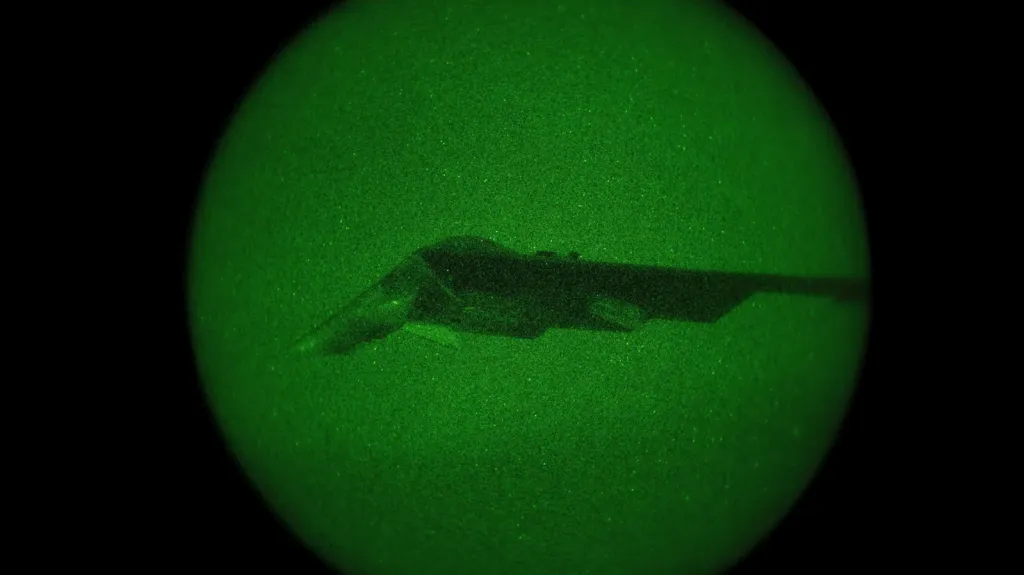
A night vision picture of a B-2 bomber supporting Operation Epic Fury. CENTCOM
“We used more exquisite standoff munitions at the start, but no longer need to,” the secretary proclaimed. “Our stockpiles of those, as well as Patriots [air defense interceptors], remain extremely strong. The enemy can no longer shoot the volume of missiles they once did. Not even close.”
Another big factor in the reduction in Iranian missile launches could be how CENTCOM has concentrated striking command and control (C2) nodes, degrading Tehran’s ability to communicate and direct fires.
Iranian (C2) “structures in a bad way,” Caine posited. “Admiral Cooper has been continuing to pressure the [Islamic Revolutionary Guard Corps] IRGC C2 and other military elements, and will continue to do so.”
A graphic the Pentagon released today offering details about the first 100 hours of Operation Epic Fury against Iran. US Military
As a result of how the operation has unfolded, “CENTCOM is now shifting in day four already from large deliberate strike packages- using standoff munitions at range outside an enemy’s ability to shoot at us – now into stand-in precision strikes overhead Iran.”
Caine said the U.S. is now using “joint direct attack munitions [JDAMs], which are GPS-aided free-fall weapons and other things like [AGM-114] Hellfires, etc. This will allow the joint force to deliver significantly increased precision effects on the target.”
A USAF MQ-9 Reaper fires a AGM-114 Hellfire at a Iranian ballistic missile TEL, which had just revealed its position by firing. pic.twitter.com/gWP4sdxrzh
TWZ has frequently described how important it is for the U.S. to move as quickly as possible from standoff to direct attacks on Iranian targets, which will significantly increase the number of strikes that can occur and widen the range of effects that can be realized via the employment of more varied weaponry. This is especially true for going after fortified targets with bunker buster munitions.
The U.S. Air Force continues to execute a high volume of airstrikes into Iran. The two most powerful air forces in the world (🇺🇸+🇮🇱) are dominating the skies over the world’s largest state sponsor of terror. pic.twitter.com/0nfwY3zdCL
Hegseth further explained that “we moved the vast majority of American troops – over 90% of Americans that were on our bases – off the X out of the range of Iranian fire. Our defensive shield is equally formidable. The most sophisticated air and missile defense network ever fielded. Thousands of Iranian missiles and drones have been intercepted and vaporized, tens of thousands of American allied lives protected. We have pushed every counter-UAS [uncrewed aerial systems] system possible forward, sparing no expense or capability.”
“I know there have been a lot of questions about munitions,” Caine acknowledged. “We have sufficient precision munitions for the task at hand, both on the offense and defense, but I want to tell you teammates, as a matter of practice, I don’t want to be talking about quantities, and I know there’s been a great debate about that, and I appreciate the interest, but just know that we consider that an operational security matter.”
Regardless of the public stance taken by Hegseth and Caine, the Trump administration “plans to meet with executives from the biggest U.S. defense contractors at the White House on Friday to discuss accelerating weapons production, as the Pentagon works to replenish supplies after strikes on Iran and several other recent military efforts,” Reuters reported, citing “five people familiar with the plan.”
(Reuters) – The Trump administration plans to meet with executives from the biggest U.S. defense contractors at the White House on Friday to discuss accelerating weapons production, as the Pentagon works to replenish supplies after strikes on Iran and several other recent…
Still, Trump has gone out of his way to present a problem he has mentioned as being concerning many times before, as a non issue:
“The United States Munitions Stockpiles have, at the medium and upper medium grade, never been higher or better,” Trump said Tuesday on his Truth Social platform. “As was stated to me today, we have a virtually unlimited supply of these weapons. Wars can be fought “forever,” and very successfully, using just these supplies (which are better than other countries finest arms!). At the highest end, we have a good supply, but are not where we want to be. Much additional high grade weaponry is stored for us in outlying countries…”
Following reports from various media outlets that stockpiles of U.S. munitions, including air defense interceptors for Patriot and THAAD systems, were running low, President Trump posted to TruthSocial that the U.S. has a “virtually unlimited supply” and that “wars can be fought… pic.twitter.com/7m6xEjVnfM
So, as it sits today, there is still a race against who will run out of munitions first when it comes to Iran’s long-range strike capabilities, but it seems as if the tide is turning in favor of the U.S., Israel, and the Arab Gulf states based on the information we are seeing. With direct attacks now ramping up on Iranian targets deeper and farther east in Iran, the momentum will more likely than not continue in that direction. This does not address the stockpile’s concerning state in regard to a potential conflict with China or even Russia. It is in a far worse state than it was at the start of this war, and these weapons take years and huge sums of money to build.
The two military leaders also discussed several other topics, including:
“Yesterday, the leader of the unit who attempted to assassinate President Trump has been hunted down and killed,” said Hegseth. “Iran tried to kill President Trump, and President Trump got the last laugh.”
“Over the next 24 to 48 hours, CENTCOM will continue to strike infrastructure and naval capability and will continue to assess our progress against the military objectives,” said Caine.
“Our partners are answering the call to defend themselves right alongside us,” Caine noted. “Jordan, Bahrain, Saudi Arabia, the UAE, Qatar and Kuwait, are all defending their people with their own combat capability, with precision and restraint.”
“We’ve got a lot of autonomous systems, or systems that are that – drones and others incorporated with smart AI aspects to them, but a lot of which I can’t talk about here,” Hegseth stated.
Hegseth addressed Iranian claims that the U.S. struck a girl’s school in southern Iran, killing more than 175 people. “All I can say is that we’re investigating that,” he avowed. “We. of course, never target civilian targets, but we’re taking a look at investigating.”
“I am not going to comment on U.S. boots on the ground,” Caine said. “I think that’s a question for policymakers, and I don’t make policy. I execute policy.”
The rest of our ongoing coverage of the conflict continues below, with the latest updates at the top.
UPDATE: 4:12 PM EST –
U.S. Central Command has issued another set of denials regarding claimed U.S. losses in the ongoing conflict, including that U.S. naval vessels and aircraft have been destroyed by enemy fire.
More fake news from the Iranian regime: 🚫The regime claims U.S. forces are withdrawing. 🚫They say they sank a U.S. destroyer. 🚫IRGC claims to have taken down U.S. fighter aircraft. 🚫The regime says they killed 100 U.S. Marines. ALL LIES.
In another new data point about the apparent slowing pace of Iranian missile launches, the IDF’s Home Front Command says it is easing restrictions on public gatherings and movements imposed at the start of the conflict. Another reassessment is now set to occur on Saturday, which could lead to further easements.
As the rate of Iran’s ballistic missile fire on Israel slows, the IDF Home Front Command says it is easing restrictions that were imposed on the Israeli public at the start of the conflict.
Following a fresh assessment, the Home Front Command says that from tomorrow at noon, the… pic.twitter.com/xYGj9EbZhx
— Emanuel (Mannie) Fabian (@manniefabian) March 4, 2026
Iranian-backed militants in Iraq have threatened to attack the interests of France, Germany, the United Kingdom, and other NATO nations if they “interfere in Iraq or the region,” according to Reuters. Pro-Iranian militants also reportedly carried out a drone attack on a majority Christian neighborhood in Erbil, the capital of Iraq’s northern Kurdish autonomous region.
IRAQ’S ISLAMIC RESISTANCE SAYS ANY ENTITY THAT AIMS TO INTERFERE IN IRAQ OR THE REGION, INCLUDING NATO, FRANCE, GERMANY AND BRITIAN, WOULD HAVE ITS INTERESTS AS ‘LEGITIMATE TARGETS’ FOR THE GROUP
White House press secretary Karoline Leavitt addressed Operation Epic Fury on Tuesday.
“Well, they’re not part of the plan for this operation at this time, but I certainly will never take away military options on behalf of the president of the United States or the commander in chief, and he wisely does not do the same for himself,” she said in response to a question about whether the U.S. military could commit ground troops to the operation. “I know there’s many leaders in the past who liked to take options off of the table without having a full understanding of how things could develop. So again, it’s not part of the current plan, but I’m not going to remove an option for the president to act that is on the table.”
“I don’t want to commit to a timeline, but certainly it’s something that is being calculated actively by both the Department of War and the Department of Energy. They’re working very closely. Both secretaries are in all of the briefings on this subject with the president, and this is again something they’re monitoring,” she also said when asked when U.S. Navy ships might begin escorting commercial vessels through the Strait of Hormuz. “And if and when necessary, the United States Navy will provide assistance to escort oil tankers through the Strait.”
“Obviously, as the president has said numerous times, do we want to see Iran being led by a rogue terrorist regime? No, of course, not,” she said on the topic of regime change. “So any day the United States of America is taking out a terrorist is a good day for our country and a good day for our people.”
When it comes to what role the United States could have after the conflict ends, “I think it’s something the president is actively considering and discussing with his advisors and his national security team,” she added. “But again, right now, the focus minute-by-minute, hour-by-hour, day-by-day, is on ensuring the quick and effective success of Operation Epic Fury.”
Q: Has the president considered how he views a US role in Iran post-conflict?
“I don’t have any updates for you on congressional asks from the president. As you know, under this president, we have significantly increased our defense budget, which is a good thing for the United States, for our national security and for protecting our homeland,” when asked about concerns about stocks of anti-air interceptors. “With respect to munitions, ammunition, weapons stockpiles, the United States of America has more than enough capability to not only successfully execute operation Epic Fury, but to go much further. And we have weapons stockpiles in places that many people in this world don’t even know about.”
Leavitt: “With respect to munitions, the United States has more than enough capability to not only successfully execute Operation Epic Fury but to go much further. We have weapons stockpiles in places that many people in this world don’t even know about. Unfortunately we had a… pic.twitter.com/qNHmQLp1Gc
“I will also add, President Trump has rightfully been calling on defense contractors in this country to rapidly and aggressively produce American-made weapons because they are the best in the world,” she added.
The Israeli Air Force has released pictures showing F-16I jets heading out for strikes on Iran carrying stand-in munitions.
The IDF continues to target Iranian ballistic missile capabilities in the central and western parts of the country.
An “extensive” wave of Israeli airstrikes in central and western Iran earlier today destroyed dozens of Iranian ballistic missile launchers and air defense systems, the military says.
According to the IDF, some of the missile launchers were armed and they were struck while… pic.twitter.com/GeBw8bNYda
— Emanuel (Mannie) Fabian (@manniefabian) March 4, 2026
The IDF has pushed back on the suggestion that attacks from Iran and Iranian-backed Hezbollah militants in Lebanon today were directly coordinated.
“It is true, there was fire at the same time, more or less, you can say simultaneously, from Iran and Lebanon,” IDF Spokesman Brig. Gen. Effie Defrin said at a press conference, according to The Times of Israel. “I don’t possess any intelligence information that says this was coordinated.”
IDF Spokesman Brig. Gen. Effie Defrin says the military has no intelligence indicating that today’s concurrent fire from Iran and by Hezbollah in Lebanon was a coordinated effort.
“It is true, there was fire at the same time, more or less, you can say simultaneously, from Iran…
— Emanuel (Mannie) Fabian (@manniefabian) March 4, 2026
New satellite imagery from Planet Labs shows damage resulting from strikes on an Iranian missile base in Kermanshah.
Planet imagery shows airstrike related damage at the Kermanshah missile base (North), Iran, most of the buildings associated with the site have been destroyed, strikes also extend to the underground tunnel entrances pic.twitter.com/9XfPW1rkbu
Axios has reported that the White House denied reports of back-channel communications with the regime in Iran in response to queries from Israeli authorities.
🇮🇱🇺🇸🇮🇷Netanyahu sought clarifications from the White House earlier this week after intelligence suggested Trump administration officials might be communicating with Iran. The White House told him no such talks had taken place. My story on @axioshttps://t.co/RRvVnXrPEF
“We need to act with clarity, with purpose, and with a cool head. The protection of U.K. nationals is our number one priority,” U.K. Prime Minister Keir Starmer said today. “American planes operating out of British bases, that is the special relationship in action… hanging on to President Trump’s latest words is not.”
Has the PM’s “dithering” response to the week’s events made the UK-US “relationship stronger or weaker?” Tory MP Gareth Bacon asks
Spanish authorities have denied White House claims that they agreed to support current U.S. operations in the Middle East following economic threats from President Donald Trump. Yesterday, Trump had threatened to cut off all trade with Spain after authorities in Madrid blocked the use of bases in the country to support strikes on Iran.
“I categorically deny it. I heard about these statements on my way here, and I’ve had time to look into them and listen to them a little,” Spanish Foreign Minister Jose Manuel Albares said. https://t.co/TS7xwBCyOr
French President Emmanuel Macron has issued a statement after speaking with the leaders of Israel and Lebanon. Macron called on Hezbollah to cease attacks on Israel and for Israel to preserve Lebanon’s territorial integrity.
Israeli Air Force Commander Maj. Gen. Tomer Bar has written that his service’s “special units are currently carrying out extraordinary missions that could ignite the imagination” in a letter, according to Ynet News. No further details about the letter’s origins or how it was obtained are provided. This comes amid other unconfirmed reports of unusual military activity in the Najaf Desert in Iraq. Israeli special operations forces have conducted spectacular raids in the past, including one targeting an Iranian-linked underground missile production facility in Syria in 2024. TWZ noted at the time that this sent a signal to Iran that its critical underground facilities were not untouchable.
MORE: Israeli Air Force commander Maj. Gen. Tomer Bar said today that IAF special forces are currently carrying out “extraordinary missions that could ignite the imagination.”
Israeli Air Force operates elite special units such as Shaldag (Unit 5101) and Unit 669, which conduct… https://t.co/S0Yvx4kZYe
The Israel Defense Forces (IDF) say they have now dropped 5,000 munitions on targets in Iran since the start of the current conflict, and that operations “continue to deepen air superiority throughout Iran, with an emphasis on the Tehran area.” The IDF also continues to release footage from those strikes.
The Israeli Air Force has dropped over 5,000 bombs during strikes in Iran since the start of the conflict, the military says.
The military says that IAF fighter jets “continue to deepen air superiority throughout Iran, with an emphasis on the Tehran area.”
— Emanuel (Mannie) Fabian (@manniefabian) March 4, 2026
An armed Iranian ballistic missile launcher in the Kermanshah area was destroyed by an Israeli Air Force F-35 fighter jet today, the military says. pic.twitter.com/W9BihQbtPI
— Emanuel (Mannie) Fabian (@manniefabian) March 4, 2026
The IDF has also released the video clip below showing a strike on what looks to be one of Iran’s Russian-made Mi-17 Hip helicopters. However, there are questions about whether it may have been a decoy.
Looks like the Israeli Air Force struck a decoy of an Iranian Mil Mi-17 helicopter painted on the ground. pic.twitter.com/mtEznE308A
— Status-6 (War & Military News) (@Archer83Able) March 4, 2026
The IDF has also provided details about targets struck during another round of strikes on Iran’s capital, Tehran.
🎯STRUCK: A large Iranian terror regime military compound in eastern Tehran.
Struck command centers in the compound include:
* The IRGC headquarters * The Intelligence Directorate headquarters * The ‘Basij’ headquarters * The ‘Quds Force’ headquarters * The Internal Security… pic.twitter.com/XBvXqks29R
The Israeli Air Force says it carried out “large-scale” airstrikes in Tehran targeting a massive Iranian military compound, which housed headquarters and personnel from across Iran’s security apparatus.
— Emanuel (Mannie) Fabian (@manniefabian) March 4, 2026
Israeli forces are also continuing to conduct ground operations in southern Lebanon, ostensibly targeting Iranian-backed Hezbollah militants.
The IDF publishes footage of its new deployment in southern Lebanon, after Hezbollah began attacking Israel.
Troops have pushed deeper into southern Lebanon in recent days, with the IDF saying it assumed “forward defensive positions to establish an additional defensive layer to… pic.twitter.com/cnsKfLXgfB
— Emanuel (Mannie) Fabian (@manniefabian) March 4, 2026
The IDF says Lebanese civilians in all of southern Lebanon should evacuate to north of the Litani River, amid the ongoing fighting against Hezbollah. pic.twitter.com/d9eTOzSo92
— Emanuel (Mannie) Fabian (@manniefabian) March 4, 2026
U.S. Central Command also continues to release footage from strikes on targets in Iran.
While the Iranian regime indiscriminately targets civilians with missiles and drones, U.S. forces continue to aggressively hunt and destroy Iranian missile launchers with precision. pic.twitter.com/1RIhMcg0Jm
CENTCOM has also now explicitly confirmed the use of Precision Strike Missile (PrSM) short-range ballistic missiles in strikes on Iran. This detail had already emerged, as TWZ previously reported.
In a historic first, long-range Precision Strike Missiles (PrSMs) were used in combat during Operation Epic Fury, providing an unrivaled deep strike capability.
“I just could not be prouder of our men and women in uniform leveraging innovation to create dilemmas for the enemy.”… pic.twitter.com/bydvIv5Tn5
Israeli authorities are still planning around one to two more weeks of operations against Iran, at least, according to the Times of Israel.
The Israeli military is planning for at least one or two more weeks of operations in Iran, during which it aims to hit thousands more Iranian regime targets, The Times of Israel has learned.
Israel’s goal is a systematic degradation of the Iranian regime and its military sites.…
— Emanuel (Mannie) Fabian (@manniefabian) March 4, 2026
Imagery continues to emerge, said to show strikes on targets in Iran’s capital, Tehran.
Massive clouds of smoke rising over several neighborhoods of the capital of Iran, Tehran, following continued American/Israeli strikes on Wednesday. pic.twitter.com/ksuZvvFiZh
— Status-6 (War & Military News) (@Archer83Able) March 4, 2026
US/Israeli airstrike this morning in Tehran, targeting an Iranian site in the government and military-heavy District 4. pic.twitter.com/uWKAM0aj9n
The video below is said to show the crew of a commercial vessel somewhere in the Middle East watching as U.S. Tomahawk land attack cruise missiles pass overhead toward targets in Iran.
The Telegraph newspaper in the United Kingdom has reported that U.S. Air Force B-2 bombers could soon be flying strikes on Iran from RAF Fairford in that country, as well as Diego Garcia in the Indian Ocean. There were reports in the lead-up to the current conflict, that British authorities had denied use of those same bases to support any future operations against Iran.
BREAKING: American B-2 stealth bombers are expected to land at British military bases “in a matter of days” to join attacks on Iran. Bases at Diego Garcia and at RAF Fairford, in Gloucestershire, are being prepared for their arrival, Western officials said today.
“Based on analysis of [the] latest available satellite imagery, IAEA [International Atomic Energy Agency] sees no damage to facilities containing nuclear material in Iran and therefore no radiological release risk at this time,” according to a new statement from the Agency today. “Near [the] Isfahan nuclear site, damage is visible at two buildings. No additional impact detected at Natanz after previously reported damage at entrances, and no impact at other nuclear sites, including [the] Bushehr NPP [nuclear power plant].”
Based on analysis of latest available satellite imagery, IAEA sees no damage to facilities containing nuclear material in Iran and therefore no radiological release risk at this time. Near Isfahan nuclear site, damage is visible at two buildings. No additional impact detected at… pic.twitter.com/boUtjRTpAk
— IAEA – International Atomic Energy Agency ⚛️ (@iaeaorg) March 4, 2026
CNN has reported again on the possibility of armed Iranian Kurdish groups launching a ground incursion in support of the current U.S.-Israeli operation, citing an unnamed source. That outlet has also reported that the U.S. Central Intelligence Agency has been working to arm those groups.
Asked about this today, Hegseth told reporters that “none of our objectives are premised on the support of the arming of any particular force. So what other entities may be doing, we’re aware of, but our objectives aren’t centered on that.” https://t.co/76MI2irOKE
Saudi Arabian authorities say they intercepted two Iranian cruise missiles in the vicinity of Al Kharj, a city situated near Prince Sultan Air Base. That base has been a major hub for U.S. air operations in the current conflict.
BREAKING: Saudi Ministry of Defense says two cruise missiles were intercepted and destroyed in Al-Kharj, a town near Prince Sultan Airbase
The New York Times says satellite imagery that it has reviewed shows damage to several radars, as well as communications systems and other facilities, at multiple military bases in the region as a result of Iranian retaliatory attacks.
A tent surrounded by satellite dishes was destroyed at Al Udeid Air Base in Qatar. Some of the dishes were most likely damaged as well. Al Udeid is the regional headquarters for the US Central Command, and was similarly struck by Iran last June. pic.twitter.com/TyuqZWHUL3
Ali Al Salem Air Base in Kuwait sustained damage to at least eight buildings or structures adjacent to satellite communications infrastructure. pic.twitter.com/oToNYRLTQg
An AN/TPY-2 radar system appears to have been stationed next to a building at a military installation outside of Al Ruwais, UAE since June of last year. Sat imagery from Sunday shows a building adjacent to it had been damaged (unclear if radar was hit) pic.twitter.com/Bp80VxDdU1
While this analysis is not comprehensive (as evidenced by what appears to be yet another radar system damaged during the strikes visible in newly released sat imagery!), it does suggest Iran has been aiming to disrupt US communication and coordination https://t.co/cb2ToNwP9p
Qatar has reportedly fully halted gas liquefaction in the country, according to Reuters. It could take up to a month for production to return to normal levels once the decision is made to do so, as well.
NEW: Qatar will fully shut gas liquefaction, two sources say. Initial estimates suggest it would take about two weeks to restart operations and at least another two weeks to return to full capacity – Reuters
The United Kingdom Marine Trade Operations (UKMTO) organization, which is managed by the Royal Navy, says it has received reports of another ship coming under attack in the Strait of Hormuz.
Dutch authorities are reportedly considering a request from France to deploy military assets to help safeguard commercial shipping, according to The New York Times. There are also reports that a Dutch warship could take up station in the Eastern Mediterranean to bolster defenses against Iranian threats.
The Netherlands is weighing a request from French President Emmanuel Macron to use its military to help secure international shipping routes, according to the New York Times.
The Netherlands is preparing to send HNLMS Evertsen (F805) with France’s CSG to the Eastern Mediterranean as part of a defensive deployment against Iranian attacks.
Notably, Evertsen will be able to provide ballistic missile tracking and engagement data. pic.twitter.com/0wWxZuOcSN
“EUNAFOR [European Naval Forces] ASPIDES assets in the area of operation monitors the situation, remain on high alert and stand ready to contribute within means and capabilities to protect lives at sea, contributing to freedom of navigation and enhancing Maritime Security through one of the most vital and vulnerable sea trade corridors,” a spokesperson for the European Union-led Operation Aspides has told TWZ. “ASPIDES conducts daily assessments of potential risks, making necessary operational adjustments where required.”
In the event of a resumption of Houthi attacks – which remains a possibility – we are present and ready to implement our mandate,” they added, referring to Iranian-backed militants in Yemen. “There [is] no such tasking (escort ships through or near the Strait of Hormuz) for ASPIDES.”
“We expect significantly higher costs i.e. for bunker, insurance, container storage at different ports due to closed or unreachable ports” and “delays have to be expected especially in the Middle East, but also in other trades,” German shipping company Hapag-Lloyd has also told TWZ. “All ports within [the] Persian Gulf can not be served. This is why we need to find alternates [sic] in the region. Many other ports [are] not being served as well. We have a booking stop for all import/export cargo in the region.”
Danish shipping company Maersk is also “suspending most cargo bookings in and out of the United Arab Emirates, Oman, Iraq, Kuwait, Qatar, Bahrain and Saudi Arabia until further notice,” according to Reuters.
COPENHAGEN, March 4 (Reuters) – Maersk said on Wednesday it is temporarily suspending most cargo bookings in and out of the United Arab Emirates, Oman, Iraq, Kuwait, Qatar, Bahrain and Saudi Arabia until further notice.
All of this follows comments yesterday from U.S. President Donald Trump about the possibility of U.S. Navy ships escorting commercial vessels through the Strait of Hormuz, which you can read more about here.
The American Jewish Committee has compiled data from open sources regarding total Iranian ballistic missile launches at countries in the region. Though the full tallies may be incomplete, the indication is that the United Arab Emirates has been most heavily targeted so far.
Nearly 50% of the missiles and UAVs fired by the Iranian regime have been aimed at the UAE.
Tehran’s actions threaten U.S. partners across the region and put broader Middle East stability at risk. pic.twitter.com/s581ZmMAjl
— American Jewish Committee (@AJCGlobal) March 3, 2026
Turkish Authorities say that “NATO air and missile defense elements” intercepted a “ballistic munition” that had been tracked passing over Iraq and Syria in the direction of the Eastern Mediterranean. Debris subsequently fell inside Turkish territory.
There are reports that the weapon was aimed at Cyprus, but went off course. Turkish Foreign Minister Hakan Fidan subsequently spoke by phone with his Iranian counterpart, Foreign Minister Abbas Araghchi, and warned against “any steps that could lead to the spread of the conflict.”
A Turkish official, speaking to AFP on condition of anonymity, said the missile had been “aimed at a base in Greek Cyprus but veered off course”. https://t.co/Q7rj2j3OSB
A ballistic missile from Iran crossing Iraq and Syria was intercepted by NATO in the Eastern Mediterranean before entering Turkish airspace. No casualties reported. Türkiye summoned Iran’s ambassador and called for restraint.https://t.co/JTBeeYVDKx
Local media in Cyprus has reported that Greek F-16 fighters now operating in the country intercepted two incoming drones earlier today.
The New York Times has reported that there have been back-channel, indirect talks between U.S. and Iranian officials, including members of the respective intelligence services, about possible off-ramps to the current conflict. That report also says that American authorities are so far skeptical. Iran’s quasi-official Tasnim News Agency says the country’s Intelligence Ministry has denied that any such talks are taking place.
NEW: The Secret Channel Between Iran and the US
In public, Iran’s surviving leaders have defiantly refused to negotiate with President Trump to end the American and Israeli assault on their country. But a day after the attacks began, operatives from Iran’s Ministry of…
Iran denies that its Intelligence Ministry reached out to the CIA for talks, Iran’s semi-official Tasnim news agency reports, citing a ministry source.
“Iran’s future must not be decided outside its borders” and the international community’s support should “go to the people, not to geopolitical calculations,” Farah Pahlavi, widow of Mohammad Reza Pahlavi, the last Shah of Iran, has said in an interview with AFP in France.
She has also said that the death of Iranian Supreme Leader Ayatollah Ali Khamenei is “a moment of historic significance,” but “does not automatically mean the end of a system.”
➡️ Elle estime aussi que la mort du guide suprême Ali Khamenei constitue “un moment d’une portée historique” mais “ne signifie pas automatiquement la fin d’un système”.
“The government of the Republic of Korea, with grave concern, is closely monitoring the developments in the Middle East involving the United States, Israel, and Iran, and is actively undertaking multifaceted efforts to ensure the safety and protection of Korean nationals currently in the region, as well as to safeguard our economic security, including the stable supply of energy resources,” that country’s Ministry of Foreign Affairs has said in a statement.
The government of the Republic of Korea, with grave concern, is closely monitoring the developments in the Middle East involving the United States, Israel, and Iran, and is actively undertaking multifaceted efforts to ensure the safety and protection of Korean nationals currently… pic.twitter.com/iyhfpjvOhc
The Hollywood star was on the BBC programme’s sofa on Wednesday (March 4) to promote her latest television project The Madison, in which she stars alongside Kurt Russell, reports Wales Online.
However, whilst she was talking to the show’s presenters Alex Jones and Clara Amfo, viewers found themselves distracted by her timeless beauty. Many took to X, which was previously known as Twitter, expressing disbelief at how young the 67-year-old actress appeared.
One viewer wrote on the platform: “Dang Michelle Pfeiffer is still hot even at almost 70.”
“Michelle is unreal I mean look at her,” another enthused, whilst a fellow admirer noted: “I’m amazed how beautiful Michelle Pfeiffer looks on The One Show tonight x.”
“How does Michelle still look so amazing,” questioned one fan, whilst another revealed: “Michelle Pfeiffer in Grease 2 was my first crush oof!”
“Michelle Pfeiffer is so great and beautiful!” gushed another fan, as one viewer noted that the star “still looks great”.
“Love her,” said someone else, as another fan posted: “I b***** adore Michelle Pfeiffer.”
Another fan wrote: “Michelle Pfeiffer looks amazing. She looks so at ease on the sofa and interviews really well. I bet she’s great to work with. A seasoned professional.”
Her new series The Madison centres on the Clyburn family, who relocate from New York to Montana following a tragedy in the family.
Hollywood star Michelle opened up about the role and the show as she appeared on The One Show, explaining: “I play Stacy Clyburn, and I am the matriarch of the family based in New York, and a tragedy fractures the family, and then actually pulls it back together in ways that were unexpected.”
The star went on: “And, you know, it’s a story about, you know, it’s tender and visceral and actually unexpectedly funny at times, and it is a story about self-discovery and the messy and profound work to rebuild everything that you knew that has fallen apart.”
For the latest showbiz, TV, movie and streaming news, go to the new **Everything Gossip** website
Russian President Vladimir Putin said that the sinking of a Russian gas tanker in the Mediterranean Sea was the result of a terrorist attack by Ukraine. The tanker sank between Libya and Malta after explosions and fire were observed by Libyan port officials. File Photo by Sergei Ilnitsky/EPA
March 4 (UPI) — A Russian liquefied natural gas tanker sank in the Mediterranean Sea on Wednesday after catching fire from what Russian officials said was an attack by Ukrainian drones.
Libyan port officials said there were explosions on the ship and it ultimately erupted in flames between Libya and Malta. The tanker was carrying about 62,000 metric ton of liquefied natural gas.
Thirty crew members were rescued and no deaths have been reported, TASS Russian News Agency reports.
Ukraine‘s security service has not commented on the incident.
The Russian Transport Ministry said in a statement that the tanker was attacked by unmanned Ukrainian boats.
The tanker was about 130 nautical miles north of the Sirte, Libya, port when it sank. It departed from the port of Murmansk, Russia.
“We qualify what happened as an act of international terrorism and maritime piracy, a gross violation of the fundamental norms of international maritime law,” the Russian Transport Ministry said in a statement.
“Such criminal actions, carried out with the connivance of the authorities of European Union member states, must not remain without assessment by the international community.”
Russian President Vladimir Putin echoed the statement of the transport ministry, calling it a “terrorist attack.”
The ministry adds that the tanker was operating in “full compliance with all international regulations.”
As part of its sixth-anniversary celebrations, HumAngle, Africa’s leading conflict and humanitarian crises reporting newsroom, held a training session on “ethical dilemmas in conflict reporting” on Tuesday, March 3, in Abuja, North Central Nigeria.
The session, which brought together HumAngle editors and reporters, was led by award-winning journalist Sally Hayden and focused on the challenges and responsibilities of reporting from conflict zones.
Founded in 2020, HumAngle has been at the forefront of covering insurgency and mass displacement, publishing investigations and exposés on state failure, human rights violations, climate vulnerability, abductions, disappearances, and systemic corruption.
According to Ahmad Salkida, Founder and CEO of HumAngle, the training is part of its bold agenda to transform the newsroom into a lasting knowledge institution.
“The initiative reflects our commitment to equipping journalists with skills that align with global standards, ensuring they are prepared to navigate the complexities of reporting in conflict-affected regions while maintaining professional integrity,” he said.
Ahmad Salkida, Founder and CEO of HumAngle. Photo: Al’amin Umar/HumAngle
Ahmad also revealed that over the last six years, HumAngle has consistently shifted the world’s gaze to underreported stories, fought for accountability, and demanded justice. “When we started HumAngle, we knew the road would be tough, but we also knew it was necessary. We set out to create a platform that would not only report the news but transform it into a tool for change,” he added.
The CEO also highlighted plans to strengthen digital security and newsroom resilience by expanding the scope and quality of fellowships and investing in capacity-building initiatives. He added that a key part of this vision is establishing permanent institutional infrastructure, which he described as critical to sustaining HumAngle’s mission and impact in the long term.
“Going forward, our newsroom focus will be on scaling investigative capacity across the Sahel, expanding immersive and data-driven storytelling, and deepening transitional and reparative justice and reporting,” he noted.
Through interactive discussions, Sally unpacked the ethical grey zones that define conflict reporting: access negotiated under restrictive conditions, the burden of bearing witness, and the solitude of decision-making in volatile environments. Drawing on years of reporting from Iraq, Syria, Sudan, Burkina Faso, Lebanon, Palestine, Nigeria, and beyond, she shared practical frameworks for risk assessment, personal safety, and editorial judgement.
Sally Hayden, during a training with HumAngle journalists on Tuesday, March 3. Photo: Al’amin Umar/HumAngle
“Sometimes, you face situations that no one has ever faced because you’re the only one in that specific place at that specific time, so sharing experiences helps other journalists who may be there some day,” she reflected.
Drawing on her years of experience covering conflict-affected regions such as Iraq, Syria, and Sudan, among others, risk assessment and decision-making were also central to the discussions, equipping attendees with frameworks to evaluate personal and organisational safety in volatile contexts.
One such moment came in 2025, when she reported from a Syrian prison housing suspected Islamic State members. The access was conditional.
“We were told we could go to the prison as long as we followed certain rules. We could not ask how the prisoners were or about other things. Most importantly, we could not tell them about current events. We were told this was for security reasons.”
Sally and the attendees further discussed how ethical reporting in conflict zones demands constant negotiation between access, accuracy, and accountability.
Equally pressing was the psychological toll of the work. She spoke candidly about trauma, burnout, and the importance of self-awareness. In conflict reporting, she stressed, it does not merely document suffering; it absorbs it.
“When you’re constantly surrounded by insecurity, it can be helpful to find something to do rather than constantly be lost,” she advised, urging journalists to cultivate routines and boundaries that protect their mental health.
HumAngle journalists during the training session with Sally Hayden. Photo: Al’amin Umar/HumAngle.
According to Saduwo Banyawa, HumAngle’s Adamawa and Taraba Correspondent, the conversation made her realise that “it is okay to feel stuck as a journalist at times and when one gets unnecessarily pressured or has their mental health strained, they should prioritise self-care.”
Over the years, HumAngle has prioritised the mental well-being of reporters and other team members through an Employee Assistance Programme, which offers confidential, one-on-one counselling sessions with our in-house licensed clinical psychologist.
Recently, the newsroom introduced an Anti-Burnout Work Policy that has embedded a three-month rest period into newsroom staff contracts while still providing full annual pay.
“HumAngle’s reporters routinely work in and around conflict zones, camps for displaced people, and communities living with violence and trauma. This kind of journalism demands not just technical skill but emotional stamina and deep empathy, and the costs are often borne silently,” the CEO noted.
Get our in-depth, creative coverage of conflict and development delivered to you every weekend.
Subscribe now to our newsletter!
Reflecting on the training, Sabiqah Bello, Multimedia Reporter, described it as both relevant and validating to the experiences of conflict reporters.
“It was particularly insightful because it came from a journalist with extensive, cross-regional experience covering conflict and war, and who has had to confront the realities of that work firsthand. It was especially valuable that we explored ethical dilemmas faced in conflict reporting,” she added.
As part of its sixth-anniversary celebrations, HumAngle, a leading African conflict and humanitarian crisis reporting newsroom, held a training on “ethical dilemmas in conflict reporting” in Abuja, led by journalist Sally Hayden.
The session gathered HumAngle editors and reporters to discuss the challenges of reporting in conflict zones and emphasized maintaining professional integrity. Founded in 2020, HumAngle aims to transform its newsroom into a lasting knowledge institution and is investing in digital security, quality of fellowships, and capacity building.
Ahmad Salkida, HumAngle’s Founder, highlighted the organization’s role in spotlighting underreported stories, accountability, and justice, with plans to enhance investigative reporting and storytelling. Sally Hayden shared frameworks for risk assessment and editorial judgment based on her extensive experience in conflict areas like Iraq, Syria, and Sudan. The session also addressed the psychological toll on journalists and the importance of self-care. HumAngle supports its team with an Employee Assistance Programme and an Anti-Burnout Work Policy, ensuring their reporters are both technically skilled and emotionally resilient.
By day, you’d be forgiven for walking past the newest theater in downtown L.A.
It isn’t hidden in an alley or obscured via a nameless door. No, this performance space is essentially a theater in disguise, as it’s designed to look like an electrical box — a fabrication so real that when artist S.C. Mero was installing it in the Arts District, police stopped her, concerned she was ripping out its copper wire. (There is no copper wire inside this wooden nook.)
Open the door to the theater, and discover a place of urban enchantment, where a red velvet door and crimson wallpaper beckon guests to come closer and sit inside. That is, if they can fit.
With a mirror on its side and a clock in its back, Mero’s creation, about 6 feet tall and 3 feet deep yet smaller on its interior, looks something akin to an intimate, private boudoir — the sort of dressing room that wouldn’t be out of place in one of Broadway’s historic downtown theaters. That’s by design, says Mero, who cites the ornately romanticized vibe and color palette of the Los Angeles Theatre as prime inspiration. Mero, a longtime street artist whose guerrilla art regularly dots the downtown landscape, likes to inject whimsy into her work: a drainage pipe that gives birth, a ball pit for rats or the transformation of a dilapidated building into a “castle.” But there’s just as often some hidden social commentary.
With her Electrical Box Theatre, situated across from the historic American Hotel and sausage restaurant and bar Wurstküche, Mero set out to create an impromptu performance space for the sort of experimental artists who no longer have an outlet in downtown’s galleries or more refined stages. The American Hotel, for instance, subject of 2018 documentary “Tales of the American” and once home to the anything-goes punk rock ethos of Al’s Bar, still stands, but it isn’t lost on Mero that most of the neighborhood’s artist platforms today are softer around the edges.
Ethan Marks inside S.C. Mero’s theater inside a fake electrical box. The guerrilla art piece is near the American Hotel.
“A lot of galleries are for what can sell,” Mero says. “Usually that’s paintings and wall art.”
She dreamed, however, of an anti-establishment place that could feel inviting and erase boundaries between audience and perfomer. “People may be intimidated to get up on a stage or at a coffee shop, but here it’s right on street level.”
It’s already working as intended, says Mero. I visited the box early last week when Mero invited a pair of experimental musicians to perform. Shortly after trumpeter Ethan Marks took to the sidewalk, one of the American Hotel’s current residents leaned out his window and began vocally and jovially mimicking the fragmented and angular notes coming from the instrument. In this moment, “the box,” as Mero casually refers to it, became a true communal stage, a participatory call-and-response pulpit for the neighborhood.
Clown Lars Adams, 38, peers out of S.C. Mero’s theater inside a fake electrical box. Mero modeled the space off of Broadway’s historic theaters.
A few days prior, a rideshare driver noticed a crowd and pulled over to read his poetry. He told Mero it was his first time. The unscripted occurrence, she says, was “one of the best moments I’ve ever experienced in making art.”
“That’s literally what this space is,” Mero says. “It’s for people to try something new or to experiment.”
Marks jumped at the chance to perform for free inside the theater, his brassy freewheeling equally complementing and contrasting the sounds of the intersection. “I was delighted,” he says, when Mero told him about the stage. “There’s so much unexpectedness to it that as an improviser, it really keeps you in the moment.”
A downtown resident for more than a decade, Mero has become something of an advocate for the neighborhood. The area arguably hasn’t returned to its pre-pandemic heights, as many office floors sit empty and a string of high-profile restaurant closures struck the community. Mero’s own gallery at the corner of Spring and Seventh streets shuttered in 2024. Downtown also saw its perception take a hit last year when ICE descended on the city center and national media incorrectly portrayed the hood as a hub of chaos.
Artist S.C. Mero looks into her latest project, a fake electrical box in the Arts District. Mero has long been associated with street art in the neighborhood.
“A lot has changed in the 13 years when I first got down here,” Mero says. “Everybody felt like it was magic, like we were going to be part of this renaissance and L.A. was going to have this epicenter again. Then it descended. A lot of my friends left. But I still see the same beauty in it. The architecture. The history. Downtown is the most populous neighborhood in all of L.A. because it belongs to everybody. It’s everybody’s downtown, whether they love it or not. And I feel we are part of history.”
Art today in downtown ranges from high-end galleries such as Hauser & Wirth to the graffiti-covered towers of Oceanwide Plaza. Gritty spaces, such as Superchief Gallery, have been vocal about struggles to stay afloat. Mero’s art, meanwhile, remains a source of optimism throughout downtown’s streets.
At Pershing Square, for instance, sits her “Spike Cafe,” a mini tropical hideaway atop a parking garage sign where umbrellas and finger food props have become a prettier nesting spot for pigeons. Seen potentially as a vision for beautification, a contrast, for instance, from the nature intrusive barbs that aim to deter wildlife, “Spike Cafe” has become a statement of harmony.
Elsewhere, on the corner of Broadway and Fourth streets, Mero has commandeered a once historic building that’s been burned and left to rot. Mero, in collaboration with fellow street artist Wild Life, has turned the blighted space into a fantastical haven with a knight, a dragon and more — a decaying castle from a bygone era.
“A lot of times people are like, ‘I can’t believe you get away with that!’ But most people haven’t tried to do it, you know?” Mero says. “It can be moved easily. It’s not impeding on anyone. I don’t feel I do anything bad. Not having a permit is just a technicality. I believe what I’m doing is right.”
Musician Jeonghyeon Joo, 31, plays the haegeum outside of S.C. Mero’s latest art project, a theater in a faux electrical box.
After initially posting her electrical box on her social media, Mero says she almost instantly received more than 20 requests to perform at the venue. Two combination locks keep it closed, and Mero will give out the code to those she trusts. “Some people want to come and play their accordion. Another is a tour guide,” Mero says.
Ultimately, it’s an idea, she says, that she’s had for about a decade. “Everything has to come together, right? You have to have enough funds to buy the supplies, and then the skills to to have it come together.”
And while it isn’t designed to be forever, it is bolted to the sidewalk. As for why now was the right time to unleash it, Mero is direct: “I needed the space,” she says.
There are concerns. Perhaps, Mero speculates, someone will change the lock combination, knocking her out of her own creation. And the more attention brought to the box via media interviews means more scrutiny may be placed on it, risking its confiscation by city authorities.
As a street artist, however, Mero has had to embrace impermanence, although she acknowledges it can be a bummer when a piece disappears in a day or two. And unlike a gallerist, she feels an obligation to tweak her work once it’s out in the world. Though her “Spike Cafe” is about a year old, she says she has to “continue to babysit it,” as pigeons aren’t exactly known for their tidiness.
But Mero hopes the box has a life of its own, and considers it a conversation between her, local artists and downtown itself. “I still think we’re part of something special,” Mero says of living and working downtown.
And, at least for now, it’s the neighborhood with arguably the city’s most unique performance venue.
March 4 (UPI) — NATO air and missile defenses intercepted a ballistic missile launched from Iran heading toward Turkish airspace on Wednesday.
The Turkish Ministry of National Defense announced that the ballistic missile had crossed Iraqi and Syrian airspace before being neutralized by NATO air defenses posted in the Mediterranean Sea. There were no casualties or injuries.
“Our resolve and capacity to ensure the security of our country and citizens are at the highest level,” the Ministry of Defense said in a press release translated from Turkish. “While Turkey supports regional stability and peace, it is capable of ensuring the security of its territory and citizens, regardless of who or where the threat comes from.”
The ministry did not say what it believed the intended target of the missile to be.
The Iranian missile is the first fired toward NATO territory since the conflict began. It followed a warning from Tehran that European countries supporting the United States and Israel would face retaliation from Iran.
Iran has launched missiles and drones toward countries in the Middle East that have a U.S. military presence in response to the U.S. and Israeli strikes on Iran.
“NATO stands firmly with all allies, including Turkey, as Iran continues its indiscriminate attacks across the region,” Allison Hart, NATO spokeswoman, said in a statement. “Our deterrence and defense posture remains strong across all domains, including when it comes to air and missile defense.”
After being intercepted, debris from the missile fell in the Turkish province Hatay in south-central Turkey near the Syrian border.
Turkish President Recep Tayyip Erdogan said in a social media post on Tuesday that he wishes to see a diplomatic solution to the ongoing conflict.
“We do not wish to witness conflict, war, tension and massacre right next door,” Erdogan said. “Our stance on the illegal attacks targeting Iran is also in this direction.
Former South African president Nelson Mandela speaks to reporters outside of the White House in Washington on October 21, 1999. Mandela was famously released from prison in South Africa on February 11, 1990. Photo by Joel Rennich/UPI | License Photo