Leicester City legend Jamie Vardy has won big with his new podcastCredit: PAHis new podcast, Jamie Vardy’s Having A Party, has seen the first episode listened to more than 8.4million times in a weekCredit: Getty
The pair are understood to have signed a seven-figure deal with media giant Banijay for the series, which launched on June 9.
It’s now been revealed that the first episode has clocked up over 8.4million streams across podcast platforms in the first seven days.
A source said: “Jamie and Becky could not be more happy with the success of their ITV show, and now the podcast figures have really given them a boost.
“It just serves to show they have a massive following.
“For the first week of a new podcast those numbers are fantastic. And, as for Banijay, they will be delighted with the initial return on their investment.”
The launch of the podcast, which will also feature regular guest appearances from Rebekah, 44, comes just a week after ITV aired three-part documentary The Vardys.
The show followed the family during his first year in Italy after he joined Serie A newcomers Cremonese.
That series – which consolidated at more than 1.1 million viewers – has proved to be an even bigger hit on the network’s streaming service ITVX – behind only entertainment juggernauts I’m A Celebrity, Britain’s Got Talent and Celebrity Sabotage in the ratings.
The next footballing destination for Leicester City legend Vardy – now 39 – is currently unknown.
However, the series and podcast illustrate his determination to build, with Rebekah, a powerful post-football brand – even whilst continuing to terrorise defences.
His wife Rebekah features in the podcast, which was released after their ITV series The Vardys delved into the aftermath of the Wagatha Christie High Court battleCredit: GettyVardy went head-to-head will Coleen Rooney in courtCredit: Alamy
Speaking of the podcast, Jamie said: “I am still an active player but having an opportunity to chat football and have a banter off the pitch is something that I am really looking forward to.”
Kenya stops constructing US-run Ebola site amid public outcry; $13.5m US funding is criticised as masking health risks.
Published On 23 Jun 202623 Jun 2026
Kenya has ordered a halt to preparations for a United States-run Ebola quarantine facility, the health minister has told a court after being held in contempt for ignoring a previous stop-work order.
The announcement on Tuesday comes amid strong opposition to the plan in Kenya. Deadly protests have taken place since the government confirmed plans to build the facility for potential US citizens evacuated from the Democratic Republic of the Congo (DR Congo), which is grappling with a major Ebola outbreak.
Recommended Stories
list of 3 itemsend of list
The quarantine facility was being constructed at Laikipia airbase, about 200 kilometres (124 miles) from the capital, Nairobi, with some 50 isolation beds. It was expected to be managed by US medical staff.
“I have directed the immediate and complete cessation of any intended construction, site preparation, or related activities concerning the Laikipia airbase facility pending the hearing and determination of the substantive petition or until further orders of this court,” Health Minister Aden Duale said.
The minister spoke in court a day after he was held in contempt for failing to respond to multiple orders in late May and early June to halt activities.
Rights groups had petitioned the court, saying the facility was being developed secretly and without consultation. Kenyan doctors and medical professionals have been especially outspoken about the proposed Nanyuki site, arguing it would threaten the country’s already fragile health system.
Three people have been killed in unrest near the facility in Laikipia.
Civilians and healthcare workers have expressed anger over the prospect of importing the virus and criticised the Kenyan government’s acceptance of a $13.5m Ebola preparedness contribution from the US as whitewashing the deal. So far, the country has not recorded a case of Ebola.
The Ebola outbreak was confirmed in DR Congo in May. It has led to 1,048 confirmed cases and at least 267 deaths as of June 22, according to the Health Ministry. At least 75 healthcare workers in DRC have contracted the virus, with 17 deaths recorded.
Uganda – which neighbours Kenya – has reported 20 confirmed cases, including two deaths.
Weekly insights and analysis on the latest developments in military technology, strategy, and foreign policy.
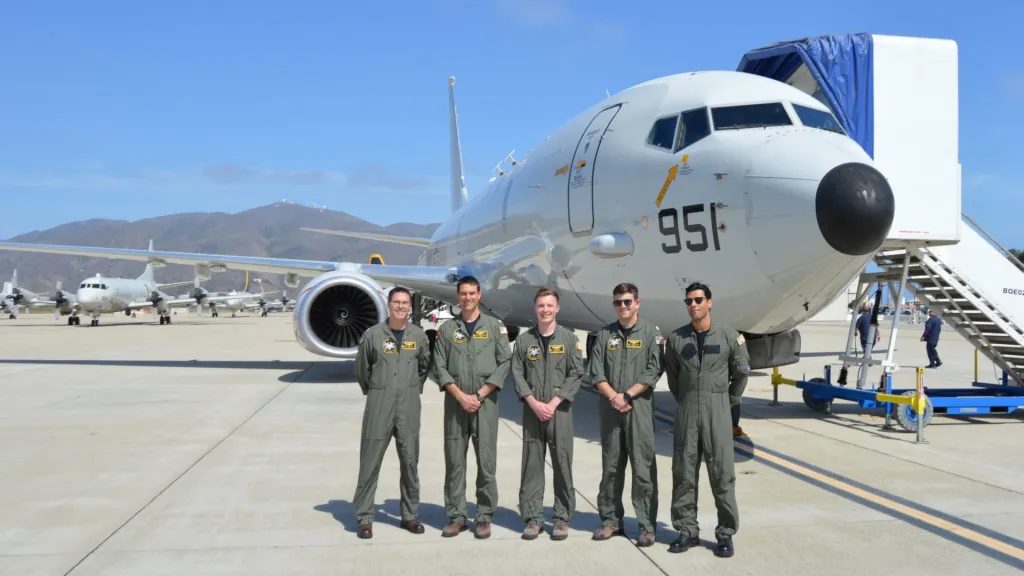
The very first P-8A Poseidon aircraft is now assigned to Air Test and Evaluation Squadron 30 (VX-30), the “Bloodhounds.” TWZ was first to report last year that VX-30 was in line to get two P-8As to support long-range missile and other testing efforts. The aircraft will help the squadron address the increasing difficulties it is facing with its aging P-3 Orion aircraft. Only a handful of P-3s remain in service anywhere in the Navy, and are becoming increasingly challenging to operate and maintain.
VX-30 shared pictures of the P-8A arriving at its home base in Point Mugu, California, on its Facebook page last week. Naval Air Station Point Mugu, part of Naval Base Ventura County, sits right on the southern California coast with direct access to the expansive Point Mugu Sea Range. The Navy and other branches of the U.S. military, as well as defense contractors, regularly use the offshore ranges for missile and other tests, which the Bloodhounds support. Aircraft from VX-30 also often deploy to other locations around the world to support test and evaluation activities, including in other U.S. military range complexes in the Pacific Ocean around Hawaii and in the Atlantic Ocean off the coast of Florida.
Members of VX-30 pose in front of the squadron’s ‘new’ P-8A. USN
As noted, the P-8A now assigned to VX-30 is actually the very first Poseidon ever built and is also known as T-1. The aircraft, which made its maiden flight in 2009, was used for years to support the Poseidon program. The Bloodhounds are also in line to get the second test P-8A, which is also still referred to as T-2. We will come back to this in a moment.
VX-30 already operates a variety of planes specially configured to support test missions, including the aforementioned P-3s. The unit also has KC-130T Hercules tanker/transports, as well as its one-of-a-kind NC-20G and NC-37B jets. The NC-37B was specifically acquired to replace one of the squadron’s NP-3D Orions, a variant nicknamed the “Billboard” because of its heavily modified tail. The NC-20G and the NC-37B reflect a larger push to revamp the Bloodhounds’ fleets in recent years.
Collectively, VX-30’s aircraft are equipped with a mix of radars, cameras, and other equipment to collect imagery, telemetry, and other data during tests. They have communications and data-sharing suites to be able to pass information along to test facilities on land to aid with live monitoring and for deeper analysis.
Some of VX-30’s existing aircraft (from left to right: the NC-37B, a P-3C, and a KC-130T). Katie Archibald/USN
Aircraft assigned to VX-30 are also used for what is called range surveillance and clearance missions to keep unwanted visitors and errant bystanders out of the way in the air and down below during tests. This is where the P-8As will come in, at least initially.
“Both aircraft will perform the Range Surveillance & Clearance mission as well as dedicated testing for Naval Air Systems Command programs supported by P-3 today,” a NAVAIR spokesperson told TWZ last year. “T-1, the airworthiness P-8 aircraft, will have a radar modification to integrate an APY-10 in the airframe, as one does not currently exist. This will provide T-1 with a supportable radar configuration and capability that mirrors the baseline P-8 fleet. T-2 will be unmodified.”
Raytheon’s AN/APY-10 is the standard maritime search radar used on the P-8A, and is primarily designed to spot and track vessels on the surface, as well as masts belonging to submerged submarines protruding above the waves. It also has a synthetic aperture radar (SAR) mode that allows it to capture still images, even through cloud cover, smoke, and dust, and at night. The SAR mode is one of several capabilities of the P-8As that allows it to be used for surveillance in coastal environments and over land, as well as while flying over open bodies of water.
Standard Poseidon aircraft also have a sensor turret with electro-optical and infrared full-motion video cameras, as well as signals intelligence capabilities, as you can read more about here.
A typical US Navy P-8A Poseidon. USN
The P-8A’s core capabilities are well suited to the range surveillance and clearance mission. In an unmodified form, the Poseidon’s other sensors might be capable of gathering additional visual and other data during testing, as well.
NAVAIR has also left the door open to potentially modify VX-30’s ‘new’ P-8As in the future to take on an expanded role with the squadron. The Poseidon is based on the Boeing 737 airliner, and offers swap space that could accommodate additional systems down the line. The Navy already operates several more deeply modified P-8s with additional intelligence-gathering capabilities. Those aircraft are notably capable of carrying the AN/APS-154 Advanced Airborne Sensor (AAS), a large podded active electronically scanned array (AESA) radar, under their fuselages, as you can learn more about here. Boeing has developed other add-on sensor packages for the P-8A over the years, as well.
A US Navy P-8A carrying the AN/APS-154 Advanced Airborne Sensor. USN
Unlike the P-3, the P-8A also has the ability to refuel in mid-air via boom-equipped tankers. That is another capability VX-30 might be able to leverage to enable longer-duration flights, whether in support of range surveillance and clearance or other missions.
Overall, the “P-8 will go a long way to enabling range support operations and will provide new opportunities for future developmental programs,” the NAVAIR spokesperson told us last year.
On top of the P-8A’s inherent capabilities, even the older test jets are just younger and more modern, in general, than the P-3s that make up the core of VX-30’s fleet today. The Navy took delivery of its last new-production P-3C variant in 1990, and Lockheed (now Lockheed Martin) shuttered the line afterward. This means the very youngest Orion is 36 years old now. As noted, the Navy has been steadily withdrawing Orions from service in recent years.
One of VX-30’s P-3 Orions. USN
Several Navy test squadrons do continue to operate P-3s, but that’s becoming an increasingly more complex proposition. This is not just because of the maintenance demands of aging aircraft that are no longer in widespread U.S. service, but also the availability of trained aircrews. As part of the transition of active and reserve Navy maritime patrol squadrons from the P-3 to the P-8, the service no longer has a Fleet Replacement Squadron (FRS) for the Orion. FRSs are the Navy’s ‘school houses’ that provide training specific to particular aircraft types to aviators and ground personnel before they are sent to operational units. VX-30 now has to do that training in-house.
“The two P-8s will reduce sustainment costs and increase availability over the four P-3 aircraft VX-30 currently flies. P-8s also help alleviate P-3 manning challenges now that the FRS and operational squadrons have all transitioned to P-8 or decommissioned,” the NAVAIR spokesperson told us last year. “P-3 aircraft require a Flight Engineer crew position, and as the P-3 model manager, the return on time invested to train incoming pilots or qualify Flight Engineers in the P-3 is rapidly diminishing for VX-30’s primary missions.”
It remains to be seen whether the configurations of T-1 and T-2 might evolve in the coming years to expand their ability to support testing over the Point Muge Sea Range or elsewhere globally.
In the meantime, T-1’s arrival already marks a new chapter for VX-30 and the Navy’s oldest P-8A Poseidon.
Barry Manilow has told the story behind his first big hit so many times that I had no intention of bringing up the half-century-old “Mandy” when I sat down with the singer on a recent afternoon at his home in Palm Springs. Among the questions I did ask was how he ended up recording the song that opens his new album, and the answer — as it’s so often been throughout Manilow’s career, beginning with that 1975 chart-topper — was Clive Davis.
“It was all Clive,” Manilow said of “Once Before I Go,” the Peter Allen/Dean Pitchford number that leads off his just-released “What a Time” LP. Davis, the star-making record executive with the so-called golden ears, had been urging him to record the song for years, Manilow told me, which inevitably brought him back to the well-rehearsed tale of “Mandy” — to Davis’ decision that Manilow’s debut for his Arista label lacked a breakout smash and to his suggestion that the singer cut a version of a modest hit called “Brandy” by Scott English.
“So I went in the studio and did it trying to sound like that guy,” Manilow recalled, stomping his foot to approximate a lumbering rock beat. “Clive came in and said, ‘That’s terrible.’ I said, ‘I know it’s terrible.’ But in order to learn the song, I’d slowed it down and changed the key — I found the love song hiding in ‘Brandy,’” Manilow continued. (He also changed the title to avoid any confusion with Looking Glass’ “Brandy,” which had recently reached No. 1.) Manilow played the tune in his more romantic style for the exec. “I’ll never forget it — Clive said, ‘Just do that.’ And that was the record.” He laughed.
“He’s a kind of a genius.”
Davis, who died Monday at age 94, didn’t sing or play an instrument. “I knew nothing about music,” he once said, looking back at his entry into the record business. Yet his instincts made him one of the surest spotters and nurturers of talent in pop history, with a long — and varied — line of success stories that included Manilow, Janis Joplin, Neil Diamond, Lou Reed, Patti Smith, Whitney Houston, Aretha Franklin, Dionne Warwick, Alicia Keys, Jennifer Hudson and Maroon 5, among many others. He even helped the Grateful Dead score a Top 10 single with “Touch of Grey” in 1987.
Davis, who got his start in Columbia Records’ legal department, could identify original voices and seemed to intuit which songs were likely to become hits. Sometimes the hits came from the voices themselves, as in the case of Bruce Springsteen, whom Davis cajoled into writing “Blinded by the Light” for his Columbia debut; sometimes the exec match-made performers and composers, as in the case of “Mandy” or “Freeway of Love,” a zippy Narada Michael Walden jam that launched Franklin’s comeback in the mid-1980s.
A natty dresser with a cosmopolitan air, Davis founded Arista in 1974 after he was fired from Columbia (where he’d ascended to the presidency) amid an embezzlement scandal of which he was later cleared. In 2000, he was ousted from Arista in a corporate shakeup — just months after the label won eight Grammy Awards with Carlos Santana’s 15-times-platinum “Supernatural” LP — then launched a new label, J Records, which scored an immediate blockbuster with Keys’ “Songs in A Minor.”
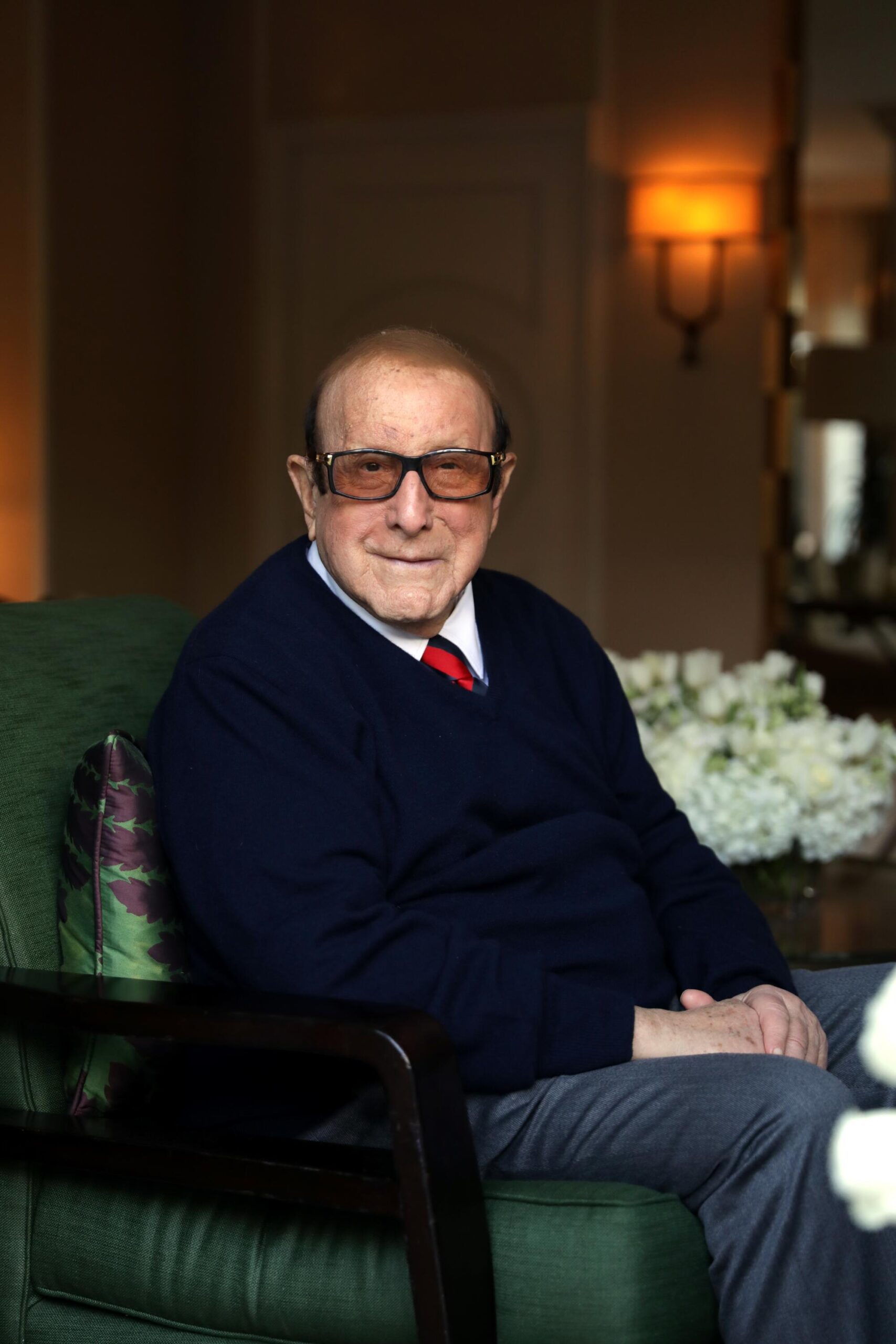
Clive Davis at the Beverly Hills Hotel in 2020.
(Christina House / Los Angeles Times)
Wherever he worked, Davis’ goal was shepherding hits that spanned formats and generations; he delighted in projects like “Smooth,” the inescapable Santana single pairing the rock guitarist and Rob Thomas of Matchbox Twenty, and a series of Great American Songbook albums by the once-scruffy Rod Stewart. He might also have been the music industry’s biggest believer in ballads, at least among suits: Between 1985 and 1992, Houston alone released almost a dozen of music’s all-timers, including “Saving All My Love for You,” “Didn’t We Almost Have It All” and — perhaps the greatest pop ballad ever recorded — her take on Dolly Parton’s “I Will Always Love You.” (It wasn’t a huge hit, but listen to Houston and Jermaine Jackson’s pedal-steel-drenched “Nobody Loves Me Like You Do,” from Houston’s debut, for an early instance of that crossover ambition.)
One of relatively few nonperformers inducted into the Rock & Roll Hall of Fame, Davis brought his flair for variety to the party he threw at the Beverly Hilton every year on the night before the Grammys — a famously hot ticket that drew A-list celebs from the worlds of music and Hollywood as well as business and politics. You could always count on the exec to have persuaded some number of the year’s splashiest new acts to perform; this year’s bash, in January, had Sombr, Olivia Dean and the women of “KPop Demon Hunters.” But my favorite part of the show was always seeing which veteran Davis had tapped to mix it up with the youngsters — Diamond or Manilow, for instance, or Johnny Mathis, who absolutely killed in 2015.
Davis horrified many in 2012 when he opted to proceed with his party just hours after Houston was found dead in a hotel room at the Beverly Hilton. In the years after the singer’s death, Davis drew criticism for taking too much credit for Houston’s artistic achievements; to some, he became a symbol of the music industry’s efforts to tone down Houston’s Blackness in order to reach white audiences. Five years ago, I asked Warwick, who was Houston’s cousin, whether she’d taken on any kind of consulting role on “I Wanna Dance With Somebody,” the 2022 Whitney biopic that Davis produced.
Bobby Brown, from left, Whitney Houston and Clive Davis in New York in 1998.
(Stuart Ramson / AP)
“Not one thing,” she told me. “I want them to let Whitney rest in peace. Leave her alone. Ten years [since she died] — it’s time to let her sleep.” (In a statement Monday, Warwick called Davis her “dear friend” and said she “can think of no other record man that seemed to have that magical ability to know a hit when he heard a song.”)
I spoke with Davis many times over the years and was always struck by his enthusiasm about music and about his recall of events from decades ago. In 2017, I interviewed the exec alongside Mathis and Kenneth “Babyface” Edmonds about a record the three made together that had Mathis singing newish pop songs like Adele’s “Hello” and Pharrell Williams’ “Happy” — a concept Manilow told me in March he and Davis had been talking about replicating. After my story ran, Davis emailed me and said he’d enjoyed the piece, which had a couple of lines about Davis’ tendency to go overboard hyping his projects.
“Yes, a few of your bites required a personal Band-Aid,” he wrote, “but I did appreciate your perspective of the Mathis album’s quality.”
He knew the music was good; Clive Davis always knew when the music was good.
BTS member Jungkook, seen here performing in New York’s Central Park in September 2023, topped 3 billion Spotify streams with his single “Seven,” his agency BigHit Music said Tuesday. File Photo by John Nacion/UPI | License Photo
“Seven,” a hit solo track by BTS member Jungkook, has surpassed 3 billion streams on Spotify, making him the first Korean artist to hit the threshold with a single song, his agency BigHit Music said Tuesday.
“Seven” is also the only song released in 2023 globally to reach the milestone, according to the agency.
A passionate serenade about wanting to spend every day with a loved one, “Seven” blends a catchy melody with a warm acoustic guitar sound and rhythms from UK garage, a genre of electronic music that emerged in Britain in the early 1990s.
The song’s music video surpassed 600 million views on YouTube in April.
Since its release, “Seven” has enjoyed worldwide success, debuting at No. 1 on the U.S. Billboard Hot 100 and reaching No. 3 on the British Official Singles Chart Top 100.
K-pop supergroup BTS, to which Jungkook belongs, is currently on its largest-ever scale world tour, “Arirang.”
Copyright (c) Yonhap News Agency prohibits its content from being redistributed or reprinted without consent, and forbids the content from being learned and used by artificial intelligence systems.
A United Nations commission of inquiry has accused Israel of systematically targeting Palestinian children in the occupied Palestinian territory, saying Israeli actions amount to genocide, war crimes and crimes against humanity in Gaza and war crimes in the occupied West Bank.
In a report released on Tuesday, the commission said about 30 percent of those killed in Gaza since Israel’s war began in October 2023 were children, and that attacks on maternity and neonatal units, along with an aid blockade, have devastated children’s chances of survival.
The commission says Israeli forces have destroyed orphanages and schools, and Palestinian children have been arbitrarily arrested, tortured and subjected to sexual abuse in detention. It warns that killings and serious injuries have continued even after the October 2025 “ceasefire”, in defiance of international law.
UNICEF estimates more than 50,000 children have been killed or wounded since the war began, with at least one Palestinian child killed on average every day in the eight months since the October “ceasefire” took effect.
These images document the lives and losses of Palestinian children in Gaza and the West Bank as they struggle to survive bombardment, displacement and imprisonment – and to hold on to a future that is being systematically stripped away.
At the beginning of Mary H.K. Choi’s wildly entertaining presentation for her new novel “Pool House’” at Skylight Books, she reveals she won’t be reading.
“Readings are boring,” she says, tapping her Prada loafers. “It’s like you’re watching someone else play video games.”
Instead, she and Yasi Salek, host of the hit podcast “Bandsplain,” spend the evening riffing on literature, coolness, autism diagnoses and a literary perennial: unrelenting pain.
“How is your mother wound?” Salek asks in her signature vocal fry most often heard ad-libbing about the band Weezer. Salek reveals she is in Jungian therapy, adding, “What Carl says, goes.”
Throughout the discussion, Choi describes her novel as a challenging read — calling it a “gross, decaying meat soup.” She jokes that her career as an author feels like a “Make-A-Wish Foundation wish,” bewildered by any attention her work has garnered. Yet dozens of eager readers have packed into the independent bookstore, spilling into the aisles with copies of the novel balanced on their laps.
“Publishing is so slow, it’s like giving birth to a lawn chair,” Choi remarks. Later, she professes tedium with the resurgence of an alt-lit scene.
“Don’t you find that everyone has to be cool right now? Why is everyone so cool?” Choi asks Salek.
Let’s be clear: Salek and Choi are very cool. Salek sits cross-legged, dressed in all black, with a heart tattoo on her forearm that reads “books.” Before “Pool House,” Choi authored three New York Times bestselling novels. Salek recounts dropping out of her MFA program at Bennington College in 2020 to start what would become a cult-classic podcast.
Book-themed sugar cookies sold at a past Little Literary Fair at Hauser & Wirth.
(Francine Orr / Los Angeles Times)
“I love that you started a podcast instead of getting an MFA,” Choi replies.
Like Skylight Books, independent bookstores across Los Angeles have become gathering places for readers and writers alike. Authors ranging from household names to debut novelists regularly draw enthusiastic crowds. Increasingly, bookstores are functioning not only as retail spaces but as community hubs.
A few blocks from Echo Park Lake, local favorite A Good Used Book has transformed Sunday mornings into one of the neighborhood’s liveliest recurring gatherings. Visitors browse used books while enjoying charcoal portraits, handmade jewelry and Hawaiian shaved ice. Buy a book and you might even end up on the store’s coveted Instagram Story — the hottest plug in town.
“It feels like in a city as big as Los Angeles, books are still underrepresented. So there’s a lot of room to grow, and that’s exciting,” says Chris Capizzi, who founded the bookstore in 2017.
Earlier this month, the Los Angeles Review of Books hosted its annual Little Literary Fair at SCI-Arc, drawing hundreds to literary panels and workshops on zine-making, publishing and finding an agent. Vendors from across California filled the space, representing independent presses, bookstores and literary magazines.
“I find writers based [in the L.A. area] to be socially incisive in equal measure as being experimental, innovative and just fun,” says Emily VanKoughnett, the events director at the Los Angeles Review of Books. “I love the L.A. lit scene because it invites people to explore pockets of the city and connect over writing.”
This summer, literary events across Los Angeles are continuing to draw readers into bookstores, community spaces and alternative venues alike. The city’s literary scene remains as weird, profane and sentimental as ever.
Colombia’s outgoing leftist president, Gustavo Petro, has alleged electoral fraud after preliminary results from a presidential run-off saw his handpicked candidate lose by a small margin.
In a barrage of posts on the social media site X on Monday, Petro alleged that the opposition bought votes and Israel and the United States interfered to help opposition far-right candidate Abelardo de la Espriella win.
Recommended Stories
list of 4 itemsend of list
Petro has refused to recognise the results and has called for an investigation by the judiciary.
The president, who was barred by the constitution from running for a second term, was Colombia’s first leftist president, putting him at odds with the US.
His administration is praised for reforms that boosted social spending, raised the minimum wage and redistributed land to poorer families. Petro also cut ties with Israel over Israel’s genocidal war on Gaza and distanced himself from US President Donald Trump’s administration.
However, critics said his refusal to accept the election results risks inflaming political tensions – and violence. Here’s what we know:
Presidential candidate Abelardo de la Espriella of the opposition Defenders of the Motherland movement and his vice presidential running mate, Jose Manuel Restrepo, ride inside a bulletproof enclosure towards a victory rally in Barranquilla on June 21, 2026 [Rodrigo Abd/AP]
What are the election results?
The first round of the presidential election was held on May 31. Neither of the two leading candidates – Abelardo de la Espriella of the right-wing Defenders of the Homeland movement and Senator Ivan Cepeda of the ruling Historic Pact – secured at least 50 percent of the vote, leading to a run-off on Sunday.
De la Espriella narrowly won with 49.66 percent over Cepeda’s 48.7 percent, according to preliminary results released on Monday by the National Registry, which manages vote numbers.
The razor-thin difference amounts to less than 1 percent of the vote and represents one of Colombia’s closest elections.
Trump-backed de la Espriella, 47, is to take office on August 7. The criminal lawyer is a multimillionaire who campaigned on tougher security and anti-leftist policies. He also has US citizenship.
De la Espriella’s win is part of a recent trend of Latin American countries electing far-right, populist leaders who are pro-Trump. Argentina’s Javier Milei, Honduras’s Nasry “Tito” Asfura, El Salvador’s Nayib Bukele and Costa Rica’s Laura Fernandez Delgado all have close ties to the Trump administration.
Why is Petro alleging fraud?
Petro took to X to denounce in a series of posts what he said was voter fraud committed with the help of Israel and Prime Minister Benjamin Netanyahu.
Petro said there was evidence of manipulation of Form E-14, the official, handwritten tally of sheets filled out by poll workers at each voting station.
The form is a physical record of the vote count and is meant to prevent electoral fraud. It is filled out by hand, and digital scans are also uploaded to the National Registry’s portal for public auditing. If found to have errors, parties may request a recount.
Petro alleged that foreign actors accessed the National Registry’s website and rewrote voting data on some E-14 forms.
“Today we have evidence of a change in IP addresses of several servers of the national registry,” he posted.
“This means that the software was compromised and others wrote data for polling stations and voting posts. The only entity in the world capable of doing that is the state of Israel,” Petro added without providing evidence of Israel’s alleged involvement.
Petro said his party had requested a “technical audit” of the voting software before the elections and asked authorities to retrieve the digital footprints of all digitally transmitted documents to avoid modification. He claimed those requests were ignored.
The outgoing president shared videos of what he alleged captured the “premeditated” modification of E-14 forms. He also claimed the manipulation was done “from the offices of the Bautista brothers”.
Electoral workers, observers and party delegates attend the official vote count the day after the presidential run-off in Bogota on June 22, 2026 [Fernando Vergara/AP]
Who are the Bautista brothers?
Petro was referring to Thomas Greg & Sons, an influential private logistics and security printing firm that runs Colombia’s electoral infrastructure. Until recently, it also printed Colombian passports.
It is run by brothers Fernando and Camilo Bautista Palacio. The duo was convicted of bank fraud in the US in the 1980s.
Thomas Greg & Sons, which was founded by their father, Gregorio, has been contracted by the National Registry for more than a decade to manage election logistics, preliminary vote counting and vote-tallying software.
Petro in April accused the Bautista brothers of negotiating a deal with de la Espriella that would see them secure the presidency for the far-right candidate in return for clinching passport printing contracts once more.
At the time, de la Espriella refuted the claims, and his lawyers threatened Petro with a lawsuit.
What are authorities saying?
Attorney General Gregorio Eljach has dismissed the allegations and told reporters there is “no evidence of fraud” with more than 99 percent of the votes counted.
De la Espriella, meanwhile, has so far not responded directly to Petro.
Is de la Espriella linked with Israel?
Yes, de la Espriella has consistently voiced support for Israel and campaigned in Colombia’s Jewish community, making pro-Israel promises and saying his government would “defend Judeo-Christian principles”.
He pledged to reverse Petro’s 2024 decision to cut ties with Israel and has promised to relocate the Colombian embassy to Jerusalem.
Netanyahu congratulated de la Espriella on Monday, saying: “I look forward to working with you to strengthen the bond between Israel and Colombia.”
How has the US reacted?
In his posts, Petro also blamed Trump for interfering in the elections by publicly endorsing a candidate and thus swaying voters.
Trump endorsed de la Espriella on his Truth Social platform weeks before the run-off.
Trump and US Secretary of State Marco Rubio also congratulated de la Espriella on his preliminary win, and Trump took credit for the far-right candidate’s victory.
“He was in 10th place. I endorsed him, and he won the election. He called me last night and thanked me for the endorsement,” Trump told reporters at the White House on Monday.
Rubio wrote on X: “The Trump administration looks forward to working closely with your incoming administration to advance regional security cooperation, end illegal immigration to the United States, and strengthen our economic ties.”
Petro has invited Trump to make a statement on the electoral fraud allegations.
“I formally invite President Donald Trump to speak,” Petro wrote, adding that the US president bears responsibility for “having supported a candidate and not the freedom of the Colombian people”.
What is the US-Colombian relationship like?
Although both countries have close trade ties, diplomatic relations have often been strained over drug trafficking policies and relations with Israel, among other issues.
But relations essentially collapsed under the Trump and Petro administrations.
Petro in January last year refused to allow US migrant deportation planes to land in his country and said on X that the US “cannot treat Colombian migrants like criminals”.
In October, the US sanctioned Petro, his family and key officials in his government based on unproven allegations of involvement in the drug trade.
In January this year, the US military abducted leftist Venezuelan President Nicolas Maduro from his Caracas home after the Trump administration accused him of “narcoterrorism”.
Pakistan hosts Iranian President Masoud Pezeshkian after mediating the breakthrough US-Iran negotiations in Switzerland.
Published On 23 Jun 202623 Jun 2026
Islamabad, Pakistan – Iranian President Masoud Pezeshkian has alanded in Pakistan for a state visit – his first overseas trip since the United States and Israel launched strikes on Iran on February 28.
His Pakistani counterpart Asif Ali Zardari, Prime Minister Shehbaz Sharif, and Deputy Prime Minister and Foreign Minister Ishaq Dar received the Iranian leader at a military base near capital Islamabad on Tuesday.
Recommended Stories
list of 4 itemsend of list
During his day-long visit, Pezeshkian, who is accompanied by a high-level delegation that includes ministers and senior officials, will hold talks with Sharif, and is also expected to meet with Zardari.
According to Pakistan’s Ministry of Foreign Affairs, Senate Chairman Yousaf Raza Gilani, National Assembly Speaker Ayaz Sadiq, and Deputy Prime Minister and Foreign Minister Ishaq Dar will also call on the Iranian leader.
“During the visit, the two sides will review the full spectrum of bilateral relations and explore new avenues to further deepen cooperation across diverse sectors, including trade, energy, border security, people-to-people exchanges, and regional connectivity,” the ministry said in a statement on Monday.
Pezeshkian’s visit follows the crucial first round of talks between the United States and Iran, mediated by Pakistan and Qatar, in the Swiss city of Bürgenstock to end the war on Iran.
As part of the agreement, the US will release $12bn in frozen Iranian funds. The US has also announced a temporary easing of international sanctions on Iran, allowing it to sell its oil and petrochemicals until August 21. The talks concluded with a 60-day roadmap towards a final deal.
It is Pezeshkian’s second visit to Pakistan as president. His first, in August 2025, came days after the 12-day Iran-Israel war, and was also his first overseas trip following that conflict.
The visit is widely viewed as an expression of gratitude for Pakistan’s role in brokering the Islamabad Memorandum of Understanding, signed on June 18 by US President Donald Trump and Pezeshkian, with Prime Minister Sharif signing the document as a mediator.
The Islamabad MoU launched the formal diplomatic process now under way in Switzerland.
“The visit will also provide an important opportunity to discuss ongoing diplomatic engagements following the signing of the Islamabad Memorandum of Understanding, as well as regional and international developments of mutual interest,” Pakistan’s Ministry of Foreign Affairs said in its statement.
Julie Hayden and Gail Gregory, the self-proclaimed ‘dementia rebels’, appeared on This Morning to share their experiences of living with dementia and challenge misconceptions about the condition
11:53, 23 Jun 2026Updated 11:53, 23 Jun 2026
The inspirational women are raising awareness of living with dementia (Image: ITV)
Julie Hayden and Gail Gregory, the self-proclaimed ‘dementia rebels,’ featured on Tuesday’s This Morning to mark Alzheimer’s Society’s Forget Me Not month.
Chatting to hosts Ben Shephard and Cat Deeley, Gail, from Lancashire, disclosed she had received her diagnosis in 2019 aged 54, and was informed at the time she only had six to seven years to live.
“I was running my own business, and we’d noticed changes with my personality,” she explained. “I had an embroidery business like teddy bears and clothing, and we put personalised messages on, and I was taking a lot of information in which I wasn’t retaining. So when people were placing orders, I was having trouble retaining information, so I was making mistakes, which we put down to stress at the beginning because we had just moved.
“As you do, you put things off, and you think it’s going to get better, but it doesn’t get better, it goes worse, and so other things start to creep in,” reports Lancs Live.
Eventually, Gail chose to consult a medical professional and described the assessments she underwent at the doctor’s that proved challenging, such as drawing a clock face, “getting the numbers muddled up,” and attempting to recall an address.
Reflecting on that moment, she said: “You realise there’s something wrong. It’s then that it’s reality, that there’s something wrong. But what, you don’t know.
“Nobody tells you it’s going to be dementia, and you don’t imagine it’s going to be dementia, especially not at the age of 54.
“This is where the perception is wrong. Everybody expects it to be an older person in their later years, what they don’t expect is that people younger than me have been diagnosed, there are even children diagnosed.
“It’s that perception we need to change, because it’s not the end of life, it’s the beginning of a new one.”
Julie also revealed how she had been suffering from “life-changing” symptoms for more than five years when she was diagnosed, but was dismissed by the doctors.
She was told she was depressed and going through menopause, and it took Julie more than five years for a diagnosis.
Julie and Gail are now both supporting other people with dementia, particularly younger people, and fighting back against the stigma of people living with the condition.
As she urged for more training and information to support doctors, Julie said, “I can’t tell you what it’s like to live with cancer and go through the treatments because I’ve never been there. Nobody can tell you what it’s like to live with dementia unless they’ve actually lived with it.”
She added, “I had huge surprises as to what it was like, compared to how I thought it was going to be like when I got my own.”
Sharing her gratitude for the support they’ve both received from friends, family and those spreading awareness, Gail read: “A diagnosis of dementia, it can change many things but it should never, ever change our worth.
“We don’t need pity, and we don’t need to be pushed aside, because we need understanding and support and the opportunity to continue to live our lives with purpose, dignity, and connection.”
She added, “When I got my diagnosis, they said to me I would have six to seven years to live. I’m in those years now, and I’m still going, and what people should be saying to us is, go outside and live your life. Do the things that you want to do because that’s what life’s about at the end of the day, it’s about living.”
She continued: “I’m very grateful for dementia, because dementia has made me calm down. It’s made me appreciate the things that we have, like nature and things like that; it’s been wonderful. We get so many opportunities that we wouldn’t even dream of having, like coming here today, it’s wonderful.”
This Morning airs weekdays from 10am on ITV1 and ITVX.
In this photo released Tuesday, North Korean leader Kim Jong Un (C) speaks during a plenary meeting of the Ninth Central Committee of the Workers’ Party of Korea in Pyongyang. Kim called for the expansion of Pyongyang’s nuclear forces, citing military cooperation between Seoul and Washington. Photo by KCNA/EPA
SEOUL, June 23 (UPI) — North Korean leader Kim Jong Un called for accelerating the expansion of North Korea’s nuclear forces, citing increasingly hostile military cooperation between Seoul and Washington and an unstable global security environment, state media reported Monday.
Kim led a plenary meeting of the Ninth Central Committee of the ruling Workers’ Party of Korea from Saturday through Monday to review progress on national goals for the first half of the year and outline priorities for the remainder of 2026, according to the official Korean Central News Agency.
The meeting reaffirmed Pyongyang’s commitment to strengthening and expanding its nuclear forces, describing them as “the core of the military sovereignty of the country” and the foundation of its war deterrent.
“To thoroughly exercise the position of a nuclear weapons state is the most correct and unique way to actively and confidently cope with the unpredictable international military and political situation,” KCNA said.
North Korea passed a law declaring itself a nuclear-armed state in 2022. Kim later amended the country’s constitution to enshrine the permanent growth of its nuclear arsenal, calling the status “irreversible.”
The remarks come weeks after Kim toured a newly inaugurated nuclear fuel production facility and vowed to continue expanding the country’s fissile material at an “exponential rate.”
In an address to the meeting, Kim said it was necessary to bolster North Korea’s defense capabilities in response to an increasingly volatile international environment.
“Wars, bloodshed and political and economic instabilities are becoming a daily occurrence in the world due to the gangster-like and unlimited geopolitical greed and misuse of strength,” Kim said, according to KCNA.
The North Korean leader criticized the U.S.-South Korea military alliance, citing regular joint military exercises and Seoul’s pursuit of a nuclear-powered submarine.
Kim also singled out the allies’ Nuclear Consultative Group, which met in Seoul earlier this month, calling it a “nuclear war body” and accusing Washington and Seoul of developing plans for a nuclear strike against North Korea.
He further accused Japan of transforming itself into a “war state” and warned that military buildups in Northeast Asia were heightening regional tensions.
In addition to expanding the country’s nuclear program, Kim outlined broader military modernization goals, including construction of a 10,000-ton strategic guided missile cruiser, expansion of munitions production and the development of new naval facilities. He also called for completing ongoing efforts to harden the border with South Korea.
The remarks come as North Korea continues extensive fortification work near the Military Demarcation Line inside the DMZ, including the installation of barbed-wire fencing and preparations for mine-laying operations.
South Korea’s Defense Ministry on Monday called the activity a violation of the armistice agreement that ended fighting in the 1950-53 Korean War.
North Korea has revised its constitution to remove all references to reunification with South Korea, formalizing Kim’s push to redefine inter-Korean ties as relations between two separate states.
“In particular, it is essential to thoroughly adhere to the principle of struggle against the enemy set forth by our party which defined the ROK as the most hostile state,” Kim said, using the official acronym for South Korea.
The remarks underlined Pyongyang’s continued rejection of South Korean President Lee Jae Myung’s outreach efforts since taking office last year.
Last week, Lee said he discussed North Korea with U.S. President Donald Trump during the Group of Seven summit in France, arguing that sanctions had failed to halt Pyongyang’s nuclear development and suggesting a more phased approach.
Trump met Kim three times during his first term and has repeatedly said he would be open to meeting the North Korean leader again since returning to office.
“President Trump said it was time to pay attention to the North Korea issue again,” Lee said.
Weekly insights and analysis on the latest developments in military technology, strategy, and foreign policy.
Turkey’s Baykar and Leonardo of Italy say they have successfully completed the first live trials of their K-SWARM concept, demonstrating collaborative operations between crewed and uncrewed aircraft as part of an effort to develop next-generation autonomous air combat capabilities. The trials, involving Baykar’s Kizilelma uncrewed combat air vehicle (UCAV) and Leonardo’s M-346 light fighter-trainer aircraft, are the latest to explore what is fast becoming a key element in the evolution of air combat.
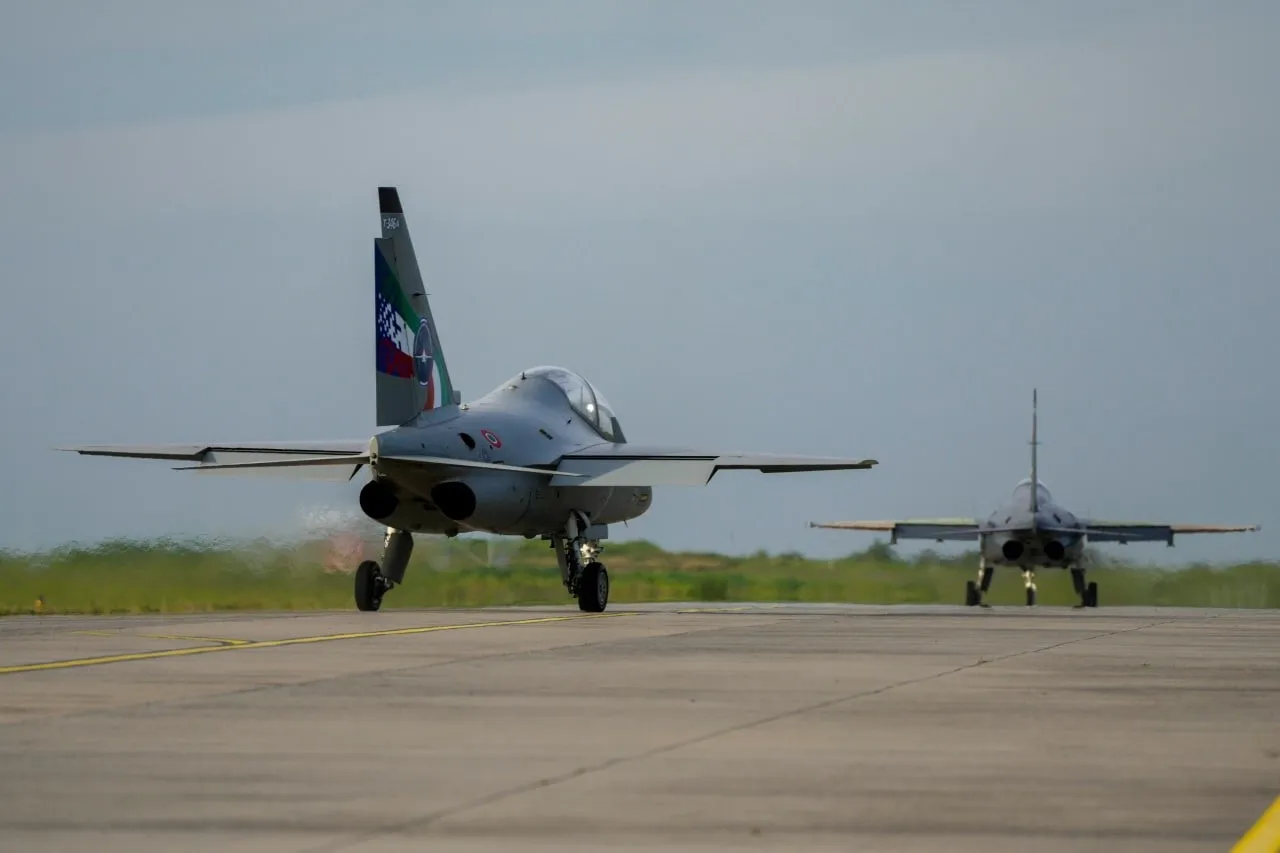
Leonardo and Baykar announced the development today. The trials took place last month at Baykar’s flight and test center in Çorlu, Turkey, and involved a Leonardo-owned M-346 Fighter Attack variant and a Kizilelma UCAV. An Italian Air Force T-346A, the trainer version of the M-346, was on hand as chase aircraft.
T-346A and M-346FA taxi out for a sortie during the K-SWARM trials. Leonardo
During the flight-test campaign, the Kizilelma completed its taxi and takeoff autonomously. It then autonomously joined the M-346 in formation. At this point, the two-person crew in the jet assumed full control of the Kizilelma.
The Kizilelma used so-called Smart Fleet Autonomy algorithms developed by Baykar’s Hardware-in-the-Loop (HIL) Laboratory for the trials.
Once ‘handed over’ to the M-346, the pilots in the jet made use of a newly developed and fully integrated avionics suite to command different formations. Via a crewed/uncrewed computing system, the Kizilelma performed different maneuvers and formations, including position changes, separations and rejoins. These were executed autonomously by the drone, with the M-346 pilots only responsible for providing the initial commands.
The M-346FA as used in the K-SWARM trials. Leonardo
What was described as an advanced radio-frequency data exchange system was used to share all data between the platforms.
The Kizilelma/M-346 trials in Çorlu were the first live phase of Leonardo and Baykar’s K-SWARM program, which focuses on developing interoperability between crewed and uncrewed aircraft. The companies refer to this as crewed/uncrewed teaming (CUC-T), but it’s also referred to by other names, including manned-unmanned teaming (MUM-T), or collaborative combat teaming.
TWZ was provided the opportunity to experience the M-346FA firsthand during a visit and demonstration flight at the Beech Factory Airport in Wichita, Kansas:
We Fly Aboard The M-346 That Could Become The Navy’s Next Jet Trainer
Whatever the term, the ambition is similar: to have future fighter pilots go into battle accompanied by drones under their control, ready to fire weapons, gather intelligence, jam communications, or serve as decoys.
Baykar and Leonardo helped accelerate the start of these crewed/uncrewed teaming trials by first running simulated missions, including using an M-346 full-mission simulator in Venegono, Italy, and the Leonardo product capability and concept laboratory, or PC2LAB, in Turin. This meant that algorithms, as well as tactics and procedures, could be tested in the virtual realm first.
The Kizilelma’s rapid rise to prominence as a fighter-like UCAV has been notable, and there have been some impressive milestones along the way.
A top view of a Kizilelma UCAV. Baykar Baykar
In general, the Kizilelma is one of only a few fighter-type air combat drone projects to have resulted in hardware. The development of the Kizilelma began as long ago as 2013, although the project was only revealed to the public in July 2021, when conceptual studies were presented.
Kizilelma was flown first — very briefly — in December 2022, as you can read about here. That milestone came only weeks after the Kizilelma’s emergence for ground testing.
The UCAV is claimed to be supersonic (at least in later versions), have a degree of reduced-observable characteristics, and be tailored for the kinds of air combat missions typically undertaken by crewed fighter jets. In particular, it is eyed as being a drone companion to Turkey’s next-generation TF Kaan crewed fighter. In its definitive form, the drone is powered by a single Ukrainian-made Ivchenko-Progress AI-322F turbofan delivering close to 10,000 pounds of thrust with afterburner.
A next set of K-SWARM tests is planned for the coming months, with more complexity and additional functions. The companies say these will require greater levels of situational awareness and assets working together ‘as one’ toward mission objectives. Further details, including how enhanced situational awareness will be achieved, were not disclosed, but it should be noted that the Kizilelma has already been tested with a Toygun electro-optical sensor and targeting system, as well as an active electronically scanned array (AESA) radar.
Ultimately, however, the K-SWARM program aims to harness AI technology to enable uncrewed systems to incrementally shift from remote piloting to autonomy, suggesting that, in future trials, the Kizilelma will autonomously conduct more complex missions and maneuvers on the command of the M-346 pilots. At all times, those human pilots will maintain full control and decision-making, the companies say.
A UCAV operating under the control of a crewed tactical jet represents a major milestone for Turkey, placing it among a very small group of countries pursuing this advanced capability. Publicly, such crewed-uncrewed teaming has largely been confined to experimental efforts in the United States and China. We meanwhile know a lot about what the United States has been doing in the “white world” in this regard, and it is now only accelerating its CCA efforts, while it is clear that China has also prioritized it.
A view from the backseat of an L-39 Albatros light jet being used as a drone controller in a Skunk Works test. Note the touch-screen type user interface. Lockheed Martin
Russia has also reportedly flight-tested its S-70 Okhotnik UCAV with a crewed Su-57 Felon fighter, but there is no confirmation about the degree of collaboration achieved. Last year, meanwhile, the U.S. Air Force demonstrated an MQ-20 Avenger drone being controlled by a pilot in an F-22 Raptor, during a mock mission.
Given the current surge in interest in collaborative combat aircraft (CCAs), the joint trials by Baykar and Leonardo also appear especially well-timed.
To take just one European country, Germany currently has a stated requirement for an operational CCA to be fielded before the end of this decade. While the Kizilelma might not necessarily be in the running for that, the AI technology that it is now demonstrating could be of considerable interest to a variety of export customers.
The Kizilelma during earlier taxi trials. Baykar
Meanwhile, the Kizilelma, like other Turkish defense products, comes with the advantage of being free from the restrictions imposed by the U.S. International Traffic in Arms Regulations (ITAR) guidelines. ITAR serves to limit the transfer of defense and military technologies and services — especially the more sensitive ones — to certain countries. Already, Turkey has leveraged its drone developments to secure major arms sales to a variety of countries for which these kinds of capabilities would otherwise be out of reach — in both technological and political terms.
The opportunity for Turkey to offer for export the Kizilelma in concert with the high-end TF Kaan, or the lower-end Hürjet light combat aircraft, would put it in a unique position, at least in Europe. The same platforms could also be supplied with integrated weapons options, providing another significant advantage.
Turkish light fighter trainer made its first flight in 2023. TAI screencap TAI screencap
As for Leonardo, the M-346 has recorded some notable sales, with the combat-optimized Fighter Attack version also gaining increasing traction. Meanwhile, through its stake in Eurofighter, the Italian firm may well be looking forward to offering these ‘drone commander’ capabilities to the multirole fighter. As we have discussed only recently, the collapse of the pan-European Future Combat Air System (FCAS) effort means that CCA capabilities are even more in the spotlight, including efforts to team UCAVs with advanced fourth-generation platforms like the Eurofighter Typhoon.
A rendering from Airbus of manned-unmanned teaming with Typhoon fighters, a type that is also on order for Turkey. Airbus
For Baykar and Leonardo, demonstrating that the Kizilelma can be commanded from an M-346 is an important achievement, but scaling that capability to different aircraft, larger formations, and increasingly autonomous mission execution will ultimately determine whether K-SWARM becomes an operational capability rather than simply a technology demonstrator. It should also be remembered that while the autonomy engine and AI agent are critical parts of an effective fighter-CCA teaming concept, it is unclear how developed these technologies are in the K-SWARM experiments. After all, just controlling the UCAV is one thing, but having the drone do much of the thinking while the pilot gives approvals and basic directions is the key. The companies have also proposed developing these technologies further to achieve ‘swarming,’ which presents an even greater challenge in this context.
However, with demand for affordable force multipliers continuing to grow and air forces looking for ways to increase combat mass without buying ever more expensive crewed fighters, a UCAV that can combine with a crewed combat aircraft further demonstrates the rapid pace of advances in Turkey’s burgeoning drone capabilities.
Paul Avery, a journeyman actor best known for his role on “All My Children,” and his wife, Sheila, have died following a house fire. He was 81 and she was 77.
The couple’s death was confirmed by their daughters Parker Sanchez and Kyle Avery, who said the fire broke out in their home in Blairstown, N.J., early last Tuesday morning. While firefighters were able to reach Paul and Sheila inside the Mohican Road home, the couple succumbed to smoke inhalation.
The cause of the fire is under investigation.
Paul had a recurring role playing Hughie the bartender at Foxy’s on the ABC daytime soap “All My Children” for 12 years. He also acted in the 1978 film “Superman,” “Three’s Company,” “Soap,” and appeared in more than 300 commercials. He also acted in theater productions and produced plays in both New York and Los Angeles.
According to his daughters, the actor joked that his “elastic face” landed him multiple national commercials that ran concurrently. Casting directors looking for a “Paul Avery type” would turn the actor away because he was in too many commercials.
“He had a teeny tiny part — one line in Superman — but boy did he make a meal out of that,” Sanchez joked.
Kyle Avery added that at the Oscars, they played a clip from “Superman” that featured Paul reciting his line.
“His good friend ran into the kitchen and made him an Oscar out of tinfoil and handed it to him,” she said. “But I think the thing that he was proudest of was that he could make a living as an actor.”
Paul Avery was born Oct. 8, 1941; and Sheila Avery was born May 22, 1949. Paul was raised in Indianapolis, served in the Vietnam War in his 20s and moved to Los Angeles and then New York by his late 20s to try to make it as an actor. Sheila was raised in Kansas City, Mo., and moved to New York where she worked as a registered nurse but also had a background in theater.
She studied the craft in college, performed on a USO tour in Vietnam and worked as a costume mistress.
According to the couple’s daughters, the two brought their Midwest charm and sensibilities to the East Coast.
The couple met while living in an apartment building filled with other journeymen actors in the late 1970s.
“They were all part of this theater community, people who would go from regional theater to regional theater with the season,” Kyle Avery said. “They were a whole troupe of people who’d be in New York for part of the year, but then they’d go and be in Lakewood, Ohio, or Kansas City or Chicago, just following the theater.”
Sheila was previously married to John Quincy Bruce Jr., also an actor in the New York theater community and the father of Sanchez. Sheila and Paul got together in 1982 and married in 1984. They celebrated their 42nd wedding anniversary in April.
Paul was a jack-of-all-trades and master of many. He was a small plane pilot who often flew into a tiny airport in Blairstown, N.J., which is how the couple discovered the town they’d call home. There, they opened a bookstore, Cabbages and Kings. Paul also launched a magazine: the Warren County Companion. According to the couple’s daughters, Paul was the first internet service provider in town. He also penned film reviews for the New Jersey Herald and some for the New York Times as well.
Sheila found what her daughters called the “perfect job,” which brought together her work as a registered nurse and background in theater: speaking in schools about domestic violence and sexual assault. She also became a counselor who worked with survivors, and a trainer who worked with volunteers, teaching them how to interact with victims.
“People who took her training 20 years ago have been contacting us and saying, ‘Your mother changed the way I thought about the world, she is the basis for my feminism,’” Sanchez said. “It’s been so fascinating to hear the ripple effects of young women who took that training from her, and who are now middle-aged women who are still thinking about her.”
The daughters said that their parents were community icons who were dedicated to service. “They had a sense of duty to the people around them,” Kyle Avery said.
“They loved to throw parties,” Sanchez said. “They hosted an annual event called Faux Giving and they would have these insane traditions, like we would have a head-measuring contest and measure the circumference of people’s heads, and then a winner gets to eat their pie first, and a badge.
“Whoever had the smallest head, everyone there would shout, ‘Pin head! Pin head!’ at this person, and it was the silliest thing in the world, but everyone who attended that event, even if they came one time, would talk about it forever.”
Kyle Avery added, “They were incredibly memorable.”
“They were community builders, they were people who wanted to nourish you in every way, and they were so good at it.”
They are survived by their children: Kyle Avery; Parker Sanchez and her husband, Pablo; Paul Avery’s son from a previous relationship, Stuart Sutherland; and their grandchildren, Avery, Duncan and Liana.
A Coast Guard MH-60 Jayhawk helicopter, like the one seen here, crashed in Alaska on Monday with four people on board. File Photo by Petty Officer 3rd Class Connie Terrell/U.S. Coast Guard/UPI
June 23 (UPI) — All four Coast Guard members aboard a helicopter that crashed in Alaska sustained only minor injuries, the maritime law enforcement agency said.
The Coast Guard MH-60 Jayhawk helicopter crashed Monday morning during a training flight near Harbor Mountain, Sitka, Alaska, the Coast Guard said in a statement.
The first reports of the crash were received at the Arctic District command center shortly after 10 a.m. local time, officials said.
Deployed responders reached the aircraft at about 11 a.m. local time, the Coast Guard said, and were able to transport the helicopter’s four occupants to Mt. Edgecumbe Medical Center.
U.S. Coast Guard Arctic later Monday said that the four Coast Guard members involved in the crash sustained only minor injuries.
“We are incredibly relieved our crew members survived with only minor injuries,” Rear Adm. Bob Little, commander of the Coast Guard’s Arctic District, said in a statement.
“We are grateful for the swift response by the Sitka Fire and Rescue, who assisted us during this critical time.”
In response to the crash, Coast Guard Air Station Kodiak will be repositioning a helicopter and crews to Coast Guard Air Station Sitka to maintain operational readiness in the Southeastern Alaska region, officials said.
To get a better sense of how this project came together so quickly, the challenges it faced and the tradeoffs that had to be made, we spoke with Jason Lambert, President of Intelligence, Surveillance and Reconnaissance (ISR) at L3Harris, the company that performed the conversion. During the interview, he gave us some unique insights into this highly visible and often controversial effort.
Jason Lambert (L3Harris)
Some of the questions and answers have been edited for clarity.
Q: Can you give us an overview of L3Harris’s role in this program?
A: It’s an honor to talk about this monumental and generational event. L3Harris worked in conjunction with the Air Force to deliver the first VC-25B — a 747-8I that the U.S. government received as a gift from Qatar. We had the opportunity to work on that aircraft for a 10-month period, with pre-staged employees operating on a 24/7, three-shift structure to convert it into what was unveiled on Friday: the new Air Force One.
The new VC-25B bridge jet. (USAF) USAF
L3Harris, in the ISR [intelligence, surveillance and reconnaissance] business, is uniquely positioned for this type of project. We’re the world’s largest non-OEM [Original Equipment Manufacturer] integrator of aircraft. We don’t make planes from scratch — we’re not a type certificate holder like Boeing, Airbus, or Gulfstream. We take existing planes, whether commercial or military, and missionize and outfit them for specific uses. We operate the world’s largest intelligence, surveillance and reconnaissance fleet — the RC-135 Rivet Joint.
RC-135 Rivet Joint. (USAF/Staff Sgt. William Rosado)
We missionize business jets for electronic attack, ISR, and airborne early warning and control missions, including a series of special mission aircraft, some of which are classified. And then, of course, the head-of-state mission, which we’ve been proud to be part of for many years.
We’re also the prime contractor for the Senior Leader Communication System. Any time the president is on board Air Force One, the communications system he uses to talk to his staff and to world leaders — voice, video, all content going on and off the plane — has to be secure, so state actors cannot intercept it, and it has to have the right bandwidth and latency, which is evolving as new satellite providers come online.
VC-25A. (USAF)
We have the ability to broker and work with multiple providers to ensure that the system is 24/7 ready whenever the president needs it. And when he’s on that plane, he’s not just the commander-in-chief — he’s the head of state, representing the country internationally. The president spoke to that directly when he talked about the livery and how this plane looks. Our team is just very, very excited to have converted this aircraft into what is now the first VC-25B.
In conjunction with the modification work, we were also asked to help build out a training program and a sustainment program — not just for this specific aircraft, but for the VC-25B fleet overall. On the training side, the Presidential Airlift Group had been flying the legacy 747. The 747-8I is a very different aircraft — it’s much larger — so we worked with two companies to address that. We leased an aircraft from Atlas Air for a period of time, and we purchased a plane from Lufthansa out of their commercial fleet to serve as a dedicated flight trainer, so the Presidential Airlift Group could learn how to fly the platform.
You can see video of one of those Lufthansa 747-8is below:
Lufthansa Boeing 747-8i D-ABYG, one of two aircraft slated to be sold to the U.S. Air Force, visited LAX during the Airline Videos Live broadcast from the H Hotel on December 14th, 2025. Lufthansa plans to sell both 747-8i aircraft in 2026. pic.twitter.com/IxsB55Kz8h
We also built a one-to-one scale mockup of the aircraft interior and placed it on the hangar floor at Joint Base Andrews. It was an exact replica of the layout — monuments like bulkheads, walls, doors, tables, and chairs in full-scale configuration, along with the galleys — so the flight crew supporting the president could practice and learn how to operate this aircraft before ever flying it. There were multiple training touchpoints built around that, and then, of course, the sustainment portion: spare parts, engineering support, everything needed to keep that aircraft ready whenever the president needs it. All of that infrastructure was built out in advance — not just for this plane, but to support the entire VC-25B fleet, which will include more aircraft to follow.
US President Donald Trump speaks in front of the new Air Force One, gifted to him by Qatar, in a hangar at Joint Base Andrews in Maryland on June 19, 2026. (Photo by Brendan SMIALOWSKI / AFP) BRENDAN SMIALOWSKI
Q: How did this all come about? Was there a requirement for a bridge Air Force One aircraft prior to the Trump administration’s second round? How did it all come into being and why?
A: In the first administration, a deal was signed with the Air Force and Boeing to build the VC-25B. That program has been delayed significantly by years, and its budget overrun by billions. You have that event taking place. The aircraft weren’t ready for the president’s use coupled with the fact that the VC-25A — the legacy aircraft — are 35 years old. They’re starting to have — there’s not a safety risk, there’s an operational risk in terms of what happens on planes, given their, I’ll just say, their usage. And so the president and the Air Force wanted to have a solution… given that the VC-25Bs are delayed further and the VC-25As are starting to — I’ll say show some age in terms of their availability. Again, there’s only two of those VC-25As and so one is usually in for depot-level maintenance. In fact, at present, I have one of them in my facility.
VC-25A. (USAF/Josh Plueger) USAF/Josh Plueger
The other one came back from the G7 summit recently, the president flew on that. And then of course the second one is in for maintenance. It was at Boeing’s facility at San Antonio for several months, getting upgraded, and then it’s in our facility right now for paint. That leaves the president with one VC-25A asset that, from an operational availability perspective, is not probably what it should be, given the age of the plane. So the Air Force approached us with a solution potential on how we could potentially go find a bridge to create when the VC-25Bs that are under contract with Boeing would be ready, and this was the solution.
A rendering of a future US Air Force VC-25B Air Force One jet. (Boeing) Boeing
Q: Can you provide any insights into what it took to get the work on the VC-25B done in just 10 months? Can you tell the story of how it all came together and why L3Harris was tasked with the job?
A: I’ll start with the L3Harris piece. Our core competency and what our uniqueness is, is taking existing platforms — military or commercial — and modifying them based on whatever the customer’s mission set might be. For example, we take tankers and convert them into the RC-135 Rivet Joint, the country’s premier intelligence, surveillance and reconnaissance platform. We take a legacy G550 business jet and convert it to the EA-37B Compass Call electronic attack plane. We take a Global 6500 from Bombardier and are converting it to ARES X, an airborne early warning and control offering for the Republic of Korea.
An EA-37B Compass Call. (USAF)
We do that because we’ve got an engineering team of 2,600 people on our total workforce of 7,600. Within the ISR business, 5,600 are cleared, so we have the ability at scale and size to do classified things very quickly and detect classified things with a large group of people that can do things in our facilities. So there is a lot of technical talent, but with that we also have around 100 people in our ODA. The ODA is essentially the delegated organization from the FAA, where we in our business can do work on behalf of the FAA for certification work.
So, the way we operate it, we’ll take an existing platform or an existing plane, and rather than have to certify it from scratch, we have to just certify the modifications that we’re doing for it. So you’re always starting with this baseline, and then you’re doing a modification on top of that baseline that enables us to go far quicker than if we were to start with a brand new aircraft from scratch.
So all that aircraft missionization competency is one of the reasons I think of why we were asked. The second reason is we’re the prime contractor for what’s called the Senior Leader Communication System, and so that communication system is used for every aircraft that’s utilized for Air Force One. So, in the 747s that the president flies — when he’s flying on a 757 — those are known as the C-32s — we have the hardware and the software on that aircraft, as well as the services that connect from satellite links, ground links, and be able to manage the communications content that the president and his staff are using in flight anywhere in the world.
A stock picture of a C-32A wearing the blue-over-white livery. (USMC)
Think of it like a help desk always online when the president or his staff are flying to ensure that the connections are live and working. If there’s an issue, we have redundancies within the system that we can ensure that it’s working, and most importantly, in addition to it being resilient, it’s also secure when that phone call gets made, or that video feed gets made from POTUS to a world leader, we’ve got to make sure that adversaries aren’t listening in. And so it’s fully secure, and that’s the core competency of what L3Harris does. So, combining those two pieces together, along with our legacy of supporting the Air Force One fleet, and we’re a logical choice to be asked to go take on this work and we are really uniquely positioned to do that because of the nature of the things that we do.
Q: What is the difference between this aircraft and Boeing’s VC-25Bs that are still in modification?
A: They both started as a 747-8i so from a platform perspective, they are the same. I can’t talk too much about the VC-25B program. What I can say for this one is, while this is an 8i, it had a very nice interior that came in from the Qataris. So we had a place to start from.
One of the first things we have to do on this aircraft, in conjunction with the U.S. government, is ensure it is safe. There was a lot of content and buzz on blogs and whatnot about is the aircraft secure? Is there anything that we wouldn’t want coming in on the aircraft? Somebody could listen in, something like that. And I can assure you that was very effectively managed to the highest degree. Experts from the U.S. government, experts from L3Harris, experts in cyber security, electronic warfare, ensured that every square inch of that plane was clean, not only on the exterior but interior of the plane and all systems within. So I’ll say, there’s just electronic scrubbing, is how I would describe it, to ensure that it was safe and secure. Frankly, that work took place even before we were able to do any real work on the plane.
In this February 15, 2025 photograph, a Qatari Boeing 747 sits on the tarmac of Palm Beach International airport after US President Donald Trump toured the aircraft on February 15, 2025. (Photo by ROBERTO SCHMIDT / AFP) ROBERTO SCHMIDT
Once we started work on the plane, it had an existing interior, much of which we kept and maintained. One of the things that we had to do for the speed of this program – because the goal was to get it done before the country’s Independence Day.
We were excited that we delivered early to that commitment. There are things that would have driven the schedule, so for example, changing the room structure, changing the hard walls, or any of the bulkheads, things like that, that would drive a significant amount of schedule risk associated. So those were some of the big rules that said, ‘okay, we’re not going to change any of what I call monuments,’ but there’s things within those that we did have some flexibility to change.
For example, there’s some things that came in on the interior that, while they look very nice, they weren’t really representative of what would be fitting for the U.S. president, and so we did make some modifications into some of the fit and finish in terms of the leather and wood and other aspects of what the aircraft looks like to really be fitting for the president’s mission.
✈️🇺🇸 The ultra-luxurious Boeing 747-8, which former U.S. President Donald Trump is set to receive as a gift from the Qatari emir’s family, is poised to become the most valuable present ever given to the United States by a foreign government.
— Savchenko Volodymyr (@SavchenkoReview) May 12, 2025
Q: When the original VC-25B contract was put forward, we were told the USAF, the White House and Secret Service carefully picked the exact requirements needed to execute the mission, and they would come at great cost. Some were even dropped to save money, like aerial refueling. Clearly, those standards had to change drastically to make this Bridge aircraft happen. What requirements were relaxed and what features were omitted in order to meet its aggressive budget and timeline requirements?
A: That’s classified, so I won’t be able to take that one, but I’d prefer that you direct that question back to the US Air Force.
Q: The one thing we get asked about the most is if this aircraft is hardened against electromagnetic pulse and has the command and control capabilities of the full-up VC-25B? Can you speak about that?
A: I think that’s one I’ll also have to defer back to the Air Force.
Q: What about survivability? The VC-25As are covered with infrared countermeasures and missile detection systems, and there are clearly capabilities that are less obvious. This aircraft doesn’t appear to have a similar outfit. How was survivability factored into its abbreviated modifications?
A: Survivability of the aircraft was something that was absolutely thought of, but I can’t comment on the specific systems on the aircraft yet. That’s one I’ll have to direct you back to the Air Force.
Common Infrared Countermeasures (CIRCM)
Q: If this aircraft is good enough to carry the commander-in-chief in the Air Force One role, why does the USAF need to spend over $4 billion on the other two aircraft? Why can’t the USAF just procure two aircraft in this configuration?
A: It’s an interesting question. Good question for the Air Force, but that’s an interesting question.
Q: Will this aircraft be able to fly all missions that the current VC-25As can? What about trips overseas to less peaceful regions?
A: I can comment about [the recent speech Trump gave at Andrews Air Force Base]. I know he’s intending to use this aircraft for international travel. I think he mentioned that there’d be an upcoming flight to Turkey coming up in the future. So specific locations, that’s always done through the White House planning group and White House Presidential Airlift Group. But the intent is this aircraft would be used overseas very much. The president talked about it in his speech about how it really is comparative to some of the other head-of-state aircraft.
It’s 18 feet longer for one so it really is a large aircraft. In fact, the hangar at [Joint Base Andrews] JBA that we were in on Friday for the ceremony was actually custom-built for the VC-25B because of the size of these planes.
In addition, of course, when you see the livery up close, it’s just amazing in terms of what it looks like. So I think the intention is for the president to use this overseas. He definitely signaled that directly on Friday.
Trump unveils new Air Force One, a $400 million jet gifted by Qatar | full video
Q: But are there any preclusions about where it can go at all? To a less peaceful region? Is there any place that it can’t go that the other aircraft can?
A: That’s probably a question for the Air Force.
Q: The aircraft belonged to another country’s government. What had to happen in order to make sure a foreign aircraft like this is free from potential nefarious tampering, bugs and other potential threats? Did every single component have to be examined?
A: What I can say is that a team of experts from the U.S. government, in terms of cyber security, did an immense amount of work on this aircraft, in conjunction with the L3Harris team, to ensure that this aircraft was fully safe from that environment, that threat, and that threat has been fully mitigated. I can say that. How they do it is classified.
The new VC-25B Bridge jet practices touch and go landings on June 22, 2026, in Joint Base Andrews, Maryland. (Photo by Andrew Leyden/Getty Images) Andrew Leyden
Q: The interior in this thing cost massive amounts of money when the Qataris outfitted it. It was one of, if not the most incredible VIP aircraft on earth before becoming a VC-25B. What unique elements of its interior and other VIP features were kept and what was changed?
A: The majority of the wall structure was all kept so any movements of monuments was maintained. That aircraft has 10 restrooms, and those were all kept and maintained. The fit and finish, in terms of some of the materials that were selected, those in some cases were upgraded in certain areas of the aircraft, and that’s both in terms of some of the leather and some of the wood grain veneers and things to be able to not only be esthetically pleasing, but fitting for the U.S. president.
You can imagine that the president is on the aircraft and could be doing interviews with the media. The presidential seal was of course incorporated in a few areas.
Inside the new VC-25B Bridge jet. (Dan Scavino via X) President Donald Trump inside the new VC-25B Bridge jet. (Dan Scavino via X)
We had to put in an air stair, which is for when the aircraft is landing in a remote location, it doesn’t have to — like on Friday — there’s the trucks that come up with the stairs to be able to get on and off the plane. This has one that can self deploy, so that was a fairly sizable structural mod to be able to integrate that into the aircraft and go through the certification process with it, but it works flawlessly. It’s actually a phenomenal piece of mechanical engineering. So yes, there were a couple of minor things that had to happen in conjunction with the other systems we had to incorporate.
U.S. President Donald Trump pumps his fist after touring the inside of the newest aircraft in the presidential fleet at Andrews Air Force Base on June 19, 2026 at Joint Base Andrews, Maryland. (Photo by Alex Wong/Getty Images) Alex Wong
Q: Were these requests from the president himself?
A: I’ll say that the president didn’t see the aircraft personally until last Friday, but his staff was directly engaged in the project throughout the entire project. Air Force leadership engaged throughout the entire project. We had senior Air Force visitors, including the Secretary and Chief of Staff of the Air Force, Gen. [Dale R.] White [The Pentagon’s Director of Critical Major Weapon Systems], and representatives from the White House military office visit us on several occasions to check on the progress of the aircraft, and then also to make design decisions.
I think about even one like the paint scheme, and the president had to sign off on the paint scheme, had to sign off on — if you look at the back of the tail — the wavy flag versus the fixed rectangular flag. The president personally had to approve all those items.
And one of the things the Air Force did an amazing job of helping us with is getting those decisions made as early as possible on the program, and then once the decisions were made, keeping the configuration frozen. In any type of aircraft development program, regardless of the customer, being able to make those design decisions and have them… locked in the front end allows the team to actually go do the procurement and engineering and work on the aircraft without having to do a lot of change.
In this example, we had an objective, along with our Air Force customer, to get this plane delivered before the 4th of July, 2026 for the country’s 250th birthday. And the team rallied behind that mission set to do that. And we could never have done it without the level of collaboration we had with the Air Force, working the requirements back with the president.
You can see the VC-25B bridge jet practicing touch-and-goes at Andrews in the following video:
Q: What new features does this aircraft’s interior have that the VC-25As don’t?
A: Well, the upgrades. So the comm suite is all the latest content gear, so that’s an upgrade. The aircraft is larger than the 25A, again about 18 feet larger, and so I’ll just say the size and just the finish of the aircraft.
Also, VC-25As were commissioned under President Reagan, and then first used under President Bush, and so while they are nice planes, they’re 35 years old, and so you can imagine just how those will wear a bit over time.
And yes, they’ve been kept upgraded, but this is a modern, beautiful aircraft, and I can say, when I saw it for the first time, it was the most beautiful aircraft I’ve ever seen. It’s — and if you have the chance someday to walk on the inside — or as things will start being released, you’ll see that on the interior also. It’s just absolutely gorgeous. And we had a great plane, a great point to start from, but again, we did have to do some things to make it fitting for the U.S. president.
Q: The paint job has gotten more press than anything else. What was the process of painting the highest profile aircraft on earth?
A: That’s a great question. So the first was the color selection, and as the president said on Friday, he was asked what color would he like. ‘So I like the American flag,’ and so trying to incorporate the American flag into the color scheme, we did a couple of things.
One, we took a legacy fuselage of a business jet. We do a lot of work on missionized planes to use it as essentially a test to be able to get the white and the red and the blue and the gold. How we apply those, took a lot of practice. We essentially painted a scrap airframe to be able to do the testing. The second thing we did is our team actually painted a C-32 — which is actually the first aircraft that was ever released with this paint scheme — a 757 called C-32A.
So we painted that and released that and actually got to show it live to the senior leaders of the Air Force before it was delivered, and it came out great as well.
One of the U.S. Air Force’s C-32A VIP aircraft wearing the new red, white, and blue paint scheme, spotted in Greenville, Texas (@tt_33_operator) @tt_33_operator
But what we learned from that plane was the sequencing. So the plane’s got essentially the white on top, the red, the gold stripe, and the navy on the bottom. We actually learned through that process of painting the 757 of how to optimize the sequence, and essentially the navy coming last.
That’s navy that’s on the undercarriage of the fuselage, when you see it up close, you can actually see your reflection in it. It’s just so beautiful. But we did learn that because it’s on the lower end of the aircraft, and we’re doing continual maintenance and masking of the aircraft, it was optimal to do that in the last part of the sequence, and so that’s something that we took forward when we painted the 747.
Q: What will happen to the original VC-25As? What about this new aircraft once the full VC-25Bs enter service in a couple of years?
A: Great question. The aircraft are still flying, they’re not decommissioned, per se. You know, there were some announcements made when the aircraft flew a mission coming back from the G7 summit and landed at Andrews last week, but those aircraft are still available for use.
But in terms of the operational availability of what you expect, there’s two aircraft that are again, 35 years old, and so they’re not going to have that same uptime as what you’d expect out of the new planes. But in terms of a plan for usage, that’s probably a good question for the Air Force.
Q: What happens with this aircraft once the full VC-25Bs enter service in a couple years?
A: I think that’s also probably a good question for the Air Force. They’ll have the better purview for that. In terms of L3Harris’s role with this right now, our role is to sustain it and make sure that this aircraft is always ready to fly whenever the president needs it. And then I think what we just demonstrated again with this plane is we have the capability from both a scale with our size of what we have from our workforce, our classified workforce, the speed in which we can operate, and the unique expertise to do very high-demanding aircraft modernization and integration roles. We’re ready to step up whenever the Air Force asks us to.
There’s many things we do for them on a regular basis. This one gets a lot of press. It is actually interesting because it was — up until this past week — essentially an unacknowledged special access program, meaning we couldn’t talk about it. So all this was happening essentially in the dark, and you go home and talk to your family at night, and they ask, ‘why are you stressed out,’ or ‘why do you look so tired,’ and you can’t say. And that’s just the nature of what we do in the classified world.
We’re doing this in several other examples across other customers we work with. This one just finally was able to come into the light, and we’re just thankful to be able to talk about it, but we want to do more.
Q: What lessons can L3Harris and the USAF learn from this program?
A: What we learned from this program is when the U.S. government has an immediate or incredibly urgent need, when the Department of War and industry work together as a partnership and team with leadership alignment all the way to the top, you can do anything. And it totally changes the game in terms of what’s been thought of as — I’ll say a historically slow and sluggish defense acquisition process. We at L3Harris and the Air Force just proved that that entire paradigm can shatter if you put the right leaders together to be able to do an impossible mission, and you do it as one team.
LIAM Payne’s ex Kate Cassidy has revealed she’s been “dumped” by her new man over “anger” issues – just two weeks after going official.
The influencer, 27, admitted in April that she felt “ready to start dating again” before sharing a video of her being swept off of her feet by a man.
Sign up for the Showbiz newsletter
Thank you!
Liam Payne’s ex Kate Cassidy has revealed she’s been “dumped” by her new manCredit: @kateecas / TikTokShe took to TikTok to share the relationship update with her followersCredit: @kateecas / TikTok
But it looks like the new romance is over as she took to TikTok to share a relationship update.
Kate told her followers: “I got broken up with, I got dumped you guys.
“I’ve been super MIA online here about my updated dating situation going on, that is because I recently met someone.
“I feel like things were moving super fast kind of, if you know me, you know I have a tendency of moving fast.
“Let’s just name this guy Joe. Joe was really sweet and I feel like he was kind of like a lot of things I wanted in a guy.
“He’s really super low-key, he doesn’t have any social media which I actually really liked. I met his family, he took me on a trip, things were going really well, really quick.
“I f****d up. Dating after losing somebody that you genuinely thought you were going to spend the rest of your life with is really tough because I physically look for Liam in every single guy that I meet,” she bravely admitted.
“If they don’t hit all the check marks, I tend to either back away or almost resent this person and it’s so crazy.
She previously shared a video that said “when you know you know”Credit: TikTokA man was seen sweeping her off her feetCredit: TikTok
“There were certain times where I would get so angry with this guy because I physically would be like, ‘oh Liam would do this so why aren’t you doing this?’
“Or he would do something and I would be like, ‘Liam would never do that, why are you doing that?’
“He texted me yesterday and we should go our separate ways because it’s just too much and I understand,” Kate explained.
“I feel sad because I don’t like losing people and I feel like especially in the beginning of a situationship, it’s so fun and you’re so excited to see where it goes.”
Her TikTok followers rallied around her in the comments section and offered her support as she continues to live without Liam.
One person wrote: “The whole point of the dating journey after losing someone is to learn and understand your feelings.
“You won’t always compare every guy to Liam, and you’re learning that as you go along.”
Another social media user penned: “I didn’t know you were actually dating someone, I’m so sorry you got broken up with though, you will find the one someday!”
Liam and Kate were in a relationship before his tragic deathCredit: InstagramThe pair were together for two yearsCredit: @katecass / instagram
Somebody else said: “Liam would be proud of you for putting yourself out there again. I’m sure all he wanted was for you to be loved the right way and someone will come along who will do that again.”
While a fourth added: “Your heart isn’t ready yet. Don’t blame yourself. He wasn’t the one.”
Earlier this month, Kate shared a video of herself walking into a lavish event while donning a blue silk gown.
A handsome man in a suit walked beside her and put his arm around her before lifting her up and into his arms.
Twirling her around, the man held on tightly to Kate as she beamed from ear to ear.
“I love having a crush,” she penned in the caption of the post.
Meanwhile, over the top of the video, Kate wrote: “When you know you know.”
The content creator was in a relationship with the One Direction star before his tragic death at the age of 31 in October 2024.
They were together for two years and first met in South Carolina in the Autumn of 2022.
The pair were holidaying together two days before Liam’s fatal fall at a hotel in Buenos Aires, Argentina.
US announces the temporary easing of oil sanctions for 60 days after Iran agrees to allow international nuclear inspections.
Published On 23 Jun 202623 Jun 2026
Iran’s top negotiator, Mohammad Bagher Ghalibaf, says an agreement has been reached with the United States to release $12bn in frozen Iranian funds following talks in Switzerland.
The US eased sanctions on Iranian oil for 60 days after Tehran committed to allowing international nuclear inspectors to return to the country during negotiations to end the US-Israel war on Iran.
Recommended Stories
list of 4 itemsend of list
Israel and Lebanon are scheduled to hold talks in the US as a ceasefire appears to be holding in Lebanon.
So what’s the latest as the conflict enters its 116th day?
Diplomacy
Iranian Deputy Foreign Minister Kazem Gharibabadi says technical talks with the US have concluded and the next phase “will take place under the supervision of the high-level committee” that includes Ghalibaf, Foreign Minister Abbas Araghchi and US Vice President JD Vance.
Ghalibaf has hailed “good achievements” in the US-Iran talks and confirmed the release of two tranches of $6bn in frozen funds.
The US Treasury Department has waived sanctions on the sale of Iranian crude oil, petrochemicals and petroleum products until August 21.
Omani Foreign Minister Badr Albusaidi reaffirms a commitment for “toll-free passage” in the Strait of Hormuz after talks with Iranian diplomats in Muscat.
Henry Ensher, a former US ambassador and deputy assistant secretary of state, says the release of frozen Iranian assets and the resumption of maritime traffic in the Strait of Hormuz suggest that Washington and Tehran are both “getting what they want”. “Both sides are very interested to show that, somehow, they’ve gotten the upper hand or at least that they’re not being taken advantage of,” Ensher tells Al Jazeera.
In Iran
Iranian President Masoud Pezeshkian has called for a “full commitment to agreed obligations”. “The effectiveness of the talks depends on full commitment to the agreed obligations and their precise implementation,” Pezeshkian says.
Ghalibaf has defended the decision to hold talks with the US, saying Iranian delegates went to Switzerland to end the bloodshed in Lebanon.
Central Bank of Iran Governor Abdolnaser Hemmati has denied comments by US President Donald Trump that released Iranian funds would be used to buy US farm products. Hemmati tells the Tasnim News Agency that Iran has “no obligation to buy” agricultural products from the US. He says the agreement between the US and Iran on the matter says the first $6bn can be used to buy “basic goods and medicine”.
In the US
Trump says Iran “will agree” to have weapons inspections and any released Iranian assets will be used to buy US produce.
Democrats on the Foreign Affairs Committee of the US House of Representatives have accused Trump of granting Iran sanctions relief before making progress on key issues under negotiation, including Tehran’s nuclear programme. “Trump officials repeatedly said sanctions relief would be tied to Iran addressing its nuclear program and terrorist proxies. Neither has been addressed, but the regime has been gifted sweeping sanctions relief it has dreamed of for decades,” they say in a post on X.
In Lebanon
A ceasefire between Israel and Hezbollah has largely held, even as fear of renewed hostilities has kept displaced people from returning home.
The United Nations said Sunday marked the first time its peacekeepers have detected no air attacks in Lebanon since March 2, the day the war between Israel and Hezbollah escalated and two days after the US-Israel war on Iran began.
Mahmoud Qamati, deputy head of Hezbollah’s political council, has warned that the Lebanese group will respond to any violation of the ceasefire by Israel, according to Iran’s Press TV. “Hezbollah remains fully alert with its finger on the trigger, ready to confront any violation by the Israeli regime,” Qamati is quoted as saying.
Israeli Prime Minister Benjamin Netanyahu, Defence Minister Israel Katz and Chief of the General Staff Eyal Zamir say Israeli troops will continue to occupy southern Lebanon.
The Israeli military will continue to “act with determination in order to neutralize threats against our soldiers and our citizens” and to demolish infrastructure belonging to Hezbollah, they say in a statement.
The Israeli military will also continue to “maintain the security zone in southern Lebanon”, they say, referring to the land Israel occupies there, razing buildings and forcibly displacing one million people.
Israel and Lebanon are to start a new round of direct talks in Washington, DC, on Tuesday.
Weekly insights and analysis on the latest developments in military technology, strategy, and foreign policy.
Here’s TWZ’s weekly carrier tracker monitoring America’s flattop fleet, including deployed Carrier Strike Groups (CSG) and Amphibious Ready Groups (ARG), using publicly available open-source information. Check out last week’s report here.
The United States lifted its naval blockade of Iranian ports, U.S. Central Command (CENTCOM) announced on Friday, following the execution of the Islamabad Memorandum of Understanding in Versailles. While the blockade is over, the fate of the blockade forces – and future U.S. force posture in the region – remains unclear. The “plan is to keep the current force posture” during negotiations, a U.S. official said on background, but “the agreement contemplates the reduction in military forces in the region upon the agreement of a final deal.”
Major U.S. naval assets, including two aircraft carriers, continue operating “in the general area to support freedom of navigation,” according to a press release from CENTCOM. “U.S. forces remain present and vigilant to ensure all aspects of the agreement with Iran are adhered to, obeyed, and in full force and effect.” USS Abraham Lincoln, now deployed for more than seven months, was conducting flight ops in the CENTCOM area of responsibility (AOR) as of June 21, and USS George H.W. Bush was last spotted on June 20.
A U.S. Sailor oversees flight operations from the tower aboard USS Abraham Lincoln (CVN 72) as the aircraft carrier continues to operate in the Arabian Sea. pic.twitter.com/upff7YF7Hh
USS Nimitz arrived at Naval Station Mayport in Florida on June 16, marking the completion of her participation in Southern Seas 2026. “This year’s deployment marked the 11th iteration of the Southern Seas exercise since 2007, demonstrating the United States’ enduring commitment to the Western Hemisphere. Southern Seas 2026 highlighted unprecedented diplomatic and military integration, recording the highest number of Latin American leadership visits in the exercise’s history, with approximately 339 distinguished visitors embarking and 3,100 guests hosted during port visits.” Nimitz is on the final leg of a homeport shift to Naval Station Norfolk after the Navy announced a service life extension into 2027.
USS Nimitz (CVN 68) Nimitz-class aircraft carrier coming into Mayport, Florida – June 16, 2026 SRC: FB- Naval Station Mayport pic.twitter.com/DgPsu6R1lG
USS Dwight D. Eisenhower departed Norfolk on June 17 for Fleet Replacement Squadron Carrier Qualifications (FRS-CQ) and is underway in the Virginia Capes Operating Area, according to publicly available AIS data. Eisenhower is not scheduled to deploy this year, and is preparing for a deployment in early 2027, TWZ has learned.
USS Dwight D. Eisenhower (CVN 69) Nimitz-class aircraft carrier leaving Norfolk, Virginia – June 17, 2026 SRC: FB- Sean Tuttle pic.twitter.com/1lYOX670Ot
USS Theodore Roosevelt got underway on June 15 and is conducting exercises off the west coast in the U.S. 3rd Fleet AOR. The drills are meant to “bolster strike group readiness and capability” and the crew was spotted participating in firefighting drills, barricade drills, and crash and salvage training on the flight deck. While the upcoming deployment date is unknown, Roosevelt is the next carrier slated to deploy.
Power for Peace 🔱
USS Theodore Roosevelt (CVN 71) sails through the Pacific Ocean while conducting exercises to enhance strike group capability.
Our visible demonstration of warfighting readiness through operational competence is the high standard we hold ourselves to. pic.twitter.com/B88XO04n1R
— U.S. Pacific Fleet (@USPacificFleet) June 22, 2026
USS Carl Vinson is moored at Berth Lima at Naval Air Station North Island in San Diego. Over the weekend, Vinson was the centerpiece of NASCAR’s “Race the Base” event at Naval Base Coronado. “The event marked a historic collaboration between the U.S. Navy and NASCAR while celebrating the service’s enduring connection to the American people. It provided attendees opportunities to engage directly with Sailors, explore Navy capabilities, and learn about the Navy’s role in defending the nation around the globe.”
USS George Washington moored in Apra Harbor, Guam, from June 16-20, and then participated in a PHOTOEX to kick off exercise Valiant Shield 2026. Washington was pictured alongside cruiser USS Robert Smalls, destroyers USS Shoup and USS Benfold, fast-attack submarine USS Minnesota, and the Japan Maritime Self-Defense Force, including JS Kaga, JS Fuyuzuki, and JS Jingei. “Valiant Shield is a biennial, multilateral field training exercise conducted by the U.S. Armed Forces and partner nations in the Western Pacific focusing on joint, cross-combatant integration operating seamlessly across sea, air, land, and cyberspace.”
Lethal Joint Force. US Navy aircraft with CVW-5 & @USAF F-35As fly over the USS George Washington (CVN 73) Carrier Strike Group and @JMSDF_PAO units during Valiant Shield 2026 in the Philippine Sea, demonstrating multi-domain Combat Readiness. (1/2) pic.twitter.com/wzT5KHWx71
— U.S. Pacific Fleet (@USPacificFleet) June 22, 2026
Note: Positions are general approximations.Non-deployed LHA/LHD amphibious warships are not shown.
Contact the author: ian.ellis-jones@teamrecurrent.io
Liam Payne’s 9-year-old son has inherited the late singer’s fortune.
Bear Grey Payne, the only child of Payne and British singer and former “X-Factor” judge Cheryl Cole, has been named the sole beneficiary of the former One Direction star’s estate, according to court documents reviewed by People.
Bear now has more than $29 million to his name. According to the filing, a portion of the inheritance can be accessed now, but the majority will be held in a trust for another nine years, until Bear turns 18.
During a 2019 appearance on “The Jonathan Ross Show,” Payne opened up about fatherhood and spending time with Bear after the singer and Cole had called it quits.
“He comes over to my house every so often, and we just hang out and do whatever,” Payne said of his then-2-year-old son. “I think you put pressure on yourself as a dad sometimes. It’s hard to connect with it with a 2-year-old … but they literally will laugh at anything. We put this Batman costume on him in the house, and it was a little bit slidey on the floor, and he kept falling off the sofa. And if I said ‘Whoopsie-daisy!’ and it was like the best thing ever.”
Payne, who was one-fifth of the global boy-band sensation One Direction, died Oct. 16, 2024, after falling from a balcony at the CasaSur Palermo Hotel. Officials determined the 31-year-old singer died from multiple traumas caused by the fall. He had traces of alcohol, several narcotics and a prescription antidepressant in his system when died, according to officials.
The boy-band star turned solo artist had been open about his battle with addiction and mental health and shared updates on his sobriety journey on social media.
After Payne’s death, the National Criminal and Correctional Prosecutor’s Office of Argentina charged five people for alleged involvement in the pop singer’s death, including a representative for Payne and the manager and the head of reception of the Buenos Aires hotel where the British singer fell to his death.
Another hotel employee and a waiter whom Payne met in a restaurant were charged with supplying the singer with narcotics.
Times staff writers Alexandra Del Rosario and Karen Garcia contributed to this report.
Belgium has issued five visas to a Taliban delegation to attend a European Union meeting on migration in Brussels and discuss the deportation of Afghan asylum seekers from European nations.
The meeting, expected to take place on Tuesday, will be the first time the EU has hosted the group since it returned to power in Afghanistan almost five years ago.
Recommended Stories
list of 3 itemsend of list
A spokesperson from the Belgian Foreign Ministry told reporters that the five visas were granted on Monday after a security assessment and that they are valid for Belgium for one day only.
The European Commission said it has invited the Taliban officials for discussions on irregular migration from Afghanistan to the 27-member bloc, and to also discuss the deportation of Afghan people in the EU who have had their asylum applications rejected.
The EU has not identified which Taliban representatives were invited to the meeting. Several senior Taliban leaders are also under EU sanctions.
“Member States are looking into ways to return persons who have committed serious crimes and who are possibly a security threat. So this is the initiative that the Commission is now following up on,” Commission spokesman Markus Lammert told the EU’s daily news briefing on Monday.
According to a letter seen by the Reuters news agency and addressed to Abdul Qahar Balkhi, a Taliban Foreign Ministry spokesman, the meeting will focus on “the return and readmission of Afghan nationals without a right to stay in the European Union”.
The Commission, however, emphasised that this meeting does not mean Brussels is formally recognising the Taliban.
Since returning to power in August 2021, the Taliban have steadily curtailed rights, restricting women’s freedom of movement, banning girls from education beyond primary school, and enforcing morality laws that limit free expression and access to employment. European governments also shut their embassies in Kabul when the Taliban authorities returned to power.
Rights organisations have asked the Commission to abandon its plans to talk with the Taliban.
“Any engagement with the Taliban needs to prioritise protecting human rights and accountability – not deporting people to danger there,” Fereshta Abbasi, Afghanistan researcher at Human Rights Watch, said.
Earlier this month, the EU’s migration chief Magnus Brunner defended the outreach, saying Brussels had no other option than to talk to the Taliban government about returning Afghan asylum seekers who had entered the 27-member bloc irregularly.
European governments have sought a tougher stance on migration as public opinion has hardened, spurring far-right electoral gains across the continent.
EU countries have received about a million asylum applications filed by Afghans between 2013 and 2024, according to the bloc’s migration agency.
Although Afghans are among the nationalities with the highest asylum recognition rates in the EU, overall acceptance has tightened as migration policies become more restrictive.
About 20 of the EU’s 27 member states expressed interest in returning numbers of migrants without a right to stay, particularly those with criminal convictions, to Afghanistan in a letter last year.
EU law allows for deportations of people convicted of serious crimes or deemed security threats in certain cases, but returns to Afghanistan have been limited due to the lack of diplomatic relations.
“The focus for member states is very much on persons who have committed serious crimes or who pose a security threat,” Commission spokesman Lammert told journalists Monday.
Afghanistan is, however, currently mired in a deep humanitarian crisis. According to the United Nations World Food Programme, more than 17 million Afghans – or one-third of the population – are “food insecure”, while the country is absorbing tens of thousands of people returning from Iran and Pakistan.
“The desperate scenes of people – including EU staff – fleeing Afghanistan are a recent memory,” Eve Geddie, director of Amnesty International’s European Institutions Office, said in a statement.
“It is unconscionable that the EU would now try and deport people to Afghanistan, which has only become more dangerous in the meantime,” she added.
“Hitting customers with hidden fees is illegal. It’s not fair to draw people in with what looks like a good deal, only for them to find the real price is higher when they get to the checkout due to extra charges that can’t be avoided,” said Emma Cochrane, executive director of consumer protection at the CMA.