News Desk

Noah Cyrus goes braless in daring shredded gown as she reunites with mom Tish after nasty family feud

NOAH Cyrus made sure she turned heads when she went braless in a daring shredded gown as she reunited with her mom Tish after their nasty family feud.

Things previously took a turn in the mother-daughter relationship when it was reported that Noah, 26, had been seeing actor Dominic Purcell, 56, before her mom Tish, 58, married him.

Noah Cyrus ditched the bra in this shredded dress for the Reminders Of Him premiereCredit: Getty
The star was seen reunited with her mom on the red carpet following their family feudCredit: Getty
Noah’s outfit turned heads at Hollywood premiereCredit: Getty
It was previously revealed that Noah ‘had been seeing’ actor Dominic Purcell before her mother started pursuing himCredit: Instagram

Things got so bad, that Noah was reportedly “banned” by her mom from her wedding to the Prison Break actor.

But two years later, and things appear to be back on track for the pair as they were seen posing on the red carpet at a glitzy bash.

Noah made a dramatic statement in her shredded dress.

The star had also ditched her bra for the premiere of Reminders of Him at the Hollywood Legion Theater.

Noah was there to promote her new track Light Over the Hill, which she wrote for the film.

Tish, who is also the mom of Miley Cyrus, 33, was seen supporting her daughter at the event, proving that their relationship is back on track.

The ex-wife of Billy Ray Cyrus looked chic in her off-the-shoulder black sweater and black pants.

It’s Noah and Tish’s first outing together following reports of a fallout over actor Dominic.

Most read in Entertainment

Tish married the TV star in the summer of 2023 – a year after her divorce from country star Billy Ray

But Noah was reportedly “banned from the wedding” over fears she might “cause a scene”.

“Tish didn’t invite Noah to her wedding because she thought it would cause a scene and drama,” an insider told Entertainment Tonight.

“It’s also been an adjustment for Noah in general for her parents to be divorced.”

It was then claimed that Noah had actually been “seeing” Dominic before her mom started a romance with him.

The actor, who is 30 years Noah’s senior, started dating her mother Tish in 2022.

Noah is seen here with her dad Billy Ray Cyrus and her sister MileyCredit: Getty

“Noah was [seeing] Dominic when Tish started pursuing him,” a source told Us Weekly.

The source also said that Tish was aware of the situation before deciding to pursue him.

“The turmoil between Noah and Tish goes far beyond [what people think],” said the source.

“Noah is very distraught over Tish stealing Dominic from her.”

Tish shares Noah, Miley, and sons Trace and Braison with ex-husband Billy Ray, 64.

The country star is now in a relationship with model Elizabeth Hurley, 60.

Meanwhile, Tish and Billy were married for nearly 30 years before their shock 2022 split.

Miley and Noah pose together at an event in 2019Credit: Getty

Source link

Women’s football team to be welcomed home with open arms, Iran says | Football News

The Iranian women’s footballers returning to the country after their Asian Cup campaign in Australia will be welcomed home “with open arms”, Iran’s Ministry of Foreign Affairs has said.

Ministry spokesperson Esmaeil Baghaei urged the players to “come home” on Tuesday, hours after five members of Iran’s squad sought asylum in Australia following their team’s exit from the tournament.

Recommended Stories

list of 3 itemsend of list

“To Iran’s women’s football team: don’t worry – Iran awaits you with open arms,” Baghaei wrote on X.

His post came shortly after the office of Iran’s general prosecutor said the remaining members of the team were invited back to the country “with peace and confidence”.

“These loved ones are invited to return to their homeland with peace and confidence, and in addition to addressing the concerns of their families,” the general prosecutor’s office was quoted as saying by Iran’s Tasnim news agency.

Australia’s decision to provide visas to five players came amid uncertainty and concerns for the team’s safety following their decision to stand in silence during Iran’s anthem before their first match of the tournament on March 3.

The players sang and saluted the anthem in their remaining two matches, on Thursday and Sunday, prompting fears that they could face punishment upon their return home.

Australian Minister for Home Affairs Tony Burke told a news conference on Monday that he had informed the five members “that they are welcome to stay in Australia, that they are safe here, and they should feel at home here”.

He added that he had also offered the other team members the chance to stay in Australia.

The Department of Home Affairs named the five team members as captain Zahra Ghanbari, midfielders Fatemeh Pasandideh, Zahra Sarbali Alishah, Mona Hamoudi, and defender Atefeh Ramezanizadeh.

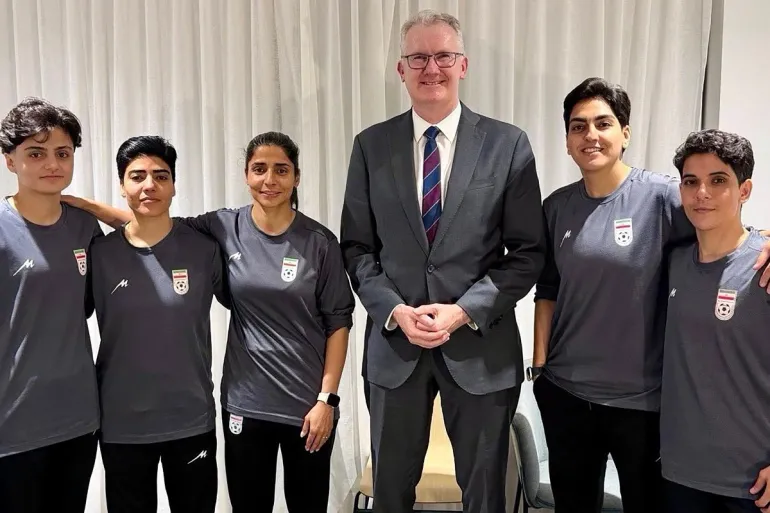
An undated and unplaced photo released by Australia's Department of Home Affairs shows Home Affairs minister Tony Burke (3/R) with five Iranian women football players who applied for asylum after competing in the Women's Asia Cup tournament being played in Australia. Australia has granted asylum to some of Iran's visiting women's football team over fears they faced persecution at home for not singing the national anthem before a match, Home Affairs Minister Tony Burke said on Tuesday. (Photo by HANDOUT / AUSTRALIAN DEPARTMENT OF HOME AFFAIRS / AFP) / ----EDITORS NOTE ----RESTRICTED TO EDITORIAL USE MANDATORY CREDIT " AFP PHOTO / DEPARTMENT OF HOME AFFAIRS" NO MARKETING NO ADVERTISING CAMPAIGNS - DISTRIBUTED AS A SERVICE TO CLIENTS
An undated and unplaced photo released by Australia’s Department of Home Affairs shows Home Affairs Minister Tony Burke, third left, with five Iranian women football players who applied for asylum [Handout/Australian Department of Home Affairs via AFP]

The players’ decision to stand in silence during Iran’s anthem before their match against South Korea was labelled as the “pinnacle of dishonour” by a commentator on Iran’s IRIB state broadcaster.

The announcement to grant the players visas came after United States President Donald Trump, who is currently waging war on Iran alongside ally Israel, said he had spoken to Australian Prime Minister Anthony Albanese about the “delicate situation” faced by the team, and that Albanese was “on it!”

Iran’s Baghaei dismissed Trump’s statement, questioning the US president’s claims of “saving” the players after new footage of a February 28 attack on an Iranian elementary girls’ school in Minab, which killed 165 students, suggested that the site of the school was likely hit by a Tomahawk missile – a weapon used by the US that Israel and Iran do not possess.

The US had previously accused Iran of the attack.

“They slaughtered more than 165 innocent Iranian schoolgirls in a double-tap Tomahawk attack in the city of Minab, and now they want to take our athletes hostage in the name of ‘saving’ them?” Baghaei said.

Following the Australian government’s decision to grant humanitarian visas to five Iranian players, they were moved to an undisclosed location under police protection, Australian officials were quoted as saying by the Reuters news agency.

Iranian media quoted Farideh Shojaei, vice president for women’s affairs at the Iranian Football Federation, as saying the team had left the hotel through the back door with the police.

“We have contacted the embassy, the football federation, the ‌Foreign Ministry and anywhere possible to see what will happen,” she said.

“We have even spoken with the families of these five players.”

Some of the Iranian players left their hotel in the northeastern city of Gold Coast on Tuesday afternoon on a bus that was surrounded by members of the diaspora protesting against the Iranian government. They flew to Sydney airport on Tuesday evening before being transferred to the international terminal.

It was not clear how many players arrived at the airport or where they were going.

Members of the Iranian community in Australia block the path of a departing bus transporting members of the Iranian Women’s Asia Cup football team to the airport, outside the Royal Pines Resort on the Gold Coast on March 10, 2026. Five players from Iran's visiting women's football team claimed asylum in Australia on March 10, seeking protection after they were branded "traitors" at home for refusing to sing the national anthem. (Photo by Patrick HAMILTON / AFP)
Members of the Iranian community in Australia block the path of a departing bus transporting Iran’s squad to the airport on the Gold Coast [Patrick Hamilton/AFP]

Trump initially posted on social media that Australia was “making a terrible humanitarian mistake” by allowing the team to be sent back home, apparently unaware that Australia had been in secret talks with the women for several days.

Trump said members of the team would “likely be killed” if forced to return to Iran. “The US will take them if you won’t,” he added.

In a later post, Trump said he had spoken to Albanese and that the Australian leader was “doing a very good job having to ⁠do with this rather delicate situation”.

The Iranian general prosecutor’s office said “some members of our country’s women’s football team have, unintentionally and emotionally provoked by the enemy’s conspiracy and mischief, behaved in a way that has caused the delusional excitement of the criminal leaders of the imposed American-Zionist war.”

The US and Israel attacks on Iran have killed 1,255 people in the country and left 1,200 injured after 11 days.

Tehran has responded by launching waves of missiles and drones at Israel and towards several military bases in the Middle East where US forces operate.

Source link

Venezuela After January 3: A Nation Standing in the Storm

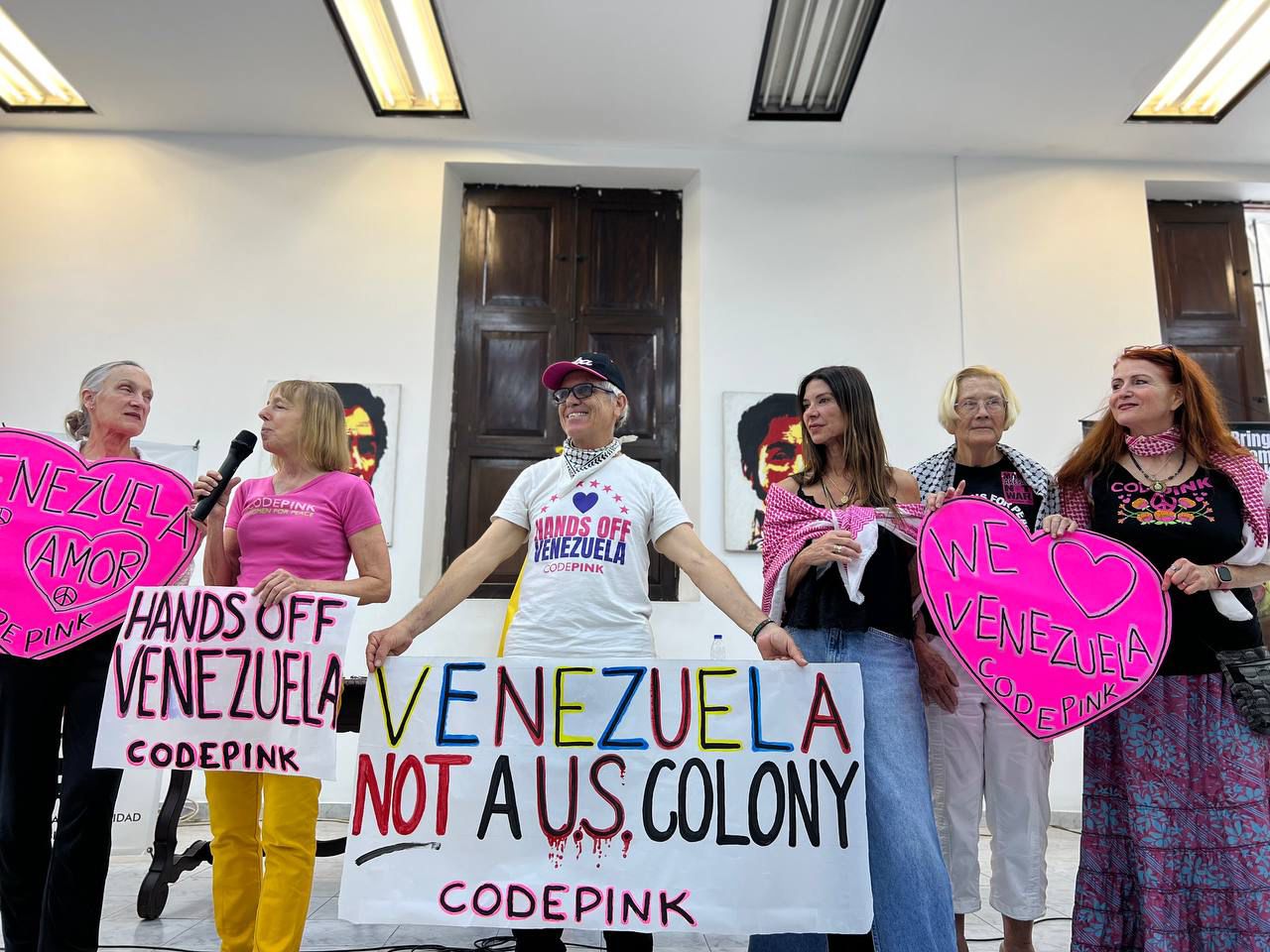
Code Pink participated in a solidarity brigade to Venezuela in February. (Instituto Simón Bolívar)

On our recent delegation to Venezuela, one quote echoed again and again — a warning written nearly two centuries ago by Simón Bolívar in 1829:

“The United States appears destined by Providence to plague America with misery in the name of liberty.”

For many Venezuelans, that line no longer feels like history. It feels like the present.

The January 3 U.S. military operation that seized President Nicolás Maduro and First Lady Cilia Flores marked a dramatic escalation in a conflict that Venezuelans describe not as sudden but as cumulative — the culmination of decades of pressure, sanctions, and attempts at isolation. “We still haven’t totally processed what happened on January 3,” sanctions expert William Castillo told us. “But it was the culmination of over 25 years of aggression and 11 years of resisting devastating sanctions. A 20-year-old today has lived half his life in a blockaded country.”

Carlos Ron, former deputy foreign minister and now with the Tricontinental Institute for Social Research, described the buildup to the invasion as the result of a carefully constructed narrative. “First there was the dangerous rhetoric describing Venezuelans in the United States as criminals,” he said. “Then endless references to the Tren de Aragua gang. Then the boat strikes blowing up alleged smugglers. Then the oil tanker seizures and naval blockade. The pressure wasn’t working, so they escalated to the January 3 invasion and kidnapping of President Maduro and his wife, Cilia Flores, and the deaths of over 100 people.”

While in the United States the events of January 3 have largely been forgotten, replaced by a devastating war with Iran, in Venezuela the reminders are everywhere. Huge banners draped from apartment buildings demand: “Bring them home.” Weekly protests call for their release.

In the Tiuna neighborhood of Caracas, we met Mileidy Chirinos, who lives in an apartment complex overlooking the site where Maduro was captured. From her rooftop, she told us about that dreadful night, when the sky lit up with explosions so loud her building shook and everyone ran outside screaming.

“Have your children ever woken up terrified to the sound of bombs?” she asked.

We shook our heads.

“Ours have,” she said. “And they are U.S. bombs. Now we understand what Palestinians in Gaza feel every day.”

She told us psychologists now visit weekly to help residents cope with the trauma.

Within days of the U.S. invasion, the National Assembly swore in Vice President Delcy Rodríguez as acting president. President Trump publicly praised Rodríguez for “doing a good job,” emphasizing his strong relationship with her. But from the beginning, she has been negotiating with the United States with a gun to her head. She was told that any refusal to compromise would result not in the kidnapping of her and her team, but death and the continued bombing of Venezuela.

The presence of U.S. power looms large. Nuclear submarines still patrol offshore. Thousands of troops remain positioned nearby. Every statement and decision made by the government is scrutinized. And on February 2, despite Trump’s praise for Delcy Rodríguez, he renewed the 2015 executive order declaring Venezuela an “unusual and extraordinary threat” to U.S. national security.

The visits from the heads of the CIA and Southern Command have undoubtedly been difficult for the government to swallow. Delcy’s revolutionary father was tortured to death in 1976 by a Venezuelan government that worked closely with the CIA. The U.S. Southern Command coordinated the January 3 attack.

But the government is not without leverage.

“The United States thought the state was weak, that it didn’t have popular support, that the military was divided,” said Tania Díaz of the ruling PSUV party. “January 3rd could have triggered looting, military defections, or widespread destabilization. None of that happened.”

The United States has overwhelming military dominance, but it was also aware that millions of Venezuelans signed up to be part of the people’s militia. This militia, along with the army that remained loyal to the government, gave Washington pause about launching a prolonged war and attempting to replace Delcy Rodríguez with opposition leader María Corina Machado. 

While Machado enjoys enthusiastic support among Venezuelan exiles in Miami and the Trump administration recognized her movement as the winner of the 2024 election, the picture inside Venezuela is very different.  The opposition remains deeply divided and Trump realized there was no viable faction ready to assume power.

Besides, as William Castillo put it bluntly: “Trump does not care about elections or human rights or political prisoners. He cares about three other things: oil, oil, and oil.” To that, we can add gold, where the U.S. just pushed Venezuela to provide direct access to gold exports and investment opportunities in the country’s gold and mineral sector, 

Certainly, under the circumstances, the Venezuelan leadership has had little choice but to grant the United States significant influence over its oil exports. But while Trump boasts that this is the fruit of his “spectacular assault,” Maduro had long been open to cooperation with U.S. oil companies.

“Maduro was well aware that Venezuela needed investment in its oil facilities,” Castillo told us, “but the lack of investment is because of U.S. sanctions, not because of Maduro. Venezuela never stopped selling to the U.S.; it is the U.S. that stopped buying. And it also stopped selling spare parts needed to repair the infrastructure. So the U.S. started the fire that decimated our oil industry and now acts as if it’s the firefighter coming to the rescue.”

In any case, the easing of oil sanctions — the only sanctions that have been partially lifted — is already bringing an infusion of much-needed dollars, and the government has been able to use these funds to support social programs.

But in Venezuela the conflict is not seen as simply about oil. Blanca Eekhout, head of the Simon Bolivar Institute, says U.S. actions represent a brazen return to the 1823 Monroe Doctrine. The doctrine originally warned European powers not to interfere in the Western Hemisphere, but over time it became a justification for repeated U.S. interventions across the region. 

“We have gone back 200 years,” she said. “All rules of sovereignty have been violated. But while the Trump administration thinks it can control the hemisphere by force, it can’t.”

The historical contradiction is stark. In 1823, the young United States declared Latin America its sphere of influence. A year earlier, Bolívar envisioned a powerful, sovereign Latin America capable of charting its own destiny. That tension still echoes through the present.

Bolívar’s dream is also being battered by the resurgence of the right across the region. The left in Latin America is far weaker than during the days of Hugo Chávez. Bolivia’s Evo Morales and Ecuador’s Rafael Correa have been replaced by conservative leaders. Cuba remains under a suffocating U.S. siege. Progressive regional institutions like CELAC and ALBA have faded, and the vision of Latin American unity that once seemed within reach now feels far more fragile.

In Caracas, the situation is tangled, contradictory, and volatile. But amid the uncertainty, one thing felt clear: the Venezuelan left is not collapsing. It is recalibrating.

As Blanca told us before we left:

“They thought we would fall apart. But we are still here.”

And in the background, Bolívar’s warning continues to drift through the air — like a storm that never quite passes.

The views expressed in this article are the author’s own and do not necessarily reflect those of the Venezuelanalysis editorial staff.

Medea Benjamin is the cofounder of CODEPINK for Peace, and the author of several books, including Inside Iran: The Real History and Politics of the Islamic Republic of Iran

Source: Code Pink

Source link

Why a father of five is telling Judy Blume’s revealing life story

On the Shelf

Judy Blume: A Life

By Mark Oppenheimer
G.P. Putnam’s Sons, 480 pages, $35

If you buy books linked on our site, The Times may earn a commission from Bookshop.org, whose fees support independent bookstores.

One of the biggest takeaways from the biography “Judy Blume: A Life” may not be in the story itself but in its author. Because of her frank talk about puberty and sexual awakenings, Blume’s work is usually associated with young female readers. Her biographer, Mark Oppenheimer, is a middle-aged father of five.

He says he received minimal pushback on the idea that a man should be allowed to write Blume’s definitive life story. If the whole point of her books is that there should be no shame in body awareness, what service does it do to say only a woman has the authority to write her story? Plus, although her books aren’t selling as well as they used to — who’s are? — Oppenheimer’s biography points out that there are still plenty of parents who will throw a copy of her seminal “Are You There God? It’s Me, Margaret.” at their kids rather than have the menstruation talk or risk any misinformation that may be online.

“No good writer should be ghettoized,” Oppenheimer says during a recent Zoom call with The Times. “If you’re a good writer, you shouldn’t be marketed just to girls or just to boys or just to white people or just to straight people. Good art should be for everyone.”

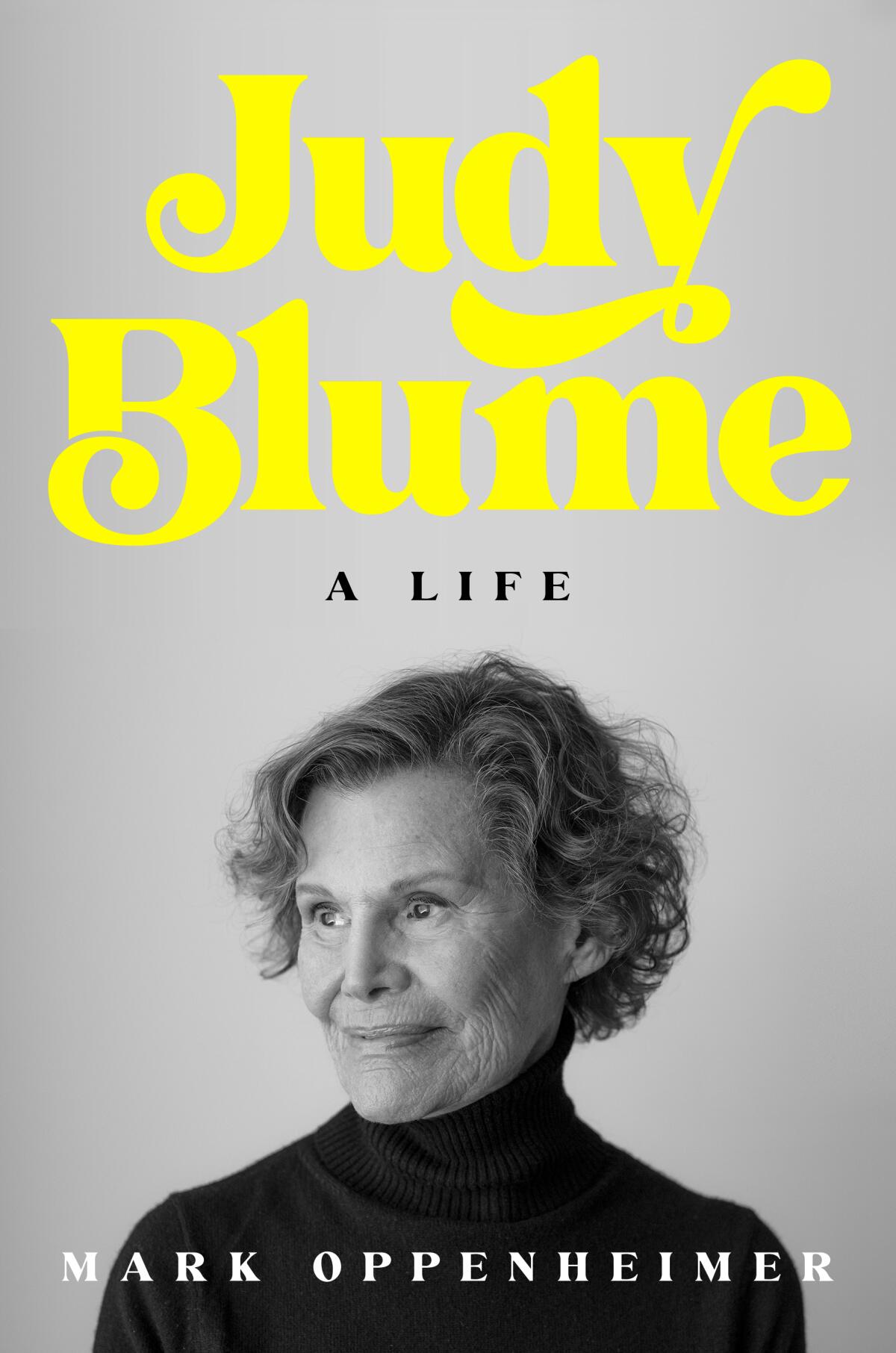
"Judy Blume: A Life" by Mark Oppenheimer

It is intrinsic and impossible not to parlay Blume’s stories of sibling rivalries, first loves, friends and frenemies, and (most famously) puberty with what was going on in your life when you read them. Books like “Deenie” and “Superfudge” and “Margaret” are also remarkably malleable enough so that, even if a kid picks them up decades after their release or cannot relate with a parallel experience, they can become placeholders and explainers for what must be going on in the minds of their classmates. Last year, TV creator Mara Brock Akil adapted “Forever,” Blume’s 1975 story of the kind of mutually shared devotion that feels like it will last eternally, into a miniseries set in 2018 Los Angeles.

“I think for many of us, Judy’s books are our first crush or our first love and they do hold a special place that no book we read in our world-weary, cynical 40s can hold,” says Oppenheimer.

Some of this can be attributed to time and brain space. Oppenheimer discovered Blume’s work when he was a child. He’s now a parent, with a career and all the other time-sucks that come with adulthood.

“The books I read as a child imprinted on me in a way that books today don’t,” he says. “I probably remember more plot points of the first Judy Blume books that I read than I do of any book I’ve read in the past five years.”

But what of Blume herself? Can America’s mom also be a three-dimensional person who makes her own mistakes? Discovering her four adult novels — especially “Wifey,” a book about a gilded-caged suburban housewife that even Oppenheimer describes as “a very salacious, one might say, smutty, adult novel” that even some of Blume’s collaborators wanted her to publish under a pseudonym — or watching documentaries about her like 2023’s “Judy Blume Forever,” in which she is seen joking about masturbation with employees at her Key West, Fla., bookstore, can seem as evasive and dangerous as reading your mom’s diary.

Author Mark Oppenheimer

Author Mark Oppenheimer

(Lu Arie)

There have been other books about Blume and her work, most notably Rachelle Bergstein’s 2024 deep-dive “The Genius of Judy: How Judy Blume Rewrote Childhood for All of Us.” But Oppenheimer’s biography is a more straightforward tracing of Blume’s life and career. He starts with her childhood when she was encouraged to read Philip Roth at home and went to sleepovers at friends’ houses that were more about body awakenings. He discusses her stifling first marriage, which gave her the last name she carries with her to this day and her two children but is also where she hung her college diploma and another award over her washing machine as reminders of her intellect. There’s talk of her second marriage, which Blume has always been reluctant to discuss, as well as the two abortions that resulted from it. And there are details on her life with her third husband, the polymath George Cooper.

Oppenheimer relied on past news stories about Blume, as well as a collection of her work and professional correspondences that are archived at Yale’s Beinecke Rare Book & Manuscript Library and, probably most informatively, his own interviews with Blume and her friends and family. (Although Blume did agree to speak with Oppenheimer for his book, she declined our request to interview her for this story about that book).

“I think that the difficult subjects are sometimes the ones that make her more relatable,” Oppenheimer says of his subject. “I think most of her fans will find it interesting and admirable that she speaks so candidly about her abortions, about especially her divorce from her first husband, which came as she was getting involved in the [second-wave] women’s movement, about her early same-sex experiences, about masturbation as a girl; these are things we would expect Judy Blume to be candid about.”

Oppenheimer matches how these life events correspond with the ones of Blume’s characters because, for better or for worse, she almost always was an author who wrote what she knew even if her fandom transcended it. What her books lack in character diversity, they make up for in specificity. And that, in turn, also makes them relatable.

“Judy found incredibly compelling human drama in books about the New Jersey suburbs, and that’s a testament to her strength as an artist,” Oppenheimer says.

Writer Judy Blume rests her hands on books on a bookcase

Writer Judy Blume at her nonprofit bookstore Books and Books on March 26, 2023, in Key West, Fla.

(Mary Martin / Associated Press)

Examining and reexamining Blume’s work as an adult also gave Oppenheimer a better perspective of her writing style. Blume didn’t begin to try to write professionally until she was a married mother of two and some have criticized her work for not being as flowery and polished as others’.

“All of her books tend to take a fairly tight focus on the characters,” Oppenheimer says. “They don’t tend to pull back and look at large societal forces or changes going on in the country or the world. And that’s fine. You know, the same could be said of Jane Austen.”

Perhaps the best example of this is Blume’s own religious foundation. Her most autobiographical novel, “Starring Sally J. Freedman as Herself,” has a protagonist who is paranoid that she sees Adolf Hitler on park benches and whose life is imprinted with stories of a relative who followed her mother into the concentration camps and the neighbors sitting shiva (a time of mourning) for their daughter who got pregnant with her non-Jewish boyfriend. And yet, Oppenheimer notes, Blume is not always immediately thought of as a Jewish writer. Nor have most of her readers been Jewish.

“I think that her Judaism is there, if you know where to look,” says Oppenheimer, who spends the early part of his biography looking at how the synagogue and religious community were a normal part of a young Blume’s life. He adds that “she is somebody who speaks really, really well across religious, cultural and racial differences, and that’s partly why she has sold tens of millions of books.”

Oppenheimer acknowledges that Blume’s characters may not be diverse enough by today’s standards; that they don’t usually discuss “gender identities or sexualities; children of multiracial backgrounds; children who have disabilities.” They can also feel like time capsules to other dimensions; his 12-year-old daughter was scandalized by how normative bullying was after she read “Blubber,” Blume’s 1974 novel about tween mean girls and body shaming.

He adds that some of today’s bestselling young adult novels, like Rick Riordan’s Percy Jackson series about a teen demigod or Suzanne Collins’ dystopia-set “Hunger Games” books, are “contemporary realism [that] focus on extraordinary or unusual circumstances.” And while he’s happy for these books’ popularities, he says that some subjects may be better told by kids who also aren’t tasked with saving the world. (I am pretty sure I learned more about male puberty from Blume’s 1971 story “Then Again, Maybe I Won’t,” which is as much about wealth divides and questionable friend choices as it is about a 13-year-old boy’s inner monologues about her awkward adolescence).

“If what you’re looking for is realism that isn’t focused on obvious external differences, but rather on interiority,” Oppenheimer says, “then Judy Blume still remains one of the premier novelists that you would want to read.”

Friedlander is a pop culture and entertainment journalist based in Los Angeles who hates coffee but loves Coke Zero.

Source link

Russia the only ‘winner’ of US-Israel war on Iran: EU Council president | US-Israel war on Iran News

Antonio Costa says Russia benefits from soaring global energy prices and attention being diverted from war in Ukraine.

European Council President Antonio Costa has said Russia is the only country benefitting from the US-Israeli war on Iran, as global energy prices soar and attention from Moscow’s four-year conflict with Ukraine is diverted.

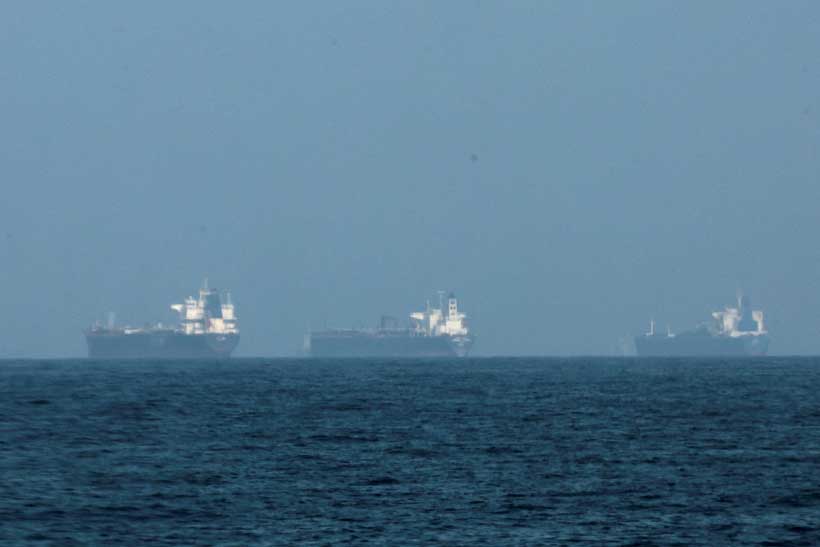
Now in its 11th day, the war has spiralled rapidly throughout the region as Iranian forces hit back at US and Israeli targets, as well as facilities in the Gulf. It has also slowed oil and natural gas flows through the strategic Strait of Hormuz to a near standstill, pushing fuel prices upwards and threatening far-reaching impacts on a number of industries.

Recommended Stories

list of 3 itemsend of list

“So far, there is only one winner in this war – Russia,” Costa said in a speech to European Union ambassadors in Brussels on Tuesday.

“It gains ‌new resources to finance its war against Ukraine as energy prices rise. It profits from the diversion of military capabilities that could otherwise have been sent to support Ukraine. And it benefits from reduced ⁠attention to the Ukrainian front ⁠as the conflict in the Middle East takes centre stage.”

Costa stressed the need for the EU to protect ⁠the international rules-based order, which he said was now being challenged ⁠by the United States, ⁠and for all parties in the Middle East to return to the negotiating table.

“Freedom and human rights cannot ‌be achieved through bombs. Only international law upholds them,” he said. “We must avoid further escalation. ‌Such ‌a path threatens the Middle East, Europe, and beyond.”

The US and Israeli attack on Iran triggered the biggest spike in oil prices on Monday since the turmoil following Russia’s invasion of Ukraine in 2022.

INTERACTIVE - Strait of Hormuz - March 2, 2026-1772714221

Costa’s comments came as the Kremlin said all parties wanted to continue US-mediated Russia-Ukraine peace talks, but that no date or venue had been agreed yet for the next round.

Russia and Ukraine held three rounds of talks in Turkiye last year and have conducted several more US-mediated sessions in Abu Dhabi and Geneva this year. But they remain far apart on key issues, especially on Russia’s demand for Ukraine to cede control of the whole of its eastern Donetsk region.

On Monday, US President Donald Trump and his Russian counterpart, Vladimir Putin, held their first phone call of the year, during which they discussed the wars in Iran and Ukraine.

The Kremlin said the possibility of lifting US sanctions on Russian oil had not been discussed in any detail with Washington, but that US actions were aimed at stabilising global energy markets.

Following this call, Putin said Russia, the world’s second-largest oil exporter and holder of the biggest natural gas reserves, was ready to work again with European customers if they wanted to return to long-term cooperation.

Before the Ukraine war, Europe was buying more than 40 percent of its gas from Russia. By 2025, combined sales of pipeline gas and LNG from Russia accounted for only 13 percent of total EU imports.

Also on Monday, Trump said his administration would lift some sanctions on oil-producing countries to keep energy prices down – though he did not say which ones.

Washington currently maintains sanctions on the oil sectors of Russia, Iran and Venezuela.

The Reuters news agency, citing multiple unnamed sources, reported that Trump was considering easing sanctions on Russia as part of his plans to keep oil prices down.

US Treasury Secretary Scott Bessent last week announced a 30-day waiver on sanctions on Russian oil sales to India to help it cope with the cuts to Middle East supply.

Source link

HRW Alleges Israel Illegally Used White Phosphorus in Southern Lebanon

Human Rights Watch (HRW) said on Monday that the Israeli military illegally deployed white phosphorus munitions over the southern Lebanese town of Yohmor on March 3, posing severe risks to civilians.

Ramzi Kaiss, HRW’s Lebanon researcher, described the incendiary effects of white phosphorus as capable of causing death or “cruel injuries that result in lifelong suffering.” The group said it had verified eight images and reports from civil defense personnel responding to fires in residential areas.

White phosphorus can legally be used in warfare to create smoke screens, illuminate battlefields, mark targets, or burn fortified positions. However, HRW emphasized that deploying airburst white phosphorus over populated areas is prohibited under international humanitarian law.

Protocol III of the Convention on the Prohibition of Certain Conventional Weapons classifies white phosphorus as an incendiary weapon and forbids its use against military targets located among civilians. While Israel has not signed the protocol and is not legally bound by it, HRW and other rights groups argue that its use in populated areas constitutes a violation of humanitarian principles.

Previous Patterns and Scale

The report comes amid an intensification of Israeli strikes in Lebanon over the past week. According to the Lebanese National Council for Scientific Research, between October 2023 and July 2024, Israel carried out 175 attacks using white phosphorus in southern Lebanon, sparking fires across more than 600 hectares (1,480 acres) of farmland.

HRW previously accused Israel of using white phosphorus in 2023, a charge the Israeli military denied. Civilian displacement and casualties have been severe: nearly 400 people killed and hundreds of thousands forced to leave their homes as strikes continue.

Israeli Response

The Israeli military told Reuters it was unaware of and could not confirm the use of white phosphorus shells in Yohmor. Officials said they had not reviewed the same videos cited by HRW and declined to comment on the allegations. Lebanese authorities have not issued a statement on the report.

On March 3, the Israeli military ordered residents of Yohmor and 50 other nearby towns to evacuate ahead of strikes, highlighting the heightened risks to civilians in affected areas.

Analysis

The allegations underscore the ongoing humanitarian and legal concerns in southern Lebanon amid Israel’s operations. Even without Israel being formally bound by Protocol III, the use of incendiary munitions in populated areas raises questions about compliance with customary international humanitarian law, which prohibits indiscriminate attacks on civilians.

The repeated accusations of white phosphorus use reflect both the intensity of Israel’s military campaign and the broader risk of civilian harm in the conflict. Beyond immediate casualties and destruction, agricultural damage and displacement threaten long-term social and economic stability in southern Lebanon, particularly for farming communities still recovering from previous conflicts.

The HRW report may intensify international scrutiny on Israel’s conduct in Lebanon, potentially influencing diplomatic and humanitarian responses in the region.

With information from Reuters.

Source link

Olivia Attwood drops cryptic hint on her ex Bradley Dack’s ‘breach of trust’

OLIVIA Attwood has dropped a cryptic hint about her ex Bradley Dack’s “breach of trust” following their split.

The TV and podcast star, 34, appeared to suggest her next relationship won’t have the same pitfalls in her Instagram story.

Olivia Attwood shared this cryptic post on InstagramCredit: Instagram
Olivia’s choice of music for the post was also tellingCredit: Splash

She shared a post that read: “No more learning experiences please god I am smart enough,” while Tame Impala’s aptly titled ‘New Person, Same Old Mistakes’ played over the top.

Yesterday, Olivia revealed that she will speak about her split from footballer Bradley, 32, a week after she was spotted leaving the same Manchester hotel as close pal Pete Wicks, 37.

The Sun reported how he was seen carrying two pizzas up to his room at 3am.

Yesterday, Olivia joined This Morning hosts Ben Shephard and Cat Deeley in the studio to discuss her new ITV show The Heat.

READ MORE ON OLIVIA ATTWOOD

BACK TOGETHER

Pete Wicks & Olivia Attwood all smiles as they reunite after ex blocked Pete


ATTA GIRL

Olivia Attwood opens up on ‘good distraction’ from Bradley Dack split

But the presenters couldn’t help but turn the spotlight onto Olivia’s personal life as they asked her how she was coping following her split.

Ben said: “It’s been a very busy start to the year for you professionally and personally, how you doing?” to which Olivia began to laugh.

She replied: “My feet haven’t touched the ground, I’m grateful forever for this wonderful thing that I get to call work and I can throw myself into it.

“I think when you are in entertainment and you have to show up as the person you’re booked to be, almost when you’re doing that you kind of trick your brain – it’s a distraction isn’t it, you can just get into it, that’s been my anchor since Jan.

“I feel like I haven’t breathed.”

Olivia then spoke about her house move, which saw her leave her shared home with Brad last month.

The TV presenter said she’ll reveal all about her marriage breakdown on her podcastCredit: Getty

“I am now getting there with the apartment, I am very lucky that I’m in the position where I’m on my own two feet and I can do that. But moving is hell, no matter how much help you have,” she said.

Olivia acknowledged there is an expectation for her to share her private life due to her rise to fame on reality show Love Island.

But she said she’s taking her time to process everything before speaking about her split on her podcast.

“The reason I’m sat here with you guys today is from being on Love Island, so people are used to a level of access to me which I have no issue with providing still but I have to do it when I’m ready and I know what I’m wanting to share,” she said.

“I’m trying to do that a little bit more as I get older ‘think before you speak’, because once you’ve said it, it’s hard to take it back.

“I’m still digesting things and working things out. We’ll get to it, we’ll have a podcast chat, it’s coming but I just need to process it.”

The Sun revealed in January that Olivia had split from Gillingham footballer Bradley following a “breach of trust” on his part.

In 2017, she went on Love Island and emerged in a relationship with Chris Hughes, later saying it was revenge on Bradley for cheating.

They eventually reunited after having a heart to heart while she was still with Chris, and she joined Towie in 2019, on which Pete was already a regular.

Last summer, Olivia and Pete were seen in an intimate embrace on a yacht off Ibiza.

Olivia’s close pal Pete Wicks has been blocked by Bradley on InstagramCredit: Splash

We revealed Bradley has now blocked Pete on Instagram — just a few weeks after the couple’s split.

Speaking ahead of the Brit Awards on their Sunday Roast podcast, Pete said: “What always happens at these events is Liv and I gravitate towards each other and basically just stick together, don’t we?”

Olivia replied: “Because I feel like we both have the same objective. And talk to as few people . . .”

Pete then added: “As possible.”

Pete then said: “Although we are not going big this year, are we?” – to which Olivia countered: “What do you mean?”

Pete continued: “You have a flight the next day.”

Olivia replied: “I know – you need to keep me lucid enough that I don’t get stopped at immigration.”

Pete said: “The danger being that I jump on the flight with you in what I am wearing from the Brits.”

Source link

Man removed from flight after call to prayer was mistaken for ‘bomb threat’ | Aviation

NewsFeed

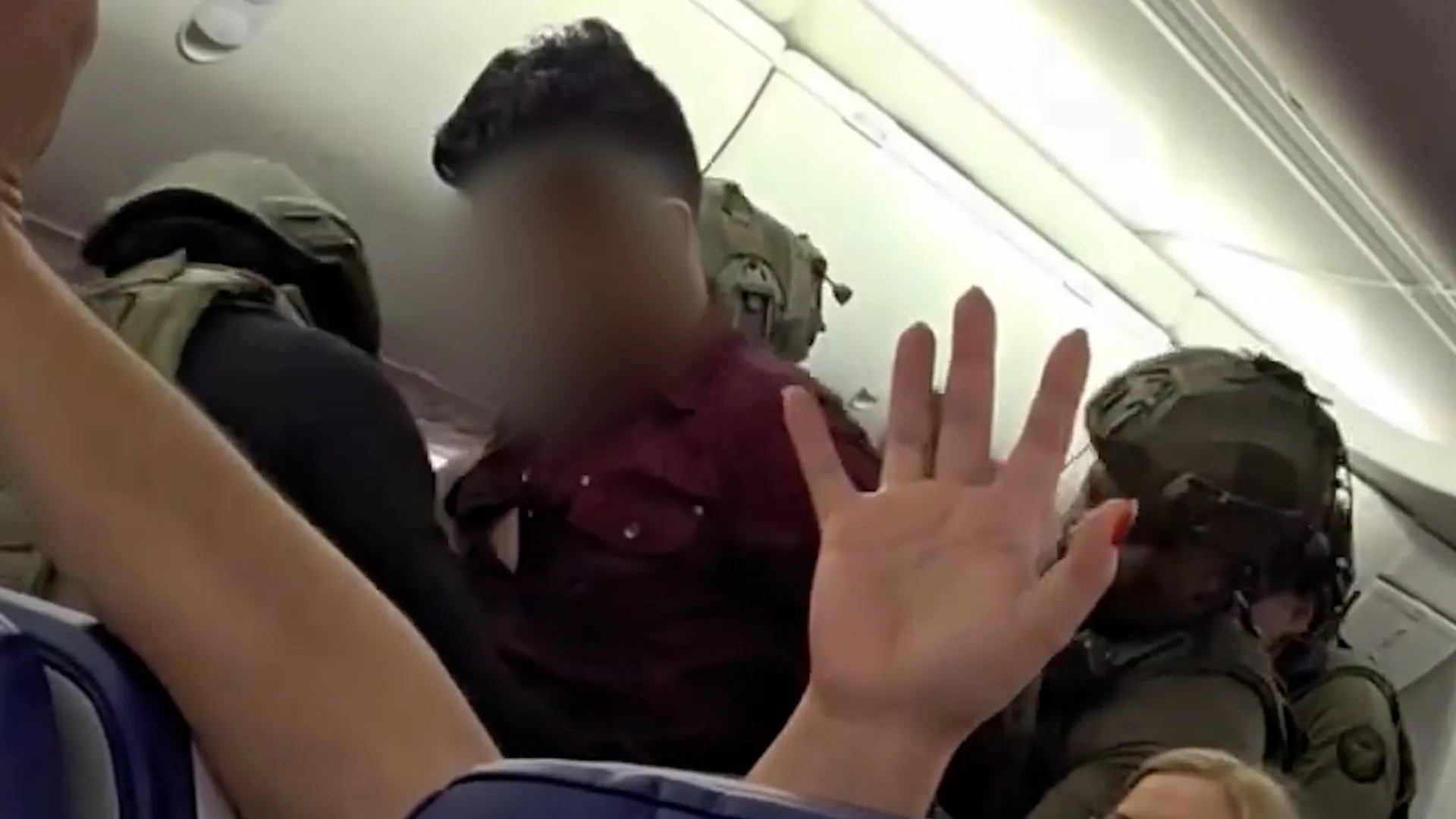
A passenger onboard Southwest Airlines was removed from their flight after their call to prayer was mistaken for a ‘bomb threat’. Officials later called the incident a ‘misunderstanding’ after finding no credible threat, following the Florida-bound flight’s emergency landing in Georgia.

Source link

Markets Bet on Quick End to Iran War Despite Threats from Both Sides

Investors placed strong bets on Tuesday that Donald Trump could bring the war in Iran to a rapid conclusion, even as both sides escalated threats. The Islamic Revolutionary Guards Corps of Iran declared that no oil would leave the Middle East until U.S. and Israeli attacks cease, prompting Trump to threaten that any attempt to block tanker traffic would be met with strikes “twenty times harder.”

Despite the rhetoric, markets quickly reversed the historic surge in crude prices seen on Monday. Brent crude briefly surged to nearly $120 a barrel, a level not seen since mid‑2022, but fell back to around $92 by Tuesday morning. Futures volumes were low, reflecting both caution and the fact that traders were recalibrating risk based on Trump’s comments that the U.S. was “very far ahead” of his initial four- to five-week timeframe for the conflict. Asian and European share prices staged a recovery from earlier steep falls, signaling that markets were treating Trump’s statements as a de-escalation signal, even if the on-the-ground situation remained dire.

Analysts noted that while the market’s reaction reflects optimism about a short conflict, underlying risks remain. Suvro Sarkar of DBS Bank observed that benchmark Middle Eastern grades like Murban and Dubai crude remain above $100 per barrel, meaning the fundamental pressures on supply have not dissipated.

On the Ground: Intensified Conflict

Meanwhile, the human and strategic realities on the ground remain stark. Tehran residents described the heaviest bombardment of the conflict yet, with strikes across the city leaving civilians fearful and homes damaged. One resident said, “It was like hell. They were bombing everywhere, every part of Tehran… my children are afraid to sleep now. We have nowhere to go.”

Israel is simultaneously operating under the assumption that Trump could end the war at any moment, sources familiar with its military plans told Reuters. This has encouraged Israeli forces to maximize damage on Iranian targets before any potential ceasefire, highlighting the tension between the short-term operational calculus and long-term strategic objectives.

Iran’s appointment of hardliner Mojtaba Khamenei as Supreme Leader signals defiance against U.S. pressure to influence Iranian leadership, underscoring Tehran’s unwillingness to yield to external demands despite the military pressure.

Strategic Implications: Oil, Leadership, and Geopolitics

The war has effectively halted shipments through the Strait of Hormuz policy measures such as easing sanctions on Russia and releasing strategic oil reserves, are interpreted by markets as mitigating factors that could prevent a prolonged energy crisis.

However, the underlying political and military dynamics suggest that a rapid resolution may not meet all stated U.S. objectives. Ending the conflict quickly to restore oil flows would likely leave Iran’s leadership intact, which contrasts with Trump’s previous maximalist demands for influence over Iran’s succession. Israel’s objectives diverge further, as it continues to seek regime change and to weaken Tehran’s ability to strike beyond its borders, while U.S. officials emphasize missile and nuclear containment.

Human and Regional Costs

The war has already inflicted significant human costs. Iran’s U.N. ambassador reported at least 1,332 civilian deaths and thousands wounded since the airstrikes began. Iranian missile and drone strikes targeting Gulf states have damaged infrastructure, closed airports, and disrupted hotels, while retaliatory Israeli strikes in Lebanon have killed scores amid ongoing efforts to neutralize Hezbollah.

Domestically, Iran has suppressed dissent and anti-government protests following the death of Ali Khamenei, further complicating the social dynamics that external military action interacts with. Large-scale rallies in support of Mojtaba Khamenei demonstrate public mobilization in favor of the hardline leadership, which may limit the U.S. and Israel’s capacity to influence internal political outcomes even after the war concludes.

Analysis: Financial, Strategic, and Geopolitical Interplay

Markets are betting on a short conflict because of political signaling, but the broader picture is far more complex. Oil prices remain sensitive to supply disruptions, and the potential for renewed escalations persists. The market response highlights how sentiment can temporarily override fundamental risks, yet volatility is likely to continue as long as strategic objectives, military operations, and leadership decisions remain unresolved.

From a geopolitical perspective, the conflict illustrates the tension between military objectives and economic consequences. A rapid end to the war would stabilize energy markets and global growth expectations but may leave U.S. and Israeli goals partially unmet. Conversely, prolonging the conflict to pursue maximalist aims risks a sustained oil shock, regional instability, and wider economic fallout, echoing lessons from past Middle East crises in the 1970s.

Analysts emphasize that energy markets, geopolitical strategy, and human costs are tightly intertwined: traders respond quickly to political statements, but the underlying realities strikes, leadership decisions, and supply chain vulnerabilities ensure that uncertainty will remain high. The delicate balance between military pressure, diplomacy, and market psychology will determine whether the Iran conflict resolves quickly or evolves into a more protracted crisis.

With information from Reuters.

Source link

Channel 4 star holds back tears over homeless man who wants to return to jail

Jonathan Ross’ new Channel 4 show Handcuffed: Last Pair Standing has gripped the nation.

Emotions were at an all-time high during an episode of Channel 4’s Handcuffed: Last Pair Standing.

The new social experiment, with his hosted by Jonathan Ross, sees nine strangers put into pairs and compete against one another to win a £100,000 prize.

During an upcoming episode of the Channel 4 show, millionaire businessman Anthony Saxon Kearsley had an eye-opening experience with a homeless man.

Anthony has been partnered with 37-year-old Tilly, a North London barmaid who works three jobs and is involved with giving meals to the homeless through her charity.

While prepping meals, the wealthy contestant shared some out-of-touch opinions on those without a home, suggesting some people ‘don’t want to help themselves’.

He also compared homelessness to ‘camping’, however, Anthony quickly changed his tune when handing out meals himself.

When giving a McDonald’s to one homeless man, who had recently come out of prison, Anthony learnt the man was struggling to secure a job without an address.

He explained: “I’ve been out of jail for a while, I just feel like going back, I can’t stand it.”

For the latest showbiz, TV, movie and streaming news, go to the new **Everything Gossip** website.

Sharing the hope that things worked out for him, it was clear Anthony was moved by the interaction with the homeless man.

While speaking to the camera, he confessed: “I am a bit [overwhelmed]. He wants to go back to prison because he can’t cope with life. It’s appalling.

“It’s really shocking. I was wrong to say some people don’t want help. It’s appalling, dreadful. Thank you [Tilly] for showing me. I won’t be as flippant again.”

As Tilly revealed that it was a small percentage of what she sees day in and day out, Anthony was in awe.

While getting choked up, he replied: “I’m amazed that you’re so positive and I’m amazed that you’ve survived this intact. Anyway, God love you. Terrible isn’t it. I’m quite cut up about it to be honest.”

Handcuffed: Last Pair Standing is available to watch or stream on Channel 4

Source link

Hundreds killed in Haiti drone strikes, including 60 civilians: Report | Human Rights News

Human Rights Watch says drone strikes by Haitian forces kill more than 1,200 people in and near Port-au-Prince since 2025.

Drone strikes operated by Haitian security forces and private contractors have killed at least 1,243 people and injured 738 in Haiti, Human Rights Watch (HRW) reports.

Since March last year, Haitian security forces with support from Vectus Global, a United States-licensed private military firm, have carried out antigang operations using quadcopter drones strapped with explosives, often in densely populated parts of the ⁠capital, Port-au-Prince.

Recommended Stories

list of 3 itemsend of list

The report found strikes from March 1, 2025, to January 21 in West Department, where Port-au-Prince is located, have killed 17 children and 43 adults not believed to be members of any criminal groups.

“Haitian authorities should urgently rein in the security forces and private contractors working for them before more children die,” Juanita Goebertus, Americas director at HRW, said in a statement.

The nonprofit said the number of drone attacks in Port-au-Prince, which is 90 percent controlled by gangs, has “significantly increased” in recent months, with 57 reported from November to late January, almost double that of the 29 attacks reported from August through October

HRW said its researchers analysed seven videos uploaded to social media or shared directly with the group that show quadcopter drones in action and geolocated four of them to Port-au-Prince.

“The videos show the repeated use of drones equipped with explosives to attack vehicles and people, some of them armed, but none who appear to be engaged in violent acts or pose any imminent threat to life,” the group said.

‘There are innocent people’

HRW said it did not find widespread drone use among criminal groups.

One of the attacks highlighted in the report occurred on September 20 in the Simon Pele neighbourhood, an impoverished community controlled by a gang of the same name.

The drone attack killed nine people, including three children, and injured at least eight as the leader of the Simon Pele gang prepared to distribute gifts to children in the area.

HRW quoted one unnamed resident as recalling how the explosion ripped both feet off a baby.

Among those killed was a six-year-old girl whose unidentified mother was quoted as saying: “In the spaces where the gangs are, there are innocent people, people who raise their children, who follow normal paths.”

The families of those killed said the criminal group organised and controlled access to their funerals, according to Human Rights Watch.

Last month, the United Nations Integrated Office in Haiti said it had no ‌indications ‌the deaths and injuries were being investigated.

HRW said there was no evidence drones were being used widely by gangs. The UN’s high commissioner for human rights said in October that the drone strikes were disproportionate and likely unlawful.

Source link

Venezuelans Pick State-Funded Projects to Address Local Community Needs

A voter participates in the March 8 consultation. (Archive)

Mérida, March 9, 2026 (venezuelanalysis.com) – Millions of Venezuelans participated on Sunday in the first National Popular Consultation of 2026, a direct democracy mechanism designed to transfer state resources directly to organized communities for the execution of self-managed projects. 

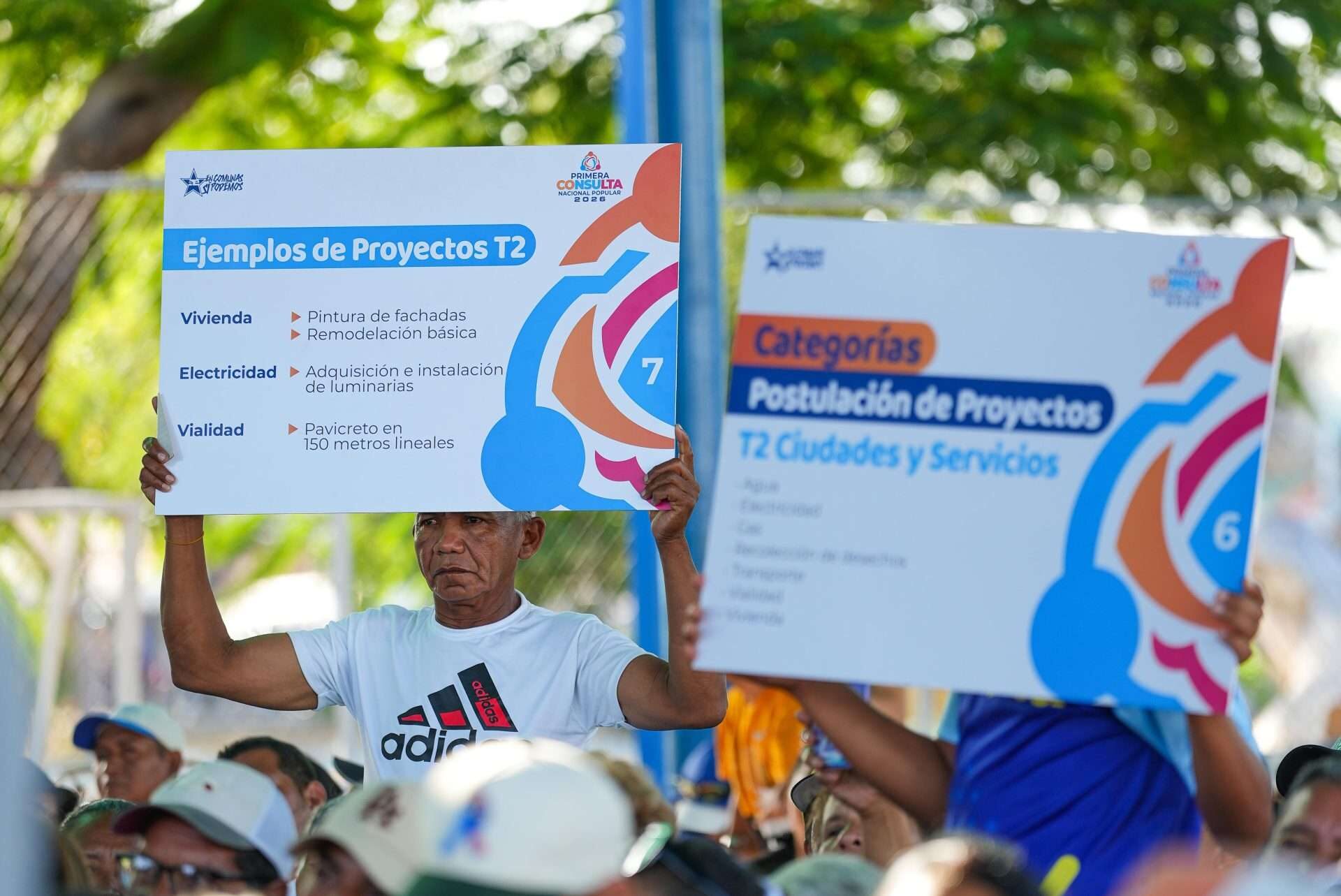
The process took place in 5,336 communal circuits nationwide. Residents over the age of 15 were eligible to vote for one of up to seven projects previously proposed and debated in local citizens’ assemblies. The initiatives mostly focus on urgent territorial priorities such as water distribution, electrical grid repairs, and infrastructure renovations.

Once a project is selected by the majority of voters in a communal circuit, the government transfers US $10,000, in local currency. The community then manages the resources and oversees the execution of the work. 

Communes Minister Ángel Prado visited several voting centers on Sunday, hailing the turnout and the efficiency of the communal model.

“This is an extraordinary result and a demonstration of the great participation registered in this 2026 Popular Consultation,” Prado stated to national media. “The organized people are showing that they have the capacity to manage their own resources and solve their problems with transparency and commitment.”

The winning proposal in the Lanceros Atures Commune in Lara state was the purchase of equipment for the local healthcare center. In rural Cojedes state, residents of the Zamora Vive Communal Circuit chose to fund the production of cereals and legumes.

In 5 de Marzo Comandante Eterno Commune in southwest Caracas the community selected a project to replace 10 kg liquefied gas (LPG) cylinders used mostly for cooking. For many families, this was a critical priority as existing cylinders were in poor condition or insufficient for daily needs.

Anaís Márquez, a spokesperson for the commune, explained to Venezuelanalysis the transformative impact of the winning project.

“The winning project is the replacement of the cooking gas cylinders, which will transform our realities,” Márquez said. Six of the seven community councils here rely on these cylinders. Many were in poor condition, or people only had one. Selecting this project means guaranteeing a better quality of life and safety for our families.”

Márquez highlighted that the consultation’s timing on March 8, International Working Women’s Day, added a layer of historical significance to the process.

“I believe this consultation is one of those demands we have fought for. What better way to commemorate International Working Women’s Day than through participation, since 80% of communal spokespeople in Venezuela are women,” she noted.

The local activist added that the projects chosen in the consultations “create a sense of belonging and joint responsibility for the transformation of our territory.”

The concept of the commune was central to former President Hugo Chávez’s vision of the path toward socialism. Chávez envisioned communes as the “unit cells” of a new state, where social property and self-governance would eventually replace the old “bourgeois” structures.

Starting in 2024, the Nicolás Maduro government implemented the consultations as the main mechanism to support grassroots organizations. By empowering local communities to execute projects identified through their own “concrete agenda of action,” the state bypassed the local governorships and mayoralties to deliver funds directly.

Sunday’s vote was the first of several planned for 2026.

Communards hold signs with information on possible projects. (Archive)

Edited by Ricardo Vaz in Caracas.

Source link

Who is in the cast of One Piece Season 2 on Netflix?

A whole host of new faces are joining the crew for the adventure

One Piece season 2 first look

The second season of Netflix’s critically acclaimed live-action adaptation of a beloved manga series is finally here.

Brand new episodes of One Piece are now available to stream as of today (March 10). Fresh instalments adapt several story arcs from the original source material which was previously turned into a popular anime.

The first season of the live-action version debuted exclusively on the streaming service back in August 2023. It means fans have been eagerly awaiting the continuation of the Straw Hat crew’s adventures.

Based on the Japanese manga series by Eiichiro Oda, One Piece follows Monkey D. Luffy on his journey to find the legendary treasure, the One Piece, in his quest to become King of the Pirates. The second season is subtitled Into The Grand Line.

Who is in the cast One Piece Season 2 on Netflix?

All members of the Straw Hats crew return for the live-action series’ second outing. They are lead by Iñaki Godoy as Monkey D. Luffy, a young pirate bestowed with the power of stretching from eating a Devil Fruit as a child.

His ultimate goal is to find the One Piece and become the next King of the Pirates. Mexican actor Godoy has previously appeared in The Imperfects on Netflix.

Emily Rudd also returns as Nami, a cat burglar and expert cartographer. Rudd has previously starred in Fear Street Parts Two and Three as well as thriller series Hunters.

Mackenyu stars as swordsman Roronoa Zoro, an ex-bounty hunter who becomes Luffy’s first mate shortly after their first encounter. He trains regularly to become the world’s greatest swordsman. Mackenyu previously appeared in Pacific Rim Uprising and recently voiced Gennojo in the game Assassin’s Creed Shadows.

Jacob Romero Gibson plays Usopp, master storyteller and estranged son of an infamous pirate. He aspires to be a brave warrior of sea. He has also appeared in episodes of Grey’s Anatomy and The Resident.

Get Netflix free with Sky

This article contains affiliate links, we will receive a commission on any sales we generate from it. Learn more
Content Image

from £15

Sky

Get the deal here

Sky is giving away a free Netflix subscription with its new Sky Stream TV bundles, including the £15 Essential TV plan.

This lets members watch live and on-demand TV content without a satellite dish or aerial and includes hit shows like Stranger Things and The Last of Us.

Taz Skylar also returns as Sanji, the master chef and martial artist who only fights with his legs to protect his hands for cooking. He is searching for the All Blue, a mythical connection point of the Four Seas. Spanish-British actor Skylar, is also known for Boiling Point and The Lazarus Project.

The newest member of the Straw Hats for Season 2 is Tony Tony Chopper. They are a reindeer capable of walking and talking like humans after consuming a Devil Fruit, who also happens to study as a medical practitioner. Providing Chopper’s voice is Mikaela Hoover, known for turns as Cat Grant in 2025’s Superman while she’ll also appear in the new season of Beef on Netflix.

Aside from the main crew, they have a number of familiar adversaries on their tail. It includes Koby, the former cabin boy of the Alvida Pirates Luffey rescued back in the first episode. He has since become a Marine in his tracking his former pal down. He is once again played by Morgan Davies whose recent credits include Evil Dead Rise.

Marine Vice Admiral Garp is also on the Straw Hats’ tail. He was also revealed during season one to be Luffey’s estranged Grandfather. He’s played by Welsh actor Vincent Regan, whose credits include Shetland, House of the Dragon, The Bay and Poldark to name a few.

Also confirmed to return is Jeff Ward as Buggy the Clown, the circus-themed captain of the Buggy Pirates. Buggy has the power to split his body into pieces and control each part remotely. Like Luffey, his unique ability comes from eating a Devil Fruit. Ward has previously appeared in Hacks and Agents of Shield.

Who are in the Baroque Works?

There are not the only ones our heroes need to worry about though. A brand new faction is introduced and causing trouble on the Grand Line. Namely, a mysterious group of assassins who call themselves Baroque Works.

Their leader is the mysterious Mr. O, played by Joe Manganiello. The actor is easily recognisable for his turns in True Blood and his uncredited appearance as Deathstroke in Zac Snyder’s Justice League.

Bridgerton star Charithra Chandran is also part of the group as Miss Wednesday while she also has her own agenda. Her partner is Mr 9, played by Raised by Wolves actor Daniel Lasker.

David Dastmalchian stars as Mr. 3 described as “creepy artist serial killer of Baroque Works.” Dastmalchian previous roles include Oppenheimer, Ant-Man, The Suicide Squad and Late Night With The Devil.

The OA actor Camrus Johnson is Mr 5, while Lioness star Jazzara Jaslyn plays Miss Valentine. They are joined by Exterritorial’s Lera Abova as Miss All Sunday alongside The School for Good and Evil’s Sophia Anne Carusoas as Miss Goldenweek.

One Piece is streaming on Netflix.

For the latest showbiz, TV, movie and streaming news, go to the new ** Everything Gossip ** website.

Source link

Number of foreign residents in S. Korea nears 1.7 mln in 2025

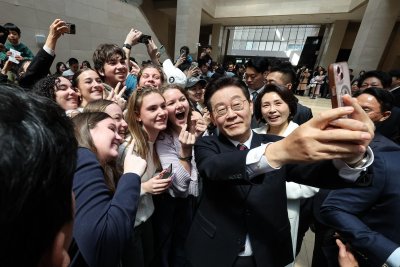
The number of foreign nationals residing in South Korea is nearly 1.7 million, government data showed Tuesday. In this February photo, foreigners pose with South Korean President Lee Jae Myung in Seoul. File Photo by Yonhap

The number of foreign nationals residing in South Korea approached 1.7 million as of May last year, government data showed Tuesday.

The total number came to 1.69 million as of last May, up 8.4 percent from a year earlier, according to data released by the Ministry of Data and Statistics. The figure refers to foreigners aged 15 and older who have resided in the country for more than 91 days.

By category, overseas Koreans with foreign nationalities accounted for the largest share, at 24.2 percent, followed by non-professional employment visa holders, at 19 percent, the data showed. International students accounted for 14 percent, and permanent residents accounted for 9.6 percent.

Among foreign nationals, ethnic Koreans with Chinese nationality accounted for 29.9 percent of the total, followed by those from Vietnam with 16 percent, the data showed.

The data also showed that 65.5 percent of foreign nationals had jobs as of May.

Among those employed, 10.8 percent of foreign workers said they were seeking new jobs, with most citing low income as the main reason.

About 32 percent of foreign nationals reported earning a monthly income between 2 million won (US$1,362) and 3 million won, the data showed.

The data also showed 12.9 percent of foreigners said they experienced financial difficulties over the past year.

Copyright (c) Yonhap News Agency prohibits its content from being redistributed or reprinted without consent, and forbids the content from being learned and used by artificial intelligence systems.

Source link

Could the US-Israel war with Iran fuel global inflation? | Business and Economy

Oil prices are swinging as markets react to every twist in the conflict.

The United States and Israel’s war on Iran has caused the largest energy supply shock in decades.

The Strait of Hormuz is in effect closed, and attacks are being carried out on energy facilities in the Middle East, rattling oil markets.

From Americans filling their tanks at the pump to European factories and Asian economies, the impact is already being felt.

US President Donald Trump says the rise in oil prices is a “very small price to pay” for “safety and peace”. But investors warn that if the conflict drags on, there’s danger of stagflation.

Source link

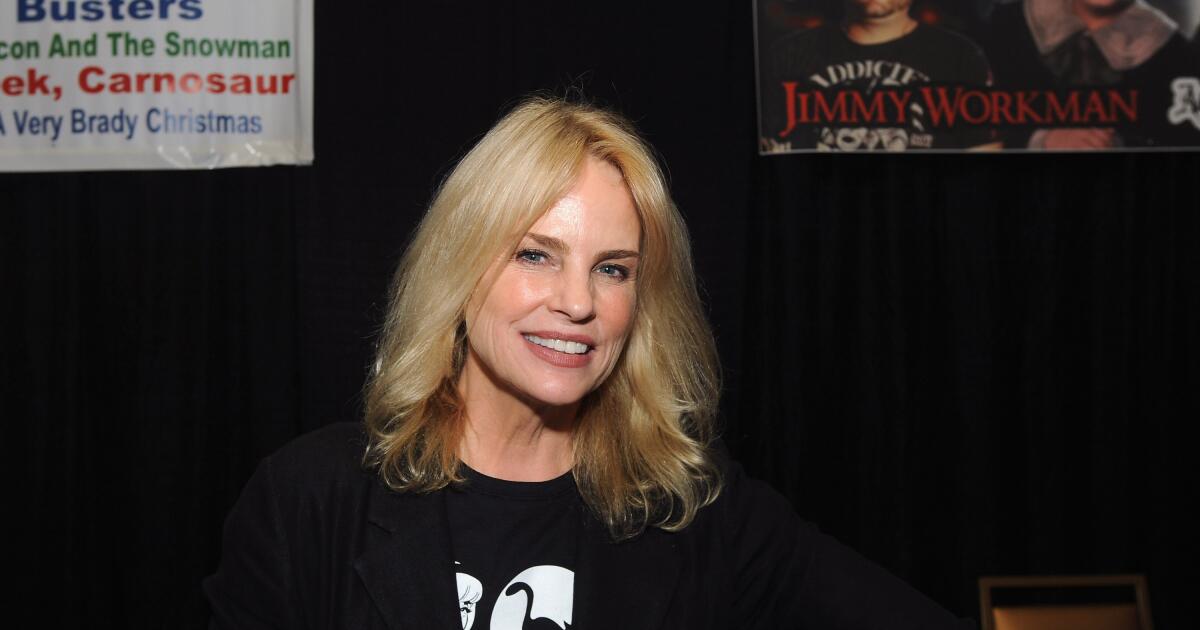
Jennifer Runyon dead: ‘Ghostbusters,’ ‘Brady Christmas’ actor was 65

Jennifer Runyon, a film and television actor known best for her roles on “Ghostbusters,” “A Very Brady Christmas” and “Charles in Charge,” has died. She was 65.

Runyon died Friday, according to a Sunday statement reportedly posted to her social media account, which has since gone private.

“This past Friday, our beloved Jennifer passed away. It was a long and arduous journey that ended with her surrounded by her family,” the statement read, according to ABC7. “She will always be remembered for her love of life and her devotion to her family and friends. Rest in peace our Jenn.”

“Bewitched” actor Erin Murphy shared in a Sunday post on Facebook and Instagram that Runyon died “after a brief battle with cancer.”

“Some people you just know you’ll be friends with before you even meet,” Murphy wrote in her tribute. “She was a special lady.”

On the 1980s sitcom “Charles in Charge,” Runyon portrayed Gwendolyn Pierce, a fellow college student of the show’s titular live-in housekeeper (portrayed by Scott Baio) and the target of his affections.

In his Facebook tribute, fellow “Charles in Charge” actor Willie Aames described Runyon as a “dear dear friend, muse, and encourager.”

“From the moment we met on set all those decades ago- I knew you ‘got me,’” wrote Aames. “Watching you slip away these last few months was one of the hardest times of my life… I can still hear your voice so clearly. No one will ever be able to fill the massive hole that’s been left in our hearts… ever.”

A Chicago native, Runyon made her television debut as Sally Frame in the long-running soap opera “Another World.” She also appeared in episodes of “Magnum, P.I.,” “Quantum Leap” and “Murder, She Wrote.” Runyon also portrayed the grown-up Cindy Brady in “A Very Brady Christmas.”

Her film credits include the 1984 classic “Ghostbusters,” where she appeared as one of the students participating in the ESP study conducted by Bill Murray’s Peter Venkman.

On Instagram, Runyon’s daughter Bayley Corman, an actor who has appeared on TV shows such as “Chilling Adventures of Sabrina,” “Bel-Air” and “Running Point,” described her mother as “the kindest most compassionate person i’ve ever known.”

“All of the best parts of me came from you,” Corman wrote in her tribute. “i would give anything for one more day together.”


Source link

Train service between Beijing, Pyongyang to resume this week for 1st time in 6 yrs

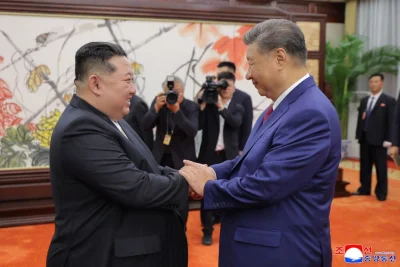
Train service linking Pyongyang and Beijing will resume this week for the first time in six years, sources said Tuesday. This September 2025 photo shows China’s president Xi Jinping (R) shaking hands with North Korean leader Kim Jong Un in Beijing. File Photo by KCNA/EPA

Train service linking Pyongyang and Beijing will resume this week for the first time since it was suspended six years ago due to the COVID-19 pandemic, sources said Tuesday.

The Beijing-Pyongyang train route will resume operations Thursday, running four times a week, on Monday, Wednesday, Thursday and Saturday, an official at China State Railway Group told Yonhap News Agency.

The train will depart from Beijing at 5:26 p.m. and arrive in Pyongyang at 6 p.m. the following day, stopping once at the Chinese border city of Dandong en route. The last two train cars will be reserved for passengers, according to sources.

The resumption marks the first cross-border train service between the two countries since operations were suspended following the outbreak of the pandemic.

Last year, North Korea resumed direct flight and train services between Pyongyang and Moscow, Russia’s capital.

The Chinese official said the upcoming Beijing-Pyongyang train will primarily serve diplomats and those on official business trips, while plans to accommodate general passengers will be considered if empty seats are available.

China’s foreign ministry said maintaining a regular passenger train service between China and North Korea takes on “significance” in facilitating exchanges of personnel between the two nations.

“China supports creating more convenient conditions for both sides’ exchanges of personnel by strengthening communication between relevant authorities of the two nations,” Guo Jiakun, spokesperson at the ministry, told a press briefing.

The move comes as North Korea and China appears to be seeking to promote cooperation amid the fluid international situation, highlighted by U.S.-Israeli strikes on Iran and the subsequent intensifying conflict in the Middle East.

North Korea also seems to be trying to expand cooperation with China as speculation arises that U.S. President Donald Trump may seek to resume diplomacy with North Korean leader Kim Jong-un on the occasion of his planned trip to Beijing on March 31-April 2.

North Korea’s ties with China, the North’s traditional ally and economic benefactor, became cool amid Pyongyang’s deepening military cooperation with Russia on the occasion of Moscow’s war with Ukraine.

Kim held summit talks with Chinese President Xi Jinping in Beijing in September last year on the occasion of a Chinese military parade and discussed ways to improve bilateral ties.

But relations between Pyongyang and Beijing do not appear to be restored in a full-fledged manner with no signs of high-level exchanges of personnel spotted.

“The government is closely monitoring the development of Korean Peninsula affairs, including North-China relations,” an official at South Korea’s foreign ministry said.

Copyright (c) Yonhap News Agency prohibits its content from being redistributed or reprinted without consent, and forbids the content from being learned and used by artificial intelligence systems.

Source link

Heartbreaking moment Hilary Duff breaks down in tears over years-long feud with sister saying ‘we don’t speak’

HILARY Duff broke down in tears as she laid bare the heartbreaking feud with her sister.

The So Yesterday hitmaker – who is in the midst of a huge pop revival with new album Luck … Or Something – admitted the pair “don’t speak”.

The heartbreaking moment Hilary Duff broke down in tears over her years-long feud with her sister has been captured on a new podcastCredit: YouTube/Jay Shetty Podcast
The So Yesterday chart star admitted she and elder sibling Haylie Duff ‘don’t speak’Credit: Getty
Hilary opened up on the ‘raw’ nature of their bond on Jay Shetty’s On Purpose podcastCredit: YouTube/Jay Shetty Podcast

Hilary, 38, first referenced bad blood with her actress and singer sibling Haylie, 41, in her album track We Don’t Talk.

The track also tellingly samples Gotye song Somebody That I Used To Know.

In a new podcast chat with Jay Shetty, she explained the delicate situation and how the ongoing drama is a “raw part of my existence”.

Hilary, who previously starred with her big sister on the pair’s infamous Lizzie McGuire TV show, fought back tears as she told the On Purpose podcast: “My sister and I don’t speak.

HEY NOW!

Stalking & ‘child trafficking rumours’ – scandals that have plagued Hilary Duff


STARS AT WAR

Hilary Duff admits she CRASHED A-lister ‘nemesis’ movie premiere during feud

“And I think in my adulthood I’ve come across more and more people that are having this experience”.

She branded the situation as “a very raw part of my existence’ before she added: “I hope it’s not forever, but it’s for right now”.

Hilary said: “As painful as it feels to share, when I decided to make this record, I could only talk about the things that I’ve gone through.

“Like there would be no purpose to make a record after 10 years than to face, you know, what it’s been like.

“That’s my truth.

“And I really worked hard to lyrically make sure that I’m just speaking about my experience, you know?”

The sisters haven’t been seen together in public since 2019.

Mum of four Hilary is re launching her pop careerCredit: Getty
Her new album Luck … or something features track We Don’t TalkCredit: Getty
She has confirmed the track centres on their strained relationsCredit: Getty

During her recent tour Hilary, who is currently relaunching her music career with a slew of stage shows, appeared to lift the lid on the fall out with her sister, and even blamed “jealousy”.

During her recent concert in London, Hilary introduced fans to the new song, We Don’t Talk.

In a clip of her performing the song on stage, she sung: “Don’t know when it happened / Not even sure what it was about,” alluding to their broken down relationship.

She continued: “Cause we come from the same home, same blood.

“People ask me how you’re doing / I wanna say amazing, but the truth is that I don’t know / What I always end up saying is how … ”

For the chorus, Hilary sung: “We don’t talk, we don’t talk about it / We don’t talk about anything anymore.”

It is in the second verse that Hilary alluded to sibling rivalry.

“And if it’s ’cause you’re jealous / God knows I would sell it all, then break you off the bigger half,” she sung.

A fan then took to social media to put: “WOWW… Hilary Duff just sung We don’t talk and it’s 100% about Haylie. But not mean at all. Basically telling her to reach out.”

Another agreed and put: “I think Hilary misses her sister!”

In another interview, she confirmed the spat was the source material for her track.

“Yeah, it is. It’s definitely about my sister,” Hilary admitted.

After years of silence, back in November Hilary seemingly addressed the feud between her and her sister while chatting about “family drama”.

Speaking to Rolling Stone about her musical comeback, the star said she feels “ready to fill in the blanks and share with people and connect with them on the level of now”.

She then told the outlet how she and her fans have gone through twists and turns and “have gone through a lot of the same things”.

“Whether that’s complicated relationships, anxiety, raising kids, divorces, trying to find yourself in adulthood, family drama…

“Finally I felt safe enough and comfortable in my own family to step outside and open that part of myself up again,” she explained.

Chatter previously swirled that the pair, who were once very close, weren’t getting along because of differing political views.

However, social media gossip page DeuxMoi claimed that the sisters fought over Hilary’s husband, Matthew Koma, butting heads with Haylie’s husband, Matthew Rosenberg.

The pair haven’t been seen together in public for yearsCredit: Getty
Rumours have suggested Hilary’s husband Matthew Koma does not get on with her sister’s spouseCredit: Getty
The bubblegum pop singer has released a new album and tourCredit: Getty

Source link

Trump threatens Cuba again, says island nation may face ‘friendly takeover’ | Donald Trump News

The US president repeats claims that Cuba is ready to negotiate as it faces a spiralling energy and economic crisis.

United States President Donald Trump has signalled that his administration is still pursuing a government overthrow in Cuba even as the US-Israeli war on Iran enters its second week.

Trump said on Monday that the US Department of State is still focused on Cuba, where plans by the White House may or may not include “a friendly takeover” of the island, according to the Reuters news agency.

Recommended Stories

list of 4 itemsend of list

US Secretary of State Marco Rubio is “dealing” with Cuba, the president told reporters in Florida.

“He’s dealing [with it], and it may be a friendly takeover, it may not be a friendly takeover. Wouldn’t really matter because they’re really down to … as they say, fumes. They have no energy, they have no money,” Trump said.

“They are going to make either a deal or we’ll do it just as easy, anyway,” he said.

Cuba has been grappling with an energy crisis since January, when US forces abducted Venezuelan President Nicolas Maduro and halted fuel exports from Caracas to Havana, cutting the country off from one of its few allies and a key source of oil for the Cuban economy.

White House officials have suggested that Cuba is facing an economic collapse and that its government is ready to negotiate with Washington.

Trump has said on multiple occasions that Cuba’s government is ready to “fall” and that its leaders want to “make a deal” with Washington, according to NBC News.

Cuba has denied reports of high-level talks, according to Reuters, but it has not “outright” denied US media reports of “informal talks” between Raul Guillermo Rodriguez Castro, the grandson of former Cuban President Raul Castro, and US officials.

Cuba has been in the crosshairs of the US for decades, but Trump is the first US president since the Cold War to openly discuss and pursue a government change in Havana.

Trump’s attacks on Venezuela and Cuba are in line with his revival of the “Monroe Doctrine”, a 19th-century policy that states the Western Hemisphere should be solely under the sway of the US and no other foreign power.

Trump first raised the notion of a “friendly takeover” of Cuba in February.

Source link

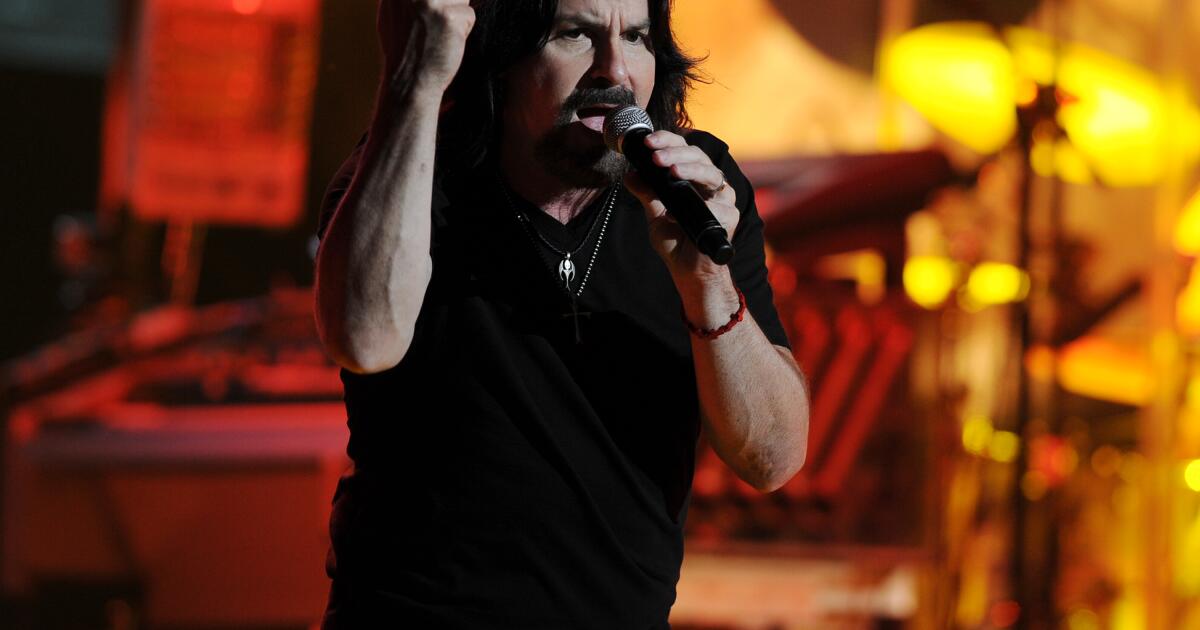
Tommy DeCarlo dead: Boston fan turned lead singer was 60

Tommy DeCarlo, a longtime fan of Boston who became the classic rock band’s lead singer in the late 2000s, has died. He was 60.

DeCarlo died Monday following a battle with brain cancer, his family announced on Facebook.

“[H]e fought with incredible strength and courage right up until the very end,” the family’s statement said. “During this difficult time, we kindly ask that friends and fans respect our family’s privacy as we grieve and support one another.”

Born April 23, 1965, in Utica, N.Y., DeCarlo said he first started listening to Boston — the 1970s rock band known for its instrumental overtures and hits including “More Than a Feeling,” “Don’t Look Back” and “Peace of Mind” — as a young teenager, according to the group’s website. The vocalist credited his love for Boston’s original frontman Brad Delp and his desire to sing along with him on the radio for helping to develop his own singing voice.

After Delp’s death in 2007, DeCarlo, then a manager at a Home Depot, sent a link to his MySpace page filled with Boston covers as well as an original song in tribute to Delp to the Boston camp, hoping for a chance to participate in a tribute show for the singer. They kindly turned down his offer.

But eventually, Boston founder and lead songwriter Tom Scholz heard DeCarlo’s cover of “Don’t Look Back” and invited the singer to perform a few songs with the band at the tribute. That tribute show would be DeCarlo’s first time ever performing with any band in front of a crowd, but it wouldn’t be his last. He continued to perform with the band at live shows for years, and even joined them on some tracks for their 2013 album, “Life, Love & Hope.”

DeCarlo also formed the band Decarlo with his son, guitarist Tommy DeCarlo Jr. In October, the singer announced he was stepping away from performing due to “unexpected health issues.”

“[P]erforming and sharing music with all of you around the world has been one of the greatest joys of my life,” DeCarlo wrote in his Facebook post. “I can’t thank you all enough for the incredible love, support, and understanding you’ve shown me and my family during this time. It truly means the world to us.”

Source link