Becki Jones has made a cryptic comment about ‘not being honest’ with fans amid swirling rumours about fat jabs and weight loss surgeryCredit: Tiktok/@tvyoutubeclips2Becki rose to fame on TikTok and was known for her showing fans what she ate each day – which often included sweet treats and takeawaysCredit: Instagram/@beckijonesxxLast year, she took a break from the platform and returned significantly smaller – denying she had used jabs or undergone surgery
Becki replied: “I have been honest about everything that needs to be said.
“The only thing I haven’t told you about is what I’ve been through and what I’m currently battling with as well. It’s nothing that will benefit anybody knowing, so, yeah.”
Later on in the stream, she said: “I did not come back to TikTok in September to be like, ‘Guys! I’ve lost weight’.
“That was not my intention, it was not my goal. Like I’ve said, my page was never gonna be ‘Becki Jones for fitness’ or ‘Becki Jones for how to lose weight’.
“That’s never been my goal for my journey on TikTok or as a content creator.”
Becki added: “I’ve come back and to be fair, most of my weight I’ve lost has been since September.”
Fans in the comment section still weren’t convinced by her comments, as one wrote: “People just want honesty… period!”
“Just give people a straight answer, especially your loyal followers,” echoed another.
However, others defended that it was “nobody’s business” what Becki has done.
Last year, a source told The Sun why Becki really left social media, and why she returned.
They explained: “Everyone knows Becki took six months offline because she felt the trolling had become too much.
“It was a real chance to reflect on her life and the main cause of issues – her weight. She’s also a secret smoker, so really did start to feel like her lifestyle wasn’t doing her any favours.
“Once she started losing some weight, she felt a new wave of confidence and when she returned online and saw the reaction to the way she looked, it really spurred her on.”
They added: “It’s the same when she was larger and the more she ate, the more people watched her videos. At the end of the day, it’s all about engagement and making money. It’s addictive.”
Becki first rose to fame in 2020 and boasts 1.3 million followers on TikTokThe star has insisted that she has ‘been honest’ about everything that ‘needs to be said’ in a cryptic remarkCredit: Tiktok/@tvyoutubeclips2
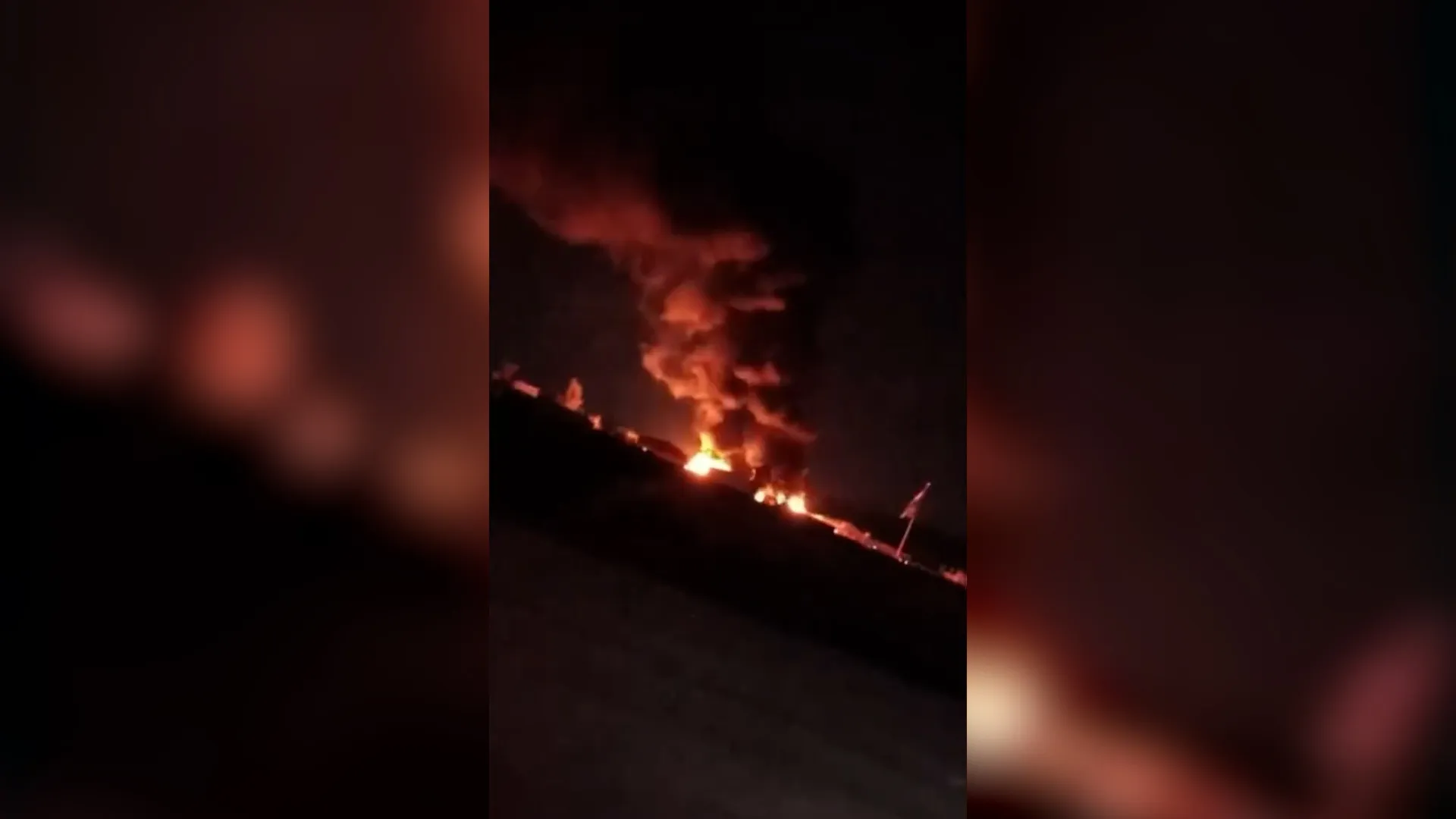
Black smoke could be seen in Dubai’s financial district where witnesses reported hearing explosions on Friday morning. Authorities there said a building was hit by debris from an intercepted missile.
Who: Real Madrid vs Elche What: Spanish football’s La Liga Where: Bernabeu Stadium in Madrid, Spain When: Saturday, March 14 at 9pm (20:00 GMT) How to follow:Al Jazeera Sport’s live coverage begins at 17:00 GMT
After stuttering and spluttering in Spain’s La Liga of late, Real Madrid stormed back into life with a resounding win in the UEFA Champions League in midweek.
Recommended Stories
list of 4 itemsend of list
Now the record La Liga winners return their focus on catching league leaders, and defending champions, Barcelona, in the Spanish top flight.
Elche arrive in Madrid with major concerns of their own, sitting one place above the relegation zone.
Al Jazeera Sport takes a closer look at the game.
How is Real Madrid and Barcelona’s La Liga title race looking?
Barcelona are four points clear of Real, having both played 27 matches. Barca have won 22 of their matches and lost four, while Real have lost that same number but have only won 20, drawing two more games than their rivals.
Barcelona entertain 14th-placed Seville on Sunday, meaning Real can cut the lead to just a point if they beat Elche.
How have Real Madrid fared in La Liga this season?
The turbulent time that marked the end of Xabi Alonso’s spell as Real manager appeared to return in recent weeks, with Los Blancos losing two on the bounce in La Liga for the first time this season.
With a tricky trip to Celta Vigo following the defeats by Osasuna and Getafe, Real’s title challenge appeared on the line.
A 2-1 win in Vigo, thanks to goals from Aurelien Tchouameni and Federico Valverde, last Friday cut Barca’s lead at the top to only a point, only for the Catalan club to restore their advantage with a 1-0 win at Athletic Bilbao on Saturday.
Los Blancos had won 13 of their opening 14 games in all competitions this season, only dropping points in the 5-2 defeat in the Madrid derby at Atletico.
The two wins in eight that followed set the tone for the remainder of Alonso’s time in charge, even five wins on the bounce thereafter couldn’t save the former Real midfielder from the chop, with the end coming following the Spanish Super Cup final 3-2 defeat by Barcelona.
Interim head coach, Alvaro Arbeloa, endured a torrid start – with a humiliating 3-2 defeat at Albacete in the Copa del Rey, but won the next five league games on the bounce to renew hope of catching Barcelona.
How have Elche fared in La Liga this season?
Elche were unbeaten in their opening seven games of the season, all in the league, winning four.
A seven-match winless run followed in La Liga, plunging the Alicante-based club into the relegation scrap.
Their latest winless run stretches to 11 matches – 10 in La Liga – with seven defeats in that time and only four league points snared.
Eder Sarabia’s side are now just one point and one place above the bottom three and are the only side in the competition yet to win away from home this season – losing nine of their 13 games on the road.
Last up for Real Madrid
Real’s season was given a welcome boost in midweek with a resounding 3-0 win against Manchester City – led by former Barcelona manager Pep Guardiola – in the first leg of their UEFA Champions League round-of-16 tie.
Valverde, who netted the winner last weekend in Vigo, scored a first-half hat-trick to hand Los Blancos a significant advantage heading to Manchester for the return fixture.
Last up for Elche
Elche were defeated 2-1 at Villarreal in La Liga last Sunday, in what was their fifth consecutive defeat on their travels.
The last four of those came in the league, while the run began with their Copa del Rey exit at Real Betis.
Leo Petrot had given Elche the lead in the 58th minute, but a double from Chimy Avila turned the game.
Stat attack – Elche
Elche are yet to keep a clean sheet on their travels in the league this season. In the 13 games on the road, they have conceded 26 goals – but, on a more optimistic note, they have managed to score in all but two of those games.
What happened the last time Real Madrid played Elche?
Elche secured a valuable point in a 2-2 draw in the reverse match against Real in La Liga this season.
Aleix Febas and Alvaro Rodriguez twice gave the home side the lead, the latter netting in the 84th minute, but Dean Huijsen and Jude Bellingham twice levelled for Los Blancos, before Victor Chust was sent off for the home side in injury time.
What happened the last time Elche entertained Real Madrid?
Real were 3-0 winners in this fixture in October 2022, with Federico Valverde, Karim Benzema and Marco Asensio netting the goals.
Los Blancos took the reverse fixture 4-0 in February 2023.
When did Elche last beat Real Madrid?
It has been a long wait for Elche to come away with the spoils in this fixture, with their last win – a 3-1 victory – coming in 1978.
Head-to-head
The teams have met 54 times, with Real winning 35 of the encounters. Elche have emerged victorious on six occasions.
All six of Elche’s victories have come at home.
Real Madrid team news
Kylian Mbappe’s absence remains Real’s major frustration, but the French striker heads a long list of absentees.
Ferland Mendy is a major doubt, having been forced off in the victory against Manchester City due to injury.
The defender could join Mbappe, Eder Militao, Jude Bellingham, Dani Ceballos and Rodrygo on the sidelines
Franco Mastantuono is suspended for the game, but Alvaro Carreras and David Alaba are both close to shaking off calf injuries.
Elche team news
Hector Fort, who is on loan from Barcelona, is out with a shoulder injury.
Pedro Bigas and John Donald are both injury doubts and face late fitness tests.
Martin Lewis has explained the personal savings allowance and when basic rate taxpayers with over £22,000 in savings could pay tax on interest earned
08:47, 13 Mar 2026Updated 08:53, 13 Mar 2026
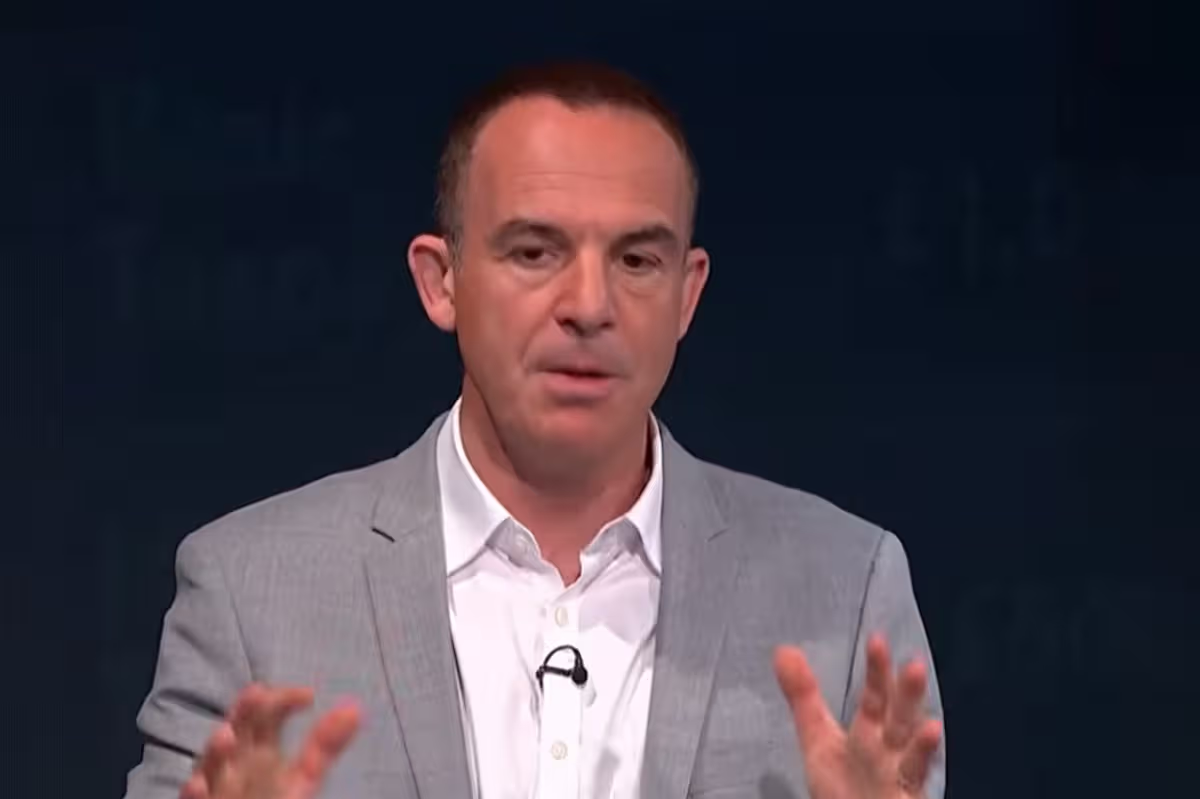
Martin Lewis gave some crucial savings tax advice to help people avoid unnecessary tax(Image: ITV)
Martin Lewis has issued a tax alert for savers, with a particular warning for those holding more than £11,000 or £22,000 in savings, depending on their tax bracket. On his ITV programme this week, Mr Lewis provided savers with guidance on structuring their savings to prevent unnecessary tax charges on interest.
He began by explaining the personal allowance, which permits anyone to earn £12,570 before any tax is levied. This threshold has remained frozen since 2021, and last November Chancellor Rachel Reeves controversially extended this freeze until 2031.
The freeze has faced criticism for creating ‘fiscal drag’, meaning more of the lowest earners in the country now pay tax as inflation and wage rises leave them with less disposable income whilst facing higher taxation.
On this he said: “The first one, the personal allowance, £12,570 a year that you can earn from any source, earnings, rent, savings, interest without paying tax on. Most people get that unless you start earning over £100,000 when it’s taken away.”
Starting Rate for Savings Tax.
Mr Lewis said: “The next one not that many people know about is called the starting rate for savings. This is another £5,000 of savings. savings interest you can earn a year on top of the personal allowance. And this is designed for people who have low work earnings but high interest on savings. Often people who are retired. And here’s how it works.
“For every pound of earnings you earn above this allowance, you lose a pound on your starting savings rate. So imagine you earn £13,570. You’re a £1,000 above that. You can now only have £4,000 of tax-free interest in your savings due to the starting savings rate. And by the time you earn from work £17,570, this is gone. So it’s only for people on low work earnings and high interest on savings.”
Content cannot be displayed without consent
He previously outlined that those in the ‘perfect circumstance’ would receive £12,570 from earned income. Mr Lewis explained the individual would then gain £5,000 through the starting savings allowance, plus £1,000 from the personal savings allowance on top ‘because they all go on top of each other’.
He added: “You could earn £18,570 a year tax-free with £12,570 of it coming from work or other sources, and another £6,000 of it coming from savings. I hope that makes sense. The main two for most people are the personal allowance and the personal savings allowance, but for those on lower incomes, it’s worth reading the starting savings allowance guide that’s our money saving expert just so you really understand it.”
Personal savings allowance
Mr Lewis described this as the ‘big one’ and said: “Next, we get the big one that many of you will know about, the personal savings allowance. And this is on top of those two. This is the fact that a basic rate taxpayer, 20% taxpayer, can earn £1,000 a year of interest in any form of savings at all without paying tax on it. Now, the top savings accounts at the moment pay about 4.5 per cent. So, you need about 22,000, just a little over £22,000 in the top savings account before you earned £1,000 interest.
“So, if you got less than that, you’re not going to be paying tax on your savings interest because it’s tax free. High rate tax because it’s within your personal savings allowance. High rate taxpayers pay £500 a year of interest they can make each year tax free. It’s about £11,000 saved at the top rate.
“If you’re an additional rate taxpayer earning over £125,000, you don’t get one of these. So, you got your personal allowance, your starting rate for savings, and on top of that up to another £1,000 in your personal savings allowance.”
For the 2025/26 tax year, the UK Personal Allowance stays at £12,570, with a 20% basic rate (up to £50,270), 40% higher rate (£50,271-£125,140), and 45% additional rate (over £125,140) applying to England, Wales, and Northern Ireland.
Mr Lewis stated that this week’s show was focused on ISAs, explaining: “You can put up to £20,000 a tax year in, as you know. And crucially, the interest earned in a cash ISA does not count towards the personal allowance, does not count towards the starting rate of savings does not count towards the personal savings allowance. It is totally separate from that. So, anything you earn in there is not taxable. I should note premium bonds work roughly the same way, but it’s not an annual allowance. It’s a maximum £50,000 you can put in in total. Those are the main ways that you can save without paying tax on them.”
Pointe-Noire and Brazzaville, Republic of Congo – In Pointe-Noire, the economic capital of the Republic of Congo, the aisles of the Grand Marche come alive in the early hours of the morning. Among the market stalls, street vendors, and shoppers pushing their way through the crowd, Romain Tchicaya is selling medicines on the sly.
As the price of basics – including pharmaceutical products – rises, and people turn to more affordable unregulated options, merchants like Tchicaya step in to fill the gap while trying to earn a living in a struggling economy.
Recommended Stories
list of 3 itemsend of list
However, the 37-year-old’s background is far from typical for a street vendor.
With a degree in management, he thought he would find a stable job after graduating from university. But like many young Congolese, he found himself facing a tight job market with few opportunities.
“We are told that the country is rich in oil. But I don’t see that wealth in my daily life,” he told Al Jazeera. “Look at Pointe-Noire, formerly nicknamedas Ponton la Belle [Beautiful Pointe-Noire]. Today, the city is unrecognisable.”
Around the Grand Marche, the main roads are potholed, and when it rains, the streets get flooded, making it almost impossible to drive.
Like Tchicaya, Brice Makaya, in his 40s, has never managed to find a stable job here despite having a degree in computer science.
With no stable employment, he is unable to rent a house and now lives outside the church where he prays.
“I am still underhoused at my age and have no prospects for the future,” he told Al Jazeera. “Without a job, I can’t plan ahead. I’m just trying to survive.”
For many young Congolese, daily life is a paradox: though they live in a resource-rich country – the third largest oil producer in sub-Saharan Africa and a producer of liquefied natural gas (LNG) – nearly half the population live below the poverty line.
This Sunday, Congo goes to the polls in which President Denis Sassou Nguesso, 82, is again seeking another term. For young voters, jobs and the economy are a big concern. But for the government, there appear to be limitations to what is possible.
During one of his speeches in the election campaign, Nguesso pointed out that the civil service could not absorb all job seekers, and urged young people to take charge of their own futures by encouraging self-employment.
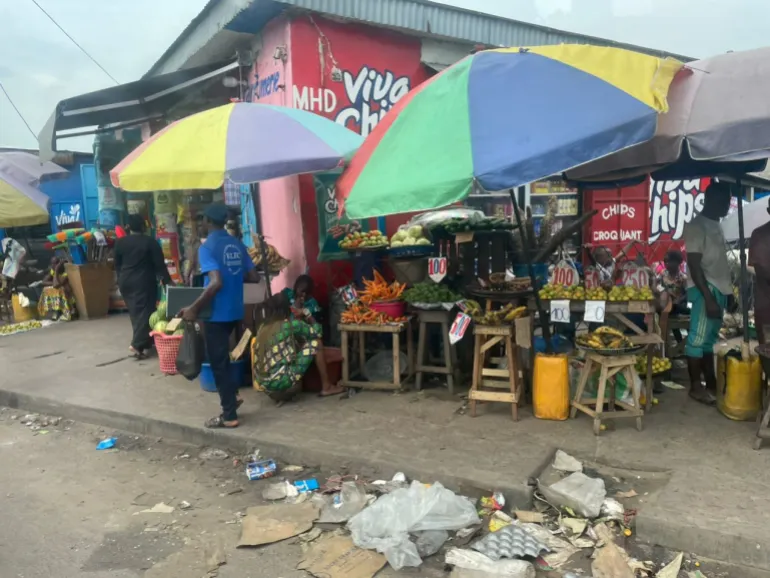
A market in the Republic of the Congo before the 2026 presidential election [Al Jazeera]
Oil: ‘Fuel of the political system’
According to the World Bank, oil accounts for about 70 percent of Congo’s exports and nearly 40 percent of its gross domestic product (GDP).
But this wealth does not automatically translate into an improvement in living standards for most of the populace.
The World Bank estimates that more than 40 percent of Congolese people live below the poverty line, despite the country’s significant natural resources.
For economist Charles Kombo, this can be explained in large part by the very structure of the Congolese economy, which is dependent on oil revenues.
“Oil dependency plays a structuring role in many African economies. In what some call a ‘rentier state’, a large part of public resources comes from the exploitation of natural resources rather than taxation,” he explained.
In a rentier state, the country generates substantial revenue from “renting out” natural resources, such as oil, to foreign companies. In exchange for the exploitation rights granted on these resources, the state receives royalties, taxes, or a share of production.
In this type of system, Kombo explains, the management of revenues becomes central to political power.
“Control of this revenue often reinforces institutional centralisation,” he said, explaining that dependence is no longer solely economic, but becomes institutional and sometimes psychological, as it influences budgetary priorities, political strategies, and even perceptions of development.
He points out that when the economy relies heavily on extractive revenues, economic and political resources tend to become intertwined, which can limit electoral competitiveness.
“Oil revenues can generate significant income, but they do not guarantee the structural transformation of the economy,” he said.
This oil dependence also exposes the country to fluctuations in oil prices on international markets.
After the fall in crude oil prices in 2014, the Congolese economy experienced a severe crisis. Public debt exceeded 90 percent of GDP, before being restructured under agreements with the International Monetary Fund and several international creditors.
Although this has helped stabilise the macroeconomic situation, the country remains heavily indebted. According to the World Bank, public debt fell from 103.6 percent of GDP in 2020 to about 93.6 percent in 2024, reflecting a gradual improvement, but also the continued vulnerability of Congo’s economy to fluctuations in global oil prices.
For political analyst Alphonse Ndongo, oil revenues also influence political life in Congo.
“Oil has become the fuel of the political system. It is used to finance parties, co-opt elites, and maintain social balance,” he said.
According to him, “oil money comes easily and quickly”, but this financial windfall has long delayed necessary structural reforms such as economic diversification.
In his view, the steady flow of money from the oil sector can create a sense of complacency within the system, reducing the pressure to pursue deeper structural reforms. As a result, debates around economic diversification tend to emerge mainly during periods of financial stress, when falling oil prices expose the limits of the model. But when revenues rise again, he argues, the urgency to diversify often fades, leaving the economy heavily dependent on the same resource.
A man walks past a campaign banner of first-time presidential candidate Destin Gavet, in advance of the election [Roch Bouka/Reuters]
‘An uphill battle’
As the country’s oil wealth fails to filter to the majority of the population, young people are particularly affected and many face unemployment.
According to data from the World Bank and the International Labour Organization, the youth unemployment rate in Congo is among the highest in Central Africa, while the informal sector absorbs the majority of new entrants to the labour market.
During a news conference on March 4 in Brazzaville, Prime Minister Anatole Collinet Makosso, who is also spokesperson for presidential candidate and incumbent leader Nguesso, said that young people were at the heart of the government’s policy.
“Youth has always been at the centre of Denis Sassou Nguesso’s policies and social projects,” he said, citing investments in education and the construction of universities.
He also claimed that the unemployment rate had fallen from 44 percent to 39 percent in recent years.
But on the ground, many young people remain sceptical.
Landry, 23, a student in the capital Brazzaville who did not want to give his last name, says he has lost faith in political promises.
“Promises of jobs come back every election. It’s become a cycle,” he said.
A months-long strike at Marien Ngouabi University, the country’s main institution of higher education, forced him to interrupt his studies.
“I went back to my parents’ house to wait and see what I could do. Today, I’m seriously thinking about going abroad.”
Another student in Brazzaville, a 26-year-old woman who did not want to give her name, expressed similar frustration.
“The only sector that is really recruiting today is the army. But not everyone can become a soldier. Becoming a civil servant is also an uphill battle,” she said.
Even sectors that are supposed to be structured are not immune to precariousness. Regine, a young journalist who also did not want to provide her last name, said she works without a stable employment contract.
“In the media, many young people live off ‘camora’, one-off payments for services. It’s not a real salary.”
She also lamented the difficulties of everyday life, including infrastructure issues, such as power cuts and inconsistent water supplies, despite repeated government investment plans.
“In the 21st century, people rejoice when the electricity comes back on. And when the water finally flows, everyone rushes to fill buckets,” she said.
President of Congo Denis Sassou Nguesso [File: Minasse Wondimu Hailu/Anadolu Agency]
‘Social time bomb’
Congo’s infrastructure problems are a reminder to Regine and many others that economic difficulties go beyond the issue of employment.
At the same time, the consequences of the country’s youth employment crisis also reverberate more widely and into the social sphere.
Analyst Ndongo sees this as a potentially explosive situation.
“When there are large numbers of young people who are unemployed and have no prospects, it can become a social time bomb,” he said.
This dynamic is already visible in the tensions that emerge when unemployment and inequality intersect, Ndongo explained: As large numbers of young people struggle to find work while wealth linked to the oil sector remains visible, frustration can build among those excluded from economic opportunities.
He says pressure can be contained for a time, but without meaningful job opportunities and stronger education systems, resentment may deepen. Over time, he warns, groups of unemployed and poorly trained youth can become more vulnerable to crime or gang activity.
The Congolese population is very young: more than 60 percent of people are under 25, according to United Nations data. This demographic reality represents both economic potential and a major challenge for the authorities.
For economist Kombo, the issue goes far beyond just unemployment.
“Demographics are a major political factor in many African countries. When the population is predominantly young, expectations for employment and social mobility are particularly high.”
According to him, long-term political stability will depend on the ability to create economic opportunities.
“Development is not distributed,” he said, “it is built.”
Despite the frustrations, political mobilisation remains limited, even as several candidates rally to compete against Nguesso in this weekend’s vote.
Chris Taty, a young student in Brazzaville, says he is not interested in the current election, as it is clear that the president who has already been in power for more than 40 years will once again reign supreme.
“Everyone already knows who is going to win. So why bother voting? I’d rather stay at home and do other things,” he said.
“Sometimes we joke that Sassou [Nguesso] is our grandfather,” the young journalist Regine said. “He has been ruling for so long that many of us have never known another president”
Nguesso has been a dominant figure in Congolese politics for decades, first ruling the country from 1979 to 1992 before returning to power in 1997 following a brief period out of office. His long tenure has enabled him to consolidate influence over key state institutions. Meanwhile, analysts say the country’s opposition remains fragmented and lacks the organisational capacity to pose a strong challenge.
For some potential voters, the perception of a largely predictable outcome has contributed to a degree of political disengagement, which Ndogo says is a “feeling of resignation”.
“Resignation is ingrained in everyone … Students, politicians, intellectuals … everyone is forced to scramble for a piece of the pie,” he said.
“We are all lulled into resignation because we tell ourselves that if we stand up against the established order, against those in power, we risk ending up in prison or even six feet under. It’s risky to oppose the system today.”
This combination of economic frustrations and limited political participation is a main challenge facing Congo, observers say. And the issue of youth unemployment risks becoming a major crisis in the coming years if nothing is done to fix it.
For many educated yet underemployed young people in the oil-rich country, the question is whether or not Congo can transform its natural wealth into concrete opportunities for its people.
“We are not asking for much,” said Regine. “Just the chance to work, to live in our own country with dignity and to believe that our future can be built here, without connections, with equal opportunities for young people, and without conditions.”
A drone attack on a joint French-Kurdish base in northern Iraq has killed one French soldier and wounded several others. Iran-aligned armed groups have been carrying out attacks against US and coalition forces in the region.
Michelle Keegan shared this sweet snap of daughter Palma and her mum all in matching PJsCredit: InstagramMichelle shares baby Palma with her husband MarkCredit: InstagramMichelle dressed baby Palma in matching PJs at Christmas as wellCredit: instagramMichelle has settled well into life as a first time mumCredit: Instagram
Former Coronation Street actress Michelle looked every inch the proud mum, as she beamed in the photo.
The Fool Me Once star posted the sweet snap on her Instagram Stories last night.
In the heartwarming photo, which is to celebrate Mother’s Day this weekend, Michelle is seen posing in matching nightwear with her mum Jacqueline and daughter Palma.
The trio looked adorable all wearing the same PJs that were cream with flowers on them.
To celebrate their only child turning one, they hosted a pink-themed bash for the young tot at their £3.5 million mansion.
No expense was spared, and there was yummy food and drinks for party-goers to enjoy.
No expense was spared for Palma’s first birthday last weekendCredit: Instagram/luxe.eventsandpartiesMark and Michelle hired a marquee for a bouncy castle and balloon domeCredit: Instagram/luxe.eventsandparties
There was a themed cocktail bar serving “Palma Tinis”, with vodka, raspberry liqueurs and pineapple juice, and pink gin refreshers called “Bubbly First Birthday”.
Outside in the couple’s huge garden, there was a large marquee which had an inflatable balloon dome, a bouncy slide, and seating areas.
The couple have kept their firstborn largely out of the spotlight, hiding her face from social media snaps to maintain her privacy.
Michelle and Mark shared the arrival of Palma last year: “Together we have a new love to share… Our little girl.
Michelle welcomed baby Palma with Mark last yearCredit: InstagramMichelle and Mark got married in 2015Credit: PA
Gulf countries, including Qatar, Bahrain and Kuwait, have declared force majeure on gas exports following the United States-Israel war on Iran, now in its third week, and the disruptions to shipping through the Strait of Hormuz, as Tehran has retaliated across the region, targeting US assets.
QatarEnergy was among the first to halt production, shutting down gas liquefaction on March 2 and sending ripples through global energy markets. Kuwait Petroleum Corporation and Bahrain’s Bapco Energies followed days later, while India invoked emergency measures to redirect gas supplies to priority sectors.
Oil prices also soared to more $100 a barrel as war intensified and uncertainty grew over energy shipments through one of the world’s most critical maritime chokepoints.
Here’s what we know about force majeure and what Gulf countries invoking it means for global oil and gas markets.
What is force majeure?
Force majeure, from the French meaning “superior force”, is a clause in contracts that allows a party to be excused from its obligations when an event beyond its control prevents performance.
This legal move can allow a party to suspend its obligations temporarily, be released from them partially or fully, or adjust them to reflect the new circumstances.
Why are Gulf countries invoking force majeure?
Companies in Qatar, Kuwait and Bahrain have invoked it following severe disruptions to shipping through the Strait of Hormuz caused by US-Israeli military strikes against Iran that started on February 28.
Following these attacks, a commander in Iran’s Islamic Revolutionary Guard Corps (IRGC) said on March 2 that the Strait of Hormuz was closed and warned that any vessel attempting to pass through would be attacked, a statement echoed by Iran’s new supreme leader, Mojtaba Khamenei, on Thursday.
As a result, Gulf companies started invoking force majeure, in order “to avoid paying damages or other financial penalties under their contracts”, Ilias Bantekas, a professor of transnational law at Hamad bin Khalifa University in Qatar, told Al Jazeera.
“These companies are most likely unable to fulfil their obligations, for example, to deliver shipments of oil and gas to other countries, or for shippers to transport them across the Arabian Gulf,” he said.
Does war automatically qualify as force majeure?
No. For war to qualify as force majeure, it must either be covered by the contract or actually prevent one or both parties from performing their obligations.
Companies and states typically include force majeure clauses that define which events qualify, meaning that when force majeure is invoked, the parties rely on provisions they previously agreed upon.
“War can always be foreseen, but perhaps not at the level at which it is being waged right now,” Bantekas said, adding that under general contract provisions, ships carrying goods are usually expected to find another route, “even if it is more costly to them”.
“What we could never have foreseen is that the Strait of Hormuz could be closed to shipping altogether, even if Iran were attacked in the brutal way it is now. I think that, on its own, could be sufficient to constitute a force majeure event,” he said.
“However, only a court would have the authority to make a definitive determination as to whether this kind of war, under these particular circumstances, amounts to force majeure,” he added.
Will LNG and oil markets be affected?
Yes. QatarEnergy’s declaration of force majeure alone has already significantly disrupted the global LNG market, as Qatar accounts for nearly 20% of global supply.
Gas prices soared immediately following the country’s halt of gas production, and global gas markets are expected to experience shortages for weeks, if not longer.
“The lack of visibility over the likely duration of force majeure, and of the broader military conflict, is injecting extreme uncertainty into global oil, gas and LNG prices,” Seb Kennedy, global gas and LNG analyst, told Al Jazeera.
“Prices will necessarily keep rising as volumes are withheld from the market, until price pain triggers demand destruction in price-sensitive areas of the economy,” he noted.
Which other countries have invoked force majeure?
On Tuesday, India invoked force majeure to redirect gas supplies from non-priority sectors to key users after disruptions to liquefied natural gas shipments through the Strait of Hormuz, according to a government notification.
But India’s measures are a “domestic demand-management response”, Kennedy said, as its government is relocating its limited gas supplies internally “to protect critical sectors such as households, small businesses, power generation and city gas distribution”.
(Al Jazeera)
Kennedy said the move reflects the difficult choices facing LNG-dependent economies, where governments may prioritise households and power generation over industrial users.
This prioritisation of LNG for domestic use “highlights the tough choices facing LNG-dependent countries”, he noted.
Aside from India, Omani trading house OQ also declared force majeure to a customer in Bangladesh after the Qatari supply was halted.
How will this affect US and European markets?
US LNG exporters are likely to benefit from the disruption. Analysis by Energy Flux estimates that US LNG exporters could generate about $4bn in windfall profits in the first month of the disruption alone.
If the situation persists, “US LNG windfall profits could reach $33bn above the pre-Iran average within four months. Over eight months, that figure rises to $108bn,” says Kennedy.
(Al Jazeera)
These gains largely come at the expense of European consumers, Kennedy notes, as Europe is the main destination for US LNG and remains heavily reliant on those supplies to refill gas storage and ensure winter supply security.
European stock markets fell last week, while the region’s natural gas prices rose sharply again.
What does this mean for Asian markets?
Major Asian economies such as India, China and South Korea rely heavily on imported LNG.
On the other hand, Southeast Asia alone has significant fossil fuel resources, but the region still depends heavily on imported oil and gas, much of which is transported through the Strait of Hormuz.
“Wealthier buyers such as Japan and South Korea can generally outbid others to secure cargoes during periods of extreme scarcity,” Kennedy said, noting that price-sensitive importers, especially in South and Southeast Asia, tend to be “forced out of the market” whenever prices soar, “leading to demand destruction, fuel switching, or industrial curtailment”.
“In that sense, the crisis does not hit all LNG importers equally: It becomes a contest of balance sheets as much as a question of physical supply.”
Can force majeure be challenged?
If a force majeure clause is written in the contract, then it stands because the parties have consented to it.
Contrary to that, if it has not been written in the contract, then any unforeseen event would potentially be open to legal challenge, and it becomes a matter of convincing the courts that the event could never have been foreseen and that it makes obligations on one of the parties impossible to perform.
“However, in the present circumstances, the stronger parties – the ones waiting for deliveries of oil and gas elsewhere in the world – may actually be harming themselves if they refuse to accept force majeure,” Bantekas said.
“Doing business with Gulf countries could become more difficult in the future, and premiums would likely rise significantly. So, I do not think they will be taking these matters to court,” he noted.
Heavy Israeli strikes have hit Tehran, Iran, as its allies launch attacks across Gulf states, and shipping through the Strait of Hormuz has been severely disrupted, sending global oil prices soaring.
Meanwhile, political pressure is mounting in Washington as the conflict spreads across the region.
Recommended Stories
list of 1 itemend of list
Here is what we know about what has been happening in the past 24 hours:
In Iran
Supreme leader speaks: Appointed last week following the assassination of his father, Iran’s new Supreme Leader Mojtaba Khamenei has issued his first statement, warning that attacks on Israel and US military assets and infrastructure in the Middle East will continue unless bases hosting US forces in the region are closed.
Heavy strikes on Tehran: The Israeli military has launched a new “extensive wave” of air attacks on Iran’s capital, Tehran, leaving the city covered in thick smoke on Friday morning.
Strait of Hormuz closure and surging oil prices: The Strait of Hormuz, which connects the Gulf to the Gulf of Oman, is closed, causing Brent crude oil prices to surge past $100 per barrel. The strait, which falls into the territorial waters of Iran and Oman, is the only waterway to the open sea available to oil and gas producers in the Gulf. Iran has stated that the strait is under Iranian control and US-and Israel-linked ships are banned. Other vessels must receive Iranian permission to pass.
Civilian casualties: Iran’s ambassador to the United Nations, Amir Saeid Iravani, said at least 1,348 civilians have been killed, with victims ranging in age from eight months to 88 years old.
A navy vessel is seen sailing in the Strait of Hormuz [Sahar Al Attar/AFP]
In Gulf countries
Regional retaliation and attacks: Iran has launched waves of drones and missiles towards Gulf countries that host US military assets and troops, and has targeted oil tankers and facilities.
Bahrain: The nation has reported intercepting 114 missiles and 190 drones since the war began on February 28.
Saudi Arabia: The country intercepted 10 drones over its eastern region and later destroyed an additional 28 drones that breached its airspace.
Attacks on the UAE: The country has strongly condemned Iranian strikes on the region, and said they have hit Dubai International Airport and some hotels.
Evacuations: Australia has ordered all “non-essential” officials to leave the United Arab Emirates and Israel, and urged its citizens to evacuate the Middle East while it is still safe to do so
Qatar’s response: Qatar’s airspace is officially closed, but Qatar Airways has scheduled more than 140 special flights to help repatriate stranded residents and citizens.
Qatar has strongly rejected Israeli media claims that it intentionally paused liquefied natural gas (LNG) production to manipulate US energy prices; officials clarified that the suspension was actually forced by an Iranian drone attack.
A view of the damaged part of the Dubai Creek Harbour tower after it was hit by an Iranian drone attack in Dubai, United Arab Emirates [EPA]
In the US
Trump claims war moving ‘rapidly’: US President Donald Trump told reporters the war against Iran was moving “very rapidly”.
“It’s doing very well, our military is unsurpassed,” he said at the White House, not directly responding to the latest comments from Iran’s new supreme leader.
Domestic opposition: More than 250 US organisations have signed a letter calling on Congress to halt funding for the war. They argue the $11.3bn spent in the first six days of the conflict is diverting crucial funds from urgent domestic needs, such as food benefits.
No ‘need’ for ground troops in Iran: US Senator Lindsey Graham has played down the possibility of US troops being deployed to Iran, but suggested the war could continue for some time. “I don’t see this conflict ending today,” the Republican senator told reporters in Washington, DC.
In Israel
New missile wave launched at Israel: The Israeli military said early on Friday that Iran had fired a new barrage of missiles towards Israel, and instructed people in affected areas to head to shelters.
Israel strikes Basij force: Israel’s military said it had struck checkpoints set up in Tehran by the Basij force of Iran’s Revolutionary Guards as part of efforts to undermine control by the authorities.
Regime change: Israeli Prime Minister Benjamin Netanyahu said Israel can create conditions for regime change, but it is up to Iran’s people to take to the streets. He also said Israel is aiming to stop Iran from moving nuclear and ballistic projects underground.
In Lebanon, Iraq
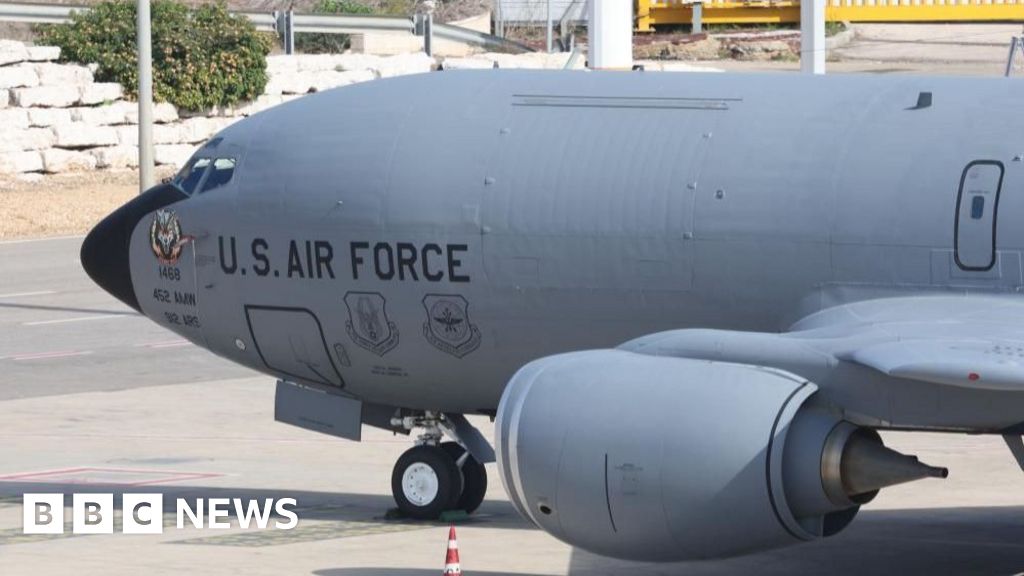
Downed US aircraft: A US KC-135 refuelling aircraft crashed in western Iraq. While the Islamic Resistance in Iraq claimed it shot the aircraft down using air defence systems, US Central Command (CENTCOM) stated the aircraft went down in “friendly airspace” and was not the result of hostile fire.
Iraqi port closures: Iraq has shut its port operations after an Indian crew member was killed during an attack on a US-owned oil tanker in Iraqi waters.
Six French soldiers hurt: A drone attack wounded six French soldiers in Erbil, in Iraq’s autonomous Kurdish region, President Emmanuel Macron said on Thursday.
Deadly attacks in southern Lebanon: Israeli bombardments continue on southern towns and villages. A strike on the village of Arki, near Sidon, killed nine people, including five children.
Mounting death toll and mass displacement: Lebanese officials have reported that at least 687 people have been killed in Israeli attacks on Lebanon since last Monday, including 98 children. The intense bombardments have displaced an estimated 700,000 to 750,000 people from their homes.
WHEN Gaz Beadle and Emma McVey announced their split in 2023, their fans were shocked.
Geordie Shore lothario Gaz had always described the model, who he had two children with, as his ‘rock’. But, just months after she underwent heart surgery, Gaz announced their eight-year relationship was over. Now, insiders tell us tension has been bubbling behind the scenes.
Gary Beadle and Emma McVey fell for each other in 2016 but it wasn’t an easy startGaz Beadle is now expecting a baby with his new girlfriendCredit: Instagram
Things are said to have reached boiling point after Gaz announced he was expecting a baby with his new girlfriend, Maia, 13 years his junior.
Our insider says: “Gaz and Emma have both moved on and are in happy, loving relationships with new people.
“But fans have noticed there is a level of competitiveness between them, and they seem to be trying to outdo each other.
“Emma got engaged, and then Gary announced he was having a baby. It was a huge shock and very eye-opening.
“She feels like she has a very small group of loyal friends, and exactly who they are has become very clear since her split from Gary.”
It’s certainly not the first time Emma has been blindsided by Gaz – she was shocked when he announced they had split during a Q&A with fans.
He casually revealed they had split three weeks prior and insisted there was no bad blood between the couple, who share kids Chester, eight, and Primrose, six.
Sources said Emma felt it was ‘unfair’ and was keen to announce it to her own followers herself.
She didn’t shy away from how hard the breakup was, in contrast to Gaz’s laissez-faire attitude.
In a heartbreaking post, she told her followers: “It’s been really hard for me and the kids to be separated. There’s been a lot of crying on FaceTime, which really breaks my heart.
“I’ve been numb and focusing on my children while still trying to work. I’ve honestly not known what to say. I’m hoping this will get easier in time.
“Sending so much love to anyone going through something similar, and thank you so much to everyone who has been checking in on me.”
If Gary took them to the park, the next week Emma took them to a theme park
Our insider
And when she moved on with a new man and a fan accused her of being unfaithful, she shot back with a jibe that appeared to be aimed at Gary: “I was unfaithful? What with someone I met 7 months after my separation? No darlin, you clearly have NO IDEA who was unfaithful.”
Our insider continued: “There was tension from the get-go but they masked it pretty well. They both doted on their kids whenever they had them, but fans noticed how they often posted competing snaps. If Gary took them to the park, the next week Emma took them to a theme park.”
Cheating allegations
Emma and Gaz first started dating in 2016, but just a year later, they called time on their relationship, with Emma accusing Gaz of cheating and dumping her by text.
She ranted: “When he’s been filming Geordie Shore, he decided to send me a TEXT ending things, telling me to move my stuff out of OUR home that I furnished and paid for without explanation.
Emma has also moved on and is engaged to James StaszewskyCredit: InstagramHer marriage to Gaz ended in 2023 – two years after they said I DoCredit: Sophie Eleanor Photography
“After begging me to go to Australia with him and making me leave my career, I still find out he still managed to cheat on me throughout our relationship and continually lie.”
But the pair reconciled, and in 2017, they announced they were having a baby. Their son Chester was born in January 2018, and their second child, a daughter named Primrose, was born in December 2019.
Gary popped the question while she was pregnant with baby number two – the whole thing was filmed.
They tied the knot in 2021 in front of 90 guests and their kids in Cheshire.
Bedding 1000 women
Gary appeared to be a very different man – his wild Geordie Shore days were well in the past.
He once boasted about sleeping with over 1000 women – his tumultuous relationship with Charlotte Crosby was well documented – but after quitting the show in 2017, he turned his life around.
He told us previously: “My life couldn’t be more different.
“My DM’s have changed dramatically, I can tell you that. It’s gone from mum’s wanting to shag me to mums and dads talking about colic, acid reflux, nappies, and bath toys.
“I had ten-years of partying and doing whatever I wanted. I was so used to life being all about me then I had a baby and quickly realised life wasn’t about me anymore.”
It wasn’t an easy time for any of them, as Emma suffered a series of debilitating health issues
The model, who once dated Towie’s Mario Falcone, had no idea she’d been born with three holes in her heart until a monitor was fitted following her second pregnancy.
Emma’s new man has slotted into family life – and now lives with Primrose and ChesterCredit: InstagramMaia has also grown close to the kidsCredit: Instagram
She’d suffered years of seizures, exhaustion and fainting episodes – but while the diagnosis was illuminating, medics were cautious about operating because Emma is also battling ulcerative colitis.
The condition, which affects roughly one in 420 in the UK, causes ulcers and inflammation in the digestive tract.
The steroid treatment used to treat it can lead to bone loss and breakage, which doctors warned could stop Emma’s bones from fusing back together.
I thought, ‘I’m going to get put to sleep and I’m not coming back out’.
Emma, on her heart surgery
Around Christmas time of 2023, her tricuspid valve – the valve between the two right chambers of the heart – further deteriorated, and the decision was made to proceed with the op in spite of the risks.
She later said: “I knew in surgery I’d be connected to a heart machine that would be keeping me alive while my heart was stopped, and I kept thinking, ‘They’re not going to be able to start my heart again’.
“I thought, ‘I’m going to get put to sleep, and I’m not coming back out’.”
It was a life-changing experience for all the family, and made their split even more surprising.
It wasn’t long until they both moved on, though. Emma started dating electrician James Staszewsky, and he became a huge part of her life and that of the kids as they set up home.
Gary had a brief romance with pro golf star Charley Hull, before falling for student Maia.
In what some felt was a dig at influencer Emma, Gary gushed about Maia: “I like how she’s got a normal job. Like, she got in at 8 o’clock this morning after leaving at half past 7 last night… 13 hours. She’s doing it again tonight, it’s inspirational.
Emma underwent heart surgery shortly before her split from GazLoved-up Emma with her new man – the couple are now planning to head down the aisleCredit: Instagram
“It almost brings me down a peg and I think that’s why I’m getting more normal and normal.
“I just love to pop to the pub for a bit of food and a walk with the dog, cutting the grass, like, I’ve become quite a normal boring person.”
The romances both came under fire and in a very surprising move they joined forces once again in order to issue a lengthy statement in which they addressed their marriage ending and the attention their new romances had gained.
‘One team’
Gaz hit back to insist they are “really good friends” and that they are both “happy and happy for one another” despite being in “new relationships”.
He added: “Both of us are in new relationships and we all get along well, and we can say we are so proud of ourselves to be able to all stay as one team.”
We’re told it was a brief period of calm for all parties involved but it wasn’t long that changed.
Gaz’s baby news was said to be one of those moments that rocked the boat.
Only a couple of years ago, Gaz had told The Sun he wouldn’t be having more kids, he said: “Two is hard enough. I think if you asked us before we may have said three but that was before we realised how hard it is.
“If we had two boys or two girls, then maybe it would be different but we have one of each, which is perfect.”
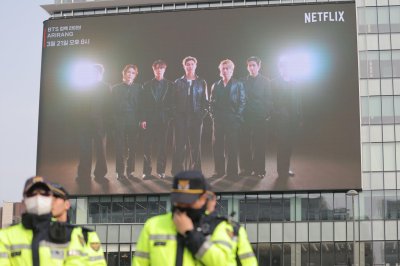
In this photo taken Wednesday, police stand in front of a promotional video in central Seoul for the upcoming BTS live performance in Gwanghwamun Square. Photo by Yonhap
Police vowed Friday to detain any suspects behind possible terror threats targeting K-pop juggernaut BTS‘ comeback concert set to draw hundreds of thousands to downtown Seoul next week.
The group is scheduled to perform before some 22,000 fans in Gwanghwamun Square on March 21, with police estimating as many as 260,000 people to gather around the area that day.
The Seoul Metropolitan Police Agency said it would deploy police commandos to inspect the site, noting it could not rule out the possibility of terror in connection with the current conflict in the Middle East.
“If police resources are wasted or the event is disrupted due to public threats, such as bomb threats, (we) will pursue and apprehend (the suspects) to the end under the principle of investigation under detention,” it said.
Police plan to set up metal detectors at the venue’s entrances as well as barricades to prevent possible accidents or acts of terror, such as a vehicle-ramming attack.
They also asked concertgoers to minimize personal items as security checks will be strengthened.
Copyright (c) Yonhap News Agency prohibits its content from being redistributed or reprinted without consent, and forbids the content from being learned and used by artificial intelligence systems.
Women and children were among those killed in the attacks, according to the Taliban.
Published On 13 Mar 202613 Mar 2026
Share
Afghanistan’s Taliban government has accused Pakistan of targeting civilian homes in overnight air attacks in the capital Kabul and the southern province of Kandahar, as fighting between the two neighbours entered its third week, overshadowed by the United States-Israel war on Iran igniting the middle East.
Women and children were among those killed in the attacks, according to the Taliban.
Recommended Stories
list of 3 itemsend of list
Government spokesman Zabihullah Mujahid said on X Friday that Pakistan’s aircraft also struck fuel depots belonging to the private airline Kam Air near Kandahar airport.
There was no immediate comment from Pakistan’s military or government.
Calls for restraint from the international community have gone unheeded by both sides.
On Thursday, the Taliban government said four members of the same family, including two children, were killed by Pakistani artillery and mortar fire in eastern Afghanistan.
The deaths reported on Thursday brought the toll to seven people killed in Afghanistan since Tuesday in cross-border clashes, according to authorities in Kabul. That could rise with the latest attacks on Friday.
Fighting between the two countries intensified on February 26 when Afghanistan launched an offensive along their shared border in retaliation for earlier Pakistani air attacks on the Pakistan Taliban, just two days before the US and Israel attacked Iran, starting a sprawling regional war.
Pakistan maintains that it does not target civilians, and casualty claims from both sides are difficult to verify independently.
Islamabad accuses Kabul of harbouring fighters from the Pakistan Taliban, which has claimed responsibility for a series of deadly attacks inside Pakistan, and from the ISIS (ISIL) affiliate in Khorasan province. Afghan authorities deny the charge.
The United Nations mission in Afghanistan has said 56 civilians have been killed there, including 24 children, by Pakistani military operations from February 26 to March 5.
Pakistani officials have confirmed about 12 soldiers were killed and 27 wounded in the latest bout of fighting, while the Taliban claims to have killed more than 150.
You can’t help rooting for Colleen Hoover heroines, bless their bruised hearts. The bestselling novelist specializes in women who have been kicked around by life. She’s the new name brand of tragic romance, picking up where Nicholas Sparks’ terminal diseases left off.
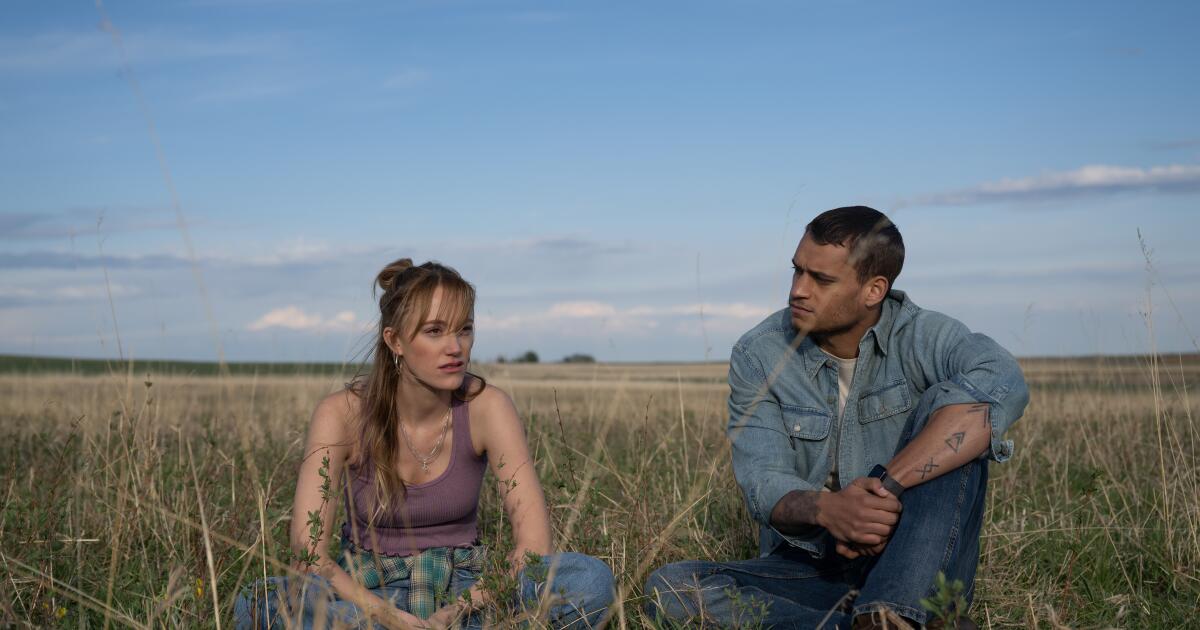
“Reminders of Him,” directed by Vanessa Caswill, is the third film based on a Hoover book in three years and the first that the author herself has adapted alongside co-screenwriter Lauren Levine. Like the others, its lead suffers heartily before falling in love with a hunk. The previous two, “It Ends With Us” and “Regretting You,” were about, respectively, domestic abuse and adultery. “Reminders” adds more tarnish to the poor dear: She’s an ex-convict who served six years for killing her boyfriend in a DUI.
Finally freed from prison, Kenna (Maika Monroe) has returned to Laramie, Wyo., the hometown of her dead lover, Scotty (Rudy Pankow). From what we see of Scotty in flashbacks, he was a buoyant blond goofball — exactly the kind of guy that the apparently friendless and family-less Kenna would have clung to like a life preserver. But she’s not here to lay flowers at his grave. In a salty touch, the first thing Kenna does is remove his roadside cross, claiming he hated memorial shrines.
But Kenna is desperate to meet their 5-year-old daughter, Diem (Zoe Kosovic), who was born months into her incarceration. The girl’s name comes from carpe diem, as in Kenna’s vow to seize the child she never got to hold, but the script has the restraint not to make a big standing-on-a-desk speech about that. Nevertheless, the kid’s grandparents, Grace and Patrick (Lauren Graham and Bradley Whitford), who never liked Kenna to begin with, consider a restraining order in fear that Kenna might actually kidnap Diem.
The stakes are plain: Can Kenna prove herself worthy to be Diem’s mother? Her only tentative ally is Scotty’s childhood friend, Ledger (Tyriq Withers), who thinks she’s hot and intriguing until he realizes who she is. Then he wants Kenna gone too.
Caswill sets the mood with a shot of a snow-capped mountain range, fitting for a movie that proceeds at a glacial pace. (The book moves faster, with Kenna and Ledger hooking up immediately and then discovering their unfortunate connection.)
The first stretch of the movie is strong, with Kenna, who is too broke for a car or even a phone, hoofing it around town in search of any job willing to hire a broke girl with a criminal record. A grocery store manager sends her away coldly after nattering on in corporate-speak about the importance of treating people with respect — an exchange that feels so real it gives you the shivers — but his beleaguered assistant, Amy (country singer Lainey Wilson in her promising, but brief, film debut), steps in and treats Kenna like a person. “What’s your trauma?” Amy asks her and somehow Wilson delivers that line with a lilt that keeps it from sounding corny.
These female strangers share a moment of such sincere human connection that I would have happily watched a dozen more scenes of the two women leaning on each other while they endure their hard-luck lives. Alas, these nice detours don’t last long; the movie has a preordained higher parental purpose that’s bigger than anything else onscreen, from the Wyoming skies to the bond between Kenna and Ledger that’s the main reason an audience has bothered to come.
Where this is all going is as unavoidable as the fact that Scotty died on what seems to be only road in and out of town. As the title declares, there are traces of him everywhere, including Diem’s giggle.
To get anywhere with the film, you have to settle into the idea that Kenna and Ledger must slowly build trust in each other while spending most of the baggy running time talking about a little girl who is rarely around. (When Kosovic is, she’s charming.) Cinematographer Tim Ives snatches his rare opportunities to shoot the beautiful scenery, but most of the pair’s encounters take place in or near Ledger’s orange pickup truck, a totem from the book. Visually, these car chats get stagnant. At least Monroe and Withers generate decent chemistry, eyes shiny and gleaming as they try their hardest to put gas in this love story’s tank.
Ledger calls Kenna “the saddest girl in the world.” True, but the glumness of said world is central to Hoover’s zeitgeisty appeal — a point she underlines a few beats later, Kenna insisting that the radio only ever plays depressing songs. To prove her wrong, Ledger flips it on anyway and to his dismay, it plays one bummer after another, station after station, until finally, the two of them share a much-needed laugh. (Meanwhile, Tom Howe’s acoustic country score is adamantly winsome, even intercut with Coldplay covers.)
Hoover is a strong world-builder. When she writes about small towns with shuttered bookstores or dive bars with fetid pots of coffee, you feel that she truly knows these places and has made a principled choice to set her hard-earned happy endings there. Caswill gets it, keying into credible, lived-in details, like Kenna’s tiny glance at the price tag on a stuffed animal that she’s considering for Diem.
Monroe’s Kenna couldn’t be farther from the cliché romantic diva, usually a high-heeled glamazon who runs a cupcake boutique. Even her hair really does look like she fixed it in the squalid bathroom of the only apartment she can afford. The complex is called Paradise, an on-the-nose irony. The owner (Jennifer Robertson) cuts Kenna a deal if she promises to take a free kitten. (I never saw Kenna get a litter box, but the kitten’s pretty cute.)
Ledger is the fantasy: a former NFL player whose hobbies include babysitting Diem, wearing tight shirts and building himself a hilltop dream cabin that will someday belong in Architectural Digest. (He owns that dive bar but the cast stays Mormon-sober.) Withers, a former wide receiver at Florida State University, also played a football jock in the gorgeously made but narratively screwy horror film “Him,” and it’s a treat to see an actor who moves like a genuine athlete and has that “Yes, coach” politeness that comes from being humbled in a locker room. You don’t totally buy his character exists in reality, but Withers believes in it enough to get the job done.
Another Paradise tenant, Lady Diana (Monika Myers), a headstrong teenager with Down syndrome, is the closest thing the film has to comic relief. Bursting into Kenna’s quarters seemingly at will, she raids her near-empty fridge while bluntly shouldering much of the exposition. “Why are you so poor?” Lady Diana asks, following that up by wondering, “Why are you so sad?”
“Reminders of Him” could use a little more swooning, a little less of the endless middle stretch of driving and talking, interrupted by wet sprints through thunderstorms. The rain pours down so often that you can’t help but snort when the film cuts to Whitford’s granddad angrily watering his lawn.
Eventually, even the film itself seems over all of the dilly-dallying. It takes a narrative shortcut to wrap things up, leaving behind not much other than a few worthwhile scenes: Kenna and Scotty’s meet-cute at a dollar store, her and Ledger pushing through their morning-after guilt, and a powerful moment shortly after Diem’s birth when a fellow inmate gives her a friendly but stern pep talk that sums up everything this film takes nearly two hours to say.
‘Reminders of Him’
Rated: PG-13, for sexual content, strong language, drug content, some violent content, and brief partial nudity
Occupied East Jerusalem – Basema Dabash sheds tears daily for the home she and her husband, Raed, were forced to demolish in Sur Baher, in the south of occupied East Jerusalem.
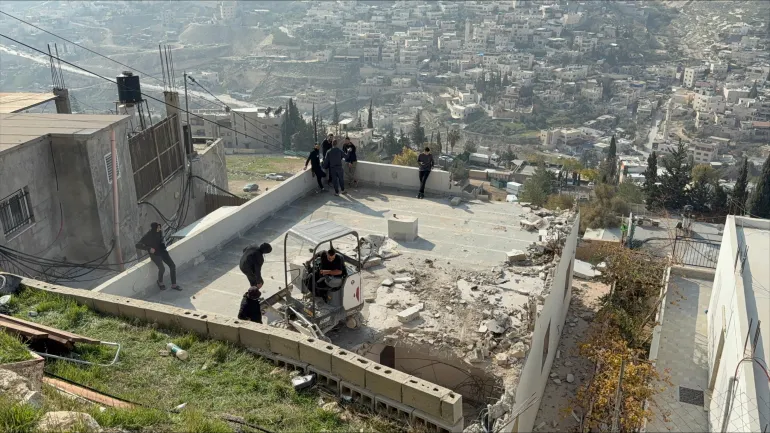
For years, the couple lived under the spectre of losing their home, ever since the Israeli authorities issued a demolition order in 2014. In January of this year, the eviction notice came. And then, on February 12, the family were forced to demolish their home. If they didn’t, they would have been forced to pay the municipality to carry out the demolition.
Recommended Stories
list of 3 itemsend of list
“We were forced to start demolishing the house ourselves to avoid the municipality’s demolition fees, which can reach 100,000 shekels [$32,000],” Basema, 51, said. “We started by breaking down the inside of the house and sent the municipality photos to confirm that we had begun the demolition, but they demanded that we demolish it from the outside as soon as possible.”
The family soon completed the demolition of the two houses where eight people, including three children, lived. However, this didn’t waive the fine of 45,000 shekels ($14,600), which will continue to be paid in instalments until 2029.
‘Self-demolition’ haunts Palestinians living in East Jerusalem, which has been controlled by Israel since 1967, and illegally merged with West Jerusalem under one Israeli-run administration.
The choice between self-demolition and paying a further fee to the municipality is a simple one – the vast majority of Palestinians can’t afford to pay the exorbitant amount, and resort to demolishing their own homes, despite the immense pain and profound psychological impact it causes.
‘How did we come to this?’
Basema’s troubles started in 2014, when she received a building violation notice from the Israeli municipality in Jerusalem for the building she and her husband shared with their married son, Mohammed, and his family. They appealed at the time to an Israeli court in an attempt to freeze the demolition order.
For more than a decade, the family was forced to pay accumulated fines in an attempt to keep their home. Then, on January 28, they received an eviction notice, giving them a deadline to vacate the house and have it demolished.
The house slated for demolition was 45 square metres (485sq feet), an extension Basema had added to her existing 45-square-metre home. She had also built a similar-sized residence for her married son on top of the extension. The demolition order targeted both the extension and her son’s residence.
The Dabash family tried to obtain a building permit for the house several times, but their requests were rejected by Israel. Despite this, the municipality fines Palestinians and demolishes their homes under the pretext of lacking permits.
“We chose to demolish our own house not only to avoid the fine, but also because the municipal crews show no mercy to anything around the house and deliberately vandalise the entire area under the pretext of demolition, breaking trees and causing extensive damage that we could have done without,” Basema said.
Basema, along with her husband and one of her sons, Abdelaziz, now lives in what remains of their home. Mohammed has also moved in with them, while his wife and children live in her family’s home. The demolition has thus scattered her son’s family, who haven’t yet been able to find a small house to rent due to the high cost of housing.
The family also incurred significant expenses removing the rubble and redesigning the older section of the house to accommodate everyone, not to mention the psychological toll, which has been devastating.
“I stand to wash the dishes and find my tears falling on their own. How did we come to this? Why are we being subjected to this injustice? The house has become cramped and barely fits us. My grandchildren visit us and then cry bitterly when they leave for their grandfather’s house because we have no space,” Basema said sadly.
Increased demolitions
As illegal Israeli settlements continue to expand in East Jerusalem and the occupied West Bank, with building permits easily obtained, Palestinians say the double standards are obvious.
Human Rights Watch has found that Israeli authorities make it “virtually impossible for Palestinians to obtain building permits”, and the Israeli human rights organisation B’Tselem said planning policies in East Jerusalem make it “very difficult for residents to obtain building permits”.
Marouf al-Rifai, spokesperson for the Palestinian Authority’s Jerusalem Governorate, told Al Jazeera that 15 self-demolitions were carried out last February, five in January, and 104 in December.
Demolitions, in general, escalated to unprecedented levels after October 2023, when Israel’s genocidal war on Gaza began. Al-Rifai said that 400 demolitions were carried out in 2025 in East Jerusalem and its surrounding area, either by municipal crews or by homeowners themselves. Prior to that, the number of demolitions had reached a maximum of 180 per year.
The United Nations has reported that demolitions in 2025 displaced 1,500 Palestinians.
“Even the method of carrying out demolitions changed after the war on Gaza,” al-Rifai said. “Previously, demolitions were only carried out after exhausting all legal avenues and giving residents the opportunity to appeal to the courts and freeze the demolitions.”
But Israeli authorities have taken a more punitive position since demolition policy fell under the influence of far-right Israeli National Security Minister Itamar Ben-Gvir, who began pushing for Israeli army bulldozers to carry out demolitions without even notifying the homeowners, al-Rifai said.
In addition, the Palestinian Authority official said, demolition notices for Palestinian homes in Jerusalem increased from 25,000 before the war to 35,000. The town of Silwan alone has received 7,000 demolition notices since 1967.
Fakhri Abu Diab, a member of the Committee for the Defence of al-Bustan Neighborhood in East Jerusalem, told Al Jazeera that self-demolition is a double punishment and pain for the homeowner after the effort and hardship involved in building the house.
“Israel’s goal is to break the morale of the Palestinians and to brainwash them into becoming tools for implementing its plans to demolish homes. When we demolish our own homes, it’s as if we are demolishing a part of our own body,” he explained.
Israel can only demolish a limited number of Palestinian homes annually due to logistical, financial, budgetary, and logistical constraints. Demolition by Palestinians multiplies the number of homes demolished, thus turning the victim into a “demolition contractor”, as he put it.
“I refused to demolish my house myself because of the negative consequences that I and my family would have to live with for the rest of our lives, and the Israeli bulldozers demolished it. If I had done it myself, it would have remained a nightmare that would haunt me.”
Saqr Qunbur says he has already received a total of $26,000 in fines for building his house, and so can’t afford to pay more for Israeli crews to demolish it [Ahmad Jalajel/Al Jazeera]
No alternative
But the cost of a demolition carried out by Israeli municipal crews ranges between 80,000 and 120,000 shekels ($26,000-$39,000).
Saqr Qunbur couldn’t pay that, and was forced instead, on December 26, to demolish his 100-square-metre (1,076sq-foot) house in Jabal al-Mukabber under the pretext of lacking a permit. He had built it in 2013 and was immediately issued a building violation notice.
Saqr told Al Jazeera that he had lived in the house with his wife and four-year-old child. Since building the house, he has received a total of 80,000 shekels ($26,000) in fines that he’s still paying despite his home being demolished.
Saqr had nowhere to live after being forced to demolish his house, so his neighbour gave him a dilapidated room to live in while he found a place to rent.
“My child has been suffering psychologically since we demolished the house. Every day he asks me why I demolished it, and I don’t know what to tell him. I say it’s so I can build him a better house, but deep down I know I won’t even be able to rent a suitable place,” he explained with anguish.
Saqr chose to demolish his house himself after he says an Israeli officer threatened him, saying, “Demolish it, or I’ll demolish it over your head”. He also wanted to avoid the humiliation that accompanies demolitions carried out by Israel, where police sometimes fire live ammunition and tear gas at family members and carry out assaults, as documented by human rights groups.
“I developed diabetes and high blood pressure after my house was demolished. The doctor said it was due to anger and grief. This is an occupation that wants to expel us from our land, and we want to stay,” he concluded.
Kasuwan Daji, once a bustling village, now lies in haunting silence.
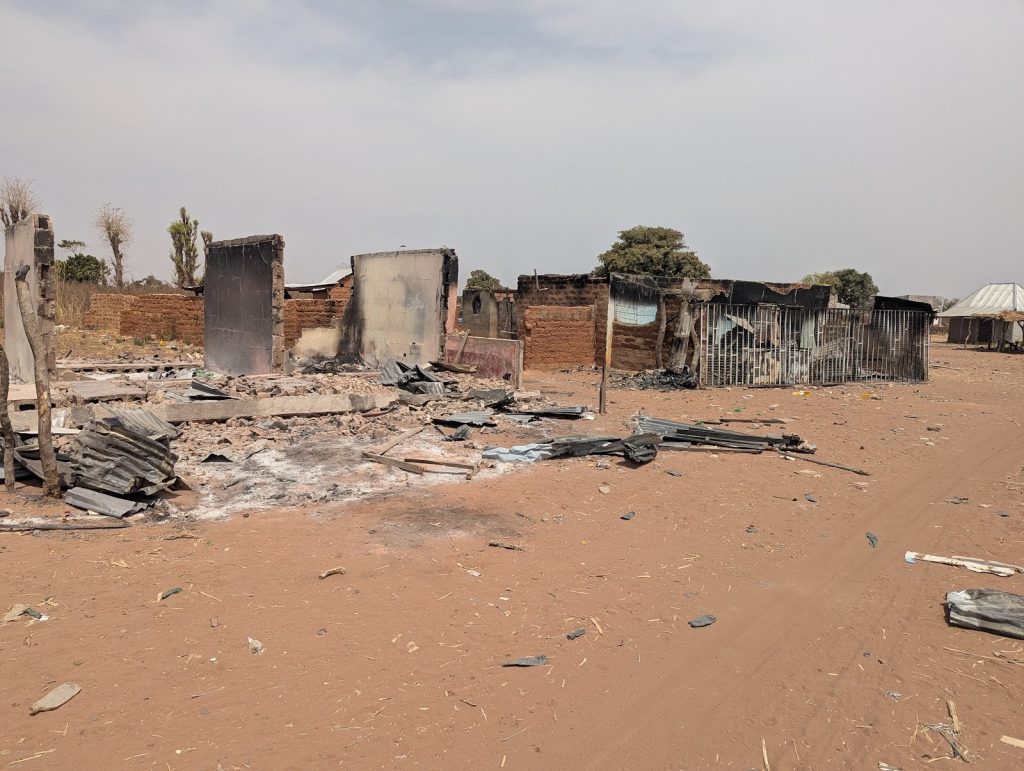
The aftermath of the Jan. 3 terror attack has stripped the community and market of their familiar rhythm, leaving behind charred homes and empty streets.
In the village market, located in the Borgu Local Government Area of Niger State, North Central Nigeria, where voices once mingled in trade and laughter every Wednesday, only the wind now moves through its abandoned, burnt makeshift tents.
When HumAngle visited the community in February, the village felt hollow, its people gone—either displaced, abducted, or buried.
Shops in the market that were burnt down by terrorists who attacked the Kasuwan Daji. Photo: Isah Ismaila/HumAngle.
Amid the ruins, Sule Amadu, an elderly man in his late 60s, moved slowly through the debris of his burnt house, searching for anything that might have survived the flames. He was dressed in the same clothes he wore on the day of the attack.
Sule lost his brother and his house, and nine of his grandchildren were abducted by the same terrorists who attacked his community on Jan. 3. Photo: Isah Ismaila/HumAngle.
His quiet scavenging symbolised both survival and loss.
“I was at the farm when I first heard the roar of their motorcycles heading towards our village,” he recounted. “Moments later, they began shooting sporadically. In panic, I exclaimed, ‘Innalillahi wa inna ilaihi raji’un’ [from God we are and to Him we shall return].”
Sule said the violence was relentless, as the terrorists aimed their bullets directly at people.
“Those who tried to run were chased down by terrorists on motorcycles. Two of them rode together—one driving, the other firing at random. What was our crime?” he added, his voice carrying both grief and bewilderment.
A distant view of some of the burnt houses and food storage facilities in Kasuwan Daji, now sitting in eerie silence. Photo: Isah Ismaila/HumAngle.
State authorities said no fewer than 30 people were killed in the attack. However, eyewitnesses who spoke to HumAngle say 57 people were buried that day, while 49 others were abducted, contradicting the official figures.
Sule narrowly escaped death. His younger brother was killed, and nine of his grandchildren and his son’s wife were abducted that day.
“When the terrorists stormed in, I was trying to bag my millet. One of them chased me while shooting, but by God’s mercy, I escaped the bullets. I ran and jumped into the river to save my life,” he said.
How the attack unfolded
Sule was not alone in witnessing the chaos that engulfed Kasuwan Daji. HumAngle met another resident, Isa Mamman, who said he was among the first to notice the approaching attackers and raise the alarm in the community that day.
Isa, a resident in his 40s, is a living witness to the atrocities committed by the terrorists who stormed his village on Jan. 3, 2026. He vividly remembers the horrifying scenes. Photo: Isah Ismaila/HumAngle.
He recalled how the attack began and how quickly it unfolded.
Isa was alone in a nearby bush around 4 p.m. when he noticed heavy dust rising in the distance and the sound of motorcycles approaching. He immediately ran towards the community to raise the alarm, where he met another villager who was also fleeing. Isa learned from him that the attackers had stormed in from the market axis.
Within minutes, chaos engulfed Kasuwan Daji.
Gunshots echoed across the village as people screamed and scattered. Terrorists on motorcycles fired indiscriminately, chasing down those who tried to escape. Shops and homes were set ablaze, and the once-thriving market became a scene of devastation.
Just like Amadu, Isa narrowly survived, as he was shot at twice as he fled into the bush. From his hiding place, he watched helplessly as villagers were slaughtered and houses reduced to ashes.
Isa narrowly escaped death when the terror struck. Photo: Isah Ismaila/HumAngle.
The violence stretched into the night as Isa remained hidden, fearing an ambush, while the community lay in ruins.
“By dawn, when I came back to the community, lifeless bodies were scattered across the village, food storage facilities were destroyed, and every house and the market were burnt,” he said. That day, I escaped by God’s grace. I ran into the bush to hide, but I could still see what was happening. I saw our people being slaughtered like rams.”
Get our in-depth, creative coverage of conflict and development delivered to you every weekend.
Subscribe now to our newsletter!
The area where people were tied and slaughtered by terrorists. Residents told HumAngle that dead bodies littered this area in pools of blood. Photo: Isah Ismaila/HumAngle.
Isa noted that, “There was no part of the community where we didn’t find dead bodies. Every house in Kasuwan Daji was set ablaze. Our market and storage facilities, where we kept food, were burnt down. We’ve all fled because we are terrified they might attack again.”
A new terror base
Field investigations conducted by HumAngle across the Kasuwan Daji, Wawa, and Babanna areas of the Borgu LGA of Niger State, in February show that terrorist factions are now entrenched in and around the Kainji Lake National Park axis.
Terror groups such as Mahmudawa (Mahmuda faction), Lakurawa, elements of Ansaru, and Jama’atu Ahlis Sunna Lidda’awati wal-Jihad (JAS) led by Sadiku and Umar Taraba, as well as a newly emerged cell affiliated with Jama’at Nusrat al-Islam wal-Muslimin, have turned the Kainji Forest Reserve into a safe haven.
These groups operate in interconnected networks rather than in isolation, exploiting local cover to conceal their movements. They conduct attacks in distant areas before retreating to established hideouts within the park’s surrounding communities.
Kasuwan Daji is situated within this geographic corridor and has become a focal point due to its depth, accessibility, and lack of security presence. It sits about 14 kilometres from the Saint Mary’s Catholic School, where some schoolchildren were abducted in Nov. 2025.
The largely ungoverned terrain provides violent groups with mobility, supply routes, and escape paths across state and national boundaries. This strategic advantage has made the area increasingly attractive to extremist factions seeking to expand their operational reach.
Recent incidents in Niger State and adjoining areas — including coordinated assaults on villages and high-profile abductions — have heightened concerns that extremist networks are embedding themselves beyond the country’s North East, their traditional stronghold. Their spillover into villages such as Kasuwan Daji, Agwara, Babanna, and Kaiama LGA of Kwara State underscores the emergence of a hybrid threat ecosystem in which ideology, criminal enterprise, and local grievances converge to reinforce instability.
This evolving dynamic positions Kainji not only as a local security challenge but also as a critical node in the broader extremist landscape of the North Central region.
Earlier attacks
The Kasuwan Daji attack of Jan. 3 was not the first.
Months before, precisely in September 2025, residents told HumAngle that terrorists had entered the community and abducted several of its most significant figures. Among them was Usman Jatau, the village head, along with five others: Ibrahim Jatau (zone chair of Kambari), Anthony Yakubu Takura (youth leader), Mathew Ibrahim (head of vigilante), David (businessman), and Abu Agwara.
Relics of the Jan. 3 attack. Photo: Isah Ismaila/HumAngleThis rhombus had over 20 stacks of sorghum that were stored by a farmer in Kasuwan Daji, but was razed by terrorists. Photo: Isah Ismaila/HumAngle.
To date, none of them has been heard from, a situation that has left families in anguish and the community without its leadership.
After the abduction, Ajikali Jatau, the brother of the village chief and head of the Kasuwan Daji market, said the same attackers returned with greater brutality.
“This time, their intent seemed clear—to wipe out the community. Villagers were slaughtered mercilessly, some tied with their hands behind their backs before being killed,” Ajikali told HumAngle. He believes the market was deliberately attacked because of its boom and constant business activities.
Ajikali Jatau is burdened by the pain of losing his brother, nephew, and relatives in the terror attack. Photo: Isah Ismaila/HumAngle.The remains of the Kasuwan Daji weekly market burnt by terrorists in the Borgu area of Niger State. Photo: Isah Ismaila/HumAngle.
Ajikali told HumAngle how the market itself had its own history of struggle.
“Before establishing Kasuwan Daji, we used to trade at Sokomba market every Wednesday. But after two young men from our tribe [Kambari] were killed and burnt there in broad daylight, we decided to stop going there.
“One of the victims had tried to escape but was shot dead. The repeated harassment and targeting forced us to request that the market be moved somewhere else, but after several futile efforts, we created our own,” he revealed.
Debris of burnt grains from the storage facilities razed by terrorists in Kasuwan Daji Market. Photo: Isah Ismaila/HumAngle.
For seven years, Kasuwan Daji market thrived, residents say, as they paid revenue to the local government—until it was reduced to ashes in the January attack.
Displacement and human toll
More than 300,000 people have been displaced across 10 LGAs in Niger State, including residents of Kasuwan Daji, according to Governor Umaru Mohammed Bago.
Hajara Shuaibu, a resident of Kasuwan Daji, is one of them. Her husband, Malam Shuaibu, a farmer, had made the village his home, cultivating produce with his family and planning to relocate there permanently. When the terrorists struck, Hajara’s world collapsed. Two of her younger brothers were kidnapped along with her husband’s other wife and daughter, forcing the family to flee to Papiri, a 14-kilometre drive from Borgu to Agwara LGA of Niger State, in search of refuge.
Hajara Shuaibu [in pink] and one of her daughters are now seeking refuge in the Papiri, Agwara Local Government Area of Niger State, after fleeing from Kasuwan Daji in Borgu. Photo: Isah Ismaila/HumAngle.
Before arriving at Papiri, Hajara said she and her children hid in the bush for three days, waiting for the violence to subside.
“Our house was burnt to the ground, along with our belongings and food supplies. About two truckloads of grains and groundnuts that were harvested by my husband were destroyed in the fire, erasing our year-long hard work in a single night,” she said.
Days later, her brother’s wife managed to escape captivity, only to return with devastating news: her husband [Hajara’s brother] and several others who had been abducted had been killed.
The terror was felt even among the youngest.
Suleiman, Hajara’s four-year-old grandson, was among the abducted persons from the attack but was later abandoned in the Gallah area of Agwara LGA, near the house of the village chief.
His cries were said to be so persistent that the attackers eventually dropped him off before leaving with the other captives.
Hajara said that the joy at seeing him [Suleiman] alive was quickly overshadowed by grief, as she remembered her slain brother and relatives still in captivity.
‘We’re not thieves’
In the aftermath of the Jan. 3 attack, the Niger State Governor described Kasuwan Daji as a “market of thieves”, claiming that the community had become notorious for the sale of rustled cattle. He made the remarks during a condolence visit to the Emir of Borgu.
Some of the houses that were burnt by terrorists who stormed the Kasuwan Daji community of the Borgu LGA of Niger State, North Central Nigeria. Photo: Isah Ismaila/HumAngle.
Adding to the despair, he instructed the survivors to leave the Kasuwan Daji village altogether, even though no plans were announced for their relocation or resettlement, leaving families displaced, vulnerable, and uncertain of their future.
However, survivors of the attack strongly refuted the governor’s framing.
Isa Mamman and Sule Amadu are the two people who have refused to leave the community; since they have nowhere to go, they serve as watchdogs watching over the ruins left behind. Photo: Isah Ismaila/HumAngle.
Ajikali, brother of the village chief and leader of the now-destroyed market, told HumAngle, “We are not thieves. We are hard-working people, and the emirate is aware of us and our market. We are farmers—that is our business and what we are known for. We do not deal in the cattle business, so how can we be called thieves?”
Sule also echoes this rejection of the governor’s claim: “I strongly disagree with the governor’s assertion that our market is ‘a market of thieves.’ We do not sell cows in Kasuwan Daji, yet he accuses us of selling rustled cows. He’s been misled by those around him.”
“The only thing I want is to have my grandchildren back. Even if they [terrorists] demand ransom, I have nothing to give except the clothes I am wearing. They burnt everything I owned—my food, my savings, and my animals were stolen,” he noted.
The Niger State Commissioner for Homeland Security, Bello Maurice Magaji, while reaffirming the government’s commitment to tackling insecurity through intelligence gathering and grassroots collaboration, also defended the governor’s branding regarding activities at the market, stressing that it was based on verified intelligence.
“We are adopting an intelligence-gathering strategy to understand the patterns of these crimes and attacks so that we can tackle the situation head-on,” the commissioner told HumAngle. He noted that the government is also engaged in advocacy to help citizens recognise early warning signs that may not have been obvious in the past.
“Also, I believe that whatever information was released by His Excellency is based on facts that were made available. Our government does not simply go out to brand or profile people based on unverifiable information. Our government is too serious to speculate or issue statements without evidence. Therefore, we stand firmly by what the Governor said about the market,” he stated.
Investigation by HumAngle revealed that there are two markets with the same name: Kasuwan Daji. One is situated in Niger State, North-Central, and another in the Kauran Namoda area of Zamfara State, in northwestern Nigeria.
Further checks also indicate that Kasuwar Daji Market in Kaura Namoda local government area of Zamfara State, is a popular hub for cattle rustling. Terrorists, in January, stormed the market and rustled over 500 cattle.
Aminu Garba, Chairman of the Cattle Breeders Association of Nigeria in the state, told journalists that the operation was not an isolated incident noting that similar attacks have occurred in the past, with one recorded about four years ago.
He explained that the terrorists infiltrate the market and nearby villages during the day, monitoring livestock transactions before striking.
It is not impossible that the Niger State government is mistaking one Kasuwan Daji for the other.
For Isa Mamman, another survivor of the attack in Niger State, the governor’s words add insult to injury. He explains that he and Amadu stayed behind in the community because they had nowhere else to go, even as their livestock was rustled and nearly fifty women and children were abducted.
“It has been almost two months since the attack, yet nothing has been done. Neither the state governor nor the district head of Kabe has visited our community. Instead, we were insulted and labelled as thieves. We pay revenue to the government, yet they claim our market is illegal. Now, we have no food, no peace, and countless lives have been lost, and nothing has been done.”
NEW YORK — What makes life worth living? For hard-core “Harry Potter” fans with money to burn, it might be getting Broadway tickets to interact fleetingly with Daniel Radcliffe in “Every Brilliant Thing,” an ingenious and touching solo performance piece written by Duncan Macmillan with Jonny Donahoe on the subject of suicide — or more precisely, on the ordinary joys that militate against such a drastic step.
Radcliffe was breathlessly scampering up and down the aisles of the Hudson Theatre before the show began, enlisting audience members to be participants in the play. Having seen “Every Brilliant Thing” twice before, once at the Edye (the black box at Santa Monica’s BroadStage) starring Donahoe in 2017 and once at the Geffen Playhouse’s intimate Audrey Skirball Kenis Theater starring Daniel K. Isaac in 2023, I knew exactly what he was up to.
The play revolves around a list that the narrator began at the tender age of 7 after his mother first attempted suicide. While she was still in the hospital, he started compiling, as much for her benefit as for his own, sources of everyday happiness.
Ice cream, water fights, kind people who aren’t weird and don’t smell unusual. These items are given a number, and audience members assigned a particular “brilliant thing” are expected to shout out their entry when their number is called.
The list gradually grows in complexity as the narrator gets older. Miss Piggy, spaghetti bolognese and wearing a cape give way to more sophisticated pleasures, such as the way Ray Charles sings the word “You” in the song “Drown in My Own Tears” or the satisfaction in writing about yourself in the second person.
Music plays a prominent role in “Every Brilliant Thing,” which was adapted from a monologue/short story Macmillan wrote called “Sleeve Notes.” The narrator’s terribly British father takes refuge from the emotional storms of his household by listening to jazz records in his office. John Coltrane, Cab Calloway, Bill Evans, Nina Simone are favorite artists, and the narrator can tell his father’s mood simply by the record he’s decided to play.
The production, directed by Jeremy Herrin and Macmillan, involves every level of the Hudson Theatre. I assumed I would be safe, occupying an aisle seat in the murderously expensive prime orchestra during a press performance attended by critics. But I wasn’t flashing a pad as my colleague across the aisle from me was doing to ward off any intrusions. And just before the show was about to start, Radcliffe was suddenly kneeling beside my seat asking if the person I was sitting with was my partner.
I told him that we weren’t a couple, just friends, and that I would be the worst person he could possibly ask to perform anything. But Radcliffe wasn’t so easily put off. “Let’s just say that you’re an older couple who have been together for some time,” he whispered. “And all you have to do is hand me this box of juice and candy bar when I refer to the older couple.”
OK, what harm could there be? Little did I know that “older couple” was to become “old couple,” a term that seemed to be repeated incessantly, at least to my Gen X ears not yet accustomed to scurrilous millennial attacks! I composed myself by pretending that we were in the world of anti-realism. But in truth, I would like to be the kind of person who would offer an anxious kid in a hospital waiting room a juice box and a candy bar, so maybe the casting wasn’t so far-fetched after all.
Daniel Radcliffe in the Broadway production of “Every Brilliant Thing.”
(Matthew Murphy)
A theatergoer was called upon to play the vet who euthanized the narrator’s childhood pet, a dog named Indiana Bones that was symbolized by a coat someone volunteered from the audience. It was the boy’s first experience of death, a difficult concept for a young mind but an important precursor for a boy not given the luxury of existential innocence.
Other audience members, particularly those seated on the stage, played much more elaborate roles. One man, first invited to serve as a stand-in for the narrator’s father, was asked instead to play the boy. He was given one word to say in reply — “Why?” — as his father tries to explain the reason his mother is in the hospital. This same enlisted actor was later called upon to play the dad giving a toast at his son’s wedding, one of the rare occasions when he was able to summon language for the kind of deep feeling he would normally only be able to express through his records.
One kind and patient spectator conscripted to play the school counselor had to remove her shoe to improvise a sock puppet, one of the tools of her empathetic practice. Another audience member sensitively played Sam, the narrator’s love of his life, a relationship that reveals the long-term toll of being raised by a parent suffering from suicidal depression.
Radcliffe’s audience wrangling was as intuitively sharp as his deeply felt performance. He has the comfort of a good retail politician, who’s not afraid of making direct contact with crowds. Two-time Tony winner Donna Murphy, in the house at the reviewed performance, gamely went along when Radcliffe briefly enlisted her luminous services.
Obviously, Radcliffe is the main reason “Every Brilliant Thing” is on Broadway. The show, which began at Britain’s Ludlow Fringe Festival in 2013, is a gossamer piece, a 70-minute curio best experienced in close quarters without the high expectations and ludicrous prices of New York’s turbo-charged commercial theater. The Hudson Theatre lends a mega-church vibe to the proceedings, but the spirits of theatergoers are nonetheless moved.
A scruffy-faced Radcliffe, twinkling accessible geniality in jeans and a sweatshirt, zips up and down the cavernous theater as though waging a one-man campaign against the isolation epidemic. There’s no denying that Harry Potter has matured into an assured stage actor. His Tony-winning performance in “Merrily We Roll Along” should have put to rest any doubts, but the glare of his fame can still obscure his serious chops.
Sincere yet never smarmy, ironic without ever being cynical, well-groomed though far from swank, he’s a more glamorous version of the character than the one originated by Donahoe, the British comedian with an everyman demeanor whose portrayal seemed so genuine at the Edye that I mistakenly thought that the play was his personal story.
Donahoe’s performance was filmed for HBO, but “Every Brilliant Thing” is meant to be experienced in a theater. The whole point of the show is to transform the audience into an impromptu ensemble, a group of strangers emotionally united through the story of one young man’s intimate knowledge of suicide, a subject that Albert Camus called the “one truly serious philosophical problem.”
I’m of two minds about “Every Brilliant Thing.” I was moved once again by the piece, but I’m grateful I didn’t have to wreak havoc on my credit card to pay for my seats. I love the interactive, gentle humanity of the play, but I was also acutely aware of how the work has been commodified. I applaud Radcliffe’s willingness to carve an independent path as an actor, but I might have been more impressed by his adventurousness had he decided to perform in a pocket venue that didn’t have the tiers of pricing I associate with airlines.
Yet launching a conversation around mental health with an audience magnet as powerful as Radcliffe is on balance an excellent thing. And Radcliffe’s compassionate portrayal of a survivor recognizing that he’s not out of the woods just because he made it into adulthood is one of those things that makes a theater lover just a little more appreciative of the humanity at the center of this art form.
Energy markets remain on tenterhooks as the prospect of prolonged war in the Middle East grows.
Published On 13 Mar 202613 Mar 2026
Share
Oil prices have again risen above $100 per barrel as energy markets see little relief amid the biggest disruption to global energy supplies in a generation.
Brent crude, the international benchmark, surged more than 9 percent on Thursday as traders weighed the prospect of weeks, or even months, of turmoil in energy markets as the United States and Israel wage war on Iran.
Recommended Stories
list of 4 itemsend of list
Brent futures, which are traded outside of regular market hours, were priced at $101.13 as of 03:00 GMT.
Asian stock markets, including exchanges in Tokyo, Seoul and Hong Kong, opened sharply lower on Friday, following steep losses on Wall Street overnight.
The latest surge in oil prices came after Iran’s Supreme Leader Mojtaba Khamenei pledged to maintain the effective closure of the Strait of Hormuz, which normally transports about one-fifth of global oil supplies.
In a statement read out on his behalf on Iranian state television, Khamenei described Tehran’s threats against shipping in the waterway as a “lever” that “must continue to be used”.
US President Donald Trump struck a similarly defiant tone on Thursday, posting on Truth Social that stopping Iran from getting nuclear weapons was of “far greater interest and importance” than rising oil prices.
‘Lack of tangible goals in this war’
Traffic through the strait has effectively ground to a halt due to Iranian threats, with only a handful of vessels passing through each day, many of them claiming links to China, Iran’s key economic partner.
According to the United Kingdom Maritime Trade Operations (UKMTO) centre, no more than five ships have passed through the waterway each day since the US and Israel launched joint strikes on Iran on February 28, compared with an average of 138 daily transits before the war. At least 16 commercial vessels have been attacked in the region since the start of the conflict, according to the UKMTO.
Tehran has claimed responsibility for several of the attacks, including a strike on Wednesday that crippled a Thai-flagged vessel off the coast of Oman.
Efforts to bring calm to the market have so far done little to tame prices, which are up nearly 40 percent compared with before the start of the war.
The International Energy Agency’s (IEA) announcement on Wednesday that member countries would release 400 million barrels of oil from emergency stockpiles drew a tepid response among traders eyeing a daily shortfall in global supplies estimated at 15-20 million barrels.
The US Department of the Treasury’s issuance on Thursday of a temporary licence authorising countries to purchase sanctioned Russian oil that has been stranded at sea also failed to move the market, with Brent crude staying above $100 a barrel after the Treasury announcement.
“The key problem is a lack of tangible goals in this war,” said Adi Imsirovic, an energy security expert at the University of Oxford.
“It makes it hard for oil traders to see the light at the end of the tunnel,” he said.
Trump has repeatedly floated the possibility of using the US Navy to escort commercial shipping through the strait, but the Pentagon has yet to conduct such operations amid concerns about the risks posed by Iranian attacks in the narrow waterway.
In an interview with CNBC on Thursday, US Energy Secretary Chris Wright said that Washington was “not ready” to provide navy escorts but that such operations could begin by the end of the month.
“It’ll happen relatively soon but it can’t happen now,” Wright said.
The Israeli military has dropped charges against five soldiers, whose alleged sexual abuse of a Palestinian detainee was caught on camera. The video caused international outrage but also led to protests in support of the soldiers in Israel.
ISLA Fisher shows she’s a match for any red carpet.
The Australian star, 50, beamed in a crimson dress at the Time Women of the Year Gala.
Sign up for the Showbiz newsletter
Thank you!
Isla Fisher, 50, wows in a crimson dress at the Time Women of the Year GalaCredit: GettyIsla has revealed she is ready to embrace life following her split from Sacha Baron CohenCredit: Getty
ideo from northern Israel captured the moment an Iranian missile impacted in a residential area early Friday morning. The aftermath shows a fire and scattered debris next to damaged vehicles and buildings.