WASHINGTON — Five years after the Jan. 6 assault on the U.S. Capitol by President Trump’s supporters, the White House released a website this week attempting to revise history.
Reasserting Trump’s false claim that he had won the 2020 presidential election, the administration doubled down on his decision to issue blanket pardons for the rioters, blamed Capitol Police for escalating tensions that day, and denounced Trump’s vice president at the time, Mike Pence, for “refusing to act” in defiance of the Constitution to stop congressional certification of Trump’s loss.
It was a display of political audacity that has become the hallmark of Trump’s second act — challenging anyone to stop him from asserting raw executive authority, both at home and increasingly abroad.
Whether on foreign or domestic policy, lawmakers have struggled to respond to an administration that moves with unfettered restraint and exceptional speed. The U.S. Supreme Court has only facilitated Trump’s expansion of unitary executive power. And governments abroad accustomed to Trump’s lack of predictability now face a president whose entire philosophy toward foreign interventionism appears to have turned on a dime.
“There are political checks. They are checks, though, that have been degraded,” said William Howell, dean of the School of Government and Policy at Johns Hopkins University and author of “Trajectory of Power: The Rise of the Strongman Presidency.”
“They are checks that are looked upon not just with frustration, but an outward animosity by the president,” Howell added. “It’s a feature of his populist politics for him to say, ‘anything that stands in my way is illegitimate.’”
Unitary rule
Trump’s extraordinary use of executive authority has no comparison in recent times. The president has issued more than 220 executive actions in his first year back in office — more than the 220 orders he issued throughout his entire first term, and dwarfing the 276 actions that President Obama issued over eight years in office.
Directing the Justice Department to prosecute his political enemies, and deploying his pardon power to shield his friends and allies, Trump risks fueling the very sort of politicized system of justice he campaigned against as a presidential candidate.
And his administration has shown derision for Congress, controlled by the president’s own party, approving historically few bills and neglecting those that have passed, such as the Epstein Files Transparency Act. Trump has attempted to unilaterally rename the Defense Department and the Kennedy Center, despite straightforward laws requiring acts of Congress to do so, and has impounded funds appropriated by Congress for child care and family assistance allocated to Democratic states.
“The nature of presidential power is that it is given as much as taken,” said Andrew Rudalevige, a professor of government at Bowdoin College and author of “The New Imperial Presidency.” “You can’t have an imperial presidency without an invisible Congress. And certainly, the current Congress is setting new records for intentional invisibility.”
After Trump bulldozed the East Wing of the White House, a reporter asked his press secretary what was stopping him from knocking down the entire building. Karoline Leavitt demurred. “That’s a legal opinion that’s been held for many years,” she said, suggesting he could, in fact, demolish the rest of it.
“The institutional constraints on the unilateral presidency are weak,” said Dino Christenson, a political science professor at Washington University in St. Louis and co-author of “The Myth of the Imperial Presidency.” “The conservative majority of the [Supreme] Court has also recently chosen to back executive power.
“Arguably,” he added, “international constraints are even weaker, at least for powerful nations like the U.S.”
‘Governed by force’
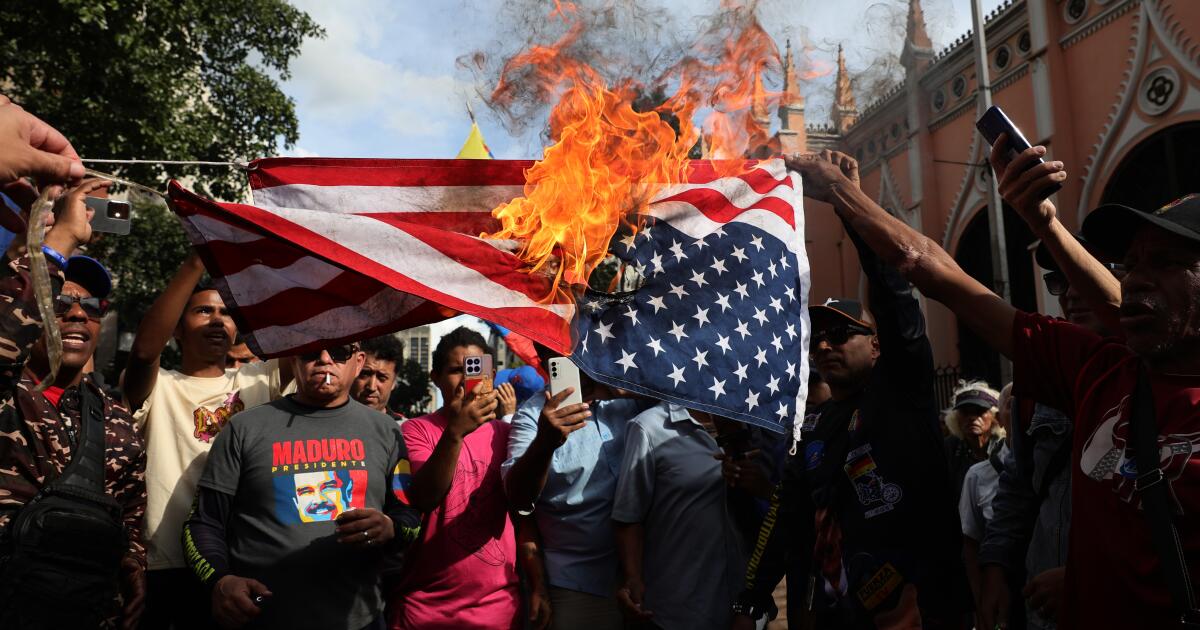
Trump’s order over the weekend to depose Venezuela’s president, Nicolás Maduro, seizing him and his wife from their bedroom in a stunning military raid, was the type of rare exercise in American power that has defined past presidencies. But Trump said he was just getting started.
Beaming from the operational success in Caracas, Trump told reporters aboard Air Force One that he was considering military action against no fewer than five countries, allies and foes alike. His homeland security advisor, Stephen Miller, said that no one would even try to stop Trump from militarily taking over Greenland, an autonomous region of Denmark, a NATO ally and European Union member state.
“We live in a world,” Miller told CNN, “that is governed by strength, that is governed by force, that is governed by power.”
At the State Department, veteran U.S. diplomats waited anxiously for guidance from the administration on how it would justify the operation based on international law on the global stage. It never came. “At least with Iraq, Libya, Syria, there was an effort to seek legal cover,” one diplomat said, granted anonymity to speak candidly. “This is just grab-and-go.”
After the president vowed to run Venezuela going forward as a vassal state, Trump’s energy secretary said the United States would exert control over its oil production “indefinitely.”
And the Trump administration ordered the seizure of two foreign tankers on Wednesday in international waters that have violated its unilateral oil embargo against Caracas, risking precedent governing the laws of the seas that have for decades ensured international commercial flows.
It was a surprising turn for a president who had campaigned on a promise to focus on domestic policy, under a slogan of “America first.”
“So many of the claims that he was making — both in terms of his power and his politics — was about an inward turn, about standing up for America and attending to core problems that it had failed to face, whereas all these foreign entanglements were distractions to be avoided,” Howell said. “So it is striking that he has assumed this new posture of outward imperialism — land grabs, oil tankers, removing heads of state — all at once.”
Several Republican lawmakers expressed skepticism over Trump’s new posture, warning the president against entrenching the U.S. military in foreign conflicts. House Speaker Mike Johnson, a Republican from Louisiana, warned that U.S. military action against Denmark in Greenland “would not be appropriate” after the White House issued an explicit threat of force.
Scholars of the imperial presidency often say that public opinion — not the legislature or the courts — remains the strongest check on executive authority. Trump is ineligible for a third term in office, and has signaled in recent weeks that he recognizes that constitutional limit as unambiguous.
“I don’t think Trump is immune from the laws of political gravity,” Rudalevige said. “Despite his bluster, he is a lame duck. He has never had a Gallup approval rating above 50%, and that rating is in the 30s. His policy actions are even less popular.”
But he also said he believes the public supports him in his brash use of power, telling lawmakers there could be a “constitutional movement” to keep him in office.
“MAGA loves it,” Trump said in an interview with NBC News this week, defending his foreign policy approach. “MAGA loves what I’m doing. MAGA loves everything I do.”
“MAGA is me,” he added. “MAGA loves everything I do, and I love everything I do, too.”
What else you should be reading
The must-read: Palisades fire report was sent to mayor’s office for ‘refinements,’ Fire Commission president says
The deep dive: Michael Reagan’s death reverberates among Californians of both parties
The L.A. Times Special: One year since my childhood home burned
More to come,
Michael Wilner
—
Was this newsletter forwarded to you? Sign up here to get it in your inbox.