PLANS for a brand-new luxury hotel resort located in the European countryside have been unveiled.
The spot is known for its award-winning golf course and has now partnered with a renowned luxury hotel brand for the project.
Plans for a new luxury resort in the European countryside have been revealedCredit: NobuNobu Hotels are set to launch their second Portugal location in the Eastern AlgarveCredit: Nobu
Nobu Hotels has announced plans for its latest luxury destination which will welcome visitors to Portugal’s Eastern Algarve.
The site will be Portugal’s second Nobu location, with the lifestyle hotel chain previously announcing plans for an expansion in Lisbon on Avenida da Liberdade.
Sign up for the Travel newsletter
Thank you!
Construction for the Algarve holiday spot is set to begin in 2027, with plans to accommodate guests in 2029.
The hotel will reside within more than 1,000 acres of countryside at the iconic Monte Rei site, known for its Jack Nicklaus Signature Golf course.
Plans for the new Nobu Hotel include 100 guestrooms and suites, alongside a signature Nobu restaurant and dedicated wellness and lifestyle amenities.
As part of the development, over 226,000 sq ft of land will become villas and branded residences, meaning guests and owners can enjoy Nobu services while living on the Monte Rei site.
According to Nobu Hospitality, in the past two decades, Monte Rei has garnered international reputations owing to “its award-winning golf, high standards of service, residential community and enviable location in one of Portugal’s most characterful resort regions”.
The resort hopes to combine the luxury and hospitality of Nobu with the exceptional privacy offered by the Monte Rei setting.
CEO of Nobu Hospitality, Trevor Horwell, said: “Monte Rei offers a rare combination of natural beauty, privacy and an established reputation for exceptional golf and residential living.
“Together with Norfin, we have the opportunity to create a distinctive Nobu destination that feels deeply connected to the Eastern Algarve while delivering the hospitality, dining, design and service for which the brand is known around the world.”
The project is set to bring together an international design team, including DSA Architects and the Rockwell Group, to develop the architecture and vision of the luxury resort.
CEO of Norfin, Miguel Mateus, has called the new plans an “important milestone” for Monte Rei.
“The resort has long been recognised for the quality of its golf, service and residential environment.
“We are now building on that legacy with a broader ambition for the destination – one that brings together world-class hospitality, exceptional residential living and carefully designed leisure experiences.
FIFA’s Gianni Infantino has scrapped his controversial plan to sell a stake in the World Cup to private investors after global outrage. The FIFA president is up for re-election next year, so why is no one running against him? Soraya Lennie unpacks the details.
Police said at least three people were killed several others were wounded in a shooting at an In-N-Out Burger in Twin Falls, Idaho on Saturday afternoon. Footage captured the suspected gunman firing several shots into a vehicle before he was killed.
If you buy books linked on our site, The Times may earn a commission from Bookshop.org, whose fees support independent bookstores.
If your summer could use a little energy boost, forget the complicated smoothie — turn to one of these fresh book releases instead. From fast-paced World War II history to a slow-burn rescue in rural Wyoming, along with an art-world mystery and a punchy look at modern America, you’ll find something to galvanize your bedside book stack. Happy reading!
While Boyles’ debut novel ostensibly follows the fate of an Eastern Colorado family farm, its deeper purpose involves showing how dire water resources are for all agricultural endeavors in the region. Maggie and her husband Fish have inherited their land from her grandparents, but they and their teenage daughter Ozzie all know that without irrigation, even defeating big development plans won’t make much of a difference to locals.
Vietnamese American sisters Vivi and Calla are also a curator and an artist. When their father dies and leaves behind a sketch that might be the work of renowned Vietnamese painter K.P. Lý, the siblings embark on a quest to find out whether Lý had connections to their family. Along the way they reexamine their difficult upbringing and find new ways to communicate that matter more than any artwork.
Etna: A Novel By Paul Yoon Scribner: 208 pp., $28 (Aug. 4)
Anyone who has seen “The Odyssey” with Matt Damon or is anticipating “Heart of the Beast” with Brad Pitt (about a veteran and his war dog), should pick up Yoon’s remarkable tale of a combat survivor in an alternate present who happens to be a former military dog named Etna. His adventures traversing a broken land of haunted people and animals may be less the stuff of future myth and more about trauma, but Yoon brilliantly creates voices for human and canine that make both more whole.
Jeon-Gi, known as J-G, is a relatively happy 10-year-old in 1976, until a neighbor’s attack on him fuels his own violent ideas. Although he gets a relatively easy sentence after threatening a classmate, J-G’s parents decide to send him to a Christian summer camp. Incidents there that might be sweet nostalgia for other kids only remind him of how different and lonely he feels inside. However, it’s J-G’s adult reason for sharing his experience that hits home.
Many, so so many, historical novels seek to tie a contemporary protagonist to a long-ago event or story; so so many fail to make the connections mean anything. That’s why Obreht’s superb and fascinating new book should earn a place on your 2026 reading list: She not only meaningfully connects the stories of a stranded young woman, an early-20th-century gunslinger, and a historical reenactor, but manages to make them illuminate each other.
NONFICTION:
Triage By Claudia Rankine Graywolf: 192 pp., $28 (Aug. 4)
The book’s epigraph says a great deal: “Any attempt to name and describe our lives will always seem unstable because all language is a form of triage.” Rankine’s new attempt at triage focuses on her long friendship with a person identified only as “the theorist.” Anecdotes and analysis are interspersed with photos of all sorts of sofas and couches, calling into question ideas about where and how we find respite and support — or not.
Santenello has over 4 million subscribers on YouTube, where he posts videos about every kind of place in America — rich and poor, renowned and hidden, busy and abandoned. Love or hate the author’s self-described nonpartisan approach, you’ll find this book surprising, particularly as it reveals how geography, climate and infrastructure affect community and communication. Think Anthony Bourdain crossed with Michael Moore.
Historian Scott (“Black Snow”) creates a propulsive read about the last days of World War II, in which America’s development of the atomic bomb pushed against Japan’s aggressive majority, with tragic results that many — including the author — believe necessary. The contrast between President Harry S. Truman, who had been in office for a matter of weeks, and Emperor Hirohito, whose military seemed unstoppable, remains shocking.
Recently a friend showed me a list of books recommended by a pundit and asked which one to read first. Without hesitation I told her she should pick up “A People’s History of the United States” by Howard Zinn, first published in 1980 and still the most comprehensive remedial tonic to received wisdom I know. Zirin’s lively biography of this activist should remind everyone that history isn’t just about facts and figures but also context and compassion.
Hannah Arendt, one of the 20th century’s defining political thinkers, posited that modern life was making “being human superfluous”; her learned successor Lepore warns that our present bears out that idea. One day scholars will teach Lepore’s work alongside Arendt’s, seeing that Lepore interrogates not simply a modern moment, but traces our current machine age back to the 17th-century conceit for artifice as improvement. According to her, the way out is to get back to nature. Meet you in the woods.
The Dodgers play a video before each home game, which includes these words from a sinister-sounding voice: “You need teams like us to point your finger and say, ‘That’s the bad guy.’ ”
In this case, “you” means the owners of the other 29 teams. You can hear them wailing now: Baseball is rigged, and only a salary cap can unrig the sport. The Dodgers are the back-to-back champions, and they just picked up the best player on the trade market.
They. Have. Too. Much. Damn. Money.
But here’s the thing: All the money the Dodgers lavish upon their major league roster isn’t what made the trade for Skubal possible.
Oh, all that money helped put them in position to where Skubal could help them in October, but Skubal could have helped the Milwaukee Brewers or the Chicago Cubs or the Tampa Bay Rays or the Atlanta Braves or the New York Yankees or the Philadelphia Phillies.
When the Detroit Tigers took bids for Skubal, they liked the Dodgers’ offer the best. And here is what the Dodgers offered: three prospects, none a first-rounder, none ranked among baseball’s top 20 prospects.
Outfielder Zyhir Hope was drafted in the 11th round, by the Cubs. When the Cubs needed a corner infielder, the Dodgers shipped them a surplus major leaguer, Michael Busch, in exchange for two prospects. One was Hope, whose professional experience was limited to 11 games of rookie ball.
Pitcher River Ryan was drafted in the 11th round, by the San Diego Padres. When the Padres needed a left-handed bat that could play the outfield, the Dodgers shipped them a surplus major leaguer, Matt Beaty, for a prospect that had yet to make his professional debut, Ryan.
Pitcher Brady Smith was drafted in the third round, by the Dodgers. This is his second professional season.
The Dodgers developed Hope and Ryan from minor leaguers into top prospects, and the Tigers hope some of that Dodgers development dust has rubbed off on Smith.
Tarik Skubal delivers during a game between the Detroit Tigers and the Baltimore Orioles on July 29.
(Paul Sancya / Associated Press)
For now? The prospect rankings on the league website put Hope at No. 25 and Ryan at No. 68. The Baseball America prospect rankings put Hope at No. 55, with Ryan outside the top 100. Neither ranking includes Smith among the top 100.
As Baseball America editor-in-chief J.J. Cooper wrote, Hope was the third-best outfielder on the Dodgers’ double-A team.
That might be the greatest testament of all to the Dodgers’ player development system, particularly considering all of their winning means they draft at the end of every round, every year.
Will money come into play here? Yes, but not yet. Skubal is a free agent at the end of the season, and not every team could afford $300 million or $400 million or so to sign him to a long-term contract.
But, for these final months of the season, the cost to pay Skubal is $9 million. Any team can do that. And, if the owner of your team tells you he could not have done that, the proper response would be to laugh, and then chant “Sell the team!”
And, as the Brewers and Cleveland Guardians and Tampa Bay Rays prove just about every year, any team can afford to build an excellent player development system.
Look, I am not going to try to tell you that every team could sign Shohei Ohtani and Yoshinobu Yamamoto and Freddie Freeman and Mookie Betts and Edwin Díaz and Kyle Tucker.
But the New York Mets, in the largest market in the major leagues, certainly could. Their Saturday was not spent trading for Skubal. It was spent taking trade offers for players on their last-place team and commemorating the 40th anniversary of their 1986 World Series championship team — their last championship team.
In Anaheim, the last-place team in the second-largest market in the major leagues lost to the Brewers, the team in the smallest market in the major leagues — and, as of Saturday, the team with the best record in the majors.
Market size need not be destiny, if you can scout and sign and coach and develop players. The owners could learn from that, but it’s easier to point at the Dodgers and say, “That’s the bad guy.”
Instead, some poor league employee probably stayed up late Saturday night, planning how to splice clips of Skubal wearing a Dodgers uniform into the “Level the Playing Field” ad campaign the owners are running to persuade fans to take their side in collective bargaining. Imagine what they could do with clips of Skubal waving to fans in a championship parade.
Inspired by Agatha Christie’s Murder on the Orient Express
I visited Istanbul because of Murder on the Orient Express,even though the city only makes a fleeting appearance in the novel.
In fact, one of the things I love about Agatha Christie is that she doesn’t fart about with long descriptions of place. Part of the charm of her detective novels is that they are welterweights, all knotty muscle and six-packs, feinting one way then smacking you in the chops with an unexpected revelation. An extra stone of description would kill that energy.
And it’s possible to read Murder on the Orient Expressand miss how important the city is, both to the novel and its author. Christie is a master of misdirection and buried clues. Even her autobiography is notably guarded about her personal life. She doesn’t hide the fact, however, that her first trip to Istanbul was a landmark. She went as a solo traveller after her first marriage broke down and the city became the starting point for her life’s second chapter.
She often stayed at the Pera Palace Hotel and allegedly wrote a draft of Murder on the Orient Expressin one of its rooms. Pera Palace is still going; its suite 411 is named in Christie’s honour and kitted out with an antique typewriter and copies of her novels. From Istanbul, Christie undertook intrepid overland adventures to the Middle East. Amazingly, in those days you could travel from Haydarpaşa station on the city’s Anatolian side all the way to Baghdad, Mosul and Tehran.
Marcel Theroux in Pera Palace Hotel, Istanbul.
One Easter egg buried in the pages of Murder on the Orient Expressis the name of the hotel that Poirot visits in its second chapter: the Tokatlian. Christie is so sparing with details that this really stands out. The handsome facade of the Tokatlian is still intact. You can read the name carved on the masonry of its upper storeys, but today it houses shops and offices. It couldn’t be more central: it stands on a corner of İstiklal Avenue, the long, pedestrianised thoroughfare that runs through the heart of the Beyoğlu district. At one end is Taksim Square; at the other, the Tünel, the amazing Victorian funicular that is the second-oldest underground railway in the world, after the London Underground.
I sneaked into the Tokatlian and had an underwhelming wander: the hotel shut down many years ago. But once upon a time, this was the place to stay in Istanbul. It’s where Christie herself spent her first nights in the city. In her autobiography, she describes going to a restaurant on a nearby backstreet run by White Russians. That is almost certainly Rejans, renamed Istanbul 1924, and still doing good business serving Russian-inspired food and flavoured vodka.
Poirot doesn’t stay the night in Istanbul. He barely has time for a bath and a bowl of soup before he has to get across the Golden Horn to Sirkeci station and catch the 9pm train to Paris, which he finds mysteriously crowded. That train doesn’t run any longer, sadly, but the echoing interior of Sirkeci and its fetching pink facade give you a tantalising flavour of what it must have been like to travel by train in that era.
One thing that’s clear is that Christie knows far more about Istanbul than she makes explicit in Murder on the Orient Express. She doesn’t show off any local knowledge; there’s not a glimpse of a hammam or a mosque, no one smoking a shisha, no sense of Turkish food – or any food for that matter. But the book is still rooted in Istanbul and an intriguingly understated introduction to it.
Istanbul’s unique geography and blended cultures shape the opening chapters. Christie perfectly understands the logistics involved in moving Poirot around the city. And just as she leaves clues that enable an alert reader to solve the mysteries in her novels, she drops hints at what it is that makes Istanbul special. This is a gift: her reticence leaves anyone travelling in her footsteps free to make their own discoveries. Marcel Theroux
Yukon and Alaska
Inspired by Jack London’s The Call of the Wild
A grizzly bear in Yukon, Canada. Photograph: Robert Postma/Getty Images/Design Pics RF
I came to Jack London through Mr Hill, the best English teacher I ever had, and so from early on a love of the North – breathlessly capitalised – and a love of words went hand in hand. It’s the story of Buck, a Californian house dog, abducted to work pulling sledges in the Yukon gold rush who, chapter by chapter, frees himself from the shackles of civilisation.
I liked Buck but it was the Yukon that held me. “The stars leaping in the frost dance, and the land numb and frozen under its pall of snow.” Here was the midnight sun and endless spruce forest, the noble wolf and 50 degrees below, and solitary men grinding a living from the land. It was a place that seemed impossibly distant, not only in space but in time.
I made it there two decades later. I spent five months paddling the length of the Yukon River, from its source in the Pelly Mountains. It was a place of superlatives. The river is 2,000 miles long and, where it meets the Bering Sea, some of its channels can be seven miles from bank to bank.
Rereading the book this past week, placenames that once sounded like invocations have become familiar to me: Five Fingers, Little Salmon, Sixtymile. Outside Circle City, where Buck attacked the troublemaker Black Burton in a bar, I saw my first grizzly. In Dawson, where in a wager Buck pulled a sled that weighed 1,000lbs, I visited London’s cabin, or the half that remained (the other is on display in California).
Adam Weymouth at the rear of a canoe on the Tatchun River, Yukon. Photograph: Peter Mather
London spent fewer than nine months in Dawson, and most of those in bed with scurvy. His experience of this “Northland”, as he calls it, is not the one of the characters he beatifies. What he wrote was an idea, a backdrop for forging a new version of oneself. These lands were “new and naked”, operating under the “law of club and fang”, an ongoing tussle between the outsiders who had come into the country and the wild nature that they found there. Apart from their role in the tragic denouement, Indigenous people scarcely get a mention. If anything, they are one more facet of this wild nature to be contested, rather than people who built a communal, grounded life here for millennia before the rest of the world showed up.
As I travelled in the Yukon, and met the Tr’ondëk Hwëch’in and the Tlingit tribes, and heard about the terrible legacies of the gold rush, I came to better see through London’s fantasy. Yet I could not deny its lure. I could have moved to the Yukon in a heartbeat. “I may never in my life get to Alaska,” wrote the US essayist Edward Abbey, “but I am grateful that it’s there.” London’s writing acknowledges that need for such escape in all of us. For conjuring the seed that first led me to that place, it’s a book that I’ll always hold dear. Adam Weymouth
South of France
Inspired by Françoise Sagan’s Bonjour Tristesse
Menton on the Côte d’Azur. Photograph: Kirk Fisher
It was 1964 and I was a bored 15-year-old in Basingstoke. I’d already discovered that literature could be scandalous. A couple of years earlier, my girlfriends and I hid behind the rattan sofa in the living room of one of the more “alternative” family homes after school and read out the rude bits in Lady Chatterley’s Lover. When I got my hands on a copy of Françoise Sagan’s 1954 novella Bonjour Tristesse, labelled a succès de scandale by the French press and literary establishment, I was away. Away from my dull, small country town existence and my equally boring family.
I wanted to be French, like the protagonist, 17-year-old Cécile; I wanted to sit in a Paris cafe. I wanted to discuss philosophy with elegant adults while drinking an aperitif and smoking a Gauloises (untipped). My list of wants was endless. I dreamed of staying in a white-walled villa on the Côte d’Azur, the sun burning through the bedroom window on my bare body, gauzy curtains blowing in the warm wind. Not icy patterns on the inside of the glass in a semi on a new-build estate in Hampshire. I wanted warm caressing sea and hot sand, not the freezing English Channel and painful pebbles. I wanted to ride in an open-topped car along the corniche dressed in a Givenchy cocktail dress and Cartier jewellery to casinos, not a Westward Ho! holiday camp in the same hand-knit, turquoise sweater as my brothers. I wanted to be treated as an equal by grownups and live my life in dangerous colour. I wanted to write a hedonistic novel of shocking immorality – as Françoise did at 18. And I wanted to not be a virgin.
By 1969, I had an artist boyfriend and was staying in the apartment of a schoolfriend’s film-star uncle in Paris. So many boxes ticked! I marvelled at the sophistication of Parisienne women, swooned at the lemony chewing-gum smell of the Métro and the soft whoosh of the trains with different classes of carriage, the beauty of the regimented Tuileries. We bought baguettes and croissants and learned how to tear them apart to eat à la française, the proper way. Because in Paris it seemed there was a proper way for everything.
Elaine Kingett in Cap d’Antibes in 1979.
It was in 1971 that I finally got to the Côte d’Azur, to Port Grimaud and Saint-Tropez, and found the France I’d been searching for: heat, blinding sunlight, blue sky and sea. Sunbathing topless, covered in baby oil, reading Valley of the Dolls and smoking Gitanes. The pan bagnat, moules farcies and frites. The celebration of indulgence and liberation, such a contrast to the rules and regs of Paris.
In 1979, my husband and I were back there, on holiday with a load of friends, staying in a white-walled villa with two grand pianos in Cap d’Antibes, driving an open-topped, gold Beetle. And that’s where I conceived my longed-for first child, after dinner one night at the Hotel du Cap-Eden-Roc. Seems dreams can come true. Now I just need to write that novel … Elaine Kingett Elaine runs writing holidays in Spain
Kyrgyzstan
Inspired by Chinghiz Aitmatov’s The White Ship
Rukh Ordo cultural complex. Photograph: Marina Pissarova/Alamy
The smoky smell of grilled meat drifted out of cafes and over sunbathers, swimmers and a group of elderly ladies dressed in sun hats selling dacha-grown berries by the bucket-load. After a long, hard winter in Kyrgyzstan, life looked sweet on Central Asia’s “beach”, sand-fringed Issyk-Kul, the world’s second largest mountain lake after the Andes’ Titicaca.
This visit in 2011 wasn’t my first to Kyrgyzstan but it was the first time I’d dipped my toes into the lake’s frigid water. I’d wanted to do so ever since reading The White Ship(first published in 1970 and translated by Mirra Ginsburg) by Chinghiz Aitmatov, who was born in a village in the north-west of Kyrgyzstan in 1928.
In the story, a lonely seven-year-old boy – abandoned by his divorced parents – dreams of morphing into a fish. That way he can better look out for his father who, he believes, captains the white ship that sails on Issyk-Kul. This moving novel, in which the lake features heavily, reads like a fable, mixing in Kyrgyz legends, clans and myths. There are many references, for example, to the “horned Mother Deer”; the Bugu clan – Kyrgyzstan has 40 historical tribes, each represented by a sun ray on the national flag – consider their earliest ancestor to be a deer.
One of the first people I met at Cholpon-Ata, the busiest stretch of the shoreline, was a Russian woman, a factory manager from an industrial city in Siberia, who was visiting Kyrgyzstan with her family. She told me that she’d just tried a fresh peach, rather than a canned one, for the first time. I have never forgotten the pleasure that spread across her face as she described it to me. She also believed that the environment – fresh mountain air and the lake’s slightly saline properties – to be health-giving, good for her asthmatic son. Just as in Aitmatov’s book, the lake was expected to offer hope and perhaps answers. Above us, paragliders hovered in the cloudless sky.
Caroline Eden with a statue of Chinghiz Aitmatov. Photograph: Caroline Eden
Issyk-Kul in summer remained a place of simple pleasures, of buckets and spades, sandcastles and blow-up beach balls. Only the backdrop of the chocolate-brown mountains of the Tian Shan range hinted at our altitude of 1,600 metres (5,270ft). Once I’d had enough sun, and enjoyed the cooling effects of fresh cherries and a Baltika beer, I set off to nearby Rukh Ordo, an open-air museum also on the lake.
The museum, pitched as a spiritual centre promoting world peace and respect for different religions, was a place to wander, with chapels and yurts scattered along the shore. Pleasingly, I learned that after Aitmatov’s death in 2008, Rukh Ordo was dedicated to his memory. Before getting a bus back to the town of Karakol, where I’d based myself, I found a statue of him and had my photograph taken alongside it. A final personal tribute to Kyrgyzstan’s beloved literary son. Caroline Eden
Cornwall
Inspired by Daphne du Maurier’s Frenchman’s Creek
Landmark Trust have a holiday cottage at the head of Frenchman’s Creek. Photograph: John Miller
I first read Frenchman’s Creek aged 12 or 13. I can’t recall how it came into my orbit; maybe it was on the bookshelves at home, or one of my worldly aunts pressed it into my hands. The effect was instant. From the dreamy, almost hallucinogenic opening chapter, I was swept up in this girls’ own adventure, gasping aloud at the daring feats of our sassy heroine, Lady Dona St Columb, as she escapes her stodgy husband and their feckless court life in Restoration-era London.
Retreating to their Cornish estate with her two children, she discovers their long-neglected country house is being used as a base for a wanted man – a French pirate (of the passionate, artistic variety, natch). They embark on a wild and dangerous romance in and around the Helford River, as she joins him on board his ship, even dressing as a cabin boy to launch raids on the oafish locals. But when her husband and his friends show up, determined to hunt down her swashbuckling lover, she must make a choice – sacrifice him to certain death, or risk her own life to save him.
As an adventure-hungry teen, it wasn’t just the bold Dona and her below-decks antics that lured me in, but the almost physical immersion in the setting. Like all Du Maurier’s novels, Frenchman’s Creek employs all the senses to transport the reader, conjuring a mysterious, untamed Cornwall that bore no resemblance to the muddy campsites and ice-cream vans of my childhood holidays. Here was a lawless land of secret tributaries, hidden pools and wooded riverbanks where anything could happen.
Reading the novel again recently (and still gasping at every turn), I was inspired to finally make my pilgrimage, summoning the spirit of Dona as I headed west from London.
Frenchman’s Creek is a real place. It’s about 15 miles south of Falmouth, part of a ria – a flooded river valley open to the sea – described in the book as “a narrow inlet, branching from the parent river, its short, twisting course running westward into a valley”. Nowadays it’s owned by the National Trust and apart from a few tastefully placed signs and footpath markers, it remains its enchanted self, unchanged from how it would have appeared to the novel’s 17th-century characters. It’s more accessible now, with a 3.8-mile circular walk from the village of Helford following the creek itself. Through the trees you can glimpse the sailing boats anchored in the main channel and it’s easy to imagine Dona wandering among the oaks, spying the white sails of the pirate ship hidden up the creek, her heart pounding as she descends to the water’s edge.
Lois Pryce reading Frenchman’s Creek in a creek.
Du Maurier excels not only at setting and plot but also at subversive female characters. Written in 1941 as an escape from the grim realities of war, and reflecting her own resistance to domesticity, the novel’s themes of female lust, infidelity and disregard for maternal duties would have been controversial, even shocking. Refreshingly, Du Maurier never attempts to justify or apologise for her protagonist’s actions.
This is a book that deserves to be read breathlessly in one sitting, far from the distractions of the modern world. Fortunately for today’s reader, there’s a remote holiday cottage owned by the Landmark Trust, tucked away in the woods at the head of the creek, with no wifi or phone signal. Ask yourself, what would Dona do? Lois Pryce
Olympic canoeist David Hearn departs the Moultrie Courthouse with his attorneys, Norm Eisen (not pictured) and Mary Dohrmann, after pleading not guilty to damaging the Lincoln Memorial Reflecting Pool in Washington, D.C., on July 9. Charges against Hearn were dropped Friday. Photo by Bonnie Cash/UPI | License Photo
Aug. 1 (UPI) — President Donald Trump has called out District Attorney Jeanine Pirro after her office moved to dismiss charges against an Olympic canoeist for vandalism.
Prosecutors on Friday made the motion to dismiss charges against David Hearn, 67, and admitted that the damage to the Lincoln Memorial Reflecting Pool was due to a “botched installation and not vandalism.” Hearn was indicted in early July for purposely ripping up a piece of the blue sealant from the bottom of the pool.
The filing in D.C Superior Court lists documents and evidence showing the contracting work was rushed to finish in time for the America 250 celebrations and was not done properly.
“I disagree 100% with Jeanine Pirro, the U.S. Attorney for the District of Columbia, on the Reflecting Pool,” Trump posted on Truth Social Saturday. “I don’t know what she was thinking? To me, it was a pure case of VANDALISM, that included the grass, which had a big 86 47 emblazoned in giant letters on it, and other elements of the surrounding area. There may have been some contractor difficulty, but the major damage was caused by VANDALS!”
Soon after, he posted again, saying, “Look for yourselves at the VANDALISM that took place at The Reflecting Pool. The material is being cut with a knife or a box cutter, for all to see!”
President Donald Trump announces a program to allow veterans to expedite a career in commercial trucking on Thursday. Known as the Freedom Haulers program, the initiative would allow any veterans who drove heavy equipment to be automatically eligible for a commercial trucking license. Photo by Jim Lo Scalzo/UPI | License Photo
The five-star KOIA All-Suite Wellbeing Resort on Kos, Greece, is a world away from the party scene – and rooms start from £220 a night
Views from KOIA resort are magical(Image: KOIA)
Like countless Brits, my initial encounter with the Greek island came via an 18-30 holiday. I recall cheap cocktails, sticky dancefloors and a hotel where staff flat-out refused to hand out more than one deflated pillow per guest. It was enjoyable in that uniquely carefree way only your early twenties can deliver, but I’d mentally categorised Kos with the other party islands I’d ticked off and left behind.
So when the invitation arrived to return this summer, I’ll confess my expectations were modest. I certainly wasn’t anticipating discovering one of the most peaceful hotels I’ve ever stayed in.
Situated high above the Aegean Sea, KOIA All-Suite Wellbeing Resort feels like it exists on an entirely separate island. There’s no thumping music poolside, no inflatable flamingoes floating about and definitely no wristbands.
Instead, it offered supreme luxury through serene infinity pools, premium dining and wellness experiences – all at a sensible price point, reports OK!.
Stay in style
Launched in 2023, the five-star adults-only sanctuary boasts just 51 suites, meaning it never feels overcrowded, even at full capacity. Built into the hillside overlooking Agios Fokas, roughly a 12-minute drive from Kos Town, the resort draws inspiration from the ancient wisdom of Hippocrates, who was born on the island, with wellbeing woven into every aspect.
Suites span from pared-back Cave Suites to more generous Sea View Suites featuring private infinity pools or outdoor whirlpools, all styled in soothing neutral shades, natural stone and timber. The appeal of the hotel lies in the fact that every suite provides full or partial vistas across the Aegean, meaning there’s genuinely no disappointing room.
Thoughtful details such as a pillow menu, rainfall showers, smart-controlled blinds and room-service dining choices really reinforce the sense of ‘private luxury’. In terms of facilities, there are two pools – one indoors within the spa and a main pool – plus a gym.
The food
Despite there being just one restaurant, Thyme, I never found myself craving additional dining choices, which speaks volumes about how exceptional the food was. For breakfast, a generous buffet featuring local fruit, pastries and made-to-order dishes can be savoured with uninterrupted sea vistas.
Come evening, Thyme becomes an elegant à la carte restaurant showcasing Mediterranean cuisine with seasonal ingredients, fresh seafood and regional wines. I’m not exaggerating when I say I requested the shrimp linguine four times.
Lunch is also available there, but with a completely different menu from evenings, offering plenty of variety through fancy sandwiches and grilled options. Throughout the day, my book and I set up camp at the pool bar for iced coffees between dips, before relocating to the sophisticated Elixir Bar at sunset, where cocktails are served with a backdrop of one of the finest views on the island.
What’s on
If you need more than a pool and a good book to keep you occupied, the carefully curated range of activities on offer are well worth booking in advance. From open-air morning yoga overlooking the glittering sea to a traditional baking class with Thyme’s head chef, there’s plenty to keep you busy.
I headed to the hotel’s Ydor Spa (on the one overcast day we had) and relished the chance to privately hire the Himalayan salt room and sauna cabin before treating myself to a full body massage. I’d also highly recommend the floating breakfast experience. I’ve never consumed so much food in a single morning, and there truly is nothing more delightful than chasing your strawberries as they drift across your private pool.
Further afield
Reception can point you towards hiking trails leading to the medieval ruins of Palio Pyli or the summit of Mount Díkaios, where breathtaking sunset views from the island’s highest peak make the climb thoroughly worthwhile. Kos Town offers an entirely different tempo, boasting Roman landmarks such as the beautifully preserved Odeon of Kos and Casa Romana, alongside some superb tavernas to dine at. If you have a hire car, venture out to the island’s thermal springs, located at the northern tip of the island at Therma Beach, where the seawater bubbles.
Why I’ll be returning
It’s uncommon to experience a genuine sense of magic from a hotel, yet that’s precisely what I encountered here. A tranquil retreat, ideal for those seeking respite from the hustle and bustle.
Perhaps the greatest revelation was discovering it on an island I’d previously dismissed as a party destination. Its intimate size lends itself to a wonderfully personal level of service, and within just a few days, the staff already knew my preferred morning coffee and favourite sunbed spot. Worth noting too – from August 2026, guests can also look forward to a brand-new Greek restaurant, a second pool and newly added suites.
Book it
A Junior Suite with Sea View and Hot Tub starts from £220 per night, and a Sea View Suite with Private Pool starts from £256 with breakfast included. Book via koiaresort.com to make the most of offers like complimentary airport transfers. Half board and full board dining also available. Flights to Kos from major UK airports operate daily May-October with return pricing from around £60.
At least three people are dead and more than 20 injured after a bomb exploded outside a restaurant in central Moscow. Russian authorities say a woman carrying an explosive device was stopped by a security guard before it exploded. It’s not clear who the target was.
One of the most read — and debated — stories from the Arts team this week was an interview with Oskar Eustis a day after he announced that he would step down as the artistic director of the Public Theater in 2028. The New York Times broke the news July 22 in an interview with Eustis in which he also said that the American nonprofit theater movement was over.
I followed up in a phone interview the next day and asked him to explain what he meant, which he did, noting that the broad consensus that nonprofit theater mattered to the country — a belief held by national endowments, state arts agencies, public policy institutes and corporate philanthropic departments — had disappeared. So, too, have many of those very same agencies and their budgets that provided funding to the arts. The case for sustaining any particular theater now comes down to that theater and how relevant and necessary it can make itself to its surrounding community, Eustis said.
There is never enough room in an article when you’ve had a good conversation with someone, so I thought I’d use the newsletter to publish a bit more of what Eustis shared with me. I was particularly interested in something he said about the Public’s famed Shakespeare in the Park program, which is free and takes place every summer at the Delacorte Theater in Central Park. Since its inception, more than 160 productions have been staged, reaching more than 6 million people.
The free tickets the Public gives away for these shows are “the prime driver of our income at the Public, and this has been true since our founding,” Eustis told me.
That may sound counterintuitive, but it goes directly to the case Eustis is making for modern nonprofit theaters to be as relevant as possible to their communities. Ticket sales will never bring in the kind of money theaters need to sustain a robust slate of diverse programming — that will always have to come from donors. These very same donors, Eustis said, are the ones who feel most excited to be sitting among the citizenry in Central Park, watching the beauty of public art unfold in a joyous communal atmosphere.
“It’s not just when they make a donation that they get to see the show,” said Eustis of uber-wealthy donors. “They absolutely viscerally feel that — sitting in that theater when 75% of the audience hasn’t paid a penny to be there — they are getting to be part of their dream city. They’re feeling, ‘Oh, this is what New York is supposed to feel like.’”
By giving away free Shakespeare in the Park tickets, Eustis said, the Public is “making an unbelievably powerful case for why we need subsidy … and that’s why the money comes, because we are [showing] that democratic access is more fun for a better city.”
I like the idea of free theater being more fun, and rich people paying for the privilege of being a part of that fun when it is so removed from their cordoned-off daily lives. But I do worry that so much of what we now rely on culturally comes down to the whims and fancies of a handful of ultra-rich patrons. Newspapers are run by them, public school art and music programs rely on them, as do museums, symphonies, ballets and operas.
As Eustis pointed out, these donors no longer represent a broad consensus that is channeled into a civic vision via government support, but that is precisely why the situation feels so precarious. We might be one serious AI-driven stock market crash from artistic oblivion.
I’m Arts editor Jessica Gelt staring gloomily into the distance. This is your arts and culture news for the week.
You’re reading Essential Arts
Our critics and reporters guide you through events and happenings of L.A.
By continuing, you agree to our Terms of Service, which include arbitration and a class action waiver. You agree that we and our third-party vendors may collect and use your information, including through cookies, pixels and similar technologies, for the purposes set forth in our Privacy Policy such as personalizing your experience and ads.
The week ahead: A curated calendar
FRIDAY
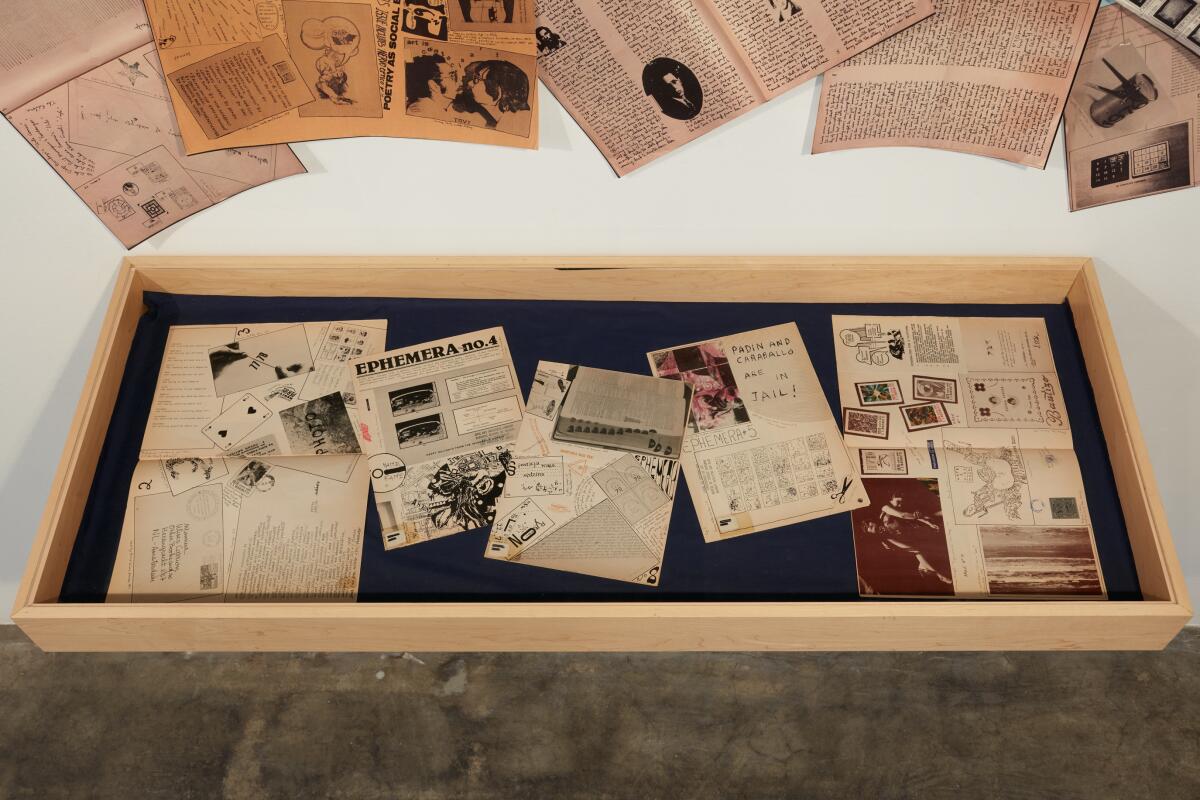
“Ulises Carrión, a bookwork in many places” exhibition at Joan Los Angeles.
(Evan Walsh)
Ulises Carrión, a bookwork in many places The exhibition, in its final two weeks, examines the Mexican-born conceptual artist’s influence on reimagined systems of exchange through printed matter by artists, librarians, publishers and alternative spaces. The show focuses on Southern California in particular, spanning the 1970s, ’80s and ’90s, featuring artist books, correspondence, video and ephemera. 11 a.m.-5 p.m. Thursdays-Saturdays. Through Aug. 9. Joan, 1206 Maple Ave., Suite 715, Fashion District, downtown L.A. joanlosangeles.org
Puppet Up! Brian Henson’s adventurous stage show featuring improv and sketch comedy with the iconic Henson puppets and puppeteers is back for a limited eight-performance run. Also on tap is “A Conversation With Brian Henson,” a live presentation by the Emmy-winning producer, director and puppeteer about the rich history of the Jim Henson Company, 2 p.m. Sunday at the Montalbán. 8 p.m. Friday; 3 and 7 p.m. Saturday; 5 p.m. Sunday; 8 p.m. Aug. 7; 3 and 7 p.m. Aug. 8; and 5 p.m. Aug. 9. Ricardo Montalbán Theatre, 1615 Vine St. puppetup.com
Tchaikovsky Spectacular with Fireworks L.A.-based circus company Troupe Vertigo and the USC Trojan Marching Band join the Los Angeles Philharmonic, conducted by France’s Chloe Dufresne, for the 1812 overture — with pyrotechnics. 8 p.m. Friday and Saturday. Hollywood Bowl, 2301 N. Highland Ave. hollywoodbowl.com
SATURDAY
A scene from “Acquaprofonda” at the Aquarium of the Pacific.”
(Andres Leon for Long Beach Opera)
Acquaprofonda: A Deep-Sea Opera for Families Long Beach Opera Education collaborates with the Aquarium of the Pacific for this free, family-friendly, 30-minute adventure about a young girl who finds an ailing whale and stands up for what’s right. Music by Giovanni Sollima, libretto by Giancarlo De Cataldo and English libretto by Elle Moody. Noon and 3 p.m. Saturdays and Sundays, through Aug. 9. Aquarium of the Pacific, Honda Pacific Visions Theater, 100 Aquarium Way, Long Beach. longbeachopera.org
Boleros De Noche The 10th annual celebration of romance, nostalgia and cultural pride features Puerto Rican singer iLe and a special performance by the L.A.-based trio Voz Bohemia. 8 p.m. Ford Amphitheatre, 2580 Cahuenga Blvd. East. theford.com
Free 4 All Claremont Lewis Museum of Art opens its doors for this annual one-day takeover by local artists who will display their work with no fees to exhibit and no gatekeepers to choose whose work gets seen. With live music by the Kamran Curlin Trio, Home Again Home Again and Coupe Deville. 1-8 p.m. Claremont Lewis Museum of Art, 200 W. First St., Claremont. clmoa.org
People of Pompeii A new comedy by Los Angeles Drama Critics Circle Award-winning playwright Bernardo Cubría, co-directed by Ellen Geer and Xochitl Romero, is set in Topanga Canyon itself and focuses on community in a time of climate catastrophe. Through Oct. 4. Will Geer Theatricum Botanicum, 1419 N. Topanga Canyon Blvd., Topanga. theatricum.com
Two Gentlebots of Verona The annual Actors’ Gang Free Shakespeare in the Park for Families features a cyber-inspired Shakespeare adaptation by Rynn Vogel, directed by Adam J. Jefferis. 11 a.m. Saturdays and Sundays, through Aug. 23. Media Park, 9091 Culver Blvd., Culver City; noon, Aug. 29-30. Buena Vista Branch Library, 300 N. Buena Vista St., Burbank. theactorsgang.com
SUNDAY
Sidney Jacobs & the Monsters The jazz vocalist and his sextet perform original music with reimagined standards. 8 p.m. Sierra Madre Playhouse, 87 W. Sierra Madre Blvd. sierramadreplayhouse.org
St. Vincent with the Hollywood Bowl Orchestra The six-time Grammy-winning singer-songwriter guitarist goes orchestral with the HBO led by conductor Jules Buckley. 7 p.m. Hollywood Bowl, 2301 N. Highland Ave. hollywoodbowl.com
TUESDAY
Louis Langrée The French conductor leads the L.A. Phil in works from Felix Mendelssohn and Joseph Haydn on Tuesday at the Hollywood Bowl; two nights later, Langrée returns with pieces by Johannes Brahms, Georges Bizet and Louise Farrenc. Mendelssohn & Haydn, 8 p.m. Tuesday; Brahms & Bizet, 8 p.m. Thursday. Hollywood Bowl, 2301 N. Highland Ave. hollywoodbowl.com
“Saint Luke” from Irmengard Codex shortly after 1053. German. Tempera colors, gold, and ink on parchment 22.2 × 18.7 cm (8 3/4 × 7 3/8 in.)
(Getty Museum)
The Making of a Medieval Manuscript If you ever wondered how the beautiful manuscripts in the Getty’s extensive collection were created, this is the exhibition for you. Tools and materials used illustrate each phase of the process from parchment making, writing and illuminating through the final binding. Christian manuscripts from Europe, Armenia and Ethiopia, plus objects of Jewish and Muslim origin, will also be on display, along with a video component. Through May 2, 2027. Getty Center, 1200 Getty Center Drive, L.A. getty.edu
WEDNESDAY
Kalean Ung as the Chanteuse in “The Comedy of Errors.”
(Mike Ditz)
The Comedy of Errors Melissa Chalsma directs Indie Shakes’ production of the Bard’s wordplay and slapstick set in a Mediterranean port town, with an original score. 7 p.m. Wednesday-Sunday; through Sept. 6. Old Zoo Picnic Area, Griffith Park. indieshakes.org/free-shakespeare-2026
THURSDAY
Annie and the Caldwells/The Campbell Brothers The Skirball concludes its 29th season of Sunset Concerts with this family-fueled pairing of disco soul and sacred steel gospel groups, respectively, plus DJ sets by Sonrisita. 7 p.m. Skirball Cultural Center, 2701 N. Sepulveda Blvd. skirball.org
JazzPOP 2026 The summer series marks its 19th season with three concerts showcasing West Coast creative jazz: Kasey Knudsen Sextet (Thursday); Malachi Whitson Quartet (Aug. 13); and Machado Mijiga Trio (Aug. 20). 8 p.m. Thursdays, through Aug. 20. UCLA Hammer Museum, 10899 Wilshire Blvd., Westwood. hammer.ucla.edu
— Kevin Crust
Retrospective
L.A. Times arts coverage from the the past …
Playwright/director Moises Kaufman of “The Laramie Project” was on the cover of Sunday Calendar, July 29, 2001.
(Irfan Khan / Los Angeles Times)
At the Heart of a Modern Tragedy
Sunday Calendar, July 29, 2001
NEW YORK — Moises Kaufman could not turn off the television. He could not put down the newspaper. Like much of America, he was mesmerized by the news of the horrific beating, robbery and eventual death in 1998 of Matthew Shepard, a gay university student attacked and left for dead by two young men near Laramie, Wyo.
“For the five days until he died, you couldn’t turn on a television or a radio and not hear about it,” says the 37-year-old playwright and director. “Matthew Shepard put a face on hate crimes. He was young, beautiful, starting his life. The nation as a whole said, ‘Oh, my God. What’s going on?’ ”
It was exactly the sort of question that Kaufman and his colleagues at the Tectonic Theater Project here try to ask, if not answer, onstage. So unlike much of America, Kaufman did not simply move on to the next news tragedy. The man who created the widely produced “Gross Indecency: The Three Trials of Oscar Wilde” had found his next theater project. READ MORE
— Barbara Isenberg
Culture news and the SoCal scene
Artist Betye Saar visits her pet tortoise named Ms. Rojo on Tuesday, Feb. 3, 2026, in Los Angeles.
(Jason Armond / Los Angeles Times)
Pioneering Los Angeles assemblage artist Betye Saar died Sunday, just a few days shy of her 100th birthday. The Times had the privilege of profiling her a few weeks earlier in a story that also included some wonderful photos of Saar still hard at work in her Laurel Canyon home studio. After Saar’s death, we published an obituary written by former Times columnist Carolina Miranda, and I put together a list of five of Saar’s most compelling works.
Watts Towers is poised to break ground in October on a $22-million campus renovation — the first such work done to the arts campus since it opened in 1970. The work is set to begin as funding for a 15-year project to preserve the towers themselves has dried up, with work about 90% complete. Community leaders say the situation represents the frustrating piecemeal approach taken over the years to preserve one of the city’s most important cultural landmarks. Times contributor Jane Horowitz has the scoop.
Evan Lugo (George Page), Sonya Cooke (Margaret Page), Zane Caputo (Abraham Slender), Zach Trent (Skateboard Fenton) and Heriberto Cruz Jr. (Doctor Cayo) in “The Merry Wives of Windsor Cove.”
(Elijah Waller)
“The Merry Wives of Windsor’” got a ’50s-themed SoCal beach blanket bingo musical makeover at UC Irvine’s New Swan Shakespeare Festival, and Times theater critic Charles McNulty was there to weigh in on the result. “The pastiche score, indebted to the pop charts of the 1950s, isn’t allowed to dominate,” McNulty writes. “As modern musicals go, this is a low-key affair. The comedy is still the thing in this frolicsome outdoor production, which takes place in the charming ambiance of the festival’s portable, mini-Elizabethan venue.”
McNulty also took time to praise the work of stellar older actors in a rare revival of Nöel Coward’s “Waiting in the Wings,” which is running in repertory at Will Geer Theatricum Botanicum through Oct. 10. The play, “which is set in ‘The Wings,’ a charity home for retired actresses, provides a feast for veteran thespians for whom it would be impolite to ask their age,” writes McNulty. “Led by Susan Angelo, Jan Wikstrom and Ellen Geer, this ensemble, under the direction of Willow Geer, diverts and distracts from the mustier aspects of Coward’s style.”
The Lucas Museum of Narrative Art announced its inaugural film programming, which is set to screen nonstop during museum hours in two dedicated 299-seat theaters. One theater will play mostly documentary films, and the other will be devoted to the more experimental aspects of the art form.
Alaska Thunderf— will play Mary Todd Lincoln in “Oh, Mary!” at the Ahmanson.
(Daniel Rampulla)
“RuPaul’s Drag Race” star Alaska Thunderf— will play Mary Todd Lincoln in Cole Escola’s Tony-winning comedy “Oh, Mary!” when it arrives at Center Theatre Group’s Ahmanson Theatre in the fall. Broadway star J. Harrison Ghee has been cast opposite Alaska in the role of her famous husband.
Enjoying this newsletter? Consider subscribing to the Los Angeles Times
Joey McIntyre of New Kids on the Block performs during Audacy’s 11th annual We Can Survive at Prudential Center on Sept. 28, 2024, in Newark, N.J.
(Manny Carabel / Getty Images for Audacy)
The Wallis Annenberg Center for the Performing Arts announced some additions to its 2026-2027 season, including the world premiere of a new play, “Radio Galaxy,” written by Michèle Aldin Kushner, directed by Kimberly Senior and starring Joey McIntyre (yes, that Joey McIntyre) and Olivier Award winner Lesli Margherita. The show is about a 17-year-old from a working-class New Jersey town who wants to become an astronomer but must deal with the harsh realities of daily life, including his half-sister’s need for a bone marrow transplant. The show is scheduled for 18 performances in the Lovelace Studio Theater Nov. 6-22. Tickets are available here.
A few reduced-rate spots remain for Camp Build at the Gamble House in Pasadena, which runs from Aug. 1 to 5 for three hours each day. Two hours are devoted to learning the art and craft of woodworking, and a third hour is spent on activities inspired by nature and architecture in the historic home. The cost of the camp is assessed on a sliding scale according to income and need with four payment tiers ranging from free to $650. The remaining slots are in the second tier, which costs $350.
— Jessica Gelt
And last but not least
Want a glimpse into the hedonistic L.A. of yore? Check out this story about Eve Babitz’s personal letters. It will not disappoint.
Mohamed Salah edging towards a move to Trabzonspor, Bayern Munich keen on Manchester United striker Benjamin Sesko and Man City boss Enzo Maresca wants to work with Chelsea winger Pedro Neto again.
Egypt forward Mohamed Salah, 34, is close to joining Turkish side Trabzonspor despite having verbally agreed to join Besiktas after leaving Liverpool this summer. (Foot Mercato), external
Bayern Munich remain interested in signing Manchester United striker Benjamin Sesko, 23, as the Slovenia forward will allow England’s Harry Kane, 33, to play a deeper role in the future. (CF Bayern Insider), external
Man City boss Enzo Maresca wants to work again with Chelsea winger Pedro Neto, with City exploring a move for the 26-year-old Portugal forward valued at £70m. (Sun), external
Chelsea and Tottenham have joined Newcastle in the race to sign Atalanta centre-back Giorgio Scalvini, 22, with the Magpies prepared to open with a £34m bid for the Italy defender valued at £42m. (Sun), external
Liverpoolmidfielder Curtis Jones is ready to push for a move to Inter Milan after a deal worth 25m euros (£21m) was rejected for the 25-year-old, but discussions remain ongoing over a package worth around £30m that would match the Reds’ valuation of the England international. (Teamtalk), external
Paris St-Germain have stepped up their pursuit of Ajax winger Mika Godts, who is valued at £52m, with Premier League sidesArsenal,Liverpool,Manchester United and Tottenhamall being informed of the 21-year-old Belgium forward’s growing interest. (Teamtalk), external
Chelseaforward Joao Pedro, 24, is set to receive a new contract despite his current deal running until 2032, following previous interest from Barcelona in the Brazil international. (The Athletic), external
Fulham are interested in making a move for Republic of Ireland striker Troy Parrott, 24, from Eredivisie side AZ Alkmaar, but face competition from Ajax, PSV Eindhoven, Real Betis and Como. (Talksport), external
Benfica striker Franjo Ivanovic is close to joining Hull Cityafter talks began over the terms of a deal that will likely see the 22-year-old Croatia forward join initially on loan.(Record), external
Strikes hit Gaza homes two days after US unveiled plan for Hamas disarmament, Israeli withdrawal.
Published On 2 Aug 20262 Aug 2026
Israeli forces have killed at least five Palestinians in strikes across the Gaza Strip.
At least two people were killed and several wounded in a strike on a house in central Deir el-Balah, while three others were killed in a strike on an apartment in northern Gaza City, according to local officials.
Recommended Stories
list of 3 itemsend of list
The strikes came on Sunday, two days after US President Donald Trump’s Board of Peace published a 15-point roadmap for implementing last year’s Gaza ceasefire agreement, extending a pattern of continued Israeli strikes despite diplomatic breakthroughs.
The roadmap has yet to be implemented on the ground. Hamas has said it will hand over its weapons for storage only after Israel halts military operations and withdraws its forces in line with last year’s agreement. An Israeli official told the Reuters news agency there would be no withdrawal from current positions unless Hamas undergoes “genuine disarmament”.
Israeli Prime Minister Benjamin Netanyahu has not publicly commented on the initiative, but far-right National Security Minister Itamar Ben-Gvir has called it unacceptable and said Israel should continue targeting Hamas leaders.
Former senior Fatah official Mohammed Dahlan, based in the United Arab Emirates, said Jared Kushner, Trump’s son-in-law and a senior adviser on the US initiative, told him he was working with Israel to halt the attacks on Gaza. Dahlan said talks with Washington were continuing, and that the agreement’s success now depended on Israel fully ending its daily strikes.
Separately, Israeli strikes destroyed a medical supply warehouse in central Gaza on Saturday, leaving a crater 20 metres (66ft) wide and 10 metres (33ft) deep, part of a broader wave of attacks that has continued despite the ceasefire push.
Tens of thousands of migrants briefly cross into Spain’s north African territory of Ceuta from Morocco.
Images of migrants from Morocco streaming into the Spanish territory of Ceuta in North Africa have again thrust the immigration debate into the spotlight in Europe and elsewhere.
Despite the sea barrier separating Ceuta and mainland Europe, some EU countries have announced controls at their borders with Spain.
Italy has suspended Schengen rules allowing border-free travel.
US President Donald Trump has also weighed in, attempting to tie the brief migrant surge in Ceuta to the US midterm elections in November.
But why did the influx happen now, and what does it mean for Spain’s relatively migrant-friendly policy as it faces hostility from large parts of Europe?
Presenter: Anna Burns-Francis
Guests:
Anna Terron Cusi – Spain’s former secretary of state for immigration and emigration, who is now a senior fellow at the Migration Policy Institute
Daniel Gros – Director of the Institute for European Policymaking at Bocconi University and an adviser to the EU parliament
Deborah Fleischaker – Former acting chief of staff at US Immigration and Customs Enforcement (ICE), who is now a senior adviser for immigration policy and strategy at UnidosUS
“Today” show host Savannah Guthrie said Saturday on social media that her family was “desperate” and “begging for help” in the disappearance of her mother, a day after authorities released two ransom notes including one saying that she had died.
Authorities released an early note in the investigation into the disappearance of 84-year-old Nancy Guthrie, hoping that someone will recognize the writing style. A second note said Guthrie died shortly after she was kidnapped and “is buried in nature now.” Both notes initially were sent to a Tucson television station days after Guthrie went missing from her home outside Tucson on Feb. 1.
Desperate plea
“We are begging for help. We are desperate. We need someone to come forward. Someone knows something. Someone suspects something. Someone recognizes the writing in the ransom demand notes,” Guthrie wrote on her Instagram account, alongside a photo of her mother.
“Someone has noticed something different, strange, troubling or just unusual — perhaps with someone they deeply love,” she wrote. “Perhaps they are afraid to come forward. Perhaps they are conflicted. Perhaps they are angry or upset for being in this situation. There is a way out — to tell what you know.”
Guthrie went on to say she and her family “wanted to find out what happened to her, so that we can give her the dignity of a proper goodbye — a celebration of her remarkable life that she so deserves.”
Missing since February
Saturday is the six-month mark since Guthrie disappeared. No suspects have been arrested. The investigation has been dogged by unanswered questions, such as how many people are believed to have taken part in her abduction and whether she was taken by someone who knew her.
The FBI in Washington did not respond to questions about the ransom notes, including whether both messages sent to the Tucson station have been deemed legitimate.
In releasing the notes, the Pima County Sheriff’s Department said that “we believe these distinctive linguistic characteristics may be recognizable to someone who knows or has interacted with the notes’ writer.”
Ransom notes released
The first note, sent Feb. 2, said Guthrie was safe but scared and would be released unharmed once her captors received $4 million in cryptocurrency, with the ransom amount increasing if the first demand was not met. It said Guthrie would be released within 12 hours if the payment was received. It also included a threat to kill her if the ransom wasn’t paid.
“Your mother is aware of this and her life is in your hands,” the first note read. “It is in the best interest of everyone to have this completed as soon as possible.”
The second note was sent Feb. 6 and said Guthrie died shortly after she was taken. “She is buried in nature now,” it said. “Nothing you could have done could have changed the outcome.” The note ended with an apology: “We are truly sorry.”
The Pima County Sheriff’s Department said the notes reveal a distinctive pattern of word choices and provide insight into the writer’s mindset. The agency said someone who knows the notes’ writer may recognize the patterns.
Authorities similarly used a suspect’s writings as a tool to find Theodore “Ted” Kaczynski, branded the “Unabomber” by the FBI. Kaczynski, who killed three people and injured 23 others with mail bombs over a 17-year span, pressured the Washington Post, in conjunction with the New York Times, to publish his 35,000-word manifesto in 1995. He was finally arrested after his brother realized his sibling was the suspect and notified authorities.
Signs of preparations
The sheriff’s office also said Friday that two videos recovered from Guthrie’s doorbell camera might be from two separate days and indicate an unidentified male prepared ahead of when Guthrie was taken. Authorities are seeking information on anyone who was behaving differently, changed their physical appearance, suddenly left the Tucson area or had a noticeable or unexplained interest or disinterest in the case.
“Investigators continue to pursue every available technological and investigative lead,” the sheriff’s office said. “However, community members remain a vital resource as we seek to provide answers for Nancy’s family.”
The FBI had released surveillance videos of a masked person who authorities said appeared to tamper with a camera on Nancy Guthrie’s front porch and block it with a plant. They described the person as a male about 5 feet, 9 inches tall.
England’s Jazmin Sawyers was finally able to put previous disappointments at major championships behind her by winning the women’s long jump at the Commonwealth Games in Glasgow.
The 32-year-old bounced back from serious injury to celebrate a gold medal on a night when there was a silver for England’s mixed 4x400m relay team and a bronze for pole vaulter Owen Heard.
Sawyers finished just outside the medals in fourth place at the previous games in Birmingham four years ago, failed to qualify for the final of the 2023 World Championships and was then forced to miss the 2024 Olympics.
She had to undergo surgery after rupturing her Achilles tendon on her take-off leg and so, rather than competing in Paris ended up commentating for the BBC.
But the Stoke-on-Trent born athlete put all those setbacks behind her on a memorable evening at Scotstoun with her fourth jump of 6.93m proving to be enough to claim the gold medal ahead of Nigeria’s Ruth Usoro (6.87m) and Brooke BuschKuehl of Australia (6.80m).
“It hasn’t properly hit me how this is the thing I’ve been telling myself all the horrible bits are for,” she said.
“The feeling is overwhelming. I will do the horrible bits 100 times over, I’ll do it and do it and do it. This is amazing.”
Sawyers will now turn her attention to competing for Great Britain at the European Championships in Birmingham, which start on 10 August, but is keen to hang on to the memories Glasgow has given her.
“Twelve years ago almost to the day, I won a silver here in Glasgow (2014 Commonwealth Games) at my first major championships. It was a shock silver and I’ve held Glasgow close to my heart ever since,” she added.
“It was the start of my career and so sensational and I had the time of my life. I take that as one of the best moments of my entire career, but when you’ve done that there’s only one thing to do which is to upgrade.”
This article provides a historical overview of Benin in observance of its Independence Day on August 1st. It traces the nation’s origins from the Kingdom of Dahomey, which rose to regional dominance through military strength and early involvement in the slave trade. Following the decline of that era, the territory transitioned into a French colony before evolving into an autonomous republic within the French Community. The text highlights that the country officially secured its full sovereignty in 1960 and later adopted its current name in 1975. Beyond these historical insights, the source also includes snippets of global news and contemporary regional updates from the summer of 2026.
British-Nepalese mountaineer Nirmal Purja, 42, was among 10 climbers who were swept away by a deadly avalanche on Pakistan’s Broad Peak. File Photo by Narendra Shrestha/EPA-EFE
Aug. 1 (UPI) — World-renowned mountaineer Nirmal Purja and nine others were killed during an avalanche on Pakistan’s Broad Peak, it was confirmed Saturday.
Purja, 42, was among 10 climbers who were swept away by the deadly avalanche on Thursday, leading rescuers on a frantic search for survivors.
“Today, it is with profound sadness and immense heartbreak that we confirm that Nirmal ‘Nimsdal’ Purja tragically lost his life following the avalanche on Broad Peak,” his company said in a statement on Instagram.
“We have also received confirmation that other members of the expedition sadly did not survive,” the statement added.
The expedition included Nadhira Ahmed Abdullah Al Harthy of Oman, Sohail Sakhi of Pakistan, Wang Zhong of China, Mallory Geis of the United States, as well as Pur “Yukta” Bahadur Gurung, Kili “Kilu” Pemba Sherpa, Nima Sherpa and Nawang Thindu Sherpa.
Purja, known as Nims Dai, reached the peak of his sport in 2019, when he climbed all of the world’s 14 tallest peaks in just six months, beating the previous record by nearly eight years.
“The world has lost one of mountaineering’s greatest climbers; a leader who inspired millions through his courage, humility and unwavering belief that human potential is far greater than we often imagine,” his company said.
“More than his extraordinary achievements, he wanted to show the world what was possible when you dared to dream bigger, believed in yourself and refused to accept limitations,” the statement continued. “Through his actions, he inspired millions of people to believe that they, too, could achieve more than they ever thought possible.”
Purja, who was Nepali and British, served in the U.K. military for 16 years and was awarded an MBE by the queen in 2016 for his outstanding achievement in mountaineering.
“Nims served with distinction in the British Armed Forces before becoming one of the world’s greatest mountaineers, putting Nepalese climbers on the map,” Prince Williams of Wales said in a statement on X.
“His relentless pursuit of what seemed impossible, combined with his humility and selflessness, made him truly unique.”
Footage shows firefighters dousing the wreckage of a crashed tourist aircraft in southern Peru. Police said the plane was carrying 13 people when it went down while flying over the ancient archeological site of Nazca Lines.
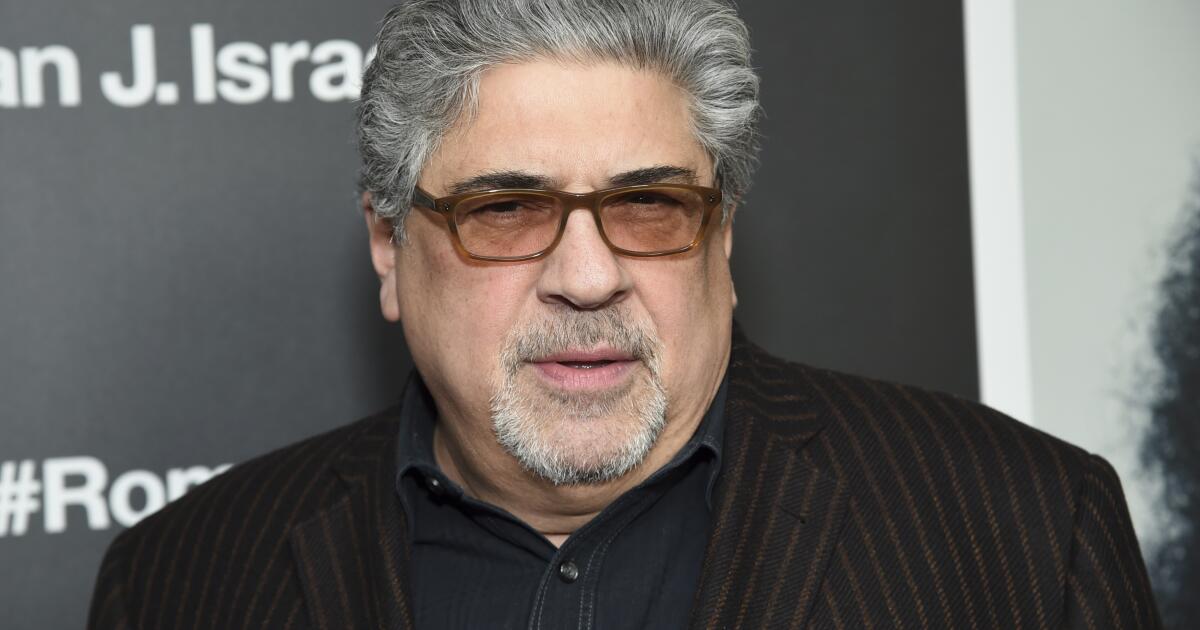
Vincent Pastore, best known for playing gangster informant Salvatore “Big Pussy” Bonpensiero on HBO’s “The Sopranos,” has died. He was 80.
Pastore was found dead in his Bronx residence Saturday by a friend who did a wellness check after he had not been heard from for three days, his manager Steve Atterman confirmed to The Times. No cause of death was revealed.
While Pastore was best known for his time on the HBO drama starring the late James Gandolfini, he was often cast as an Italian American bad guy in other film and TV projects. His early credits include “Goodfellas,“ “Carlito’s Way” and “The Jerky Boys: The Movie.” He also appeared in the 1996 HBO TV movie “Gotti,” alongside future “Sopranos” co-stars Tony Sirico, Dominic Chianese and Frank Vincent.
A New York native, Pastore was born on July 14, 1946, in the Bronx. He fought in the Vietnam War and went on to graduate from Pace University with a degree in drama. He spent most of his young adulthood running bars and nightclubs in New Rochelle.
He didn’t get into acting until he was in his 40s in the late ‘80s at the encouragement of acting siblings Matt and Kevin Dillon. In a 1999 interview with The Times, Pastore offered his thoughts on why the brothers saw potential in him: “I guess because I looked like a gangster!”
“They used to live in a nearby town, and they used to come to my club a lot, and I became good friends with these guys,” Pastore said. “Kevin brought me down to meet his manager, and I had an interview. I took acting classes and some classes in college, but I didn’t have a clue how to break into film and the New York business. The agent gave me a guidepost, and I started doing some independents and a lot of theater. I started to study acting at 42!”
Pastore appeared in nearly 200 movies and TV projects, and twice in singing roles on Broadway (2007’s “Chicago” and 2014’s “Bullets Over Broadway” productions). But it was his role in David Chase’s 1999 drama “The Sopranos” that became his signature role.
Big Pussy was seminal to the show’s lore as Tony’s longtime best friend and trusted mob enforcer; his betrayal in becoming an FBI informant led to his murder and became one of the show’s most memorable scenes early in the show’s run.
Given his propensity to be cast as a mobster, Pastore was once asked whether he ever considered turning down a job because he thought it portrayed Italian Americans in a bad light.
“No, I haven’t turned any work down,” he told The Times. “The only time I turned work down is when I can’t do it because of ‘The Sopranos.’ I don’t think I am in a position [to turn down work] … when you got a daughter in grad school and you are paying her expenses, it’s pretty hard to turn a job down…You just hope the films are going to be good.”
At the time, Kerr gave his answer as the bell tolled. In a flash, he made his move, bursting to the outside in pursuit of Myers and Cheruiyot, who made theirs momentarily first.
With 250m to go, Kerr left them behind. Wightman gamely tried to follow but how do you chase down a man this fast? His brave gamble failed and the bronze medallist from the last two Games trailed home in sixth.
By then, Kerr was already celebrating gold, with Myers coming through for silver and Cheruiyot bronze.
“I peeked up at the screen, saw I had a bit of a gap, and I felt great,” added the Edinburgh athlete, who has been racing at Scotstoun since he was a child.
“I was just trying to stay present and enjoy it. I learned how to race on that track – and I’ve had some pretty bad ones out there – so to really enjoy that last 100m was a really important moment.”
It was the moment Glasgow 2026 has been building to. The historic, reinstated, Blue Riband event of these Games got a fittingly elite winner. As a student of the sport’s history, Kerr will appreciate that.
And as a kid who was at the athletics event at Hampden in 2014, he knew how much joy every man, women and child inside this place would derive from every picture he had taken, every word he shared with them, and every scrawl of his name.
“I have to take my time out there because they’ve waited and put their hard-earned money to come out and watch me perform,” he said.
“You’ve got to stay in your lane and realise I’m lucky coming into this championship healthy, ready to go and I’m in the best shape of my life. And to do that in front of a home crowd is very special.”
Aug. 1 (UPI) — At least three people were killed and two injured in a shooting at an In-N-Out restaurant in Idaho on Saturday, police said.
Authorities in Twin Falls responded to reports of shots fired about 2:30 p.m. in an area that included multiple major retailers and a movie theater, NBC News reported.
Videos posted on social media showed a man wearing a black shirt and carrying a large rifle in the area, Boise State Public Radio reported.
The man reportedly shot the front windshield of a parked car and later walked into the In-N-Out drive-through.
Police Chief Matthew Hicks said it was a “very chaotic scene” and confirmed the shooter was dead.
“We have literally hundreds of people that were in some way, shape or form in the area of this restaurant at the time that are being interviewed right now,” he told reporters, BSPR reported.
In a statement, Twin Falls police said roads and a nearby bridge were closed to all residents and visitors while officers responded to the incident.
“We are working to try to ascertain his identity and the motivations behind [the shooting] and we’ll be able to figure that out in the next coming days,” Hicks told reporters.
The police chief added, “Today has been a very hard day here in Twin Falls,” NBC News reported.
Weekly insights and analysis on the latest developments in military technology, strategy, and foreign policy.
The U.S. Navy has shared details about its vision for a new family of modular surface-to-air missiles that is expected to include a version that will arm future variants of the Virginia class submarine. This would be an all-new capability for the service, at least as far as we know. All of the members of the Naval Modular Missile (NMM) are set to be based around a common Terminal Stage Interceptor (TSI), creating a range of capabilities in very different form factors. This, in turn, opens a door to new options for larger and/or mixed loadouts in vertical launch systems on surface warships and submarines.
New information about the Navy’s NMM concept is contained in a draft request for solutions contracting notice recently posted online, which Aviation Week was first to report on. Naval Sea Systems Command (NAVSEA) hosted an NMM Industry Day event earlier this year to get feedback from prospective vendors. The NMM effort traces its roots back to at least 2021, but the Navy has only released limited details about its plans for these new missiles in the past.
“The United States Navy (USN) is seeking a new, modular interceptor to serve as the basis for the Naval Modular Missile (NMM) program, a next-generation initiative designed to revolutionize surface naval capabilities through multi-mission utility, enhanced capacity, and a modular open architecture,” according to the recent draft request for solutions notice. “The NMM TSI is a modular, highly capable multi-mission interceptor that leverages state-of-the-art technology to provide effectiveness across the entire mission space.”
A graphic depicting a notional common Terminal Stage Interceptor (TSI) for use across all variations of the Naval Modular Missile (NMM). USN
“The TSI is ten inches in diameter and consists of five modules,” which are “the Seeker Assembly Module (SAM), Lethality Module (LM), Command Module (CM), Terminal-Stage Rocket Motor (TSRM), and Control Actuation Module (CAM),” the notice adds. “This TSI will be integrated with multiple booster stacks and canisters to achieve a robust family of multi-mission and multi-platform variants.”
To start with, the contracting document describes the desired TSI as “highly agile” and “multi-mission capable,” but does not lay out any hard performance or capability requirements.
When it comes to the TSI’s seeker, there are certainly multiple options for prosecuting an aerial intercept, including active radars, imaging infrared sensors, and passive radiofrequency (RF) capabilities. Though we do not know yet what the Navy’s requirements here might be, a multi-mode seeker system could also be extremely valuable as the countermeasure ecosystem continues to expand.
An interceptor with a high degree of agility would also be required for any NMM variants intended to address high-supersonic and/or hypersonic targets, especially ones with their own ability to maneuver significantly during mid-course and/or terminal phases of flight. The Navy has made clear in the past that addressing the threats posed by ever more advanced supersonic and hypersonic anti-ship missiles, including air-breathing types, as well as ballistic and hypersonic designs, is a top priority. This has only been underscored by lessons learned from recent conflicts in and around the Middle East, as well as observations from the war in Ukraine. Those threats are only expected to be magnified in any future high-end fight against an adversary like China or Russia. Both of those countries have been investing heavily in the development and fielding of new high-speed anti-ship missile capabilities.
All this being said, the TSI element is perhaps the least interesting part of the overall NMM concept the Navy has now outlined. The service envisions at least four distinct NMM “All-Up-Rounds,” or AURs, topped with the common interceptor. As described now, the missiles are very different in form and function.
A graphic laying out the Navy’s current vision for the different members of the NMM family. USN
There is a Long-Range (LR) version that “brings multi-mission, hypersonic capability to the Mk 41 Vertical Launching System (VLS), leveraging existing USN investments in a 21” rocket motor and fully integrating with future Long-Range Fires kill chains,” according to the recent notice. A single LR NMM will be able to fit inside a Mk 41 Vertical Launch System (VLS) cell.
A 21-inch rocket motor is a key component of the Standard Missile-3 Block IIA anti-ballistic missile interceptors in Navy inventory today. A similarly sized rocket motor is also a central feature of the still-in-development supersized Block IB version of the Standard Missile-6 (SM-6). Existing variants of the SM-6 are multi-purpose missiles that can be employed as anti-interceptors, including against certain hypersonic threats, as well as surface targets. The rendering the Navy has shown now of the LR version of the NMM is very much in line with the overall designs of the SM-3 Block IIA and SM-6 Block IB.
A side-by-side look at renderings of, left to right, the LR NMM, the SM-3 Block IIA, and the SM-6 Block IB. USN/Raytheon
In addition, the Navy wants slimmer extended and medium-range NMMs that can be dual- and quad-packed into a single Mk 41 VLS cell, respectively. These are called the DP-ER and QP-MR versions. It’s worth noting here that the service uses similar extended and medium-range terminology today to describe different variants of the Standard Missile-2 (SM-2). Those missiles are primarily employed as surface-to-air interceptors, but have a limited secondary surface-to-surface capability, as well. However, SM-2s can only be loaded singly in Mk 41 VLS cells. The Navy is now in the process of integrating the Patriot PAC-3 Missile Segment Enhancement (MSE) interceptor into the Mk 41, offering another alternative to SM-2, but those missiles will also be loaded one per cell, at least initially.
An SM-2 Block IIIB missile seen at the moment of launch. The IIB version has a fairing with an additional infrared seeker on the right side of the missile’s forward body. USN
The last and most notable version of the NMM that the Navy has outlined now is an extended-range version intended to be launched from future subvariants of the Virginia class nuclear-powered attack submarine equipped with the Virginia Payload Module (VPM). The VPM consists of four large vertical launch tubes and is set to be integrated first on Block V Virginia class boats. The so-called ER-S member of the NMM family would be loaded into those tubes via a seven-cell Multiple All-Up-Round Canister (MAC) adapter, first used on Ohio class guided missile systems.
【P1】 The submarine currently under construction appears to be USS Arizona (SSN-803), the second Block V Virginia-class attack submarine. 【P2】 is likely the Virginia Payload Module (VPM), a key feature of the Block V variant.
The Navy does not currently have an operational submarine-launched surface-to-air capability at all, at least that we know about. This is something that has been explored by navies globally to varying degrees for decades, as you can read about more in this past TWZ feature. We will come back to this later on.
The NMM concept presents clear potential benefits operationally. The Navy’s 2027 Fiscal Year budget request indicates the service is aiming to eventually supplant all of its existing Standard missiles with NMM types. The new modular missile family could conceivably replace other munitions. With a new common TSI interceptor, even shorter-range NMM versions could offer expanded capability against an array of aerial threats in different envelopes. The Navy’s description of the LR type, at least, as a multi-mission weapon, also points to new capability against surface targets.
It’s also important to point out that the Navy says the LR and ER-S versions will be capable themselves of traveling at hypersonic speeds, helping to close any kill chain faster, even at extended ranges. This would be especially important for engaging incoming hypersonic threats, something the Navy can only currently do with versions of SM-6, to at least some degree. Depending on the full scope of capabilities the Navy has planned for NMM, this could open the door to new options for strikes on time-sensitive or otherwise fleeting surface targets.
An SM-6 missile seen being launched. USN
The DP-ER and QP-MR versions would bring valuable additional magazine depth. Currently, the lower-end Evolved Sea Sparrow Missile (ESSM) is the only surface-to-air interceptor in Navy inventory that can be multi-packed into VLS cells on its surface ships. Greater magazine depth means more engagement opportunities before having to reload, a process that currently requires Navy warships to leave their stations and head to a friendly port. During those transits, they may also be more vulnerable due to limited remaining ordnance. Especially in the face of growing threats to established port facilities, the Navy is also pursuing new at-sea reloading capabilities to create additional operational flexibility and reduce vulnerability. These issues have also been highlighted by recent U.S. operations in and around the Middle East.
ESSM Blk 2 GTV 1 Firing
The NMM plan would present benefits logistically and when it comes to production, too. Multiple contractors could be brought on to produce TSIs and the different rocket motors, creating opportunities for competition and cost savings, as a result. It could also help with ramping up production at scale. The recent NMM contracting notice says the Navy could leverage multiple vendors just to produce the modular components of the TSIs, and that the service is aiming for a production rate of 1,000 interceptors per year within five years of a contract award.
These are all considerations that are top of mind for the U.S. military at present when it comes to anti-air interceptors, as well as other munitions. Higher-end surface-to-air missiles have historically been very long-lead-time items with the delivery timelines measured in months, if not years. This has already created serious issues for sustaining stockpiles that have been exacerbated by a succession of crises in the Middle East, as well as the need to support allies and partners, especially Ukraine.
Overall, NMM “will provide the US Navy, Joint Force, Allies and Partners with advanced defensive and offensive capability to out-pace the threat. As the effective range, capability and capacity of adversary anti-access/area denial (A2/AD) systems have increased, the US Navy and Joint and Allied forces are at increased risk,” the Navy’s budget documents explain. “Additionally, adversary capacity and expected large raid engagement tactics will demand US and Allied forces increase their platforms’ defensive capacity (depth of magazine) or be forced to resupply frequently in the midst of combat operations. The adversary’s increased capacity comes with increased capability in the form of highly-maneuverable, complex threats that will stress the current U.S. weapon systems capabilities.”
Then there is the additional matter of the submarine-launched capability. As stressed from the start, the explicit inclusion of the ER-S version in the NMM plan is especially significant since this is not something the Navy is known to have access to at all right now. TWZ has previously explored in detail the potential benefits, as well as drawbacks, of arming submarines with anti-air interceptors.
Historically, the most immediate use case for a submarine-launched anti-air missile capability has been localized defense against anti-submarine aircraft and helicopters, as seen in the video below. The threat of a submarine shooting back could have a deterrent effect, too. Still, a submarine could have to get close to the surface and otherwise expose its position to prosecute such an engagement. A submarine launching anti-air interceptors is not automatically guaranteed to achieve a kill, either. This all raises a question of the value proposition compared to simply trying to evade detection and escape pursuers. There are rules of engagement and other questions to be answered, as well, as you can read more about here.
DCNS A3SM submarine launched MICA surface to air missile
However, the extended-range nature of the ER-S NMM variant raises the possibility of a different concept of operations involving a deep integrated and fully networked kill web, which is an area the Navy has already been investing in heavily. In this context, submarines might offer broader additional anti-air engagement capacity as part of a larger defensive posture around carrier strike groups, other surface action groups, and even potentially friendly assets on island outposts or along other coastlines, although this is unlikely to be the primary use of this capability set.
Submarines offer inherent survivability benefits and can operate discreetly across broad areas for extended periods of time. This, in turn, could create additional challenges for opponents who would have to account for the potential of additional surface-to-air capabilities to be hiding underneath the waves. Similarly, ER-S-armed submarines could be used proactively to take out enemy aircraft in areas far forward of any other friendly forces, and without opponents knowing they are there to begin with. This could be an especially valuable tool for targeting airborne early warning and control planes and other prized strategic force multiplying platforms. Targeting data could come from many sources, including future air moving target indicator space sensing layers, but also from warships equipped with the Aegis combat system or aircraft, including future sixth-generation F/A-XX fighters operating beyond the reach of their weapons capabilities. Acting as forward remote ‘shooter’ nodes, submarines would be very unpredictable and dangerous counter-air assets. Ukraine, for instance, has leveraged remote forward ‘shooter’ concepts in a similar manner, albeit on land, to great success.
Tied in with offboard sensor networks, submarines loaded with ER-S missiles might be able to conduct more general anti-missile defense missions, as well. For instance, a submarine would offer a new and different way to position such a capability closer to enemy territory, and potentially without their knowledge, from where boost-phase intercepts might be attempted. Missiles, especially larger ballistic types, are particularly vulnerable in the boost phase after launch. However, taking advantage of that has historically been complicated by the fact that the launch points are generally expected to be in more heavily defended areas.
If ER-S can also be employed as a hypersonic surface-to-air missile, it would give submarines armed with them additional operational flexibility. A VPM-equipped Virginia class submarine could also carry ER-Ss as just one part of a mixed ordnance load. VPM tubes are designed to accommodate a variety of munitions, including Tomahawk land-attack cruise missiles and Intermediate-Range Conventional Prompt Strike (IRCPS) hypersonic missiles.
A rendering of a Block V Virginia class submarine firing Tomahawk missiles from its VPM, as well as Virginia Payload Tubes (VPT) at the bow. General Dynamics Electric Boat
In the missile defense context, the submarine with mid-course ballistic missile and/or hypersonic missile interceptors onboard could provide a more forward launch point for midcourse interception of these weapons. This would provide another layer of defense, especially in anti-access combat scenarios, allowing for the traditional missile defense layer, farther to the rear, to deal with whatever breaks through.
This all sounds great, but there is one problem with actually using this kind of capability in a sustained operational context. Firing off a larger interceptor from a submarine gives off a huge signature — infrared, radar, and acoustic. This is exactly what submarines operating forward try to avoid at nearly all costs. So how exactly this would be mitigated is unclear at this time. Clearly, there is a risk-reward calculus to all operations, but having a hugely valuable asset loaded with sensitive technologies and lives give away its position deep in enemy territory to shoot down a plane or missile would be a choice that would have to be made very carefully. The submarine could have a long way to run to safer territory if its presence were detected.
If nothing else, ER-S would create a submarine-based anti-air capability, and its very presence would impact adversary anti-submarine warfare playbooks. When it comes to chasing down U.S. submarines from the air, the hunted could now shoot back.
The Navy does still appear to be relatively early on in the process of outlining the NMM concept, let alone moving down a path that could lead to an operational capability. The requirements for NMM, including the submarine-launched capability, could well evolve further down the line, or even be truncated to focus first on a lower-risk spiral. As it stands now, the Navy is asking for $311 million to support NMM development in Fiscal Year 2027, which it says is a “new start” effort.
“The Department [of the Navy] is implementing diverse procurement strategies to enable rapid acquisition,” the service’s budget documents also note. “These will include the use of Other Transaction Authorities, ‘Marketplace’ acquisition platforms, and alternative concepts to increase supply and suppliers in addition to traditional FAR-based procurement strategies.”
Still, the NMM plan that the Navy has outlined now shows that it is pursuing a significant leap in anti-air capability that will be employed across its fleets, including on certain Virginia class submarines.