What was the moment from the season finale of “The Pitt” that finally broke you?
Was it the shot of the day-shift staff watching the Fourth of July fireworks from the hospital roof, the sound of “America the Beautiful” playing in the distance? Maybe it was Dr. Al-Hashimi (Sepideh Moafi) crying in her car, realizing she can’t work around the seizure disorder that makes her a liability in the ER. Or perhaps it came when Noah Wyle’s Dr. Robinavitch (a.k.a. Dr. Robby) swaddled Baby Jane Doe, telling her that “everything’s gonna be just fine,” because she has “so many wonderful things to see and so many people to love.”
But what opened the floodgates for me, after the last half-hour of the episode left me completely dazed and dumbfounded, was Drs. Santos (Isa Briones) and King (Taylor Dearden) exorcising the day’s demons by belting out Alanis Morissette’s “You Oughta Know” at a karaoke bar and demonstrating that primal scream therapy is alive and well three decades into the 21st century.
Sign up for The Envelope
Get exclusive awards season news, in-depth interviews and columnist Glenn Whipp’s must-read analysis straight to your inbox.
By continuing, you agree to our Terms of Service, which include arbitration and a class action waiver. You agree that we and our third-party vendors may collect and use your information, including through cookies, pixels and similar technologies, for the purposes set forth in our Privacy Policy such as personalizing your experience and ads.
Which is all to say: “The Pitt” is the only television show I’ve watched that gives me the same feeling I have when I read a great, immersive novel. When the end is near, I’m bereft. I’m Al-Hashimi in her car, wanting to pound the dashboard. I do not want to let these characters go. They’ve given me 15 hours and I still crave more. I would devour a series of short films about odd couple Santos and Whitaker (Gerran Howell) sharing an apartment or a summer spinoff showing Dr. Abbot (Shawn Hatosy) working off-hours as a SWAT medic. Anything to fill the long, “Pitt”-less weeks between seasons.
“The Pitt” won five Emmys from 13 nominations, including best drama series, for its celebrated first season, a 15-episode run that began with Dr. Robby up on the hospital roof talking down Dr. Abbot after an intense shift. The season ended with Dr. Abbot returning the favor after Robby and his staff ground their way through a day that included a mass shooting, a child drowning and a patient assaulting LaNasa’s no-nonsense charge nurse.
How do you follow that?
For a few episodes this new season, it looked like “The Pitt” wasn’t up to the task. We watched the ER staff dealing with a series of bloody, messy (the disimpaction!) medical maladies, an avert-your-eyes spectacle that felt like the writers were trying to one-up themselves and find the worst possible affliction to make viewers double over. Worse, the thrill of discovery that kept us invested throughout the first season, the slow drip of information about the characters, wasn’t quite there. Something was missing, and it wasn’t just Dr. Robby’s motorcycle helmet.
But the luxury of having 15 episodes is that the writers can take their time laying the groundwork for the story they want to tell.
And what a story it was.
Over the course of the season, we watched Dr. Robby disintegrate, his mental health more precarious than ever because he has done nothing to address his apparent PTSD. “You need help,” Dr. Langdon (Patrick Ball) tells Robby, confronting him in the finale. “Be honest with yourself.”
Robby isn’t the only one struggling, as Dr. Abbot puts it, to “dance through the darkness.” Langdon is back, managing his sobriety. Dr. Mohan (Supriya Ganesh) is having panic attacks. Santos is still dealing with self-harm. Dana remains haunted by that Season 1 patient assault and now carries a syringe containing a heavy sedative just in case somebody emerging from that overcrowded waiting room crosses the line again.
“I’ve seen so many people die that I feel like it’s leaching something from my soul,” Robby says. “I’m tired of feeling like I’m drowning every day.”
And there you have it, the subject of Season 2 of “The Pitt.” Medical professionals are gasping for air, and the American healthcare system, with its focus on profit above all else, is failing them and the patients they treat.
Remember Orlando, the patient with severe diabetic ketoacidosis who arrives at the ER after fainting? Orlando had to ration his insulin because he lacked insurance and felt he had to cut corners. He ends up leaving the hospital early, fearing the cost of treatment. Later he returns, having fallen (jumped) from a catwalk at his construction job, fracturing his skull. But good news: He now qualifies for Medicare and Medicaid due to long-term disability.
It’s a tragedy, one of many reasons the season finale shot of the ER staff holding back tears as they watched the Fourth of July fireworks felt like a body blow. “America the Beautiful”? How can that be true when the current administration is seeking $1.5 trillion for defense spending — nearly 50% more than this year — while cutting healthcare and social safety nets? How can that be true when an act known as the “Big, Beautiful Bill” removed funding from an already frayed healthcare system and exacerbated the shortage of care in rural areas of the country?
That one scene, the culmination of hours of careful, patient storytelling, said more about the disconnect between American ideals and America’s reality than anything else I’ve read or watched this year.
Give “The Pitt” all the Emmys. It has more than earned them.
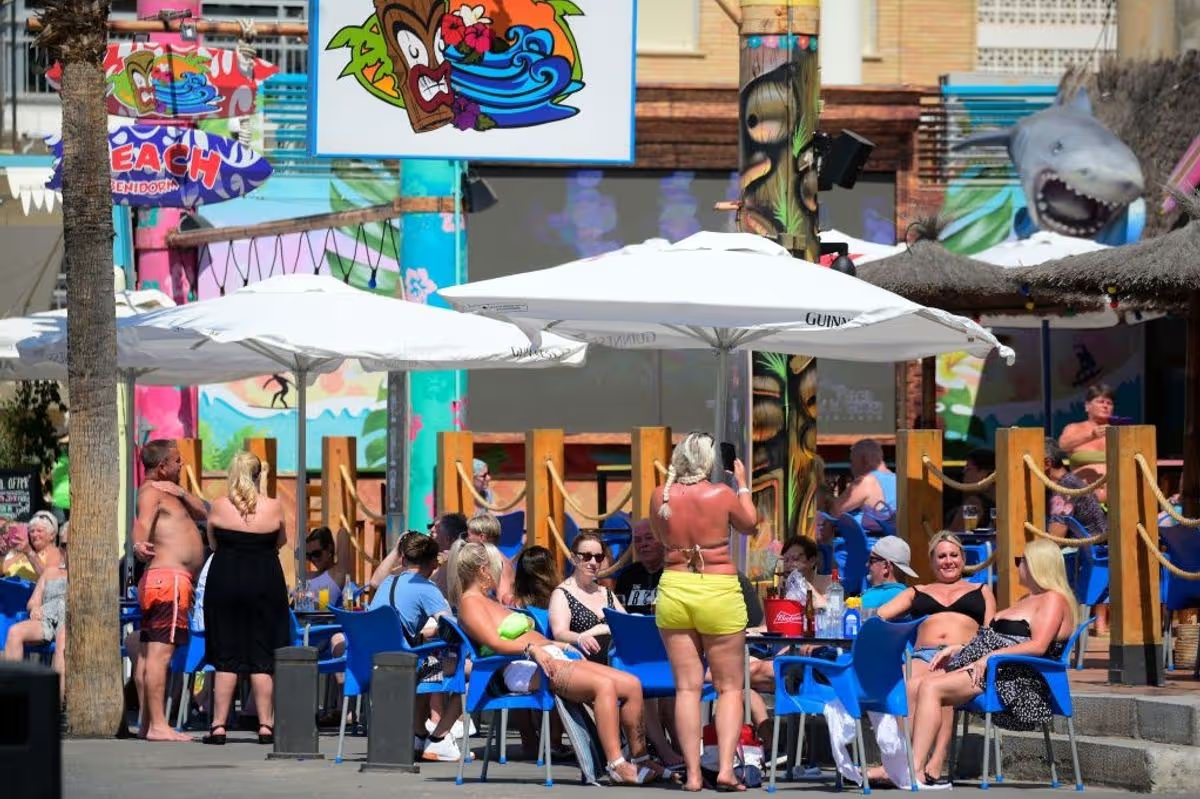
A British man living in Benidorm has issued a stark message to those jetting out to the popular Spanish resort this summer – saying there’s certain places you want to avoid at night
10:14, 07 Jun 2026Updated 11:06, 07 Jun 2026
Stay safe while in Benidorm (stock)(Image: JOSE JORDAN/AFP via Getty Images)
A British expat living in Benidorm has issued a warning to holidaymakers heading to the popular Spanish resort this summer – revealing the three places he would avoid after dark. Benidorm remains one of the UK’s favourite holiday destinations, attracting millions of tourists every year with its beaches, bars and nightlife.
But according to one resident, there are a handful of spots visitors should think twice about walking through late at night. Sharing his advice on social media, the expat said: “This is a warning for anyone coming out to Benidorm. “This is the top three areas I would definitely avoid if coming to Benidorm in 2025 and the reasons why.”
Coming in at number three was a public pathway known locally as the “Yellow Brick Road”, which runs behind several hotels and leads towards the Rio Park area.
He explained: “Now it has been known for a few things, mainly small thefts like pickpocketing, that sort of thing.
“Now generally during the day it’s absolutely fine. I’d recommend avoiding it at night.”
Next on his list was Pueblo Alley, which he claimed can attract unwanted attention after dark.
He said: “And in at number two has got to be Pueblo Alley.
“And this is one I definitely recommend avoiding, especially late at night, as you do get the pickpockets hanging around this area and you also get the odd lady of the night.
Content cannot be displayed without consent
“So I definitely consider avoiding it. There’s plenty of other ways around.”
Topping his list was a location known as “Mugger’s Alley”, which has long gained a reputation among some tourists and locals.
He said: “Straight in at number one, it’s Mugger’s Alley.
“It is the most notorious. It is the one we all know, known for pickpocketing, ladies of the night.
“It’s just an area that I would avoid.”
The expat also warned visitors to be cautious of scams, claiming he had recently seen reports of people being targeted.
He added: “Cross the road, it’s not necessary. I mean, they’re even doing these new taxi scams. I’ve seen videos online about it.
“It’s crazy. So save yourself the hassle and cross the road.”
Commenting on his post, one travel fan said: “Don’t agree with you, stayed in Rio Pak about 20 times and never had a problem.”
Another user added: “Anywhere people are shouting.”
It comes after the UK Government issues a warning about a police officer scam in Spain, saying: “Thieves posing as police officers may ask to see your wallet, claiming they need to see it for identification.
“Genuine police officers will ask to see ID but will not ask for wallets or purses. All police officers, including those in plain clothes, carry official ID.”
The Visit Benidorm Tourist Board has been contacted for comment.
Bellamy has regularly been keen to stress the need for Wales to increase and improve their player pool.
The 46-year-old has used 37 different players during his tenure to date.
He has also handed seven players – Karl Darlow, Dylan Lawlor, Ronan Kpakio, Kai Andrews, Joel Colwill, Isaak Davies and Cameron Congreve – their senior Wales debuts.
Qualifying for Euro 2028 remains the long-term aim for Wales and Bellamy, and blooding young talent has been viewed as a necessity to strengthen the nation’s long-term prospects.
Now halfway through his four-year contract with the Football Association of Wales, there are clearly signs of evolution, although there is work still to be done.
Assessing his two years in the hotseat after the loss to Romania, Bellamy said: “We’re definitely very different, two years older.
“It’s been really enjoyable, there’s a lot of stuff I really like that we’ve been able to do.
“But also it’s so, so clear, I feel that if we want to improve, these are the areas we need to improve on.”
Bellamy, who has been linked with several clubs in recent months, has clearly not lost his appetite for the Wales job.
“That excites me as well because I do like the team, I like how we play, but we need to be better in certain areas,” he added.
“That’s going to allow us to be able to compete with the top, top teams on a regular basis – because that’s where we want to be and we’re going to be tested now on that in Nations League A.
“It’s going to test everything about us. That’s where we want to be and that’s where we want to stay, so a lot of work to do.”
EXCLUSIVE: A new book charts the extraordinary history of British Airways, inclduing its unusual first passenger flight, its unique link to Marmite, royal fans, and some questionable fashion
10:05, 07 Jun 2026Updated 10:06, 07 Jun 2026
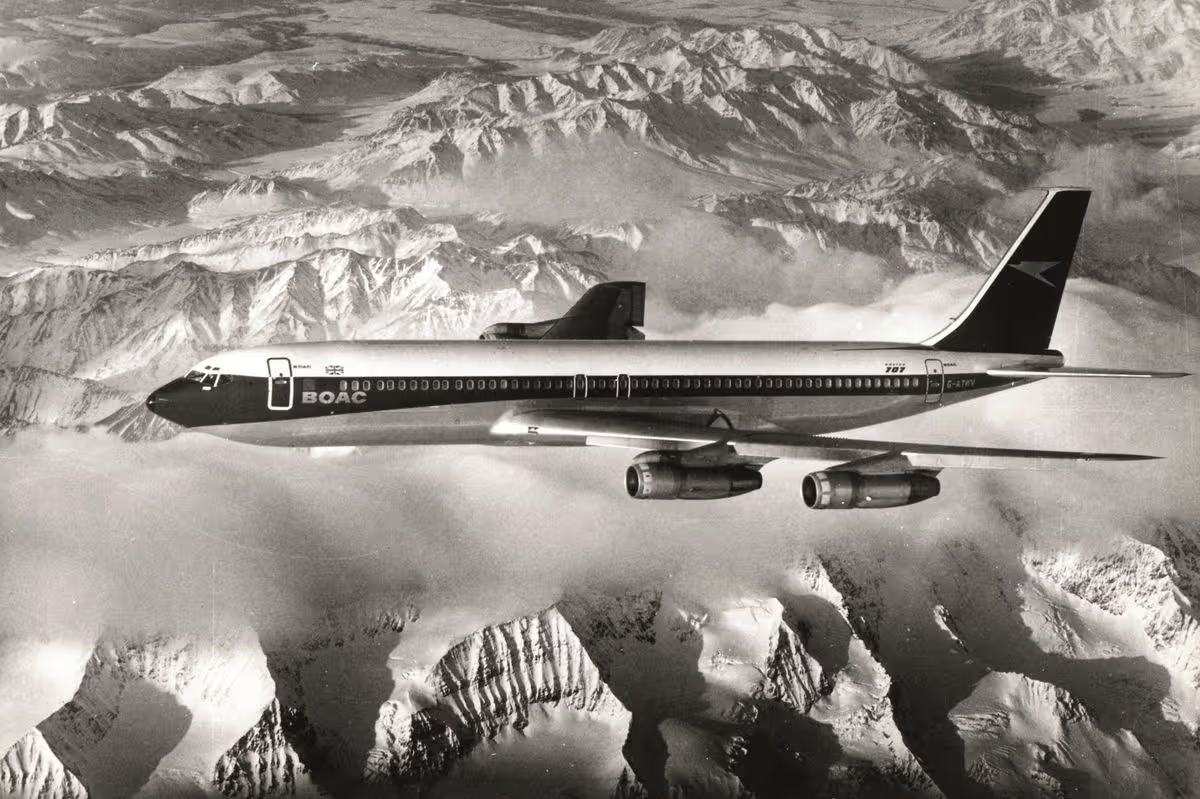
The Boeing 707 was a symbol of the iconic 60s and shrunk the world overnight(Image: Supplied)
British Airways has been flying for 107 years, connecting Britain to the world across more than a century of aviation history.
From a single biplane lifting off from a grass field in west London to a fleet serving destinations across the globe, the story of the world’s favourite airline is told in a new history by Captain Al Bridger – taking the story of BA in 100 objects, which encompass everything from Neville Chamberlain to Marmite.
British Airways traces its roots to 1919, when Aircraft Transport and Travel (AT&T) launched the world’s first international scheduled passenger service from Hounslow Heath to Paris.
This pioneering line later fed into Imperial Airways, which became BOAC in 1939 for long-haul routes, while BEA was formed in 1946 for European services; the two finally merged in 1974 to create modern British Airways.
But it began on August 25 1919 when a modest biplane was prepared on the grass at Hounslow Heath, a few miles from what is now Heathrow Airport. Captain Al said: “The world’s first international scheduled passenger was piloted by Lieutenant Bill Lawford.
“It carried one passenger, some newspapers, fresh grouse bound for the British Ambassador to France and Devonshire clotted cream. In challenging weather, Lawford skilfully completed the trip in 2 hours and 30 minutes.”
Five years later, in March 1924, the British government formed Imperial Airways, at the futuristic Croydon Airport. The art deco structure had a first-class restaurant, canteen for staff and a viewing gallery. The network expanded and flights could reach Delhi in seven-and-a-half days.
The Argosy aircraft, which first flew a passenger service on July 16 1926, gave early travellers a taste of luxury that would define the airline’s ambitions for decades to come. Captain Al said: “A white-coated steward served twenty passengers incredible four-course meals with drinks, providing true luxury for those lucky enough to afford it.
“The aircraft were also used for very popular weekend ‘Tea Flights’, offering afternoon tea while enjoying fabulous views over the capital.”
Among the collection’s most striking objects is a signed photograph of Prime Minister Neville Chamberlain, stepping from a British Airways Lockheed 10A after his famous Munich meetings and the declaration of “peace in our time”.
The 1950s brought a fresh start. “The Jet Age was officially launched with the introduction of the Comet in 1952, placing the UK at the very forefront of aviation,” said Captain Al, “The Rolls-Royce-powered Boeing 707 was a truly iconic symbol of the 1960s, and Sydney in Australia was now within reach in just 33 hours with four stops on the way. A true symbol of the iconic 1960s, the Boeing 707 was a triumph, shrinking the world overnight.”
The collection’s menu cards speak to a more glamorous age of flying. A BEA Silver Wing menu signed by Sir Winston Churchill on 26 April 1955 sits alongside one signed by Muhammad Ali on 10 May 1979
The 1960s brought experimentation of a more flamboyant kind. BOAC introduced cabin crew uniforms that became one of aviation’s most memorable fashion footnotes.
“While famously described as paper dresses, they were in fact sensibly made of a fireproof fabric that resembled paper and could be cut to the required length,” said Captain Al. “Incredibly, they were discarded after each flight.” They lasted a year.
The airline was also reaching out to its youngest passengers. On 26 March 1957, BOAC launched the Junior Jet Club, and Captain Al said: “The club was a huge success and had over 2 million members in its twenty-seven years of existence. Cabin crew would hand young travellers an envelope containing a registration form, a logbook and a Junior Jet Club badge.”
No history of British Airways would be complete without Concorde. The aircraft first flew on 2 March 1969 and entered service with British Airways on 21 January 1976. Captain Al said: “Concorde was to become the flagship of the fleet, bringing supersonic travel to everyone for the first time. Able to carry 100 customers in total luxury at speeds in excess of Mach 2 (more than 1,300 mph) the aircraft could cross the Atlantic in under 3 hours, with the record set on 7 February 1996 at 2 hours and 52 minutes.” The aircraft operated its last service on 24 October 2003.
While Concorde was redefining long-haul travel, the airline was also transforming life on board for ordinary passengers. A BOAC packing checklist pamphlet from the 1960s shows the formality of travel at the time. “For gentlemen, the list mentions the necessity of a dinner jacket, shirt collars and hair tonic,” said Captain Al. “For ladies, a bed jacket, hat and stole were essentials when travelling abroad.”
A photograph of the Beatles from the same era shows the Fab Four carrying BEA travel bags. Captain Al said: “Note how the Beatles are carrying BEA(TLES) travel bags, much like the more common BOAC bags. Clearly the band were travelling light.”
The 1980s brought fresh challenges and fresh ambition. In 1995, as part of a £500 million investment, the airline introduced the world’s first fully flat bed seat in First Class. Captain Al said: “Scientifically proven to give a much better night of sleep, it represented a huge leap forward in airline comfort.”
The airline’s inflight magazine, High Life, had been charting the journey since 1973. Captain Al said: “It truly is BA’s wingman. Through the years there have been some amazing contributors, from Jilly Cooper to Morecambe and Wise.”
Smoking had been part of airline life since the very beginning, but by March 1998 it was over. “When BEA was formed in 1946 over half of the British public smoked, with two-thirds of adult males recorded as smokers,” said Captain Al. “It wasn’t until 1998 that British Airways introduced a complete smoking ban on all flights.”
The modern era brought its own landmark moments. On 18 May 2012, a gold-liveried Airbus A319 named Firefly carried the Olympic flame into Culdrose Naval Airbase in Cornwall. Captain Al said: “Safely contained in four miner’s lamps, the flame was taken from the aircraft by Anne, the Princess Royal, accompanied by Lord Coe, the chairman of the London Olympics Organising Committee and football superstar David Beckham.”
The airline’s centenary in 2019 produced one of the collection’s most unlikely objects. “To celebrate the airline’s centenary, British Airways and Marmite teamed up and created a limited-edition jar that could be purchased on board,” said Captain Al.
“Apparently Marmite is the most confiscated brand at airport security, so the centenary jar was made to be just 70 grams, conveniently sized to fit within the liquid allowance to get it safely through airport security.”
Few objects in the collection carry more weight than the Royal Flights book, its pages bearing the signatures of those who have trusted the airline across the decades. The first entry dates from November 1983.
Captain Al said: “The book was beautifully inscribed with superb calligraphy and the signatures of Her Late Majesty Queen Elizabeth II and His Late Royal Highness The Duke of Edinburgh. Fittingly, the final signature is again that of Her Late Majesty after her visit to the British Airways Headquarters on 23 May 2019 to celebrate the airline’s centenary year.”
From a grass field in Hounslow to the signature of a queen, British Airways has carried the nation and the world for 107 years.
As Captain Al writes of the airline he has served and loves: “It has seen great highs and led the world through some very challenging times, and I know it will continue to give the best it can in the coming years, generating many more wonderful objects along the way.”
British Airways in 100 Objects by Al Bridger is published by Amberley, £17.99
BA in numbers
46.3 million passengers carried in 2025.
Fleet of 254 aircraft serving 215 destinations across six continents.
SIR Ranulph Fiennes and Bear Grylls most likely pop into your head when you think of adventurers. But now, you can add Wizz Air customers to that list.
And me. Last month, I was invited to join some competition winners on a flight to . . . who knows where?
Sign up for the Travel newsletter
Thank you!
Zvartnots ruins and Mount Ararat in ArmeniaCredit: GettyThe architectural highlight was the Mother See of Holy EtchmiadzinCredit: Alamy
As part of the Hungarian airline’s Let’s Get Lost promotion, 22 lucky travellers and their plus-ones were going on an all-expenses-paid trip, to a secret destination.
Even after boarding the plane we were still none the wiser, all we had was a pre-provided packing list and a rough idea of the climate.
It was only once the flight had exceeded three and a half hours that we could guess it was Armenia. A tannoy announcement confirmed it, prompting a round of applause.
I’ll be honest, Armenia was never on my radar as a holiday destination, but that’s exactly what made this trip so special.
Arriving in Republic Square, the heart of the capital city Yerevan, the Saturday evening atmosphere was electric with hordes of people enjoying live music alfresco.
We stayed in the DoubleTree by Hilton Hotel, perfectly located in the city centre of Yerevan.
A walking tour was the best way to get our bearings. We wandered the main streets past buildings made from pink volcanic stone, before reaching the Cascade Yerevan.
Made up of 572 steps (we took the interior escalator), this mighty landmark is a must-visit. From its peak, we had stunning views of the snow-capped Mount Ararat, now in modern-day Turkey.
A 30-minute drive away is Charents’ Arch, a monument dedicated to a much-loved poet in this region. The curved brick structure provides the perfect natural frame for the landscape and is a great photo spot.
The architectural highlight for me was the Mother See of Holy Etchmiadzin — the Mother Cathedral of the Armenian Church.
Remnants of it date back to the 4th century (Armenia was the first nation to adopt Christianity in 301AD), and it is the most ornate church I’ve ever seen.
The ruins of the 7th-century Zvartnots Cathedral are also worth a visit.
The whole place has an otherwordly feel, and with the hot sun beating down on us, it felt spiritual.
In just two days, we ticked off key landmarks, including Garni Temple and the Geghard Monastery, with lunches and dinners in between, accompanied by Armenian wine, which I would highly recommend.
With such a short time on the ground, this trip didn’t allow for loafing, but that’s the brilliance of a Wizz Air mystery getaway — cramming in all the best bits.
The Cascade, made up of 572 steps, is a mighty landmark and a must-visitCredit: GettyYerevan, pictured at night, can be navigated independently and you can tailor-make a cultural and/or foodie breakCredit: Getty
Our final evening was spent at Tavern Yerevan Riverside. The setting, grub and entertainment were truly amazing. Armenian wine was flowing while we tucked into khorovats, traditional Armenian barbecued meats scorched over an open flame.
While we had a curated itinerary, Yerevan can be navigated independently and you can tailor-make a cultural and/or foodie break.
After attempting, and failing, to say ‘shnorhakalutyun’ — Armenian for ‘thank you’ — throughout, I was advised that the French equivalent would also be appreciated.
So, merci Armenia — a destination I’d never planned to visit, but am so glad I did.
GO: ARMENIA
GETTING THERE: Starting tomorrow, Wizz Air flies twice a week from Luton to Yerevan with one-way fares from £45.99.
June 6 (UPI) — A second case of New World screwworm was confirmed in Texas this week in a one-month old calf nearly six miles from where the first case was detected.
The U.S. Department of Agriculture announced the second confirmed case on Friday, which was detected in Zavala County, Texas, but 5.6 miles away from the first one.
The second case was confirmed just 24 hours after the first, which had been detected in a three-week old calf, and has spurred the USDA to step up surveillance, as well as take other actions to prevent the infestation from spreading.
New World screwworm is spread by flies that lay their eggs in the exposed flesh of living animals — livestock, pets, wildlife and humans are all susceptible — and when the fly larvae, or maggots, emerge from the eggs they burrow through muscle as they grow.
Although screwworm was eradicated from the United States in the 1960s, severe infestations in recent years in Central America slowly moved toward the southern border and was detected here in 2025, according to the USDA.
“With our partners in Texas, we are responding with speed and strength,” the USDA said in a statement about the second case that was posted on X.
“We have defeated this pest before, and we will do it again,” the agency said. “America’s livestock producers have USDA’s FULL support.”
The primary way of controlling the spread of New World screwworm is a combination of trapping flies for testing, implementing detection and quarantine zones where it confirmed, and releasing sterile flies into the area it has been detected to prevent infected insects from reproducing, the agency said.
The USDA has encouraged people in the area of the two cases to check their pets and livestock for draining or enlarging wounds, if not maggots or eggs around bodily opening such as the nose, ears or genitals, or around the navel of newborn animals.
Although screwworm infection in humans is relatively rare, the infestations can happen in ways similar to animals and require immediate medical attention.
President Donald Trump discusses renovations to the Lincoln Reflecting Pool and makes an announcement on coal in the Oval Office at the White House on Thursday. Photo by Samuel Corum/UPI | License Photo
Funerals will be held for Lebanese officers killed in an Israeli attack in southern Lebanon, as Beirut’s army chief headed to Pakistan on a surprise visit amid ongoing mediation efforts in the wider United States-Israel war on Iran.
The Lebanese soldiers will be laid to rest on Sunday, a day after the brigadier general, captain and soldier were killed in an Israeli strike on a military vehicle on the Khardali-Nabatieh road, in an incident the Israeli army said it was investigating.
Recommended Stories
list of 4 itemsend of list
A ceasefire agreed on April 17 was meant to halt the fighting between Israel and Hezbollah, but Israel has continued to carry out near-daily attacks, prompting retaliatory ones from the Lebanese group. The violence has taken a disproportionate toll on civilians in Lebanon, where more than 3,500 people have been killed since hostilities resumed on March 2.
A further conditional ceasefire was announced by Lebanese and Israeli envoys last week in Washington, but was rejected by Hezbollah as it did not include the group or provide for Israel’s withdrawal from southern Lebanon.
Lebanese army chief Rodolphe Haykal left on Saturday for Pakistan, which has emerged as a central mediator between the US and Iran.
The visit is notable given the insistence by Washington – and by Lebanese leaders, including the president – that ceasefire talks for Lebanon remain separate from the US-Iran negotiations mediated by Pakistan.
Fighting continues in southern Lebanon
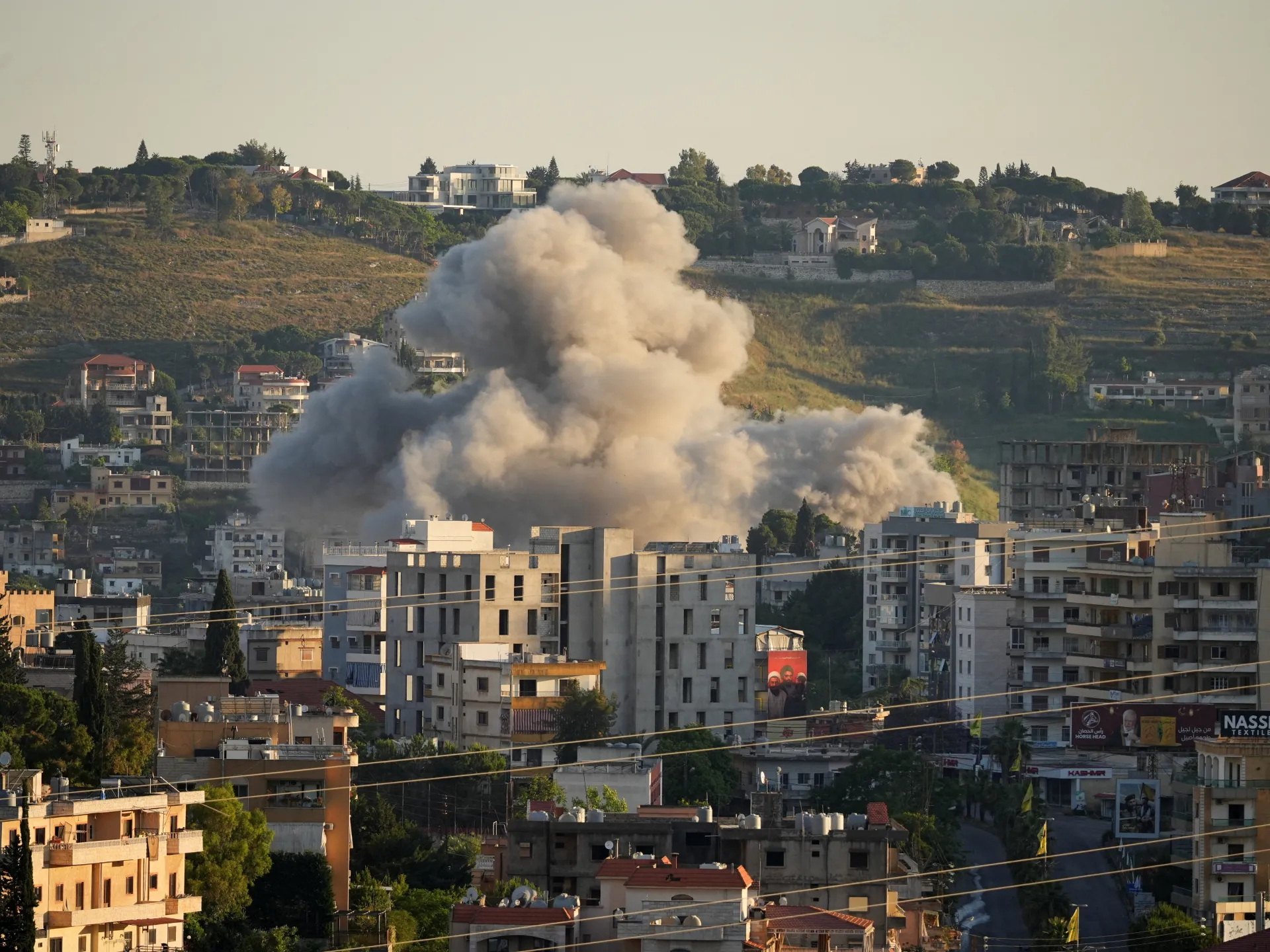
Meanwhile, Israeli attacks hit several towns across southern Lebanon and the western Bekaa overnight, while Hezbollah said it launched rockets, artillery fire, and drone attacks against Israeli forces, including near the Beaufort Castle in Yohmor al-Shaqif.
Lebanon’s Ministry of Public Health said on Sunday that an Israeli raid on the town of Saksakiyeh a day earlier killed at least two people. The ministry added that 22 people were wounded in the attack, including three children and a woman.
Two others were wounded following an Israeli drone attack on the town of Shahabiyeh, Lebanon’s National News Agency (NNA) reported.
Israeli air attacks also hit the town of Qalawiya at dawn, and the towns of al-Qatrani, Byblos and Rihan in the Jezzine district overnight. The town of Deir Kifa in the Tyre district was also bombed, while Barashit and Chaqra in the same district were subjected to intermittent artillery shelling overnight.
NNA also reported artillery shelling in the towns of al-Mansouri and Bayt al-Sayyad in the Tyre district.
Israeli warplanes launched an attack on the town of Srifa. Local media also reported that Israeli fighter jets attacked Dweir, near Nabatieh, north of the Litani River.
Paramedics, meanwhile, continue to look for survivors under the rubble following Israeli attacks.
“The pattern is part of what is being called the Gazafication of Lebanon, or Israel using actions normalised by the Gaza genocide,” said Al Jazeera’s Nour Odeh, reporting from Ramallah in the occupied West Bank.
“The targeting of schools in southern Lebanon, just like Gaza. Bombing Lebanese hospitals and clinics, also like Gaza. And the murder of journalists. Then there’s these so-called double-tap attacks against paramedics and rescue workers. Hundreds of Palestinian and Lebanese paramedics have been killed with this unlawful practice.”
Gazafication extends to the ceasefire, too, she added.
“The ‘Yellow Line’, first introduced in Gaza, has now swallowed 60 percent of the territory. In Lebanon, the ‘Yellow Line’ now includes nearly a fifth of the country. Both invisible lines keep expanding,” said Odeh.
No choice but negotiations, says Lebanese lawmaker
Najat Aoun Saliba, an independent member of Lebanon’s parliament, meanwhile, condemned Israel’s killing of the Lebanese soldiers and said President Joseph Aoun has no choice but to enter into negotiations with Israel.
“If we don’t have negotiations, what is the alternative? Is the alternative going to war? The war is not going to give us peace,” she told Al Jazeera.
Saliba said dialogue was the only viable path given the imbalance of power between Israel and Lebanon’s armies.
“The balance of power between the armies is not to be compared. Israel has a very strong army backed up by the United States. The Lebanese Armed Forces have been sidelined by a political will for 30 years, because they wanted to strengthen the presence of Hezbollah,” she said.
The lawmaker added that Hezbollah has not been able to stop Israeli aggression.
“Hezbollah is not able to stop any of these war crimes, and it’s not able to stop any of the invasions that Israel is doing. I think with … all these massacres and destruction, I don’t think we have a choice.”
The killing of Brigadier General Wissam Sabra, Captain Elie Khoury and soldier Hussein Ghozal came at a tense moment amid broader efforts to strike a deal between the US, Iran, Hezbollah, the Lebanese government and Israel.
Lebanese President Joseph Aoun said the attack was “aimed at thwarting all efforts to reach a solution”, while Prime Minister Nawaf Salam described it as “a heinous crime and an attack on Lebanon and all Lebanese people”.
Lebanon was drawn into the Middle East war when Iran-backed Hezbollah attacked Israel on March 2, following joint US-Israeli attacks on Iran.
Tehran has made a ceasefire in Lebanon between Israel and Hezbollah a condition for any peace deal with Washington.
Ben Gibbard remembers late 2023 as a time of competing realities.
Onstage, the frontman of Death Cab for Cutie and the Postal Service was thriving as his two bands toured together to mark the 20th anniversaries of Death Cab’s “Transatlanticism” and the Postal Service’s “Give Up.”
Behind the scenes, Gibbard’s personal life was in shambles.
“I was getting off phone calls — very difficult phone calls — 20 minutes before going on in an arena,” he says. The singer and his wife, photographer Rachel Demy, were in the middle of an agonizing breakup that would eventually lead to divorce. Yet audiences in the thousands were turning up nightly to see Gibbard reanimate the peak-millennial classics that made him one of indie rock’s defining stars.
“I’d just tell myself, You’re a professional — you’re gonna go out there and do it, and no one’s gonna know,” he recalls. “It was all waiting for me when I got offstage, of course. But for two hours I was able to disconnect and be a performer, which was incredibly …” Gibbard, 49, trails off into a laugh.
“I don’t know if it was healthy,” he says. “But it was helpful.”
Two and a half years later, that split-screen experience — “this idea of how we compartmentalize our pain or our grief or our trauma,” as Gibbard puts it now — forms a through line of Death Cab’s ruminative new album, “I Built You a Tower.” Due Friday from Anti Records, where the group landed after leaving its longtime home of Atlantic amid a corporate shake-up, the LP sets thoughts of broken fences and never-ending storms against tuneful arrangements that can churn, shimmer or chime.
“I pledge myself to your misery / I kneel at its throne,” Gibbard sings in his still-boyish tenor over the sleek new wave groove of “Trap Door,” “Respecting your proclivity / To languish on your own.” In the fuzzed-out “Envy the Birds,” the frontman recounts an argument between two lovers “spraying bullets of grievances”; the driving “Riptides” is narrated by a guy “too tired to end the war.”
“This record is definitely the result of a divorce,” Gibbard says plainly during a recent visit to Los Angeles from his home in Seattle. “But I didn’t want to make a score-settling record or an angry record. This wasn’t an opportunity to defame someone or make this about how I’d been wronged. People drift apart — relationships don’t work. And I think how that’s affected me at almost 50 is a very different mindset than I found myself in when I was 33 or whatever the last time it happened.”
Gibbard means his first divorce, in 2012, from the actor and singer Zooey Deschanel — a split that inspired Death Cab’s 2015 album “Kintsugi,” on which one song asks, “Was I in your way when the cameras turned to face you?” and another chides an unnamed celebrity: “You’ll never have to hear the word ‘no’ if you keep all your friends on the payroll.”
“There’s some gnarly stuff on that record,” says Gibbard, who’d moved to L.A. to be with Deschanel then promptly left as soon as their marriage collapsed. “It’s not exactly a kind album.”
Bassist Nick Harmer, who formed Death Cab with Gibbard in the late ’90s after the two met as students at Western Washington University, agrees that “I Built You a Tower” represents a shift in perspective. “There’s so much more self-examination — and so much more self-indictment,” he says. (Death Cab’s other members are drummer Jason McGerr, guitarist Dave Depper and keyboardist Zac Rae.)
Which isn’t to say that Gibbard entirely resists placing blame. In “Trap Door” he sings about “a trap door in your heart and a button on your desk well-worn from being pressed.”
The frontman says that in recent years he’d “tried to get away from using the word ‘heart’ because that had been a touchstone for so many of our early records.” Yet this line seemed worth holding onto when it came to him.
“I Googled it to see: Did I already write this?” he says, laughing. “Or is there a very popular song called ‘There’s a Trap Door in Your Heart,’ and now I’m just rewriting it? We’ve made a lot of songs at this point — you gotta check your work.”
Indeed, “I Built You a Tower” is Death Cab’s 11th studio LP. After the band’s previous album, 2022’s “Asphalt Meadows,” fulfilled its deal with Atlantic, Death Cab reupped with the major label for one more record, Gibbard says, based on its strong relationship with the company’s then-CEO, Julie Greenwald.
“Julie was our shepherd and our protector the whole time we were there,” the singer says of Death Cab’s nearly two-decade run at Atlantic, which began with 2005’s Grammy-nominated “Plans.” Yet just days after they reached an agreement for “Tower,” Greenwald was fired and replaced by a new leader, Elliot Grainge, about whom the band felt less than optimistic.
Ben Gibbard
(Cielito Mercado Vivas / For The Times)
“We weren’t given the impression that Elliot had spent a lot of time with ‘Transatlanticism’ in college,” Gibbard says of the 32-year-old exec, who made his name signing rappers like Ice Spice and Trippie Redd. With Greenwald’s help, Gibbard says, Death Cab negotiated an exit from Atlantic with ownership of the new album.
Did Grainge try to persuade the band to stay?
“Never heard a word,” Gibbard says.
In an email, Grainge (whose father is Universal Music Group Chairman and Chief Executive Lucian Grange) said that Death Cab’s music “has meant a great deal” to him.
“Working together may not have been in the cards for us; however, that does not lessen my enthusiasm for the band,” he wrote. “They have delivered an impressive body of work over their decades-long career, and I am looking forward to their new music.”
Death Cab’s Harmer says he and his bandmates “talked for half a beat” about putting out “Tower” on their own before thinking better of the idea.
“We’re not businesspeople,” Gibbard says. “Music is the only thing we know how to do.”
At a friend’s wedding in 2024, the frontman had been seated next to the musician Allison Crutchfield, who was then heading up Anti’s A&R department; early this year, Death Cab announced that it had signed to the indie label, whose other acts include Fleet Foxes and Madi Diaz.
This summer, the band will tour behind “I Built You a Tower,” including two shows in August at L.A.’s Greek Theatre. After the “Transatlanticism”/”Give Up” anniversary outing — not to mention a subsequent tour on which the group looked back at “Plans” — Gibbard is “very ready to play some new material,” he says.
Doing the hits was fun. “But at a certain point,” he adds, “it’s really about moving ahead.”
To think that four-goal first-half performance didn’t even involve John McGinn.
A traditional 4-4-2 brought the best out of Scott McTominay, if that’s even more possible. Although we all know the Napoli star’s position was never in any doubt.
Bologna’s Lewis Ferguson, who captain Robertson said “turned into a man” , externalduring the qualification campaign, again showed his maturity and ability to dictate play in the middle of the park. Cultured, some might say.
But, in truth, the first half was dominated by the work done down the wings by Bournemouth pair Ben Gannon-Doak and Ryan Christie.
Long before he was even in the squad, Gannon-Doak excited supporters. He was the Billy Gilmour of the Euro 2024 team, picking up an injury before the squad jetted off to Germany.
Since then, he’s reminded everyone what they missed with his absence. The epitome of a Duracell Bunny, the 20-year-old dazzled on Saturday.
At times, his end-product has been his downfall, but it wasn’t of concern stateside.
“Ben did himself the power of good today,” Clarke acknowledged. “We know what he can give us.”
Clarke also knows what Christie can provide. In many positions. He was lively down the left, with an instinct to cut in and create.
Many were crying out for Findlay Curtis to start, given his first international goal last weekend, but its hard to make a case for Christie not starting somewhere on Sunday.
It’s perhaps the biggest head-scratcher of them all for Clarke, but what a problem to have.
STAYCATIONS are on the rise, according to the experts – and there is a county that is booming in demand.
In its latest Summer Travel Report, Airbnb revealed that not only are staycations up 11 per cent year on year, but an unlikely trending rural destination is Herefordshire where searches have increased by 76 per cent.
Sign up for the Travel newsletter
Thank you!
Herefordshire is rising in popularity when it comes to staycationsCredit: AlamyEardisley is one of Herefordshire’s ‘black and white’ villagesCredit: Alamy
The county bordered by Gloucestershire, Shropshire and Worcestershire is known for its cider and pretty villages that look similar to those found in the nearby Cotswolds.
Earlier this year, Herefordshire was called the ‘quiet corner of England’ by The Independent – but hoped it would be thrust into the spotlight after the release of Hamnet.
Some of the county’s small villages were used for filming and doubled as Shakespeare’s Stratford.
One of the villages is Weobley which is nicknamed a ‘black and white’ village thanks to its half-timbered houses.
Alongside its pubs, fans of Hamnet should head into The Wobbly Badger Cafe which took centre stage for the exterior of Shakespeare’s family home in the film.
It’s not just Weobley – there are lots of other villages like this one and some are part of that are part of Herefordshire’s ‘black and white villages’ trail which is a 40-minute driving route.
Other villages include Pembridge, or Eardisland, which sits on the banks of the River Arrow (and looks similar to Bourton-on-the-Water).
Even smaller villages include Eardisley, Dilswyn, Leominster and Kingsland.
Hereford Cathedral is in the middle of the cityCredit: Alamy
Herefordshire gets around six million visitors each year compared to the Cotswolds’ 25million – so for visitors it will make for a much quieter staycation.
For fans of cider, Herefordshire has around 15,000 orchards growing apples and pears, some of which is used to produce the drink.
Stops on the South Circuit include Little Pomona Cider & Perry, Gregg’s Pit Cider & Perry, Oliver’s Cider & Perry, Ross on Wye Cider & Perry.
Another famous spot that TV fans will recognise in Herefordshire is Symonds Yat.
The spot on the River Wye is known for its enormous limestone gorge.
It even appeared in the Netflix series of Sex Education – one of the most recognisable places is the red and white chalet that sits high above the valley, which was the exterior of Jean and Otis’ house.
There are a number of cider farms and dedicated routes to visit themCredit: Visit Herefordshire
The River Wye within the valley is the fifth longest river in the country.
It’s surrounded by walking paths and tourists are also welcome to take to the water on a kayak, canoe or paddleboard.
Of course, Herefordshire’s centre is the city of Hereford which is home to a large cathedral.
This houses a famous treasure calledMappa Mundi which is a medieval map of the world from 1300.
It also has the unusual 17th century Chained Library – a collection of over 1,500 rare books and manuscripts that are secured to their shelves by iron chains, rods, and locks.
Entry into Hereford Cathedral is free, but to see Mappa Mundi, Chained Library or a Tower Tour there are additional fees.
Eastnor Castle is a popular spot for a weekend with the familyCredit: Alamy
Another popular spot is the Eastnor Castle which while it looks like one isn’t a medieval fortress, instead, it’s a 19th-century mock castle.
Found in Ledbury, the castle was once home to the Hervey-Bathurst Family who lived at there for over 200 years.
It’s open throughout the year holding events like family fun days, bird of prey and supercar displays,
The grounds are popular for hiking and to entertain the kids, there’s a playground, tree top walkway, maze and mini zip wire.
A US influencer and actor have caused outrage after mocking Palestinians subject to rape and beastiality in Israeli prisons. Elon Gold and Lizzy Savetsky made the comments at the Tribeca Film Festival as they promoted a new film made in Israel.
Formula One racing sensation Kimi Antonelli made a mockery of suggestions that the Monaco Grand Prix would stall his incredible start to the season by producing a stunning qualifying lap to stick his Mercedes on pole position.
The qualifying battle lived up to expectations, with provisional pole changing hands several times before the 19-year-old championship leader snatched it with his final lap on Saturday.
Recommended Stories
list of 4 itemsend of list
He edged out Red Bull’s Max Verstappen by 0.043 seconds to become the first Italian since Jarno Trulli in 2004 to take pole position in the principality.
“It was one of those laps that we call a magic lap. I was able to put it all together. It was such a close qualifying with Max,” Antonelli, who clocked 1:12.051 (1 minute and 12.051 seconds) to claim his fourth pole in six races this season, said.
“I knew the last lap was good; I was just hoping that it would be enough, but it was very close.”
Antonelli is the youngest driver to lead the championship, having won the last four races, but the unique nature of Monaco’s twisting circuit, full of slow corners, was supposed to take away the Mercedes power advantage.
Ferrari pair on second row
Ferrari have been strongly tipped as race favourites but had to be content with the second row on Sunday’s grid, with Lewis Hamilton third quickest, 0.228 seconds slower, and local favourite Charles Leclerc, winner of the race in 2024, fourth.
Leclerc had been on provisional pole with time running out in Q3 – the third and final session of qualifying – but clipped the wall on his final lap as he tried to wrestle it back, stopping his car at Rascasse.
Ferrari dominated Friday’s two practice sessions, with Hamilton and Leclerc first and second in both, although Antonelli was quickest in Saturday’s final practice.
“Congrats to Kimi. Mega, mega job. Having your first pole here is so special,” three-time Monaco champion Hamilton, who is yet to win a race for Ferrari, said.
“It was tough for us. We were looking so strong in practice, and we barely changed anything, but the car was drastically different once we got to qualifying for some reason.”
Isack Hadjar, in the second Oracle Red Bull, bounced back from a nasty crash in Friday practice to qualify fifth, with Antonelli’s teammate George Russell, who trails him by 43 points in the standings, a disappointing sixth.
Reigning world champion and last year’s Monaco winner Lando Norris will be on the fourth row alongside fellow McLaren driver Oscar Piastri, with the team’s hopes of victory in their 1,000th Grand Prix now looking slender.
Antonelli, Verstappen and Hamilton after the qualifying round for Monaco GP [Rudy Carezzevoli/Getty Images]
‘The walls start coming closer’
Antonelli finished 18th and last at the Monaco Grand Prix 12 months ago, and he was expected to feel the pressure of leading the standings on his return.
But he now has a golden chance to continue his dream start to the season by emulating Trulli, who converted his pole into a victory in his Renault in 2004.
“I think this is one of the most intensive, if not the most intense, qualifying sessions of the year, and it takes a massive effort,” he said. “When it is about finding the last two tenths, it is not easy because the walls start coming closer.
“But I felt great this morning, and I am happy that we could finish the job today.”
Of the last 22 Monaco Grands Prix, only six have been won by a driver who did not start on pole, such is the extreme difficulty of overtaking on the narrow, twisty circuit that snakes round the stunning Mediterranean playground.
The last three editions have all been won by the top driver in qualifying, but Hamilton did win from third on the grid in 2016, and with Verstappen showing great speed here this year, Antonelli will be taking nothing for granted.
“If you would have told me yesterday I would be on the front row, I would have taken it,” Verstappen said.
“He passed away peacefully of complications due to pneumonia, surrounded by his family,” his daughters Emily and Daisy said.
Their statement went on: “It has been, and forever will be, an honour and a privilege to be his daughters, and to have witnessed firsthand the impact both he and his work have had on so many.”
Fans have now taken to social media to share they’ve been watching some of his works, including Persuasion, Ted Lasso and Vanity Fair.
“It’s a lovely tribute to remember artists for their work,” one fan wrote on Reddit.
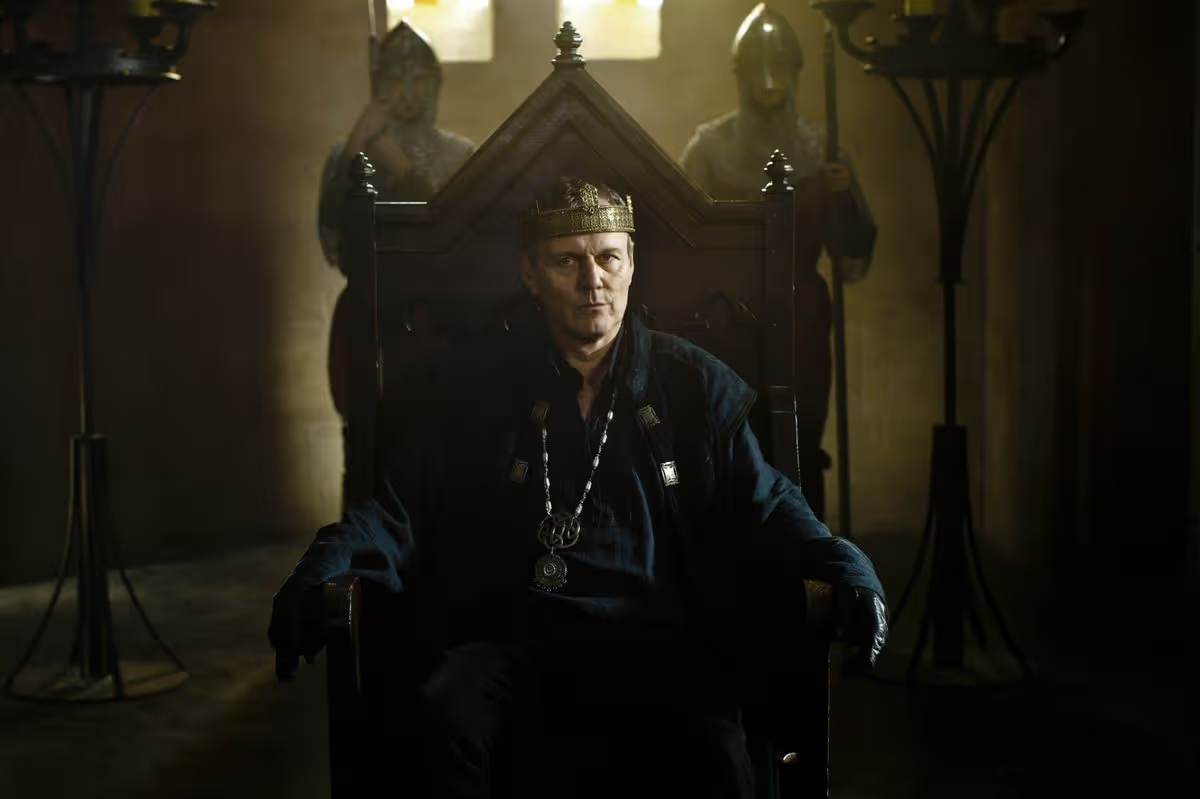
Another replied: “My favourite was him in Merlin,” to which another said: “He was incredible as Uther! So intimidating!” “Right he was so good as Uther,” a fan agreed.
The beloved actor starred as Uther Pendragon, King of Camelot in the BBC fantasy series, alongside Colin Morgan as Merlin, Bradley James as Prince Arthur and Richard Wilson as Gaius.
Merlin aired for five seasons between 2008 and 2012, and followed a reimagining of the legend, in which the young warlock was sent to live with Gaius in Camelot after his mother feared for his life because of his gift of magic.
Working in court, he becomes Arthur’s manservant and spends his talent trying to protect him from evil forces.
Over years, the pair become trusted friends, despite Merlin keeping his magic a secret from all those around him, as he works to help Arthur become the King he was destined to be.
Fans have hailed Merlin as “spellbinding” and “one of the best,” with one writing: “The ending is heartbreaking and may leave you in an eternal sadness but it’s worth it.”
Another said: “I love Merlin, from the 1st episode I knew this would be an excellent show.”
“One of the best TV series of BBC,” another echoed, as one called it “perfection”.
Someone else called it “phenomenal”, as another fan called it “an epic masterpiece”.
Anthony Head previously spoke about how much he enjoyed playing his role in Merlin.
“He has so many levels, and that makes him fascinating,” he said in a 2010 interview.
“We established early on that he wasn’t just a two-dimensional baddie, and now his past transgressions have manifested themselves, which is great fun to play.”
He joked: “I also get to wear the cloak and sword, which reminds me of dressing up as a knight when I was a child.”
The incredible lift ascends 153 metres (502 feet) in under a minute
Europe’s highest outdoor lift is used by 40,000 people a year
Some of the world’s most jaw-dropping lifts can be found in luxury hotels, including the highest outdoor lift in Europe, nestled in Lucerne, Switzerland. The Bürgenstock Resort is home to the remarkable Hammetschwand lift, offering stunning views of Lake Lucerne.
The Hammetschwand lift was built between 1900 and 1905 by pioneering hotelier Franz Josef Bucher, at a cost of 500,000 Swiss francs (around £470,000). It remains the quickest route up to the viewpoint, climbing 153 metres (502 feet) in under a minute.
Those planning a visit should bear in mind that to reach the foot of the lift, you’ll need to walk the breathtaking Felsenweg cliff path.
It is estimated that over 40,000 people use the Hammetschwand lift annually, and around 200 to 250 riders per day.
On Tripadvisor, one visitor advised choosing “the perfect sunny day to enjoy the view.” They went on to say: “This is a fantastic view, the elevator is just too quick, but still worth a visit.”
Another said: “You do the Burgenstock track to the lift and it is already by itself stunning!!! Nobody talks about it. It’s a hidden gem in Switzerland!
“Then you arrive at that special spit where the lakes of the four cantons connect, and it’s breathtaking. A bit ahead, there’s the lift and the adventure to one of the most beautiful views ever. It’s easy, it’s accessible, it’s unbelievably beautiful. I will do it again.”
Among other remarkable examples is the Hotel Santa Caterina’s lift in Amalfi, Italy, which boasts breathtaking views. Carved into the rugged cliffside, the glass-fronted elevator takes guests down to the exclusive Beach Club and the hotel’s Italian seafood restaurant.
In Greece, the Corfu Holiday Palace features a stunning lift that transports guests down the cliffside to the beach in just moments, treating them to gorgeous views across the bay while providing far easier access to the white sands below.
The Luxor Hotel in Las Vegas, United States, is home to one of the most iconic lifts on the planet. Given the hotel’s striking pyramid shape, the lifts travel between floors at a diagonal 39-degree angle, treating guests to a spectacular outlook over the atrium as they make their way to one of the hotel’s 4,407 rooms.
Vegas Golden Knights defenseman Brayden McNabb was forced to leave Game 2 of the Stanley Cup Final on Thursday after taking a puck to his face on a slap shot midway through the first period.
The 14-year veteran, who played for the Kings from 2014-2017, did not return to the game. ESPN is reporting that McNabb was taken from Lenovo Center in Raleigh, N.C., to a hospital for evaluation.
Vegas coach John Tortorella did not have an update on McNabb’s status after his team’s 4-3 overtime loss to the Carolina Huricanes, and the Golden Knights had not provided one as of early Friday morning.
McNabb was defending in front of the net with 9:08 remaining in the first period when a blistering shot by Carolina winger Nikolaj Ehlers hit him in the facial area. Slow-motion replays show the puck may have struck the protective visor on McNabb’s helmet near his eyes.
After crumpling to the ice, McNabb immediately climbed to his feet, skated off the playing area and headed down the tunnel while holding a hand over his nose and mouth.
“It’s a scary play,” Vegas forward Brett Howden said after the game. ”You never want to see that. Just hope he’s doing all right. We haven’t seen him yet but hope he’s doing OK.”
Knights defenseman Noah Hanifin said: “Any time you see that happen to a teammate, especially to a guy like Nabber who is a huge part of this team, a leader, it’s tough. It’s hard to see that happen to any guy on the ice. We’re just hoping for the best for him.”
Born in Davidson, Canada, McNabb was selected by the Buffalo Sabres in the third round of the 2009 entry draft. He played in 37 games for the Sabres and was acquired by the Kings on March 5, 2014. Los Angeles also received Jonathan Parker and a pair of draft picks in exchange for Hudson Fasching and Nic Deslauriers.
McNabb had six goals and 36 assists in three seasons with the Kings before being selected by Vegas in the 2017 expansion draft. This is his third Stanley Cup Final with the Golden Knights, who won the championship in 2023.
In Vegas’ 5-4 Game 1 victory against Carolina on Tuesday, McNabb had three assists for the first time in his career. Ben Hutton and Kaedan Korczak are possible options to take McNabb’s spot if he can’t play in Saturday’s Game 3 in Las Vegas.
Tourists have been urged to stop making a common packing mistake as it could lead to “ruining holidays”. The advice comes as vacation season begins to kick off
08:01, 07 Jun 2026Updated 08:01, 07 Jun 2026
The packing mistake could “ruin holidays” (stock image)(Image: Bet_Noire via Getty Images)
The prospect of jetting off somewhere keeps most of us motivated, so the last thing anyone wants is for something to spoil their well-earned break. Yet, as many may not realise, a straightforward packing blunder could land you in trouble, and may even affect whether you’re able to fully enjoy your time away.
If you’re hoping for a smooth and stress-free trip, there’s some vital travel information you really ought to be aware of. It’s essential to steer clear of a simple packing error, as it could prove costly and seriously disrupt your holiday — something nobody wants to experience.
According to pharmacist Seema Khatri at Roseway Labs, the vast majority of medication-related holiday mishaps stem from a handful of easily preventable errors, with most occurring before the trip has even begun.
Seema said: “People spend weeks planning itineraries and what to take, but medication is often an afterthought. And that causes problems.”
Travelling with medication can be a minefield, as regulations differ from country to country. As a general rule, ensuring your medication is clearly labelled is always a sensible precaution.
For certain medicines, particularly injectables or controlled substances, a doctor’s letter may also be required. She added: “Always keep your medication in your carry-on luggage.
“It reduces the risk of loss, delays or temperature damage.” What you might not realise is that medication can cause problems at airports if it’s not packed and documented properly.
In fact, it can result in hold-ups, questioning, confiscation or you could even be refused permission to fly in certain situations. Issues typically occur with controlled substances, liquid medications that exceed particular limits or absent prescriptions.
To make sure you pack yours appropriately, check the regulations at your airport and in the country you’re visiting. Seema said: “Most holiday medication problems are preventable.
“With a bit of planning, you can focus on enjoying your trip instead of dealing with avoidable health issues.” That said, there are several general guidelines people ought to follow to be on the safe side.
What you need to know
Always keep medication in your hand luggage in its original, properly labelled packaging. Store a spare supply in your checked baggage in case your bags go missing.
Additionally, make sure you carry a copy of your repeat prescription and, in certain cases, a signed letter from your doctor outlining the medication, dosage and duration of travel. It’s always advisable to verify what you require before you pack your bags.
A doctor’s note is recommended for large quantities of over-the-counter medicines to prevent complications at border control. You also need to make certain that liquid medication exceeding 100ml is readily accessible, as it will probably be screened separately.
If your medication is classified as a controlled drug, such as powerful painkillers or particular sedatives, specific rules apply. Therefore, check what applies to you before you travel.
Rules can differ from country to country, so always ensure you verify this before travelling, and declare that you’re carrying medication at the airport. After all, nobody wants to face delays at security, or be refused the right to travel, because of a straightforward packing error.
Eight people were shot on Saturday afternoon at a festival in Toledo, Ohio, but all are expected to make full recoveries. File Photo by Justin Lane/EPA-EFE
June 6 (UPI) — Several people were shot Saturday afternoon at an outdoor festival in Ohio, with “many victims” sent to the hospital.
At least eight people were shot around 5:30 p.m. at the Old West End Festival in Toledo, Ohio, all of whom were transported to the hospital and all of whom are expected to survive, the city’s mayor, Wade Kapszukiewicz, told WTOL-11.
As of 8:00 p.m., police said that they were still looking for the suspect or suspects that were involved in the shooting.
“The investigation currently includes scenes in the area of Delaware Avenue and Robinwood Avenue,” the Toledo Police Department said in a statement posted to Facebook.
“Residents and visitors are asked to avoid scenes in the area and expect a significant police presence as officers continue their search and investigators work to determine the circumstances surrounding the incident,” the police department said.
The Old West Festival, an event that has been held for more than 50 years, is a celebration of the history of the area, and was scheduled for Saturday and Sunday.
“Summer festivals should be safe spaces for families to spend time together without fear of violence,” Ohio Gov. Mike Dewine said in a statement on social media.
“We are confident that law enforcement will locate the suspects involved in this senseless crime,” he said.
President Donald Trump discusses renovations to the Lincoln Reflecting Pool and makes an announcement on coal in the Oval Office at the White House on Thursday. Photo by Samuel Corum/UPI | License Photo
Weekly insights and analysis on the latest developments in military technology, strategy, and foreign policy.
After reportedly losing dozens of MQ-9 Reaper drones while battling Iran, the Air Force on Friday confirmed to TWZ that it is planning to purchase an undisclosed number of unused ones from General Atomics, who made the aircraft. The company, however, said it has less than 10 of these drones to offer, and it remains unclear where else the Air Force can find more.
All of this continues to raise serious questions about the Air Force’s near-term ability to plug gaps left by the losses fighting against Iran and in other recent operations in and around the Middle East. The downed Reapers have a reported combined value of about $1 billion.
The Air Force has reportedly lost dozens of MQ-9 Reaper drones. (USAF)
Furthermore, despite the top Air Force officer recently praising Reaper as “perhaps the most valuable player” in the air war against Iran, the aircraft have been in the crosshairs of service officials. They have openly questioned the drone’s survivability and, by extension, general value in future operations. The Air Force has made several half-hearted efforts, without success, to find a successor. It is now in the early stages of a new attempt at acquiring an “MQ-9 Next.” You can read more about that effort in our story here.
An MQ-9 Reaper. (USAF)
It will be years, if ever, before “MQ-9 Next” comes online. Meanwhile, the search is on for existing replacements.
“The USAF intends to purchase several unused MQ-9A Block 5 from GA-ASI [General Atomics Aeronautical Systems, Inc.],” a spokesperson for the service told TWZ today. “A number of MQ-9A Block 5 aircraft were manufactured based on forecasted purchases for other customers but are no longer needed. The available aircraft are currently GA-ASI owned aircraft.”
“The USAF has received funds to begin the acquisition process,” they added.
A U.S. Air Force service member assigned to the 46th Expeditionary Attack Squadron, conducts pre-flight checks on an MQ-9 aircraft in preparation for an Operation Agile Spartan mission departing from Ali Al Salem Air Base, Kuwait, August 21, 2023. (U.S. Air Force photo by Tech. Sgt. Isaac Garden) Tech. Sgt. Isaac Garden
The Air Force was responding to our questions about congressional testimony from a top officer highlighting the service’s plans to backfill the combat losses.
“We’re looking at options to buy back as many of the MQ-9As as we possibly can right now,” Air Force Lt. Gen. David Tabor, Deputy Chief of Staff for Plans and Programs, had told members of Congress at a hearing back on May 13. “So there’s a bit of a short-term effort to buy back things immediately, in this fiscal year.”
Tabor also said at that time that the Air Force’s total MQ-9A fleet had shrunk to 135 aircraft. Official budget documents say the Air Force had 165 Reapers in inventory as of the start of Fiscal Year 2026, which began on October 1 of last year. This had already marked a significant year-over-year decrease, down from 231 MQ-9As at the beginning of Fiscal Year 2025.
Despite Air Force needs, General Atomics told us the number of available Reapers is in short supply.
“Between parts in stock for new builds, and company-owned Reapers with some number of flight hours on them, there are less than 10 total ‘new’ MQ-9As available to any customers anywhere in the world,” General Atomics spokesperson C. Mark Brinkley told TWZ earlier this week. “There are some number of decommissioned Reapers out there, and some number of those could potentially be brought back into service.”
MQ-9A Reaper in flight. (General Atomics)
One place the Air Force won’t be able to find any Reapers is in storage.
The MQ-9A is out of production. General Atomics has moved on to the MQ-9B, and currently offers those drones in multiple configurations. Though an evolution of the original Reaper, the core B model design differs in significant ways from its predecessor. Any new Air Force purchases of drones in this broader family would have to be of the B model and worked into the existing production schedule.
How many MQ-9As the Air Force has lost in operations in and around the Middle East since January 2025 is unclear, but is understood to be substantial. As of May, “nearly 30 MQ-9 Reapers have been lost in the course” of Operation Epic Fury against Iran, Air & Space Forces Magazine reported, citing “people familiar with the matter.” This is on top of dozens of Reapers reportedly downed while conducting operations targeting Iranian-backed Houthi militants in Yemen in the past year or so.
At the hearing last month, Tabor did not provide any official accounting of Reaper losses, but did acknowledge that “we are concerned about how they’ve attrited.”
In another effort to bolster the supply of operational Reapers, the Air Force told us that while it never regenerated MQ-1 Predator drones back into service, it was repurposing parts from these aircraft that the service stopped using in 2020. There were dozens on hand after they were retired.
An MQ-1 Predator flies above the flightline during launch and recovery training at Creech Air Force Base, Nev. Aircrew will fly the MQ-1 for the final time at Creech on March 9, 2018, before it is officially retired from the Air Force inventory. (U.S. Air Force photo by Senior Master Sgt. Cecilio Ricardo) Senior Master Sgt. Cecilio Ricardo
Questions about the status of the MQ-1 fleet arose last week after U.S. Central Command (CENTCOM) acknowledged the loss of an “MQ-1” drone to Iranian fire. This has led many to question whether American forces are flying the venerable Predator again as a result of the Reaper losses.
At the time, the Air Force declined to say if it lost any of theirs and referred us to CENTCOM, which declined comment. However, on Friday, the Air Force told us that in addition to the Predators being used for parts, 20 had been transferred to the Navy. We reached out to them for comment.
As we previously noted, it is also very possible, if not likely, that the uncrewed aircraft in question was an MQ-1C Gray Eagle, a related but different design still in active U.S. Army service. You can read more about this event in our original story here.
A U.S. Army MQ-1C seen being prepared for a mission somewhere in the Middle East on April 18, 2026. The official caption for this picture erroneously says the drone is an MQ-1 Predator. USAF/Master Sgt. James Cason
At the time of the incident, CENTCOM declined to tell us which variant of the MQ-1 was lost.
Regardless, the Air Force’s mad scramble to find additional Reapers highlights the value of having a high-flying, long-loitering drone that can gather intelligence and fire off munitions, no matter how slow it flies.
A site of big changes, the Music Center has become farewell central. Alongside the Gustavo Dudamel hullabaloo at Walt Disney Concert Hall, James Conlon has begun his final appearances in the Dorothy Chandler Pavilion as music director for two decades of Los Angeles Opera, with his own signature form of enchantment in Mozart’s “Magic Flute.”
The silent-movie panache of Barrie Kosky’s production, which opened Saturday night at the Dorothy Chandler Pavilion and runs through June 21, is on its way to becoming a perennial. This is the third revival since L.A. Opera first staged it in 2013 — all four times with Conlon in the pit. The production operates like an operatic graphic novel and live animated film charmingly all in one. The scene is a giant movie screen broken up in sections and upon which is projected witty, fantastical background animation, while the characters are the live singers, dressed as though silent film stars.
The orchestra plays Mozart’s score as though it were, as orchestras did in the old days, accompanying a silent movie but to radically different effect. Fulgurous cinematic spectacle may immerse your attention, but the opera’s essence is transferred from the stage to the pit. The singers, meanwhile, function to an unusual degree as choreographed characters in a cartoon, leaving little opportunity for body language, allowing, instead, individual expression almost exclusively to their voices.
In Mozart’s opera, Tamino, a prince in a fairyland of mystic temples and mystifying gods, relies on his supernatural flute that turn sorrow into joy to get him out of jams. The genius of Kosky’s singularly musical production is that it magically makes the orchestra itself a compendious magic flute. It more than ever becomes an agent of delight.
That is where Conlon comes in. He has, while leading L.A. Opera for 20 seasons (half the company’s existence), served as an advocate for the core operatic repertory — notably Mozart, Verdi and Wagner — much of it little heard in our late-blooming former operatic desert. He has also been an international champion of his “recovered voices” project, salvaging the neglected operas of composers in the first half of the 20th century who were silenced by Nazi Germany.
“The Magic Flute,” one of the world’s two or three most popular operas, needs no such patronage. Written at the end of Mozart’s life as a popular entertainment, its a singspiel, or sung play. As a proto-Broadway musical operatic genre of spoken word and musical numbers, it appeals on all levels. The fairy-tale libretto is child-friendly. Mozart’s score is tune heaven.
The troublesome Queen of the Night dazzles with high notes that shoot out like daggers. The main lovers, Tamino and Pamina, are lyrical wonders. The comical bird-catcher, Papageno, is everyone’s darling. The domineering Sarastro, an all-powerful priest, bellows spiritual profundities. But if you start digging under the surface, deeper than the symbolic Freemasonry and all, you may never find bottom.
The opera begins with three ceremonial chords in the orchestra that signal a brief, sober introduction quickly undercut by an exhilarating fast-forwarding overture. Those three chords can be made to mean many things. Often, they come across as commands by an orchestra to sit up straight and pay attention. They may be dignified or downright quirky and playfully no big deal, just a here-we-go.
Conlon handles them as a sweet, perfectly tuned, almost amorous invitation to pleasure, implying this will be a genial, gracious, laid-back “Flute.” Among his accomplishments in L.A. has been to make the opera’s orchestra capable of producing just such velvety, flowing Mozart, as well as terse, tight theater.
Here, Conlon offers a lesson in the kind of leadership generally lacking in modern society, by simultaneously staying out of the way yet being at the essential center of things. Depth here is not announced, but the care of phrasing implies that there is more to everything Mozart is saying than first meets the ear, that, under it all, the “Magic Flute” is not fantasy but a spiritual lesson in morality.
Many in the cast, this revival, are young singers, not yet well known and new to the company. Sydney Mancasola and Miles Mykkanen, as Pamina and Tamino, are likable, lyric lovers. Kyle Miller catches Papageno’s vulnerable charm. Aigul Khismatullina, Queen of the Night, impresses with the silvery pricks of her high notes, while Kwangchul Youn’s Sarastro, unsteady in middle register, takes on weight at the bottom of his bass. Zhengyi Bai’s lustful Monostatos, disguised in the production as a hammy vampire, almost steals the show a time or two. The Three Ladies and Three Spirits provide vocal allure.
One of the evening’s most theatrical moments, though, came after the music stopped when what sounded like a gun interrupted curtain calls. But as if rescued by a magic flute, an instant of fear turned to joy, glittery gold graffiti filling the Chandler and celebrating Conlon.
‘The Magic Flute’
Where: Dorothy Chandler Pavilion, 135 N. Grand Ave., L.A.
When: Through June 21
Tickets: $49-$440
Running time: About 2 hours, 50 minutes, with one intermission.
The chasm between the Freeway Series rivals was on display in the Dodgers’ 9-2 win against the Angels at Dodger Stadium on Saturday night.
The bottom of the first inning took so long that Dodgers starter Yoshinobu Yamamoto resorted to throwing a ball against the back of the dugout to stay warm.
The one-run lead the Angels (24-41) had jumped out to in the top of the inning — when a leaping center fielder Andy Pages couldn’t quite reel in Oswald Peraza’s deep line drive for an RBI triple — was long forgotten after the Dodgers rallied for nine runs in the first.
Andy Pages celebrates with teammates in the dugout after hitting a two-run home run as part of a nine-run first inning for the Dodgers.
(Ronaldo Bolaños / Los Angeles Times)
It was the most runs the Dodgers scored in a single inning in nearly five years, matching their seventh-inning rally against the Nationals on July 2, 2021.
The Dodgers (42-23) helped themselves with a show of power. Pages drove in the first two runs by crushing a center-cut changeup from Angels starting pitcher Jack Kochanowicz over the left-field wall.
Judging by his stroll out of the batter’s box, Pages seemed to know it was a homer on contact.
The ball had so much loft that reliever Blake Treinen parked under it in the bullpen and caught it with his hat. His fellow relievers mobbed him in an impromptu mosh pit.
Dodgers pitcher Yoshinobu Yamamoto delivers against the Angels in the first inning Saturday at Dodger Stadium.
(Ronaldo Bolaños / Los Angeles Times)
Later in the same inning, after the lineup turned over, Shohei Ohtani also notched a two-run homer, for his second hit. In between, rookie Ryan Ward hit a two-run double off the wall.
The Dodgers brought 12 batters to the plate and recorded six hits in a row — seven total.
The Angels’ shoddy defense exacerbated the scoring spree. They had a chance to get out of it just four runs into the rally.
Kochanowicz had faced eight hitters and only recorded one out when Angels manager Kurt Suzuki turned to his bullpen.
Veteran left-hander Brent Suter jogged in with the bases loaded. Immediately, Suter got Alex Freeland to hit a ground ball to shortstop Zach Neto, for what should have been an inning-ending double play.
Instead, Neto’s throw across his body sailed past second and into foul territory on the other side of the diamond. By the time Angels right fielder Jo Adell collected the ball and threw to the cutoff man, three runs were scored.
Rams defensive end Myles Garrett throws out the ceremonial first pitch Saturday at Dodger Stadium.
(Ronaldo Bolaños / Los Angeles Times)
Ohtani was up next. And in a two-strike count, he stayed inside a sinker to launch his two-run blast to left-center field.
The Angels’ defense didn’t fare much better in the second, although Suter navigated a pair of misplays — Neto muffed a one-hopper up the middle, which was ruled a single, and third baseman Donovan Walton overthrew first on a chopper — to escape without the Dodgers extending their lead.
Yamamoto retired 22 straight en route to eight innings of two-hit ball.
By mid-game, both teams were putting in replacements. The Angels had time to chip away, but they didn’t score again until Neto’s solo homer off Dodgers reliever Jack Dreyer in the ninth inning.
The contrast was glaring.
Smith scratched
Dodgers catcher Will Smith was scratched from the lineup because of a stiff neck, manager Dave Roberts said. The issue “came out of nowhere,” Roberts said, pointing to a “bad night’s sleep or a bad pillow.”
“He was going to play two out of three [against the Angels] regardless,” Roberts said. “So it’s nice that we could kind of tap Dalton [Rushing] on the shoulder and get him in there.”
Roberts said he expects Smith will return to the lineup Sunday.
Injury update
Right-handed reliever Brock Stewart (left foot bone spur) is progressing after a setback a week and a half ago stymied his throwing progression.
The last time Stewart threw live batting practice, he aggravated the injury by running afterward. But throwing to hitters Saturday went better. He’s scheduled to throw one more live BP session before going out on a minor-league rehab assignment, Roberts said.
Roster moves
The Dodgers added right-hander Nick Frasso to the 40-man roster and transferred right-hander Tyler Glasnow (back spasms) to the 60-day injured list.
The team originally expected Glasnow to avoid the IL altogether, but his back issues have persisted. He remains shut down from throwing after a flare-up.
“He wants to get cranking again,” Roberts said, “but the doctors just aren’t allowing it and the body is not allowing for it right now.”
The Dodgers also traded left-hander Antoine Kelly, whom they signed to a minor-league deal in November to the Cubs.
Finland has been named the world’s happiest country for nine years running, but arriving in Helsinki, dishevelled from one of my first flights with my nine-month-old baby, I was less interested in national rankings and more in having a nice nap. My husband, Jake, and I had emerged from the fog of newborn life and the idea of a holiday felt possible again. My ambitions were small: a sunset beer, a walk in the woods, reading a few pages of my book uninterrupted.
But Finland, with its famously family-friendly culture, made exploring with my tiny new travel companion a delight. Finnish parents are supported with generous, gender-equal parental leave, affordable childcare, and free healthcare and education. No one bats an eyelid at a pram parked beside a restaurant table or a baby snoozing outdoors in the cool air, and the terrifyingly efficient public transport system is a dream with children.
In Helsinki, we found ourselves in the cool neighbourhood of Kallio, where locals spilled out on to terraces in the late evening sunshine. We stayed at Hobo Hotel, which, despite attracting a hip crowd, was kitted out with travel cots and highchairs. At a bar aptly named Holiday, my daughter, Sylvie, sat happily chewing a spoon while we drank paloma cocktails in the long golden evening light of July, when the sun barely seems to set at all.
Part of Finland’s appeal for me lies in jokaisenoikeudet, or “Everyman’s Right” – the law that gives everyone freedom to roam the country’s forests and lakes. On the southern coast, we hiked through pine forest and over moss-clad rocks towards Lake Kukuljärvi, with Sylvie snoozing, strapped to my front. At a traditional laavu – a simple wooden shelter with a communal fire pit – Jake and I cooked sausages and boiled coffee over open flames. Sylvie eventually deigned to wake from her nap and gnawed on flakes of pink salmon like a tiny woodland creature. Then I handed her to Jake and jumped from the rickety jetty into the lake for a swim.
The off-grid cabin at Majamaja. Photograph: Sian Lewis
In summer, Finns are all about escaping to remote cabins. At Santalahti in Kotka, simple self-catering wooden cottages were just steps from the sea, but my favourite tiny houses were Majamaja, four minute off-grid cabins perched on rocks on the Baltic Sea. A stay here felt truly wild, yet we were a 10-minute drive from Helsinki if we ran out of nappies.
On our last day, we boarded a little ferry which chugged the 15 minutes from Helsinki to Lonna island, a tiny military outpost turned summer escape. Now uninhabited and carpeted in wildflowers, it has a wood-fired sauna overlooking the sea. Inside, women of all ages sat side by side as steam curled from the stove. Finnish children grow up going to saunas from infancy, and two locals showed me how to plonk Sylvie into a bucket of cool water, where she spent the entire time grinning with her four newly minted teeth at the sauna-goers smiling back at her. “She’s Finnish now!” one woman laughed. Sian Lewis
‘I struck gold with the Vespa tour’: Naples with my teenage son
Jill Mead’s son, Ned, on a Vespa with guide Michele in Naples. Photograph: Jill Mead
On a wing and a prayer, I took my 13-year-old son, Ned, to Naples. Just the two of us. He was old enough to carry his bags, young enough to bunk in the same bed and keep the cost down. I’d booked a small apartment in the centro storico with decent wifi in case single parenting got the better of me and we simply needed to play Fifa.
My worry didn’t last long. I struck gold by booking a Vespa tourwith Michele and Luigi at NeaTour, who took our brief – “Show us where you wouldn’t normally go” – as a personal challenge. We wove through the city under balconies dripping with washing, past giant graffiti and smelly fish stalls, and shared fruit with elderly women sitting outside on old chairs. We stopped at Bar Niloto pay homage to Maradona and check out a lock of his hair, then scootered on to a towering mural of the icon himself.
Michele handed Ned a cornicello,a small red charm to ward off bad luck. Legend has it they only work when given as gifts, and we bought into it immediately, wandering off into the Quartieri Spagnoli (Spanish quarter) despite all the warnings of theft and danger. Doors were open everywhere. It was tempting to peep in. One family were inside finishing lunch. Without ceremony, they invited us in. Wine appeared. A Pepsi for Ned. Three generations shifting to make space for strangers who weren’t strangers any more.
Naples worked like that. You needed to give in quickly. We took the smallest alleyways, watched football with the locals, stayed out until the early hours. Not because of the place itself, but because of the interruptions: conversations, offers, eye contact that turned into something wonderful.
Of course, it wasn’t all a success story, despite the cornicello. It was a terrible idea to climb Vesuvius in the midday heat. Blisters, lack of water, wishing we wore hats. Then, on the same day, Pompeii. Crowds, dust, exhaustion and the surreal shock of carved penises everywhere.
Jill and Ned above Naples. Photograph: Jill Mead
Capri proved the antithesis. Beautiful and polished. Botox clashing with bougainvillea. We neither wanted nor could afford the restaurants or designer shops, but lovely assistants indulged us as wetried on sunglasses and handbags costing more than my monthly salary.
Sixteen years earlier, I’d photographed boats arranged like petals outside the Blue Grotto, and wanted to see if we could make it happen again. What I never expected was the same boatmen agreeing to recreate it, carefully positioning themselves into a floating flower.
Trusting local knowledge, we left everything on the old iron stairs leading into the water and swam through the tiny cave entrance. The azure blue was so dense, like liquid moonlight lit from within. After diving and GoPro posing, we swam to the back and sat watching the regulars in their cave cathedral.
As we climbed back up the cliff, salt-dried and tired, Ned turned to me and said, “That’s the best thing I’ve ever done.”
“Me too,” I replied. Jill Mead
‘One for the family album’: glamping with granny in Norfolk
The beach at Hunstanton, Norfolk. Photograph: Nigel Harris/Getty Images
Sitting on the veranda with a glass of rosé, my mum and I watched rabbits hop through ferns while birds of prey soared overhead. We decided the view from our “safari” tent was pleasingly wholesome – the only howls were coming from the teenagers inside …
Last summer, I took my twin daughters, my mum and my dog, Miss Babs, on holiday to north Norfolk. Aged 19, the girls are fully embroiled in their own lives – Lola has the travelling bug, Nancy’s away at university – so it was a rare opportunity for us all to get together.
We stayed on the edge of the Sandringham estate, the royal family’s Norfolk retreat, where Experience Freedom, the glamping arm of the Caravan and Motorhome Club, has smart safari tents for us commoners to enjoy (from £69 a night).
While a week in Norfolk is not quite “Ibiza with the girls”, the twins adore their granny and jumped at the chance to come along. A child of the 70s, I grew up holidaying with multiple generations. Every year, my very extended family would head en massefor a week at St Margaret’s Bay holiday camp near Dover. We went the full hokey cokey, joining glamorous granny contests, donkey derbies and a highly competitive fancy dress competition. I adored those holidays with my beloved grandparents, aunts, uncles and numerous cousins, plus aunty Joan and uncle Dick, my nana’s neighbours, who always came, too.
This trip didn’t involve such a large crew, but we had a lovely time in Norfolk. I enjoyed early morning dog walks through the Sandringham estate while the twins slept in. My mum cooked us a full English breakfast every morning, drawing the girls out of their beds with the smell of sizzling bacon. Afternoons were spent on the beach at Old Hunstanton or bobbing around the twee villages that dot the north Norfolk coast. We’d head back to camp in the late afternoon for a glass of rosé on the veranda, when the girls would entertain their grandmother with some inappropriate TikTok reels. One night after dinner, Nancy and Lola challenged us to a game of Cards Against Humanity, only to be utterly horrified when their grandmother won.
The twins and their granny. Photograph: Tracey Davies
Sating the different wants and needs of teenagers and a septuagenarian was not always easy. Tensions did rise, particularly when the sisters snipped at each other or bickered over doing the washing up. More than once, I had to throw the girls a stern look when they dropped the F-bomb in front of their grandmother. And as the unelected leader of the pack, by day three I had decision-making fatigue over what to do, where to go and what to eat.
On our last afternoon, we popped to the main house to see our royal neighbours. Sandringham House is not dog-friendly (unless you’re a corgi or an assistance dog), so Lola stayed back with Miss Babs. Wandering through the hallways of the royal family home, I watched Nancy and her nana, arm in arm and nattering happily, and thought: “This holiday is definitely one for the family album.” Tracey Davies
‘We would have happily carried on going to who knows where’: Interrailing to Turkey with our boys
Sam Wollaston and family with one of the many trains they took. Photograph: Sam Wollaston
I was due a sabbatical, my wife, Vicky, is a teacher and so gets long school holidays, and our boys Tom and Jack were nine and 11, which created an opportunity for an adventure beyond the usual Cornwall. So, in the summer of 2023, we took the train – to Asia.
I never did the Interrail thing in my youth, so why not in middle age? And kids up to 11 go free. (You still have to pay for reservations, and sleepers; it’s really not a cheap holiday). We got passes that give you 10 days travel within two months, and on an August morning we set off with backpacks to the tube, the boys mortified at the prospect of being spotted by their school friends.
Our route in brief: Eurostar from St Pancras; a couple of nights in Paris; Stuttgart; the first sleeper to Budapest (paprika chicken and a thermal bath); another overnight to Brasov, where we got off the train and spent a week travelling round Romania (Carpathian hiking, Ceaușescu opulence-ogling, birding in the Danube delta). Then on through Bulgaria to Istanbul, Ankara, İzmir, Selçuk. Ancient ruins (boo!), waterparks (yay!), the best breakfasts and bazaars, then cooling off in the Aegean. Back via Vienna and Amsterdam.
The trains were more than just a way of getting from A(ustria) to B(ulgaria), they were a big part of the whole thing. They started off lightning-quick, smooth, pointed at the front, with western Europe flashing past on fast-forward out of the window. As we got farther east, they got older, slower and clankier, but more romantic. We liked the ones with steps up to the carriages, and a window at the back to watch the track disappearing behind, literally a window to the past.
Ephesus, Turkey, one of the stops on the Wollaston family trip. Photograph: Ron Watts/Getty Images
And we liked the overnighters – apart from a rude and rather retro awakening on the border between Romania and Turkey. There was a sharp knock on the door, then uniformed men were shining torches in our blinking eyes. “Your papers, please!” Is this a summer holiday, or a thwarted escape from cold war repression? Still, holidays are about memories, right? And now it’s one of them, and a story to tell.
That aside, there is something special about boarding a train at dusk, finding the right compartment, unpacking dinner – simit bread perhaps, interesting stringy cheese, tomatoes, a glass (plastic cup) or two of rough red, with the sun going down outside the window. Then a game of cards before pulling down our bunks and drifting off to the clickety-clack of steel wheels passing over the joints in the rails. That was the heartbeat soundtrack of our month away – that, and Kraftwerk’s Trans-Europe Express, which I definitely overplayed.
Yes, of course there were strops and disagreements, times we longed for a washing machine, a pool, wifi. But had there not been tedious things like jobs and school to get back for, we would have happily carried on – clickety-clack, clickety clack – to who knows where. And, possibly because we were often literally on top of each other, I don’t think we’ve ever felt closer as a family. Sam Wollaston
‘Reclaiming the spirit of adventure for all of us’: a healing family trip to Norway
Ailsa Sheldon’s sons at Sognsvann lake. Photograph: Sheldon Family
“Miss Butler says there’s a real live Viking ship in Norway and you can go and see it!” Challenge accepted. I’d been looking for inspiration and found it in my eight-year-old, buzzing with enthusiasm at the school gate. There was more to it: I’d been widowed three months previously and felt as though I had something to prove. When someone you love is ill, your world gets very small: it was our flat, the hospital, and then the hospice. My husband, Jay, and I loved to travel, living in China when our two boys were toddlers; they were now six and eight. I wanted to reclaim that adventurous spirit for all of us.
Walking across Oslo in the early hours of the morning, I wondered what on earth I was doing. Bus tickets could only be bought in convenience stores, which were all closed, so we walked for miles over dark bridges between islands of white light. Our Airbnb host left directions to find a key, hidden behind a rock in a park near his flat: funny looking back, but stressful that night in the dark after too many Scandi noir dramas.
Norway is expensive, so I packed plenty of snacks and tried to keep costs as low as I could. In Oslo, a 24-hour travel pass could last two days: an afternoon hopping on boats and buses, then ensuring we were within walking distance of the flat when it ran out the following morning. We explored brilliant galleries and played games on the roof of the opera house. We took a ferry to Hovedøya island and found 12th-century ruins in the woods, before sprinting to catch the last boat back. We walked round Sognsvann lake picking wild blueberries. The Viking Ship Museum did not disappoint, the dark carved wood so beautifully intricate, gleaming in the pale light (the museum is now being refurbished, due to reopen in 2027). With time left on our bus tickets, we visited Huk on a whim, which, it turns out, is one of Oslo’s nudist beaches. All part of a European education.
Ailsa Sheldon and her sons in Norway. Photograph: Sheldon Family
From Oslo, we took a train to Myrdal, then the steep Flåmsbana line to Flåm for a night in the youth hostel, before continuing by boat along the Nærøyfjord, then two trains to Bergen. It was thrilling. The boat trip was our favourite, passing remote villages and watching thundering waterfalls tumble down the sides of the fjord.
In Bergen, the cheapest place to stay was a berthed yacht in the harbour. When our host had to change mooring, we went along for the ride. A planned quick transfer became a longer trip when he saw how excited the boys were to be out on the water. He produced fishing rods and gave them their first fishing lesson.
The kindness of this young man felt like a gentle squeeze of encouragement from the universe. It was a trip that reminded me of my capabilities as a parent, my boys’ resilience, the inherent goodness of people, and the power of big skies and new horizons to help start to heal a broken heart. Ailsa Sheldon
Ryanair has highlighted some ‘commonly affected routes’
Ryanair has sent emails to customers who may be affected(Image: Getty)
Ryanair has issued an ‘important’ alert to passengers with upcoming bookings ahead of a major change that came into force earlier this year.
Emails to Ryanair customers read: “From 10 April 2026, the EU’s Entry/Exit System (EES) is in place at all Schengen Area external borders. As a result, passport control may take longer for some passengers.” The messages add that passengers are affected if they hold a non-EU/non‑EEA /non‑Swiss passport and are flying into or out of the Schengen Area.
The correspondence continues: “Commonly affected routes include flights between the Schengen Area and countries such as: UK, Ireland, Cyprus, Albania, Montenegro, Serbia, Türkiye, Egypt, Israel and others.” Holidaymakers and other travellers may need to scan their passport, provide fingerprints, and have a facial image taken at passport control.
Because of the more extensive checks, longer queues may form, particularly at busy airports. Queues may also form before security.
If you are affected, Ryanair suggests you arrive at the airport early to allow for queues, have all travel documents ready, and follow signs marked ‘EES / Passport Control’. EU, EEA and Swiss passport holders are not affected, and neither is anyone flying within the Schengen Area, for example from Spain to Italy, or from Germany to France.
Ryanair added: “If you are denied entry, this will be due to EU policy, not Ryanair’s rules. Find out more about how EES may affect your travel plans.”