I’ve been on a number of cruises with various companies, but always get surprised with one dress code gets ignored
I love going on cruises but one thing always surprises me about formal dress codes(Image: StockPlanets via Getty Images)
Having discovered my passion for cruising last year, I’ve now embarked on quite a few voyages with a range of different companies. There’s something truly special about drifting off to sleep and waking up in an entirely new destination, all without the stress of airports and flying. The onboard entertainment and activities are second to none, and formal nights are without doubt my personal highlight.
Formal night is a prestigious occasion, typically held on the second-to-last evening of shorter sailings, where passengers are invited to don their finest, elegant or formal attire. Gentlemen generally opt for suits, while ladies tend to choose cocktail dresses, evening gowns or other sophisticated ensembles.
The evening usually features an enhanced dining experience, the chance to have professional photographs taken, and specially curated entertainment.
While dress codes vary among cruise lines, the occasion is designed to deliver a truly unforgettable, glamorous atmosphere, giving guests the opportunity to revel in the timeless seafaring tradition of dressing up.
On a week-long cruise, you may even be treated to two formal evenings.
Naturally, those who’d rather not participate are perfectly welcome to dine at other restaurants or visit the buffet in their everyday casual attire.
However, during my most recent cruise, I was taken aback to spot guests turning up to the main formal restaurant dressed entirely casually.
While the vast majority of passengers respected the dress code and arrived smartly dressed, a handful turned up in shorts, T-shirts and flip-flops.
Some even in short dresses that were not appropriate for this evening.
I found this rather surprising, given that the dress code had been clearly communicated in advance and was designed to create a special atmosphere for everybody on board.
I personally relish formal evenings as dressing up isn’t something that features heavily in my day-to-day life, so it was disappointing that not all guests adhered to the rules.
While other cruise lines may enforce their policies more rigorously, I feel the one I sailed with could have done considerably more to uphold the dress code.
It was a similar story on my cruise the previous year, when a number of guests turned up at the main dining room on formal night without the appropriate attire.
AS THE UK heats up, the idea of wild swimming becomes more and more appealing.
And one expert claims to have found the best places in the UK to head wild swimming.
Sign up for the Travel newsletter
Thank you!
The Scottish Hebrides are home to amazing swimming spotsCredit: Emma MacDonaldIncluding small water channels through volcanic rockCredit: Emma MacDonald
Follow The Sun’s award-winning travel team on Instagram and Tiktok for top holiday tips and inspiration@thesuntravel.
And the experienced wild swimmer claims to have found the best spots to do this in the UK, with “spiritual” waters, landscapes shaped by volcanoes and white sand beaches just like those in the Caribbean.
Emma said: “The Isle of Mull is volcanic, so it was shaped by volcanic activity millions of years ago, so it actually creates a really lovely swimming playground for open water swimmers because you’ve got these rocky areas that spring up in the sea.”
Despite the water being cooler, many of the beaches are shelteredCredit: Emma MacDonald
Despite Scottish waters being relatively cool around the Hebrides, Emma claims there are a tonne of unique swimming experiences that really make you “feel like you’re swimming on the edge of the world”.
Emma explained: “Even though it is the inner seas off the west coast of Scotland, it is wild in so far as it can actually accommodate swimmers from real beginners through to advanced.
“The waters are easy to get to, yet you feel like you’re in the middle of nowhere.”
To get to the Isle of Mull and Iona, you can fly to Glasgow then get the train from Glasgow to Oban – which takes around three hours.
Emma said: “It’s a beautiful scenic journey by train and feels a bit like a Harry Potter train.”
Once in Oban, you then can catch the CalMac ferry across to the islands from there.
And while swimming you could even see local wildlife including seals, otters and puffinsCredit: Emma MacDonald
“It’s a very romantic thing to do to get a ferry from the mainland to an island where you’re going to spend the next few days or whatever,” Emma shared.
Mull is around a 90-mile round trip, so when you get off of the ferry there is plenty to explore including numerous swimming spots.
Iona, on the other hand, is just three miles long and one mile wide, but feels entirely different according to Emma.
A third island is Ulva, which has a tiny little ferry you can hop on to get to the island.
As for the best swimming spots, Emma confessed these are in the peninsula, the Ross of Mull.
“That’s the south of Mull, so turning left at the ferry and heading all the way down so that you’re almost at the ferry to Iona.
I’ve found the UK’s top swimming spots with white sand Caribbean-like beachesCredit: Emma MacDonald
“The beaches on the south west of Mull, have the most amazing Caribbean white sand and turquoise water beaches.
“The north of the peninsula also has lovely beaches, despite being a bit more exposed.
One spot is Kilby Kewen (Kilvickeon) Beach, which Emma describes as a “real showstopper beach” with “really lovely sort of sheltered bits for people”.
“It just feels like you’ve got your own little cove,” she added.
Alternatively you could head to Dalanish Beach, which Emma describes as “gorgeous” and it’s “a long, white, sprawling beach and it’s quite exposed – but you can get a really nice swim along the shore”.
Some spots are great for beginners tooCredit: Emma MacDonald
At Notvolergan Beach, there are some small horseshoe bays with sheltered pockets and Ushkin (Uisken) Beach is ideal for more experienced swimmers with little channels to venture through.
As for a more popular spot, Calgary Beach is a great choice.
Emma added: “Lots of people want to come to Tobermory because of the multicoloured houses.
“While you can swim off of Tobermory Beach, there are nice spots to see in the town too such the beautiful harbour.”
The more sheltered the spot, the more comfortable the swim is, Emma also revealed.
Swimmers even might get the chance to spot seals, minke whale, orca, otters, puffins and sea eagles.
Around the Isle of Mull, Iona and Ulva there are great places to grab a bite to eat as well such as seafood shacksCredit: Emma MacDonald
Iona has nice beaches too, including the North End Beaches which have great views and the West Side Beaches which are a little more rugged.
If basing yourself in Tobermory when visiting the Hebrides, you won’t be short of great spots to grab a bite to eat, with Emma recommending The Gallery, which serves freshly made pizzas.
“Hebridean Lodge is another one that does really nice food.
“And Creole Seafood Shack, where you can sit outside – they do things like langoustine and scallops and stuff like that.
“There is also a, there’s a fine dining place down there called the 9th Wave.”
And there are holiday cottages you can stay in as wellCredit: Emma MacDonald
“In Pennyghael, head to Pennyghael, which has a really lovely campsite with glamping pods and lots of space.
“Just outside Tobermory in Salen, there’s a beautiful knitwear-coffee shop, which do fancy coffees.
“On Iona, there is Ailidh’s Pizza, which is right on the pier – it just looks gorgeous.
“And then there’s the Rookery Cafe, with sandwiches and scones.”
As for places to stay, one option is the Isle of Mull cottages, which often share information about the best places to swim nearby.
Another option is Ackermann House, which can sleep up to 14 people.
Many of the beaches boast white sand as well, like the CaribbeanCredit: Emma MacDonald
“In Tobermory, there are Airbnb’s, guest houses, hotels.
“If you’re staying on the west side, there’s a really lovely place, hotel called the Bellachroy – based in Dervaig – which gives you easy access to the west side of the island.
“There’s also Croig and Langamull as well.
When wild swimming, Emma says you should always take a tow float and write your name and number on it.
You can also use things like tide times to ensure you are swimming at the safest time.
Syrian commission confirms the deaths of Rania al-Abbasi’s six children, missing since 2013 under Bashar al-Assad’s rule.
Published On 31 May 202631 May 2026
Syria’s National Commission for Missing Persons (NCMP) says the children of dentist and former chess champion Rania al‑Abbasi, who disappeared with their parents more than a decade ago under then-President Bashar al-Assad, are likely dead.
“We have reached reliable and corroborating results that allow us to conclude with a high degree of professional certainty that Dr Rania al-Abbasi’s children are deceased,” the NCMP said in a statement on Saturday.
Recommended Stories
list of 3 itemsend of list
The fate of the children, unknown for years, became a symbol of the plight of other missing children of detainees and those forcibly disappeared during al-Assad’s rule, which ended with his ouster in 2024.
Al-Abbasi went missing along with her husband, Abdul Rahman Yasin, and their six children, aged three to 15, in March 2013 after government forces raided their home in Damascus, according to rights groups.
The commission, set up by the country’s new rulers in May 2025 to investigate missing and forcibly disappeared people, said its findings were “based on multiple verification and analysis procedures” conducted in coordination with national authorities.
“Efforts to find the remains … are still ongoing,” it added.
Hassan al-Abbasi, Rania’s brother, confirmed the children’s deaths in a video posted on Facebook.
He said the family had been able to view video recordings linked to the main suspect in a 2013 massacre in a Damascus district, including one showing him accusing children in a dark room of being “major financiers of terrorism”.
“They turned out to be our children,” Hassan al-Abbasi said. “We finally saw them … but they were martyred.”
The fate of Rania and her husband remains officially unknown after all contact with them was lost following their arrest on accusations linked to opposition to the Assad government.
Rights groups and media reports suggest they may have died, though their bodies were never found.
The issue of missing people remains one of the most pressing in Syria. They include detainees who vanished in government prisons as well as people who went missing during fighting, at checkpoints or while fleeing their homes over the years of civil war.
Tens of thousands of people were detained or disappeared during the war, which erupted in 2011 after a brutal crackdown on antigovernment protests by al-Assad.
The NCMP said last year that the number of people who went missing over decades of al-Assad family rule may exceed 300,000.
Notorious al-Assad regime figure linked to killings
Separately on Saturday, the Syrian Ministry of Interior said its investigation into the disappearance of al-Abbasi’s children had uncovered evidence linking Amjad Youssef – a notorious figure during al-Assad’s rule and the perpetrator of the 2013 Tadamon massacre – to their killing.
In a statement, it said interrogations of detainees, together with videos and information shared by the NCMP, had helped strengthen the case.
Youssef was arrested in April, prompting many Syrians to demand “just punishment” for a man they say carried out the massacre in cold blood.
The Tadamon case drew international attention after footage surfaced documenting the killings.
In 2022, The Guardian newspaper in the United Kingdom published footage it said had been leaked by a conscript in a pro-government militia showing members of the Assad-era Military Intelligence Branch 227 killing at least 41 people and burning their bodies.
The video showed an intelligence officer, identified as Youssef, shooting blindfolded and bound detainees.
Travel experts have listed what you should wear to the airport
Many people plan a specific airport outfit(Image: Thomas M Barwick INC/Getty)
UK holidaymakers are being warned that planning and wearing a special ‘airport outfit’ is probably not the best move if they want to make sure they avoid any additional charges.
With many airlines charging extra for checked bags, being caught out at the airport can add significant costs to your trip abroad. Thankfully, experts at Good Business Travel are sharing the insider packing habits frequent flyers use to avoid unnecessary fees, travel lighter, and beat the dreaded airport bag weigh-in.
Natasha Inglis, Client Operations and Success Director at Good Business Travel, said: “Airlines are under pressure to offset rising costs, and baggage fees are one of the easiest ways for them to increase revenue. The good news is that smarter packing genuinely can save people a significant amount of money.”
One tip Natasha suggests is ditching the airport outfit – an ensemble people plan in advance to look good during the journey itself. The trend, which is now becoming more common, actually works against passengers packing efficiently, Natasha added.
She said: “Your airport outfit is one of the most underused packing tools you have. Instead of choosing lighter, aesthetic layers for photos or comfort, you should use travel days strategically, wearing the bulkiest items, heaviest trainers, and thickest layers to free up valuable suitcase space.”
As well as this, Natasha suggests a ‘bed test’. This is where you lay everything out on your bed, or the floor, before packing. You then immediately remove at least a third to expose any unnecessary extras or duplicate items that rarely get used of worn.
Natasha explained: “It’s a visual shock tactic. Once you see everything together, you realise how much of it you don’t actually need. The key rule is if it’s a ‘maybe’, then it doesn’t make it into the case.”
She also suggests using packing cubes to compress clothes, and a 3-2-1 carry-on rule. The formula includes packing three tops, two bottoms and one outer layer, all chosen so that everything works interchangeably.
As travellers continue looking for ways to reduce holiday costs, Natasha says smarter packing is becoming one of the simplest ways to avoid unnecessary spending. She added: “Packing light isn’t about sacrificing comfort. It’s about travelling smarter, avoiding stress, and refusing to pay extra for things you never actually use.”
A new train service has created the world’s longest train journey, allowing passengers to travel across 13 countries
08:49, 31 May 2026Updated 08:50, 31 May 2026
Travellers will be able to travel across multiple borders as part of a new connecting service(Image: Alexander Spatari via Getty Images)
The launch of a brand-new rail service has created the world’s longest train journey, spanning 21 days and passing through 13 countries.
A new rail link between Laos and China now allows travel from Portugal to Singapore entirely by rail.
The epic route covers a staggering 11,600 miles and is operated by multiple railway companies throughout.
Travellers can cross numerous borders while making several spectacular stops along the way.
The mammoth trip offers passengers stunning countryside scenery between the major destinations along the route.
Departing from Lagos in Portugal, the journey concludes in Singapore, reports the Express.
It’s a truly one-of-a-kind adventure, crossing from the western to the eastern hemisphere entirely by train.
From Lagos, the service heads to the Portuguese capital, Lisbon, before stopping at the next stop in the Basque region of Spain.
The train then winds its way through France, Russia, China, Vietnam, and Thailand before finally rolling into Singapore.
Along the way, the service stops at some of the world’s most iconic cities, including Paris, Moscow, Beijing, and Bangkok.
The lengthiest leg of the trip is a gruelling 40-hour stretch from Paris to Moscow.
Despite this marathon section, the journey features 11 stops, giving passengers plenty of opportunities to stretch their legs.
Travellers can also enjoy overnight stays at destinations en route, stepping off the train to explore.
To complete the full journey, passengers must obtain seven separate visas. The overall fare is approximately £1,006, comparable to the cost of a flight from Portugal to Singapore.
Nevertheless, the trip requires considerably more planning than a flight and involves numerous additional stops.
In some areas, passengers must make bus connections to continue their train journey.
These included the stretch from Vietnam to Cambodia, and from Malaysia to Singapore.
The longest journey has only been made possible by the introduction of the Laos-China railway.
It is expected to boost Laos’ economy by allowing it to transport people from China.
The previous longest train journey ran from London to Singapore.
The title of Violet Grohl’s debut album, “Be Sweet to Me,” started as an inside joke.
“‘Be Sweet to Me’ is a phrase that my best friend and I say to each other when we’re play-fighting,” says the rising singer. “It’s what we do to put an end to it. Like, ‘Oh, be sweet to me!’”
The phrase might also carry a double meaning, one Grohl is still parsing. At some point in the naming process, someone in her circle asked Grohl if she was making a plea. Remembering that moment, Grohl pauses to consider.
“I guess it can be seen as a pretext for the album. Just … be sweet,” she says. “But at the same time, it’s literally just what my best friend and I say to each other when we’re calling each other idiots.”
Intentional or not, no one could blame the 20-year-old for inserting an earnest request for audiences to proceed with kindness as she readies her debut album, which finally landed Friday.
The reasons are pretty self-explanatory: Grohl is the eldest child of modern rock icon Dave Grohl, the highly decorated founder and centerpiece of Foo Fighters and onetime drummer of Nirvana, and his wife, former model and TV producer Jordyn Blum. In an age of “nepo” accusations and internet dogpiles, it would be completely understandable for Grohl to feel anxious about her album’s reception.
But if she is, it doesn’t show. On a warm day in mid-May, Grohl appears relaxed and self-assured — but not arrogant — as she idles on a sofa in a cozy Studio City ADU owned by her publicist. Encased in a long, black sleeveless dress, she’s giving a mixture of off-duty rock star and summer goth. Her arms host an array of intricate tattoos; I spot a raven, a skull and a vintage lace fan. Next to her is a bulging Balenciaga mini bag, and a pair of oversized sunglasses on her head are perched atop a mop of jet black curls. The high contrast of her pale, makeup-less skin and swept back hair makes her round, gray-blue eyes appear even more pronounced.
“Everyone wants you to be an idealized version of … not even yourself, but of what they want you to be,” she says. “Sorry, that’s just not gonna happen with me.”
(Bella Newman)
Any time spent with her reveals that Grohl is the sort of person who is ultra-sensitive to the energy of places, people and even the long-deceased. In her free time, Grohl is an avid lover of anything paranormal. “The same time I got into horror movies, I started watching ‘Ghost Adventures’ on Travel Channel,” she says. “It totally sent me down this rabbit hole of the supernatural.”
When I ask if she’d ever made contact with any ghosts, Grohl nods emphatically before describing a trip to a hunting estate near the Scottish Highlands. “It is the most haunted place I’ve ever been in my whole life,” she says. “I walked into the house, and it was like a blast of cold air, chills everywhere. It’s this instinctual feeling of, I’m not alone here … I heard footsteps and disembodied voices, I saw shadows, I had crazy f–ing dreams. It’s so eye-opening, but it’s not evil or negative.”
Chilling films and Lynchian surrealism pervade the tracklist of “Be Sweet to Me,” which relies on symbolic lyricism to illustrate coming-of-age stories. From a sonic perspective, listeners will be thrilled to know that her debut does not just make for an entertaining listen — it’s a dedicated towpath to the very squealing heart of alternative rock, built by an artist who understands her music history on a granular level. Across a tight 11 tracks, “Be Sweet to Me” careens across late-’80s and ‘90s experimental genres, from ripping alt-rock on “Bug in the Cake” to hazy dream pop on “Mobile Star” to aggro Clinton-era alt metal on “Often Others,” and even a bit of chugging hardcore on “Cool Buzz.”
As many references as she brought to the recording process, led by producer Justin Raisen (a known collaborator of Charli XCX and Kim Gordon, who made the introduction), Grohl is not attempting to cosplay the grunge era. Instead of simply mirroring influences, she deftly puts her own spin on each arrangement with inventive, grabby arrangements, razor-sharp production and her versatile vocals, which can bellow like Courtney Love, murmur like PJ Harvey or turn ethereal like Elizabeth Fraser.
“Justin has a crew of musicians that he works with, and they’re all close friends of his,” Grohl explains of the album’s backing band, which Raisen assembled to mimic the Wrecking Crew, a loose collective of session players who appeared on some of the most beloved albums of the 1960s and ‘70s. “They’re the coolest, most talented, genuine music lovers, and seriously talented musicians … I’d never been in that kind of recording environment before. Everyone would throw out ideas or I would share a reference, and whatever it was about the song, [we’d ask] how we can build and make it a completely new, different thing.”
Growing up in Tarzana/Woodland Hills, Grohl says she’s been singing ever since she could speak. In a baby book, her mother wrote how Grohl, at 8 or 9 months, was “babbling and singing.” She took piano lessons with a teacher who taught her any Beatles song she wanted to learn. She later picked up the ukulele, and then a guitar. Now, it’s any piece of gear, from bass to drums to a lap dulcimer. “I just love messing around with different instruments and seeing all the different sounds I can make,” she says.
Grohl also had an ideal music-taste mentor in her father, who told his eldest all about Björk and acquiesced to playing Amy Winehouse’s “Rehab” on repeat. “I think I was 4 or 5, and I remember sitting in front of his computer, and he was talking about how she was from Iceland,” Grohl says of those days. “And I was like, ‘Oh, she’s the princess of Iceland. That was my idea of Björk from a young age. Björk’s ‘Hunter’ music video was a turning point for me.”
By adolescence, while on the road with the Foo Fighters, Grohl would make herself useful by assisting the band’s tour manager. She remembers: “I had a walkie-talkie, I would hand per diems out to people, I would run the envelopes around, and bring my dad a towel after the show, stuff like that.” The live-music atmosphere may have also sparked Grohl’s curiosity in songwriting, which she says began as a way of journaling. “I have cassette demos that I made with a tiny one-track recorder,” she remembers. “Then I started learning how to use Logic right before I turned 13, and that opened up this whole new world.”
One night in May 2018, on a break from the East Coast leg of the Foos’ Concrete and Gold tour, the elder Grohl headlined a benefit concert for the UCSF Benioff Children’s Hospital, where he encouraged his daughter, then only 12, to join him onstage to sing Adele’s “When We Were Young.” A few weeks later, back on tour, Grohl jumped onstage to help sing backup on a few tracks. “It wasn’t my first time singing on a stage, but it was my first time singing on a stage with that many people in [the audience],” she says of the second experience. “I was really scared, but once it was happening, and once it was over, I was like, ‘Oh, this is what I want to do. This is my purpose.’”
Chilling films and Lynchian surrealism pervade the tracklist of “Be Sweet to Me,” which relies on symbolic lyricism to illustrate coming-of-age stories.
(Bella Newman)
From there, Grohl became something of a live fixture — a beloved Foos adjunct performer. But clearly one with her own trajectory. In pre-pandemic 2020, Grohl joined the surviving members of Nirvana at the Art of Elysium Gala, where she sang “Heart-Shaped Box.” The next year, father and daughter recorded a duet of “Nausea” by L.A. classic punk favorites X. In 2022, Grohl opened the second tribute to late Foos drummer, Taylor Hawkins, with an aching rendition of Leonard Cohen’s “Hallelujah.”
It should definitely be said that Grohl is hardly pulling a Jakob Dylan as it relates to her parentage — a detail that actually makes her appear that much more self-actualized and approachable, simply because she isn’t trying to circumvent reality or engage in a furious round of name-dropping. She freely discusses the long evening car rides around Los Angeles she’d take with her dad and two younger sisters during the pandemic, the car becoming a music-recommendation feedback loop, with older and younger generations trading off DJ duties. “My sister and I introduced him to Jockstrap,” Grohl chuckles when I ask what bands she introduced her dad to during those rides. “I’d play him old jazz standards, hip-hop. It was a constant thing.”
During those evening rides, Grohl also drank up the city’s otherworldly, vaguely haunted visage. “There’s something special about L.A. that I can’t fully describe,” she says. “There’s inspiration everywhere, so many beautiful people and historic buildings. I love art about L.A. — when people reference L.A. in their music, movies, or books. I grew up here, and I’ve lived here my whole life. I just feel that deep connection to it all.”
Like any great artist, Grohl is a product of her surroundings, and that can’t help but include a very specific, unlikely upbringing. In her own matter-of-fact way, Grohl shrugs as she acknowledges the inescapable pressure of her last name. “Everyone wants you to be an idealized version of … not even yourself, but of what they want you to be,” she says. “Sorry, that’s just not gonna happen with me. You’re not gonna convince me to change. I’m doing this because I love music, and that’s all I’ve ever known. Everyone’s gonna want me to be something, and I’m not the person that will give in to that.”
Videos on social media show people on a beach in northern Israel running for shelter as Hezbollah rockets are launched towards the region, according to Israeli media. It was the first barrage fired from Lebanon towards Nahariya in three weeks.
An early draft of the annual defense policy bill, or National Defense Authorization Act (NDAA), for the 2027 Fiscal Year, would authorize the addition of $5 million to the Navy’s budget for work on a containerized HELIOS. It would also add $2.5 million for a “Containerized Maritime High Energy Laser Weapon System,” which does not otherwise appear to be mentioned, at least by that name, in the service’s proposed budget for the 2027 Fiscal Year. The House Armed Services Committee released this draft NDAA earlier this week.
The one HELIOS laser directed energy weapon in Navy service currently, which is integrated onto the Arleigh Burke class destroyer USS Preble, seen being tested. USN USN
The Navy’s proposed budget for the next fiscal cycle does already include a request for $75.6 million for a separate Joint Laser Weapon System (JLWS) effort. The development of a containerized 150-kilowatt-class laser directed energy weapon, along with work toward 300 and 500-kilowatt-class designs, are part of the stated plans for JLWS. It’s unclear whether the Maritime High Energy Laser Weapon System mentioned in the draft NDAA is related to JLWS.
HELIOS, which the Navy has also designated Mk 5 Mod 0, is a 60-kilowatt-class laser directed energy weapon. At that power level, it is able to destroy or at least damage certain targets, such as drones or small boats, a capability that has now been demonstrated in multiple tests. There has been talk in the past about scaling HELIOS’s power rating up to 150 kilowatts.
Currently, the Navy only has one HELIOS laser, installed on the Arleigh Burke class destroyer USS Preble. Despite integration on an operational warship, the service describes this system as a “Non-Program of Record (POR) Research & Development (R&D) asset” in its most recent budget request.
A graphic depicting an Arleigh Burke class destroyer firing a HELIOS laser. Note that the beam would not be visible to the naked eye during a real engagement. Lockheed Martin
As an aside, another laser system, the Optical Dazzling Interdictor, Navy (ODIN), is currently found on seven other Arleigh Burke class destroyers. An eighth example was integrated on the USS Kidd, but has been temporarily removed while that ship is completing a two-year maintenance availability. That ODIN system is currently being used for land-based training at the Naval Surface Warfare Center, Port Hueneme Division, in California. Designed as a “dazzler,” ODIN is lower-powered than HELIOS, and is intended to blind or confuse electro-optical and/or imaging infrared systems, including seekers on incoming munitions, sending them off course rather than shooting them down.
An ODIN system seen undergoing testing on land. USN
As noted, HELIOS offers demonstrated capability now, and a containerized version is something the Navy might be able to field more widely in the near-term. This, in turn, could help provide a bridge to future developments under JLWS. Containerized systems, as well as palletized ones, inherently offer valuable flexibility, especially in a maritime context. Integration can be more readily achieved on a broad array of ships – including carriers, amphibious warfare ships, sea base-type vessels, and sealift ships, as well as certain surface combatants – as long as there is sufficient deck space and available power.
In April, the Navy disclosed a test of a palletized version of AeroVironment LOCUST laser counter-drone system on the Nimitz class aircraft carrier USS George H.W. Bush, underscoring exactly this kind of flexibility. For that test, AeroVironment leveraged a palletized configuration of LOCUST it had already developed for the U.S. Army. However, various changes were made to adapt it to shipboard use, including “hardened electronics for salt fog, humidity, vibration, and long deployments” and the addition of “stabilization hardware to manage ship motion,” according to a company press release.
The palletized LOCUST system seen on the deck of the USS George H.W. Bush. USN
When it comes to a containerized version of HELIOS, which could also be used to bolster defenses ashore, would benefit from having been developed for maritime use from the start. It might still be less hardened against environmental conditions, as well as battle damage, than its more deeply integrated counterpart on the USS Preble. There are also questions about how the system might be integrated onto the host ship and its combat system, if it has one at all.
Laser directed energy weapons do also have limitations, especially when employed in the maritime domain, as TWZ has highlighted in the past:
“A single laser can only engage one target at once. As the beam gets further away from the source, its power also drops, just as a result of it having to propagate through the atmosphere. This can be further compounded by the weather and other environmental factors like smoke and dust. More power is then needed to produce suitable effects at appreciable distances. Adaptive optics are used to help overcome atmospheric distortion to a degree. Altogether, laser directed energy weapons generally remain relatively short-range systems.”
“In addition, laser directed energy weapons, especially sensitive optics, present inherent reliability challenges for use in real-world military operations. Shipboard use adds rough sea states and saltwater exposure to the equation. There is also the matter of needing to keep everything properly cooled, which creates additional power generation and other demands.”
Overall, the Navy’s current top leadership is already very supportive of containerized systems and directed energy weapons, including both lasers and high-power microwave types. In March, Chief of Naval Operations (CNO) Adm. Daryl Caudle, the service’s top officer, unveiled a formal Containerized Capability Campaign.
Chief of Naval Operations Adm. Daryl Caudle, left, speaks at a separate budget-related hearing before members of the House Appropriations Committee on May 12, 2026. USN
“From towed-array-systems, to drone swarms, to electronic attack systems, to high-powered lasers … I want to containerize everything,” Caudle said at the annual McAleese Defense Programs Conference in March. “Tailored capabilities give our combatant commanders something they value above all else: options.”
Laser directed energy weapons are also central to the current plan for the Navy’s future Trump class battleships, but they are expected to be deeply integrated into that design rather than containerized. Adm. Caudle has been outspoken more broadly in his view that laser-directed energy weapons are key to bolstering close-in defenses on his service’s warships going forward, including against the growing threat posed by drones.
A rendering of a Trump class battleship firing various weapons, including laser directed energy weapons. USN
“My thesis research at [the] Naval Post Graduate School was on directed energy and nuclear weapons,” the CNO told TWZ and other outlets at a roundtable at the Surface Navy Association’s (SNA) annual symposium in January. “This is my goal, if it’s in line of sight of a ship, that the first solution that we’re using is directed energy.”
In particular, “point defense needs to shift to directed energy,” Caudle added at that time. “It has an infinite magazine.”
Even before assuming his current role as CNO, Caudle has been a vocal supporter of Navy directed energy weapon developments. At the same time, as mentioned, the service has faced continued stumbling blocks to more widespread fielding of these capabilities. This is, in many ways, reflected just in HELIOS, which remains a largely experimental effort despite years of testing and previous talk about expanding it into a broader operational capability. The Navy has integrated other one-off lasers onto other ships in the past. This includes the Laser Weapon System Demonstrator Mk 2 Mod 0 installed for a time on the San Antonio class amphibous warfare ship USS Portland, which is seen being tested in this video below.
Despite it adding funding for containerized system development, the draft NDAA that the House Armed Services Committee also proposes to cut $5 million from the Navy’s Directed Energy and Electric Weapon Systems line item due to what it simply describes as “unjustified growth.” The bill is also very likely to change in substantial ways in the coming weeks and months before it is ever put to a full vote, let alone sent to President Trump’s desk.
Whether or not the extra funding for a containerized version of HELIOS, or the Maritime High Energy Laser Weapon System, comes across in the end, the Navy is already heavily committed to new developments in this arena despite the continued challenges.
A picturesque seaside town in Essex is embroiled in controversy after plans were submitted to convert a shopfront into a Greggs outlet — with a petition now launched to block it
A picturesque seaside town hailed as one of Essex’s finest places to live could soon see the arrival of Greggs — but the prospect has divided opinion.
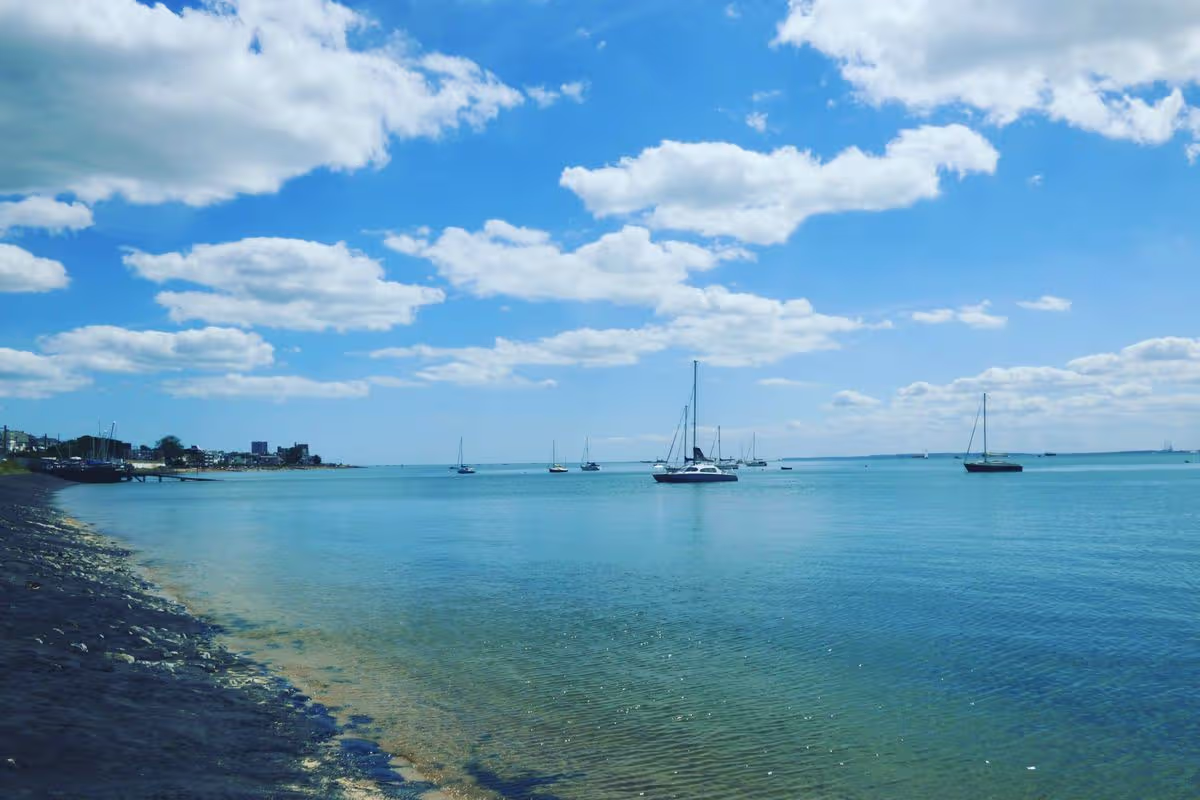
Leigh-on-Sea occupies one of Essex’s most stunning locations and is renowned for its independent shops and businesses.
The beautiful coastal town, known simply as ‘Leigh’ amongst residents, comprises the old town where dining and drinking venues abound, and the Broadway, home to boutique retailers and restaurants.
The delightful town, which features spectacular waterfront vistas, cobbled streets and vibrant beach huts, is celebrated for its independent character. Yet proposals to transform a Broadway shop into a Greggs branch have sparked debate.
Papers lodged with Southend-on-Sea City Council outlined plans for a shopfront displaying Greggs signage on the Factory Shop — with a verdict expected by July 10.
Nevertheless, a petition has been started urging the council to reject the Greggs proposals, attracting more than 1,700 signatures so far.
Behind the campaign is resident Enzo Harrison. He explained to this reporter: “It’s important to keep the Broadway independent. When people spend money in locally-owned businesses, the money stays in the area, it enriches us all.
“We risk losing not only our wealth but the unique feel of the area.”
Elaborating on why he started the petition, he explained on the website: “For as long as I remember, Leigh has had a host of high quality, independently owned bakeries and restaurants. Grout’s, The Homemade Bakery, The Flour and Spoon etc.
“The money we spent stayed in our community, the food we ate was wholesome and used proper ingredients, the faces behind the counter were familiar and friendly. This may soon come to an end.”
He continued: “To put it simply — Leigh’s too good for a Greggs. And we all know it.”
Responding below, one resident remarked: “I live on the Broadway and this would have a huge impact in my daily life, as their operations unit would sit right on my backyard. Keep Leigh independent, we love our artisan bakeries and coffee shops.”
Another chimed in: “Leigh doesn’t need any more chains or food outlets . To keep Leigh special we need independent shops selling things we actually need.”
Greggs was established in 1939 and has become one of Britain’s best-loved bakeries with thousands of branches. It also runs its own charity, The Greggs Foundation, which provides eight million free breakfasts for primary school children each year.
Leigh-on-Sea, meanwhile, is home to over 20,000 residents who enjoy scenic walks and delicious fish and chips.
Situated on the Thames Estuary, London is accessible by train in roughly 45 minutes, making the town attractive to commuters who prefer to avoid living in the heart of the capital. Edward White, the owner of fashion boutique Local Merchants, told express.co.uk last year: “We’re lucky to be surrounded by locals and visitors who actually care about supporting independent shops. They want something you can’t get everywhere.”
Councillor Carole Mulroney also weighed in on the flourishing high street, saying: “We’re lucky, we don’t often see empty shops in Leigh. There’s a healthy turnover, but people are invested. Shop owners, residents, they want this place to do well.”
She went on to note that cafes were “always full” whether by the old town waterfront or along the lively hilltop high street.
The town once had a Costa Coffee, which has since shut its doors, and a Subway had to be redesigned to blend in with its surroundings. Leigh continues to resist the cookie-cutter uniformity that plagues so many British high streets, with its embrace of independent businesses proving to be its greatest strength.
The seaside town sits just a 15-minute drive from Southend-on-Sea, and according to Rightmove, the average property price in Leigh-on-Sea stands at £448,840.
Local resident Russell Campbell, who previously lived in Basildon, shared his thoughts on Leigh with this publication.
He said: “I like the people here. I like the art here, the music, and I like that it’s by the sea. I just like the whole feel about it. It’s quite arty. The people here are creative.”
A visitor also chimed in: “Leigh has a cultural life which other towns like Southend don’t. It’s a wonderful place. Some talented people have emerged from here.”
This includes Oscar-winner Dame Helen Mirren, who grew up there, and Jamie Oliver, who once posted on social media: ” Aaaaahhhh back in my home town of Leigh on Sea ESSEX down at the cockle sheds just a quick visit but 15 mins for a pint of Adams and a little Cockles white pepper and vinegar and a roll before my next job then back to London Town happy days and memories.”
One local resident, Simon Green, also championed Leigh-on-Sea last year when Which? placed Southend-on-Sea as the fourth-worst seaside resort in the country in its yearly survey of top coastal destinations.
He outlined three reasons why this assessment was “total nonsense”, arguing that Leigh-on-Sea had been unfairly dismissed as one of Southend’s finest assets.
Simon described it as “undoubtedly one of the most desirable areas in the city”, highlighting how residents descended there every weekend to soak up the atmosphere at the Broadway cafes.
He also praised the independent retailers and a Michelin restaurant named Food.
And painting a picture of what Broadway – which may soon welcome a Greggs – is truly like, he wrote: “Situated right on the seafront, the former fishing village has a beautiful cobbled street running through it lined with clapboard houses from the 18th Century. Shacks are always open selling countless varieties of fresh fish — including prawns, oysters and mussels caught that day.
“And the meal can be washed down with a pint at the ever-popular Peterboat or the Boatyard, which overlook the fishing trawlers bobbing in the estuary. Ye Olde Smack is always a popular pub for locals too.”
Greggs and Leigh Town Council have been approached for comment.
A TIKTOK rapper has shocked fans when he revealed he is the son of a huge 90s boyband star.
The cheeky lad didn’t hold back as he roasted his famous father for his “s*** music” as he poked fun at him at one of his gigs.
Sign up for the Showbiz newsletter
Thank you!
TikTok rapper Phoenix JD has revealed he has a famous 90s boyband star dadCredit: Tiktok/@ph0enixjdThe social media star poked fun at his dad in a new videoCredit: Tiktok/@ph0enixjd
Phoenix’s dad is Spike Dawbarn (right) of the boyband 911 – seen here with Jimmy Constable, and Lee Brennan in 1996Credit: GettyPhoenix poked fun at his dad’s music. Spike seen here in 2024Credit: BBC
“But yeah, and then this is them on stage. There’s me dad on the right.”
Poking fun at Spike, he said: “Thankfully, I don’t get my musical ability from him, you know, I’ve got a bit about me.
“I hope he doesn’t see this now. He’ll kill me.
“But hey, this is him at 51 still trying to do back flips – and nearly decked it.
Spike’s son said he only went to the gig ‘to see Blue’ who his dad’s band were supportingCredit: Tiktok/@ph0enixjd911 were one of the biggest boybands of the 90sCredit: Getty
“I would’ve flipping loved it if he decked it.”
Phoenix also added he only went to the gig “to see Blue”.
Fans of 911 from back in the day went wild for the video, with one joking: “Oi your dad was a legend to us fossils!!”
Another quipped: “Lmfao! The way your roasting your dad! I’ll have you know 14-year-old me loved your dad’s band!”
The boyband’s fans rushed to their defenceCredit: Getty
This fan said: “I was obsessed with 911 still love them now! You’ve got your dad’s humour!”
Appearing on the BBC’s Boyband Forever doc, the star spoke about his bizarre living arrangements when the band were in their heyday.
“Jimmy got one bedroom, Lee got another bedroom and I was in the cupboard like Harry Potter,” he explained.
“On a mattress, in a cupboard. It’s literally where you’d just throw a load of coats in there.”
“And I just didn’t care to be honest, I wasn’t bothered,” he laughed.
In their early days, the band would tour schools across the country and perform for students.
“I used to come in, press play, do your singing and dancing routines, do your bit then load yourself back in the van and go to the next school,” he said.
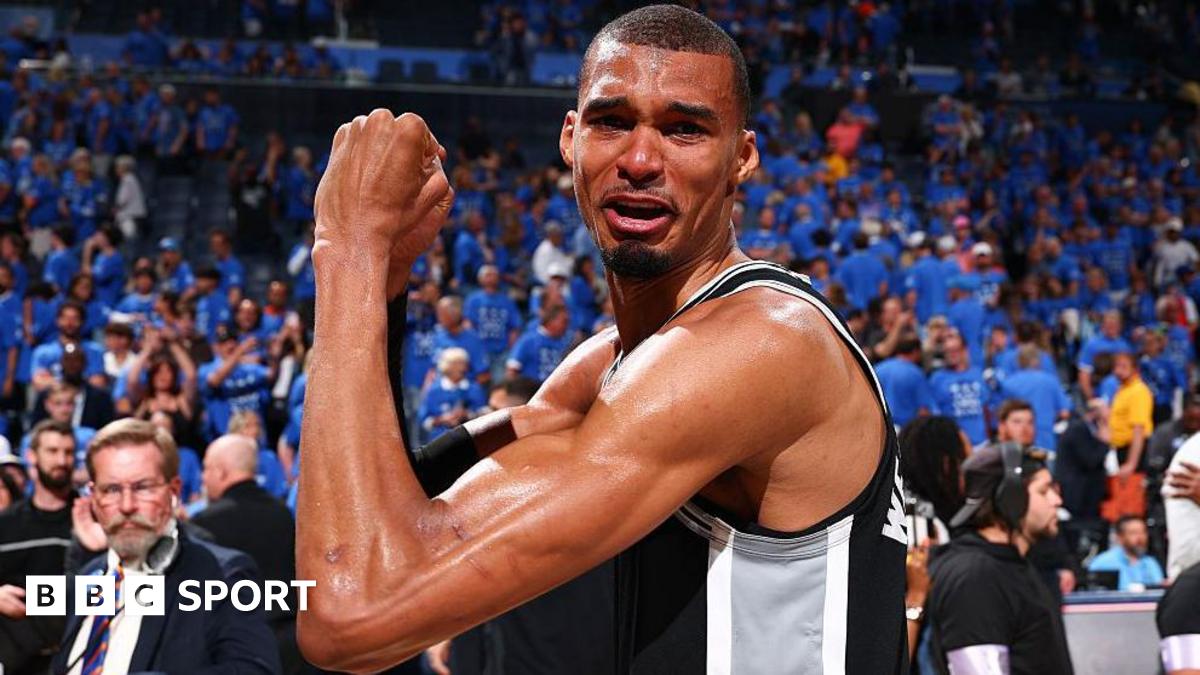
Victor Wembanyama bagged 22 points as San Antonio Spurs defeated defending champions the Oklahoma City Thunder 111-103 to reach the NBA Finals for the first time since 2014, where they will face the New York Knicks.
San Antonio coach Mitch Johnson had called on Wembanyama to score more than 20 points after a disappointing showing in game five.
An inspired 28-point haul by the 22-year-old Frenchman on Friday helped level the best-of-seven series at 3-3 and save his “childhood dream” – which is now within touching distance.
“Winning the Larry O’Brien [NBA championship trophy] is a childhood dream, and having a real shot at it, having a tangible chance at winning it – it’s a lifetime chance,” said Wembanyama after reaching the Finals for the first time.
“You never know when it’s gonna happen again. But the day we win it, speaking for myself, it’s going to be an amazing day – the realisation of a dream.
“It’s hard to put into words. It’s almost like the meaning of my life.”
Johnson’s side last won the NBA showpiece in 2014, while the Knicks will compete in the finals for the first time in 27 years.
It will be a rematch of the 1999 NBA Finals, which San Antonio won in five games for their first of five NBA championships.
Having scored 41 points in game one and 33 points in game four, the number one pick in the 2023 draft showed in the deciding two matches why he was one of the most coveted picks since LeBron James in 2003.
“What I’ve learned is that I can go through hurdles that I didn’t know could get so high,” added Wembanyama.
“I found resources inside of me. Relentlessness. I already knew that, but doing it at this level, this is the best basketball being played on the planet right now. And the crazy thing is I want to do that 15 or 20 more times.”
The NBA Finals series will begin on 3 June, with a possible game seven finale on 19 June.
The San Antonio Spurs, sparked by superstar Victor Wembanyama, have advanced to the NBA Finals for the first time since 2014 by dethroning the defending champions, the Oklahoma City Thunder, 111-103, to book a championship showdown against the New York Knicks.
The Spurs captured the best-of-seven Western Conference finals 4-3 on Saturday and reached the NBA Finals, which begin on Wednesday against the Knicks in San Antonio.
“Though we’re still hungry for one more, this feeling is, I can’t explain it, it’s so powerful,” Wembanyama said. “We want four more. We’re not done. Go Spurs go.”
French 7-foot-4-inch (224cm) centre Wembanyama scored 22 points and grabbed seven rebounds, Julian Champagnie added 20 points, including six three-pointers, and Stephon Castle had 16 points for the Spurs, who led the winner-take-all contest almost the entire way.
“We had a good team, a great team,” Champagnie said. “We had to stay the course and play a good game.
“We were passing the ball. We were playing as a team. We come out here and play together.
“We never knew if we were going to get this far, but when you’ve got the greatest player in the world, things happen.”
That was a nod to Wembanyama, the Most Valuable Player of the Western Conference finals and the NBA Defensive Player of the Year.
“It doesn’t mean anything for me other than the fact we are a team,” Wembanyama said of his series MVP award. “I got this for all of us and all the fans right here.”
Wembanyama was emotional after securing his first appearance in the NBA Finals [Zach Beeker/Getty Images via AFP]
Of his teammates, Wembanyama added, “They don’t even know how much I love them. They are just incredible. Everybody stepped up tonight.”
“Wemby” dominated in his first playoff game seven and was emotional at the finish, laughing, crying and hugging teammates over reaching his first NBA Finals.
“Realising that some part of the childhood dream was going to come true,” the 22-year-old Frenchman said of his reaction.
The win sets up an NBA Finals repeat of this season’s NBA Cup final, which the Knicks won with a 124-113 defeat of San Antonio last December in Las Vegas.
“A lot of physicality, hit first, and rebounding,” Champagnie said of the Knicks. “It will be a nice challenge for us.”
San Antonio Spurs guard Devin Vassell hangs on the rim after a dunk [Tony Gutierrez/AP]
NBA Most Valuable Player Shai Gilgeous-Alexander led Oklahoma City with 35 points.
“He was brilliant. He had a great game,” Thunder coach Mark Daigneault said. “He delivered. It was a really big-time game for him.
“That would have been one of the stories of the game if we had been able to figure out a way to win it.”
Daigneault said the challenge to repeat was not among the things that led to the defeat.
“You can be proud of effort and progress and the level we played … and we can also be really disappointed,” he said.
“Felt like we could have won the series. We were right there. There’s nobody we don’t think we can’t beat.
“I thought we had enough to win, but credit San Antonio – they’re the ones who did.”
Oklahoma City Thunder guard Shai Gilgeous-Alexander shoots [Nate Billings/AP]
A Spurs squad with only one player who had been in a game seven before overcame a more experienced Thunder squad that won the title in a game seven last year.
“Back in October, we knew we had a chance to be pretty good,” Spurs coach Mitch Johnson said.
“There’s a lot being talked about, words like competitiveness, resolve, togetherness, execution – who gives a damn about the word experience?
“They had to go out and execute, and they did.”
Wembanyama hit two three-pointers in a 17-9 run to start the fourth quarter that lifted the Spurs ahead 97-86 with eight minutes remaining.
“Wemby” was whistled for his fifth foul seconds later and went to the bench, boosting Thunder hopes in the dying minutes while Gilgeous-Alexander tried to rally the reigning champions, only to fall short at the finish.
The low-cost airline is reducing the number of flights at 19 airports across Europe, including in the UK, and passengers have been warned to check their itineraries and alternative routes
Ryanair has cut flights from 19 airports (Image: NurPhoto, NurPhoto via Getty Images)
Ryanair has slashed flights at 19 airports across Europe, including in the UK, ahead of its summer timetable.
The decision comes as the budget carrier attempts to streamline its operations and tackle seasonal overcapacity, according to Travel and Tour World.
Travellers departing from or arriving at the airports facing reductions must verify their schedules to confirm their booking remains valid.
Full list of airports facing cuts:
United Kingdom
London Stansted
Manchester
Ireland
Germany
Berlin Brandenburg
Cologne Bonn
Hamburg
Italy
Portugal
Belgium
France
Poland
Hungary
Romania
Bulgaria
Spain
The budget carrier has implemented the reductions to optimise its strategic network, ease economic pressures and manage rising costs.
The widespread cancellations form part of the airline’s efforts to safeguard profitability as the fuel crisis continues to fuel inflation worries.
The cuts come after Brits heading to Europe were caught in hours-long airport queues, with some passengers reportedly missing flights as new border checks continue to cause disruption across the EU.
The delays come following the rollout of the EU’s Entry/Exit System (EES), which officially launched on October 12, 2025. Under the new system, non-EU travellers including Brits are required to register fingerprints and have their photograph taken when entering or leaving the Schengen area.
Jaua defended the importance of national unity in the struggle to reclaim sovereignty. (Venezuelanalysis)
Elías Jaua is a Venezuelan intellectual, university professor, and politician who served as vice president under Hugo Chávez in addition to several ministerial roles in the Chávez and Maduro administrations. He currently heads the Center for the Study of Socialist Democracy (CEDES). In this exclusive interview, Jaua discusses Venezuela’s post-January 3 conjuncture, the anti-imperialist struggle to reclaim sovereignty, and the role to be played by Chavismo.
Venezuela’s reality changed on January 3 with the US strikes and kidnapping of President Maduro. How would you describe the current situation? And regarding the US, there is talk of “conditional sovereignty” and “tutelage,” while officials speak of a “cooperation agenda.” What is your take on this?
Sovereignty is a comprehensive concept. You either have it or you don’t. Sovereignty means not depending on anyone. It is the foundation of a republic. A republic means independence from others, something distinct from liberal, individual freedom. Venezuela today is a state under tutelage, overseen by the Donald Trump administration. This was officially declared by Trump and White House officials such as Secretary of State Marco Rubio.
This is also clearly reflected in oil production, which must be sold primarily to the US, and the proceeds from those exports do not enter directly into Venezuela’s coffers but instead into a US Treasury account. From there, the Venezuelan government will make requests and have certain amounts necessary for the country’s basic functioning disbursed. That is a complete loss of economic sovereignty. We have also seen how reforms to strategic laws, such as those governing hydrocarbons and mining, have been rushed through. Today, there is immense pressure on labor legislation, both from the Venezuelan business community and from transnational capital, which views labor laws as yet another obstacle to attracting investment.
And finally, we have seen that Venezuela’s foreign policy – which was openly supportive of Palestine, Iran, and Cuba – has been significantly toned down. This is another clear sign that Venezuela is no longer an independent state. Its status as a republic is entirely relative.
US forces recently ran a military exercise in Caracas, with aircraft flying over the city and landing at the embassy compound. (EFE)
In light of all this, how do you feel the government and other national political groups should respond?
I view the decision made on January 3 not to respond to the US military attack as a responsible one, because the enemy clearly had military superiority and the capability to control the entire airspace using high-tech means. A response would have resulted in significant destruction of the country’s infrastructure and armed forces, as well as the killing of thousands of civilians.
Now, four months later, the Venezuelan government and all political forces should clearly denounce to the international community the coercion to which we are being subjected. On the one hand, as a public denunciation, but also to have it formally recorded before international bodies such as the International Commission on Human Rights. What occurred in January were war crimes, a fact supported by United Nations rapporteurs. Next, a complaint should be filed with the International Court of Justice to restore control over national revenues to the Venezuelan state.
One might argue that this is ineffective at the moment, that international law is irrelevant and international organizations are incapable of acting – and that is true. But the country must establish a legal precedent because these institutions still exist, and as a result they are a source of rights. These complaints set precedents so that the country can, in the future, claim the rights that have been damaged by the occupying power.
Finally, it is important to reach out to the international community, and above all to the peoples of the world, so that they know there is a nation that refuses to be placed under tutelage and subjected to these conditions, in order to build international solidarity. An internal political stance must also be established, because this attempt to conceal the gravity of the coercion to which the country is being subjected numbs popular consciousness, undermines patriotic morale, and that is contrary to what is expected of the leadership – not only of the government, but of the entire political leadership of the nation.
But what if that triggers another US military attack?
I don’t think a repeat of the January 3 incident is imminent because it would have repercussions in the US domestic political landscape. The political cost for the Trump administration would no longer be zero, as it practically was on January 3, but there would be greater resistance, especially for attacking a country that has simply exercised its rights before international bodies to claim sovereignty over resources and political self-determination.
Put another way, the option of not denouncing this, of not activating available mechanisms, is to accept and normalize this situation of neocolonialism, and I believe that is a very dangerous path that could even lead to Venezuela’s annexation by the US. I believe there are moments when peoples, nations, and their leaders must take a firm stand for the sake of history. Here it is no longer a matter of defending a party or a political movement, but rather the existence of a nation that was born free. We have a historic responsibility to ensure it remains that way for future generations.
Jaua highlighted the importance of denouncing US neocolonial impositions and calling for international solidarity. (Unión Radio)
US officials repeat their “three-phase plan,” which ends with a political “transition,” on a daily basis, while the extremist opposition demands immediate elections to seize power at any cost. From your perspective, what is the path forward, and what should the priorities be?
The priority is to regain independence. If we hold elections, that is with candidates for what? For governor of the colony? Anyone who truly wants to hold the presidency of the Republic of Venezuela must first raise their voice in favor of the immediate restoration of the country’s sovereign rights over its resources and revenues and the assertion of political self-determination.
In any case, I argue that any eventual electoral process should be the result of a national agreement, renationalizing politics and not waiting for a call from the White House one day announcing that there will be elections in six months. That would be very shameful. I believe that Venezuelan political forces would be obligated, as part of that strategy to reclaim and demand the restoration of Venezuela’s sovereignty, to also commit to the international community and the Venezuelan people to seek a political, democratic, and electoral path forward.
In a recent article, you spoke of an inability to manage the internal political conflict, which paved the way for foreign intervention. Could you elaborate on this idea? How has that situation changed since January 3?
Foreign meddling began on the very first day of the Bolivarian Revolution, and there were agents that facilitated it. The first concrete example was the April 11, 2002 coup d’état, with the open participation of the US and Spanish governments, and from that point on, that interference never ceased. But there was always a degree of autonomy that allowed, especially after 2004, for the democratic resolution of the conflict through national agreements. For instance, the recall referendum that ultimately ratified Chávez’s mandate.
But starting in 2014, after the right-wing insurrectionary attempt known as “La Salida” and its failure, the US began to intervene directly by declaring Venezuela an “unusual and extraordinary threat,” and from that point on, the opposition lost any capacity to make decisions. I was a member of the dialogue delegation in the Dominican Republic in 2018 and saw how an agreement signed by everyone was overturned by a phone call from the US embassy.
I also believe that later, over the past five years, the Venezuelan government chose to engage in dialogue with the US and bet that the conflict would be resolved directly with Washington. Therefore, everyone put all their eggs in the White House’s basket, and the decision slipped completely out of the control of the country’s internal institutions until the game came to a standstill. And indeed, at the behest of the far-right opposition, Washington intervened and attacked on January 3. That is why I say that reclaiming internal political control in order to resolve the conflict would be an act of dignity and courage on the part of the entire Venezuelan political leadership. Conflict is not going to vanish, because today the calls for a conflict-free Venezuela come alongside a set of measures that deepen it. For example, labor deregulation, social disinvestment, political exclusion, etc.
“We’re socialists and anti-imperialists!” banner in a Chavista march. (Archive)
In recent years, you have analyzed and debated the direction of Chavismo amid sanctions and the implementation of orthodox macroeconomic adjustment policies. Since January 3, we have seen a drastic overhaul of key pillars of the Bolivarian project, such as the Hydrocarbons Law, and critical voices growing louder, including Mario Silva and Luis Britto García. What is the current state of Chavismo, in your opinion?
First of all, the revision and change of course regarding fundamental aspects of Chavismo’s historic program did not begin on January 3 but much earlier. It was formalized starting in 2018 with the Program for Economic Recovery, Growth, and Prosperity, aimed at halting the advance of the transition to socialism and restoring the private sector’s hegemony in managing the economy, with clear consequences for social rights and the fight against social inequality. This was also accompanied by increasingly undemocratic mechanisms, from the political leadership, to impose a change of course in economic and social policy.
However, a fundamental core of Chavismo’s programmatic unity – the struggle for independence and national sovereignty – remained intact, and that kept Chavismo cohesive despite major differences. Today, I believe Chavismo must be situated within different spheres. There is a Chavismo within the United Socialist Party (PSUV) – no one can dispute that – but I believe there is a broader, and much larger, Chavismo, with a cultural, political, and symbolic identity rooted in a metanarrative that exists outside the PSUV and the Great Patriotic Pole. That sector currently lacks clear leadership and organizational structure, but it retains its values. It may have circumstantial views of the situation, but essentially it continues to uphold the principles that launched this process: sovereignty, participatory and protagonist democracy, democratic pluralism, freedom, political ethics, debate, speaking the truth, and social equality. It also holds a vision of a multipolar world, in solidarity with international struggles. These were, in essence, the core tenets of Chavismo from its inception and remain relevant for a significant portion of the Venezuelan population that is Chavista or was once Chavista.
You have talked about building national unity at this juncture, but also about upholding Chávez and his legacy. Are these two paths compatible?
This is a difficult and painful reflection because the figure and the project of Hugo Chávez have been burdened with a series of deviations. Practices that run completely contrary to the principles and values he defended, and upon which he built the Chavista project. For example, the case of Víctor Hugo Quero and his mother is deeply outrageous (1). It is a truly shameful incident, yet international news outlets report, “Chavismo admits to the disappearance of a detainee,” “Mother of prisoner killed by Chavismo dies.” Is it Chavismo or just a few individuals responsible? What about the men and women who, for over 25 years, laboriously dreamed, built, and dedicated part of their lives to creating well-being and the common good in their communities, to building a national project called “Chavismo”? It is very unfair because Chavismo, as a movement, is being accused of things it did not do. Chavismo is not this or that leader; it is the men and women who gave up the only thing they had – their time, their effort – to build community, a national project, to plant crops, to learn to read and write or to teach others to read and write, to study, and so on.
I stand by Chavismo as the men and women who dreamed, who continue to dream, and who have given their all to build a more humane society. For me, that will continue to be Chavismo. And those of us who have held leadership posts in this process must assume their responsibilities for the good and the bad. But it is unethical to blame a popular movement, a popular ideal like Chavismo, for the mistakes, deviations, and vile acts that some leaders may have committed.
I believe that the call for national unity, to paraphrase [revolutionary communist leader Alfredo] Maneiro, will spring from the most authentic Chavismo, but will transcend it. It will converge with other currents of the left that were not Chavista, with social democratic sectors that broke away from the extremist opposition, and with people who never took a stance on the political conflict the country has experienced in recent decades. It will be the plurality of opinions, of people, of organizations, that will provide the foundation for a necessary movement, which I see as unstoppable and already feel in the streets, in this struggle to regain independence and sovereignty.
Jaua served as Chávez’s vice-president from 2010 to 2012. (Archive)
Note
(1) Victor Quero died in state custody in July 2025 but his family was not notified. His mother, Carmen Navas, continued to search for him until his death was publicly acknowledged in May 2026 after a judge denied an amnesty request. Navas passed away shortly afterward.
This article contains spoilers for the series finale of “Hacks.”
After five seasons and (thus far) 12 Emmys, “Hacks” has come to an end. The story of how Deborah Vance (Jean Smart), a 70-something comedian of the Joan Rivers type, and Ava Daniels (Hannah Einbinder), a prickly 20-something comedy writer, came together to resurrect both their careers was a roller coaster ride of intergenerational judgment, wins, setbacks, ruthless behavior, personal growth, power reclamation and much general hilarity.
Deborah sees Ava as entitled and self-righteous, Ava sees Deborah as washed-up and boring. Eventually, of course, they realize they are kindred spirits who do their best work together.
In Season 5, Deborah attempts yet another comeback. Having walked off her late-night show rather than fire Ava in Season 4, she is determined to rewrite her premature obituary by playing Madison Square Garden. When that too is snatched away, she pivots (with much difficulty and hilarity, including a show-stopping monologue by Laurie Metcalf’s tour manager Weed) to Central Park, where she is finally allowed a moment of glory, basking in the adulation of applauding thousands.
But that is not the end of “Hacks.” In the final episode, Deborah reveals she has cancer and rather than undergo treatment, she is choosing to “go out on top” with the aid of a Zurich clinic. She asks Ava to accompany her, after they take a girls trip to Paris. After an emotional meltdown, Ava agrees, hoping to persuade Deborah to change her mind. She does, but only after Deborah realizes that she cannot bear to walk away from the jokes she could write about dying. And so the show ends, with the two women walking arm in arm, first in Paris and then in Las Vegas, working on Deborah Vance’s final show.
Here, Times TV and culture critics Robert Lloyd and Mary McNamara discuss the ending, and legacy, of “Hacks.”
Deborah, left, decides she doesn’t want to get treatment for cancer despite Ava’s protests. Deborah changes her mind when she realizes she could write jokes about dying.
(HBO Max)
Mary McNamara: Hey there, Robert; are you as devastated as I am that we have no more “Hacks” to look forward to? The only solace I can find is the news that creators Lucia Aniello, Paul W. Downs and Jen Statsky are planning to release a DVD box set of the series. And the possibility that there could be a movie sequel — I for one want to see Deborah Vance’s death tour, especially since you know she’ll beat the odds and survive.
Seriously, though, sad as I am to contemplate life without “Hacks,” I am equally thrilled that the show so thoroughly stuck its landing. Finales are always a crap shoot and I appreciated how this season managed to show growth and cosmic justice while never tipping into treacle. I love that everyone ended on a win — including Marty! (Christopher McDonald) — and I didn’t even mind that suddenly Deborah had cancer (what?), was choosing assisted suicide (double what?) or that we were whisked to Paris (sure, I guess, why not?) because it made just enough narrative sense to set up Deborah’s decision to live because she just couldn’t leave good material on the table. “I may not have 30 years, but I do have one more hour,” may be the best line from a TV finale ever.
It is too easy to think of people like Deborah as clawing back their careers for fame, validation or money rather than a deep and essential love of their art. Having Deborah decide to prolong her life with chemo because she could not resist mining this final seam of comedic gold was a coup de grace.
What did you think?
Robert Lloyd: Hail, Mary. Reviewing the first-season finale, I wrote that the series was at heart a romantic comedy. And though many timely points were made along the way about artificial intelligence, the fate of late-night television and the awfulness of rich jerks who control media companies — Deborah’s Madison Square Garden show was undermined by the network head she named on national television in her resignation speech — the show asserted itself as a love story once again in the end. Where earlier seasons had depended on creating friction between Deborah and Ava, this one was mostly of concord, their only real clash being Deborah’s decision, introduced late in the season, to end her life (in a clean, posh way); her climactic change of heart spared us a medical tearjerker, but, believe me, I shed plenty of tears along the way. Unlike most seasons of “Hacks,” the fifth and final was orchestrated very much as a feel-good experience — “Ted Lasso” has nothing on it. A fairy tale, almost, as you point out, full of fairy-tale endings and plot points that were as good as magic. It could be contrived and improbable and old-fashioned in its triumphs snatched from the jaws of defeat, and I completely loved it.
Deborah Vance (Jean Smart) didn’t get the Madison Square Garden show she imagined, but she did get one at Central Park.
(HBO Max)
McNamara: The series had a lot to say about a lot of things (including vengeful power brokers/network executives) that feel particularly pointed now. But I deeply appreciated that while underlining the real obstacles Deborah and Ava faced, the writers showcased and explored how the bad choices each women had made, and defended, also contributed to their situations. Obviously having the great Jean Smart in the driver’s seat helped a lot — she revealed the woman beneath the diva even in Deborah’s most outrageous actions. The writers did not shy away from calling attention to the blatant sexism female comedians faced (and continue to face) or how the “woke” women of Ava’s generation are often able to see that kind of injustice more clearly.
It was, as you say, more rom-com than morality play, and rom-coms are often based on discovering that the differences that initially divide are too often based on, well, to put it in its original form, pride and prejudice. So while there was some hilarious and spot-on commentary about intergenerational miscommunication, there was also a clear message of how important it is for people with vastly different experiences to listen to, and learn from each other, which also feels incredibly important at this moment in time, especially given the show’s essential, and deeply human, respect for creative work. What motivated Deborah and Ava, and virtually every character in “Hacks” — agent Jimmy (Downs), his assistant Kayla (Megan Stalter) and later Randi (Robby Hoffman); Deborah’s staff, including Marcus (Carl Clemons Hopkins), Damien (Mark Indelicato) and Josefina (Rose Abdoo) — was a belief in the importance, and difficulty, of the creative process. It’s something that is rarely, if ever, the work of a single individual — as Deborah finally acknowledges at the opening of the Diva casino. Or as Laurie Metcalf’s Weed makes clear in her hilarious monologue before the Central Park gig.
1
2
1.Creativity isn’t the work of a single individual: Damien (Mark Indelicato), Marcus (Carl Clemons-Hopkins) and Deborah (Jean Smart) at work on the casino.(HBO Max)2.Deborah’s crew at her Central Park show.(HBO Max)
Lloyd: In a way Deborah’s speech summed up what we’d already been seeing through an especially generous season that served as “Hacks’” tribute to itself and its people. It was a party to which most every significant and many minor characters were invited, including Metcalf and McDonald; Luenell as comedian Miss Loretta; Poppy Liu as Deborah’s personal blackjack dealer, Kiki; Jane Adams as Ava’s mother, Nina; J. Smith-Cameron as Deborah’s estranged sister, Kathy; and Kaitlin Olson as Deborah’s daughter, DJ, who finally got her mom to partner with her on “The Amazing Race” and was allowed to sell her detachable earrings on QVC.
Gifts were distributed widely, including a previously unseen interview with Deborah’s late husband and co-star, Frank (Peter Strauss), giving her credit for their success — credit he had previously accepted for himself — and thus removing a giant thorn that drove the early plot. These kind-hearted acts of closure were performed both for the benefit of these very real, made-up people, and for We the Viewers, who have made them our family. Declarations, or at least demonstrations of love, were abundant, not merely between Deborah and Ava, with the characters acting as our proxies, feeling what we want them to feel, and what we feel for them ourselves. (There are moments this year when Einbinder — whose brilliance Smart could seem to outshine, but who was never less than an equal partner — absolutely killed me, just in the tender way she gazed upon Deborah.) That’s why it’s so hard to let go of a show like this, even when we know it’s time to say goodbye. You can only stretch an arc so far before it breaks.
McNamara: You’re right, of course. But I still want to see the “Hacks” movie.
Philadelphia’s Edmundo Sosa sauntered out of the box, motioning with one hand in a pump-wave in front of 51,794 Dodgers fans. The left fielder, who had taken over for Brandon Marsh in the top of the sixth, connected on a four-seam fastball that Dodgers reliever Tanner Scott left too far over the plate for a two-run home run that put the Phillies ahead.
The Dodgers had been playing with fire all night, but they couldn’t regain momentum after Scott’s struggles, losing to the Phillies 4-3 to set up a Sunday series rubber match.
The Dodgers (37-21) started strong, with pitcher Roki Sasaki giving up just three hits and one earned run over 5⅓ innings.
Sasaki’s elevated velocity posed early concerns for the Dodgers as he struggled more with his command. The right-hander crossed the 100-mph threshold for the first time this season on two pitches: a 100.4mph four-seam to J.T. Realmuto and another fastball, this time 100.1mph, to Kyle Schwarber.
Three of his four pitches — the four-seam, slider and splitter — averaged at least 1.2 mph faster than his yearly average. As a result, he struggled with location. Neither his slider and splitter hit the zone more than 45% of the time. Even his fastball hit the strike zone a mere 55%.
Dodgers manager Dave Roberts warned about this scenario when Sasaki’s fastball had only reached an upper limit of 99.5 mph.
“I think now the velo is certainly in a good spot,” Roberts said before the game. “I do believe that if he wanted to throw 100 miles an hour, he could do that, but it wouldn’t be where he needed to throw it.”
Dodgers starting pitcher Roki Sasaki delivers during the first inning Saturday against the Phillies.
(Mark J. Terrill / Associated Press)
Still, the Phillies (30-28) struggled to generate consistent momentum despite Sasaki’s location problems. Phillies third baseman Alec Bohm hammered a four-seam fastball that skimmed the top of the strike zone over the center field wall. The rest of the Phillies lineup ended most of their at-bats with little luck, striking out seven times and walking only once.
Roberts pulled Sasaki with runners on first and second in the sixth. Left-hander Alex Vesia walked Bryce Harper but escaped a one-out, bases-loaded jam by striking out Sosa and forcing Alec Bohm into a ground out to third.
By then, the Dodgers had already established a lead. Alex Call put them on the board in the second on a poked single through the gap between second and short. In the fourth, Call reached third on a double and throwing error from Adolis García. Santiago Espinal hit a sacrifice fly to deep center field, driving in Call.
Mookie Betts also found his footing after he went 0 for 3 on Friday. The shortstop struggled in the first four games of the Dodgers’ homestand, batting .200 across 15 plate appearances. Against the Phillies on Saturday night, Betts laced two singles and a double.
Andy Pages scored on a close play at the plate after Betts singled to shallow right field in the seventh. Although catcher J.T. Realmuto missed tagging Pages’ foot, the Dodgers center fielder’s cleat didn’t appear to touch the plate. After a long review, the safe at home call stood.
But the Dodgers’ good fortune didn’t last. Scott gave up an RBI single to Bryce Harper, and it was like the Phillies could sense exactly when the reliever’s pitches crossed over the zone. Scott (1-2) then gave up the home run to Soto before going down in order on three groundouts in the ninth.
Iranian Ambassador to South Korea Saeed Koozechi (L) speaks to reporters as he exits the foreign ministry building in Seoul, South Korea, 27 May 2026. The ministry summoned Koozechi to lodge a protest over a 04 May attack on the HMM Namu, a South Korean-operated vessel, in the Strait of Hormuz. The ministry said Iranian-developed anti-ship missiles were likely used in the attack earlier this month. Photo by YONHAP / EPA
May 29 (Asia Today) — South Korean defense experts said the government should take a tougher position toward Iran after investigators concluded that an Iranian-developed anti-ship missile was likely used in an attack on the HMM Namu.
Experts said Thursday that Seoul needs a firm diplomatic response to the results of the government investigation into the unidentified aerial objects that struck the HMM-operated vessel.
The government said Wednesday that the objects were highly likely to have been Noor-series anti-ship missiles developed by Iran. Technical analysis found the engine resembled an Iranian-made turbojet engine, and some components carried markings believed to be from an Iranian manufacturer.
South Korean officials said the evidence points toward Iran but stopped short of making a final judgment on who carried out the attack or whether it was intentional. The government summoned Saeed Koozechi, Iran’s ambassador to South Korea, but Koozechi denied that Iran was involved.
“If it was actually confirmed to be an Iranian missile, it should be viewed as an act by the Iranian government,” said Kwon Yong-soo, professor emeritus at Korea National Defense University. “The missile’s maximum range is short, and because of the flame at launch, it would have been visible where it came from.”
Kwon said the government should be able to explain whether the missile was fired from land, a ship or a fast boat.
“If it was not Iran’s act, Iran itself should present evidence,” he said.
Yang Uk, a research fellow at the Asan Institute for Policy Studies, said the evidence points to an Iranian-made anti-ship missile.
“Even if Iran denies it, that denial is not persuasive,” Yang said. “Anti-ship missiles are weapons that only states, governments and militaries can operate.”
Yang said Iran may have provided missiles to an armed group, such as the Houthi rebels, but the distance would have been too far for such a launch.
“If the Islamic Revolutionary Guard Corps fired it and the Iranian government pretends not to know, that would prove Iran’s own command and control is inadequate,” he said.
Some experts said the South Korean government’s response has been too weak, even though it summoned Koozechi immediately after announcing the investigation results.
A Foreign Ministry official said summoning Iran’s ambassador was a serious diplomatic measure.
“Summoning the Iranian ambassador to South Korea is by no means meaningless,” the official said. “The measure itself shows our firm position.”
The official said Seoul had sent investigation teams twice, collected debris, reached its conclusion through analysis by expert agencies, publicly announced the findings and explained them to the other country.
“That itself is a serious diplomatic step,” the official said.
Yang said some may argue South Korea does not need to create unnecessary conflict with Iran. But he said Seoul should at least secure something from the Iranian government if it takes that position.
“Given that the evidence points to Iran, we should at least apply pressure to ensure our ships are allowed to return safely,” Yang said. “If we do not even do that, then we are refusing to do what a state should do.”
After a complete shakeup at CBS’ “60 Minutes,” ousted correspondent Cecilia Vega said she had been facing pressure to insert political bias into her stories and dealing with censorship.
“I very much fear what comes next for … the future of the legendary broadcast,” Vega said in a social media post on Thursday referring to “60 Minutes.”
The latest shakeup follows multiple controversial moves by Weiss, who’s set on remaking the institution long defined by tradition. She arrived at CBS News in October with no television experience, installed by Paramount Chief Executive David Ellison after he acquired her digital news outlet, the Free Press, with a mandate to change the network.
Ellison’s pronouncements that CBS News needs to move more to the political center has led to the perception that the network is trying to placate Trump with more positive news coverage, even as “60 Minutes” has remained tough with its White House reporting.
“Our responsibility is to preserve that legacy and vital mission by building a show that thrives in the 21st century,” wrote Weiss in her note to staff. “That requires a new approach: expanding ’60 Minutes’ beyond a one-hour television broadcast, deepening its role across CBS News.”
Vega claims, in her statement, that “in recent months, my producing teams and I have experienced efforts to insert political bias into our stories.” She also said that reporting teams are holding back on submitting specific story pitches, due to the “fear of the internal repercussions.”
“Let’s call this what it is: censorship, both imposed and self-driven,” Vega wrote. “It is dangerous for the show and dangerous for democracy.”
She said that in working at “60 Minutes” she’s had to keep stories rooted in fact and away from “questionable editorial suggestions.”
“I know from many conversations with colleagues that many producing teams and correspondents working on the show today have had to fight to maintain editorial independence with regularity,” Vega said. “I am far from the only ’60 Minutes’ correspondent who has asked herself, ‘What is my personal red line? How much can I push back before I pay the price?’”
In a statement, a CBS News representative said, “We respect Ms. Vega and her contributions, but her claims are not based in reality.”
Vega joined the newsmagazine in 2023, becoming the program’s first Latina correspondent. Before that, she worked for over a decade at ABC as the network’s chief White House correspondent and co-anchoring “Good Morning America.”
Several journalists like ABC’s John Quiñones and former Univision anchor Jorge Ramos offered words of support for Vega’s remarks. Quiñones commented, “Journalism is stronger because of your voice, your courage and your story-telling, Cecilia,” and Ramos wrote in Spanish that he respects and admires her.
Cardiff lost head coach Matt Sherratt to Steve Tandy’s backroom staff just a few days before the season started, with forwards boss Corniel van Zyl making the step up to replace him.
“We’re proud of the boys from where we started the season into how we finished,” said van Zyl.
“To end up sixth, with 16 quality teams, I say would make us proud. Unfortunately we couldn’t push on to the next step and that’s the disappointing part.”
Van Zyl guided Cardiff to 11 league victories, with eight of those coming at their Arms Park home.
With only one URC win achieved outside of Wales this season, securing an unlikely play-off victory in South Africa against a former tournament winner was always going to be a tough ask.
The squad landing just a few days before the fixture after a 6,000-mile flight to Cape Town added to their task.
Cardiff flanker Dan Thomas has been one of the shining lights this season and again impressed against Stormers.
The open-side did not want to accept defeat but acknowledged the steps made in the 2025-26 campaign.
“Everyone was happy with how the season went, we made the play-offs which was important for the club, but no-one remembers who loses in quarter-finals,” Thomas told S4C.
“Making the play-offs is important for the club.
“It’s an odd one, we’re happy with how the season has gone, but you want silverware. It is back to the drawing board now and we need to start again.”
Cardiff have signed Australian veteran prop Scott Sio next season, which they will hope shores up a scrum taken apart by Stormers.
“It is obvious, our set-piece needs to improve,” said Thomas.
“The Stormers were dominant and we didn’t cope. We knew it was coming and still couldn’t stop it.
Geopolitical analyst Joe Macaron says the Lebanese army is ‘overly stretched’ as Israeli troops expand their occupation of Lebanese territory. The Israeli army has pushed north of Lebanon’s Litani River and appears poised to encircle the major city of Nabatieh.