HOLLY Willoughby is turning up the heat — as she plans to install a sauna at her £8million London home.
The TV host, 45, has been researching fancy brands and asked her 8.1million Instagram followers about the health benefits of classic and infrared units.
Sign up for the Showbiz newsletter
Thank you!
Holly Willoughby is turning up the heat — as she plans to install a sauna at her £8million London homeCredit: GettyHolly has been researching fancy brands and asked her 8.1million Instagram followers about the health benefits of classic and infrared unitsCredit: GettyHolly’s sauna search comes as prepares a comeback on YouTube with an edgier imageCredit: Getty
Mum-of-three Holly and her telly producer husband Dan Baldwin, 50, bought the six-bedroom home in South West London last year.
Her sauna search comes as the ex-This Morning host and former golden girl of ITV shuns traditional broadcasters and prepares a comeback on YouTube with an edgier image.
A source recently told The Sun: “Charli XCX might think she’s the original Brat girl, but Holly will give her a run for her money.”
She appeared to put her band’s woes to one side as she posed for pictures with her longtime friend Holly.
Baby Spice got into the spirit of things by donning a pair of Mickey Mouse ears as well as a tie with the famous character on it.
She looked chic in a white shirt tucked into a pair of straight leg jeans and a cream wool coat.
Emma wore her blonde locks straight and opted for a subtle make-up look.
Meanwhile, Holly wore a black t-shirt tucked into jeans with a black coat and some brown boots.
She too got into the Disney spirit with a set of ears as the two put on their widest smiles for photos.
The two women have been firm friends for several years and are often spotted socialising with their group of friends, including Melanie Blatt and Christine Lampard.
The ex-This Morning host and former golden girl of ITV is shunning traditional broadcastersCredit: GettyA source recently told The Sun: ‘Charli XCX might think she’s the original Brat girl, but Holly will give her a run for her money’Credit: Getty
A travel content creator based in Tenerife believes there are five common mistakes tourists make when visiting the largest of the Canary Islands and has advised how to avoid making them
Alan Johnson Social News Reporter
06:00, 05 Apr 2026
View of San Cristóbal de La Laguna from the Jardina Viewpoint, with the Teide volcano covered by clouds, Tenerife (Image: Manuel ROMARIS via Getty Images)
If you’re planning a getaway to Tenerife in the near future, a travel content creator based in the popular Canary Islands resort has highlighted five common blunders many visitors make. Taking to TikTok, Tenerife Ambience suggested that such missteps stop tourists from experiencing the “real” island.
Around 2.3 million Brits flock to the sun-soaked destination each year. However, Brits travelling to Spain this weekend could face severe travel disruption amid major airport strikes.
More than a million travellers could be hit by industrial action taking place at popular destinations across Spain. Tenerife Ambience warned against falling victim to these pitfalls.
Staying only in the South
“The South is for sun and hotels,” Tenerife Ambience said, “but the soul of the island is in the North (Anaga, La Orotava, Garachico) – that is where the real magic begins.”
Fearing the North’s weather
Connected to the previous point, Tenerife Ambience urged prospective holidaymakers not to be deterred by the supposedly more challenging weather conditions in the island’s northern region. “Mist in the laurel forests is not a ‘bad forecast’,” they explained.
“It is the most photogenic atmosphere you will ever see. Just pack a light jacket.”
Content cannot be displayed without consent
Overlooking logistics
While mountain roads may look short on the map, these winding ‘serpentine’ routes require time to navigate. Therefore, Tenerife Ambience recommends: “Do not rush through the drives. Tenerife is not for hurrying.”
Visiting Teide
Mount Teide is a 3,718-metre-high active stratovolcano situated on the island, and is an absolute must-see. However, Tenerife Ambience cautions against visiting around midday, when it tends to be heaving with crowds.
“The heat and crowds kill the scale of this place,” they said. “Stay for the sunset. Watching the sun go down above the clouds is a life-changing experience.”
‘Tourist’ food
Rounding off Tenerife Ambience’s list is a word of warning about dining out. “Forget frozen paella in the ports,” they advised. “Look for Guachinches in the North. Local wine and fresh octopus are the true taste of the island.”
For those who love exploring on foot, Tenerife Ambience has put together five “iconic” oceanfront routes to “feel the real energy” of the Atlantic, taking in “wild cliffs to misty palm groves”. In their own words, these are:
1. Costa de El Sauzal. A hidden scenic boardwalk directly above the crashing waves.
2. El Médano to Montaña Roja. Windy dunes and a stunning view of the Red Mountain. Pure freedom.
3. Lago Martiánez to Playa Jardín. The best of Puerto de la Cruz: saltwater pools, black sand, and lush parks.
4. Punta del Hidalgo. Walking between huge volcanic mountains and natural ocean pools. North side vibe.
5. Rambla de Castro. A lush palm forest trail right above the powerful Atlantic ocean. A total fairytale.
Newly opened Ella Álkyna is an adults-only, all-inclusive 5-star resort on Corfu’s west coast with stunning sea views and private pools
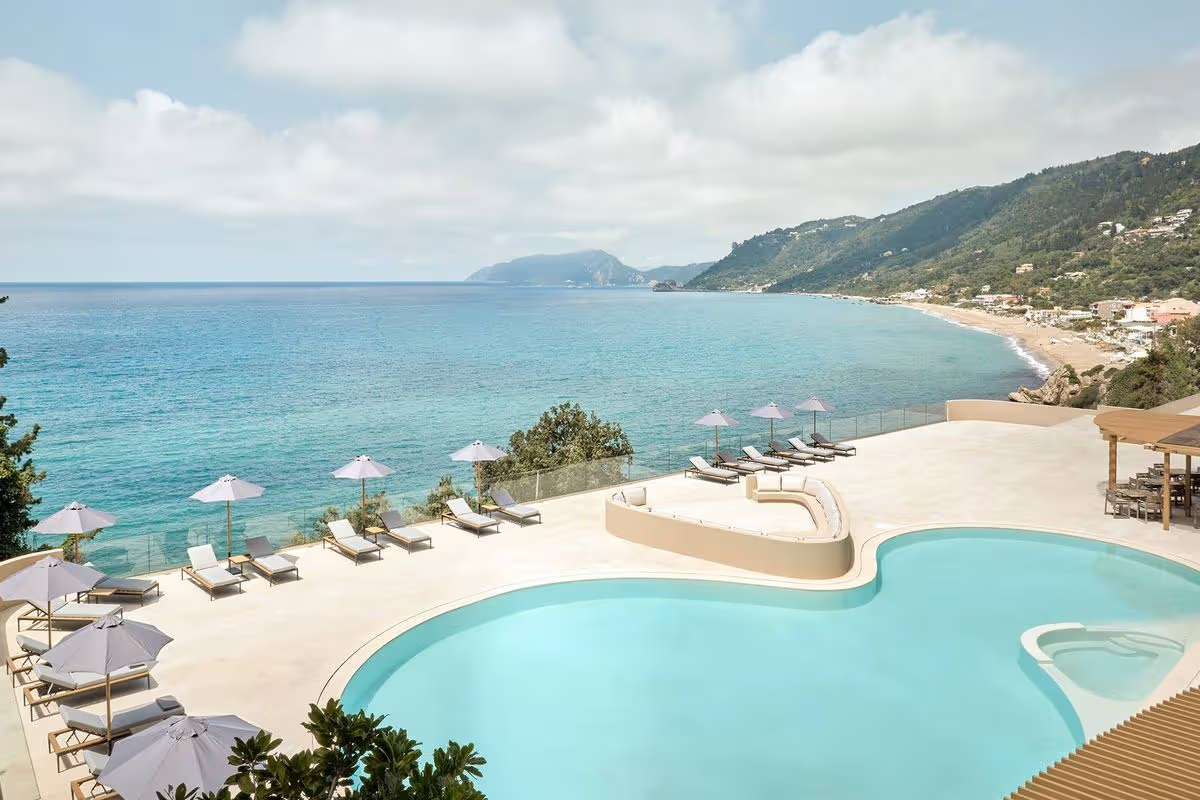
The resort sits close to the small village of Agios Gordios(Image: Ella Álkyna)
There arrives a moment in life when the notion of an adults-only, all-inclusive resort suddenly seems less of a luxury and more of a relief. No inflatable pool toys hurtling towards you, no frantic early-morning buffet chaos – simply sea vistas, excellent cuisine and the freedom to do absolutely nothing if that’s what you fancy. That’s precisely the atmosphere Ella Álkyna delivers to Corfu’s west coast.
Recently launched and positioned high above the dramatic bay of Agios Gordios, it’s crafted as a sophisticated, luxury retreat, yet without the eye-watering bill you’d typically encounter at other 5-star Mediterranean resorts.
The accommodation
The resort boasts 349 rooms, suites and villas, all orientated towards the Ionian Sea to ensure the panorama is practically inescapable. I stayed in a private pool sea-view room, which swiftly became the standout feature of the entire visit. At the more budget-friendly end of the spectrum, you can also reserve charming comfort rooms that still offer equally stunning vistas.
Inside, the design is serene and modern, featuring touches of pale timber, sandy hues and linen finishes that mirror the scenery beyond. But the genuine showstopper is the terrace. My compact private pool gazed straight out across the water, meaning mornings commenced with a pre-breakfast swim and evenings frequently concluded with another plunge as the sun descended behind the cliffs. Bathrooms are spaciously proportioned with rainfall showers and sumptuous robes, reports OK!.
The resort Álkyna is carved into the hillside overlooking Agios Gordios beach, and the location is breathtaking. The resort’s terraces tumble downwards, meaning virtually every spot – from the pools to the dining areas – boasts sweeping sea vistas. Amenities include two primary outdoor pools, an indoor pool, and a contemporary spa and wellness centre.
One point worth noting: the sunloungers surrounding the main pools tend to get snapped up fairly swiftly as the morning progresses. There’s no requirement for a crack-of-dawn towel dash, but if you’ve got your eye on a specific view, it’s wise to head down following breakfast rather than waiting until mid-afternoon.
Dining takes centre stage here, with three restaurants – Cocura, Nafs and Lucáta – plus six bars dotted throughout the resort. Several of the culinary concepts were developed alongside Michelin-starred chef Alex Tsiotinis, which accounts for why evening meals feel more akin to a chic metropolitan eatery than a typical hotel buffet.
Anticipate abundant Mediterranean touches such as grilled seafood, seasonal vegetables, regional olive oil and dishes crafted for leisurely, convivial dining rather than hurried consumption. Most tables are positioned outdoors, as you’d expect, meaning dinner frequently comes accompanied by a sea breeze and a stunning sunset.
It’s worth noting, however, that Corfu’s late-summer wasp season can make alfresco dining slightly more animated than anticipated. They appeared especially drawn to sweet cocktails and anything containing honey during my visit, so a touch of patience or a well-chosen seat makes all the difference if you’re planning to go in August or September.
What’s on offer at the resort
There’s no shortage of activities if you fancy keeping busy. Visitors can take part in fitness classes, yoga and Pilates sessions, or indulge at the spa with massages and facials designed to promote complete relaxation. I was especially taken with the on-site Roée Wellness spa’s Finnish sauna and steam room, and enjoyed the most soothing (and aromatic) 50 minutes of tranquillity thanks to the bespoke massage featuring Greek botanicals and natural oils.
Exploring the local area
The resort is located near the charming village of Agios Gordios, where traditional tavernas dot the seafront and the sunsets are renowned throughout the island. If you venture out just once, I’d urge you to visit Akrogiali Family Taverna, where I sampled the finest honey-drenched baklava and ice cream of my entire life.
I’d also strongly suggest making the journey to Kaiser’s Throne in the quaint town of Pelekas, merely a 20-minute drive away. The walk is brief, and the restaurant perched at the summit serves superb Greek salads alongside endless emerald vistas. For a change of scenery, Corfu Town is approximately a 30-minute taxi journey away and certainly worth a visit. Its Venetian alleyways, independent boutiques and bustling squares make it one of Greece’s most characterful island capitals. Boat excursions along the west coast are also sought-after and showcase some of Corfu’s most striking beaches and secluded coves.
Book it
Comfort Room with Sea View prices start from £215 per night based on an all-inclusive basis. To book, visit here. Flights to Corfu from major UK airports are served by Ryanair, easyJet, Jet2 and more.
A fourth man has been arrested in the arson of several Jewish ambulances parked in front of a synagogue that belonged to a volunteer service. Three that have already been charged will next appear in court in late April. File by Andy Rain/EPA
April 4 (UPI) — A fourth man suspected of being involved in an attack on a Jewish volunteer ambulance service was arrested when he attended a hearing for three of his alleged accomplices.
On March 26, four ambulances that belong to a Jewish community organization were torched in the Golders Green area of North London in an attack that police said was aimed at terrorizing the Jewish community there.
Police on Saturday arrested a fourth suspect in the attack during a hearing for three people — two British citizens, Hamza Iqbal, 20, and Rehan Khan, 19, as well as a 17-year-old with dual British-Pakistani citizenship — who had already been charged in the crime, The BBC reported.
Officers, who already were aware that four people were responsible for the arson, recognized a 19-year-old man who was suspected of participating and arrested him at Westminster Magistrates’ Court.
Golders Green has a large Jewish population and the four people are suspected for being responsible for oxygen cylinders in four ambulances parked outside a synagogue there that exploded on March 23, The New York Times reported.
All four were arrested, although the 19-year-old arrested while entering the courthouse has not formally been charged, while the other three face an April 24 court date.
Two other men also had been arrested and released on bail, but also will be expected in court in April.
The four ambulances were operated by Hatzolah, an organization that was started in 1973 in New York by a group of Orthodox Jews trained in First Aid and CPR looking to assist their local community, according to the group’s website.
Court records show well over $1 million in damage in what prosecutors called a “premeditated and targeted attack against the Jewish community.”
Since its founding, volunteer ambulance groups associated with the organization have been established across the United States, United Kingdom, Canada, Mexico, South Africa and Australia, among other places.
Violence against Jewish people and organizations has increased over the course of the past year globally, including in London.
The Metropolitan Police said it has deployed “highly visible armed police patrols” to areas with larger Jewish populations because of a series of fires and attacks across Europe and the United States that have been blamed on doing business with Jewish people.
Metropolitan Police Commissioner Mark Rowley said at the beginning of the week that a claim of responsibility by a group with links to Iran was being investigated but stopped short of officially placing blame.
“Whoever was responsible, the impact is serious,” Rowley said.
Masked Palestinians hold knives and axes as they celebrate an attack on a Jerusalem synagogue while standing in front of a poster of the attackers,Ghassan and Uday Abu Jamal, during a rally in Rafah in the southern Gaza Strip November 18, 2014. Two Palestinians armed with a meat cleaver and a gun killed fiver people in a Jerusalem synagogue on Tuesday before being shot dead by police, the deadliest such incident in six years in the holy city amid a surge in religious conflict. UPI/Ismael Mohamad | License Photo
Finding a new TV show can be a chore in itself but luckily people have recently suggested a series which is the “funniest ever” that’ll make you “spit up laughing”
Christine Younan Deputy Editor Social Newsdesk
05:07, 05 Apr 2026
The series is available to watch on Netflix(Image: Peacock)
Recently, people went wild for a gripping series which is similar to Breaking Bad and Dexter. Now if you want something comical and we’re talking laugh out loud funny, then viewers are singing the praises of one show which is available on Netflix. It comes as one TV fan revealed they were on the search for something that “hooks you early” and stays good all the way through.
Posting on Reddit, the person visited the r/tvsuggestions forum for inspiration as many recommended Resident Alien.
They asked: “It feels like everything is overhyped lately and I keep getting disappointed after something people swear is amazing.
“Don’t get me wrong, I don’t mind popular shows, I just want something that actually lives up to it and doesn’t fall off after a few episodes.
“Ideally something that hooks you early and stays consistently good all the way through. Open to any genre at this point, I just want a show that delivers.”
In the comments section, people recommended Resident Alien which is “one of the funniest shows ever made”.
Someone commented: “For real! I absolutely adore it. Such a good storyline. Hard to watch it and eat or drink though. The sudden hilarious moments make me spit laugh.”
What is Resident Alien about?
The American science fiction comedy-drama TV series, which was created by Chris Sheridan, is about an extraterrestrial sent to wipe out humanity who kills a vacationing physician and takes on his identity.
After a crash landing on Earth in a small town in Colorado, the extraterrestrial, named Harry, is asked to do an autopsy on the town’s doctor, who died in unknown circumstances, and eventually takes over for the doctor at the town’s clinic.
With the moral dilemma of his secret mission, he also deals with the mayor’s young son who can see his true alien appearance. He also develops compassion for humanity and ends up defending them from other extraterrestrial threats.
The series ran for four seasons from January 2021 to August 2025 on Syfy, but now it’s available to watch on Netflix.
Rated a 15, the comedy has an 8 out of 10 rating on IMDB. Reviewers say ‘Resident Alien’ is lauded for its clever humour and engaging storylines.
Denis Bouanga scored three goals, his fifth career hat trick in MLS, and Son Heung-min had four assists to help LAFC beat Orlando City 6-0 on Saturday night.
Sergi Palencia and Tyler Boyd each added a goal for LAFC (6-0-1). Hugo Lloris had six saves.
Orlando City (1-5-0) — which also conceded a hat trick to Sam Surridge the previous time out in a 5-0 loss to Nashville and lost 5-0 at New York City FC on March 7 — set the franchise record for largest margin of defeat in a regular-season match.
Son’s cross was redirected into the net by Orlando defender David Brekalo to give LAFC a 1-0 lead in the seventh minute.
Bouanga added goals — all off assists by Son — in the 20th, 23rd and 28th minutes.
Son fed Sergi Palencia for his first goal of the season that made it 5-0 in the 39th, and Boyd capped the scoring in the 70th minute with his first MLS goal since July 13, 2024 for Nashville.
Hebron, occupied West Bank – Hebron’s Ibrahimi Mosque is no more than 50 metres from Aref Jaber’s home, in the neighbourhood that bears his surname, reflecting his family’s long history in the Palestinian city.
The 51-year-old has taken advantage of that proximity since his childhood, regularly praying at the mosque, one of the most important Islamic sites, and a Palestinian national symbol.
Recommended Stories
list of 3 itemsend of list
But the Ibrahimi Mosque of Jaber’s childhood is not the one of today. A 1994 massacre of Muslim worshippers by the Israeli settler Baruch Goldstein killed 29 Palestinians. Instead of getting justice, Palestinians faced more restrictions in the aftermath of the attack.
Israeli settlers began establishing an illegal presence in Hebron, part of the occupied West Bank, in 1968, the year after Israel seized control of the Palestinian territory. The settlers have been working to grow their presence ever since, with increased support from the Israeli government.
After 1994, Israel began taking steps to, in effect, control the Ibrahimi Mosque – known to Jews as the Cave of the Patriarchs – by closing off large areas in Hebron’s Old City and the southern area surrounding the mosque, then dividing it between Muslims and a few hundred Jewish settlers, granting the latter the right to pray there.
This was followed by the signing of the Hebron Agreement with the Palestinian Authority in 1997, which stipulated the division of the city into two parts: H1, under Palestinian control, comprising 80 percent of the area, and H2, under Israeli control, comprising 20 percent, but including the Ibrahimi Mosque and the Old City.
Following this series of events, settlement activity intensified in the heart of Hebron. Settlers established illegal outposts within the Old City and began gradually expanding and seizing new homes under the protection of the Israeli army.
Meanwhile, Palestinians were subjected to closures, restrictions and repressive measures aimed at forcing them to leave the Old City, thus facilitating Israeli control over the mosque.
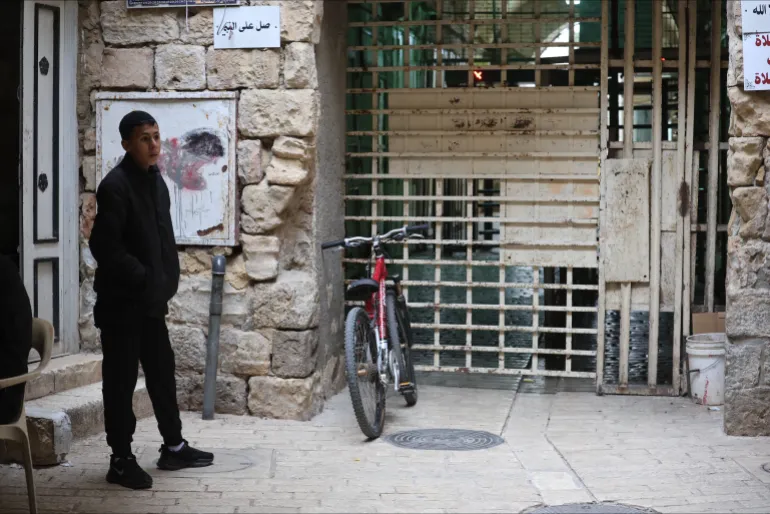
Israeli forces have erected metal barriers throughout the neighbourhoods surrounding the Ibrahimi Mosque, restricting access for Palestinians [Mosab Shawer/Al Jazeera]
Neighbours of the Ibrahimi Mosque
Jaber had hoped that his children would pray at the mosque daily and become familiar with it, but Israeli measures prevented this.
He explained that since 1994, the southern gate of the mosque, which residents of his neighbourhood used for access, has been closed. They have instead been forced to take alternative routes, turning a journey of 50 metres into one that now spans almost three kilometres.
Things have gotten worse since the beginning of Israel’s genocidal war on Gaza in October 2023, when Israel also ramped up its attacks in the West Bank.
Israel tightened its grip on the mosque and its surroundings, closing more of the alternative routes.
“The difficulty of reaching the mosque is compounded by the procedures at the iron and electronic gates installed at its entrances and in its vicinity,” Jaber said. “We are subjected to searches, detention, and harassment without any justification, and often young men, boys, and even women are arrested.”
The Israeli government says that the restrictions are necessary for security reasons – to protect Israeli settlers whose presence in the West Bank’s most populous city is illegal under international law.
Jaber explained how the Israeli army closes barriers and gates around the mosque and the neighbourhoods that surround it for extended periods under security pretexts. Palestinian residents are not allowed to leave their homes, even to shop, while settlers are permitted to move freely throughout the Old City.
Israeli authorities also used the justification of the current conflict with Iran to close access to the Ibrahimi Mosque for Palestinians for six days from February 28, allowing it to reopen for a limited number of worshippers on March 6.
The Ibrahimi Mosque is an important Islamic holy site and a Palestinian national symbol, also holy to Jews who call it the Cave of the Patriarchs [Mosab Shawer/Al Jazeera]
Increased control
But these measures aren’t only aimed at restricting Palestinians in the vicinity of the mosque, but also seem to be an attempt to establish complete Israeli security control over it, with measures similar to those Israel employs at the Al-Aqsa Mosque in occupied East Jerusalem.
In Al-Aqsa, the third holiest site in Islam, renewable expulsion orders are used to prevent the entry of worshippers deemed troublesome. Searches are also regularly conducted at the gates of Al-Aqsa, as well as detentions, confiscation of identity cards and restrictions on entry to certain parts of the mosque compound.
Israel now regularly conducts similar actions at the Ibrahimi Mosque.
The Israeli army issued orders to remove Moataz Abu Sneineh, the director of the Ibrahimi Mosque, and other employees from the mosque for 15 days in January. The Palestinian Authority said that the orders were part of “an attempt to reduce their role in the administration and supervision of the Ibrahimi Mosque’s religious and administrative affairs”.
Israeli officials have also tried to push through construction work in the mosque without the approval of Palestinian officials.
On February 9, the Israeli cabinet approved the transfer of licensing, building and municipal administration powers in Hebron from the municipality to the Israeli Civil Administration, in addition to establishing a separate settlement municipality within the city.
The change, part of an internationally condemned Israeli push to increase control over the West Bank and make Israeli settlement easier, is seen as illegitimate and dangerous to the existing status quo, threatening freedom of worship and public order, according to a statement issued by the Hebron Municipality in response to the decision.
Abu Sneineh told Al Jazeera that Israel has transformed the mosque into something resembling a “military barracks” due to the stringent measures it imposes, which “aim to reduce the number of worshippers there”.
According to Abu Sneineh, the Israeli government interfered in the authority of the Ministry of Religious Endowments, and the call to prayer was prevented from being performed dozens of times a month. Worshippers were subjected to humiliating treatment at the mosque entrance, including beatings, verbal abuse and expulsion. Abu Sneineh said the measures were part of a systematic Israeli policy aimed at transforming the mosque into a Jewish synagogue.
“Israel is trying to impose a new reality by controlling the mosque and obstructing worshippers’ access to it, whether during Ramadan or at other times. After October 2023, the measures became even more stringent to erase the Islamic identity of the place, as if it were racing against time to seize control of it,” he added.
On February 28, coinciding with the start of Israeli-American strikes on Iran, the Israeli army expelled worshippers and staff from the mosque and informed them of its closure until further notice, just as it had done at Al-Aqsa Mosque in Jerusalem on the same day under the declared state of emergency measures.
The director of the Youth Against Settlements group and a resident of the Old City, Issa Amro, believes that the situation at the Ibrahimi Mosque is more dangerous than at Al-Aqsa Mosque because it has suffered from temporal and spatial division since 1994.
The “arbitrary” barriers, the closure of surrounding markets and main roads leading to it, and recently the closure of checkpoints in the southern area of the city – which includes the Old City and the Ibrahimi Mosque – prevent approximately 50,000 citizens from accessing it, along with the transfer of supervisory authority of parts of the mosque to the Religious Council in the illegal Kiryat Arba settlement, are extremely dangerous steps that threaten the Palestinian identity of the site, Amro said.
“The Jewish area [of the mosque] has been expanded, and recently, residents around the mosque have been living a difficult life due to soldier violence, settler terrorism, the constant closure of barriers, and restrictions on leaving their homes. They live as prisoners in their own homes in fear of settlers and soldiers, and disturbed by the constant gatherings held by settlers in the mosque,” he added.
According to the Applied Research Institute – Jerusalem (ARIJ) – a Palestinian research institute – approximately 40,000 Palestinians live in the H2 area, alongside about 800 Israeli settlers residing in 14 small illegal settlement outposts. These outposts are under heavy protection from thousands of Israeli soldiers deployed around the perimeter of the area and in the streets of the Old City, preventing Palestinians from leading normal lives.
The outposts are managed by the Hebron Settlements Council, which is linked to the parent settlement, Kiryat Arba, located east of the city.
A research study published by the institute in November 2025 revealed a significant increase in the forced displacement of Palestinians from the H2 area over the past two decades.
The Israeli human rights group B’Tselem said in a 2019 report that about 35,000 Palestinians lived in Hebron’s H2 area when the Hebron Agreement was signed in 1997. Today, only around 7,000 remain. Roughly 1,000 of them live in a particularly restricted zone around the Tel Rumeida neighbourhood and Shuhada Street – formerly Hebron’s main shopping street, which is now closed to Palestinians, due to the presence of several illegal Israeli settlements.
Palestinian families in the Old City and the vicinity of the Ibrahimi Mosque are subjected to various forms of pressure, including demolition orders under the pretext of unlicensed construction, frequent arrests, settler attacks on residents and students travelling to and from school, economic restrictions, shop closures, and movement restrictions, particularly regarding access to places of worship and hospitals.
According to the United Nations Office for the Coordination of Humanitarian Affairs, the area contains 97 various military checkpoints and barriers.
These are often closed for hours or even days at a time without prior notice, paralysing movement within the Old City and the residential areas adjacent to the mosque.
Towards full annexation
Observers see these measures in Hebron as a prelude to establishing a fait accompli in the West Bank as a whole, which has been subjected for more than two years to accelerated policies aimed at controlling the largest possible area of land and expanding settlements.
Settlement affairs researcher Mahmoud al-Saifi told Al Jazeera that Israel has sought over the past two years to solidify the annexation of the West Bank, particularly Area C, which constitutes more than 61 percent of the total area of the West Bank.
Israeli authorities have approved 54 new official settlements and 86 smaller outposts in 2025 alone, according to data from Peace Now, which monitors settlement activity.
Planning was approved or advanced for some 51,370 settlement units in the West Bank from late 2022 to the end of 2025, a figure also announced by Israeli government agencies based on data from the Higher Planning Council.
In addition, 222 kilometres of secondary and bypass roads were constructed in the two years preceding January 2025, aimed at connecting outposts to main settlements.
As a result of these policies, the Palestinian presence has dwindled in many areas, particularly the Jordan Valley, where their number has decreased to no more than 65,000.
“Israel is implementing a policy of encirclement and strangulation of small villages in the West Bank by confiscating land and preventing Palestinian construction, in contrast to the frenzied settlement wave that Smotrich called a ‘settlement revolution,’ and the accompanying bitter reality for Palestinians,” al-Saifi said.
There are now thousands of armed settlers spread throughout the West Bank, al-Saifi noted. Skilfully trained and often called settlement guards, they are essentially a rear guard force for the Israeli army, used to attack and intimidate Palestinians and seize their land.
“All Bedouin communities are located in Area C, and 47 of them have been forcibly displaced since October 2023, meaning more than 4,000 Palestinians have been displaced in just two and a half years,” al-Saifi said. “This is part of ethnic cleansing and de facto annexation on the ground.”
Company says move amid US-Israel war on Iran comes after a request from the US government.
Published On 5 Apr 20265 Apr 2026
Satellite imaging company Planet Labs has said it will indefinitely withhold visuals of Iran and the region of conflict in the Middle East to comply with a request from United States President Donald Trump’s administration.
The US company announced the decision in an email to customers on Saturday, with news agencies quoting it as saying the government had asked satellite imagery providers to impose an “indefinite withhold of imagery”.
The restriction expands upon a 14-day delay on imagery of the Middle East that Planet Labs implemented last month, which extended an initial 96-hour delay, a move the firm said was meant to prevent adversaries from using the imagery to attack the US and its allies.
Planet Labs said it will withhold imagery dating back to March 9 and that it expects the policy to remain in effect until the end of the war, which began on February 28 when the US and Israel launched aerial attacks against Iran. The conflict has since spread across the region, with Iran firing missile and drone barrages at Israel and US assets, as well as civilian infrastructure across the Gulf.
Planet Labs, which was founded in 2010 by former NASA scientists, said in its email to customers that it would switch to a “managed distribution of images” deemed not to pose a risk to safety.
Under a new system, Planet Labs will release imagery on a case-by-case basis for urgent, mission-critical requirements or in the public interest.
“These are extraordinary circumstances, and we are doing all we can to balance the needs of all our stakeholders,” the California-based company was quoted as saying.
Military uses of satellite technology include target identification, weapons guidance, missile tracking and communications. Some space specialists say Iran could be accessing commercial imagery, including pictures obtained via US adversaries. Satellite images also help journalists and academics studying hard-to-reach places.
Eugene Mirman appears to be in good spirits after being injured in a fiery car crash.
The comedian and “Bob’s Burgers” actor shared an Instagram update Friday to reassure fans he is “doing relatively alright, all things considered.” Mirman was hospitalized for serious injuries on Tuesday after being pulled out of the window of his Lucid Gravity that had caught fire after crashing into the Bedford Toll Plaza in New Hampshire.
“I am extraordinarily thankful to the heroic people that pulled me from the car and to the warm, kind and talented staff at the hospital that cared for me and got me on the mend!” Mirman wrote in the caption accompanying a photo of himself bandaged up and holding a piece of art that reads “Life is an Adventure.” “I am thankful beyond words to be here and doing relatively alright, all things considered.”
He also thanked everyone who had reached out with “well wishes, love and kind messages.” While Mirman appears a bit banged up in the photo, it did not keep him from including a dash of humor in his update.
“I don’t have my phone, so haven’t been online much,” his post continued. “I do not recommend my method of decreasing screen-time. If you’re a friend who sent a kind, loving message, you should know that it was hard to not respond with, ‘I’d love to be on your podcast.’ I love you all and please take care of yourselves.”
Among those who helped Mirman before first responders arrived were New Hampshire Gov. Kelly Ayotte and her security detail.
“I want to thank the Trooper on my security detail and the bystanders who stepped up to help at the scene of the crash for their brave lifesaving efforts today,” Ayotte wrote Tuesday in a post on X. “Joe and I are praying for the full recovery of the driver who was injured today.”
Mirman voices middle child Gene Belcher in Fox’s animated comedy “Bob’s Burgers,” which is currently in its 16th season.
Quinton Byfield scored 2:33 into overtime, Adrian Kempe had two goals and two assists, and the Kings beat the Toronto Maple Leafs 7-6 on Saturday at Crypto.com Arena.
Byfield finished off Artemi Panarin’s pass for his second goal of the game, securing a crucial win for the Kings, who set an NHL single-season record by playing their 31st game past regulation.
William Nylander missed his shot on a breakaway, leading to a three-on-two rush the other way where Byfield netted his 20th goal of the season.
With the win, the Kings moved into the second wild-card playoff spot in the Western Conference before San José and Nashville played each other later Saturday night.
Panarin, Samuel Helenius and Alex Laferriere also scored for the Kings, and Darcy Kuemper made 14 saves.
Matthew Knies had two goals, and John Tavares, Easton Cowan, Steven Lorentz and Nicholas Robertson also scored for the Maple Leafs. Joseph Woll made 33 saves.
The Kings came into the game stressing a good start, having been outscored 5-1 in the first period of their previous three outings, and instead face planted to spot the Maple Leafs a 2-0 lead through 20 minutes.
The Kings bounced back in the second period with three goals and tied the score twice, only for Cowan to capitalize on the power play with 12.5 seconds remaining to put Toronto back up 4-3 after two.
Kempe, Helenius and Laferriere all scored in the third period in a span of 1:36 to give the Kings a 6-4 lead, but Robertson and Knies responded to send Kings into extra hockey yet again.
The Kings have already set an NHL record with 19 losses in overtime or a shootout.
British content creator Luke Tweddle has discussed whether life is better in Australia than in the UK after moving there three years ago and he said the answer wasn’t ‘simple’
Tehran says Iraq will face no restrictions in waterway, praising country’s ‘struggle’ against the US.
Published On 5 Apr 20265 Apr 2026
Iran has announced that Iraqi ships are free to pass the Strait of Hormuz, the latest sign of Tehran easing its stranglehold on the critical conduit for global energy supplies.
Iraq will be exempt from all restrictions in the strait, with controls only applying to “enemy countries”, Iran’s Khatam al-Anbiya Central Headquarters said in a statement on Saturday.
Recommended Stories
list of 4 itemsend of list
“We hold profound respect for Iraq’s national sovereignty,” the military command said in the statement carried by the semi-official Tasnim News Agency.
“You are a nation that bears the scars of American occupation, and your struggle against the US is worthy of praise and admiration.”
Iran’s announcement came as US President Donald Trump reiterated his demands for Tehran to make a deal or relinquish control of the waterway, warning in a social media post that “all hell” would rain down within 48 hours otherwise.
Iran’s Khatam al-Anbiya Central Headquarters rejected Trump’s demand, calling his threat a “helpless, nervous, unbalanced and stupid action”.
Iran has effectively blockaded the strait, which usually carries about one-fifth of global oil and liquified natural gas supplies, since the US and Israel launched their war on the country on February 28.
While maritime traffic has ticked up in recent weeks under a de facto toll booth system imposed by Tehran, it is still down more than 90 percent from normal levels, according to ship tracking data.
According to Lloyd’s List Intelligence, there were 53 transits through the strait last week, up from 36 the previous week and the most since the war began.
The collapse of shipping in the waterway has thrown a wrench in global energy markets, pushing up fuel prices and prompting authorities in many countries to roll out emergency energy conservation measures.
Brent crude, the international benchmark, has hovered above $109 a barrel in recent days, with many analysts predicting prices to surge much higher if the waterway is not unblocked soon.
Iraq’s oil production, which provides most of Baghdad’s revenues, has been hit especially hard by the war.
Iraq’s oil ministry announced last month that production had fallen to 1.2 million barrels a day, down from 4.3 million barrels, amid declining crude shortage capacity due to the effective halt of exports through the strait.
Iraq was the world’s six-biggest oil producer in 2023, accounting for 4 percent of global supply, according to the US Energy Information Administration.
Fabiola José and Fidel Barbarito will offer insights into Venezuelan cultural expressions. (Venezuelanalysis)
The “Cultural Re-existence” column will provide insights into how our ancestral practices, habits, customs, and traditions remain alive today because Venezuelans preserve them through the human spirit they embody and amplify. These are expressions of women and men grounded in reality, history, and a consciousness of their subjective revolutionary role, as well as their responsibility and commitment to defending life.
“La muerte del poeta,” a joropo oriental by Luisana Pérez.
March, in addition to being the month honoring women, is a month of celebration centered on Venezuela’s most widespread traditional rhythm: joropo. (1) And although this is a community tradition with unique variations throughout Venezuela, on March 19 the town of Elorza in Apure state hosts a ten-day festival that draws thousands of people from all over Venezuela and other countries, to participate and enjoy concerts until dawn, joropo llanero singing and dancing contests, sports and recreational activities linked to the Llano culture, as well as culinary and artisan fairs. Another iconic date this month is March 15, since in 2014 the Bolivarian government declared “Traditional Venezuelan Joropo in All its Diversity” to be part of the nation’s cultural heritage. From that moment, this date has been commemorated as National Joropo Day.
As a community-based festival, the Venezuelan joropo in its various forms—in the eastern, north-central coastal, llanos, western, and Andean regions—has seen Venezuelan women become committed cultural creators who are conscious of their community’s identity, the very identity that has allowed them to endure since colonial times, keeping alive the feelings, thoughts, and actions that extend beyond their own lives, into the lives of their children and grandchildren.
Venezuelan women, as practitioners of the various joropos, have had to fight—as women and as joropo creators—against the Inquisition, the nation-state, and the cultural industry for their right to exist. It is well known that these institutions demonized them for “disturbing devotion,” and even today they compel them to adopt a masculinized representation of their own identity or impose the sexualization of their aesthetic expression. There is a historical debt to acknowledge the heroic insurgency that the practice, creation, and celebration of the various Venezuelan joropos have meant for the Venezuelan people, and this debt is owed primarily to the joroperas [female joropo practitioners] for their unrelenting commitment to our identities, even during the most complex moments of our history as an insurgent people.
For these reasons, we wanted to inaugurate our column with the perspective that Venezuelan women have on this popular community festival. Through Fabiola José, we were invited to the 3rd “Mujer Joropo” (Joropo Women) Gathering, held in honor of singer Cecilia Todd and dancer María Ruíz. This was our cue to attend the “Joropazo” organized at the San Carlos Barracks in Caracas on March 15, and to participate as singers and spectators in this gathering of women, an artistic-cultural initiative that brought together singers, dancers, and musicians of all ages, with repertoires integrating both the traditional music and dances of our communities and more contemporary musical and choreographic expressions that speak to multigenerational dialogue and the enduring relevance of this popular art form.
“Semillas de Amor,” a joropo central by Amaranta Pérez feat. Arturo García.
Honoring women’s role in joropo
Carolina Veracierta is the organizer of Mujer Joropo. A dancer, writer, designer, and singer, she explained to us that the project “focuses on women not just in a supporting role but as a protagonist, a creator, and carrier of ancestral knowledge.”
“For me, the joropo isn’t just a musical genre or a dance; it’s the language through which my body and my voice express my very essence. It’s the echo of my childhood in Monagas state and the strength that has sustained me on stages far away,” she explained. “When I dance the joropo, I don’t just move my feet; I shake off my sorrows, celebrate my victories, and honor the women who, before me, kept the rhythm in their skirts and in their songs to accompany the milking of cows.”
Asked about the importance of an event featuring women exclusively, Veracierta argued that joropo has historically had “a very masculine narrative” but that women have always been present, “sustaining the rhythm and in tandem with the man’s foot-stomping.”
“Celebrating it among women is an act of sorority and empowerment,” she concluded. “Joropo has the soul of a woman.”
Amaranta Pérez, another artist featured in the event, told us that joropo brings her an immediate jolt of happiness. “It takes me back to my family’s roots between Parmana and Valle de la Pascua [Guárico state], it is a sort of therapy,” she said. “I especially cherish the lyrics that express the love for our people, landscapes, history, and the folk tales from our wonderful authors that are turned into songs.”
Amaranta defended the importance of events like Mujer Joropo to help correct women’s “unequal” participation in the artistic sphere.
For her part, singer, professor, and bassoonist Luisana Pérez affirmed that “joropo for me is synonymous with Venezuela, from its history to the yellow, blue, red and eight stars that make up the national flag.”
Concerning Mujer Joropo, Luisana explained that “it was unusual to see women playing the mandolin, the harp, or the cuatro” and that these kinds of events “are a beautiful way to reclaim the role played by women in joropo.”
More than 20 artists participated in this third edition of Mujer Joropo, demonstrating the commitment of contemporary Venezuelan women to their own history, to the artistic legacy of their ancestors, and to the responsibility of preserving and promoting the heritage they now hold.
“Zumba que zumba,” a joropo llanero by Fabiola José feat. Ricardo Sandoval and Jesús González.
From underground communal festivity to national identity manufactured by the music industry
On April 10, 1749, the governor and captain general of Venezuela, Don Luis Francisco de Castellanos, published what may be the first documented reference to the joropo. He did so in the form of a decree banning the Xoropo Escobillado, “…due to its extreme movements, insolence, heel-stomping, and other indecencies, it has been frowned upon by some people of sound mind…”. The official decided to consult the Royal Audience on this matter, likely due to widespread controversy, and in the meantime, warned that those who violated the ban would face public scrutiny plus two years of imprisonment, and women would be “…confined to hospitals for an equal period…”.
Although this is the first formal ban to explicitly name joropo, we cannot overlook the fact that, as early as 1532, the Catholic Church’s published constitutions regulated and prohibited popular festivals in general, especially those where the music and dances of Mulatto, Black, and Indigenous women “…disturb devotion…,” or where both sexes mingle in dance, or those where the veneration of saints was a pretext for throwing a party.
If we consider that there is evidence that the first vihuelas [medieval Spanish string instrument] arrived in 1529 in the territory we now call Venezuela, and if we acknowledge the express order of the Catholic Monarchs to ship instruments and musicians starting with Columbus’s second voyage (1493), we could infer that between these dates and Governor Castellanos’s ban, there were some 220–250 years of incubation for what would eventually become an irreversible trend in popular culture, which the colonial order had no choice but to accept.
Although the term xoropo has been interpreted as coming from Arabic as jarabe ( شراب , sharab), for the Andalusian researcher, poet, and musician Antonio Manuel Rodríguez Ramos, the root is undoubtedly that of drinking ( شرب , shurib), and he explains that initially, this is how the festival of drinking, singing, dancing, and eating might have been called. And the fact is that drinking –alcohol– was the best way for converts to avoid suspicion from the Tribunal of the Holy Office of the Inquisition, which was formally operational in our country between 1610 and 1821.
Related to other rhythms including fandangos, jácaras, folías, jarabes, and sones, Venezuelan joropos were documented in the independence struggle that led Bolívar’s armies as far as Peru during the nineteenth century. In the mid-twentieth century, one of these joropos, the llanero, was established as the national music style and dance, though it was a version that had certainly lost its communal and rustic character. By then, the music industry, aware of the deep roots these sounds had in Venezuelans, marketed a series of commercial products featuring music, lyrics, and singers stylized to fit institutional, urban, and bourgeois tastes.
As we noted above, on March 15, 2014, the Venezuelan government declared “Traditional Venezuelan Joropo in All its Diversity” as part of the nation’s cultural heritage, recognizing it as an element of identity and unity –not only in many of our festivities and collective expressions throughout the country, but also as a collective process of community organization. The declaration of the diversity of joropos as cultural heritage was the result of a series of debates that took place both within the community of cultural workers and among research specialists.
With the same strategy of asserting the joropo not only as a dance but as a complex cultural system that integrates music, song, dance, poetry, and oral traditions passed down through generations, Venezuela proposed to the UNESCO Intergovernmental Committee for the Safeguarding of the Intangible Cultural Heritage that the Venezuelan joropo be included on the Representative List of the Intangible Cultural Heritage of Humanity. The committee approved the proposal on December 9, 2025.
Venezuelan joropos thus allow people to come together and reclaim their humanity through the recognition of their own dignity. Through parrandas, festivals for singing, dancing, eating, and drinking, joropo expresses a communal setting where agriculture, cattle rearing, and fishing were the means of sustaining life. Persecuted by the colonial order, homogenized by the nation-state, and commercialized by the music industry through jingle-franchise schemes, Venezuelan joropos also survived the journey from the rural countryside to the oil-driven urban environments.
This continuous history of persecution, denial, whitewashing, and normalization has actually pushed joropo women and men to sneak away, resonate, hold firm, reinvent themselves, and stand out in a permanent process of self-consciousness, recognition, and realization. It is not merely a connection to the land, to love, to our mothers, but to the dream of living in a free land, and the will to produce a cultural liberation project.
Note
(1) With a myriad of local expressions, joropo is the most widespread traditional rhythm in Venezuela. Its execution typically features at least one singer, maracas as percussion, the Venezuelan cuatro [four-stringed instrument], and other string instruments such as the harp or the mandolin. The most well-known variations are the joropo llanero, from the plains region, joropo oriental from the eastern coastal areas and Margarita island, and joropo central from Miranda and Aragua states in the center of the country. Listen to the songs above for examples.
Fabiola José is a Venezuelan singer. She has performed in countries across South America, Africa, Europe, and Asia. Her singles and albums are available on all digital platforms. She hosted and produced “Cantante y Sonante” for Radio Nacional de Venezuela. In 2018–2019, she created a series of videos for social media, published on her YouTube channel #HechoEnCasa. She holds a bachelor’s degree in Music from IUDEM, Caracas (2005); specialized under Maestro Tom Krause in Spain (2007); and an M.A. in Arts and Cultures of the South from UNEARTE, Venezuela (2020).
Fidel Barbarito is a Venezuelan musician and researcher, with a bachelor’s and master’s degrees in music and history, respectively. He teaches in the undergraduate and graduate programs at the National Experimental University of the Arts (UNEARTE). Together with Fabiola José, he promotes several musical projects aimed at disseminating traditional folk repertoires, integrating them with contemporary compositions inspired by these sounds. Joropo llanero. Parranda de reexistencia is one of his published essays.
The views expressed in this article are the authors’ own and do not necessarily reflect those of the Venezuelanalysis editorial staff.
Patsy Kensit is reportedly returning to Emmerdale as villain Sadie King 20 years after her big exit, with ‘explosive’ scenes on the way when she heads back later this year
22:04, 04 Apr 2026Updated 22:06, 04 Apr 2026
An Emmerdale villain is reportedly heading back to the ITV soap after 20 years(Image: ITV Network)
An Emmerdale villain is reportedly heading back to the ITV soap after 20 years.
Later this year, it’s been reported that TV star Patsy Kensit will be reprising her role as fan favourite Sadie King. The character debuted on the show back in 2004 as part of the King family.
The former wife of Jimmy King, who is still in the village with his new wife Nicola King, Sadie turned against the family when she teamed up with Cain Dingle to target them.
Cain ended double-crossing his former flame and her plan backfired, sparking her exit from the show in 2006. According to reports though she will soon be back, with “explosive” scenes on the way.
According to a publication, the top secret signing was planned to shock fans. Of course there will be a little less “shock” now that the apparent signing has been leaked.
Emmerdale have yet to confirm if the news is true, while the Mirror has contacted ITV for comment. A source is said to have told The Sun: “This signing has been kept a top secret as bosses want Patsy’s return to shock fans.
“She is apparently delighted to be get her teeth back into the meaty role. Scriptwriters want to keep the show going with explosive plots and divisive characters.”
Fans began sharing the possible news online, not expecting it while several viewers have been calling for the twist for some time. One fan said: “SADIE KING IS COMIMG BACK? OH MY GOODNESS!”
Another posted: “Sadie King potentially making a return, ok I am sat for that!” A third fan added: “SADIE IS BACK,” while another simply said: “Sadie king is returning to Emmerdale.”
It comes amid another villain trying to kill a soap legend. Graham Foster was exposed for poisoning Kim Tate in a recent episode, tampering with her pain medication.
Kim collapsed and was rushed to hospital, where it was assumed she had accidentally taken too many of her tablets. But fans soon learned the shocking truth.
Graham was shown swapping her medicine bottles over, before explaining he’d swapped out her usual pills for a double dose of her medication. He suggested the plan was to kill Kim but it did not work, so now he was figuring out another way to get rid of “the pain in his neck”.
Weekly insights and analysis on the latest developments in military technology, strategy, and foreign policy.
The U.S. Air Force Materiel Command’s secretive NT-43A has been spotted in Florida, taking part in the preparations for the launch of NASA’s long-delayed Artemis II lunar space mission. This highly unique and notoriously shy plane, a converted militarized Boeing 737-200 variant (T-43) also commonly known by the callsign RAT55, has long been used as an airborne signature measurement platform to support work related to stealthy military aircraft. However, during a high-stakes space launch, its two huge radar arrays, modular electro-optical and infrared sensors, and other capabilities would likely be well-suited to gathering telemetry and other valuable data, as you can read more about here.
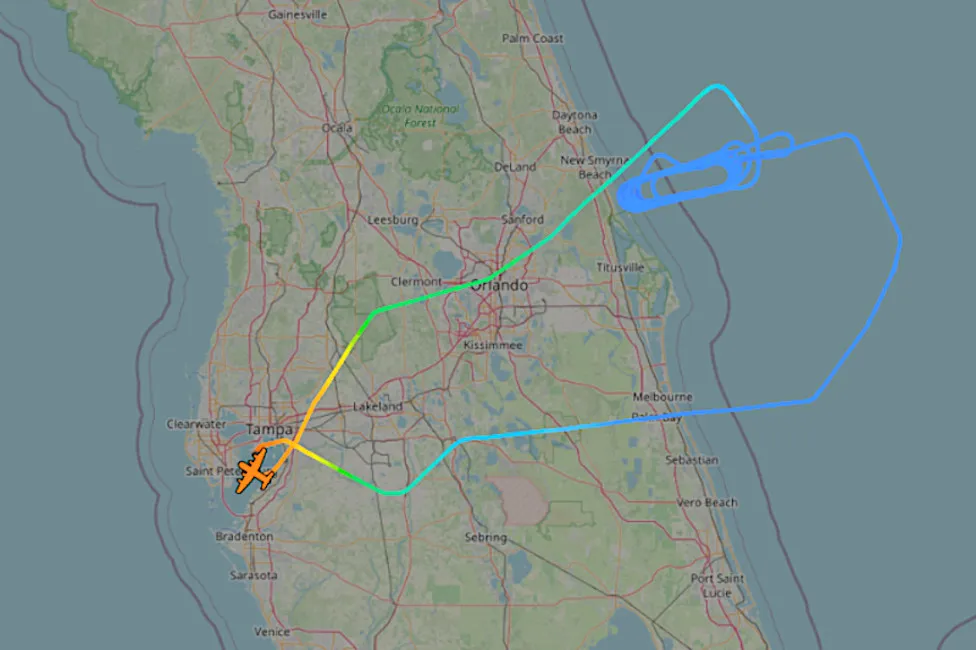
RAT55 was spotted yesterday flying over Melbourne, on Florida’s eastern coastline, which was already highly unusual. The jet is very easy to identify, even in the distance, due to its heavily modified nose and massive aft radome protruding from the rear of the fuselage. The NT-43A seems to live at the Tonopah Test Range Airport (TTR), a high-security facility in Nevada long associated with shadowy aircraft programs. It is often spotted flying around Area 51 in Nevada and Edwards Air Force Base in neighboring California, both of which are major U.S. military flight test hubs. It is rare to see it anywhere else.
The sighting of RAT55 in the skies above Melbourne aligned with online tracking data for a flight using the callsign NASA522. That track showed the aircraft – apparently miscoded as a C-130 Hercules transport plane – taking off from MacDill Air Force Base, situated to the southwest, and then flying an oval-shaped orbit in restricted airspace around the Kennedy Space Center’s Launch Complex 39B. The aircraft then returned to MacDill.
ADS-B Exchange
The Artemis II mission is currently scheduled to launch from Launch Complex 39B today at 6:24 PM EDT. A Space Launch System (SLS) rocket will take four astronauts in an Orion capsule into space on what is expected to be a nine-and-a-half-day-long trip. This will be the first crewed lunar mission of any kind since Apollo 17 in 1972, but the Artemis II crew will not actually set foot on the Moon. They will instead pass by, hopefully setting a new record for the longest distance that people have traveled away from Earth. The target distance is 252,000 miles, some 4,000 miles beyond the current record, set by the crew of the ill-fated Apollo 13 lunar mission in 1970. The Artemis II mission’s main goal is to help lay the groundwork for future missions to the lunar surface, the first of which is now expected to come in 2028.
The fueling process for the Artemis II rocket has picked up speed. The rocket is now more quickly filling with liquid oxygen and liquid hydrogen.
When the core stage is completely full, it will contain 196,000 gallons of liquid oxygen and 537,000 gallons of liquid hydrogen. pic.twitter.com/wejiCveeNb
NASA regularly uses fixed-wing aircraft to gather imagery and other important data during space launches. One of its high-flying WB-57F research planes, which are routinely used to provide optical tracking, was also flying around Launch Complex 39B yesterday at the same time as the NASA522 flight. The WB-57F conducted that flight from the Kennedy Space Center’s Shuttle Landing Facility (SLF).
This is correct, there are two separate NOTAMs for support aircraft that match both flight tracks. This was an obvious rehearsal. pic.twitter.com/X3i5RbP4T2
A stock image of one of NASA’s WB-57Fs. NASA One of NASA’s WB-57Fs, which carries the U.S. civil registration number N926NA. NASA
It is unclear why RAT55 has been called in to help, especially given that the U.S. military, and the U.S. Navy in particular, has an array of dedicated range support aircraft specially configured to support missile test activities, and a history of using them to support NASA launches in the past. TWZ has reached out to the Air Force and NASA for more information.
Still, as already noted, the NT-43A does have a sensor suite that would likely be very relevant to the space launch support mission. Beyond helping to collect more general telemetry information, the unique capabilities the aircraft has to offer might be used to gain more detailed insights into various aspects of the SLS rocket and the Orion capsule at launch. One of the tasks RAT55 is more typically understood to perform is helping to verify surface coatings on low-observable (stealthy) aircraft. Specialized coatings and other materials, especially to provide critical thermal protection, are a key aspect of space launch rocket and spacecraft design.
Though the WB-57F has numerous modular payload bays, as well as space for sensor and other equipment in underwing pods, the NT-43A offers a more capacious airframe, overall, along with optional dorsal fairings. NASA could fill this space with additional systems to meet other mission requirements.
In addition, it is worth mentioning here that NASA only has three WB-57Fs, and one made a fiery belly landing in Houston, Texas, back in January. The current status of that aircraft is unclear. Whether or not this was a factor in the decision to utilize the NT-43A is unknown.
The Air Force does have its own previous history of supporting NASA Moon missions, specifically, with specialized fixed-wing aircraft, which The Aviationist has noted. During the 1960s and 1970s, the U.S Air Force supported the Apollo program with a fleet of EC-135N Apollo/Range Instrumentation Aircraft (ARIA) planes, which were also used to track missile tests. The ARIA jets carried very large radars in their bulbous noses. Those aircraft were later redesignated as EC-135Es and continued to be used for various flight test activities until the last example was retired in 2000.
An EC-135N/E ARIA aircraft. USAF
Choosing the NT-43A for this task at all is still somewhat curious, given the U.S. military’s array of other missile tracking and range support telemetry aircraft, especially within the U.S. Navy. Those fleets continue to evolve, including with the Navy’s addition of its Gulfstream G550 business jet-based NC-37B. Repurposed RQ-4 Global Hawk drones are even now in the mix. There is a history of similar U.S. military planes supporting NASA launches in the past. It isn’t clear if additional roles for the NT-43A are going to be a common thing, but it certainly appears that its mission set is expanding. This is a very interesting development for an aging aircraft that has lived in the shadows for so long.
Regardless, the Artemis II launch is especially important for NASA, in general. There has only been one all-up launch of an SLS before now, in 2022, and no astronauts were on board at that time. The Artemis program has been dogged by setbacks and delays, with the hope originally that the Artemis III mission would bring Americans back to the lunar surface in 2024.
The video below shows the first SLS launch as part of the uncrewed Artemis I mission in 2022.
NASA’s Artemis I Launches on Nov. 16, 2022
NASA is now in line to finally reach the next Artemis milestone with today’s planned launch, and is doing so with help from the Air Force’s unique and rarely seen RAT55.
UPDATE: 7:42 PM EDT –
We have now received additional information from the U.S. Air Force about RAT55, which you can find in a follow-up story here.
Maura Higgins was spotted filming an advert in LondonCredit: CLICK NEWS – DEAN / RAWMaura wrapped up in a pink dressing gownCredit: CLICK NEWS – DEAN / RAWMaura was gifted a £17,000 Birkin bag by Rob RauschCredit: Eroteme
She opened up to her fans about getting work done in an InstagramQ&A earlier this week.
In the post, she revealed she gets Botox around twice a year, saying: “I do get Botox every 6-8 months and I had lip filler years ago but I haven’t had any in over 3.5 years now.
“Other than that, I haven’t had anything else done.”
Maura has previously admitted to having composite bonding on her teeth for a Hollywood smile in addition to her facial tweakments.
Maura has admitted to getting Botox twice a yearCredit: CLICK NEWS – DEAN / RAWMaura said: ‘ I had lip filler years ago but I haven’t had any in over 3.5 years now’Credit: CLICK NEWS – DEAN / RAW
A scenic train journey from London to Geneva via Paris offers some of Europe’s best views – and can cost half the price of a plane ticket at around £135 return
The service trundles through charming towns including Dijon(Image: Aliaksandr Antanovich via Getty Images)
A rail journey linking three capital cities boasts some of Europe’s most breathtaking scenery—and could set you back half the price of a flight.
The Eurostar and France’s TGV whisk passengers from London to Geneva, making the very most of a trip that spans three nations. The train departs from St Pancras with a change in Paris before heading onwards to the Swiss capital.
It’s a nearly six-hour journey in total, passing through Montbard, Dijon and Bourg-en-Bresse, offering stunning vistas of national parks and rolling countryside. Passengers can hop off in Paris to discover the city—with landmarks including the Eiffel Tower, Notre-Dame, the Champs-Élysées, Sacré-Cœur and the Louvre.
Once the train pulls into Geneva, visitors can take in Lake Geneva, Cathédrale de Saint-Pierre, the Palais des Nations, the botanical gardens and the Brunswick Monument.
From there, it’s also a brief trip to the nearby Alps, with day excursions available from the city to ski or snowboard on the slopes and savour the local restaurants. The train can be half the price of a plane ticket. According to Skyscanner, return flights this month cost up to £394.
During the same period, return train tickets cost around £135, half the price of a flight, according to Trainline.
Families can also cut costs by purchasing Interrail passes—£482 for a family of four to travel on four days within one month, plus seat reservation charges. And expense isn’t the sole advantage.
According to the Times, four passengers journeying from London to Geneva and back by rail produce approximately 44kg of carbon emissions, compared with 108kg by car and 1,608kg by plane. The Intergovernmental Panel on Climate Change states that, to maintain climate change within sustainable limits, each person has a carbon “budget” of 1,500kg of carbon emissions per year.
Although there are a number of factors that determine how polluting different forms of travel are, such as the type of electricity production used to power trains, riding the rails is typically greener than flying.
Back in 2023, carbon calculations made by the Rail Delivery Group found that travelling by rail from London to Edinburgh creates 10 times fewer carbon emissions than by car and 13 times fewer than by plane.
One of the tricky considerations for passengers is generally cost, with budget airlines such as Ryanair, easyJet and Wizz Air typically offering cheaper plane tickets than the equivalent train tickets.
The route from London to Geneva shows that it is not always the case. The price gap between the two forms of transport may also be getting smaller.
Travellers are facing rising airfare costs and reductions in flight schedules as the conflict in the Middle East causes oil prices to soar, with concerns that ticket prices could remain elevated for months even if the war de-escalates. Cathay Pacific, AirAsia and Thai Airways are among a growing number of airlines increasing fares to offset the hikes.
While train services are also impacted by rising oil prices, fuel tends to be a much smaller proportion of their operating margins than with airlines.