A popular ferry service that linked the UK with Norway was withdrawn in 2008, but it could return, as there have been calls to restore the route that connects the twin cities
Amy Jones Senior Travel Journalist and Daniel Holland
10:14, 29 Jan 2026
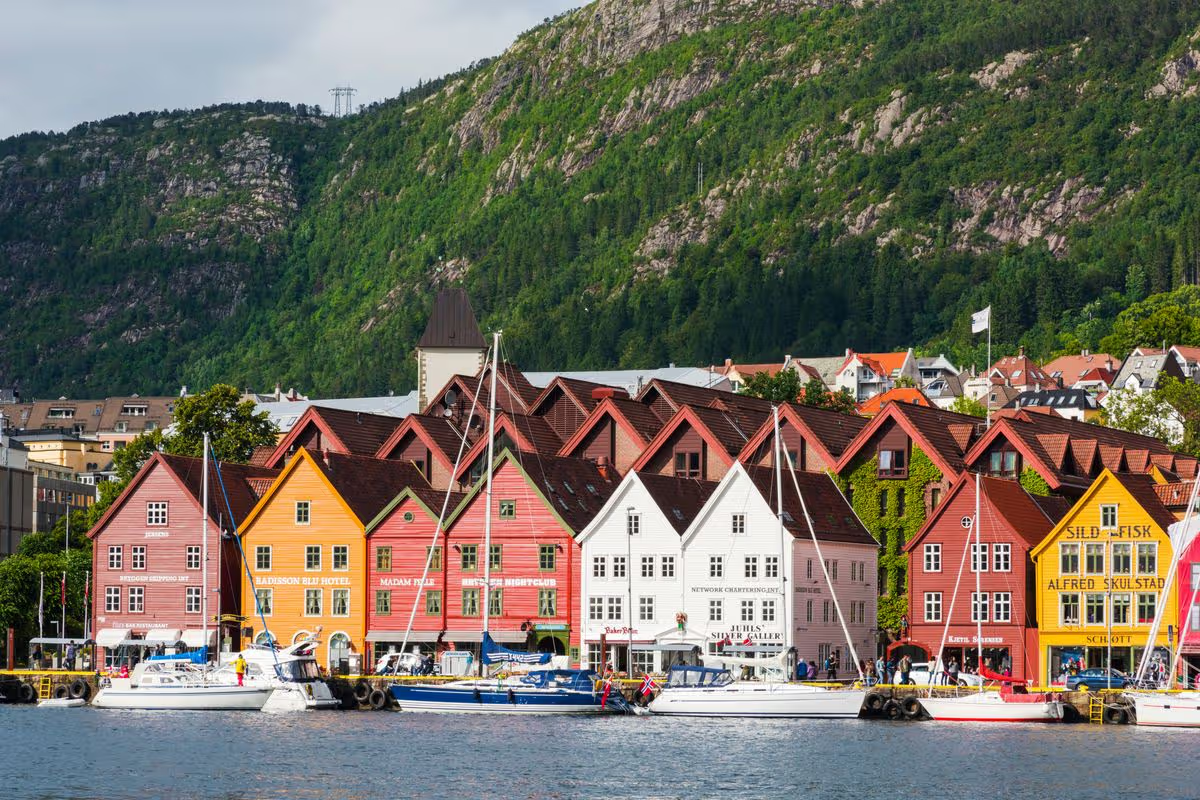
A ferry route that connected the UK to Norway could return(Image: Getty Images)
There have been calls to restore the popular DFDS ferry service linking the UK to the Norwegian city of Bergen, 18 years after it was discontinued.
The beloved DFDS ferry linking Tyneside to the Scandinavian port ceased operations in 2008. However, the upcoming launch of new direct flights from Newcastle to Bergen this year has reignited demands for the maritime connection to be revived as well.
The two cities have maintained their twin status since 1968, with Bergen previously sending Newcastle an annual Christmas tree for decades as a symbol of their bond, though this custom has since ceased due to environmental considerations. While operators consider restoring the ferry service financially unviable, Newcastle City Council leader Karen Kilgour informed colleagues on Wednesday that enthusiasm for reinstating the route persists.
The Labour councillor revealed to a full council session that she anticipated the Jet2 flights commencing this April would “prove popular enough to allow the company to offer year-long flight options connecting our two great cities”.
Coun Kilgour continued: “Not only will this assist our economic links through strategic sectors in offshore energy but also allow tourists to take advantage of city breaks. We would also love to see the return of the ferry, which stopped running in 2008. We know lots of people in both cities have fond memories of travelling by sea to visit both Newcastle and Bergen, reports Chronicle Live.
“And while at this point operators consider the route is not economically viable, we will continue to work with partners and our friends in Bergen to explore all ways of bringing it back. Bergen remains a strategic partner in our international work and we intend not only to maintain but to deepen that relationship in the months ahead.”
The possibility of reinstating a ferry service is believed to have been hampered by the requirement to construct an expanded passport control facility at Bergen’s port should operations resume.
Lib Dem councillor Greg Stone, who has consistently championed the ferry’s return on a historic route stretching back to 1890, commented: “Warm words are one thing, but we need to make it a reality. I know there are costs involved in doing that but I hope the council will continue that work, redouble that work, and work potentially with the mayor [Kim McGuinness] to look at what we can do to restore the physical ferry link.”
Travellers are delighted at the prospect of the ferry route returning, as one shared on Facebook: “That would be great, I would be on that like a flash.” A second commented: “An absolute necessity to get this route back again. Bergen/Stavanger – Newcastle.”
A third wrote: “Out of all the routes lost the return of the Bergen route would be the most successful. Bergen is a great place to visit and is also the gateway to the rest of Norway.” Reminiscing another shared: “It used to go to Hamburg as well and I went there on DFDS with my nana and grandad to visit family when I was a kid.”
One more shared: “I so hope so. Pity it may not go to Haugesund and Stavanger, but I can take Bergen. It would be amazing to have the ship back again, so we can connect again with beautiful Norway. My homeland, on my father’s side.”
Do you have a travel story to share? Email webtravel@reachplc.com
Marc Anthony and Nadia Ferreira have plans to grow their family, announcing on Wednesday that a little one is on the way.
The couple revealed in a joint Instagram post that their son “Marquito is going to be a big brother.” They posted a photo of their hands, along with their son’s hand, cradling Ferreira‘s baby bump. The pair also wrote in their caption in Spanish that their anniversary is a gift and God is great.
Grammy-winning “Vivir mi Vida” singer Anthony, 57, married model and former Miss Universe Paraguay and 2021 Miss Universe runner-up Ferreira, 26,in January 2023 in a star-studded ceremony in Miami. David Beckham served as best man and Salma Hayek, Lin-Manuel Miranda and Luis Fonsi were on the guest list.
The child will be Anthony’s eighth. The musician (real name Marco Antonio Muñiz) shares two adult children with ex-girlfriend Debbie Rosado, and two grown children from his marriage to former Miss Universe Dayanara Torres. He also shares twin teenagers with ex-wife Jennifer Lopez.
As Ferreira revealed news of her pregnancy, Anthony teased an upcoming collaboration with singer Nathy Peluso. The pair of Grammy winners posted a clip of themselves singing and dancing in a studio and urged followers to pre-save their latest song “Como En El Idilio.”
Anthony teased additional music on Tuesday. He posted a black-and-white video of himself and musicians performing in a studio. The clip ended simply with white text reading: “Feb 06.”
What seems to be Anthony’s newest music foray will drop a week before he launches his residency at the Fontainebleau Las Vegas. His Vegas My Way circuit of 10 live performances begins Feb. 13. Additional dates and information can be found on the residency’s website.
BOYS CITY SECTION AMIT 39, MSAR 28 Angelou 76, Jefferson 65 Bernstein 89, Belmont 35 Birmingham 72, Taft 48 Central City Value 58, USC-MAE 46 CHAMPS 54, Lakeview Charter 21 Cleveland 79, Granada Hills 57 Community Charter 54, Valley Oaks CES 41 East Valley 64, Vaughn 48 El Camino Real 66, Chatsworth 58 Foshay 76, Stella Charter 23 Fulton 51, VAAS 39 Garfield 53, Huntington Park 45 Gertz-Ressler 68, Alliance Ouchi 27 Grant 77, Chavez 35 Hawkins 60, Harbor Teacher 42 Los Angeles 76, West Adams 49 LA Hamilton 61, LA University 55 LA Marshall 68, Bravo 45 LA Roosevelt 56, South Gate 30 LA Wilson 83, Franklin 45 Lincoln 43, Eagle Rock 39 Marquez 89, Torres 29 Maywood Academy 45, Maywood CES 41 MSCP 68, Middle College 30 Orthopaedic 46, Animo Bunche 25 Palisades 91, LACES 63 Panorama 64, Reseda 47 Port of Los Angeles 79, Dymally 27 RFK Community 58, Hollywood 56 San Fernando 82, Canoga Park 51 San Pedro 81, Gardena 60 Santee 65, Diego Rivera 45 Simon Tech 66, TEACH Tech Charter 34 Sotomayor 67, Elizabeth 48 South East 71, Legacy 58 Sun Valley Magnet 78, Lake Balboa College 59 Sun Valley Poly 59, North Hollywood 56 Sylmar 86, Van Nuys 55 Triumph Charter 72, Bert Corona 20 USC Hybrid 77, Esperanza College Prep 22 Valor Academy 51, Discovery 25 View Park 60, Locke 36 Washington Prep d. Fremont, forfeit
SOUTHERN SECTION Aliso Niguel 65, Trabuco Hills 43 Arroyo 74, Pasadena Marshall 41 Ayala 71, Diamond Bar 63 Azusa 73, Baldwin Park 55 Bassett 66, Pomona 34 Bishop Amat 76, Gardena Serra 38 Blair 58, Temple City 51 Bonita 60, Walnut 55 Burbank Providence 66, Milken 55 California 75, El Rancho 36 Chaparral 73, Vista Murrieta 58 Charter Oak 56, Hacienda Heights Wilson 55 Citrus Hill 72, Canyon Springs 37 Covina 42, Rowland 39 CSDR 62, La Sierra Academy 46 Desert Christian Academy 41, California Military Institute 32 Desert Hot Springs 68, Banning 56 Eastvale Roosevelt 94, Norco 51 Edgewood 59, Workman 24 El Dorado 68, Troy 47 Gahr 43, Dominguez 36 Glendora 62, Claremont 47 Hemet 66, Arlington 32 Heritage 68, Lakeside 61 Hesperia 99, Apple Valley 60 Indian Springs 57, Pacific 49 Indio 70, Twentynine Palms 66 JSerra 89, Servite 47 La Canada 76, South Pasadena 45 La Mirada 81, Mayfair 65 La Serna 60, Santa Fe 24 Loara 57, Magnolia 45 Los Alamitos 71, Fountain Valley 52 Los Amigos 72, Anaheim 55 Mission Viejo 75, Dana Hills 56 Moreno Valley 66, Riverside North 44 Murrieta Mesa 71, Great Oak 63 Nogales 56, Garey 43 Norte Vista 86, Rubidoux 44 Norwalk 42, Lynwood 33 Orange Lutheran 72, St. John Bosco 68 Oxnard Pacifica 59, Buena 54 Paloma Valley 56, Vista del Lago 49 Pasadena Poly 47, Flintridge Prep 42 Patriot 56, la Sierra 29 Pilibos 89, Le Lycée 40 Public Safety Academy 74, River Springs Charter 28 Ramona 73, Jurupa Valley 40 Riverside King 69, Corona 61 Riverside Poly 54, Hillcrest 47 Rosemead 46, South El Monte 29 RSCSM 62, River Springs 52 San Bernardino 95, Miller 58 San Clemente 64, Capistrano Valley 37 San Marcos 61, Dos Pueblos 51 San Marino 77, Monrovia 40 Santa Barbara Providence 72, Oak Grove 16 Santa Margarita 74, Mater Dei 73 Sierra Vista 68, Duarte 61 St. Bonaventure 52, Thacher 47 St. Monica 89, St. Paul 53 Tesoro 74, San Juan Hills 39 Valley View 78, Perris 65 Villanova Prep 57, Laguna Blanca 42 Vista Meridian 58, Eastside Christian 34 Westminster La Quinta 48, Orange 46
GIRLS CITY SECTION AMIT 27, MSAR 20 Angelou 51, Jefferson 22 Animo Bunche 33, Orthopaedic 24 Arleta 67, Monroe 7 Aspire Ollin 53, Downtown Magnets 9 Bernstein 52, Belmont 4 Birmingham 76, Taft 29 Carson 92, Rancho Dominguez 3 Contreras 28, Roybal 19 Discovery 35, Valor Academy 24 Eagle Rock d. Lincoln, forfeit King/Drew 85, Crenshaw 20 LA Hamilton 88, LA University 16 Garfield 63, Huntington Park 30 Granada Hills 56, Cleveland 45 Marquez 33, Torres 28 MSCP 53, Middle College 15 Palisades 56, LACES 35 Panorama 54, Reseda 12 San Pedro 42, Gardena 24 USC-MAE 31, Central City Value 28 Washington Prep 79, Fremont 7 West Adams 55, Los Angeles 20 Westchester 83, Venice 44
SOUTHERN SECTION Arlington 32, Citrus Hill 15 Arroyo 24, Pasadena Marshall 16 Baldwin Park 48, Azusa 39 Bassett 23, Pomona 8 Bolsa Grande 42, Estancia 31 Bonita 34, Walnut 30 Brentwood 59, Windward 57 Buena Park 73, Santa Ana Calvary Chapel 10 Cantwell-Sacred Heart 52, St. Mary’s Academy 25 Carpinteria 44, Del Sol 24 Chaparral 52, Vista Murrieta 50 Coachella Valley 54, Yucca Valley 44 Crossroads 45, Archer 12 Desert Christian Academy 47, California Military Institute 30 Desert Hot Springs 49, Banning 42 Desert Mirage 31, Cathedral City 24 Eastvale Roosevelt 58, Corona Santiago 38 Edgewood 49, Workman 22 El Rancho 60, California 47 Excelsior Charter 48, PAL Academy 4 Fillmore 53, Nordhoff 43 Flintridge Prep 58, Mayfield 14 Fullerton 56, Laguna Hills 32 Garden Grove 52, Katella 39 Glendora 55, Claremont 38 Godinez 75, Placentia Valencia 60 Hacienda Heights Wilson 59, Charter Oak 26 Harvard-Westlake 58, Louisville 29 Hemet 45, Canyon Springs 39 Hesperia 59, Apple Valley 21 Hillcrest 58, Riverside Poly 46 Indian Springs 59, Pacific 26 La Canada 54, South Pasadena 39 La Palma Kennedy 30, Santa Ana 7 La Puente 38, Ganesha 30 Liberty 44, Vista del Lago 18 Loara 28, Westminster La Quinta 19 Long Beach Jordan 66, Long Beach Cabrillo 0 Nogales 62, Garey 23 Norte Vista 31, Rubidoux 12 Northview 38, West Covina 36 Northwood 46, Irvine University 26 Norwalk 56, Bellflower 37 Oak Hills 71, Ridgecrest Burroughs 35 Orange 57, Magnolia 13 Orange County Pacifica Christian 69, San Gabriel Academy 18 Packinghouse Christian Academy 47, Bethel Christian 10 Paramount 84, La Mirada 15 Pasadena Poly 56, Oakwood 37 Patriot 42, La Sierra 34 Pilibos 55, Le Lycée 10 Quartz Hill 53, Rosamond 37 Ramona 64, Jurupa Valley 38 Riverside North 36, Lakeside 31 River Springs Charter Magnolia d. Hemet River Springs, forfeit Rolling Hills Prep 91, Leuzinger 67 Rosemead 51, South El Monte 24 Saddleback 27, Century 22 Sage Hill 65, Rosary Academy 50 San Bernardino 56, Miller 19 San Marino 40, Monrovia 13 Sherman Oaks Notre Dame 59, Chaminade 50 Sierra Vista 44, Duarte 42 St. Margaret’s 36, Portola 32 Warren 74, Mayfair 15 Western 52, Garden Grove Santiago 8 Woodbridge 44, Irvine 27
As the United States pushes its ‘America First’ agenda, its partners are edging towards China and new alliances are being formed.
It was built on democracy, open markets and cooperation – with America at the helm.
But the rules-based global order created after World War II is now under strain. Conflicts are rising. International rules are being tested. Trade tensions are escalating. And alliances are shifting.
At the centre of it all is US President Donald Trump.
In just a few short weeks, he’s captured Venezuela’s president, vowed to take control of Greenland, and threatened to slap tariffs on those who oppose him.
Meanwhile, China is presenting itself as a stable partner.
Many warn that the global order is starting to break apart.
China has told the UN Security Council that US ‘military adventurism’ in the Middle East will push the region into chaos, as President Donald Trump continues to threaten strikes on Iran if it does not submit to his demands.
Here’s the lowdown on exactly when you can watch Bridgerton season four, part two and what to expect from the second batch of episodes.
When is Bridgerton season 4 part 2 on Netflix?
Bridgerton season four, episode five will be hitting Netflix on Thursday, February 26 when fans will be getting another four episodes to savour.
The release schedule for season four mirrors that of the third outing after Netflix started splitting up its biggest shows to maintain its subscriber base.
Netflix recently released the episode titles for season four, part two, which marks the second half of the fourth run.
The episode titles are as follows: Episode 5: Yes or No; Episode 6: The Passing Winter; Episode 7: The Beyond; and Episode 8: Dance in the Country.
Season four is adapted from Julia Quinn’s third Bridgerton novel An Offer from a Gentleman and those familiar with the book might be able to guess what the episode titles allude to in terms of the plot.
Watch Bridgerton on Netflix for free with Sky
This article contains affiliate links, we will receive a commission on any sales we generate from it. Learn more
Sky is giving away a free Netflix subscription with its new Sky Stream TV bundles, including the £15 Essential TV plan.
This lets members watch live and on-demand TV content without a satellite dish or aerial and includes hit shows like Bridgerton.
What happens in Bridgerton season 4 part 1?
WARNING: This section contains spoilers from Bridgerton season 4, part 1
Season four, part two will see what happens between Sophie Baek (played by Yerin Ha) and Benedict Bridgerton (Luke Thompson) and their blossoming romance. Despite their attempts to avoid each other, the sparks flew between them.
Benedict was also in the dark about Sophie’s complicated past, something which could come to light in the latter half of the season.
Season four, part two is also expected to address whether or not Benedict will find out if Sophie is also the Lady in Silver, and if that could have a bearing on whether he would want to marry her.
Another storyline in season four, part two will likely be Francesca Bridgerton’s (Hannah Dodd) burgeoning sexuality.
Season three previously hinted at Francesca’s feelings towards female rake Michaela Stirling (Masali Baduza), when she was left tongue-tied during their first meeting.
Finally, Eloise Bridgerton (Claudia Jessie) and her decision to become a spinster and be “left on the shelf” will be delved into further as the headstrong Bridgerton daughter might find herself fettered by the constraints of society given in her single status.
Speaking to Entertainment Weekly in a recent interview, Bridgerton’s showrunner Jess Brownell teased season four and Sophie’s arc: “We get to watch a very headstrong young woman try to decide her fate for herself and pick up the courage to believe in and dream for a life greater than the one she currently has.”
Brownell went on to say that the novel was the “easiest” one to adapt because the structure lent itself “really closely” to ones seen on the small screen.
The writer added: “There are just a lot of rich set pieces that gave us juicy conflict and high stakes. I think fans will be happy to see quite a few of the set pieces from the book in the show.”
Once season four, part two has wrapped up, fans can look forward to both seasons four and five, which are already in the pipeline with Brownell confirming to Deadline that Eloise and Francesca’s stories will be the focus of each of the outings but couldn’t confirm the order.
Given that the television adaptation has already broken with the order of the novels, there’s nothing to stop the sixth novel When He Was Wicked from being first and focusing on Francesca’s love story.
To Sir Phillip, With Love is book five in the series and focuses on Eloise.
Bridgerton season 4, part 1 is streaming on Netflix now
The beautiful country has been named the best retirement destination for 2026, beating Spain with affordable living and excellent healthcare
08:35, 29 Jan 2026Updated 08:37, 29 Jan 2026
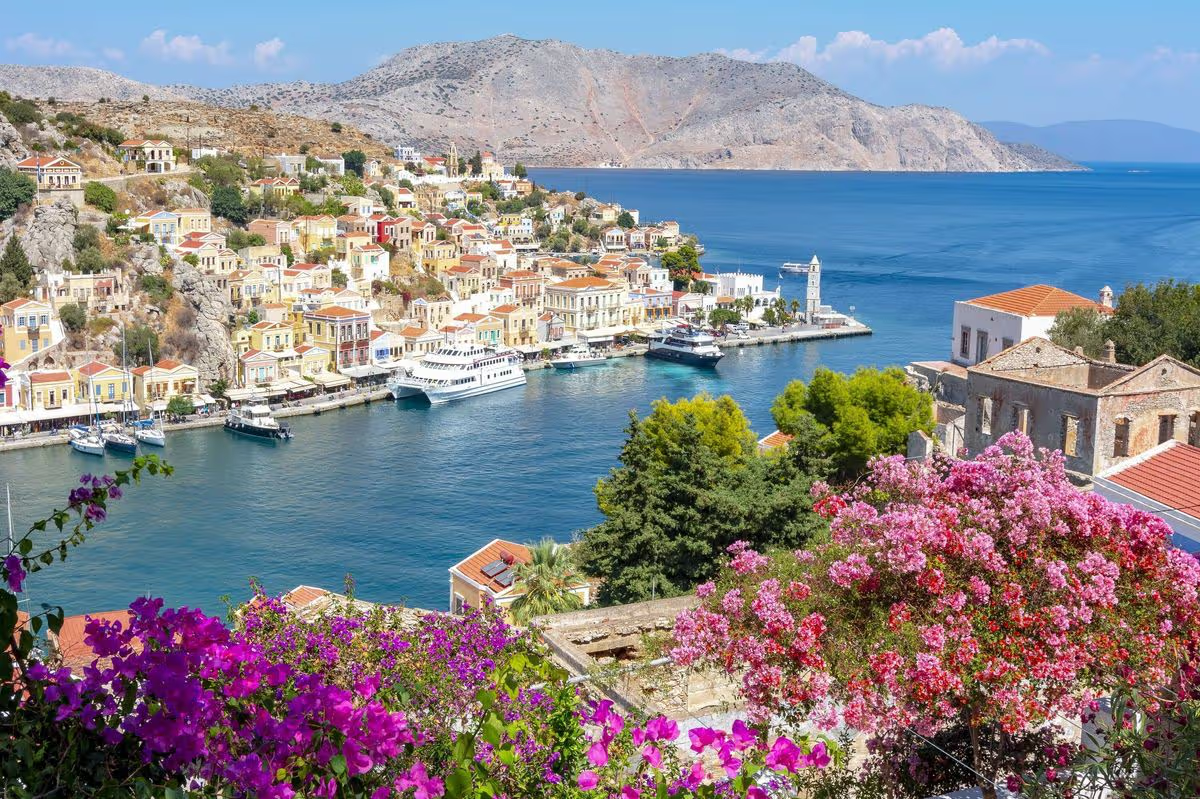
Best country for pensioners to relocate to in 2026 has great healthcare – not Spain(Image: Getty)
If you’ve been considering spending your golden years overseas, there’s no shortage of things to weigh up. Thankfully, International Living’s yearly report analysed everything from living costs to how easy it is for Britons to make the move.
Crucial factors include visa stipulations, access to medical services, and the country’s weather conditions. After putting 195 nations under the microscope, the research crowned Greece as the ultimate retirement haven for 2026.
Greece boasts great weather, a thriving expat scene, and remarkably, pensioners can get a three-bedroom property with coastal vistas for just £900 a month.
International Insurance notes that Greece operates both state-funded healthcare and private medical facilities. Retirees can shell out roughly £220 monthly for private cover to access “consistently good” treatment.
“There are also high ratios of medical specialists for the population, and basic emergency care is free for everyone, even foreigners. Pharmacies, after-hours clinics, and community health centers provide more care options. In small towns and on remote islands, pharmacies are equipped to provide many medical services, including helping with small emergencies.”
Coming in at second place for 2026 relocations is Panama. The Central American nation features a bustling British community abroad, whilst healthcare comes in both public and private forms, with the latter boasting cutting-edge facilities and English-fluent medical professionals.
Favourite retirement hotspots like Spain, Portugal, and Italy also secured spots in the top 10.
Serena Williams has refused to rule out returning to professional tennis after recently filing the necessary paperwork.
Williams, who won 23 Grand Slam singles titles, retired after the 2022 US Open.
In December, the International Tennis Integrity Agency confirmed to BBC Sport that the 44-year-old was back on the list of players registered for the drug testing pool.
At the time, the American said she was “not coming back” but during an interview on the Today Show on Wednesday, Williams did not rule out stepping back on to the court.
“I don’t know, I’m just going to see what happens,” Williams said.
Interviewer Savannah Guthrie pushed Williams further, saying “that’s a maybe to me”, and the seven-time Wimbledon champion said “It’s not a maybe”.
Jan. 29 (UPI) — A judge has barred federal immigration officers from arresting and detaining legally present refugees in Minnesota, handing the Trump administration a legal defeat in its aggressive immigration crackdown.
U.S. District Judge John Tunheim, in Minneapolis on Wednesday, issued a temporary restraining order that bars the arrest and detention of any Minnesota resident with refugee status as litigation on the issue continues.
“They are not committing crimes on our streets, nor did they illegally cross the border,” Tunheim wrote in his order.
“Refugees have a legal right to be in the United States, a right to work, a right to live peacefully — and importantly, a right not to be subjected to the terror of being arrested and detained without warrants or cause in their homes or on their way to religious services or to buy groceries.”
The Trump administration has been conducting an aggressive immigration crackdown in Minnesota. Agents with Immigration and Customs Enforcement and Customs and Border Protection have arrested thousands of people since December, attracting protests, which have been met with violence.
Democrats and civil and immigration rights advocates have accused the agents of using excessive force and violating due process protections.
The order issued Wednesday comes in a lawsuit filed by the International Refugee Assistance Project against Operation PARRIS, an initiative launched Jan. 9 to re-examine the 5,600 pending refugee cases in Minnesota in a hunt for fraud and other possible crimes.
IRAP said in its complaint, filed Saturday, that since the operation began, federal immigration agents have arrested and detained more than 100 of Minnesota’s refugee population without warrants and often with violence.
Those detained have not been charged with any crime nor with any violation of immigration statutes, according to the immigration legal aid and advocacy organization, which said this policy not only goes against immigration law but also ICE’s own guidance that states there is no authority to detain refugees because they have not yet changed their status to lawful permanent residents.
The organization states that the purpose of Operation PARRIS “is to use these baseless detentions and coercive interviews as fishing expeditions to trigger a mass termination of refugee statuses and/or to render refugees vulnerable to removal.”
“For more than two weeks, refugees in Minnesota have been living in terror of being hunted down and disappeared to Texas,” Kimberly Grano, staff attorney for U.S. litigation at IRAP, said in a statement, referring to the location of detention centers where refugees detained in Minnesota are being held.
“This temporary restraining order will immediately put in place desperately needed guardrails on ICE and protect resettled refugees from being unlawfully targeted for arrest and detention.”
Tunheim’s order does not interfere with U.S. Citizenship and Immigration Services’ ability to conduct re-inspections to adjust refugees’ status to lawful permanent residents nor the Department of Homeland Security’s enforcement of immigration laws. It only prevents the arrest and detention of refugees in the state who have yet to become lawful permanent residents while litigation proceeds.
“At its best, America serves as a have of individual liberties in a world too often full of tyranny and cruelty,” Tunheim said.
“We abandon that ideal when we subject our neighbors to fear and chaos.”
For years, 64-year-old Ibrahim Zira lived with high blood pressure, managing the condition at Jigalambu Primary Healthcare Centre (PHC) in the Michika area of Adamawa State, northeastern Nigeria. When his condition worsened, he was referred to the Michika General Hospital, where he faced a familiar struggle: incomplete medical records and repeated tests.
“When I got there, they asked for my records, and the file I had contained very little information. I was asked questions and told to repeat tests I had already done. I had to pay again. It was painful because I don’t have a steady income,” Ibrahim complained.
In Nigeria, about 77 per cent of health spending is paid out of pocket, so each additional test adds a financial burden that many patients can barely afford. But the challenge is not only financial. Without digital medical records, patients like Ibrahim are often made to reconstruct their medical histories whenever they move between facilities, relying on memory of dates, drug names, and test results.
“Sometimes I forget dates or drug names,” he said. “When that happens, the health workers think I’m not serious. It’s stressful explaining the same sickness again and again, especially when you’re not feeling well.”
The same experience surfaced for Pwavira Akami during her first pregnancy. She began antenatal care (ANC) at Gweda Mallam PHC in her hometown of Numan but later relocated to Jimeta, Yola—more than an hour’s journey away—to stay with her sister. There, she registered for antenatal care at Damilu PHC.
The transition exposed the same fault line in the absence of digital patient records.
“They asked me many questions that were already written in my ANC card, but some pages were missing,” she recalled. As a result, Pwavira was asked to repeat basic lab tests. “I had to spend more money. It’s tiring; you keep answering the same questions about your last period, past illnesses, and tests. Sometimes you’re not even sure if you’re saying it correctly.”
In both cases, the problem was not medical knowledge or staff competence. It was the absence of a shared system that allowed patient information to follow people as they moved between facilities.
Entrance of General Hospital, Michika. Photo: Obidah Habila Albert/HumAngle.
Frontline workers show concerns
This gap, healthcare workers say, affects patients across Adamawa every day.
Mercy Dakko, a midwife at General Hospital, Michika, said she works almost every month without patient files and that internally displaced persons (IDPs) and pregnant women often arrive with incomplete or fragmented medical histories.
“It slows everything down,” she told HumAngle. “In emergencies, lack of history can be risky. You may not know past complications or drug reactions.”
Mercy recalled the case of a woman who came into labour, only for the staff to later learn that she was diagnosed with high blood pressure in a previous clinic. “We found out late, and it almost caused serious complications,” the midwife explained.
Sam Alex, another medical practitioner, agreed that due to a lack of well-documented medical history, they rely only on what the patient remembers, which is not always accurate. “Very often we repeat tests. It’s not ideal, but sometimes it’s the only safe option,” Sam said, noting that the stakes are even higher for chronic diseases. “It increases the risk of wrong medication, delayed care and poor outcomes, especially for conditions like diabetes or hypertension.”
He acknowledged that patients often bear additional burdens, spending more time and money, and some even refuse to come to the hospital because they are tired of having to repeat medical procedures.
‘Everything is paper-based’
At the root of the problem is a paper-based system that requires patients to carry physical files. Emmanuel Somotochukwu, a Nigerian pharmacist, told HumAngle that in his hospital, about one in ten patients are sent back simply because a prescription is illegible or an old lab result is missing.
Studies in Nigeria have found that illegible or incomplete prescriptions are a leading cause of medical error. In most hospitals across Adamawa, record officers are overwhelmed by paperwork. Bewo Gisilanbe, a record officer at the General Hospital in Michika, described how patient histories are stored.
“Everything is paper-based. Files are created manually and stored in cabinets,” he said, admitting that old files or files from busy clinic days could get torn, misplaced, and slow to retrieve. “Once a patient leaves, their record ends here. There’s no connection to other facilities.”
Bewo stressed that searching for a lost history wastes time and distorts continuity of care. “We don’t know what happened to a patient’s prior care after they leave,” he said. If systems were linked, he argued, everything would change. “It would reduce workload, improve accuracy, and make record tracking easier.”
A manual medical record cabinet at General Hospital, Michika. Photo: Obidah Habila Albert/HumAngle.
Why digitalised medical records matter
Experts say the solution to the flawed health system in Adamawa lies in Digital Public Infrastructure (DPI). In the health sector, DPI refers to shared, secure information systems that allow “medical histories, prescriptions, insurance status, and laboratory results to move electronically between units, without requiring patients to act as messengers”.
The cornerstone of this system is a dependable digital identity. By mid-2025, Nigeria’s National Identity Management Commission (NIMC) had issued 123.5 million National Identity Numbers (NIN). These IDs, if utilised, can act as a digital passport, enabling the connection of patient records across various healthcare facilities.
Get our in-depth, creative coverage of conflict and development delivered to you every weekend.
Subscribe now to our newsletter!
Recently, the National Health Insurance Authority (NHIA) and NIMC signed an MoU to establish a unified framework linking citizens’ national identity data with health insurance records. This integration is meant to streamline verification, reduce fraud, and expand access to healthcare, especially for underserved communities.
Beyond identity, DPI seems to require an interoperable health information record system. In 2024, the government launched the Nigeria Digital in Health Initiative (NDHI) to build a national health information exchange and patient registry. The goal is for health facilities to securely and seamlessly share information.
Nzadon David, a digital innovations specialist working with the African Union, and Asor Ahura, a Nigerian-based AI engineer and digital health expert, highlighted several key requirements for success in digital health systems. Nzadon emphasised that “every system needs a way to recognise each person. In Nigeria, this means using the NIN or similar IDs in health records.” Asor also stated that “clinics must agree on data formats and coding systems to ensure that one hospital’s notes can be understood at another. He stressed that privacy laws, such as Nigeria’s 2023 Data Protection Act and clear guidelines about who can access information are essential for building trust.
Across Africa, early DPI projects show what’s possible. Rwanda has an integrated e-health platform (Irembo) that links digital IDs to patient records and lab results. Kenya’s Afya Kenya initiative likewise allows a clinic in Kisumu to retrieve the same information as a clinic in Nairobi, eliminating duplicate efforts. The payoff is clear: fewer medical errors, faster diagnosis, and better continuity of care, according to the DPI Africa platform. Even India’s Aadhaar ID system now covers 1.4 billion people and is tied into programs including health insurance.
Nzadon noted that these countries didn’t digitise everything at once. They started small, created shared standards, scaling gradually. “States that succeed focus on shared standards and simple, open systems more than expensive software,” he added.
The road map
In 2025, Nigeria joined the UN’s Digital Public Goods Alliance, pledging that government systems, including health, should be open, inclusive, and interoperable. These moves seem to reflect lessons from around the world. Rwanda, Kenya and other countries show that with a national ID, electronic medical records, and a clear privacy framework, health services can become seamless. In Nigeria’s case, there is no shortage of data on why it matters. Aside from the human toll of broken care, inefficiency has economic consequences. According to McKinsey Global Institute’s digital identification report, scaling digital ID systems worldwide could add $5 trillion to global GDP.
Frontline healthcare workers, seeing the impact firsthand, have a clear wish list.
With connected records, Mercy said, “we can focus more on care instead of paperwork.” Bewo admitted that a shared system would “reduce mistakes” and free up resources for patients. Perhaps most pointedly, patients themselves feel the difference. Reflecting on his own experience, Ibrahim says a digitalised health system would make life easier.
This report is produced under the DPI Africa Journalism Fellowship Programme of the Media Foundation for West Africa and Co-Develop.
After a competitive bidding process, indie studio A24 has acquired the U.S. rights to Olivia Wilde’s comedy “The Invite” in a major deal out of the Sundance Film Festival.
The film, which stars Wilde, Seth Rogen, Penélope Cruz and Edward Norton, was purchased for around $10 million, according to a person familiar with the deal who requested anonymity due to the sensitive matter. One factor for Wilde was a preference for a traditional theatrical release.
“The Invite” focuses on a dinner party among neighbors and was billed as a must-see after it premiered over the weekend at Sundance. So far, the film has notched a 91% rating on aggregator Rotten Tomatoes.
The market at Sundance has traditionally been viewed as a bellwether for the indie film business. In the last few years, deals have been slower to emerge from the festival, particularly as streamers stopped offering massive sums for films to stock their platforms and as studios cut back on spending.
The deal for “The Invite” is one of a handful that have already been announced. On Tuesday, Neon said it acquired the worldwide rights to horror film “Leviticus,” which premiered at Sundance. Neon also bought the worldwide rights over the weekend for another horror flick, “4 X 4: The Event” from filmmaker Alex Ullom. That deal was the first to be made in Park City, though the film was not shown at Sundance and will begin production later this year. The value for both of Neon’s deals was not disclosed.
So much has happened over the past seven days, including Australian Open grudge matches, X Games extremes and a manic marsupial.
About 14% of quizzers got full marks in last week’s edition. Will you make the grade this week?
After more quizzes? Go to our dedicated Football Quizzes and Sports Quizzes pages and sign up for notifications to get the latest quizzes sent straight to your device.
Man charged with throwing explosive device into a crowd at Invasion Day protest in Western Australia’s Perth.
Published On 29 Jan 202629 Jan 2026
Share
Police may investigate an alleged bombing attempt during an Indigenous rights protest in Perth, Western Australia, as a possible “terrorist” incident, following calls from Indigenous leaders and human rights groups for a more robust response from authorities.
The Australian Broadcasting Corporation (ABC) reported on Thursday that the incident was now being investigated by police as a “potential terrorist act”, two days after a 31-year-old man was charged with throwing a “homemade improvised explosive device” at an Invasion Day protest attended by thousands of people on Monday.
Recommended Stories
list of 4 itemsend of list
Police charged the man with throwing the device, which consisted of nails and ball bearings, into a large crowd during a protest on Australia’s national holiday, Australia Day, which is also referred to as Invasion Day, since it commemorates the 1788 arrival of a British fleet in Sydney Harbour.
The device did not explode and there were no injuries, police said.
A search of the suspect’s home was conducted, where it was further alleged that a combination of chemicals and materials consistent with the manufacture of homemade explosives was found, Western Australia Police Force said in a statement.
The suspect was charged with an attempt to cause harm and with making or possessing explosives under suspicious circumstances.
Hannah McGlade, a member of the Indigenous Noongar community, told national broadcaster ABC on Thursday that it appeared police had “heard our concerns” regarding the attack.
“A lot of people have been adding concern that it hasn’t been looked at properly as a hate crime or even possibly as a terror crime,” said McGlade, an associate professor of law at Curtin University in Australia.
Demonstrators take part in the annual ‘Invasion Day’ rally through the streets of Sydney on Australia Day on January 26, 2026 [Steven Markham/AFP]
Indigenous people felt “absolute horror that so many people could have been injured and killed at an event like this, a peaceful gathering”, McGlade added.
The Human Rights Law Centre also called for “the violent, racist attack on First Nations people” to be “investigated as an act of terrorism or hate crime”.
“Reports by rally organisers and witnesses raise serious questions about [Western Australia] Police’s response and communication with organisers, both before and after the attack,” the legal group said in a statement.
The group also said reports that police failed “to address credible threats received ahead of the rally” should be “fully and independently investigated”.
Police alleged that the suspect removed the device from his bag and threw it from a walkway into a crowd of more than 2,000 people during the Invasion Day protest in Perth on Monday.
Alerted by a member of the public, police took the man into custody and bomb response officers inspected the device, the Western Australia Police Force said in a statement.
“It was confirmed to be a homemade improvised explosive device containing a mixture of volatile and potentially explosive chemicals, with nails and metal ball bearings affixed to the exterior,” police said.
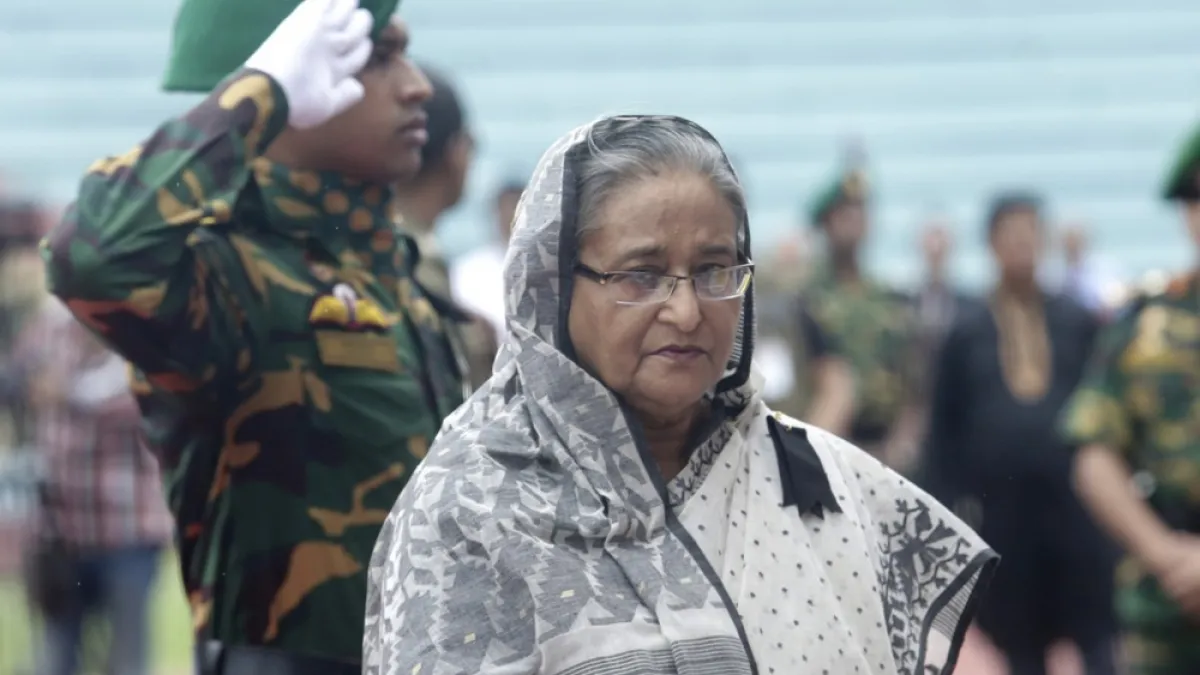
Ousted premier says the exclusion of her Awami League party “deepens resentment” on Muhammad Yunus’s interim government.
Bangladesh’s toppled leader Sheikh Hasina has denounced her country’s election next month after her party was barred from participating in the polls, raising fears of wider political division and possible unrest.
In a message published by The Associated Press news agency on Thursday, Hasina said “a government born of exclusion cannot unite a divided nation.”
Recommended Stories
list of 3 itemsend of list
Hasina, who was sentenced to death in absentia for her crackdown on a student uprising in 2024 that killed hundreds of people and led to the fall of her 15-year government, has been sharpening her critique of the interim government of Nobel Peace winner Muhammad Yunus in recent days, as the election that will shape the nation’s next chapter looms.
“Each time political participation is denied to a significant portion of the population, it deepens resentment, delegitimises institutions and creates the conditions for future instability,” the former leader, who is living in exile in India, warned in her email to the AP.
She also claimed that the current Bangladesh government deliberately disenfranchised millions of her supporters by excluding her party – the former governing Awami League – from the election.
More than 127 million people in Bangladesh are eligible to vote in the February 12 election, widely seen as the country’s most consequential in decades and the first since Hasina’s removal from power after the mass uprising.
Yunus’s government is overseeing the process, with voters also weighing a proposed constitutional referendum on sweeping political reforms.
Campaigning started last week, with rallies in the capital, Dhaka, and elsewhere.
Yunus returned to Bangladesh and took over three days after Hasina fled to India on August 5, 2024, following weeks of violent unrest.
He has promised a free and fair election, but critics question whether the process will meet democratic standards and whether it will be genuinely inclusive after the ban on Hasina’s Awami League.
There are also concerns over security and uncertainty surrounding the referendum, which could bring about major changes to the constitution.
Yunus’s office said in a statement to the AP that security forces will ensure an orderly election and will not allow anyone to influence the outcome through coercion or violence. International observers and human rights groups have been invited to monitor the process, the statement added.
Tarique Rahman, the son of former prime minister and Hasina rival, Khaleda Zia, returned to Bangladesh after his mother’s death in December.
Rahman, the acting chairman of Khaleda’s Bangladesh Nationalist Party, is a strong candidate to win the forthcoming election.
On Friday, Hasina made her first public speech since her ouster, telling a packed press club in Delhi that Bangladesh “will never experience free and fair elections” under Yunus’s watch.
Her remarks on Friday were broadcast online and streamed live to more than 100,000 of her supporters.
The statement was criticised by Bangladesh’s Ministry of Foreign Affairs, which issued a statement saying it was “surprised” and “shocked” that India had allowed her to make a public address.
Bangladesh has been asking India to extradite Hasina, but New Delhi has yet to comment on the request.
India’s past support for Hasina has frayed relations between the South Asian neighbours since her overthrow.
Davina McCall married her long-term partner during an ‘absolutely beautiful’ ceremony recently, just months after the couple announced their engagement following a trip to Ibiza
Davina McCall became emotional as husband Michael Douglas paid tribute to her openness(Image: Dave Benett/Getty Images)
Davina McCall broke down in tears during an emotional discussion with husband Michael Douglas. Davina and Michael tied the knot recently in an “absolutely beautiful” ceremony in front of their friends and family.
It came just three months after Davina, 58, announced that she and celebrity hairstylist Michael got engaged during a trip to Ibiza. The couple first started dating in 2018, having met originally on the set of Big Brother in 2000.
Now on the Making the Cut podcast, Davina’s husband Michael praised the television presenter for using her fame to speak candidly about her health battles and “help a lot of people”.
It came after Michael recently read Bruce Springsteen’s autobiography. In the book, the Boss spoke candidly about his music and his life, something Michael said he found to be a “therapeutic experience”.
Michael said: “I realised the important role that famous people can have in regular people’s lives. Bruce putting his life in the paper or out there has helped me.
“I realised what it means to be married to someone like you who also does that and what it’s like to be around someone who puts themselves out in a way that is to benefit and help other people and I want to say, well done you.
“I realise what you stand for for a lot of people and I see them stop you in the street and say how grateful they are for what you decided to do with your fame and your time. In a way that Springsteen helped me, I realised you helped a lot of people.”
The touching words from her husband made The Masked Singer panellist Davina audibly tear up. Davina will return to screens with Long Lost Families tonight (January 29) from 9pm on ITV One.
The series sees Davina and co-host Nicky Campbell reuniting people with their loved ones. Tonight the series will visit Mandy whose parents had a baby girl they placed for adoption, she is now attempting to find her long-lost big sister.
Elsewhere Jane thought she was an only child until her mother revealed she had a baby boy 11 months before her. Jane now wants help finding her long lost brother who was put up for adoption.
Davina has previously spoken about the emotions she feels when reunited siblings, especially because she lost her sister to cancer in 2012. Caroline, 50, was diagnosed with lung cancer after being rushed to hospital after suffering a suspected stroke.
Speaking to Love TV, she said: “Sometimes with siblings, it’s quite hard and painful, because one sibling might have grown up with their birth family, while the other was placed for adoption. There’s a lot to unpack there, you know?”
Davina says the show’s genealogists occasionally track people down who weren’t even aware they had a sibling. “Imagine being gifted a sibling out of the blue, it would be absolutely mad,” she added.
On the approach to Arosa in the Graubünden Alps, the road is lined with mountain chapels, their stark spires soaring heavenwards; a portent, perhaps, of the ominous route ahead. The sheer-sided valley is skirted with rugged farmhouses and the road twists, over ravines and round hairpin curves, to a holiday destination that feels like a well-kept secret.
On the village’s frozen lake, young families ice skate, hand in hand. A little farther along, on the snow-covered main street, children sled rapidly downhill, overtaking cars. The resort’s mascots are a happy gang of brown bears. And there are Narnia lamp-posts, which turn the falling snow almost gold every evening. Switzerland is replete with ski towns but none feel quite this innocent and childlike, like stepping into a fairytale.
I am here for a week in an apartment with my wife and two kids, as it’s a place my Swiss partner’s parents and grandparents have been returning to for more than a century. What first drew them here? All say the same thing: Arosa is the Swiss mountain village most Swiss don’t even think to visit; a low-key alternative to the box office of St Moritz, Verbier and Zermatt.
The village sits on a high, terraced plateau one hour south of Chur, Switzerland’s oldest city, and is surrounded by dense fir forests, above which rises an amphitheatre of saw-cut summits. The sense is that the out-of-sight village has been secretly occupied – the pretty-as-pie peaks standing sentry – as if the first farmers here back in the 14th century feared the Habsburgs might return at any moment to take back their territories.
This is also storybook Switzerland to a T. To the north is Heidiland, the farm holiday region where Johanna Spyri set her children’s novels. Also one hour away is Liechtenstein, the pipsqueak principality, which brings to my mind the land of Vulgaria in Chitty Chitty Bang Bang. Two hours to the north is Zurich where we arrived, before borrowing my in-laws’ car. If you fancy taking the train, there are options to do the trip from the UK to Zurich in as little as seven hours, with a change in Paris. Arosa can then be reached on the memorably scenic Rhaetian Railway, a journey with some of the Alps’ most glorious in-seat entertainment. Outside, all the drama is provided by a script of high-definition gorges and glaciers.
The Arosa Bear Sanctuary, at the middle station of the Weisshorn cable car, is a good place to start exploring. Even during the residents’ winter deep sleep, the 2.8 hectare den offers a walk-through education in animal welfare in an unlikely setting, and its wooden platforms offer memorable views of the snow-fuzzed summits and pistes that lead off in every direction like a spreadeagled skier.
The refuge is run in cooperation with global animal charity Four Paws and it provides four rescued European brown bears a species-appropriate home. Once held in appalling conditions, including a private mini zoo in Albania, the bears’ compound is now a place to readjust, to feel safe again. For the full Yogi and Boo-Boo experience, I’d suggest visiting in summer.
Rhaetian railway passing through snow in Arosa. Photograph: Alamy
It’s fair to say my six-year-old daughter fizzes with enthusiasm when the bears are mentioned, but also when we snowshoe later that week into pine forest along the resort’s themed Squirrel Trail. The trail is printed with fresh squirrel tracks and we add our own, feather-pressing our boots into the crisp snow. The flakes fall heavily, as if we’re inside an ornamental snow globe. Then, two red squirrels scurry past with dark-furred yet sparkling tails.
Most days we ski until lunch. All children enjoy one free half-day group lesson for each night’s stay in Arosa with ABC Snowsports School or the Swiss Ski and Snowboard School, but we prefer to explore the mountains as a family. Since 2014, the resort has been connected across the gaping Urden valley with the larger town of Lenzerheide, and like other popular Alpine ski areas, the combined piste map is now a profusion of primary colour squiggles.
But there the similarity ends. British accents are absent. The pistes are largely empty. Strict building regulations, upholding traditional timber aesthetics, mean the village is largely the same now as it was when my relatives first visited. It is Switzerland, but from a half-century ago. At the barn-like Tschuggenstübli, once a cheese dairy on the slopes, everyone crams on to tables to order bündnerfleisch (air-dried beef) and käseschnitte, an upgraded welsh rarebit with melted raclette cheese, pickles and onions.
Afterwards, it’s toboggan time. It strikes me there are almost as many traditional wooden sledges for hire in Arosa as there are pairs of skis, and, from the top of the Kulm Gondola, the only way is down. And at speed. My kids are barely ruffled by the tight, bobsleigh chicanes and, one afternoon, we all howl with laughter as my eight-year-old son hurtles off the track into a marshmallowy drift. He pops back up, grinning, but polar bear white. We repeat the sledge run another half-dozen times.
The Grand Arosa Pop-up Hotel uses a vacant resort hotel. Photograph: Studio Filipa Peixeiro/Le Terrier Studio
Another reason for visiting this winter is to stay at the Grand Arosa Pop-Up Hotel, a one-year experiment inside a vacant resort hotel which is open to the end of this season – the concept will continue next year, though details are yet to be confirmed (they also operate another pop-up hotel in Fribourg and a pop-up hostel in Zurich). Clues as to its aesthetic are in the name – this is not a ski hotel in the traditional sense, and certainly not a vintage chalet brimming with geranium window boxes and mounted antlers. More than that, it is probably the Alps’ largest ever pop-up hotel and its interiors are bathed in pastel pink. If you can find me cooler ski accommodation this year, I’m happy to wait.
With a tech-first approach, there is no reception, but self-check in instructions imposed on a poster of a purple bellboy. What might have once been a telephone operator’s room is reimagined as a walk-in guest book, its fan-print wallpaper covered with whimsical, hand-written comments. Velvet curtains drape two symmetrical elevators, then a cloaked red corridor suggests you are somehow walking backstage at a theatre, before revealing a piano observatory and a vintage design cinema. A Wes Anderson film set has been conjured before you. We only drop in for coffee, but I wish we’d stayed.
At the end of our week, my wife mentions to me how sad she is to be leaving. The kids aren’t too happy about it either. Neither am I. It crosses my mind that Arosa, with its sleepy bears, squirrels and surreal pop-up hotel, isn’t what most people come to Switzerland for. Rather, it’s what we’ve been looking for all along.
CLEVELAND — Luka Doncic grabbed at his left leg. He immediately thought of Dru Smith. The Miami Heat guard’s knee injury suffered in 2023 when he slipped off the side of the Cleveland Cavaliers court haunted Doncic while he winced in pain near the Lakers bench.
The Lakers superstar avoided serious injury after falling off the side of the Cavaliers’ raised court on Monday, but the threat of a player being hurt by Cleveland’s unique 10-inch drop off between the court and the arena floor came into focus again during the Lakers’ 129-99 loss to the Cavaliers.
“It is absolutely a safety hazard,” Lakers coach JJ Redick said after Doncic was able to return later in the first quarter. “And I don’t know why it’s still like that. I don’t. You know, you can lodge formal complaints. A lot of times you don’t see any change when you lodge a formal complaint.”
Doncic was injured shooting a fadeaway three with 7:58 left in the first quarter. He was hopping on one foot after releasing the shot and hopped right off the platform, grabbing immediately for his left leg. When he hobbled to the locker room, Doncic could barely put any weight on his leg.
But he returned with 1:32 remaining in the first quarter and finished with 29 points, six assists and five rebounds. He didn’t have any additional braces or wraps on his left leg, but he said he didn’t feel quite 100%.
“I kind of got scared,” Doncic said. “It wasn’t a great feeling and looking back at the video I think I got a little bit lucky. It hurts obviously more now, but, just, I tried to go.”
Smith was injured much more severely in 2023 when he was closing out on defense, landed on a stat sheet and slipped over the edge. He suffered a season-ending anterior cruciate ligament sprain in the accident, and the Heat contacted the NBA to express concerns about the floor at the time.
“It’s tough to see another player get hurt on this court, with the fall, with the drop off,” Lakers guard Gabe Vincent said Monday, “so hopefully something can get fixed with that, but we’re fortunate that [Doncic] is OK.”
Cleveland’s Rocket Arena, which opened in 1994 and was last renovated in 2019, is also home to the Cleveland Monsters, an American Hockey League affiliate of the Columbus Blue Jackets. The basketball court is raised to accommodate the ice underneath the floor. But several teams in the NBA, including the Lakers, share their arena with hockey teams and none have a court that drops off like Cleveland’s.
“It’s the only court like this so, I guess it’s my fault,” Doncic said. “I [gotta] stop jumping like that.”
The Lakers have history with concerning courts this year. In November, Doncic said during a postgame news conference that the Lakers’ custom NBA Cup court used during a home game against the Clippers was dangerously slippery. The team flagged the problem to the league and the Lakers did not use the court again because it was not deemed safe for play in time for the other NBA Cup games.
But when asked if there was a way he could bring the latest problem up with the league, Doncic demurred.
“I don’t know,” Doncic said, “don’t involve me in that.”
Similarly, Redick said any changes would be “way above my pay grade.”
Israel demolishes the headquarter of the United Nations Relief and Works Agency in the East Jerusalem neighborhood of Sheikh Jarrah on January 20, 2026. On Wednesday, 11 countries condemned Israel for the move. File Photo by Atef Safadi/EPA
Jan. 29 (UPI) — Britain, Canada, France and eight other allies on Wednesday “strongly condemned” Israel’s demolition of the United Nations’ Palestinian relief agency building in occupied Palestinian territory, saying it represents the latest “unacceptable move” by the Middle Eastern nation to undermine the U.N.’s ability to operate.
The joint statement from the foreign ministries of Belgium, Britain, Canada, Denmark, France, Iceland, Ireland, Japan, Norway, Portugal and Spain described Israel’s demolition of UNRWA’s East Jerusalem building as “an unprecedented act against a United Nations agency by a U.N. member state.”
“We urge the Government of Israel to abide by its international obligations to ensure the protection and inviolability of United Nations premises in accordance with the provisions of the U.N. General Convention (1946) and the Charter,” the 11 nations said.
“We call upon the Government of Israel, a member of the United Nations, to halt all demolitions.”
The West Bank and East Jerusalem are widely regarded as Israeli-occupied Palestinian territory, and Israeli actions, including the establishment of settlements and the demolition of Palestinian buildings, are widely regarded as illegal under international law.
Israel has long been a vocal critic of UNRWA, alleging it has ties with Hamas, allegations that only intensified after the Iran-backed militant group’s bloody surprise attack on Israel on Oct. 7, 2023.
The Knesset, Israel’s parliament, passed laws in the fall of 2024 to ban the agency from operating in land under its control, with the ban going into effect in January 2025.
Last week, Israel demolished UNRWA’s East Jerusalem building.
“UNRWA is a service provider delivering healthcare and education to millions of Palestinians across the region, particularly in Gaza, and must be able to operate without restrictions,” the 11 nations said Wednesday.
The nations also called on Israel to abide by its obligations to facilitate the delivery of humanitarian aid to Gaza.
“Despite the increase in aid entering Gaza, conditions remain dire and supply is inadequate for the needs of the population,” they said.
On Tuesday, UNRWA Commissioner-General Philippe Lazzarini said that not only had Israel “stormed & demolished” its headquarters, but it was now set on fire.
“Allowing this unprecedented destruction is the latest attack on the U.N. in the ongoing attempt to dismantle the status of Palestine refugees in the occupied Palestinian Territory & erase their history,” Lazzarini said on X.
“Refugee status must be resolved through a genuine political solution, not criminal acts.”
Israel has killed more than 71,600 Palestinians and damaging more than 80% of all of the region’s structures in its war against Hamas in Gaza.
According to the Palestinian Ministry of Health, Israel has killed 492 Palestinians since the fragile cease-fire was announced in October.
Israel has been accused of committing genocide against the Palestinian people in Gaza by a number of nations, international organizations and human rights groups, and the International Criminal Court has issued arrest warrants for Israel’s prime minister, Benjamin Netanyahu, and its former defense minister, Yoav Gallant, on war crimes and crimes against humanity charges.
In Dhaka’s political chatter, one word often keeps resurfacing when people debate who really holds the reins of the country: “Kochukhet”.
The neighbourhood that houses key military installations has, in recent public discussions, become shorthand for the cantonment’s influence over civilian matters, including politics.
Bangladesh is weeks away from a national election on February 12, the first since the 2024 uprising that ended then Prime Minister Sheikh Hasina’s long rule and ushered in an interim administration led by Nobel laureate Muhammad Yunus.
The army is not vying for electoral power. But it has become central to the voting climate as the most visible guarantor of public order, with the police still weakened in morale and capacity after the upheaval of 2024, and with the country still reckoning with a “security apparatus” that watchdogs and official inquiries say was used to shape political outcomes under Hasina.
For nearly a year and a half now, soldiers have policed the streets of Bangladesh, operating under an order that grants them magisterial powers in support of law and order. On election duty, the deployment will scale up further: Officials have said as many as 100,000 troops are expected nationwide, and proposed changes to election rules would formally list the armed forces among the poll’s “law-enforcing agencies”.
Bangladesh, a nation of more than 170 million wedged between India and Myanmar, has repeatedly seen political transitions hijacked by coups, counter-coups and military rule, a past that still shapes how Bangladeshis read the present. Analysts say that the army today is not positioned for an overt takeover, but it remains a decisive power centre: an institution embedded across the state, able to narrow civilian choices through its security role, intelligence networks and footprint inside government.
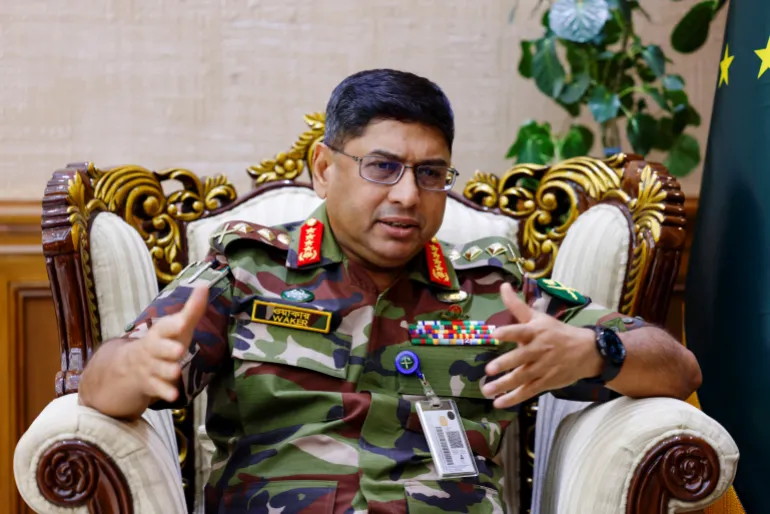
Bangladesh’s Chief of Army Staff General Waker-uz-Zaman, seen here during an interview with Reuters at his office in the Bangladesh Army Headquarters, in Dhaka, Bangladesh, September 23, 2024 [Mohammad Ponir Hossain/ Reuters]
The military’s role now
Thomas Kean, the International Crisis Group’s senior consultant on Bangladesh and Myanmar, said the army has been “backstopping the interim government” not only politically but also “through day-to-day security amid police weakness”.
He said the institution is eager to see a transition to an elected government so the country returns to a firmer constitutional footing and so troops can “return to their barracks”.
“There are different factions and views within the army, but overall I would say that the army wants to see the election take place as smoothly as possible,” Kean told Al Jazeera.
Kean argued that if the army chief, General Waker-uz-Zaman, and the military “had wanted to take power, they could have done so when the political order collapsed on August 5”, the day Hasina fled to India amid a popular student-led revolt. But the military chose not to, he said, in part because it had learned from the fallout of past experiments with its direct political control.
Asif Shahan, a political analyst and professor at Dhaka University, said the military was aware that a takeover would have also jeopardised key interests, including Bangladesh’s United Nations peacekeeping deployments, which carry both financial benefits and reputational weight for the armed forces. Bangladesh has for decades been one of the biggest suppliers to UN peacekeeping missions, and receives between $100m and $500m a year in payouts and equipment reimbursements for these services.
But Shahan argues that the military remains “an important political actor”. Today, he said, its influence is “less about overt intervention than the institutional weight it carries through the security and intelligence apparatus”.
He also pointed to what he called the army’s “corporate” footprint. That footprint spans involvement in major state infrastructure projects, the military’s own business conglomerate, and the presence of serving and retired officers across commercial and state bodies.
Shahan said the last Hasina government “gave them a share of the pie”, leaving “a kind of culture of corruption … ingrained”. He suggested that this could translate into informal pressure on whoever governs next to do the same, and anxieties inside the force over whether “the facilities and privileges” it has accumulated will shrink.
On the election itself, Shahan too said that the possibility of the army trying to gain overt control was “very low” unless there is such a major law and order breakdown that there is public demand for the army to step in as the “only source of stability”,
Others who track the military closely agreed. Rajib Hossain, a former army officer and author of the best-selling book Commando, said he “strongly believes” the army will avoid partisan involvement for its own sake. “The army will play a neutral role during this election,” he said. “What we’ve observed on the ground over the past year and a half, there is no record of the army acting in a partisan way.”
But, he added, pressure on the institution has been intense since 2024. “Internally, there’s an understanding that if the army fails to act neutrally, it could lose even the public credibility it still has,” he said.
Mustafa Kamal Rusho, a retired brigadier general at the Osmani Centre for Peace and Security Studies, also told Al Jazeera that the military does not have “any clear intent” to influence politics, though “it still remains a critical power base”.
That leverage was clearest during the 2024 uprising, Rusho said, when Bangladesh’s political crisis reached a point that many Bangladeshis and international watchdogs viewed the military’s posture as decisive. “If the military did not take the stand that it took, then there would have been more bloodshed,” he said.
With protests escalating, the military refused to fully enforce Hasina’s curfew orders and decided troops would not fire on civilians. It enabled Hasina to flee to India on an air force plane, and the army chief then announced an interim government would be formed.
In an Al Jazeera documentary on the uprising last year, Waker-uz-Zaman, who is related to Hasina and was appointed less than two months before her collapse, also stressed that his forces would not turn their guns on civilians. “We don’t shoot at civilians. It’s not in our culture … So we did not intervene,” he said.
In the same interview, he added: “We believe that the military should not engage in politics … It’s not our cup of tea.”
Bangladesh’s military leader and president, Hussain Muhammad Ershad, meeting British PM Thatcher at Downing St. London on February 16, 1989 [Wendy Schwegmann/ Reuters]
When the military ruled
That hasn’t always been the military’s position.
After the 1975 assassination of Sheikh Mujibur Rahman, Bangladesh’s founding leader and then-president, by a group of military officers, the country entered a period marked by coups, counter-coups and military rule upheavals that reshaped the state and produced political forces that still dominate elections.
One of them was the Bangladesh Nationalist Party (BNP), founded by army general-turned-ruler Ziaur Rahman, who emerged as the country’s most powerful figure in the late 1970s before moving into civilian politics. Rahman was assassinated in 1981 in a failed coup attempt by another group of military officers. The BNP remains a key contender in the February 12 vote, now led by Rahman’s son, Tarique Rahman, who has returned to front-line politics after a long exile.
In 1982, then army chief Hussain Muhammad Ershad seized power and ruled for much of the 1980s. Writer and political historian Mohiuddin Ahmed has described Ershad’s takeover as coming only months after he publicly argued that “the army should be brought in to help run the country”.
Eventually, a pro-democracy movement led by Zia’s wife, Khaleda Zia, and Hasina, also Mujibur Rahman’s daughter, forced him from office. The BNP won a landmark election, and in 1991, Khaleda became the country’s first female prime minister.
Since then, Rusho said, the military’s influence “became more indirect”, though Bangladesh still saw an abortive May 1996 showdown when the then army chief, Lieutenant General Abu Saleh Mohammad Nasim, defied presidential orders, and troops loyal to him moved towards Dhaka. Nasim was arrested and removed from office.
A decade later, in 2007, the military in effect “fully backed” a caretaker government that was formed to replace Khaleda’s second administration, which had ruled between 2001 and 2006. That caretaker government was installed in January 2007 after a breakdown in the election process and escalating political violence. The International Crisis Group described the caretaker administration as “headed by technocrats but controlled by the military”, while then-army chief Moeen U Ahmed argued the political climate “was deteriorating very rapidly” and that the military’s intervention had “quickly ended” street violence.
It was only after 2009, when Hasina came back to power – her Awami League had first ruled between 1996 and 2001 – that the military became “subordinate to the civilian regime”, Rusho said.
Bangladeshi military force soldiers on armored vehicles patrol the streets of Dhaka, Bangladesh, Saturday, July 20, 2024 [Rajib Dhar/ AP Photo]
Blurred lines
But even though the military today insists that it does not want power, it has often drifted into the political terrain.
A major moment arrived just weeks after Hasina’s ouster, in September 2024, when General Zaman told the Reuters news agency he would back Yunus’s interim government “come what may”, while also floating a timeline for elections within 18 months. The interview, which critics described as something unprecedented for a serving army chief, placed the military close to the country’s central political debate.
Hossain, the former army officer and author, criticised the public nature of the intervention. “If he [Zaman] had discussed this after sitting with all the stakeholders … the interim [administration], political parties, protest leaders … and then gone to the media, that would be acceptable,” he said. “But here, he declared it unilaterally and blindsided the government from his position of power. He had no authority to do that.”
“You may say this is an extraordinary, transitional time and the military has a role to play,” Hossain added. “But then, why do we have an administration at all?”
Shahan, the Dhaka University professor, said Zaman “came very close” to crossing the line and explained it as a product of military institutional culture after August 5. “Military organisations … like to follow standing operating procedures, order, stability,” he said. But August 5, he added, was “a political rupture” that forced the army and the nation into uncertainty: about the interim government’s longevity, legitimacy and how it would deal with the military.
Those anxieties, Shahan said, likely pushed Zaman to speak. In principle, he said, it is reasonable for the army chief to say elections are needed for stability. But “when he set a specific timeline – within 18 months – that is beyond his role”, Shahan said. “It then appears as if he is dictating.”
Shahan added that the problem becomes sharper when that kind of specificity appears to respond to a party demand; he was referring to a time when only the Bangladesh Nationalist Party was repeatedly pushing for a vote timetable.
Eight months later, in May 2025, Zaman again weighed in, telling a high-level military gathering, according to local media reports, that his position had not changed and that the next national vote should be held by December 2025. After that, Faiz Ahmad Taiyeb, a special adviser to Yunus, wrote on Facebook that “the army can’t meddle in politics” and argued that the military chief had failed to maintain “jurisdictional correctness” by prescribing an election deadline.
Military personnel stand in front of a portrait of then Prime Minister Sheikh Hasina in Dhaka, Bangladesh, on July 30, 2024 [Rajib Dhar/ AP Photo]
The shadow Hasina left
Another reason that analysts say the military’s role is being debated so intensely now is because of Bangladesh’s recent wounds.
During Hasina’s 15-year rule, human rights organisations argued Bangladesh’s security apparatus was often used for political control. Human Rights Watch has described enforced disappearances as a “hallmark” of Hasina’s rule since 2009.
When the United States sanctioned the Rapid Action Battalion (RAB) in 2021 over allegations of extrajudicial killings, the US Department of the Treasury said, “These incidents target opposition party members, journalists, and human rights activists.” Critics argue that security institutions became central to governance, and questions about how that machinery was used are now part of the post-Hasina political settlement.
Hossain, the former officer, said the Hasina-era legacy still echoes inside the top brass. “If you look at the leadership, the general, five lieutenant generals, and some major generals and brigadier generals, a lot of them were part of Hasina’s apparatus,” he said, “aside from a handful of professional officers”.
A report by Bangladesh’s Commission of Inquiry on Enforced Disappearances says disappearances were used as a “tool for political repression” and that the practice “reached alarming levels during key political flashpoints”, including in the run-up to elections in 2014, 2018 and 2024. The commission said it verified 1,569 cases of enforced disappearance.
In cases where political affiliation could be confirmed, the Jamaat-e-Islami and its student wing accounted for about 75 percent of victims, while the BNP and its affiliated groups accounted for about 22 percent. Among those “still missing or dead”, the BNP and its allies accounted for about 68 percent, while the Jamaat and its affiliates accounted for about 22 percent, the report said.
The commission also noted that the Directorate General of Forces Intelligence (DGFI), the military-run intelligence agency, had been “accused of manipulating domestic politics and interfering in the 2014 parliamentary elections”, and argued that perceived alignment with the Awami League compromised its neutrality.
Several senior military officers, including 15 in service, are now facing trial in a civilian tribunal on charges of enforced disappearances, murders and custodial tortures.
The proceedings have become a delicate issue in civil-military relations, as cases against serving officers in civilian courts are rare in Bangladesh’s history.
Former army chief Iqbal Karim Bhuiyan wrote on Facebook that local media had reported disagreements over the “trial process” for officers accused of crimes against humanity and that those disagreements had created what he described as a “chasm” between the interim government and the army’s top leadership.
Hossain, the former officer, however, said he disagreed. “These trials are not defaming the army,” Hossain said. “Rather, they are a kind of redemption for the institution to recover from the stigma created by the crimes of some self-serving officers.”
He argued that accountability could motivate younger officers and reduce the risk of the military being politically exploited again. Rusho, the retired brigadier general, also argued that politicisation under Hasina was driven less by formal doctrine than by executive control over careers.
“Promotions, important postings, placements … they were influenced considerably by the executive branch,” he said. “When you influence postings, some people’s loyalty often gets diverted to political masters, [and] it affects … professionalism and capability.”
Kean of the International Crisis Group said the real test for Bangladesh now would be whether it can stop the security state from being reabsorbed into partisan politics.
“The military is going to remain a powerful institution in Bangladesh, with a level of influence in domestic politics,” he said. “One hopes that the lesson of the past 18 months is that the military is better to support civilian administrations rather than be in power directly – that it can be a stabilising force, and one that is ultimately committed to democracy and civilian leadership.”
But, he added, the onus to do that isn’t only on the generals. Civilian politicians, too, needed to resist the temptation to misuse the military. That alone, he suggested, would help Bangladesh keep the army in the barracks and politicians accountable to the people, not to men in khakis.
Netflix has added a historical drama based on the true story and viewers have been captivated
Toni Chichiarelli is a real-life artist(Image: NETFLIX)
Netflix has quietly dropped a historical drama rooted in real events, and true crime enthusiasts are already singing its praises. The streaming giant has added this Italian post-war thriller, which chronicles the life of Toni Chichiarelli (portrayed by Pietro Castellitto).
The gifted artist scrapes by creating street portraits in Rome during Italy’s tumultuous Years of Lead. This period witnessed widespread chaos fuelled by political violence from both neo-fascist groups and far-left extremists.
Time Magazine noted: “Toni’s amoral ambition leads to a life of forgery, producing perfect replicas of paintings for his gallery owner girlfriend Donata (Giulia Michelini) and other lucrative jobs for the Banda della Magliana, a criminal organization stretching its wings in Rome, with the charismatic Balbo (Edoardo Pesce) taking the forger under his wing.”
This ambitious production, amongst Netflix’s collection of fact-based films, has earned acclaim for its meticulous period detail, with reviewers highlighting the authenticity of everything from vehicles to wardrobes and soundtrack. Viewers have branded it a compelling blend of political suspense and gangster drama.
The Netflix offering is titled The Big Fake, and supporters have flocked to IMDb reviews encouraging others to give it a watch.
Pjames10 praised it as “excellent”, revealing: “I don’t want to give anything away, but the movie took some nice twists and turns. It had some filmic serendipities that, rather than distracting, only helped to reveal how our hero has led a charmed life on the periphery of legitimacy and criminality. I was sucked in, and it held my attention the entire time.”
2B-10101010 branded it “amazing”, continuing: “Intrigue, emotion, story, actors, this movie has it all. It starts a bit slow but after the initial introduction, you get to know the characters and story and you want to see more, you want to feel like you are in the movie, it’s a captivating story with a bit of flair. Maybe one of the best European movies! Give it a chance, it’s worth seeing.”
Luuthaiquangkhai awarded the film nine out of 10 stars, commending its distinctive atmosphere.
They explained: “I came in expecting a heist/criminal movie, ends up watching a Historical drama that is very much unlike any other things. They have a good story to tell, a firm set of characters with clear individual values and motivations.”
Get Netflix free with Sky
This article contains affiliate links, we will receive a commission on any sales we generate from it. Learn more
Sky is giving away a free Netflix subscription with its new Sky Stream TV bundles, including the £15 Essential TV plan.
This lets members watch live and on-demand TV content without a satellite dish or aerial and includes hit shows like Stranger Things and The Last of Us.
Over on Rotten Tomatoes, Giulia S enthused: “Amazing plot. Great character. Great Atmosphere. I really enjoy it!” Anthousa P declared: “Finally a movie for readers of good literature. Where the story matters less than how it is told. Lovely photography, solid acting, good steady pace, interesting musical background.”
Lucas P declared: “An absolute masterpiece of a movie with a spectacular twist at the end. This is a must-watch.”
The genuine Antonio Chichiarelli was an expert in deception, and his talents extended far beyond painting. Born in Abruzzo in 1948, he made his way to Rome possessing a skill “so dangerous it made him a protected asset for the most powerful entities in Italy”, according to The Viewers Perspective.
The Big Fake is on Netflix.
**For the latest showbiz, TV, movie and streaming news, go to the new Everything Gossipwebsite**
Passengers on a busy British Airways flight from London Heathrow to Jamaica divided opinion with their behaviour, which some described as “inconsiderate” and “rude”
Maxine Munroe shared a controvesial clip online of a man preaching on the flight(Image: Kennedy News/Maxmilliok)
Some British Airways passengers divided opinion online after footage emerged of them chanting and preaching during a flight.
Clips posted on social media show a woman standing in the aisle and singing while waving and shouting at fellow passengers until they join in and clap along during the journey from London Heathrow to Jamaica this month. Further footage captures a man loudly preaching while standing at his seat until staff announce the seat belt signs have been turned on and he sits back down.
Maxine Munroe, who was on the flight and shared a clip on TikTok, described her bizarre experience as “almost like being in church,” and fierce debate followed on the social media platform. Maxine, a 56-year-old nurse, said the antics early into the flight and continued for nearly three hours.
“It was almost like we were at church…. I think I was just surprised that this was happening 40,000ft in the air. At some point I was thinking we need to settle down and we need to rest. There were a lot of people (online) who say they don’t think they could cope on a flight like that,” Maxine, who is from Croydon, south London, said.
Indeed, some online who blasted the behaviour, describing it as “inconsiderate” and “rude”. One Tiktoker posted: “I’d have found this so rude, they’re making a show of themselves and not thinking of others at all.” Another said: “As a nervous flyer this would send me over the edge.”
The clips show no obvious backlash from other passengers onboard the flight. Maxine, who regularly visits family in Jamaica, continued: “You will be on flights and people will pray before the flight takes off or if there’s turbulence you might hear somebody pray but not to that scale… It was fine while it lasted but it’s got its limit and I can understand when someone says that it is too much.
“I did think how long it would be until the crew had had enough. They need to be able to do their job and have the flight under control and it was a bit of an obstacle.
“A lot of people thought alcohol was related and actually there was no alcohol involved. It was more high on the godly spirit than they were on the alcohol, which is why I don’t think it affected the flight attendants as much as people drinking and being rowdy.”
British Airways has not faced direct criticism online following the emergence of the videos. Social media users were, though, angry at the passengers themselves for their decisions. One said: “Looks a nightmare.” Another stated: “It’s inconsiderate. I would’ve been so cross.”
But others were entertained and applauded the joyful tourists. One TikToker posted: “It was a lovely thing to see and f**k what anyone else says.” Another shared: “This would be the best flight. I like it when people are happy.” The Mirror has contacted British Airways for comment.
Merthyr are not short of star names who have dipped into their own wallets to help. Line of Duty star Vicky McClure and her filmmaker husband Jonny Owen, who is from Merthyr, are among the club’s 150-plus owners, along with former Wales international Joe Morrell.
But any major takeover – by a company or individuals who could potentially propel Merthyr up the divisions at speed, like Ryan Reynolds and Rob Mac have done at Wrexham – would likely lead to a big change in its ownership structure.
“Unfortunately we’re a fan-owned club,” said Barlow, who has seen more ups and downs than most during his 65-year involvement with Merthyr, from player to kitman, physio to boardroom leader.
But fan-owned is what Wrexham were before Rob and Ryan breezed into the Stok Cae Ras and changed the world as Red Dragons’ fans knew it back in 2021.
“Yes, and those guys [Rob and Ryan] came in and put their hands in their pockets,” said Barlow.
“We haven’t come across anybody like that at the moment, but we have had some good sponsors and, as I say, we’re talking to people weekly.
“We’re starting now for next year. Irrespective of where we end up, we still want to be in a better position financially and stadium-wise than where we are now.
“One side of the ground is perfect, but we’ve got another area which I think the Romans built when they had a fort in the corner!”
Keep moving, keep looking for new forms of investment. A responsibility to do that comes from a need to keep supporting the man leading Merthyr’s charge for a second successive promotion, manager Paul Michael.
“We’re working as hard as we can because we want to support this guy, and we want the best team we can afford,” said Barlow.
“The better the results we can get with this guy in charge…it helps a long way.”
Appointed after leaving Yate Town in April 2022, Michael has transformed Merthyr from relegation candidates in Southern League Premier South to National League hopefuls.
“Over the past few weeks we’ve probably been the most in-form team in the league, yet we’re competing against full-time teams. We’ve got no right to stay up there, really.
“If we were fortunate enough to get to the National League we would try to take it all in our stride. It would be an unbelievable achievement for a part-time team, though we’ve still got a long way to go.
“What’s happening here is fantastic for Welsh football, not just Merthyr Town.”