Month: January 2026

The Yemeni crisis: More complexity and many repercussions | Military

Events in Yemen are escalating quickly and dramatically, reaching the point of armed clashes erupting between the Arab coalition supporting the internationally recognised government in Yemen, led by Saudi Arabia, and the so‑called “Southern Transitional Council” (STC), backed by the United Arab Emirates.

Many view these developments as a natural outcome of a long, cumulative trajectory of complexities the country has experienced since the civil war erupted in late 2014, and the humanitarian and economic repercussions that followed.

External interventions had a profound impact in creating political and administrative chaos that intensified internal divisions and exposed what remained of the legitimate state to further weakness, culminating in the loss of its most important sovereign tools: unity of territory and decision-making. These developments and events add further complexity to an already complex picture, and Yemen will not be safe from their future repercussions.

On the other hand, others view the situation from another, less bleak angle. The strong reaction to the STC’s moves — on the part of the Yemeni president (chairman of the Presidential Leadership Council, or PLC) and, behind him, the Saudi‑led Arab coalition — is a new and important variable, completely different from the usual approach to many similar events. So, there is hope that these events and changes will mark a new phase that works to correct the imbalances and deviations that accompanied the Arab coalition’s intervention over more than a decade.

Watching carefully are the Houthi rebels in northern Yemen, who have remained silent, apparently waiting to see what these events will produce as they continue to strike at the unity of the components of the Arab coalition’s leadership and undermine the legitimate government. In any case, they realise that the eventual outcome will ultimately be in their favour. Therefore, the Houthis, according to multiple reports, are currently intensifying their military preparations, redeploying and dispersing their forces along the theatre of operations adjacent to contact points on the fronts: the northeast (Marib), and the southwest in Taiz and Bab al-Mandeb, preparing for zero hour.

So, what is the nature and background of this bilateral conflict between allies? Where have these events and developments led Yemen, and where will they lead it? And what are their implications for the future of the country and the region?

There is broad agreement that what is happening today is merely an initial result of a deep internal conflict of interests between the two main coalition states — Saudi Arabia and the UAE. Although most of this conflict remained hidden, its accumulations continued to roll and grow like a snowball.

To understand how matters reached this point of an explosion of conflict between allies, we must first understand the background of this rivalry and conflict.

In late March 2015, Saudi Arabia led a coalition of 10 Arab and Muslim countries to intervene militarily in Yemen — later it was called the Coalition to Support Legitimacy in Yemen, with the aim of restoring the authority of Yemen’s former legitimate president, Abd-Rabbu Mansour Hadi, from the grip of the Houthi coup forces.

At the outset, the coalition achieved major, tangible successes on the ground before differences began to emerge between the two main allies, Saudi Arabia and the UAE.

There is a widespread and well‑grounded belief that the UAE entered this war with a plan to achieve purely geopolitical and strategic interests. Some argue, however, that this was not necessarily the case at the beginning, but that it may later have turned to exploiting weakness, vacuum, and internal divisions in order to redraw its strategy anew in light of that.

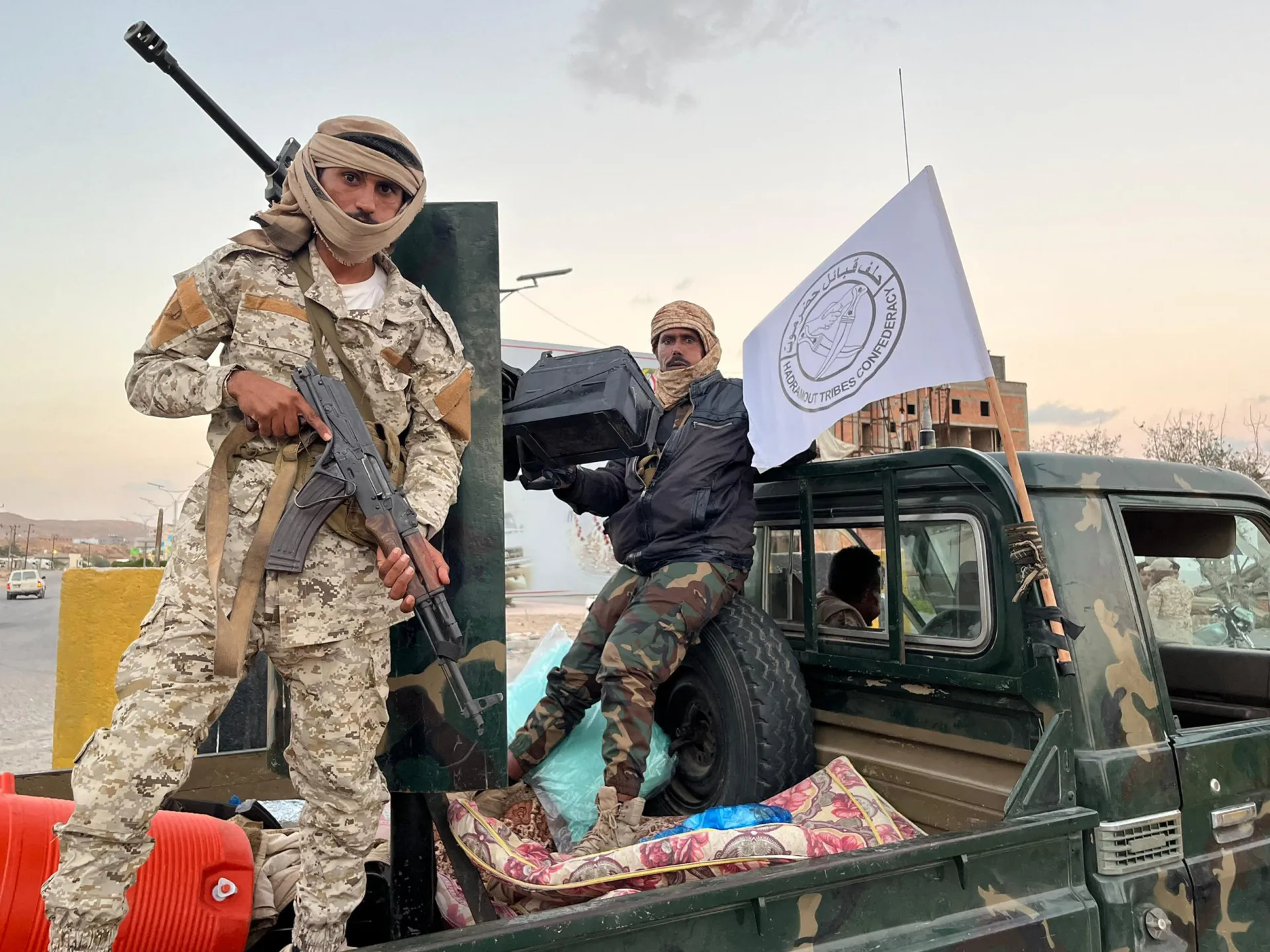
On the ground, the UAE formed, trained, and financed local forces loyal to it, using them to achieve its own objectives, away from the coalition and the legitimate government. Within just two years of its intervention, it managed — through its own local forces — to impose control over all strategic maritime outlets along southern and eastern Yemen, reaching the western coast of Taiz governorate in the country’s southwest, where the strategic Bab al-Mandeb Strait lies.

Over 10 years of the coalition’s intervention, the UAE established and built a hard-hitting army of its own militias, becoming the strongest force on the ground and the greatest threat to the interests of its ally (Saudi Arabia) in Yemen, including the system and the legitimate government that it had supported and sponsored from the outset. It can be affirmed that Riyadh committed fatal strategic mistakes in dealing with these deviations, remaining silent and failing to take decisive action on the ground to curb its ally’s overreach — perhaps settling for minor protective measures, and often acting merely as a “mediator” to resolve disputes that flared up from time to time — until the axe finally struck the head.

Military escalation

In early December, the STC, which was founded and backed by the UAE, triggered a military escalation by seizing control of the governorates of Hadramout and al-Mahra in eastern Yemen. This angered Saudi Arabia and pushed it out of its usual diplomacy and calm. Many may interpret this major shift in its policy as stemming from the fact that it views these two eastern governorates bordering it as a geographic extension of its national security, and that any compromise to their security constitutes a direct threat to its national security, something Riyadh stated explicitly in its recent statements issued in the wake of the crisis.

Accordingly, the head of the PLC dealt with these developments with great seriousness, describing them as unacceptable “unilateral measures”. Under the authority granted by the Power Transfer Declaration (April 2022), he called on the Saudi-led Arab coalition to intervene militarily.

The next day, coalition aircraft struck military equipment that had arrived on two ships from the UAE’s Fujairah port to the port of Mukalla in Hadramout. In response, Yemeni President Rashad al-Alimi declared a state of emergency and called on the UAE to end its presence in Yemen. Later that day, the UAE Ministry of Defence announced the withdrawal of what remained of its forces in Yemen (the UAE had previously announced in October 2019 that it was withdrawing its forces from Yemen).

The military escalation led to major, rapidly unfolding military and political repercussions, particularly after the STC continued to refuse to heed calls and threats by the coalition leadership and the Yemeni president to withdraw its forces from the two governorates.

Someone could ask: Why does the STC refuse to withdraw its forces despite the threats and successive strikes? The answer is that doing so would deal a powerful blow to its secessionist project. Clearly, the council’s takeover of these two governorates — both of which reject its project — raised broad hopes among southern separatists of declaring their state, but Saudi Arabia’s decisive intervention (in the name of the Arab coalition) dealt a crushing blow to that project.

Escalation and repercussions

With the start of the new year, government ground forces — formed by the Yemeni president through a presidential decision on January 27, 2023 under the name Homeland Shield, with Saudi support — began moving towards Hadramout and al-Mahra (east) to liberate them from STC forces, under air cover and support from coalition aircraft, and liberation and control operations began. In response, forces from the UAE-backed Giants Brigades, coming from Taiz’s western coast, moved towards Hadramout governorate to reinforce and support STC forces.

Amid the accelerating escalation and its repercussions, the head of the STC, Aidarous al-Zubaidi — also a member of the PLC — moved quickly to issue what he called a “constitutional declaration” (January 2, 2026), in which he announced what he termed the independent “State of the Arab South”, during a two-year transitional period.

While the country’s official institutions at the national, regional, and global levels have so far ignored this declaration, many Yemenis dealt with it ambivalently, each according to their affiliations and loyalties.

For the Southern separatists, they expressed overwhelming joy at the announcement of their state, while their opponents mocked the move as a leap over reality, an attempt to escape forward over facts and local and international laws and regulations. Some considered it merely a desperate attempt to rid the council of the pressure of promises it had made to those dreaming of secession, at a time when it became evident that secession was no longer easy after the recent events and developments.

Regardless of interpretations, even if this declaration has no legal effect, its political, economic, and administrative impacts will not be easy, whether in terms of deepening divisions among Yemen’s elite and the public (North-South), preserving the legal standing of the Yemeni state, or even the continuity of managing the fragile state.

Finally, and perhaps most importantly, its dangerous repercussions for the main battle to restore the state and relieve Yemenis from the consequences of a decade of war and state collapse.

Clearly, the Yemeni scene is becoming more complex, with events accelerating, positions erupting, and reactions escalating. No one knows precisely where developments in Yemen are headed.

The views expressed in this article are the author’s own and do not necessarily reflect Al Jazeera’s editorial stance.

Source link

Good Morning Britain interrupted as Kate Garraway announces ‘devastating’ news

Good Morning Britain host Kate Garraway was on hand to deliver the latest news headlines on Monday’s show

Good Morning Britain host Kate Garraway delivered devastating news during Monday’s broadcast.

On Monday’s (January 5) instalment of the popular ITV morning show, Ed Balls and Susanna Reid were at the helm, bringing viewers up to speed with breaking stories from Britain and beyond.

Kate joined them in the studio to cover additional headlines, but within moments of her segment beginning, she broke the tragic news about 15-year-old Charlotte Niddam, who lost her life in a devastating bar fire at a Swiss ski resort.

Addressing viewers, Kate disclosed that the teenager was among 40 victims who perished in the inferno at Crans-Montana on New Year’s Day.

Authorities have now confirmed the identities of all those who died, with 15 of the victims being under 18 years of age, reports Wales Online.

She added: “Amy Lewis is now live in Crans, Montana. I mean, this is devastating, of course, for the families directly involved, but I’m sure a huge loss for the whole community there as well.”

The programme then switched to ITV correspondent Amy, broadcasting from the location, who reported: “Yesterday there was a huge march here, and thousands of people turned out.”

Gesturing towards tributes, she went on: “Just behind me is the bar where it happened, the scene, and over here hundreds of flowers have been laid and candles are burning around the clock.

“What has been so shocking is how young some of the victims are just children aged 14 and one case and 15 year old Charlotte Madame she studied in Hertfordshire, her family have said that they are devastated.”

She continued: “The bar’s managers are under investigation, and there will be a special ceremony here on Friday. A moment of national mourning.”

The devastating news prompted an outpouring of grief on social media, with one person writing on X: “So sad and most likely preventable. Deepest condolences to all the families who have lost a loved one. RIP Angels.”

Another expressed: “Oh no! That makes my tail droop. Sending lots of love and cuddles to everyone affected. Life can be rough, but every moment is precious! Let’s hold our loved ones close and shake off the sadness!”

A third added: “Sending all my love to everyone involved. This is truly heartbreaking.”

Good Morning Britain airs weekdays from 6am on ITV1 and ITVX.

Source link

Ulster Rugby: Bryn Ward out to fill ‘big role’ in Juarno Augustus’ absence

The win over Munster was Ward’s seventh Ulster appearance, an occasion the former Ireland under-20 international marked with his first senior try.

As he seeks to establish himself at the Affidea Stadium, there has at least been one familiar face already in the team.

Ward’s brother Zac, an Irish Olympian in rugby sevens at Paris two summers ago, made his own breakthrough for the side last season.

The older of the siblings has five tries from the wing already during this campaign and again caught the eye against Munster.

“We’ve grown up together playing in the back yard and stuff so to now be out there in front of 16,500 in a sold-out Affidea, it’s pretty surreal,” said the back row of playing alongside the brother six years his senior.

“Watching him throughout the sevens and stuff, whenever I was in school and just coming out of school, he’s definitely been really influential on me. It’s just nice to have a familiar face around the place as well and its class to play with him as well.

“I dropped the ball out there and he was the first one to come over and give me a pat on the bum and say, ‘keep your head’, so it’s been really good.”

The younger of the Ward brothers, who are the sons of former Ulster captain Andy Ward, is not the only inexperienced player to make an impact in recent weeks with locks Joe Hopes and Charlie Irvine also playing meaningful minutes.

With the likes of Stuart McCloskey, Iain Henderson, Nick Timoney and Jacob Stockdale around them, Ward believes it has been hugely beneficial to be able to lean on the advice of Test players as they make the step up.

“The biggest thing probably is the speed of the game. Physically, I’ve been playing for Ballynahinch in the AIL [All-Ireland League], so it’s obviously a step up physically when you’re playing South African teams and big interpros.

“It’s definitely just the pace of the game, you’ve got to be so switched on and defensively you’ve always got your head on a swivel.

“Having guys in the club that have so much experience, it’s so good for the young boys coming through that they can give us such a help to make the jump.”

Source link

South Korean Big 5 banks’ corporate loan growth rate halves in 2025

A financial data screen in the dealing room of Hana Bank shows the benchmark Korea Composite Stock Price Index, in Seoul, South Korea, 02 January 2026. South Korean stocks surged to close at an all-time high, led by strong gains in large-cap semiconductor shares, having gained 95.46 points, or 2.27 percent, to close at 4,309.63. Photo by YONHAP / EPA

Jan. 4 (Asia Today) — Corporate lending at South Korea’s five largest commercial banks grew at about half the pace of the previous year, despite government calls for “productive finance” aimed at steering money toward businesses, industry data showed.

Outstanding corporate loans at KB Kookmin Bank, Shinhan Bank, Hana Bank, Woori Bank and NH Nonghyup Bank totaled 844.7 trillion won (about $650 billion) at the end of December, up 2.94% from a year earlier, the data showed. The increase of 24.1 trillion won (about $18.5 billion) compared with 2024’s 6.95% rise, when balances increased 53.3 trillion won (about $41.0 billion).

The lending trend diverged between the first and second halves of the year. Corporate loan balances rose 9.1 trillion won (about $7.0 billion) in the first half as banks prioritized asset quality amid higher rates and more financially strained firms. Growth accelerated in the second half, rising 15.0 trillion won (about $11.5 billion), as the government that took office in June pushed banks to expand credit to companies and advanced industries while tightening household lending.

Even so, growth in loans to small and medium-sized firms slowed sharply. SME lending at the five banks increased 12.2 trillion won (about $9.4 billion) last year, down from 31.3 trillion won (about $24.1 billion) in 2024, the data showed. Loans to large companies rose 11.9 trillion won (about $9.2 billion), down from 22.0 trillion won (about $16.9 billion) the prior year, but large-company loan growth still outpaced SME growth, with rates of 7.52% and 1.84%, respectively.

Loans to the self-employed declined. Balances fell 1.2 trillion won (about $915 million) to 324.4 trillion won (about $249.6 billion) from 325.6 trillion won (about $250.5 billion) a year earlier, according to the data.

Bankers cited higher delinquency risks among SMEs and the self-employed and said lenders have leaned toward higher-quality corporate borrowers to protect capital, including common equity tier 1, or CET1, ratios.

Authorities are expected to intensify pressure this year to expand corporate credit. Banks have said they broadly agree with the policy direction but want regulatory relief, including lower risk weights on corporate loans, to increase supply while meeting capital rules.

In September, financial authorities said they would adjust capital regulations, including raising the minimum risk weight on mortgage loans and lowering risk weights on banks’ stock holdings. The move could expand corporate lending capacity by up to 73.5 trillion won (about $56.5 billion), the report said.

— Reported by Asia Today; translated by UPI

© Asia Today. Unauthorized reproduction or redistribution prohibited.

Source link

‘Enchanted’ village with hidden historic garden and beautiful waterfalls

Discover Aysgarth in Yorkshire Dales, home to stunning Aysgarth Falls and a hidden Edwardian rock garden perfect for nature lovers and history enthusiasts

Nestled in the Yorkshire Dales lies a charming village, renowned for its natural wonders such as cascading waterfalls and a historical secret garden.

While Aysgarth is a popular destination for those seeking to marvel at the pristine Aysgarth Falls, many are unaware of another equally stunning ‘hidden gem’. This secret spot can be easily overlooked, located just off the A684 between Swinithwaite and Hawes, a short distance past the turn-off for the waterfall entrance.

Upon arrival, you’ll encounter a metal railing and small gate. Don’t let this deter you; it’s essential to continue on to discover the secret gardens. Once inside, you’ll be greeted by an assortment of limestone rocks, adorned with alpine plants, inviting you to navigate through archways and mazes, reports Yorkshire Live.

The rock garden, now a listed building protected since 1988, offers a hidden world, preserving this piece of history from potential demolition. The garden was commissioned before the First World War by Frank Sayer-Graham, who resided in the cottage opposite. It’s believed that the land directly in front of the cottage served as a vegetable patch, given Sayer-Graham’s passion for horticulture, providing him with a unique gardening space. The Edwardian rock garden continues to impress those lucky enough to find it, with one recent visitor dubbing it a “must-visit” for gardening enthusiasts.

They went on to share on TripAdvisor: “The gardens’ proportions are modest, and 30-45 mins is all the time you’ll need. Everything about it is classy and understated, e.g., the signage outside the garden is small by today’s ‘in your face’ culture, and the old-fashioned donations box is tucked away close to the ground just as you enter. The garden is beautifully looked after, and we didn’t hesitate to make a generous donation towards its upkeep.”

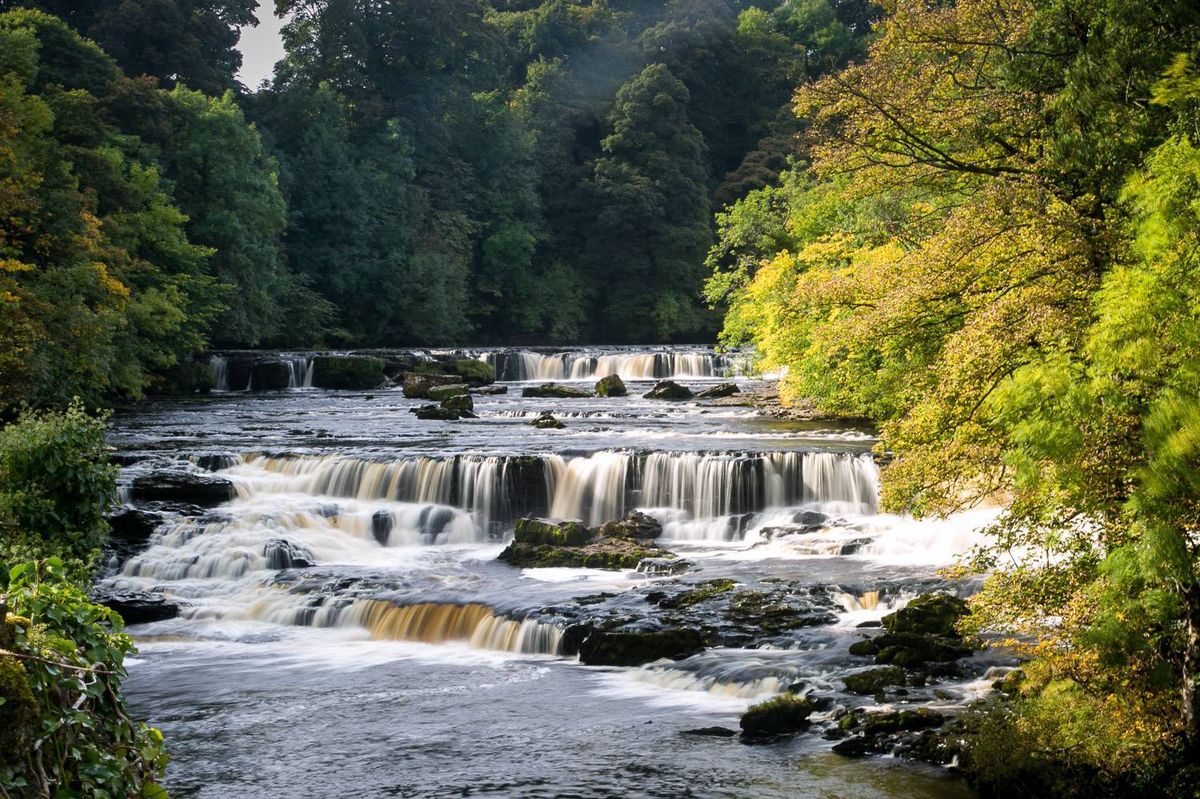
The village is also home to the enchanting Aysgarth Falls, a peaceful series of waterfalls guaranteed to captivate adventurous visitors. The location is part of the Yorkshire Dales National Park and features a visitor centre, café and car park. The three-tiered cascades tumble down into the serene waters of the River Ure, which meanders through the centre of Wensleydale.

For more than two centuries, they’ve drawn visitors and became even more renowned after featuring as the setting for a scene in the Hollywood blockbuster Robin Hood: Prince of Thieves. One guest described the spot as a “water wonderland”. They commented: “What ever time of year you go, Aysgarth falls does not disappoint. Whatever the rainfall has been, the falls are beautiful, and the autumn colours added a little something special.”

Next to the falls lies the local nature reserve, providing numerous meandering trails for passionate ramblers exploring the woodland. There are frequently even glimpses of deer darting through the trees, so make sure you watch carefully. Another satisfied visitor shared: “Lovely hour-long visit to see the lower, middle and upper falls. Each walk was well laid out and simple to do. Didn’t take as long as the recommended times, but we weren’t far off. The falls were beautiful.”

Source link

UK’s quaint fishing village with blue boats and stunning views feels ‘frozen in time’

Northumberland village is one of the UK’s most picturesque fishing villages, boasting charming cottages, sweeping views of the sea and plenty of fresh air — perfect for a serene getaway.

Tucked away in the heart of the Northumbrian coast lies a charming fishing village with a dark history, seemingly frozen in time.

Located approximately six miles east of the lively market town of Alnwick, this historic fishing hamlet is a must-see for those looking to experience the UK’s natural splendour away from the masses. As the next village up the coast from Alnmouth, it offers a stark contrast to Alnmouth’s abundant facilities and leisure spots.

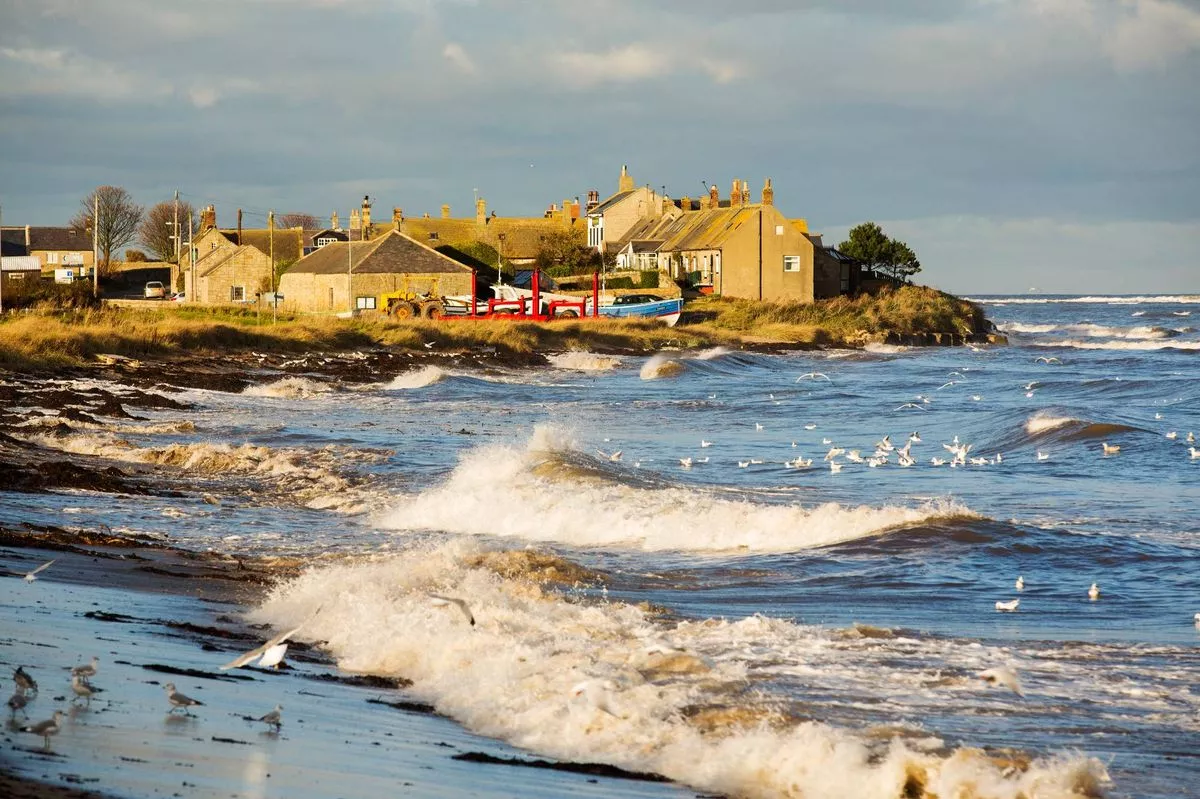
This captivating village is famed for its picturesque chocolate-box cottages and iconic blue coble fishing boats, which have been a hallmark of the region for centuries and are still utilised by local fishermen today. Interestingly, this fishing village doesn’t have a formal harbour, so boats are hauled ashore by tractors, making it an ideal location for rock pooling and coastal walks.

The beautiful coastal village of Boulmer boasts a small population (likely less than 120 residents) and primarily consists of a long row of cottages and houses providing uninterrupted views of the North Sea. It’s regarded as one of Northumberland’s last authentic fishing villages, and little has altered within its confines over the past century.

The tranquil village is an ideal spot for those seeking to escape the hustle and bustle of tourist hotspots, offering a peaceful setting for relaxation. However, Boulmer doesn’t offer much in terms of recreational activities, reports Chronicle Live.

The Fishing Boat Inn is the only place to eat and drink in this village. Despite its somewhat murky history, akin to Boulmer itself, it’s now a favourite haunt for locals looking for a pint and a bite to eat. Indeed, there isn’t a single retail shop in Boulmer, so anyone hoping for a shopping spree would need to travel approximately a mile and a half to the village of Longhoughton or 13 miles to the town of Alnwick.

Historically, a significant shift in the village’s routine came with the opening of the Royal Air Force (RAF) base in Boulmer. Located on the outskirts of the fishing village, RAF Boulmer became operational during World War II and is arguably more renowned than the village itself.

The base continues to play a crucial role in the UK’s defence and serves as a key search and rescue base for the Royal Air Force.

Aside from the arrival of the Royal Air Force, little has changed in Boulmer over the past century. It remains one of the few traditional fishing villages still found along Northumberland’s coast.

Nefarious past

Boulmer could be dubbed the smuggling hub of the North, given its rich and complex history with smugglers and pirates. The 18th and 19th centuries marked the height of smuggling activities in Boulmer, as pirates and smugglers from across the Northumbrian coast and Scotland flocked to the small fishing village to trade their illicit goods.

The Fishing Boat Inn was at the epicentre of this unlawful activity, serving as a base for these criminals.

In fact, during the 18th century, William Faa – also known as the King of the Gypsies and one of Britain’s most infamous smugglers – resided just 35 miles away from Boulmer, in the Scottish village of Kirk Yetholm. Reportedly, the landlords of the Fishing Boat Inn were quite accommodating during Boulmer’s smuggling heyday.

Nowadays, Boulmer is a tranquil fishing village boasting picturesque views, with the Fishing Boat Inn being its main attraction.

How to get there

Boulmer can be accessed by car via the village of Longhoughton or from the south through the village of Lesbury. Parking is available in the Fishing Boat Inn’s car park and directly on the seafront.

A limited bus service operates through the village, so visitors relying solely on public transport should check the latest updates and schedules before planning their trip.

Source link

Trump spurns Kremlin’s Putin residence attack claim, Russia kills 2 in Kyiv | Russia-Ukraine war News

Russia’s Defence Ministry had published a video of a downed drone it said Ukraine had launched at Putin’s residence, which Kyiv rejected.

United States President Donald Trump has dismissed claims that Russian President Vladimir Putin’s residence had been attacked by Ukraine as the war grinds on, saying he did not “believe that strike happened”, after having initially accepted the Kremlin’s version of events at face value.

On Sunday night, Trump, on board Air Force One, told reporters that “nobody knew at that moment” whether a report about the alleged incident was accurate. He added that “something” happened near Putin’s residence, but after US officials reviewed the evidence, they did not believe Ukraine targeted it.

Recommended Stories

list of 3 itemsend of list

Ukraine immediately denied its involvement, accusing Russia of a false-flag type operation to undermine peace negotiations. Moscow promptly said the incident would harden its peace talks stance.

Reports of the attack emerged last week after Russia’s Ministry of Defence published a video of a downed drone it said Kyiv had launched at Putin’s residence in the Novgorod region.

According to the ministry, the residence was not damaged, and Putin was elsewhere at the time.

Alongside Ukraine, its Western allies also heavily disputed that the attack had occurred at all.

The claim of the attack came as Russia and Ukraine work towards agreeing to a ceasefire deal to end the nearly four-year-long war.

European leaders are expected to meet in France on Tuesday for further talks on a US-backed ceasefire plan, which Ukrainian President Volodymyr Zelenskyy said was “90 percent ready”. Territorial issues over ceding land conquered in war or not remain at the heart of the matter.

First civilian deaths in Kyiv in 2026

Ukraine’s authorities reported on Monday morning that an overnight Russian attack on the Kyiv region had killed two people, in the first casualties in the capital in 2026.

According to the State Emergency Service of Ukraine, the Russian attack set a medical facility in the Obolonskyi district in Kyiv’s northern sector, where an inpatient ward was operating, on fire.

The service said once the fire was extinguished, a body was found inside. A woman was also injured, and 25 people were evacuated, the service added on Telegram.

Towns and villages across the Kyiv region were also damaged and critical infrastructure hit, leading to the killing of a man in his 70s in the Fastiv district, southwest of the capital, Governor Mykola Kalashnyk said on Telegram.

Kalashnyk added that small parts of the region were left without power.

Russia has not commented on the overnight strike yet.

Source link

South Korean cinema star Ahn Sung-ki hailed ‘The Nation’s Actor’ dies aged 74 after blood cancer battle

An image collage containing 1 images, Image 1 shows South Korean actor Ahn Seong-Ki waving at the opening ceremony of the 26th Busan International Film Festival

A SOUTH Korean movie star, hailed “The Nation’s Actor” has died, following a years long battle with cancer.

Ahn Sung-ki, who began his career as a child star, was a heavyweight in the industry and spent six decades on South Korean screens.

The 26th Busan International Film Festival - Opening Ceremony
South Korean actor Ahn Seong-Ki aka Ahn Sung-Ki has diedCredit: Getty

His death was confirmed by his agency, Artist Company, and Seoul’s Soonchunhyang University Hospital, which said Ahn had been battling blood cancer.

Born to a filmmaker in the southeastern city of Daegu in 1952, Ahn made his debut as a child actor in the movie The Twilight Train in 1957.

He subsequently appeared in about 70 movies as a child actor before he left the film industry to live an ordinary life.

In 1970, Ahn entered Seouls Hankuk University of Foreign Studies as a Vietnamese major.

Ahn said he graduated with top honors but failed to land jobs at big companies, who likely saw his Vietnamese major largely useless after a communist victory in the Vietnam War in 1975.

More to follow… For the latest news on this story keep checking back at The Sun Online.

Thesun.co.uk is your go-to destination for the best celebrity news, real-life stories, jaw-dropping pictures and must-see video.

Like us on Facebook at www.facebook.com/thesun and follow us from our main Twitter account at @TheSun.


Source link

The Ashes 2025-26: Travis Head hits back after Joe Root makes 160 in Sydney

Root has been feast or famine in this series. Until this Test, his landmark century in Brisbane was one of only two occasions when he passed 20. In Sydney, the city where he was dropped for the only time in his Test career and once batted himself into hospital in extreme heat, the former captain was outstanding.

Without Root, England would have squandered their promising overnight position of 211-3. Harry Brook played a limp poke at Scott Boland to be caught at slip for 84 and Stokes edged a beauty from Mitchell Starc for an 11-ball duck, meaning the tourists lost 2-3 in four overs.

On one hand, Smith’s role in a stand of 94 with Root was valuable, but the wicketkeeper was fortunate to last so long. He was caught off a Cameron Green no-ball on 22, then edged and miscued the same bowler. The dismissal to Labuschagne’s bouncer plan as the second new ball approached was an appalling piece of cricket.

By this point, Root had moved to three figures from his overnight 72. After edging Neser over the slips on 94, he drove the same bowler down the ground to join Australia great Ricky Ponting on 41 Test tons – only India’s Sachin Tendulkar and South Africa’s Jacques Kallis have more. He celebrated with the same shrug of the shoulders he pulled in Brisbane.

On he went, adding 52 for the seventh wicket with Will Jacks. He passed 150 for the 17th time in Tests – only four other players have done so more.

Root eventually offered a leading edge to a diving Neser in the bowler’s follow-through, part of England’s final collapse of 4-9. After more than six and a half hours at the crease, he later left the field holding his lower back, and England face an anxious wait on his condition.

Source link

All 40 deceased victims of Swiss bar fire identified

Authorities on Sunday said all 40 victims of the Le Constellation bar fire on New Year’s Eve have been identified. Photo by Jean-Christophe Bott/EPA

Jan. 5 (UPI) — All 40 victims of a Swiss bar fire that erupted New Year’s Eve have been identified, according to police, who continue to investigate the deadly blaze.

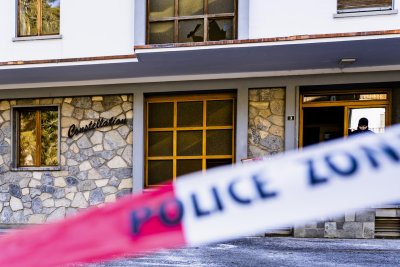
Forty people were killed and 119 were injured in the fire at the Le Constellation bar in Crans-Montana in the Swiss Alps early Thursday.

Valais Cantonal Police announced in a statement Sunday that an additional 16 victims of the fire have been identified, meaning all deceased have been named.

The victims identified Sunday range in age from 14 to 33, with the youngest being a boy from France.

Among the deceased were nine minors, including four aged 15, two girls from Switzerland, one girl from Italy and a boy with French, Israeli and British citizenship. Two 16-year-olds, both Italian, one boy and one girl; and two 17-year-olds, one Belgian girl and a French boy, were also identified Sunday.

The adults were from France, Switzerland and Portugal. One victim identified Sunday was a dual Swiss-French national.

Of all 40 victims, 20 were minors: two 14-year-olds, six 15-year-olds, nine 16-year-olds and three 17-year-olds.

The oldest adult victim was 39.

Police have opened a criminal investigation into the fire and have charged two managers of the bar with negligent homicide, negligent bodily harm and negligent arson.

The two suspects have not been detained as they do not pose a flight risk and there is no suspicion that they intend to evade the criminal proceedings, authorities said Sunday.

“The investigation is continuing in order to determine any other potential criminal liabilities,” Valais Cantonal Police said in a separate Sunday update on the investigation.

Preliminary evidence indicates that the fire was caused by pyrotechnic devices called “fountains” that produce sparks and flames. They are designed to be placed on the ground or held by hand.

Uncorroborated video of the fire published online shows fire spreading across the bar’s ceiling, apparently lit by the fountain devices that had been attached to the mouths of alcohol bottles that were being paraded around the facility as part of bottle service.

Witnesses told police that the fire spread rapidly, generating a lot of smoke and intense heat.

“Everything is said to have happened quickly,” Valais Cantonal Police said.

According to authorities, the next phase of the investigation will focus on whether the facility was in compliance with local laws and fire safety regulations over materials used in the building, the existence and condition of emergency exits and the presence of firefighting equipment.

Source link

I ran 1,400 miles around Ireland | Ireland holidays

As a long-distance runner, I had always wanted to use running as a means of travel, a way to traverse a landscape. I’d heard of people running across Africa, or the length of New Zealand, and the idea of embarking on an epic journey propelled only by my own two legs was compelling. I had just turned 50, and some might have said I was having a mid-life crisis, but I preferred to envisage it as a sort of pilgrimage – a journey in search of meaning and connection. And the obvious place to traverse, for me, was the land of my ancestors: Ireland.

Most summers as a child, my Irish parents would take us “home” to Ireland, to visit relatives, sitting on sofas in small cottages, a plate of soda bread on the table, a pot of tea under a knitted cosy. Having been there many times, I thought I knew Ireland, but, really, I knew only a tiny fragment.

And so I concocted a mad plan to run around the entire island of Ireland. I’d start in Dublin, the birthplace of my mother, and run down through the Wicklow mountains, all the way to Cork in the far south, before making my way up the Wild Atlantic Way, up past Galway, the birthplace of my father, home of the Finns, up to Donegal in the north, on through Northern Ireland, and then south to finish back in Dublin. A mere 1,400 miles. And along the way, I’d get to know Ireland more intimately.

It took me just under 10 weeks, averaging over 20 miles of running a day, while my wife and 15-year-old son travelled around in a motorhome, meeting me each evening with food and our home on wheels.

Many days I ran alone, often through a rolling landscape of farms, cows staring at me over hedges, the roads dotted with new-build houses picked straight, I was told, from a book called Bungalow Bliss.

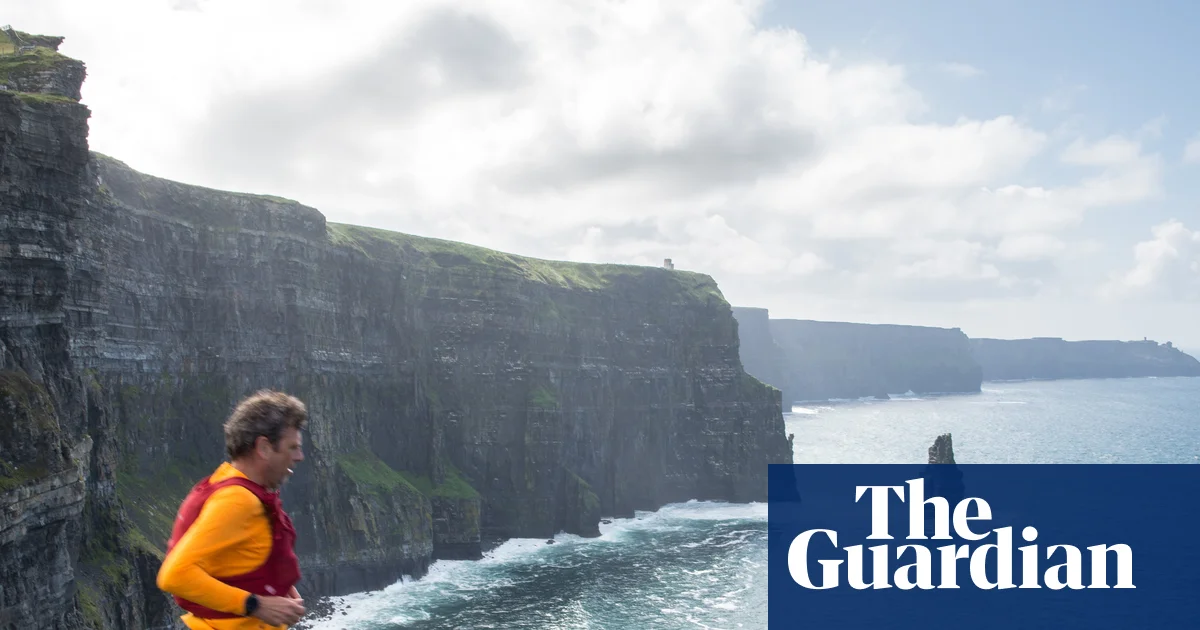
The writer runs along Castlegregory Beach in Dingle in the south-west of Ireland. Photograph: Marietta d’Erlanger

Often, though, people would come out to run with me. Those were the easiest days, when the miles would slip by unnoticed, like water under a boat, the chat being the wind in our sails. Ireland is known for its warm welcome, it’s a national cliche, but we found ourselves regularly invited into people’s houses for food, or offered a bed for the night.

One evening the fuse in our motorhome blew, which meant we had no water pump. And I hadn’t yet showered. I found a hardware shop that was long closed for the day, and I did something I wouldn’t dream of doing at home in England: I knocked on the door. It just seemed that in Ireland you can do that sort of thing. Sure enough, a man opened it, not at all put out, and found me the right fuse in his shop drawer. He didn’t even charge me.

Virtually every town or village we stopped in had a pub seemingly lost in time, wood-panelled walls covered in random objects and pictures, a happy buzz emanating from people sitting in their cosy nooks. We learned to look for the handwritten sign in the pub window: “Trad session tonight.” It was never a performance, as such, but just whoever turned up that evening, sitting in one corner, playing their fiddles, guitars and accordions, chatting among themselves between songs.

The author ran past Eagles Rock in County Leitrim. Photograph: Shutterstock

Ireland has a lot of space. I hesitate to call it wild space, as it is one of the least biodiverse countries in the world, with barely any remaining natural forest. But I would often find myself running all day up and over mountains, or along stretches of coastline, without meeting a single other person. One memorable day, I ascended Knocknadobar in Kerry, one of Ireland’s many “holy mountains” (of which Croagh Patrick in Mayo is the most famous). These are known pilgrimage routes, and along the trail were 14 crosses with depictions of Jesus signifying the 14 Stations of the Cross. Despite not being religious, as I made my way up the mountain in the rain, the story of Jesus struggling on, being whipped each time he dropped his cross, picking it up and carrying on, began to resonate with my own struggle, and I felt it pushing me on.

What burden was I carrying, I began to wonder. I’d been in a low mood all that day, grumbling about the weather, the long roads, the endless running. But I decided to put all that down, and instead be grateful for where I was; that I was able to be out here; that my body was healthy and strong enough to do this. And in that moment – I kid you not – the clouds parted, and below the swooping drop of the mountain the sea appeared. I felt my spirits lift as I raced to the top and down the other side. To complete the sense of the entire day being an allegory in itself, at the bottom I found myself in a tropical garden, complete with palm trees and waterfalls, the day now warm and humid, basking in sunshine.

The writer takes a rest outside a traditional cottage. Photograph: Adharanand Finn

Had I emerged from the mountain into paradise? Not quite. It turned out it was the RHS award-winning Kells Bay House and Gardens.

One of Ireland’s hidden gems is the Beara peninsula, straddling Cork and Kerry, and one of the most spectacular sections of the Beara Way trail is the path from Adrigole to Glengarriff. Here, the mountains are pointy and lush, like something from a Japanese painting. The trail also passes through a rare section of native Irish forest in the Glengarriff nature reserve, and ends at the beautiful Blue Pool, a tidal harbour complete with a purpose-built bathing area.

Alas, I arrived as the tide was out, so there was no chance of a cooling dip, but I did find many other swimming spots on my run around Ireland. Of course, there were some stunning beaches, such as the white sands of Derrynane Beach in Kerry that, on a less windy day, could pass as a tropical beach in the South Pacific. I also found myself dipping in numerous lakes and waterfalls, such as the serene Poulanassy waterfall in Kilkenny.

Northern Ireland also has some wonderful coastline, and I was lucky to have two days of glorious sunshine as I ran along the north Antrim coast. The Giant’s Causeway is truly one of the most extraordinary landscapes, but there are other, less explored sections of coast, such as the area around Ballintoy Point, a fantastical array of rocky outcrops and hidden sandy coves. I don’t know if it was the power of the evening light on a late summer evening after 20-odd miles of running, but as I passed through it, I wanted to lie down on the grass and never leave.

‘Virtually every town or village we stopped in had a pub seemingly lost in time.’ Photograph: Marietta d’Erlanger

Running as much as I did, I never dwelt long in any one place, and while I saw so much, my experiences were, by their nature, mostly fleeting. It felt as though I was getting an impressionistic image of Ireland. And the impression I got was of a country at ease, in no big rush to be anywhere else, letting the world in for a cup of tea and a chat, and a bit of music.

As for my own journey, and my sense of pilgrimage, I had set off not knowing if I could even run that far. There were times of struggle, and moments of transcendence, but most of all I came away feeling that I had been taken in and looked after by Ireland. The last day, headed into Dublin, I was joined by about 30 runners from across the country and we sang Molly Malone at the tops of our voices as we ran alongside the River Liffey, finishing at Ha’Penny Bridge, much to the bemusement of passing tourists. And then afterwards, we all went to the pub, where I enjoyed a Guinness.

Adharanand Finn has written three books on running: Running with the Kenyans; The Way of the Runner; and The Rise of the Ultra Runners (published by Guardian Faber)

Source link

Venezuelans reflect on Maduro’s removal, grappling with hope and fear | US-Venezuela Tensions News

It was his 26th birthday, so Wilmer Castro was not surprised by the flurry of messages that lit up his phone.

However, as he began scrolling on Saturday morning, he realised the messages were not birthday wishes, but news of something he had long hoped for: Venezuelan President Nicolas Maduro had been removed from power.

Recommended Stories

list of 3 itemsend of list

“I think it is the best gift that I will ever receive, one I will never forget,” the university student said from Ejido.

Castro told Al Jazeera that he was so elated by the news that he began daydreaming about his future self recounting the story of Maduro’s fall to his grandchildren and great-grandchildren.

“I will tell them that on January 3, 2026, a dictator fell, and [that moment] is going to be very beautiful.”

The abduction of Venezuela’s long-time authoritarian leader – and his wife – by the United States followed months of escalating tensions between the two countries, including US strikes on alleged drug-trafficking vessels and the deployment of US ships near Venezuela’s coastal waters.

But by Sunday morning, Castro’s initial jubilation was clouded by a heavy quiet. The weight of uncertainty brought the city to a sombre pause, one that closed in on him and felt unlike anything he had experienced before.

“It’s like being in a field with nothing else around. It’s a mournful silence; I can’t describe it,” he said.

That uncertainty was felt by many Venezuelans on Sunday morning.

Venezuela has had a socialist government since 1999, first under President Hugo Chavez and later Maduro, a period that began with oil-funded social programmes but unravelled into economic mismanagement, corruption and repression – with international sanctions further squeezing the population.

Momentum around the 2024 presidential election raised hopes that the opposition alliance would take control. But when Maduro declared victory, despite opposition claims of a landslide win for Edmundo Gonzalez Urrutia, a crackdown on dissent followed. It left many Venezuelans concluding that any real transition might depend on pressure — or even intervention — from outside the country.

‘Deathly silence’

In southeastern Caracas on Saturday, 54-year-old Edward Ocariz was jolted awake by a loud crash and the vibrating windows of his home near the Fort Tiuna military barracks. He thought it was an earthquake, but when he looked outside, he saw unfamiliar helicopters flying low above smoke rising in the city.

“The noise kept coming,” he said. “I could immediately tell the helicopters were not Venezuelan because I had never seen them here.”

Then, just as suddenly as it had started, it stopped.

“There was a deathly silence,” Ocariz said, adding that the brief suspension of mobile phone services and power outages contributed to the silence. “We were waiting to understand what was happening.”

Fear accompanied the fragments of information that did manage to seep through, Ocariz said. “But it was a fear mixed with joy – tremendous joy. It’s hard to explain.”

On Sunday, when images of a blindfolded and handcuffed Maduro began circulating, Ocariz reflected on the suffering he had endured under the president’s regime.

The human rights activist said he was wrongfully charged with “terrorism” and spent nearly five months as a political prisoner in Tocuyito prison, a maximum-security facility in Carabobo state.

Under Maduro, the country had a long history of jailing those who dissent. After the disputed 2024 election, nearly 2,500 protesters, human rights activists, journalists and opposition figures were arrested. While some were later released, others remain behind bars.

“I felt satisfied. A process of justice is finally beginning,” Ocariz said, fully aware that Maduro will not have to endure the dire prison conditions he did, or be denied food and legal representation.

Despite the joy he and other Venezuelans now feel, Ocariz warns that much remains to be done.

“The population still feels a huge amount of fear [from the authorities] — psychological fear — because it’s well known how the police and justice system use their power to criminalise whoever they choose.”

So far, key institutions remain in the hands of figures from Nicolas Maduro’s inner circle, including Vice President Delcy Rodriguez, who has been named acting president.

But for many Venezuelans — including Castro and Ocariz — seeing a senior Chavista figure still in power is unsettling, particularly as the Trump administration continues to engage with her.

“It is certainly frustrating for me. However, I understand that Venezuela needs to continue with its administrative, functional, and operational management as a country, as a nation,” Ocariz said, adding that the US must maintain some order to control the power vacuum and stamp out repression.

INTERACTIVE - US-Venezuela relations in 2025 - JAN 4, 2026-1767593147

Economic concerns

Venezuela remains heavily militarised, and fears of further unrest linger. During periods of dissent, the authorities relied not only on formal security forces but also on “colectivos”, armed civilian groups accused by rights organisations of intimidation and violence.

Jose Chalhoub, an energy and political risk analyst at Jose Parejo & Associates in Caracas, said he is concerned about the possibility of more attacks and social unrest.

“Any potential new government that will move ahead with the cleansing of the top ranks of the armed forces and security and police forces will lead to the disarmament of the colectivos,” he said, adding that fixing the lingering economic crisis should also be one of the main priorities.

“A new government that applies quick economic measures leading to a recovery will outshine the ideological legacy of the Bolivarian revolution,” he said, referring to the ideology of Chavismo, defined by anti-imperialism, patriotism and socialism.

Those loyal to Maduro have long blamed Venezuela’s economic woes on the US — namely, the sanctions it imposed on the oil sector.

Chalhoub said he believed Trump’s promise to boost the country’s oil production could help the economy, though he found the US president’s assertion that the US will “run the country” baffling.

However, not everyone is happy with the Trump administration’s attack.

Alex Rajoy, a mototaxi driver in Caracas, said the US president was on an imperialist crusade with the goal of “robbing” Venezuela of its natural resources.

Despite his anger, Rajoy said he will stay home over the coming days because he is fearful of further attacks.

“These missiles aren’t aimed only at Chavistas,” he said, referring to those loyal to Venezuela’s socialist ideology.

“They threaten opposition people, too,” he said, adding that anyone supporting foreign intervention amounts to a betrayal. “It’s treason against the homeland,” he said.

What now?

For Castro, the university student, the elation he felt on Saturday has been interrupted by fear for his immediate needs – concerns over whether stores would remain open in Ejido and rising costs. Under Maduro, he has long struggled to afford basic items.

“People in the street were going crazy yesterday,” he said. “Everyone was buying food with half of what they had in their bank accounts, buying what they could, because we don’t know what the future holds.”

The scenes brought back memories of the shortages of 2016, when hyperinflation and scarcity plunged the country into crisis, forcing people to queue for hours and rush between shops with limits on how much each person could buy.

But a day after the attack, Castro said Venezuelans are reflecting on the future of their country and the uncertainty of that future.

“There’s happiness, there’s fear, there’s gratitude, there’s the ‘what will happen next?’” he said. “For my next birthday, I want total freedom for Venezuela – and hopefully, God willing, we will have it.”

Source link

Jack Joseph’s tragic health battle at 19: ‘My parents came to check if I was dead’

The content creator is one of 14 famous faces taking part in the latest series of Channel 4’s Celebrity SAS: Who Dares Wins

Celebrity SAS: Who Dares Wins star Jack Joseph has opened up about a devastating health battle that left his parents checking on him “every single hour” fearing he would die in his sleep.

The 25-year-old content creator is one of 14 famous faces appearing on the Channel 4 reality show which sees celebrities put through back-breaking SAS training guided by Billy Billingham MBE, Jason Fox, Rudy Reyes and Chris Oliver.

This year’s series – made up of eight one-hour episodes – sees UK celebrities competing against Australian stars, with former Love Island contestants Dani Dyer and Gabby Allen, social media personality Cole Anderson-James and MAFS Australia’s Jessika Power among the cast.

The opening episode aired tonight (January 4), in which Jack opened up about a health scare that motivated him into taking part in the show. The star, who comes from a family who are passionate about fitness, said he took a legal steroid which had a devastating impact on his body when he was just 19 years old.

“I went to a bodybuilding gym and I hear a lot of talk of this supplement which is like a legal steroid so I bought this supplement from a website and after six weeks I had liver failure. I went all yellow, pupils all yellow, my brain completely went south. It’s a hard thing to describe,” he shared on the show, visibly emotional.

“I had to go into hospital every day for about nine or 10 months to give blood everyday and I had to be under supervision. So the way you pass away with liver failure is, I was told, that you just go to bed at night and you don’t wake up.”

He remembered: “It was hard because every night, every single hour, my parents came in my room to check if I was dead, basically. That broke my heart.

“It’s hard to see your parents with that kind of emotional weight when you know you’ve caused it. Since then I’m quite an anxious person and that’s why I came on this course. I hide my emotions a lot.”

Channel 4’s synopsis for the series reads: “The celebrities will have no entourage, agents, filters or social media followers to rescue them. Instead, they’ll face sweat, physical endurance, sand, tears and the truth they’ve been avoiding – all in the blistering North African heat.

“The DS don’t care how famous the recruits are, how many social media followers they have or what they have done before this. As soon as they enter the selection process, their celebrity status and luxuries are stripped away and there will be no room for mistakes.”

You can watch the latest episode of Celebrity SAS: Who Dares Wins on Channel 4’s catch-up service

Source link

Luka Doncic and LeBron James help Lakers beat Grizzlies again

They met two days prior to Sunday night’s encounter at Crypto.com Arena, a two-game set between the Lakers and Memphis Grizzlies reminiscent of a playoff series.

The Lakers won the first game Friday night and knew the Grizzlies were going to bring more intensity and a stronger effort even with star guard Ja Morant (right calf contusion) not playing.

And that was the case, the Lakers falling behind by 16 points in the second quarter, the Grizzlies ramping it up in a big way. But with Luka Doncic, LeBron James and Jake LaRavia leading the way, the Lakers pulled out a 120-114 win.

Doncic almost had a triple-double with 36 points, nine rebounds and eight assists. James had 26 points, 10 assists and seven rebounds. LaRavia, starting in the absence of Rui Hachimura, had 26 points, five rebounds and four assists. It was the second straight time LaRavia, who came in averaging 9.1 points, scored 20-plus.

A back-and-forth game featured several lead changes in the fourth quarter, with the Lakers and Grizzlies taking turns delivering in tense moments. The Lakers finally took the lead for good at 100-99 on a basket by Doncic.

Then James scored on a three-point play and made one of two free throws for a 104-99 lead with 3 minutes 49 seconds left.

The Lakers (22-11) had an answer for every Grizzlies counter, the final stamp on the game being Doncic’s back-to-back three-pointers for a nine-point lead with 2:01 left.

The NBA scheduling the Lakers to host the Grizzlies on Friday and again Sunday was not an issue for coach JJ Redick.

“I like it,” Redick said. “I do think it does replicate [the playoffs] in some ways. A playoff series, particularly when it’s not a home-and-away situation, but more of you’re playing a two-game series on somebody’s home court for the day in between. Had a few of these last year. So, I like this for our team and it’s a good growth opportunity. Coming off a win, knowing that there’s a lot of stuff that we can be better at and where can we make improvements. That’s the big challenge to me.”

For Redick, that meant what it always does for the Lakers — improving on defense.

Redick wanted his team to get back on defense faster and not let the Grizzlies (15-20) get so many early offense opportunities.

LeBron James shoots against Christian Koloko of the Grizzlies in the first quarter Sunday.

LeBron James shoots against Christian Koloko of the Grizzlies in the first quarter Sunday.

(Katelyn Mulcahy / Getty Images)

The Lakers also wanted to jump-start center Deandre Ayton from a five-game slumber.

Ayton had just four points on two-for-four shooting against the Grizzlies on Friday night and hadn’t scored more than 12 points in that span.

So, the Lakers went to Ayton at the outset, trying to ignite his game. It worked to a degree, Ayton scoring 15 points, grabbing eight rebounds and blocking three shots.

Source link

Venezuela: Latin American Countries Jointly Condemn US Attacks as Interim Gov’t Backs Maduro

The Venezuelan armed forces expressed readiness to maintain peace and internal order in the country. (Archive)

Caracas, January 4, 2025 (venezuelanalysis.com) – The governments of Brazil, Chile, Colombia, Mexico, Uruguay, and Spain issued a joint statement Sunday rejecting “unilateral US actions in Venezuelan territory.”

“These actions contravene basic principles of international law and represent a very dangerous precedent for peace and regional security,” the communique read.

The joint statement followed widespread regional and global condemnation of Washington’s January 3 strikes against Venezuelan military sites and kidnapping of President Nicolás Maduro and First Lady Cilia Flores.

The countries went on to issue calls for dialogue and urged the United Nations secretary general and member states to help “de-escalate tensions and preserve peace.” 

In response to US President Donald Trump’s claim that he would “run” Venezuela, the signatories expressed concern over “attempts at foreign government control or seizure of natural resources.” However, the declaration made no mention of Maduro nor called for his release.

The diplomatic response to the US attacks also included an emergency summit of the Community of Latin American and Caribbean nations (CELAC), held on Sunday, January 4. Venezuelan Foreign Minister Yván Gil decried the US actions as blatant violations of international law and the United Nations Charter.

“The US has violated the personal immunity of a sitting head of state,” Gil told regional leaders in the conference call. “Kidnapping a president is kidnapping a people’s sovereignty.”

Venezuela’s top diplomat urged CELAC member-states to “take a step forward,” warning that silence would amount to acceptance of Washington’s unilateral acts.

A number of countries, including Venezuelan allies Russia and China, have forcefully denounced the US military operation. In a Sunday statement, Beijing charged Washington with a “clear violation of international law” and called for Maduro and Flores’ “immediate release.”

The UN Security Council is scheduled to hold an emergency session on Monday.

For her part, Venezuela Vice President and now acting Interim President Delcy Rodríguez reiterated demands for Maduro’s release and vowed that the country would not submit “to any empire.” Rodríguez held a press conference Saturday afternoon and confirmed the enactment of a decree establishing a “state of external commotion.” The instrument grants the executive additional tools, including the ability to mobilize troops or restrict civil liberties, for a period of 90 days that can be extended.

On Saturday night, the Venezuelan Supreme Court ruled that Maduro’s kidnapping and rendition to US soil constituted a temporary absence and that Rodríguez was mandated to take over the presidency on an interim basis.

Footage surfaced Saturday evening showing Maduro being walked out of an airplane in New York. He was later taken to a DEA facility before being moved, along with Flores, to the Metropolitan Detention Center in Brooklyn. He made no statements but greeted DEA officers and appeared upbeat in photos, making a peace sign and holding his thumbs up.

The Venezuelan president was indicted by a New York district court on Saturday, with charges including “narcoterrorism conspiracy” and “possession of machine guns.” A hearing is reportedly scheduled for Monday.

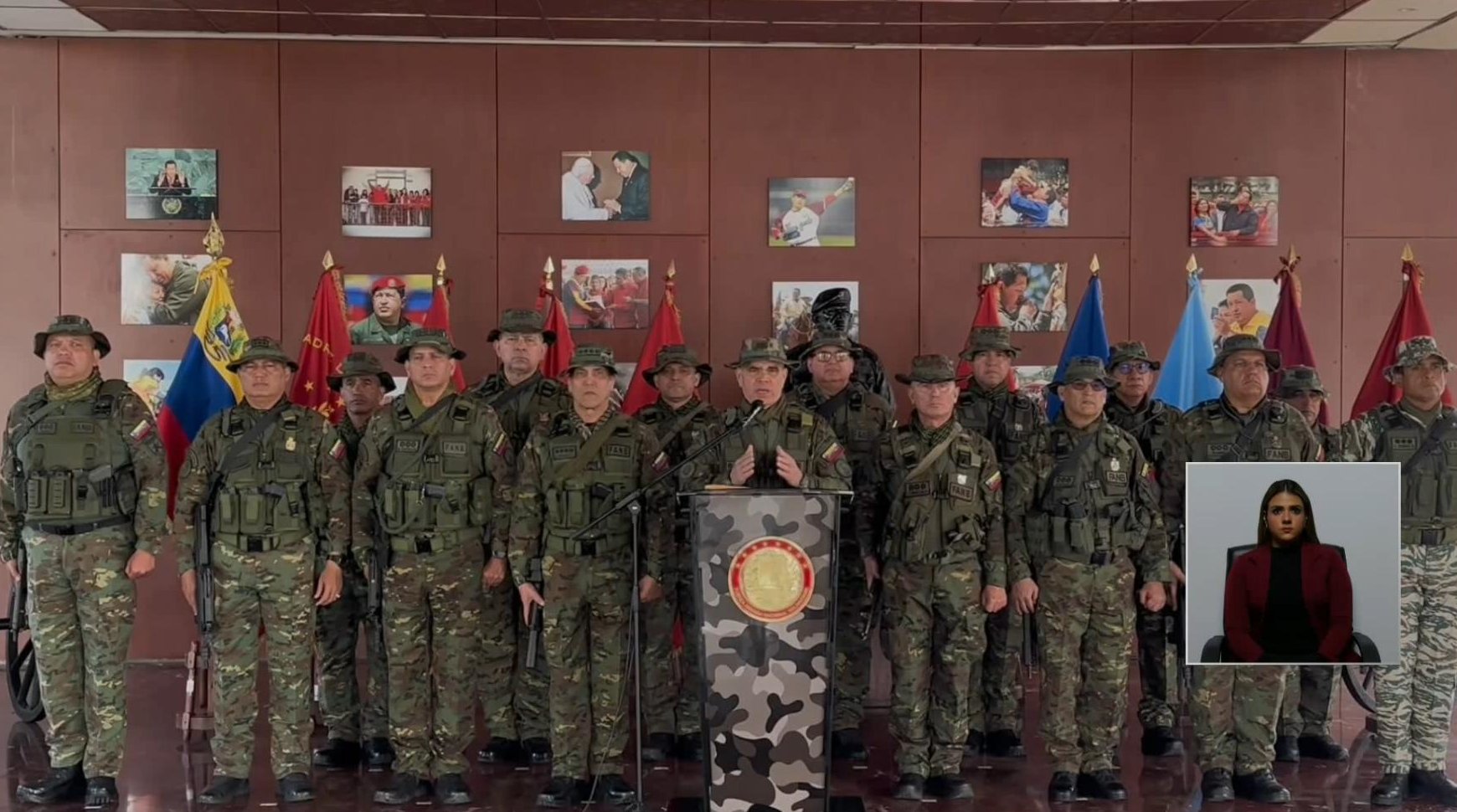
For their part, Venezuela’s National BolivarianArmed Forces (FANB) likewise issued a communique on Sunday, rejecting the “cowardly kidnapping” of Maduro and Flores and reiterating its mission to “confront imperial aggression.”

The FANB voiced support for Rodríguez taking over the presidency on an acting basis and vowed to maintain readiness to preserve “peace and internal order.” 

The Defense Ministry has yet to provide a report on damages and casualties from the US strikes, though Sunday’s communiqué condemned the “cold-blooded murder” of members of Maduro’s security detail. Unconfirmed reports have put forward a figure of 80 deaths.

Venezuelan popular movements and political parties took to the streets for a second consecutive day on Sunday, holding marches and rallies in Caracas and other cities. Public transportation and retail functioned to a greater degree than on Saturday.

The US attacks also spurred numerous international solidarity demonstrations over the weekend. Crowds gathered in dozens of Latin American, European and US cities. A demonstration was called for Sunday outside the Brooklyn detention center where Maduro is being held.

The January 3 operation came on the heels of the largest ever US Caribbean military build-up, with Trump having previously ordered dozebs of strikes against small boats accused of carrying drugs, killing over 100 civilians. The US president has repeatedly expressed intentions of using military threats to extract favorable oil deals for US corporations.

In a Sunday interview, Secretary of State Marco Rubio warned the acting government in Caracas to “make the right decisions” and affirmed that the US retained “leverage” mechanisms, including a naval blockade stopping oil exports.

Source link

Members Only: Palm Beach’s Gale Brophy’s life and vast fortune explained

Members Only: Palm Beach’s Gale Brophy’s life and vast fortune explained – The Mirror


reach logo

At Reach and across our entities we and our partners use information collected through cookies and other identifiers from your device to improve experience on our site, analyse how it is used and to show personalised advertising. You can opt out of the sale or sharing of your data, at any time clicking the “Do Not Sell or Share my Data” button at the bottom of the webpage. Please note that your preferences are browser specific. Use of our website and any of our services represents your acceptance of the use of cookies and consent to the practices described in our Privacy Notice and Terms and Conditions.

Source link

Something Exploded In Caracas | Caracas Chronicles

In Caracas, in early January, explosions are a common sound in the morning hours. To be honest, it’s not unusual for some irresponsible person, after a few too many drinks, to decide to disrupt the sleep of the entire neighborhood by launching firecrackers or fireworks. We’re quite used to it. That distinctive whistling sound, a couple of seconds of silence, and an explosion that makes dogs bark and babies cry.

That’s why, perhaps, the explosions that sounded shortly before 2:00 a.m. in the early morning of January 3, 2026, didn’t seem strange, until they were accompanied by the vibration of a cell phone. Since I have most of its contacts on silent mode and I don’t care much about what might be happening in the world outside my four walls when I’m asleep, I was about to turn it off. But when one of those WhatsApp calls came in from a group chat, my wife, who already had her phone in her hand, worriedly asked me not to. Something was happening. She had just heard a loud bang.

“I think something exploded in Caracas.”

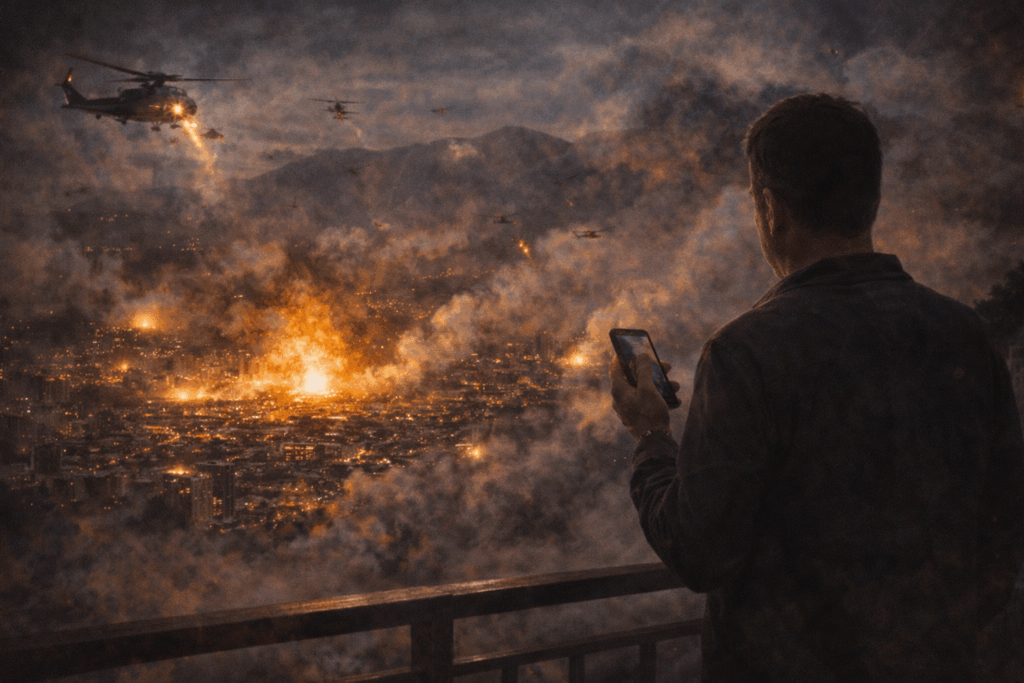
As soon as she said that, we started receiving videos that quickly went viral on social media. The first one we saw was a convoy of planes and helicopters heading west of the capital, leaving a trail of explosions across the valley. The only thing missing was the classic “Fortunate Son” by Creedence Clearwater Revival as its soundtrack, typical of any Vietnam War movie.

“They’re bombing the city,” my wife added.

Is it true? That’s the first question in times when artificial intelligence can create any kind of video. So, seeing is believing, as the apostle Thomas said. Like many skeptics, I went outside to look at the sky and listen. The roar of aircraft flying over the city at that hour was enough to confirm that it wasn’t just rumors.

Indeed, they weren’t fireworks, nor was it a false alarm. I had just gotten up, and, amidst the confusion, stunned, I went out onto the terrace to listen to the explosions of the bombs, as well as to see the sky light up in different places on the horizon, despite the dense night fog that usually shrouds the mountains around the antennas of El Volcán in its whitish mantle.

“We’re safe here,” I thought naively, very casually. I went back to the room to tell my wife, exuding all the confidence in the world, that we had nothing to fear, since all the impact reports were in the area of Fuerte Tiuna and the Generalisimo Francisco de Miranda Air Base, far away enough for us to feel safe.

I will never forget the roar, that light, or the panic that I can only describe as when your blood freezes and your heart skips a beat.

But at the same time, out of pure reflex, I was getting out of my pajamas and putting on jeans, a sweater, and sneakers, anticipating that we might suddenly have to leave urgently for some unknown reason, without knowing where to find shelter.

Suspecting the possibility of a power outage, I turned on the phone, and in less than two minutes it rang. I didn’t want to answer, but when I realized it was one of my good friends from school, one of those I’ve seen twice in the 20 years since he left the country, I had to.

José Ricardo, with the classic greeting, “What’s up, Joe?”, immediately asked if we were okay, and I could only tell him the same thing I told my wife.

—Aircraft and explosions can be heard in the distance. We’re far away, everything is calm, but it sounds like things are rough and it’s raining bullets along the Guaire River.

I promised to call him with more details as soon as the sun came up. At that precise moment, I didn’t have much to say, other than confirm that the bombing of Caracas was true.

—Nothing’s happening here in El Hatillo—I said before hanging up, unaware that, in a matter of seconds, I would eat my words. I left the phone plugged in to recharge the battery and went out onto the terrace to continue contemplating the sky and listening to the buzzing and booming sounds. The only thing running through my head was the lyrics and melody of Pink Floyd’s “Goodbye Blue Sky”: Did you see the frightened ones? Did you hear the falling bombs? Did you ever wonder why we had to run for shelter when the promise of a brave new world unfurled beneath the clear blue sky?

It was impossible not to recall what my grandfather once told me about his adolescence during World War II. Of all the grim anecdotes in his repertoire, the one that impressed me most was the terrifying sound of the bombings, when they heard the sound of the planes flying overhead, the whistling and the impact, the shaking of the ground making the walls and ceilings creak, as if death were dancing above their heads, claiming lives without distinguishing between the righteous and the sinners. “The only thing you can do,” my grandfather would say, “is pray that that hell won’t last long.”

That cruel memory haunted me just as I heard the roar of the engines approaching and I looked up. I heard the whistling sound and didn’t even have a chance to move. I was petrified with terror. The explosion illuminated the bleak landscape as if the sun had peeked out for that fleeting moment, adding color to a blast that shook the floor, walls, ceiling, and windows of the house with the force of the most violent earthquake.

I will never forget the roar, that light, or the panic that I can only describe as when your blood freezes and your heart skips a beat. The sound of war and a bombing raid is the most terrifying thing I have ever heard. No one can imagine it until they experience it firsthand, murmuring prayers to God for it all to end quickly, for the bombs to stop falling, and for dawn to break, while the uncertainty of what the end of the storm will bring gnaws at you from within.

Source link

NFL playoff picture: Breaking down each wild card matchup

p]:text-cms-story-body-color-text clearfix”>

Third time’s the charm?

Twice in club history, the Chargers lost playoff games at New England. It was the AFC championship game in the 2007 season and a divisional game in 2018.

That’s little more than a trivia answer, though, as the two teams are entirely different now. This matchup features two outstanding coaches in Jim Harbaugh and New England’s Mike Vrabel, and two elite quarterbacks in Justin Herbert and Drake Maye.

The Patriots haven’t seen many elite quarterbacks this season, instead beating a ho-hum collection of passers that includes Cam Ward, Spencer Rattler, Dillon Gabriel and 40-year-old Joe Flacco. New England did beat Kansas City’s Patrick Mahomes, and Buffalo star and reigning NFL MVP Josh Allen, knocking off the Bills in Week 5 before blowing a 21-0 lead to them in Week 15.

Of course, you play who’s on your schedule in the NFL, so you don’t pick the quarterbacks you face. And the Patriots have routinely gotten the job done. It’s just that Herbert could present a significant challenge.

That said, Herbert has yet to win a playoff game in six seasons, and he has been hit more than any quarterback in the league (witness his broken left hand).

The Patriots figure to lean heavily on their solid running attack to play ball-control in the frigid cold and make it three-for-three against their AFC foes from the opposite corner of the country.

Source link

Israel kills two people in new attack on southern Lebanon | Israel attacks Lebanon News

Israel claims the drone attack on a car targeted a Hezbollah member.

An Israeli drone attack on a car has killed two people in southern Lebanon, the Lebanese Ministry of Health has said.

Al Jazeera’s Ihab al-Aqdi, reporting from Lebanon, said the attack took place on Sunday in the Ayn al-Mizrab area north of the town of Bint Jbeil. He added that the targeted car was destroyed and that nearby buildings were damaged.

Recommended Stories

list of 3 itemsend of list

The Israeli military said the attack targeted a Hezbollah member, accusing the Lebanese group of not adhering to a ceasefire that began in November 2024.

Israel has repeatedly struck Lebanon since the ceasefire, despite the agreement, which ended a yearlong conflict that devastated Lebanon as well as Hezbollah’s leadership. Israel also continues to occupy five sites on the Lebanese side of the border.

Israeli attacks have killed more than 300 people in Lebanon since the ceasefire, including at least 127 civilians.

Israel, backed by the United States, expects Hezbollah to disarm. The Lebanese group has refused, however, leaving the Lebanese government and army in the difficult position of attempting to placate Israel and the US, while also avoiding a military confrontation with Hezbollah, which remains powerful despite the losses it has sustained at the hands of Israel.

The losses include the killing of its longtime leader, Hassan Nasrallah, in September 2024, in an Israeli attack on Beirut.

The Lebanese government is expected to meet on Tuesday to discuss the army’s progress in disarming Hezbollah, beginning in southern Lebanon. It had previously set a deadline for the end of 2025 to do so, before continuing the disarmament process in the rest of the country. However, the plan has been dismissed by Hezbollah.

A ceasefire monitoring committee, including peacekeepers from Lebanon, Israel, France, the United States and the United Nations, is also set to meet in the upcoming week.

Highlighting Israel’s uncompromising position, the country’s foreign minister, Gideon Saar, said that the Lebanese government’s efforts to disarm Hezbollah were “far from sufficient”, and that the group was aiming to rearm “with Iranian support”.

Source link