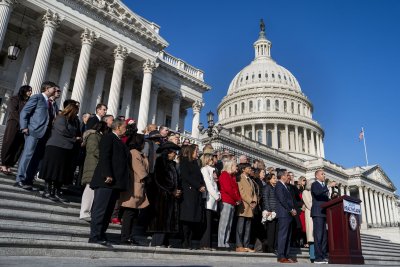

Jan. 6 (UPI) — The 2026 midterm elections are coming later this year with 33 seats in the U.S. Senate and all 435 House seats on ballots across the country.
The Nov. 3 midterms are an opportunity for voters to respond to President Donald Trump‘s second term. Midterm elections are often viewed as a measure of voters’ response to the sitting president’s policies.
After a year of aggressive deportation practices, a withdrawal from the international arena and economic upheaval, 2026 has begun with the Trump administration abducting a foreign leader and launching offensives on foreign nations.
Republicans will seek to maintain a 219-213 majority in the House and three-seat majority in the Senate while Democrats hope to make gains and offer a check on Trump’s power. The results will signal approval or disapproval of how the country is being run and will set the landscape for the final two years of Trump’s presidency.
Retirements to bring changes to Senate
Nine senators have announced they are retiring from the chamber in 2026, including one of the most senior lawmakers.
Sen. Mitch McConnell, R-Ky., the longest-serving Senate party leader in history, will end his 40-year career at the end of the current term. He is one of four Republicans retiring from the Senate.
Six Republicans launched campaigns to succeed McConnell last year, along with eight Democrats. Kentucky has been a firmly Republican-leaning state, voting more than 65% for Trump in 2024.
Alabama voted similarly in 2024, with about 64% of votes going to Trump. Sen. Tommy Tuberville, R-Ala., is ending his time in the Senate to run for state governor.
Like Tuberville, Sen. Marsha Blackburn, R-Tenn., and Sen. Michael Bennet, D-Colo., will leave the Senate to run for governor of their respective states. Bennet has been a senator since 2009 while Blackburn entered the chamber in 2019.
Of the senators not running for re-election, Sen. Joni Ernst, R-Iowa, is leaving open a seat that is considered to be the most competitive. Ernst has been a senator since 2015.
Republicans are backing Rep. Ashley Hinson to take Ernst’s seat. Hinson was elected to the U.S. House in 2020.
Three candidates are in the Democratic primary seeking to challenge Hinson in November: state Sen. Zach Wahls, state Rep. Josh Turek and Nathan Sage, a military veteran.
Wahls was the youngest Iowa Senate Democratic Leader, serving in that role from 2020 to 2023.
The race for an open seat in North Carolina features former Gov. Roy Cooper on the ticket for the Democratic Party. Cooper served two terms as governor.
On the Republican side, former Republican National Committee Chairman Michael Whatley has earned the endorsement of Trump but he is being challenged in the primary by Michele Morrow. She ran an unsuccessful campaign for North Carolina’s superintendent of public instruction in 2024 and has never held public office.
North Carolina has historically been a tightly contested state. Trump earned about 50% of the vote there in 2024. Prior to that, the last time a presidential candidate received 50% of votes was 2012 when Mitt Romney received 50.4%.
North Carolina’s Senate seats have been held by Republicans since 2014. Kay Hagan was a state senator from 2009 to 2015 before being succeeded by Sen. Thom Tillis, R-N.C. Tillis is retiring at the end of the term.
The Democratic Party has tapped former Sen. Sherrod Brown to attempt a return to the chamber in 2026 after he lost a bid for re-election in 2024 to Republican Bernie Moreno.
Brown has launched a campaign to challenge Sen. Jon Husted, the Republican who was appointed to fill Vice President JD Vance’s seat that he vacated when Trump was elected president.
Sen. Jon Ossoff, D-Ga., is running for re-election in a state won by Trump in 2024. Three Republicans have entered their party’s primary to challenge Ossoff: Rep. Buddy Carter, Rep. Mike Collins and former college and pro football coach Derek Dooley.
Georgia Gov. Brian Kemp has given Dooley his endorsement.
Georgia’s 6th Congressional District re-elected Democrat Lucy McBath to the House in 2024 by nearly 50 points over her Republican challenger. Democrats hold both of the state’s Senate seats.
Sen. Susan Collins, R-Maine, will be challenged in 2026 but who will be on the other side of the ticket will not be known until the Democratic primary in June. Collins represents a state that former Vice President Kamala Harris carried by about seven points in 2024.
Maine Gov. Janet Mills and military veteran Graham Platner are campaigning in the Democratic primary.
Texas Sen. John Cornyn is running for re-election but will first have to win a contested Republican primary. Attorney General Ken Paxton, who has been a key figure in Texas’ redistricting battle and often opponent to Biden administration policies, will challenge Cornyn, along with Rep. Wesley Hunt.
In another battleground state, the retirement of Democratic Sen. Gary Peters will leave the race for a Michigan Senate seat open.
Former congressman Mike Rogers is expected to be on the ticket for Republicans after receiving an endorsement from Trump. Three candidates have entered the Democratic primary: Rep. Haley Stevens, state Sen. Mallory McMorrow and physician Abdul El-Sayed.
Congresspeople seeking new offices
Several members of Congress are running for different offices outside of the House chambers, including 11 running for governor. Meanwhile 18 members of the House are retiring, including former House Speaker Nancy Pelosi.
Republicans running for governor in their respective states include Iowa Rep. Randy Feenstra, South Dakota Rep. Dusty Johnson, Florida Rep. Byron Donalds and South Carolina Rep. Nancy Mace.
Rep Chip Roy, R-Texas, will not run for re-election as he will try to succeed Paxton as his state’s attorney general.
New Mexico’s 2nd Congressional District is held by Democrat Gabriel Vasquez but was won by Trump in 2024. New Mexico has voted for Democrats in every presidential election since 2008.
Vasquez faces a challenge from Republicans Greg Cunningham, a veteran of the U.S. Marines and former Albuquerque police officer. Cunningham ran for a seat in the state legislature in 2024 and lost.
Arizona’s 6th Congressional District seat, held by Republican Rep. Juan Ciscomani, had several Democrats looking to challenge Ciscomani in November.
Some candidates have begun dropping out of the Democratic primary as 2026 has arrived. JoAnna Mendoza, a military veteran, and engineer Chris Donat remain in the race. Mendoza has vastly outraised Donat, tallying $1.9 million in receipts compared to Donat’s $21,061, according to Federal Elections Commission data.
Trump won Arizona in 2024 with about 52% of the vote.
Colorado’s newest seat, District 8, is held by Republican Rep. Gabe Evans. He represents the district located in the northern Denver area after flipping the seat for Republicans in 2024.
Evans has a new challenger in the Republican primary as of November with former Air Force cadet and current Colorado Army Reserve Capt. Adam DeRito filing to run against him.
DeRito has been in a long legal battle with the U.S. Air Force which expelled him hours before he was set to graduate in 2010. He was denied a diploma for allegedly violating academy rules by fraternizing with a subordinate. DeRito claims these allegations were retaliation for him reporting sexual assaults at the academy.
The Democratic primary is set to feature five candidates, former state legislator Shannon Bird, state lawmaker Manny Rutinel, Marine veteran Evan Munsing, Denis Abrate and self-proclaimed former Republican John Francis Szemler.
Michigan is one of the biggest battleground states in 2026 with three seats expected to feature close races, along with an open Senate seat.
District 7, held by Republican Tom Barrett, has flipped in consecutive elections. Barrett, a U.S. Army veteran, will seek re-election with seven Democrats declared for their primary. He assumed the seat after Democrat Elissa Slotkin ran for and was elected to the Senate.
Among the Democrats vying to challenge Barrett is former U.S. Ambassador to Ukraine Bridget Brink, Michigan State professor Josh Cowen and William Lawrence, the founder of nonprofit environmental advocacy organization the Sunrise Movement.
District 10 will feature an open election as Rep. John James, a Republican, enters the state gubernatorial race.
FEC campaign data shows a field of six Democrats seeking their party’s nomination. Eric Chung, a former U.S. Department of Commerce official under the Biden administration, has raised the most out of any candidate, followed by Republican Robert Lulgjuraj, a former county prosecutor.
After some delay, District 4 Rep. Bill Huizenga, a Republican, announced last month that he will seek re-election. Four Democrats have filed to appear in the primary, including state Sen. Sean McCann.