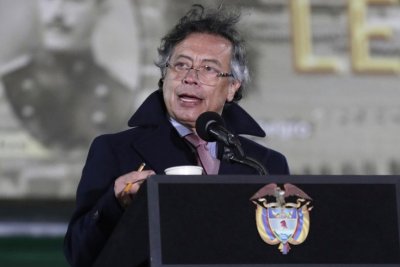
Colombian President Gustavo Petro called for a nationwide mobilization Wednesday and urged citizens to “defend sovereignty,” in response to statements by U.S. President Donald Trump that left open the possibility of military intervention. Photo by Carlos Ortega/EPA
Jan. 6 (UPI) — Colombian President Gustavo Petro has called for a nationwide mobilization Wednesday and urged citizens to “defend sovereignty,” responding to statements by the U.S. President Donald Trump that in Colombia have been widely interpreted as threats of intervention and direct attacks against the head of state.
The call, posted by Petro on X and echoed by government officials and political allies, urges rallies in public squares across the country starting at 4 p.m. local time, with the main protest planned for Bogota’s Plaza de Bolivar, the historic square that houses Colombia’s main government institutions. Petro said he will address the crowd.
The escalation follows remarks by Trump in which he referred to Petro in disparaging terms, accused him of backing drug production and left open the possibility of military action, according to reports by Colombian media.
In recent comments, Trump said a military operation against Colombia “sounds good,” following a U.S. military incursion in Venezuela. He also accused Petro of links to drug trafficking and said Colombia is “very sick.”
Petro publicly rejected the accusations and framed the dispute as a matter of national sovereignty. He said he would carefully assess the scope of Trump’s words before issuing a broader response but insisted that dialogue should be “the first path” and defended the legitimacy of his government.
“Although I have not been a soldier, I know about war and clandestinity. I swore not to touch a weapon again after the 1989 peace pact, but for the homeland, I would take up arms again, which I do not want,” Petro wrote, referring to the agreement that led to the demobilization of the M-19 guerrilla movement in which he once participated.
“I am not illegitimate, nor am I a drug trafficker. I own only my family home, which I am still paying for with my salary. My bank statements have been made public. No one has been able to say I have spent more than my salary. I am not greedy,” he added.
Separately, Colombia’s Foreign Ministry issued a statement after remarks attributed to Trump on Sunday and said it rejects what it considers unacceptable interference in matters of sovereignty and bilateral relations.
Vice President Francia Marquez joined those describing Trump’s statements as “threats” and called on Colombians to defend national sovereignty, according to local radio reports.
Demonstrations planned for Wednesday are expected in cities including Bogota, Medellin, Cali, Bucaramanga, Cartagena and Santa Marta, with calls to gather in central squares.
Petro described the protests as “peaceful” and urged Colombians to fly the national flag at their homes and bring it to public squares, El Espectador reported. He warned of the risks of military escalation and reiterated that the armed forces must follow their constitutional mandate to defend sovereignty.
The episode unfolds amid regional upheaval linked to Venezuela’s crisis and rising diplomatic tensions in Latin America.
According to daily El Tiempo, the situation has pushed Petro’s government to return to street mobilization as a political tool while Bogota seeks to manage relations with Washington without losing internal control.
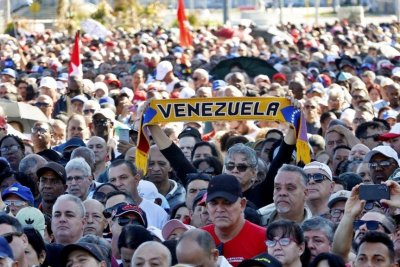
People attend an event held at the Anti-Imperialist Tribune in support of Venezuela in Havana on Saturday. Cuban President Miguel Diaz-Canel condemned the United States’ attack on Venezuela and the capture of President Nicolas Maduro and his wife, Cilia Flores. Photo by Ernesto Mastrascusa/EPA
BUESNOS AIRES, Jan. 6 (UPI) — Cuba is navigating another delicate moment in its recent history after the capture of Venezuelan President Nicolás Maduro by U.S. forces Saturday.
The operation that removed him from Caracas and left him facing a court in New York killed 32 Cuban soldiers, part of Maduro’s praetorian guard, and abruptly dismantled the island’s main economic lifeline.
The blow comes amid an energy and health crisis already considered the worst in decades — and one that could now deepen rapidly.
For more than 20 years, the alliance with Venezuela served as a strategic pillar for the Cuban government. The exchange of subsidized oil for medical and security services allowed Havana to sustain its economy after the Soviet collapse and cushion the impact of the U.S. embargo.
Maduro’s fall and the prospect of a regime change in Caracas directly disrupt that balance and place Cuba in a position of heightened economic and political vulnerability.
In the days after the Venezuelan leader’s arrest, the Cuban government responded with a mix of public gestures of support, internal political mobilization and tighter security.
On Saturday, President Miguel Díaz-Canel led a protest outside the U.S. Embassy in Havana, where he said Cuba was prepared to defend its alliance with Venezuela “even at a very high cost.”
The next day, the government decreed two days of national mourning in response to events in Venezuela. Senior officials dominated state television broadcasts to reinforce the idea of a “shared homeland” and a historic resistance to adversity.
The official narrative sought to counter statements by U.S. President Donald Trump, who publicly warned that allies of chavismo would face direct consequences.
Speaking about the island nation just 90 miles from Key West, Fla., Trump said, “Cuba is ready to fall … going down for the count,” while aboard Air Force One on Sunday.
On Monday, according to diplomatic sources, Cuban authorities stepped up surveillance at strategic facilities and convened emergency meetings. At the same time, reports of prolonged blackouts multiplied across several provinces — a concrete sign of the fragility of the energy system, as Venezuelan assistance could disappear or be sharply reduced within weeks.
Cuba’s energy crisis stems from a combination of obsolete infrastructure, chronic lack of maintenance and fuel shortages.
Most electricity generation depends on decades-old thermoelectric plants that are frequently offline due to breakdowns. Limited alternative capacity forces the state to rely on floating plants and diesel generators, whose operation depends on imports the country cannot secure due to a lack of hard currency or the loss of free supplies from traditional allies such as Venezuela.
Venezuelan lawyer and former prosecutor Zair Mundaray told UPI that for decades, Cuba depended entirely on Venezuelan oil, and that the collapse of Petróleos de Venezuela, S.A., Venezuela’s state‑owned oil and gas company, which started around 2014, broke that anchor. That left the island exposed to more frequent blackouts and a deeper economic downturn.
“In that vacuum, Mexico’s assistance emerged,” Mundaray said.
Press reports indicate that during the peak years of cooperation with Cuba, Caracas sent between 90,000 and 120,000 barrels per day. Since 2023, the Mexican state has shipped hundreds of thousands of barrels of crude and diesel to Cuba in operations valued at more than $300 million.
For economic historian Leandro Morgenfeld at the University of Buenos Aires, one of the objectives of U.S. intervention in Venezuela is to deepen Cuba’s isolation.
“The United States sees the Western Hemisphere as its exclusive domain. It will not accept the presence of extra-hemispheric forces and is willing to remove governments if it believes its interests or national security are at risk,” Morgenfeld said.
From that perspective, he added, the goal goes beyond Venezuela and seeks to dismantle the political and economic ties that sustain adversarial governments in the region, including Cuba.
“That is why they want to cut the political and economic link with Venezuela and further suffocate the island. Despite the blockade, they aim to intensify financial pressure to achieve what they have pursued for decades: the fall of the Cuban revolutionary government,” he said.
Morgenfeld said concern in Havana is real and deep. Cuba has faced a complex economic situation for years, marked by sanctions, lack of hard currency and low productivity.
“It is no longer, as in other times, an economy with easy sources of financing. If chavismo were to fall, the impact on Cuba would be very severe, economically and politically,” he said, while noting that a full regime change in Venezuela has not yet occurred.
From another angle, Colombian political scientist Christian Arias Barona said it is premature to anticipate an immediate collapse of the Cuban model.
He told UPI that as long as Delcy Rodríguez remains in power and U.S. hostility does not intensify, an abrupt shift is unlikely.
“Cuba would not face a drastic alteration in its economy or international relations, especially in its ties with Venezuela, from which it receives significant assistance, particularly in energy,” Arias Barona said. “Nor would its links with Russia and China be immediately affected.”
He recalled that Cuba’s recent history reflects an ability to adapt to adverse scenarios. Since the 1959 revolution, the island has faced what he described as constant “aggressions and hostilities” from the United States, including the ongoing economic embargo.
“That experience has allowed it to develop mechanisms of political and diplomatic survival,” he said.
Arias Barona also noted that the U.N. General Assembly has repeatedly voted against the U.S. embargo on Cuba, calling it a unilateral measure without backing in international law.
However, he said the United States, as a permanent member of the Security Council, has maintained its position and secured occasional support, including from Israel and, in recent votes, Argentina, Ecuador and Paraguay.
“What we are seeing today is a situation that increases Cuba’s vulnerability,” he said.
Sociologist Luis Wainer, also an academic at the University of Buenos Aires, agreed it is too early to project definitive scenarios.
“We do not know whether there will be a change in the political and economic model, how such a transition would look or even whether a transition will exist,” he told UPI.
“We are at a moment of negotiations, where what will be defined is who manages to impose the conditions,” he said.
Wainer said strong interest exists in framing this moment as a return to the Special Period, the severe economic and social crisis that began in 1991 after the collapse of the Soviet Union, Cuba’s main ally and supplier, and resulted in extreme shortages of fuel, food and medicine.
“There is a tendency to think Cuba will return to that scenario, but Cuban experience itself shows the country has developed creative responses to sustain itself without surrendering sovereignty,” he said.
Those responses include selective openings to new trade schemes, agreements with strategic sectors in other countries and the promotion of activities such as international tourism.
In that context, he highlighted the political and economic impact of Latin America’s leftward shift following Hugo Chávez’s electoral victory in 1998.
“That progressive cycle was a key lifeline for Cuba,” Wainer said. “It enabled regional integration, political cooperation and economic agreements that were fundamental for the island, especially with Venezuela.”
The UN human rights office says the US military intervention that ousted Venezuela’s leader violates international law and the UN Charter, warning it undermines global security and risks worsening human rights. It says Venezuela’s future must be decided by its people.
The investigation into a deadly New Year’s blaze that tore through a Swiss bar packed with young people celebrating took a twist Tuesday after the local mayor admitted safety code failings. File photo by Jean-Christophe Bott/EPA
Jan. 6 (UPI) — The bar where 40 people were killed and 116 injured in a blaze in the Swiss ski resort of Crans-Montana on New Year’s Day had not undergone an annual safety inspection since 2019, the town’s mayor admitted Tuesday.
Mayor Nicolas Feraud offered his apologies at a news conference, saying the municipal council was “profoundly sorry” but said he had no explanation as to why no checks on The Constellation bar had been carried out for so long.
“I have no answer for you today. We regret that — we owe it to the families and we will accept the responsibility. We’re profoundly sorry about that and I know how hard that will be for the families,” said Feraud.
He said the town had a five-strong team of people responsible for inspecting more than 10,000 buildings but did not give that as the reason for the failure and insisted he and other councilmen and women would not be resigning.
He said now was not the time to “jump ship” after being elected by Crans-Montana residents.
An outside contractor will now be brought in to carry out a safety audit and inspection of 128 public establishments in the town, but the failure has raised questions over Switzerland’s system of local politics run by non-career officials, many of them part-timers who often have day jobs.
However, Feraud did announce a local ban on use of sparklers — believed to have set the ceiling of the bar ablaze when pyrotechnic champagne bottles were carried too high aloft — inside all commercial premises.
Soundproofing foam on the ceiling that has been blamed for the rapid spread of the fire was within code when The Constellation was last inspected but Feraud said the use of sparklers in spaces fitted with the foam was irresponsible.
Feraud also pointed to crowding in excess of the legally permitted capacity of the premises, which he said was the responsibility of the management of the bar, but said it would for judges to decide whether local officials should fall under the criminal investigation being pursued by prosecutors.
He said the French owners of the bar, Jacques Moretti and Jessica Moretti, were under investigation, but had not been arrested. A second venue they owned had been shut, he added.
The prosecutors’ office for the Valais region said the couple were being investigated on suspicion of manslaughter by negligence, bodily harm by negligence and arson by negligence.
Feraud said the council had provided prosecutors with all relevant documents and would join the case as a civil party.
The developments came as authorities completed identification of all the victims and began the process of returning them to families in Switzerland, Italy, France and countries around the world.
The majority of those caught up in the tragedy were young with an average age of 19.
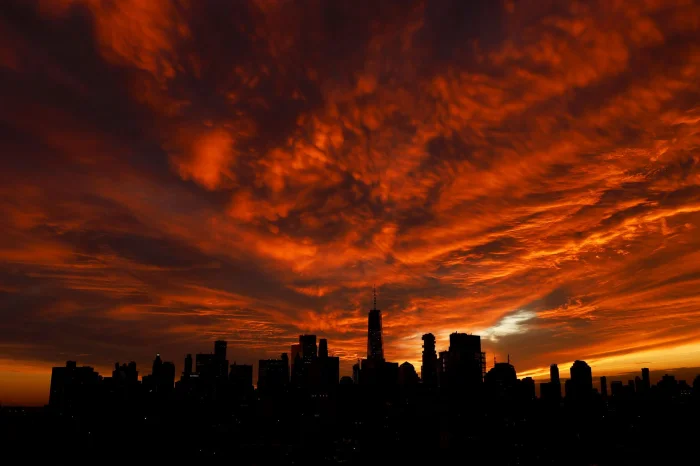
Clouds turn shades of red and orange when the sun sets behind One World Trade Center and the Manhattan skyline in New York City on November 5, 2025. Photo by John Angelillo/UPI | License Photo
Jan. 6 (UPI) — Venezuelan opposition leader Maria Corina Machado praised U.S. President Donald Trump for ousting former President Nicolas Maduro, calling it a giant achievement for humanity, for which Trump should rightly receive the Nobel Peace Prize.
“Jan. 3 will go down in history as the day justice defeated tyranny. It’s a milestone, and it’s not only huge for the Venezuelan people and our future, I think it’s a huge step for humanity, for freedom, and human dignity,” Machado told Fox News on Monday night.
She said Trump’s action to begin dismantling Maduro’s “narco-terrorist regime,” bringing him to justice, and with it, bringing democracy within reach for 30 million Venezuelans, proved beyond doubt that he deserved the Nobel Peace Prize, said Machado, herself the recipient of this year’s peace prize.
However, she issued a warning to the Trump administration that the woman who was sworn in as Maduro’s replacement, interim president Delcy Rodriguez, was not to be trusted, accusing her of being “one of the main architects of torture, persecution, corruption, narco-trafficking,” in Venezuela.
“She’s a main ally and liaison of Russia, China, Iran, certainly not an individual who could be trusted by international investors and she’s really rejected by the Venezuelan people.”
Trump said Monday night that Rodriguez was cooperating with his administration but insisted there had been no deal with any individuals or group inside Venezuelan to take down Maduro.
He said there was no communication with Rodríguez prior to Friday night’s military operation to capture Maduro, adding that a decision was imminent on whether earlier sanctions imposed on her would remain in place.
He also strongly denied that his preference for Rodriguez had anything to do with the fact he beleived the peace prize should have gone to him, rather than Machado.
The Wall Street Journal repored Monday that Trump determined Rodriguez and other members of Maduro’s inner circle were best placed to head a transition administration and keep stability in Venezuela in the event Maduro lost power, based on a CIA intelligence assessment of various scenarios.
The classified report was, in part, responsible for Trump’s decision to support Maduro’s vice president over Machado.
Publicly, he has said she lacked sufficient “support” and “respect” in her home country, despite the fact that Machado won the presidential primary in December 2023, but was barred from running by Maduro.
Machado was replaced on the ballot by Edmundo Gonzales, who is widely regarded to have won the presidency by most Western countries.
Machado, who is in Norway after being smuggled out of Venezuela in December to travel to Oslo to collect her award, vowed to return to Venezuela as soon as possible and that her opposition movement, which had the 2024 election stolen from it by Maduro, wanted the transition to democracy to move forward.
“We won an election by a landslide under fraudulent conditions. In free and fair elections, we will win over 90% of the votes, I have no doubt about it,” said Machado.
However, Trump quashed speculation that elections could be held as soon as next month, saying Venezuela had to be fixed first.
“You can’t have an election. There’s no way the people could even vote. No, it’s going to take a period of time. We have — we have to nurse the country back to health,” said Trump.
Clouds turn shades of red and orange when the sun sets behind One World Trade Center and the Manhattan skyline in New York City on November 5, 2025. Photo by John Angelillo/UPI | License Photo
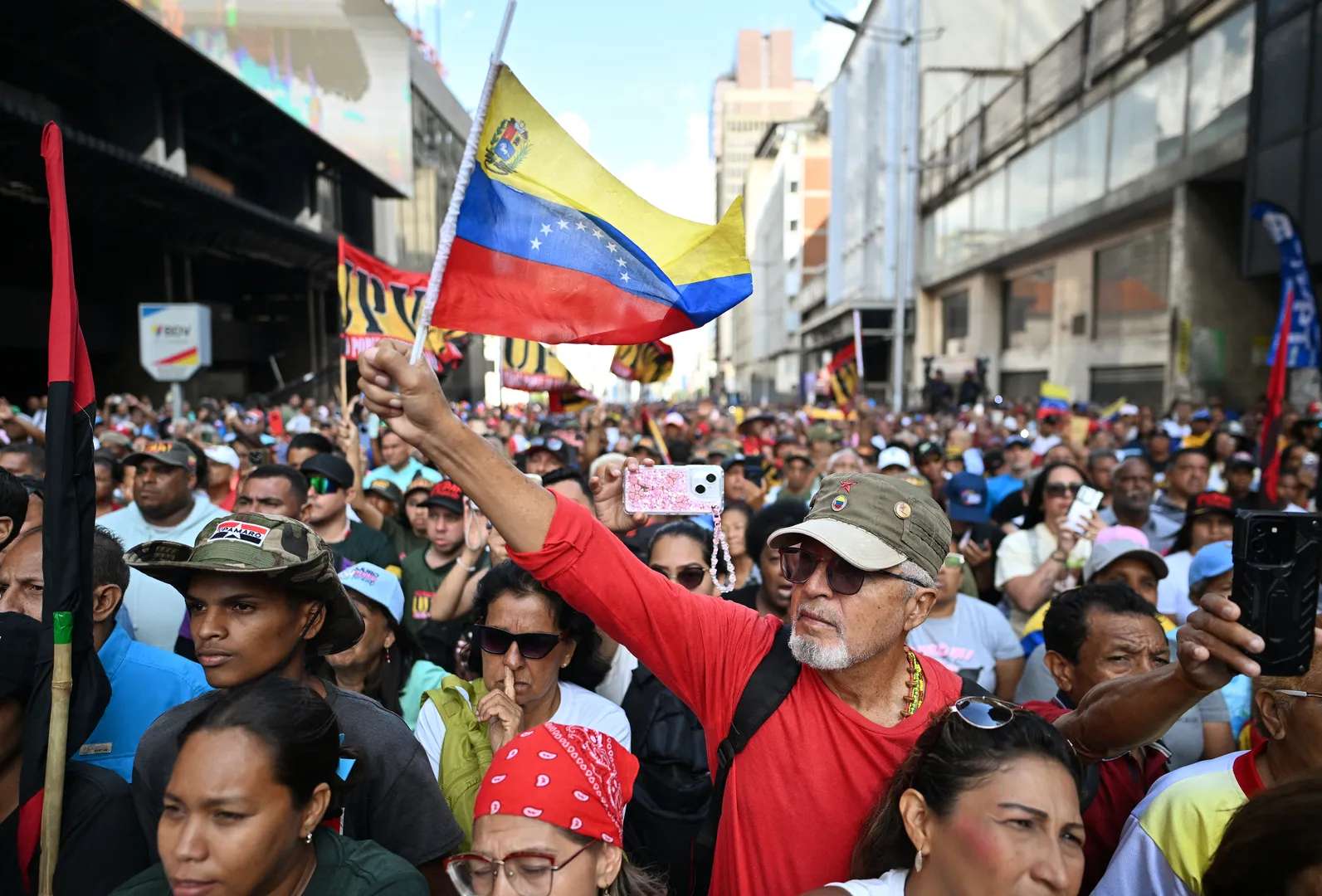
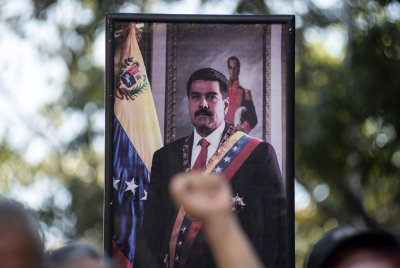
Supporters of ousted Venezuela’s President Nicolas Maduro carry his portrait during a rally outside the National Assembly in Caracas, Venezuela on Monday, January 5, 2026. Photo by Jonathan Lanza/UPI | License Photo
Jan. 6 (UPI) — Switzerland has frozen any assets in the country owned by U.S.-detained Venezuelan President Nicolas Maduro and others associated with him to ensure that if they were stolen from the Venezuelan people, they can be rightly returned.
The asset freeze went immediately into effect when it was announced on Monday, but does not impact members of the current Venezuelan government, Switzerland’s Federal Council said in a statement.
The freeze is to prevent funds from leaving the country. In the case that future legal proceedings show that the assets were illicitly acquired, Switzerland said it will “endeavor to ensure that they benefit the Venezuelan people.”
“The Federal Council wants to ensure that any illicitly acquired assets cannot be transferred out of Switzerland in the current situation,” it said. “It has therefore decided, as a precautionary measure, to freeze any assets held in Switzerland by Mr. Maduro and others associated with him.”
Maduro and his wife, Cilia Flores, were captured by the U.S. military in an early Saturday operation that involved air and ground assets in Caracas. Dozens of people were killed. There were no U.S. military casualties.
The authoritarian Venezuelan president has been indicted in the United States on narcotrafficking and other related drug charges. The operation has raised domestic and international legal questions over Maduro’s detention and has drawn condemnation, including from U.S. allies.
On Monday, Maduro and his wife pleaded not guilty to the charges, and Vice President Delcy Rodriguez was sworn in as the country’s new president.
Switzerland called for de-escalation, restraint and compliance with international law following the United States’ Saturday military operation and said it was “closely monitoring” the situation.
The new asset freeze is in addition to sanctions imposed against Venezuela under Switzerland’s Embargo Act in 2018. The new measure targets the assets of 37 individuals who were not previously blacklisted by sanctions, according to an ordinance on the action. Maduro’s wife and other relatives were named.
Switzerland said neither the reason for Maduro’s ousting nor whether it was legal plays a role in its decision to apply the asset freeze.
“The decisive factor is that a fall from power has occurred and that it is now possible that the country of origin will initiate legal proceedings in the future with regard to illicitly acquired assets,” the Federal Council said.
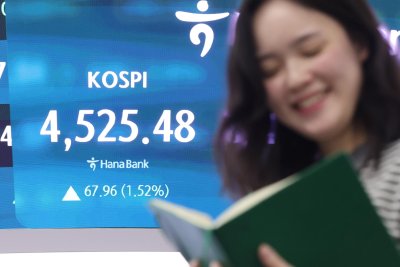
The benchmark Korea Composite Stock Price Index (KOSPI) is displayed on a screen in a dealing room of Hana Bank in Seoul on Tuesday after having surpassed the 4,500 mark for the first time. Photo by Yonhap
Seoul shares jumped more than 1.5 percent Tuesday to close at above the historic milestone of 4,500 on the back of a rise in semiconductors, brokerages and shipbuilders. The Korean won fell against the U.S. dollar.
The benchmark Korea Composite Stock Price Index (KOSPI) climbed 67.96 points, or 1.52 percent, to finish at a new record high of 4,525.48, breaking the 4,500-point mark for the first time.
The index broke through the 4,400-point threshold the previous session on continued gains in technology stocks.
Trading volume was heavy at 492.84 million shares worth 25.27 trillion won (US$17.4 billion), with losers outnumbering gainers 482 to 394.
The index opened lower, bucking overnight gains on Wall Street, but later turned higher as retail investors scooped up technology and other large-cap stocks.
Individuals bought a net 597.55 billion won worth of shares, offsetting net selling by foreigners and institutions totaling 618.83 billion won and 68.93 billion won, respectively.
Foreign investors turned net sellers Tuesday after purchasing more than 2.8 trillion won worth of shares over the past two sessions.
“Technology stocks remained weak on profit taking in the morning session, but turned higher on retail buying in the afternoon trading. Individual investors also purchased defense and shipbuilding stocks on expectations of strong earnings results in 2025,” said No Dong-kil, an analyst at Shinhan Securities Co.
Technology, defense, brokerage and shipbuilding stocks led the gains.
Market behemoth Samsung Electronics rose 0.58 percent to 138,900 won, while chip giant SK hynix jumped 4.31 percent to 726,000 won.
Leading shipbuilder HD Hyundai Heavy Industries soared 7.21 percent to 550,000 won, and Korea Aerospace Industries surged 9.41 percent to 136,100 won.
Defense giant Hanwha Aerospace gained 0.99 percent to 1,022,000 won, and Mirae Asset Securities jumped 12.55 percent to 28,700 won.
Among decliners, No. 2 carmaker Kia slipped 0.08 percent to 122,500 won, and national flag carrier Korean Air declined 0.44 percent to 22,500 won.
No. 2 steelmaker Hyundai Steel shed 1.33 percent to 29,650 won, and leading chemical firm LG Chem dropped 0.45 percent to 328,500 won.
The local currency was quoted at 1,445.50 won against the greenback at 3:30 p.m., down 1.7 won from the previous session.
Bond prices, which move inversely to yields, ended mixed. The yield on three-year Treasurys rose 1.5 basis points to 2.948 percent, while the return on the benchmark five-year government bonds fell 0.5 basis point to 3.244 percent.
Kim Myung-ho, visiting professor at Konkuk University’s Graduate School of Journalism and Public Relations. Photo by Asia Today
Jan. 5 (Asia Today) — By 2026, understanding international relations and shaping national core-interest strategies should start from a geoeconomic perspective. Geoeconomics links geopolitics and economics. It describes the use of economic tools as weapons to achieve political and security goals and the study of how those tools work.
The term is not widely used, but the idea has been around for decades. In 1990, strategist Edward Luttwak argued in an essay, “From Geopolitics to Geoeconomics: The Logic of Conflict, the Grammar of Commerce,” that competition among nations was shifting from geopolitical rivalry to geoeconomic rivalry. In other words, economic instruments were becoming as consequential as military ones.
Traditional geopolitics explains international relations mainly through territory and military power. The reality today looks different. Tariffs, supply chains, exchange rates, finance and standards have become powerful tools aimed at rivals.
The start of President Donald Trump’s second term and the intensifying U.S.-China confrontation highlight what the author calls the arrival of the geoeconomic era. The erosion of free trade and de facto globalization, the “America First” approach and broad tariffs, and the cycle of retaliation and sanctions between Washington and Beijing are presented as signals of that shift.
In the past, globalization prioritized efficiency. That made strategies such as “security with America, economy with China” workable for South Korea. The author argues that economic interdependence itself is now a weapon. Globalization is no longer a stable order. Trump’s tariff policy, the author writes, should be understood not only as an economic move to improve the trade balance but as part of a broader security strategy intended to shrink rival industries, rebuild supply chains inside the United States and push China out of key nodes of the global supply chain.
China’s countermeasures, the author adds, reflect similar logic. The U.S.-China confrontation has expanded beyond military tensions into economic conflict. The author says the superpower rivalry will place increasing pressure on allies and neighboring states to choose sides, as each power blends hard and soft approaches. The author describes an emerging world of overlapping sanctions that could reshape international order.
The author argues such pressure is already visible in currency and tariff measures and in battles over standards tied to technological leadership in telecommunications, semiconductors and artificial intelligence. The author also cites energy security, the restructuring of battery and electric-vehicle supply chains and debates over the burden of security costs. Without a geostrategic plan, the author warns, South Korea could face a compound crisis spanning industrial diplomacy and security.
The column cites U.S. State Department criticism of South Korea’s proposed revision of the Information and Communications Network Act, a measure described as aimed at rooting out false and manipulated information. The author says the U.S. raised “serious concerns,” arguing it could harm the business of U.S.-based online platforms and impede freedom of expression. The author writes that the episode shows how Washington may intervene in other countries’ domestic law when it sees national interests at stake, including through potential trade disputes.
The author links that criticism to what is described as controversy involving Coupang, which is listed in the United States. While the author says Coupang deserves criticism over a personal data leak, the column argues that influential politicians in Washington have spoken up on the company’s behalf, while responses in South Korea have largely focused on calls for hearings and political pressure.
The author also points to a U.S. airstrike on Venezuela and the operation to arrest President Nicolás Maduro as an illustration of how economic interests and security strategy can converge. The author argues that while the stated rationale included counternarcotics, remarks cited in the column about “taking back the oil” reveal a geopolitical calculation tied to energy and supply chains.
The column concludes that no national interest can be protected without a tough geoeconomic strategy and that patriotism rooted in anger or emotion cannot substitute for strategy. The author argues that domestic-focused politics risks being pushed aside in a geoeconomic order and urges South Korea to rethink its national survival strategy rather than remain a passive object of great-power competition.
Editor’s note: The views expressed in this column are those of the author and do not necessarily reflect the views of this publication.
Kim Myung-ho is a visiting professor at Konkuk University’s Graduate School of Journalism and Public Relations.
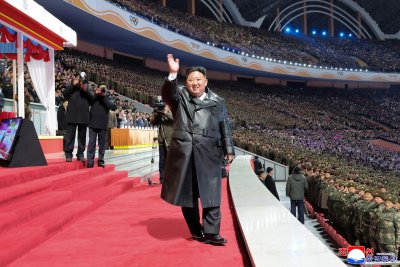
A photo released by the official North Korean Central News Agency (KCNA) shows North Korean leader Kim Jong Un waving during an art performance celebrating the New Year 2026 at the May Day Stadium in Pyongyang, North Korea, 01 January 2026. According to KCNA, the North Korean leader delivered a speech lauding the country’s successes in 2025 while calling for national unity ahead of the 9th Congress of the Workers’ Party of Korea. Photo by KCNA / EPA
Jan. 5 (Asia Today) — The U.S. military operation that captured Venezuelan President Nicolás Maduro could reinforce North Korean leader Kim Jong Un’s belief that nuclear weapons are essential for regime survival and make denuclearization talks harder, a South Korean scholar said.
Im Eul-chul, a professor at Kyungnam University’s Institute for Far Eastern Studies, said the U.S. strike and Maduro’s detention would send Pyongyang two messages: an “existential threat” and a perceived justification for clinging to nuclear arms, according to the analysis.
U.S. officials said Maduro and his wife, Cilia Flores, were taken into custody in a covert operation and transported to the United States to face criminal charges.
Im said North Korea has long cited the fates of leaders such as Saddam Hussein in Iraq and Moammar Gadhafi in Libya as warnings tied to its own survival calculus and that the Maduro case would likely deepen distrust of denuclearization negotiations inside North Korea.
He said seeing Washington’s precision strike capabilities could further fuel Pyongyang’s argument that only nuclear weapons can deter U.S. military power, adding that North Korea may accelerate steps such as expanding tactical nuclear deployment, improving second-strike capability and tightening internal control through fear-based politics.
North Korea, which has maintained ties with Venezuela since establishing diplomatic relations in 1974, condemned the U.S. strikes on Sunday as an infringement on sovereignty, according to state media.
Im also said North Korea’s ballistic missile launches Saturday could carry a message aimed at the United States, as the regime continues to emphasize self-reliance in defense amid regional and global tensions.
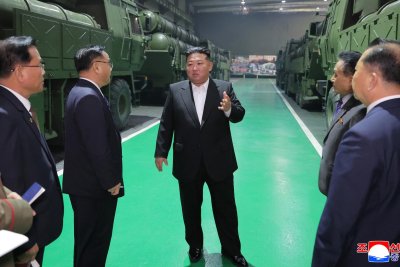
A photo released by the official North Korean Central News Agency (KCNA) shows North Korean leader Kim Jong Un (C) visiting a major munitions industry enterprise to review the production of weapons and combat equipment at an undisclosed location in North Korea, 28 December 2025 (issued 30 December 2025). File. Photo by KCNA / EPA
Jan. 4 (Asia Today) — North Korean leader Kim Jong Un visited what state media called a key military factory on Friday, inspecting upgraded production lines and ordering a roughly 2.5-fold expansion in output as he signaled a push for mass production and deployment of tactical guided weapons.
The Korean Central News Agency said Kim toured a “technologically upgraded” production area and a “flexible automated production system,” then directed the plant to increase its current capacity.
KCNA said Kim reviewed a “multi-purpose precision-guided weapon” produced at the factory and said it would be systematically fielded to major units starting in the first half of the year. The report said he told the Defense Ministry and the General Staff to expand production to meet unit-level demand.
State media portrayed the visit as a move to shift tactical guided weapons from years of testing and demonstrations toward operational deployment. KCNA said Kim pointed to shortcomings in production line design, mass-production facilities and modernization of the assembly process.
Kim also called for advancing modernization work while keeping current production running, a directive KCNA described as aimed at minimizing production gaps during new equipment investments. The report said he ordered a comprehensive review of construction and modernization plans for 2026 and demanded revised proposals.
KCNA separately released photos and footage of Kim inspecting guided-weapon production, including what the report described as anti-tank systems, while emphasizing improvements in the quality of parts supplied by cooperating factories.
The false claims are from a 2017 conspiracy theory that Brigitte Macron was a transgender woman. The allegation was amplified in the United States, pushed by right-wing media personality Candace Owens. The Macrons have also filed a lawsuit in the United States against Owens.
All but one of the defendants in France were given suspended sentences of up to eight months. The other person was jailed for not showing up to court. Some also had their social media accounts suspended.
The judge said the defendants acted with a clear desire to harm Brigitte Macron with comments that were degrading and insulting.
“The most important things are the prevention courses and the suspension of some of the accounts” of the perpetrators, Jean Ennochi, Brigitte Macron’s lawyer, said.
Two of the defendants had been found guilty of slander in 2024 for claiming that the first lady had never existed. Natacha Rey, a self-proclaimed journalist, and Amandine Roy, who claims to be a psychic, said Macron’s brother Jean-Michel Trogneux had changed gender and began using Brigitte Macron’s name.
Their convictions were overturned on appeal because claiming that she is transgender isn’t an “attack on her honor.”
The Macrons are appealing the ruling.
Brigitte Macron’s daughter Tiphaine Auzière, 41, told the court that the false claims had damaged her mother’s quality of life. She said Brigitte Macron worried every day about the clothes she wore and how she stood.
Auzière said the social media posts had caused a “deterioration of her health” and a “deterioration of her quality of life.”
“Not a day or week goes by when someone does not talk about this to her … What is very hard for her are the repercussions on her family … Her grandchildren hear what is being said: ‘Your grandmother is lying’ or ‘Your grandmother is your grandfather.’ This affects her a lot. She does not know how to stop it. … She’s not elected, she has not sought anything, and she is permanently subjected to these attacks. I — as a daughter, a woman and a mother — would not wish her life on anyone,” Auzière said.
Trogneux, 80, lives in Amiens, where he grew up with Brigitte Macron and their siblings.
Clouds turn shades of red and orange when the sun sets behind One World Trade Center and the Manhattan skyline in New York City on November 5, 2025. Photo by John Angelillo/UPI | License Photo
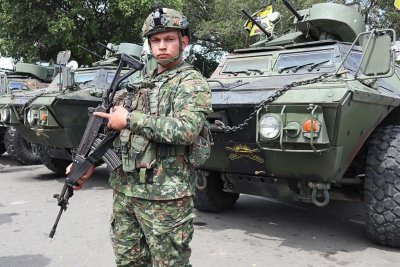
A member of the Colombian Army stands guard at the Simon Bolivar International Bridge in Cucuta, Colombia, on Sunday. The bridge is the main crossing point between Colombia and Venezuela, and it remains open after Venezuelan President Nicolas Maduro and his wife, Cilia Flores, were captured by the United States military action on Saturday and flown to New York to stand trial. Photo by Mario Caicedo/EPA
Jan. 5 (UPI) — Several South American countries announced new migration controls and border security measures in response to Venezuela’s political crisis following a United States operation that detained Venezuelan President Nicolás Maduro and his wife, Cilia Flores, and transferred them to New York to face drug-related charges.
While Colombia said it will keep its border crossings with Venezuela open and ruled out closures, Argentina, Peru, Ecuador and Paraguay announced restrictions on the entry of people linked to the Venezuelan government amid regional uncertainty and diplomatic coordination.
Colombian Vice Foreign Minister Mauricio Jaramillo said keeping the border open is strategic given cross-border migration and commercial flows along some 1,370 miles of shared frontier.
“Colombia has no interest in closing the border. It is essential that it remain open,” Jaramillo said, adding that Migration Colombia activated a permanent monitoring plan to oversee the situation without disrupting the regular movement of people and goods.
At the same time, President Gustavo Petro ordered tighter security along the border through the deployment of more than 30,000 public security personnel, including military and police forces, as a preventive measure against possible disturbances to public order.
Argentina, Peru, Ecuador and Paraguay separately announced new migration controls and entry restrictions targeting government officials, military personnel and others linked to the Venezuelan government.
In Ecuador, the Foreign Ministry said it will apply migration restrictions to public officials, members of the armed forces and security services, business figures, and other people associated with the government of Nicolás Maduro, citing national security concerns.
Authorities said asylum and refugee protections will not be misused and must comply with principles and procedures established under national and international law.
In Argentina, National Security Minister Alejandra Monteoliva said the National Migration Directorate will impose limits on the entry of people connected to the Venezuelan government, including officials, members of the armed forces, business figures and sanctioned individuals, to prevent what she described as regime collaborators from using the country as a refuge or protective platform.
“Argentina will not grant protection to collaborators of the Maduro regime,” the ministry said in a statement. President Javier Milei welcomed the fall of the Venezuelan leader and voiced support for a political transition process in Venezuela.
In Peru, the Interior Ministry announced the immediate implementation of migration controls through the National Superintendency of Migration, in coordination with the National Police.
The measures target Venezuelan citizens linked to the Caribbean nation’s government who appear on international sanctions lists, particularly those issued by the United States, to prevent Peru from being used to evade judicial proceedings.
“Notified. Those who oppressed their country for years are not welcome,” interim President Jose Jeri said in a post on social media platform X.
In Paraguay, the National Migration Directorate said it adopted control and restriction measures, with support from state security agencies, to block the entry of people linked to the Venezuelan government or with alleged ties to drug trafficking, narcoterrorism or pending criminal cases.
Authorities said they will evaluate international cooperation mechanisms and database cross-checks to verify individuals’ links to the Venezuelan government.
WHETHER you fancy a 2026 staycation or holiday across to Europe or further afield, we’ve got some incredible experience for you to consider.
We’ve been all over the world and have taken note of our favourite things to do, from guided tours to free hikes, getting our hands dirty at cooking classes or doing some daredevil stunts.
Sign up for the Travel newsletter
Thank you!
First up, you really can’t go wrong with a food tour – and you can do these anywhereCredit: Unknown
Secret Food Tour, UK
Assistant Travel Editor Sophie Swietochowski said: “Exploring a city for the first time? Getting a flavour of the food scene is a priority for me whenever and wherever I travel. And a Secret Food Tour is just the way to do that.
“The several-hour experiences are bookable in over 70 major cities globally, and thanks to a knowledgeable local guide you’ll get a strong idea of where’s good to eat and which joints are tourist traps.
“I’ve been on several of these tours, but was most blown away by the Soho one in London, naively assuming I’d learn nothing new. How wrong I was.
“Did you know that Berwick Street market was the first place in London to sell tomatoes on the street? Or that Ronnie Scott’s jazz club is where Jimi Hendrix played his last ever gig in 1970?
You can enjoy six to seven food stops, including one ‘secret stopfrom £79pp in the UK. Seesecretfoodtours.com.
You’ll see a different side to Sardinia with the underground walking tourCredit: Alamy Stock Photo
Walking Tour, Italy
Travel Reporter Cyann Fielding added: “Sardinia has been named several times as a top destination to visit this year and with that in mind one great thing to do on the Italian island is head on the Underground Cagliari Walking Tour.
“The tour takes between two and four hours and across that time you will explore three different underground sites. The sites include a limestone tunnel used by priests, a crypt and even underground Roman ruins.”
You can take vineyard tours around England if you head to KentCredit: Alamy Stock Photo
Wine Tour, UK
Deputy Travel Editor Kara Godfrey said: “The UK wine is having a moment, even beating those in France – so why not go on a tour of some of the best vineyards in the country?
“Wine Tours of Kent takes you around two vineyards in the ‘Garden of England‘ and it includes vineyard tours, wine tastings, as well as lunch, with prices starting from
“I recommend pacing yourself, as I ended up buying perhaps too many bottles of the stuff, easily tempted after a glass of wine or two.
“Don’t worry about having to drive yourself home – you are even dropped at the train station at the end.”
For the best views across Fethiye, Kara says take to the skiesCredit: Kara Godfrey
Paragliding, Turkey
Deputy Travel Editor Kara Godfrey revealed: “What’s one of the best ways to see the beach resort of Fethiye? By the air.
“There are a number of paragliding experiences in Turkey, but the best ones are in Oludeniz.
“It’s certainly nerve-wracking to start – once attached to your guide, you have to throw yourself off the cliff edge like a lemming.
“But it’s worth it for the views alone, floating suspended in the sky with the gold sand beaches below… and even a few turtles swimming in the bright blue waters.”
If seeing Montmorency Falls wasn’t enough – you can Zip Line across it tooCredit: Alamy
Montmorency Falls Park Zip Line, Canada
Travel Reporter Cyann Fielding suggested something more thrilling, she said: “If you are a dare devil or adrenaline junkie then you must head to Montmorency Falls Park in Quebec, Canada.
“Here you will find a waterfall that is higher than Niagara Falls and you can zip line across it.
“The experience is both thrilling and mesmerising as you get to fly past the cascading water and see it from a different angle.
“Afterwards, you even get a video of your zip across the waterfall.”
Tickets cost £17.25 per person see sépaq.com for more.
Can you really visit Northern Ireland without tasting the whiskey
Whiskey Tour, Ireland
Travel Writer Jenna Stevens recommends a whiskey tour when you head to this specific destination. She said: “Any trip to Northern Ireland is incomplete without a whiskey tour and tasting.
“Located in the old Victorian Crumlin Road Gaol, McConnell’s blends history, culture and deliciously distilled drinks all in one place.
“The tour starts with a history lesson on Irish whiskey and learning all about ‘Mother McConnell’, the widow who took over the McConnell business and made the drink what it is today.
“Next comes a true insight into the world of whiskey making, as you walk through the entire process – from grain to glass.
“After learning everything there is to know about Irish whiskey, you’ll be ready to taste some. Luckily with this experience, you get treated to three drams to enjoy in a group tasting.
The McConnell’s distillery experience, including a guided tour and three tastings, is £23pp. See mcconnellsirishwhisky.com.
Take to the waters in Tenerife to see lots of marine lifeCredit: Alamy
Dolphin and Whale-Watching Boat Trip, Tenerife
Deputy Travel Editor Kara Godfrey said: “The Spanish island of Tenerife is known for its dolphin and whale-watching tours, thanks to its huge conservation drive.
“During my trip, I was lucky to see huge pods of dolphins swim right alongside the boat, playing with the sides.
“While shyer, we also spotted whales in the distance, with it being one of the few locations outside of the US and Japan where they can be seen.
“The trip even includes time for a dip in the water, as well as drinks and snacks.
If history is your thing, head underground on a Victorian Tunnel TourCredit: Unknown
Victoria Tunnel Tour, UK
Travel Reporter Cyann Fielding says head underground: “Here in the UK, head on the Victoria Tunnel tour in Newcastle.
“The former Victorian wagonway was used to carry coal for the Tyne before it was later used as a shelter during bombings in World War II.
“There are two different tour types, either an hour and 15 minutes or two hours – opt for the latter for the full experience with an informative guide.
The tour costs from £7 per child and £14 per adult. See ouseburntrust.org.uk for more.
When in Rome, you’ve got to have a go at making your own pastaCredit: Jenna Stevens
Pasta Making, Italy
Travel Writer Jenna Stevens explained: “If there’s anywhere to learn to make some great pasta, it’s in Italy’s capital.
“I came across this cooking class when browsing GetYourGuide for activities in Rome, and decided to try my hand at making some fettuccine.
“The class takes place in the main square of Piazza Navona, right in the heart of the city – perfect to drop into after a day of wandering the city centre.
“Here, you’ll meet strangers from all over the world, and together you’ll get stuck into mixing dough, sprinkling flour and rolling out sheets of fresh pasta.
“After you’ve made something that resembles fettuccine, pick between a range of Italian sauces, sit down with an (included) glass of wine, and let the chefs take care of the rest.
“Soon enough you’ll be served a plate of hot fresh pasta, with your nametag neatly stuck to the plate, so you know you’ve got the real deal.
“Eating something you’ve made yourself is a super rewarding feeling, and those fresh Italian ingredients make the dish taste extra special.”
Book a pasta cooking class in Rome on GetYourGuide for £35 per person.
You can’t go to New York City without seeing the impressive skylineCredit: Alamy
“Though, the Empire State Building is an iconic part of the skyline itself and if you are inside it, you can’t see it.
“That’s what makes going to the top of the Rockefeller Center better – you see the entire skyline and can also enjoy access to The Beam Experience which feels like having lunch above the skyscraper.
Tickets cost £31.27 per adult and £26.80 per child see rockefellercenter.com for more.
Hit the roads the next time you’re in SingaporeCredit: Unknown
Sidecar City Tour, Singapore
Deputy Travel Editor Kara Godfrey advises you to take to the roads, she said: “If you love a city tour and a vintage car, then a Side Car Tour of Singapore is the best.
“Book one for the middle of the week and enjoy much emptier roads as you whizz though the financial and art districts.
“Clad in a stylish helmet, my driver was both speedy and hilarious as we explored the street art and building history along the way.
“There are different themes, from night tour to Crazy Rich Asian tours, but I highly recommend the Singapore in a Nutshell.”
Singapore Sidecar Tours from £119pp. See sidecar.sg
Take your friends for an epic race across London or Manchester
Race Across the World, UK
Travel Reporter Alice Penwill recommended getting competitive with a game, she said: “You don’t need to literally Race Across the World for thrills as there’s an experience right here in the UK.
“With the interactive game you can run across the city of London, the West End or Manchester solving puzzles and hunting for clues, and it is competitive as you’re up against the clock.
“It’s a great day out with friends or family, and you get to take little breaks for refuelling along the way too.”
You can hike to get a view of the Hollywood signCredit: Ekaterina Chizhevskaya
Hike to the Hollywood Sign and Griffith Observatory, Los Angeles
Travel Reporter Cyann Fielding can’t get enough to the US – and luckily, you don’t have to pay for everything. She suggested: “Los Angeles is expensive enough as it is, but there is an incredible, bucket list activity you can do for completely free – hiking to the Griffith Observatory and seeing the Hollywood Sign.
“The Ferndell to Observatory Loop isn’t for the fainthearted stretching 2.6 miles but you get to head through woodland before reaching the observatory.
“On the way down from the observatory, make sure to head via Glendower Avenue to see Frank Lloyd Wright’s Ennis House and into Feliz, where there is a number of independent shops and restaurants including Skylight Books.”
Take a tour around the beautiful Sistine ChapelCredit: Alamy Stock Photo
Vatican and Sistine Chapel Tour, Italy
Assistant Travel Editor Sophie Swietochowski suggested taking a tour of one well-known site, she said: “The famous Vatican City, sat within the Italian capital, is one of the most historically significant sites in not just Rome, but the entire world, and it’s still considered the heart and headquarters of Catholicism today.
“It’s also now one of the most overcrowded sites you could visit. That’s why a guided tour with queue jump, that lets you avoid those daily snaking lines, is the only way to do it.
“Even with queue-jump you’ll still have to wait a short while, but once you’re in your very knowledgeable guide will whisk you off to all the must-see places, pointing out the top photo spots as you go.
“Plus, you’ll learn things that the standard visitor won’t.”
A two-hour Vatican Museums and Sistine Chapel tour costs from £53pp. See getyourguide.co.uk.
You can hike up to this famous spot in Edinburgh for absolutely nothing
Hike to Arthur’s Seat, Scotland
Travel Reporter Cyann Fielding has top tips for anyone doing a staycation, she said: “Edinburgh is a fantastic city to visit, especially if you want a holiday but don’t want to leave the UK.
“And for those who like to keep active, head for hike up Arthur’s Seat – a dormant volcano with breathtaking views across the Scottish capital and the sea.
“What is even better is that it is free to hike – just note it isn’t for the fainthearted.”
A cooking class is an essential activity when you head to ThailandCredit: Unknown
Cooking Class, Thailand
Travel Reporter Alice Penwill cooked up a storm on a recent trip to Koh Samui, she said: “What’s one of the best things about going to Thailand? It has to be the food. From delicious curries to stir fry and of course, mango sticky rice.
“While I’m not a natural in the kitchen, Chef Lat made it very easy and soon had me chopping lemongrass and frying prawns.
“My new favourite, though is a massaman chicken curry. You eat everything you make, too.“
Book the Thai Cooking Class Farm to Table with Expedia for $82pp (£60.89). See expedia.com for more.
Whether you’re a Faithful or a Traitor, this experience is great fun for all
Traitors: The Live Experience, UK
Travel Reporter Cyann Fielding loved her experience as a Faithful, she said: “The new series of Traitors graced our screens last week and what could be a more perfect excuse to try out the live experience?
“Located in London, the Traitors live experience allows fans to actually play the game – albeit in a very shortened version.
“You get a host as well as gain an insight into what it actually feels like to be a Faithful… or perhaps, a Traitor.”
For anyone heading to Egypt, Kara says to head across the dunesCredit: Kara Godfrey
Dune Hiking Sunset Tour, Egypt
Deputy Travel Editor Kara Godfrey added: “If you want to feel like you’re on Mars without the 10-month journey, then desert hiking in Egypt is the next best thing.
“Just outside El Gouna, the drive into Wadi Bileh makes you feel like you are the only person on the planet.
“The sandy walk is best done barefoot, and head to the top to see towering dunes of red sand.
“It ends with a Bedouin bonfire and coffee when the sun goes down, making it a true, other-worldly experience.”
You can’t go wrong with Go Ape when you need to entertain your kids
Go Ape, UK
Head of Sun Travel (Digital) Caroline McGuire said: “Go Ape has taken over the UK with treetop rope courses in more than 30 inner-city and countryside locations.
“It also happens to be at some of the country’s top tourist attractions, like Leeds Castle, Bedgebury Pinetum and in Battersea Park, a stone’s throw from Battersea Power Station.
“The latter is where I took my five year old, during a day out at the power station, which has its own cinema, Lego store and holds special family events during school holidays.
“It was a brilliant experience as a bolt-on to a city day out, where my son was able to blow off steam and get plenty of fresh air, among the more cultural activities of the day.
“Yes, it’s not cheap, but the infrastructure, thought and care that has gone into these courses is not cheap. And there wasn’t a miserable child or adult among those I encountered on our afternoon in the trees.
“Go Ape has inspired several copycats, both here and abroad, but few work so cleverly with nature, which is what makes this experience, particularly in central London’s Battersea, so unique.”
Tickets start from £20.95pp. For more see goape.co.uk.
Jenna wants to zip down this steep mountain coasterCredit: Alamy
Mountain Coaster, Switzerland
Travel Writer Jenna Stevens has one of these activities on her own 2026 bucket list: “Switzerland is home to some of the world’s most beautiful landscapes. And what better way to see them than whizzing down a 1350m-long toboggan ride?
“The Fräkigaudi toboggan run in Hergiswil is the longest alpine coaster in Switzerland, and bends around vivid green mountain valleys.
“It’s a thrilling ride full of surprise twists, turns, and drops into “dragon holes”.
“You’re able to control the speed at which you ride, so whether you’re visiting for full-on adrenaline or a leisurely sightseeing slide, the choice is entirely up to you.
“At the top station there’s seating and a snack bar, and at the bottom a lift to transport you back up to the top to do it all over again. The toboggan run operates in the summer months from 10-4pm.”
Tickets cost 9 CHF (£8.41) for adults, 7 CHF (£6.54) for ages 8-16 and 5 CHF (£4.67) for ages 6-7. See rodelbahn.ch for more.
You get to see the peninsula in all its glory from a boatCredit: Alamy Stock Photo
Boat Tour around the Sirmione Peninsula, Italy
Travel Reporter Cyann Fielding added: “If you’re visiting Lake Garda in Italy this year, make sure to head to Sirmione – a picturesque town located on a narrow peninsula.
“The town is famous for its Roman ruins, medieval Scaligero Castle and thermal baths. But to catch the most spectacular experience of the town and Lake Garda, head on a boat tour.
“There are several from the town, but make sure to head off on one that explores Villa Maria Callas, Aquaria Thermal Baths, Catullus Grottoes, Giamaica Beach, Boiola Sulphur Spring and the partially-submerged Sirmione Castle.”
A boat tour that includes the above locations costs from £26.60 per person, but shorter 25-minute tours cost from £8.68 per person.
Get incredible views across the Atlas Mountains from a hot air balloon in MoroccoCredit: Alamy
Hot Air Ballooning, Morocco
For incredible views, Deputy Travel Editor Kara Godfrey says head up to the skies, she said: “One of Morocco’s most beautiful landscapes is the Atlas Mountains, and hot air balloon rides are one of the best ways to see them.
“Arriving in pitch black, I waited in darkness apart from the flame of the balloon, before piling into the basket and floating up to wait.
“There are few things as magical as seeing the sun peek over the mountains, with hues of red and pink.
“Most experiences come with a Berber breakfast afterwards too, so make the most of the breads and mint tea.”
Hot Air Balloon Flight over Marrakech from £74. See viator.com
The Musée d’Orsay has lots of beautiful artwork and sculpturesCredit: Alice Penwill
Musée d’Orsay, France
Travel Reporter Alice Penwill said: “If you’re in Paris and looking for something to do, head inside the Musée d’Orsay and for a very informative experience, take a guided tour.
“Inside are lots of huge sculptures like ‘The Gates of Hell’ and beautiful pieces of art by the likes of Renoir and Monet.
“It also houses Van Gogh pieces like Starry Night Over the Rhône, and his Self-Portrait.
“The building itself is incredible too as it used to be a train station, it has a giant golden clock and beautiful views of Paris from the fifth floor.
“The gallery sits on the bank of the River Seine too so afterwards, you can take a stroll along the water all the way down to Notre Dame.”
Guided tours are €26 (£22.56) which include the tour, admission and activity. See musee-orsay.fr/en.
You can rent a paddleboard and head out onto the water in Norfolk
Paddleboarding, UK
When it comes to summertime, Travel Writer Jenna Stevens said to head to her home county: “It’s hard to pick between the beautiful beaches to explore in North Norfolk.
“Whilst Cromer is popular for crabbing and cool cafes, Wells-next-the-Sea is famous for its postcard-perfect beach huts. But the best way by far to explore any of these beaches is by paddleboard.
“Whether you pick up a cheap blow-up paddleboard from Lidl, or borrow one from the many rental shops along the coast, you should make paddleboarding your new best friend in 2026.
“I recommend heading to the marshes of Brancaster or Burnham Overy Staithe for gorgeous golden sunsets and still, quiet waters.
“These grassy areas are way quieter than their nearby sandy beaches, and if you time your visit just right you might even be able to pick some fresh samphire from the marshland to take home for dinner.
“And whether you choose to paddle out to the horizon, try out SUP yoga, or simply lay down and soak in the views – it’s an activity everyone falls in love with.
“You can grab a cheap paddleboard from Amazon for £89.99, or rent one for just £20 per hour at Brancaster Boards.”
You can see Miami in style from a speedboatCredit: Unknown
Thriller Speedboat Adventures, Miami
Travel Report Cyann Fielding said: “The glamorous city of Miami is always in the headlines for the amount of celebs who live there or visit – but on dry land you can’t get a taste of what exactly their lifestyles look like.
“The Thriller Speedboat Adventure ride takes you directly past the houses of the rich including Oprah Winfrey and Will Smith.
“The boat itself is open-topped so you get to enjoy the heat and breeze of Miami too.
“The host is equally funny as they are informative, giving you a real glimpse into some of the luxury and scandal of the lives of the city’s residents.”
You will get drenched up on Hurricane Deck at Niagara Falls in BuffaloCredit: Unknown
Niagara Falls, New York
Travel Reporter Alice Penwill added: “If you’re heading to the US this year, there’s no way you can miss a trip to Niagara Falls in Upstate New York.
“Take the trails through the park, wander at your leisure at no cost as entering Niagara Falls State Park is completely free too so there are no fees necessary to see the impressive falls.
“If you want to get up close to the falls, either take a Maid of the Mist Boat across the waters, or walk The Cave of the Winds which takes you as close to the water as possible – and make sure to bring your waterproof for Hurricane Deck.”
Head straight to the go-karts in Sigulda, LatviaCredit: Unknown
Sigulda, Latvia
If you’re seeking adventure, head to this town recommended by Deputy Travel Editor, Kara Godfrey: “While most people head to Riga on a trip to Latvia, the town of Sigulda is the one for adventure lovers.
“I spent the idea day exploring, trying out every activity on offer for a day of adrenaline.
“There is the indoor go-karting rink Klikk, where I bounded off the tyre walls at speed, to hoping on the cable car before a zipline through the forest.
“Yachting, skydiving and bungee jumping are all on offer too, if you want ore of a thrill.”
Kids and adults alike can enjoy this activity on UK beaches
Fossil Hunting, UK
Travel Reporter Cyann Fielding added: “Kid’s love dinosaurs and right here in the UK we have some great spots to go hunting for millions-of-years old fossils.
“The best spot? Definitely Dorset’s Jurassic Coast. Head to Charmouth Beach and Lyme Regis both of which are known as great fossil-finding spots with species including ammonites (which are the popular spiral shell-shaped fossils) and belemnites (the ones that look like bullets).
“Just check rules of the specific place you plan to head to beforehand, as some spots don’t allow you to chisel into the rocks.”
Heavily armed federal law enforcement officers on guard Sunday outside the Metropolitan Detention Center in Brooklyn, where Venezuelan President Nicolas Maduro and first lady Cilia Flores are being held after being seized from the presidential palace in Caracas at the weekend. Photo by Olga Fedorova/EPA
Jan. 5 (UPI) — U.S. President Donald Trump issued a warning to Venezuela’s new president, Delcy Rodriguez, to “do what’s right,” or face a similar or worse fate than President Nicolas Maduro, who is in a U.S. prison after being seized by U.S. Special Forces over the weekend.
“If she doesn’t do what’s right, she is going to pay a very big price, probably bigger than Maduro,” Trump told The Atlantic, adding that regime change remained on the table, saying that it was preferable to the present state of affairs and the situation “can’t get any worse.”
Rodriguez, who was due to be sworn in as president in Caracas at 7 a.m. EST with the support of the country’s military and the supreme court, has said she is willing to cooperate with the United States after initially condemning the arrest of Maduro and his wife, Cilia Flores, and demanding their release.
“We invite the U.S. government to collaborate with us on an agenda of cooperation orientated towards shared development within the framework of international law,” she told her cabinet at her first meeting in charge on Sunday.
Trump said U.S. Secretary of State Marco Rubio had spoken with Rodriguez and that she was “essentially willing to do what we think is necessary to make Venezuela great again.”
Amid conflicting messaging, it was unclear if that was Trump’s meaning when he said in his news conference Saturday announcing the military operation that the United States was “going to run the country until such time as we can do a safe, proper and judicious transition.”
“We’re going to be running it with a group, and we’re going to make sure it’s run properly,” Trump said.
Rubio clarified Sunday that Trump was talking about exerting control from outside the country to bring about major policy shifts.
He said sanctions were one of the tools at the administration’s disposal to ensure the cooperation of the acting leadership, saying in an American broadcast TV interview that a blockade on Venezuela’s oil exports, being enforced by the U.S. military, would remain in place.
“We continue with that quarantine and we expect to see that there will be changes not just in the way the oil industry is run for the benefit of the people, but also so that they stop the drug trafficking, so that we no longer have these gang problems, so that they kick the [Columbian insurgent groups] FARC and the ELN out, and that they no longer cozy up to Hizballah and Iran in our own hemisphere,” Rubio said.
Meanwhile, Maduro was due to make his first appearance in Federal Court in New York later Monday, where he and Flores will be read a 25-page indictment accusing the pair of accumulating vast wealth from a narco-terrorism conspiracy.
They also face three related charges of cocaine importation conspiracy, possession of machine guns and destructive devices, and conspiracy to possess machine guns and destructive devices.
They are due to be transferred from the Metropolitan Detention Center in Brooklyn, which houses defendants accused of regular crimes, to the U.S. District Court for the Southern District of New York in White Plains, N.Y., to appear at 12 p.m. EST.
Clouds turn shades of red and orange when the sun sets behind One World Trade Center and the Manhattan skyline in New York City on November 5, 2025. Photo by John Angelillo/UPI | License Photo
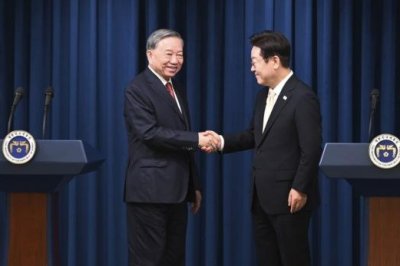
South Korean President Lee Jae Myung (R) shakes hands with General Secretary of the Communist Party of Vietnam To Lam during a press conference at the presidential office in Seoul in August. File Photo by Song Kyung-Seok/EPA/Pool
SEOUL, Jan. 5 (UPI) — Korea Land and Housing Corp. said the state-run company selected several private-sector enterprises as preferred bidders for a large-scale city development project in Vietnam.
Among them were the country’s leading contractors, Hyundai E&C and POSCO E&C, along with JR Asset Management. Public-sector involvement is also expected through the Korea Overseas Infrastructure and Urban Development Corp.
The Vietnamese government is seeking to attract investment to move forward with a multibillion-dollar project to construct a new city in the fast-growing Southeast Asian country.
The initiative is designed to transform a 2,000-acre site in Bac Ninh Province, about 12 miles northeast of Hanoi, into a self-sufficient urban center capable of accommodating more than 100,000 residents.
Midway through 2024, LH signed a memorandum of understanding with Bac Ninh Province to pursue the development. Last August, it asked the provincial government to issue an investment policy approval.
Once the approval is secured and related administrative procedures are completed, LH plans to establish a special purpose company with Vietnamese partners to implement the 50-year phased initiative, which is scheduled to conclude in 2076.
Early last year, LH estimated the project’s value at $4.1 billion, but the company noted that the figure would be subject to change depending on project scope and other factors.
The Seoul administration has expressed high hopes for the initiative. For example, President Lee Jae Myung cited it during a meeting with To Lam, general secretary of Vietnam’s Communist Party, in Seoul last August.
“We will provide full support to advance cooperation on the Bac Ninh new town development,” Lee said at the time.
Lauren Burnison’s life has changed significantly since she quit drinking in 2016. Now the Perthshire, Scotland mum runs alcohol-free travel company We Love Lucid
10:36, 05 Jan 2026Updated 10:37, 05 Jan 2026
Lauren Burnison runs the UK’s first alcohol free travel company
While many of us will be feeling the excesses of Christmas and New Year’s, fewer will have taken things as far as Lauren Burnison did back when she was drinking.
After growing up in Belfast in the grips of the Troubles, where a “blanket of fear” hung over everything, Lauren “bounded headlong into a void of self-loathing and addiction”. She left home and moved to Edinburgh and Buenos Aires during her years of “chaos”.
On New Year’s Eve 2002, things came to a heady, violent peak when her “testosterone-fuelled gang of twenty-something-year-old” pals clashed with some strangers on a booze-fueled bender on the streets of Argentina.
Today, things could not be more different for Lauren.
Having long left Argentina behind, the 41-year-old quit alcohol in 2016 and embarked on an epic world trip. “I’d done a lot of travelling in the past, but this time it was different. This time, I was seeing life through the clear lens of lucidity,” she explained.
“Towards the end of my trip, I stumbled across a quaint little Andalusian town called Ronda, in southern Spain. It was there that I was inspired to create alcohol-free travel experiences.”
Over the past decade, Lauren has been channelling this newfound lust for life into We Love Lucid – a company that organises teetotal group trips, which claims to be the UK’s first alcohol-free travel company.
“Our trips are geared towards sober solo travellers who are looking for a new challenge and who want to connect with others like them. The focus is on connection and creating new and unforgettable experiences that don’t revolve around booze,” she explains.
Going booze-free has also changed Lauren’s family holidays.
“I recently embarked on a two-month road trip in Spain and Portugal with my four-year-old daughter. My motivation for the trip was partly to escape the dark Scottish winter, but it’s also an opportunity to expand our horizons and do something that challenges us,” the Perthshire woman explained.
“What I’m enjoying most about the trip is spending the majority of our time outdoors. It’s a brilliant tonic for mental health, and something I want to do more of when we get back to the UK. We prepare our meals outside and we eat outside under the stars. My daughter spends her days playing with other children and animals while I get on with the basic chores of cooking and washing, along with writing and making driftwood art. Sometimes, we head out to explore the local surroundings. Last week we visited the remains of an ancient Roman city in Extremadura, Spain. It was fascinating!
“The best days are the ones we haven’t planned, like an impromptu trip to the beach. We’re especially looking forward to the Big Wave surfing competition in Nazaré, where surfers tackle waves up to 100ft high.”
Had the single mum still been drinking, such a trip would “be almost impossible”, in part due to the hangovers, Lauren says. Not drinking has also freed up cash to spend exploring the world.
“There’s so much to do. We meet a lot of different people on the trip, and many ask why I don’t drink, so the topic comes up quite a lot. In fact, it has led to some interesting conversations and friendships. This year, I will celebrate ten years of sobriety, which is hard to believe sometimes. My sobriety is my biggest priority in life. Without it I wouldn’t be doing any of this.”
While plans for the coming year aren’t yet finalised, 2026 promises to be a big one for We Love Lucid. They will likely include a group climb up Mount Toubkal in Morocco, and a women’s-only journey along the Portuguese section of the Camino de Santiago, to raise funds for the She Recovers Foundation.
You can follow Lauren’s travels on her Substack and find out more about We Love Lucid on her website.
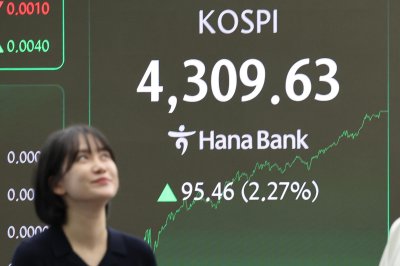
A financial data screen in the dealing room of Hana Bank shows the benchmark Korea Composite Stock Price Index, in Seoul, South Korea, 02 January 2026. South Korean stocks surged to close at an all-time high, led by strong gains in large-cap semiconductor shares, having gained 95.46 points, or 2.27 percent, to close at 4,309.63. Photo by YONHAP / EPA
Jan. 4 (Asia Today) — Corporate lending at South Korea’s five largest commercial banks grew at about half the pace of the previous year, despite government calls for “productive finance” aimed at steering money toward businesses, industry data showed.
Outstanding corporate loans at KB Kookmin Bank, Shinhan Bank, Hana Bank, Woori Bank and NH Nonghyup Bank totaled 844.7 trillion won (about $650 billion) at the end of December, up 2.94% from a year earlier, the data showed. The increase of 24.1 trillion won (about $18.5 billion) compared with 2024’s 6.95% rise, when balances increased 53.3 trillion won (about $41.0 billion).
The lending trend diverged between the first and second halves of the year. Corporate loan balances rose 9.1 trillion won (about $7.0 billion) in the first half as banks prioritized asset quality amid higher rates and more financially strained firms. Growth accelerated in the second half, rising 15.0 trillion won (about $11.5 billion), as the government that took office in June pushed banks to expand credit to companies and advanced industries while tightening household lending.
Even so, growth in loans to small and medium-sized firms slowed sharply. SME lending at the five banks increased 12.2 trillion won (about $9.4 billion) last year, down from 31.3 trillion won (about $24.1 billion) in 2024, the data showed. Loans to large companies rose 11.9 trillion won (about $9.2 billion), down from 22.0 trillion won (about $16.9 billion) the prior year, but large-company loan growth still outpaced SME growth, with rates of 7.52% and 1.84%, respectively.
Loans to the self-employed declined. Balances fell 1.2 trillion won (about $915 million) to 324.4 trillion won (about $249.6 billion) from 325.6 trillion won (about $250.5 billion) a year earlier, according to the data.
Bankers cited higher delinquency risks among SMEs and the self-employed and said lenders have leaned toward higher-quality corporate borrowers to protect capital, including common equity tier 1, or CET1, ratios.
Authorities are expected to intensify pressure this year to expand corporate credit. Banks have said they broadly agree with the policy direction but want regulatory relief, including lower risk weights on corporate loans, to increase supply while meeting capital rules.
In September, financial authorities said they would adjust capital regulations, including raising the minimum risk weight on mortgage loans and lowering risk weights on banks’ stock holdings. The move could expand corporate lending capacity by up to 73.5 trillion won (about $56.5 billion), the report said.
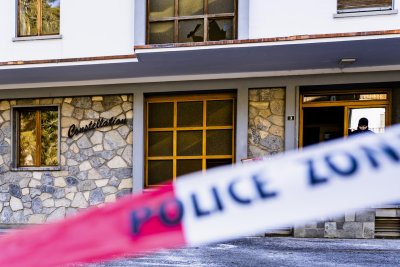
Authorities on Sunday said all 40 victims of the Le Constellation bar fire on New Year’s Eve have been identified. Photo by Jean-Christophe Bott/EPA
Jan. 5 (UPI) — All 40 victims of a Swiss bar fire that erupted New Year’s Eve have been identified, according to police, who continue to investigate the deadly blaze.
Forty people were killed and 119 were injured in the fire at the Le Constellation bar in Crans-Montana in the Swiss Alps early Thursday.
Valais Cantonal Police announced in a statement Sunday that an additional 16 victims of the fire have been identified, meaning all deceased have been named.
The victims identified Sunday range in age from 14 to 33, with the youngest being a boy from France.
Among the deceased were nine minors, including four aged 15, two girls from Switzerland, one girl from Italy and a boy with French, Israeli and British citizenship. Two 16-year-olds, both Italian, one boy and one girl; and two 17-year-olds, one Belgian girl and a French boy, were also identified Sunday.
The adults were from France, Switzerland and Portugal. One victim identified Sunday was a dual Swiss-French national.
Of all 40 victims, 20 were minors: two 14-year-olds, six 15-year-olds, nine 16-year-olds and three 17-year-olds.
The oldest adult victim was 39.
Police have opened a criminal investigation into the fire and have charged two managers of the bar with negligent homicide, negligent bodily harm and negligent arson.
The two suspects have not been detained as they do not pose a flight risk and there is no suspicion that they intend to evade the criminal proceedings, authorities said Sunday.
“The investigation is continuing in order to determine any other potential criminal liabilities,” Valais Cantonal Police said in a separate Sunday update on the investigation.
Preliminary evidence indicates that the fire was caused by pyrotechnic devices called “fountains” that produce sparks and flames. They are designed to be placed on the ground or held by hand.
Uncorroborated video of the fire published online shows fire spreading across the bar’s ceiling, apparently lit by the fountain devices that had been attached to the mouths of alcohol bottles that were being paraded around the facility as part of bottle service.
Witnesses told police that the fire spread rapidly, generating a lot of smoke and intense heat.
“Everything is said to have happened quickly,” Valais Cantonal Police said.
According to authorities, the next phase of the investigation will focus on whether the facility was in compliance with local laws and fire safety regulations over materials used in the building, the existence and condition of emergency exits and the presence of firefighting equipment.
People take part in a protest against Saudi Arabia in the southern port city of Aden, Yemen, on December 30. File Photo by Najeeb Mohamed/EPA
Jan. 4 (UPI) — Saudi-backed government forces have reclaimed oil-rich territory from United Arab Emirates-supported, armed separatists in Yemen.
The Southern Transitional Council, which seeks to create a new state called South Arabia, seized the provinces of Hadramout and al-Mahra in Southern Yemen last month.
But Yemeni information minister Moammar al-Eryani, who represents the Presidential Leadership Council, told The New York Times by phone Sunday that government forces have since re-taken Hadramout, “assumed positions” in al-Mahra and are optimistic about securing the de facto capital of Aden soon.
Al-Eryani also urged the separatists in the region to surrender as “the state reasserts authority.”
Al Jazeerasaid the Yemeni government has invited the STC to a conference in Saudi Arabia and that STC representatives see this as a “genuine opportunity for serious dialogue.”
The tension between Saudi Arabia and the UAE is taking place more than a decade after the two powerful countries joined forces to stop the Iran-backed Houthi movement in Yemen.
Over the years, however, Saudi Arabia and the UAE have supported different factions and agendas within Yemen.
The UAE is helping the separatists’ crusade for independence, while Saudi Arabia wants its neighbor Yemen to be unified and stable.
Militants loyal to Yemen’s President Abed Rabbo Mansour Hadi take their positions in Taiz, Yemen, March, 30, 2015. At least 45 people have been killed in north Yemen after an airstrike hit a camp for internally displaced people, whilst a Saudi-led coalition continued to strike Houthi targets around the country for a fifth day, the humanitarian agency, Doctors Without Borders (MSF), said. Photo by Anees Mahyoub/UPI | License Photo
A pedestrian walks on a darkened street in the Zehlendorf district in southwest Berlin on Sunday after a large-scale power outage the day before, which a far-left activist group has taken credit for as an “action in the public interest.” Photo by Filip Singer/EPA
Jan. 4 (UPI) — A far-left activist group sent police a letter taking credit for setting fire to part of a power plant near Berlin, leaving nearly 50,000 customers in the dark, as a protest against the fossil fuel industry.
The German activist group Vulkangruppe, or Volcano Group, acknowledged in a 2,500-word letter that it set a fire on Saturday near the Lichterfelde heat and power station, damaging high-voltage cables to “cut the juice to the ruling class,” The Guardian reported.
On Sunday morning, Stromnetz Berlin, the power company that owns the station, reported that roughly 45,000 homes and 2,200 businesses had lost power in the outage, Deutche Welle reported.
The power company said that while some connections have been turned back on in small waves, some customers may not have their electricity until as late as Thursday afternoon.
Some schools may also be closed for the part of the week because they do not have power, The BBC reported.
“We are expecting damage costing millions to plants and machines and owing to high losses in revenue,” Alexander Schirp, director of the regional business associations in Berlin and Brandenburg, said of the arson.
“This is a serious problem and stokes a feeling of insecurity in the business world,” he added.
Early Saturday, cables near the power plant were spotted burning and incendiary devices were later found to have caused the inferno.
In the aftermath, several hospitals and health care facilities received emergency generators, but many people had to be moved from either facilities or their own homes because there was no power.
Vulkangruppe said in the letter, which police have said is credible, that they set the fire in an “act of self-defense and international solidarity with all those who protect the Earth and life.”
The group condemned “greed for energy” by burning fossil fuels for the ever-growing electricity needs of humanity, and specifically called out the massive, and exponentially growing, use of electric for artificial intelligence computing.
“We are contributing to our own surveillance and it is comprehensive. The tech corporations are in the hands of me with power, which we give them,” the group wrote, calling the fire an “action in the public interest.”
Vulkangruppe previously took credit for a fire that was set at Tesla’s Gigafactory in Berlin in March 2024.
That arson included deliberately setting fire to a high-voltage electric pole, which damaged the electric line and cut power to the surrounding area, including the plant, officials said at the time.
Trader Joe’s “You Float Our Boat!” design makes its way down Colorado Boulevard during the Rose Parade held in Pasadena, Calif., on January 1, 2026. The float won the Wrigley Legacy Award for most outstanding display of floral presentation, float design and entertainment. Photo by Jim Ruymen/UPI | License Photo
A Royal Air Force Typhoon prepares to take off at an undisclosed location in the Middle East to join French aircraft in a joint strike targeting access tunnels to an underground ISIS facility near Palmyra in Syria. Sgt. Lee Goddard/Royal Air Force Handout/EPA
Jan. 4 (UPI) — British and French aircraft conducted a joint strike on Saturday night on an underground facility in Syria used by ISIS to store weapons and explosives.
Royal Air Force Typhoons and a Voyager refueling tanker joined the French aircraft to strike the mountain facility north of Palmyra as part of ongoing patrols to prevent the terrorist group from resurging and regaining ground in Syria, Britain’s Ministry of Defense said in a press release.
“This action shows our U.K. leadership, and determination to stand shoulder to shoulder with our allies, to stamp out any resurgence of [ISIS] and their dangerous and violent ideologies in the Middle East,” John Healey, U.K. defense secretary, said in the release.
The Saturday evening strike targeted access tunnels into the facility using Paveway IV guided bombs, with the ministry noting that initial indications show the mission was successful as a more detailed assessment is conducted.
The area around the site is “devoid of civilians habitation,” the ministry said, and there is no indication the bombing posed risks to civilians.
In a post on X, the French Ministry of the Armed Forces posted video from the strikes and said Operation Inherent Resolve, which includes ongoing patrols of the region, is essential to the region’s stability.
“Preventing the resurgence of [ISIS]: a major issue for the security of the region,” the French ministry said in the post. “The fight against terrorism remains a priority for France and the partner countries of the Coalition.”
The British personnel who conducted the mission were deployed over Christmas and the New Year, Healey said, continuing various patrols in Syria, and specifically Palmyra, that have been conducted by an international coalition that includes the United States.
In a lone gunman ambush on a patrol in Palmyra last month, two Iowa National Guard members and a civilian interpreter were killed, in addition to three other U.S. soldiers and two Syrians being shot. The gunman was identified as a member of ISIS.
Officials with Operation Inherent Resolve said in a statement on X that although ISIS no longer controls territory, “it continues to operate through residual cells, particularly in remote desert areas.”
Zohran Mamdani and his wife, Rama Duwaji, wave after Mamdani’s inauguration as mayor of New York City. They are shown outside City Hall on January 1, 2026. Photo by Derek French/UPI | License Photo
‘Been away for a while but I’m back now, 37 years old and still punching,’ Fury said in a post announcing his return.
Published On 4 Jan 20264 Jan 2026
Share
Former world heavyweight champion Tyson Fury has announced his return to boxing, having retired from the sport in December 2024 after losing to Oleksandr Usyk in a bout for three of the four major world titles.
The British star confirmed his comeback in a post on social media, which sets up the prospect of a long-awaited showdown with Anthony Joshua.
Fury posted on Instagram that “2026 is that year. Return of the mac.”
“Been away for a while but I’m back now, 37 years old and still punching,” he said. “Nothing better to do than punch men in the face and get paid for it.”
Before his two bouts with Usyk, Fury was unbeaten in 35 fights, winning 34 and drawing one.
Fury did not mention potential opponents, but his announcement comes after increased speculation about a clash with British rival Joshua in 2026. Joshua, who is also a former world champion, last month knocked out YouTube star Jake Paul. But he was injured in a fatal car crash that killed two of his friends in Nigeria this week, which has resulted in uncertainty over his immediate plans.
Fury is a two-time world champion. He ended the reign of Wladimir Klitschko with a points win in 2015 that saw him crowned Super WBA, IBF and WBO champion.
He didn’t fight again until 2018 – but a thrilling trilogy with American Deontay Wilder resulted in a draw and two victories for him to claim the WBC title.
Fury previously said he was retiring after he beat Dillian Whyte in 2022, but was back in the ring the following year.
A fight with Joshua has long been anticipated. There is also the potential of a trilogy-capping fight with Usyk or a clash with WBO champion Fabio Wardley.