Trumps

Senators clash over Trump’s National Guard deployments as military leaders face first questioning

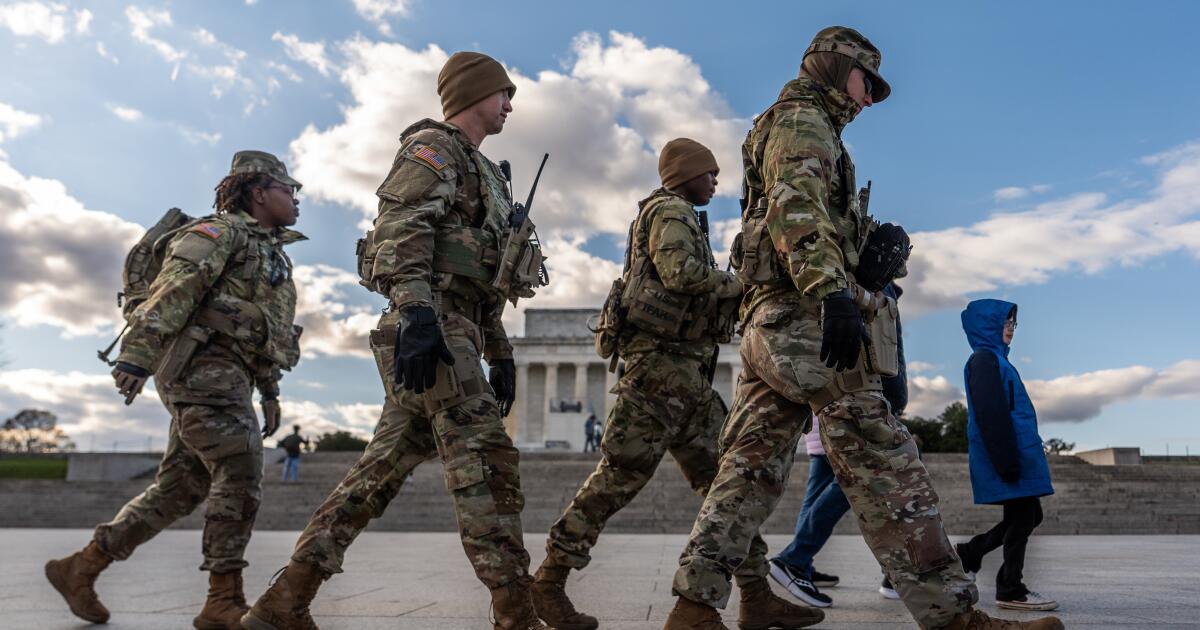
Members of Congress clashed Thursday over President Trump’s use of the National Guard in American cities, with Republicans saying the deployments were needed to fight lawlessness while Democrats called his move an extraordinary abuse of military power that violated states’ rights.

Top military officials faced questioning over the deployments for the first time at the hearing before the Senate Armed Services Committee. They were pressed by Democrats over the legality of sending in troops, which in some places were done over the objections of mayors and governors, while Trump’s Republican allies offered a robust defense of the policy.

It was the highest level of scrutiny, outside a courtroom, of Trump’s use of the National Guard in U.S. cities since the deployments began and came a day after the president faced another legal setback over efforts to send troops to support federal law enforcement, protect federal facilities and combat crime.

“In recent years, violent crime, rioting, drug trafficking and heinous gang activity have steadily escalated,” said Mississippi Sen. Roger Wicker, the committee chairman. The deployments, he said, are “not only appropriate, but essential.”

Democrats argued they are illegal and contrary to historic prohibitions about the use of military force on U.S. soil.

Sen. Tammy Duckworth, D-Ill., had pushed for the hearing, saying domestic deployments traditionally have involved responding to major floods and tornadoes, not assisting immigration agents who are detaining people in aggressive raids.

“Trump is forcing our military men and women to make a horrible choice: uphold their loyalty to the Constitution and protect peaceful protesters, or execute questionable orders from the president,” said Duckworth, a combat veteran who served in the Illinois National Guard.

Military leaders point to training

During questioning, military leaders highlighted the duties that National Guard units have carried out. Troops are trained in community policing, they said, and are prohibited from using force unless in self-defense.

Since the deployments began, only one civilian — in California — has been detained by National Guard personnel, according to Air Force Gen. Gregory M. Guillot, commander of U.S. troops in North America. Guillot said the troops are trained to de-escalate tense interactions with people, but do not receive any specific training on mental health episodes.

“They can very quickly be trained to conduct any mission that we task of them,” Guillot said.

Republicans and Democrats see the deployments much differently

In one exchange, Sen. Mazie Hirono, D-Hawaii, noted how former Defense Secretary Mark Esper alleged that Trump inquired about shooting protesters during the George Floyd demonstrations. She asked whether a presidential order to shoot protesters would be lawful.

Charles L. Young III, principal deputy general counsel at the Defense Department, said he was unaware of Trump’s previous comments and that “orders to that effect would depend on the circumstances.”

“We have a president who doesn’t think the rule of law applies to him,” Hirono said in response.

Republicans countered that Trump was within his rights — and his duty — to send in the troops.

Republican Sen. Tim Sheehy of Montana, a former Navy SEAL officer, argued during the hearing that transnational crimes present enough of a risk to national security to justify military action, including on U.S. soil.

Sheehy claimed there are foreign powers “actively attacking this country, using illegal immigration, using transnational crime, using drugs to do so.”

Senators also offered their sympathies after two West Virginia National Guard members deployed to Washington were shot just blocks from the White House in what the city’s mayor described as a targeted attack. Spc. Sarah Beckstrom died a day after the Nov. 26 shooting, and her funeral took place Tuesday. Staff Sgt. Andrew Wolfe is hospitalized in Washington.

Hearing follows court setback for Trump

A federal judge in California on Wednesday ruled that the administration must stop deploying the California National Guard in Los Angeles and return control of the troops to the state.

U.S. District Judge Charles Breyer granted a preliminary injunction sought by California officials, but also put the decision on hold until Monday. The White House said it plans to appeal.

Trump called up more than 4,000 California National Guard troops in June without Democratic Gov. Gavin Newsom’s approval to further the administration’s immigration enforcement efforts.

The move was the first time in decades that a state’s National Guard was activated without a request from its governor and marked a significant escalation in the administration’s efforts to carry out its mass deportation policy. The troops were stationed outside a federal detention center in downtown Los Angeles where protesters gathered and were later sent on the streets to protect immigration officers as they made arrests.

Trump also had announced National Guard members would be sent to Illinois, Oregon, Louisiana and Tennessee. Other judges have blocked or limited the deployment of troops to Portland, Oregon, and Chicago, while Guard members have not yet been sent to New Orleans.

Klepper, Finley and Groves write for the Associated Press. AP writer Konstantin Toropin contributed to this report.
Source link

Trump’s handling of the economy is at its lowest point in AP-NORC polling

President Trump’s approval on the economy and immigration have fallen substantially since March, according to a new AP-NORC poll, the latest indication that two signature issues that got him elected barely a year ago could be turning into liabilities as his party begins to gear up for the 2026 midterms.

Only 31% of U.S. adults now approve of how Trump is handling the economy, the poll from The Associated Press-NORC Center for Public Affairs Research finds. That is down from 40% in March and marks the lowest economic approval he’s registered in an AP-NORC poll in his first or second term. The Republican president also has struggled to recover from public blowback on other issues, such as his management of the federal government, and has not seen an approval bump even after congressional Democrats effectively capitulated to end a record-long government shutdown last month.

Perhaps most worryingly for Trump, who’s become increasingly synonymous with his party, he’s slipped on issues that were major strengths. Just a few months ago, 53% of Americans approved of Trump’s handling of crime, but that’s fallen to 43% in the new poll. There’s been a similar decline on immigration, from 49% approval in March to 38% now.

The new poll starkly illustrates how Trump has struggled to hold onto political wins since his return to office. Even border security — an issue on which his approval remains relatively high — has declined slightly in recent months.

The good news for Trump is that his overall approval hasn’t fallen as steeply. The new poll found that 36% of Americans approve of the way he’s handling his job as president, which is down slightly from 42% in March. That signals that even if some people aren’t happy with elements of his approach, they might not be ready to say he’s doing a bad job as president. And while discontent is increasing among Republicans on certain issues, they’re largely still behind him.

Declining approval on the economy, even among Republicans

Republicans are more unhappy with Trump’s performance on the economy than they were in the first few months of his term. About 7 in 10 Republicans, 69%, approve of how Trump is handling the economy in the December poll, a decline from 78% in March.

Larry Reynolds, a 74-year-old retiree and Republican voter from Wadsworth, Ohio, said he believes in Trump’s plan to impose import duties on U.S. trading partners but thinks rates have spiraled too high, creating a “vicious circle now where they aren’t really justifying the tariffs.”

Reynolds said he also believes that inflation became a problem during the coronavirus pandemic and that the economy won’t quickly recover, regardless of what Trump does. “I don’t think it’ll be anything really soon. I think it’s just going to take time,” he said.

Trump’s base is still largely behind him, which was not always the case for his predecessor, President Joe Biden, a Democrat. In the summer of 2022, only about half of Democrats approved of how Biden was handling the economy. Shortly before he withdrew from the 2024 presidential race two years later, that had risen to about two-thirds of Democrats.

More broadly, though, there’s no sign that Americans think the economy has improved since Trump took over. About two-thirds of U.S. adults, 68%, continue to say the country’s economy is “poor.” That’s unchanged from the last time the question was asked in October, and it’s broadly in line with views throughout Biden’s last year in office.

Why Trump gets higher approval on border security than immigration

Trump’s approval ratings on immigration have declined since March, but border security remains a relatively strong issue for him. Half of U.S. adults, 50%, approve of how Trump is handling border security, which is just slightly lower than the 55% who approved in September.

Trump’s relative strength on border security is partially driven by Democrats and independents. About one-third of independents, 36%, approve of Trump on the border, while 26% approve on immigration.

Jim Rollins, an 82-year-old independent in Macon, Georgia, said he believes that when it comes to closing the border, Trump has done “a good job,” but he hopes the administration will rethink its mass deportation efforts.

“Taking people out of kindergarten, and people going home for Thanksgiving, taking them off a plane. If they are criminals, sure,” said Rollins, who said he supported Trump in his first election but not since then. “But the percentages — based on the government’s own statistics — say that they’re not criminals. They just didn’t register, and maybe they sneaked across the border, and they’ve been here for 15 years.”

Other polls have shown it’s more popular to increase border security than to deport immigrants, even those who are living in the country illegally. Nearly half of Americans said increasing security at the U.S.-Mexico border should be “a high priority” for the government in AP-NORC polling from September. Only about 3 in 10 said the same about deporting immigrants in the U.S. illegally.

Shaniqwa Copeland, a 30-year-old independent and home health aide in St. Augustine, Florida, said she approves of Trump’s overall handling of the presidency but believes his immigration actions have gone too far, especially when it comes to masked federal agents leading large raids.

“Now they’re just picking up anybody,” Copeland said. “They just like, pick up people, grabbing anybody. It’s crazy.”

Health care and government management remain thorns for Trump

About 3 in 10 U.S. adults approve of how Trump is handling health care, down slightly from November. The new poll was conducted in early December, as Trump and Congress struggled to find a bipartisan deal for extending the Affordable Care Act subsidies that will expire at the end of this month.

That health care fight was also the source of the recent government shutdown. About one-third of U.S. adults, 35%, approve of how Trump is managing the federal government, down from 43% in March.

But some Americans may see others at fault for the country’s problems, in addition to Trump. Copeland is unhappy with the country’s health care system and thinks things are getting worse but is not sure of whether to blame Trump or Biden.

“A couple years ago, I could find a dentist and it would be easy. Now, I have a different health care provider, and it’s like so hard to find a dental (plan) with them,” she said. “And the people that do take that insurance, they have so many scheduled out far, far appointments because it’s so many people on it.”

Sanders and Weissert write for the Associated Press. The AP-NORC poll of 1,146 adults was conducted Dec. 4-8 using a sample drawn from NORC’s probability-based AmeriSpeak Panel, which is designed to be representative of the U.S. population. The margin of sampling error for adults overall is plus or minus 4 percentage points.

Source link

Trump’s speech on combating inflation turns to grievances about immigrants from ‘filthy’ countries

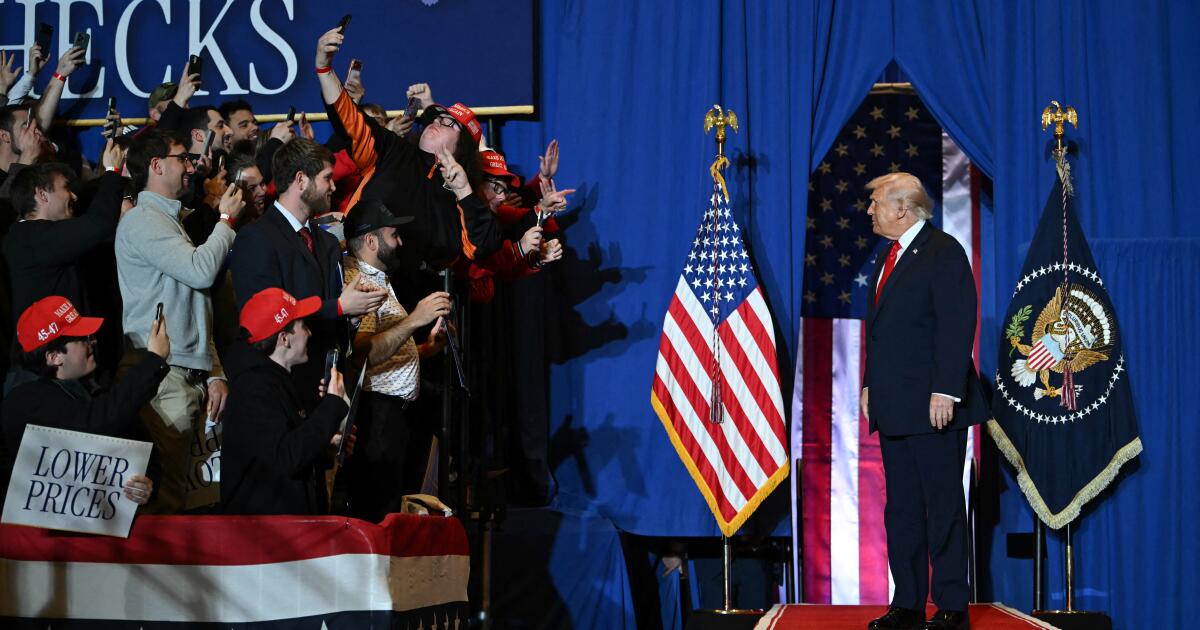
On the road in Pennsylvania on Tuesday, President Trump tried to emphasize his focus on combating inflation, yet the issue that has damaged his popularity couldn’t quite command his full attention.

The president told the crowd gathered at a casino and resort in Mount Pocono that inflation was no longer a problem and that Democrats had used the term “affordability” as a “hoax” to hurt his reputation. But his remarks weaved wildly to include grievances he first raised behind closed doors in his first term in 2018 — and later denied saying — asking why the U.S. doesn’t have more immigrants from Scandinavia.

“Why is it we only take people from s—hole countries, right?” Trump said onstage. “Why can’t we have some people from Norway, Sweden, just a few?”

Trump said he objected to taking immigrants from “hellholes like Afghanistan, Haiti, Somalia and many other countries.” He added for emphasis that those places “are a disaster, right? Filthy, dirty, disgusting, ridden with crime.”

Tuesday’s gathering in the swing state — and in a competitive House district — was an official White House event, yet it seemed more like one of his signature campaign rallies that his chief of staff said he would hold regularly ahead of next year’s midterms. But instead of being in an arena that could draw several thousand attendees, it was held in a conference center ballroom at the Mount Airy Casino Resort in Mount Pocono, a small town of about 3,000 residents.

Voters starting to pin inflation on GOP

Following dismal results for Republicans in last month’s off-cycle elections, the White House has sought to convince voters that the economy will emerge stronger next year and that any anxieties over inflation have nothing to do with Trump.

He displayed a chart comparing price increases under his predecessor, Joe Biden, to prices under his own watch to argue his case. But the overall inflation rate has climbed since he announced broad tariffs in April and left many Americans worried about their grocery, utility and housing bills.

“I have no higher priority than making America affordable again,” Trump said. “They caused the high prices and we’re bringing them down.”

As the president spoke, his party’s political vulnerabilities were further seen as Miami voters chose Eileen Higgins to be their first Democratic mayor in nearly 30 years. Higgins defeated the Trump-endorsed Republican Emilio Gonzalez.

The president’s reception in the county hosting his Tuesday rally showed he could still appeal to the base, but it was unable to settle questions of whether he could hold together his 2024 coalition. Monroe County flipped to Trump last year after having backed Biden in 2020, helping the Republican win the swing state of Pennsylvania and return to the White House after a four-year hiatus.

As home to the Pocono Mountains, the county has largely relied on tourism for skiing, hiking, hunting and other activities as a source of jobs. Its proximity to New York City — under two hours by car — has also attracted people seeking more affordable housing.

In Monroe County, prices are a problem

But what seems undeniable — even to Trump supporters in Monroe County — is that inflation seems to be here to stay.

Lou Heddy, a retired maintenance mechanic who voted for Trump last year, said he’s noticed in the past month alone that his and his wife’s grocery bills have risen from $175 to $200, and he’s not sure Trump can bring food prices down.

“Once the prices get up for food, they don’t ever come back down. That’s just the way I feel. I don’t know how the hell he would do it,” said Heddy, 72.

But Suzanne Vena, a Democratic voter, blames Trump’s tariffs for making life more expensive, as she struggles with rising bills for food, rent and electricity on a fixed income. She remembers Trump saying that he would stop inflation.

“That’s what we were originally told,” said Vena, 66. “Did I believe it? That’s another question. I did not.”

The area Trump visited could help decide control of the House in next year’s midterm elections.

Trump held his rally in a congressional district held by first-term Republican Rep. Rob Bresnahan, who is a top target of Democrats. Scranton Mayor Paige Cognetti, a Democrat, is running for the nomination to challenge him.

Speaking to the crowd before Trump, Bresnahan said the administration was working to lower costs, but voters “aren’t asking for partisan arguments — they’re asking for results.”

It’s not clear if Trump can motivate voters in Monroe County to show up in next year’s election if they’re worried about inflation.

Nick Riley, 38, said he’s cutting back on luxuries, like going out to eat, as he absorbs higher bills for food and electricity and is having a hard time finding a good deal on a used car. Riley voted for Trump in 2020, but he sat out the 2024 election and plans to do so again next year.

“We’re all broke. It doesn’t matter whether you support Republicans or support Democrats,” Riley said. “We’re all broke, and we’re all feeling it.”

Trump to start holding more rallies

White House chief of staff Susie Wiles said on the online conservative talk show “The Mom View” that Trump would be on the campaign trail next year to engage supporters who otherwise might sit out a congressional race.

Wiles, who helped manage Trump’s 2024 campaign, said most administrations try to localize midterm elections and keep the president out of the race, but she intends to do the opposite of that.

“We’re actually going to turn that on its head,” Wiles said, “and put him on the ballot because so many of those low-propensity voters are Trump voters.”

The challenge for Trump is how to address the concerns of voters about the economy while simultaneously claiming that the economy is enjoying a historic boom.

Asked on a Politico podcast how he’d rate the economy, Trump leaned into grade inflation by answering “A-plus,” only to then amend his answer to “A-plus-plus-plus-plus-plus.”

The U.S. economy has shown signs of resilience with the stock market up this year and overall growth looking solid for the third quarter. But many Americans see the prices of housing, groceries, education, electricity and other basic needs as swallowing up their incomes, a dynamic that the Trump administration has said it expects to fade next year with more investments in artificial intelligence and manufacturing.

So far, the public has been skeptical about Trump’s economic performance. Just 33% of U.S. adults approve of Trump’s handling of the economy, according to a November survey by the Associated Press-NORC Center for Public Affairs Research.

But Trump indicated that his tariffs and other policies were helping industries such as the steel sector. He said those industries mattered for the country as he then specifically told Americans that they should buy fewer pencils and dolls from overseas.

“You don’t need 37 dolls for your daughter,” he told the crowd. “Two or three is nice.”

Levy and Boak write for the Associated Press. Boak reported from Washington.

Source link