Today

Let’s Talk About The Mysterious “Civilian-Style” Plane Used To Strike A Drug Boat

A U.S. plane with a civilian-style outward appearance and the ability to launch munitions from within its fuselage carried out the first controversial strike on an alleged drug smuggling boat, according to multiple reports. Questions have been raised about this line of reporting. However, there are very real discreet munition launch options available for aircraft that can retain a distinctly civilian outward appearance, enabled heavily by one specific system called the Common Launch Tube (CLT).

The New York Times was first to report yesterday on the use of the civilian-looking aircraft, which it also described as a “secret” capability, in the strike on the boat in the Caribbean Sea on September 2, 2025, citing anonymous sources. The Washington Post and The Wall Street Journal published additional reports today, again citing unnamed sources, on the involvement of this as-yet unidentified plane.

“It is not clear what the aircraft was. While multiple officials confirmed that it was not painted in a classic military style, they declined to specify exactly what it looked like,” according to the story from the Times. “The aircraft also carried its munitions inside the fuselage, rather than visibly under its wings, they said.”

President Trump has shared video of a deadly U.S. military strike on a drug smuggling vessel from Venezuela, which killed 11 people.

On Truth Social, Trump stated: “Earlier this morning, on my Orders, U.S. Military Forces conducted a kinetic strike against positively identified… pic.twitter.com/dHoVn1bjoE

— gCaptain (@gCaptain) September 2, 2025

“Its transponder was transmitting a military tail number, meaning broadcasting or ‘squawking’ its military identity via radio signals,” that report added.

It was “a secretive military aircraft painted to look like a civilian plane,” according to the Post‘s report. “The munitions were fired from a launch tube that allows them to be carried inside the plane, not mounted outside on the wing.”

“The Pentagon has told lawmakers that it chose an aircraft painted in civilian colors to carry out a lethal Sept. 2 strike on an alleged drug boat in the Caribbean because the unit could be the quickest ready for the operation,” per the Journal. That report also included statements from the Pentagon and the White House that did not expressly confirm or deny the use of a civilian-looking plane.

All three pieces discuss whether the use of an armed aircraft with a civilian-style appearance may have violated international law in this instance, something that remains very much open for debate. The September 2 strike, which killed 11 people, has already been a subject of particular controversy over the decision to hit the boat twice, and whether doing so constituted a crime. Since then, the U.S. military has attacked dozens of boats in the Caribbean and the Eastern Pacific Ocean, all alleged to be involved in drug smuggling, and this campaign has faced intense legal scrutiny and criticism. MQ-9 Reaper drones and AC-130J Ghostrider gunships are known to have participated in those subsequent attacks.

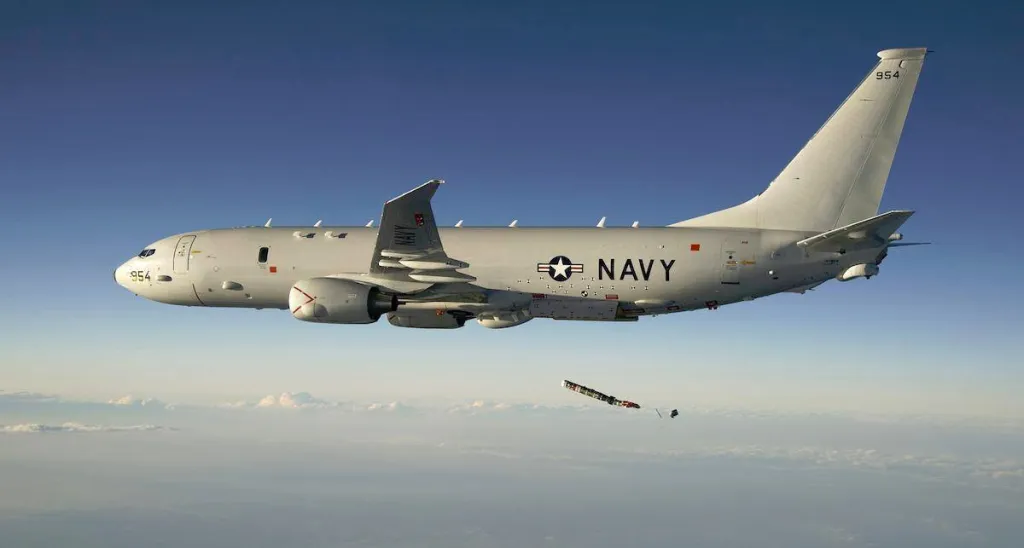
Much debate had already erupted about the details in The New York Times‘ piece after it was initially published. Many questioned whether the unnamed sources may have been confused about the aircraft in question and/or its appearance. Around the time of the September 2 strike, online flight tracking data had shown a U.S. Navy P-8A Poseidon maritime patrol plane in the area, which is primarily painted white rather than a more typical military gray and is based on a version of the Boeing 737 airliner. P-8As can carry munitions in an internal bay in the rear of the fuselage, as well as under their wings. It may potentially have the ability to dispense small munitions from inside the fuselage. We will come back to all of this later on. The Navy, as well as the U.S. Air Force and U.S. Marine Corps, fly a number of other variations of the 737, primarily as transports, under the C-40 designation.

A stock picture of a US Navy P-8 releasing a torpedo from its internal bay. USN

There is no weapons bay on N235JF ( left ), the aircraft they are referring to is likely P-8A 168012 or 168441 ( right ) which have weapons bays, and were working at the same time. https://t.co/O3EOH4LsHW pic.twitter.com/JA2ljd3lkY

— 𝗦𝗥_𝗣𝗹𝗮𝗻𝗲𝘀𝗽𝗼𝘁𝘁𝗲𝗿 (@SR_Planespotter) January 13, 2026

A truly secretive 737 with a civilian-type paint scheme is said to have been in the general area at the time of the strike, but is not known to be armed in any way, although that means little in this case. This particular aircraft, which is covered in unusual antennas, currently has the U.S. civil registration number N235JF. The Federal Aviation Administration’s (FAA) public database shows the jet has been registered to “GWP LLC TRUSTEE”, which looks to be a shell company, since 2023, but it has been linked to the U.S. military since then. It notably appeared last year directly alongside one of the U.S. Air Force’s AC-130Js and a Navy P-8A at a known U.S. forward operating location in El Salvador.

One of the U.S. Air Force’s P-9A surveillance and reconnaissance aircraft, also referred to by the nickname Pale Ale, is said to have been in the vicinity, as well. The P-9As wear overall white paint schemes and carry civilian registration numbers. They are based on the de Havilland Canada DHC-8 (or Dash-8), versions of which are also in service as airliners. They are also not known to be capable of employing munitions.

It’s HIGHLY likely that a P-8 was mistaken as a civilian paint job, as one was out on the day in question and likely was involved in the strike. P-8s historically also go very close to the water, and its not uncommon for them to be mistaken as 737s: https://t.co/b9spRbqKHC pic.twitter.com/KNb4NEDOYN

— TieDye Intel (@TieDyeIntel) January 13, 2026

What other aircraft may have been present during the strike on September 2 last year is unknown. Not all aircraft that are flying at any one time, civilian and especially military, are visible via online flight tracking sites.

What we do know is that companies in the United States openly offer ways to discreetly arm a host of crewed fixed-wing aircraft, especially smaller turboprop-powered types, with precision-guided munitions. All of this has been made easier by the advent of the aforementioned CLT. Each one of these tubes can accommodate payloads up to 42 inches in length and 5.95 inches in diameter, and that weigh up to 100 pounds. Payloads can be fired forward or ejected backward, depending on their design. GBU-44/B Viper Strike and GBU-69/B Small Glide Munition (SGM) glide bombs, AGM-176 Griffin missiles, and ALTIUS 600 drones are just a few of the payloads known to be launchable via CLT. The tube’s flexibility makes it extremely probable that even more options exist in the classified realm.

It is worth noting here that The Washington Post previously reported that the September 2 boat strike involved the use of GBU-69s and AGM-176s. The P-8A is not known to be capable of employing either of these munitions, lending further credence to the new reporting that another aircraft was used, though not necessarily to it having had a civilian-like appearance. In the past, TWZ has laid out a case for turning the Poseidon into a multi-role arsenal ship with CLT launchers and other capabilities.

A GBU-69/B Small Glide Munition. Leidos Dynetics A rendering of the GBU-69/B Small Glide Munition (SGM). Leidos Dynetics
An AGM-176 Griffin missile. USN

Originally developed by Systima Technologies, which was acquired by Karman Missile & Space Systems in 2021, CLTs have been in U.S. service for years now. Munitions launched via CLTs are part of the armament package for the AC-130J Ghostrider gunships, and this had also been a feature on the now-retired AC-130W Stinger IIs. The U.S. Marine Corps’ Harvest Hawk armament kit for its KC-130J tanker-transports also includes a CLT launch system. U.S. MQ-9 Reaper and MQ-1C Gray Eagle drones are also capable of employing payloads via CLT using launchers loaded on pylons under their wings. As mentioned earlier, AC-130s and MQ-9s are among the aircraft known to have been involved in strikes on alleged drug smuggling boats since September 2 of last year.

The CLT’s diminutive size opens up a host of options for launching whatever payload is inside from somewhere within the internal structure of a wide swath of aircraft. Launchers can be readily set up to fire through parts of the fuselage. AC-130Js have an array of CLT launchers built into the upper portion of the aircraft’s rear cargo ramp. The latest iteration of the Marine’s Harvest Hawk kit has a so-called “Derringer Door” with two launchers that replaces one of he rear paratrooper doors on the KC-130J. This took the place of a launch system strapped to the aircraft’s rear cargo ramp, which had to be open for it to be employed, found on earlier iterations of Haverst Hawk.

CLTs seen loaded into launchers inside an AC-130W gunship. USAF
The “Derringer Door” used on later iterations of the Harvest Hawk kit. Lockheed Martin

Internal CLT launcher arrays are known to be available for Dash-8s and Cessna Model 208 Caravan fixed-wing aircraft, as well as MD Helicopters’ Explorer series helicopters, among many other types. The Sierra Nevada Corporation’s (SNC) losing entry in the Air Force’s Armed Overwatch competition was a heavily modified version of the Polish PZL M28 Skytruck, dubbed the MC-145B Wily Coyote, which would have come with eight CLT launchers in its main cargo bay, among other features, as you can read more about here.

Generally speaking, they could be adapted to fit onto pretty much any aircraft large enough to accommodate them, and do so in a very discreet way, only needing a small aperture for their weapons to exist the aircraft from.

A CLT launch system from Fulcrum Concepts for the Dash-8. Fulcrum Concepts
Images from a test of Raytheon’s G-CLAW munition, showing it being ejected backward from a CLT launch system mounted inside a Cessna Caravan. Raytheon

CLT launchers mounted internally are typically reloadable in flight, offering magazine depth benefits and giving the crew more flexibility to select the most appropriate payload for the task at hand, as well as to just launch multiple payloads in relatively rapid succession. With launchers built into doors, it is also easier to add or remove this capability, as desired. This, in turn, can enhance its discreet nature, as the launchers might only be installed right before a mission and removed immediately afterward. In this way, there could be little to no obvious outward signs that an aircraft has this capability during routine movements or other day-to-day activities.

Launch systems built into certain parts of an aircraft might not even be readily apparent, to begin with. One company, Fulcrum Concepts, openly offers a launch system compatible with the CLT that fits into the rear of the engine nacelles on variants of the Beechcraft King Air, which is something the U.S. military has at least tested in the past.

An image showing an ALTIUS 600 drone being ejected from a CLT launcher installed in the rear of the engine nacelle on a Beechcraft King Air. Fulcrum Concepts

Within the U.S. military, Air Force Special Operations Command (AFSOC) publicly operates various fixed-wing aircraft, such as its U-28A Dracos and C-146A Wolfhounds. The U-28As are intelligence, surveillance, and reconnaissance (ISR) aircraft, while the C-146s are light transports. AFSOC has also flown ISR-configured variants of the Beechcraft King Air over the years. Any of these types would be well-suited to these kinds of discreet CLT launcher installations on account of the space available in their main cabins. It’s highly probable that this is an option for some of them already. These planes also often have minimal U.S. military markings. Sometimes they wear civilian-type paint schemes, as is notably the case with the Wolfhounds today and has been observed on U-28s, or related types in U.S. service, in the past.

A C-146 Wolfhound. USAF
One of AFSOC’s U-28As, seen at rear, together with a Beechcraft King Air-based MC-12W Liberty aircraft. Air National Guard Andrew LaMoreaux

There are even more secretive aircraft in service in the classified ends of the U.S. special operations world, and with the U.S. Intelligence Community that could align with the descriptions found in the New York Times, Washington Post, and Wall Street Journal stories, which might have a discreet ability to employ munitions, especially via internally-mounted CLTs. Covert and clandestine strike capabilities would also be well in line with the missions that those aviation elements are often tasked to carry out. On the military side, many of those aircraft are tied to the secretive Joint Special Operations Command (JSOC), which was involved in the September 2 strike.

All this being said, we still do not have anywhere near enough information to identify the aircraft referenced in the recent reports. At the same time, the versatility of the CLT means that essentially any aircraft can be converted to a strike platform that can be armed with small and highly accurate precision munitions capable, including ones capable of hitting targets on the move. Unassuming aircraft equipped in this way, and with liveries atypical of what is usually seen on military types, would be able to get even closer to their objectives with much less chance of raising suspicions. Equipping transport and/or corporate aircraft, and especially one like a 737 with its jet speeds and long-range, in such a way could allow it to strike, even by executing the preverbal ‘hammer toss’ as it flies over a target, while hiding in plain sight, potentially anywhere commercial aircraft can fly.

Contact the author: joe@twz.com

Joseph has been a member of The War Zone team since early 2017. Prior to that, he was an Associate Editor at War Is Boring, and his byline has appeared in other publications, including Small Arms Review, Small Arms Defense Journal, Reuters, We Are the Mighty, and Task & Purpose.


Source link

Navy Has A Plan To Attack Embarrassing Rust Caked On Its Warships

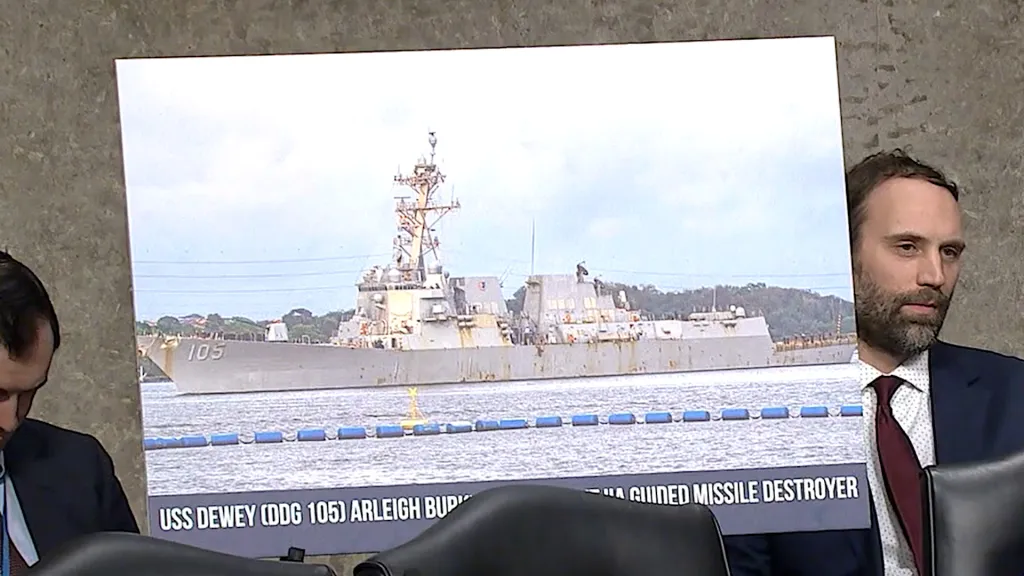
For years, the Navy has essentially ignored the issues associated with rusting ships, said the man officially tasked with fixing the problem. However, it became a priority in February 2025 after President Donald Trump saw a picture of the Arleigh Burke class guided missile destroyer USS Dewey covered in “running rust” as it pulled into Singapore last year. You can read more about that in our original story here. The Navy’s chronic rust issue and the negative optics surrounding it is a topic we have been covering for nearly a decade.

“We know what to do, but we choose not to do it,” Mark Lattner, director of the Navy’s Ship Integrity and Performance Engineering, Naval Systems Engineering Directorate, said during a panel at the Surface Navy Association’s annual symposium on Tuesday that TWZ attended. “And we choose not to do it because there’s always some other problem I’ve got to fix. I don’t have time. Our corrosion can wait. And so we don’t implement the fixes.”

Finding a solution to the Navy’s rust problem became one of Lattner’s main missions in the wake of the fallout from Trump’s late-night texts to Navy officials demanding answers.

President Donald Trump, through his pick to be the next Secretary of the Navy, has thrust long-running criticisms of what is commonly called "running rust" on American warships back into the mainstream limelight.
A picture of the USS Dewey covered in “running rust” during a recent port visit in Singapore is shown at the confirmation hearing for Secretary of the Navy nominee John Phelan on January 27, 2025. Senate Armed Services Committee capture

While it can make ships look like “rusting garbage scows,” Lattner noted, this issue isn’t just a matter of aesthetics. Unaddressed rust and corrosion on Navy ships has downstream effects on maintenance and readiness.

Some of the solutions are “simple,” Lattner suggested, like wider use of polysiloxane paint, “originally developed as an anti-graffiti paint, very robust, very good paint, easy to clean.”

“It might be as simple as putting a good scupper on the ship, diverting the water away from the ship,” Lattner said of the drain openings on a vessel’s bulwark. “If we can use materials that are inherently less prone to rust, that’s great. That includes composites, includes stainless steel, other things like that.”

250722-N-EU577-2053 NAVAL STATION NORFOLK (July 22, 2025) Aviation Boatswain’s Mate (Handling) 3rd Class Luke Martin rethreads a scupper insert aboard the Nimitz-class aircraft carrier USS George H.W. Bush (CVN 77). George H.W. Bush is pierside at Naval Station Norfolk in support of Material Assist Visit (MAV) III, in preparation for Board of Inspection and Survey (INSURV). INSURV is a Congressionally-mandated assessment of a ship's readiness condition to ensure all spaces and equipment meet Navy standards. (U.S. Navy photo by Mass Communication Specialist Seaman Apprentice Kayleigh Tucker)
Aviation Boatswain’s Mate (Handling) 3rd Class Luke Martin rethreads a scupper insert aboard the Nimitz class aircraft carrier USS George H.W. Bush. (U.S. Navy photo by Mass Communication Specialist Seaman Apprentice Kayleigh Tucker) Seaman Apprentice Kayleigh Tucker

Reducing the work load of sailors and the margin for error is another solution.

“How do we make it more sailor friendly, things like single pack paints, right?” Lattner noted. “Sailors mix multiple components together. There’s always inherent things that could go wrong. If you use a single pack thing, they break the pack open, they mix it together. They’re good to go. Try and take away work from the sailors.”

U.S. Sailors, assigned to the Iwo Jima Amphibious Ready Group, paint the hull of Wasp-class amphibious assault ship USS Iwo Jima (LHD 7) while pierside in St. Croix, U.S. Virgin Islands, Dec. 15, 2025. U.S. military forces are deployed to the Caribbean in support of the U.S. Southern Command mission, Department of War-directed operations, and the president’s priorities to disrupt illicit drug trafficking and protect the homeland. (U.S. Navy photo)
U.S. sailors, assigned to the Iwo Jima Amphibious Ready Group, paint the hull of Wasp class amphibious assault ship USS Iwo Jima while pierside in St. Croix, U.S. Virgin Islands, Dec. 15, 2025. (U.S. Navy photo) Seaman Andrew Eggert

Having sailors do more rust-preventative maintenance themselves will also help.

“Don’t just cover up the rest by painting it over again,” Lattner stated. “Just tell the sailor to go and clean it off. And we’ve got special cleaners that make it easier to clean it.”

After being asked by the Chief of Naval Operations how be knows he is getting a handle on the problem, Lattner answered that there is a new evaluation process.

“We’ve identified ways to input the data and go around and survey the ship so we actually know what’s going on with the ships,” he said. “In this particular thing, we developed an app that you use on your phone, and so when the TYCOMS walk around and inspect the ships, they can actually kind of check off, ‘yeah, this looks good. This doesn’t look good. This needs improvement.’”

“The ships come up with a grade,” Lattner added. “One of the things we did, rather than make it just qualitative, we actually give them a quantitative number. So I can actually say this is how good ships are.”

250313-N-KX492-1060 Seaman Dawie Guo, from Monterey Park, California, uses a grinder to remove rust from the deck in the vehicle stowage area aboard amphibious assault carrier USS Tripoli (LHA 7), Mar. 13, 2025. Tripoli is an America-class amphibious assault ship homeported in San Diego. (U.S. Navy photo by Mass Communication Specialist Seaman Paul LeClair)
Seaman Dawie Guo uses a grinder to remove rust from the deck in the vehicle stowage area aboard amphibious assault carrier USS Tripoli on Mar. 13, 2025. (U.S. Navy photo by Mass Communication Specialist Seaman Paul LeClair) Seaman Paul LeClair

There are also improvements in training underway, with teams teaching sailors the best and easiest ways to paint ships.

“These guys are experts,” said Lattner. “They bring the technology, the tools, all the things that are holding sailors back from being able to do the job properly.”

Teams of contractors are helping to do some of the work that sailors can’t, something that is key given how the Navy avoids keeping ships offline for extended periods of time.

These teams “go in there and actually execute the corrosion control work  They’ll install the things like the scuppers. They’ll put on the films. They’ll do some preservation. They’ll do cleaning, getting the ships better. And what we’re doing is not trying to eat the elephant all at once, but one bite at a time, right?”

Some of the solutions go beyond what the Navy can do on its own, Lattner pointed out. Industry has a big role to play too.

“They can help actually do the preservation work. They can help do the development of technology. Even though we have a lot of good technology, and we know what we can do, we’re always looking for better ideas. Are there better ways to do preservation? Are there better ways to remove the old paint? Are there more robust solutions that we can implement?”

Lattner also seeks changes in future ship designs that will reduce rust and corrosion and improve the ease of maintenance.

The future USS Pittsburgh, currently under construction at HII. (HII photo).

Even if all these solutions are implemented, the Navy will never have the same kind of shiny ships that cruise lines do.

For instance, Carnival Cruise Line is “constantly touching things up,” Lattner proffered. “They swarm the ship when it gets back in, touching things up, keeping things up to speed. When they do [maintenance in port] availabilities, their availabilities are very tight, right? They’re short. They’ll, they’ll never use a company again if they don’t meet those, those timelines.”

The Navy does not have that luxury.

“We in the Navy are unfortunately kinder and gentler, right?” Lattner postulated. “So right, wrong or indifferent. I’m more tolerant. The longer I wait between different evolutions, the more likely things are going to go south, right? And we’ll have to work with that, right? There’s no great solution.”

Contact the author: howard@thewarzone.com

Howard is a Senior Staff Writer for The War Zone, and a former Senior Managing Editor for Military Times. Prior to this, he covered military affairs for the Tampa Bay Times as a Senior Writer. Howard’s work has appeared in various publications including Yahoo News, RealClearDefense, and Air Force Times.


Source link

France to launch Greenland consulate in ‘political signal’ to US | Donald Trump News

Washington’s threats to seize the strategic island have sparked a crisis among NATO states.

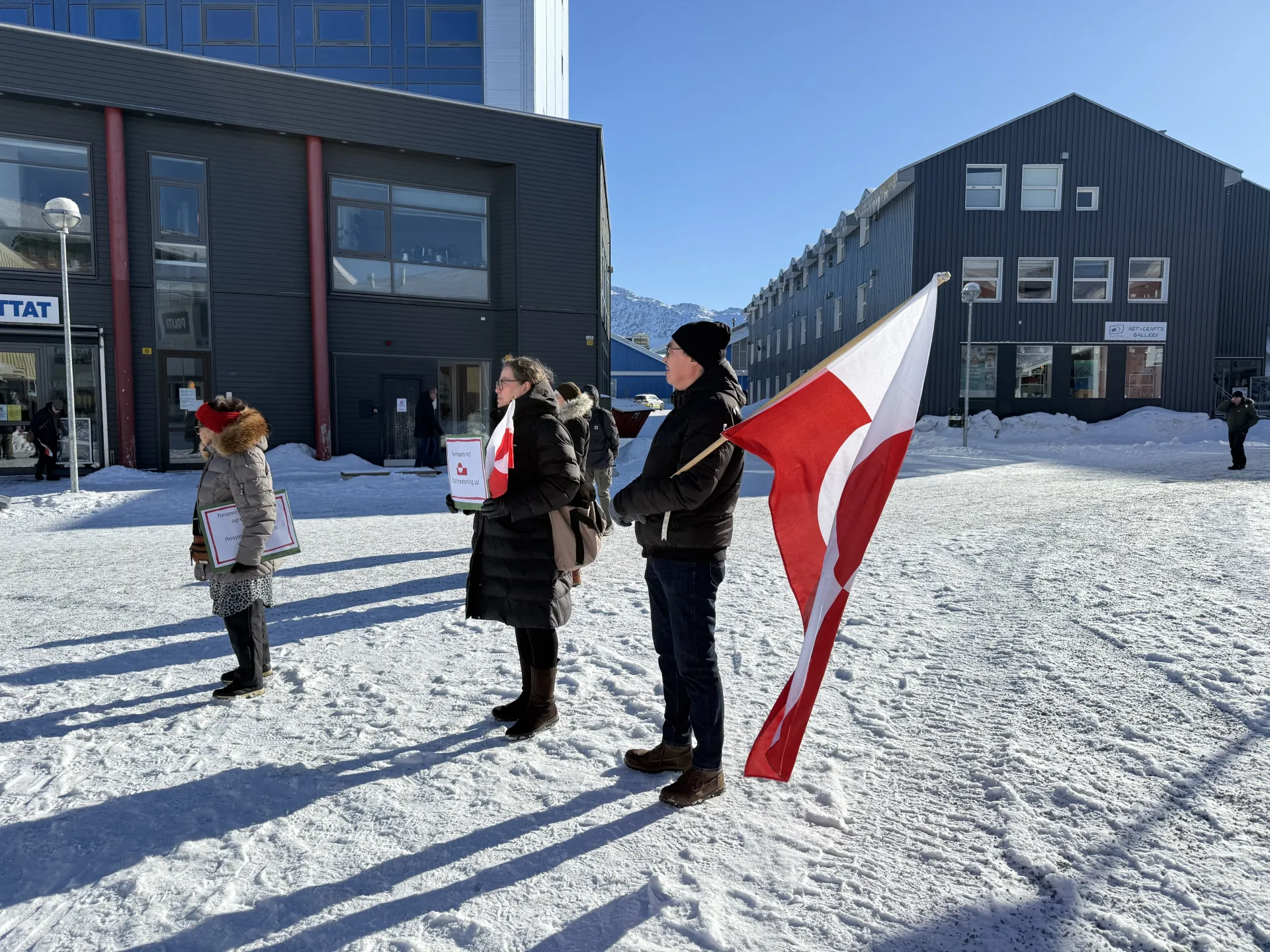
France is preparing to open a consulate in Greenland next month in a move that it says reflects the semiautonomous island’s desire to remain part of Denmark and the European Union.

Foreign Minister Jean-Noel Barrot told the broadcaster RTL on Wednesday that the opening of the consulate in the self-governed Danish territory, scheduled for February 6, is a “political signal” amid the ongoing threats from United States President Donald Trump to take control of the island.

Recommended Stories

list of 4 itemsend of list

“It’s a political signal that’s associated with a desire to be more present in Greenland, including in the scientific field,” Barrot said.

“Greenland does not want to be owned, governed … or integrated into the United States. Greenland has made the choice of Denmark, NATO, [European] Union.”

The French foreign minister’s comments came as his Danish and Greenlandic counterparts, Lars Lokke Rasmussen and Vivian Motzfeldt, were due to meet US Vice President JD Vance in Washington, DC, to discuss the island.

Trump’s repeated statements that the Arctic territory will be brought under US control “one way or another” have created a crisis inside NATO.

European allies have warned that any takeover of the island would have serious repercussions for the relationship between the US and Europe.

Trump has said the US needs Greenland, where Washington has long maintained military bases, due to the threat of a takeover posed by Russia and China. He claims that Denmark has neglected the territory’s security.

It’s also noted that Greenland has significant mineral riches, including oil and gas as well as rare earths needed for technological products.

Denmark’s defence minister said on Wednesday that it plans to “strengthen” its military presence in Greenland and was in dialogue with its allies in NATO.

“We will continue to strengthen our military presence in Greenland, but we will also have an even greater focus within NATO on more exercises and an increased NATO presence in the Arctic,” Troels Lund Poulsen wrote in a statement to the AFP news agency.

‘Big problem’

Greenlandic Prime Minister Jens-Frederik Nielsen said on Tuesday that the territory wanted to remain part of Denmark rather than join the US.

“We are now facing a geopolitical crisis, and if we have to choose between the United States and Denmark here and now, we choose Denmark,” he said at a news conference in Copenhagen.

Asked about Nielsen’s comments, Trump responded: “I disagree with him. I don’t know who he is. I don’t know anything about him. But that’s going to be a big problem for him.”

The US president’s aggressive rhetoric continues to provoke pledges of support for Denmark and Greenland from other NATO nations.

Barrot said the decision to open the consulate was taken in the summer when President Emmanuel Macron visited Greenland in a show of support. Barrot said he had visited the island in August to make plans for the consulate.

Source link

UN’s Albanese: Israel treats storm-hit Palestinians of Gaza as ‘expendable’ | News

Special rapporteur says Israel’s nonresponse to the growing crisis reflects its attitude towards Palestinians.

Francesca Albanese, the United Nations special rapporteur on Palestine, has accused Israel of treating Palestinian lives as “expendable”, linking the “hellish” impact of a deadly winter storm in Gaza directly to the deliberate destruction of the enclave’s infrastructure.

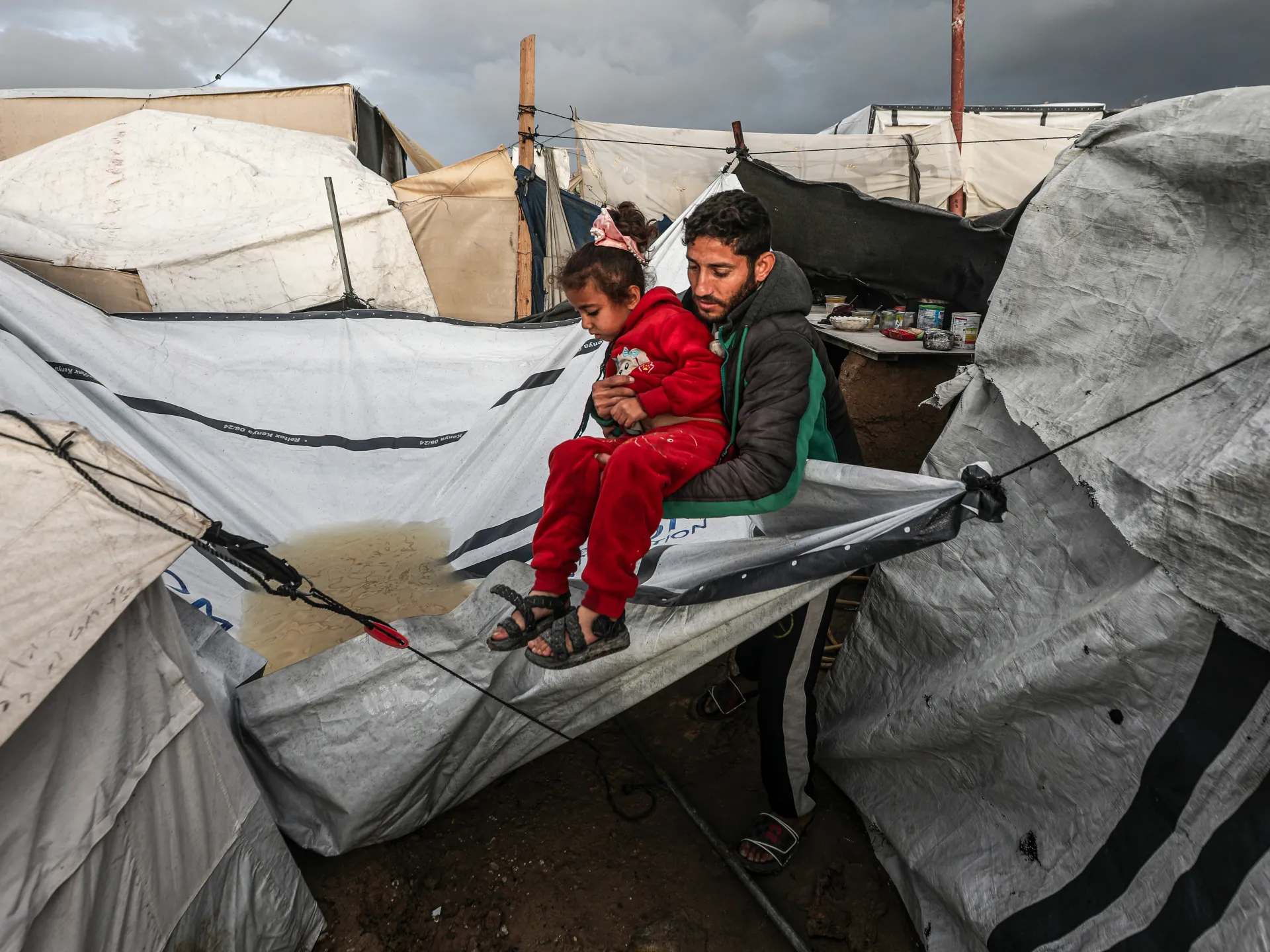
Speaking to Al Jazeera Arabic on Tuesday as a deep weather depression pummelled the Gaza Strip, killing at least seven children, Albanese said the weather disaster had exposed the depth of Israel’s disregard for civilian survival.

“It is shocking even for me sitting far away. … Their lives seem like hell,” Albanese said, reacting to testimonies of families sitting in mud and darkness as their makeshift shelters collapsed.

“We hear of family members … searching for relatives buried under rubble because damaged buildings collapsed on top of them due to the intensity of the rain.”

A ‘man-made’ vulnerability

While the storm is a natural event, humanitarian officials argued its lethality is political.

James Elder, a spokesperson for UNICEF currently in Gaza City, confirmed that seven children had died as a result of cold temperatures. He stressed that these children did not die merely from the cold but also because a “man-made shortage” of food and medicine has left them with zero resilience.

“Children aged two or three have severely weakened immune systems,” Elder told Al Jazeera, describing the situation as “extreme misery”.

“We are talking about layers upon layers of rejection [of aid],” he added, noting that Israel continues to block the entry of cooking gas and fuel needed for heating, leaving families defenceless against winds that weather experts said exceeded 100 kilometres per hour (60 miles per hour).

‘Expendable lives’

When asked about the lack of humanitarian response and Israel’s move to cut ties with UN agencies during such a crisis, Albanese was blunt.

“Israel generally does not care about Palestinian lives. On the contrary, it finds them expendable and [believes they] can be destroyed,” she said.

She argued that the international community is complicit by focusing on other global conflicts while ignoring the “genocide” that has left Gaza’s population exposed to the elements without homes, electricity or drainage systems.

“What more do we need to see? What have we not seen yet?” she asked.

Call for arms embargo

Albanese insisted that sending aid, which is often blocked, is no longer a sufficient response to such catastrophes. She called for immediate punitive measures against Israel to force a change in its policy.

“States must cut trade ties, impose an embargo on arms exports and stop normal dealings with Israel,” she told Al Jazeera.

She emphasised that the “starting point” for any solution must be the International Court of Justice advisory opinion ordering the dismantling of the occupation rather than political plans that ignore the reality on the ground.

‘Winds like a tropical storm’

The vulnerability of the population was highlighted by Khaled Saleh, a senior weather presenter at Al Jazeera.

He explained that the depression brought polar winds reaching speeds typically associated with tropical storms.

“These winds can uproot trees, … so imagine what they do to worn-out tents,” Saleh said, noting that the lack of infrastructure meant water had nowhere to go but into the shelters of displaced Palestinians.

Source link

Myanmar says Rohingya genocide case at The Hague is ‘flawed, unfounded’ | Rohingya News

The International Court of Justice is deciding if Myanmar committed genocide against the Rohingya in 2017 military crackdown.

An international court case accusing Myanmar of committing genocide against its mostly Muslim Rohingya minority is “flawed and unfounded”, the country’s Ministry of Foreign Affairs says.

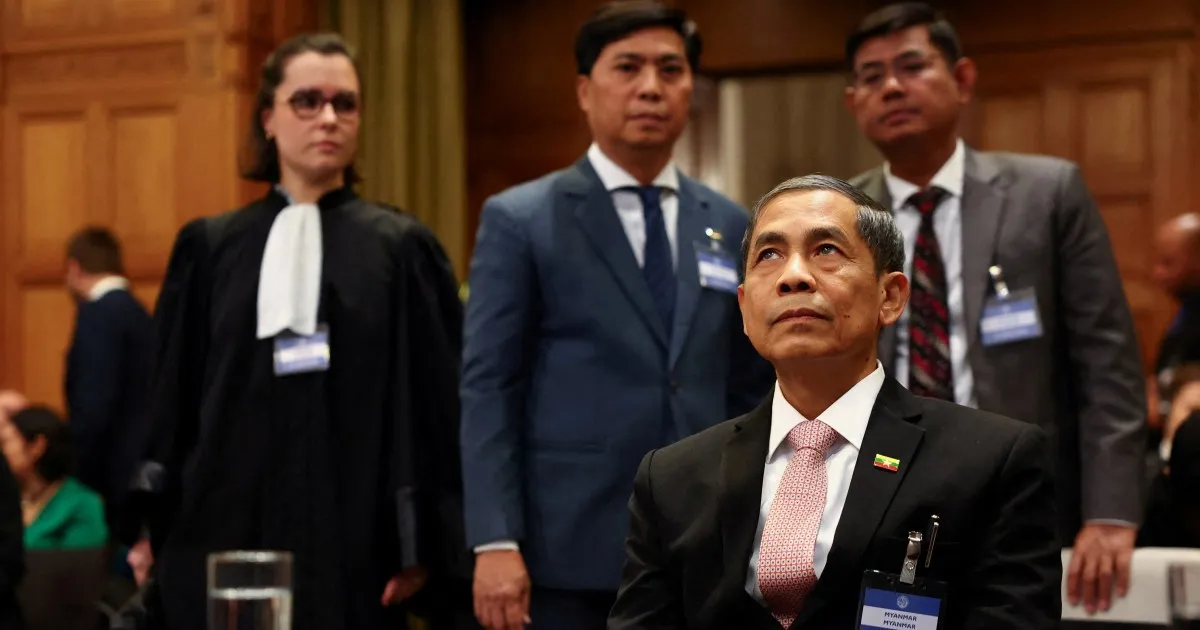
In a statement published by state media on Wednesday, Myanmar’s military government hit out at the genocide case, which has been brought to the International Court of Justice (ICJ) in The Hague, Netherlands, by The Gambia.

Recommended Stories

list of 3 itemsend of list

“The allegations made by The Gambia are flawed and unfounded in fact and law,” the Foreign Ministry said.

“Biased reports, based on unreliable evidence, cannot make up for truth,” it said.

Myanmar’s military rulers, who seized power in 2021, are cooperating with the ICJ case “in good faith” in a sign of respect for international law, the statement added.

The Gambia filed the case against Myanmar at the ICJ, also known as the World Court, in 2019, two years after the country’s military launched an offensive that forced about 750,000 Rohingya from their homes, mostly into neighbouring Bangladesh.

Survivors of the military operation recounted mass killings, rapes and arson attacks. Today, about 1.17 million Rohingya live crammed into dilapidated refugee camps in Cox’s Bazar in Bangladesh.

On the opening day of the trial on Monday, Gambian Justice Minister Dawda Jallow told the court the Rohingya “have been targeted for destruction” in Myanmar.

Lawyers for military-ruled Myanmar will begin their court response on Friday.

Included ‘genocidal acts’

The trial is the first genocide case the ICJ has taken up in full in more than a decade, and its outcome will have repercussions beyond Myanmar, likely affecting South Africa’s petition against Israel over its genocidal war in Gaza. The hearings will span three weeks.

The human rights chief of the United Nations at the time of the crackdown in Myanmar called it a “textbook example of ethnic cleansing”, and a UN fact-finding mission concluded that the military’s 2017 offensive had included “genocidal acts”. But authorities in Myanmar rejected the report, claiming its military offensive was a legitimate counterterrorism campaign in response to attacks by Rohingya armed groups.

Wednesday’s statement by Myanmar’s Foreign Ministry did not use the word Rohingya, instead referring to “persons from Rakhine state”.

The Rohingya are not recognised as an official minority in Myanmar, which denies them citizenship despite many having roots in the country stretching back centuries.

A final decision in the Rohingya genocide case could take months or even years, and while the ICJ has no means of enforcing its decisions, a ruling in favour of The Gambia would likely place more political pressure on Myanmar.

The Southeast Asian nation is currently holding phased elections that have been criticised by the UN, some Western countries and human rights groups as neither free nor fair.

Source link

Schools in Kent and Sussex shut again as water supply issues continue

Getty Images A person in an orange high vis jacket walking with water bottles under his arm. There are hundreds of bottles behind him.Getty Images

About 25,000 people were still being impacted by Tuesday

Several schools in Sussex and Kent have been forced to close again due to ongoing water supply problems.

Issues began on Saturday, with South East Water (SEW) blaming the disruption on the impact of Storm Goretti and a power outage at its pumping station.

On Tuesday, the company said about 25,000 customers still had no water or were experiencing intermittent supplies.

Ulcombe Church of England Primary in Kent is impacted, as well as East Grinstead schools Sackville School, Imberhorne, Estcots Primary, Ashurst Primary and The Meads Primary.

SEW, which has apologised, said on its website on Wednesday morning that there were 12 ongoing interruptions across its network.

The BBC has asked the water company how many customers are still affected.

The primary school in Ulcombe said online learning would be provided for pupils, and other schools have urged parents to contact them for updates.

Several schools in the counties were also closed on Monday and Tuesday because of the lack of water.

Incident manager Matthew Dean previously said some of the issues were connected to the recent cold weather and a subsequent breakout of leaks and bursts across the area that left drinking water storage tanks running low.

Water regulator Ofwat said it was concerned about the supply problems amid calls for it to take action again SEW.

Several MPs have also been calling for SEW boss David Hinton, who earns a base salary of £400,000 and was paid a £115,000 bonus in 2025, to step down or to be removed from his role.

Five bottled stations were open on Tuesday across East Grinstead, Tunbridge Wells and Maidstone.

On Monday, Kent County Council leader Linden Kemkaran wrote on X that a “major incident” had been declared.

The Queen Victoria Hospital in East Grinstead also said some appointments may have to be carried out virtually.

SEW has been approached for further details.

Source link

The Kidnapping of Venezuela’s Sovereignty

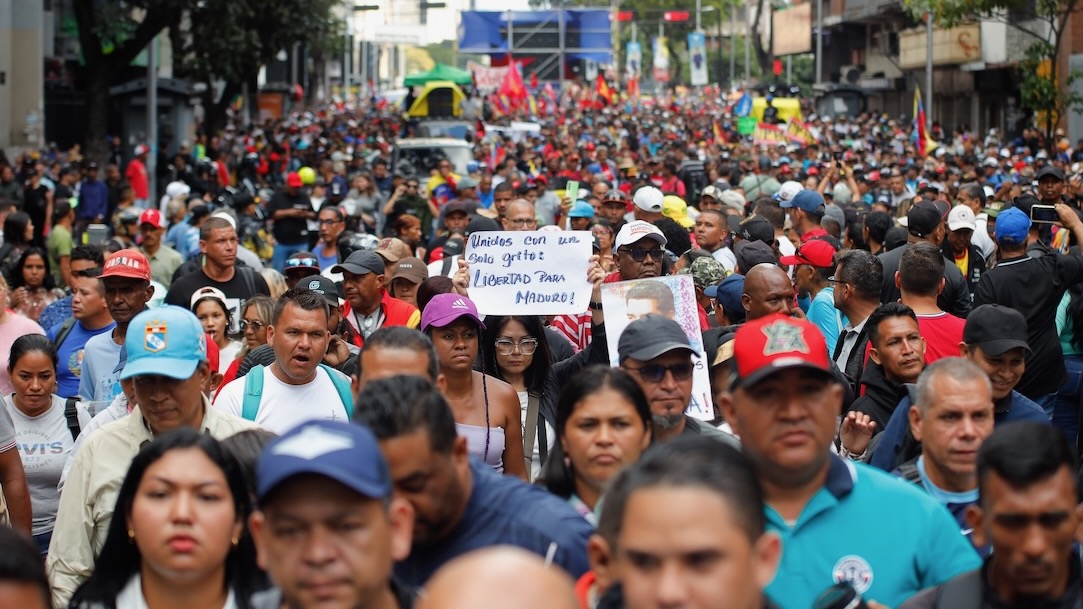
Mobilization in Venezuela for the return of President Nicolás Maduro from US captivity. (Francisco Trias)

On January 3, 2026, the United States did not merely bomb a sovereign country and capture its president. It displayed, in the most unambiguous terms, a total defiance of the post-War international order that it helped create. When US special forces captured Venezuelan President Nicolás Maduro and his wife and National Assembly deputy Cilia Flores from Caracas and transported them to a Brooklyn jail, they did not simply violate Venezuelan sovereignty. They declared that sovereignty itself, for any nation that refuses subordination to US imperialism, holds no weight.

As Nicolás Maduro Guerra, the president’s son, stated before Venezuela’s National Assembly: “If we normalize the kidnapping of a head of state, no country is safe. Today it’s Venezuela. Tomorrow, it could be any nation that refuses to submit.”

The response to this act, regardless of one’s political orientation or views on the Maduro government, will determine whether the concepts of international law, multilateralism, and the self-determination of peoples retain any meaning in the twenty-first century. This is not a question for the left alone. It is a question for every nation, every government, and every citizen who believes that the world should not be governed by the principle that might makes right.

The logic of hyper-imperialism unveiled

What distinguishes the current phase of US foreign policy from earlier periods of intervention is its brazenness. When the CIA orchestrated the overthrow of Guatemalan President Jacobo Árbenz in 1954, Washington maintained the pretense of responding to communist subversion. When American forces invaded Panama in 1989 to capture Manuel Noriega, the justification was framed within a discourse of law enforcement. The history of US intervention in Latin America spans over forty successful regime changes in slightly less than a century, according to Harvard scholar John Coatsworth.

But Trump’s announcement that the United States would “run” Venezuela represents something qualitatively different. Here there is no pretense. When asked about the operation, Trump invoked the Monroe Doctrine and said that these are called “Donroe Doctrine”, signaling that the Western Hemisphere remains a zone of US dominion – an assertion clearly made in the National Security Strategy launched in November 2025. Secretary of State Marco Rubio’s subsequent clarification that the US would merely extract policy changes and oil access did nothing to soften the nakedness of the imperial project.

This represents what we at the Tricontinental: Institute for Social Research have identified as “hyper-imperialism”, a dangerous and decadent stage of imperialism. Facing the erosion of its economic and political dominance and the rise of alternative centers of power (mainly in Asia) US imperialism increasingly relies on its uncontested military strength. The Chatham House analysis is unequivocal: this constitutes a significant violation of Venezuelan sovereignty and the UN Charter. There was no Security Council mandate, nor any claims to self-defense.

The post-1945 international order established the formal principle that states possess sovereign equality and that force against another state’s territorial integrity is prohibited. Article 2(4) of the UN Charter was designed precisely to prevent the powerful from treating the world as their domain, which the US has now blatantly ignored.

The test for Global South solidarity

The kidnapping of President Maduro poses an existential question to the discourse of “multipolarity”. While the seeds of a multipolar world order may exist (China’s economic rise, the increasing political assertiveness of Global South countries, BRICS and its expansion, the increasing trade in local currencies) they have proven to be extremely limited in the face of the US unilateral use of force. This is an uncomfortable truth.

The initial responses from governments suggest the difficulty of moving from rhetorical condemnation to material constraint. Brazilian President Lula correctly identified the stakes when he condemned the capture as crossing “an unacceptable line” and warned that “attacking countries, in flagrant violation of international law, is the first step toward a world of violence, chaos, and instability”. Colombian President Petro rejected “the aggression against the sovereignty of Venezuela and of Latin America.” Mexico’s President Sheinbaum declared that “the Americas do not belong to any doctrine or any power.” China’s Foreign Minister Wang Yi condemned US military intervention and called for the release of President Maduro, saying that, “We don’t believe that any country can act as the world’s police.”

The groundswell of opposition confronts a structural problem: the institutions designed to prevent such actions are incapable of constraining the permanent members of the Security Council. The United States can veto any resolution condemning its behavior. The emergency Security Council meeting convened at the request of Venezuela and Colombia produced denunciations but no enforcement mechanism.

Every government that has sought to develop independently, that has attempted to control its own natural resources, that has resisted subordination to Washington, must recognize that what has happened in Venezuela could happen to them. Trump’s threats against Cuba and Colombia underscore this point.

Sovereignty, resources, and the right to self-determination

The pattern is well established with the successive overthrowing of heads of states when they tried to implement land reform like Árbenz in Guatemala, nationalize national resources under Allende in Chile and Mosaddegh in Iran. The thread continues to the present situation in Venezuela.

Venezuela possesses the world’s largest proven oil reserves, estimated at 303 billion barrels. Trump made no effort to disguise the centrality of oil, announcing that American companies would rebuild Venezuela’s oil industry and the US would be “selling oil, probably in much larger doses”. The maritime blockade preceding the military operation served the explicit purpose of strangling the country economically.

Yet the entire trajectory of the US Venezuela policy since 2001, from funding opposition groups to the 2002 coup attempt, to Operation Gideon in 2020, to the “maximum pressure” sanctions, has been designed to prevent Venezuela from making free choices. The assault accelerated after Venezuela enacted its 2001 Hydrocarbons Law asserting sovereign control over oil resources.

Conclusion

The kidnapping of Nicolás Maduro and National Assembly deputy Cilia Flores should compel a fundamental reassessment of the state of the international order. The formal institutions and legal frameworks that were supposed to prevent great power aggression have failed to constrain Washington’s imperialist aggressions. This places an enormous responsibility on the governments and peoples of the Global South. The debates around multipolarity, BRICS, South-South cooperation, and de-dollarization are rendered academic if they do not translate into the practical capacity to impose costs on actions like the invasion of Venezuela. Ultimately, the imperialist aggression against Venezuela has repercussions for governments and peoples around the world, regardless of their ideological orientation or views on the Maduro government. While the real limits of “multipolarity” in this stage of US hyper-imperialism have been laid bare, we must continue building our collective capacity to resist. The defense of Venezuelan people’s sovereignty, after all, is a defense of the sovereignty of all our nations.

The views expressed in this article are the authors’ own and do not necessarily reflect those of the Venezuelanalysis editorial staff.

Atul Chandra & Tings Chak are the Coordinators of the Asia Desk at the Tricontinental: Institute for Social Research.

Source: Globetrotter

Source link

At least 22 people killed after crane falls on train in northeast Thailand | Transport News

DEVELOPING STORY,

The train was travelling from Bangkok to Thailand’s northeast when it derailed after a construction crane fell on to it.

At least 22 people have been killed and around 80 others injured after a construction crane fell on a passenger train in northeast Thailand.

The accident took place on Wednesday morning in the Sikhio district of Nakhon Ratchasima province, 230km (143 miles) northeast of Bangkok. The train was headed from the Thai capital to Ubon Ratchathani province.

Recommended Stories

list of 4 itemsend of list

Thailand’s Transport Minister Phiphat Ratchakitprakarn in a statement said there were 195 passengers on board and that he had ordered a thorough investigation to be carried out.

Those killed were in two of the three carriages hit by the crane, he said.

Al Jazeera’s Tony Cheng, reporting from Bangkok, said the train was reportedly travelling beneath the construction site for a high-speed rail when a crane working overhead collapsed.

“The train then was derailed when it hit that crane and there was a brief fire that ensued,” Cheng said.

“Initial reports said there were only four fatalities. That very quickly jumped to 12 and we now understand from the Thai police who told Al Jazeera that it’s 22 and at this stage they are expecting it to climb,” he said.

The fire has been extinguished and rescue work is now under way, according to local police.

Local resident Mitr Intrpanya, 54, was at the scene when the incident happened.

“At around 9:00 am, I heard a loud noise, like something sliding down from above, followed by two explosions,” Mitr told the AFP news agency.

“When I went to see what had happened, I found the crane sitting on a passenger train with three carriages. The metal from the crane appeared to strike the middle of the second carriage, slicing it in half,” Mitr said.

Al Jazeera’s Cheng says the route that the train was taking is “very commonly used”, serving heavily populated regions of northeastern Thailand.

“This route has been the site of a high speed Chinese rail project, which has been under construction for quite some time now – about a decade,” he said.

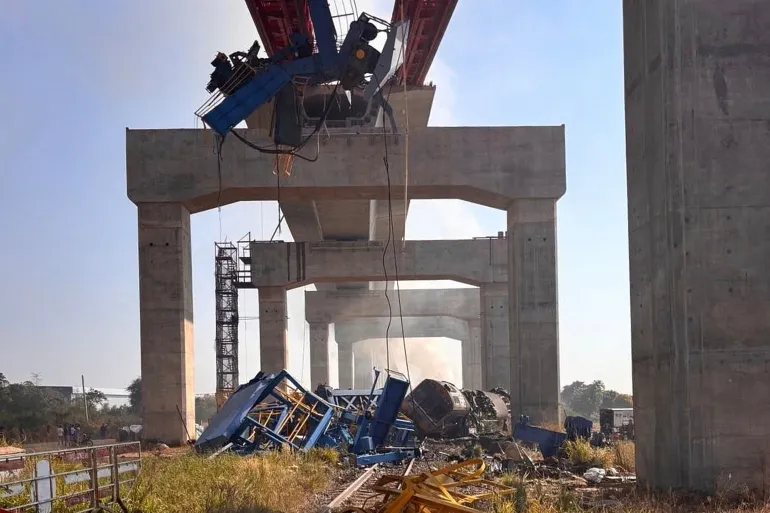
“It is supposed to be bringing a high-speed rail which is on a concrete platform above the existing rail line. Pictures that we have seen of the scene seem to show the crane which was working up there, has fallen from these big concrete columns,” he added..

This photo released from State Railway of Thailand, shows a scene after a construction crane fell into a passenger train in Nakhon Ratchasima province, Thailand Wednesday, Jan. 14, 2026. (State Railway of Thailand via AP)
The site of the train crash in Nakhon Ratchasima province, Thailand, on January 14, 2026 [State Railway of Thailand via AP]

Source link

Venezuela’s top lawmaker says more than 400 prisoners have been released | Nicolas Maduro News

The announcement contradicts claims from local rights groups that no more than 70 prisoners have been freed in recent days.

Venezuela’s top lawmaker says more than 400 people have been freed from prison, contradicting claims from rights groups that only between 60 to 70 prisoners have been released in recent days, amid calls for freeing those imprisoned for political reasons.

Jorge Rodriguez, the president of the National Assembly, made the announcement during a parliamentary session on Tuesday.

Recommended Stories

list of 4 itemsend of list

“The decision to release some prisoners, not political prisoners, but some politicians who had broken the law and violated the Constitution, people who called for invasion, was granted,” Rodriguez told parliament.

He said more than 400 prisoners had been released, but did not provide a specific timeline.

Both Rodriguez and United States President Donald Trump have said that large numbers of prisoners would be freed as a peace gesture following the abduction of Venezuelan President Nicolas Maduro on January 3 by US forces.

The release of political prisoners in Venezuela has been a long-running call of rights groups, international bodies and opposition figures.

The Venezuelan government has always denied that it holds people for political reasons and has said it has already released most of the 2,000 people detained after protests over the contested 2024 presidential election.

Human rights groups estimated there are 800 to 1,200 political prisoners in Venezuela and have said that the number of prisoners freed since last week ranges between 60 and 70, and have denounced the slow pace and lack of information surrounding the releases.

Bloomberg News has reported that at least one US citizen was released from prison on Tuesday.

Venezuela’s Ministry of Penitentiary Services said that at least 116 prisoners were released on Monday.

US to control Venezuela’s oil resources

Opposition leader and Nobel Peace Prize winner Maria Corina Machado has been one of the leading voices demanding the release of prisoners, some of whom are her close allies.

She is expected to meet with Trump on Thursday in Washington, DC. On the same day, acting Venezuelan President Delcy Rodriguez plans to send an envoy to the US capital to meet with senior officials, Bloomberg News reported.

Meanwhile, the US is continuing to take control of oil shipments in and out of Venezuela following its abduction of Maduro.

The US government has filed for court warrants to seize dozens more tanker vessels linked to the Venezuelan oil trade, according to a Reuters report.

The US military and coastguard have already seized five vessels in recent weeks in international waters, which were either carrying Venezuelan oil or had done so in the past.

Trump imposed a naval blockade on Venezuela to prevent US-sanctioned tankers from shipping Venezuelan oil in December, a move that brought the country’s oil exports close to a standstill.

Shipments have now resumed under US supervision, and, as the Trump administration says, it plans to control Venezuela’s oil resources indefinitely.

Source link

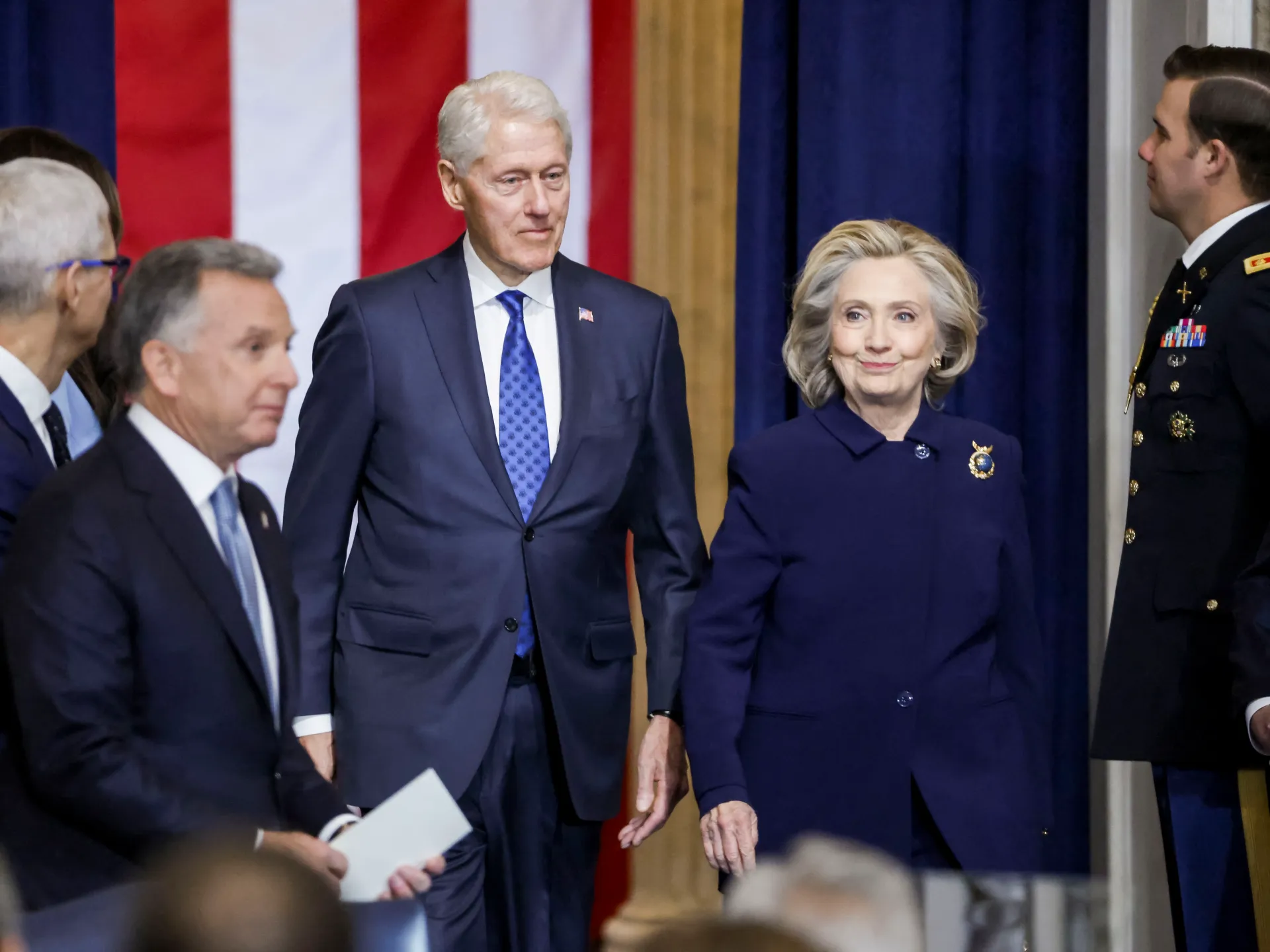
Clintons reject US Congress subpoena to testify in Epstein investigation | Donald Trump News

Former United States president and former secretary of state accuse Republicans of seeking to ‘harass and embarrass’ with probe.

Former United States President Bill Clinton and former US Secretary of State Hillary Clinton have refused a congressional subpoena to testify before a House of Representatives committee as part of an investigation into multi-millionaire financier and convicted sex offender Jeffrey Epstein.

In a letter on Tuesday, the Clintons accused Republican Representative James Comer of playing political favourites in the investigation, seeking to punish political opponents like them, while shielding allies, including US President Donald Trump.

Recommended Stories

list of 3 itemsend of list

The Clintons called the subpoena “legally invalid”, adding the investigation by a committee chaired by Comer was “literally designed to result in our imprisonment”.

“We will forcefully defend ourselves,” wrote the couple.

In response, Comer said he will begin contempt of US Congress proceedings against the Clintons, who are Democrats, next week.

The lengthy process would eventually require approval from a full vote of the House. If that were to pass, the Clintons could be prosecuted by the Department of Justice.

“No one’s accusing the Clintons of any wrongdoing,” Comer told reporters on Tuesday. “We just have questions.”

In their letter, the Clintons contended they had already provided all the relevant information they had to the committee, leading them to conclude the subpoena to appear in person was only meant to “harrass and embarrass”.

“We have tried to give you the little information we have. We’ve done so because Mr Epstein’s crimes were horrific,” the Clintons wrote.

Epstein committed suicide in 2019 as he awaited trial on sex trafficking and conspiracy charges, but speculation has continued to grow over the influential people in the multi-millionaire’s social orbit.

Both Bill Clinton and Trump had documented friendships with Epstein, but have denied knowledge that he trafficked underage girls.

Last year, Congress passed a law requiring the Department of Justice to release all the files related to its investigation into Epstein, but the agency has to date only released a small fraction.

Critics have accused the department of prioritising the release of documents related to Clinton to draw attention away from Trump.

In a letter last week, two lawmakers, Democrat Ro Khanna and Republican Thomas Massie, requested that a federal judge appoint a neutral expert to oversee the release of the files.

The pair said they had “urgent and grave concerns” that the Justice Department had failed to comply with the law. They added that they believed that “criminal violations have taken place” in the release process.

Source link

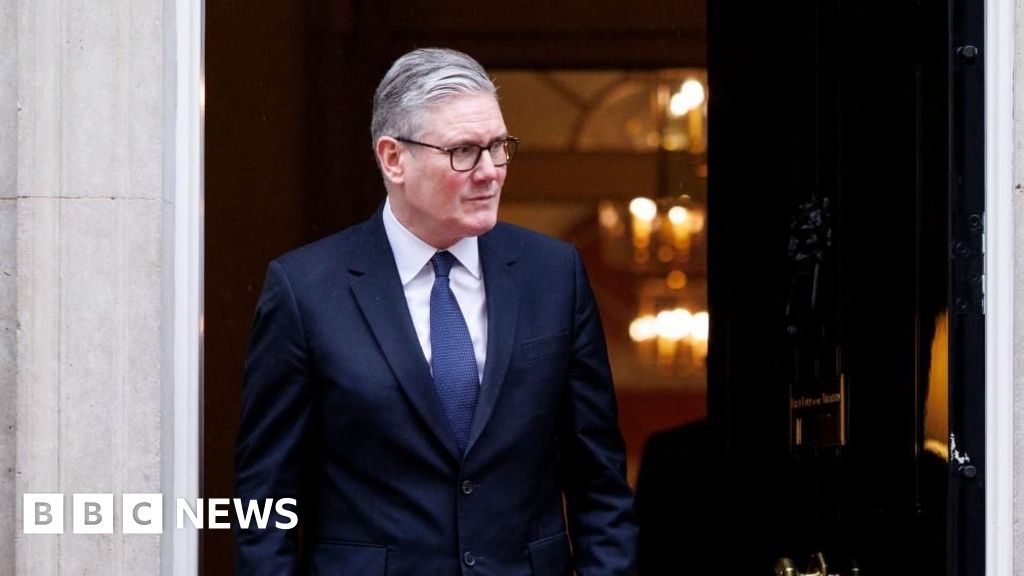
Starmer’s change of heart another ‘almighty backtracking’

Ditching his plans to make digital ID mandatory for workers in the UK is an almighty backtracking and dilution of one of the prime minister’s flagship policy ideas of the autumn.

I remember the first time Sir Keir Starmer talked publicly about his plans, because he was talking to me when he did so.

It was September, and we were sheltering from the pouring rain, in an outside metal stairwell next to a giant ship being built by BAE Systems on the banks of the Clyde in Glasgow.

What he had to say that day was rather overshadowed by the swirling storm around his then Deputy Prime Minister Angela Rayner, who 24 hours later was out of a job.

What those around him were describing as “phase 2” of his government was already off to a bumpy start, but digital ID was seen as a defining idea of the parliament that the prime minister could own and then lean into the arguments it provokes with his opponents, within his party and beyond it.

The thing is it provoked a lot of arguments, perhaps more than he had anticipated, including among some Labour MPs.

It was the mandatory element that became the magnet for the stickiest criticisms.

The idea cratered in popularity. It revived so many of the arguments that nuked the last Labour government’s plans for ID cards about two decades ago.

The sense from critics of an overbearing state, a ‘show us your papers’ society.

So what have ministers done? They have junked the mandatory element of it.

People will still have to digitally prove they have the right to work – but could use other things to do it.

This new government digital ID will not be essential.

The argument I hear within government is they are ditching the bit that is unpopular, but keeping something people might choose to use themselves because it could make accessing public services easier, for instance.

In short, the whole initial public pitch for why digital ID was a good idea – cracking down on illegal migration and illegal working – has been shelved.

The emphasis now is on digital ID being an aide to consumers.

“Let’s remove the whole culture war thing entirely and focus on the pragmatic element plenty of people will like and will choose to use,” is how one government figure put it to me.

Others say if the prime minister really is going to focus on the cost of living when he is addressing domestic policies, he needed to junk unpopular stuff that was getting in the way of that.

The opposition parties have piled in with their criticisms, while welcoming the government’s change of heart.

Here is the political challenge for Downing Street: the climbdowns, dilutions, U turns, about turns, call them what you will, are mounting up.

In just the last couple of weeks, there has been the issue of business rates on pubs in England and inheritance on farmers.

Before that, among others, income tax, benefits cuts and winter fuel payments.

Sir Keir Starmer’s critics, external and internal, are taking note.

Just hours before this latest backtracking, the Health Secretary Wes Streeting – who’d quite fancy being prime minister himself one day – said it was important the government “gets it right first time”.

That, to put it very politely, is a work in progress for Sir Keir Starmer.

Source link

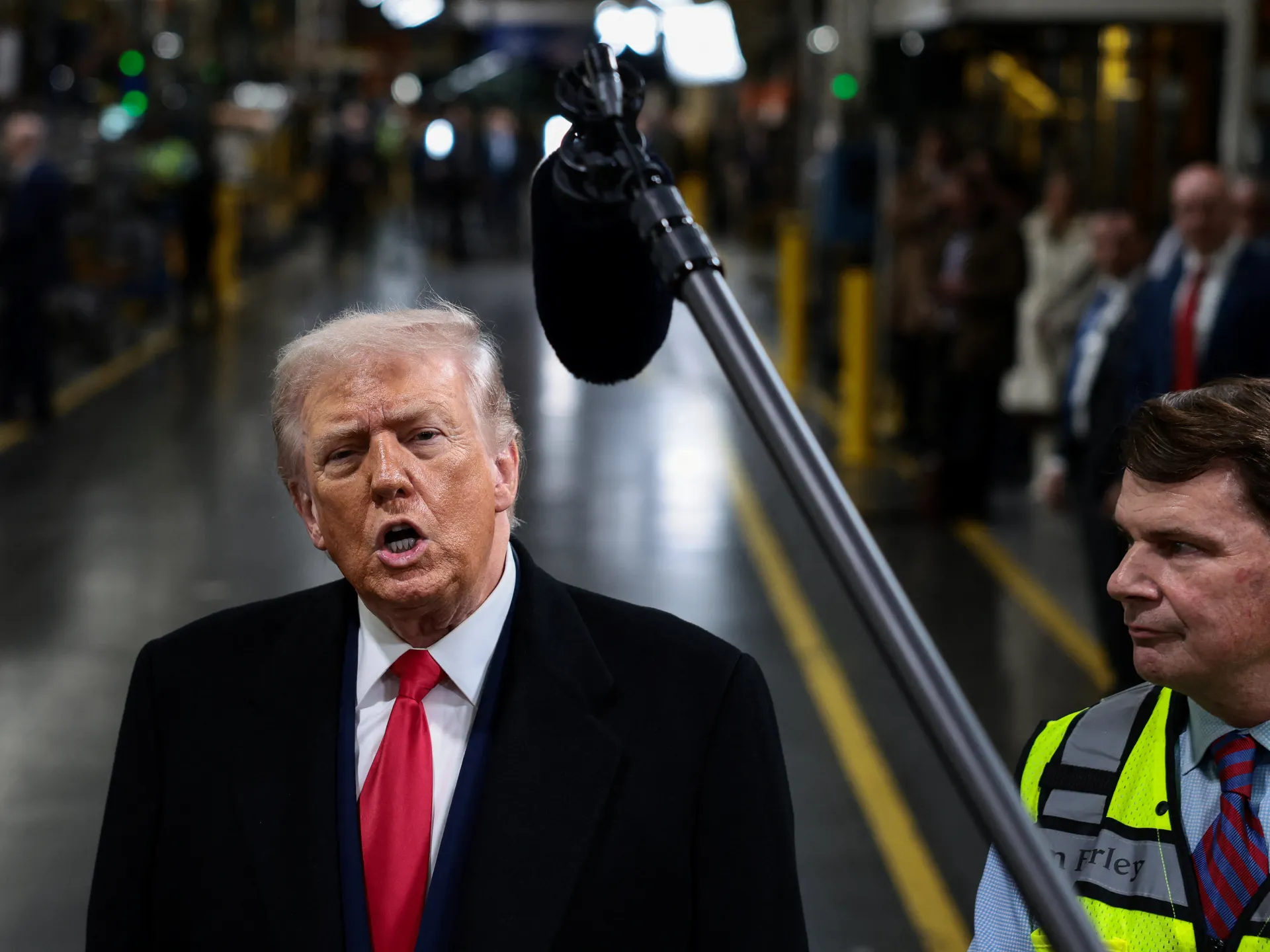
Trump says trade agreement with Mexico, Canada ‘irrelevant’ to US | Automotive Industry News

But car makers have urged an extension to the USMCA, saying it is crucial to US auto production.

US President Donald Trump says the United States-Mexico-Canada Agreement (USMCA) is not relevant to the US, but that Canada wants it, as he pushed for companies to bring manufacturing back home.

“There’s no real advantage to it; it’s irrelevant,” Trump said about the trade agreement on Tuesday, during a visit to Detroit, Michigan.

Recommended Stories

list of 4 itemsend of list

“Canada would love it. Canada wants it. They need it.”

Detroit’s three big automakers, Ford, General Motors and Stellantis, are heavily reliant on supply chains that include significant parts production in Mexico and Canada, and all three produce hundreds of thousands of vehicles annually in both countries.

Major car makers, including Tesla, Toyota and Ford, in November also urged the Trump administration to extend USMCA, saying it is crucial to US auto production.

The American Automotive Policy Council, representing the Detroit Three automakers, said the USMCA “enables automakers operating in the US to compete globally through regional integration, which delivers efficiency gains” and accounts “for tens of billions of dollars in annual savings”.

Mark Reuss, president of General Motors, said at an event on Tuesday, “Our supply chains go all the way through all three countries. It’s not simple. It’s very complex. The whole North American piece of that is a big strength.”

Trump made his comments as he toured a Ford factory in Dearborn, Michigan, ahead of a speech he is delivering on the economy in Detroit on Tuesday.

“The problem is, we don’t need their product. You know, we don’t need cars made in Canada. We don’t need cars made in Mexico. We want to take them here. And that’s what’s happening,” he said.

Stellantis said in November that under the 15 percent tariffs with Japan, US vehicles complying with North American content rules “will continue to lose market share to Asian imports, to the detriment of American automotive workers”.

The USMCA is up for review this year on whether it should be left to expire or another deal should be worked out.

The trade pact, which replaced the North American Free Trade Agreement in 2020 and was negotiated during Trump’s first term as president, requires the three countries to hold a joint review after six years.

On Wall Street, two of Detroit’s major automakers are trending downwards. Ford is 0.25 percent below the market open and Stellantis is down 2.9 percent, while General Motors is up by 0.6 percent.

Source link

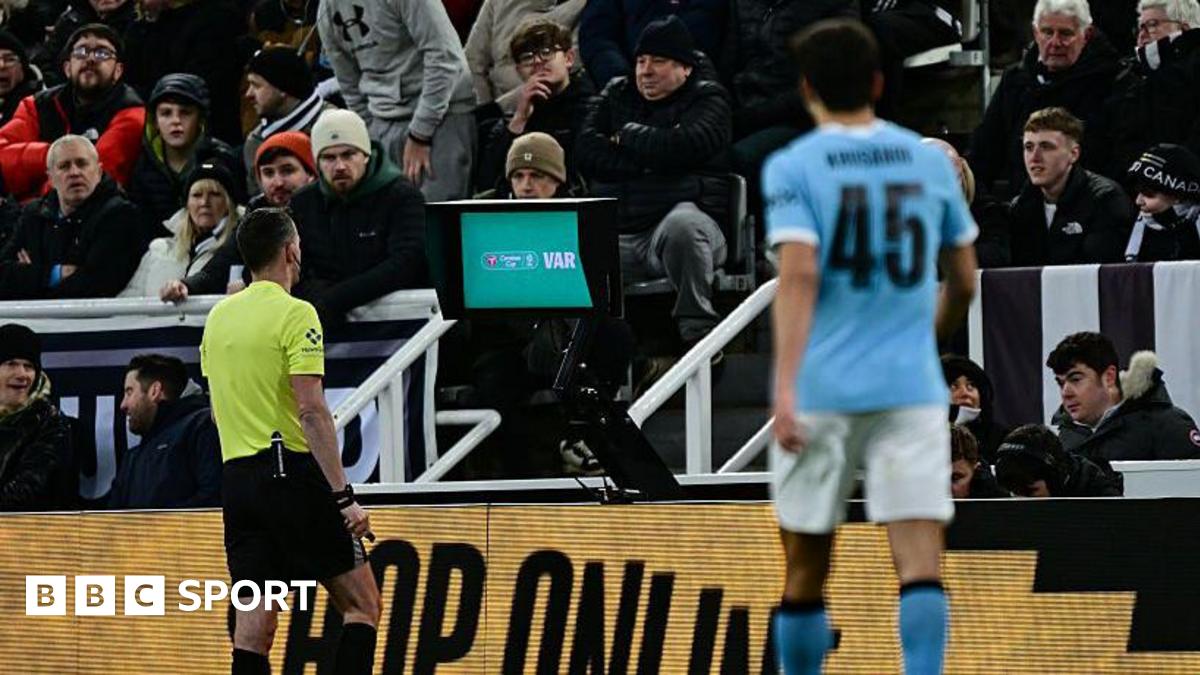
VAR: ‘The game has gone’ – a bad night for VAR in semi-final

Former Chelsea and Blackburn Rovers striker Chris Sutton agreed with Guardiola and Silva and said Kavanagh’s verdict looked like a “sheer guess”.

“I think the game has gone,” added Sutton. “Is Thiaw really going to stop that? The distance from Semenyo is a yard, a yard and a half. Thiaw is not going to react to that.”

Ex-Liverpool and England midfielder Jamie Redknapp and Newcastle defender Dan Burn said it was the correct call to rule out Semenyo’s effort, though both criticised the process.

“If they had given the goal there wouldn’t be one person that looked at this and thought it shouldn’t have been allowed,” said Redknapp.

“But by the letter of the law, whether we like it or not, it is the right decision.”

Meanwhile, Burn, who missed the game through injury, added: “I do think it is the right decision, I just don’t like the subjective offside. It’s either offside, or it’s not.

“We don’t want to see that, but by the letter of the law it should be disallowed.”

Former Manchester City defender Micah Richards said: “I understand the process but VAR wasn’t brought in for this reason here.

“This is anti-goal which they said they weren’t going to do, they said they weren’t going to re-referee the game.

“This for me is re-refereeing the game. They are both going at it. It might be right, but I don’t think we should be taking away goals for this. Why take five minutes?”

Source link

UN chief warns he could refer Israel to ICJ over laws targetting UNRWA | Israel-Palestine conflict News

In October 2024, Israel passed a law banning the agency for Palestinian refugees in Israel and occupied East Jerusalem.

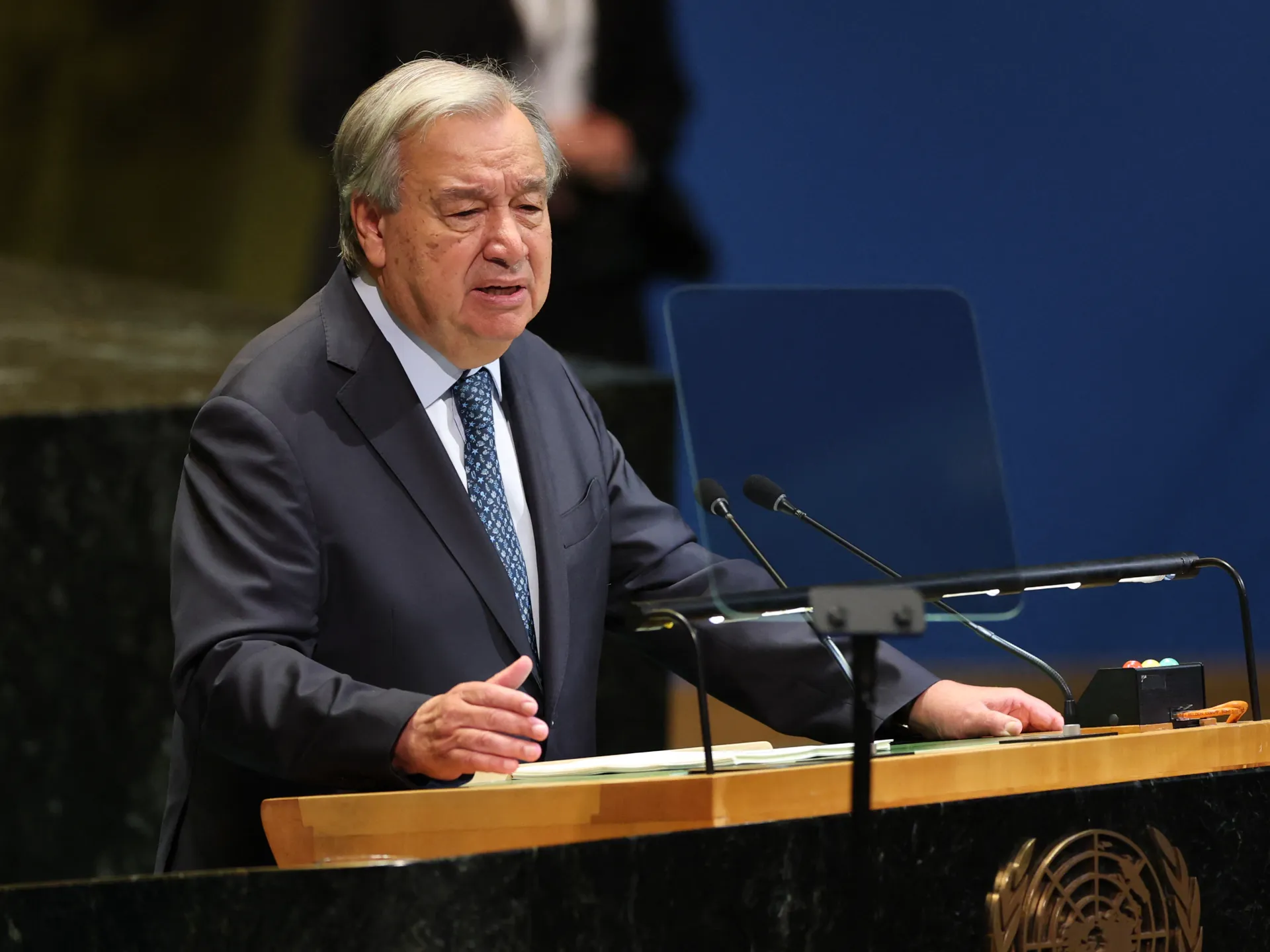
United Nations Secretary-General Antonio Guterres has warned Israeli Prime Minister Benjamin Netanyahu that he could take his country to the International Court of Justice if it does not repeal laws targeting the UN Palestinian refugee agency (UNRWA) and return its seized assets and property.

In a January 8 letter to Netanyahu, Guterres said the UN cannot remain indifferent to “actions taken by Israel, which are in direct contravention of the obligations of Israel under international law. They must be reversed without delay.”

Recommended Stories

list of 3 itemsend of list

Israel’s parliament passed a law in October 2024 banning UNRWA from operating in Israel and prohibiting Israeli officials from having contact with the agency. It then amended the law last month to ban electricity or water to UNRWA facilities.

Israeli authorities also seized UNRWA’s occupied East Jerusalem offices last month. The UN considers East Jerusalem occupied by Israel. Israel considers all of Jerusalem to be part of the country.

Guterres said that UNRWA is “an integral part of the United Nations”, and highlighted that “Israel remains under an obligation to accord UNRWA and its personnel the privileges and immunities specified in the 1946 Convention on the Privileges and Immunities of the UN”.

The convention states that “the premises of the United Nations shall be inviolable”.

Israel’s ambassador to the UN, Danny Danon, dismissed Guterres’s letter to Netanyahu.

“We are not fazed by the Secretary-General’s threats,” Danon said in a post on X on Tuesday.

“Instead of dealing with the undeniable involvement of UNRWA personnel in terrorism, the Secretary-General chooses to threaten Israel. This is not defending international law, this is defending an organization marred by terrorism,” he added.

Israel has long sought the dissolution of UNRWA, which was created by the UN General Assembly in 1949 following the war surrounding the founding of Israel. It has since provided aid, health and education to millions of Palestinians in Gaza, the occupied West Bank, Syria, Lebanon and Jordan.

Israel has alleged that a dozen of the agency’s employees were involved in the October 7, 2023, Hamas-led attacks on southern Israel, in which 1,139 people were killed, and about 240 were taken into Gaza as captives.

In response to the attack, Israel launched a devastating genocidal war against the Palestinian people of Gaza, killing more than 71,400, according to Gaza’s health authorities.

The UN has said that nine UNRWA staff who may have been involved in the Hamas-led attack on Israel have been fired. A Hamas commander in Lebanon, killed in September by Israel, was also found to have had a UNRWA job.

The UN has also promised to investigate all accusations made against UNRWA, and has repeatedly asked Israel for evidence, which it says has not been provided.

According to a January 5 UN report, Israel’s war on Gaza has killed 382 UNRWA employees in the enclave, which is the highest number of UN casualties since the world body was founded in 1945. Some have been killed in Israel’s deliberate, repeated attacks on UNRWA hospitals and schools, which shelter more than one million displaced Palestinians in Gaza.

Top UN officials and the UN Security Council have described UNRWA as the backbone of the aid response in Gaza, where Israel’s war has unleashed a humanitarian catastrophe.

In October 2025, the ICJ reiterated Israel’s obligation to ensure full respect for the privileges and immunities accorded to the UN, including UNRWA and its personnel, and said Israel should ensure the basic needs of the civilian population in Gaza are met.

The ICJ opinion was requested by the 193-member UN General Assembly.

Advisory opinions of the ICJ, also known as the World Court, carry legal and political weight, but they are not binding, and the court has no enforcement power.

Source link

Three Peace Accords Later, Tshobo and Bachama Still Clash in Adamawa 

It was December 23, 2025. A group of young men mounted motorcycles and rode through the warring communities of Lamurde Local Government Area in Adamawa State, northeastern Nigeria, to deliver the governor’s message. A peace accord had been signed, they announced, and all hostilities between the Bachama and Tshobo tribes had ceased.  

“We don’t expect further damage. Enough is enough,” Ahmadu Fintiri, the state governor, said during the signing. “With this, I want to declare, there is no victor and no vanquish.”

In the days that followed, residents who had fled to neighbouring towns began returning home. Commercial farming, which had largely stopped after the July 2025 clashes between the two tribes, was slowly resuming after months of standstill.

Eager to resume work, Grace Joshua, a 35-year-old Tshobo woman based in Lamurde Town, and her group of friends secured a contract at a commercial rice farm on the outskirts of the town. On Jan. 3, they set out. But as they were about to commence work, a man appeared. 

“We were all frightened, and we immediately stood up,” Grace told HumAngle, taking laboured breaths over the phone.  The man, she said, was tall and dressed in black, wearing a mask. 

“Two of us started running [to the opposite direction] towards Tingo Village, and then we saw two other men in front of us. That was when we realised that it was an ambush,” she recalled.  

Gunshots broke out. Grace was hit in the thigh and fell to the ground, but the other woman reached the village unharmed. “I thought I was going to die until I saw people coming from my village, and that was how I was rescued,” she said. 

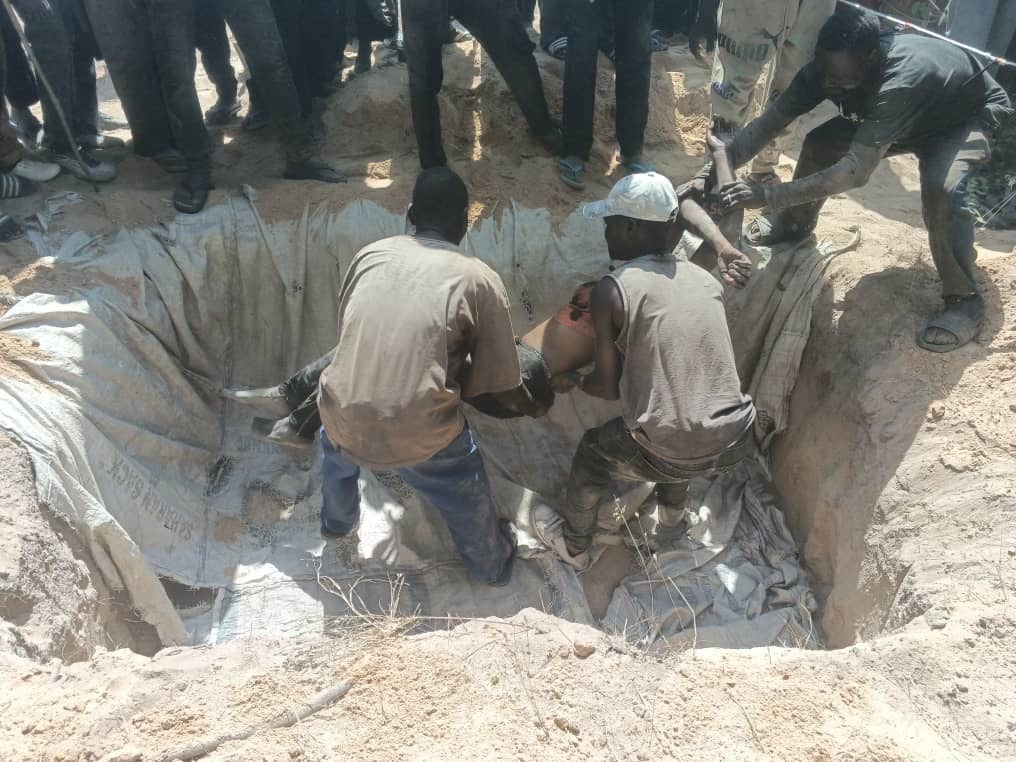
By the time a rescue team arrived on the farm, the attackers had fled, leaving the other three women dead in a pool of their own blood. The villagers rushed Grace to a clinic for treatment, while the other women were buried that same day. 

Group of people around a large pit, lifting a person out using a sheet.
The women were buried on that day. Photo: Hyginus Mangu

As Grace continues to receive treatment, the question echoes in her mind: when will the attacks cease?

The clashes 

For centuries, the Tshobo and Bachama tribes coexisted peacefully, living side by side, sharing schools, markets, water sources, health centres, and even marriages. Situated barely a kilometre apart, both tribes fall under the same local government council, with most of the shared social infrastructure located in Lamurde Town, the local government headquarters. 

However, this long-standing harmony was breached in July 2025, when a dispute over land ownership broke out. Locals say the farmland at the centre of the recent crisis is in Waduku and has been disputed for several years. The claimants — Mallam England Waduku, Afiniki Monday, and Engeti — are members of the same extended family, linked through intermarriage between the Tshobo and Bachama tribes. The violence reportedly began when members of the Engeti family, from the Tshobo tribe, went to work on the land, which they said was allocated to them through inheritance. Members of Mallam England’s family, from the Bachama tribe, confronted them and attempted to stop the farming, insisting that the land also belonged to them. What began as a family disagreement soon escalated into communal violence.

The Tshobo people primarily inhabit the mountainous areas of Lamurde Local Government Area, including communities such as Wammi, Lakan, and Sikori, which stretch toward the border with Gombe State. The Bachama, on the other hand, are largely settled in Rigange, Waduku, and other lowland communities. In towns such as Waduku and Lamurde, members of both tribes live side by side and often speak one another’s languages.

The violent land dispute has shattered daily life in these communities. Two months after the violence, HumAngle extensively documented the impact: some locals had fled to stay with relatives in other towns, while those who remained lamented being trapped within their communities, unable to move freely. Access to healthcare and other social services became difficult, especially for Tshobo communities, which had long depended on clinics in Lamurde town, a Bachama stronghold. 

Map showing Lamurde, Rigange, and Waduku near a river in the Highlands region.
The Tshobo occupy the mountainous area of Lamurde, while the Bachama people are settled in Rigange, Waduku, and across other lowland areas. Map illustration: Mansir Muhammed/HumAngle

The crisis deepened communal divisions, as both tribes began avoiding routes and activities that previously brought them together, such as trading. By September 2025, social and economic ties were being severed. Despite several peace talks and reconciliation efforts by the government and stakeholders, both communities continued to clash. 

In early December, both communities violently clashed again, prompting the intervention of the Nigerian Army. Tragically, the intervention resulted in casualties when the military allegedly opened fire on a group of Bachama women who had come out in Lamurde Town to protest the violence. Seven women and a man were killed, while many others sustained injuries. The Nigerian Army denied shooting protesters, but locals insist otherwise.

Hensley Audu, whose wife was killed in the protest, said his mind will never be at peace until justice is served. “Our house was burnt to the ground in Rigange, so we moved to Lamurde Town for safety, but then another incident broke out in the township in December, and my wife joined a group of women to protest peacefully on that day,” he said.

Collapsed building with a corrugated metal roof scattered on the ground, surrounded by damaged walls and trees in the background.
A verbal disagreement over land escalated into a violent conflict, resulting in numerous deaths, the destruction of property, and displacement. Photo: HumAngle

Hensley told HumAngle that he wasn’t at the protest ground, but eyewitnesses said it was the military who shot at his wife and the other women. “She was 63 years old. She left behind five children and two grandchildren,” he added. 

While calm seems to have been restored in Lamurde Town, Hensley said locals no longer trust the military officials patrolling the area. “They were the ones who shot our women,” he stated. 

He said his family has relied on support from relatives since his wife’s death. 

“The government also came to check on us. They offered a token, but until the military takes responsibility and my wife gets justice, my mind will never be at rest,” he said. 

The accords that keep failing 

Since the conflict began, community leaders and residents have told HumAngle that the warring sides have signed three peace agreements, yet new clashes continue to erupt. 

Hyginus Mangu, the leader of the Tshobo tribe, said that the first accord was signed in the office of the state’s Commissioner of Police when the clashes first broke out around July 2025, in the presence of all the state’s security heads. The other two, he said, were signed in the state governor’s office in September and December 2025. 

“It was agreed that there would be interactions between the two communities. And it was unanimously signed like that without any argument,” Hyginus said. 

Simon Kade, a Bachama stakeholder, corroborated the account. He noted that the accords were meant to bring a definitive end to the recurring clashes. However, with the recent attack on the Tshobo women, Hyginus said, the accord has been breached yet again.

To Hensley, the peace accord is just a piece of paper: “The government is not tackling the main issue. They need to arrest those who incite the conflict despite agreements to maintain peace.” 

HumAngle learned that two suspects linked to the attack were arrested by security operatives and are now in custody. 

Trading blames

Hensley accused some Tshobo youths of using social media to provoke hostility against the Bachama. Hyginus, on the other hand, blamed the Bachama for instilling fear among his people. He said Tshobo farmers who own land in Lamurde Town, Tingo, and other Bachama-dominated areas have yet to resume dry-season farming. Civil servants from Tshobo communities have also stayed away from the Lamurde secretariat, fearing attack.

Simon disputed this, claiming Tshobo residents around Tingo provoke Bachama people with insults, which he fears could spark renewed clashes. He added that Bachama residents living in Tshobo-dominated areas do not feel safe.

At night, Simon said, locals do not sleep despite the presence of security officials in the area. He explained that the community has set up its vigilante to patrol the area every night. Hyginus said the same situation exists in the communities where his subjects live. 

Abandoned, fire-damaged building with yellow and pink walls, surrounded by trees and rubble in the sandy foreground.
The conflict disrupted the lives of locals, with many fleeing the communities to stay with relatives in other towns. Photo: Desire Labaran

Ready to embrace peace?

Wilson Ezra, who lost his wife in the Jan. 3 attack, said he feels hopeless without his wife, who left behind six young children. The last of them, he said, is barely a year old. “Even the other two women who died were breastfeeding mothers,” he told HumAngle. 

While he grapples with the loss of his wife, he prays that more attacks do not happen in the future. “There is nothing I want in this life more than peace,” Wilson said. 

The recent incident has sparked a new wave of displacement among both tribes. Residents are leaving communities such as Rigange and Waduku, which were significantly affected in previous clashes. 

“We have left our home in Rigange and moved into Lamurde Town because we don’t know what might come next,” said Azurfa Morisson, a Bachama native from Rigange who lost her son in the December clash. Since the town houses the local government secretariat, she feels safer. 

This displacement comes at a high cost for families like Azurfa’s, as they have abandoned their farmlands and businesses. But she is willing to do anything to stay alive. 

Lamurde LGA is known for its rich cultural heritage, agricultural productivity, and trade. Before the violent conflict, locals across Adamawa and neighbouring states flocked to Tingo, home to one of the state’s largest markets. Recently, however, the area has become increasingly inaccessible. Roads leading to Lamurde Town, the Tingo market, and nearby villages are largely deserted. Business in Tingo is gradually coming to a standstill. 

Simon, a commercial farmer who lost his home in one of the clashes, said economic activity has collapsed. “This situation has changed the market in Tingo. A  lot of people used to bring their farm produce here, but as a result of this conflict, even the big trucks that come to buy and pack our goods and take them to other states have stopped coming,” he noted. 

Hyginus, the leader of the Tshobo tribe, said they are ready to embrace peace. “There will be peace if today the Bachama’s will stop harassing, attacking, or provoking us, so that there’s a peaceful movement of people from my area, wherever they want to go,” he said. 

He called on the government and the leadership of the Bwatiye Traditional Council, which comprises leaders of both tribes, to investigate the recurring incidents. 

Simon argues that the Bachama tribe also want peace, but the Tshobo doesn’t want to let their guard down. “Everyone should hold on to what they own and stop trying to take over other people’s lands or property,” he said.

HumAngle reached out to the Adamawa State government for comments, but no response had been provided at the time of filing this report. 

As both parties fail to maintain the fragile peace, many lives are strained. 

Source link

South Korea prosecutors seek death penalty for ex-President Yoon | Death Penalty News

Prosecutors say Yoon, who was impeached over a failed 2024 martial law declaration, threatened ‘constitutional order’.

South Korean prosecutors have asked for ousted President Yoon Suk Yeol to face the death penalty over his failed attempt to impose martial law in 2024.

Special prosecutor Cho Eun-suk’s team made the request to the Seoul Central District Court during court on Tuesday, accusing Yoon of threatening the “liberal democratic constitutional order” with his “self-coup”.

“The greatest victims of the insurrection in this case are the people of this country,” said the prosecutors. “There are no mitigating circumstances to be considered in sentencing, and instead, a severe punishment must be imposed.”

Yoon plunged South Korea into a crisis with his martial law declaration in December 2024, prompting protesters and lawmakers to swarm parliament to force a vote against the measure.

The decree was quickly declared unconstitutional by the Supreme Court, and Yoon was subsequently impeached, removed from office and jailed.

Yoon’s criminal trial for insurrection, abuse of power, and other offences linked to the martial declaration ended on Tuesday after 11 hours of proceedings.

The court is expected to deliver a verdict on the case on February 19, according to the Yonhap news agency.

Yoon says investigations ‘frenzied’

The former president has denied the charges against him, arguing that he was acting within his authority to declare martial law in response to what he described as opposition parties’ obstruction of government.

Speaking in court Tuesday, Yoon criticised investigations into the rebellion charges as “frenzied” and mired in “manipulation” and “distortion.”

If found guilty, Yoon will become the third South Korean president convicted of insurrection, following two ex-military leaders convicted over their roles in the 1979 coup.

But even if Yoon is handed a death sentence, it is unlikely to be implemented, as South Korea has observed an unofficial moratorium on executions since 1997.

Yoon also faces several other trials over various criminal charges related to the martial law attempt and other scandals during his time in office.

A Seoul court is expected to deliver a verdict on Friday on an obstruction of justice case, which could see Yoon facing 10 years in prison.

And he faces a trial on charges of aiding the enemy over allegations he ordered drone flights over North Korea to justify his martial law declaration.

The office of President Lee Jae Myung, who ‍was elected after Yoon was removed from office, said in a statement that it “believes the judiciary will rule … in accordance with the law, principles, and public standards.”

Source link

Manchester United manager news: Michael Carrick appointed caretaker head coach

Manchester United have appointed former player Michael Carrick as their caretaker head coach until the end of the season.

Carrick will be assisted by former England number two Steve Holland, with Jonathan Woodgate, Jonny Evans and Travis Binnion also part of his staff.

Former United midfielder Carrick, 44, had a three-game stint as United’s temporary boss after Ole Gunnar Solskjaer’s dismissal in 2021.

He will be back in the Old Trafford dugout for Saturday’s Premier League derby against Manchester City.

United sacked Ruben Amorim on 5 January after 14 months in charge, and Darren Fletcher took charge as caretaker boss for two matches.

Carrick held face-to-face talks with United officials last Thursday and is understood to have impressed chief executive Omar Berrada and director of football Jason Wilcox with his vision for the team.

He is set to play a 4-2-3-1 formation – a move away from the three-at-the-back set-up employed by Amorim.

Norwegian Solskjaer, who has played for and managed United, also held talks with the club about the vacancy.

But Carrick has been chosen as he is more of a hands-on coach than Solskjaer.

Fletcher, who took charge of the games against Burnley and Brighton immediately after Amorim’s exit, will return to the under-18s.

United view him as a key part of their coaching staff moving forward but it was mutually agreed a return to the under-18s is best to continue his development.

Source link

‘Day of reckoning, retribution’ coming to Minnesota amid ICE outrage: Trump | Donald Trump News

US president issues latest threat to midwestern state, where protests have continued after ICE agent killed woman.

United States President Donald Trump has said that a “day of reckoning and retribution” is coming to Minnesota, as outrage and protests have continued days after an immigration agent fatally shot a woman in the state’s largest city, Minneapolis.

Trump did not provide further details on the statement, which came at the end of a lengthy screed on the president’s Truth Social account on Tuesday.

Recommended Stories

list of 3 itemsend of list

The apparent threat represented the latest pledge to come down hard on the midwestern state in the wake of the killing of Renee Nicole Good by an Immigration and Customs Enforcement (ICE) agent last week.

The administration on Monday promised to send hundreds more ICE agents to Minneapolis, where federal officer ranks already dwarf local law enforcement, in what city and state leaders have called a dangerous escalation.

“All the patriots of ICE want to do is remove them from your neighborhood and send them back to the prisons and mental institutions from where they came, most in foreign Countries who illegally entered the USA though Sleepy Joe Biden’s HORRIBLE Open Border’s Policy,” Trump said, referring to his predecessor, US President Joe Biden.

“FEAR NOT, GREAT PEOPLE OF MINNESOTA, THE DAY OF RECKONING & RETRIBUTION IS COMING!” he said.

The phrase was quickly quoted by the Department of Homeland Security, which oversees domestic US immigration enforcement, in a post on X.

Later on Tuesday, a federal judge was set to hear arguments in a lawsuit filed by Minnesota’s Attorney General and the cities of Minneapolis and Saint Paul, alleging that the surge of immigration agents violates residents’ freedom of speech while trampling on the state’s constitutionally protected authorities.

“People are being racially profiled, harassed, terrorised, and assaulted,” the state’s attorney general said in a statement upon filing the lawsuit.

“Schools have gone into lockdown. Businesses have been forced to close. Minnesota police are spending countless hours dealing with the chaos ICE is causing.”

“This federal invasion of the Twin Cities has to stop, so today I am suing DHS to bring it to an end,” it said.

Ongoing outrage

Daily protests have continued across the state since Good’s killing during an enforcement operation in Minneapolis.

Within moments of the shooting, the Trump administration labelled Good a “domestic terrorist”, while claiming the officer was acting in self-defence after the 37-year-old “weaponised her vehicle”.

Widely circulated video evidence quickly cast doubt on their claims, with many observers saying recordings appeared to show Good attempting to flee the scene in her Honda Pilot SUV when the agent opened fire. Questions have also been raised over the conduct of the agents involved, including a series of actions that appeared to escalate the situation.

Last week, local officials decried the Federal Bureau of Investigation’s (FBI) unorthodox move to block an independent state investigatory body from taking part in a probe of Good’s killing. Minneapolis Mayor Jacob Frey said the move – coupled with the Trump administration’s comments – raises questions over the integrity of any conclusions reached.

On Tuesday, the UN Human Rights Council also called for a “prompt, independent and transparent” investigation into the incident.

Prior to Good’s killing, the Trump administration had surged immigration agents to Minnesota as the president increasingly focused on alleged fraud in the large Somali-American community in the state, at times employing racist rhetoric as he sent 2,000 immigration agents to the area.

On Wednesday, the Trump administration announced it was revoking so-called Temporary Protected Status (TPS) for Somalia, a special designation that protects individuals from deportation due to unsafe conditions in their home country.

In a statement on X, US Citizenship and Immigration Services (USCIS) said the move means Somalis who had been on TPS are required to leave the country by March 27.

Source link

The Terms of Struggle in Venezuela: Imperialism vs Sovereignty

Anti-imperialist mural in Venezuela. (Wikimedia Commons)

The Anti-Imperialist Scholars Collective’s Red Paper series takes on the pressing issues of our time with urgency and principled clarity. We are at the frontlines of the Battle of Ideas and we use anti-imperialist methodology to clarify the stakes, intensify the contradictions, challenge the propaganda, and defend the Resistance.

We, the Anti-Imperialist Scholars Collective (AISC), condemn in the strongest terms possible the US imperialist attack against the Bolivarian Republic of Venezuela. The US kidnapped President Nicolás Maduro and First Combatant Cilia Flores in a blatantly criminal breach of international law on January 3, 2026, while violently assaulting the sovereignty of Nuestra América. We stand firmly with the Venezuelan people and their revolutionary Bolivarian State as they defend their sovereign right to self-determination. We unequivocally recognize Nicolás Maduro as the legitimate president of Venezuela and demand the United States government immediately release him and First Combatant Flores. As an organization committed to challenging US-led imperialism and supporting the sovereignty and national liberation of the Global Majority, AISC calls on anti-imperialist forces in the US and across the world to unite in defense of President Maduro and the Bolivarian Republic of Venezuela.

In Red Paper #1, AISC provides a critical analysis of the current US attack on Venezuela, demonstrating that it must be understood as an existential conflict between US imperialism and the sovereignty of the peoples of the Americas.

Introduction: The Two Fronts of Imperialist War

The US is waging war against Venezuela on two inter-related levels. First, this war constitutes a renewed escalation of a decades-long “counter-revolutionary” attack on revolutionary forces and states in the region that have overturned imperialist property structures.[1] Second, this war represents an escalation of US imperialism’s attempt to weaken and subjugate the architects and backers of an emergent polycentric world order in which the US will no longer be the sole, hegemonic superpower.[2] The two “fronts” of the US imperialist war are inter-related. The fracturing of the alliances driving forward the polycentric world order provides a necessary condition for isolating, and destroying, the sovereign development projects of the revolutionary states of the Americas. These projects are marked for destruction as they pose an existential challenge to US imperialism. They disrupt the ability of capital in the imperialist core to superexploit labor and dominate resources while also contesting the definitive basis of imperialist power: the control over the flow of resources and capital between territories.

The attack against Venezuela and the Trump regime’s escalated war footing have generated a broad spectrum of criticism and opposition. However, the terms of the opposition have often risked delegitimizing the Venezuelan state—and thus supporting the objectives of US imperialism. In particular, there is a return to a register of anti-war opposition that posits a fundamental distinction between the Bolivarian Republic of Venezuela and a generic category of the Venezuelan “people.” This is a self-defeating move at best, a complicit one at worst. It is not possible to defend the “Venezuelan people” while aligning with the imperialists in delegitimizing the Bolivarian Republic of Venezuela as a “dictatorship.” It is not a generic category of the “Venezuelan people” that is under attack, but a specific state formation structured upon reorienting the nation’s resources in the service of national development rather than imperialist wealth appropriation. To delegitimize this state structure is to lay the groundwork for legitimizing US imperialist interventions. The questioning of an anti-imperialist state’s legitimacy, particularly by imperialist forces, should never serve as a basis for violating its state sovereignty.

As imperialist forces sow confusion, it is thus imperative that we respond with clarity as to why Venezuela has been attacked and move with a principled commitment to the defence of its sovereignty. This is a war on a revolutionary state that has challenged imperialism by reclaiming both its “internal” and “external” bases of sovereign power: it has constructed a sovereign national development project and forged sovereign international relations with other anti-imperialist states.

Socialism with Bolivarian Characteristics: Resource Sovereignty, Communal Power and Popular Defense

In the late twentieth century, the Bolivarian Republic of Venezuela emerged as a revolutionary challenge to the foundational bases of US imperialism. The Bolivarian Republic has deepened and sustained Venezuelan sovereign-popular ownership over its own resources, reclaiming control over its oil wealth from US corporations such as ExxonMobil and ConocoPhillips.[3] It subsequently directed its oil wealth into sovereign national development projects[4] as well as into regional and international “South-South” frameworks[5] that fundamentally challenge the dependent relations that have kept Global South states at the mercy of the US-led imperialist order.

The formation of communes has been at the heart of the sovereign national development projects advanced by the Bolivarian Republic. Emerging out of the historic social missions launched by President Hugo Chávez in 2004—which virtually eliminated illiteracy via Misión Robinson and built a nationwide, free community healthcare system via Misión Barrio Adentro and significantly reduced poverty—the commune project advanced the revolutionary process towards what Chávez termed “communal socialism.”[6] In these grassroots structures, communities legislate, administer resources, and manage their own means of production. Forged under the pressure of the US economic blockade and imperialist hybrid warfare, the communes now collectively control productive resources in close coordination with the state. They have played a central role in mitigating the deleterious impact of sanctions by meeting urgent community needs and advancing food sovereignty.[7] Even under escalating US attack, President Nicolás Maduro’s government deepened the state’s commitment to the communes by launching a new strategic plan in November 2025 based on over 36,000 proposals from a national popular consultation intended to fortify national unity and resilience.[8]

This same communal infrastructure that sustains daily life under siege also forms the material and organizational basis for Venezuela’s national defense. In December, building on the grassroots power of the communes, the Bolivarian National Militia activated Nicolás Maduro’s doctrine of “Guerra de Todo el Pueblo,” distributing rifles and other weapons to millions of civilians.[9] The intent of the militia is to involve the whole of the Venezuelan people in the national defense against imperialist aggression. Maduro warned that any large-scale US invasion will face a “new Viet Nam,” a prolonged campaign of guerrilla war characterized by cascading hit-and-run attacks springing from compact urban areas, foreboding mountains, and immense jungles. While the US military retains immensely destructive technological capacities, it is increasingly evident that it is not capable of engaging in such a land war. By its own admission, it has not trained in tropical environments in decades, having just revived its “jungle warfare” training program in Panama for the first time in over 20 years.

It is the popular basis of the Bolivarian Revolution, renewed and reforged through the communes and the National Militia, that grounds the legitimacy of the Bolivarian Republic of Venezuela. The “qualitative basis” of the sovereignty of the Bolivarian Republic is to be found in the empowerment of Indigenous, Afro-Venezuelan, and working class peoples, and the reorientation of the nation’s land and resources in service of a popular form of national development that meets the needs of all its peoples. This qualitative force provides the Bolivarian Republic with its greatest source of legitimacy and deepest power in resisting US imperialism.

Venezuela v. US Imperialism

It is precisely this combination of sovereign development, popular power, and territorial defense that the US led capitalist imperialist world order could never accept. Capitalist imperialism requires a consistent drain of cheap resources and goods from the periphery into the imperialist core as a means of both stabilizing class relations in the core and appropriating surplus value from the periphery.[10] Imperialism has historically established the conditions for such appropriation through military force and imposing economic dependency on the peripheries. Time and again, when the peoples of the imperially subjugated Global Majority have sought to reclaim their sovereign right over both their territories and the flow of economic capital into and out of their territories, they have been subjected to imperialist war and economic sanctions.[11] This is the fundamental rule of the capitalist imperialist system, as seen in the economic warfare and blockades imposed on Haiti in the 19th century, Cuba in the 20th century, and now Venezuela in the 21st century.

The emergence of the Bolivarian Republic of Venezuela has been all the more threatening to the US imperialist order because it is a key insurgent challenge to the “end of history” Washington consensus that the US sought to impose on the entire planet at the close of the twentieth century. The structural adjustment programs that the United States enforced across the Global South destroyed national economies, undermined social reproduction capacities, and in so doing produced massive pools of cheap labor and resources for exploitation and appropriation by the imperialist core.[12] But what US imperialism did not foresee at the time was the strength of the anti-imperialist challenge that would be launched against the IMF-World Bank neocolonial program. Key among these challenges included the anti-IMF Caracazo movement in Venezuela that led to the Bolivarian socialist revolution and the rise of the communes;[13] Venezuela’s PetroCaribe Energy Agreement program that leveraged the country’s oil wealth for the socio-economic development and the integration of Caribbean countries;[14] the resilience of the Cuban socialist revolution in the face of the collapse of the Soviet Union;[15] the Lavalas program in Haiti demanding reparations and higher wages;[16] the struggle in Zimbabwe that led to the reclamation of stolen land by dispossessed Zimbabweans;[17] the anti-privatization water wars in Bolivia that led to the rise of MAS;[18] and the Palestinian second intifada that brought the Washington consensus Oslo framework to crisis.[19] The US has systematically sought to destroy each and every one of these challenges to the foundations of imperialist-core accumulation.

US imperialism has, over the past twenty five years, attempted coups d’etats and imposed punitive economic sanctions as a means to try to overthrow the Bolivarian Republic of Venezuela. Among the longstanding aims of the US are to deny Venezuela sovereign control over its oil wealth and to hand it over instead to US oil majors, including through persistent demands that Venezuela pay “compensation” for the nationalization of its oil industry. Rather than cooperate with an increasingly sovereign Venezuelan oil sector, US oil majors escalated legal warfare, aggressively suing Venezuela for so-called “lost assets” and demanding compensation payments for the 2007 oil nationalization.[20] This demand for compensation to the expropriator—to the colonizer, to the imperialist—coupled with sanctions against national liberation projects, is a structural feature of imperialism. The roots of colonial-imperialist “compensation” lie in the blockades imposed against Haiti and Cuba, which demanded that colonial property owners be compensated for the “losses” incurred when the Haitian and Cuban peoples reclaimed sovereign power over their territories and lives.[21] Similar demands were imposed against Zimbabwe earlier this decade.[22] What is at stake today, however, is not only resource domination and colonial-imperialist compensation, but also control over the country’s financial flows as finance capital aims to dominate future revenues, debt, and collateral streams.

However, the US has failed time and again in its attempts to destroy the sovereignty of the Bolivarian Republic of Venezuela. The first Trump administration rolled out a “maximum pressure” sanctions campaign, which led to a severe economic crisis in Venezuela.[23] Its GDP contracted by close to 90 percent between 2013 to 2020, resulting in 40,000 deaths due to the devastating impact of the sanctions regime on Venezuela’s public health system.[24] The economic crisis also triggered massive economically motivated emigration from the country. The Venezuelan state not only withstood the sanctions campaign, but has achieved a small degree of economic recovery in recent years. In fact, Venezuela is forecasted to lead GDP growth in Latin America for both 2024 and 2025.[25] It is in light of the failure of the US economic sanctions regime to achieve its objectives of regime change and complete subordination that we must view the turn to military force against Venezuela. This latest wave of US imperialist intervention seeks to extract concessions from the Venezuelan state—particularly access to its oil and mineral wealth—and to curtail its independent, South-South solidaristic international relations. The attack on Venezuela is informed by the same strategic objectives that drove the US attack on the Islamic Republic of Iran this past summer. In both cases, the US has sought to destroy a sovereign state that has provisioned regional economic or military strategic depth to anti-imperialist forces.

The Revival of the Monroe Doctrine and the Recolonization of Nuestra América

The US imperialist attack on Venezuela has been identified as an enactment of the “Trump corollary to the Monroe doctrine” that animates the 2025 US National Security Strategy.[26] At its core, the revival of the Monroe doctrine is centered upon expelling what it identifies as “non-hemispheric rivals”—China, Russia, and Iran—from the Americas and re-consolidating the region under full spectrum US domination.[27] The Trump corollary is premised upon a claim that the “non-hemispheric rivals” threaten both regional prosperity and US power, and their removal and replacement with full spectrum US “leadership” will benefit the region’s economic development and security. What the attack on Venezuela reveals, however, is that the Trump corollary is primarily concerned with these “non-hemispheric rivals” for the role they have played affording Venezuela and other states in the region greater space for constructing and sustaining projects of sovereign development. Sovereign development advances the utilization of national resources for national development, and thus threatens the reproduction of cheap labor and resource pools for appropriation by capitalist imperialist modes of accumulation.

A clearer understanding of the relationship between sovereign development and the region’s engagement with an emergent polycentric world order can be grasped if we recall the key role played by these so-called “non-hemispheric rivals” in the consolidation of the gains of the Bolivarian Revolution. After the Bolivarian Revolution, the Venezuelan state identified deepening relations with non-Western powers as central to reducing dependency on US investment and export markets.[28] This strategy became particularly urgent and pronounced after Venezuela deepened the nationalization of its oil sector in 2007. Western capital, as mentioned above, refused to accept nationalization and instead sought to contest it by suing for “compensation” and effectively conducting a “capital strike” by withdrawing investments from the country.[29] While such measures have historically been used by imperialist powers to force concessions from peripheral states after they achieve independence – i.e. the capital strike will only be ended after the targeted state relents on its nationalization program – Venezuela was able to withstand this financial imperialism by drawing on support from China, Russia, and Iran. China and Venezuela created the “China-Venezuela Joint Fund” in 2007 that received significant injections of capital from Chinese state development banks that proved essential for maintaining state oil revenues in the service of infrastructure development and social spending.[30] Russia’s state-owned oil company, Rosneft, similarly injected significant levels of investment that sustained the Venezuelan state oil sector and provisioned funds for social spending.[31] Iran and Venezuela have deepened relations across multiple sectors such as healthcare and food production, and have forged cooperative economic relations through which they support each other in withstanding US sanctions. Iran, in particular, has transferred vital technical expertise, refinery parts, and catalysts to help sustain Venezuela’s blockaded oil industry.[32]

We see here the outlines of a world premised upon sovereign cooperation and solidarity. Venezuela’s ability to sustain its nationalization program provisioned the means for strengthening the cooperative relations with regional anti-imperialist states, most notably Cuba. Venezuela’s provisioning of discounted oil flows to Cuba has been essential to the latter’s own ability to withstand the nearly 70 year US blockade.[33] Venezuela has further taken leadership in regional integration efforts such as the Bolivaria Alliance for the Peoples of Our America (ALBA) and the Community of Latin American and Caribbean States (CELAC). Venezuela and Cuban solidarity would, in turn, serve as an anchor for a growing Latin American anti-zionist bloc which raised its voice loudly, and took concrete material action, in opposition to the escalating US-zionist genocidal war against Palestinians. Both states have severed ties with the zionist entity. The US-zionist imperialist alliance has, in turn, made the defeat of the anti-zionist bloc in the Americas a key component of its larger strategy to overcome the zionist entity’s increasing international isolation.[34] We note here the commitment of the US backed Venezuelan regime change leader, Maria Corina Machado, to restore full Venezuelan diplomatic support for the zionist entity.[35] In addition, US secretary of state Marco Rubio has demanded that Venezuela sever its relations with anti-zionist forces in West Asia, namely the Islamic Republic of Iran and Hezbollah, as a condition for the ending of the US blockade on Venezuelan oil exports.[36]

These two inter-related levels of anti-imperialist sovereign expression—“internal” sovereign national development and “external” cooperation and solidarity with other anti-imperialist states—pose existential challenges to the US led imperialist world order. Sovereign national development reduces the capitalist core’s access to cheap labor and resources in the Global South, while deepening anti-imperialist inter-state cooperation counteracts the threat of “isolation” that imperialism seeks to impose on anti-imperialist states.

It is for this reason, above all, that the “Trump corollary to the Monroe doctrine” seeks to remove “non-hemispheric rivals” and why it has targeted Venezuela as its first act. It seeks to remove from Venezuela the strategic economic depth through which it has been able to withstand decades of hybrid warfare—capital strikes, international lawfare, sanctions, attempted coups—and sustain its sovereign development project. The attack on Venezuela explicitly takes as its aim the re-routing of oil flows away from China and Russia and towards the US.[37] This will open the door to windfall profits for Western finance and mining capital, severely curtail the sovereign development capacity of the Venezuelan state, and provision the US with a stronger control over international oil and capital flows. Controlling Venezuelan oil would, in turn, provide US imperialism with a powerful instrument with which to intensify its squeeze on the Cuban economy and advance its longstanding aim of rolling back the Cuban revolution. It could further be deployed to exercise leverage against China, the major source of strategic economic depth for anti-imperialist forces in the world today.

US imperialism’s strategic renewal of the Monroe doctrine is thus propelled, in significant part, by an awareness that the US has rapidly lost economic leadership in the world economy. China has demonstrated it is pulling away from the US in economic and technological sectors shaping the future of the world economy.[38] The superior efficiency and performance of its Artificial Intelligence (AI) sector has threatened the valuation of US AI sectors and firms that have received hundreds of billions of dollars in capital investment.[39] In contrast to the US doubling down on oil and gas as a means to power its AI sectors,[40] China is demonstrating a future that ties AI to the accelerated development of its renewable energy sector.[41] This represents a decisive shifting of the world away from dependence on oil and gas, which will not only challenge the basis of US imperialist power—resource dominance and dollar hegemony—but open greater space for more sustainable futures. China has further consolidated its command over the global supply chain for the transition to AI and renewable energy, securing control of both the access to, and the advanced technology required to process, the essential rare earth minerals renewable energy economies demand.[42] It bears emphasizing that China’s strategic control over energy and rare earth supply chains has been anchored primarily in long-term domestic industrial and processing capacity, while its access to upstream resources in the Global South has been sustained through negotiated South–South cooperation frameworks, as seen above in its relations with Venezuela.[43] This contrasts with the coercive sanctions, regime-change operations, and expropriatory demands characteristic of Western imperialism. Recognizing it is incapable of competing with China on economic terms, the US is increasingly using lawfare and military power to seize access to rare earth minerals, deepen control over energy flows, reshape global supply chains and shift capital investment towards US controlled global production lines.

While China has helped sustain Venezuela’s oil nationalization program, US oil majors have for decades sought to undermine and reverse it. In the fall of 2025, when U.S. courts ruled in favor of domestic energy and mining capital by ordering the Venezuelan state to sell its U.S. assets to satisfy colonial-imperialist “compensation” claims from Exxon and ConocoPhillips, the zionist-led “vulture capitalist” firm Elliot Management—owned by the notorious Paul Singer – stepped in and acquired Venezuela’s US assets—largely consisting of CITGO refineries.[44] The rush by the Trump regime to re-route Venezuelan oil to the US will then provision windfall profits to Elliot Management and other US firms involved in refining Venezuelan crude oil in the CITGO refineries.

A similar dynamic exists if the US is able to gain access to Venezuela’s substantial rare earth mineral supply. This will strengthen the “Pax Silica” alliance recently forged by the US. The “Pax Silica” is an explicit framework in which the US has brought together eleven allied states in an attempt to build a supply chain for semiconductor chips and AI technology independent of China.[45] Venezuela’s critical minerals (including coltan) would constitute an important foundation to counter China’s Belt and Road Initiative.[46]

We can thus see how the US imperialist state’s “strategic” move to re-consolidate control over global energy and mineral flows has implications for the profitability and valuation of US capital and firms. It is necessary to be attentive to the motives of US imperialism at both the firm level and the structural level of the world economy in order to grasp the dynamics of the “Trump corollary to the Monroe Doctrine.”

The Contradictions of the Trump Corollary: Tactical Gains versus Strategic Losses

In light of the US attack on Venezuela, it may appear that US imperialism has re-established its primacy in the world-system. However, it remains the case that its crises not only persist, but deepen. Absent a fundamental re-organization of its economic structure, the US will continue to prove incapable of keeping up with China’s productive leaps across a range of sectors, including renewable energy and AI. As the US doubles down on wars for oil, China has decisively opened a post-fossil fuel trajectory wherein its own dependency on oil will enter into secular decline.

The ongoing US-led wars in Ukraine and Palestine have become a resource drain for NATO.[47] Its member nations are suffering cash flow problems and declining economies compounded by exhausted weapons and defense systems that are expensive and slow-to-manufacture.[48] Social unrest across the US and Europe is high and political fragmentation threatens the stability of both.[49] In this context, the desperation of US imperialism betrays itself, manifesting in racist, colonial language, fascist repression, savage violence and abductions of both migrants and heads of state, as well as the accelerating use of concentration camps like the Terrorism Confinement Center (CECOT) in El Salvador. Having lost the ability to conduct long wars as those waged against Viet Nam and Iraq, the US turns to short, sequential wars sprinkled with discrete and barbaric acts of aggression, like the abduction of President Maduro and First Combatant Flores.

The underlying contradiction persists for US imperialism: its immediate tactical victories undermine its longer term strategic objectives. It is notable that the US prepared for six months, then deployed 150 aircraft and dozens of military personnel to capture two people.[50] In the aftermath of this spectacular display of force, however, the Bolivarian Republic remains intact. Interim President Delcy Rodriguez has been sworn in, the Venezuelan armed forces, together with the mass-based Bolivarian militia, have ensured national security and stability, opposition parties have united with President Maduro’s party—Partido Socialista Unido de Venezuela (PSUV)—in defense of the nation; and each day has brought growing global and national outcry against the US as a “rogue superpower.”

US-led Western imperialism has once again reaffirmed its refusal to make any space for the sovereign development of the peoples of the Global South. The defeat of US imperialism therefore remains the fundamental task confronting all those who are fighting for a world founded on sovereignty, justice, and peace. In the face of the criminal terrorist attack conducted by US imperialism, the Bolivarian Republic of Venezuela remains standing and its popular forces remain prepared to defend it. It is imperative that anti-imperialist forces across the world unite in demanding the release of President Maduro and First Combatant Flores, the unconditional lifting of U.S. sanctions and the blockade against Venezuela and Cuba, the full defense of the sovereignty of the Bolivarian Republic of Venezuela, and the recognition of the Venezuelan people’s right to resist imperialist aggression.

Notes

[1] Our use of the concepts of “revolutionary” and “counter-revolutionary” is precise. Our understanding of revolution begins with Malcolm X’s definition that “revolutions overturn systems”, which we then combine with Karl Marx’s insight that the overturning of a system (or mode of production) occurs when its organizing property relations are “burst asunder” by class struggle. The system of capitalist imperialism has historically organized itself in its colonies and imperially subjugated peripheries through property regimes—plantations, haciendas, zamindari, etc.—that are structured by a “denial of sovereignty” and which function to transfer cheap labor, resources, and surplus value to the imperialist core. Revolution from the periphery is thus premised upon an overturning of the plantation, its underlying power relations being burst asunder by the violent class struggle of peasants and workers. In the Latin American region, the revolutionary struggle has been waged on a continental scale and has secured important victories in overturning imperialist property structures in Cuba, Venezuela, Nicaragua, and Bolivia. The “counter-revolutionary” war seeks to return to the past, to undo the revolution and restore imperialist property. We can grasp here the convergence of US oil majors and Venezuelan class collaborators eager to re-enter Venezuela through the renewed militarized Monroe doctrine.

[2] In this case, the target is the “framework” being constructed by relations between Venezuela, Cuba, Iran, China, and Russia.

[3] James Petras, “Venezuela: Democracy, Socialism, and Imperialism” in The Marxist (24,2), 2008.

[4] George Ciccariello-Maher, We Created Chavez: A People’s History of the Venezuelan Revolution (Duke University Press, 2013).

[5] Cira Pascual Marquina and Chris Gilbert, Venezuela, the Present as Struggle: Voices from the Bolivarian Revolution (New York: Monthly Review Press, October 29, 2020).

[6] Chris Gilbert, Commune or Nothing! Venezuela’s Communal Movement and its Socialist Project (New York: Monthly Review Press, October 1, 2023); ​​Rebecca Trotzky Sirr, “Misión Barrio Adentro: Experiencing Health Care as a Human Right in Venezuela,” Venezuelanalysis, May 27, 2007, https://venezuelanalysis.com/analysis/2406/.

[7] “Preliminary Statement and Findings of the Venezuela Fact-Finding Mission of the International People’s Tribunal on U.S. Imperialism,” National Lawyers Guild International Committee, August 3, 2023, https://nlginternational.org/2023/08/preliminary-statement-and-findings-of-the-venezuela-fact-finding-mission-of-the-international-peoples-tribunal-on-u-s-imperialism/.

[8] President Maduro Celebrates Success of 4th Nationwide Popular Consultation,” Orinoco Tribune, November 25, 2025, https://orinocotribune.com/president-maduro-celebrates-success-of-4th-nationwide-popular-consultation/.

[9] Instituto Tricontinental de Investigación Social, Venezuela y las guerras híbridas en Nuestra América, Dossier no. 17, June 2019, https://thetricontinental.org/wp-content/uploads/2019/06/190604_Dossier-17_ES-Web-Final-2.pdf.

[10] Samir Amin, The Law of Worldwide Value (Monthly Review Press, 2009); Utsa Patnaik and Prabhat Patnaik, Capital and Imperialism: Theory, History, and Present (Monthly Review Press, 2021); Walter Rodney, How Europe Underdeveloped Africa (London: Bogle-L’Ouverture Publications, 1972).

[11] Antony Anghie, Imperialism, Sovereignty, and the Making of International Law (Columbia, 2004).

[12] Farshad Araghi, “The Invisible Hand and the Visible Foot: Peasants, Dispossession, and Globalization” in Peasants and Globalization: Political economy, rural transformation, and the agrarian question (Routledge, 2009).

[13] Ciccariello-Maher, Op Cit.

[14] Pierre, Jean Jores, “PetroCaribe is at the Heart of a Geopolitical Battle in the Caribbean,” https://peoplesdispatch.org/2020/07/15/petrocaribe-is-at-the-heart-of-a-regional-geopolitical-battle/ (July 15, 2020).

[15] Helen Yaffe, “We are Cuba! How a Revolutionary People Survived in a Post-Soviet World (Yale Press, 2020).

[16] Peter Hallward, Damning the Flood: Haiti and the Politics of Containment (Verso, 2007).

[17] Sam Moyo and Paris Yeros, “Land Occupations and Land Reform in Zimbabwe: Towards the National Democratic Revolution in Zimbabwe” in Reclaiming the Land: The Resurgence of Rural Movements in Africa, Asia, and Latin America (Zed Books, 2005).

[18] Oscar Olivera and Tom Lewis, ¡Cochabamba! Water War in Bolivia (South End Press, 2004).

[19] Rashid Khalidi, The Hundred Years War on Palestine (Columbia, 2018).

[20] Juan Carlos Boue, “Conoco-Philliips and Exxon-Mobil v. Venezuela: Using Investment Arbitration to Rewrite a Contract” Investment Treaty News, September 20, 2013 https://www.iisd.org/itn/2013/09/20/conoco-phillips-and-exxon-mobil-v-venezuela-using-investment-arbitration-to-rewrite-a-contract/.

[21] Steve Cushion, “Neocolonialism through Debt: How French and US Banks Underdeveloped Haiti” Monthly Review (77,4) 2025; On Cuba, see Harry Magdoff, Imperialism without Colonies (Monthly Review, 1961).

[22] Reuters, “Zimbabwe agrees to pay $3.5 billion dollars in compensation to white farmers,” July 30, 2020, https://www.reuters.com/article/world/zimbabwe-agrees-to-pay-35-billion-compensation-to-white-farmers-idUSKCN24U2SD/.

[23] Mark Weisbrot & Jeffrey Sachs, Economic Sanctions as Collective Punishment: The Case of Venezuela (Center for Economic and Policy Research, April 2019).

[24] Weisbrot and Sachs, Op Cit.

[25] CEPAL/ECLAC, Balance Preliminar de las Economías de América Latina y el Caribe 2025, noting 8.5 % growth in 2024 and projected 6.5 % in 2025 for Venezuela, above regional trends.

[26] White House, National Security Strategy of the United States, 2025.

[27] Ibid.

[28] Stephen Kaplan and Michael Penfold, China-Venezuela Economic Relations: Hedging Venezuelan Bets with Chinese CharacteristicsWilson Center, February 2019.

[29] Kenneth Stein, “Exxon-Venezuela arbitration dispute: next steps and impact on future investor-state disputes under ICSID” The Journal of World Energy Law & Business (4, 4, 2011).

[30] Kaplan and Penfold, Op Cit.

[31] Reuters, “How Russia sank billions of dollars into Venezuelan quicksand” March 14, 2019, https://www.reuters.com/investigates/special-report/venezuela-russia-rosneft/.

[32] Ghazal Golshiri and Madjid Zerrouky, “Venezuela: Iran risks losing a key economic and military ally” Le Monde Diplomatique, January 7, 2026, https://www.lemonde.fr/en/international/article/2026/01/07/venezuela-iran-risks-losing-a-key-economic-and-military-ally_6749155_4.html.

[33] Politico, “Trump’s attack on Venezuela could change the world. Here’s how.” January 4, 2026, https://www.politico.com/news/magazine/2026/01/04/us-venezuela-maduro-predictions-analysis-00710030.

[34] Liza Rozovsky, “Netanyahu wants to Tango with Latin America after the Venezuela Take Over. But the Music May Change” Haaretz, January, 5, 2026, https://www.haaretz.com/israel-news/2026-01-05/ty-article-magazine/.premium/netanyahu-wants-to-tango-with-latin-america-after-venezuela-takeover-the-music-may-change/0000019b-8d25-de2a-a7db-cd3f3e450000.

[35] Al-Akhbar, “Who is Maria Corina Machado, the US backed face of Venezuela?” January 3, 2026, https://en.al-akhbar.com/news/who-is-maria-corina-machado–the-us-backed-face-of-venezuela.

[36] The National, “Venezuela must cut ties with Iran and Hezbollah, Rubio Demands,” January 4, 2026, https://www.thenationalnews.com/news/us/2026/01/04/maduro-capture-rubio-middle-east/.

[37] Ron Bousso, “Trumps ‘Donroe’ Doctrine Targets China, US oil firms could pay the price” Reuters, January 8, 2026, https://www.reuters.com/markets/commodities/trumps-donroe-doctrine-targets-china-us-oil-firms-could-pay-price-2026-01-08/.

[38] Tim Wu, “Could America win the AI race but lose the war?” Financial Times, December 13, 2025, https://www.ft.com/content/12581344-6e37-45a0-a9d5-e3d6a9f8d9ba.

[39] John Thornhill and Cawei Chen, “The State of AI: is China about to win the race?” Financial Times, November 3, 2025, https://www.ft.com/content/794caa5d-1039-4c21-9883-9374912fe1a9.

[40] Ian Harnett, “America’s risky bet on hydrocarbons might hurt it in the AI race” Financial Times, December 23, 2025, https://www.ft.com/content/73e02356-adbd-4054-bd6e-bd6c8489f094.

[41] Jianyin Roachell, “Environmental AI Governance: US and China have Different Roads to Developing Green AI Systems” China-US Focus, January 9, 2026, https://www.chinausfocus.com/energy-environment/environmental-ai-governance-us-and-china-have-different-roads-to-developing-green-ai-systems.

[42] Oxford Institute for Energy Studies, “China’s rare earth dominance and policy responses”, June 2023.

[43] See Oxford Institute for Energy Studies, China’s Rare Earths Dominance and Policy Responses (2023), on China’s consolidation of rare-earth processing through domestic industrial policy; and Deborah Bräutigam, China, Africa and the International Aid Architecture (AfDB Working Paper 107, 2010), on China’s use of negotiated infrastructure-for-resources financing as a form of South–South “win-win” cooperation distinct from Western conditionality. On the critical minerals supply chains in particular see Weihan Zhou, Victor Crochet, and Haoxue Wang, “Demystifying China’s Critical Mineral Strategies: Rethinking ‘De-Risking’ Supply Chains” World Trade Review (24, 2, 2025).

[44] Ibid.; Stephen Prager, “Meet Paul Singer, the Billionaire Trump Megadonor Set to Make a Killing on Venezuela Oil,” Common Dreams, January 5, 2026, https://www.commondreams.org/news/paul-singer-venezuela.

[45] US Department of State, Pax Silica Declaration https://www.state.gov/pax-silica.

[46] Marc Caputo and Madison Mills, “The War for Minerals, Oil, and AI” Axios, January 6, 2026, https://www.axios.com/2026/01/06/donroe-doctrine-the-war-for-minerals-oil-and-ai.

[47] “The hard facts of three years of war—considering both economic costs and political consequences—present a stark reality. Ukraine is a fragile nation, its economy and war effort sustained only by Western support. The asymmetry with Russia has deepened; Moscow has demonstrated economic resilience, repositioned itself internationally, and solidified a nationalist political and economic elite loyal to Vladimir Putin’s authoritarian rule. The cost of the war has fallen disproportionately on Europe, which has found itself politically marginalised by the United States under both Biden and Trump. Europe has been unable to propose a negotiated resolution to the conflict. It has severed cooperation with Russia while facing unexpected strains in its alliance with the United States, particularly under Trump. The continent has suffered from inflation, economic downturns, and growing impoverishment, with profound consequences for its social and political landscape. Under the pretext of supporting Ukraine, Europe is transforming itself into a military power—abandoning the very principles of European integration, fueling further arms races, and constructing a military-industrial complex that remains subordinate to the technological supremacy of American weaponry.” Pianta, Mario. “What Has Been the Cost of Ukraine’s War–And Who Pays?”, 10 March 2025, https://www.socialeurope.eu/what-has-been-the-cost-of-ukraines-war-and-who-pays.

[48]“Fact Sheet: President Donald J. Trump Prioritizes the War Fighter in Defense Contracting,” 6 January 2026, https://www.whitehouse.gov/fact-sheets/2026/01/fact-sheet-president-donald-j-trump-prioritizes-the-warfighter-in-defense-contracting/.

[49] Id.

[50] Gordon, Chris. “US Airpower Paved the Way for Delta Force to Capture Venezuela’s Maduro,” Air & Space Forces Magazine. January 3, 2026, https://www.airandspaceforces.com/us-airpower-paved-the-way-for-delta-force-to-capture-venezuelas-maduro/.

The views expressed in this article are the authors’ own and do not necessarily reflect those of the Venezuelanalysis editorial staff.

Source: Anti-Imperialist Scholars Collective
Source link