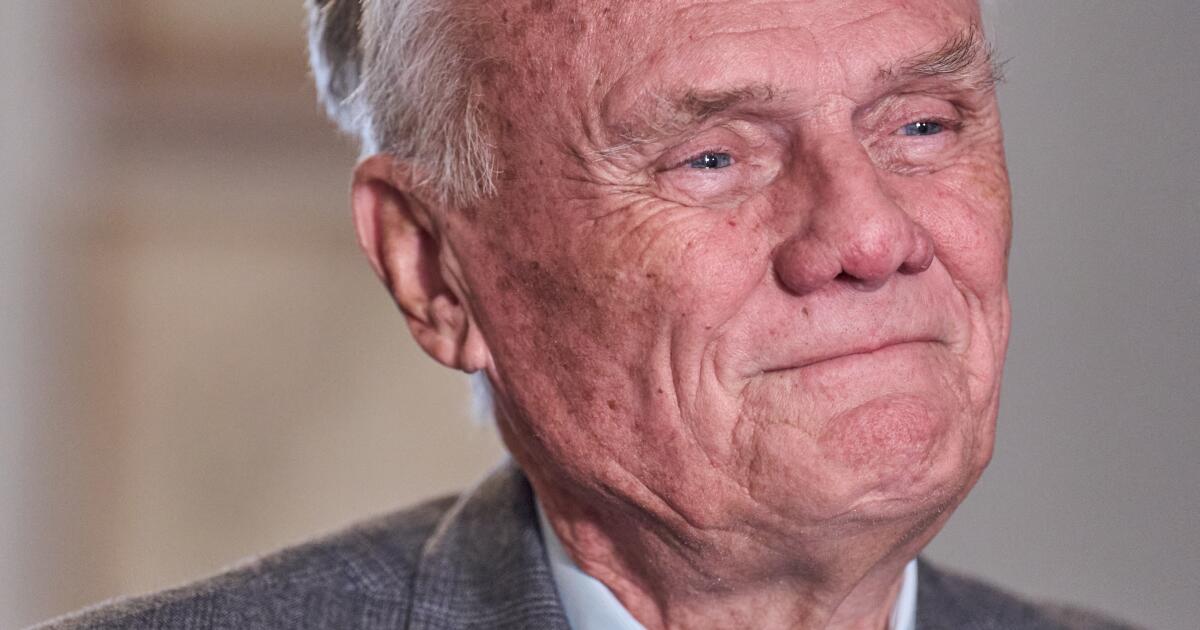
Gov. Pete Wilson on Thursday formally named Greater San Diego Chamber of Commerce President Lee Grissom as senior policy adviser for economic development.
Grissom, 49, resigned from the chamber on Tuesday after heading the business group for 17 years. Over that period he oversaw the chamber’s growth from 1,400 to 3,700 member firms and helped mold the organization into an influential force in city politics.
In his new job, Grissom will advise the governor on economic planning as well as issues relating to the state’s efforts to attract and retain jobs.
Grissom has experience in that area, having served on the Governor’s Council on California’s Competitiveness, a blue-ribbon group that surveyed the problems of doing business in California contrasted with other states.
Kyrylo Budanov, 39, has been named President Volodymyr Zelensky’s new chief of staff. File Photo by Sergey Dolzhenko/EPA
Jan. 2 (UPI) — Ukrainian President Volodymyr Zelensky announced Friday that he named spy boss Lt. Gen. Kyrylo Budanov as his chief of staff.
“I had a meeting with Kyrylo Budanov and offered him the role of the Head of the Office of the President of Ukraine. At this time, Ukraine needs greater focus on security issues, the development of the Defense and Security Forces of Ukraine, as well as on the diplomatic track of negotiations, and the Office of the President will primarily serve the fulfillment of these tasks of our state. Kyrylo has specialized experience in these areas and sufficient strength to deliver results,” Zelensky said in a post on X.
“It is both an honor and a profound commitment, especially at this decisive moment in our country’s history, to focus on issues critical to Ukraine’s strategic security,” Budanov said.
“We will continue to do what must be done — to strike the enemy, defend Ukraine, and work tirelessly toward a just peace. Together, we will continue to fight for a free and secure future for Ukraine.”
Zelensky’s former chief of staff, Andriy Yermak, resigned on Nov. 28 after a raid on his home in a sweeping corruption scandal. Yermak was the most powerful political figure in Ukraine behind Zelensky.
Budanov, 39, has been the leader of the country’s Hur military intelligence agency since 2020. The agency is known as one of the most competent institutions in the country, and Budanov has become a household name, the Kyiv Independent said.
A lawmaker from Zelensky’s party told the Independent that hiring Budanov could indicate that the peace plan for the war between Ukraine and Russia negotiated by President Donald Trump and his team may fall apart.
“We need to prepare for a long, exhausting struggle. And this is exactly the approach that Budanov represents,” the lawmaker said.
Budanov “will need to build his own system, his own vertical of power. I think it will be a different style of leadership for the office,” the source told the Independent. “He’s a spymaster, but he’s not a master of political intrigue.”
Ukrainian demonstrators rally in Kyiv on February 12, 2022 to show unity amid U.S. warnings of an imminent Russian invasion. Photo by Oleksandr Khomenko/UPI | License Photo
WEST PALM BEACH, Fla. — President Trump has spent much of his two-week vacation in Florida golfing. But when he gets back to the White House, there’s a military golf course that he’s never played that he’s eyeing for a major construction project.
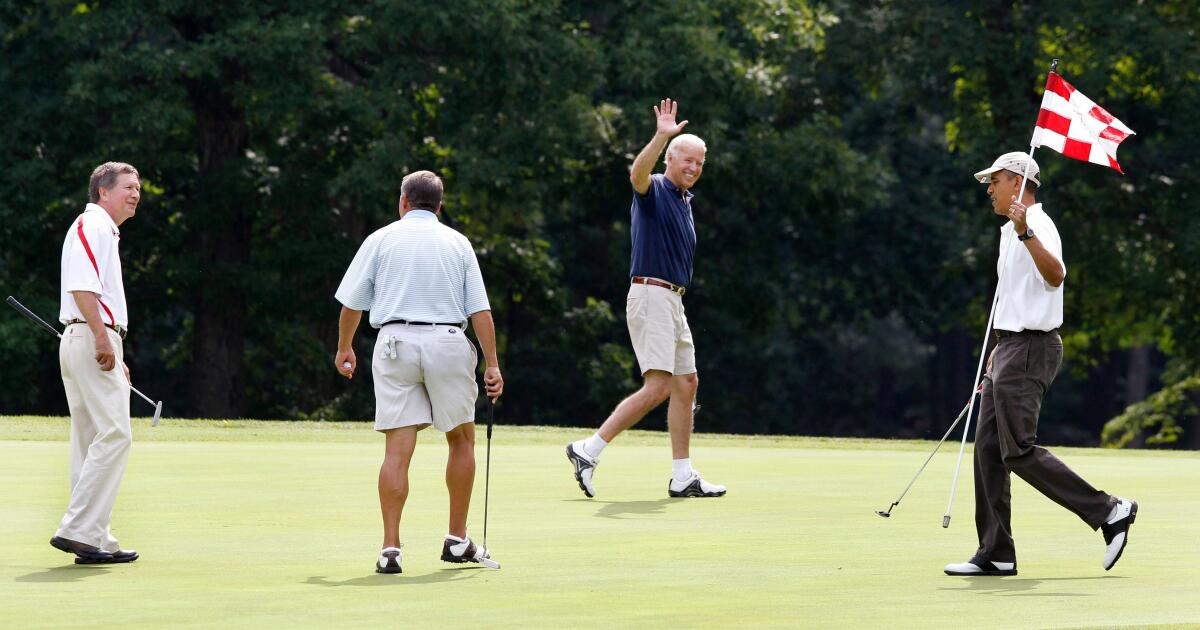
Long a favored getaway for presidents seeking a few hours’ solace from the stress of running the free world, the Courses at Andrews — inside the secure confines of Joint Base Andrews in Maryland, about 15 miles from the White House — are known as the “president’s golf course.” Gerald Ford, Ronald Reagan, George H.W. Bush, Bill Clinton, George W. Bush and Joe Biden have spent time there, and Barack Obama played it more frequently than any president, roughly 110 times in eight years.
Trump has always preferred the golf courses his family owns — spending about one of every four days of his second term at one of them. But he’s now enlisted golf champion Jack Nicklaus as the architect to overhaul the Courses at Andrews.
“It’s amazing that an individual has time to take a couple hours away from the world crises. And they’re people like everybody else,” said Michael Thomas, the former general manager of the course, who has golfed with many of the presidents visiting Andrews over the years.
Andrews, better known as the home of Air Force One, has two 18-hole courses and a 9-hole one. Its facilities have undergone renovations in the past, including in 2018, when Congress approved funding to replace aging presidential aircraft and to build a new hangar and support facilities. That project was close enough to the courses that they had to be altered then, too.
Trump toured the base by helicopter before Thanksgiving with Nicklaus, who has designed top courses the world over. The president called Andrews “a great place, that’s been destroyed over the years, through lack of maintenance.”
Other golfers, though, describe Andrews’ grounds as in good shape, despite some dry patches. Online reviews praise the course’s mature trees, tricky roughs, and ponds and streams that serve as water hazards. The courses are mostly flat, but afford views of the surrounding base.
‘They all like to drive the cart’
The first president to golf at Andrews was Ford in 1974. Thomas began working there a couple years later, and was general manager from 1981 until he retired in 2019.
He said the Secret Service over the years used as many as 28 golf carts — as well as the president’s usual 30-car motorcade — to keep the perimeter secure.
“It’s a Cecil B. DeMille production every time,” said Thomas, who had the opportunity to play rounds with four different presidents, and with Biden when he was vice president.
He said the commanders in chief generally enjoyed their time out on the course in their own unique ways, but “they all like to drive the cart because they never get an opportunity to drive.”
“It’s like getting your driver’s license all over again,” Thomas laughed.
Trump golfs most weekends, and as of Friday, has spent an estimated 93 days of his second term doing so, according to an Associated Press analysis of his schedules.
That tally includes days when Trump was playing courses his family owns in Virginia, around 30 miles from the White House, and near his Florida estate Mar-a-Lago, where he’s spending the winter holidays. It also includes 10 days Trump spent staying at his golf club in Bedminster, N.J., where his schedule allowed time for rounds of golf.
Trump has visited Andrews in the past, but the White House and base have no record of him playing the courses.
Another of Trump’s construction projects
Andrews’ military history dates to the Civil War, when Union troops used a church near Camp Springs, Md., as sleeping quarters. Its golf course opened in 1960.
The White House said the renovation will be the most significant in the history of Andrews. The courses and clubhouse need improvements due to age and wear, it said, and there are discussions about including a multifunctional event center as part of the project.
“President Trump is a champion-level golfer with an extraordinary eye for detail and design,” White House spokesman Davis Ingle said in a statement. “His vision to renovate and beautify Joint Base Andrews’ golf courses will bring much-needed improvements that service members and their families will be able to enjoy for generations to come.”
Plans are in the very early stages, and the cost of — and funding for — the project haven’t been determined, the White House said. Trump has said only that it will require “very little money.”
The Andrews improvements join a bevy of Trump construction projects, including demolishing the White House’s East Wing for a sprawling ballroom now expected to cost $400 million, redoing the bathroom attached to the Lincoln bedroom and replacing the Rose Garden’s lawn with a Mar-a-Lago-like patio area.
Outside the White House, Trump has led building projects at the Kennedy Center and wants to erect a Paris-style arch near the Lincoln Memorial, and has said he wants to rebuild Dulles International Airport in northern Virginia.
On Wednesday, meanwhile, the Trump administration ended a lease agreement with a nonprofit for three public golf courses in Washington — which could allow the president to further shape golfing in the nation’s capital. The White House, however, said that move isn’t related to the plans for Andrews.
Presidential perks of golfing at Andrews
When the president is golfing, Andrews officials block off nine holes at a time so no one plays in front of him, allowing for extra security while also ensuring consistent speed-of-play, Thomas said.
That’s relatively easily done given that the courses aren’t open to the public. They’re usually reserved for active or retired members of the military and their families, as well as some Defense Department-linked federal employees.
Thomas remembers playing a round with the older President Bush, a World Golf Hall of Fame inductee known for fast play, while first lady Barbara Bush walked with Millie, the first couple’s English Springer Spaniel. George W. Bush also played fast, Thomas said, and got additional exercise by frequently riding his mountain bike before golfing.
When he wasn’t golfing at Andrews, Obama tried to recreate at least part of the experience back home. He had a White House golf simulator installed after then-first lady Michelle Obama asked Thomas how they might acquire a model that the president had seen advertised on the Golf Channel. Thomas gave her a contact at the network.
Obama famously cut short a round at Andrews after nine holes in 2011 to hustle back to the White House for what turned out to be a top-secret review of final preparations for a Navy SEAL raid on the compound of Osama bin Laden.
But, while Thomas was golfing with presidents, he said he never witnessed play interrupted by an important call or any major emergency that forced them off the course mid-hole. There also were never any rain-outs.
“If there was rain coming, they’d get the weather forecast before we would,” Thomas said. “They would cancel quick on that.”
Chinese President Xi Jinping has invited South Korean President Lee Jae Myung to a state visit in Beijing, signalling China’s desire to reinforce relations with South Korea amid regional turbulence.
South Korea’s national security adviser, Wi Sung-lac, told reporters on Friday that Lee will meet Xi in Beijing on Monday before travelling to Shanghai to visit the historic site of South Korea’s provisional government during Japan’s 35-year colonial rule.
Recommended Stories
list of 4 itemsend of list
Wi said the leaders are expected to discuss “practical cooperation” in areas including supply-chain investment, tourism, and responses to transnational crime, according to Yonhap News Agency.
Lee is also expected to persuade China to take a “constructive” role in achieving “a breakthrough in resolving issues on the Korean Peninsula”, Wi added.
It will be the second meeting between Xi and Lee in just two months, in what analysts have described as an unusually short interval, reflecting Beijing’s interest in bolstering ties before the next meeting between the leaders of South Korea and Japan takes place.
Relations between China and Japan remain at a low point after Japanese Prime Minister Sanae Takaichi suggested in November that a hypothetical Chinese attack on Taiwan could provoke a military response from Tokyo.
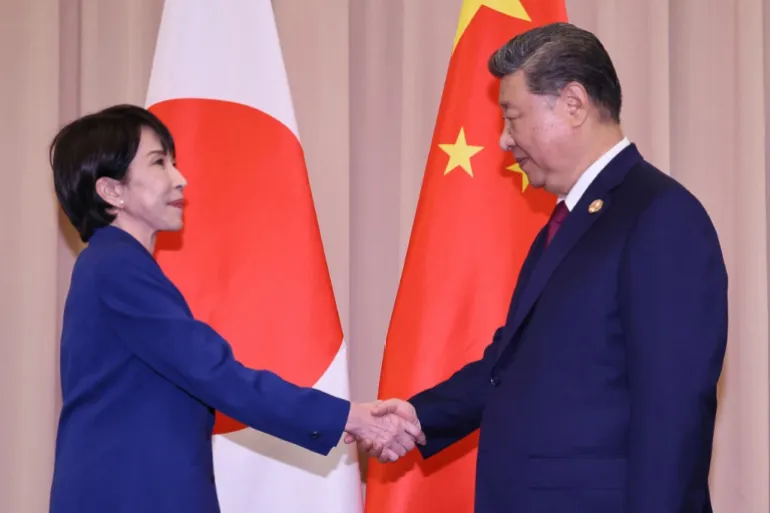
Japan’s Prime Minister Sanae Takaichi (L) shakes hands with Chinese President Xi Jinping before the Japan-China summit on the sidelines of the Asia-Pacific Economic Cooperation (APEC) Summit in Gyeongju [File: Jiji Press/AFP]
On Friday, Wi reaffirmed South Korea’s position on Taiwan, saying the country does “respect the one China policy and act in accordance with that position”. The position acknowledges Beijing’s view that Taiwan remains part of its sovereign territory, while allowing for separate ties with the self-governing island.
Kang Jun-young, a professor of political economics at Hankuk University of Foreign Studies, said “China wants to emphasise South Korea’s importance slightly more than before.
“China appears to have strategically decided that it would be better to have [Lee] visit China before South Korea holds a summit with Japan again,” Kang told the Reuters news agency.
For its part, the Lee administration has stressed its goal of “restoring” ties with China, which remains South Korea’s largest trading partner. At the same time, it has said Lee’s approach of “practical diplomacy” aims to maintain strong ties with Japan and the United States, South Korea’s most important ally.
Under Lee’s predecessor, Yoon Suk Yeol, Seoul leaned closer to Washington and Tokyo and increased criticism of China’s stance on Taiwan.
Lee, in contrast, has said he will not take sides in the dispute between China and Japan, a position he maintains as tensions around the Taiwan Strait rise following Beijing’s recent large-scale military drills near Taiwan.
Security alliances, regional strategy
The two leaders may also address contentious issues such as efforts to modernise the South Korea-US alliance, which some see as a counterbalance to China’s dominance in the Asia Pacific region, according to Shin Beom-chul, a former South Korean vice defence minister and senior research fellow at the Sejong Institute.
Currently, roughly 28,500 US troops are stationed in South Korea to deter threats from North Korea. US officials have signalled plans to make those forces more flexible in responding to other regional challenges, including Taiwan and China’s growing military reach.
“Korea is not simply responding to threats on the peninsula,” General Xavier Brunson, commander of US Forces Korea, said at a forum on December 29. “Korea sits at the crossroads of broader regional dynamics that shape the balance of power across Northeast Asia.”
As China remains North Korea’s principal ally and economic lifeline, experts expect Lee to seek Beijing’s assistance in encouraging dialogue with Pyongyang.
North Korea dismissed Lee’s outreach last year, calling him a “hypocrite” and “confrontational maniac”.
China and North Korea have, in turn, continued closer coordination, with North Korean leader Kim Jong Un appearing alongside Xi at a major military parade in September.
Trade and culture
Lee’s visit is also expected to focus on cooperation in critical minerals, supply chains, and green industries, his office said.
Nearly half of South Korea’s rare earth minerals, which are essential for semiconductor production, come from China. The trading partner accounts for a third of Seoul’s annual chip exports, its largest market.
Last month, officials from both countries agreed to work towards stable rare earth supplies. The visit may also explore partnerships in AI and advanced technologies.
Huawei Technologies plans to launch its Ascend 950 AI chips in South Korea next year, providing an alternative to US-based Nvidia for Korean firms, Huawei’s South Korea CEO, Balian Wang, said at a news conference last month.
Another potential topic is Beijing’s effective ban on K-pop content, which stretches back to 2017 following the deployment of the US’s THAAD missile defence system in South Korea.
SM Entertainment’s chief executive, who heads one of the country’s leading K-pop agencies, will join Lee’s business delegation, according to local media.
In an exclusive interview, Somalia’s president Hassan Sheikh Mohamud told Al Jazeera that terror groups ISIL and al-Shabab are responsible for destroying the Somali people’s livelihood and security, and says the groups opened the door to Israeli recognition of Somaliland.
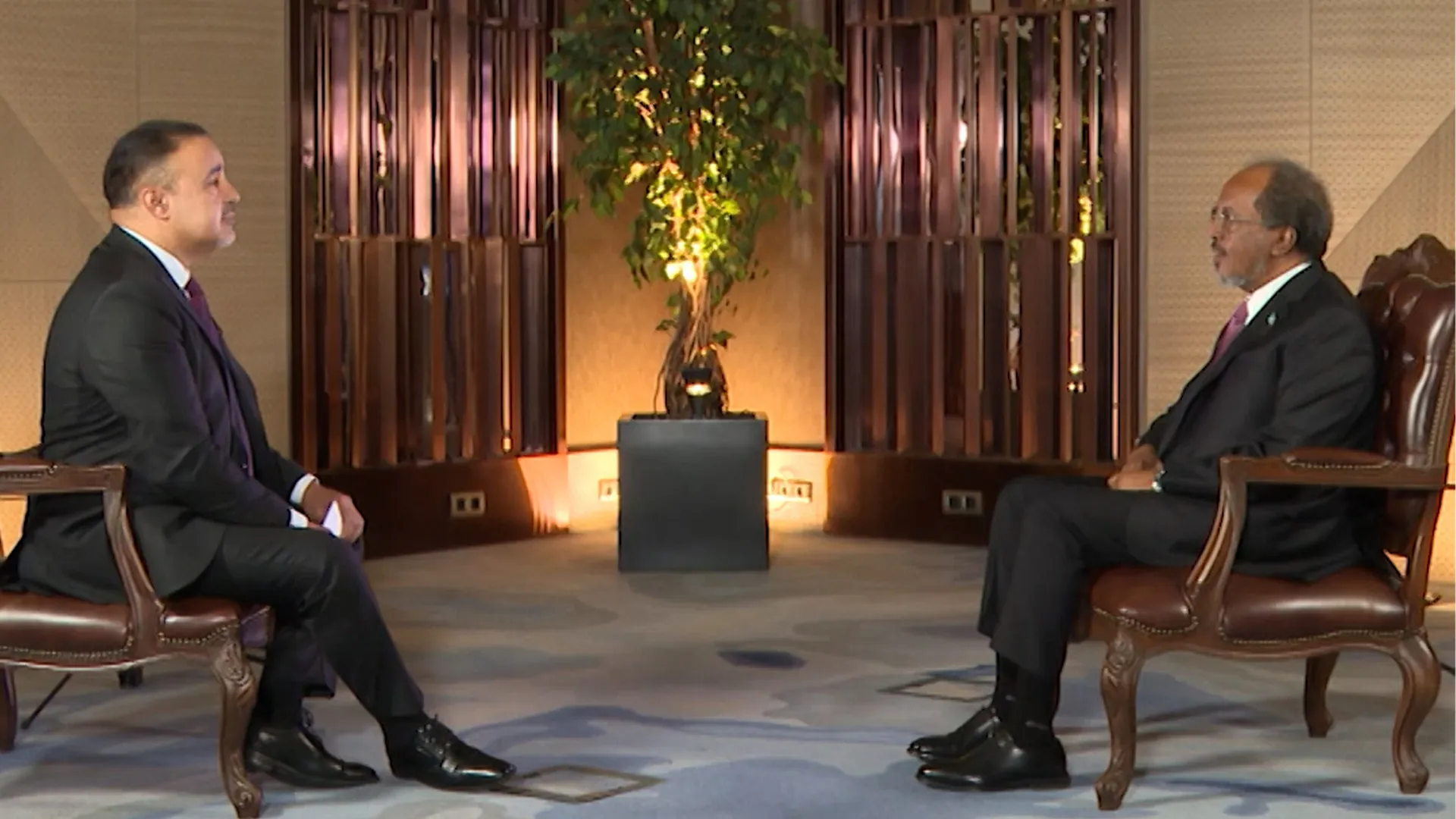
In an exclusive interview, Somalia’s president Hassan Sheikh Mohamud told Al Jazeera that the breakaway region of Somaliland has agreed to accept displaced Palestinians being relocated there in exchange for recognition. Somaliland officials have rejected the allegations.
The most potent attack ad of Donald Trump’s comeback campaign seemingly ran on a loop during the final weeks before the 2024 election. Assailing rights for transgender people, its punch line indeed delivered a punch: “Kamala Harris is for they/them. President Trump is for you.”
2025: Promise broken. Back in office, the president has shown that the only pronouns he really recognizes are the first-person kind: me, myself and I.
A year into Trump 2.0, those self-regarding pronouns are now firmly affixed as the bywords of his presidency, on matters major and mundane. They might as well be mounted in gold in the Oval Office, in fonts so large as to not get lost amid all the bling he’s installed there. Asked in October just who was to be honored by Trump’s planned Arc de Triomph-like monument near Arlington Cemetery, the president was quick: “Me.”
To an extent that’s shocked even critics long convinced of his sociopathic narcissism, Trump has fashioned a government that’s of Trump, by Trump and for Trump. “I run the country and the world,” he boasted in April. Trump thinks “there’s nothing he can’t do. Nothing, zero, nothing,” his White House chief of staff, Susie Wiles, told Vanity Fair, as reported in twoarticles last month that signaled her own unease with Trump’s ongoing vengeance against his political enemies; his clemency for even the most violent rioters of Jan. 6, 2021; the pain of his erratic tariffs, too-cruel migrant roundups and tragic shutdown of USAID’s humanitarian aid; his stonewalling of the Jeffrey Epstein files that candidate Trump promised to release; and the foibles of his slavish Cabinet.
If Trump strutted as the center of the universe in 2025 — unchecked by advisors like Wiles or by a cowed Republican-controlled Congress, the Supreme Court and corporate chieftains — buckle up for 2026. It marks the 250th birthday of America’s independence, and our self-appointed master of ceremonies is focused on the festivities that he’ll star in not only on July 4th but all year long. One of his first acts as president was to create a White House task force with himself as chair, of course, to plan semiquincentennial events, ignoring an eight-year-old commission created by Congress for that purpose. Coming soon: A (possibly illegal) commemorative $1 coin with Trump’s image from the U.S. Mint.
Never mind that 2026 starts with a big spike in health insurance costs for tens of millions of Americans, including many Trump voters. The president who campaigned on bringing down the costs of living has stood in the way of a legislative remedy to the Dec. 31 expiration of healthcare premium subsidies, repeatedly mouthing his years-old promise that he’ll propose a cheaper alternative within weeks.
But here’s how 2026 will end: with midterm elections in November that loom as a referendum on whether the Trump Republican Party should keep control of Congress. The early betting is that no, it won’t. Especially after another year of Trump grandstanding, and his party’s genuflecting.
In good times, Trump’s garish self-regard might be tolerable to voters, even comical. But these aren’t good times, hardly the “golden age” Trump announced in his inaugural address last January — except for him and the wealthy hangers-on at his seemingly endless round of parties in the White House and at Mar-a-Lago. The Gatsby-themed Halloween party at Trump’s Florida resort was especially rich, pun intended, coming as it did hours before federal food aid for 42 million Americans expired amid a government shutdown he’d done nothing to avert.
Days later, voters gave a shellacking to Republicans in various states’ 2025 off-year elections, which is a good omen for the same result nationwide in 2026. There are other signs. On Tuesday, a new Gallup poll showed three out of four Americans were dissatisfied with “the way things are going in the United States.” Trump’s approval rating was just 36% in Gallup’s poll in early December, his lowest reading of the past year, and nearly equal to his all-time low after the Jan. 6 insurrection. Averages of various polls show Trump with negative ratings on his handling of immigration, the economy, trade and tariffs, and inflation — all issues that helped get him reelected.
But go ahead, Mr. President. Keep talking about how great you are. You’re a legend in your own time and mind.
Trump’s tone-deafness has become the great mystery of U.S. politics, for both parties, especially considering that he slammed President Biden for bragging about the economy’s post-pandemic recovery when Americans weren’t feeling it.
As Americans struggle to buy a home or to afford its upkeep, Trump has gilded the People’s House (see the New York Times’ recent 3-D recreation of the Oval Office for full, nauseating effect) and transformed the bathroom adjoining the Lincoln Bedroom in marble and gold. Having demolished the East Wing to make way for a gargantuan ballroom where Marie Antoinette would be at home, financed by favor-seeking billionaires and corporations, Trump told reporters on Tuesday that it would have to be bigger than he’d first planned because “we’re gonna do the inauguration” there.
What? The man who’s supposed to be leaving office on Jan. 20, 2029, is picking the new location for the next presidential inauguration? Hmmm.
Even before he’s been in office a year, Trump has put his brand on two Washington buildings, including the nation’s 60-year-old cultural center named by law as a memorial to an assassinated president. The Kennedy Center (no, I will not call it by Trump’s name) will have marble armrests; Trump took to social media on the day after Christmas to show off samples. Meanwhile, he’s refurbishing a royal jet from Qatar, a “palace in the sky.”
Trading on his power in unprecedented ways, Trump was a “crypto billionaire” by May, the Wall Street Journal reported, and in August the New Yorker estimated that he’d profited in office by at least $3.4 billion through crypto and licensing deals.
NEW YORK — By nearly any measure, 2025 has been a rough year for anyone concerned about freedom of the press.
It’s likely to be the deadliest year on record for journalists and media workers. The number of assaults on reporters in the U.S. nearly equals the last three years combined. The president of the United States berates many who ask him questions, calling one woman “piggy.” And the ranks of those doing the job continues to thin.
It’s hard to think of a darker time for journalists. So say many, including Timothy Richardson, a former Washington Post reporter and now program director for journalism and disinformation at PEN America. “It’s safe to say this assault on the press over the past year has probably been the most aggressive that we’ve seen in modern times.”
Tracking killings and assaults against journalists
Worldwide, the 126 media industry people killed in 2025 by early December matched the number of deaths in all of 2024, according to the Committee to Protect Journalists, and last year was a record-setter. Israel’s bombing of Gaza accounted for 85 of those deaths, 82 of them Palestinians.
“It’s extremely concerning,” said Jodie Ginsberg, chief executive of the Committee to Protect Journalists. “Unfortunately, it’s not just, of course, about the sheer numbers of journalists and media workers killed, it’s also about the failure to obtain justice or get accountability for those killings.
“What we know from decades of doing this work is that impunity breeds impunity,” she said. “So a failure to tackle journalists’ killings creates an environment where those killings continue.”
The committee estimates there are at least 323 journalists imprisoned worldwide.
None of those killed this year were from the United States. But the work on American soil has still been dangerous. There have been 170 reports of assaults on journalists in the United States this year, 160 of them at the hands of law enforcement, according to the U.S. Press Freedom Tracker. Many of those reports came from coverage of immigration enforcement efforts.
It’s impossible to look past the influence of Trump, who frequently seethes with anger at the press while simultaneously interacting with journalists more than any president in memory — frequently answering their cell phone calls.
“Trump has always attacked the press,” Richardson said. “But during the second term, he’s turned that into government action to restrict and punish and intimidate journalists.”
Journalists learn quickly they have a fight on their hands
The Associated Press learned that quickly, when Trump limited the outlet’s access to cover him after it refused to follow his lead to rename the Gulf of Mexico. It launched a court fight that has remained unresolved. Trump has also extracted settlements from ABC and CBS News in lawsuits over stories that displeased him, and is suing the New York Times and Wall Street Journal.
Long angry about a perceived bias against conservatives on PBS and NPR newscasts, Trump and his allies in Congress successfully cut funding for public broadcasting as a whole. The president has also moved to shut down government-run organizations that beam news to all parts of the world.
“The U.S. is a major investor in media development, in independent media outlets in countries that have little or no independent media, or as a source of information for people in countries where there is no free media,” Ginsberg said. “The evisceration of Radio Free Europe, Radio Free Asia and the Voice of America is another blow to press freedom globally.”
Others in his administration take Trump’s lead, like when his press office chose the day after Thanksgiving to launch a web portal to complain about outlets or journalists being unfair.
“It’s part of this overall strategy that we’re seeing from certain governments, notably the United States, to paint all journalists who don’t simply [repeat] the narrative put out by the government as fake news, as dubious, as dodgy, as criminal,” Ginsberg said.
Trump’s defense secretary, Pete Hegseth, has portrayed journalists as dark figures skulking around Pentagon halls to uncover classified secrets as his rationale for enacting restrictive rules for coverage.
That’s led to the most notable example of journalists fighting back: most mainstream news outlets gave up their credentials to work in the Pentagon rather than agree to these rules, and are still breaking stories while working off-site. The New York Times has sued to overturn the rules. The newspaper also publicly defends itself when attacked by the president, such as when he complained about its coverage of his health.
Despite the more organized effort against the press, the public has taken little notice. The Pew Research Center said that 36% of Americans reported earlier this year hearing a lot about the Trump administration’s relationship with the press, compared to 72% who said that at the same point in his first term.
Pew’s polling shows that trust in news organizations has declined over the last decade, and journalists are likely to elicit little sympathy when their work becomes harder.
“Really, the harm falls on the public with so much of this because the public depends on this independent reporting to understand and scrutinize the decisions that are being made by the most powerful office in the world,” Richardson said.
Some reasons for optimism
The news industry as a whole is more than two decades in to a retrenchment caused largely by a collapse in the advertising market, and every year brings more reports of journalists laid off as a result. One of the year’s most sobering statistics came in a report by the organizations Muck Rack and Rebuild Local News: in 2002, there were 40 journalists for every 100,000 people in the United States; by this year, it was down to a little more than eight.
Asked if they could find reasons for optimism, both Ginsberg and Richardson pointed to the rise of some independent local news organizations, shoots of growth in a barren landscape, such as the Baltimore Banner, Charlottesville Tomorrow in Virginia and Outlier Media in Michigan.
As much as they are derided in Trump’s America, reporters at mainstream media outlets are still working hard and able to set the nation’s agenda with their reporting, noted influential Axios CEO Jim VandeHei in a recent column.
As he told the AP: “Over time, people will hopefully come to their senses and say, ‘Hey, the media like anything else is imperfect but, man, it’s a nice thing to have a free press.’”
WASHINGTON — President Trump is not the first president to want more room at the White House for entertaining, says the longest-serving top aide in the executive residence, offering some backup for the reason Trump has cited for his ballroom construction project.
Gary Walters spent more than two decades as White House chief usher to presidents Reagan, George H.W. Bush, Clinton and George W. Bush — a role that is akin to being the general manager of the residence.
“All the presidents that I had an opportunity to serve always talked about some possibility of an enlarged area” for entertaining, Walters said in an interview with the Associated Press about his recently published memoir.
Trump has been talking about building a White House ballroom for years, even before he entered the political arena. In July, the White House announced a 90,000-square-foot space would be built on the east side of the complex to accommodate 650 seated guests at a then-estimated cost of $200 million. Trump has said it will be paid for with private donations, including from him.
The Republican president later upped the proposed ballroom’s capacity to 999 people and, by October, had demolished the two-story East Wing of the White House to build it there. In December, he updated the price tag to $400 million — double the original estimate.
Images of the East Wing being demolished shocked historians, preservationists and others, but Walters said there is a long history of projects on the campus, ranging from conservatories, greenhouses and stables being torn down to build the West Wing in 1902, to the expansion of the residence with a third floor, to the addition of the East Wing itself during World War II to provide workspace for the first lady, her staff and other White House offices.
“So there’s always been construction going on around the White House,” Walters said.
Other presidents bemoaned the lack of space for entertaining
When Walters was on the job, the capacity of the largest public rooms in the White House was among the first topics he discussed with the incoming president, first lady and their social secretary, he said. The presidents he served all talked about the limited number of people the White House could handle.
When set up for a state dinner, the State Dining Room can hold about 130 people: 13 round tables each with seating for 10, Walters said. The East Room can accommodate about 300 chairs — fewer if space is needed for television cameras.
Trump complains often that both rooms are too small. He also has complained about the use of large tents on the south grounds, the main workaround for big events such as ritzy state dinners for foreign leaders. Walters said the tents had issues.
“When it rained, the water flows downhill and the grass became soggy, no matter what we tried to do,” Walters said. “We dug culverts around the outside of the tent to try and get the water.” Tents damaged the grass, requiring more work to reseed it, he said.
Walters admitted it was a bit jarring to see the East Wing torn down, and said he had fond personal memories of the space. “I met my wife at the White House and she worked in the East Wing, so that was a joy for me,” said Walters, 79.
His wife, Barbara, was a receptionist in the visitors office during the administrations of Richard Nixon and Gerald Ford. The couple recently celebrated 48 years of marriage.
Broken bones alter usher’s career trajectory
Walters owes his place in history as the longest-serving White House chief usher to the misfortune of a broken ankle.
He was 23 in early 1970, honorably discharged from the Army and looking for a job that would allow him to finish college at night. The Executive Protective Service, a precursor to the U.S. Secret Service, was hiring and accepted him.
But shortly before the graduation ceremony, Walters broke an ankle playing football. He could not patrol out of uniform, wearing a cast and hobbling around on crutches, so he was given a temporary assignment in the White House Police Control and Appointments Center. He stayed for five years.
“This injury also changed the course of my career,” Walters wrote in his memoir, “White House Memories: 1970-2007: Recollections of the Longest-Serving Chief Usher.” He gained an ”in-depth knowledge of the ways and security systems of the White House that would ultimately greatly benefit me in my future role in the Usher’s Office.”
A few months after being promoted to sergeant in 1975, he learned of an opening in the Usher’s Office. He applied and joined as an assistant in early 1976.
A decade later, he was elevated to chief usher by Reagan, who gave Walters the top job in the residence overseeing maintenance, construction and renovation projects, and food service, along with administrative, financial and personnel functions. He managed a staff of about 90 butlers, housekeepers, cooks, florists, electricians, engineers, plumbers and others.
Walters retired in 2007 after 37 years at the White House, including a record 21 years as chief usher. He served under seven presidents, from Nixon to George W. Bush.
In that time, Walters saw a broad swath of presidential history: the only president who ever resigned, an appointed vice president become the only unelected president, a president be impeached and stay in office, a father and son become president and the Supreme Court decide the most closely contested presidential election in U.S. history.
He’s often asked what he liked most about his work and “without hesitation I say it is getting to know and interact directly with the president, first lady, and other members of their family. It was an honor to get to know them with my own eyes and ears,” Walters wrote.
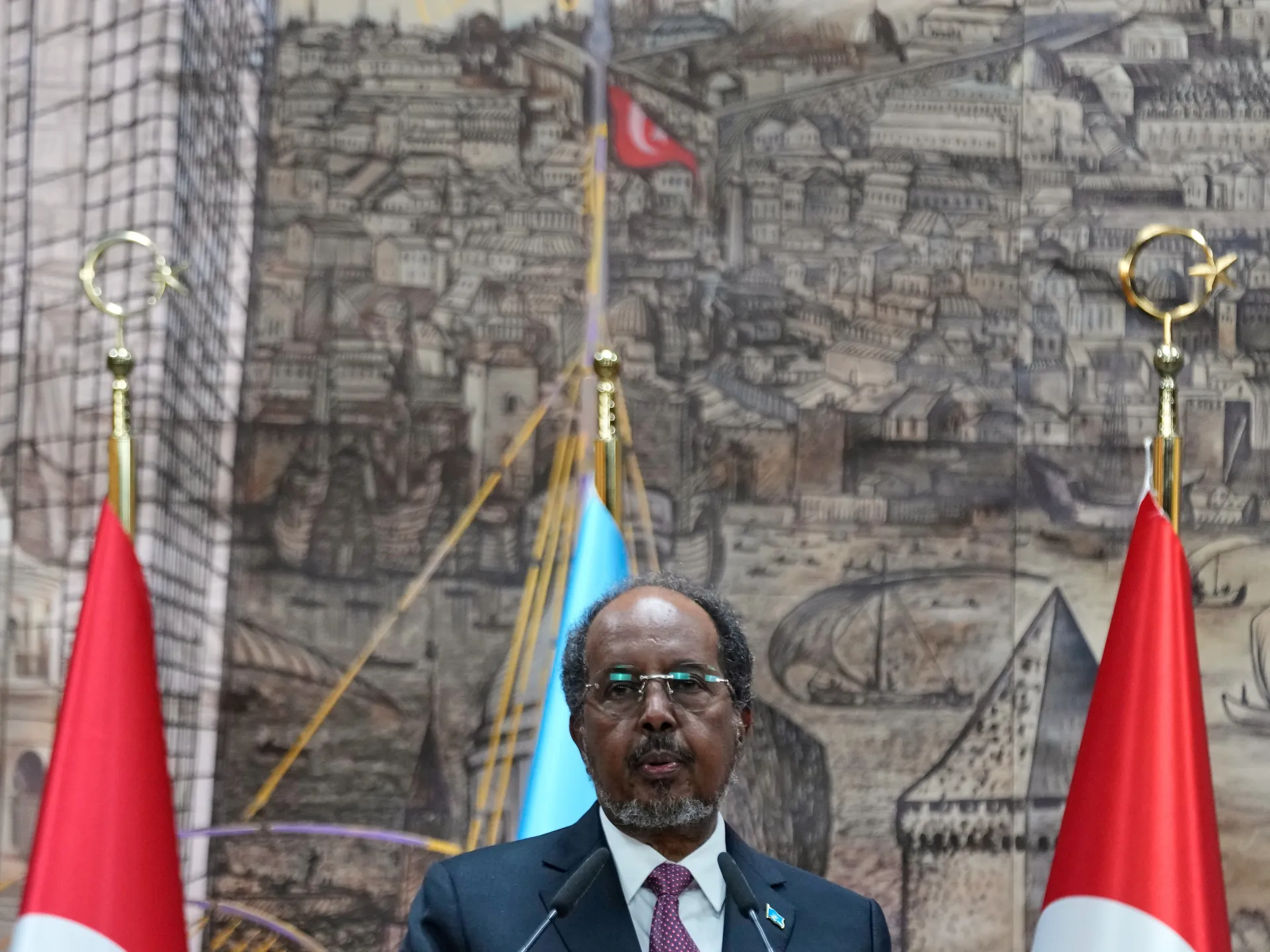
Hassan Sheikh Mohamud says his country believes the move is linked to Israel’s plans to forcibly displace Palestinians from Gaza.
Somali President Hassan Sheikh Mohamud has told Al Jazeera that Israel’s “unexpected and strange” recognition of Somaliland may have implications for Palestinians in Gaza.
“Somaliland has been claiming the secession issue for a long time, over the past three decades, and no one country in the world has recognised it,” Mohamud told Al Jazeera in an exclusive interview from Istanbul, Turkiye, on Tuesday.
Recommended Stories
list of 4 itemsend of list
“For us, we’ve been trying to reunite the country in a peaceful manner,” the Somali leader added. “So, after 34 years, it was very unexpected and strange that Israel, out of nowhere, just jumped in and said, ‘We recognise Somaliland’.”
Israel last week became the first and only country to formally recognise Somaliland, a breakaway region in northwest Somalia, bordering the Gulf of Aden.
Somalia’s president also told Al Jazeera that, according to Somali intelligence, Somaliland has accepted three Israeli conditions in exchange for Israeli recognition: the resettlement of Palestinians, the establishment of an Israeli military base on the coast of the Gulf of Aden, and Somaliland joining the Abraham Accords. The accords are a set of pacts establishing the normalisation of ties between Israel and several Arab states. The UAE, Bahrain, Morocco and Sudan have signed onto the accords.
Mohamud also said that Somalia has intelligence indicating there is already a certain level of Israeli presence in Somaliland, and Israeli recognition of the region is merely a normalisation of what was already happening covertly.
Israel will resort to forcibly displacing Palestinians to Somalia, and its presence in the region is not for peace, the Somali leader added.
A 20-point plan released by the administration of US President Donald Trump ahead of a ceasefire between Israel and Hamas in Gaza said that “no one will be forced to leave Gaza, and those who wish to leave will be free to do so and free to return”.
However, Israel has reportedly continued to explore ways to displace Palestinians from the besieged and occupied territory, including in mysterious flights to South Africa, which has formally accused Israel of committing genocide in Gaza.
Israel is also seeking to control strategically important waterways connecting vital seas of commercial and economic significance, namely the Red Sea, the Gulf and the Gulf of Aden, Mohamud said.
The Somali leader was in Turkiye on Tuesday, where he gave a joint news conference with Turkish President Recep Tayyip Erdogan, with the two leaders warning that Israel’s recognition of the breakaway region could destabilise the Horn of Africa.
Somaliland declared independence from Somalia in 1991, but had failed to gain recognition from any United Nations member state, before Israel changed its position last Friday.
Israel’s move was swiftly condemned, including by most members of the UN Security Council at an emergency meeting convened in New York on Monday.
The United States was the only member of the 15-seat body that defended Israel’s move, although it stressed that the US’s position on Somaliland remained unchanged.
WASHINGTON — President Reagan signed the Farm Credit System rescue bill with misgivings Wednesday, saying that some provisions foster a tendency to put federal props under the agricultural economy.
Although finding fault with some aspects of the legislation to bail out as much as $4 billion in federally guaranteed bonds for the debt-ridden credit system, Reagan said the measure “ensures that the farm credit system will continue as a principal source of private credit to America’s farmers.”
During a bill-signing ceremony in the White House’s Roosevelt Room, the President said also that the legislation “implements many needed reforms to the system to ensure its long-term viability.”
Reagan painted a generally rosy picture of farming in his remarks but said that “many of America’s farmers are still suffering from the aftershocks of the runaway inflation of the ‘70s.”
$4.8 Billion in Losses
The Farm Credit System is a 70-year-old network of 37 banks and hundreds of local lending co-ops. It provides credit to one-third of the nation’s farm borrowers but has registered losses of $4.8 billion over the last two years.
The system’s problems are generally blamed on the crisis that swept rural America in the early 1980s, when land values plunged in the wake of falling crop prices and farmers were saddled with long-term loans at high interest rates.
Reagan used the bill-signing ceremony to criticize some provisions that he said encourage continued reliance by farmers on federal aid and are too expensive.
“Unfortunately, the Congress declined to require the system to provide as much self-help as we believe was appropriate and created new and potentially expensive federal support mechanisms for secondary markets for private sector agricultural loans,” he said.
The bill is expected to cost taxpayers up to $1.5 billion over five years. The Treasury eventually could have to pay the whole $4 billion plus interest if the system folds despite the rescue effort, but that is considered unlikely.
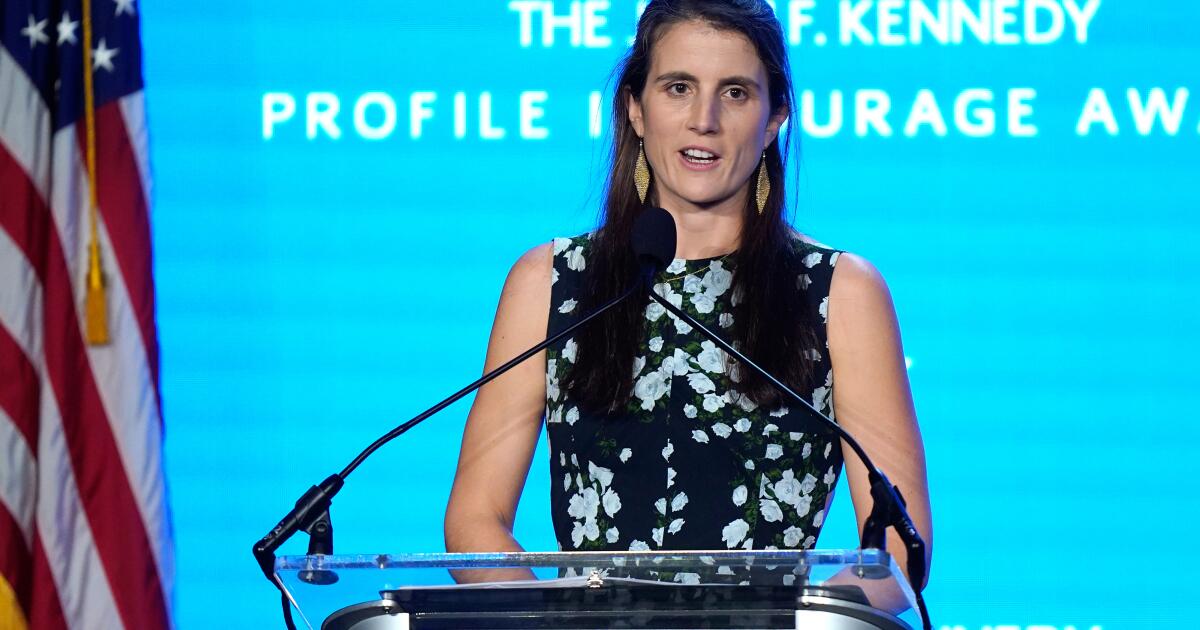
BOSTON — Environmental journalist Tatiana Schlossberg, the granddaughter of the late President John F. Kennedy, has died. She was 35.
Schlossberg, the daughter of Kennedy’s daughter, Caroline Kennedy, and Edwin Schlossberg, revealed that she had terminal cancer in a November 2025 essay in The New Yorker. Her family issued a statement disclosing her death, which was released on social media by the John F. Kennedy Library Foundation.
“Our beautiful Tatiana passed away this morning. She will always be in our hearts,” the statement said. It did not disclose a cause of death or say where she died.
Schlossberg was diagnosed with acute myeloid leukemia in May 2024 at 34. After the birth of her second child, her doctor noticed her white blood cell count was high. It turned out to be acute myeloid leukemia with a rare mutation, mostly seen in older people.
In the essay, “A Battle With My Blood,” Schlossberg recounted going through rounds of chemotherapy and two stem cell transplants and participating in clinical trials. During the most recent trial, she wrote, her doctor told her “he could keep me alive for a year, maybe.”
Schlossberg also criticized policies pushed by her mother’s cousin, Health and Human Services Secretary Robert F. Kennedy Jr., in the essay, saying policies he backed could hurt cancer patients like her. Her mother had urged senators to reject his confirmation.
“As I spent more and more of my life under the care of doctors, nurses, and researchers striving to improve the lives of others, I watched as Bobby cut nearly a half billion dollars for research into mRNA vaccines, technology that could be used against certain cancers,” the essay reads.
Schlossberg had worked as a reporter covering climate change and the environment for The New York Times’ Science section. Her 2019 book “Inconspicuous Consumption: The Environmental Impact You Don’t Know You Have” won the Society of Environmental Journalists’ Rachel Carson Environment Book Award in 2020.
Schlossberg wrote in The New Yorker essay that she feared her daughter and son wouldn’t remember her. She felt cheated and sad that she wouldn’t get to keep living “the wonderful life” she had with her husband, George Moran. While her parents and siblings, Rose and Jack, tried to hide their pain from her, she said she felt it every day.
“For my whole life, I have tried to be good, to be a good student and a good sister and a good daughter, and to protect my mother and never make her upset or angry,” she said. “Now I have added a new tragedy to her life, to our family’s life, and there’s nothing I can do to stop it.”
If history is a guide, Republicans stand a good chance of losing control of the House of Representatives in 2026. They have just a slim majority in the chamber, and the incumbent party usually gives up seats in midterm elections.
President Trump, whose loss of the House halfway through his first term led to two impeachments, is trying to keep history from repeating — and doing so in ways his opponents say are intended to manipulate next year’s election landscape.
He has rallied his party to remake congressional maps across the country to create more conservative-leaning House seats, an effort that could end up backfiring on him. He’s directed his administration to target Democratic politicians, activists and donors. And, Democrats worry, he’s flexing his muscles to intervene in the midterms like no administration ever has.
Democrats and other critics point to how Trump has sent the military into Democratic cities over the objections of Democratic mayors and governors. They note that he’s pushed the Department of Homeland Security to be so aggressive that at one point its agents handcuffed a Democratic U.S. senator. And some warn that a Republican-controlled Congress could fail to seat winning candidates if Democrats reclaim the House majority, recalling Trump’s efforts to stay in power even after voters rejected him in 2020, leading to the violent attack by his supporters on the U.S. Capitol.
Regarding potential military deployments, Ken Martin, chairman of the Democratic National Committee, told The Associated Press: “What he is going to do is send those troops there, and keep them there all the way through the next election, because guess what? If people are afraid of leaving their house, they’re probably not going to leave their house to go vote on Election Day. That’s how he stays in power.”
Military to the polls, or fearmongering?
Democrats sounded similar alarms just before November’s elections, and yet there were no significant incidents. California Gov. Gavin Newsom, a frequent Trump antagonist who also warns about a federal crackdown on voting in 2026, predicted that masked immigration agents would show up at the polls in his state, where voters were considering a ballot measure to counter Trump’s redistricting push.
There were no such incidents in November, and the measure to redraw California’s congressional lines in response to Trump’s efforts elsewhere won in a landslide.
White House spokeswoman Abigail Jackson said the concerns about the midterms come from Democratic politicians who are “fearmongering to score political points with the radical left flank of the Democrat party that they are courting ahead of their doomed-to-fail presidential campaigns.”
She described their concerns as “baseless conspiracy theories.”
Susie Wiles, Trump’s chief of staff, denied that Trump was planning to use the military to try to suppress votes.
“I say it is categorically false, will not happen. It’s just wrongheaded,” she told Vanity Fair for an interview that was published earlier in December.
DNC litigation director Dan Freeman said he hasn’t seen an indication that Trump will send immigration enforcement agents to polling places during the midterms, but is wary.
He said the DNC filed public records requests in an attempt to learn more about any such plans and is drafting legal pleadings it could file if Trump sends armed federal agents to the polls or otherwise intervenes in the elections.
“We’re not taking their word for it,” Freeman said in an interview.
States, not presidents, run elections
November’s off-year elections may not be the best indicator of what could lie ahead. They were scattered in a handful of states, and Trump showed only modest interest until late in the fall when his Department of Justice announced it was sending federal monitors to California and New Jersey to observe voting in a handful of counties. It was a bureaucratic step that had no impact on voting, even as it triggered alarm from Democrats.
Alexandra Chandler, the legal director of Defend Democracy, a group that has clashed with Trump over his role in elections, said she was heartened by the lack of drama during the 2025 voting.
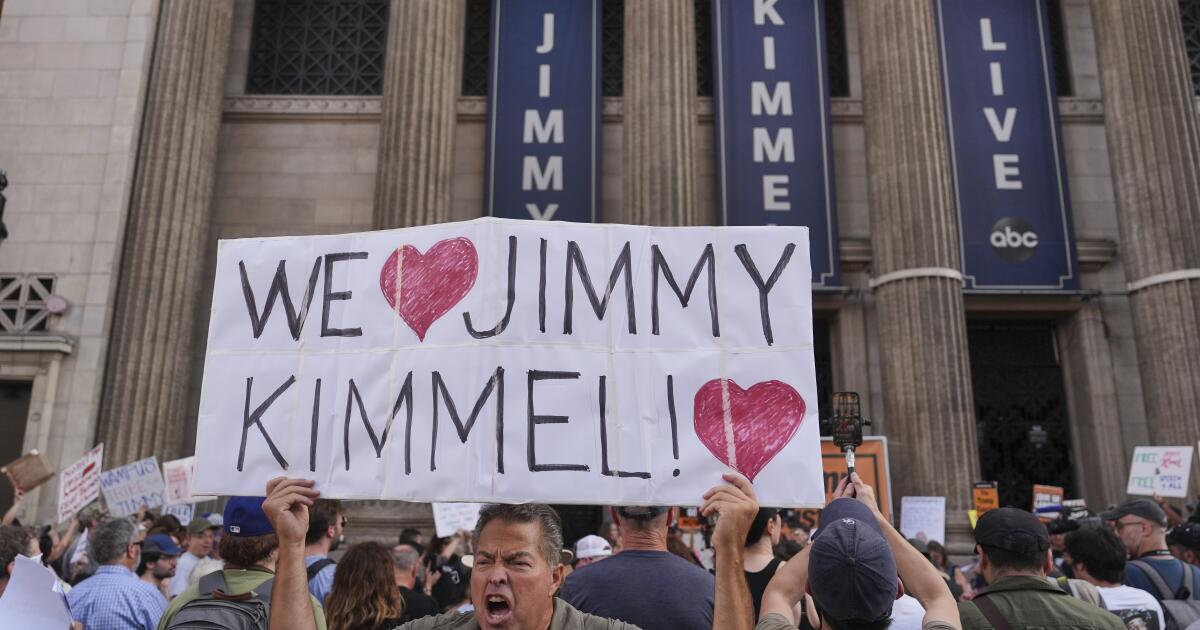
“We have so many positive signs we can look to,” Chandler said, citing not only a quiet election but GOP senators’ resistance to Trump’s demands to eliminate the filibuster and the widespread resistance to Trump’s demand that television host Jimmy Kimmel lose his job because of his criticism of the president. “There are limits” on Trump’s power, she noted.
“We will have elections in 2026,” Chandler said. “People don’t have to worry about that.”
Under the Constitution, a president has limited tools to intervene in elections, which are run by the states. Congress can help set rules for federal elections, but states administer their own election operations and oversee the counting of ballots.
When Trump tried to singlehandedly revise election rules with a sweeping executive order shortly after returning to office, the courts stepped in and stopped him, citing the lack of a constitutional role for the president. Trump later promised another order, possibly targeting mail ballots and voting machines, but it has yet to materialize.
DOJ voter data request ‘should frighten everybody’
Still, there’s plenty of ways a president can cause problems, said Rick Hasen, a UCLA law professor.
Trump unsuccessfully pushed Georgia’s top election official to “find” him enough votes to be declared the winner there in 2020 and could try similar tactics in Republican-dominated states in November. Likewise, Hasen said, Trump could spread misinformation to undermine confidence in vote tallies, as he has done routinely ahead of elections.
It’s harder to do that in more lopsided contests, as many in 2025 turned into, Hasen noted.
“Concerns about Trump interfering in 2026 are real; they’re not frivolous,” Hasen said. “They’re also not likely, but these are things people need to be on guard for.”
One administration move that has alarmed election officials is a federal demand from his Department of Justice for detailed voter data from the states. The administration has sued the District of Columbia and at least 21 states, most of them controlled by Democrats, after they refused to turn over all the information the DOJ sought.
“What the DOJ is trying to do is something that should frighten everybody across the political spectrum,” said David Becker, a former Justice Department voting rights attorney and executive director of the Center for Election Innovation & Research. “They’re trying to use the power of the executive to bully states into turning over highly sensitive data — date of birth, Social Security numbers, driver’s license, the Holy Trinity of identity theft — hand it over to the DOJ for who knows what use.”
‘Voter protection’ vs ‘election integrity’
Voting rights lawyers and election officials have been preparing for months for the midterms, trying to ensure there are ways to counter misinformation and ensure state election systems are easy to explain. Both major parties are expected to stand up significant campaigns around the mechanics of voting: Democrats mounting what they call a “voter protection” effort to monitor for problems while Republicans focus on what they call “election integrity.”
Freeman, the DNC litigation director who previously worked in the DOJ’s voting section, said his hiring this year was part of a larger effort by the DNC to beef up its in-house legal efforts ahead of the midterms. He said the committee has been filling gaps in voting rights law enforcement that the DOJ has typically covered, including informing states that they can’t illegally purge citizens from their voter rolls.
Tina Barton, co-chair of the Committee on Safe and Secure Elections, a coalition of law enforcement and election officials who advise jurisdictions on de-escalation and how to respond to emergencies at polling places, says interest in the group’s trainings has “exploded” in recent weeks.
“There’s a lot at stake, and that’s going to cause a lot of emotions,” Barton said.
Riccardi writes for the Associated Press. AP writers Marc Levy in Harrisburg, Penn., Julie Carr Smyth in Columbus, Ohio, and Ali Swenson in New York contributed to this report.
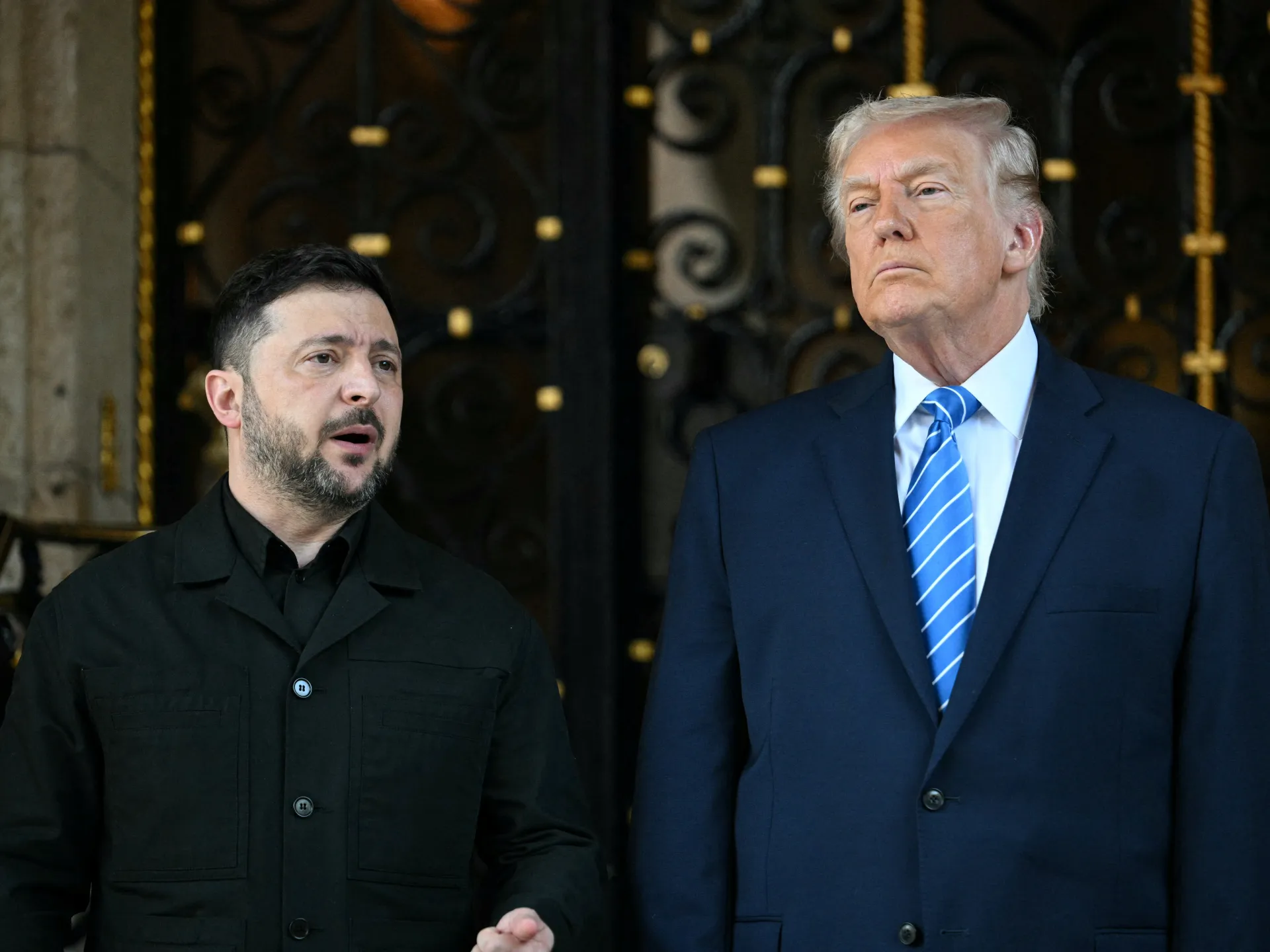
Diplomacy over the Russia-Ukraine war is in its “final stages”, said US President Donald Trump as he welcomed Ukraine’s leader Volodymyr Zelenskyy to his Florida estate.
The two leaders stood outside the Mar-a-Lago resort on Sunday and addressed reporters as they prepared to discuss a new proposal to end the bloody conflict.
Recommended Stories
list of 4 itemsend of list
The US president has been working hard to end the nearly four-year war in Ukraine for much of his first year back in office, showing irritation with both Zelenskyy and Russian President Vladimir Putin while publicly acknowledging the difficulty of ending the fighting.
“I think we’re … in final stages of talking and we’re going to see. Otherwise, it’s going to go on for a long time, and millions of additional people will be killed,” said Trump, adding he did not have a deadline for the process.
“I do believe that we have the makings of a deal that’s good for Ukraine, good for everybody.”
He added there would be “a strong agreement” to guarantee Ukraine’s security, one that would involve European countries.
“We have two willing parties. We have two willing countries … The people of Ukraine want [the war] to end, and the people of Russia want it to end, and the two leaders want it to end,” Trump said.
Zelenskyy, by Trump’s side, said he and the US president would discuss issues of territorial concessions, which have so far been a red line for his country. He said his negotiators and Trump’s advisers “have discussed how to move step by step and bring peace closer” and would continue to do so in Sunday’s meeting.
During recent talks, the US agreed to offer certain security guarantees to Ukraine similar to those offered to other members of NATO.
The proposal came as Zelenskyy said he was prepared to drop his country’s bid to join the security alliance if Ukraine received NATO-like protection designed to safeguard it against future Russian attacks.
Oleksandr Kraiev, an analyst with the think-tank Ukrainian Prism, said the people of Ukraine are “quite cynical” about the talks brokered by the United States.
“We tried this in 2015, 2016, 2017, and unfortunately each time the Russians broke even the ceasefire regime, not even talking about the peace process,” he told Al Jazeera.
“So we have little faith that a proper peace process will take place. As of now we’re striving for a ceasefire as a precondition for any kind of talks… We cannot trust the Russians with a peace deal, but a ceasefire is something we’re working on.”
‘Blindsided yet again’
Trump’s upbeat tone comes despite widespread scepticism in Europe about Putin’s intentions after Russia carried out another massive bombardment of the Ukrainian capital just as Zelenskyy headed to Florida.
Before Zelenskyy arrived, Trump spoke with Putin by phone for more than an hour and said he planned to speak again after the Zelenskyy meeting – catching Ukrainian leaders off guard, reported Al Jazeera’s Shihab Rattansi.
“From what we’re hearing, the Zelenskyy delegation here have been blindsided yet again by Donald Trump. And according to the Russians, it was at the Americans’ insistence there should be a call with Vladimir Putin the hour before Zelenskyy arrived,” said Rattansi, speaking from Palm Beach, Florida.
Meanwhile, while there is talk about land concessions from Ukraine’s side, they are outside the framework Zelenskyy is hoping for.
The Kremlin gave a more pointed readout of Trump’s talks with Putin, saying the US leader agreed a mere ceasefire “would only prolong the conflict” as it demanded Ukraine compromise on territory.
Zelenskyy said last week that he would be willing to withdraw troops from Ukraine’s eastern industrial heartland as part of a plan to end the war, if Russia also pulls back and the area becomes a demilitarised zone monitored by international forces.
Putin has publicly said he wants all the areas in four key regions captured by his forces, as well as the Crimean Peninsula, illegally annexed in 2014, to be recognised as Russian territory. He also insisted that Ukraine withdraw from some areas in eastern Ukraine that Moscow’s forces have not captured.
Kyiv has publicly rejected all those demands.
Trump has been somewhat receptive to Putin’s conditions, making the case that the Russian president can be persuaded to end the war if Kyiv agrees to cede Ukrainian land in the Donbas region, and if Western powers offer economic incentives to bring Russia back into the global economy.
WASHINGTON — When Charlie Kirk was killed by an assassin this fall, Republican leaders credited the organization he founded for enabling President Trump’s return to power.
Now that organization is mobilizing behind Vice President JD Vance.
Uninterested in a competitive Republican primary in 2028, Turning Point USA plans to deploy representatives across Iowa’s 99 counties in the coming months to build the campaign infrastructure it believes could deliver Vance, a Midwesterner from nearby Ohio, a decisive victory, potentially short-circuiting a fractious GOP race, insiders said.
It is the latest move in a quiet effort by some in Trump’s orbit to clear the field of viable competitors. Earlier this month, Marco Rubio, the secretary of State previously floated by Trump as a possible contender, appeared to take himself out of the running.
“If Vance runs for president, he’s going to be our nominee, and I’ll be one of the first people to support him,” Rubio told Vanity Fair.
After Kirk’s widow, Erika, endorsed Vance on stage at Turning Point USA’s annual conference in Arizona last week, a straw poll of attendees found that 84% would support Vance in the coming primaries. Yet, wider public polling offers a different picture.
A CNN poll conducted in early December found that Vance held a plurality of Republican support for 2028, at 22%, with all other potential candidates, such as Rubio and Florida Gov. Ron DeSantis, registering in single digits.
The remaining 64% told pollsters they had “no one specific in mind,” reflecting an open field with plenty of room for other figures to gain ground.
While a recent Gallup poll found that 91% of Republicans approve of Vance’s job performance as vice president — an encouraging number entering a partisan primary — only 39% of Americans across party lines view him positively in the role, setting Vance up for potential challenges should he win the nomination.
Potential presidential candidates on both sides of the political aisle are expected to assess their chances over the next year, before primary season officially kicks off, after the midterm elections in November.
Closing out the Turning Point USA conference, Vance called for party unity amid escalating conflicts among right-wing influencers over the acceptability of racism and antisemitism within Republican politics.
“President Trump did not build the greatest coalition in politics by running his supporters through endless, self-defeating purity tests,” Vance said. “Every American is invited. We don’t care if you’re white or Black, rich or poor, young or old, rural or urban, controversial or a little bit boring, or somewhere in between.”
Charlie Kirk, he added, “trusted all of you to make your own judgment. And we have far more important work to do than canceling each other.”
Vance’s remarks drew criticism from some on the right for appearing to tolerate bigotry within the party. The vice president himself has been subjected to racist rhetoric, with Nick Fuentes — a far-right podcaster who has praised Adolf Hitler — repeatedly directing attacks at Vance’s wife and children over their Indian ancestry.
“Let me be clear — anyone who attacks my wife, whether their name is Jen Psaki or Nick Fuentes, can eat s—,” Vance said in an interview last week, referring to President Biden’s former press secretary. “That’s my official policy as vice president of the United States.”
In the same interview, Vance praised Tucker Carlson, another far-right podcaster who has defended Fuentes on free speech grounds, as a “friend of mine,” noting that he supported Vance as Trump’s vice presidential pick in 2024.
Trump has floated Vance as his potential successor multiple times without ever explicitly endorsing his nomination, calling him “very capable” and the “most likely” choice for the party.
“He’s the vice president,” Trump said in August. “Certainly he’s doing a great job, and he would be probably favored at this point.”
Several of Trump’s most ardent supporters have pushed the president to seek a third term in 2028, despite a provision of the Constitution, in the 22nd Amendment, barring him from doing so.
Trump himself has said the Constitution appears clear on the matter. But Steve Bannon, an architect of Trump’s historic 2016 campaign and one of his first White House strategists, continues to advocate a path forward for another run, reportedly disparaging Vance as “not tough enough” to lead the party to victory.
“He knows he can’t run again,” Susie Wiles, the president’s White House chief of staff, told Vanity Fair in a recent profile of her. “It’s pretty unequivocal.”
Trump, who will be 82 when he is slated to leave office, has told Wiles he understands a third term isn’t possible “a couple times,” she added.
Alan Dershowitz, a prominent constitutional law professor and a lawyer to Trump during his Senate impeachment trial, recently presented Trump with a road map to a third term in an Oval Office meeting, which he will publish in a new book slated for release next year.
Even he came away from their meeting believing Trump would pass on another bid.
“That is my conclusion based on what he has said in public,” Dershowitz told The Times.
“He has said in the past,” he added, “that it’s too cute.”
If Israel and the US were to attack Iran again, they would ‘face a more decisive response’, Pezeshkian warns.
Published On 27 Dec 202527 Dec 2025
Share
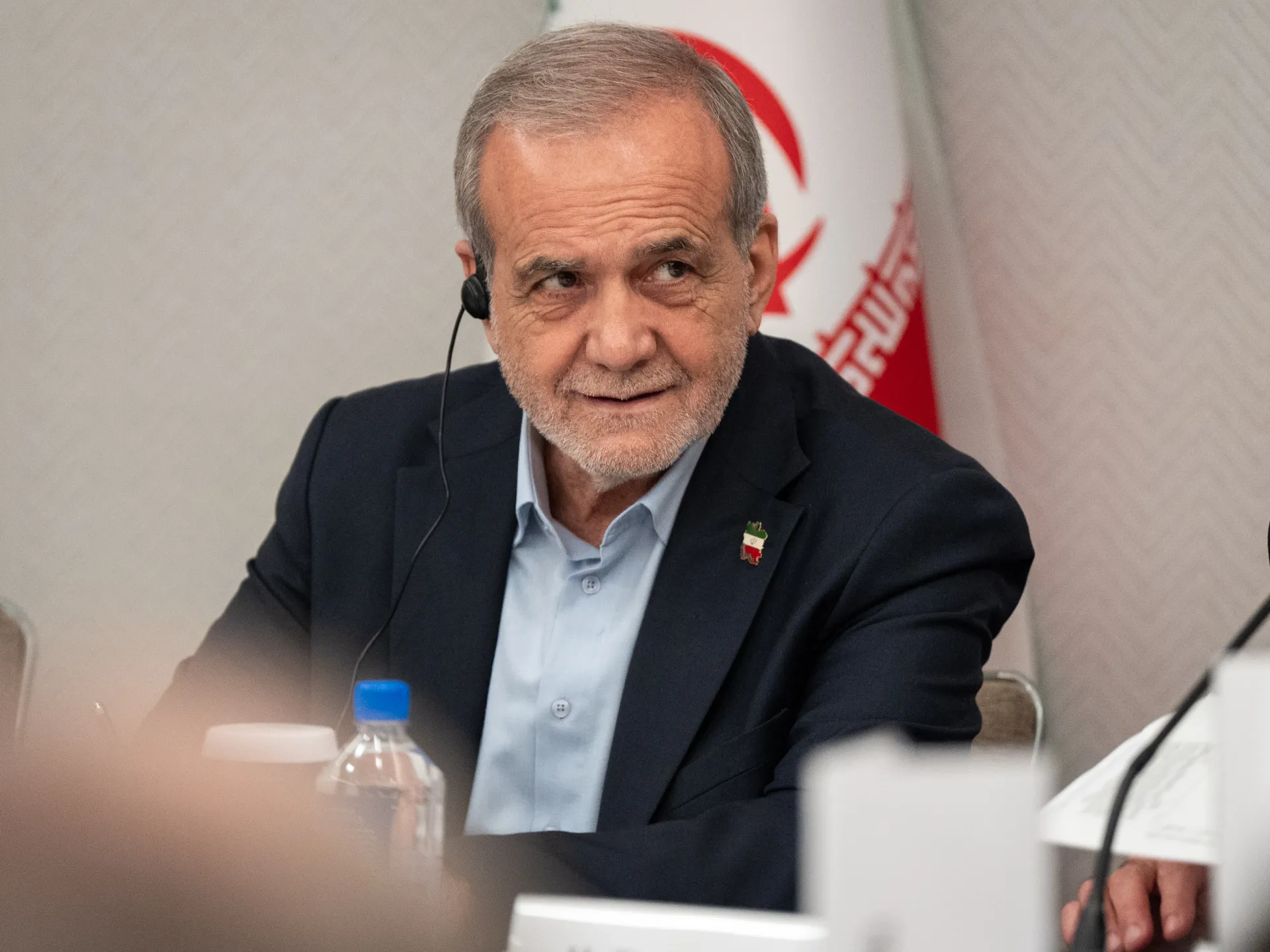
Iranian President Masoud Pezeshkian says that the United States, Israel and Europe are waging a “full-fledged war” against his country.
“In my opinion, we are in a full-fledged war with America, Israel and Europe. They do not want our country to stand on its feet,” Pezeshkian told the official site of Supreme Leader Ayatollah Ali Khamenei in an interview on Saturday.
Recommended Stories
list of 3 itemsend of list
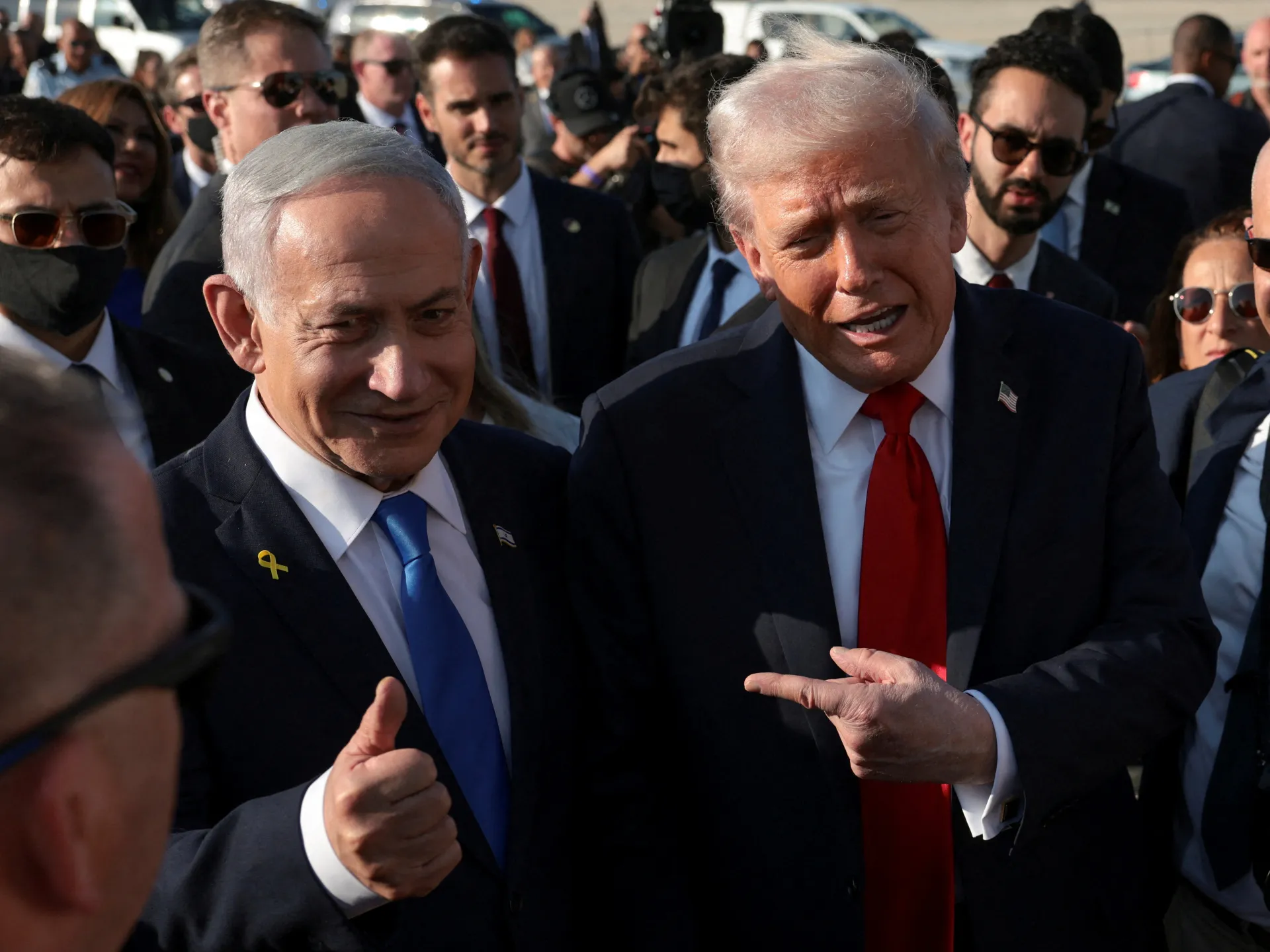
The president’s remarks come ahead of Israeli Prime Minister Benjamin Netanyahu’s meeting on Monday with US President Donald Trump. They also come six months after Israel and the US launched strikes on Iran, and after France, Germany and the United Kingdom reimposed United Nations sanctions on Iran in September over its nuclear programme.
“Our dear military forces are doing their jobs with strength, and now, in terms of equipment and manpower, despite all the problems we have, they are stronger than when they [Israel and the US] attacked,” Pezeshkian said.
“So, if they want to attack, they will naturally face a more decisive response.”
The president said that “this war” is unlike past ones.
“This war is worse than Iraq’s war against us. If one understands it well, this war is far more complex and difficult than that war,” Pezeshkian said, referring to the 1980-1988 conflict between the neighbouring countries in which thousands were killed.
The US and its allies accuse Iran of seeking to acquire nuclear weapons, a claim Tehran has repeatedly denied.
Israel and Iran engaged in a 12-day war in June, triggered by an unprecedented Israeli attack on Iranian military and nuclear sites, as well as civilian areas.
The strikes caused more than 1,000 casualties, according to Iranian authorities.
The US later joined the Israeli operation, bombing three Iranian nuclear sites.
Washington’s involvement brought a halt to negotiations with Tehran, which began in April, over its nuclear programme.
Since returning to the White House in January, US President Donald Trump has revived his so-called “maximum pressure” policy against Iran, initiated during his first term.
That has included additional sanctions designed to economically cripple the country and dry up its oil revenues from sales on the global market.
According to recent reports, when Netanyahu visits Trump at his Mar-a-Lago resort in Florida this weekend, he will be pushing for more military actions against Iran, this time focusing on Tehran’s missile programme.
ST. LOUIS — President Clinton on Friday joined the growing cultural and political war between Democrats and their critics on the right, bitterly assailing Christian broadcasters and conservative radio talk-show hosts.
In unusually angry and aggressive remarks during a radio interview, Clinton attacked the Rev. Jerry Falwell and popular radio personality Rush Limbaugh by name, saying that their brand of politics and religion feed a spreading intolerance and cynicism across America.
The tenor and heat of his remarks showed what is increasingly becoming apparent–that for those in the roiling political battle, this is less a contest between strong adversaries with some mutual respect than a holy war fueled by bitterness and personal loathing.
Clinton spoke by telephone from Air Force One as he was flying to St. Louis to inaugurate a youth service program and headline a $1,500-a-plate fund-raiser for House Majority Leader Richard A. Gephardt (D-Mo.).
The President said that televangelist Falwell and other spokesmen for the religious right hide behind their fervent protestations of faith while engaging in baseless personal attacks and political demagoguery.
“I do not believe that people should be criticized for their religious convictions,” Clinton said. “But neither do I believe that people can put on the mantle of religion and then justify anything they say or do.”
The President called Falwell’s Christian values questionable when he uses his church and his access to television to promote a videotape attacking Clinton’s honesty and morality.
Clinton said that the Falwell tape, which includes lurid allegations about Clinton’s sex life, his personal finances and assorted skullduggery in Arkansas, is full of “scurrilous and false charges.”
“Remember,” Clinton said, “Jesus threw the money-changers out of the temple. He didn’t try to take over the job of the money-changers.”
In an interview with Cable News Network later Friday, Falwell dismissed Clinton’s criticism and invited the President to tape a personal rebuttal to the videotape for use on the “Old Time Gospel Hour,” which airs on 200 stations nationwide.
“While the President should really direct his denials and apparent anger at those making the charges, we will be happy to provide him a forum for rebutting those charges, assuming he has watched the video, knows what the charges are and addresses them specifically,” Falwell said.
Clinton’s growing frustration not only with his legislative difficulties but with the unanswered attacks on his character was evident in the 23-minute interview with radio station KMOX.
He was testy from the outset, then unloaded on radio interviewers Charles Brennan and Kevin Horrigan after they asked about the alleged pilfering of towels and bathrobes from the aircraft carrier George Washington by White House staff members on the President’s recent trip to Europe to commemorate the D-day anniversary.
“Look at all the things you could have asked me about and you just asked me about that,” Clinton said, his voice rising in wrath. “Did you know that there were other people on that aircraft carrier? Did you know that there were press people on the aircraft carrier? Did you know that the carrier had been fully reimbursed out of the private pocket of a White House staff member who was so upset about it. . . ? No. No.”
White House Press Secretary Dee Dee Myers went out of her way to insist that Clinton was not angry. He was shouting only to be heard over the engine noise of Air Force One, she said.
“He wasn’t angry and didn’t want to leave the impression that he was,” Myers said after reading wire service accounts that described the President as inflamed. “It sounded a lot harder than it was.”
She said that Clinton did not intend to point fingers at any individuals. “I think the President just spoke his mind,” she added.
Clinton’s assault on Falwell, Limbaugh and other critics elevated to a new plane a battle that Rep. Vic Fazio (D-West Sacramento) launched earlier this week with an attack on the Republican Party and its supporters from the “intolerant . . . religious right.”
Fazio warned that radical fringe groups are seizing control of the GOP in more than a dozen states and are threatening to become a major force in Congress.
Fazio’s comments were denounced by Republican leaders as “religious bigotry” and a “calculated smear campaign.”
It was clear Friday that Clinton would join Fazio’s line of attack as part of the Democratic Party strategy to demonize the right and stanch Democratic losses in the November mid-term elections.
The President said he respects the religious convictions of evangelicals but that he would not be silent “when people come into the political system and they say that anybody that doesn’t agree with them is Godless, anyone who doesn’t agree with them is not a good Christian, anyone who doesn’t agree with them is fair game for any wild charge, no matter how false, for any kind of personal, demeaning attack.”
The Falwell tape sells for $43, and tens of thousands reportedly have been sold. The people quoted on the tape are several longtime enemies of Clinton who, among other things, suggest that Clinton was involved in several murders in Arkansas.
Falwell aide Mark DeMoss has said that he does not know if the charges are true but believes they should be aired so they can be investigated.
House Republicans also responded to Clinton’s comments. “People who go to work on Monday and church on Sunday are not public enemies,” said Rep. Dick Armey (R-Tex.), who chairs the House GOP Conference. “Clinton should be putting an end to this McCarthyistic tactic now, rather than fanning the flames and setting up some religious right bogeyman.”
The mainstream media also did not escape Friday’s presidential ire. Clinton complained that the reporting on his Administration has emphasized its failures unfairly and ignored its accomplishments.
He said that news reporting today is “much more negative . . , much more editorial . . . and much less direct” than ever before.
And he said that the American people were subjected to a “constant unremitting drumbeat of negativism and cynicism” from talk radio–particularly Limbaugh and his many imitators.
Clinton noted that the three-hour Limbaugh show would follow him on the same radio station and that he would have no opportunity for response or challenge.
“And there’s no truth detector,” Clinton said. “You won’t get on afterwards and say what was true and what wasn’t.”
Limbaugh, in his show Friday, answered the President mockingly, “There is no need for a truth detector. I am the truth detector.”
Clinton said that he had given up hope of receiving better treatment from the press, the religious broadcasters and talk radio.
“So I decided instead of being frustrated, I needed to be aggressive and I’m going to be aggressive from here on in. I’m going to tell what I know the truth to be,” Clinton said.
So no more Mr. Nice Guy?
“I’m going to be very nice about it,” the President said, “but I’m going to be aggressive about it.”
Times staff writer Jeff Leeds in Washington contributed to this story.
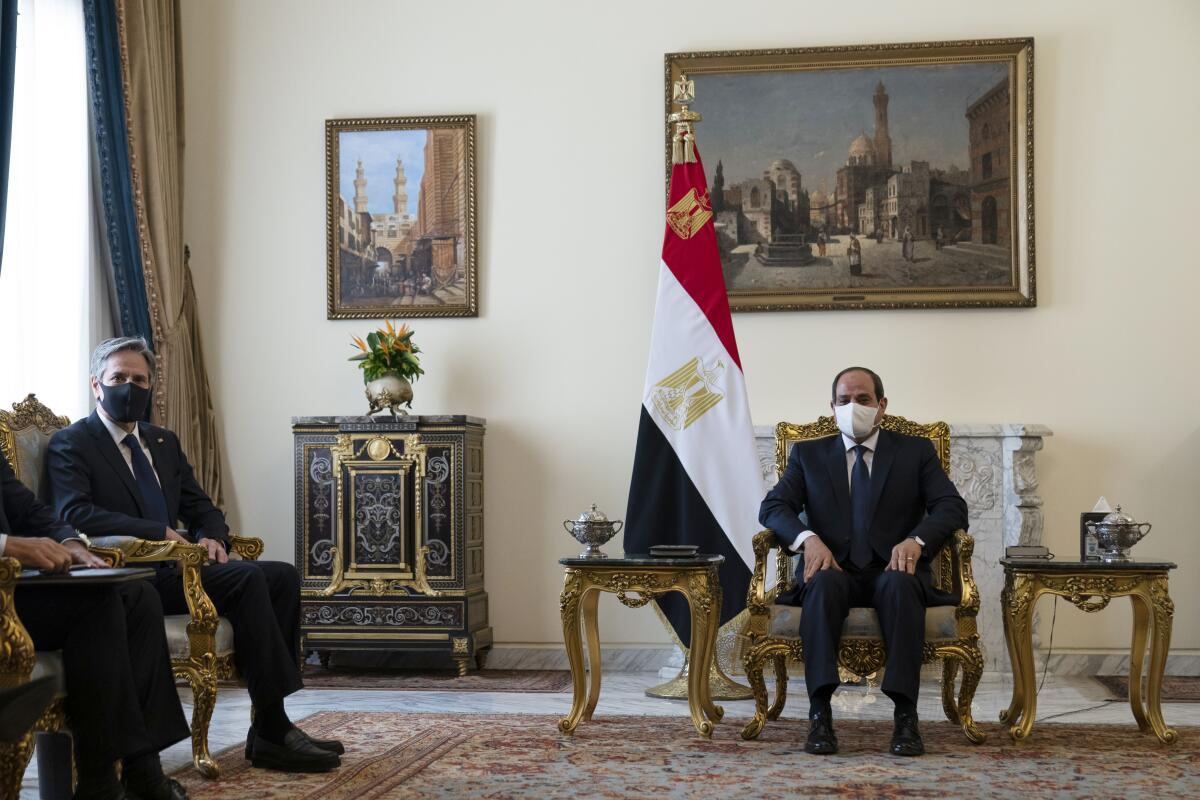
CAIRO — Egyptian President Abdel Fattah Sisi sat at the head of the ornate room, on a chair that seemed slightly bigger than the rest, thronelike. Even through his COVID mask, it was clear he was not smiling.
His visitor, the first envoy from the new Biden administration, was relegated to the side chairs with other members of the U.S. and Egyptian delegations.
Secretary of State Antony J. Blinken had called on the notorious strongman, a military man whom former President Trump once called his “favorite dictator,” to thank him for helping stop a war between Israel and the militant group Hamas.
It was an awkward position for Blinken. Human rights, he has said repeatedly, are at the core of Biden-era foreign policy — and human rights are not something Sisi regards favorably. He jails and tortures dissidents, journalists and others, activists say, and has been accused of repeatedly ordering deadly fire on peaceful demonstrators.
But Sisi, as Egyptian leaders have before him, helped defuse violence between Israel and Palestinian groups. So Blinken made the high-level visit to offer thanks, which Sisi will attempt to leverage to influence Washington and to skirt criticism. During his campaign, President Biden promised “no blank checks” for Sisi, but Egypt has long parlayed its recognition of Israel into an alliance in which U.S. officials tended to look the other way when it came to abuses.
“Egypt played a crucial role in brokering the cease-fire,” Blinken said later in discussing his meeting with Sisi. He insisted that he raised human rights issues with the Egyptian leader. “We had a lengthy exchange on that with President Al Sisi as a reflection of the fact that it remains very much on the agenda with Egypt.”
Before the meeting late last month, reports had circulated among diplomats that Sisi would release a number of detained American citizens as a good-faith gesture. That did not happen.
Blinken and Sisi met for one hour and 45 minutes, with Sisi speaking for more than an hour without interruption, according to people familiar with the encounter. He extolled his own achievements in what he considers true human rights: making daily life better for ordinary Egyptians. Political rights or the right to dissent do not figure in his narrative.
Secretary of State Antony J. Blinken, left, is seated to the side during a meeting with Egyptian President Abdel Fattah Sisi at the Heliopolis Palace in Cairo on May 26.
(Associated Press)
Journalists accompanying Blinken on his trip were given about 30 seconds to view the initial seating of the meeting, but no more. Once during an earlier visit, Vice President Mike Pence answered a question from the attending journalists and invited Sisi to join in. The Egyptian was appalled at such openness, refused to engage and subsequently fired several palace aides who he blamed for allowing such an affront, according to diplomats.
This time, Sisi’s supporters in the mostly state-controlled Egyptian media celebrated Blinken’s visit and two telephone calls from Biden as validation of the government’s tactics and its recovered importance to regional diplomacy.
Critics said the diplomatic niceties obscure the ruthlessness of the government.
Sisi, 66, a former minister of defense and head of military intelligence, began his rise to power in a July 2013 coup against democratically chosen President Mohamed Morsi, and eventually won election as president in 2014.
After gaining power, Sisi jettisoned the Egyptian Constitution, unleashed brutally lethal security forces on massive civilian protests in Cairo and kept power through a 2018 vote widely seen as fraudulent.
Human Rights Watch, in an extensive report, held Sisi at least partially to blame for a massacre of hundreds of government critics, including many Muslim Brotherhood members, in July and August of 2013.
“His utmost concern is the sustainability of his regime, with him at the top of that regime, and he is ready to do whatever he can for the sustainability of the regime,” said Bahey eldin Hassan, director of the Cairo Institute for Human Rights Studies, which has repeatedly urged the Sisi government to end its crackdown on peaceful dissent.
Sisi sees enemies everywhere, Hassan and other human rights experts said — especially from among Islamists like the Muslim Brotherhood that backed Morsi, and activists who would hold him accountable for repeated killings of dissidents. Sisi does not tolerate internal debate, much less public criticism, said people who know him.
Hassan fled to France after the Sisi judiciary prosecuted him twice for what he says was his work on behalf of human rights. The activist blames decades of U.S. “political support and complicity” for strengthening the hands of autocratic Egyptian rulers. Egypt receives roughly $1.3 billion annually in military aid, second only to Israel, and the Biden administration is asking for the same amount for next fiscal year.
“I’d just like President Biden to keep his promises from the campaign,” Hassan said in a telephone interview, referring to Biden’s pledge to work to free tens of thousands of political prisoners said to have been detained under Sisi.
Egypt has for decades enjoyed a unique spot in U.S. foreign policy and the geopolitics of the Middle East.
Through successive U.S. administrations, Washington upheld a string of Egyptian strongmen, from the late Anwar Sadat and Hosni Mubarak, to Sisi now. Until last year, Egypt, along with Jordan, was one of only two Arab nations to recognize Israel. That vital role led Washington to ignore many of the abuses of Cairo governments while enlisting their help in protecting Israel.
The role came into focus again last month when it took Sisi and Egypt to persuade the militant Hamas organization based in the Gaza Strip to agree to stop its rocket fire onto Israeli cities and towns. Israel responded with heavy aerial bombardment that devastated parts of the Gaza Strip including residential buildings and schools. Because the U.S. formally regards Hamas as a terrorist group, it cannot negotiate with its leaders directly.
For Sisi, it was a welcome opportunity to prove his mettle to the Biden administration and to counter a shift in U.S. attentions to Persian Gulf nations after several agreed to recognize Israel as part of the 2020 Abraham Accords brokered by the Trump administration.
“Egypt is working hard on reclaiming and cementing its role as a significant international player that can be an ally, rather than a liability,” Mirette Mabrouk, founding director of the Egypt program at the Washington-based Middle East Institute, wrote in a recent analysis.
That includes Sisi’s intervention in Libya, where he has sought to mediate among warring factions, and in the debate over a massive dam on the Nile that pits Egypt against Ethiopia and Sudan.
Sisi was unsure of the Biden administration, experts said, following four years of latitude under Trump.
For example, Blinken’s predecessor called on Sisi in January 2019. And rather than raise human rights issues, Trump’s secretary of State, Michael R. Pompeo, praised Sisi for what he called an embrace of religious freedom because he had allowed a Coptic Christian church to be built in a Cairo suburb. (Shortly thereafter, Egypt built a mosque nearby.)
Under pressure from the Trump administration and advocacy groups, Sisi last year released an American arts teacher who had been detained for 300 days, Reem Desouky. But another U.S. citizen, Moustafa Kassem, died in Egyptian custody. The United Nations estimates that there are half a dozen Americans among the tens of thousands of political prisoners in Egypt.
Sisi hopes his ability to influence Hamas will help keep Washington off his back, said Nimrod Novik, an Israeli foreign policy analyst who worked for the late Prime Minister Shimon Peres and has continued close ties with Egyptian intelligence officials.
“He was very apprehensive about the dual phenomenon of a Biden administration and a Democratic Congress,” Novik, a senior fellow at the U.S.-based Israel Policy Forum advocacy group, said in an interview. “There was great concern on that score: America is back, and human rights are back.”
Administration officials reject the idea that Sisi will be able to leverage his usefulness in Hamas negotiations to thwart their concern about human rights. They are able to address the issues in compartmentalized ways, they say.
“President Biden takes the issue of human rights and our commitment to human rights very seriously,” Blinken said in a news conference. “Indeed, he’s asked us to put it at the heart of our foreign policy, and that’s exactly what we’re doing, and that was reflected in the conversations that we had” with Sisi.
Taiwan President William Lai Ching-te, pictured, and Premier Cho Jung-tai will undergo impeachment proceedings after Taiwan’s legislature approved an impeachment motion on Friday. File Photo by Ritchie B. Tongo/EPA-EFE
Dec. 26 (UPI) — Taiwan President William Lai Ching-te and Premier Cho Jung-tai face impeachment proceedings filed by opposition party leaders accusing them of constitutional and legislative violations.
Members of Taiwan’s KMT and TPP parties and two independent lawmakers secured enough support on Friday to advance impeachment proceedings to go before Taiwan’s Constitutional Court,Al Jazeera reported.
The impeachment effort is viewed as symbolic because a two-thirds majority is needed to impeach an official holding public office in Taiwan.
“It’s not possible to have a real impeachment,” Yen-tu Su, a constitutional law and democratic theory expert at Taiwan’s Academia Sinica, told Al Jazeera.
“They want to make a record that President Lai would be the first president considered impeached in the history of Taiwan’s democracy,” he said. “It’s a way to register their protest.”
The Legislative Yuan approved an impeachment motion with a 60-51 vote on Friday, but it would take 76 of its 113 seated members to impeach the president and premier.
The conflict arises from Lai’s administration refusing to enact a legislatively approved amendment that would give more public funding for local units of government, according to the South China Morning Post.
The Legislative Yuan is controlled by opposition parties, but Lai’s refusal to enact the law change created conflict, and Cho Jung-tai declined to sign the amendment.
Lai became president in 2024, but Taiwan’s legislature has been divided and mostly deadlocked since.
Dec. 26 (UPI) — Nigerian President Bola Tinubu gave the U.S. government the “go-ahead” to carry out airstrikes on ISIS targets, Nigeria’s foreign minister said Friday.
U.S. President Donald Trump announced the strikes Thursday, calling them retaliation against “ISIS terrorist scum” for violence on “primarily, innocent Christians.”
Nigerian Foreign Minister Yusuf Tuggar told Al Jazeera the country cooperated with the U.S. Defense Department on the “fight against terrorism” in the northwestern region.
Citing local news sources, the news outlet said at least one missile landed in the village of Jabo in Sokoto state. Residents told Al Jazeera there were no casualties in the village.
“The bomb fell and burst into many pieces. There were two big pieces of debris. One of them was carried by two people,” resident Abdulrahman Mainasara said.
Resident Ismail Umar told the outlet the village hadn’t received any armed attacks from ISIS in more than two years.
Tuggar said the Nigerian government provided intelligence to the U.S. government, and he spoke with U.S. Secretary of State Marco Rubio on the phone twice before the strikes. He added that Tinubu was also involved in the decision-making process.
“Now that the U.S. is cooperating, we would do it jointly, and we would ensure, just as the [Nigerian] president emphasized yesterday before he gave the go-ahead, that it must be made clear that it is a joint operation, and is not targeting any religion nor simply in the name of one religion or the other,” Tuggar said in an appearance on Channels Television‘s Sunrise Daily program.
Tuggar and other officials, though, took issue with Trump’s rhetoric saying that ISIS violence targets only Christians in Nigeria.
“We are a multi-religious country, and we are working with partners like the U.S. to fight terrorism and safeguard the lives and properties of Nigerians,” Tuggar said.
Auwal Musa Rafsanjani, the director of the non-profit organization Civil Society Legislative Advocacy Centre, said suggestions that ISIS is primarily targeting people based on religion could incite ethnic and religious tensions in Nigeria.
“Muslims are being killed and harassed every day by the same criminals,” Rafsanjani said, according to the local news outlet Leadership. “This conversation should be about human life, not religion or geography.”
Clouds turn shades of red and orange when the sun sets behind One World Trade Center and the Manhattan skyline in New York City on November 5, 2025. Photo by John Angelillo/UPI | License Photo
Jimmy Kimmel swapped his suit and late-night desk for a cardigan and Christmas living room scene as he shared with British viewers an important holiday message: “Tyranny is booming over here.”
Kimmel appeared on public broadcaster Channel 4 Thursday to deliver an “alternative Christmas message,” counter programming to the British monarch’s annual televised address.
Kimmel’s message focused on his battle with President Trump, who reveled in his talk show’s September suspension. Kimmel was benched for roughly a week after backlash to his comments about Charlie Kirk — and an ominous threat by the Federal Communications Commission chair. Kimmel had criticized MAGA supporters for attempting to “score political points” after the conservative activist’s killing. He also poked fun at Trump boasting about White House ballroom renovations after being asked about Kirk’s death.
“You may have read in your colorful newspapers my country’s president would like to shut me up because I don’t adore him in the way he likes to be adored,” he said. He attributed the return of “Jimmy Kimmel Live!” to the “millions and millions of people” who fought to get him back on the air in the name of free speech.
“And because so many people spoke out, we came back. Our show came back stronger than ever. We won, the president lost, and now I’m back on the air every night giving the most powerful politician on Earth a right, and richly deserved, bollocking,” he said, referencing the British slang for scolding. Earlier this month, Kimmel signed a contract extension with ABC through May 2027.
Past hosts of the alternative Christmas message, which began in 1993, include Edward Snowden, Jesse Jackson and a deepfake of Queen Elizabeth II.
During his address, Kimmel called the president “King Donny the 8th.” “We don’t have a problem with your king, just the guy who thinks he’s our king,” he said, apologizing for the state of America and its democratic institutions.
“Don’t give up on us,” Kimmel said. “We’re going through a bit of a wobble right now, but we’ll come around.”